




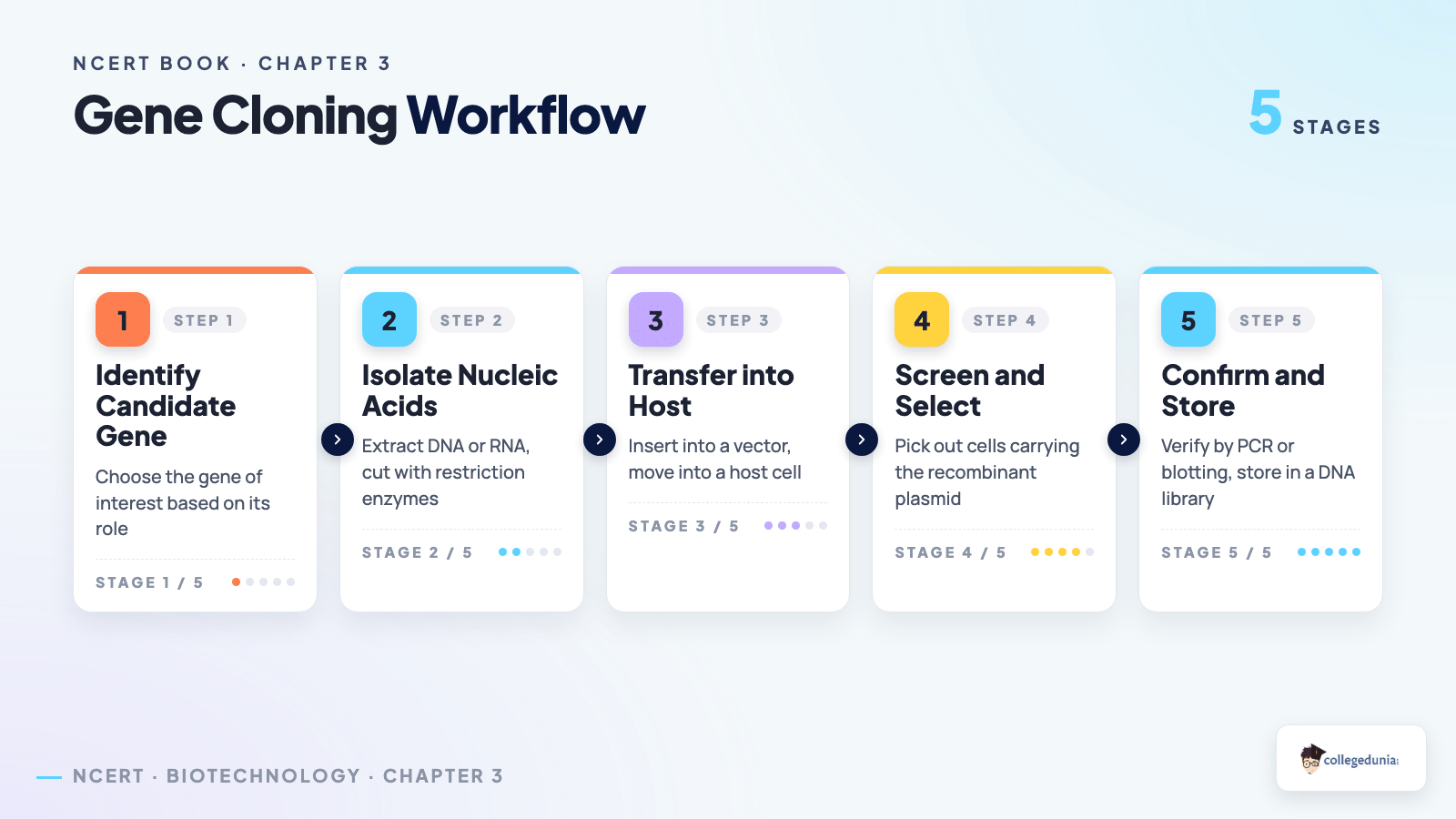
Gene Cloning is the chapter where Class 12 Biotechnology moves from theory into the actual lab workflow. The NCERT Book Class 12 Biotechnology Chapter 3 Gene Cloning file on this page is the official chapter for the 2026-27 session. Download it to read every section from identifying a candidate gene to building a DNA library.
- 40 pages, printed pages 27 to 66, the complete official chapter with 8 numbered sections
- Covers candidate gene identification, nucleic acid isolation, DNA transfer, screening, blotting and PCR
- Includes assertion-reason and case-based questions in the exercise set, matching the CBSE 2026-27 pattern
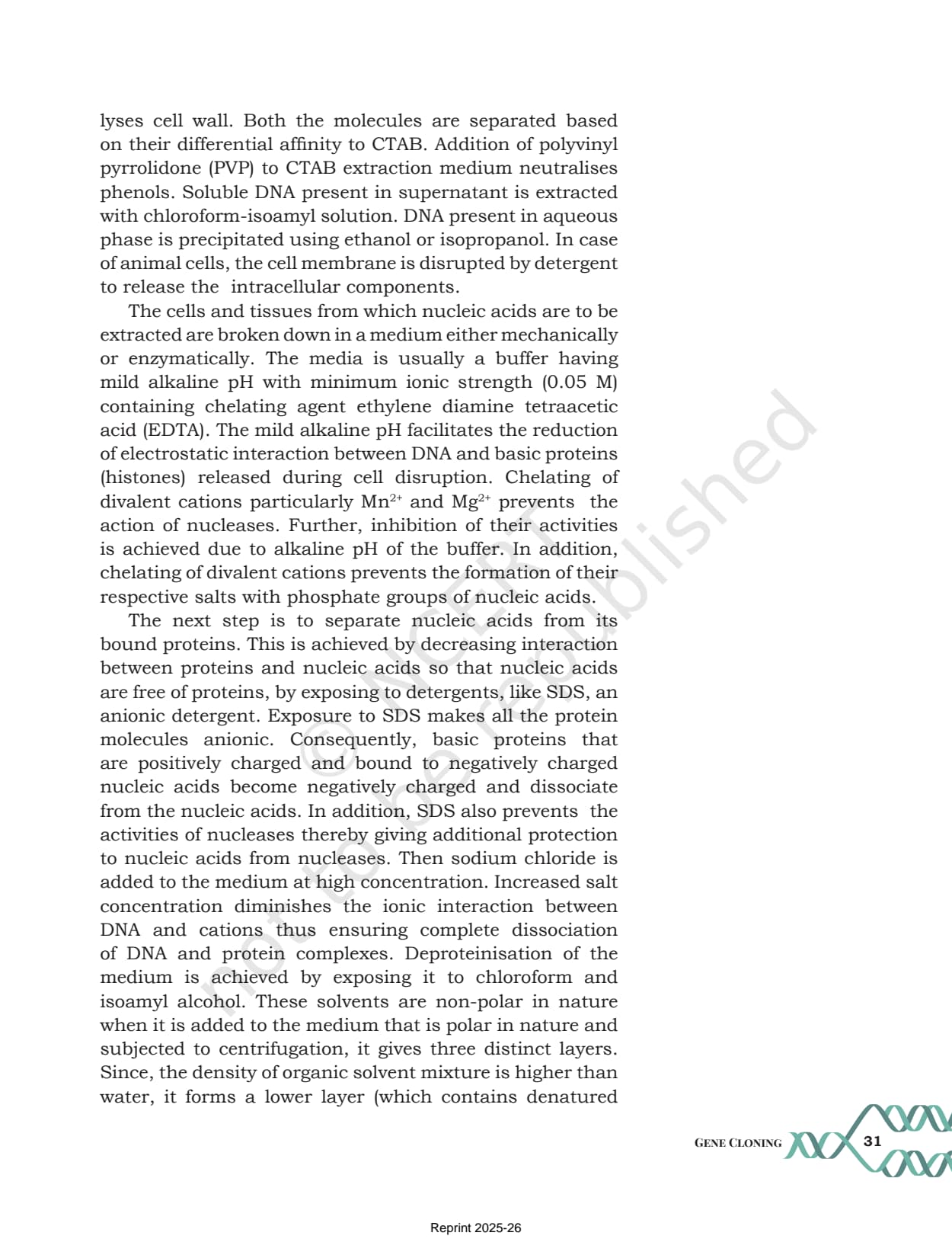
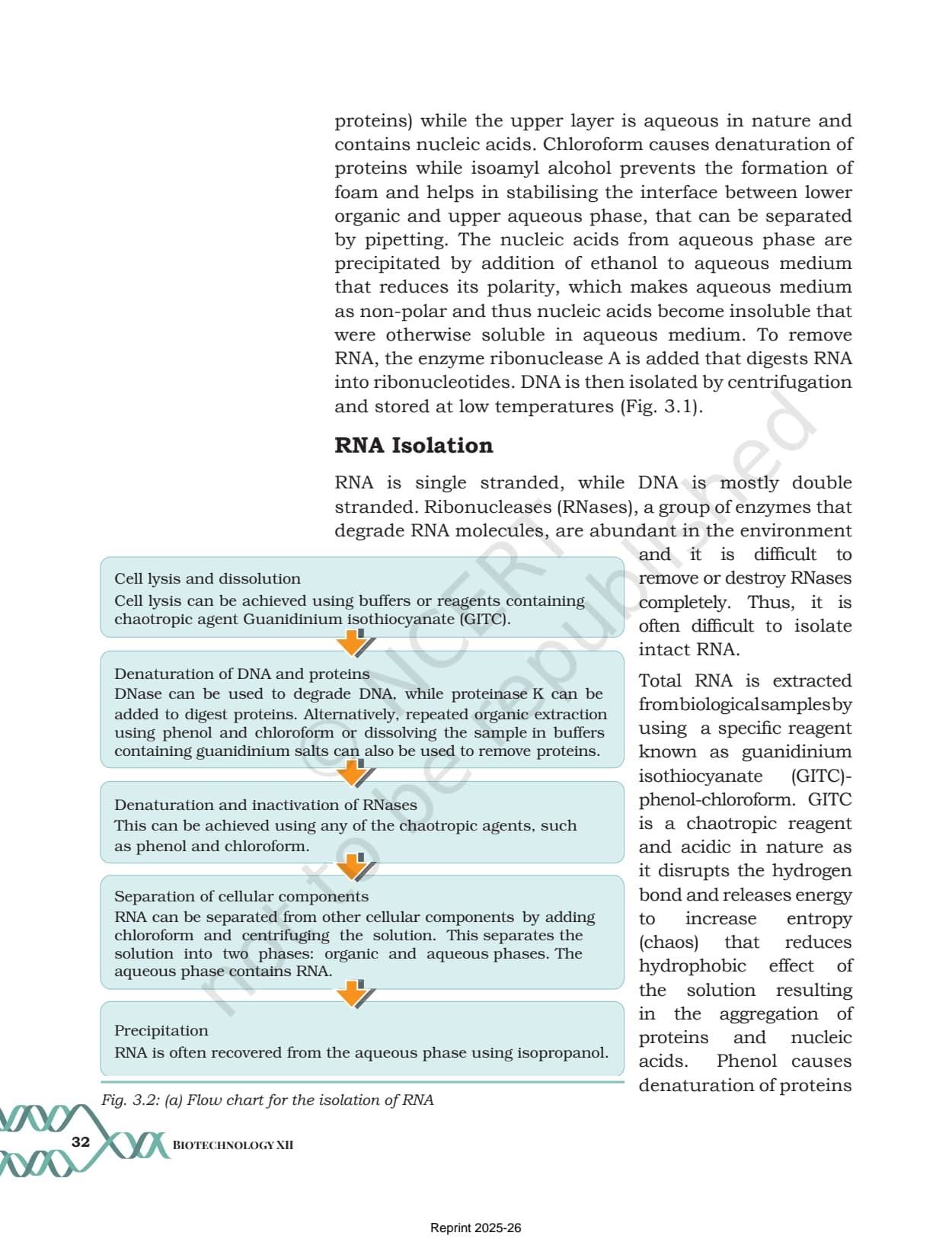
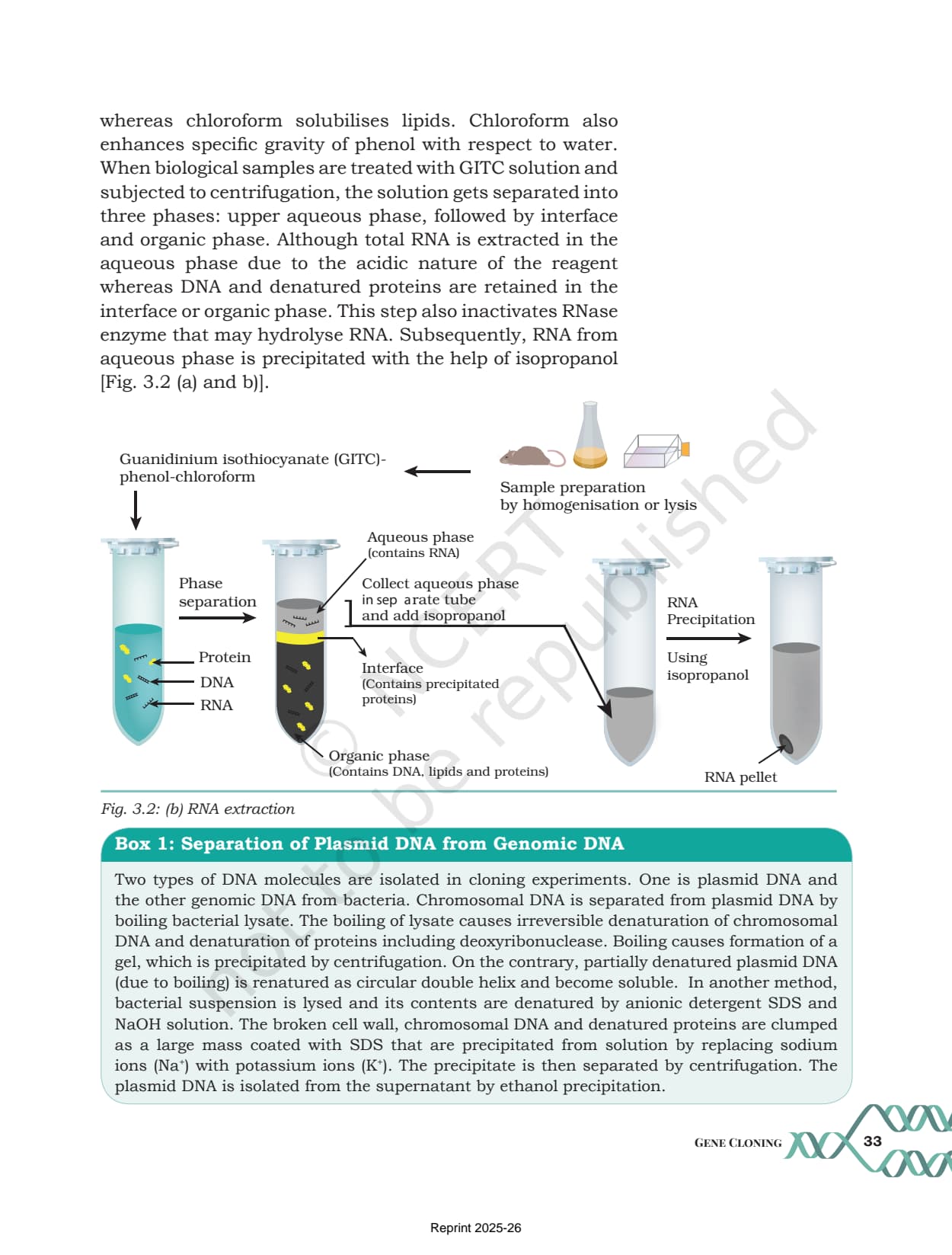
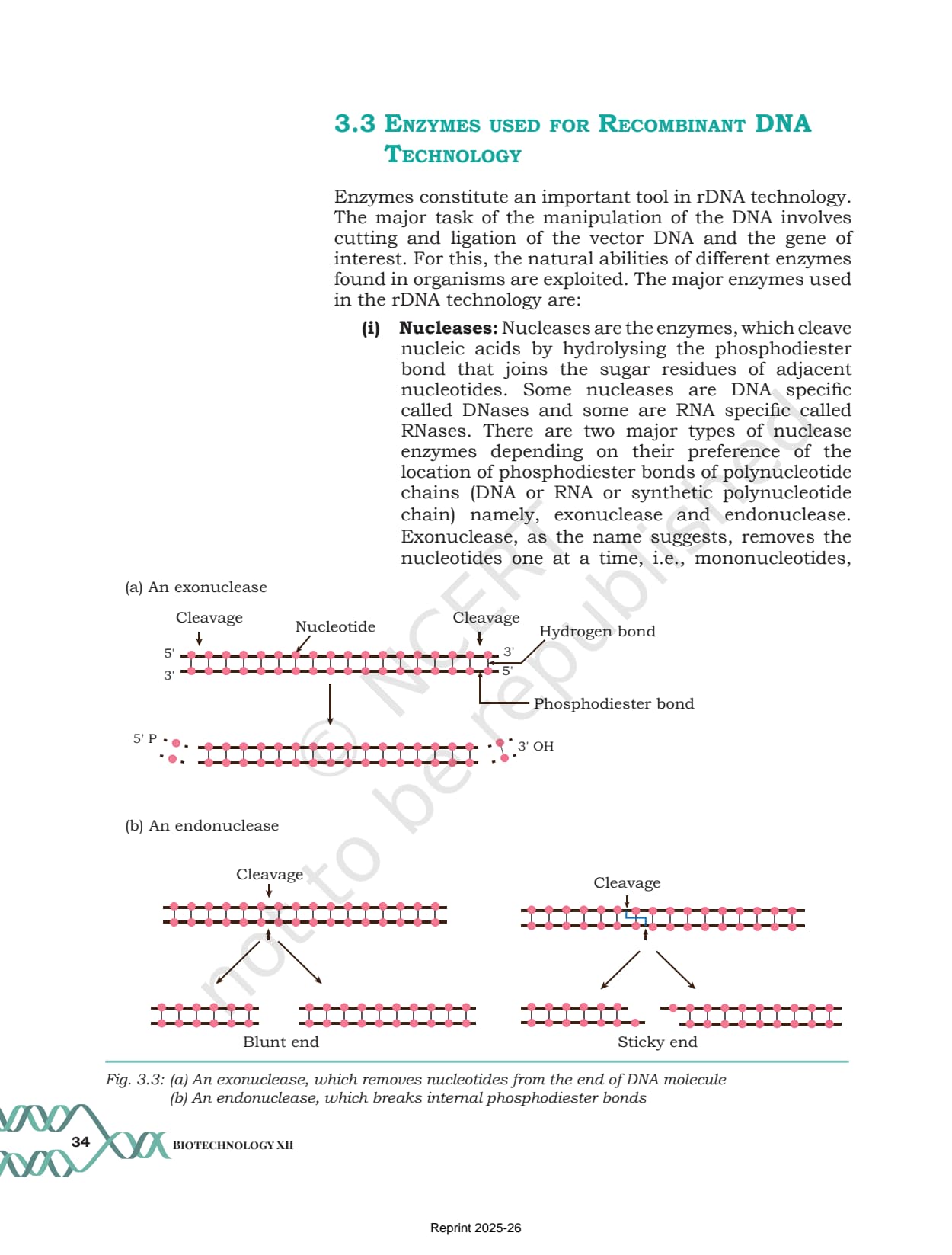
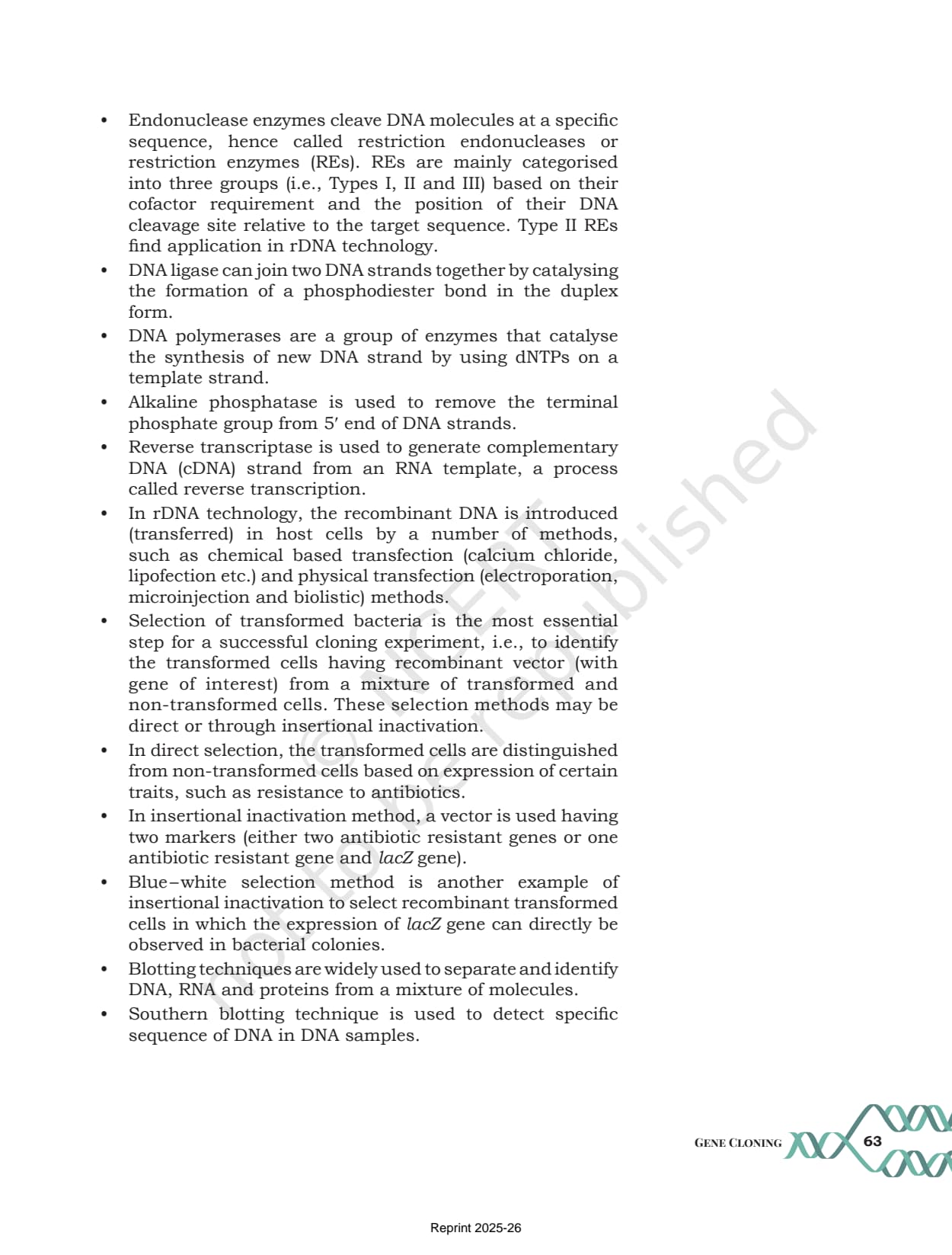
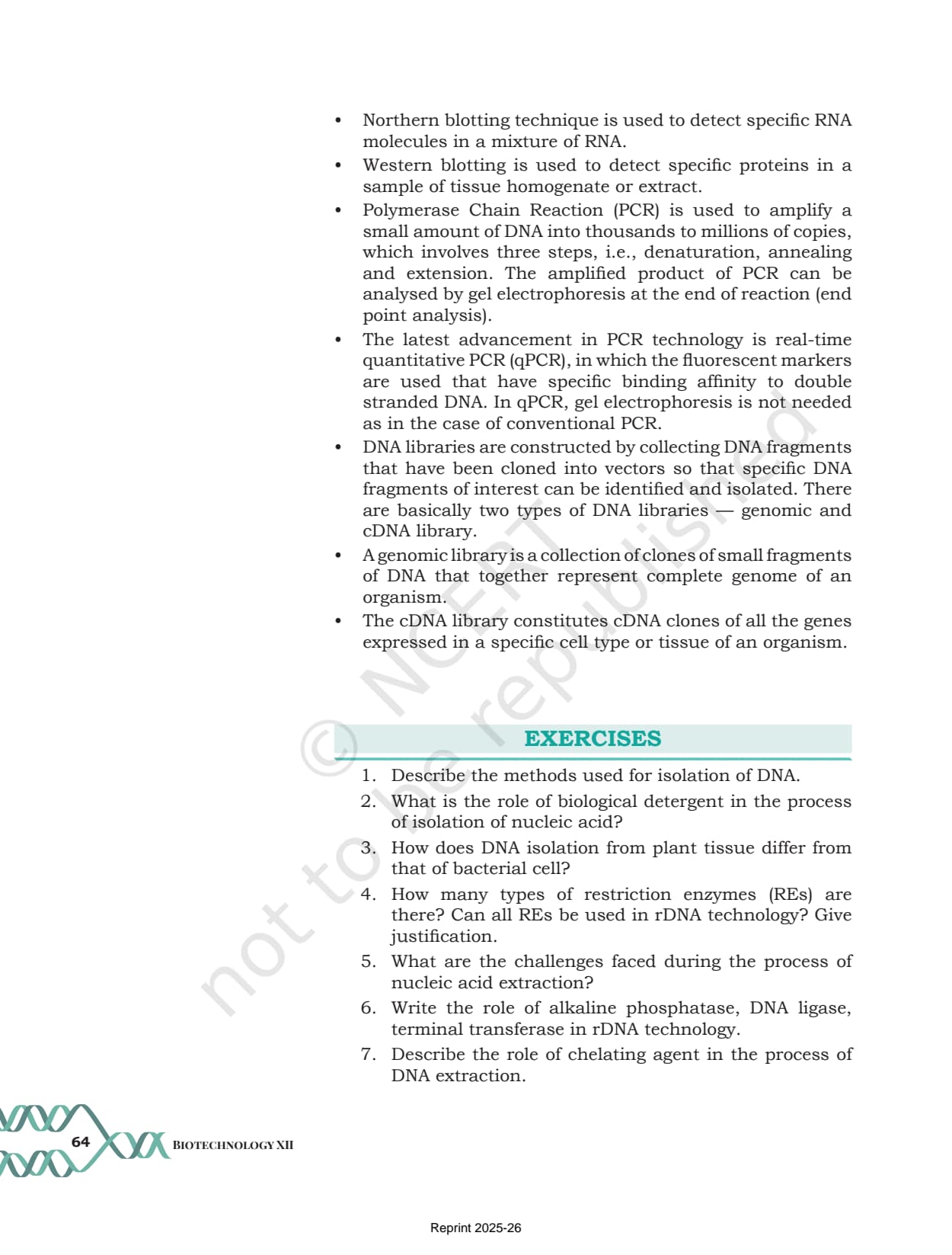
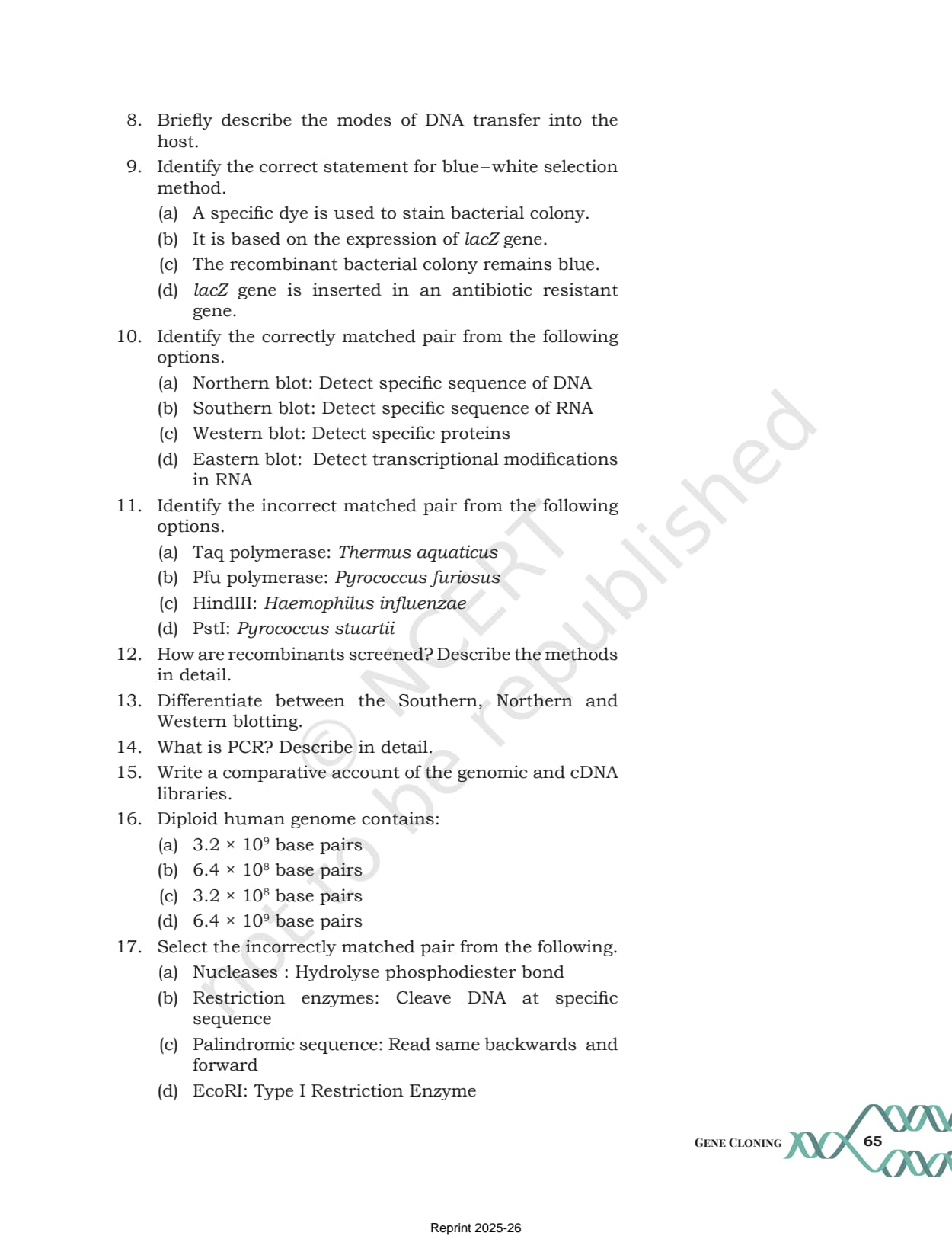
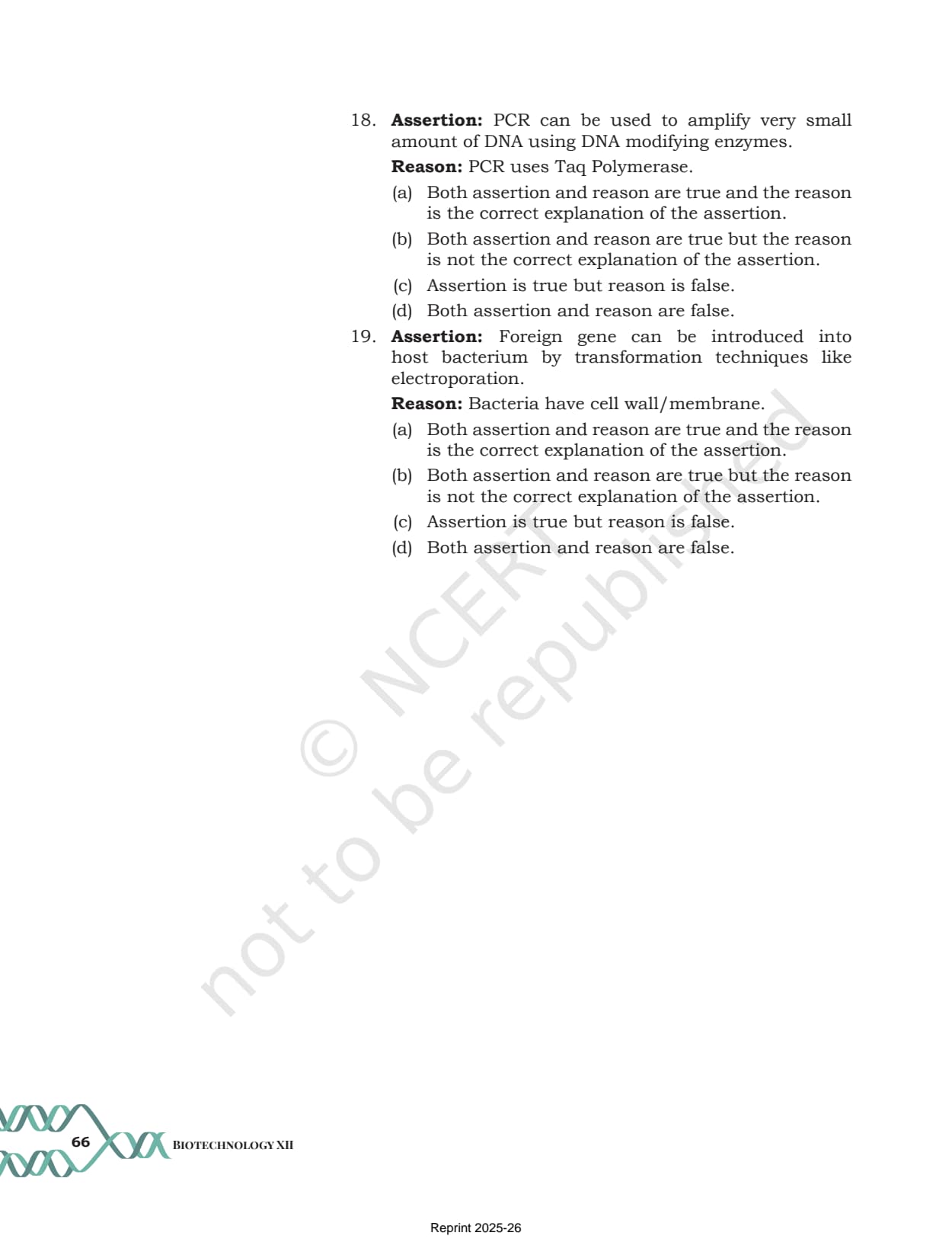
This is the official NCERT chapter file for the 2026-27 session, hosted by Collegedunia with no pages removed.
How the Gene Cloning Chapter Is Laid Out
The chapter opens by explaining why gene cloning matters in biotechnology, then works through eight sections in the order a real cloning experiment would follow. Each section hands over the next step, from finding the gene to storing the clones in a library.
| Section | What it covers |
|---|---|
| 3.1 Identification of Candidate Gene | choosing the gene worth cloning, and why finding it is so hard |
| 3.2 Isolation of Nucleic Acids | extracting DNA and RNA from bacterial, plant and animal cells |
| 3.3 Enzymes used for Recombinant DNA Technology | restriction enzymes, DNA ligase and their nomenclature |
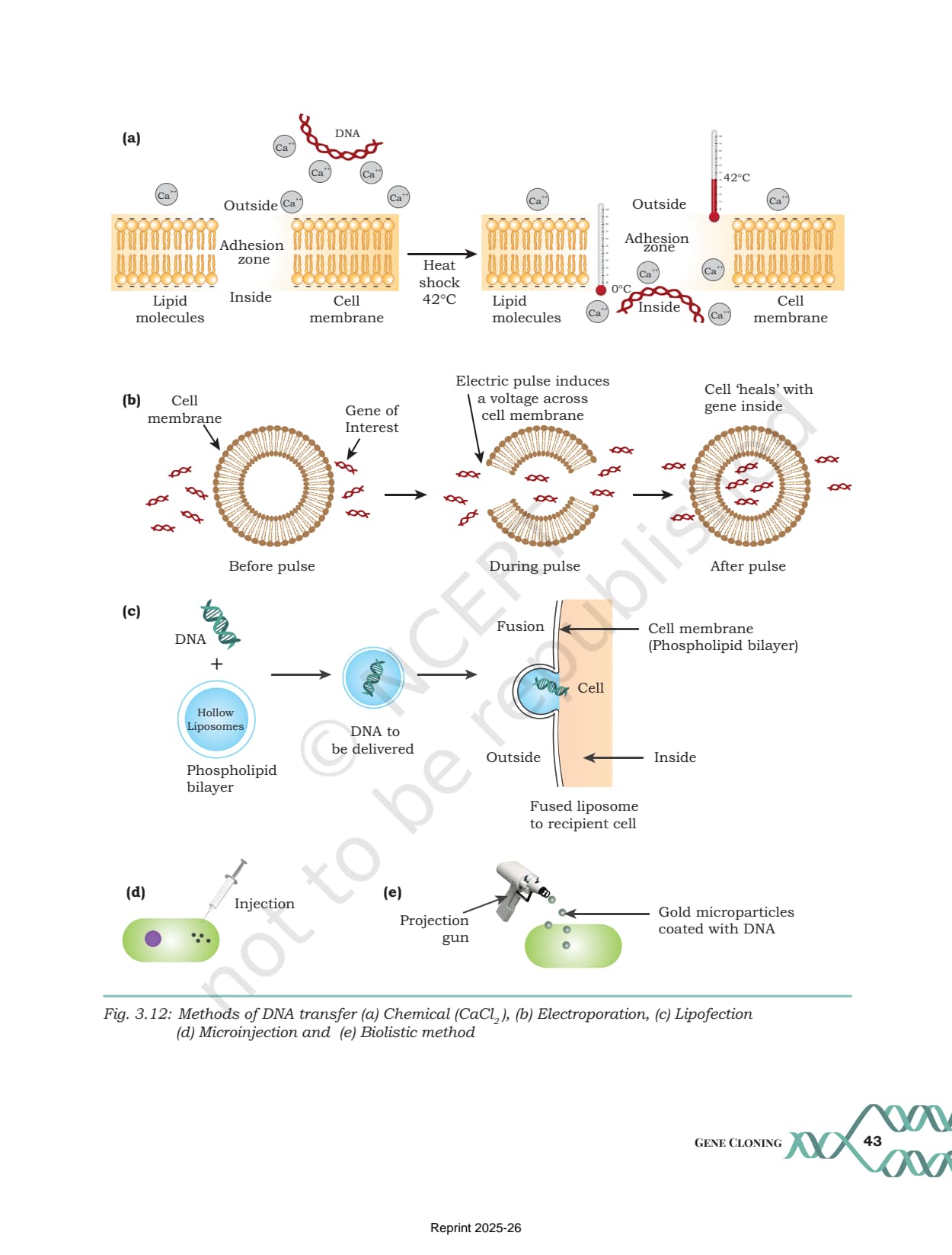
| 3.4 Modes of DNA Transfer | transformation, transduction and conjugation |
| 3.5 Screening and Selection | picking out the bacteria that actually took up the recombinant plasmid |
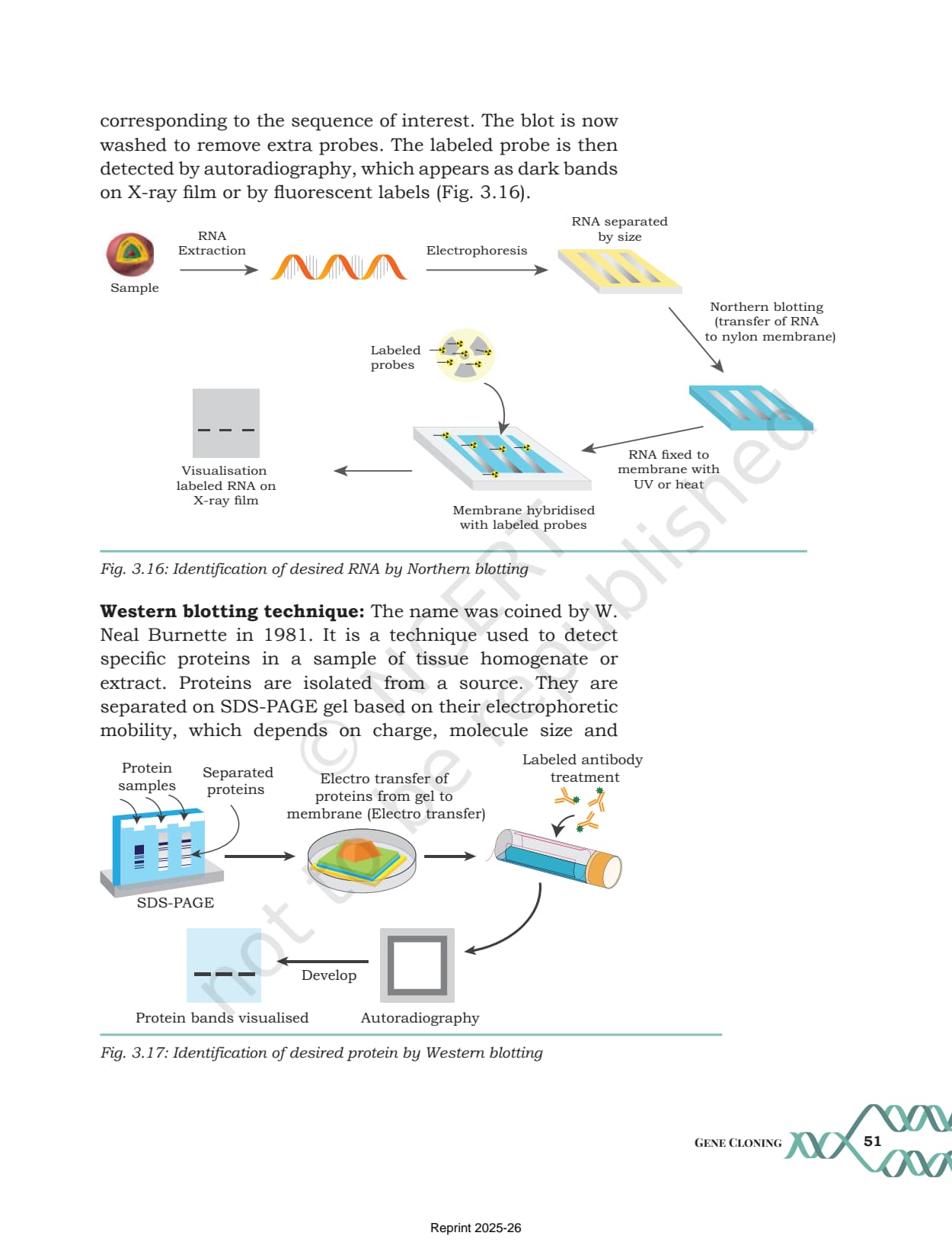
| 3.6 Blotting Techniques | Southern, northern, western and eastern blotting |
| 3.7 Polymerase Chain Reaction (PCR) | amplifying DNA in the lab, including real-time PCR |
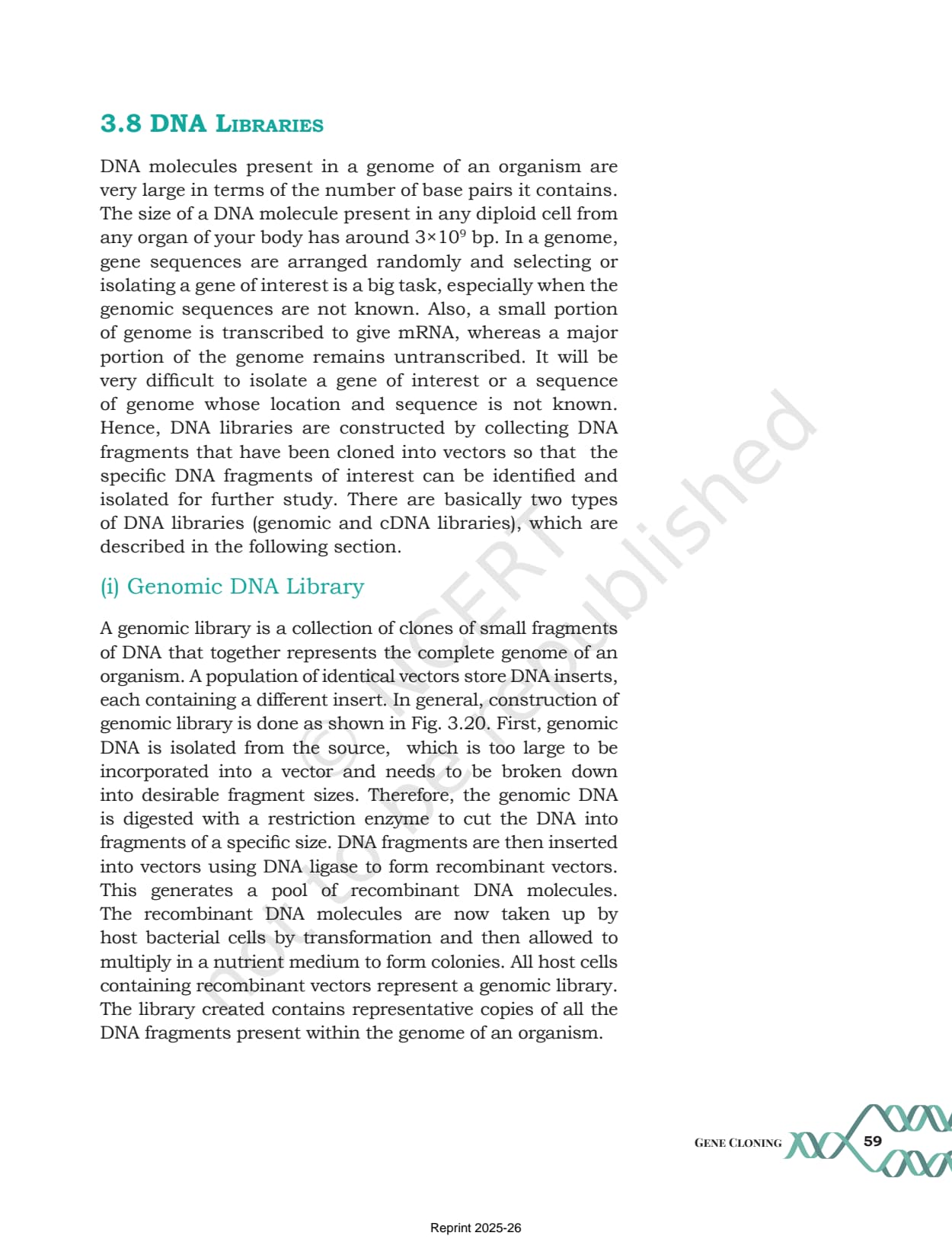
| 3.8 DNA Libraries | genomic libraries and cDNA libraries |
Gene Cloning Explained by Khan Academy
Source: Khan Academy India - English on YouTube
What the Gene Cloning Chapter PDF Contains
The PDF holds the whole chapter exactly as NCERT printed it, with nothing trimmed from either end.
- All eight numbered sections, from candidate gene identification to DNA libraries
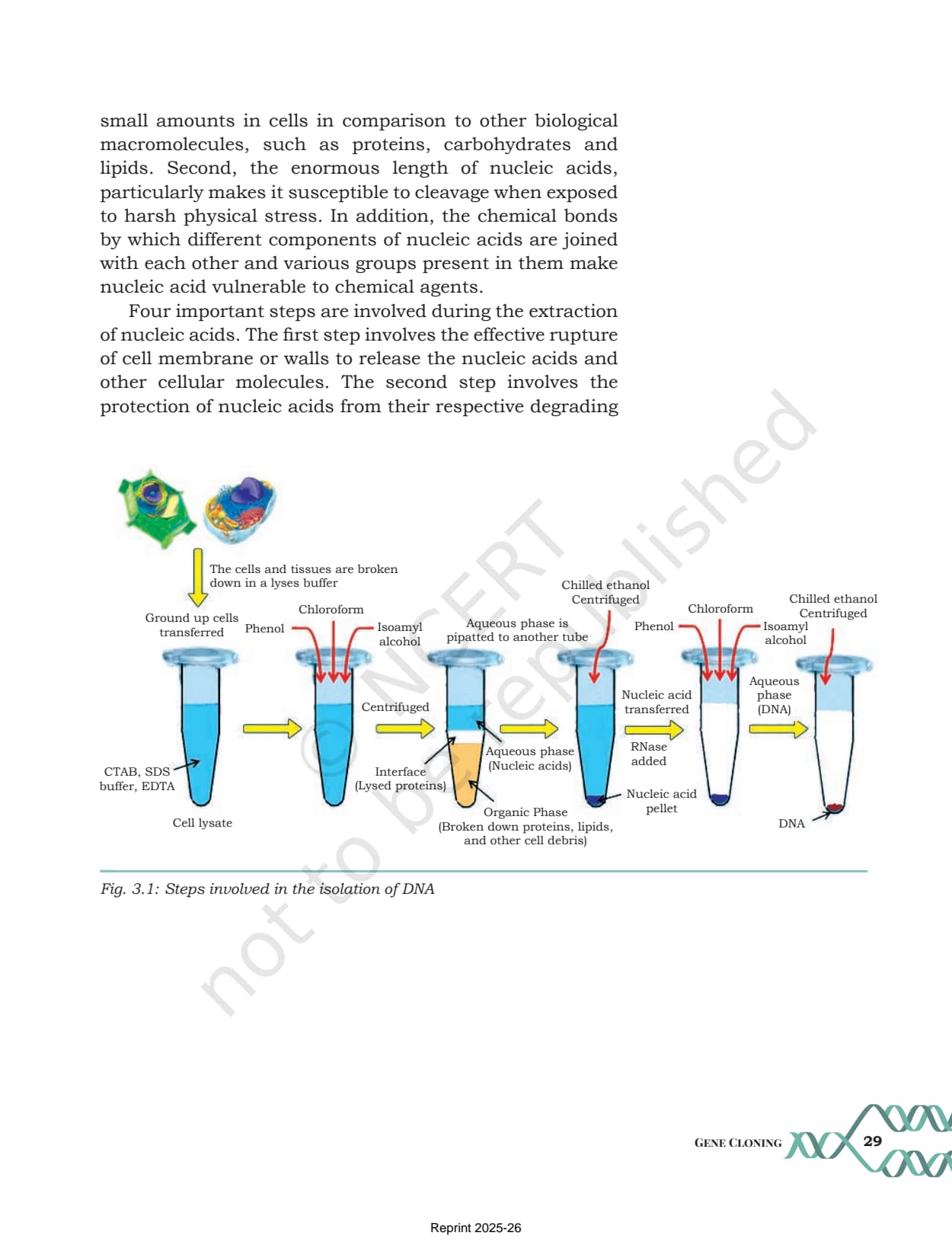
- Figure 3.1 on DNA isolation and Figure 3.2 on RNA isolation, both as flowcharts
- Four boxed inserts, including a box on separating plasmid DNA from genomic DNA and a box on the eastern blot
- Diagrams of restriction enzyme cutting, blue-white selection and the PCR cycle
- The full exercise set at the end, including assertion-reason and case-based questions
Identifying the Candidate Gene for Cloning
Section 3.1 opens with what the chapter calls the first and most formidable problem in gene cloning: finding the right gene in the genome. A gene becomes a candidate for cloning based on its role in health, the economy or evolution, so the chapter lists examples such as the insulin gene linked to diabetes, iron-deficiency genes linked to chlorosis in plants, and salinity-tolerance genes.
- A haploid human genome holds about 3.2 billion base pairs, while a target gene is often only 3,000 to 3,500 bp
- The chapter compares this search to finding a needle in a haystack
- One method deduces the gene's DNA sequence from the amino acid sequence of its protein
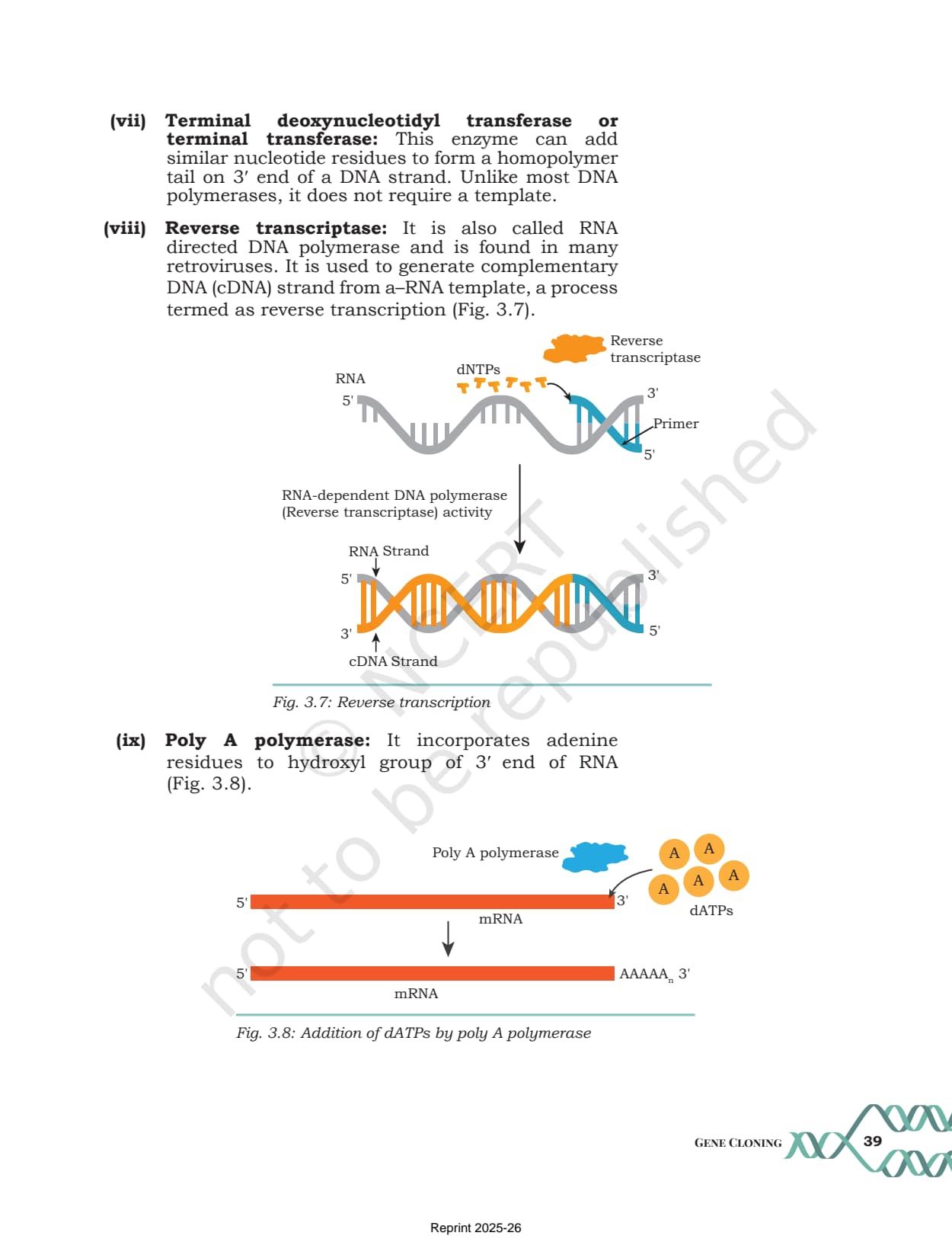
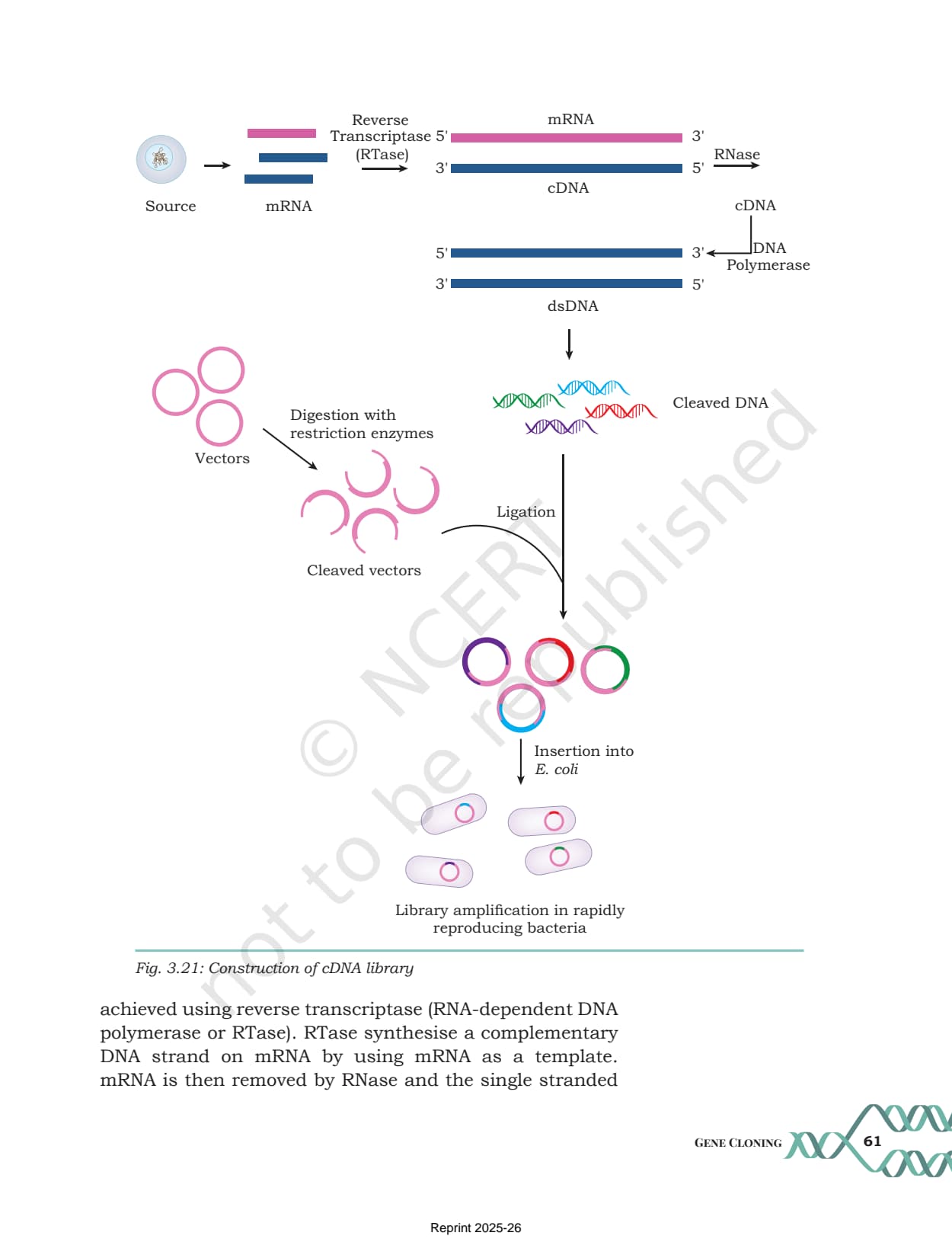
- Another method isolates mRNA from a tissue and converts it into cDNA using reverse transcriptase
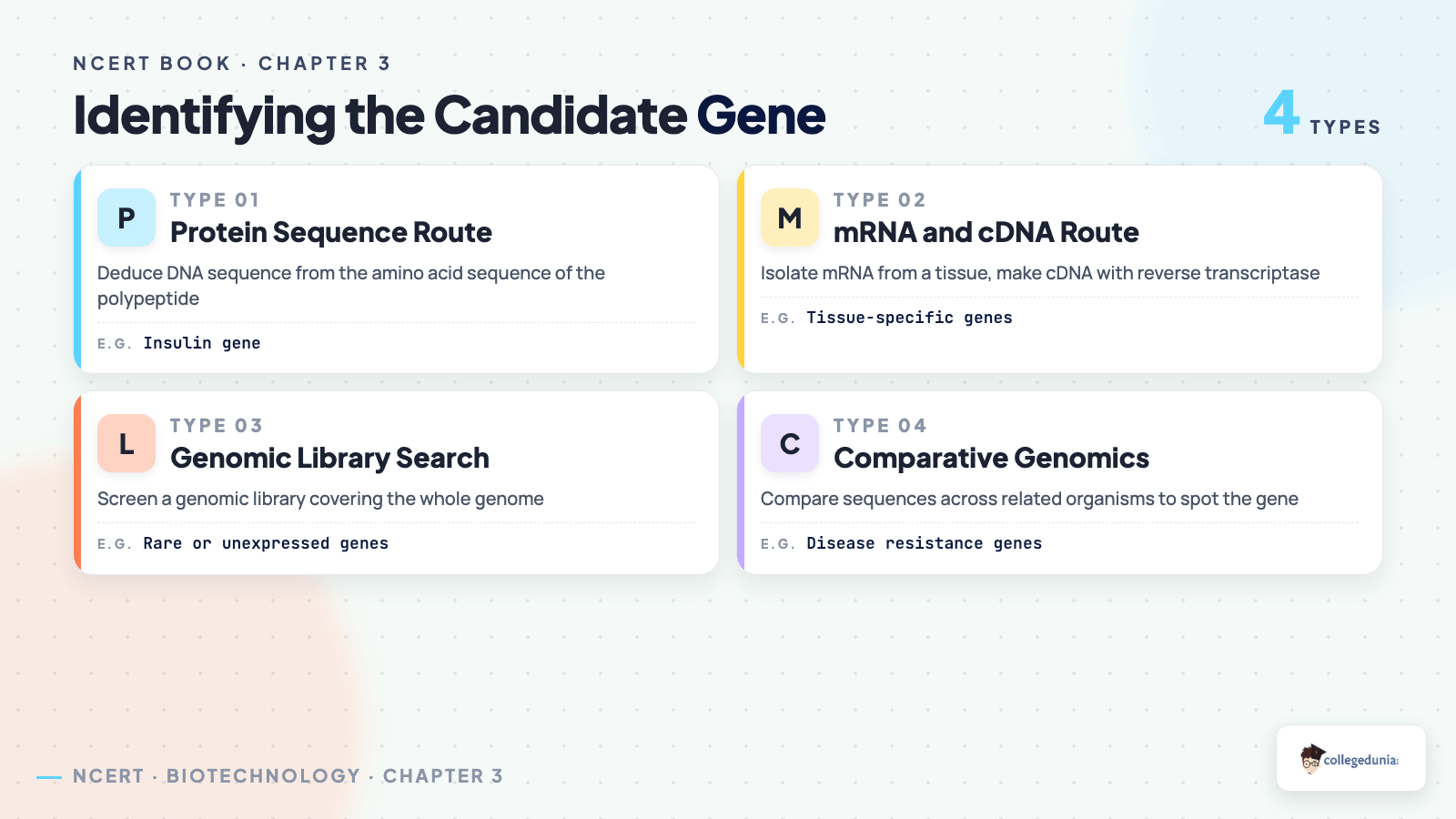
Once a candidate gene is identified, the chapter explains that it still has to be explored in new sources and then cloned through the steps covered in the rest of the chapter.
Isolating Nucleic Acids and the Enzymes Used in Gene Cloning
Section 3.2 walks through DNA and RNA extraction step by step, and Section 3.3 covers the enzymes that cut and join DNA once it is isolated. Both sections explain why the same four extraction steps apply across bacteria, plants and animals, even though each cell type needs a different way to break its outer layer open.
| Step or enzyme | What the chapter explains |
|---|---|
| Rupturing the cell | lysozyme for bacteria, CTAB for plant cells, detergent for animal cells |
| Removing protein | SDS makes proteins anionic so they separate from the negatively charged DNA |
| Precipitating DNA | chilled ethanol or isopropanol, after a chloroform-isoamyl alcohol wash |
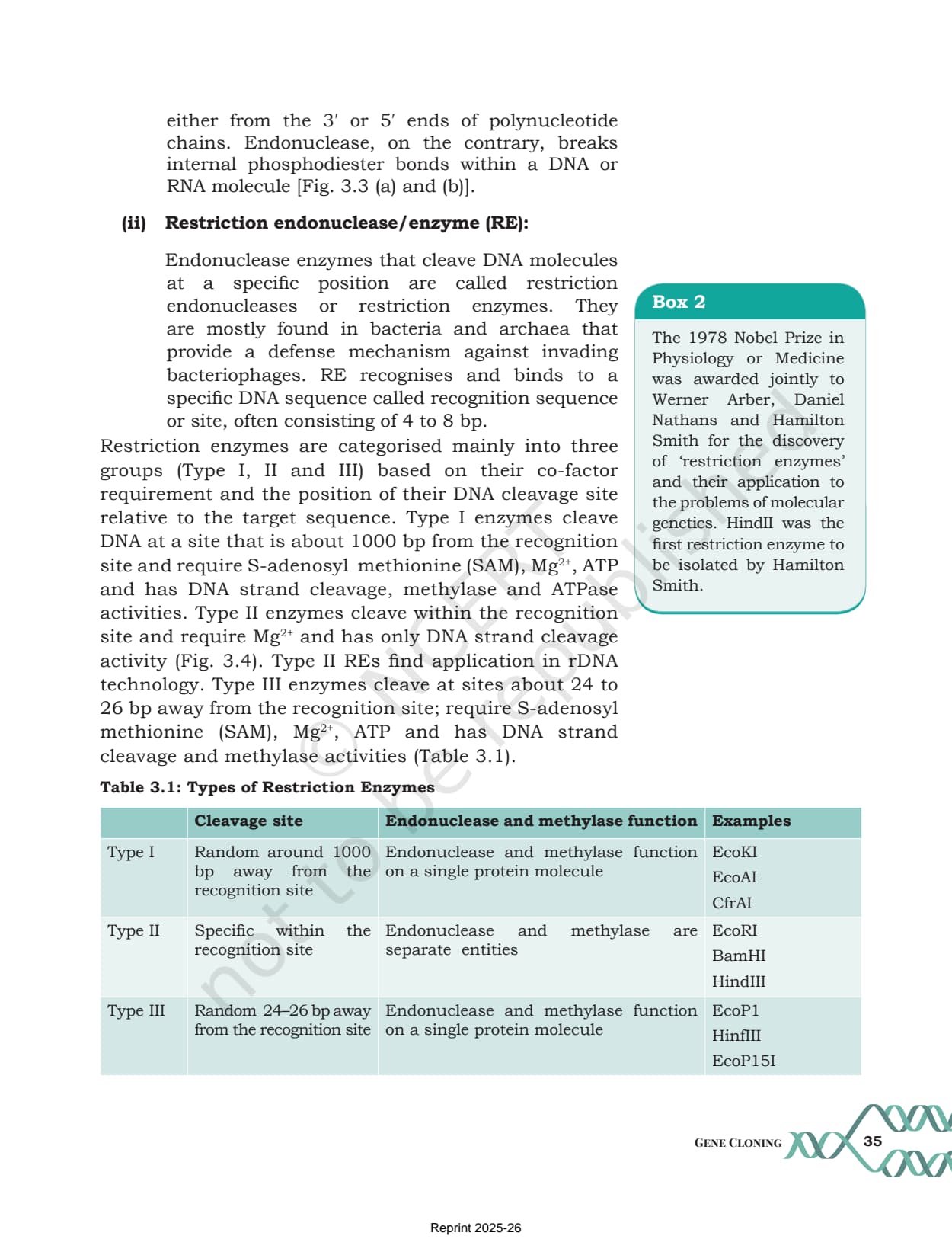
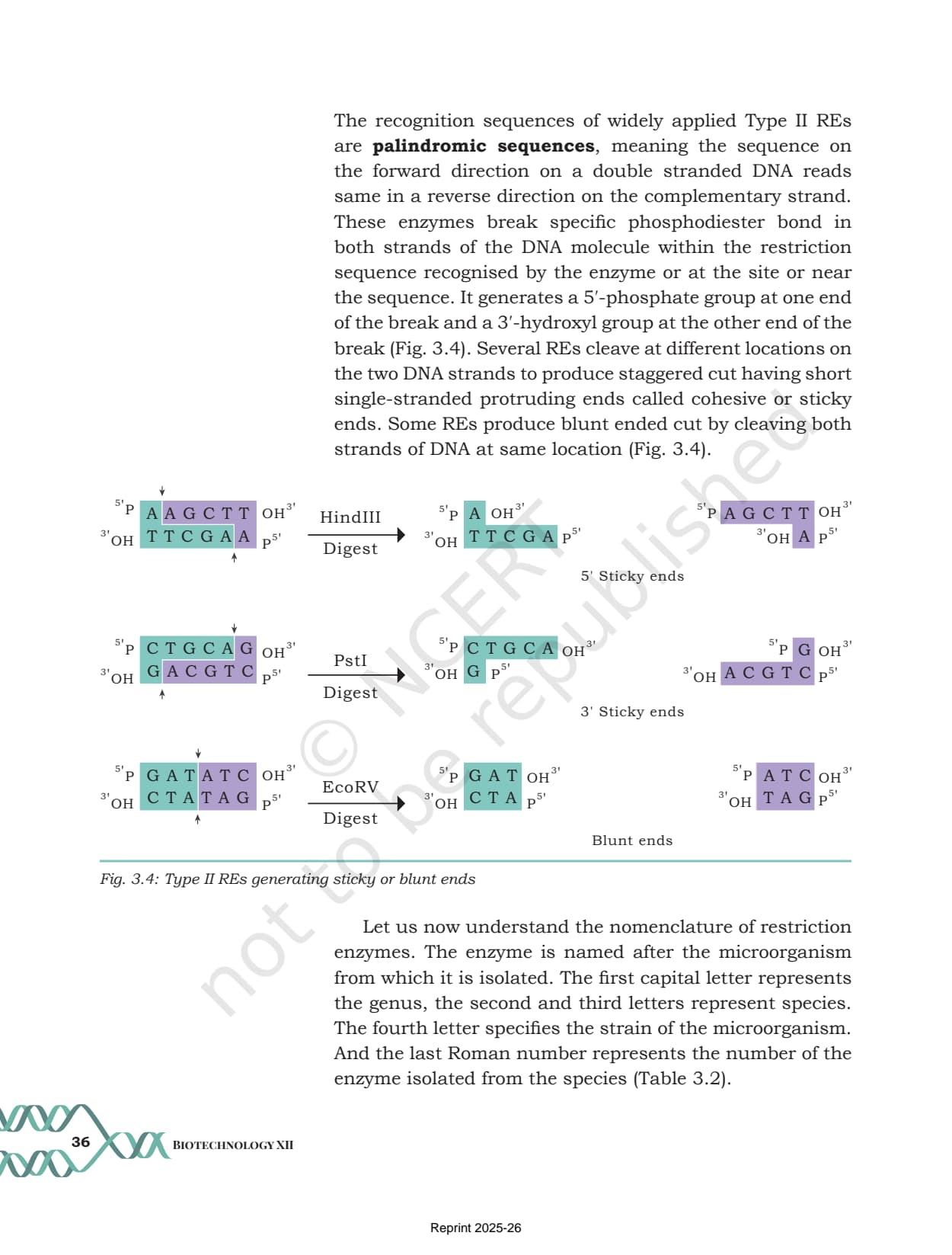
| Restriction enzymes | cut DNA at a palindromic recognition site, leaving sticky or blunt ends |
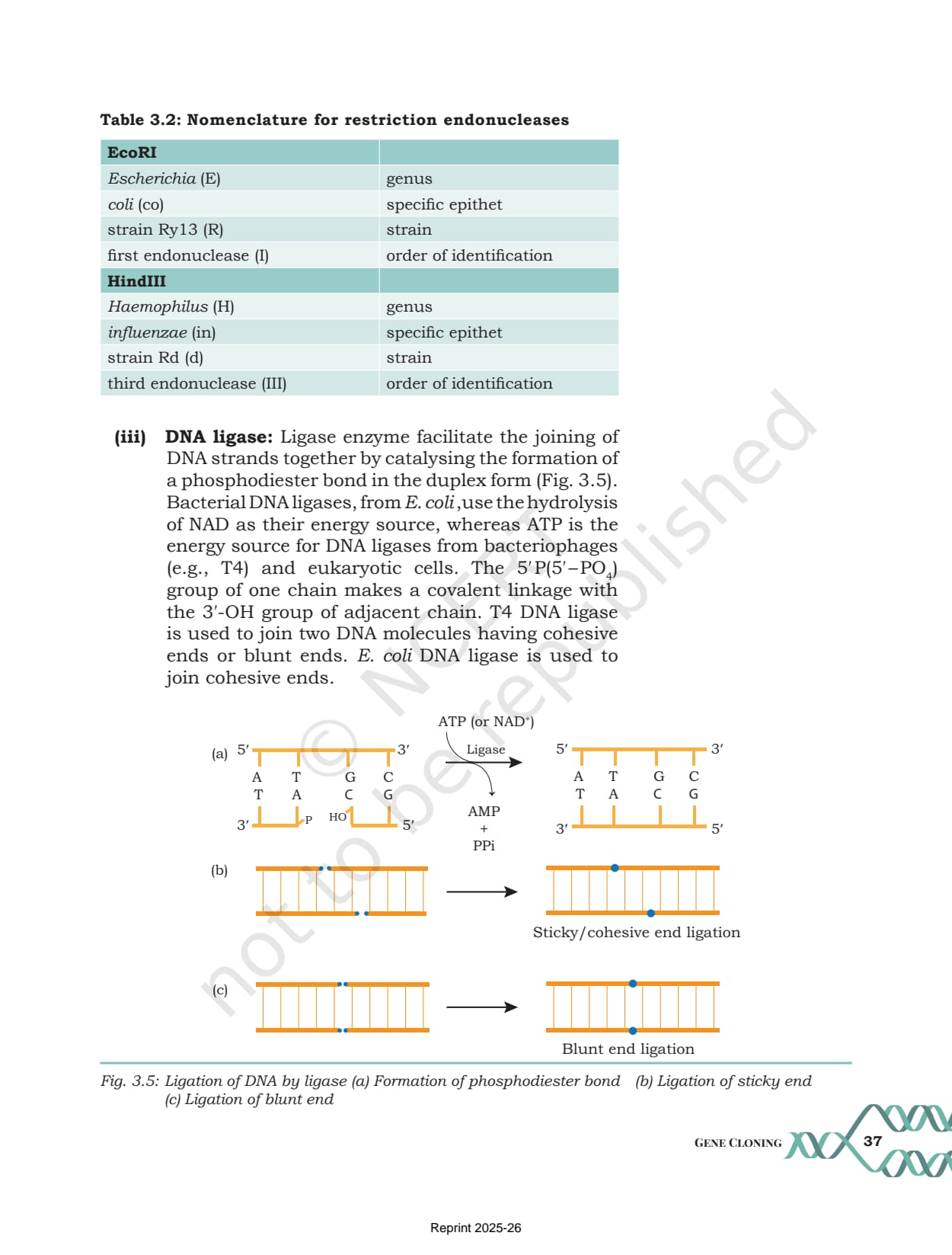
| Enzyme naming | genus, species, strain and enzyme number, for example HindIII |
The chapter also separates plasmid DNA from genomic DNA in a dedicated box. Boiling a bacterial lysate denatures the long chromosomal DNA irreversibly, while the smaller circular plasmid DNA renatures and stays soluble, which is exactly why plasmids can be recovered and used as cloning vectors.
Modes of DNA Transfer Into a Host Cell
Section 3.4 explains how a foreign DNA molecule actually gets inside a host cell, prokaryotic or eukaryotic. In nature, bacteria pick up foreign DNA in three ways, and the chapter uses all three as the basis for the transfer methods used in the lab.
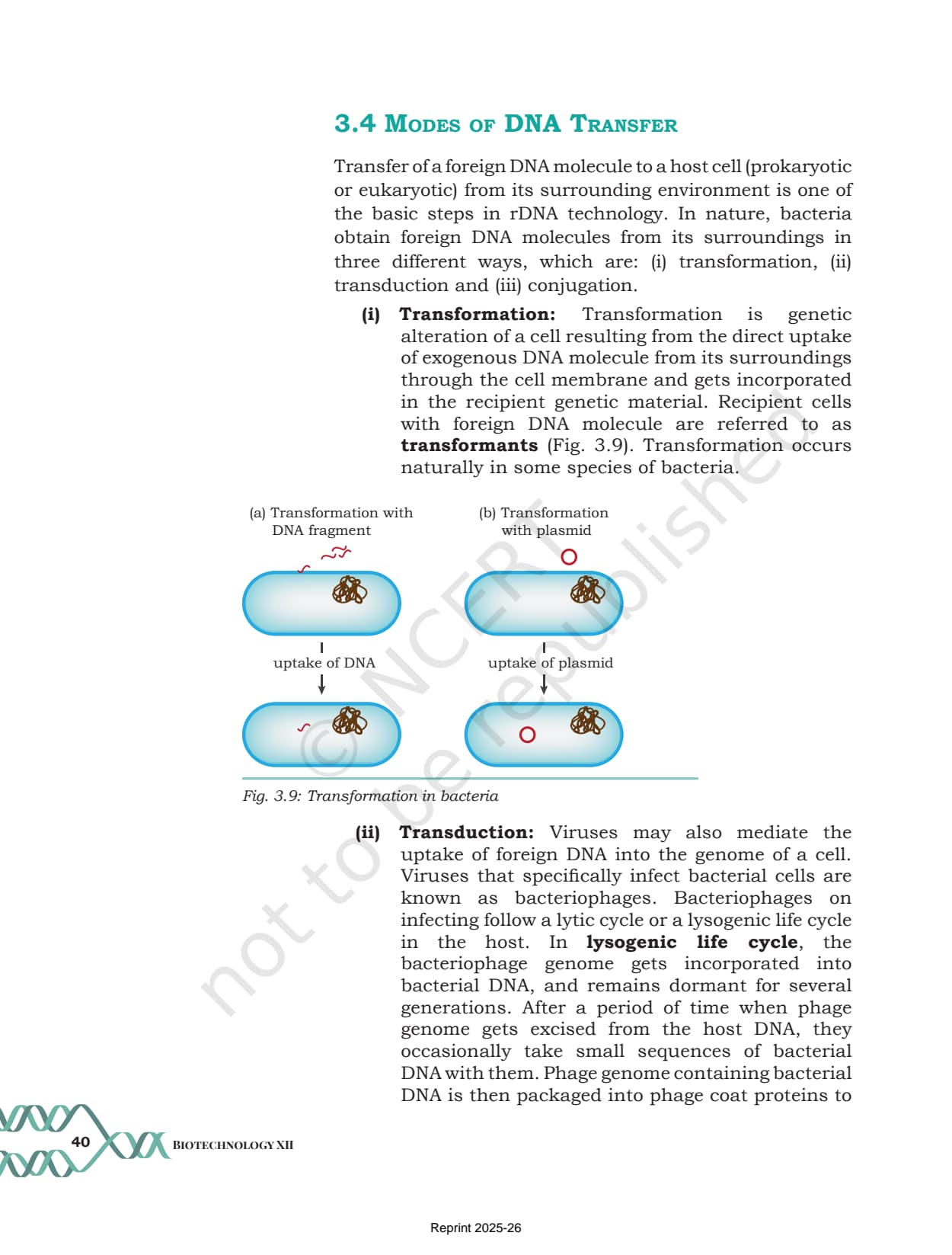
- Transformation: a cell directly takes up exogenous DNA through its membrane; the recipient is called a transformant
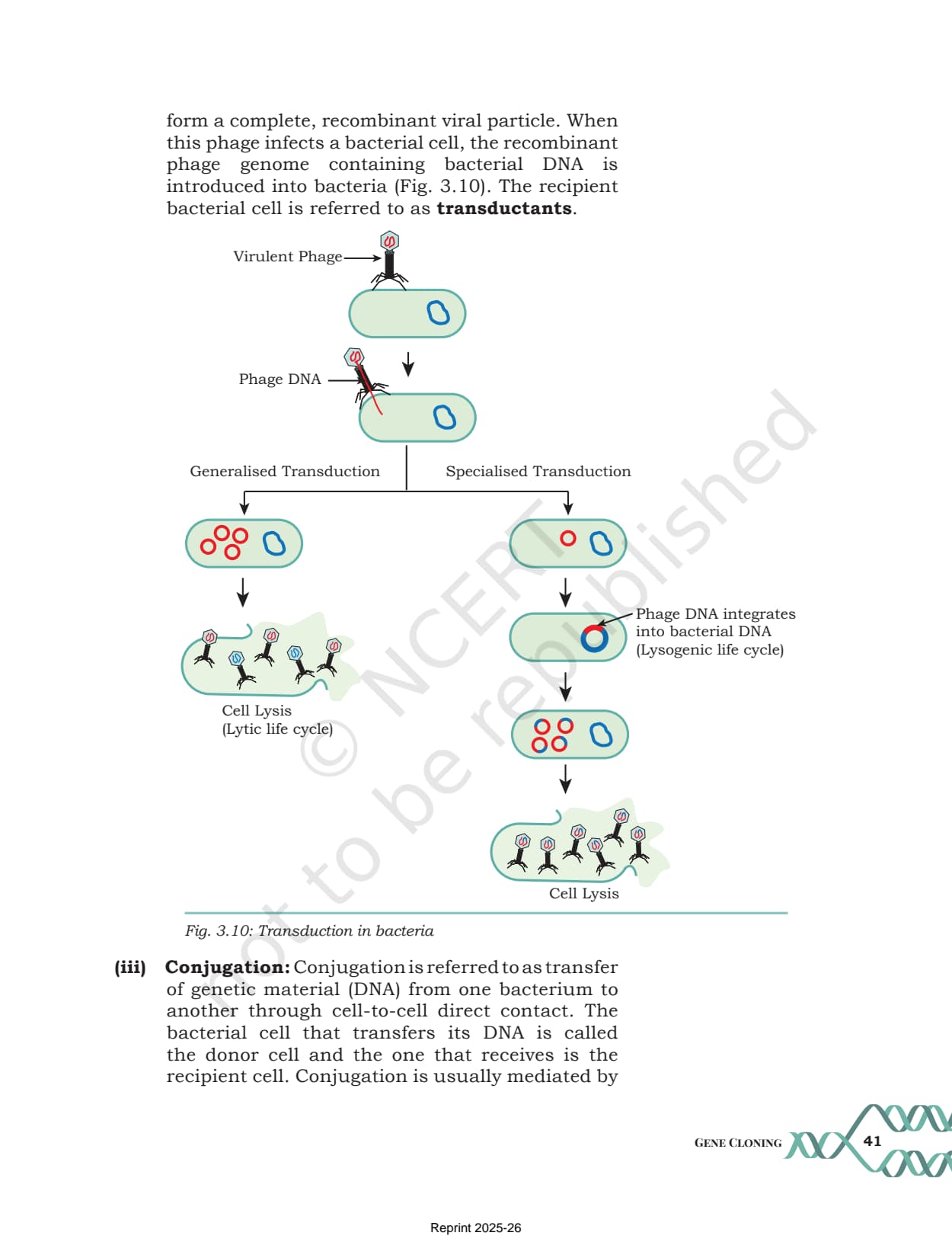
- Transduction: a bacteriophage carries bacterial DNA between cells during its lytic or lysogenic cycle
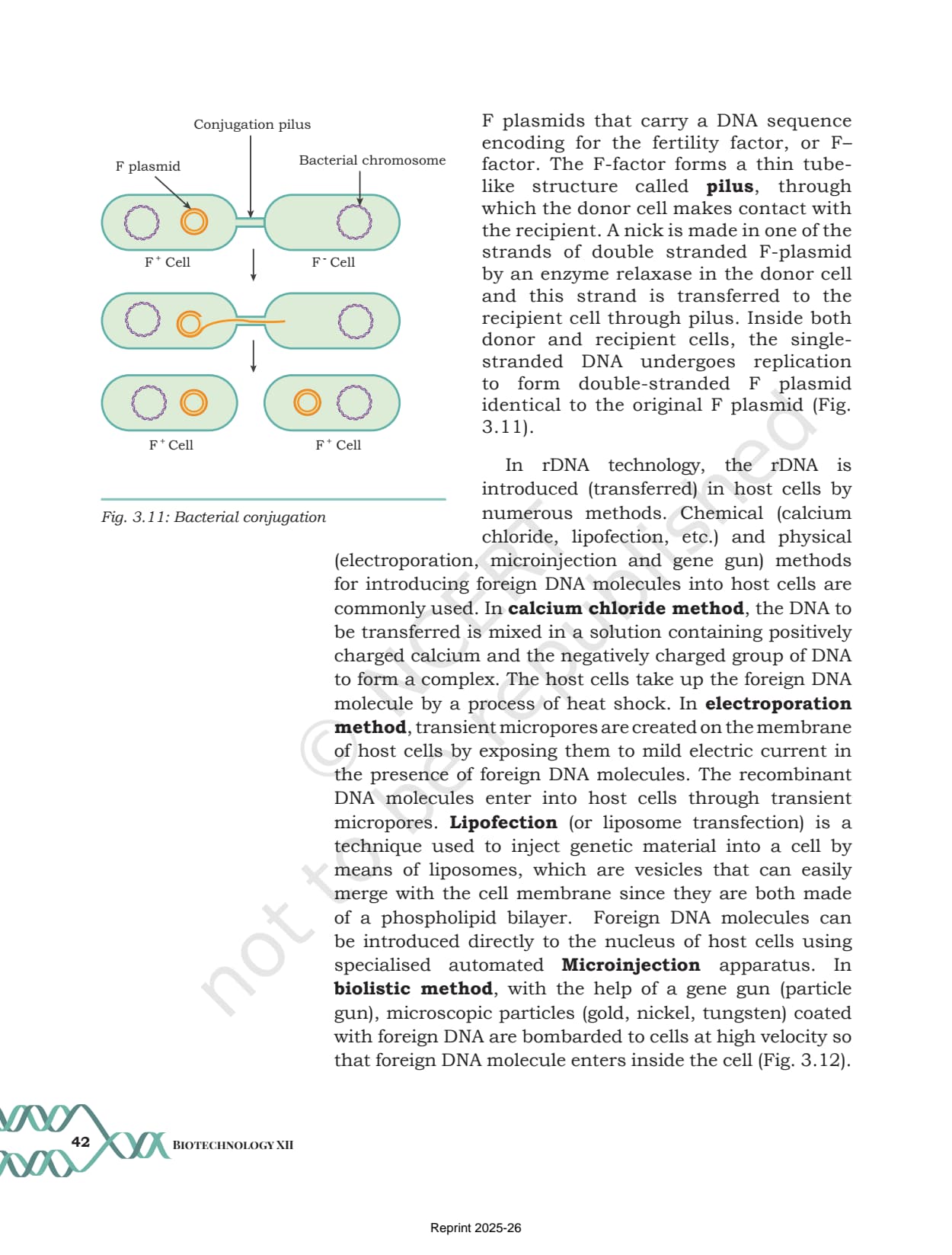
- Conjugation: DNA passes directly between two bacterial cells in contact
This section connects back to the host-vector systems covered earlier in the book, since the transfer method decides which vector and which host cell a cloning experiment can use.
Screening and Selection of Recombinant Clones
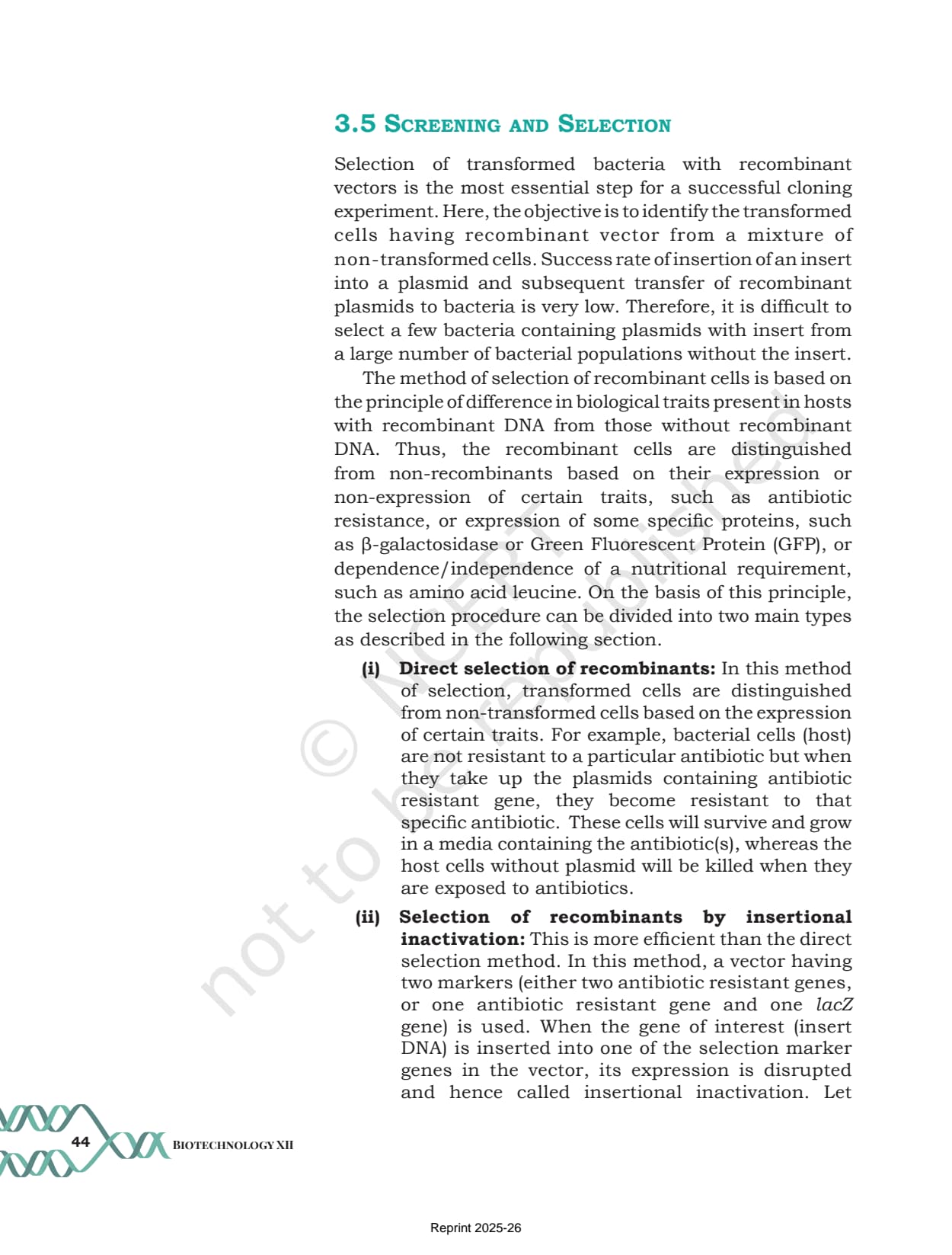
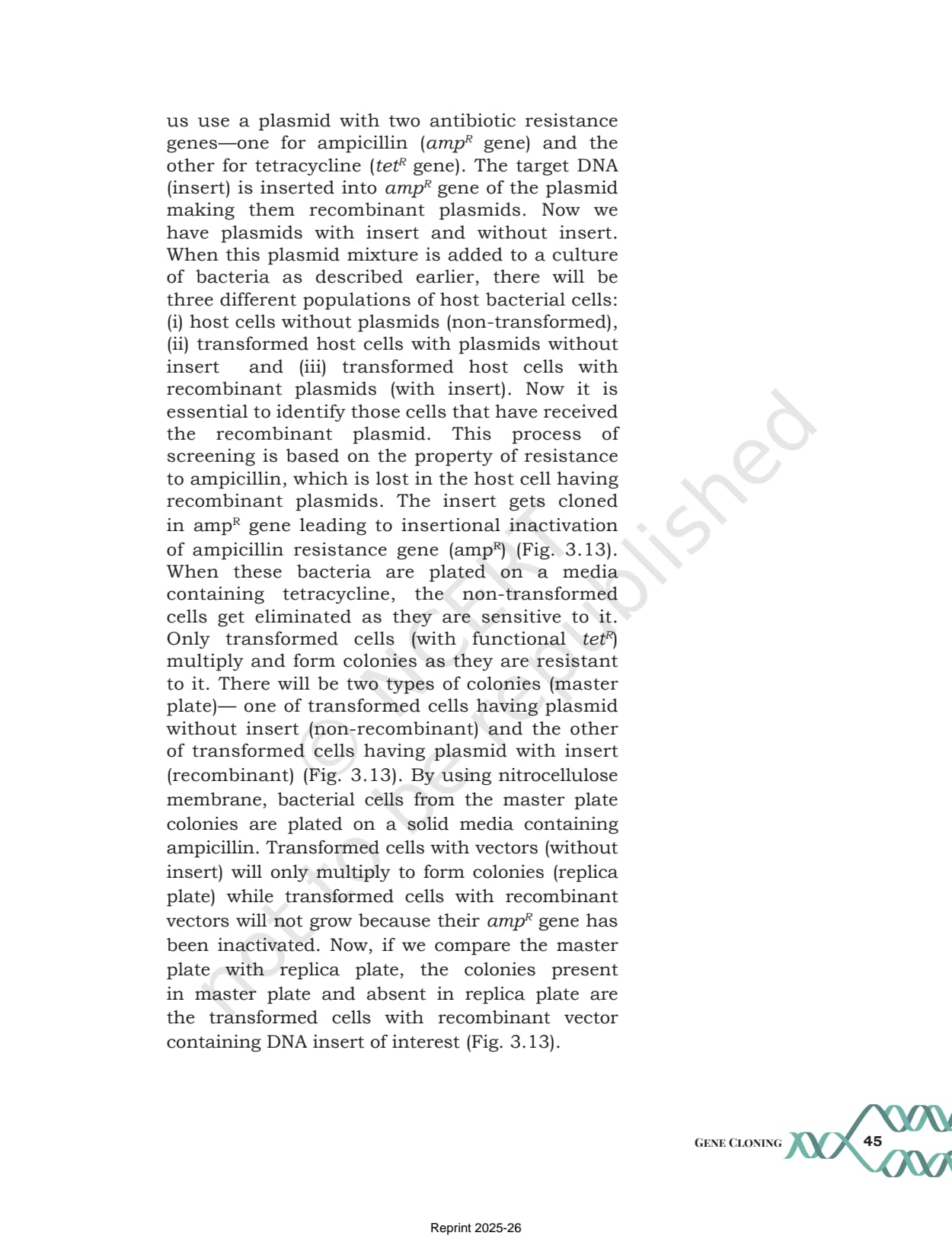
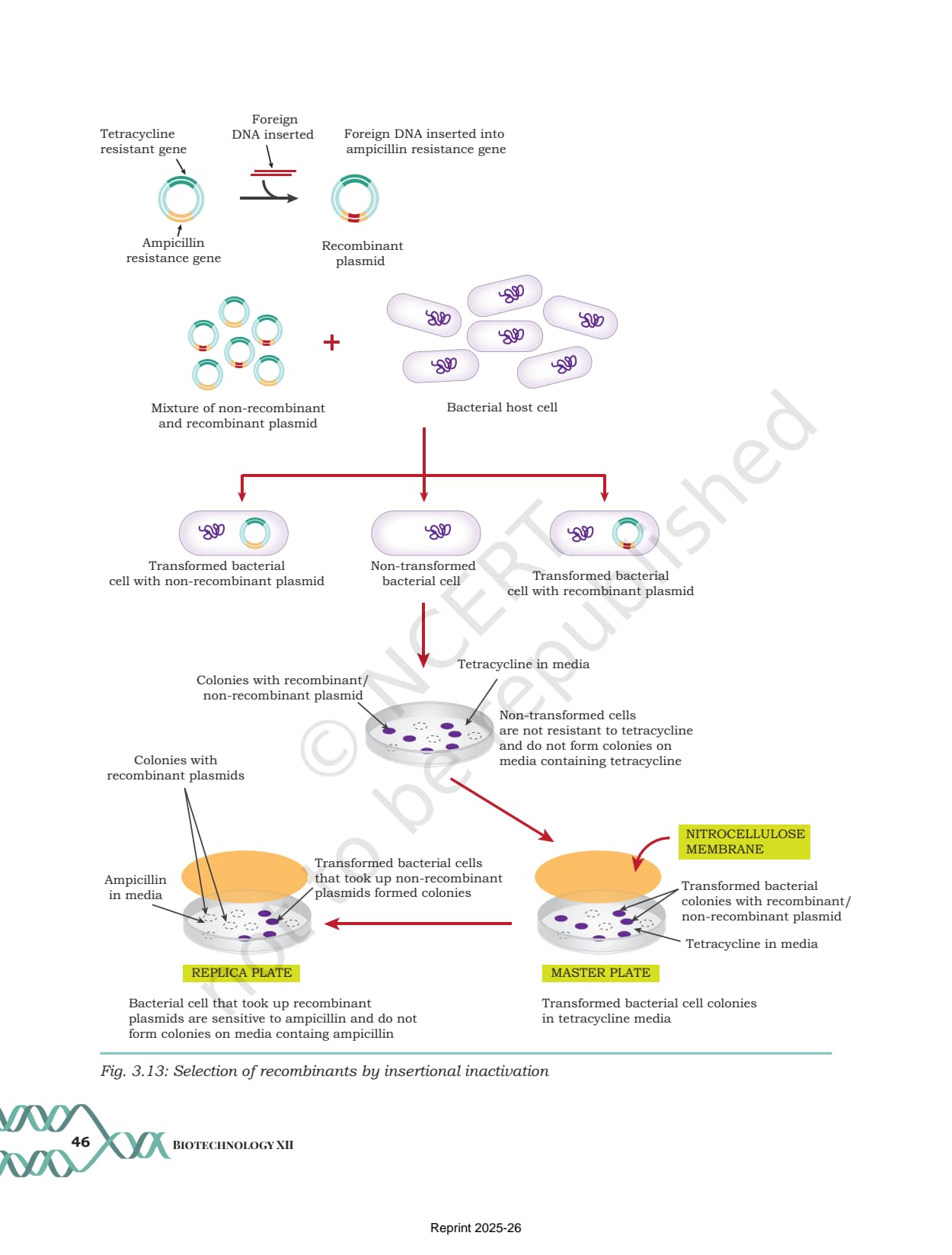
Section 3.5 solves a practical problem: after transformation, only a tiny fraction of cells actually carry the recombinant plasmid. The chapter calls this the most essential step for a successful cloning experiment, since sorting a handful of true recombinants out of a huge bacterial population is not simple.
- Recombinants are told apart from non-recombinants by a trait such as antibiotic resistance or a marker protein
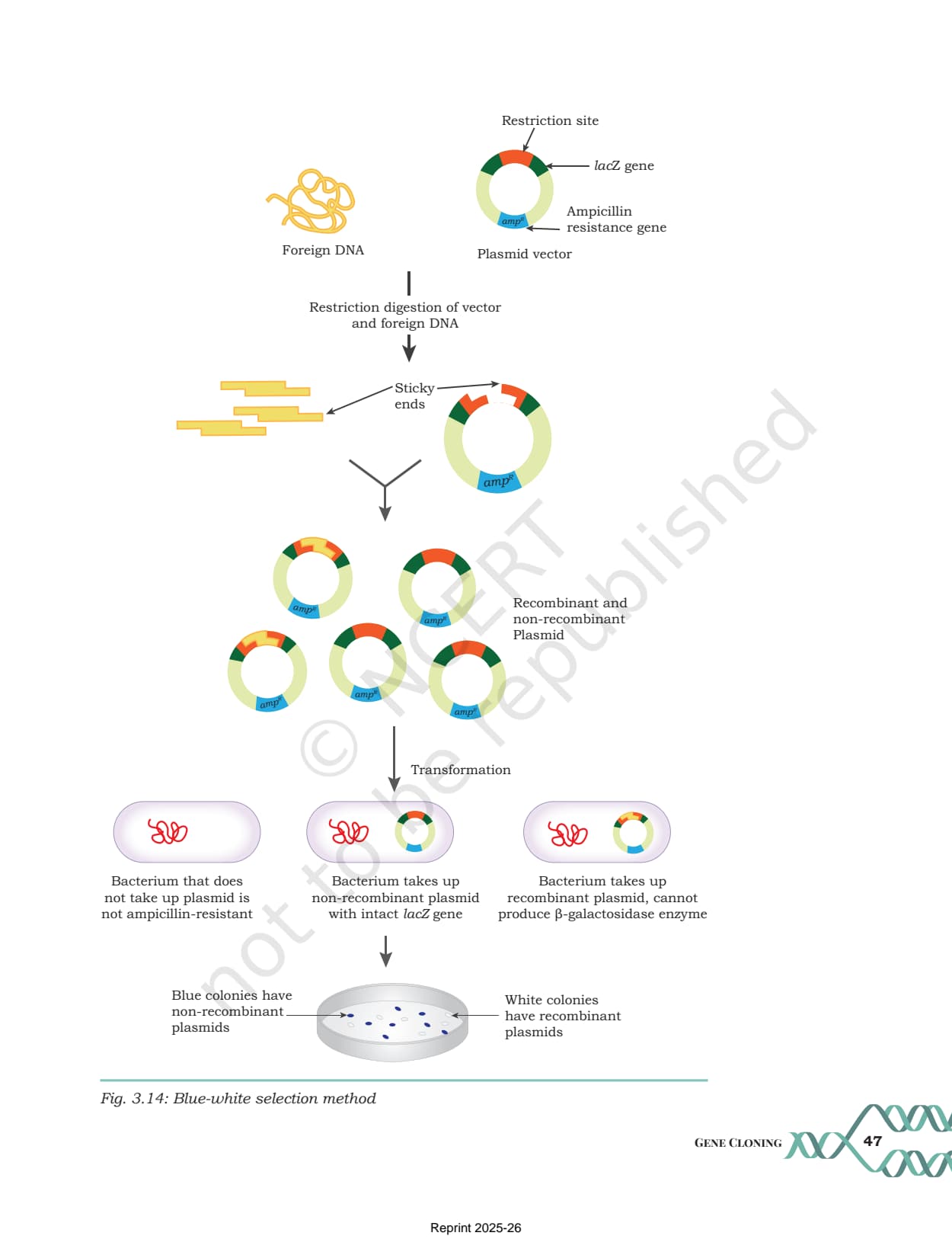
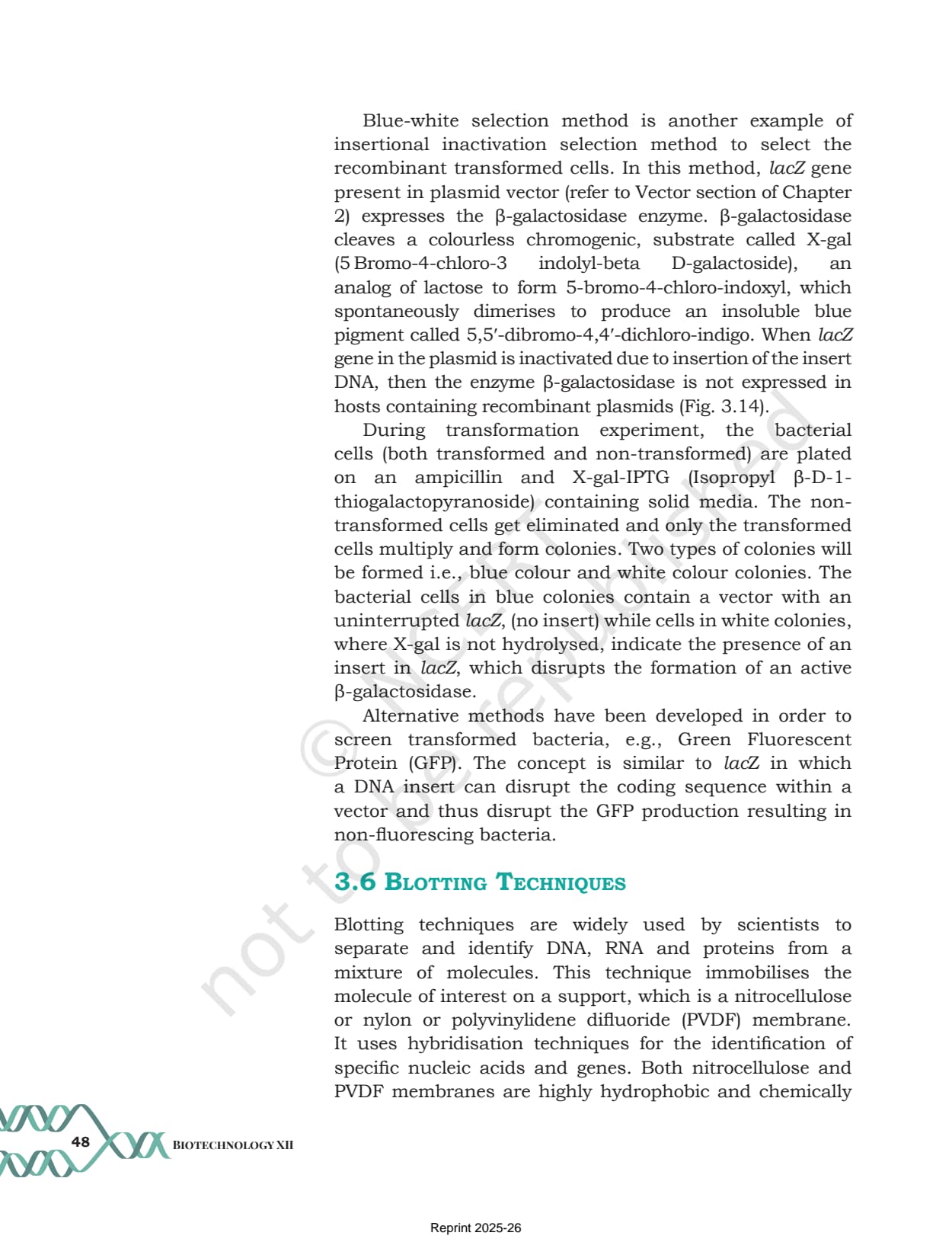
- Blue-white selection uses the lacZ gene and the substrate X-gal; unbroken lacZ turns colonies blue, an insert in lacZ leaves them white
- Colonies are grown on ampicillin plus X-gal-IPTG media so untransformed cells are eliminated first
- Selection can also use dependence on a nutrient, such as the amino acid leucine
Blotting Techniques and the Polymerase Chain Reaction
Sections 3.6 and 3.7 cover how scientists confirm that a gene, its RNA transcript or its protein product is actually present, and how they multiply a tiny DNA sample into millions of copies.
| Technique | What it detects |
|---|---|
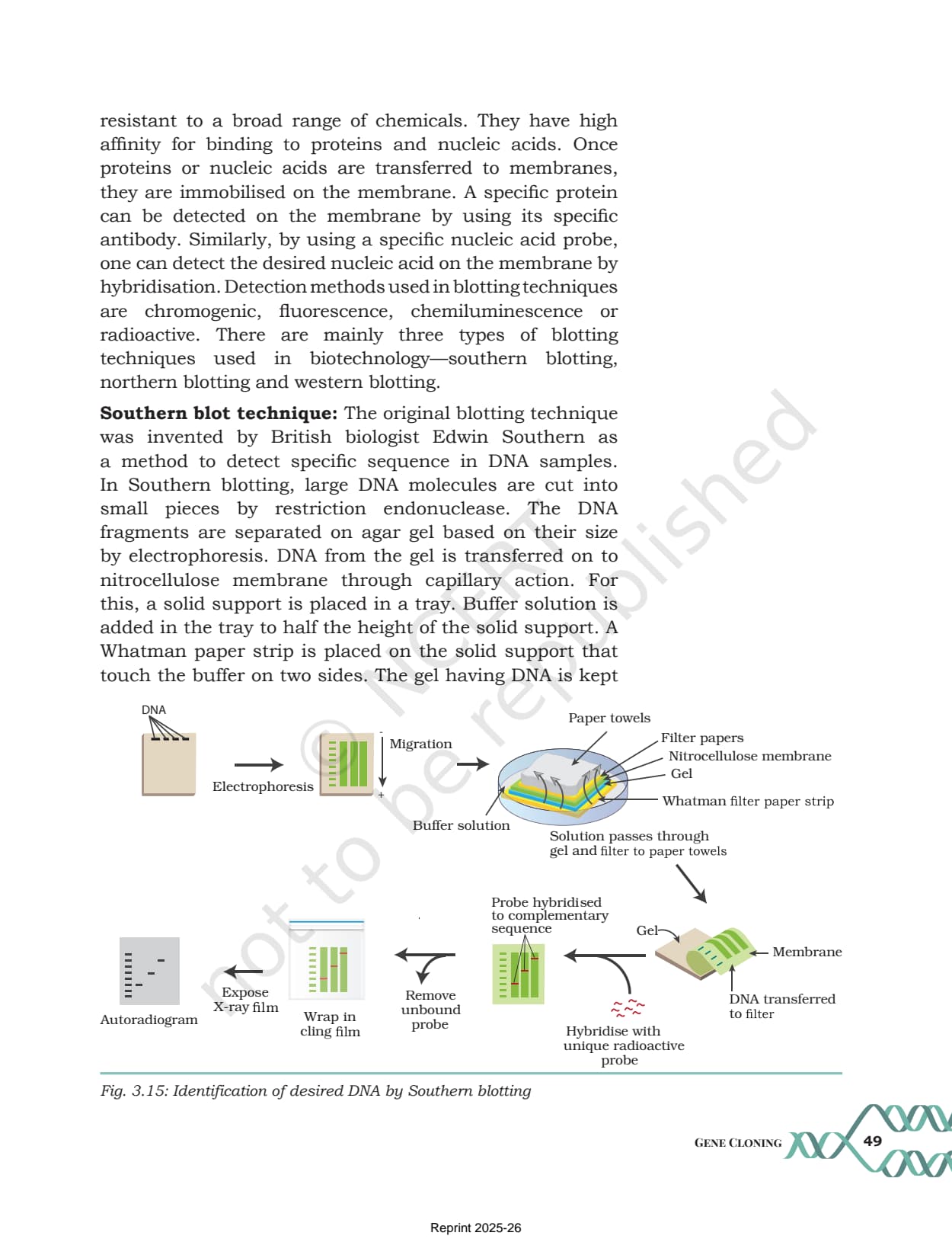
| Southern blotting | a specific DNA sequence |
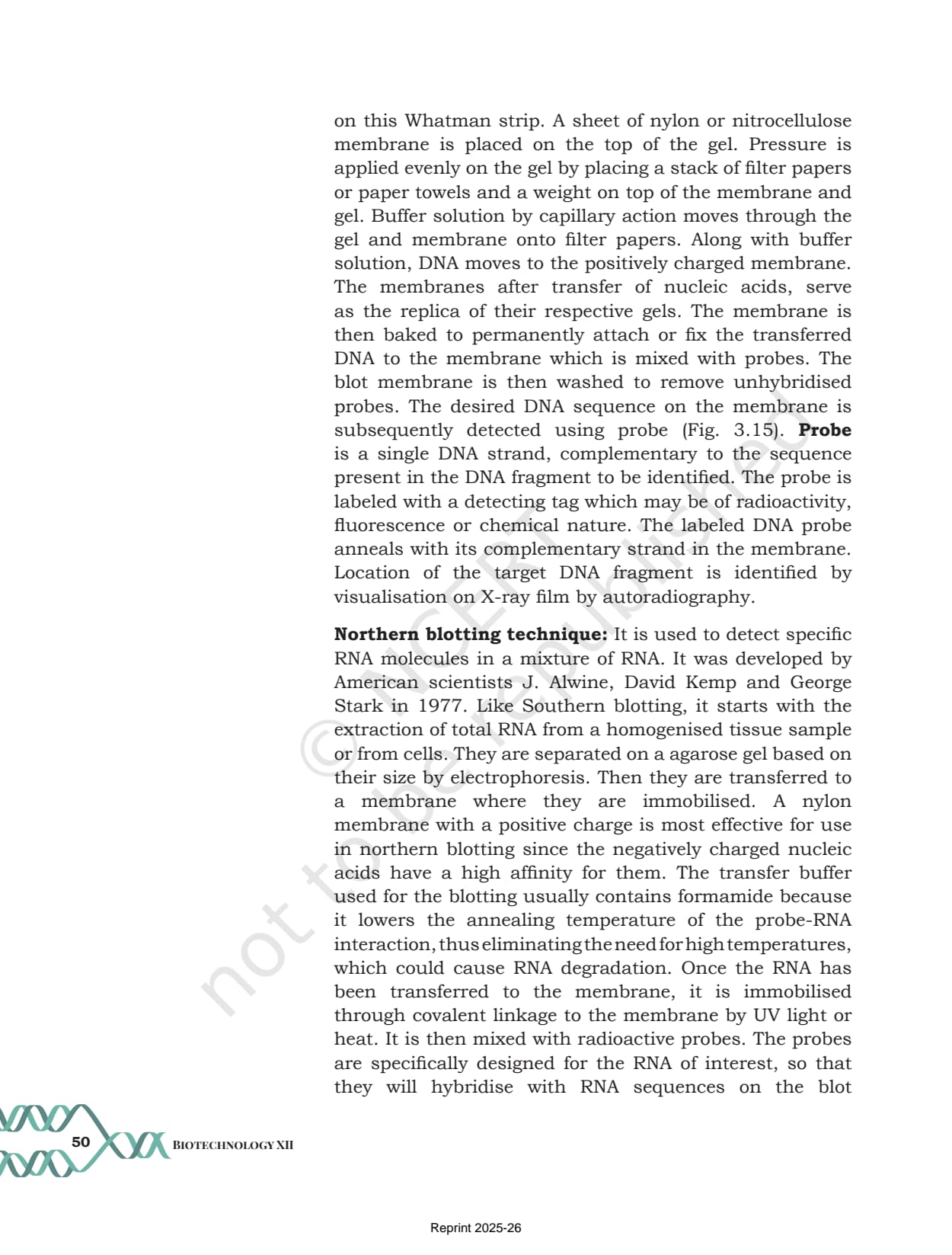
| Northern blotting | a specific RNA transcript |
| Western blotting | a specific protein, using an antibody |
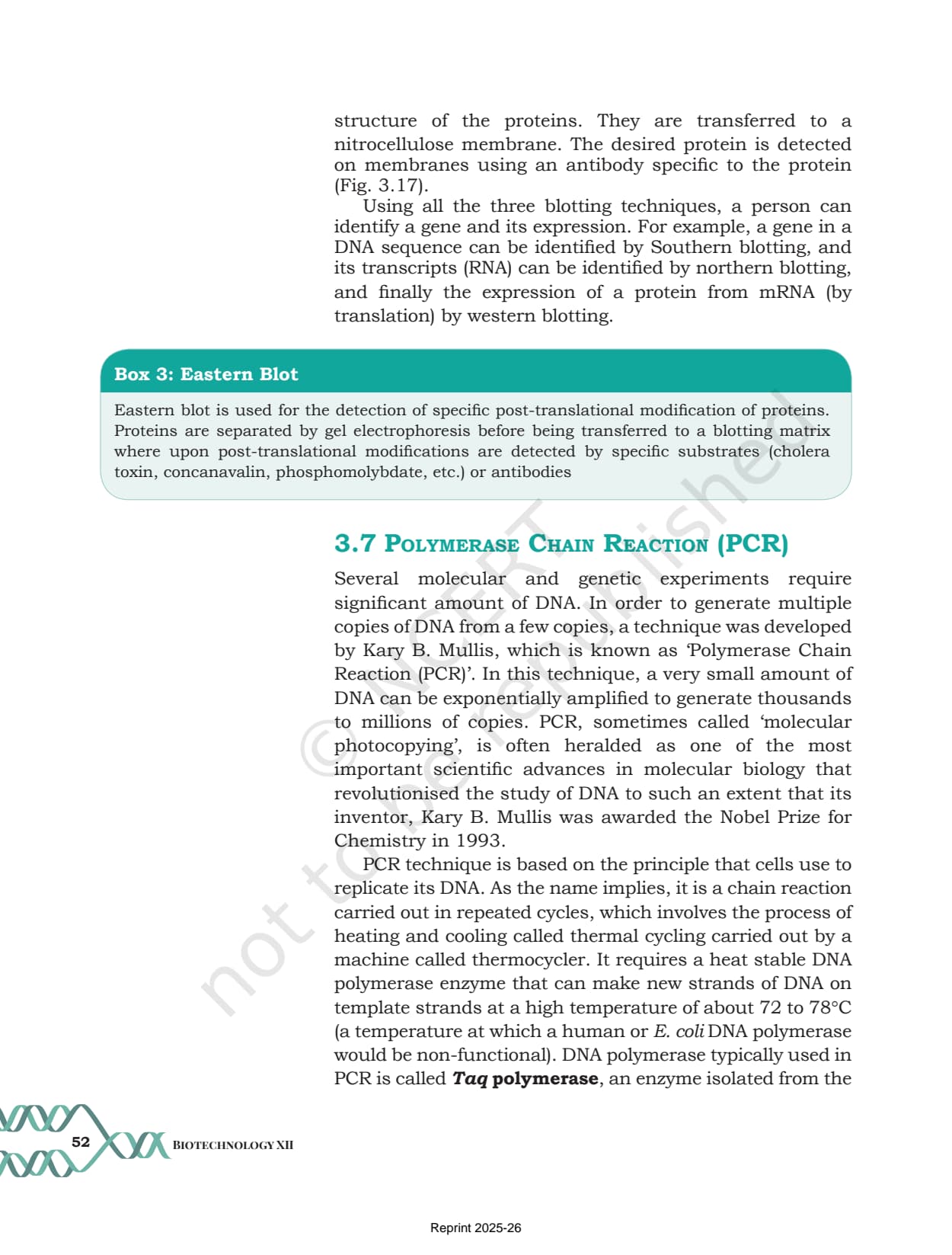
| Eastern blotting | post-translational changes to a protein |
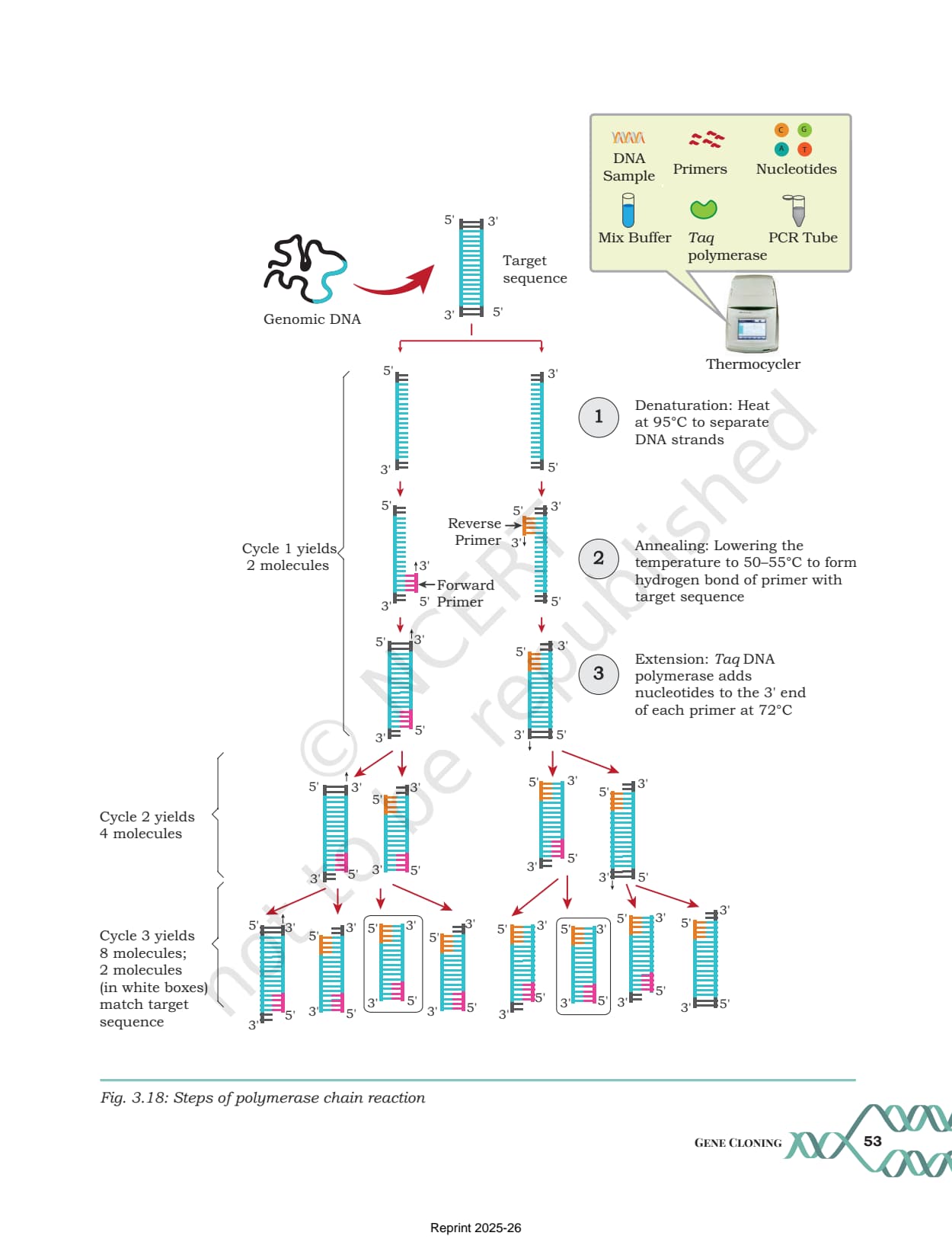
| PCR | amplifies a small DNA sample; developed by Kary B. Mullis |
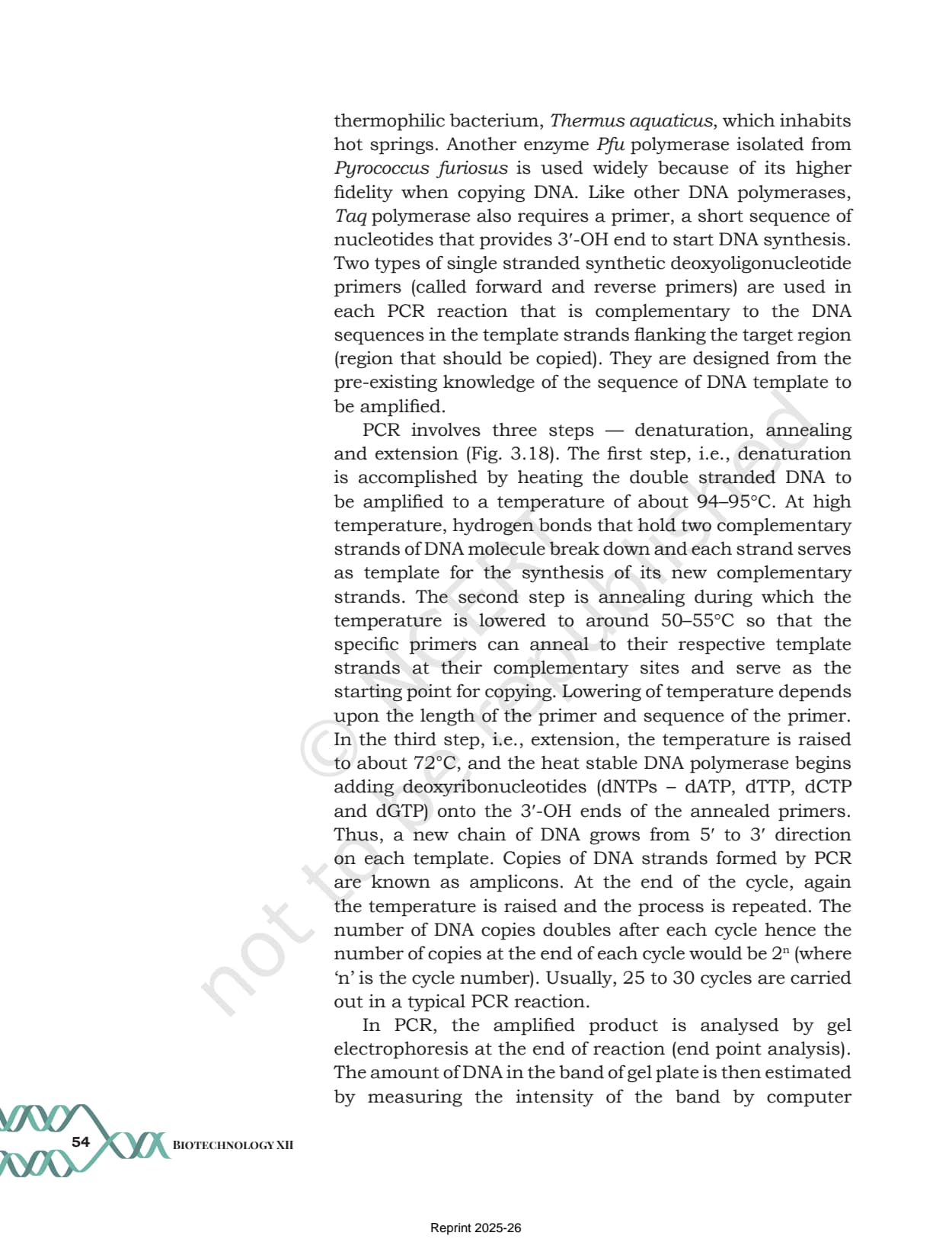
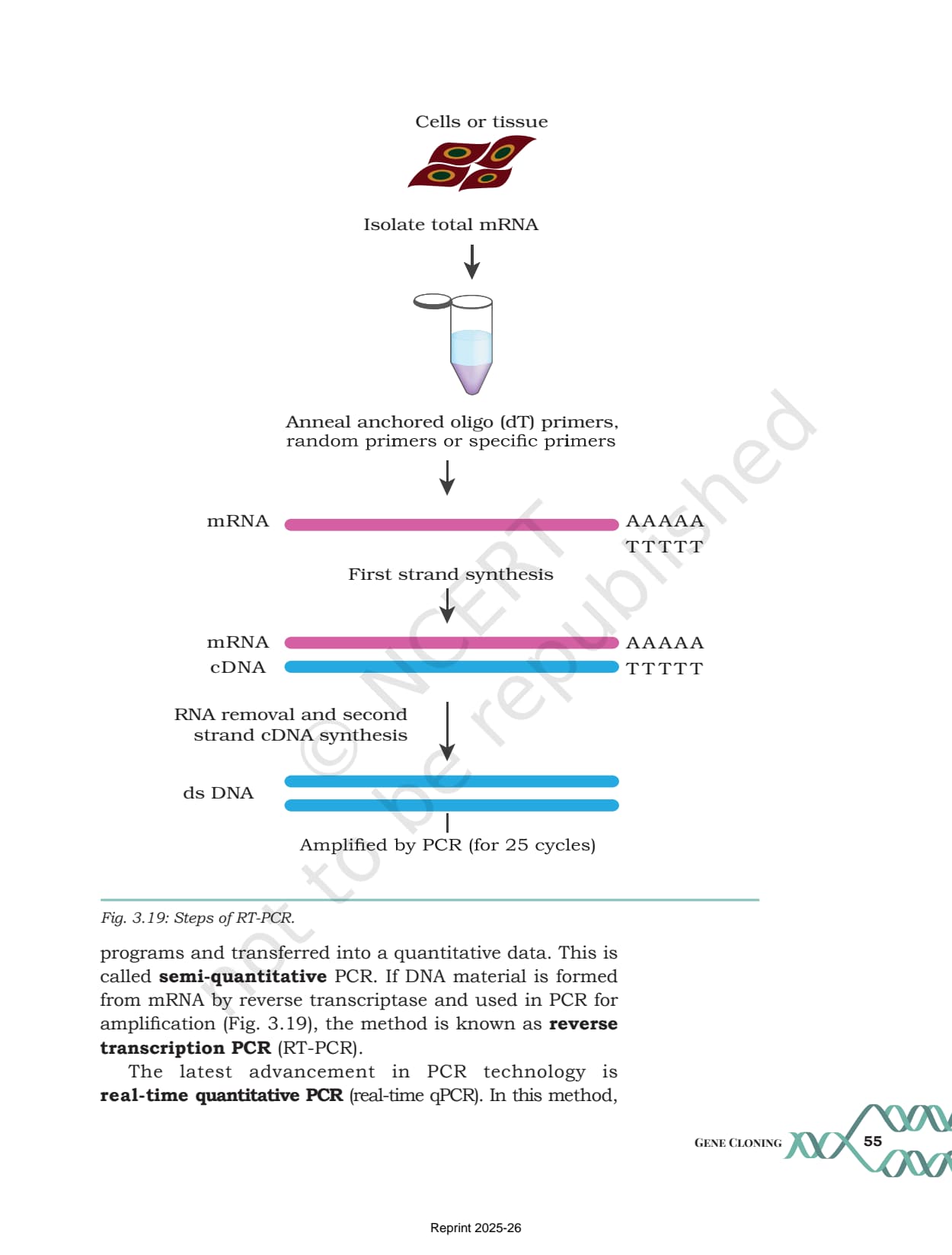
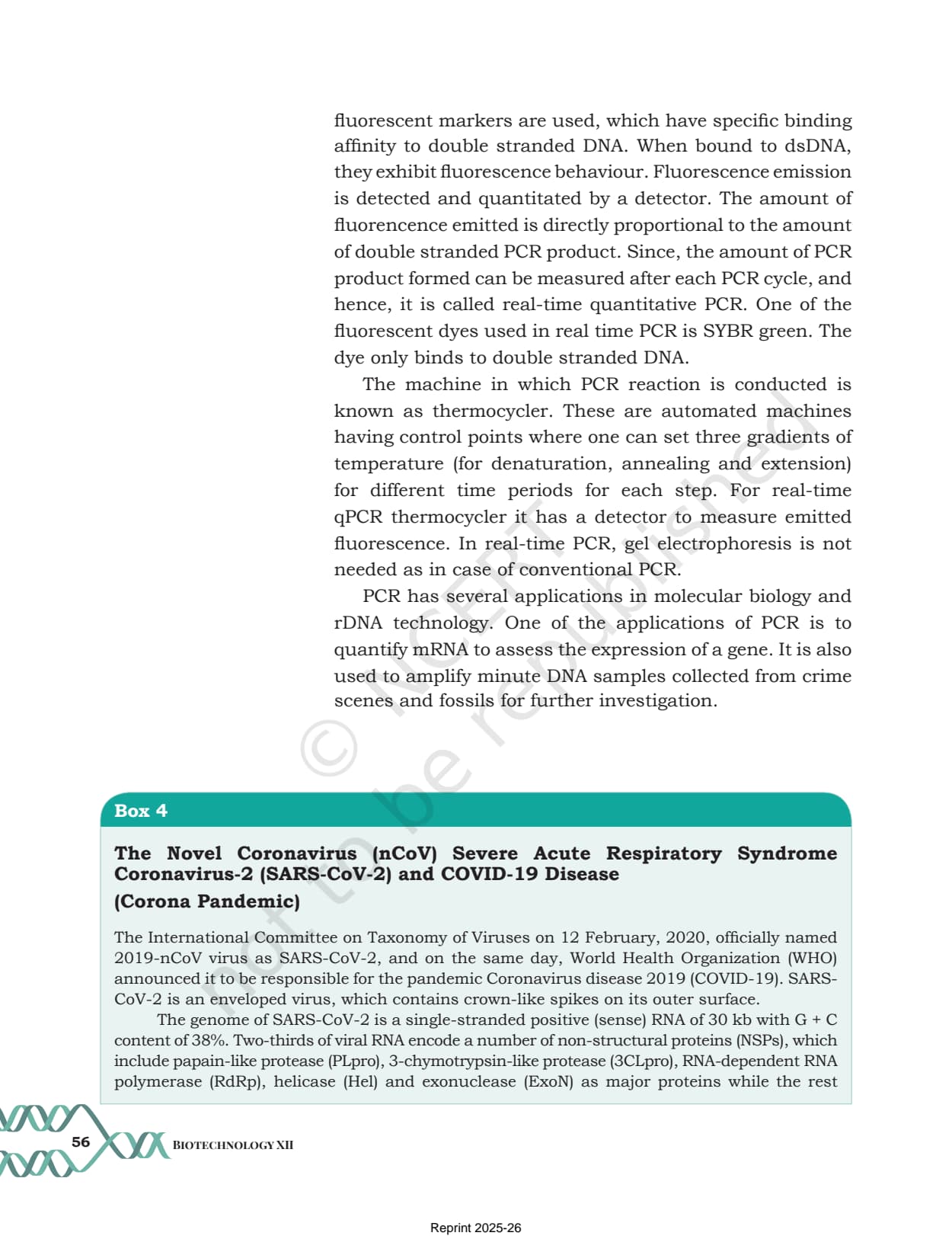
The chapter calls PCR "molecular photocopying" and explains the thermocycler, the machine that cycles a reaction through denaturation, annealing and extension temperatures. It also covers real-time quantitative PCR, where a fluorescent dye such as SYBR green lets the amount of product be measured after every cycle, skipping the gel electrophoresis step used in conventional PCR.
DNA Libraries and What Collegedunia Adds to This Chapter PDF
Section 3.8 closes the chapter with two kinds of DNA libraries, the storage step that keeps cloned fragments available for later use.
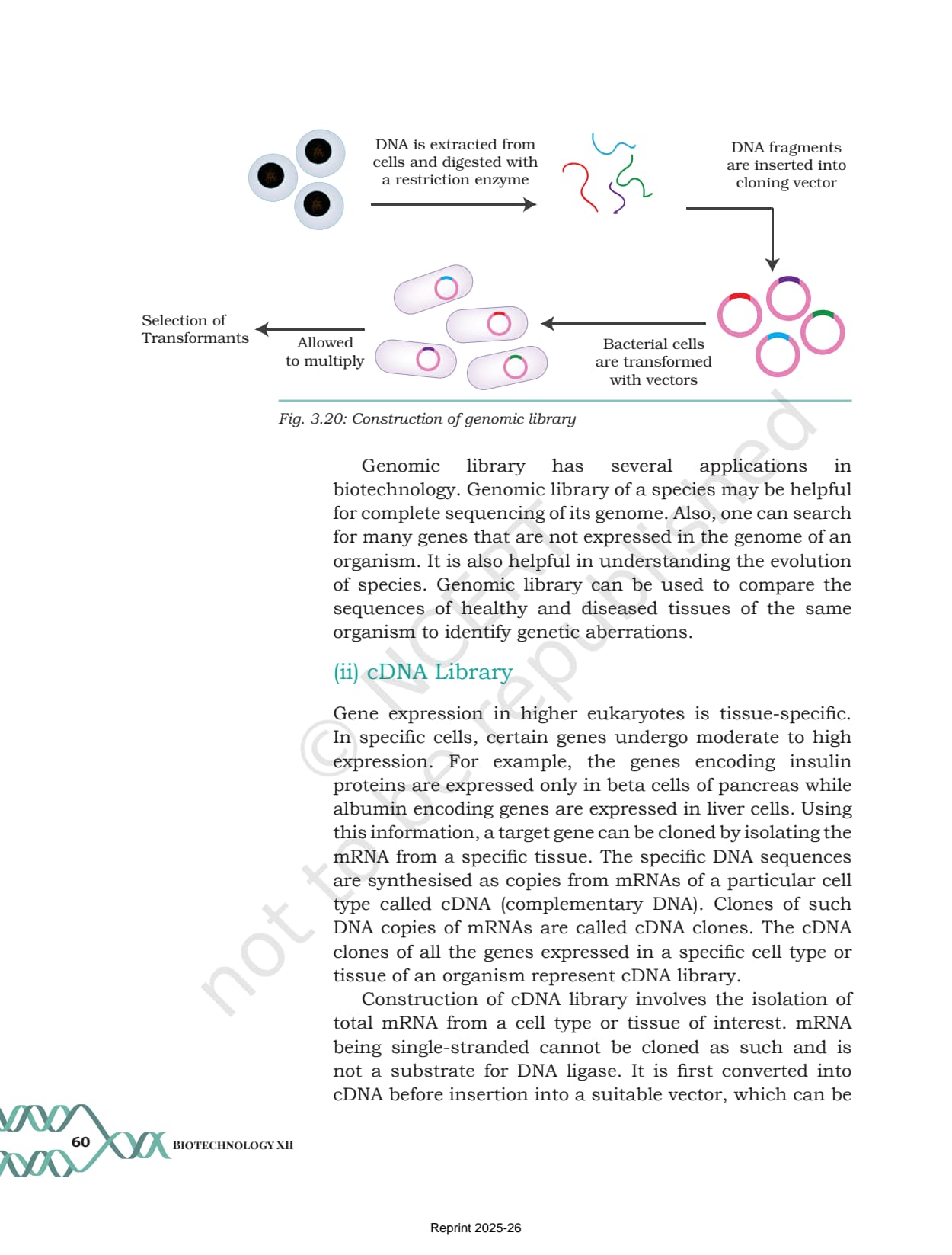
- Genomic library: a collection of clones covering an organism's entire genome, used for full genome sequencing and comparing healthy versus diseased tissue
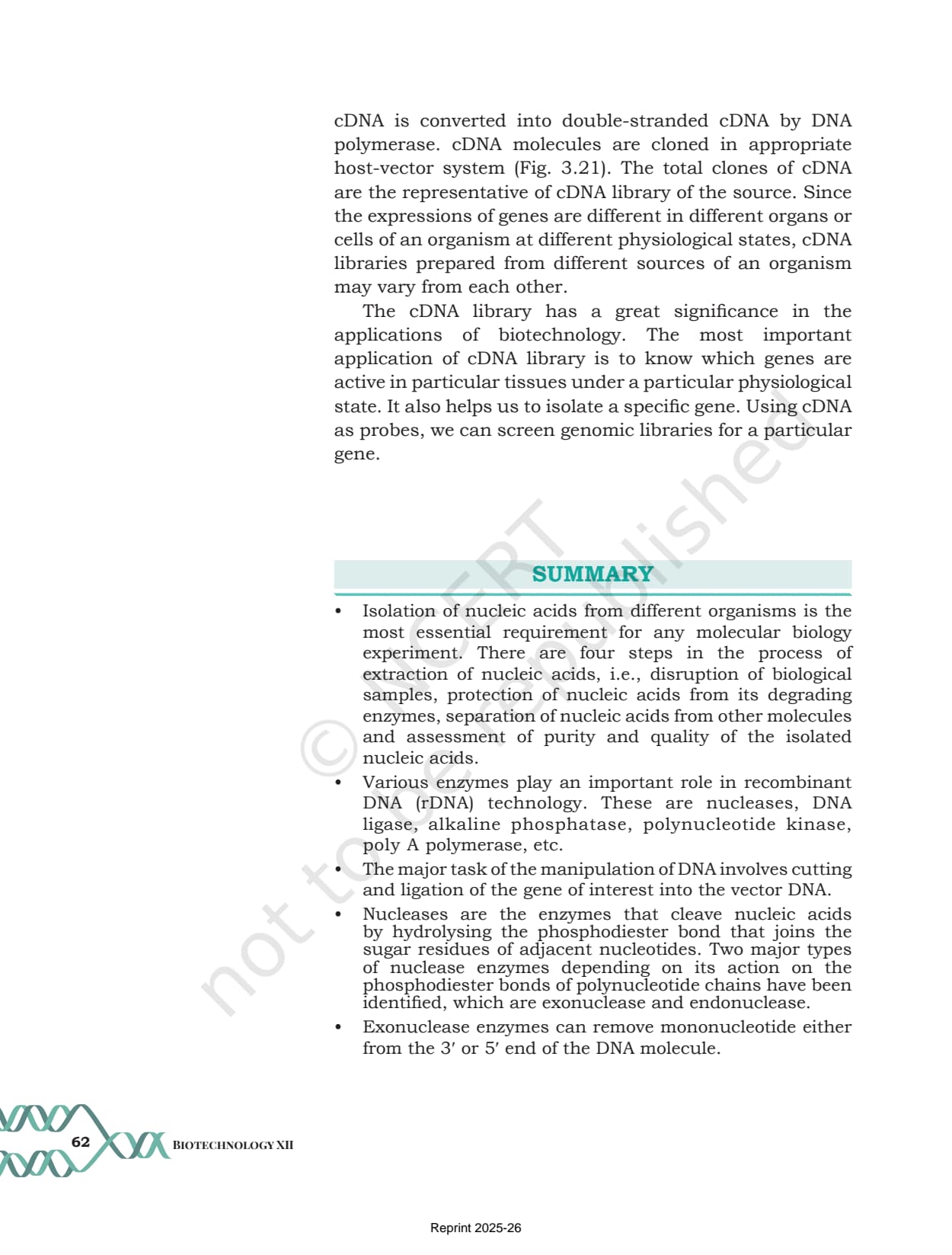
- cDNA library: built from the mRNA expressed in one specific tissue, since genes such as insulin or albumin switch on only in particular cells
Collegedunia hosts the exact NCERT file plus a way to read it before downloading.
- Official file: the exact NCERT chapter PDF, no pages removed
- Read in the browser: page through all 40 pages before downloading
- Chapter list: jump to any other Biotechnology chapter from one table
Also Check: the related Class 12 Biology chapter that covers the same rDNA technology basics from a different subject's lens.
| Resource | Link |
|---|---|
| Related reading (Biology) | Biotechnology: Principles and Processes Class 12 Biology NCERT Book PDF |
| Chapter notes | Gene Cloning Class 12 Notes (coming soon) |
| Chapter solutions | Gene Cloning Class 12 NCERT Solutions (coming soon) |
| Handwritten notes | Gene Cloning Class 12 Handwritten Notes (coming soon) |
| Previous chapter | Host-Vector System NCERT Book PDF (coming soon) |
| Next chapter | Applications of Recombinant DNA Technology NCERT Book PDF (coming soon) |
Class 12 Biotechnology NCERT Book PDF: All Chapters
Every chapter of the book gets its own page. The 2026-27 Class 12 Biotechnology textbook has 13 chapters, and Chapter 3 sits right after the host-vector system that a cloning experiment depends on.
| Chapter | Download |
|---|---|
| Chapter 1 | An Overview of Recombinant DNA Technology NCERT Book PDF (coming soon) |
| Chapter 2 | Host-Vector System NCERT Book PDF (coming soon) |
| Chapter 3 | Gene Cloning NCERT Book PDF |
| Chapter 4 | Applications of Recombinant DNA Technology NCERT Book PDF (coming soon) |
| Chapter 5 | Genome Technology and Engineering NCERT Book PDF (coming soon) |
| Chapter 6 | Microbial Culture NCERT Book PDF (coming soon) |
| Chapter 7 | Plant Tissue Culture NCERT Book PDF (coming soon) |
| Chapter 8 | Animal Cell Culture NCERT Book PDF (coming soon) |
| Chapter 9 | Stem Cell Culture and Organ Culture NCERT Book PDF (coming soon) |
| Chapter 10 | Bioprocessing and Biomanufacturing NCERT Book PDF (coming soon) |
| Chapter 11 | Bioremediation NCERT Book PDF (coming soon) |
| Chapter 12 | Recent Innovations in Biotechnology NCERT Book PDF (coming soon) |
| Chapter 13 | Entrepreneurship NCERT Book PDF (coming soon) |
Gene Cloning Class 12 NCERT Book PDF FAQs
Common Student Questions on the Gene Cloning Chapter File
Ques. Where can I download the Class 12 Biotechnology Chapter 3 Gene Cloning NCERT Book PDF?
Ans. The official 40-page chapter file is on this page, free to download.
Ques. How many pages is the Gene Cloning chapter?
Ans. 40 pages, printed pages 27 to 66 in the 2026-27 book, and this PDF is the complete chapter.
Ques. What is a candidate gene in gene cloning?
Ans. A candidate gene is a gene chosen for cloning because of its role in health, the economy or evolution, such as the insulin gene or a salinity-tolerance gene. Section 3.1 explains why finding one in a genome of billions of base pairs is so difficult.
Ques. What are the three modes of DNA transfer covered in this chapter?
Ans. Transformation, transduction and conjugation, all explained in Section 3.4 with the example of how bacteria naturally exchange DNA.
Ques. How does blue-white selection work?
Ans. A vector carrying an intact lacZ gene produces blue colonies on X-gal media. When an insert disrupts lacZ, the colony turns white, which marks it as a true recombinant. This is covered in Section 3.5.
Ques. What is the difference between a genomic library and a cDNA library?
Ans. A genomic library holds clones covering an organism's whole genome. A cDNA library holds only the genes expressed as mRNA in one specific tissue. Section 3.8 covers both.
Ques. Who developed the Polymerase Chain Reaction?
Ans. Kary B. Mullis developed PCR, the technique Section 3.7 calls "molecular photocopying" because it can turn a few DNA copies into millions.
Ques. What is the difference between Southern, northern and western blotting?
Ans. Southern blotting detects DNA, northern blotting detects RNA, and western blotting detects a protein using a specific antibody. Section 3.6 covers all three plus eastern blotting for post-translational protein changes.
Ques. Is this the official NCERT file?
Ans. Yes. It is the NCERT chapter PDF for 2026-27 hosted as published, with no pages removed or added.



Comments