



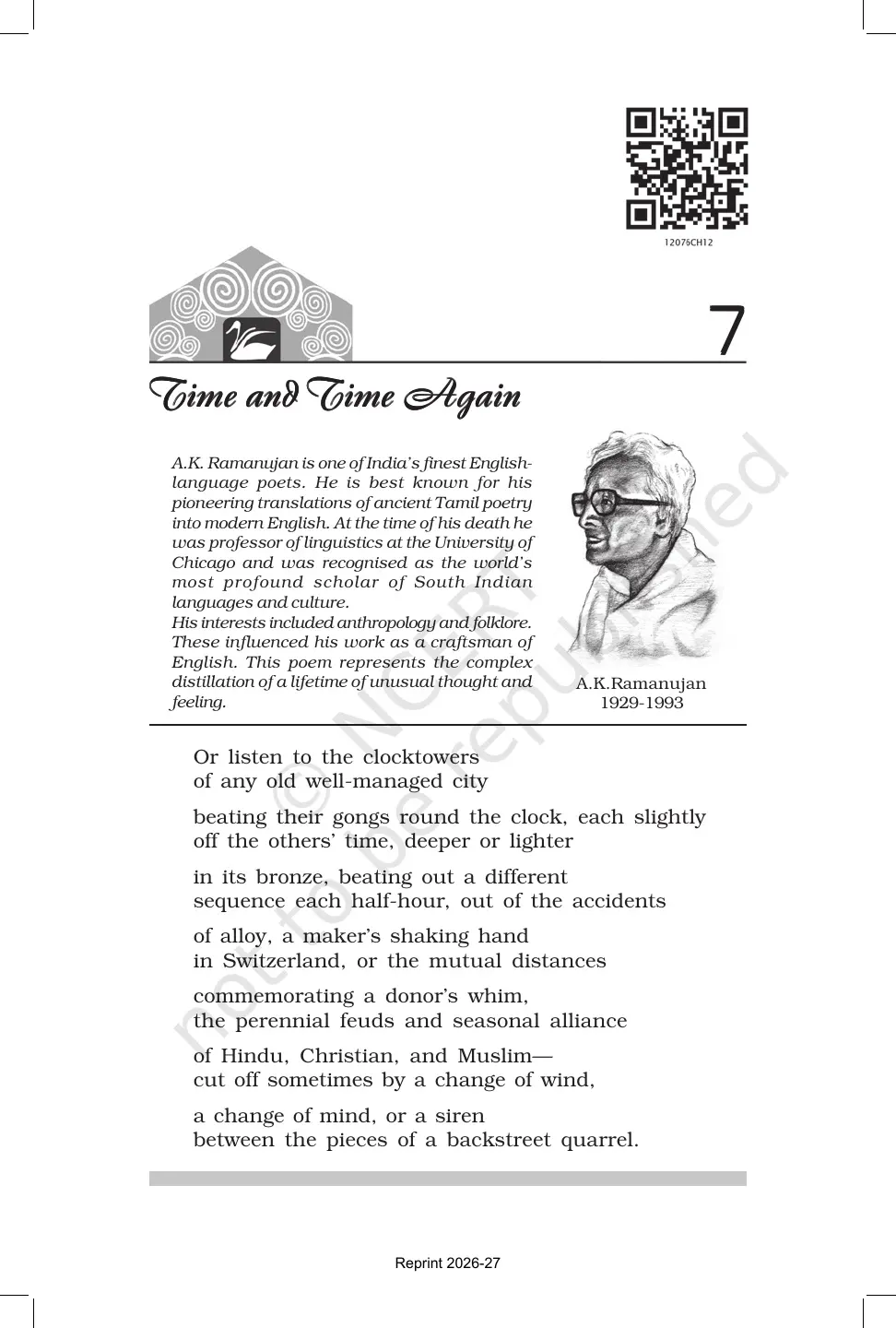
The NCERT Class 12 English Supplementary Chapter 12 Time and Time Again Book PDF gives students the official 2026-27 Kaleidoscope poem by A.K. Ramanujan. Use it to read the city clocktower image, mark the communal references, and revise the NCERT questions before checking notes or solutions.
- Best use: read once for the city sound and once for the broken clock image.
- Chapter focus: time, communal disharmony, violence and nature's force.
- Revision cue: connect each image to the poet's attitude, not only the scene.
Student Feedback: In a Collegedunia survey of 9,280 Class 12 English students before the 2026 boards, most students said this poem became clearer after they treated the clocks as symbols of a shared but fragile city.
Time and Time Again NCERT Book PDF Overview
Class 12 English Supplementary Chapter 12 belongs to the Kaleidoscope poetry section. Time and Time Again is a compact poem, but it carries a serious public theme. A.K. Ramanujan begins with clocktowers in an old city and then moves toward images of violence, riots and natural destruction.
The poem is not only about clocks. It is about how a city measures time, memory and conflict. The official PDF keeps the poem, questions and suggested reading together for direct 2026-27 revision.
| NCERT part | What to notice | Answer cue |
|---|---|---|
| Opening image | Clocktowers with different gongs | Explain sound, distance and difference |
| Communal reference | Hindu, Christian and Muslim histories | Connect timekeeping with city life |
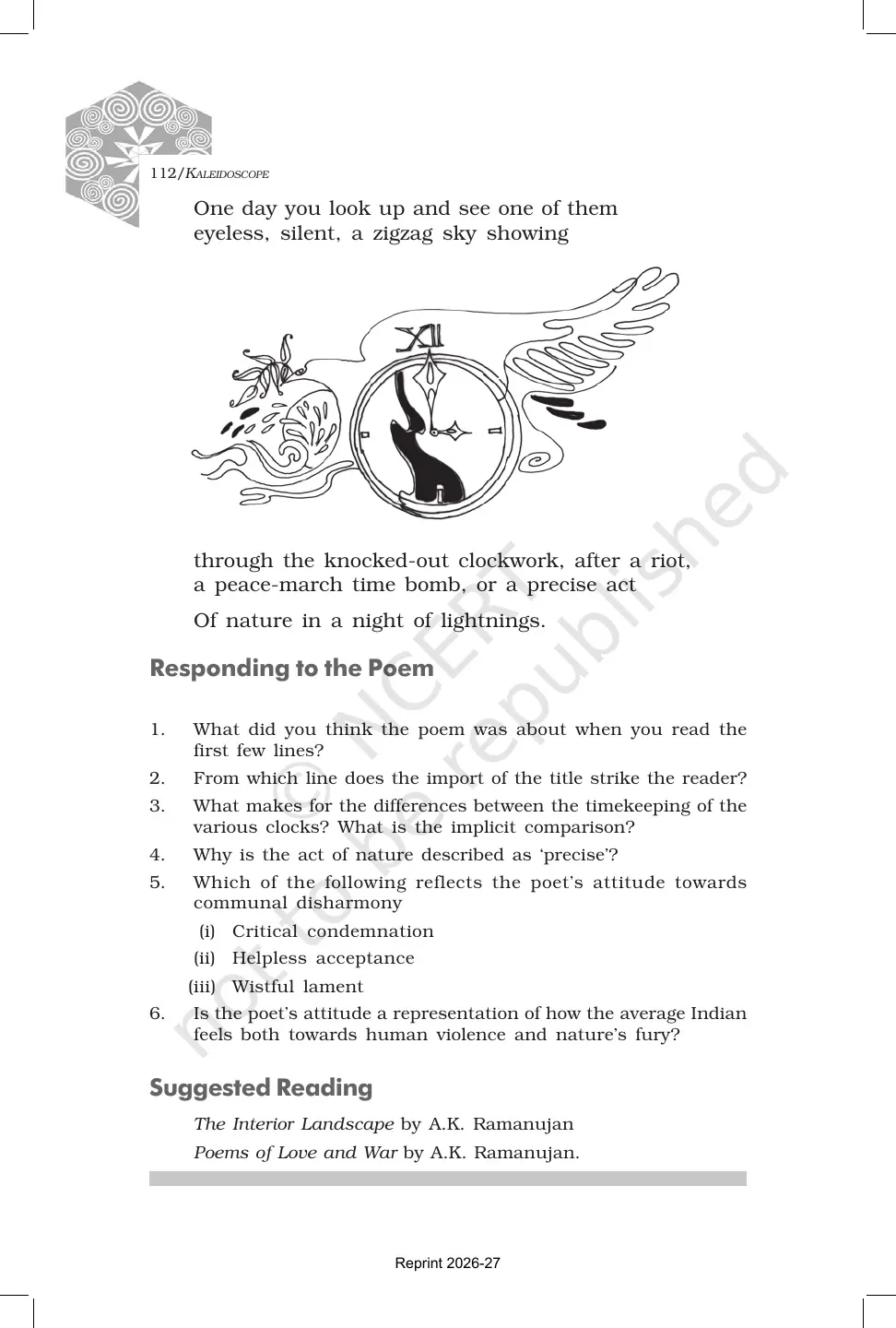
| Broken clock | Riot, bomb or lightning | Show how violence interrupts order |
Clocktower Image in Time and Time Again
The clocktower image is the centre of the poem. Each clock sounds slightly differently because of metal, distance, donors, history and accident. This turns a simple city sound into a layered public image. Different clocks suggest different communities and memories inside the same city.
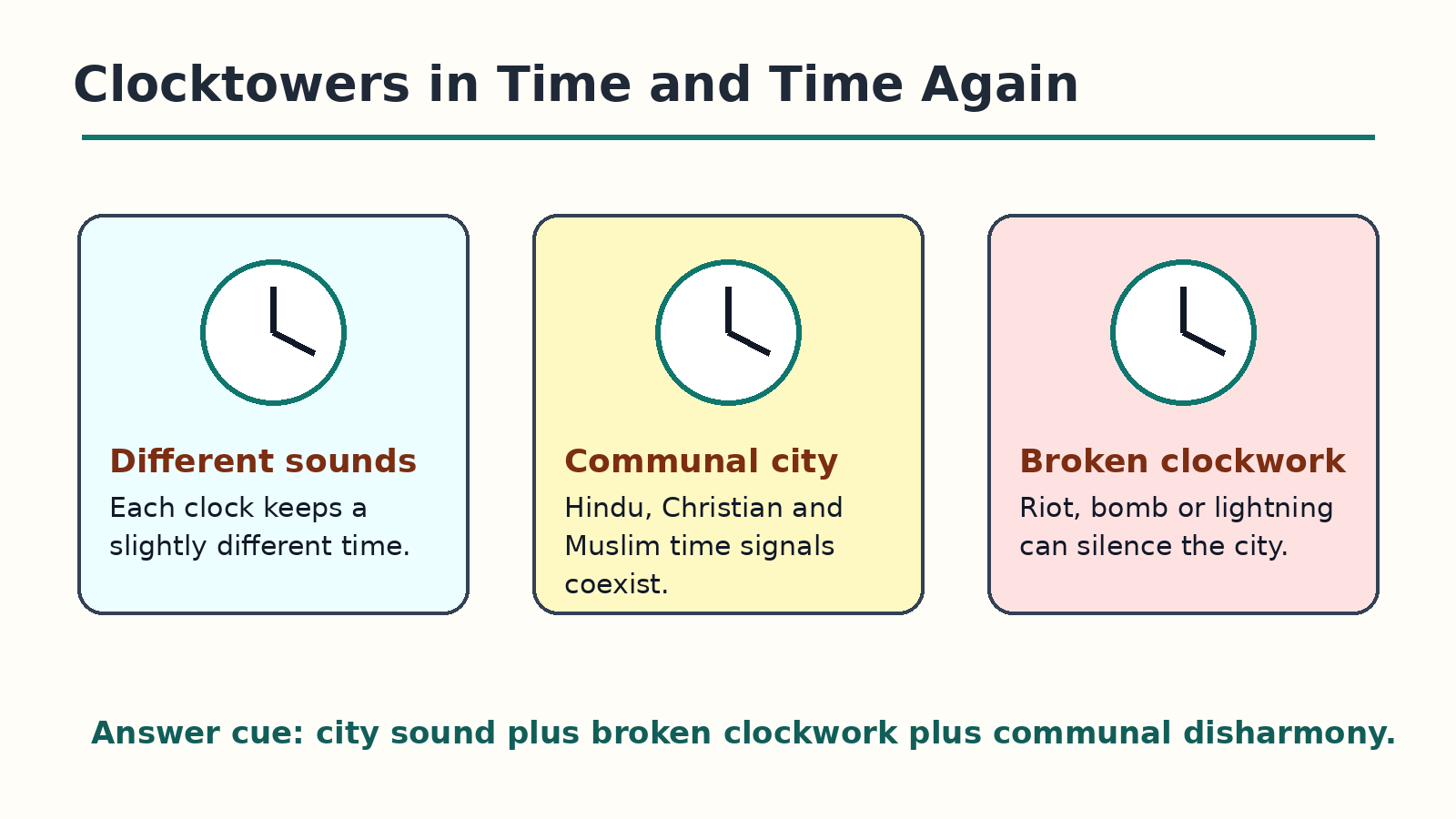
- Clock sound: shows order, habit and public time.
- Different sequence: shows variation within one city.
- Knocked-out clockwork: shows the damage caused by violence or nature.
- Implicit comparison: human conflict is set against time's fragile order.
Time and Time Again Poem Summary
Source: Magnet Brains on YouTube
How to Study Time and Time Again for Class 12 English
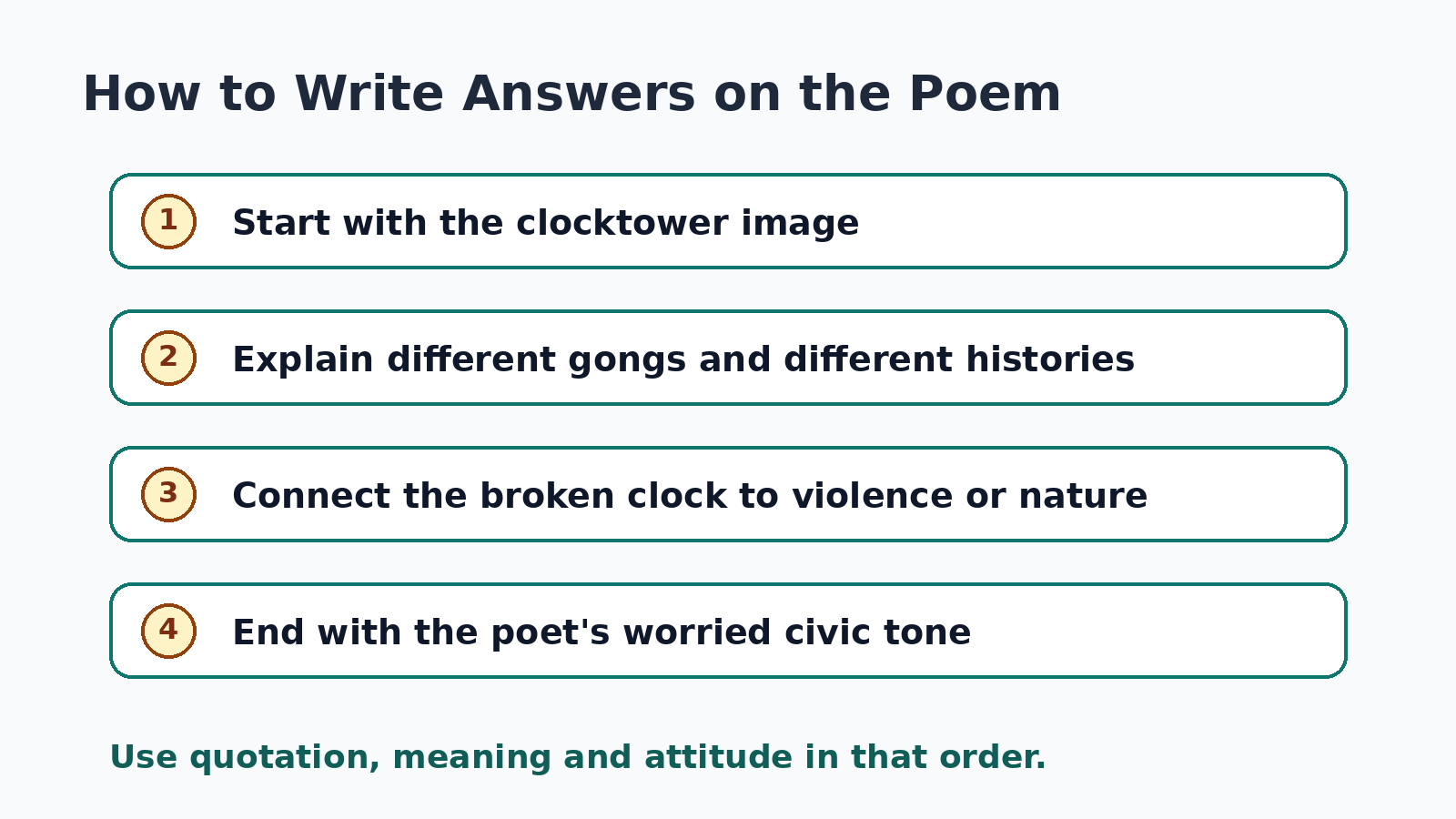
A good answer on this poem should move from image to meaning. Do not write only that the poet describes clocks. Write how the clocktowers build an image of a city where time, faith and public life overlap. The safest answer pattern is image, public meaning, then poet's attitude.
- Underline words linked to clocks, bells, alloy and distance.
- Mark the line where the poem shifts toward damage.
- Write one note on communal disharmony.
- End answers with the poet's worried but controlled tone.
Important NCERT Questions from the Poem
The NCERT questions ask students to identify the title's meaning, the difference between clocks, the act of nature and the poet's attitude toward communal disharmony. These are short questions, but they need precise wording.
| Question focus | What to include | Common mistake |
|---|---|---|
| Title | Repeated time signals and broken time | Writing only about clock hours |
| Different clocks | Alloy, distance, maker and donor history | Missing the implicit comparison |
| Act of nature | Lightning as exact and sudden force | Treating it like a random event only |
| Poet's attitude | Critical concern and wistful lament | Choosing one label without explanation |
Official Time and Time Again PDF and 2026-27 Revision Use
The official PDF is the source text for the poem and exercise. Read it before writing answers because the poem's effect depends on exact phrases such as "beating their gongs", "perennial feuds" and "knocked-out clockwork".
For final revision, spend ten minutes on the poem text, ten minutes on the six NCERT questions and five minutes on a one-line theme summary. Keep quotations short and explain the image immediately after each quotation.
Related Resources for Class 12 Time and Time Again
Use the NCERT Book PDF as the source text, then use the notes and solutions pages for answer framing. The linked resources follow the same Class 12 Kaleidoscope chapter.
| Resource | Best for | Link |
|---|---|---|
| NCERT Solutions | Step-by-step answers for NCERT questions | Time and Time Again NCERT Solutions |
| NCERT Notes | Theme, imagery and quick revision points | Time and Time Again Notes |
| Previous Year Questions | Board-style question practice | Time and Time Again PYQ PDF |
All NCERT Book PDFs for Class 12 English Supplementary
The table below links to live NCERT Book PDF chapters from the same Class 12 English Supplementary Kaleidoscope set.
| Chapter | Title | Book PDF |
|---|---|---|
| Chapter 1 | I Sell My Dreams | NCERT Book PDF |
| Chapter 2 | Eveline | NCERT Book PDF |
| Chapter 3 | A Wedding in Brownsville | NCERT Book PDF |
| Chapter 4 | Tomorrow | NCERT Book PDF |
| Chapter 5 | One Centimetre | NCERT Book PDF |
| Chapter 6 | A Lecture upon the Shadow | NCERT Book PDF |
| Chapter 7 | Poems by Milton | NCERT Book PDF |
| Chapter 8 | Poems by Blake | NCERT Book PDF |
| Chapter 9 | Kubla Khan | NCERT Book PDF |
| Chapter 10 | Trees | NCERT Book PDF |
| Chapter 11 | The Wild Swans at Coole | NCERT Book PDF |
| Chapter 12 | Time and Time Again | Current PDF |
Time and Time Again Class 12 English NCERT Book PDF FAQs
Ques. What does the Class 12 English Time and Time Again NCERT Book PDF include?
Ans. It includes the official Kaleidoscope poem by A.K. Ramanujan, the NCERT exercise questions and suggested reading for 2026-27 revision.
Ques. What is the main image in Time and Time Again?
Ans. The main image is a city's clocktowers beating different gongs, later interrupted by riot, bomb or lightning.
Ques. How should students answer questions from this poem?
Ans. Students should begin with the clocktower image, explain its public meaning, and then connect it to communal disharmony or nature's force.
Ques. Is Time and Time Again part of Class 12 Kaleidoscope?
Ans. Yes. Time and Time Again is part of the poetry section in the Class 12 English Supplementary Kaleidoscope book.



Comments