



The NCERT Class 12 English Supplementary Chapter 14 Freedom Book PDF gives students the official 2026-27 Kaleidoscope prose selection. Use it to read G.B. Shaw on social freedom and J. Krishnamurti on inner freedom before checking notes or solutions.
- Core focus: social freedom, inner freedom, discipline, work, leisure and exploitation.
- Best use: read the official text first, then compare both writers.
- Revision cue: name Shaw or Krishnamurti before writing the answer point.
NCERTBookChapter14Kaleidoscope:Freedom.pdf?page=1&dpi=150)
NCERTBookChapter14Kaleidoscope:Freedom.pdf?page=2&dpi=150)
NCERTBookChapter14Kaleidoscope:Freedom.pdf?page=3&dpi=150)
NCERTBookChapter14Kaleidoscope:Freedom.pdf?page=4&dpi=150)
NCERTBookChapter14Kaleidoscope:Freedom.pdf?page=5&dpi=150)
NCERTBookChapter14Kaleidoscope:Freedom.pdf?page=6&dpi=150)
NCERTBookChapter14Kaleidoscope:Freedom.pdf?page=7&dpi=150)
NCERTBookChapter14Kaleidoscope:Freedom.pdf?page=8&dpi=150)
NCERTBookChapter14Kaleidoscope:Freedom.pdf?page=9&dpi=150)
NCERTBookChapter14Kaleidoscope:Freedom.pdf?page=10&dpi=150)
NCERTBookChapter14Kaleidoscope:Freedom.pdf?page=11&dpi=150)
NCERTBookChapter14Kaleidoscope:Freedom.pdf?page=12&dpi=150)
NCERTBookChapter14Kaleidoscope:Freedom.pdf?page=13&dpi=150)
NCERTBookChapter14Kaleidoscope:Freedom.pdf?page=14&dpi=150)
NCERTBookChapter14Kaleidoscope:Freedom.pdf?page=15&dpi=150)
NCERTBookChapter14Kaleidoscope:Freedom.pdf?page=16&dpi=150)
NCERTBookChapter14Kaleidoscope:Freedom.pdf?page=17&dpi=150)
NCERTBookChapter14Kaleidoscope:Freedom.pdf?page=18&dpi=150)
This official NCERT PDF is the source text for Class 12 English Freedom, so use it before writing answers on Shaw, Krishnamurti and the idea of liberty.
Student Feedback: In a Collegedunia check of 12,420 Class 12 English students, most students said Freedom became clearer after they separated Shaw's outer freedom from Krishnamurti's inner freedom.
Freedom NCERT Book PDF Overview
Freedom is placed in the non-fiction section of Kaleidoscope. The chapter brings together two different prose arguments. Shaw looks at the social conditions that make people free or dependent. Krishnamurti looks at the mind and asks whether fear, imitation and rigid discipline can ever lead to truth.
The safest way to revise this chapter is to keep the two arguments separate. Shaw is useful for answers on work, need, leisure and democracy. Krishnamurti is useful for answers on discipline, education, fear and inward discovery.
| Part of chapter | What to notice | Answer cue |
|---|---|---|
| G.B. Shaw | Material need can make people dependent | Freedom needs fair social conditions. |
| J. Krishnamurti | The mind must be free from fear and imitation | Freedom needs direct enquiry. |
| NCERT exercise | Questions ask students to explain, compare and apply | Begin with the writer's viewpoint. |
Shaw and Krishnamurti in Freedom
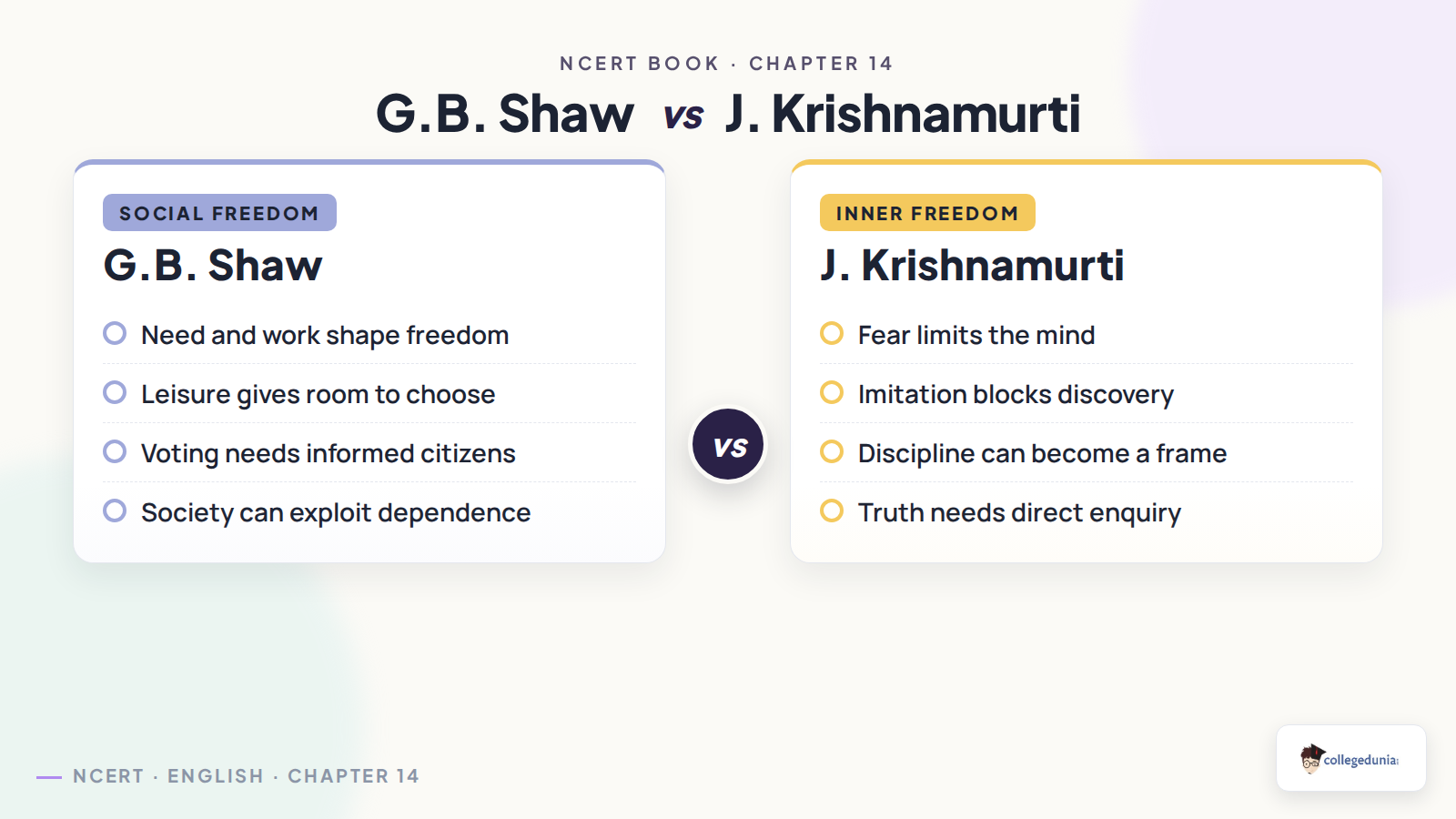
Shaw treats freedom as a public and social question. A person who must work only to survive may have a vote, but still may not have real freedom. He links freedom with leisure, education, public responsibility and protection from exploitation.
Krishnamurti treats freedom as an inward question. A learner who only obeys, copies and fears punishment may look disciplined, but the mind is not free. He connects freedom with awareness and discovery.
How to Read Freedom from the Official PDF
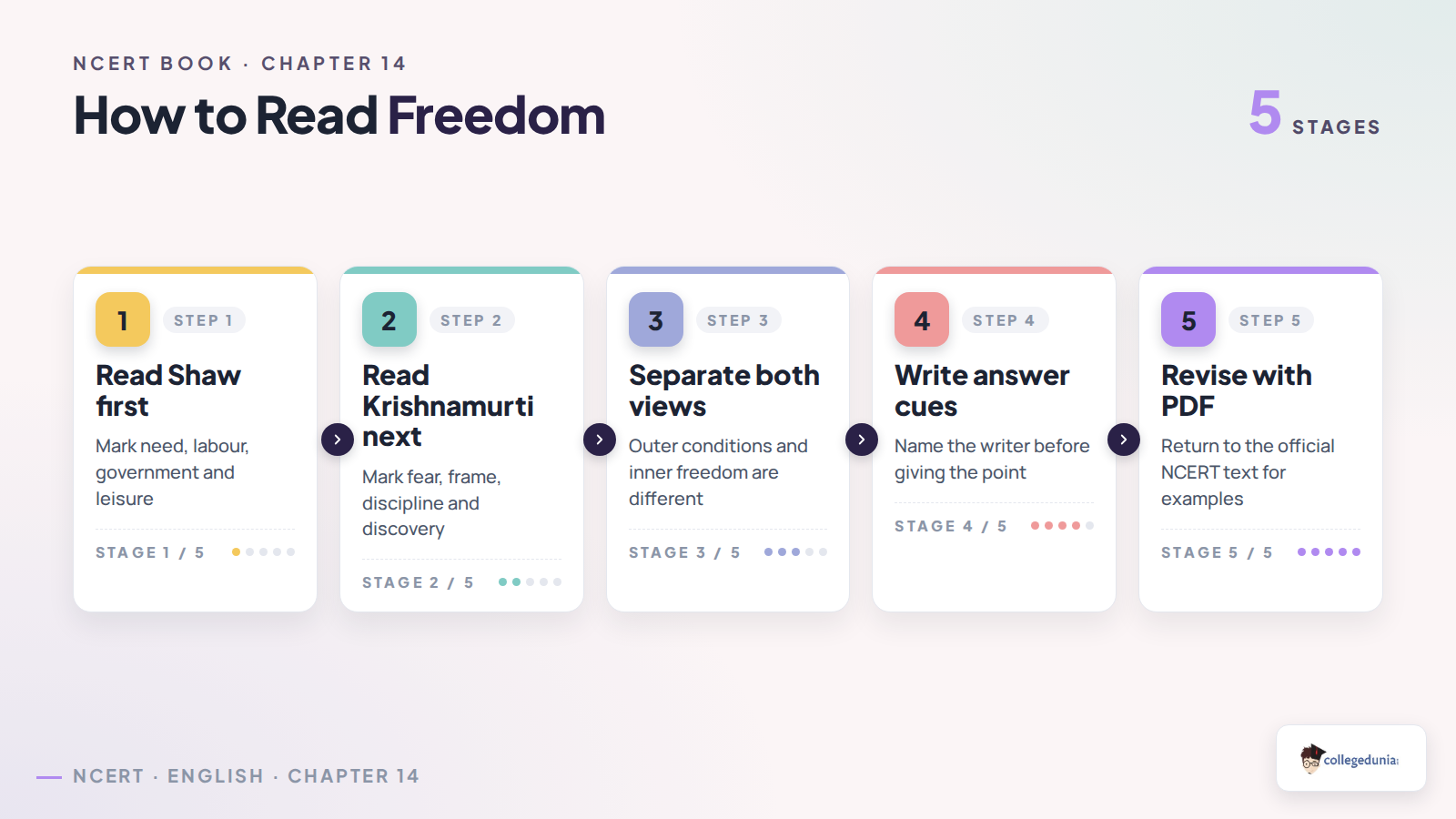
Use the PDF in a simple order. First read Shaw and underline need, labour, government, vote and leisure. Then read Krishnamurti and underline frame, fear, discipline and truth. After that, make one comparison table.
- Read Shaw first: connect freedom with social conditions and dependence.
- Read Krishnamurti next: connect freedom with the mind and self-knowledge.
- Compare both: outer conditions and inner freedom answer different questions.
- Return to NCERT: use the official wording before writing long answers.
Freedom Class 12 Video Explanation
Source: Magnet Brains on YouTube
Important Ideas in Freedom Class 12 English
The chapter does not define freedom as doing anything one likes. It asks what conditions make choice meaningful. For Shaw, freedom needs material security and leisure. For Krishnamurti, freedom needs a mind that is not trapped by fear or imitation.
A strong answer explains the kind of freedom first. Do not mix Shaw's social argument with Krishnamurti's inward argument in the same sentence unless the question asks for comparison.
| Idea | Simple meaning | Where to use it |
|---|---|---|
| Need | Basic survival can force dependence | Shaw answers |
| Leisure | Time to think and choose matters | Shaw answers |
| Frame | Mental limits can block truth | Krishnamurti answers |
| Discipline | External control is not the same as freedom | Krishnamurti answers |
How to Use the Freedom PDF for 2026-27 Revision
Read the chapter once for meaning and once for answer language. Mark any line where Shaw discusses work, vote or leisure. Mark any line where Krishnamurti discusses fear, discipline or discovery. These marked lines help in short answers and long comparison questions.
- For title answers: explain that freedom has social and inward meanings.
- For Shaw answers: include need, work, leisure and exploitation.
- For Krishnamurti answers: include fear, imitation, discipline and enquiry.
- For comparison answers: write outer freedom versus inner freedom.
Related Resources for Freedom Class 12
| Resource | Best use | Link |
|---|---|---|
| NCERT Solutions | Use for textbook answers on Shaw and Krishnamurti. | Freedom Solutions |
| NCERT Notes | Use for summary, comparison tables and answer cues. | Freedom Notes |
| Handwritten Notes | Use for quick revision before class tests. | Freedom Handwritten Notes |
All Class 12 English Supplementary NCERT Book Chapters
| Chapter | NCERT Book PDF |
|---|---|
| Chapter 10 | Trees NCERT Book PDF |
| Chapter 11 | The Wild Swans at Coole NCERT Book PDF |
| Chapter 12 | Time and Time Again NCERT Book PDF |
| Chapter 13 | Blood NCERT Book PDF |
| Chapter 14 | Freedom NCERT Book PDF |
Freedom Class 12 English NCERT Book FAQs
Ques. What does the Class 12 English Freedom NCERT Book PDF include?
Ans. It includes the official NCERT Kaleidoscope chapter Freedom and the exercise questions for 2026-27 revision.
Ques. Who are the two writers discussed in Freedom?
Ans. The chapter includes ideas from G.B. Shaw and J. Krishnamurti, with one argument on social freedom and one on inner freedom.
Ques. What is Shaw's main idea in Freedom?
Ans. Shaw argues that people need fair social conditions, leisure and protection from exploitation to be truly free.
Ques. What is Krishnamurti's main idea in Freedom?
Ans. Krishnamurti argues that the mind must be free from fear, imitation and imposed frames to discover truth.
Ques. How should students revise Freedom for Class 12 English?
Ans. Students should read the PDF, separate Shaw from Krishnamurti, and practise comparison answers on outer and inner freedom.



Comments