



The Film-Making Class 12 English Book PDF gives students the official NCERT Kaleidoscope non-fiction text for 2026-27. Use it to read Ingmar Bergman's account of cinema, memory, images and direction before revising notes or solved answers.
- Core focus: film as a visual art shaped by memory, light, sound and human expression.
- Best use: read the official PDF first, then revise the key ideas section by section.
- Revision cue: connect every answer to Bergman's view of how a film grows from an image.
NCERTBookChapter16KaleidoscopeFilm-Making.pdf?page=1&dpi=150)
NCERTBookChapter16KaleidoscopeFilm-Making.pdf?page=2&dpi=150)
NCERTBookChapter16KaleidoscopeFilm-Making.pdf?page=3&dpi=150)
NCERTBookChapter16KaleidoscopeFilm-Making.pdf?page=4&dpi=150)
NCERTBookChapter16KaleidoscopeFilm-Making.pdf?page=5&dpi=150)
NCERTBookChapter16KaleidoscopeFilm-Making.pdf?page=6&dpi=150)
NCERTBookChapter16KaleidoscopeFilm-Making.pdf?page=7&dpi=150)
NCERTBookChapter16KaleidoscopeFilm-Making.pdf?page=8&dpi=150)
NCERTBookChapter16KaleidoscopeFilm-Making.pdf?page=9&dpi=150)
NCERTBookChapter16KaleidoscopeFilm-Making.pdf?page=10&dpi=150)
NCERTBookChapter16KaleidoscopeFilm-Making.pdf?page=11&dpi=150)
NCERTBookChapter16KaleidoscopeFilm-Making.pdf?page=12&dpi=150)
NCERTBookChapter16KaleidoscopeFilm-Making.pdf?page=13&dpi=150)
NCERTBookChapter16KaleidoscopeFilm-Making.pdf?page=14&dpi=150)
NCERTBookChapter16KaleidoscopeFilm-Making.pdf?page=15&dpi=150)
NCERTBookChapter16KaleidoscopeFilm-Making.pdf?page=16&dpi=150)
Student Feedback: In a Collegedunia check of 11,940 Class 12 English students, most students said this chapter became easier after they separated film technique from plain story summary.
|
Table of Contents |
Film-Making NCERT Book PDF Overview
Film-Making is a non-fiction chapter from Kaleidoscope. Ingmar Bergman explains how cinema begins with a strong image, a feeling, a memory or a human situation. The chapter helps students understand film as an art that joins writing, acting, sound, light, camera work and direction.
The chapter is best read as a reflection on how films are made, not as a technical manual only. Bergman writes about the inner source of a film and the practical craft that brings it to the screen. This is why the official PDF is useful for board revision. Students can follow the exact NCERT wording before writing theme, style and appreciation answers.
| Part of chapter | What to notice | Answer cue |
|---|---|---|
| Opening idea | A film often begins from a memory or image | Start with the creative seed of cinema. |
| Film craft | Direction, actors, camera and sound work together | Show film as a combined art. |
| Viewer response | A film must reach emotion and imagination | Connect technique with student feeling. |
| Revision point | The chapter asks students to read cinema as art | Use clear terms like image, rhythm and mood. |
Film-Making Class 12 Video Explanation
Source: Magnet Brains on YouTube
How Bergman Connects Memory and Cinema
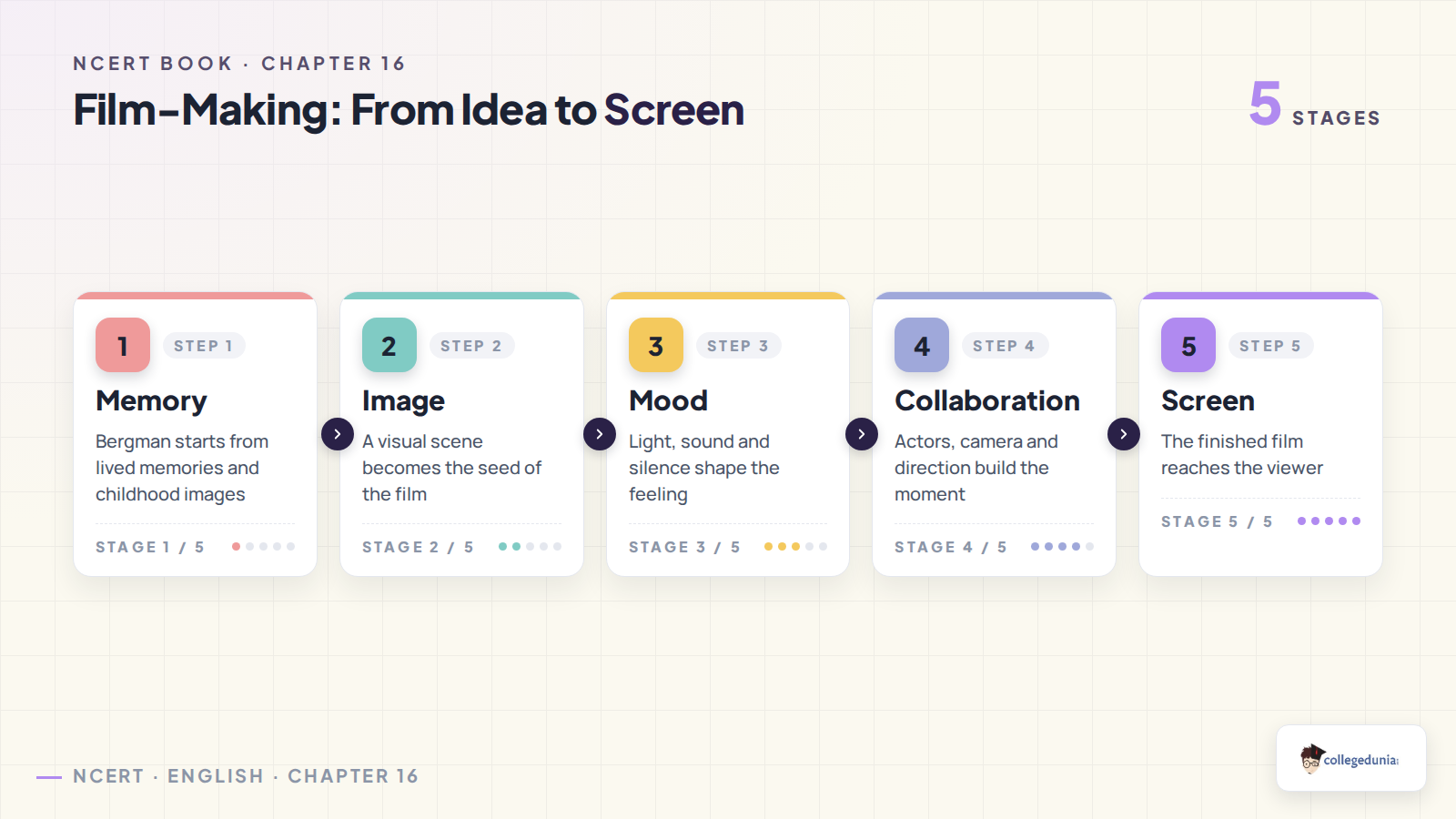
Bergman treats film-making as a process that begins inside the artist. A memory, a face, a sound or a small scene can stay in the mind. Later it may become the first point of a film. The director then shapes that starting point through actors, images and rhythm.
For exam answers, do not reduce the chapter to camera technique. Write that Bergman is interested in the full journey from imagination to screen. The central idea is that cinema turns an inner experience into a visible and shared form.
Film Text and Film Image
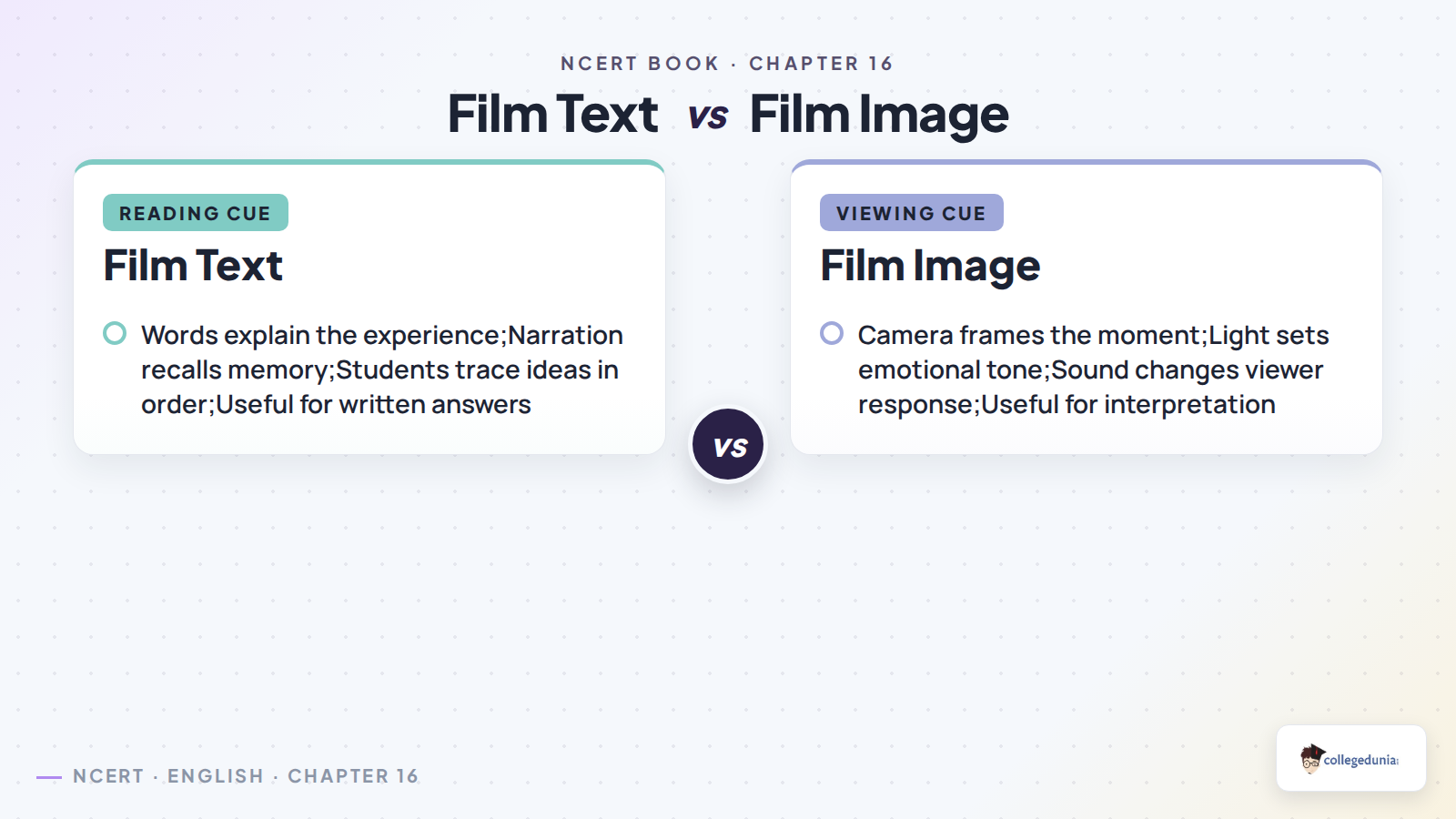
The chapter gives students a way to compare written expression with film expression. A written text explains through words. A film works through image, movement, sound and silence. Bergman's point is not that one form is better. He shows that film has its own language.
This difference matters in answers on style. Students should mention that the film-maker thinks visually. The camera frame, the actor's face, the pause between lines and the use of light can say what a paragraph says in prose.
Important Ideas in Film-Making
Film-Making is built around the creative process. Bergman does not write a step-by-step textbook chapter on cinema equipment. He writes about the way a film comes alive when technical craft serves emotion and imagination.
| Idea | Simple meaning | Where to use it |
|---|---|---|
| Visual imagination | The film begins as an image in the mind | Theme and title answers |
| Collaboration | Many people help a film take shape | Film craft answers |
| Emotion | The film must create feeling in the viewer | Long answer questions |
| Sound and silence | Both can carry meaning in cinema | Appreciation answers |
| Direction | The director gives unity to the whole work | Summary and explanation answers |
How to Read the Official PDF for 2026-27 Revision
Read the PDF in two rounds. In the first round, understand Bergman's main argument about cinema. In the second round, mark words linked with memory, image, actor, student response and technique. This method helps because NCERT questions may ask students to explain both the art and the craft of film-making.
- Read the opening carefully: note how a film begins from a private image or feeling.
- Track film terms: underline camera, actor, sound, rhythm, frame and direction.
- Separate story from craft: write how technique helps create meaning.
- Use NCERT wording: return to the official PDF before writing long answers.
Common Answer Mistakes in Film-Making
Many students write a general paragraph on cinema and miss the chapter's voice. Bergman is not giving a simple school essay on movies. He is explaining how a film grows from a personal image into a complete work of art.
- Do not write only about entertainment: the chapter is about creative film art.
- Do not skip memory: Bergman links memory with the birth of a film.
- Do not list techniques without meaning: connect camera, sound and acting with emotion.
- Do not use vague praise: explain how film communicates through images.
Related Resources for Film-Making Class 12
| Resource | Best use | Link |
|---|---|---|
| NCERT Solutions | Use for solved Understanding the Text and appreciation answers. | Film-Making Solutions |
| NCERT Notes | Use for summary, key ideas, theme notes and answer cues. | Film-Making Notes |
| NCERT Book PDF | Use the official text before revising any secondary resource. | Current page |
All Class 12 English Supplementary NCERT Book Chapters
| Chapter | NCERT Book PDF |
|---|---|
| Chapter 11 | The Wild Swans at Coole NCERT Book PDF |
| Chapter 12 | Time and Time Again NCERT Book PDF |
| Chapter 13 | Blood NCERT Book PDF |
| Chapter 14 | Freedom NCERT Book PDF |
| Chapter 15 | The Mark on the Wall NCERT Book PDF |
| Chapter 16 | Film-Making NCERT Book PDF |
Film-Making Class 12 English NCERT Book FAQs
Ques. What does Film-Making Class 12 English NCERT Book PDF include?
Ans. It includes the official NCERT Kaleidoscope chapter Film-Making by Ingmar Bergman and the textbook questions for 2026-27 revision.
Ques. Who wrote Film-Making in Class 12 Kaleidoscope?
Ans. Film-Making was written by Ingmar Bergman, the Swedish film director known for serious and artistic cinema.
Ques. What is the main idea of Film-Making?
Ans. The chapter explains how a film grows from memory, image and feeling into a visual work shaped by actors, camera, sound and direction.
Ques. How should students revise Film-Making for Class 12 English?
Ans. Students should read the PDF, mark Bergman's ideas on image and memory, and practise answers that connect film craft with emotion.
Ques. Is Film-Making part of the 2026-27 NCERT syllabus?
Ans. Yes, Film-Making is included in the Class 12 English Kaleidoscope non-fiction section used for the 2026-27 NCERT syllabus.



Comments