



The Why the Novel Matters Class 12 English Book PDF gives students the official NCERT Kaleidoscope non-fiction text for 2026-27. Use it to read D. H. Lawrence's essay on life, the body, the whole person and the novel before revising notes or solved answers.
- Core focus: Lawrence argues that the novel reaches the whole living person.
- Best use: read the official PDF first, then revise the metaphors and answer routes.
- Revision cue: connect every answer to "man alive" and the idea of wholeness.
NCERTBookChapter17Kaleidoscope:WhytheNovelMatters.pdf?page=1&dpi=150)
NCERTBookChapter17Kaleidoscope:WhytheNovelMatters.pdf?page=2&dpi=150)
NCERTBookChapter17Kaleidoscope:WhytheNovelMatters.pdf?page=3&dpi=150)
NCERTBookChapter17Kaleidoscope:WhytheNovelMatters.pdf?page=4&dpi=150)
NCERTBookChapter17Kaleidoscope:WhytheNovelMatters.pdf?page=5&dpi=150)
NCERTBookChapter17Kaleidoscope:WhytheNovelMatters.pdf?page=6&dpi=150)
NCERTBookChapter17Kaleidoscope:WhytheNovelMatters.pdf?page=7&dpi=150)
NCERTBookChapter17Kaleidoscope:WhytheNovelMatters.pdf?page=8&dpi=150)
NCERTBookChapter17Kaleidoscope:WhytheNovelMatters.pdf?page=9&dpi=150)
NCERTBookChapter17Kaleidoscope:WhytheNovelMatters.pdf?page=10&dpi=150)
NCERTBookChapter17Kaleidoscope:WhytheNovelMatters.pdf?page=11&dpi=150)
Student Feedback: In a Collegedunia check of 12,640 Class 12 English students, most students found this chapter easier after linking each Lawrence metaphor to one exam answer cue.
Why the Novel Matters NCERT Book PDF Overview
Why the Novel Matters is a non-fiction essay from Kaleidoscope. Lawrence questions the habit of splitting a person into body, soul, mind or brain. He says the living person is whole, and the novel matters because it can show that living wholeness better than abstract theory.
The chapter is best read as an argument about life, not only as praise for novels. Lawrence uses the hand, the pen, the scientist, the philosopher, the saint and the living character to build one claim: nothing is important but life.
| Part of chapter | What to notice | Answer cue |
|---|---|---|
| Opening idea | The living hand is as much "me" as the mind | Use for bodily knowledge. |
| Middle argument | Philosophy and science study only parts of man | Use for the specialist contrast. |
| Novel argument | The novel can move the whole person | Use for why the novel matters. |
| Closing idea | Life changes but keeps integrity | Use for character and consistency answers. |
Why the Novel Matters Class 12 Video Explanation
Source: Magnet Brains on YouTube
Lawrence's Argument Flow in Why the Novel Matters
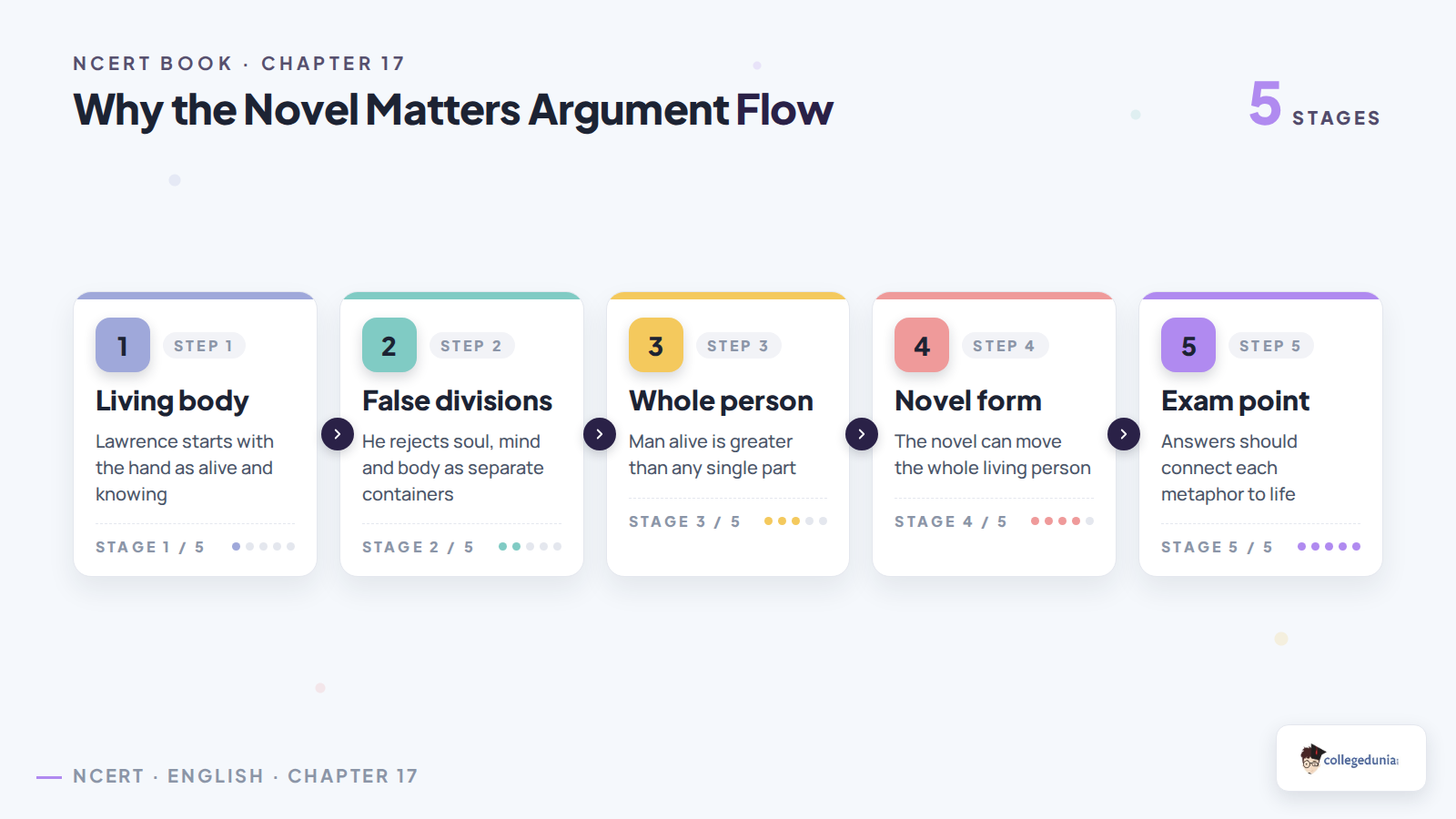
Lawrence begins with a simple body example. His hand writes, feels and knows. This helps him reject the idea that the body is only a container. From there, he argues that life cannot be reduced to one neat label.
For board answers, keep the argument in order. Start with the living body, move to the failure of fixed ideas, then explain why the novel is the "book of life." The central point is that the novel deals with the whole person, not a single part.
Novel, Philosophy, Science and Poetry Compared
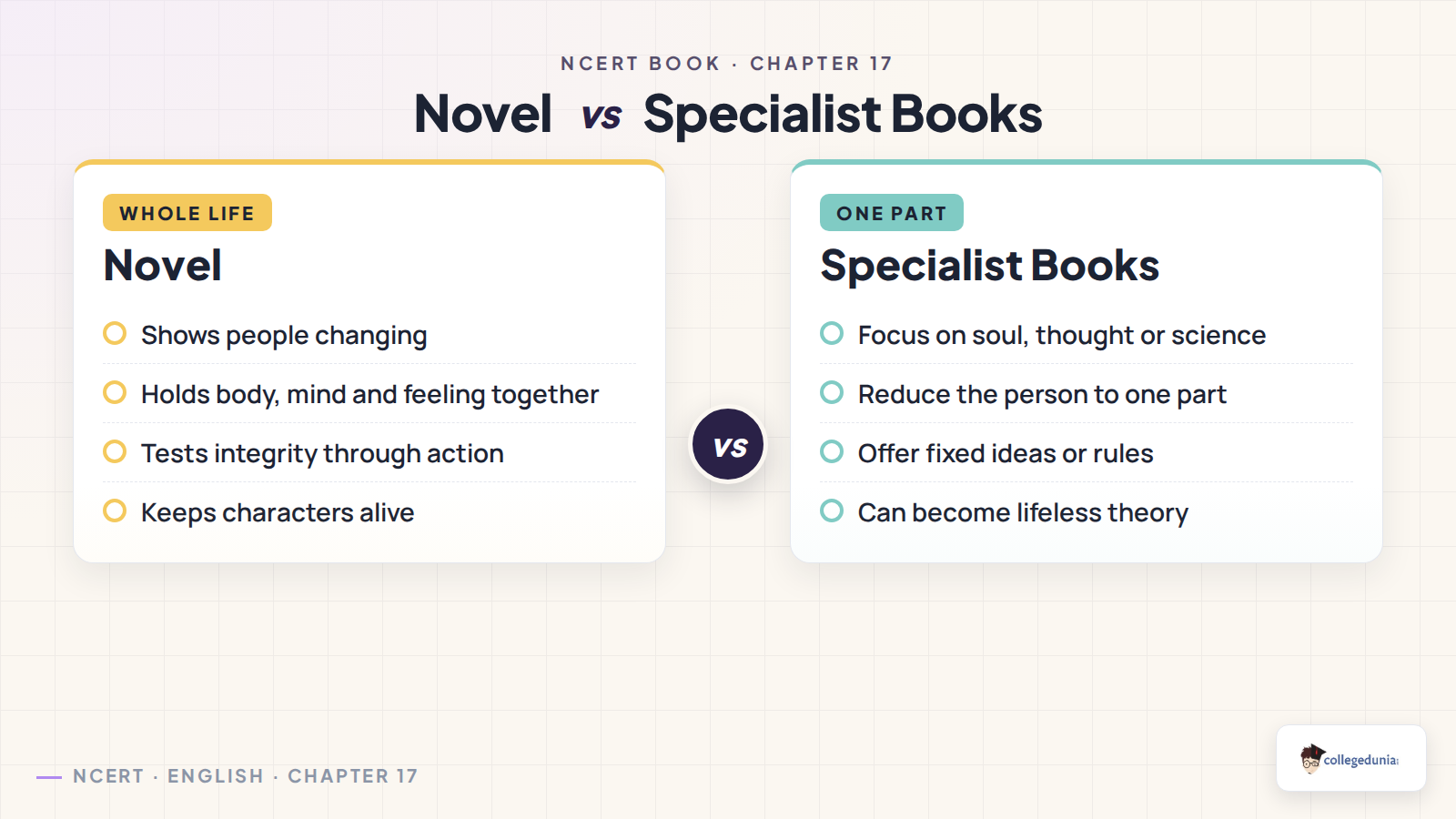
Lawrence does not reject all books. He rejects the habit of treating one part of a person as the whole person. The philosopher may focus on thought. The scientist may study a dead piece under a microscope. The novel, at its best, keeps the living person in full play.
| Figure or form | Focus | Lawrence's objection |
|---|---|---|
| Parson or saint | Soul and spiritual message | Moves away from present life. |
| Philosopher | Ideas, infinity and pure spirit | Turns life into abstraction. |
| Scientist | Brain, nerves, glands or organs | Reduces a person to parts. |
| Novel | Whole man alive and changing | Shows life in action. |
How to Read the Official PDF for 2026-27 Revision
Read the PDF in two rounds. In the first round, follow the main argument from body to novel. In the second round, mark the repeated phrases and images. NCERT questions often ask students to explain the argumentative force of those repeated words.
- Track "man alive": note every place where Lawrence returns to living wholeness.
- Mark comparisons: parson, philosopher, scientist and novelist all have different roles.
- List metaphors: hand, pen, radio message, tree, lamp-post and pianoforte matter for answers.
- Use the questions: revise Understanding the Text, Appreciation and Language Work from the PDF.
Common Answer Mistakes in Why the Novel Matters
Many students write that novels are important because they are enjoyable. That is too general for this chapter. Lawrence's argument is sharper. He says the novel matters because it can awaken the whole living person.
- Do not ignore the body: the living hand is the starting point of the essay.
- Do not write only about story: the essay is about life, change and wholeness.
- Do not mix specialists together: each figure reduces man in a different way.
- Do not skip integrity: Lawrence accepts change without losing the living self.
Related Resources for Why the Novel Matters Class 12
| Resource | Best use | Link |
|---|---|---|
| NCERT Solutions | Use for Understanding the Text, Talking, Appreciation and Language Work answers. | Why the Novel Matters Solutions |
| NCERT Notes | Use for summary, metaphors, key ideas and answer cues. | Why the Novel Matters Notes |
| NCERT Book PDF | Use the official text before revising any secondary resource. | Current page |
All Class 12 English Supplementary NCERT Book Chapters
| Chapter | NCERT Book PDF |
|---|---|
| Chapter 11 | The Wild Swans at Coole NCERT Book PDF |
| Chapter 12 | Time and Time Again NCERT Book PDF |
| Chapter 13 | Blood NCERT Book PDF |
| Chapter 14 | Freedom NCERT Book PDF |
| Chapter 15 | The Mark on the Wall NCERT Book PDF |
| Chapter 16 | Film-Making NCERT Book PDF |
| Chapter 17 | Why the Novel Matters NCERT Book PDF |
Why the Novel Matters Class 12 English NCERT Book FAQs
Ques. What does Why the Novel Matters Class 12 English NCERT Book PDF include?
Ans. It includes the official NCERT Kaleidoscope essay Why the Novel Matters by D. H. Lawrence and the textbook questions for 2026-27 revision.
Ques. Who wrote Why the Novel Matters in Class 12 Kaleidoscope?
Ans. Why the Novel Matters was written by D. H. Lawrence, the English novelist, poet and essayist.
Ques. What is the main idea of Why the Novel Matters?
Ans. Lawrence argues that the novel matters because it can show the whole living person, while philosophy, science and other systems often focus on only one part.
Ques. How should students revise Why the Novel Matters for Class 12 English?
Ans. Students should read the PDF, mark Lawrence's metaphors, revise "man alive" and practise answers on body, life, change and the novel.
Ques. Is Why the Novel Matters part of the 2026-27 NCERT syllabus?
Ans. Yes, Why the Novel Matters is included in the Class 12 English Kaleidoscope non-fiction section used for the 2026-27 NCERT syllabus.



Comments