



The The Argumentative Indian Class 12 English Book PDF gives students the official NCERT Kaleidoscope non-fiction text for 2026-27. Use it to read Amartya Sen's essay on discussion, dissent, gender, caste and public reasoning before revising notes or solved answers.
- Core focus: India's long habit of debate, dialogue and public reasoning.
- Best use: read the official PDF first, then mark Sen's examples section by section.
- Revision cue: connect Krishna, Arjuna, Gargi, Maitreyi, Draupadi and democracy.
NCERTBookChapter18Kaleidoscope:TheArgumentativeIndian.pdf?page=1&dpi=150)
NCERTBookChapter18Kaleidoscope:TheArgumentativeIndian.pdf?page=2&dpi=150)
NCERTBookChapter18Kaleidoscope:TheArgumentativeIndian.pdf?page=3&dpi=150)
NCERTBookChapter18Kaleidoscope:TheArgumentativeIndian.pdf?page=4&dpi=150)
NCERTBookChapter18Kaleidoscope:TheArgumentativeIndian.pdf?page=5&dpi=150)
NCERTBookChapter18Kaleidoscope:TheArgumentativeIndian.pdf?page=6&dpi=150)
NCERTBookChapter18Kaleidoscope:TheArgumentativeIndian.pdf?page=7&dpi=150)
NCERTBookChapter18Kaleidoscope:TheArgumentativeIndian.pdf?page=8&dpi=150)
NCERTBookChapter18Kaleidoscope:TheArgumentativeIndian.pdf?page=9&dpi=150)
NCERTBookChapter18Kaleidoscope:TheArgumentativeIndian.pdf?page=10&dpi=150)
NCERTBookChapter18Kaleidoscope:TheArgumentativeIndian.pdf?page=11&dpi=150)
NCERTBookChapter18Kaleidoscope:TheArgumentativeIndian.pdf?page=12&dpi=150)
NCERTBookChapter18Kaleidoscope:TheArgumentativeIndian.pdf?page=13&dpi=150)
NCERTBookChapter18Kaleidoscope:TheArgumentativeIndian.pdf?page=14&dpi=150)
NCERTBookChapter18Kaleidoscope:TheArgumentativeIndian.pdf?page=15&dpi=150)
Student Feedback: In a Collegedunia check of 12,620 Class 12 English students, many students said this essay became easier after linking every example to one idea: argument as a public habit.
The Argumentative Indian NCERT Book PDF Overview
The Argumentative Indian is a non-fiction essay by Amartya Sen in the Kaleidoscope textbook. Sen says India has a long tradition of testing ideas through speech, debate and questioning. He does not present argument as noise. He presents it as a serious way of thinking together.
The chapter is best read as an essay on public reasoning, not only as a historical survey. Sen moves from epics and Upanishadic debates to caste, gender, class and democracy. The official PDF keeps the essay and NCERT questions together for direct 2026-27 revision.
| Part of chapter | What to notice | Answer cue |
|---|---|---|
| Opening examples | Indians speak at length, from Menon to the epics | Use for prolixity and dialogue. |
| Gita debate | Krishna stresses duty while Arjuna asks about consequences | Use for moral reasoning. |
| Gender and caste | Gargi, Maitreyi, Draupadi and anti-caste voices enter debate | Use for participation beyond elites. |
| Democracy | Public reasoning supports heterodoxy and secular priorities | Use for contemporary relevance. |
The Argumentative Indian Class 12 Video Explanation
Source: Magnet Brains on YouTube
Sen's Argument Flow in The Argumentative Indian
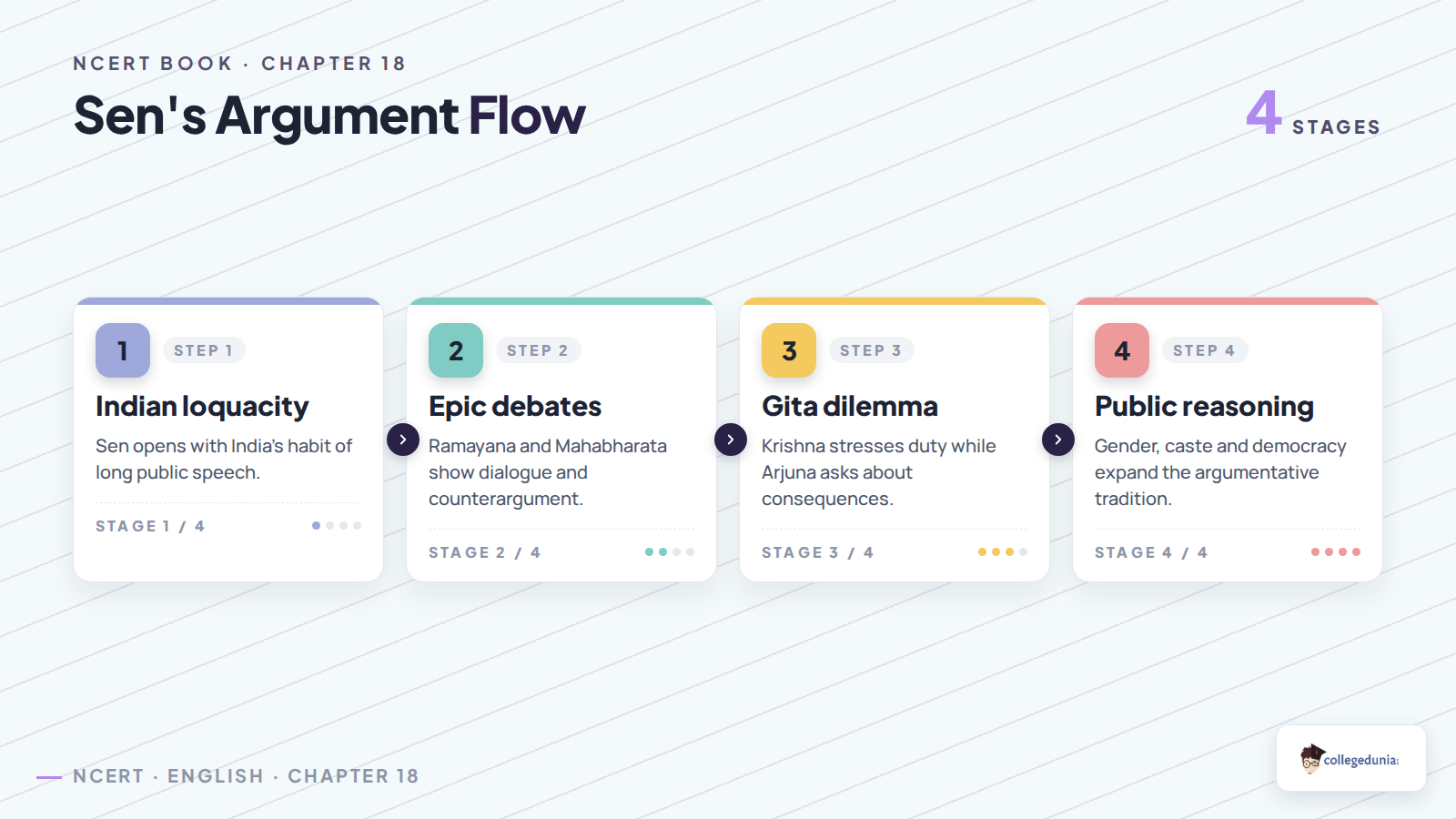
Sen begins with the Indian habit of long speech and then shows that this habit has older intellectual roots. The Ramayana and Mahabharata are not only long stories. They carry dialogues, doubts, moral choices and counterarguments.
For board answers, keep Sen's movement in order. Start with prolixity, move to epic debate, then explain how the tradition reaches women, lower castes and democratic politics. The central point is that argument gives Indian public life a questioning habit.
Krishna, Arjuna and the Gita Debate
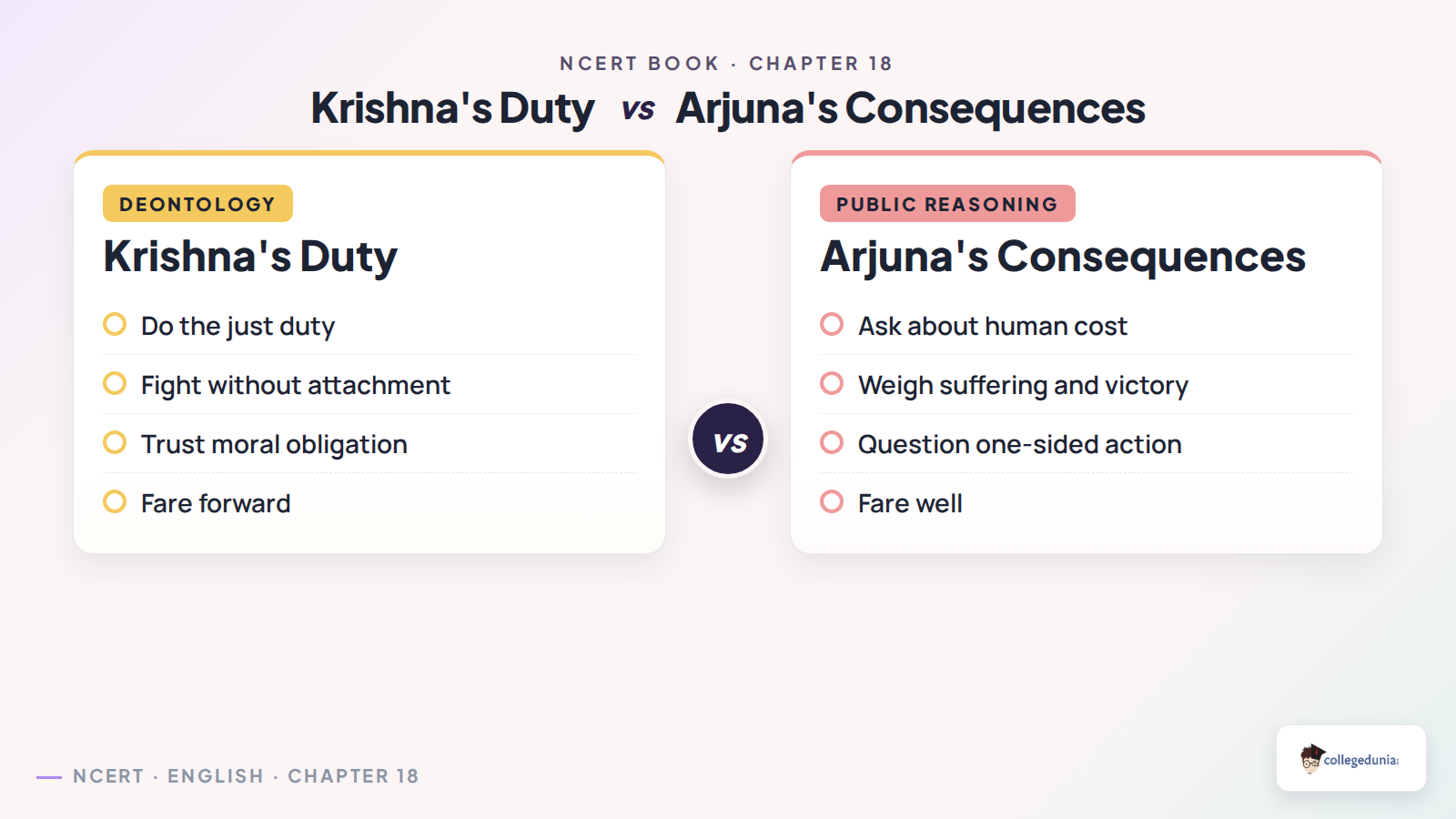
Sen reads the Bhagavad Gita as a debate with two reasonable sides. Krishna asks Arjuna to do his duty as a warrior. Arjuna worries about the suffering and death that the war will cause. Sen does not erase Krishna's argument, but he says Arjuna's doubts still matter.
| Position | Main idea | How to use in answers |
|---|---|---|
| Krishna | Duty must be done without attachment to results. | Use for "fare forward". |
| Arjuna | Consequences and human suffering cannot be ignored. | Use for "fare well". |
| Sen | The wider Mahabharata keeps both arguments alive. | Use for balanced public reasoning. |
| Oppenheimer | Technical duty can create a moral crisis after success. | Use for modern relevance. |
Gender, Caste and Voice in the Essay
Sen asks whether India's argumentative tradition belonged only to male elites. His answer is careful. He accepts that inequality shaped who could speak, but he also shows that women and disadvantaged groups did take part in important arguments.
- Gargi: questions Yajnavalkya with sharp intellectual force.
- Maitreyi: asks whether wealth can give immortality or real achievement.
- Draupadi: pushes Yudhisthira toward action and rejects passive forbearance.
- Bhakti and Sufi voices: question caste, class and artificial social barriers.
Use these examples to show that Sen's tradition is not limited to polished court debate. It also includes protest, scepticism and social challenge.
Democracy as Public Reasoning
In the later part of the chapter, Sen connects argument with modern democracy. He says public reasoning helps India live with heterodoxy, secular priorities and disagreement. This is why the chapter matters beyond literary summary.
Do not write that democracy came only from British influence. Sen wants students to notice older Indian habits of discussion, dissent and questioning. These habits support public debate in the present.
| Term | Meaning in the chapter | Exam cue |
|---|---|---|
| Heterodoxy | Acceptance of different opinions and belief systems | Link to debate. |
| Public reasoning | Testing public choices through discussion | Link to democracy. |
| Secular priorities | Political life that does not depend on one religious voice | Link to plural India. |
| Social inequality | Gender, caste, class and community barriers | Link to Sen's warnings. |
How to Read the Official PDF for 2026-27 Revision
Read the PDF in two rounds. In the first round, follow Sen's examples without stopping for every footnote. In the second round, mark the names, debates and concepts that can become answer points.
- Track examples: Menon, the epics, the Gita, Oppenheimer, Gargi, Maitreyi and Kabir.
- Mark pairs: duty and consequence, wealth and capability, tradition and inequality.
- Use section heads: revise Dialogue and Significance, Gender, Caste and Voice, and Democracy as Public Reasoning separately.
- Practise NCERT tasks: answer Stop and Think before moving to long questions.
Related Resources for The Argumentative Indian Class 12
| Resource | Best use | Link |
|---|---|---|
| NCERT Solutions | Use for Stop and Think, Understanding, Talking, Appreciation and Language Work answers. | The Argumentative Indian Solutions |
| NCERT Notes | Use for summary, themes, examples and answer cues. | The Argumentative Indian Notes |
| NCERT Book PDF | Use the official text before revising any secondary resource. | Current page |
All Class 12 English Supplementary NCERT Book Chapters
| Chapter | NCERT Book PDF |
|---|---|
| Chapter 12 | Time and Time Again NCERT Book PDF |
| Chapter 13 | Blood NCERT Book PDF |
| Chapter 14 | Freedom NCERT Book PDF |
| Chapter 15 | The Mark on the Wall NCERT Book PDF |
| Chapter 16 | Film-Making NCERT Book PDF |
| Chapter 17 | Why the Novel Matters NCERT Book PDF |
| Chapter 18 | The Argumentative Indian NCERT Book PDF |
The Argumentative Indian Class 12 English NCERT Book FAQs
Ques. What does The Argumentative Indian Class 12 English NCERT Book PDF include?
Ans. It includes the official NCERT Kaleidoscope essay The Argumentative Indian by Amartya Sen and the textbook questions for 2026-27 revision.
Ques. Who wrote The Argumentative Indian in Class 12 Kaleidoscope?
Ans. The Argumentative Indian was written by Amartya Sen, the Nobel Prize-winning economist known for work on welfare economics and public reasoning.
Ques. What is the main idea of The Argumentative Indian?
Ans. Sen argues that India has a long tradition of debate, questioning and dialogue, and that this tradition shapes democracy and social thought.
Ques. How should students revise The Argumentative Indian for Class 12 English?
Ans. Students should read the PDF, list Sen's examples, compare Krishna and Arjuna, and connect gender, caste and democracy to public reasoning.
Ques. Is The Argumentative Indian part of the 2026-27 NCERT syllabus?
Ans. Yes, The Argumentative Indian is included in the Class 12 English Kaleidoscope non-fiction section used for the 2026-27 NCERT syllabus.



Comments