



Inside the NCERT Book PDF for Class 12 Fine Arts Chapter 2 The Deccan Schools of Painting you will find the three court schools of Ahmadnagar, Bijapur and Golconda, the twelve plates the appreciation question is set from, and the six exercise questions printed at the end. It is the official chapter from An Introduction to Indian Art Part 2, Reprint 2026-27.
- Covers Deccani painting from the late sixteenth century to the 1680s, when the Mughals took the Deccan.
- Names to spell right: Hussain Nizam Shah I, Ali Adil Shah I, Ibrahim Adil Shah II, Farrukh Beg and Muhammad Ali.
- Ends with 6 exercise questions and 6 full page painting appreciations.
This Deccan Schools of Painting chapter PDF is the unedited NCERT text page for page, checked against the Reprint 2026-27 print run, and paired here with a court by court painting index written by Collegedunia Fine Arts teachers.
What the Deccan Schools of Painting Class 12 PDF Contains
The chapter is organised by kingdom, not by ruler. Read it court by court and the whole plateau falls into three neat blocks. Every question in the exercise comes out of one of those blocks or out of the appreciation plates that follow it.
| Section in the PDF | What it covers | Question type it feeds |
|---|---|---|
| Opening on Deccani painting | Dates, the plateau setting, and the long argument over whether this was a school at all | 1 mark and 2 marks |
| Ahmadnagar School of Painting | Tarif-i-Hussain Shahi, the Ragamala costume, the Lepakshi link, the Bukhara idiom | 3 marks and 5 marks |
| Bijapur School of Painting | Nujum al-Ulum, The Throne of Prosperity, the Ragamala series, the Yogini | 5 marks, appreciation |
| Golconda School of Painting | Trade wealth, the Diwan of Hafiz folios, the Qutb Shahi portraits, the Sufi manuscript | 5 marks, appreciation |
| Six appreciation plates | Composite Horse, Ibrahim Adil Shah II hawking, Ragini Pathamsika, Abdullah Qutb Shah, Nizamuddin Auliya and Amir Khusrau, Chand Bibi | Picture based questions |
One naming point before you start. The textbook heads the chapter The Deccani Schools of Painting, while the syllabus and most question papers say Deccan. Both refer to the same chapter, so do not waste time hunting for a second one.
Why the Deccan Schools of Painting Were Long Filed Under Indo-Persian Art
The opening page of the chapter is an argument, and examiners like arguments. For a long time this style was parked inside Indo-Persian art and called Middle Eastern, Safavid, Persian, Turkish or even Mughal in origin. Art historians accepted that it looked different but stopped short of calling it a school in its own right.
- What the book corrects: the Deccani style was sustained by a class of rulers with their own political and cultural vision.
- How they sustained it: they hired and nurtured artists, then commissioned work that suited their taste and their needs of governance.
- Where it grew: the plateau of southern India, beyond the Vindhya mountain range, under the Sultans of the Deccan.
- Shared traits across the three courts: dense composition, unique sensuality, intense colours and a deliberate aura of romance.
- Regional anchor: the colour sense has a strong affinity to regional aesthetics, and the idiom stays natural and vivid.
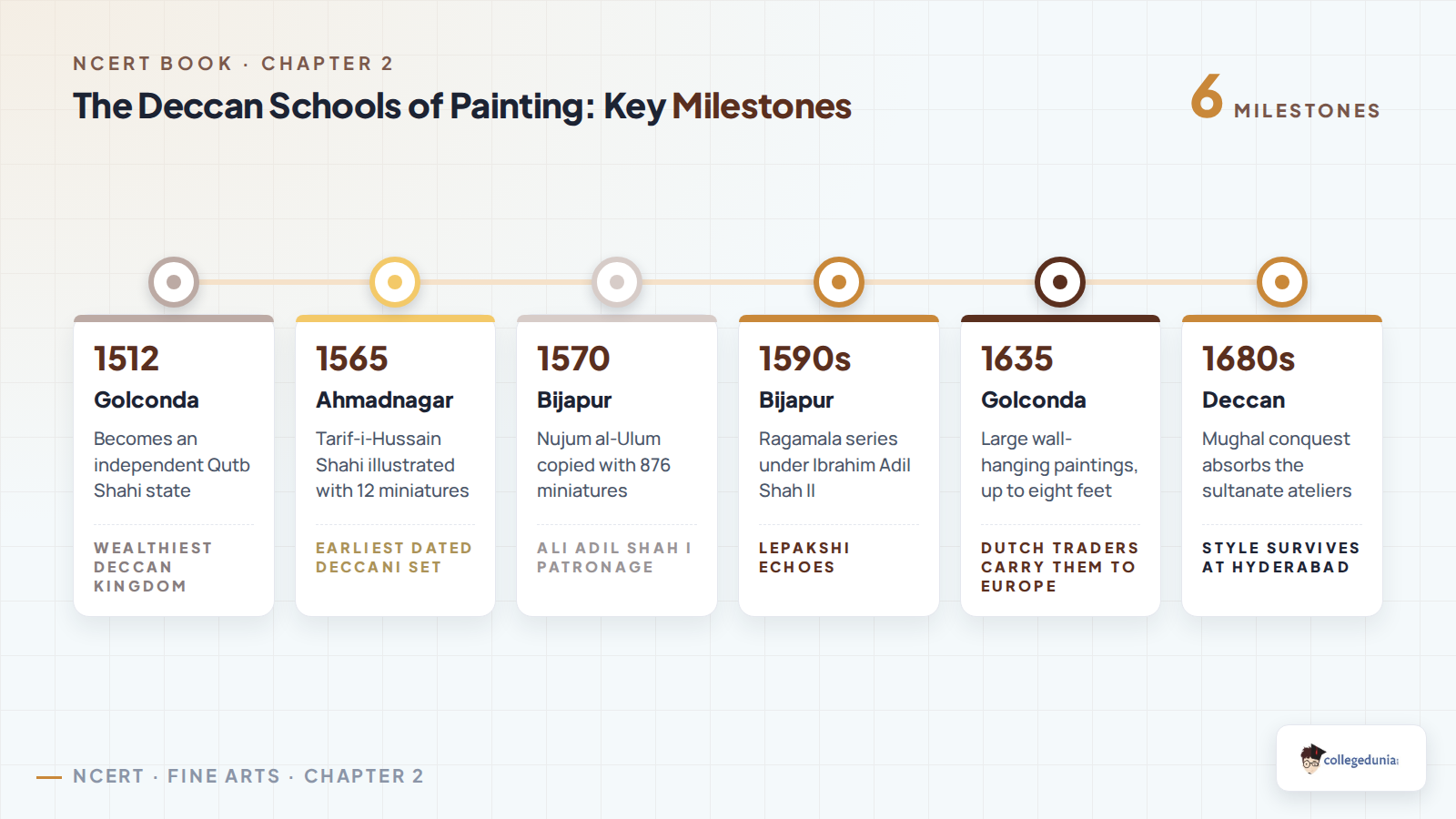
The timeline matters as much as the argument. Deccani painting can be reconstructed from the late sixteenth century until the 1680s, the point at which the Mughals conquered the Deccan. It resurfaces in nineteenth century art, under the Asafiya dynasty, and finally in the provincial courts of Rajas and Nawabs across the State of Hyderabad under the Nizam.
Deccan Schools of Painting Explained in One Shot
Source: Study Box on YouTube
Ahmadnagar School of Painting: Tarif-i-Hussain Shahi and the Ragamala Costume
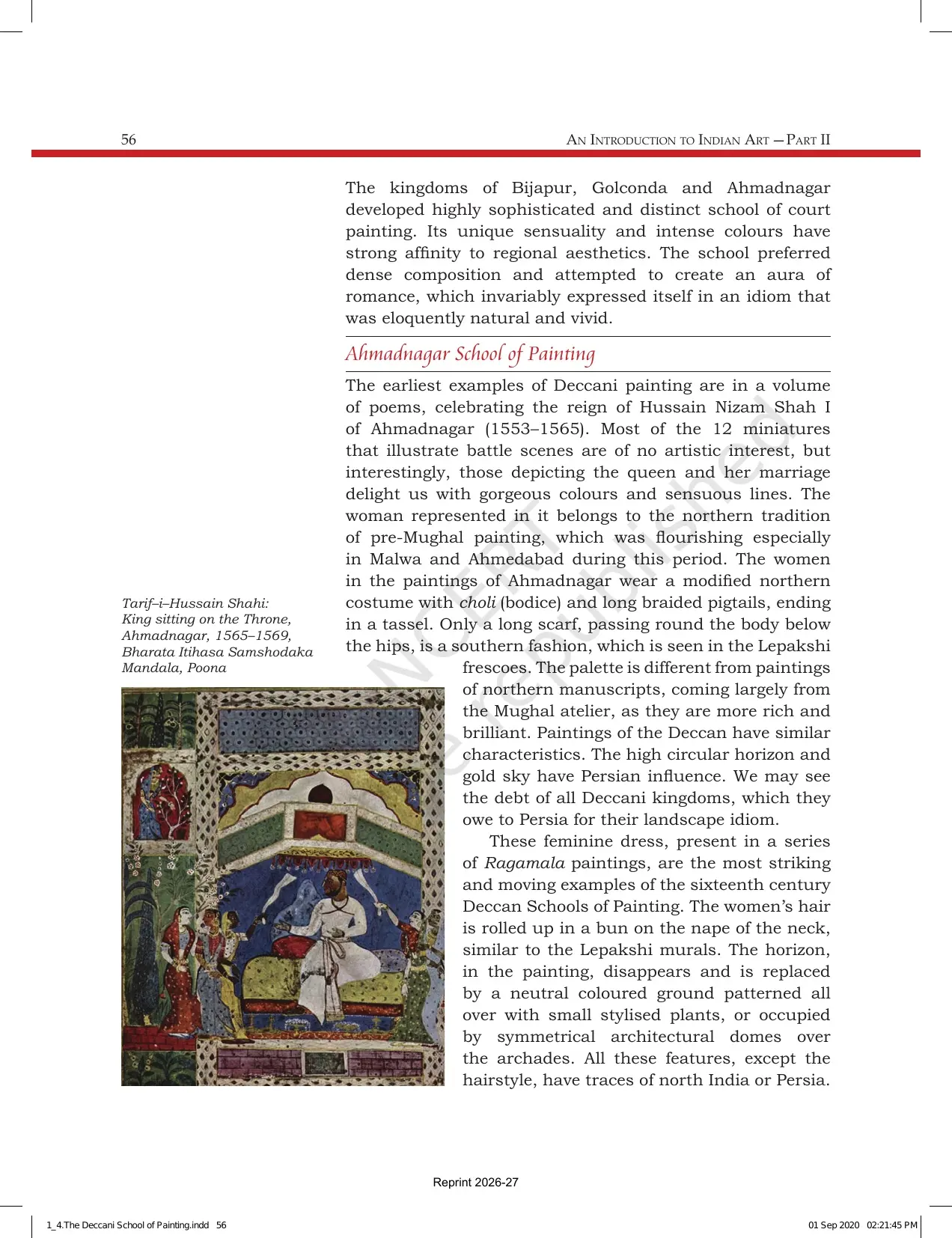
Ahmadnagar gives you the earliest dated examples in the chapter. They sit in a volume of poems celebrating the reign of Hussain Nizam Shah I (1553 to 1565), known as the Tarif-i-Hussain Shahi. The book is blunt about quality, and that judgement is quotable in an answer.
- Of the 12 miniatures, most illustrate battle scenes and are of no artistic interest.
- The folios showing the queen and her marriage are the exception, rich in gorgeous colours and sensuous lines.
- The women belong to the northern tradition of pre-Mughal painting, then flourishing in Malwa and Ahmedabad.
- Costume is a modified northern one: choli (bodice) and long braided pigtails ending in a tassel.
- Only the long scarf passing round the body below the hips is southern, a fashion seen in the Lepakshi frescoes.
The palette separates Ahmadnagar from the northern manuscripts that came out of the Mughal atelier, because it is richer and more brilliant. The high circular horizon and the gold sky are Persian, and the book says every Deccani kingdom owes its landscape idiom to Persia.
In the Ragamala series the horizon disappears altogether. It is replaced by a neutral coloured ground patterned all over with small stylised plants, or by symmetrical architectural domes set over arcades. The women's hair is rolled into a bun on the nape of the neck, exactly as in the Lepakshi murals, and that hairstyle is the one feature the book refuses to trace to north India or Persia.
Male costume goes the other way. The jama with pointed tails appears often in early Akbari miniatures and probably began somewhere between Delhi and Ahmedabad, while the small pagri is close to the earliest Akbari form. The chapter then adds a Bukhara thread: the original paintings in the Gulistan of 1567 are given to Bukhara artists, and a manuscript in the Bankipore Library, Patna, signed by the scribe Yusuf and dedicated to Ibrahim Adil in 1569 (presumably Ibrahim Qutb Shah of Golconda, who ruled from 1550 to 1580), carries seven miniatures completely in the Bukhara idiom.
Bijapur School of Painting: Nujum al-Ulum, the Ragamala Series and the Yogini
Bijapur is the richest section for facts and the easiest to score in. It opens with an illustrated encyclopaedia and closes with the single most asked plate in the chapter, the Yogini. Learn the two patrons first, because the manuscripts hang off them.
| Fact | What to quote in the answer |
|---|---|
| Nujum al-Ulum | Richly illustrated encyclopaedia dated 1570, carrying 876 miniatures of weapons, utensils and constellations |
| Patrons | Ali Adil Shah I (1558 to 1580) and his successor Ibrahim Adil Shah II (1580 to 1627), both patrons of art and literature |
| Ibrahim Adil Shah II | Expert in Indian music and author of the Nauras-nama; owner of the Nujum al-Ulum; likely commissioned the Ragamala series in the 1590s |
| Turkish link | Bijapur had a close connection with Turkey, and the astronomical illustrations may derive from Ottoman Turkish manuscripts |
| Ragamala character | Indian in its connections, with definite echoes of the Lepakshi style, women tall and slender in south Indian dress |
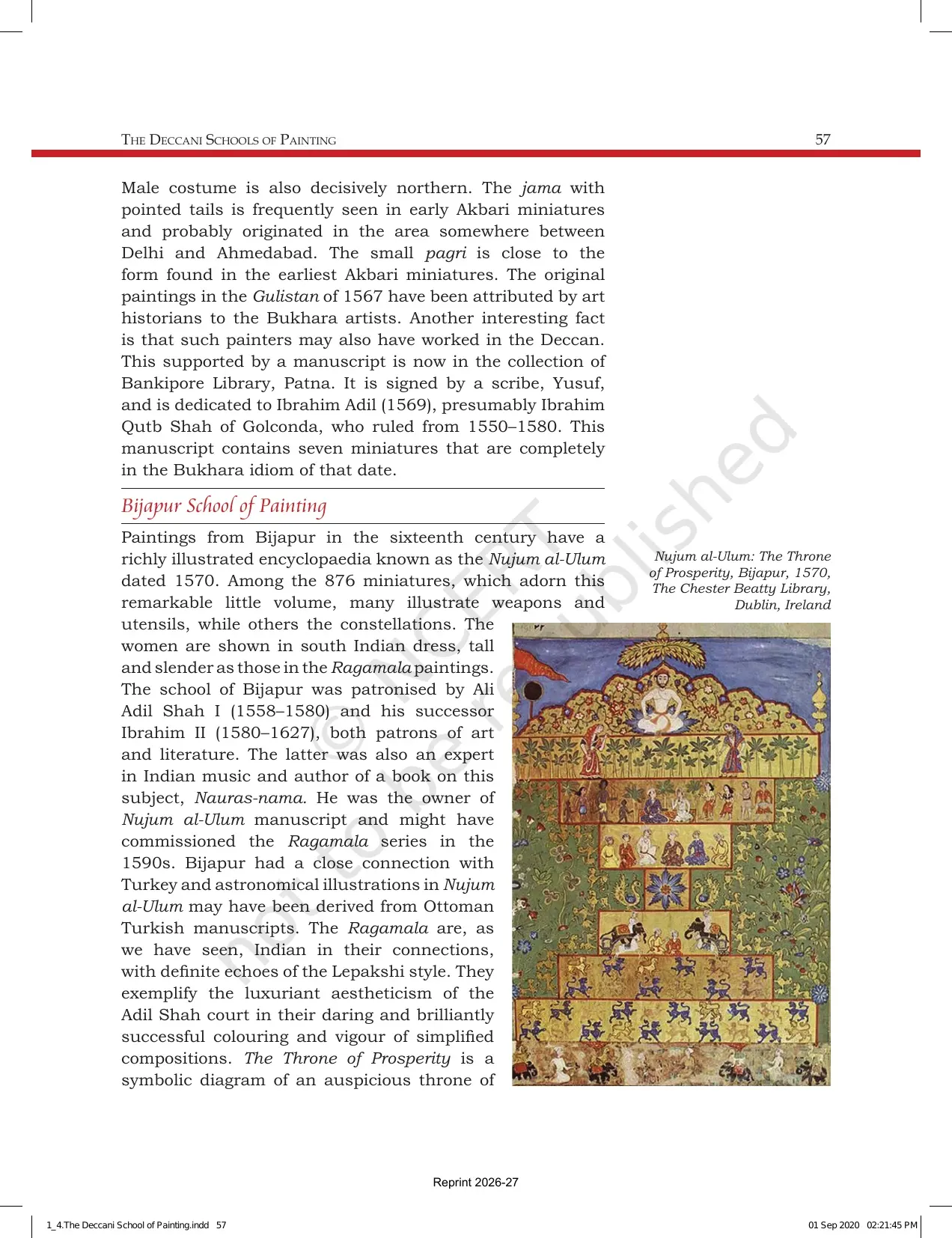
The Throne of Prosperity is the plate lifted from that encyclopaedia. It is a symbolic diagram of an auspicious throne of seven stages, each stage supported by different inhabitants, from elephants and tigers to palm trees, through storeys of peacocks and primitive tribes. The basic structures recall the wood carved doorways and facades of Gujarati homes, or the temples of the Deccan.
The colouring, though, sits in the Islamic Persian tradition, especially the arabesques at the top of the throne. Deccani foliage rises against an amazingly deep blue sky, and the stylised plants on either side echo the margin decoration of an early sixteenth century Gujarati manuscript. A strong Indian visual tradition holds the whole miniature together.
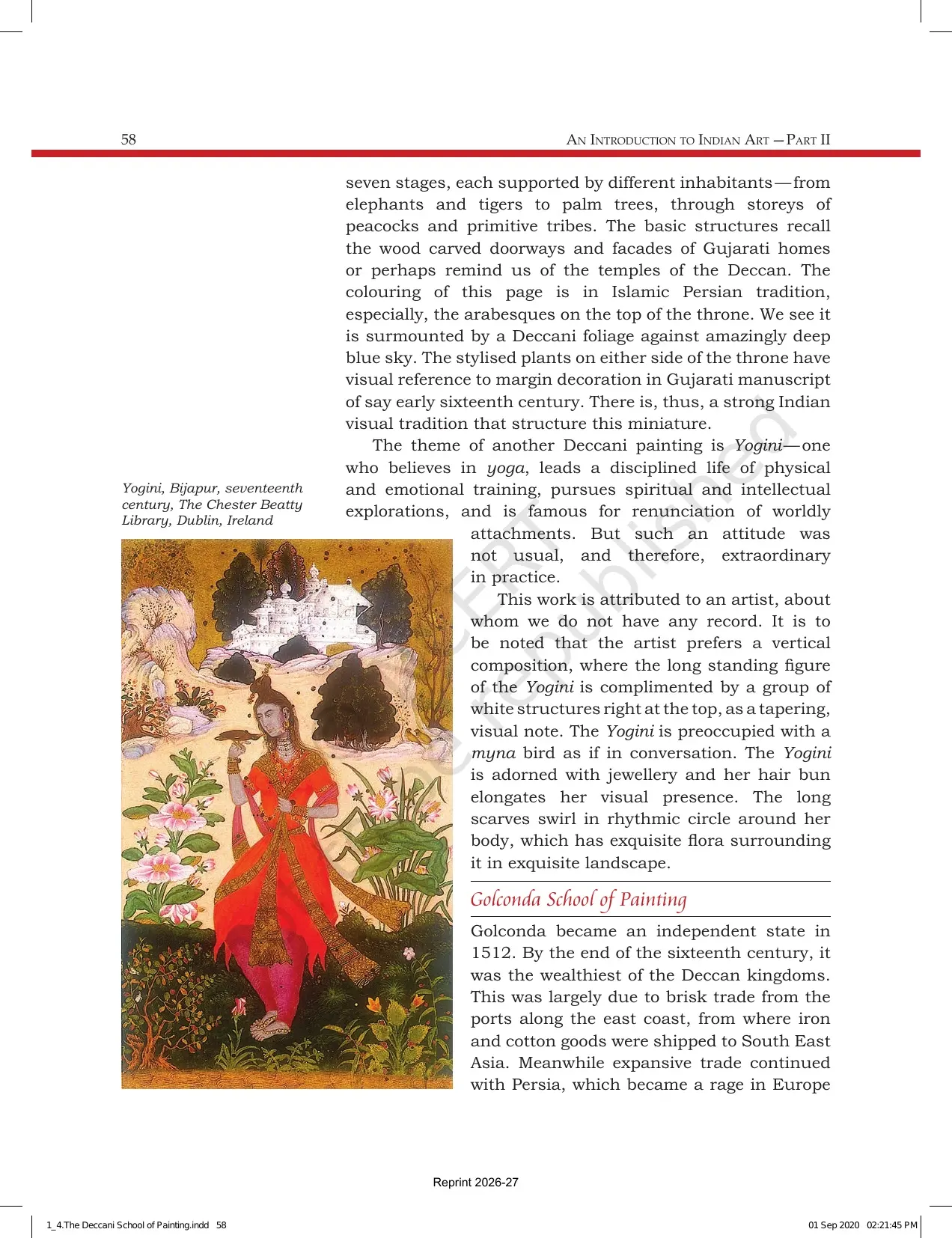
The Yogini (Bijapur, seventeenth century, Chester Beatty Library, Dublin) is the appreciation plate to prepare word for word. A yogini believes in yoga, leads a disciplined life of physical and emotional training, pursues spiritual and intellectual exploration and renounces worldly attachment, which the book calls extraordinary in practice.
- The artist is unrecorded, so never attribute this painting to a named hand.
- The composition is vertical, and the tall standing figure is answered by white structures at the top as a tapering visual note.
- The Yogini is preoccupied with a myna bird, as though in conversation with it.
- Jewellery and an elongated hair bun stretch her visual presence upward.
- Long scarves swirl in rhythmic circles around her body, set in an exquisite flora filled landscape.
Golconda School of Painting: Trade Wealth, Blue Foxes and the Qutb Shahi Portraits
Golconda became an independent state in 1512 and was the wealthiest of the Deccan kingdoms by the end of the sixteenth century. The chapter explains the wealth before it explains the paintings, and the examiner expects that order in a 5 mark answer.
- Brisk trade ran through the ports of the east coast, shipping iron and cotton goods to South East Asia.
- Trade with Persia stayed heavy, and Golconda painted cottons became a rage in Europe.
- Diamonds were discovered early in the seventeenth century, widening the revenue base further.
- That wealth shows on the surface of the paintings as gold jewellery worn by women and men alike.
- Dutch merchants carried portraits of the sultans to Europe in the late seventeenth century, works probably made for the bazaar.
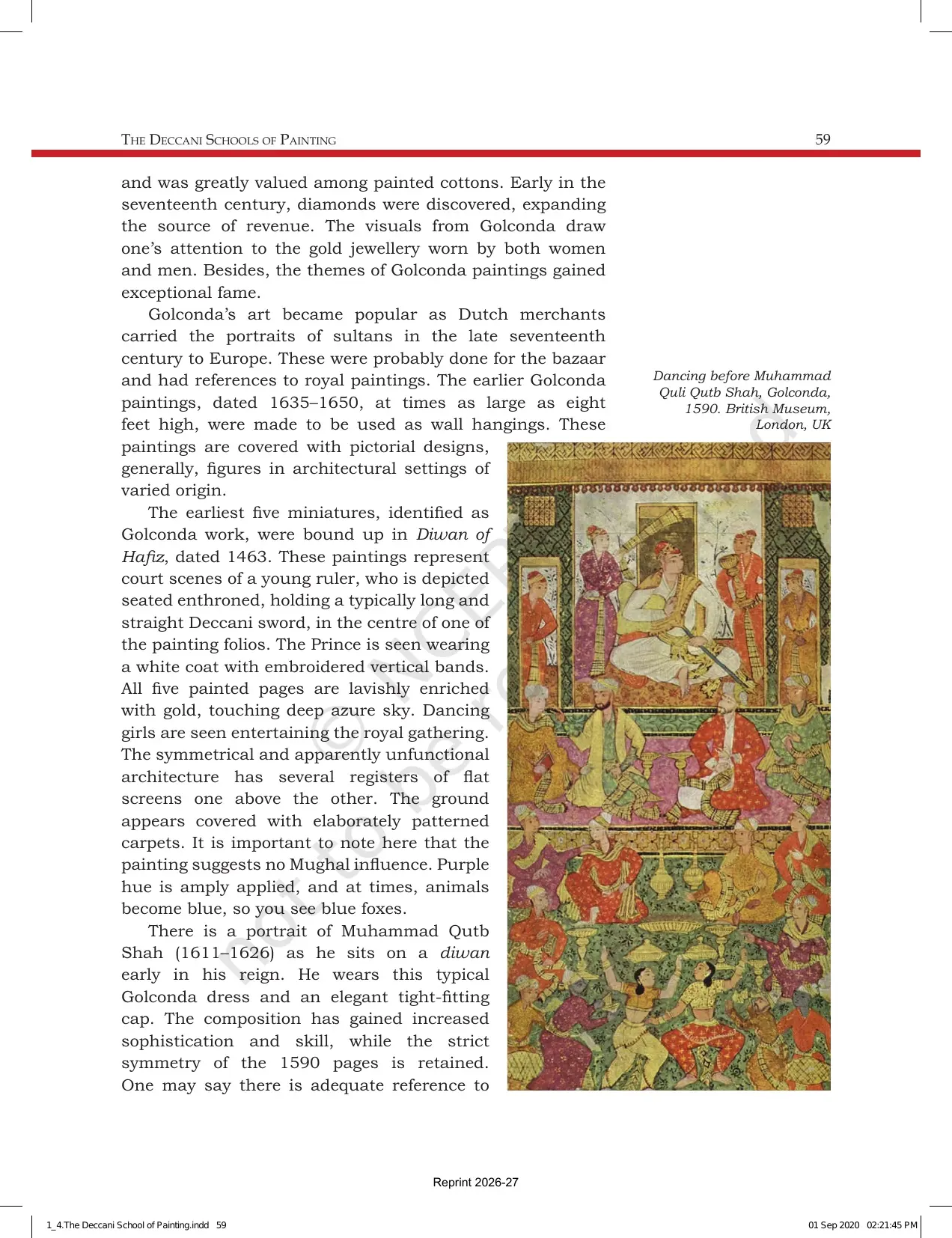
The earliest five miniatures identified as Golconda work were bound into a Diwan of Hafiz dated 1463. They show court scenes of a young ruler seated enthroned, holding the typically long and straight Deccani sword, wearing a white coat with embroidered vertical bands. All five pages are lavishly enriched with gold against a deep azure sky, with dancing girls entertaining the gathering.
Two details from those folios carry marks. The architecture is symmetrical and apparently unfunctional, built of several registers of flat screens stacked one above the other, and the ground is covered with elaborately patterned carpets. The book states plainly that these paintings suggest no Mughal influence, and that purple is used so freely that animals turn blue, giving you blue foxes.
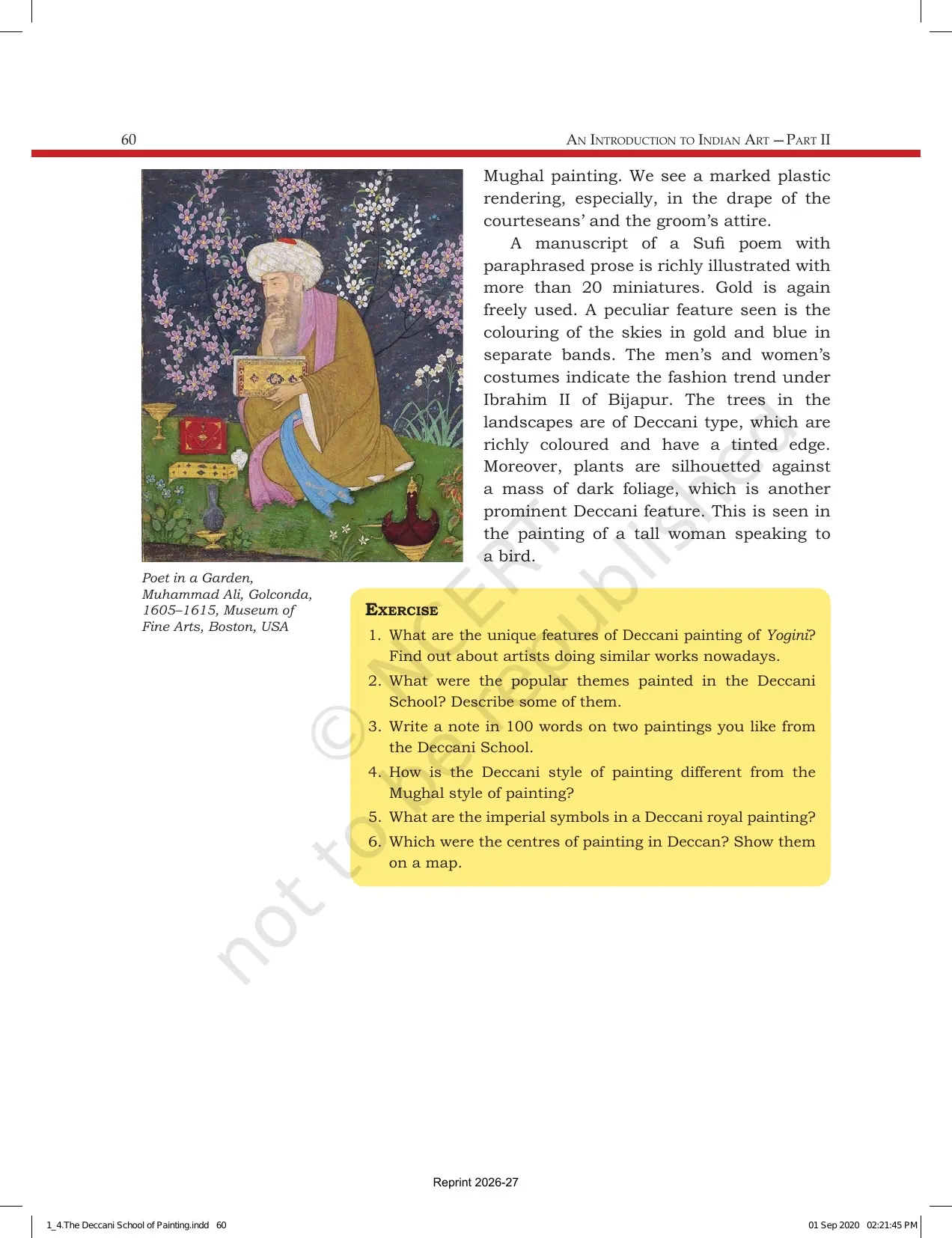
The later material does admit Mughal contact. The portrait of Muhammad Qutb Shah (1611 to 1626) shows him early in his reign on a diwan, in typical Golconda dress and an elegant tight fitting cap. The strict symmetry of the 1590 pages survives, but the composition gains sophistication and the drapery shows a marked plastic rendering. A manuscript of a Sufi poem with paraphrased prose adds more than 20 miniatures, gold used freely again, skies coloured in gold and blue in separate bands, and costumes following the fashion set under Ibrahim Adil Shah II of Bijapur. Its Deccani trees are richly coloured with a tinted edge, and its plants stand silhouetted against a mass of dark foliage, a feature the book flags as prominently Deccani.
Deccani Style Against Mughal Style: The Comparison Question Examiners Set
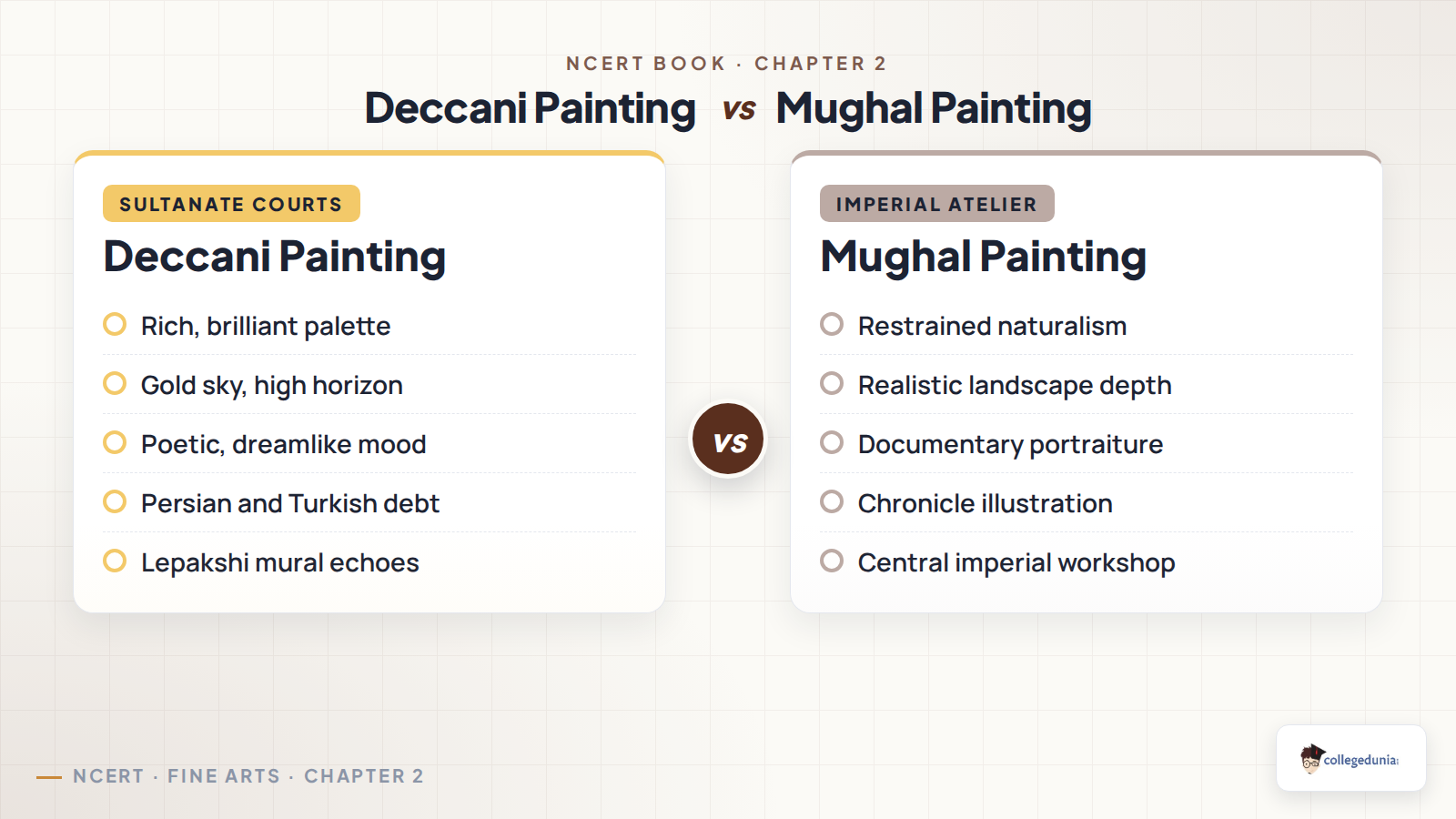
Exercise question 4 asks straight out how the Deccani style differs from the Mughal style. The chapter supplies the material in scattered lines, so pull it into one table now and you will not have to think in the exam hall.
| Point of comparison | Deccani Schools | Mughal School |
|---|---|---|
| Patrons | Sultans of Ahmadnagar, Bijapur and Golconda, later the Nizams of Hyderabad | Mughal emperors and their imperial atelier |
| Working dates | Late sixteenth century to the 1680s, with a provincial afterlife | Sixteenth century to the middle of the nineteenth century |
| Colour | Intense, sensual, rich and brilliant, purple used freely, animals sometimes blue | Subtle and finished, aiming at optical reality |
| Composition | Dense, symmetrical, often deliberately unfunctional architecture | Narrative space cut and divided so the story reads in order |
| Mood | An aura of romance, expressed in a natural and vivid idiom | Documentary record of court, campaign and natural history |
| Landscape | High circular horizon and gold sky owed to Persia, Deccani trees with tinted edges | Accurate flora and fauna studied from life |
Tip: the honest answer is not that one is better. Both schools grew at almost the same time, and the chapter says so directly while discussing Ragini Pathamsika of Raga Hindola.
Named Paintings You Must Be Able to Appreciate in the Board Answer
Fine Arts appreciation questions want four things every time: title, court or artist, date and collection, then two or three lines on what you actually see. The table below is the full plate list of the chapter in that shape, so you can turn it into flashcards in one sitting.
| Painting | Court, artist and date | Collection |
|---|---|---|
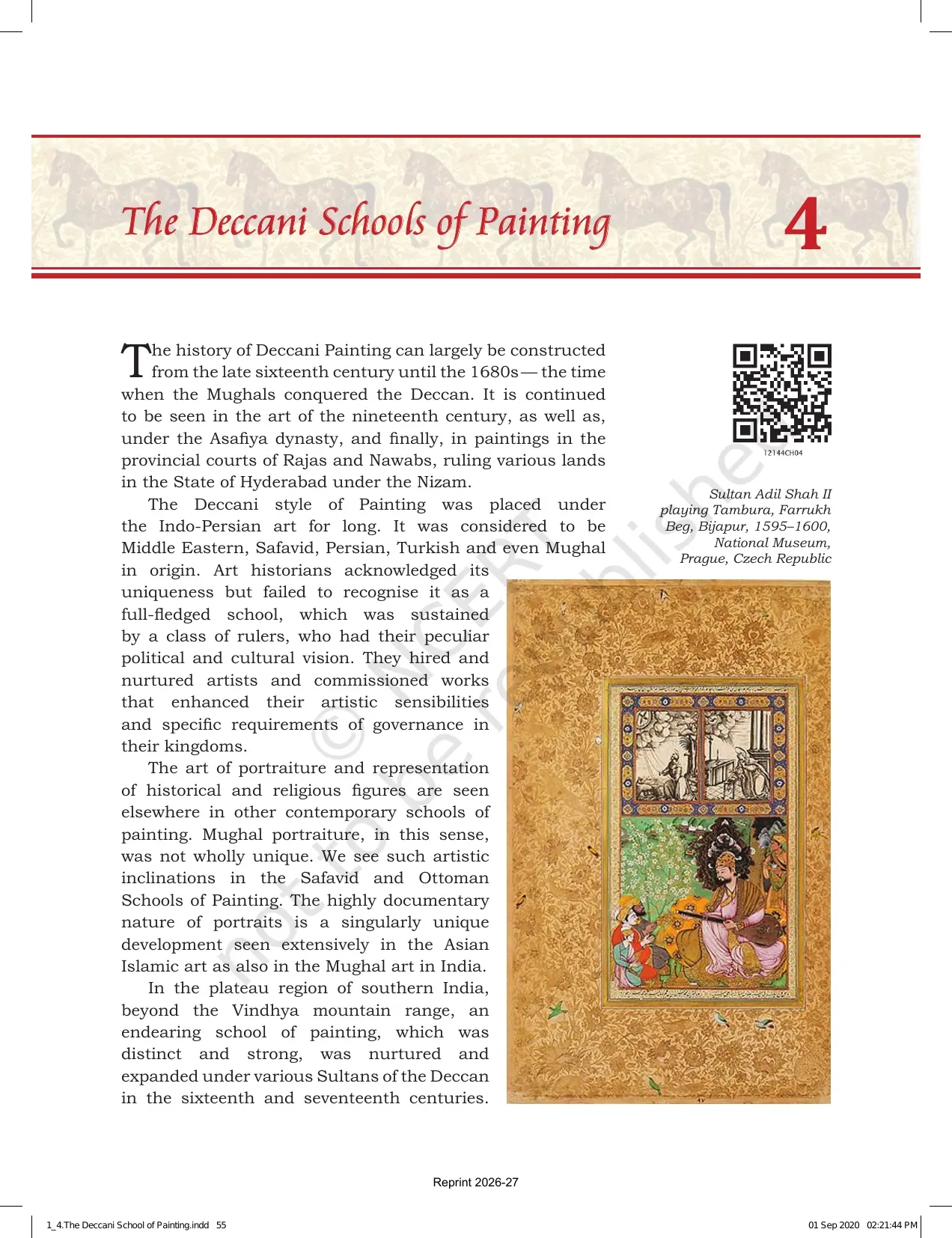
| Sultan Adil Shah II playing Tambura | Farrukh Beg, Bijapur, 1595 to 1600 | National Museum, Prague, Czech Republic |
| Tarif-i-Hussain Shahi: King sitting on the Throne | Ahmadnagar, 1565 to 1569 | Bharata Itihasa Samshodaka Mandala, Poona |
| Nujum al-Ulum: The Throne of Prosperity | Bijapur, 1570 | Chester Beatty Library, Dublin, Ireland |
| Yogini | Bijapur, seventeenth century, artist unrecorded | Chester Beatty Library, Dublin, Ireland |
| Dancing before Muhammad Quli Qutb Shah | Golconda, 1590 | British Museum, London |
| Poet in a Garden | Muhammad Ali, Golconda, 1605 to 1615 | Museum of Fine Arts, Boston |
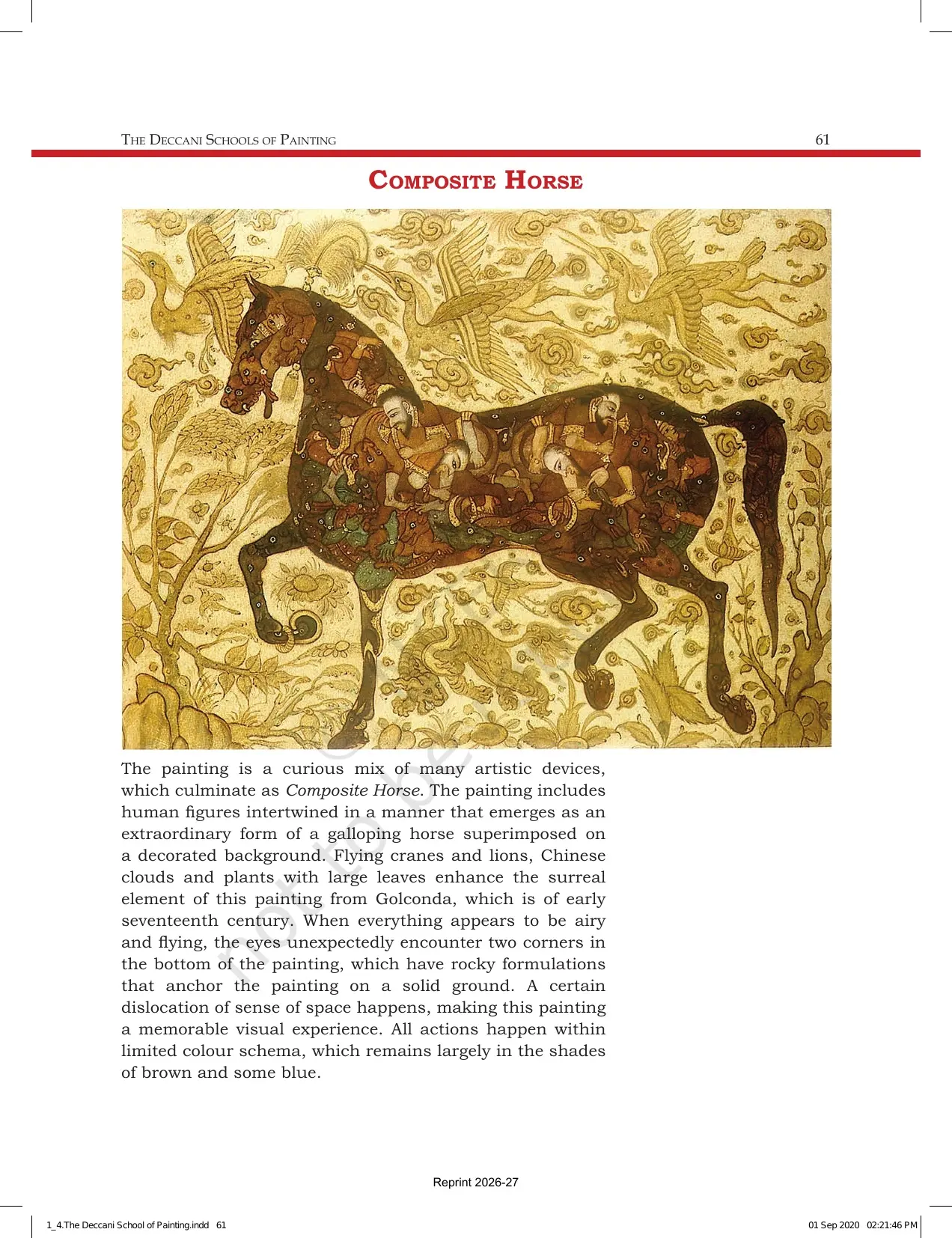
| Composite Horse | Golconda, early seventeenth century | Reproduced in the chapter without a collection line |
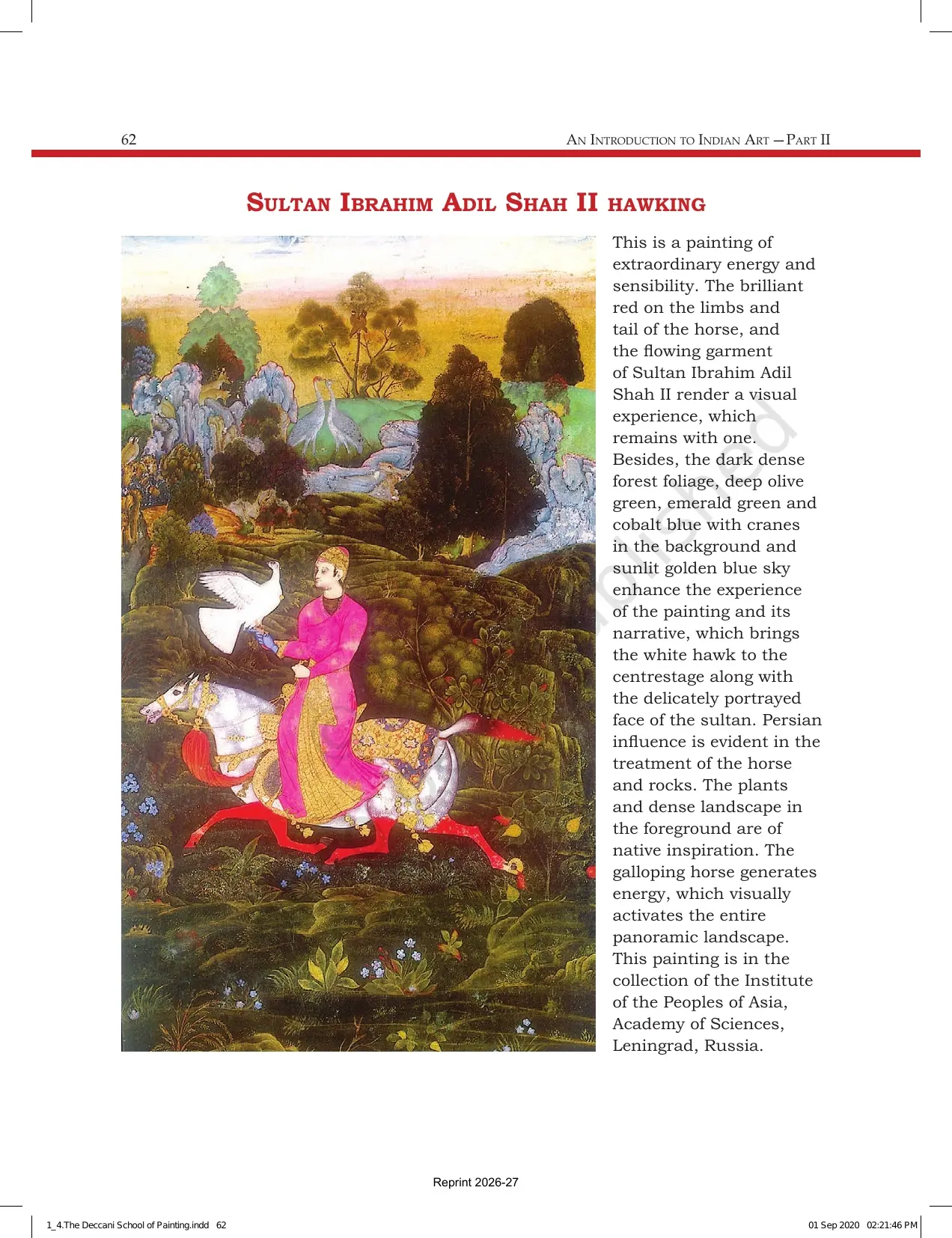
| Sultan Ibrahim Adil Shah II hawking | Bijapur | Institute of the Peoples of Asia, Academy of Sciences, Leningrad, Russia |
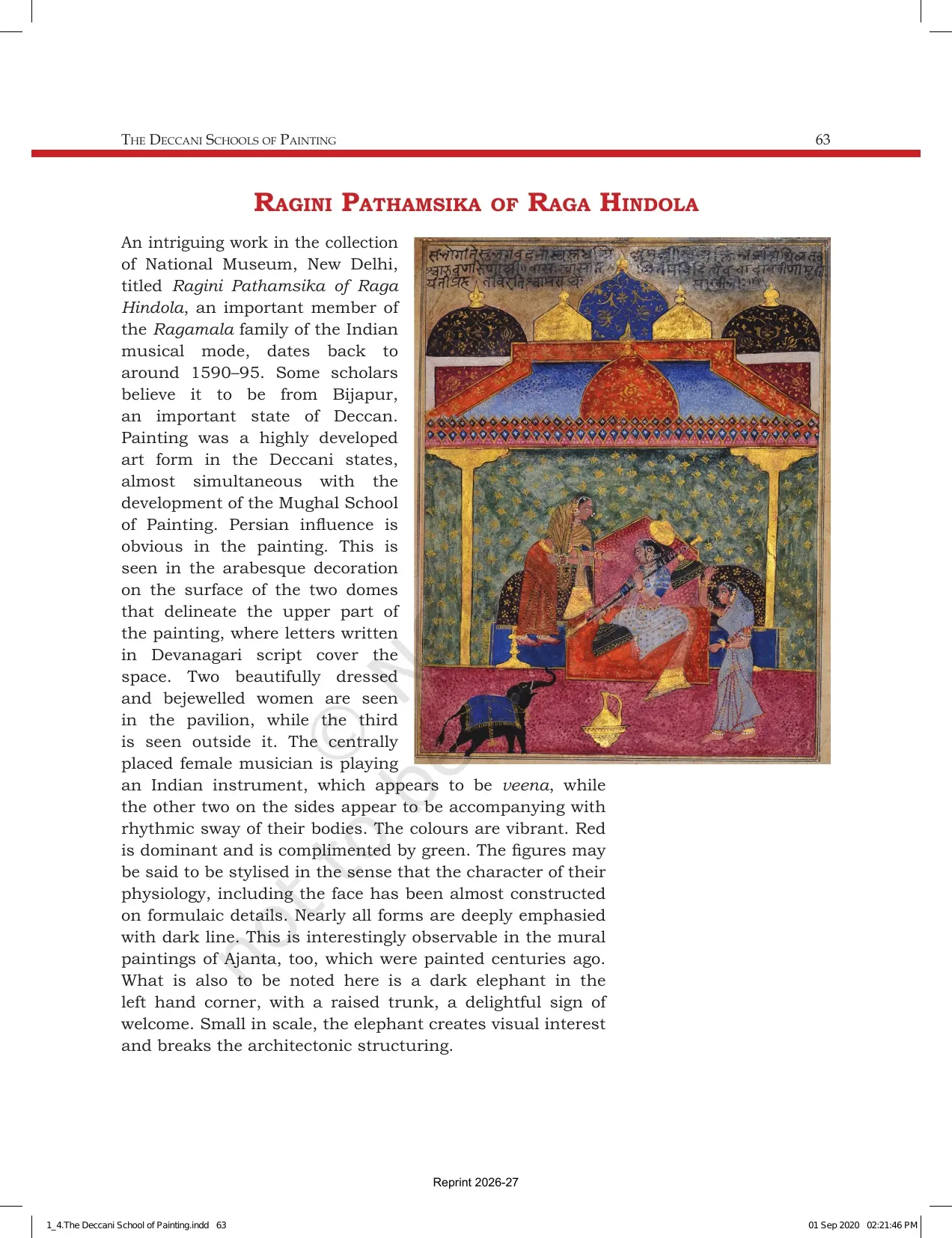
| Ragini Pathamsika of Raga Hindola | Around 1590 to 1595, believed by some scholars to be Bijapur | National Museum, New Delhi |
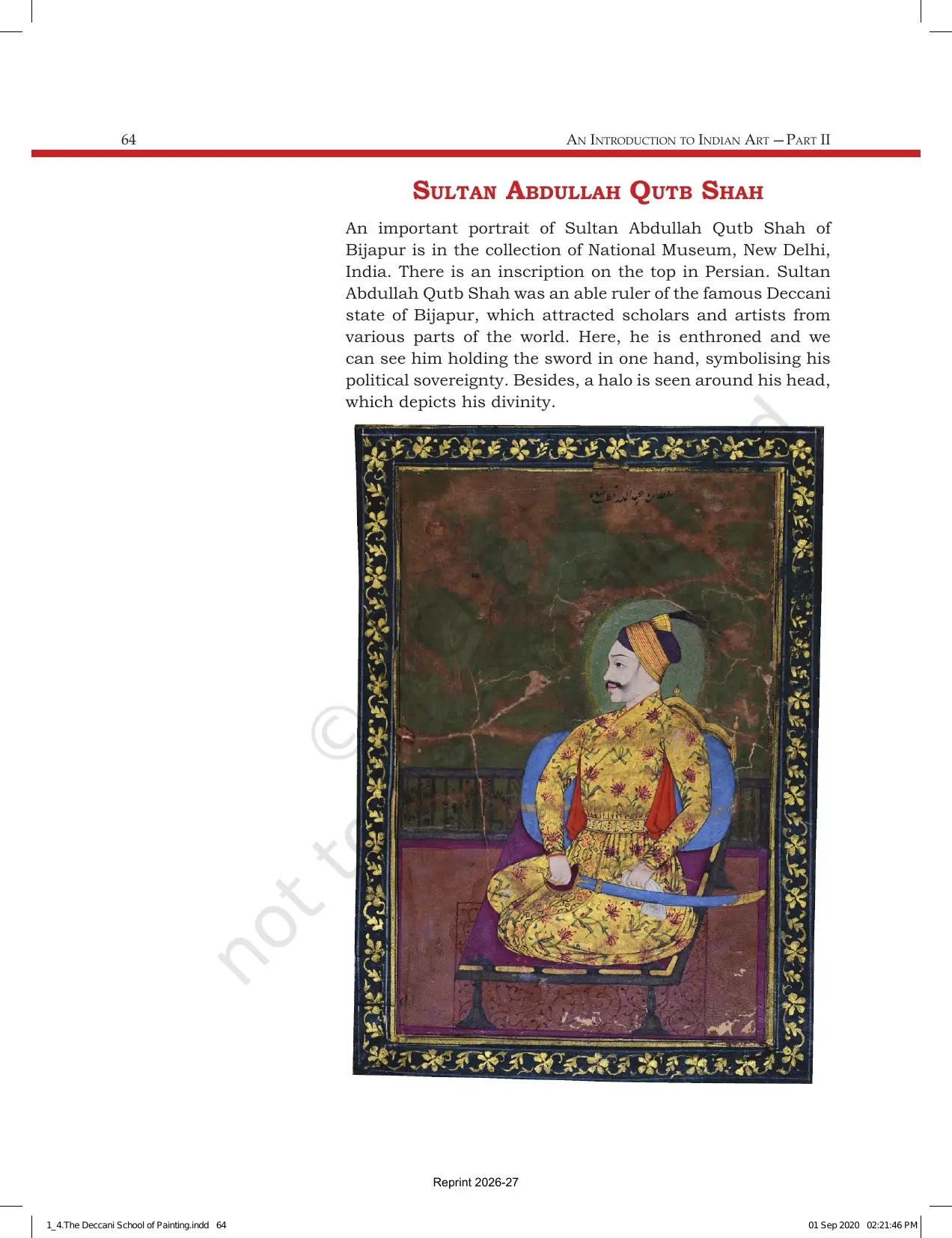
| Sultan Abdullah Qutb Shah | Deccani portrait with a Persian inscription at the top | National Museum, New Delhi |
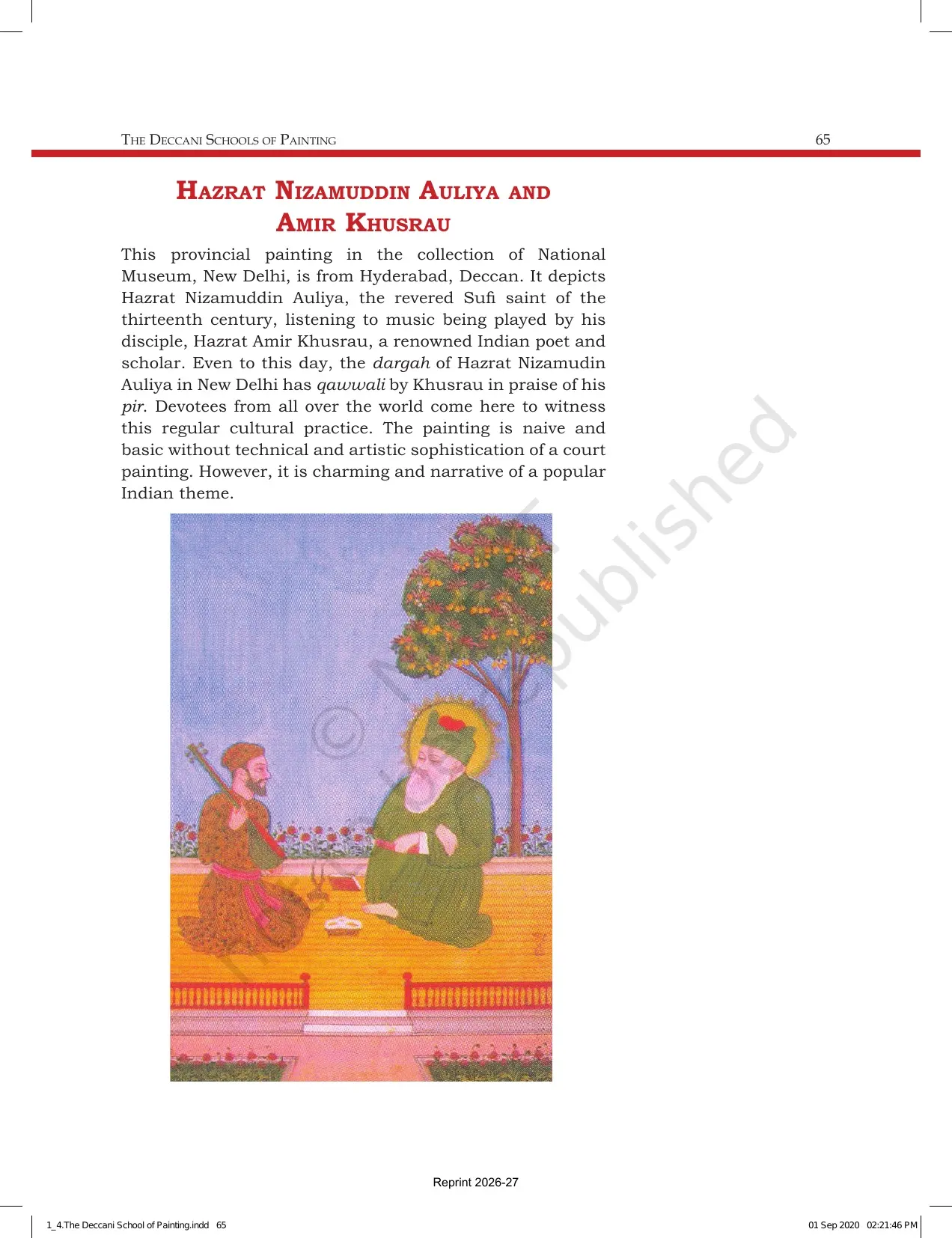
| Hazrat Nizamuddin Auliya and Amir Khusrau | Hyderabad, Deccan, provincial work | National Museum, New Delhi |
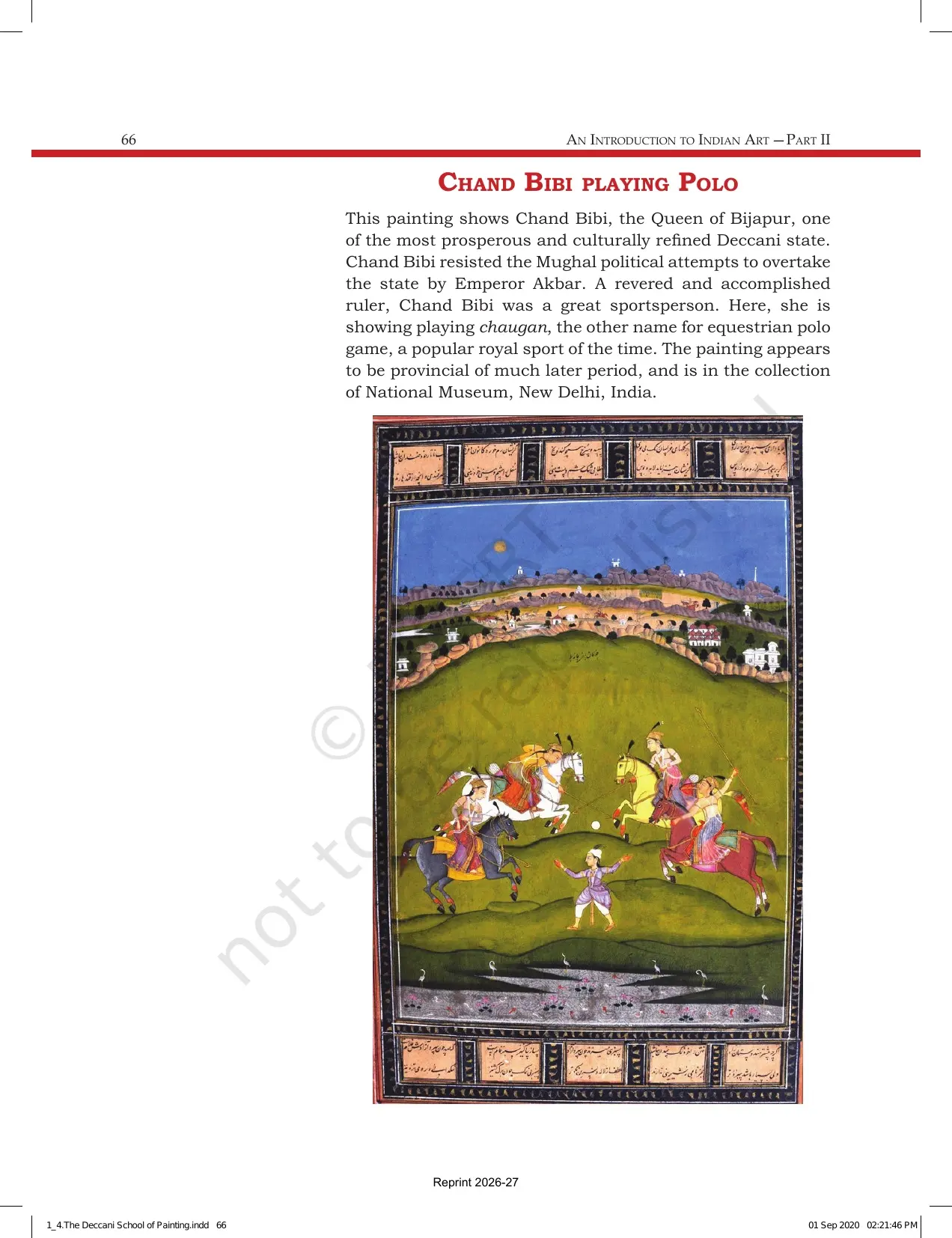
| Chand Bibi playing Polo | Provincial, of a much later period | National Museum, New Delhi |
Four of these plates carry lines you can quote almost verbatim, and they are the ones worth memorising:
- Composite Horse: human figures intertwine into a galloping horse, with flying cranes and lions, Chinese clouds and large leaved plants, and rocky formations in the two bottom corners that anchor the picture. The colours stay within browns and some blue.
- Sultan Ibrahim Adil Shah II hawking: brilliant red on the limbs and tail of the horse, dark dense forest foliage in olive and emerald green, cobalt blue with cranes, a sunlit golden blue sky, and a white hawk at centre stage. Persian influence shows in the horse and rocks, the foreground plants are native.
- Ragini Pathamsika of Raga Hindola: Persian arabesques on two domes, Devanagari letters filling the upper space, a central female musician playing what appears to be a veena, red dominant with green, forms outlined in dark line as in the Ajanta murals, and a small dark elephant in the left corner raising its trunk in welcome.
- Sultan Abdullah Qutb Shah: enthroned, holding a sword that stands for political sovereignty, with a halo around his head that stands for divinity. That pair of symbols answers exercise question 5 on its own.
The Six Exercise Questions at the End of the Deccan Schools Chapter
The chapter closes with six exercise questions. Two of them ask you to look outside the book, so keep the PDF open while you write and do not try to answer from a summary.
- What are the unique features of the Deccani painting of Yogini, and which artists do similar work today?
- What were the popular themes painted in the Deccani School, and can you describe some of them?
- Write a note in 100 words on two paintings you like from the Deccani School.
- How is the Deccani style of painting different from the Mughal style of painting?
- What are the imperial symbols in a Deccani royal painting?
- Which were the centres of painting in the Deccan, and can you show them on a map?
Question 6 is the quickest mark in the chapter. The three centres are Ahmadnagar, Bijapur and Golconda, all on the southern plateau beyond the Vindhya range, with Hyderabad added later under the Asafiya rulers.
Common Mistakes Students Make in the Deccan Schools of Painting Chapter
Watch out for these six:
- Writing about one Deccan school. The title is plural, and the answer needs Ahmadnagar, Bijapur and Golconda named separately.
- Giving the Nujum al-Ulum to Golconda. It is a Bijapur manuscript of 1570 with 876 miniatures.
- Confusing the two Ibrahims. Ibrahim Adil Shah II ruled Bijapur from 1580 to 1627; Ibrahim Qutb Shah ruled Golconda from 1550 to 1580.
- Saying the early Golconda folios show Mughal influence. The book says they suggest no Mughal influence at all.
- Ending the timeline in 1857. Deccani painting is traced to the 1680s, when the Mughals conquered the Deccan.
- Skipping Lepakshi. The southern scarf and the bun on the nape of the neck both point back to the Lepakshi murals.
Student Feedback on the Deccan Schools of Painting Chapter
What 12,840 students told us about this chapter
- 71% of the students surveyed said the three courts blur together once they start writing under time pressure.
- Only 34% could place the Nujum al-Ulum in Bijapur on the first attempt.
- Students who wrote the plate table out by hand twice reported the fastest recall in the appreciation question.
- Most skipped section: the opening argument about Indo-Persian art, left unread by roughly 2 in 5 students.
Source: Collegedunia Class 12 Fine Arts student survey taken before the 2026-27 board exams. Sample of 12,840 students from CBSE schools across 14 states.
How to Revise the Deccan Schools Chapter in a Three Block Plan
This chapter is shorter than the Mughal one but carries more place names. About two and a half focused hours makes it board ready, and the order printed in the book gives you the sequence for free.
- Block 1, 45 minutes. Read the opening and the Ahmadnagar section. Write the timeline, the three courts and the Ahmadnagar costume list from memory.
- Block 2, 60 minutes. Read Bijapur and Golconda. Build fact cards for the Nujum al-Ulum, the Ragamala series and the Diwan of Hafiz folios, then describe the Yogini in six lines.
- Block 3, 45 minutes. Read the six appreciation plates. Write the Deccani against Mughal comparison table without looking, then check it against the version above.
Repeat Block 3 a week before the paper. The plate details and the comparison points are the cheapest marks here, and they fade fastest if you leave them alone.
How the Deccan Schools Chapter PDF Works with the Fine Arts Revision Notes
The chapter PDF gives you the official text and every plate exactly as printed. What it does not give you is a compressed one page recall sheet. That sits on the notes pages for the same subject, and running the two together is faster than reading either one alone.
| Resource | What it adds beyond this chapter PDF | Link |
|---|---|---|
| Revision Notes | The court by court index, the plate table and the Deccani against Mughal comparison condensed for a last read | The Deccan Schools of Painting Class 12 Notes |
| Previous chapter notes | The Mughal atelier and its technique, which the comparison question sets against the Deccan | The Mughal School of Miniature Painting Class 12 Notes |
| Next chapter notes | The Rajasthani courts, where Ragamala painting continues in a very different palette | The Rajasthani Schools of Painting Class 12 Notes |
Also Check: read the Mughal chapter first and this one straight after. The comparison question is set from the two together far more often than from either alone.
All 8 Chapters of Class 12 Fine Arts with NCERT Book PDFs
The Class 12 Fine Arts course runs across eight chapters. Every link below opens the official NCERT chapter PDF for the 2026-27 session.
| Chapter | NCERT Book PDF |
|---|---|
| Chapter 1 | The Mughal School of Miniature Painting Class 12 PDF |
| Chapter 2 | The Deccan Schools of Painting Class 12 PDF |
| Chapter 3 | The Rajasthani Schools of Painting Class 12 PDF |
| Chapter 4 | The Pahari Schools of Painting Class 12 PDF |
| Chapter 5 | The Bengal School and Cultural Nationalism Class 12 PDF |
| Chapter 6 | Modern Indian Art Class 12 PDF |
| Chapter 7 | The Company School Class 12 PDF |
| Chapter 8 | Living Art Traditions of India Class 12 PDF |
The Deccan Schools of Painting Class 12 Fine Arts NCERT Book PDF FAQs
Questions Class 12 Students Ask Most About the Deccan Schools Chapter
Ques. What are the Deccan Schools of Painting?
Ans. They are the court schools of painting that grew on the southern plateau beyond the Vindhya range under the Sultans of the Deccan in the sixteenth and seventeenth centuries. The history runs from the late sixteenth century until the 1680s, when the Mughals conquered the Deccan. The style is known for dense composition, intense colour, a strong sensuality and a deliberate aura of romance.
Ques. Which three kingdoms developed the Deccan Schools of Painting?
Ans. Ahmadnagar, Bijapur and Golconda. Each developed a sophisticated and distinct school of court painting, with its own patrons and its own manuscripts. Later Deccani work continues under the Asafiya dynasty and in the provincial courts of Rajas and Nawabs across the State of Hyderabad under the Nizam.
Ques. What is the Tarif-i-Hussain Shahi?
Ans. It is a volume of poems celebrating the reign of Hussain Nizam Shah I of Ahmadnagar, who ruled from 1553 to 1565, and it holds the earliest examples of Deccani painting. Of its 12 miniatures, most show battle scenes the book calls of no artistic interest, while the folios of the queen and her marriage stand out for gorgeous colours and sensuous lines.
Ques. What is the Nujum al-Ulum and how many miniatures does it have?
Ans. The Nujum al-Ulum is a richly illustrated encyclopaedia from Bijapur dated 1570, holding 876 miniatures. Many illustrate weapons and utensils, others the constellations. Ibrahim Adil Shah II owned the manuscript, and its astronomical illustrations may derive from Ottoman Turkish sources because Bijapur had a close connection with Turkey. The Throne of Prosperity plate comes from this volume.
Ques. Who was Ibrahim Adil Shah II and why does he matter in this chapter?
Ans. He ruled Bijapur from 1580 to 1627, following Ali Adil Shah I. He was a patron of art and literature, an expert in Indian music, and the author of a book on the subject called the Nauras-nama. He owned the Nujum al-Ulum and probably commissioned the Bijapur Ragamala series in the 1590s. Do not confuse him with Ibrahim Qutb Shah of Golconda.
Ques. What are the unique features of the Yogini painting from Bijapur?
Ans. The artist is unrecorded. The composition is vertical, with the tall standing figure of the Yogini answered by a group of white structures at the top that work as a tapering visual note. She is preoccupied with a myna bird as if in conversation, wears jewellery, and her elongated hair bun stretches her presence upward. Long scarves swirl in rhythmic circles around her body in a landscape of exquisite flora.
Ques. Why was Golconda the wealthiest of the Deccan kingdoms?
Ans. Golconda became independent in 1512 and grew rich on brisk trade from the ports along the east coast, shipping iron and cotton goods to South East Asia. Trade with Persia stayed heavy, and Golconda painted cottons became a rage in Europe. Diamonds were discovered early in the seventeenth century, widening the revenue base further. That wealth shows in the gold jewellery worn by both women and men in its paintings.
Ques. What is the Composite Horse painting?
Ans. It is an early seventeenth century painting from Golconda in which human figures intertwine to form a galloping horse set over a decorated background. Flying cranes and lions, Chinese clouds and plants with large leaves add a surreal quality, while rocky formations in the two bottom corners anchor the picture on solid ground. The colour scheme stays limited, mostly browns with some blue.
Ques. How is the Deccani style of painting different from the Mughal style?
Ans. Deccani painting was made for the Sultans of Ahmadnagar, Bijapur and Golconda, and it favours dense composition, intense and sensual colour, symmetrical and often unfunctional architecture and an aura of romance. Mughal painting was made for the imperial atelier and aims at documentary record and optical reality. The Deccani landscape idiom, with its high circular horizon and gold sky, is owed to Persia. Both schools developed almost at the same time.
Ques. Who was Chand Bibi and what does her painting show?
Ans. The chapter describes her as the Queen of Bijapur, a revered and accomplished ruler who resisted the political attempts of Emperor Akbar to take the state. She was a great sportsperson, and the painting shows her playing chaugan, the other name for equestrian polo, a popular royal sport of the time. The work is provincial and of a much later period, and it is in the National Museum, New Delhi.
Ques. Why does the textbook call it the Deccani Schools while the syllabus says Deccan?
Ans. They are the same chapter. The printed heading in An Introduction to Indian Art Part 2 reads The Deccani Schools of Painting, while the Class 12 Fine Arts syllabus and most question papers use the Deccan Schools of Painting. Write either spelling in the exam, but keep the plural, because the answer must cover Ahmadnagar, Bijapur and Golconda as three separate courts.
Ques. How do I download the Deccan Schools of Painting NCERT Book PDF?
Ans. Use the PDF viewer at the top of this page. It carries the official NCERT chapter exactly as printed, with all plates and captions, so you can read the whole chapter online or save it for offline revision before the 2026-27 board exams. No sign up is needed.



Comments