



Inside the NCERT Book PDF for Class 12 Fine Arts Chapter 6 Modern Indian Art you will find the full story of Indian modernism, from the colonial art schools of the nineteenth century to installation and video art after the 1990s. It is the official chapter from An Introduction to Indian Art Part 2, Reprint 2026-27, printed page for page as the board prescribes it.
- Covers Kala Bhavana, the Calcutta Group, the Bombay Progressives, abstraction, Neo-Tantric art, the Baroda narrative painters and New Media art.
- Names to spell right: Gaganendranath Tagore, Ramkinkar Baij, Amrita Sher-Gil, Chittoprasad, F. N. Souza, S. H. Raza and K. G. Subramanyan.
- Ends with 4 exercise questions and 14 full page appreciations across 28 printed pages.
This Modern Indian Art chapter PDF is the unedited NCERT text page for page, checked against the Reprint 2026-27 print run, and paired here with an artwork by artwork appreciation index written by Collegedunia Fine Arts teachers.
What the Modern Indian Art Class 12 PDF Contains
This is the longest chapter in the book and it runs as a timeline, not as a list of schools. It starts in the colonial art schools of the late nineteenth century and ends with digital art and social media at the turn of the present century. Read it in the printed order and the fourteen appreciation plates at the back slot straight into the timeline.
| Section in the PDF | What it covers | Question type it feeds |
|---|---|---|
| Introduction to Modernism in India | British bias against Indian fine arts, art schools at Lahore, Calcutta, Bombay and Madras, Kala Bhavana in 1919, Cubism and Expressionism reaching India through art magazines | 3 marks and 5 marks |
| The Shantiniketan artists | Nandalal Bose at Kala Bhavana, Benode Behari Mukherjee, Ramkinkar Baij, the Santhal community, Jamini Roy, Amrita Sher-Gil | 5 marks, the core question |
| Modern Ideologies and Political Art | World War 2, the Bengal famine, the Calcutta Group of 1943, Marxism, Chittoprasad and Somnath Hore, printmaking as a political medium | 5 marks |
| The Progressive Artists' Group | The Progressives of 1946 in Bombay, F. N. Souza, M. F. Husain, K. H. Ara, S. A. Bakre, H. A. Gade and S. H. Raza | 5 marks |
| Abstraction, a New Trend | S. H. Raza and the bindu, Gaitonde, Piloo Pochkhanawala, Krishna Reddy, K. C. S. Paniker, Cholamandalam, Neo-Tantric art | 3 marks and 5 marks |
| Tracing the Modern Indian Art | Group 1890 and manifestos, why modernism arrived under colonial rule, cultural nationalism, Ananda Coomaraswamy and swadeshi in art | 5 marks |
| New Figurative Art from the 1980s | Baroda Art School, storytelling in painting, the Place for People exhibition of 1981, Geeta Kapur and the role of the art critic | 5 marks |
| New Media Art from the 1990s | Liberalisation and globalisation, video and photography, installation, photorealism, documentary photography, digital painting | 3 marks and 5 marks |
| Fourteen appreciation plates | Paintings, prints, murals and sculptures described in full at the back of the chapter | Picture based questions |
One planning note before you start. This chapter is examined on movements and groups, not on individual courts or dynasties. Keep one page ruled into four columns titled Group, Year, Members and Belief, and fill a row every time the book names a new collective. You will finish the chapter with the Calcutta Group, the Progressives, Group 1890 and the Baroda narrative painters already tabulated.
Modernism Arrives in India: Colonial Art Schools and Kala Bhavana in 1919
The chapter opens with the colonial attitude that everything else reacts against. Fine arts was seen as European by the British, and they felt that Indians lacked the training and the sensibility to create and appreciate it. That single sentence is a ready made two mark answer, so learn it first.
- Where the schools were: art schools were set up by the mid and late nineteenth century in Lahore, Calcutta, Bombay and Madras.
- What they taught: traditional Indian crafts, plus academic and naturalist art that reflected Victorian tastes.
- The catch on crafts: even the Indian crafts that received support were the ones based on European taste and on the demands of its market.
- The nationalist reply: the Bengal School of Art, nurtured by Abanindranath Tagore and E. B. Havell, is named as the prime example of art that grew against this colonial bias.
- The first national art school: Kala Bhavana, set up in 1919 as part of the newly established Visva-Bharati University at Shantiniketan, conceptualised by the poet Rabindranath Tagore.
- How Europe reached India: through the Bauhaus exhibition that travelled to Calcutta, and through art magazines that were in circulation.
The book then defines the idea that the whole chapter hangs on. Cubism and Expressionism had rejected academic realism and experimented with abstraction, holding that art need not copy the world but create its own world out of forms, lines and colour patches. A landscape, portrait or still life may be called abstract if it draws our attention to an abstract design created by forms, lines and colour patches. Write that definition word for word if a question asks what abstraction means.
Note the political setting too. This was the time when the whole world was in a state of intense political turmoil in the wake of World War 1, which is why the chapter treats 1919 as a turning point rather than a date to memorise.
Modern Trends in Indian Art Explained in One Video
Source: Study Box on YouTube
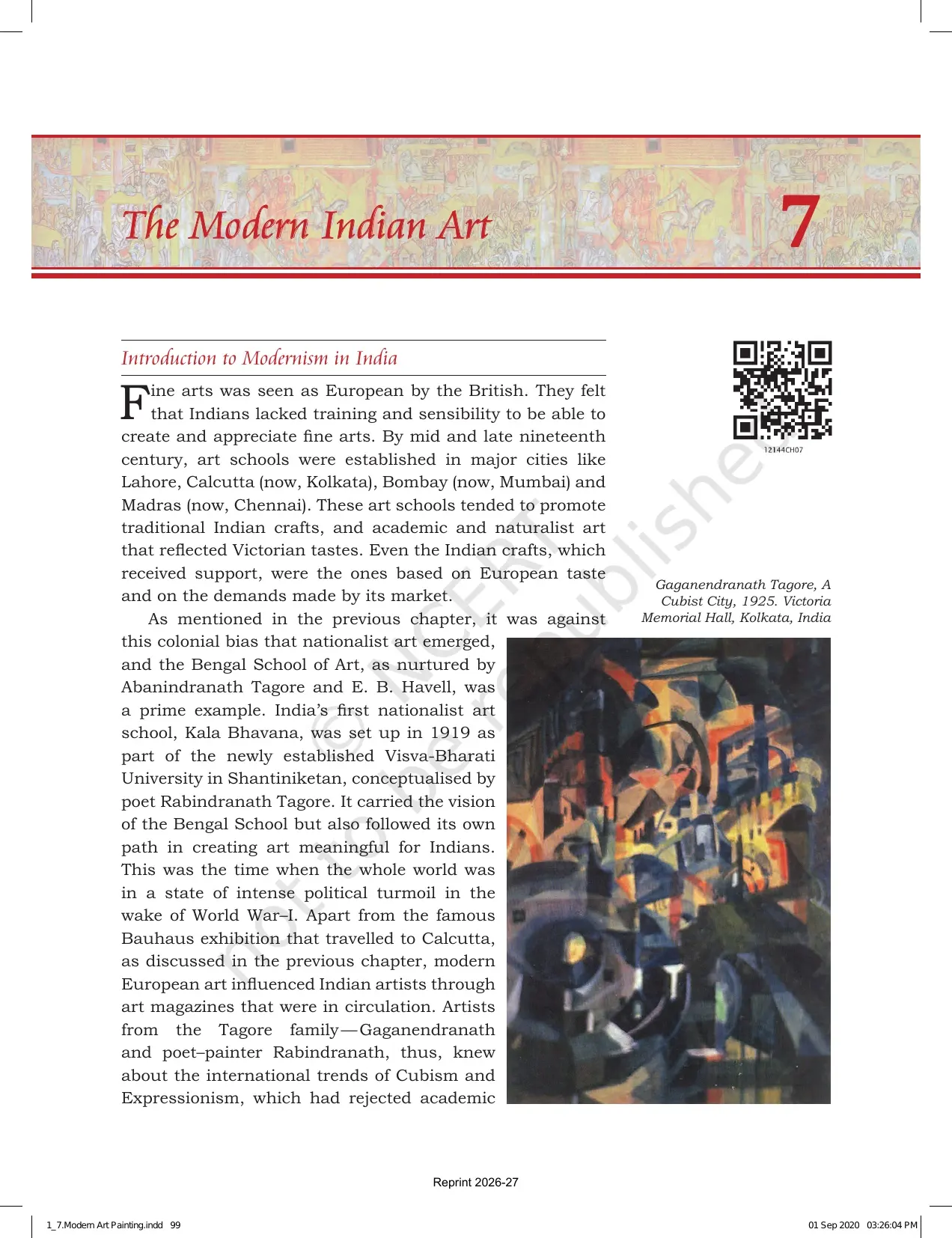
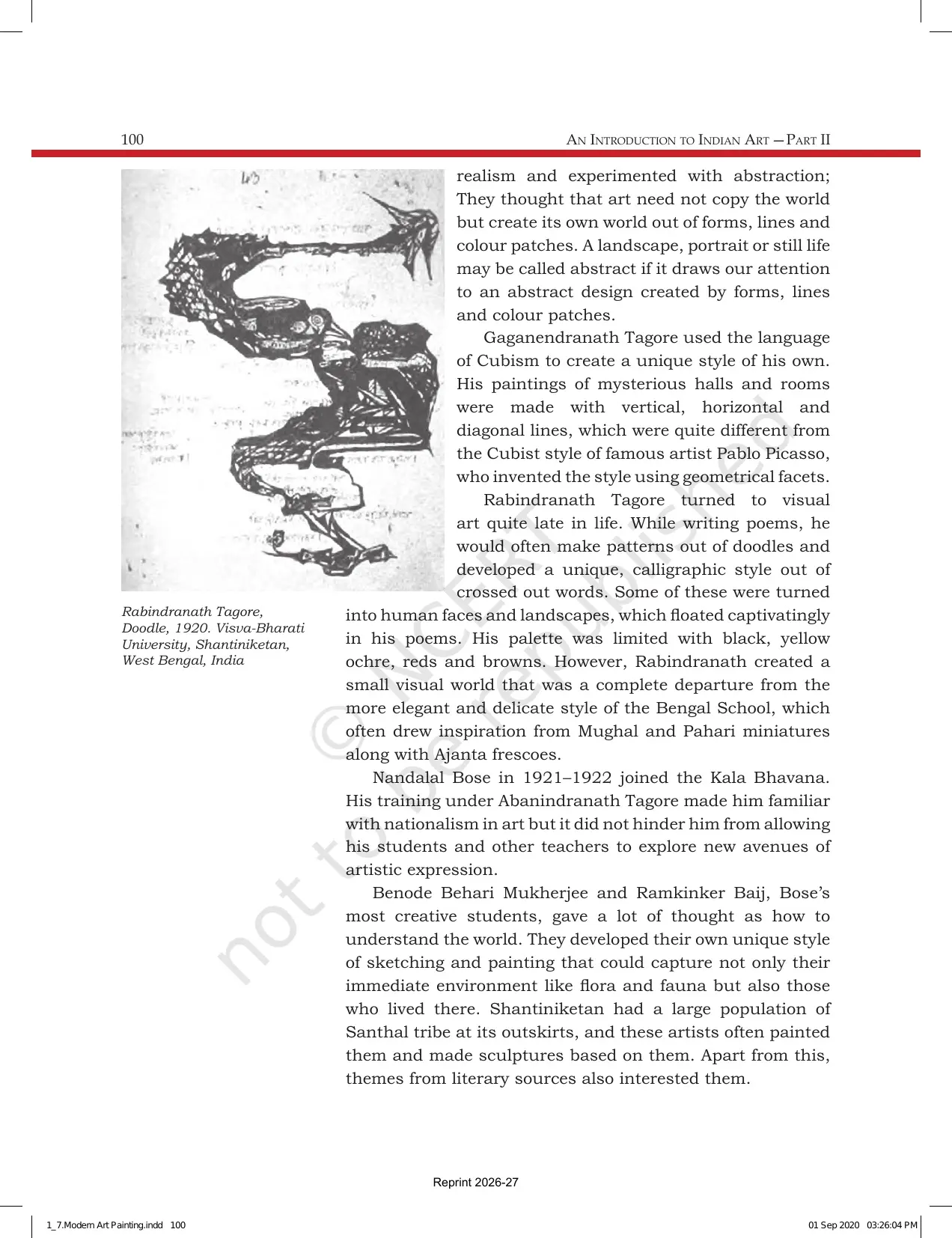
Gaganendranath and Rabindranath Tagore: Cubism, Doodles and the Break from Academic Realism
Two artists from the Tagore family open the modern story, and the paper often asks you to separate them. Both knew the international trends of the day, but they used them very differently.
| Artist | What the book credits to him | The plate printed in the chapter |
|---|---|---|
| Gaganendranath Tagore | Used the language of Cubism to create a unique style of his own. His paintings of mysterious halls and rooms were made with vertical, horizontal and diagonal lines, quite different from the Cubist style of Pablo Picasso, who invented the style using geometrical facets | A Cubist City, 1925, Victoria Memorial Hall, Kolkata |
| Rabindranath Tagore | Turned to visual art quite late in life. While writing poems he made patterns out of doodles and developed a unique calligraphic style out of crossed out words, some of which became human faces and landscapes floating in his poems | Doodle, 1920, Visva-Bharati University, Shantiniketan |
The book is precise about Rabindranath's palette, and precision is where the marks sit. His palette was limited to black, yellow ochre, reds and browns. He created a small visual world that was a complete departure from the more elegant and delicate style of the Bengal School, which often drew on Mughal and Pahari miniatures along with Ajanta frescoes.
Do not write that Gaganendranath copied Picasso. The chapter goes out of its way to say the two styles were different, and an answer that misses that distinction loses the mark it was set to test.
Nandalal Bose, Benode Behari Mukherjee and Ramkinkar Baij at Shantiniketan
Nandalal Bose joined Kala Bhavana in 1921 to 1922. His training under Abanindranath Tagore had made him familiar with nationalism in art, but the book stresses that this did not stop him from letting his students and fellow teachers explore new avenues of artistic expression. That openness is what produced the next two artists.
- What the two students shared: Benode Behari Mukherjee and Ramkinkar Baij were Bose's most creative students and developed their own style of sketching and painting.
- What they painted: their immediate environment, its flora and fauna, and the people who lived there.
- The community they painted: Shantiniketan had a large population of the Santhal tribe at its outskirts, and both artists painted them and made sculptures based on them.
- Mukherjee's choice of subject: rather than the well known epics, he was drawn to the lives of medieval saints.
- His famous mural: Medieval Saints on the walls of Hindi Bhavana in Shantiniketan, charting a history of medieval India through the lives of Tulsi Das, Kabir and others, focusing on their humane teachings.
- Baij's subject: a celebration of nature, with almost all his sculptures and paintings created as a response to his environment.
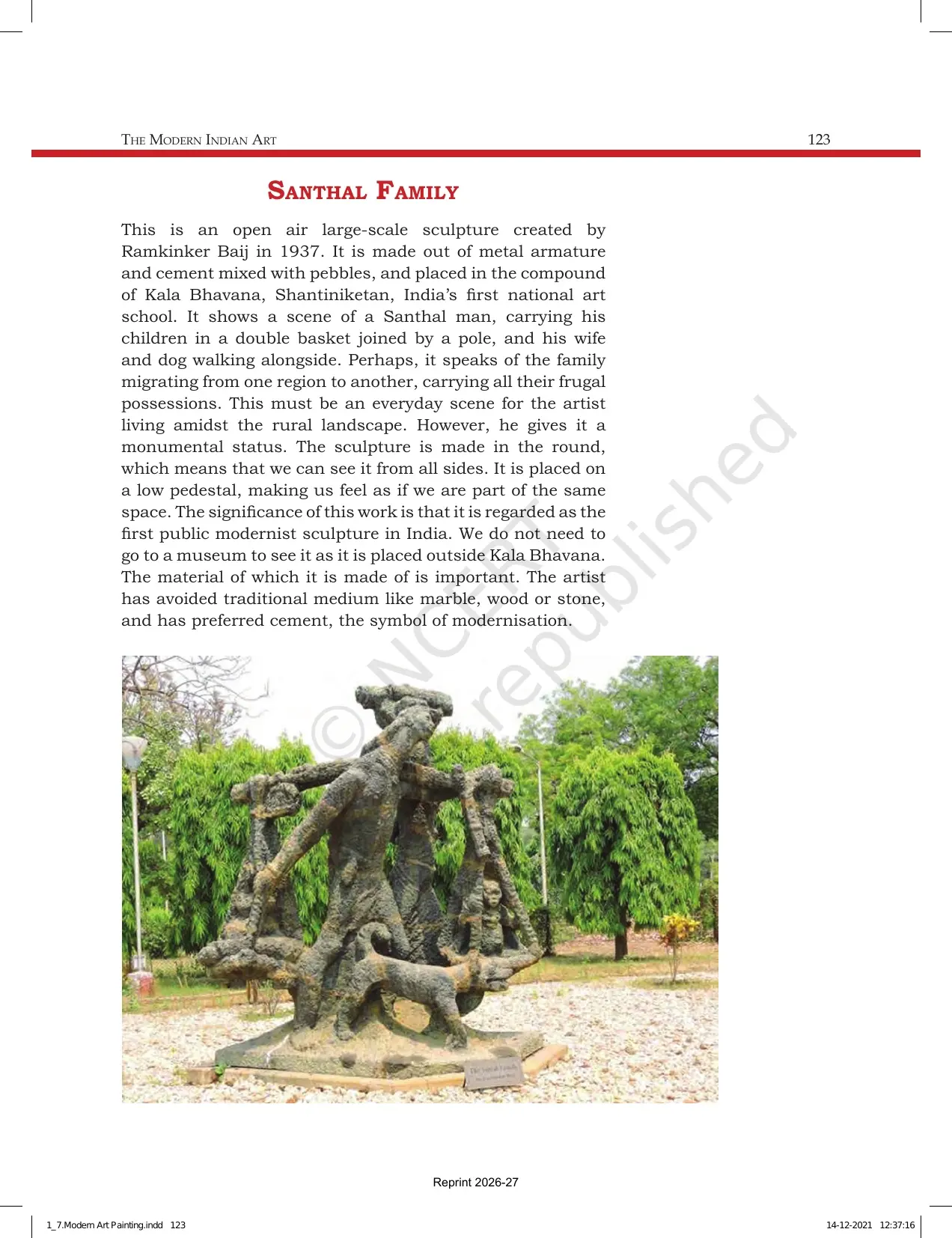
Santhal Family turned the daily activity of a Santhal family setting out for work into a larger than life size piece of art. It stands as an outdoor sculpture in the Kala Bhavana compound and it was made from modern material: cement mixed with pebbles, held in shape by a metal armature.
The book sets this against an older sculptor for contrast. D. P. Roy Choudhury had used academic realism to celebrate the labour of the working classes in The Triumph of Labour. Baij's style was in sharp contrast to it, and that contrast between academic realism and modern material is a clean three mark answer.
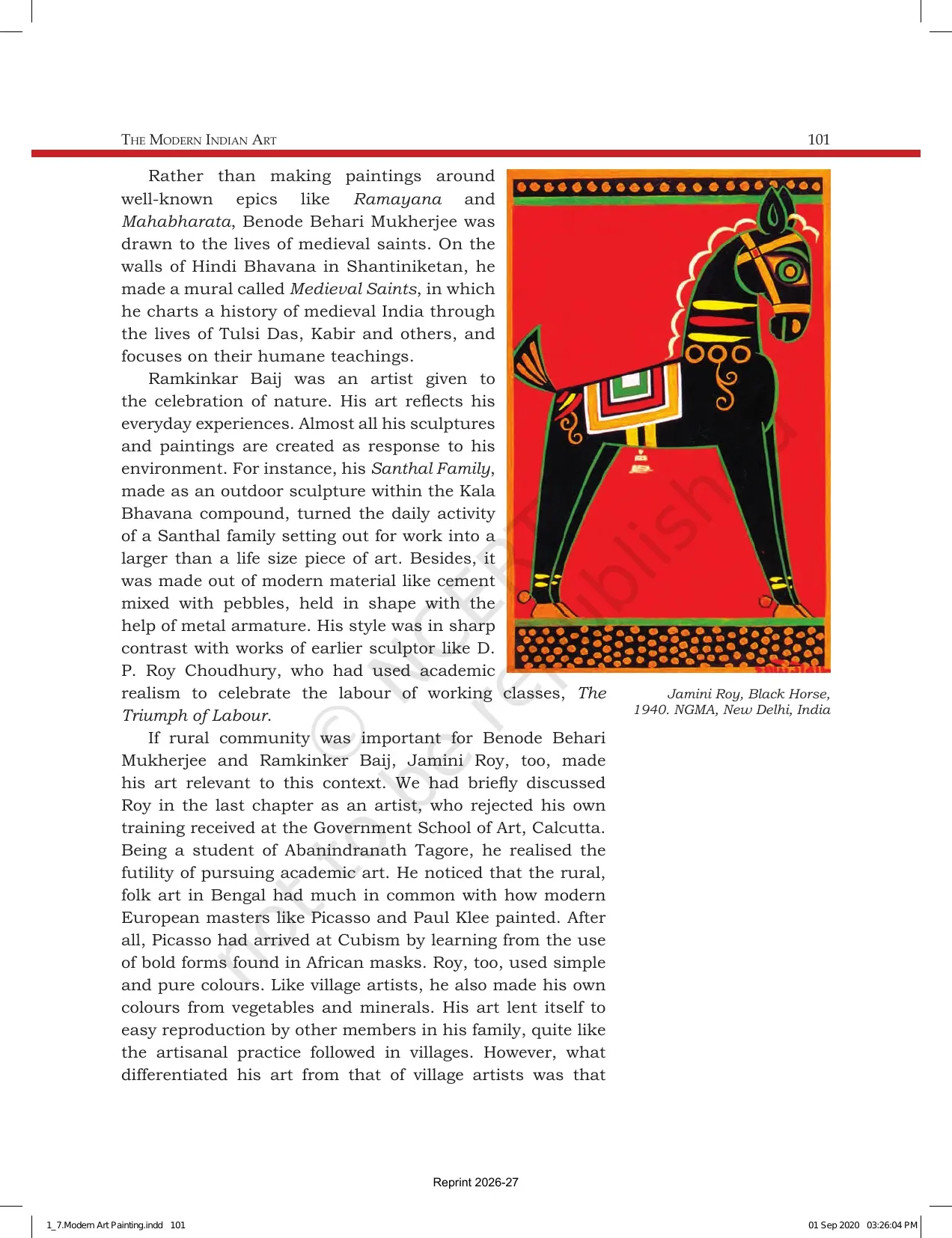
Jamini Roy and Amrita Sher-Gil: Two Routes to a Modern Indian Language
Both artists wanted an art that was modern and Indian at the same time, and both got there by different roads. Prepare them as a pair, because the paper likes to set them against each other.
| Point of comparison | Jamini Roy | Amrita Sher-Gil |
|---|---|---|
| Training | Trained at the Government School of Art, Calcutta, a student of Abanindranath Tagore, who then rejected that training | Trained in Paris, with first hand experience of European modern art |
| What he or she realised | The futility of pursuing academic art, and that rural folk art in Bengal had much in common with how Picasso and Paul Klee painted | That Indian themes and images needed a base in India, so she made India her base |
| Method | Simple and pure colours, made at home from vegetables and minerals, like village artists | Assimilated miniature and mural traditions of Indian art with European modernism |
| Reproduction | His art lent itself to easy reproduction by other members of his family, like the artisanal practice in villages | Trained in Impressionism and post Impressionism before the shift to Indian subjects |
| What set the work apart | Roy signed his paintings, unlike village artists, and his style is uniquely personal | Died young in 1941, leaving work valued for its experimental spirit |
Two extra facts are worth carrying into the answer. Picasso had arrived at Cubism by learning from the bold forms found in African masks, which is the book's reason for saying folk art and modern European art were close cousins. And Roy's style is described as distinct from three things at once: the academic naturalism of art schools, Raja Ravi Varma's Indianised naturalism, and the delicate style of some Bengal School artists.
Sher-Gil's dates are printed as 1913 to 1941, and she is called a unique female artist who contributed immensely to modern Indian art through the 1930s. The plate that carries her work in this chapter is Haldi Grinder of 1940, covered in the appreciation list below.
Modern Ideologies and Political Art: The Calcutta Group of 1943 and the Bengal Famine
Soon after Sher-Gil's death, India, still under British rule, was deeply affected by global events like World War 2. One indirect outcome was the outbreak of the Bengal famine, which ravaged the region and forced massive rural migration to the cities. That humanitarian crisis pushed artists to ask what their role in society was.
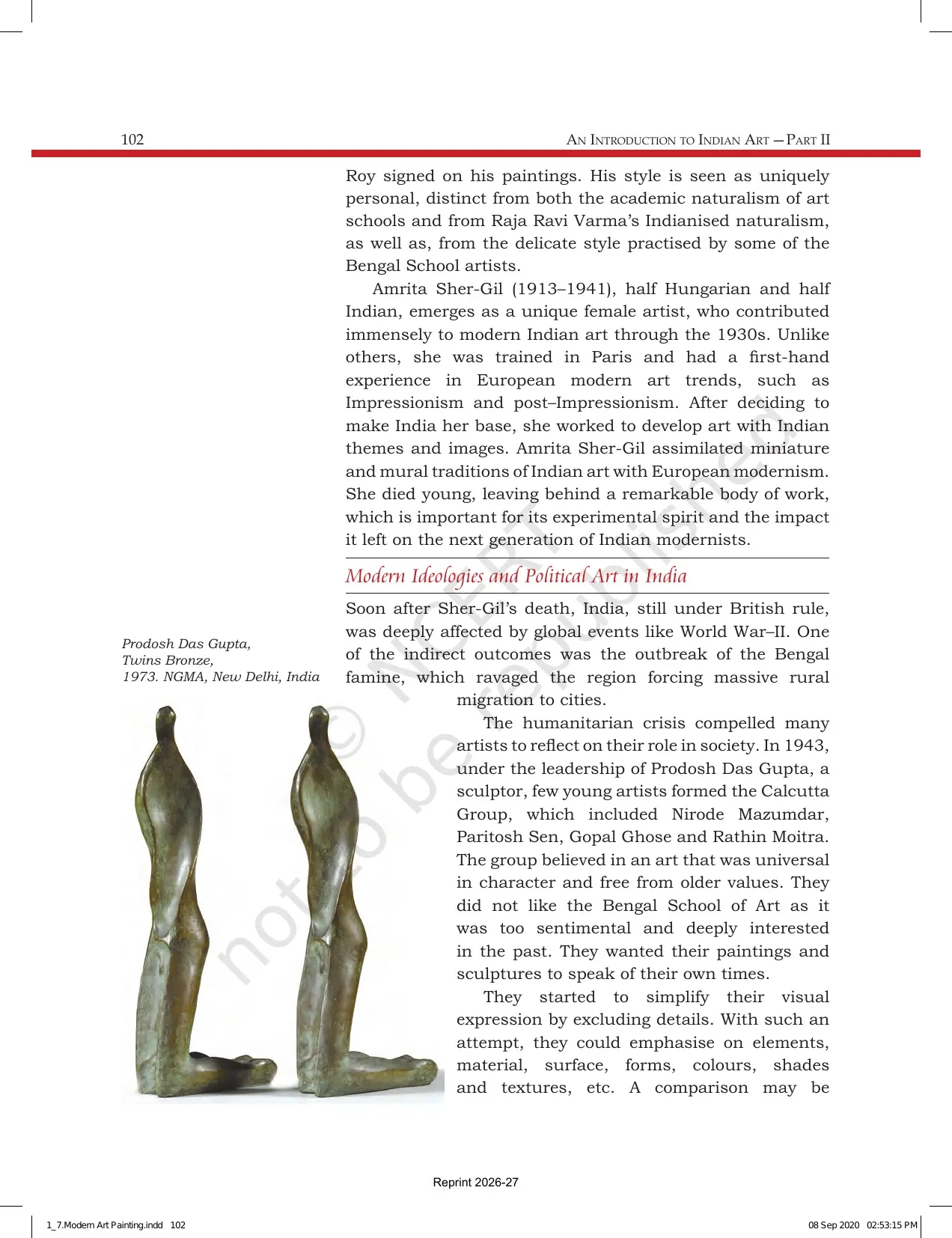
- The group and its year: in 1943, under the leadership of the sculptor Prodosh Das Gupta, a few young artists formed the Calcutta Group.
- Its members: Nirode Mazumdar, Paritosh Sen, Gopal Ghose and Rathin Moitra.
- Its belief: art that was universal in character and free from older values.
- Its quarrel with the Bengal School: they found it too sentimental and too deeply interested in the past, and wanted work that spoke of their own times.
- Their method: they simplified visual expression by excluding details, so they could emphasise elements, material, surface, forms, colours, shades and textures.
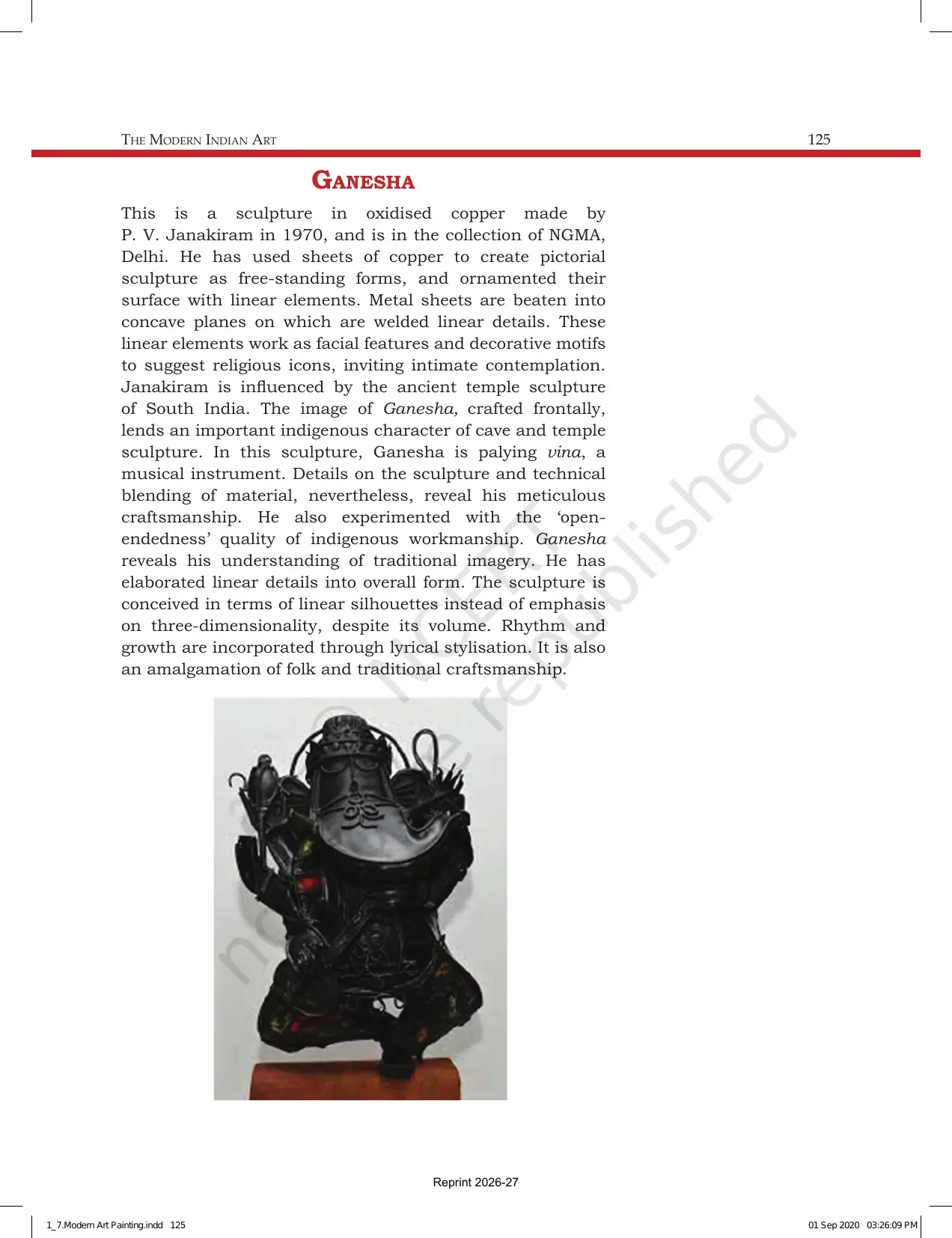
- The South Indian comparison: the sculptor P. V. Janakiram, who worked with metal sheets in a creative way.
Seeing abject poverty in villages and cities, many young artists in Calcutta were drawn to socialism and especially Marxism, the philosophy taught by Karl Marx in the mid nineteenth century in the West, which asked hard questions about class difference. Chittoprasad and Somnath Hore, the two political artists of India, found printmaking to be a strong medium to express these social concerns.
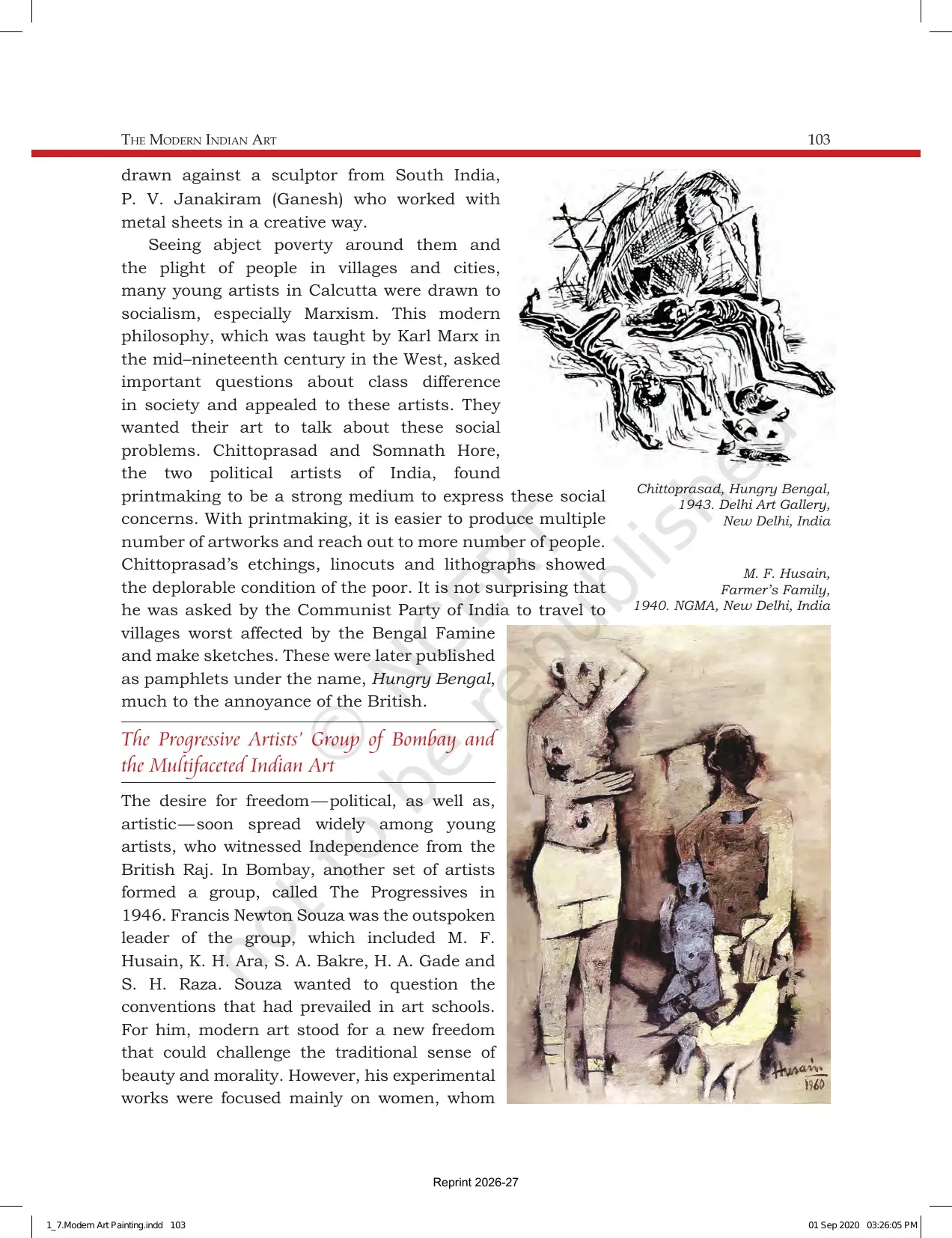
The reason given for that choice is examinable on its own: with printmaking it is easier to produce multiple artworks and reach more people. Chittoprasad's etchings, linocuts and lithographs showed the deplorable condition of the poor, and the Communist Party of India asked him to travel to the villages worst affected by the Bengal Famine and make sketches. These were published as pamphlets under the name Hungry Bengal, much to the annoyance of the British.
The Progressive Artists' Group of Bombay and the Multifaceted Indian Art
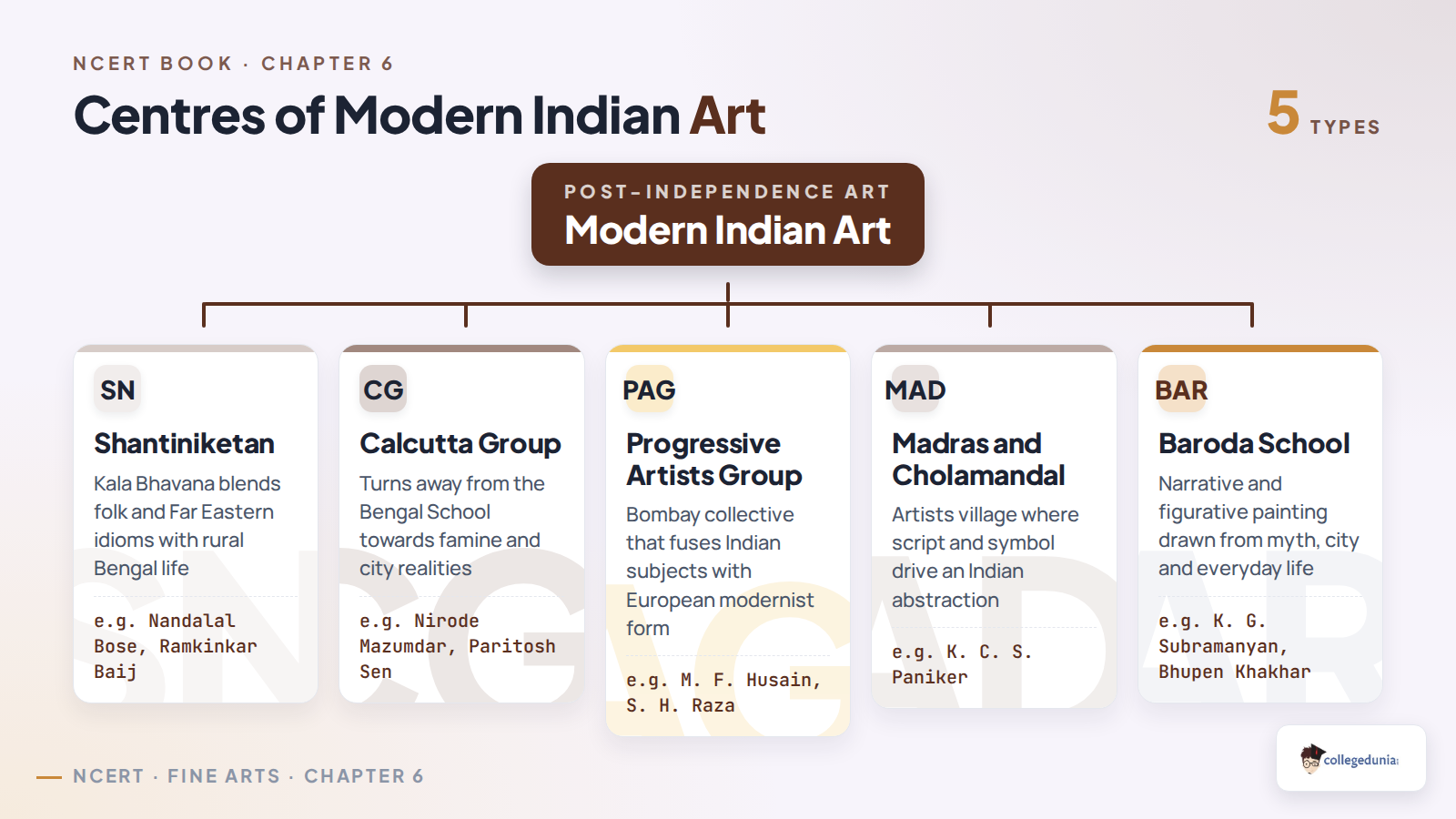
The desire for freedom, political as well as artistic, spread among young artists who witnessed Independence from the British Raj. In Bombay another set of artists formed a group called The Progressives in 1946. The membership list is a favourite one mark question, so learn all six names together.
- Leader: Francis Newton Souza, the outspoken leader of the group.
- Members: M. F. Husain, K. H. Ara, S. A. Bakre, H. A. Gade and S. H. Raza.
- Souza's position: he wanted to question the conventions that had prevailed in art schools, and for him modern art stood for a new freedom that could challenge the traditional sense of beauty and morality.
- Souza's subject: his experimental works focused mainly on women, painted as nudes with exaggerated proportions that broke standard notions of beauty.
- Husain's project: to make the modern style of painting understandable in an Indian context, painting with western expressionist brush strokes in bright Indian colours.
- Husain's sources: Indian mythology and religious sources, plus the style of miniature paintings, village crafts and even folk toys.
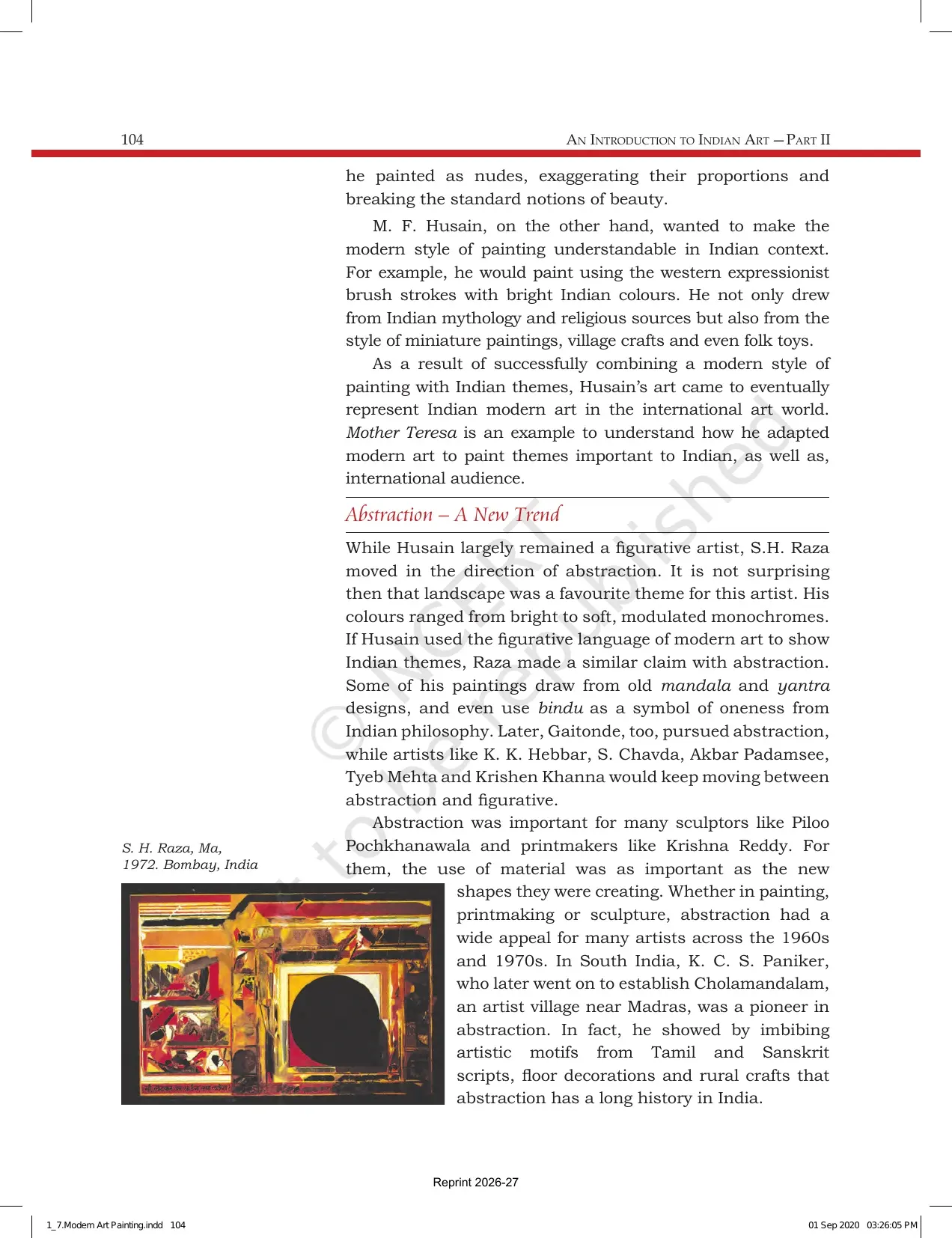
By combining a modern style of painting with Indian themes, Husain's art came to represent Indian modern art in the international art world. The chapter offers Mother Teresa as the example of how he adapted modern art to paint a theme important to Indian and international audiences alike. His in text plate is Farmer's Family of 1940 in the National Gallery of Modern Art, New Delhi.
Abstraction as a New Trend: S. H. Raza, Krishna Reddy and Neo-Tantric Art
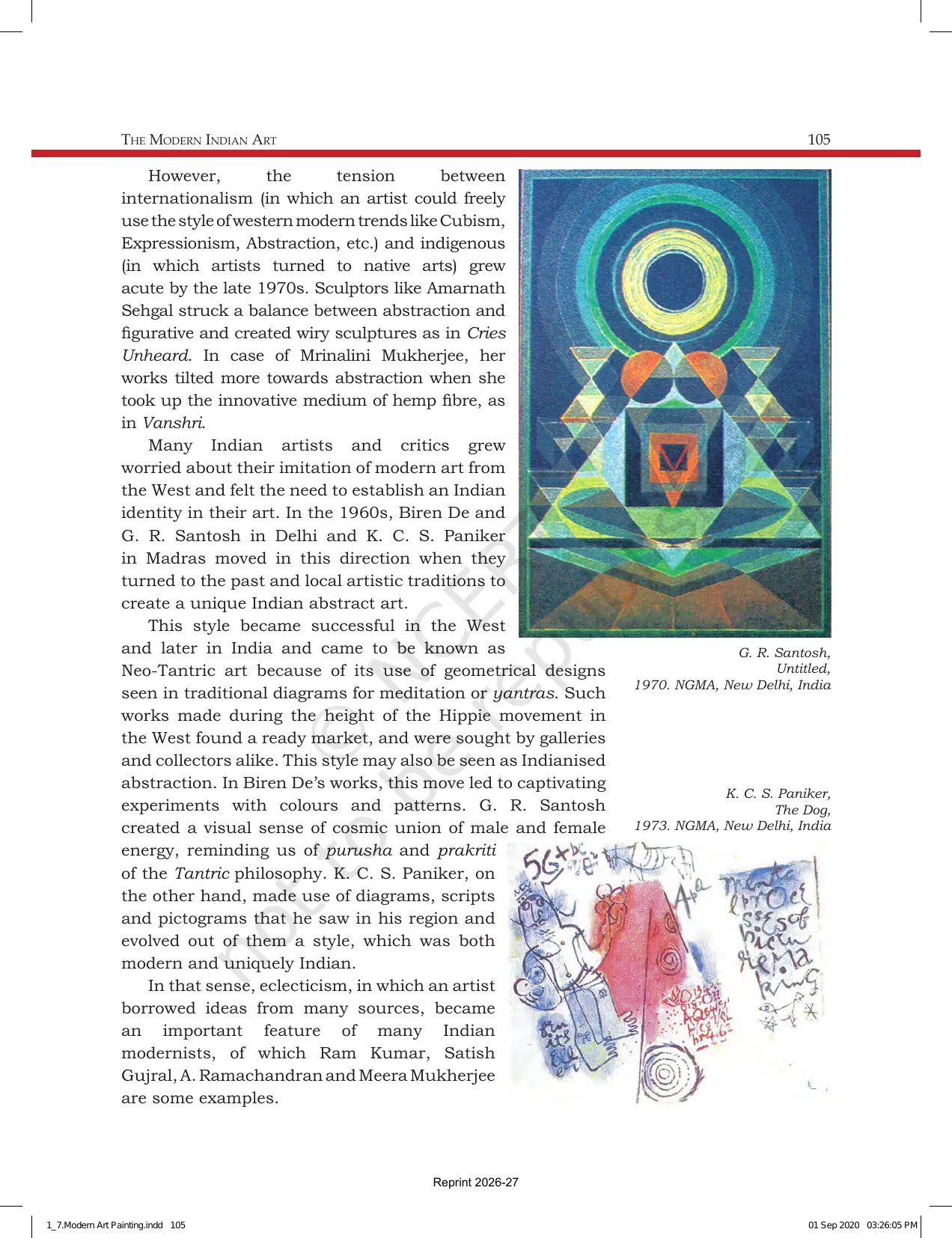
Husain stayed largely figurative while Raza moved towards abstraction, which is why landscape was Raza's favourite theme. His colours ranged from bright to soft, modulated monochromes. If Husain used the figurative language of modern art to show Indian themes, Raza made the same claim through abstraction.
- Raza's Indian sources: old mandala and yantra designs, and the bindu as a symbol of oneness from Indian philosophy.
- Who followed: Gaitonde pursued abstraction, while K. K. Hebbar, S. Chavda, Akbar Padamsee, Tyeb Mehta and Krishen Khanna kept moving between abstraction and the figurative.
- In sculpture and printmaking: abstraction mattered to the sculptor Piloo Pochkhanawala and the printmaker Krishna Reddy, for whom the use of material was as important as the new shapes.
- In South India: K. C. S. Paniker, who later founded Cholamandalam, an artist village near Madras, was a pioneer in abstraction.
- Paniker's argument: by taking motifs from Tamil and Sanskrit scripts, floor decorations and rural crafts, he showed that abstraction has a long history in India.
- The span: in painting, printmaking and sculpture alike, abstraction had wide appeal across the 1960s and 1970s.
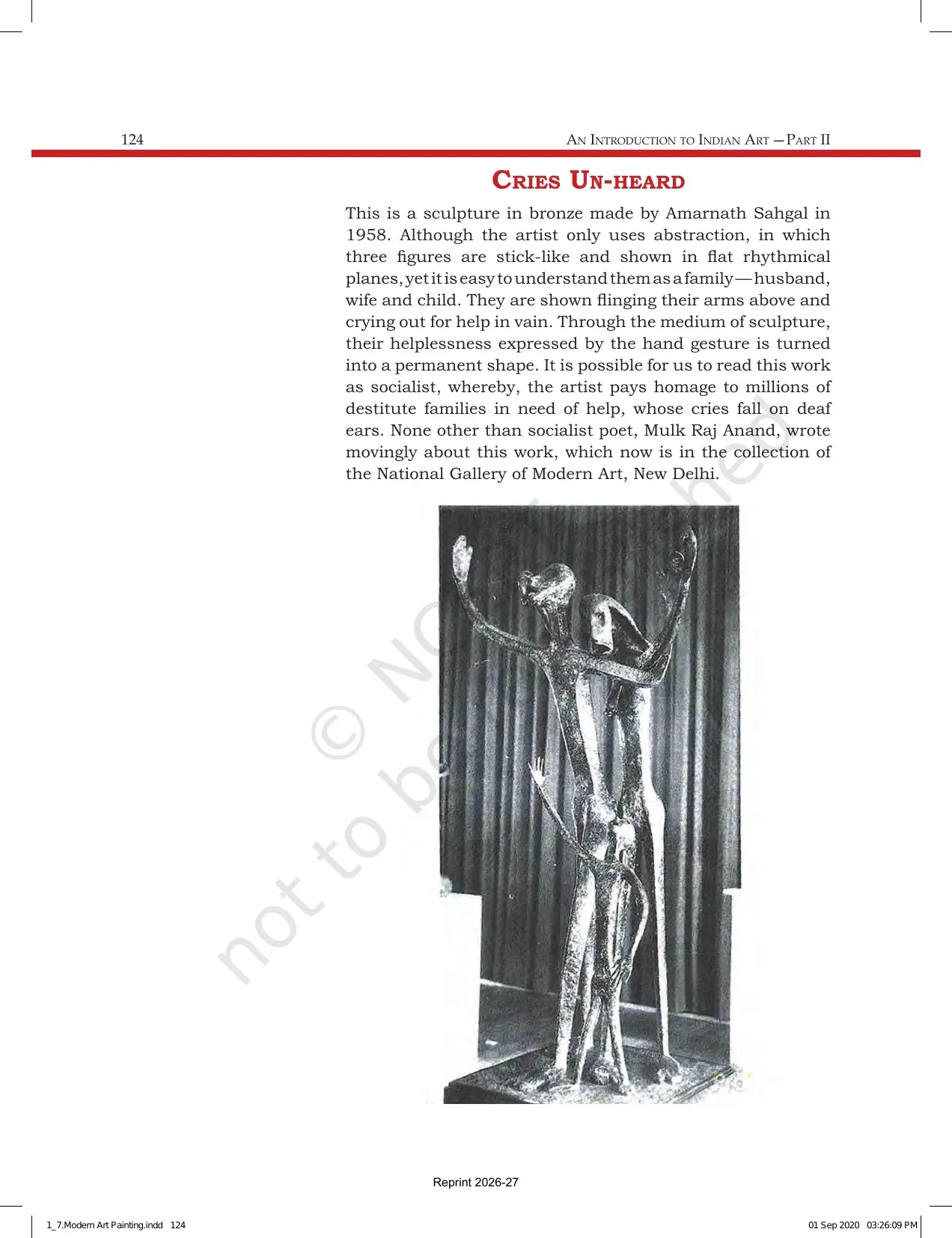
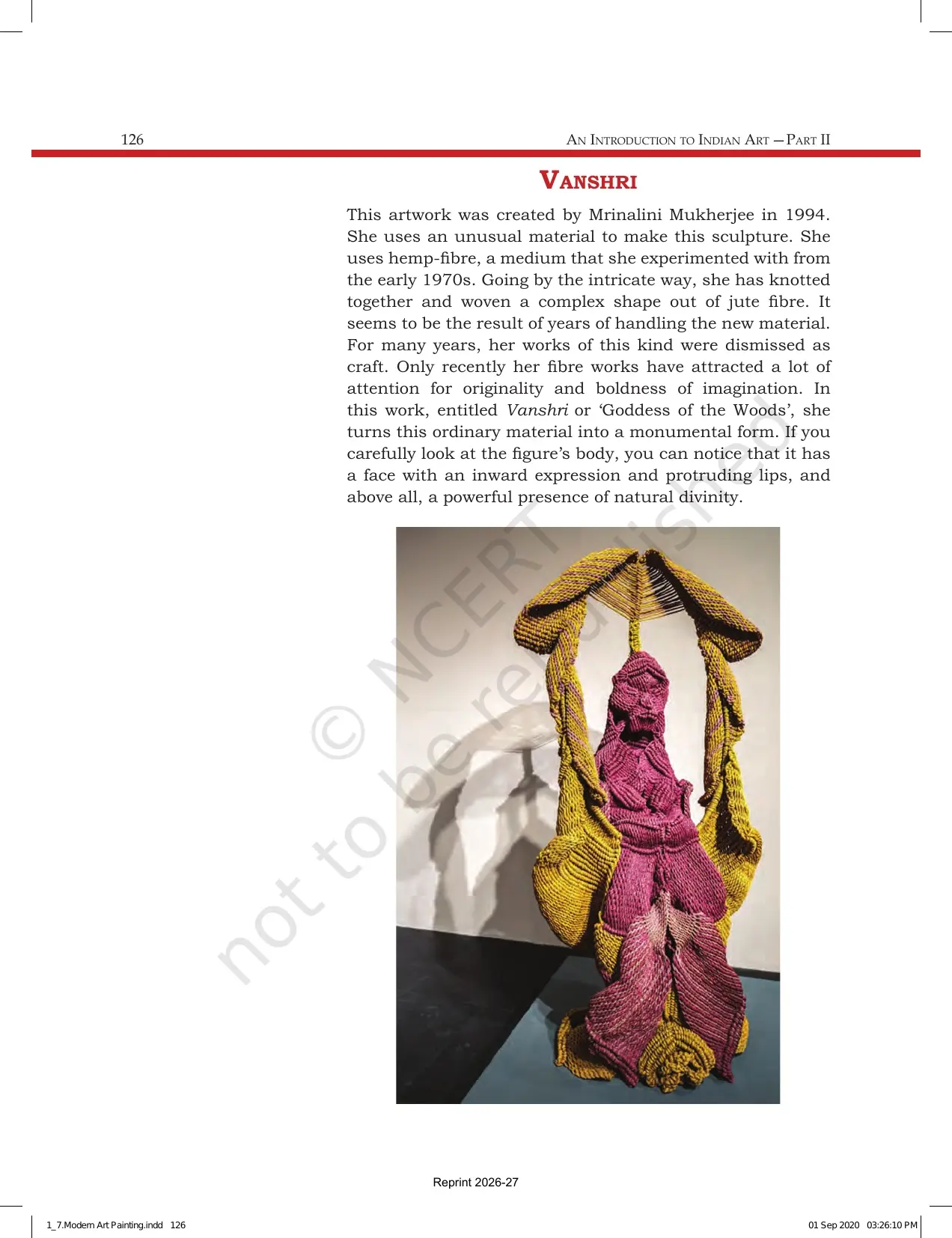
By the late 1970s the tension between internationalism, in which an artist freely used western modern trends like Cubism, Expressionism and Abstraction, and the indigenous, in which artists turned to native arts, grew acute. Amarnath Sehgal struck a balance between abstraction and the figurative in the wiry sculptures of Cries Unheard, while Mrinalini Mukherjee tilted towards abstraction with the innovative medium of hemp fibre in Vanshri.
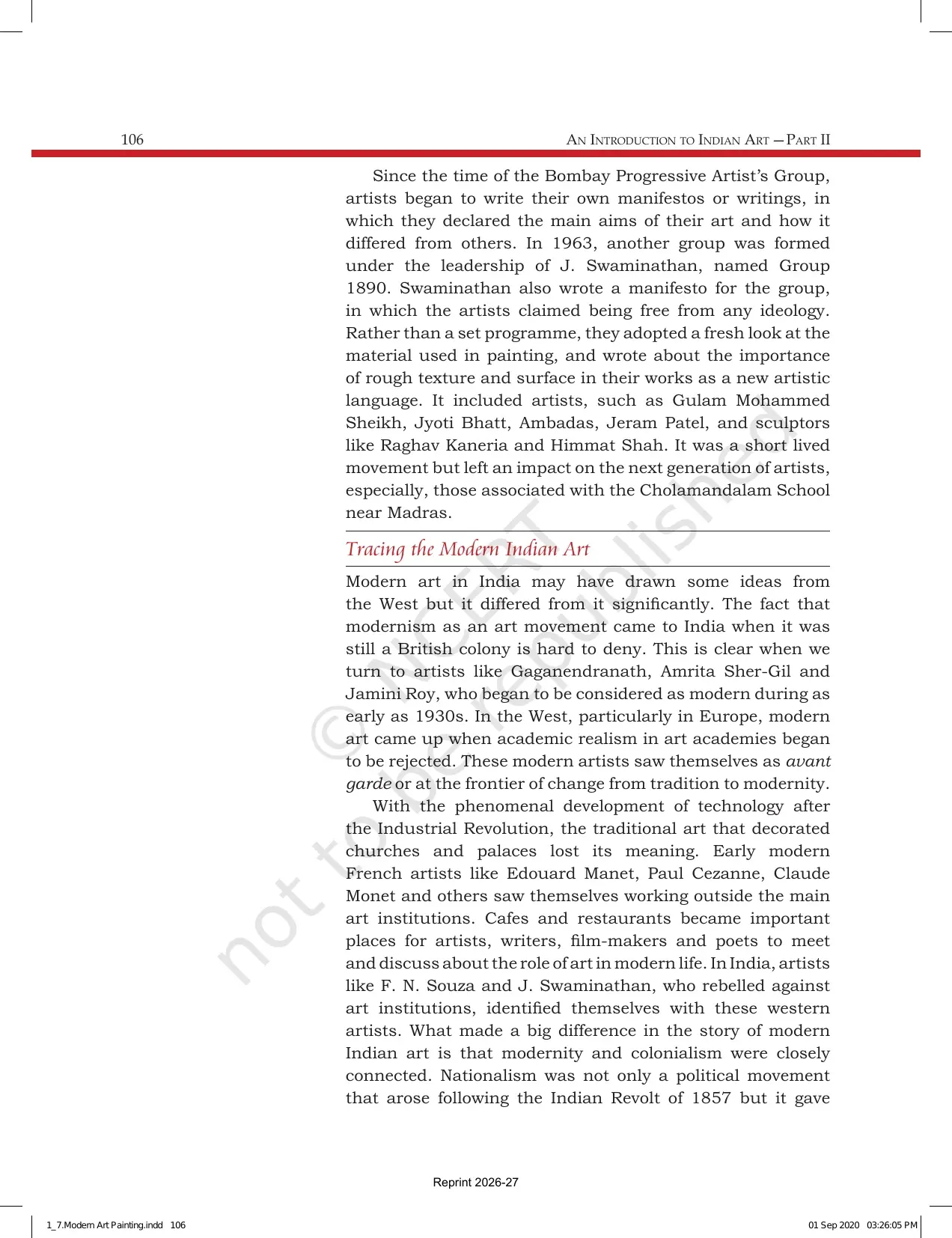
Neo-Tantric art is the name given to the Indianised abstraction that grew out of that worry about imitating the West. In the 1960s Biren De and G. R. Santosh in Delhi and Paniker in Madras turned to the past and to local artistic traditions. The style takes its name from the geometrical designs seen in traditional diagrams for meditation, or yantras, and it found a ready market with galleries and collectors during the height of the Hippie movement in the West.
Keep the three artists separate in an answer. Biren De made captivating experiments with colours and patterns. Santosh created a visual sense of the cosmic union of male and female energy, recalling purusha and prakriti of Tantric philosophy. Paniker used diagrams, scripts and pictograms from his region to evolve a style that was both modern and uniquely Indian.
Group 1890, Artist Manifestos and the Pull Between Internationalism and the Indigenous
Since the time of the Bombay Progressives, artists began to write their own manifestos, declaring the aims of their art and how it differed from others. The chapter uses one more group to show what that produced.
| Detail | What the book says |
|---|---|
| Year and leader | Formed in 1963 under the leadership of J. Swaminathan, who also wrote the manifesto |
| The claim in the manifesto | The artists claimed to be free from any ideology, with no set programme |
| What they focused on instead | A fresh look at the material used in painting, and the importance of rough texture and surface as a new artistic language |
| The painters | Gulam Mohammed Sheikh, Jyoti Bhatt, Ambadas and Jeram Patel |
| The sculptors | Raghav Kaneria and Himmat Shah |
| Its life and legacy | A short lived movement that left an impact on the next generation, especially artists linked to the Cholamandalam School near Madras |
Eclecticism, in which an artist borrowed ideas from many sources, became an important feature of many Indian modernists. The four names the book gives as examples are Ram Kumar, Satish Gujral, A. Ramachandran and Meera Mukherjee. If a question asks you to define eclecticism with examples, that one line plus those four names is the full answer.
Tracing the Modern Indian Art: Why Indian Modernism Was Not a Copy of the West
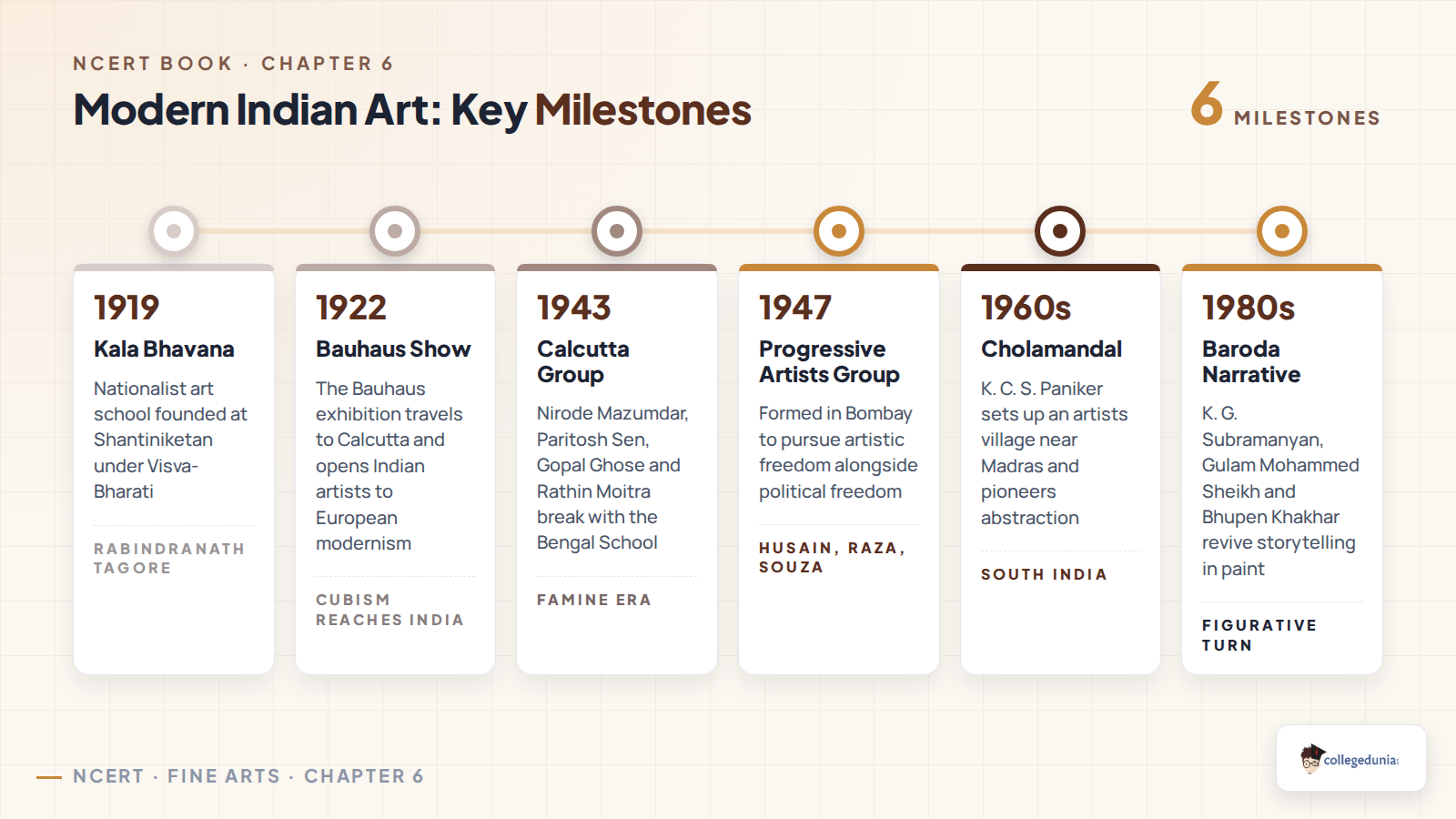
This section is the argument of the chapter and the likeliest five mark question in the paper. Modern art in India may have drawn some ideas from the West, but it differed from it significantly, and the reason is historical rather than stylistic.
- The colonial fact: modernism as an art movement came to India while the country was still a British colony.
- The first Indian moderns: Gaganendranath, Amrita Sher-Gil and Jamini Roy began to be considered modern as early as the 1930s.
- Why the West turned modern: modern art came up in Europe when academic realism in the art academies began to be rejected, and those artists saw themselves as avant garde, at the frontier of change from tradition to modernity.
- What pushed them out: after the Industrial Revolution, traditional art that decorated churches and palaces lost its meaning, and early French artists like Edouard Manet, Paul Cezanne and Claude Monet worked outside the main art institutions.
- Where they met: cafes and restaurants became important places for artists, writers, film makers and poets to discuss the role of art in modern life.
- The Indian parallel: F. N. Souza and J. Swaminathan, who rebelled against art institutions, identified themselves with these western artists.
What made the big difference is that in India modernity and colonialism were closely connected. Nationalism was not only a political movement that arose after the Indian Revolt of 1857; it also gave rise to cultural nationalism. Ideas like swadeshi in art were held by art historians like Ananda Coomaraswamy around the late nineteenth and early twentieth century.
The book states its verdict plainly. We cannot understand Indian modernism as a blind imitation of the West, because there was a careful process of selection carried out by modern artists in India. Nationalism in art traces back to the Bengal School under Abanindranath Tagore in late nineteenth century Calcutta, then took a different form at Kala Bhavana, where Nandalal Bose and Asit Kumar Haldar drew on Ajanta frescoes and Mughal, Rajasthani and Pahari miniatures.
There is a boxed fact on this page that students routinely skip. The subject matter in modern Indian painting and sculpture was largely drawn from rural India, even with the Bombay Progressives and the Calcutta Group in the 1940s and 1950s. City and urban life rarely appeared, perhaps because it was felt that the real India lives in villages. Quote that box and you separate your answer from the class average.
The New Figurative Art and Modern Art from the 1980s
Since the 1970s many artists moved towards figures and stories that are easy to recognise. The book links the shift to social concern after the Indo-Pakistan war of 1971 and the birth of Bangladesh, and it names the two centres where the shift happened.
- In Baroda: K. G. Subramanyan, Gulam Mohammed Sheikh and Bhupen Khakhar began using storytelling in their paintings.
- In West Bengal: Jogen Chowdhury, Bikash Bhattacharjee and Ganesh Pyne painted the social problems that disturbed them.
- Their sources: old miniature paintings and popular art forms like calendar and folk art, so stories could be understood by a larger public.
- In printmaking: Jyoti Bhatt (Devi), Laxma Goud (Man Woman, Tree) and Anupam Sud (Of Walls) used figures to show conflict between men and women in a world full of social inequality.
- On the city: Arpita Singh, Nalini Malani and Sudhir Patwardhan turned to the plight of people living in big cities, trying to see the world from the eyes of the oppressed.
- The institution: the Baroda Art School, which came up in the late 1950s, is where the important departure of the 1980s can be seen.
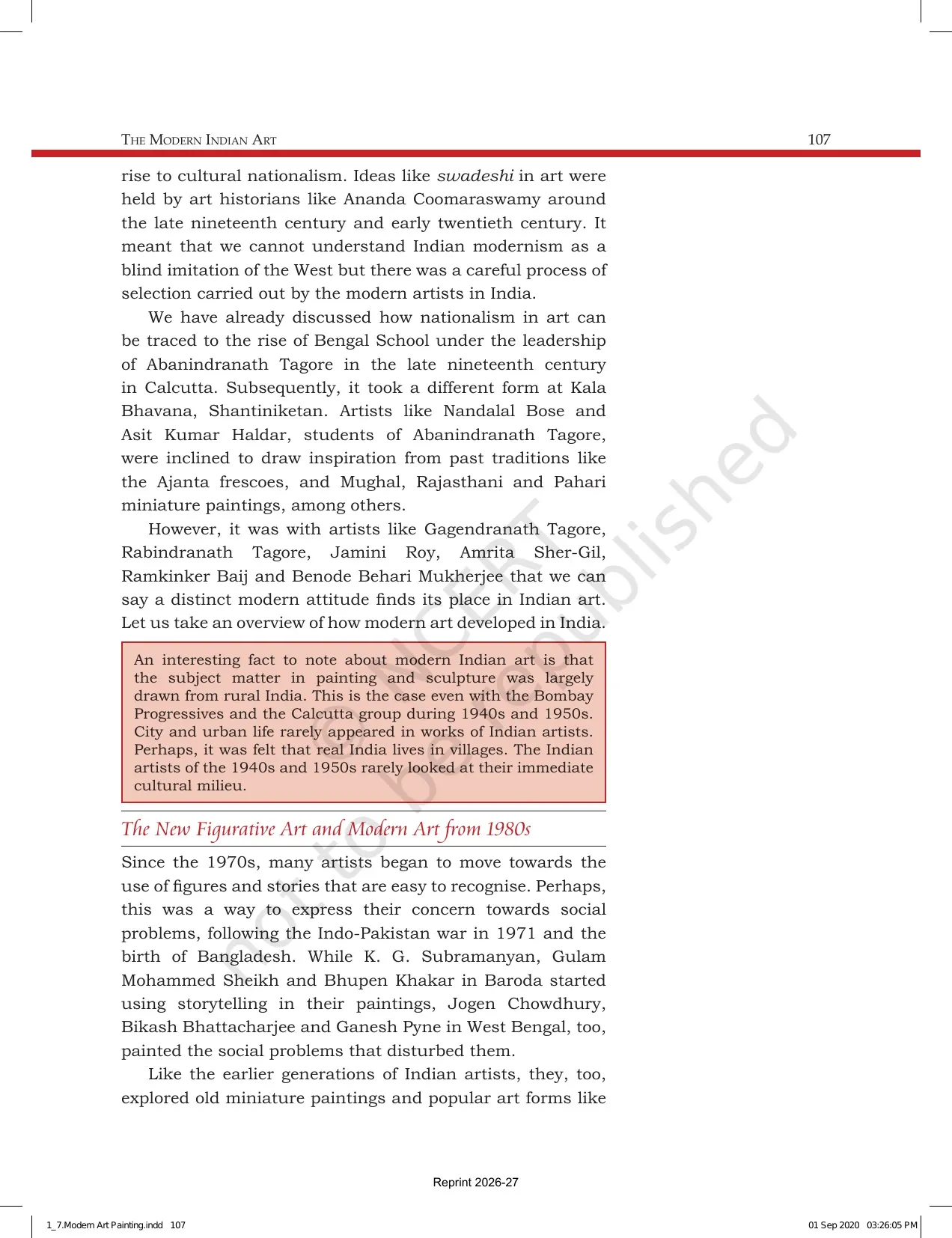
The Baroda painters combined fact with fiction and autobiography with fantasy, and drew their style from other art historical styles. Gulam Mohammed Sheikh painted the busy lanes of the old bazaar in Baroda while invoking a medieval town in Sienna and the style of Italian painters like the Lorenzetti brothers, which he knew as a teacher of art history.
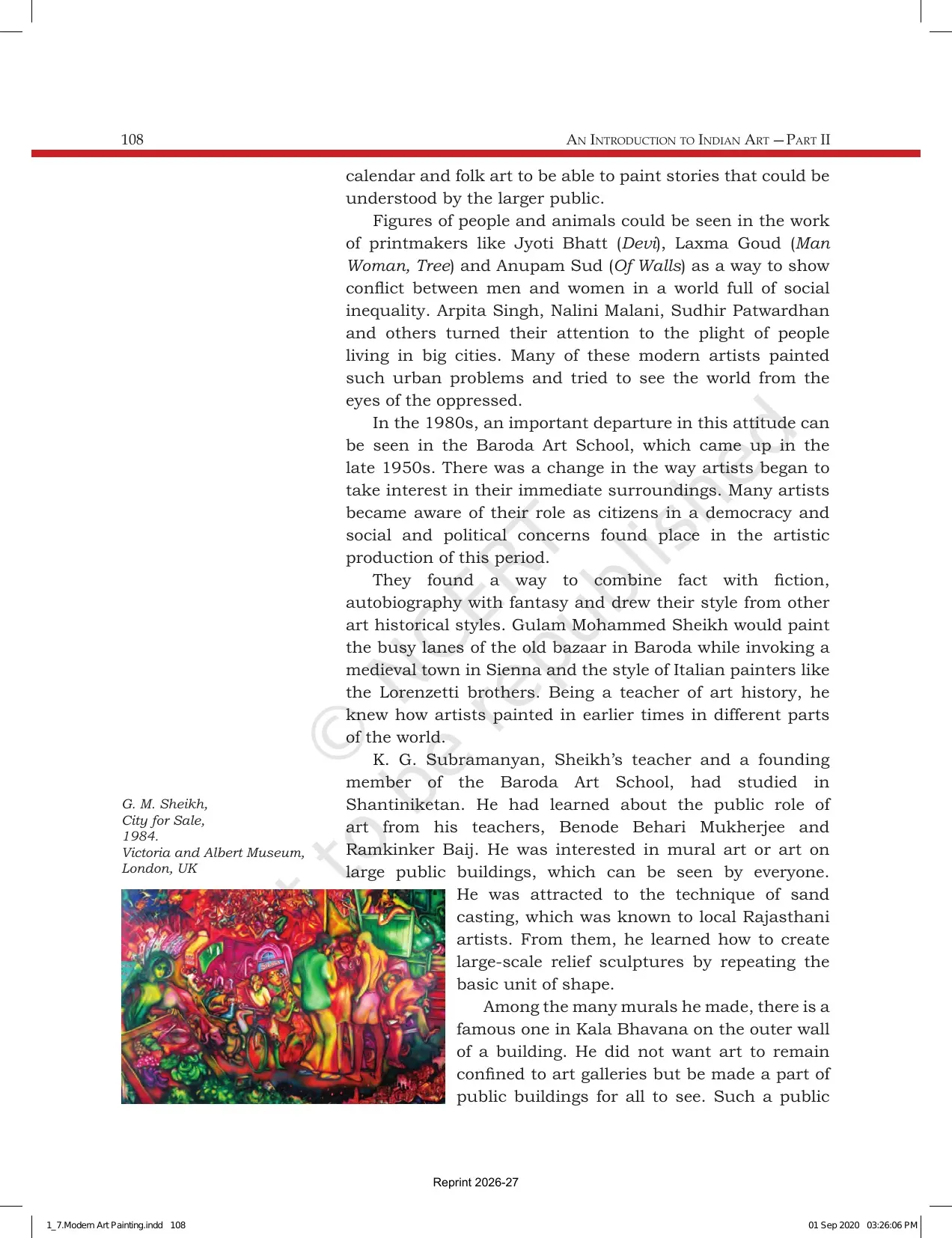
K. G. Subramanyan, Sheikh's teacher and a founding member of the Baroda Art School, had studied at Shantiniketan and learned about the public role of art from Benode Behari Mukherjee and Ramkinkar Baij. He was attracted to sand casting, a technique known to local Rajasthani artists, and used it to make large scale relief sculptures by repeating a basic unit of shape. He did not want art confined to galleries, and one of his famous murals sits on the outer wall of a building at Kala Bhavana.
The public view of art also shows in the exhibition Place for People of 1981, shown in Delhi and Bombay with six artists: Bhupen Khakhar, Gulam Mohammed Sheikh, Vivan Sundaram, Nalini Malani, Sudhir Patwardan and Jogen Chowdhury. The art critic Geeta Kapur wrote about it, and the chapter uses this to mark a change: until then artists wrote their own manifestos, but here the critic's role in explaining the work became important.
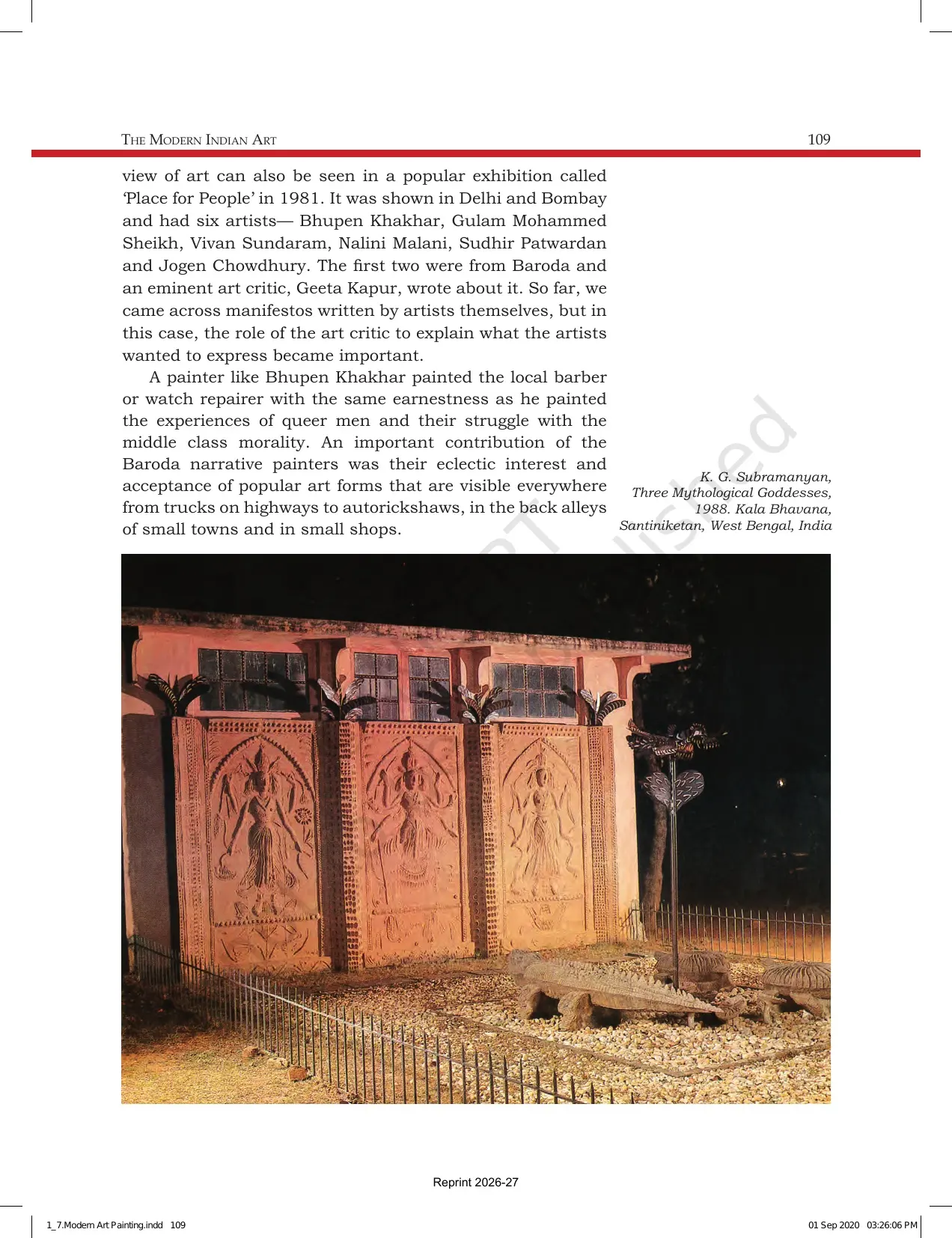
Bhupen Khakhar painted the local barber or watch repairer with the same earnestness as he painted the experiences of queer men and their struggle with middle class morality. The eclectic acceptance of popular art forms, visible from trucks on highways to autorickshaws and small shops, is named as an important contribution of the Baroda narrative painters. Younger painters in Mumbai then took the clue and used calendar images, advertisements and film hoardings, even putting photographic images on canvas.
New Media Art from the 1990s: Installation, Video and Photorealism
With the liberalisation of the Indian economy in the 1990s, the impact of globalisation was felt first in the big cities. India advanced in information technology while also seeing many social and political issues, and artists looked for ways of reacting to those changing times.
- What lost importance: easel painting and sculpture, which artists had earlier signed proudly as an expression of unique creativity.
- What replaced it: video, and photography, which allowed multiple copies to reach many people at the same time.
- The contemporary form: installation, which combined painting, sculpture, photography, video and even television in one space.
- Why it worked: it could spread across a whole hall and grab attention from all sides, offering a new immersive experience that affected almost all our senses.
- Why it started in cities: it depended on technology, so the early installation artists were Nalini Malani from Mumbai and Vivan Sundaram from Delhi, and their subject matter was grim and thought provoking.
- The new technique: photorealism, used by Atul Dodiya in Bapu at Rene Block Gallery, New York, with oil or acrylic painted in the manner of a photograph or a television screen.
T. V. Santosh and Shibu Natesan used photorealism to comment on communal violence while showing the new look Indian cities had acquired with technological advancement. Documentary photography went in a different direction: Sheba Chachi, Ravi Agarwal and Atul Bhalla photographed people living on the margins of society whom we do not notice in day to day life, including women ascetics and queer people, and often expressed concern about ecology such as river pollution and urban congestion.
The chapter closes with an instruction rather than a conclusion. At the turn of the present century almost all major cities have art galleries, both private and public, and artist communities working across a wide range of media including digital paintings. Even social media has played a major role in evolving local art. As a student of visual arts you are asked to explore artists' work in your own city, collect information about it, visit galleries and learn about their contribution to society.
The Fourteen Appreciations Printed at the End of the Modern Indian Art Chapter
Fine Arts picture questions come from the plates the book describes in full, and this chapter carries fourteen of them, more than any other chapter in the book. Each one gives the artist, the medium, the date and a set of style points. Prepare them as fixed blocks.
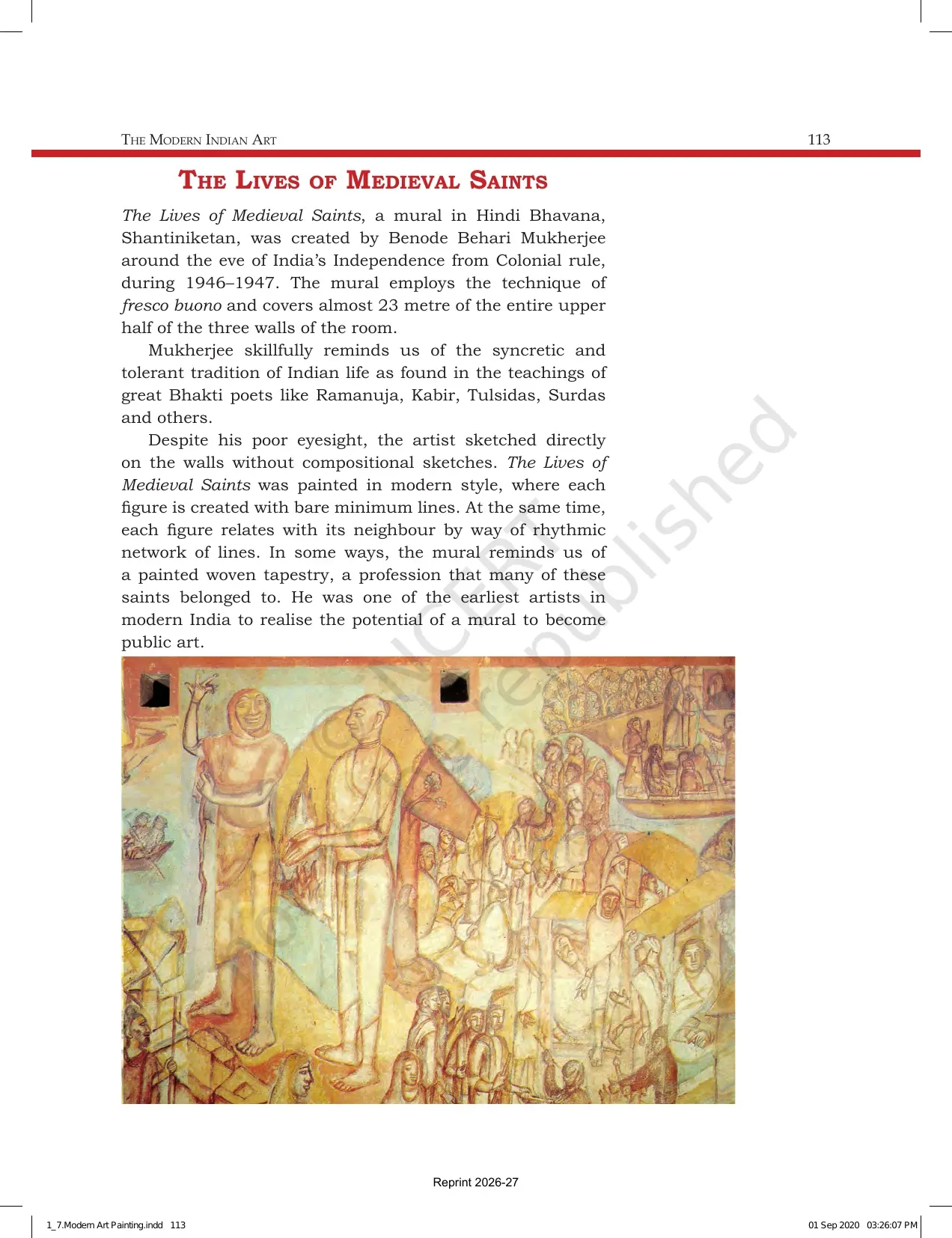
- The Lives of Medieval Saints by Benode Behari Mukherjee, a mural in Hindi Bhavana, Shantiniketan, made around the eve of Independence during 1946 to 1947. It uses the technique of fresco buono and covers almost 23 metre of the upper half of three walls. It recalls the syncretic and tolerant tradition of Indian life in the teachings of Bhakti poets like Ramanuja, Kabir, Tulsidas and Surdas. Despite poor eyesight the artist sketched directly on the walls without compositional sketches. Each figure is created with bare minimum lines yet relates to its neighbour through a rhythmic network of lines, so the mural recalls a woven tapestry, a profession many of these saints belonged to. He was one of the earliest artists in modern India to realise the potential of a mural to become public art.
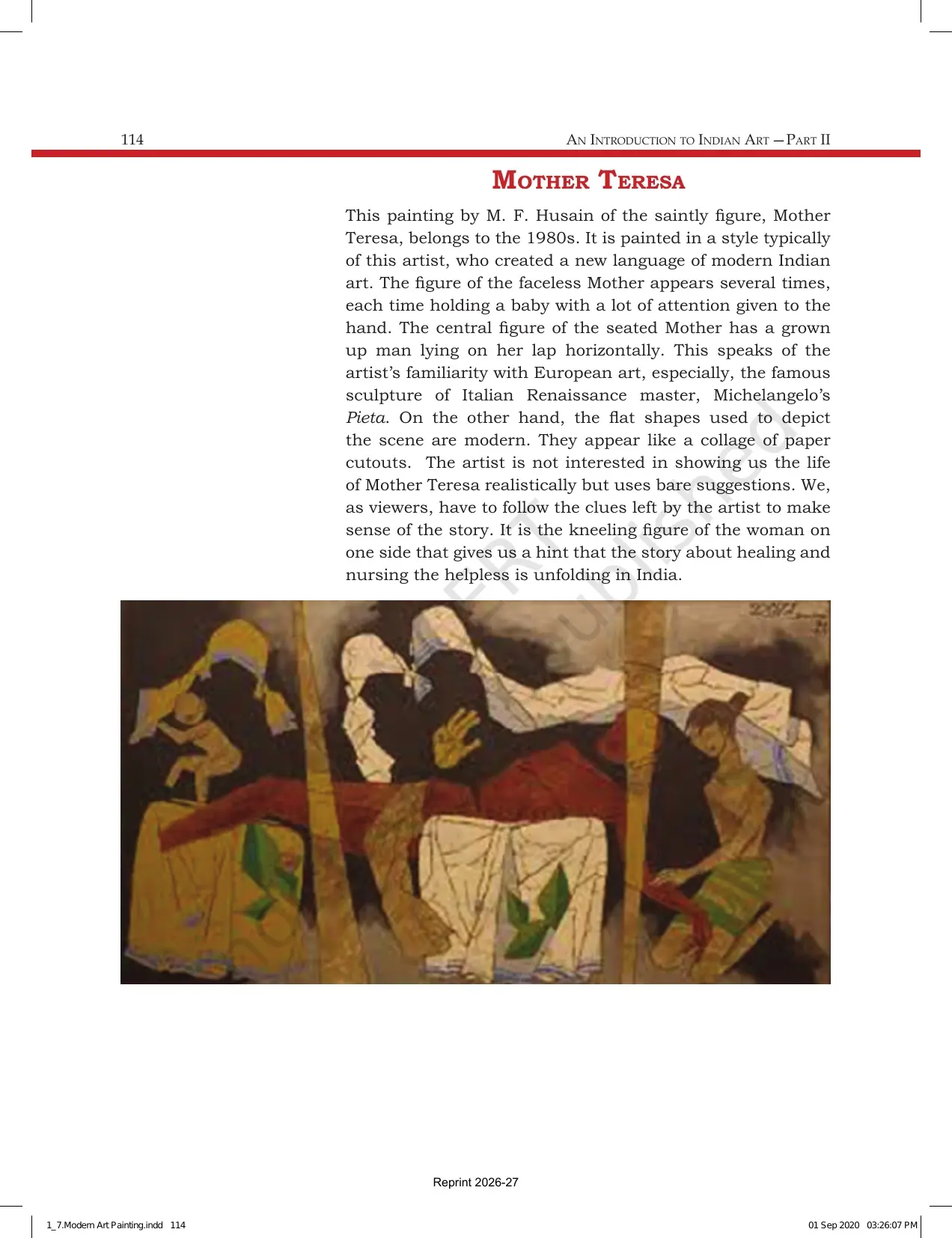
- Mother Teresa by M. F. Husain, from the 1980s. The faceless Mother appears several times, each time holding a baby with a lot of attention given to the hand. The central seated figure has a grown man lying horizontally on her lap, which shows the artist's familiarity with European art, especially Michelangelo's Pieta. The flat shapes are modern and look like a collage of paper cutouts. He is not interested in showing her life realistically but uses bare suggestions, and the kneeling figure of the woman on one side hints that the story of healing and nursing the helpless is unfolding in India.
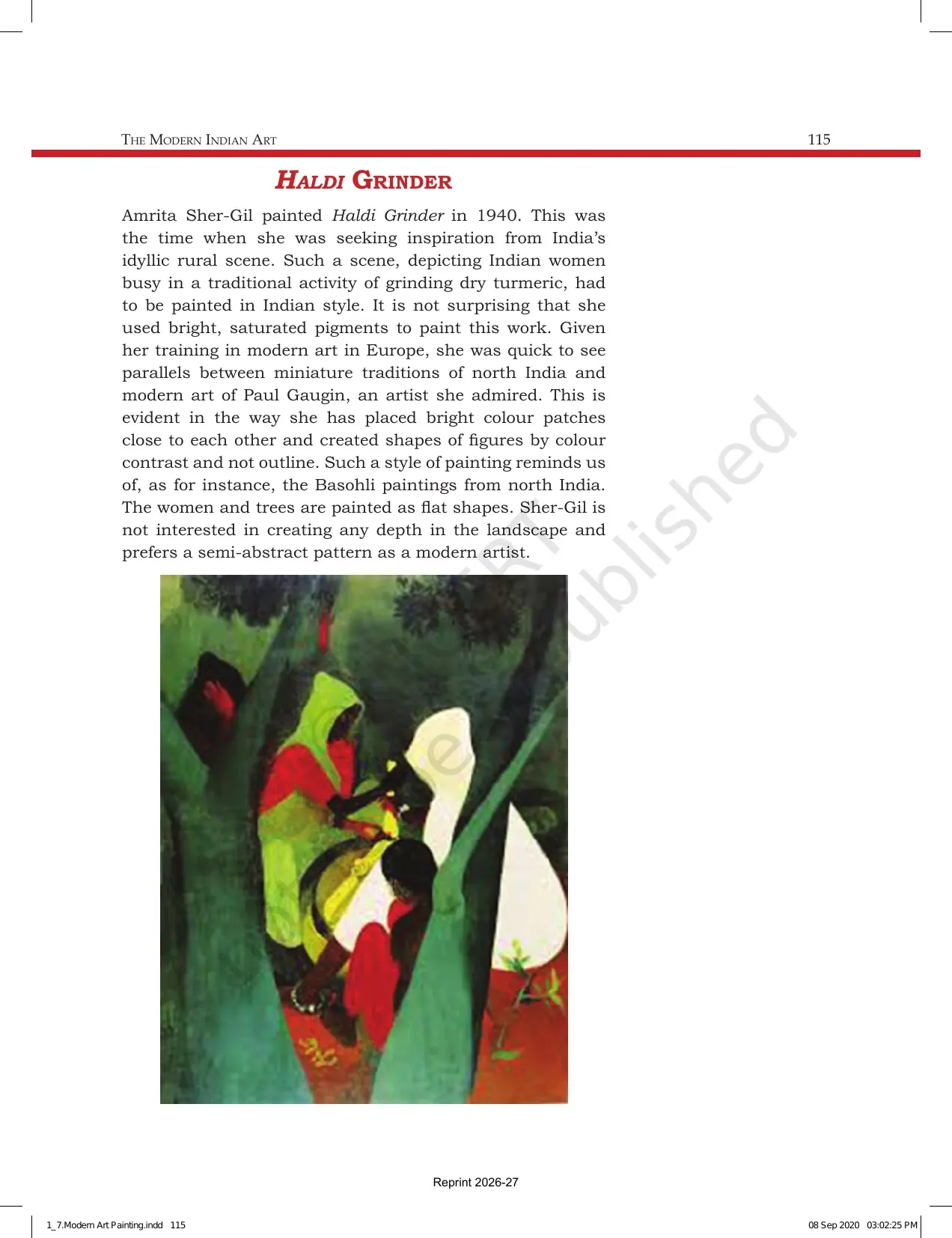
- Haldi Grinder by Amrita Sher-Gil, painted in 1940, when she was seeking inspiration from India's idyllic rural scene. Indian women are shown grinding dry turmeric in bright, saturated pigments. Given her training in Europe she was quick to see parallels between the miniature traditions of north India and the modern art of Paul Gaugin, whom she admired. Bright colour patches are placed close together so that figures are created by colour contrast and not by outline, which recalls the Basohli paintings of north India. The women and trees are flat shapes, and she prefers a semi abstract pattern to any depth in the landscape.
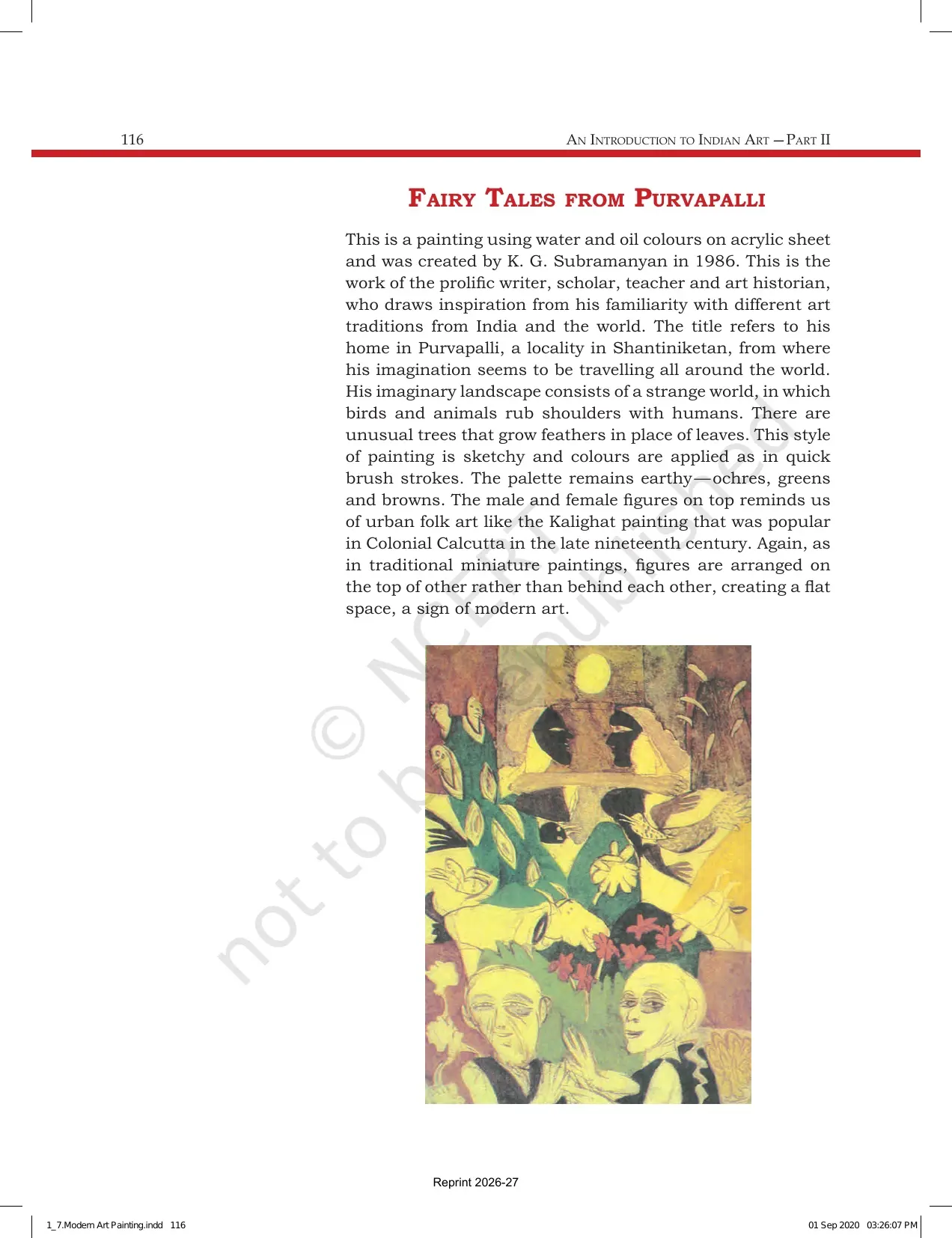
- Fairy Tales from Purvapalli by K. G. Subramanyan, 1986, using water and oil colours on an acrylic sheet. The title refers to his home in Purvapalli, a locality in Shantiniketan. His imaginary landscape holds a strange world where birds and animals rub shoulders with humans and unusual trees grow feathers in place of leaves. The style is sketchy with quick brush strokes and an earthy palette of ochres, greens and browns. The male and female figures on top recall urban folk art like Kalighat painting, and figures are arranged on top of one another rather than behind, creating a flat space, a sign of modern art.
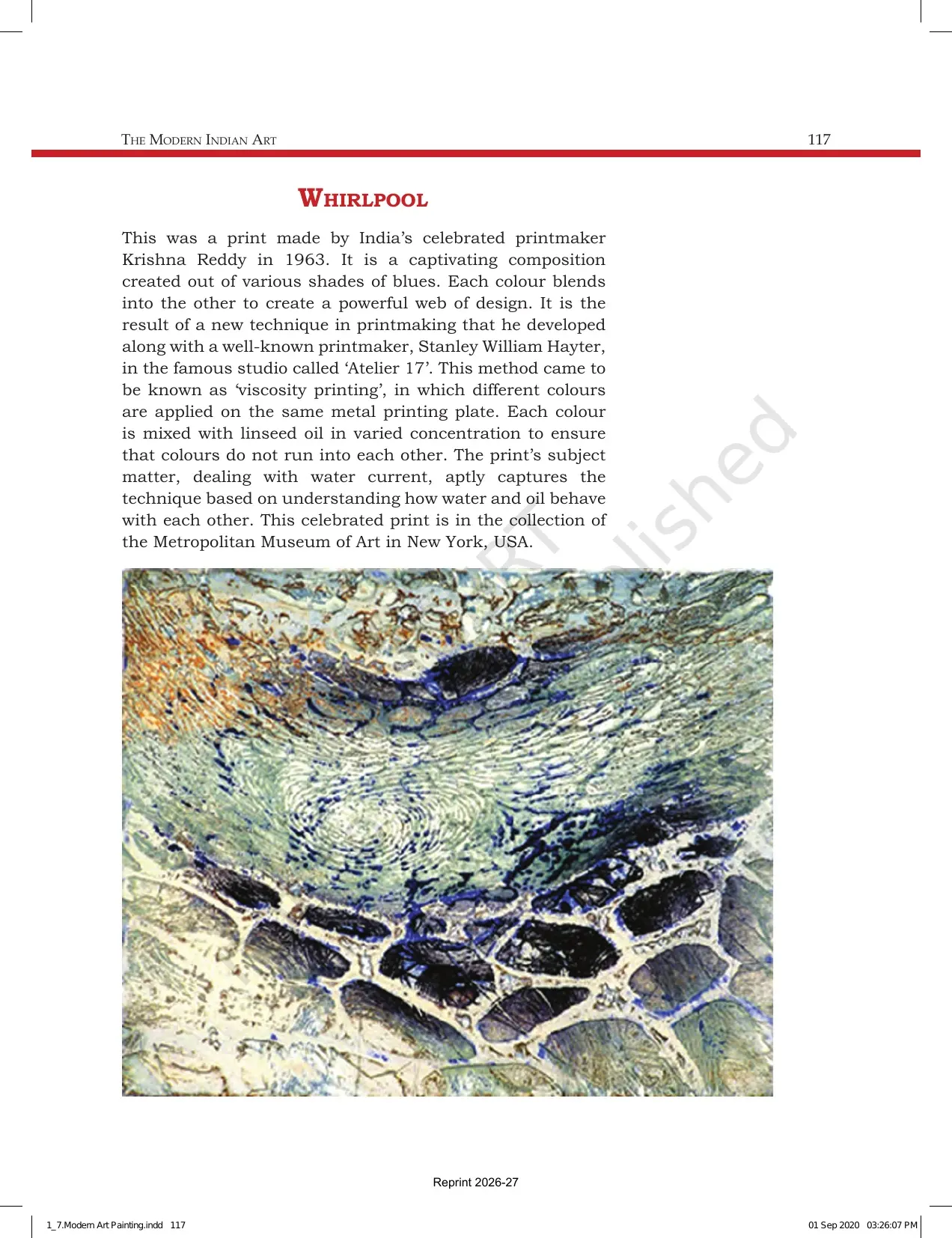
- Whirlpool by Krishna Reddy, a print of 1963 made from various shades of blue that blend into a powerful web of design. It came from a new technique he developed with the printmaker Stanley William Hayter at the studio Atelier 17, known as viscosity printing, in which different colours are applied on the same metal plate and each is mixed with linseed oil in varied concentration so the colours do not run into each other. The subject of water current aptly matches a technique based on how water and oil behave. It is in the collection of the Metropolitan Museum of Art, New York.
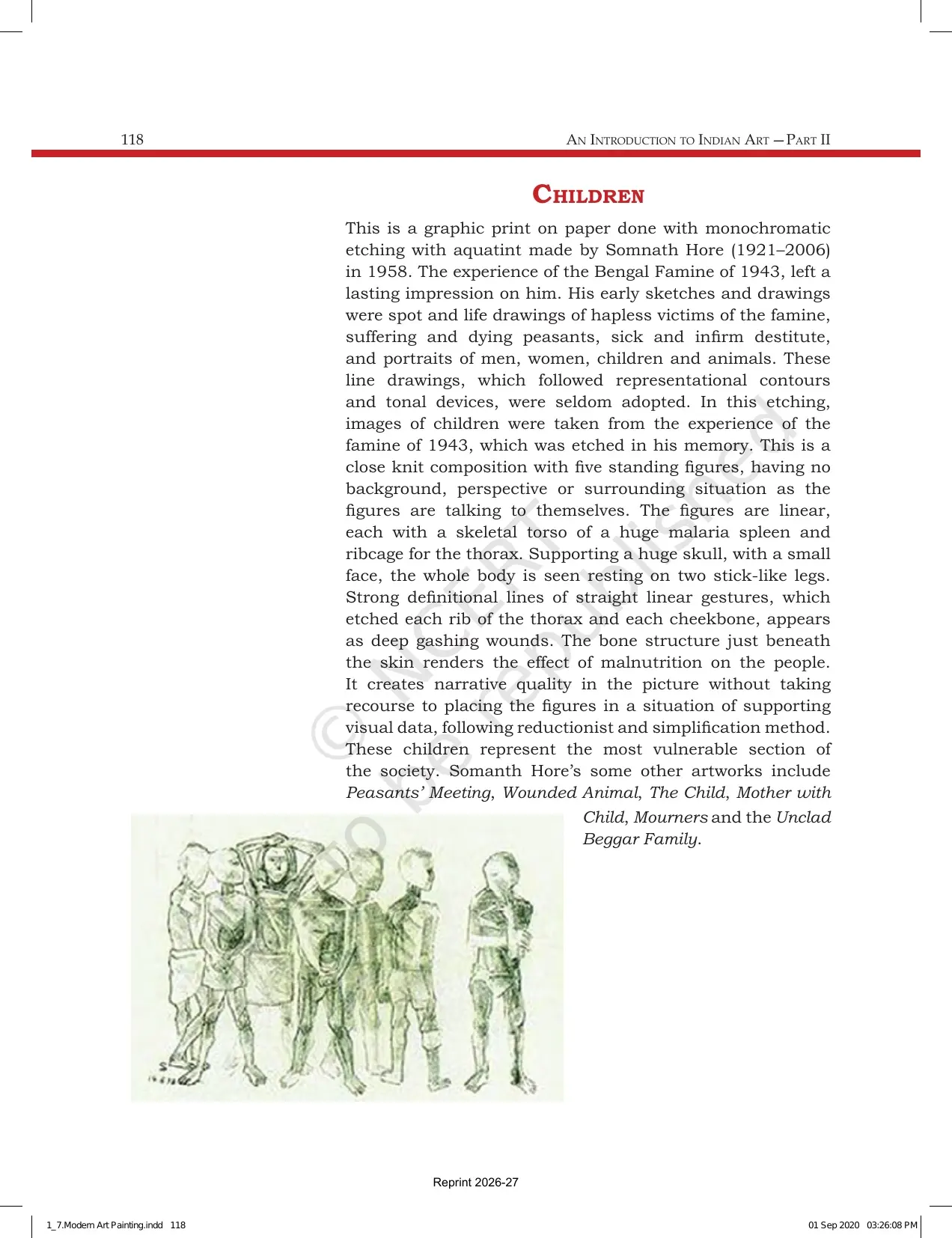
- Children by Somnath Hore, 1921 to 2006, a graphic print on paper in monochromatic etching with aquatint, made in 1958. The Bengal Famine of 1943 left a lasting impression on him, and his early spot and life drawings recorded hapless victims of the famine. This close knit composition has five standing figures with no background, perspective or surrounding situation. The figures are linear, each with a skeletal torso, a huge malaria spleen and a ribcage for the thorax, supporting a huge skull with a small face on two stick like legs. The straight linear gestures appear as deep gashing wounds and the bone structure beneath the skin renders the effect of malnutrition. Other works include Peasants' Meeting, Wounded Animal, The Child, Mother with Child, Mourners and the Unclad Beggar Family.
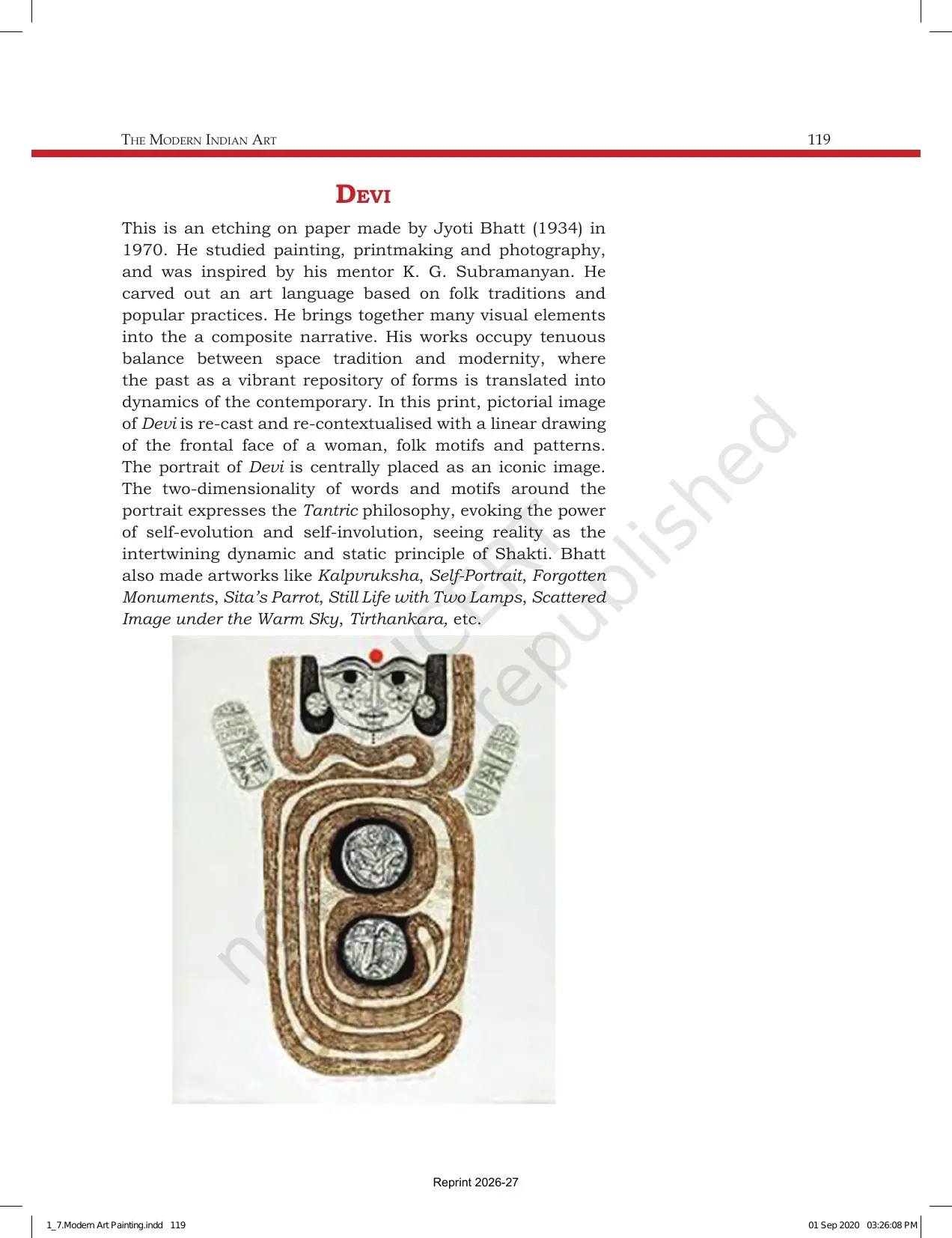
- Devi by Jyoti Bhatt, born 1934, an etching on paper of 1970. He studied painting, printmaking and photography and was inspired by his mentor K. G. Subramanyan, carving out an art language based on folk traditions and popular practices. In this print the pictorial image of Devi is re-cast with a linear drawing of the frontal face of a woman, folk motifs and patterns, with the portrait centrally placed as an iconic image. The two dimensionality of words and motifs around the portrait expresses Tantric philosophy, evoking self-evolution and self-involution and seeing reality as the intertwining dynamic and static principle of Shakti. Other works include Kalpvruksha, Self-Portrait, Forgotten Monuments and Sita's Parrot.
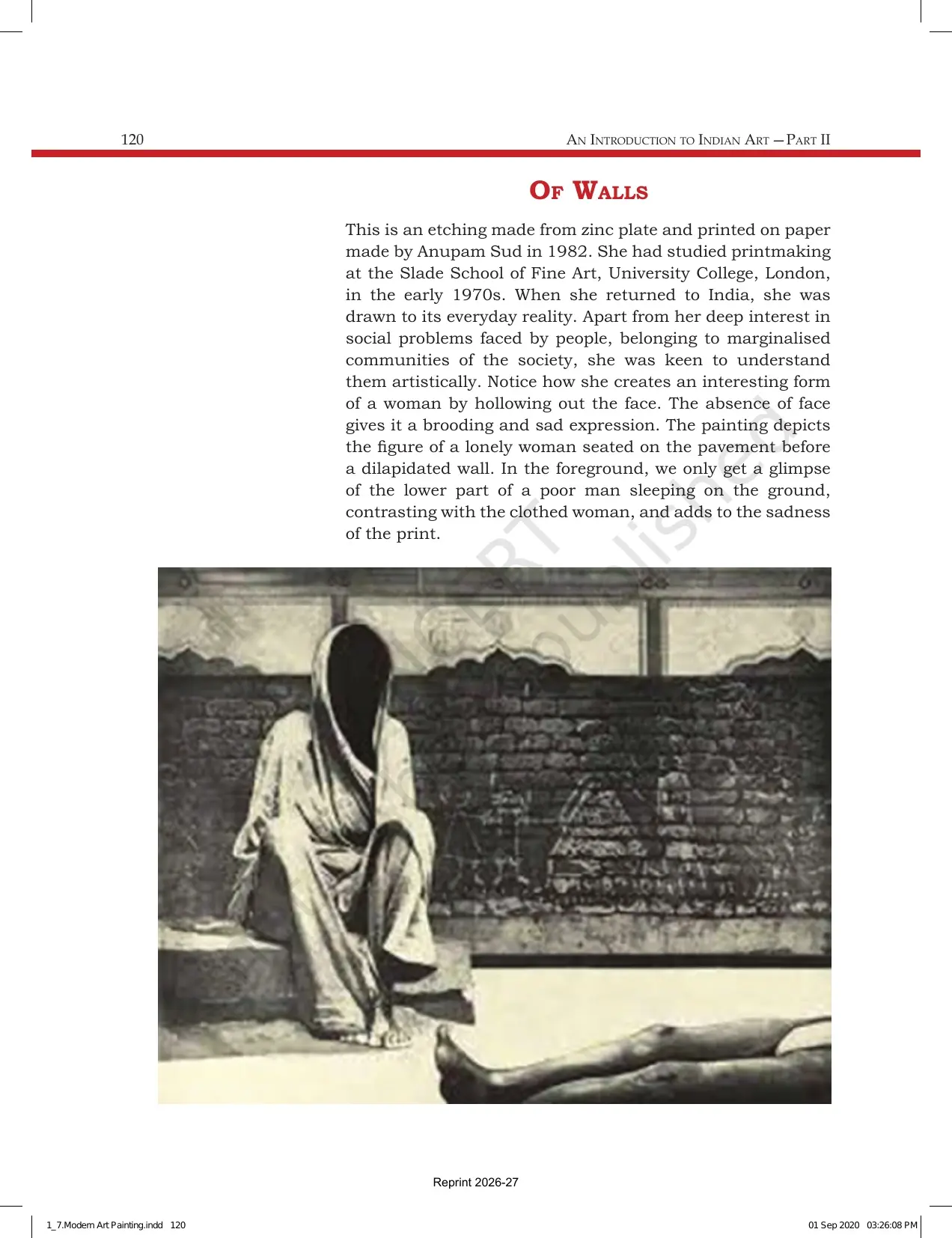
- Of Walls by Anupam Sud, an etching made from a zinc plate and printed on paper in 1982. She studied printmaking at the Slade School of Fine Art, University College, London, in the early 1970s and on returning to India was drawn to its everyday reality and to the social problems of marginalised communities. She creates the form of a woman by hollowing out the face, and that absence gives a brooding and sad expression. A lonely woman is seated on the pavement before a dilapidated wall, and in the foreground we glimpse the lower part of a poor man sleeping on the ground, contrasting with the clothed woman and adding to the sadness.
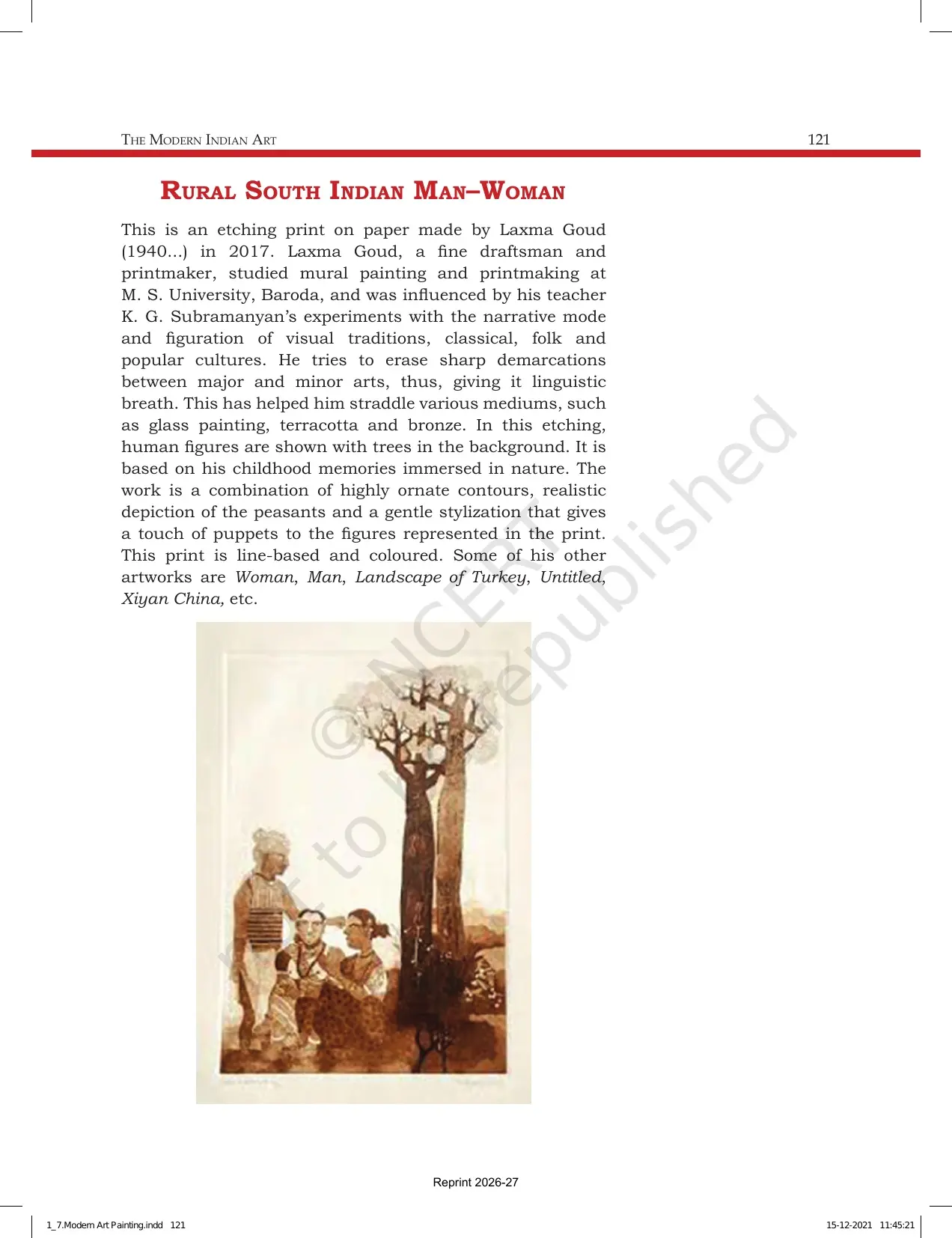
- Rural South Indian Man Woman by Laxma Goud, born 1940, an etching print on paper of 2017. A fine draftsman and printmaker, he studied mural painting and printmaking at M. S. University, Baroda, and was influenced by his teacher K. G. Subramanyan's experiments with narrative and figuration drawn from classical, folk and popular cultures. He tries to erase sharp demarcations between major and minor arts, which let him work across glass painting, terracotta and bronze. Human figures are shown with trees in the background, based on childhood memories immersed in nature, combining ornate contours, realistic depiction of peasants and a gentle stylisation that gives the figures a touch of puppets.
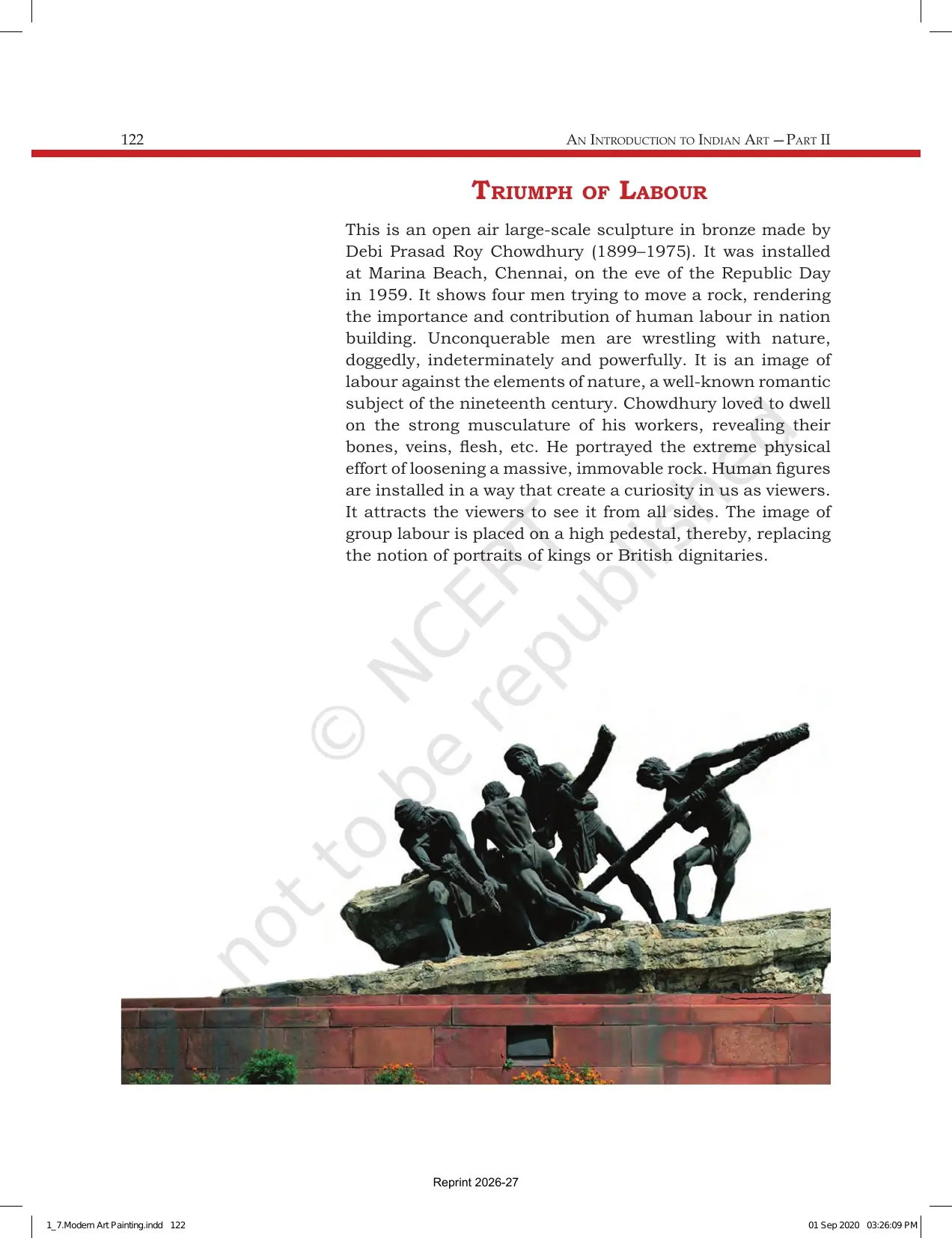
- Triumph of Labour by Debi Prasad Roy Chowdhury, 1899 to 1975, an open air large scale sculpture in bronze installed at Marina Beach, Chennai, on the eve of Republic Day in 1959. Four men try to move a rock, rendering the importance of human labour in nation building. It is an image of labour against the elements of nature, a well known romantic subject of the nineteenth century. Chowdhury dwells on the strong musculature of his workers, revealing bones, veins and flesh, and portrays the extreme physical effort of loosening a massive rock. The figures are installed so as to attract viewers from all sides, and the group is placed on a high pedestal, replacing the notion of portraits of kings or British dignitaries.
- Santhal Family by Ramkinker Baij, an open air large scale sculpture of 1937 made from metal armature and cement mixed with pebbles, placed in the compound of Kala Bhavana, Shantiniketan. A Santhal man carries his children in a double basket joined by a pole, with his wife and dog walking alongside, perhaps a family migrating with their frugal possessions. It is made in the round, so it can be seen from all sides, and it is placed on a low pedestal so we feel part of the same space. It is regarded as the first public modernist sculpture in India. The artist avoided marble, wood and stone and preferred cement, the symbol of modernisation.
- Cries Un-heard by Amarnath Sahgal, a sculpture in bronze of 1958. The artist uses abstraction, with three stick like figures in flat rhythmical planes, yet it is easy to read them as a family of husband, wife and child. They fling their arms above and cry out for help in vain, and their helplessness is turned into a permanent shape through the gesture of the hands. It can be read as socialist, a homage to millions of destitute families whose cries fall on deaf ears. The socialist poet Mulk Raj Anand wrote movingly about the work, which is now in the National Gallery of Modern Art, New Delhi.
- Ganesha by P. V. Janakiram, a sculpture in oxidised copper of 1970, in the collection of NGMA, Delhi. Sheets of copper are used to create pictorial sculpture as free standing forms, beaten into concave planes on which linear details are welded to work as facial features and decorative motifs suggesting religious icons. He is influenced by the ancient temple sculpture of South India, and Ganesha, crafted frontally, carries the indigenous character of cave and temple sculpture. Here Ganesha is playing the vina. The sculpture is conceived in terms of linear silhouettes rather than three dimensionality, despite its volume, and it amalgamates folk and traditional craftsmanship.
- Vanshri by Mrinalini Mukherjee, created in 1994 from hemp fibre, a medium she had experimented with from the early 1970s. She knotted and wove a complex shape out of jute fibre, the result of years of handling the material. For many years such works were dismissed as craft, and only recently have her fibre works drawn attention for originality and boldness of imagination. The title means Goddess of the Woods, and she turns an ordinary material into a monumental form. The figure has a face with an inward expression and protruding lips, and a powerful presence of natural divinity.
Every one of the fourteen appreciations names the medium in its first line. Fresco buono, etching with aquatint, viscosity print, oxidised copper, hemp fibre, bronze and cement with pebbles all appear, and stating the correct medium is usually the first mark in a picture based answer.
Named Artworks, Artists and Collections You Must Be Able to Quote
Build this table once and revise from it. If the paper reproduces any plate from the chapter, you will be able to give the artist, the date and the collection without opening the book again.
| Artwork | Artist and date | Where it is held |
|---|---|---|
| A Cubist City | Gaganendranath Tagore, 1925 | Victoria Memorial Hall, Kolkata |
| Doodle | Rabindranath Tagore, 1920 | Visva-Bharati University, Shantiniketan |
| Black Horse | Jamini Roy, 1940 | National Gallery of Modern Art, New Delhi |
| Twins Bronze | Prodosh Das Gupta, 1973 | National Gallery of Modern Art, New Delhi |
| Hungry Bengal | Chittoprasad, 1943 | Delhi Art Gallery, New Delhi |
| Farmer's Family | M. F. Husain, 1940 | National Gallery of Modern Art, New Delhi |
| Ma | S. H. Raza, 1972 | Bombay, India |
| Untitled | G. R. Santosh, 1970 | National Gallery of Modern Art, New Delhi |
| The Dog | K. C. S. Paniker, 1973 | National Gallery of Modern Art, New Delhi |
| City for Sale | G. M. Sheikh, 1984 | Victoria and Albert Museum, London |
| Three Mythological Goddesses | K. G. Subramanyan, 1988 | Kala Bhavana, Santiniketan, West Bengal |
| Janata Watch Repairing | Bhupen Khakhar, 1972 | Private Collection, India |
| Whirlpool | Krishna Reddy, 1963 | Metropolitan Museum of Art, New York |
| Cries Un-heard | Amarnath Sahgal, 1958 | National Gallery of Modern Art, New Delhi |
| Ganesha | P. V. Janakiram, 1970 | National Gallery of Modern Art, New Delhi |
| Santhal Family | Ramkinkar Baij, 1937 | Kala Bhavana compound, Shantiniketan |
| Triumph of Labour | Debi Prasad Roy Chowdhury, installed 1959 | Marina Beach, Chennai |
| The Lives of Medieval Saints | Benode Behari Mukherjee, 1946 to 1947 | Hindi Bhavana, Shantiniketan |
Twelve of these are printed inside the main text and the rest come with a written appreciation at the back. The ones with appreciations are the likeliest picture questions, so give them the extra revision time.
The Four Exercise Questions at the End of the Modern Indian Art Chapter
This chapter closes with four exercise questions and one Project. Three of the four are written answers and one asks you to design something, so plan your preparation around the written three.
| Question | What it asks | Where the answer sits in the PDF |
|---|---|---|
| 1 | Compare Pata Chitra, a form of audio-visual storytelling still practised in some parts of India, with the modern storytelling or narratives adopted by some Baroda artists since the 1980s | The New Figurative Art section, especially the Baroda narrative painters and their use of calendar and folk art |
| 2 | How does new technology like video and digital media inspire contemporary artists to experiment with new themes, and comment on genres such as video, installation and digital art | The New Media Art section, from liberalisation in the 1990s to photorealism and digital painting |
| 3 | What do you understand by public art, and how would you design a public monument that people can relate with | The Santhal Family and Triumph of Labour appreciations plus the K. G. Subramanyan mural passage |
| 4 | How do you understand the art world, what are its different components and how does it relate with the art market | The manifesto passage, the Geeta Kapur and Place for People passage, and the Neo-Tantric market paragraph |
Question 3 is the safest mark in the paper if you prepare Santhal Family properly. Write the year, the material of cement mixed with pebbles over a metal armature, the low pedestal, the fact that it is made in the round, and the line that it is regarded as the first public modernist sculpture in India. That is five scoring points from one plate.
The Project at the end asks you to visit the National Gallery of Modern Art or another museum in your city, or the NGMA website, and build a timeline of trends in modern Indian art after 1947 in terms of internationalism and the indigenous. You are also asked to note where the timeline ends and what material each artist used.
Common Mistakes Students Make in the Modern Indian Art Chapter
Watch out for these seven:
- Mixing up the two groups and their years. The Calcutta Group was formed in 1943 under Prodosh Das Gupta. The Progressives were formed in Bombay in 1946 under F. N. Souza.
- Writing that Gaganendranath Tagore painted like Picasso. The book says his vertical, horizontal and diagonal lines were quite different from Picasso's geometrical facets.
- Crediting Santhal Family to the wrong sculptor or the wrong material. It is Ramkinkar Baij, 1937, in cement mixed with pebbles over a metal armature, not marble, wood or stone.
- Confusing Triumph of Labour with Santhal Family. Triumph of Labour is by D. P. Roy Chowdhury in bronze at Marina Beach, and it uses academic realism, which the book sets in sharp contrast to Baij's style.
- Calling Neo-Tantric art a western import. The book presents it as Indianised abstraction, built by Biren De, G. R. Santosh and K. C. S. Paniker by turning to the past and to local traditions.
- Saying Amrita Sher-Gil belonged to the Bengal School. She trained in Paris in Impressionism and post Impressionism, then assimilated Indian miniature and mural traditions with European modernism.
- Treating Indian modernism as a copy of the West. The chapter's own verdict is that there was a careful process of selection by modern artists in India, because modernity here was tied to colonialism.
Student Feedback on the Modern Indian Art Chapter
What 14,610 students told us about this chapter
- 71% of the students surveyed said the fourteen appreciation plates are the hardest part of the chapter to hold in memory, because the mediums vary far more than in the miniature chapters.
- Only 27% could name all six members of the Bombay Progressives after a first reading.
- Students who tabulated Group, Year, Members and Belief while reading reported the fastest recall in the five mark group questions.
- Most skipped passage: the boxed note on rural subject matter in the works of the Bombay Progressives and the Calcutta Group, left unread by about 2 in 5 students, even though it is a ready made three mark point.
Source: Collegedunia Class 12 Fine Arts student survey taken before the 2026-27 board exams. Sample of 14,610 students from CBSE schools across 16 states.
How to Revise the Modern Indian Art Chapter in a Three Block Plan
This is the longest chapter in the book at 28 printed pages, and about three focused hours makes it board ready. The printed order already gives you a timeline, so do not shuffle the sections while revising.
- Block 1, 50 minutes. Read from the colonial art schools to Amrita Sher-Gil. Write, from memory, why Kala Bhavana mattered and how Jamini Roy and Sher-Gil each arrived at a modern Indian style.
- Block 2, 55 minutes. Read the Calcutta Group, the Progressives, abstraction and Group 1890. Fill your four column group chart and add the Neo-Tantric trio of Biren De, G. R. Santosh and K. C. S. Paniker.
- Block 3, 60 minutes. Read the Baroda and New Media sections, then write all fourteen appreciations as six line blocks with artist, date, medium and two style points each.
Repeat Block 3 a week before the paper. Plate dates and mediums fade fastest, and they are the cheapest marks in the Fine Arts theory paper for both the CBSE Class 12 board exam and the CUET general test.
How the Modern Indian Art Chapter PDF Works with the Fine Arts Revision Notes
The chapter PDF gives you the official text and every plate exactly as printed. What it does not give you is a compressed recall sheet you can read in ten minutes before the paper. That sits on the sister page for the same chapter, and running the two together is faster than reading either one alone.
| Resource | What it adds beyond this chapter PDF | Link |
|---|---|---|
| Revision Notes | The group and year chart, the internationalism against indigenous comparison and the fourteen plate index condensed for a last read before the paper | Modern Indian Art Class 12 Notes |
Also Check: read the Bengal School chapter before this one. Modern Indian Art opens by referring back to Abanindranath Tagore, E. B. Havell and the Bauhaus exhibition in Calcutta, so the first two pages assume you already know that argument.
All 8 Chapters of Class 12 Fine Arts with NCERT Book PDFs
The Class 12 Fine Arts course runs across eight chapters. Every link below opens the official NCERT chapter PDF for the 2026-27 session.
| Chapter | NCERT Book PDF |
|---|---|
| Chapter 1 | The Mughal School of Miniature Painting Class 12 PDF |
| Chapter 2 | The Deccan Schools of Painting Class 12 PDF |
| Chapter 3 | The Rajasthani Schools of Painting Class 12 PDF |
| Chapter 4 | The Pahari Schools of Painting Class 12 PDF |
| Chapter 5 | The Bengal School and Cultural Nationalism Class 12 PDF |
| Chapter 6 | Modern Indian Art Class 12 PDF, the chapter you are reading |
| Chapter 7 | The Company School Class 12 PDF |
| Chapter 8 | Living Art Traditions of India Class 12 PDF |
Modern Indian Art Class 12 Fine Arts NCERT Book PDF FAQs
Questions Class 12 Students Ask Most About the Modern Indian Art Chapter
Ques. What is modern Indian art according to the NCERT chapter?
Ans. Modern Indian art is the art that grew in India from the early twentieth century, when artists rejected the academic and naturalist style taught in the colonial art schools and began creating work that was both modern and Indian. The chapter says modern art in India may have drawn some ideas from the West but differed from it significantly, because modernism arrived while India was still a British colony. It names Gaganendranath Tagore, Amrita Sher-Gil and Jamini Roy as artists already considered modern in the 1930s, and adds Rabindranath Tagore, Ramkinkar Baij and Benode Behari Mukherjee to that list.
Ques. What is abstraction in art?
Ans. The chapter defines it through the European trends of Cubism and Expressionism, which rejected academic realism and held that art need not copy the world but can create its own world out of forms, lines and colour patches. It then gives the working test: a landscape, portrait or still life may be called abstract if it draws our attention to an abstract design created by forms, lines and colour patches. In India, abstraction had wide appeal across painting, printmaking and sculpture during the 1960s and 1970s.
Ques. When was Kala Bhavana set up and why does it matter?
Ans. Kala Bhavana was set up in 1919 as part of the newly established Visva-Bharati University at Shantiniketan, conceptualised by the poet Rabindranath Tagore. It was India's first nationalist art school. It carried the vision of the Bengal School but also followed its own path in creating art meaningful for Indians. Nandalal Bose joined it in 1921 to 1922 and let his students and fellow teachers explore new avenues of artistic expression, which produced Benode Behari Mukherjee and Ramkinkar Baij.
Ques. What was the Calcutta Group and what did it believe?
Ans. The Calcutta Group was formed in 1943 by a few young artists under the leadership of the sculptor Prodosh Das Gupta, and it included Nirode Mazumdar, Paritosh Sen, Gopal Ghose and Rathin Moitra. It was a response to the humanitarian crisis of the Bengal famine, which followed World War 2 and forced massive rural migration to the cities. The group believed in an art that was universal in character and free from older values. They disliked the Bengal School of Art because it was too sentimental and too deeply interested in the past, and they wanted their paintings and sculptures to speak of their own times.
Ques. Who were the members of the Progressive Artists' Group of Bombay?
Ans. The Progressives were formed in Bombay in 1946. Francis Newton Souza was the outspoken leader, and the group included M. F. Husain, K. H. Ara, S. A. Bakre, H. A. Gade and S. H. Raza. Souza wanted to question the conventions that had prevailed in art schools, and for him modern art stood for a new freedom that could challenge the traditional sense of beauty and morality. His own experimental works focused mainly on women, painted as nudes with exaggerated proportions.
Ques. How did M. F. Husain make modern painting Indian?
Ans. Husain wanted to make the modern style of painting understandable in an Indian context. He painted using western expressionist brush strokes with bright Indian colours, and he drew not only from Indian mythology and religious sources but also from the style of miniature paintings, village crafts and even folk toys. By successfully combining a modern style with Indian themes, his art came to represent Indian modern art in the international art world. Mother Teresa is the example the chapter gives, and it shows his familiarity with Michelangelo's Pieta alongside flat modern shapes that look like a collage of paper cutouts.
Ques. What is Neo-Tantric art?
Ans. Neo-Tantric art is the name given to a style of Indianised abstraction that grew in the 1960s, when Biren De and G. R. Santosh in Delhi and K. C. S. Paniker in Madras turned to the past and to local artistic traditions to answer the worry that Indian artists were imitating the West. It takes its name from the geometrical designs seen in traditional diagrams for meditation, known as yantras. The style became successful in the West and later in India, and works made during the height of the Hippie movement found a ready market with galleries and collectors.
Ques. Why is Santhal Family important in modern Indian sculpture?
Ans. Santhal Family was created by Ramkinker Baij in 1937 and stands in the compound of Kala Bhavana, Shantiniketan. It is regarded as the first public modernist sculpture in India, and you do not need to go to a museum to see it. It shows a Santhal man carrying his children in a double basket joined by a pole, with his wife and dog walking alongside, so it turns an everyday rural scene into a monumental one. It is made in the round on a low pedestal, and the material matters: the artist avoided marble, wood and stone and preferred cement mixed with pebbles over a metal armature, cement being the symbol of modernisation.
Ques. Who were Chittoprasad and Somnath Hore and why did they choose printmaking?
Ans. They are described in the chapter as the two political artists of India. Drawn to socialism and especially Marxism after seeing abject poverty in villages and cities, they wanted their art to talk about social problems, and they found printmaking a strong medium because it is easier to produce multiple artworks and reach more people. Chittoprasad's etchings, linocuts and lithographs showed the deplorable condition of the poor, and the Communist Party of India asked him to sketch in the villages worst affected by the Bengal Famine. Those sketches were published as pamphlets titled Hungry Bengal. Somnath Hore's etching Children, made in 1958, comes from the same famine experience.
Ques. What is viscosity printing and who developed it?
Ans. Viscosity printing is a printmaking method in which different colours are applied on the same metal printing plate, each mixed with linseed oil in a different concentration so the colours do not run into each other. It was developed by the Indian printmaker Krishna Reddy along with the well known printmaker Stanley William Hayter at the studio called Atelier 17. His print Whirlpool of 1963 uses it, and its subject of water current matches a technique based on understanding how water and oil behave with each other. The print is in the collection of the Metropolitan Museum of Art in New York.
Ques. What was Group 1890?
Ans. Group 1890 was formed in 1963 under the leadership of J. Swaminathan, who also wrote its manifesto. The artists claimed to be free from any ideology, and instead of a set programme they took a fresh look at the material used in painting and wrote about the importance of rough texture and surface as a new artistic language. It included Gulam Mohammed Sheikh, Jyoti Bhatt, Ambadas and Jeram Patel, along with the sculptors Raghav Kaneria and Himmat Shah. It was a short lived movement but it left an impact on the next generation, especially artists associated with the Cholamandalam School near Madras.
Ques. What changed in Indian art from the 1980s at the Baroda Art School?
Ans. Artists began to take an interest in their immediate surroundings and became aware of their role as citizens in a democracy, so social and political concerns entered their work. They combined fact with fiction and autobiography with fantasy, and drew their style from other art historical styles. Gulam Mohammed Sheikh painted the busy lanes of the old bazaar in Baroda while invoking a medieval town in Sienna and the style of the Lorenzetti brothers. K. G. Subramanyan, his teacher, worked on murals and learned sand casting from local Rajasthani artists so that art could sit on public buildings rather than stay in galleries.
Ques. What was the Place for People exhibition of 1981?
Ans. Place for People was a popular exhibition shown in Delhi and Bombay in 1981 with six artists: Bhupen Khakhar, Gulam Mohammed Sheikh, Vivan Sundaram, Nalini Malani, Sudhir Patwardan and Jogen Chowdhury. The first two were from Baroda. The eminent art critic Geeta Kapur wrote about it, and the chapter marks this as a shift. Until then artists had written their own manifestos, but here the role of the art critic in explaining what the artists wanted to express became important.
Ques. What is installation art and why did it grow in the 1990s?
Ans. Installation is the art form the chapter describes as increasingly seen as contemporary. It combines painting, sculpture, photography, video and even television in one space, spreading across a whole hall so it can grab attention from all sides and offer an immersive experience that affects almost all our senses. It grew after the liberalisation of the Indian economy in the 1990s, when easel painting and sculpture lost importance and artists looked for new ways to react to changing times. Because it depended on technology, most early installation artists came from big cities, such as Nalini Malani in Mumbai and Vivan Sundaram in Delhi.
Ques. What is photorealism and which artists used it?
Ans. Photorealism is a technique in which artists use oil or acrylic to paint in the manner of a photograph or a television screen. The chapter credits it to the new ideas photography gave artists, and names Atul Dodiya's Bapu at Rene Block Gallery, New York, as an example. T. V. Santosh and Shibu Natesan used photorealism to comment on communal violence while also showing the new look that Indian cities had acquired with the country's technological advancements.
Ques. How do I download the Modern Indian Art NCERT Book PDF?
Ans. Use the PDF viewer at the top of this page. It carries the official NCERT chapter across all 28 printed pages exactly as issued, with every plate, caption, the fourteen appreciations, the Project and the four exercise questions, so you can read the whole chapter online or save it for offline revision before the 2026-27 board exams. No sign up is needed.



Comments