



The NCERT Book PDF for Class 12 Fine Arts Chapter 7 The Company School brings together the official Company Painting text exactly as the board prints it. It is taken from An Introduction to Indian Art Part 2, Reprint 2026-27, and it explains how Indian artists began painting for English patrons in the eighteenth century.
- Covers Indian art before the British, the switch to close observation, and the decline of the style after photography arrived.
- Two named plates to learn: Ghulam Ali Khan's Group of Courtesans and Raja Ravi Varma's Krishna as envoy.
- Ends by handing the story over to the Bengal School of Art of the early twentieth century.
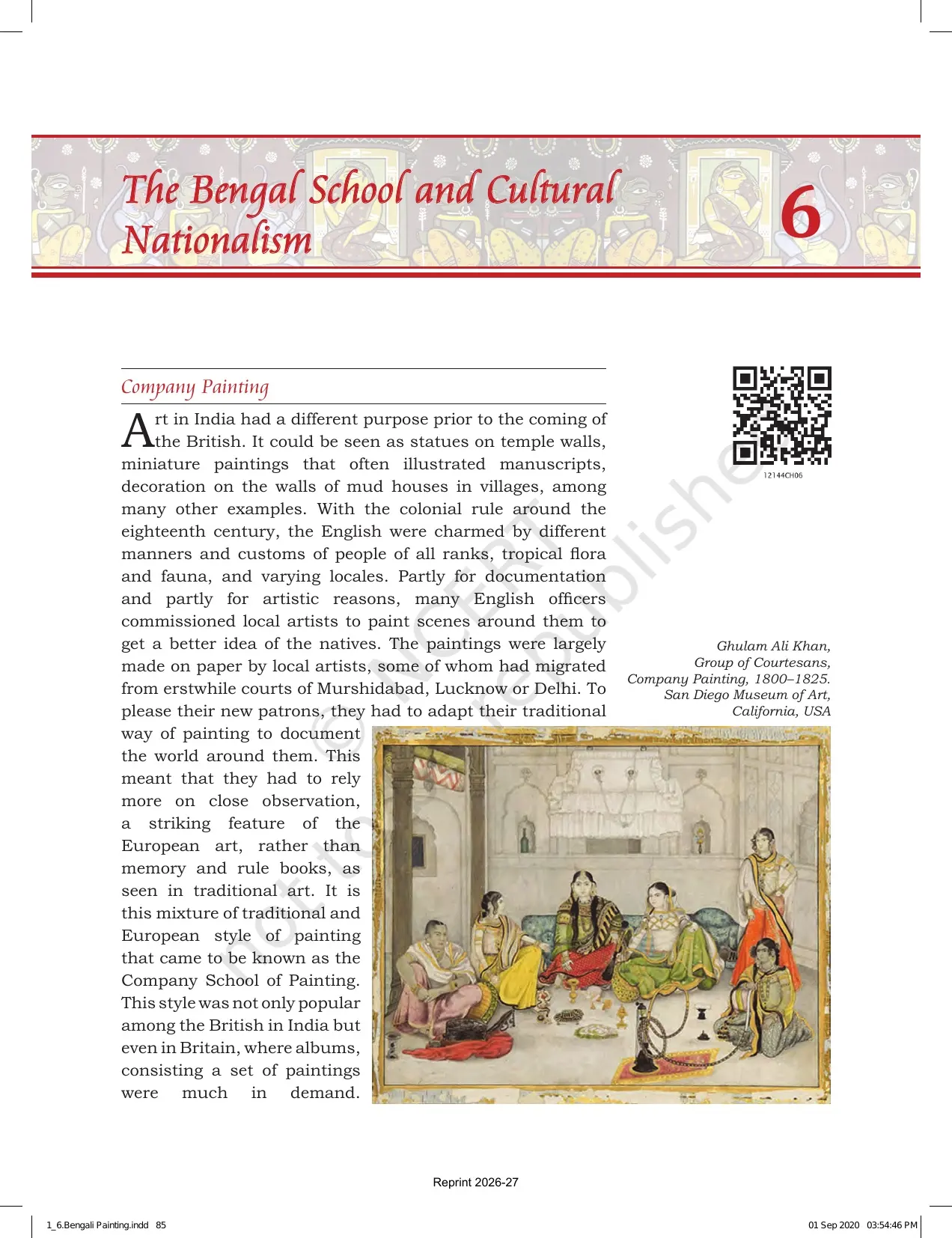
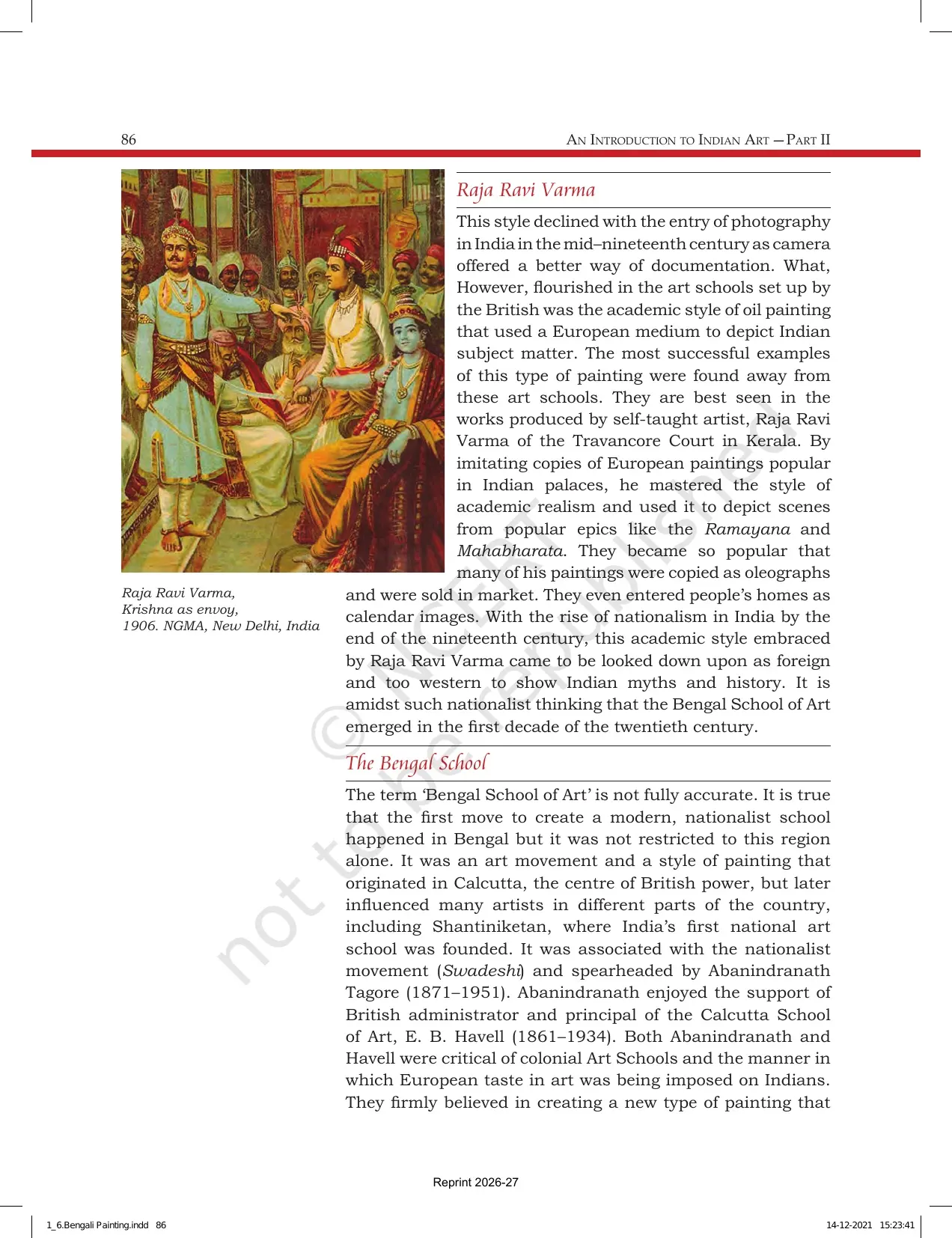
These Company Painting pages are the unedited NCERT text, checked against the Reprint 2026-27 print run, and paired here with an exam focused reading guide written by Collegedunia Fine Arts teachers.
What the Company Painting Pages of the Class 12 Fine Arts PDF Contain
This is a short piece of text with a very high mark yield. Two printed pages carry a full historical arc: why the style started, who painted it, why it died, and what replaced it. Read it in printed order and the argument holds together on its own.
| Part of the text | What it covers | Question type it feeds |
|---|---|---|
| Art in India before the British | Statues on temple walls, miniature paintings illustrating manuscripts, decoration on the walls of village mud houses | 2 marks |
| The colonial commission | English officers charmed by manners and customs, tropical flora and fauna and varying locales, commissioning local artists | 3 marks |
| Who the artists were | Local artists working largely on paper, some migrated from the courts of Murshidabad, Lucknow and Delhi | 3 marks |
| The change in method | Close observation, a striking feature of European art, replacing memory and rule books | 5 marks, the core question |
| The named plate | Ghulam Ali Khan, Group of Courtesans, Company Painting, 1800-1825, San Diego Museum of Art | Picture based |
| The decline | Photography reaching India in the mid nineteenth century and offering a better way of documentation | 3 marks |
| Raja Ravi Varma | Academic realism learned outside the art schools, epics on canvas, oleographs and calendar images | 5 marks |
| The handover | Nationalism rejecting the academic style as foreign, and the Bengal School emerging in the first decade of the twentieth century | 5 marks |
One planning note before you begin. This text is examined as a chain of cause and effect, not as a list of artists. Rule one page into three columns titled Cause, Effect and Evidence, and fill a row for every shift the book names. You will finish with the whole section on a single sheet.
Where the Company School Sits in the NCERT Class 12 Fine Arts Book
Be clear about this before you revise, because it saves confusion in the exam hall. Company Painting is not a separate numbered chapter of the textbook. It is the opening titled section of the unit called The Bengal School and Cultural Nationalism, and it runs across printed pages 85 and 86 of An Introduction to Indian Art Part 2.
- What the PDF on this page carries: those exact two printed pages, with both plates and both captions.
- Why we number it Chapter 7: our Class 12 Fine Arts study plan treats Company Painting as its own unit of study, because the board asks about it separately.
- What follows it in the book: the Bengal School section, which begins right after Raja Ravi Varma on page 86.
- Exercise questions: there are none printed at the end of this section, so build your own answers from the study questions given later on this page.
Also Check: read this section before the Bengal School unit, not after. The Bengal School argument only makes sense once you know what the nationalists were reacting against.
Indian Art Before the British: Temple Statues, Manuscripts and Village Walls
The text opens with a single line that is worth learning word for word. Art in India had a different purpose before the British came. The book then gives three examples of where that art lived, and those three examples are usually the whole answer to an opening two mark question.
- On temple walls: art could be seen as statues built into the temple structure itself.
- In books: miniature paintings that often illustrated manuscripts.
- In villages: decoration on the walls of mud houses, made by ordinary people rather than court artists.
- The point behind the list: art served religion, storytelling and daily life. It was not made to be collected or sold as a picture on its own.
Hold on to that last idea. Everything that changes in the next two pages changes because the purpose of the painting changes, from serving a temple or a manuscript to serving a foreign patron who wanted a record of India.
Why English Officers Commissioned Indian Artists in the Eighteenth Century
With colonial rule around the eighteenth century, the English arrived in a country they did not understand. The book says plainly that they were charmed by what they saw, and it names three things that charmed them. Learn the three as a set.
- People: the different manners and customs of people of all ranks, not only the rich or the courtly.
- Nature: tropical flora and fauna, plants and animals they had never seen at home.
- Places: the varying locales of a country far larger than anything in their own experience.
Then comes the reason for the commission, and the book gives two reasons at once. Many English officers asked local artists to paint the scenes around them partly for documentation and partly for artistic reasons. The stated aim was to get a better idea of the natives.
Write both halves in an answer. A student who says only "for documentation" loses the second half of the mark. The paintings were records and pictures at the same time, which is exactly why they are still studied as art.
Company Painting and the Bengal School Unit Explained in One Video
Source: Cafe Pedia on YouTube
Who Painted the Company Pictures and How Their Method Changed
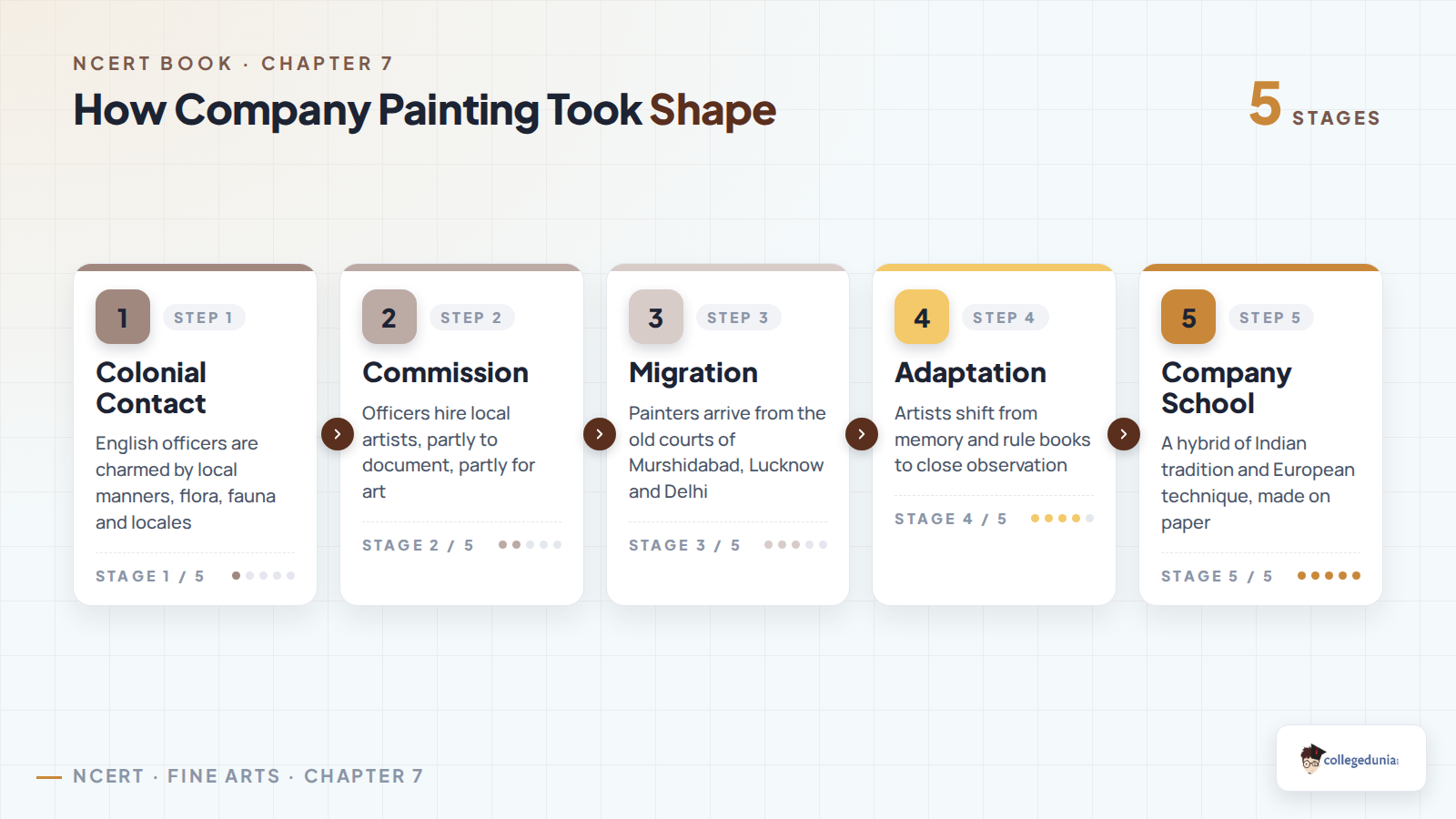
The artists were Indian, not British. That single fact carries several marks, because everything about the style follows from who these people were and where they came from.
- The material: the paintings were largely made on paper, which links them straight back to the miniature tradition.
- The artists: local artists, some of whom had migrated from the erstwhile courts of Murshidabad, Lucknow and Delhi.
- Why they moved: the old courts could no longer pay them, so they went where the new patrons were.
- The demand on them: to please their new patrons, they had to adapt their traditional way of painting so it could document the world around them.
- The method they took up: close observation, which the book calls a striking feature of European art.
- The method they left behind: memory and rule books, the way traditional art had always been made.
It is this mixture of traditional and European style of painting that came to be known as the Company School of Painting. That sentence is the definition the paper wants. If a question asks what the Company School is, open with that line and then add the paper support and the migrated artists as evidence.
Group of Courtesans by Ghulam Ali Khan and the Albums Sent to Britain
One artwork is named and captioned in this part of the text, so it is the likeliest picture based question from the section. Learn the caption as a fixed block, because picture questions usually award the first mark for the artist and the date.
| Caption detail | What to write |
|---|---|
| Artist | Ghulam Ali Khan |
| Title | Group of Courtesans |
| Style | Company Painting |
| Date | 1800-1825 |
| Where it is held | San Diego Museum of Art, California, USA |
The book then explains how far the style travelled. It was popular not only among the British in India but even in Britain itself, where albums consisting of a set of paintings were much in demand. That is the detail most students skip, and it answers the common question of why so much Company Painting sits in foreign museums today.
Notice the subject of the named plate as well. A group of courtesans is a study of people and their dress, not a religious or courtly scene. It shows the new interest in manners and customs that the text describes a paragraph earlier.
Company Painting and Traditional Miniature Painting Compared
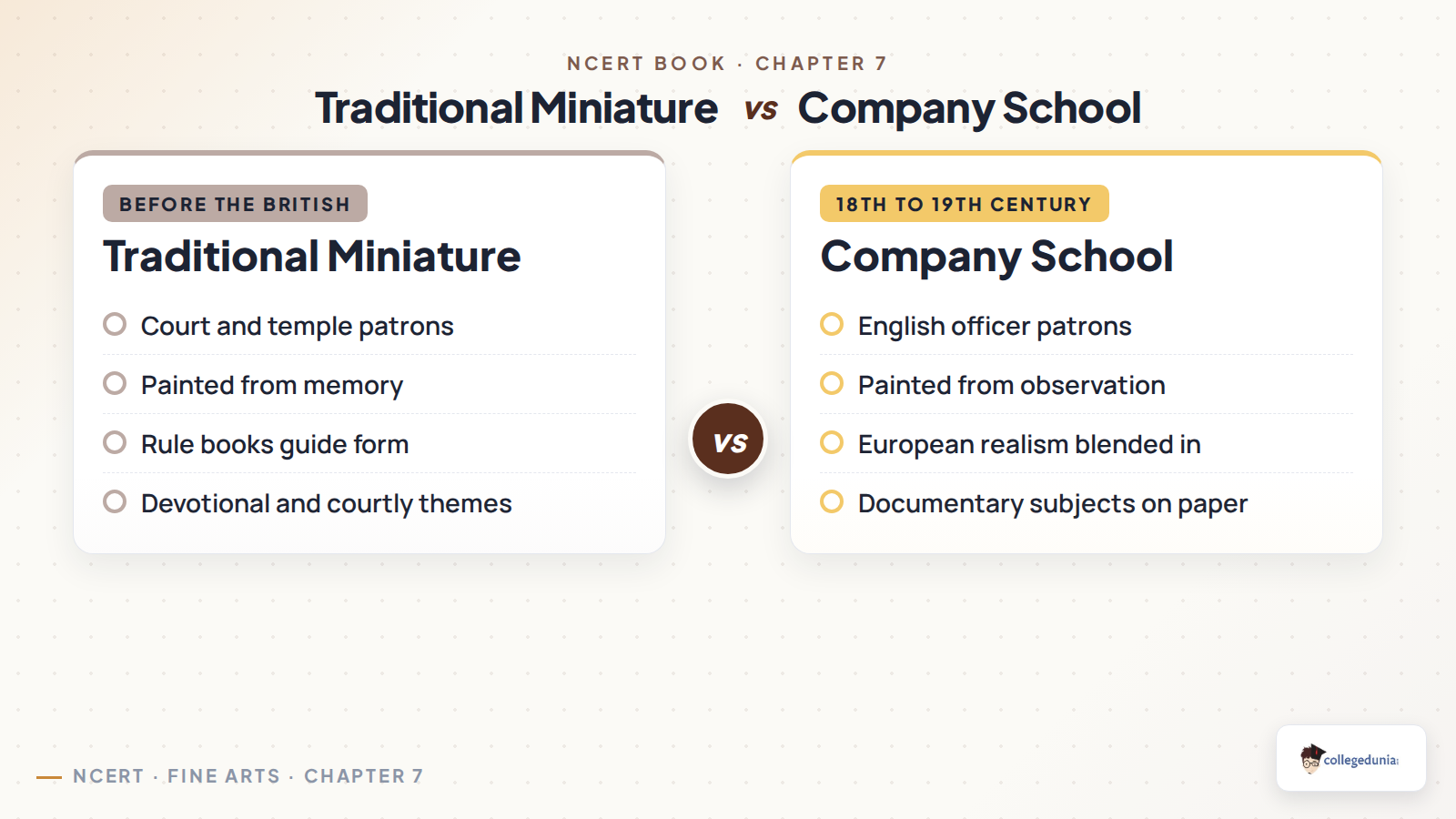
Almost every long answer on this section is really a comparison question. Build the comparison once, in a table, and you can answer it from any direction the paper asks.
| Point of comparison | Traditional Indian painting | Company School painting |
|---|---|---|
| Who paid for it | Temples, courts and village households | English officers of the colonial period |
| Why it was made | Religion, manuscripts and decoration | Documentation and artistic pleasure together |
| How the artist worked | From memory and rule books | From close observation |
| Who the artists were | Court and village painters | The same painters, many migrated from Murshidabad, Lucknow and Delhi |
| Support used | Paper, walls, cloth and manuscript pages | Largely paper |
| Where it ended up | Temples, palaces and homes in India | British collections in India and albums sold in Britain |
Keep one caution in mind while writing this comparison. The Company School is a mixture, not a replacement. The paper wants you to show what carried over from the Indian tradition as much as what came in from Europe.
Why the Company School Declined After Photography Reached India
The reason for the decline is stated in one clean sentence, and it is a favourite three mark question because the logic is so tidy. The style declined with the entry of photography in India in the mid nineteenth century, because the camera offered a better way of documentation.
- The trigger: photography arriving in India around the middle of the nineteenth century.
- The logic: half the demand for Company Painting was documentary, and a photograph documents faster and more exactly.
- What this tells you: the style depended on a job, and it faded when a machine did that job better.
- What survived instead: the academic style of oil painting that flourished in the art schools set up by the British.
The academic style used a European medium to depict Indian subject matter. That one line is the definition of academic art for this section. Learn it exactly, because the next part of the text is built entirely on it.
Raja Ravi Varma of Travancore and the Academic Style of Oil Painting
Here the text makes a point that surprises students. The most successful examples of the academic style were found away from the British art schools, not inside them. They are best seen in the work of one self taught artist.
- Who he was: Raja Ravi Varma of the Travancore Court in Kerala, described by the book as a self-taught artist.
- How he learned: by imitating copies of European paintings that were popular in Indian palaces at the time.
- What he mastered: the style of academic realism.
- What he painted: scenes from popular epics like the Ramayana and the Mahabharata.
- How his work spread: many of his paintings were copied as oleographs and sold in the market.
- Where they ended up: they even entered people's homes as calendar images.
The plate printed with this passage is Krishna as envoy, dated 1906, held at the National Gallery of Modern Art, New Delhi. It is an epic subject painted in an entirely European medium, which is the contradiction the whole passage is about.
An oleograph is a printed copy made to look like an oil painting. That is why the book treats the oleographs as important rather than as a footnote. They took a court artist's work off the palace wall and put it on the wall of an ordinary home, which is the first time Indian fine art reached ordinary households in large numbers.
Why Nationalism Turned Against Ravi Varma and Opened the Way for the Bengal School
The last paragraph of the section is the bridge to the rest of the unit, and it is the most commonly asked five mark question from these two pages. With the rise of nationalism in India by the end of the nineteenth century, opinion turned against the very style that had been most popular.
- The charge against the style: the academic style embraced by Raja Ravi Varma came to be looked down upon as foreign.
- The second charge: it was seen as too western to show Indian myths and history.
- The irony to point out: the subjects were entirely Indian, so the objection was to the medium and manner, not the story.
- What grew out of it: it is amid such nationalist thinking that the Bengal School of Art emerged in the first decade of the twentieth century.
Company Painting and Ravi Varma are the two things the Bengal School was reacting against. If your answer on the Bengal School does not open with that, it will read as a list of names instead of an argument, and the difference is usually two marks.
Named Artworks, Artists and Collections You Must Be Able to Quote
Only two artworks are named in this section, which makes it one of the cheapest picture question sets in the whole book. Learn both captions completely and you have covered every plate on these pages.
| Artwork | Artist and date | Where it is held |
|---|---|---|
| Group of Courtesans, a Company Painting | Ghulam Ali Khan, 1800-1825 | San Diego Museum of Art, California, USA |
| Krishna as envoy | Raja Ravi Varma, 1906 | National Gallery of Modern Art, New Delhi |
When a picture question gives you one of these plates, write the artist, the date and the collection first, then two style points, then one line on why the work matters to the section. That order matches how the marks are usually split.
Common Mistakes Students Make in the Company Painting Section
Watch out for these six:
- Writing that British artists painted the Company School pictures. They were painted by local Indian artists, many of whom had migrated from the courts of Murshidabad, Lucknow and Delhi.
- Giving only one reason for the commissions. The book gives two: partly for documentation and partly for artistic reasons.
- Saying the style declined because the British lost interest. The stated reason is the entry of photography in the mid nineteenth century, which offered a better way of documentation.
- Placing Raja Ravi Varma inside a British art school. He was self-taught, at the Travancore Court, and the book says the best work was found away from those schools.
- Treating oleographs as original paintings. They were printed copies sold in the market that entered homes as calendar images.
- Saying nationalists rejected Ravi Varma's subjects. They rejected his academic style as foreign and too western for Indian myths and history. His subjects were the epics.
Student Feedback on the Company Painting Section
What 11,480 students told us about these two pages
- 68% of the students surveyed did not know Company Painting sits inside the Bengal School unit and lost time hunting for a separate chapter in the book.
- Only 31% could give both reasons for the English commissions after a first reading. Most wrote documentation and stopped.
- Students who prepared the two plate captions as fixed blocks scored fastest on the picture based question.
- Most skipped line: the note that albums of these paintings were in demand in Britain, left unread by about 2 in 5 students.
Source: Collegedunia Class 12 Fine Arts student survey taken before the 2026-27 board exams. Sample of 11,480 students from CBSE schools across 14 states.
How to Revise Company Painting in a Two Block Plan
Two printed pages need about fifty minutes, not an evening. The text already runs in order of cause and effect, so do not shuffle it while revising.
- Block 1, 25 minutes. Read from art before the British up to the definition of the Company School. Then write, from memory, the three examples of pre colonial art, the three things that charmed the English, and the one line definition of the style.
- Block 2, 25 minutes. Read from the decline to the end. Write the photography reason, the definition of the academic style, the six point Ravi Varma list, and the two nationalist charges against him.
Repeat only Block 2 a week before the paper. The plate dates and the Ravi Varma chain fade fastest, and they are the cheapest marks available in the Fine Arts theory paper for both the CBSE Class 12 board exam and the CUET general test.
How the Company School Chapter PDF Works with the Fine Arts Revision Notes
The chapter PDF gives you the official text and both plates exactly as printed. What it does not give you is a compressed recall sheet you can read in ten minutes before the paper. That sits on the sister page for the same chapter, and running the two together is faster than reading either one alone.
| Resource | What it adds beyond this chapter PDF | Link |
|---|---|---|
| Revision Notes | The cause and effect chain, the traditional against Company comparison table and both plate captions condensed for a last read before the paper | The Company School Class 12 Notes |
Also Check: pair this section with the Bengal School and Modern Indian Art chapters. All three deal with the same argument about what counts as Indian art, and the paper often sets a question that crosses two of them.
All 8 Chapters of Class 12 Fine Arts with NCERT Book PDFs
The Class 12 Fine Arts course runs across eight chapters. Every link below opens the official NCERT chapter PDF for the 2026-27 session.
| Chapter | NCERT Book PDF |
|---|---|
| Chapter 1 | The Mughal School of Miniature Painting Class 12 PDF |
| Chapter 2 | The Deccan Schools of Painting Class 12 PDF |
| Chapter 3 | The Rajasthani Schools of Painting Class 12 PDF |
| Chapter 4 | The Pahari Schools of Painting Class 12 PDF |
| Chapter 5 | The Bengal School and Cultural Nationalism Class 12 PDF |
| Chapter 6 | Modern Indian Art Class 12 PDF |
| Chapter 7 | The Company School Class 12 PDF, the chapter you are reading |
| Chapter 8 | Living Art Traditions of India Class 12 PDF |
The Company School Class 12 Fine Arts NCERT Book PDF FAQs
Questions Class 12 Students Ask Most About the Company School
Ques. What is the Company School of Painting?
Ans. The Company School of Painting is the mixture of traditional Indian and European styles of painting that grew under colonial rule from around the eighteenth century. English officers commissioned local Indian artists to paint the scenes around them, partly for documentation and partly for artistic reasons. To please these new patrons the artists adapted their traditional way of painting and relied more on close observation, which is a striking feature of European art, rather than on memory and rule books as in traditional Indian art. That mixture is what came to be known as the Company School of Painting.
Ques. Is the Company School a separate chapter in the NCERT Class 12 Fine Arts book?
Ans. No. Company Painting is the opening titled section of the unit called The Bengal School and Cultural Nationalism in An Introduction to Indian Art Part 2, and it runs across printed pages 85 and 86. The PDF on this page carries exactly those pages with both plates and both captions. We list it as Chapter 7 in our Class 12 Fine Arts study plan because the board asks about it as a topic in its own right, and because it is easier to revise as a separate block before you move on to the Bengal School.
Ques. What was Indian art like before the British came?
Ans. The book says art in India had a different purpose before the British. It gives three examples of where that art lived: statues on temple walls, miniature paintings that often illustrated manuscripts, and decoration on the walls of mud houses in villages. The common thread is purpose. Art served religion, storytelling and daily life rather than existing as a picture to be collected. That is the point the section builds on, because the arrival of English patrons changed the purpose of the painting before it changed the style.
Ques. Why did English officers commission Indian artists to paint?
Ans. With colonial rule around the eighteenth century, the English were charmed by three things: the different manners and customs of people of all ranks, the tropical flora and fauna, and the varying locales of the country. Many English officers then commissioned local artists to paint the scenes around them, partly for documentation and partly for artistic reasons, so they could get a better idea of the natives. Both halves of that reason matter in an answer, because an answer that mentions only documentation misses half the mark.
Ques. Who were the artists of the Company School?
Ans. They were local Indian artists, not British painters. Some of them had migrated from the erstwhile courts of Murshidabad, Lucknow and Delhi, where the old patronage had dried up. Their paintings were largely made on paper, which connects the Company School directly to the older miniature tradition they had been trained in. The change was in method rather than in the people. They had to adapt their traditional way of painting to document the world around them for a new set of patrons.
Ques. How did the Company School differ from traditional Indian painting?
Ans. The biggest difference is how the artist worked. Traditional Indian art was made from memory and from rule books that set out how a figure or a scene should look. Company School artists had to rely much more on close observation, which the book calls a striking feature of European art, because their patrons wanted an accurate record. The patron, the purpose and the destination changed too. The pictures were made for English officers, made partly as documents, and many of them left India in albums.
Ques. Who painted Group of Courtesans and where is it kept?
Ans. Group of Courtesans was painted by Ghulam Ali Khan. The caption in the NCERT text gives it as a Company Painting dated 1800-1825, and it is held at the San Diego Museum of Art in California, USA. It is the only Company Painting plate named in this section, so it is the likeliest picture based question from these two pages. Learn the artist, the title, the style, the date and the collection together as one block, because picture questions usually award the first mark for the artist and the date.
Ques. Why did the Company School of Painting decline?
Ans. The style declined with the entry of photography in India in the mid nineteenth century, because the camera offered a better way of documentation. Half the demand for Company Painting had always been documentary, so once a photograph could do that job faster and more exactly, the commissions dried up. What flourished instead was the academic style of oil painting that grew in the art schools set up by the British, a European medium used to depict Indian subject matter.
Ques. What is the academic style of painting according to the chapter?
Ans. The academic style of oil painting is described as a European medium used to depict Indian subject matter. It flourished in the art schools set up by the British after the Company School declined. The interesting turn in the text is that the most successful examples of this type of painting were found away from those art schools. They are best seen in the work of the self-taught artist Raja Ravi Varma of the Travancore Court in Kerala, who learned the style on his own.
Ques. How did Raja Ravi Varma learn academic realism?
Ans. Raja Ravi Varma was a self-taught artist of the Travancore Court in Kerala. He mastered the style of academic realism by imitating copies of European paintings that were popular in Indian palaces at the time. He then used that style to depict scenes from popular epics like the Ramayana and the Mahabharata. His plate in this section is Krishna as envoy, dated 1906, held at the National Gallery of Modern Art in New Delhi. He is the clearest example in the book of a European technique carrying an entirely Indian subject.
Ques. What are oleographs and why do they matter?
Ans. An oleograph is a printed copy made to look like an oil painting. Raja Ravi Varma's paintings became so popular that many of them were copied as oleographs and sold in the market, and they even entered people's homes as calendar images. That matters because it took Indian fine art off the palace wall and put it in ordinary homes for the first time. It is also why his images are still familiar to people who have never visited a gallery.
Ques. Why did nationalists reject Raja Ravi Varma's style?
Ans. With the rise of nationalism in India by the end of the nineteenth century, the academic style embraced by Raja Ravi Varma came to be looked down upon as foreign and too western to show Indian myths and history. Note carefully that the objection was to the medium and the manner, not to the subjects, since his subjects were the Ramayana and the Mahabharata. It is amid such nationalist thinking that the Bengal School of Art emerged in the first decade of the twentieth century.
Ques. How do I download the Company School NCERT Book PDF?
Ans. Use the PDF viewer at the top of this page. It carries the official NCERT Company Painting pages exactly as issued in the Reprint 2026-27 print run, with both plates and both captions, so you can read the section online or save it for offline revision before the 2026-27 board exams. No sign up is needed. Pair it with the revision notes linked above if you want the same content compressed into a single recall sheet.



Comments