



Inside the NCERT Book PDF for Class 12 Fine Arts Chapter 8 Living Art Traditions of India you will find the six painting traditions the book names in detail, the full Dhokra casting process in order, and the terracotta section that closes the textbook. It is taken from An Introduction to Indian Art Part 2, Reprint 2026-27, printed pages 127 to 143.
- Six painting traditions covered in detail: Mithila, Warli, Gond, Pithoro, Pata and the Phads of Rajasthan.
- Two sculptural traditions: Dhokra lost wax casting of Bastar and terracotta made by village potters.
- The longest process answer in the whole book sits here, so learn the Dhokra steps in printed order.
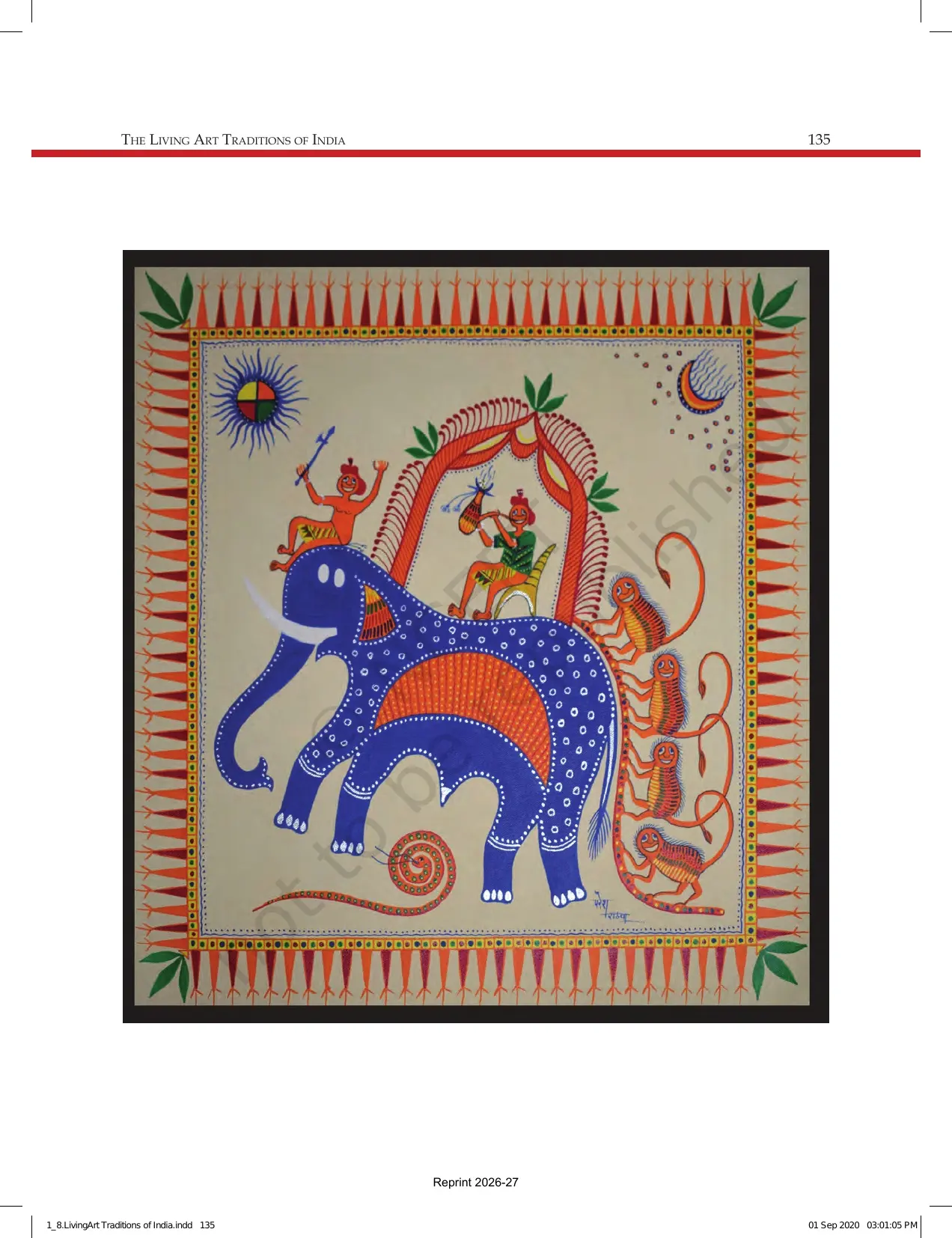
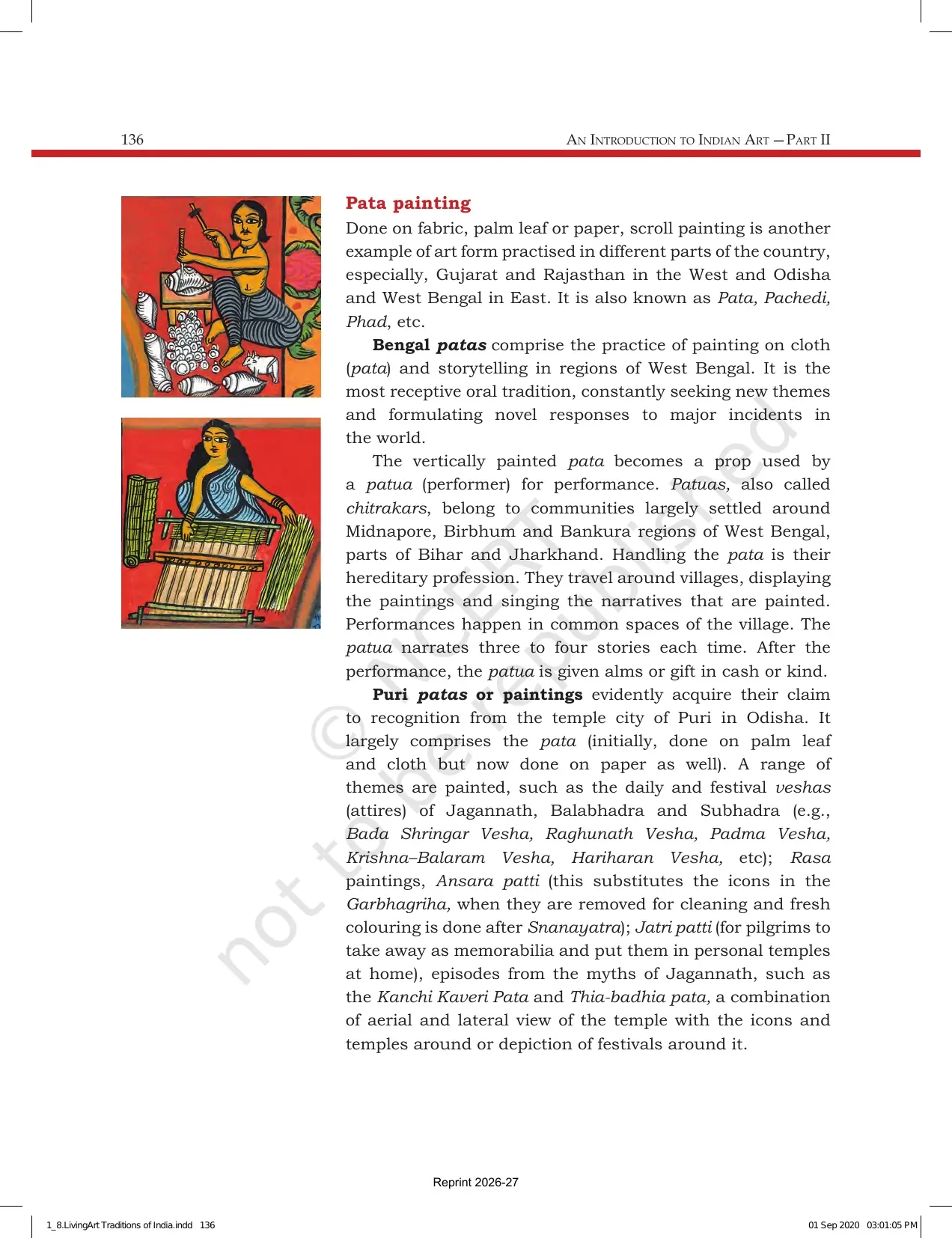
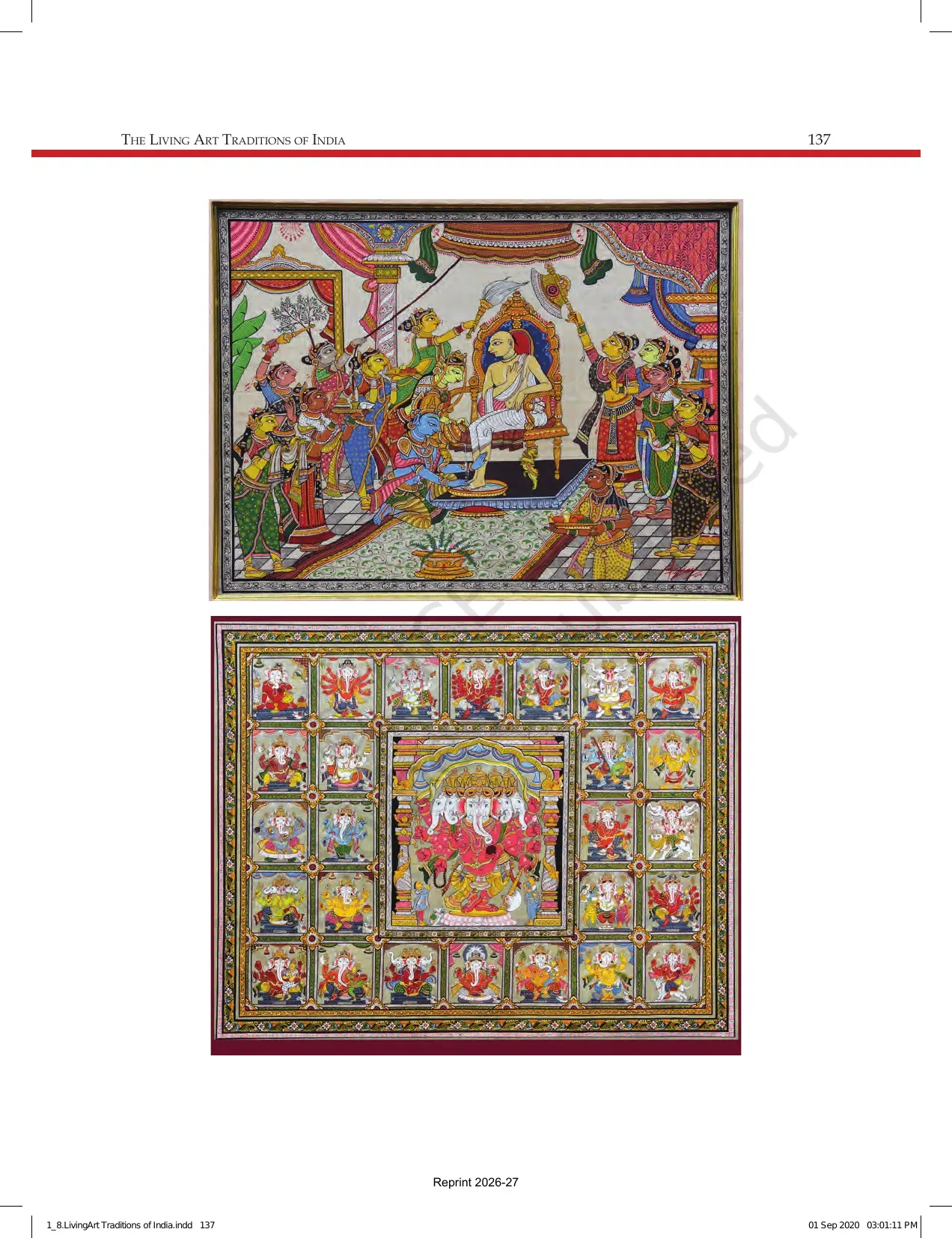
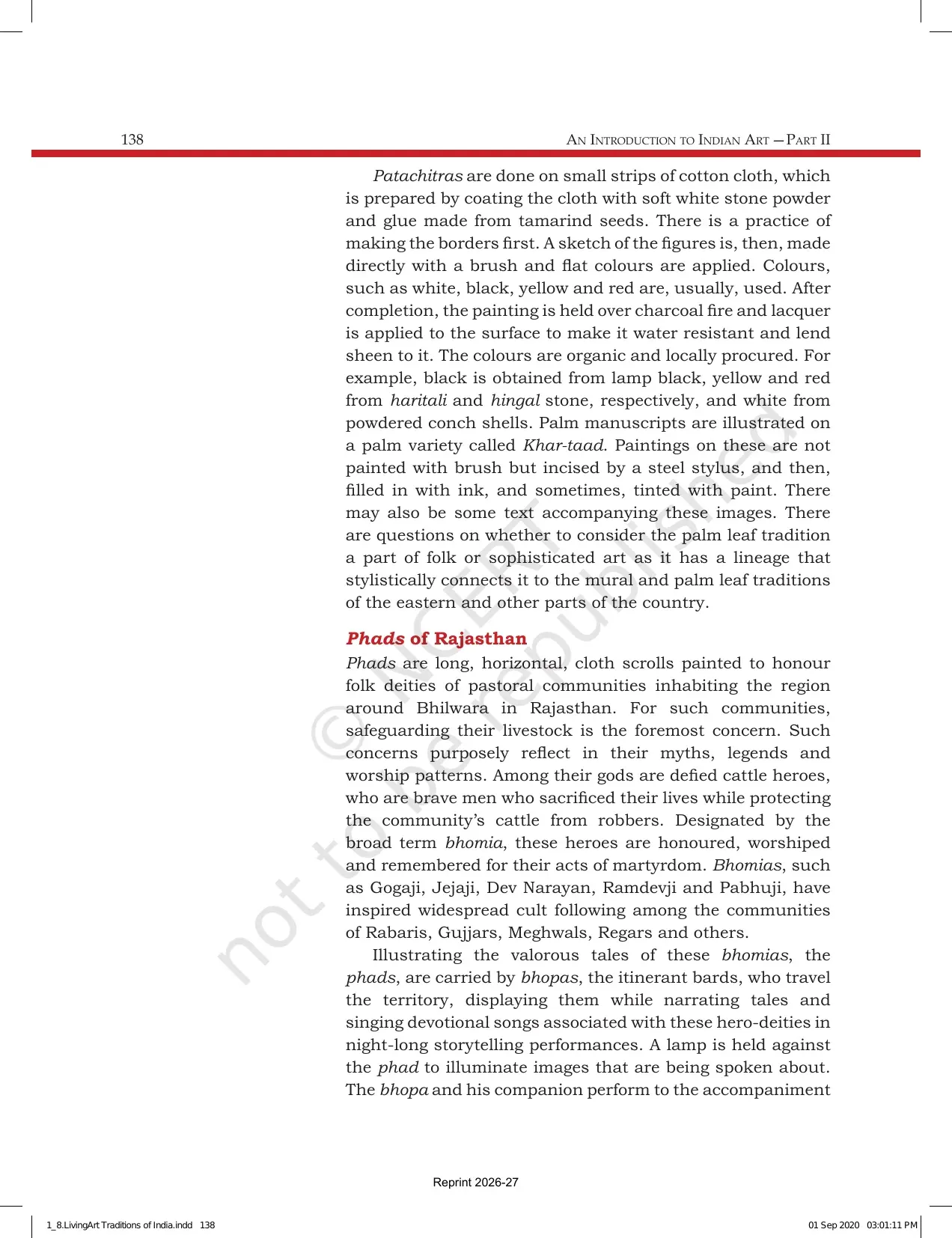
These Living Art Traditions pages are the unedited NCERT text, checked against the Reprint 2026-27 print run, and paired here with an exam focused reading guide written by Collegedunia Fine Arts teachers.
What the Living Art Traditions Pages of the Class 12 Fine Arts PDF Contain
This is the longest chapter in the book and the most name heavy. It has no derivations and no dates to memorise. What it does have is a long list of communities, regions, materials and processes, and the paper tests exactly those.
| Part of the text | What it covers | Question type it feeds |
|---|---|---|
| Opening argument | Art made by people living far from urban life, indigenous knowledge passed from one generation to another, the thin line between art and craft | 3 marks |
| Post Independence revival | The handicraft industry becoming organised for commercial production, and State emporia showcasing each region | 2 marks |
| Painting tradition list | Eight traditions named, six of them explained in detail | 2 marks, naming question |
| Mithila and Warli | The two most asked painting traditions, with named goddesses, house areas and tools | 5 marks, the core question |
| Gond and Pithoro | Nature worship of the Gonds, and the Rathva cosmography read in rows of horse riders | 3 marks |
| Pata painting | Bengal scroll performance, Puri veshas, and the full Patachitra technique | 5 marks |
| Phads of Rajasthan | Bhomia cattle heroes, bhopa bards, and the Joshi painters | 5 marks |
| Dhokra casting | The lost wax process from riverbank soil to hammering the clay away | 5 marks, process question |
| Terracotta | The most common sculptural medium, made by potters from local clay | 2 marks |
One planning note before you start. Every tradition in this chapter is examined as a set of four facts: community, region, material and purpose. Rule four columns with those headings and fill one row per tradition. That single sheet answers most of what the paper can ask.
Where Living Art Traditions Sits in the NCERT Class 12 Fine Arts Book
This is the last chapter of An Introduction to Indian Art Part 2, and it is the only one that leaves court patronage behind completely. Knowing that placement helps, because the paper often asks you to contrast this art with the miniature schools you studied earlier.
- What the PDF on this page carries: printed pages 127 to 143, with every plate and caption as issued.
- What comes before it: Modern Indian Art and the Company School, both built on trained, city based artists.
- Why the order matters: the book ends with artists who never went to an art school, which is the point of the whole chapter.
- Exercise questions: none are printed at the end of the section, so build answers from the study points on this page.
Also Check: read this chapter after the Rajasthani and Pahari schools. The Joshi painters of the phads came out of exactly that court miniature world, and the link only makes sense in that order.
Mithila, Warli and Pithoro Painting Explained in One Video
Source: Anu Sangwan on YouTube
Why Folk and Tribal Art Sits Outside the Court Story of Indian Art
The opening pages ask a set of blunt questions. So far the book has studied art of a certain time, named after a place or a dynasty. But what about common people? Were they not creative? Where did the artists who reached the courts come from in the first place?
- Who makes this art: people living far from urban life, in forests, deserts, mountains and villages, most of whom never attended an art school, a design institute or even formal schooling.
- How the skill survives: India is described as a repository of indigenous knowledge, passed from one generation to another.
- The names scholars gave it: minor arts, utility art, folk art, tribal art, people's art, ritual art and crafts.
- How old it is: the same instinct shows in pre historic cave paintings and in the pottery, terracotta, bronze and ivory of the Indus period.
- The art or craft line: the book says there is a thin line between the art of the people and crafts, because both involve creativity, instinct, necessity and aesthetics.
Two more points close the opening. In the nineteenth and twentieth centuries modern artists in India and in the West began treating these traditional forms as sources of inspiration. After Independence the handicraft industry was revived and became organised for commercial production, and as States and Union Territories were formed, each one showed its own art forms in a State emporium.
Mithila Painting of Bihar: The Kohbar Ghar, the Themes and the Natural Colours
Mithila is the tradition the paper asks about most, and it is also the one students answer loosely. The safest answer follows the order of the printed text: the name, the makers, the three painted areas, the kohbar room, the themes, then the tools and colours.
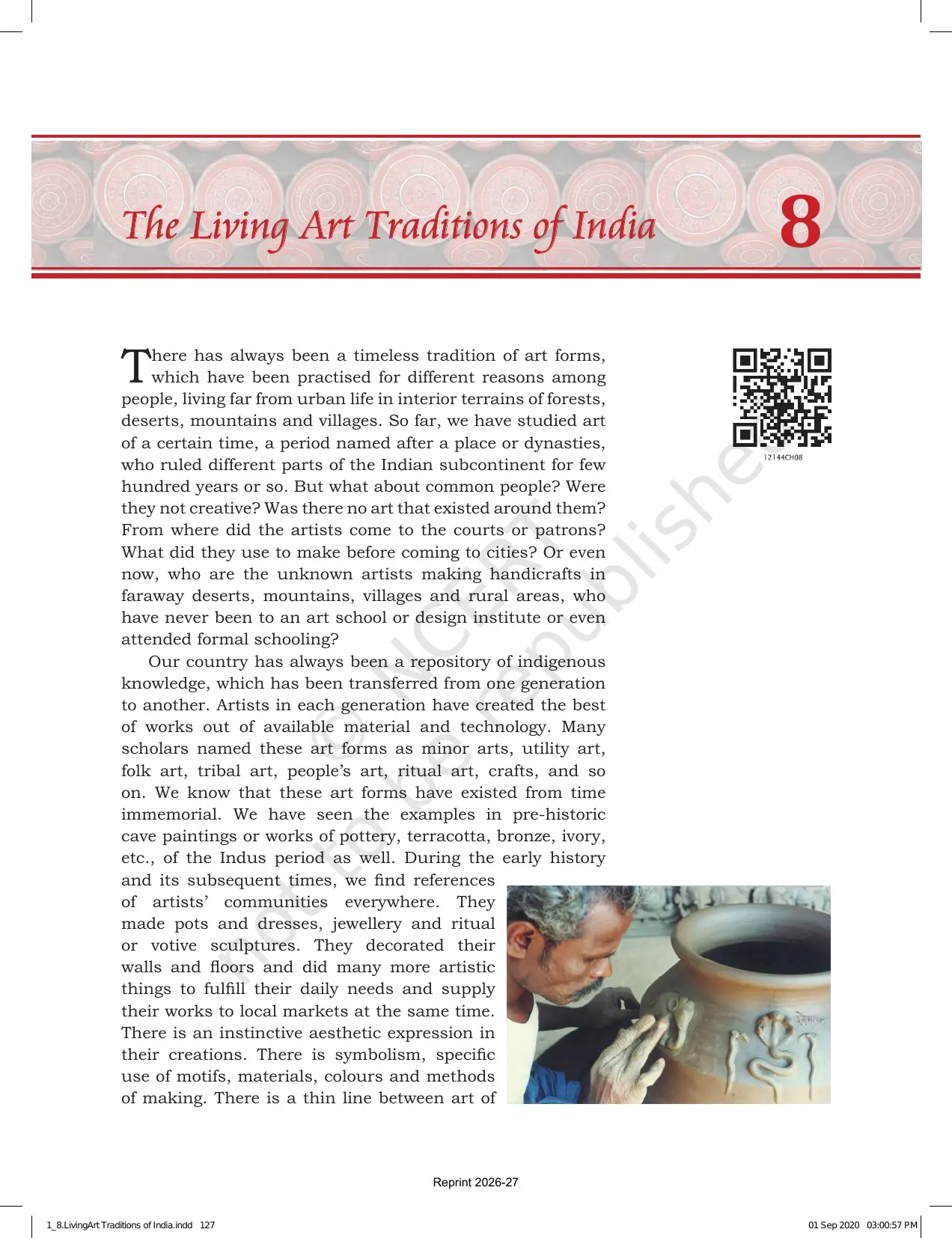
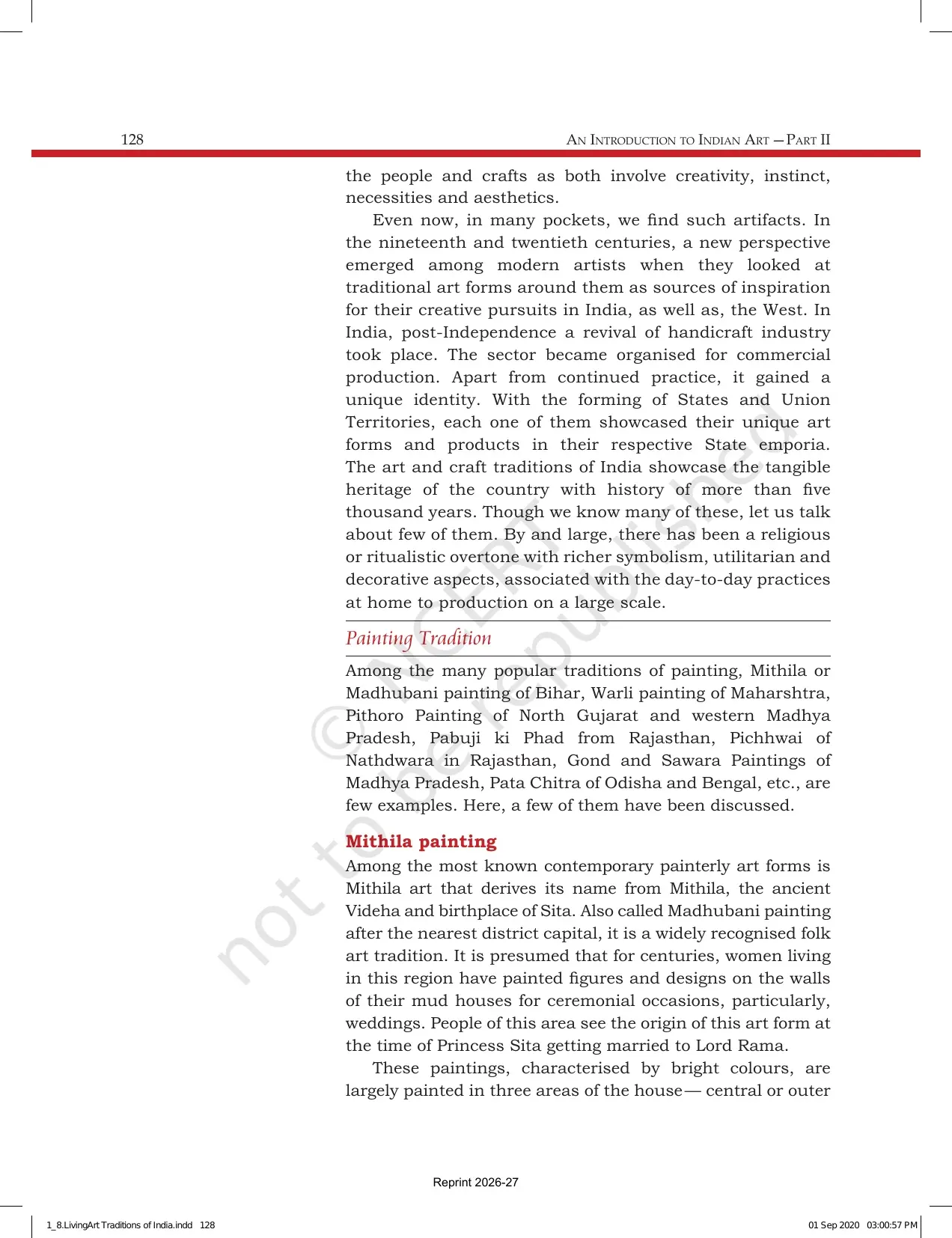
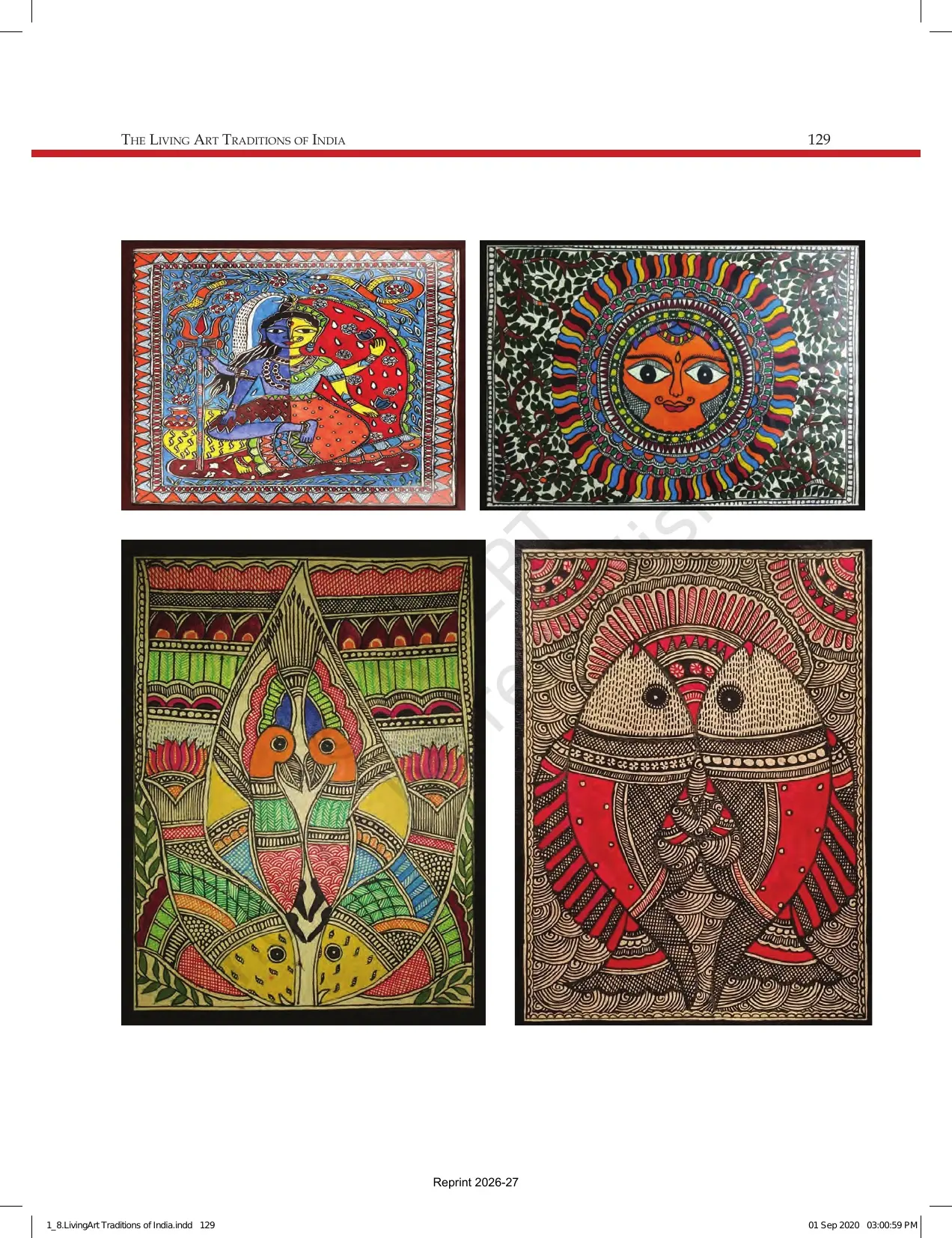
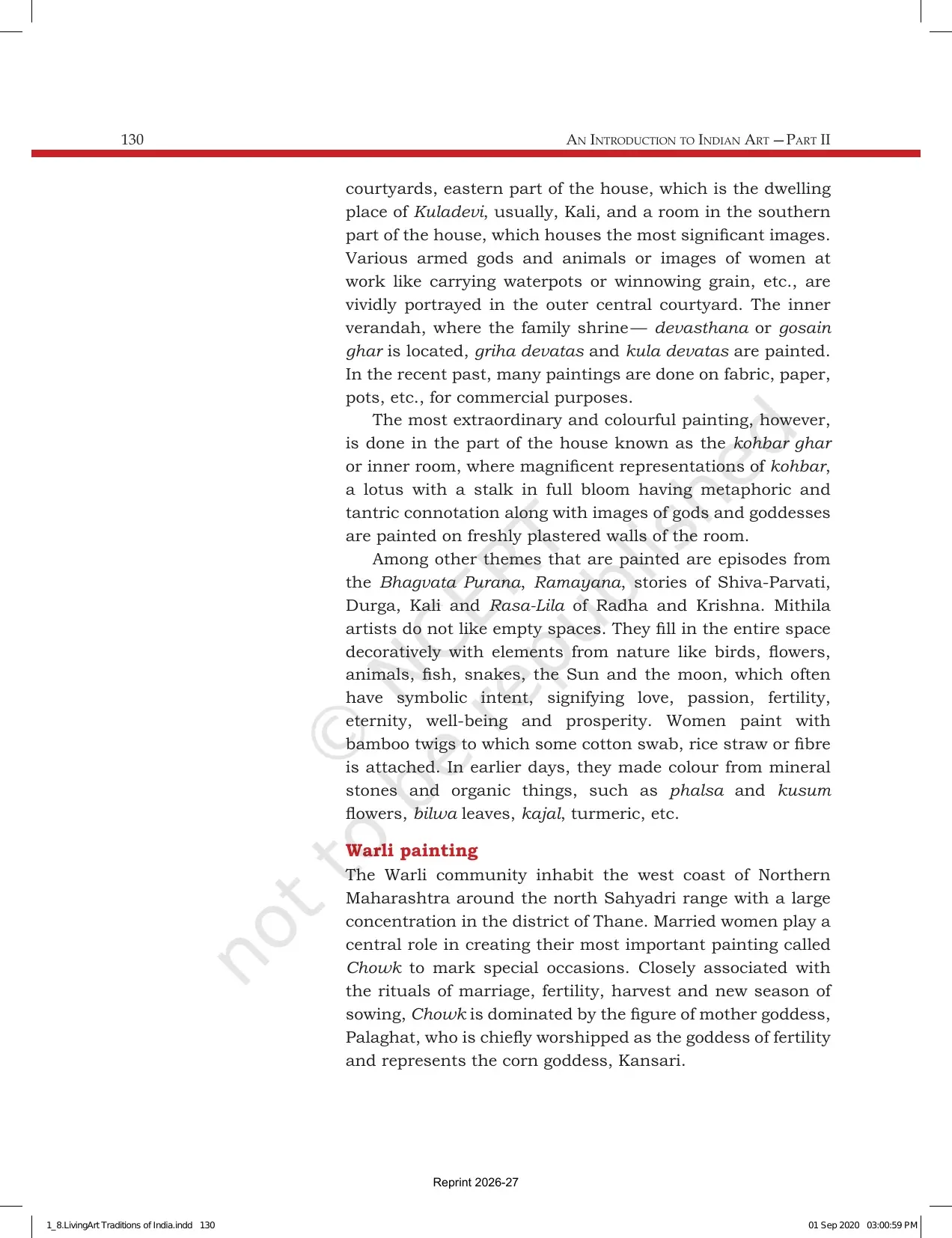
- The name: from Mithila, the ancient Videha and birthplace of Sita. It is also called Madhubani painting after the nearest district capital.
- The origin story: people of the area trace the art to the time of Princess Sita's marriage to Lord Rama.
- The makers: women of the region, painting figures and designs on the walls of their mud houses for ceremonial occasions, especially weddings.
- Recent change: much of it is now done on fabric, paper and pots for commercial sale.
The three painted areas of the house are a standing two or three mark question. Learn them with what each one carries.
| Area of the house | What is painted there |
|---|---|
| Central or outer courtyard | Armed gods, animals, and women at work carrying waterpots or winnowing grain |
| Eastern part of the house | The dwelling place of the Kuladevi, usually Kali |
| Room in the southern part | The most significant images of the house |
| Inner verandah, the devasthana or gosain ghar | The family shrine, with griha devatas and kula devatas |
| The kohbar ghar, or inner room | The kohbar, a lotus with a stalk in full bloom, with metaphoric and tantric meaning, along with gods and goddesses on freshly plastered walls |
Mithila artists do not like empty spaces. They fill the whole surface with birds, flowers, animals, fish, snakes, the Sun and the moon, and these stand for love, passion, fertility, eternity, well being and prosperity. Other themes come from the Bhagvata Purana, the Ramayana, stories of Shiva and Parvati, Durga, Kali, and the Rasa Lila of Radha and Krishna.
- The brush: a bamboo twig with cotton swab, rice straw or fibre tied to the end.
- The colours: mineral stones and organic sources such as phalsa and kusum flowers, bilwa leaves, kajal and turmeric.
Warli Painting of Maharashtra: Chowk, Palaghat and the Panch Sirya Devata
Warli is the second most asked tradition, and the marks sit in the named figures. Do not describe the style in general terms. Name the painting, the goddess, the chevrons and the guardian, and the answer writes itself.
- Where they live: the west coast of northern Maharashtra, around the north Sahyadri range, with a large concentration in the district of Thane.
- The painting: the Chowk, made by married women to mark special occasions, and tied to the rituals of marriage, fertility, harvest and the new sowing season.
- The central figure: the mother goddess Palaghat, worshipped as the goddess of fertility, who represents the corn goddess Kansari.
- Her frame: a small square edged with pointed chevrons that stand for Hariyali Deva, the god of plants.
- Her guardian: a headless warrior on a horse or standing beside her, with five shoots of corn springing from his neck, so he is called Panch Sirya Devata, the five headed god. He is also Khetrapal, guardian of the fields.
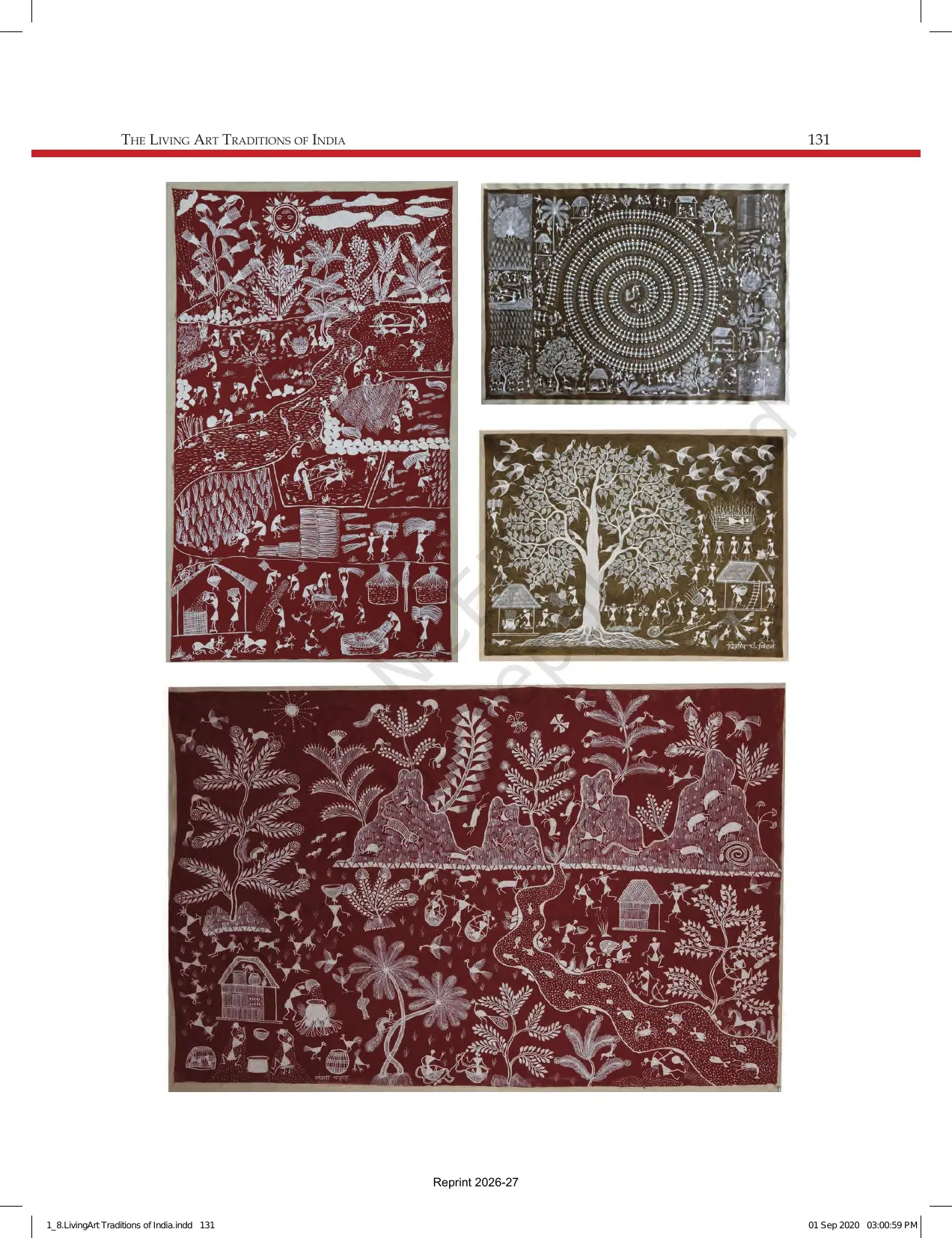
Around that central motif the Warli paint what they see. The book lists hunting, fishing, farming, dancing and mythological animal stories in which the tiger is clearly visible. It then adds a detail students often miss: scenes of buses plying and the busy urban life of Mumbai appear in the same painting, because that is also part of what the Warli see around them.
- The material: rice flour painted on earth coloured walls of the home.
- The brush: a bamboo stick chewed at the end.
- The purpose: to promote fertility, avert diseases, propitiate the dead and satisfy the demands of spirits.
Gond and Pithoro Painting: Nature Worship and the Rathva Cosmography
These two are short in the book but they carry a clean three mark question each. Gond is about who the community was and what changed recently. Pithoro is about how to read the picture, top to bottom.
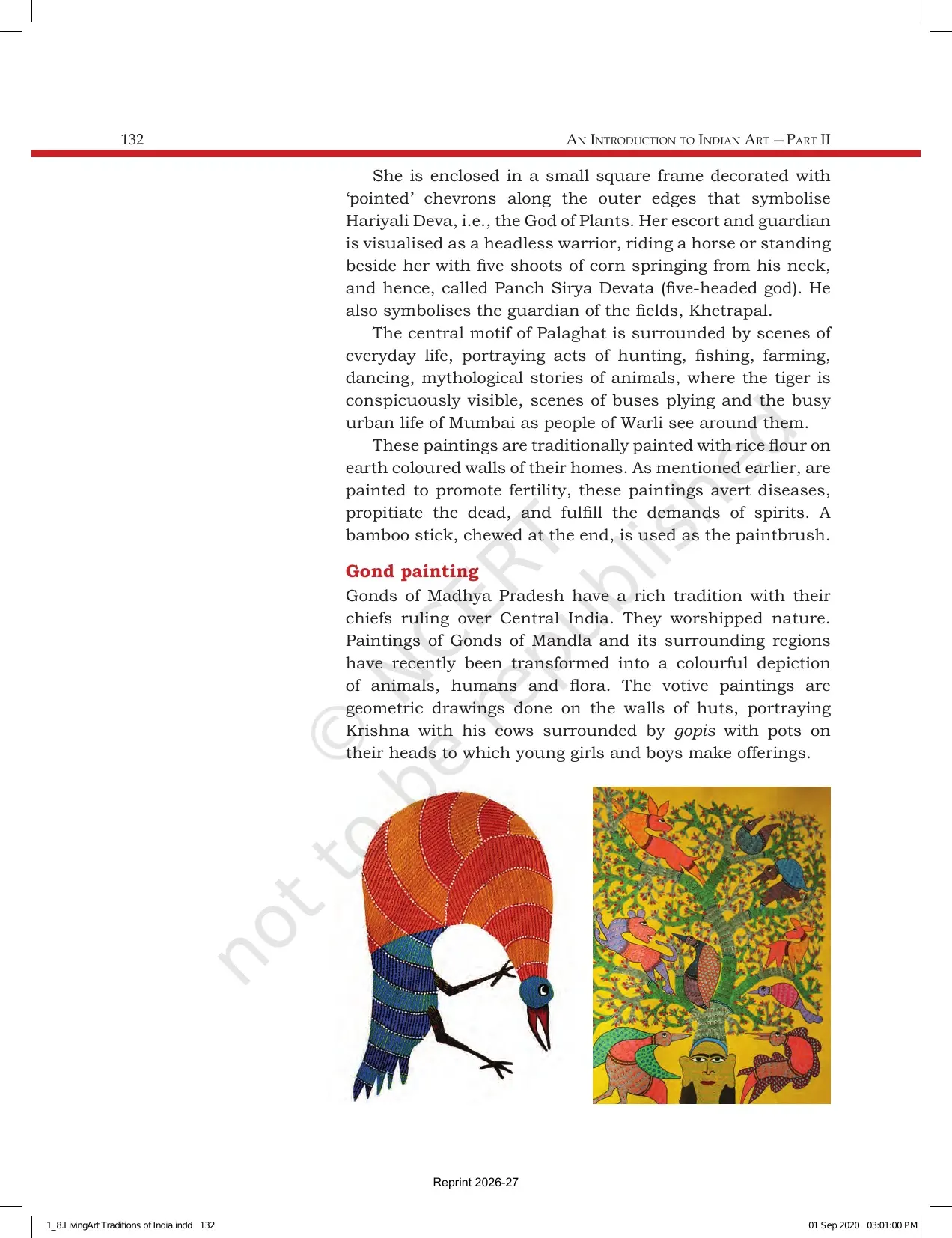
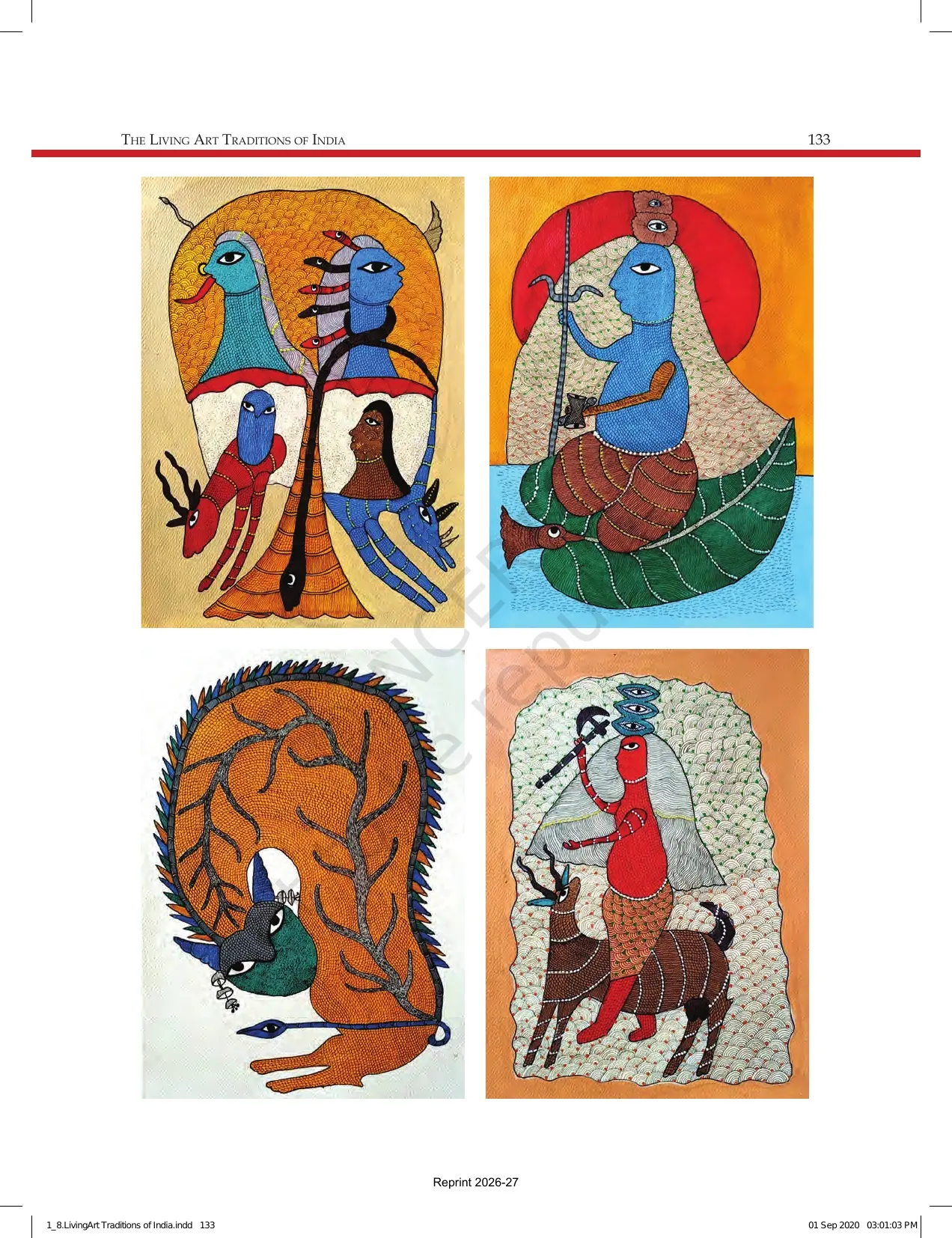
- Gond, who they are: the Gonds of Madhya Pradesh, whose chiefs ruled over Central India, and who worshipped nature.
- Gond, the region named: Mandla and its surrounding regions.
- Gond, the recent change: the painting has been transformed into a colourful depiction of animals, humans and flora.
- Gond, the older votive form: geometric drawings on hut walls showing Krishna with his cows, surrounded by gopis with pots on their heads, to which young girls and boys make offerings.
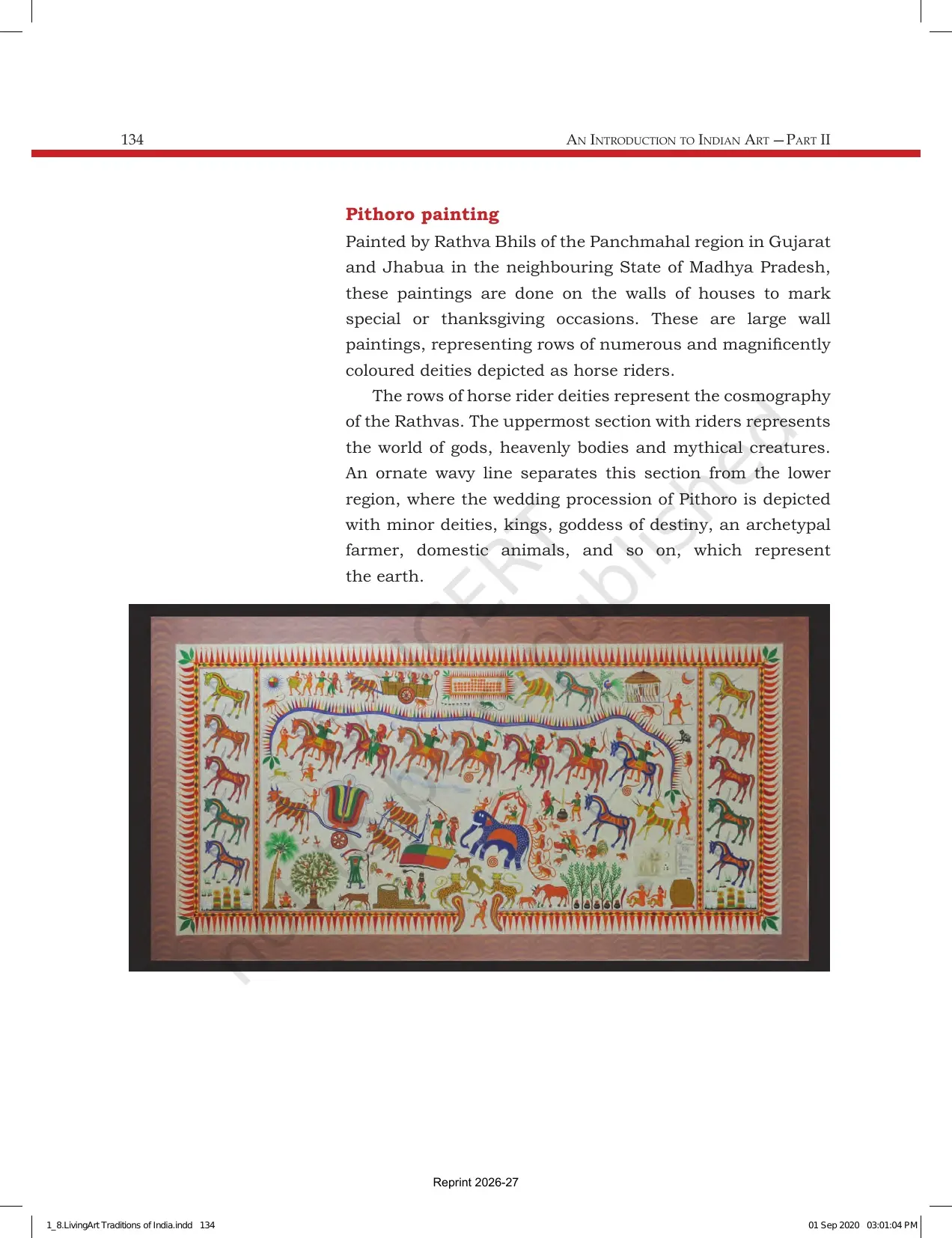
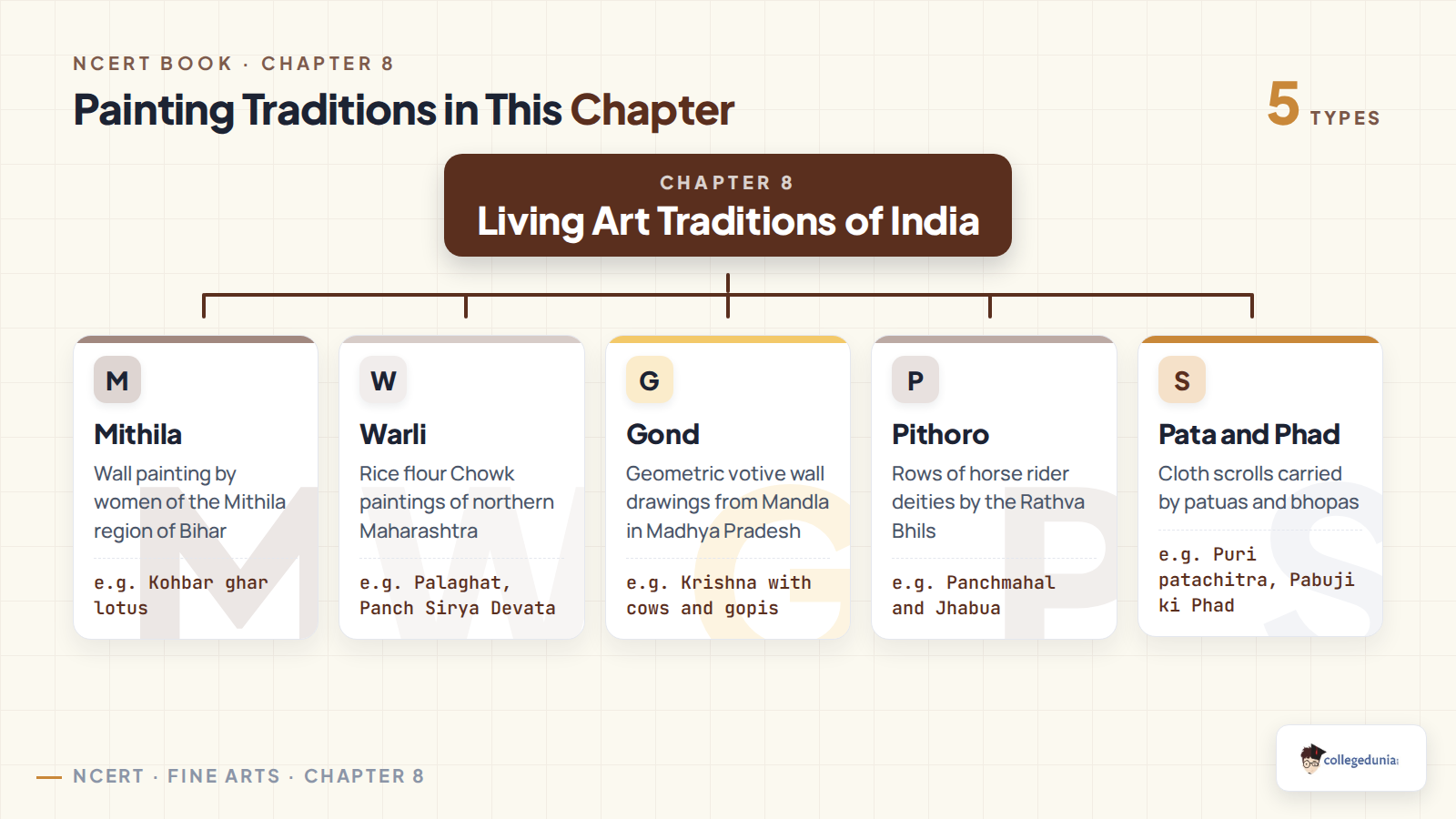
Pithoro is painted by the Rathva Bhils of the Panchmahal region in Gujarat and Jhabua in Madhya Pradesh. These are large wall paintings made to mark special or thanksgiving occasions, and they show rows of brilliantly coloured deities riding horses.
| Register of the painting | What it represents |
|---|---|
| Uppermost section with riders | The world of gods, heavenly bodies and mythical creatures |
| An ornate wavy line | The divider between the two worlds |
| Lower region | The earth, shown as the wedding procession of Pithoro with minor deities, kings, the goddess of destiny, an archetypal farmer and domestic animals |
The point to write in an answer is that the rows of horse riders are the cosmography of the Rathvas, not decoration. A student who calls it a decorative border loses the whole mark.
Pata Painting of Bengal and Odisha: Scrolls, Patuas and the Puri Veshas
Pata is scroll painting done on fabric, palm leaf or paper. It is practised in Gujarat and Rajasthan in the west and Odisha and West Bengal in the east, and it goes by several names: Pata, Pachedi and Phad. The book then splits the section into Bengal patas and Puri patas, so answer it that way.
- What a Bengal pata is: painting on cloth combined with storytelling, called the most receptive oral tradition because it keeps taking on new themes and responds to major events in the world.
- How it is used: the vertically painted pata becomes a prop for the patua, the performer.
- Who the patuas are: also called chitrakars, settled around Midnapore, Birbhum and Bankura in West Bengal and in parts of Bihar and Jharkhand. Handling the pata is their hereditary profession.
- The performance: they travel village to village, display the paintings and sing the painted narrative in a common village space, telling three to four stories each time.
- The payment: alms or a gift in cash or kind after the performance.
Puri patas take their name from the temple city of Puri in Odisha. They were first done on palm leaf and cloth and are now done on paper as well. The themes are fixed, so learn them as a list.
| Theme | What it shows |
|---|---|
| Daily and festival veshas, or attires | Jagannath, Balabhadra and Subhadra in Bada Shringar, Raghunath, Padma, Krishna Balaram and Hariharan vesha |
| Rasa paintings | Episodes of the Rasa |
| Ansara patti | Substitutes the icons in the Garbhagriha when they are removed for cleaning and fresh colouring after Snanayatra |
| Jatri patti | Taken away by pilgrims as memorabilia for personal temples at home |
| Kanchi Kaveri pata | An episode from the myths of Jagannath |
| Thia badhia pata | Aerial and lateral view of the temple together, with the icons, the temples around it or the festivals held there |
How a Patachitra Is Made and How Palm Leaf Manuscripts Differ
This is a process question with a fixed order, so write it as steps. The examiner is checking whether you know the ground, the sequence and the finishing, not whether you can describe the picture.
- Prepare the ground. Small strips of cotton cloth are coated with soft white stone powder and glue made from tamarind seeds.
- Make the borders first. This is the practice the book names before anything else is drawn.
- Sketch with the brush. The figures are sketched directly with a brush, not pencilled in.
- Apply flat colours. White, black, yellow and red are the usual colours.
- Fire and lacquer. The finished painting is held over a charcoal fire and lacquer is applied, which makes it water resistant and gives it sheen.
The colours are organic and procured locally. Black comes from lamp black, yellow and red from haritali and hingal stone, and white from powdered conch shells. Keep that pairing exact, because it is an easy one mark to lose.
- The palm variety used: manuscripts are illustrated on a palm called Khar taad.
- The technique: the images are not painted with a brush. They are incised with a steel stylus, then filled with ink and sometimes tinted with paint.
- The open question: the book says there is debate on whether the palm leaf tradition is folk or sophisticated art, since its lineage connects it to the mural and palm leaf traditions of the east.
Phads of Rajasthan: Bhomia Cattle Heroes, Bhopa Bards and the Joshi Painters
The phad section carries the sharpest argument in the chapter, and the last line of it is the five mark answer. Build up to that line rather than opening with it.
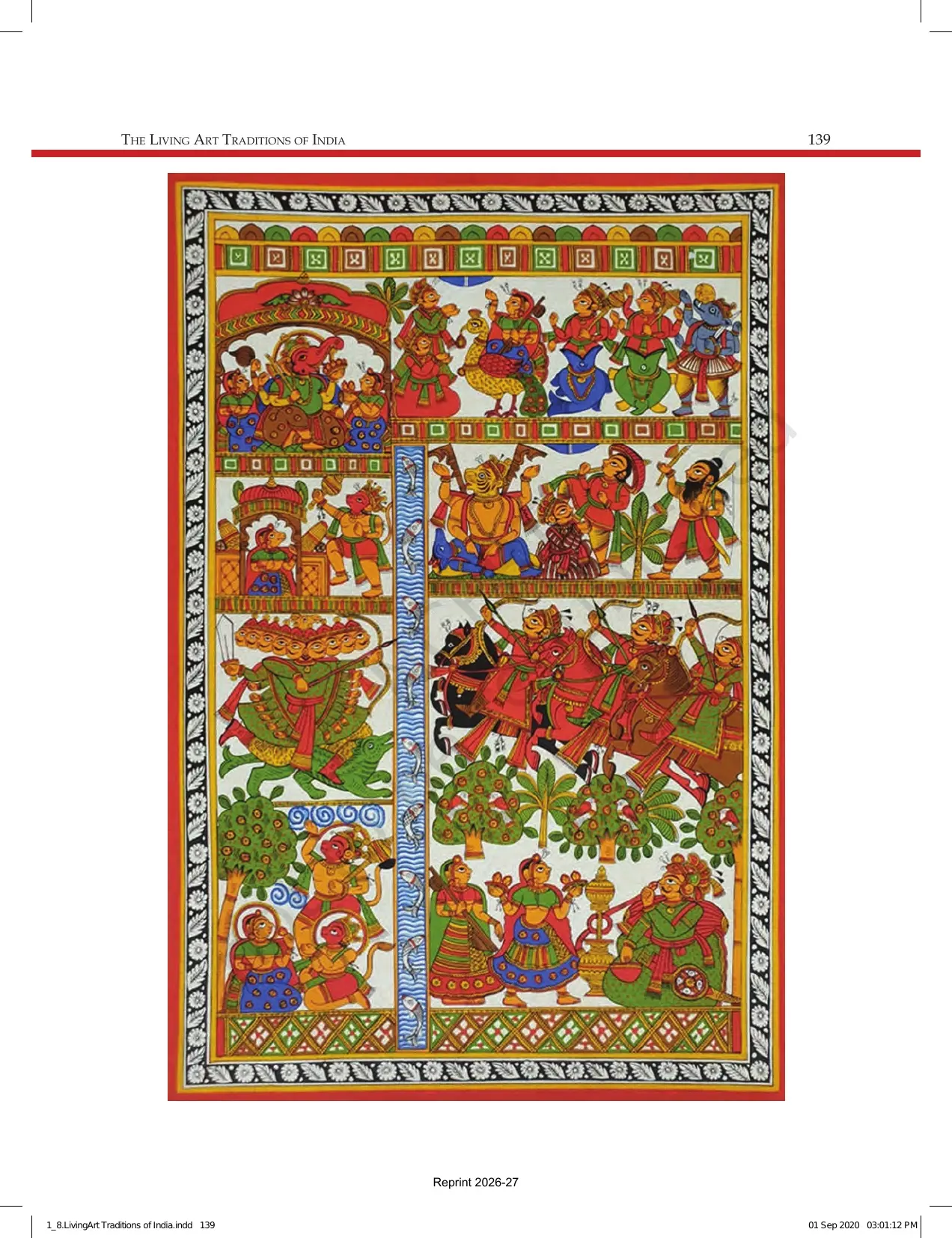
- What a phad is: a long, horizontal cloth scroll painted to honour the folk deities of pastoral communities around Bhilwara in Rajasthan.
- Why these deities exist: for pastoral communities, safeguarding livestock is the first concern, so their myths and worship follow that concern.
- Who a bhomia is: a deified cattle hero, a brave man who died protecting the community's cattle from robbers, honoured for his martyrdom.
- The bhomias named: Gogaji, Jejaji, Dev Narayan, Ramdevji and Pabhuji.
- Their followers: the Rabaris, Gujjars, Meghwals and Regars, among others.
The performance is as important as the painting. The phads are carried by bhopas, itinerant bards who travel the territory, display the scroll and sing the tales of the hero deities in night long storytelling performances. A lamp is held against the phad to light the image being spoken about, and the bhopa and his companion perform to ravanahattha and veena in the Khyal style of singing.
Then comes the turn in the argument. Phads are not painted by the bhopas. They are painted by a caste called the Joshis, who were painters in the courts of the kings of Rajasthan and who specialised in court patronised miniature painting. Because a phad brings together skilled painters, bard musicians and court artists, the book places phads higher than other similar cultural traditions.
Dhokra Casting of Bastar: The Lost Wax Process in Printed Order
This is the single longest process in the Class 12 Fine Arts book and the likeliest five mark question from the sculptural half. The steps are strictly ordered. Learn them as a chain, because one skipped stage breaks the logic of the next.
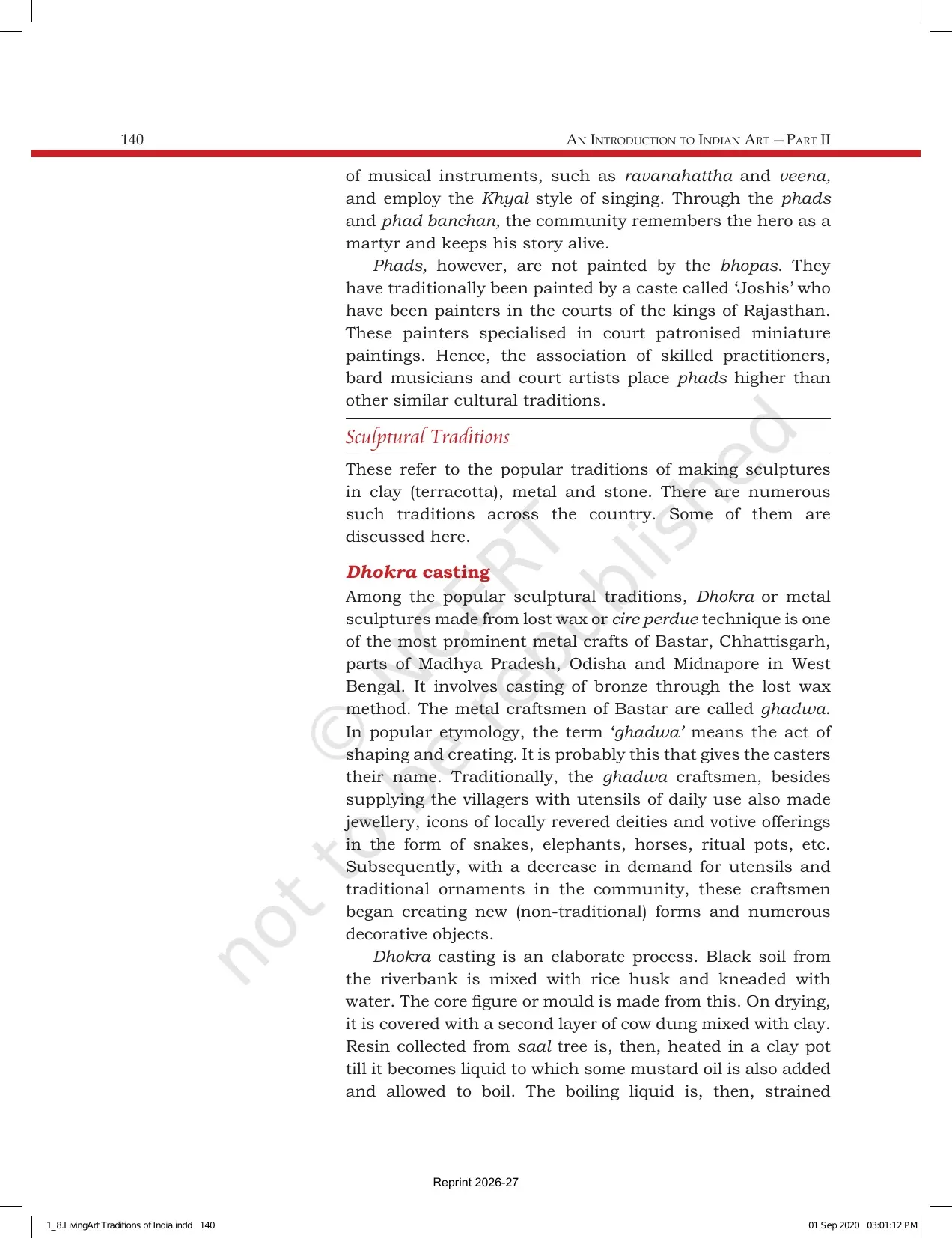
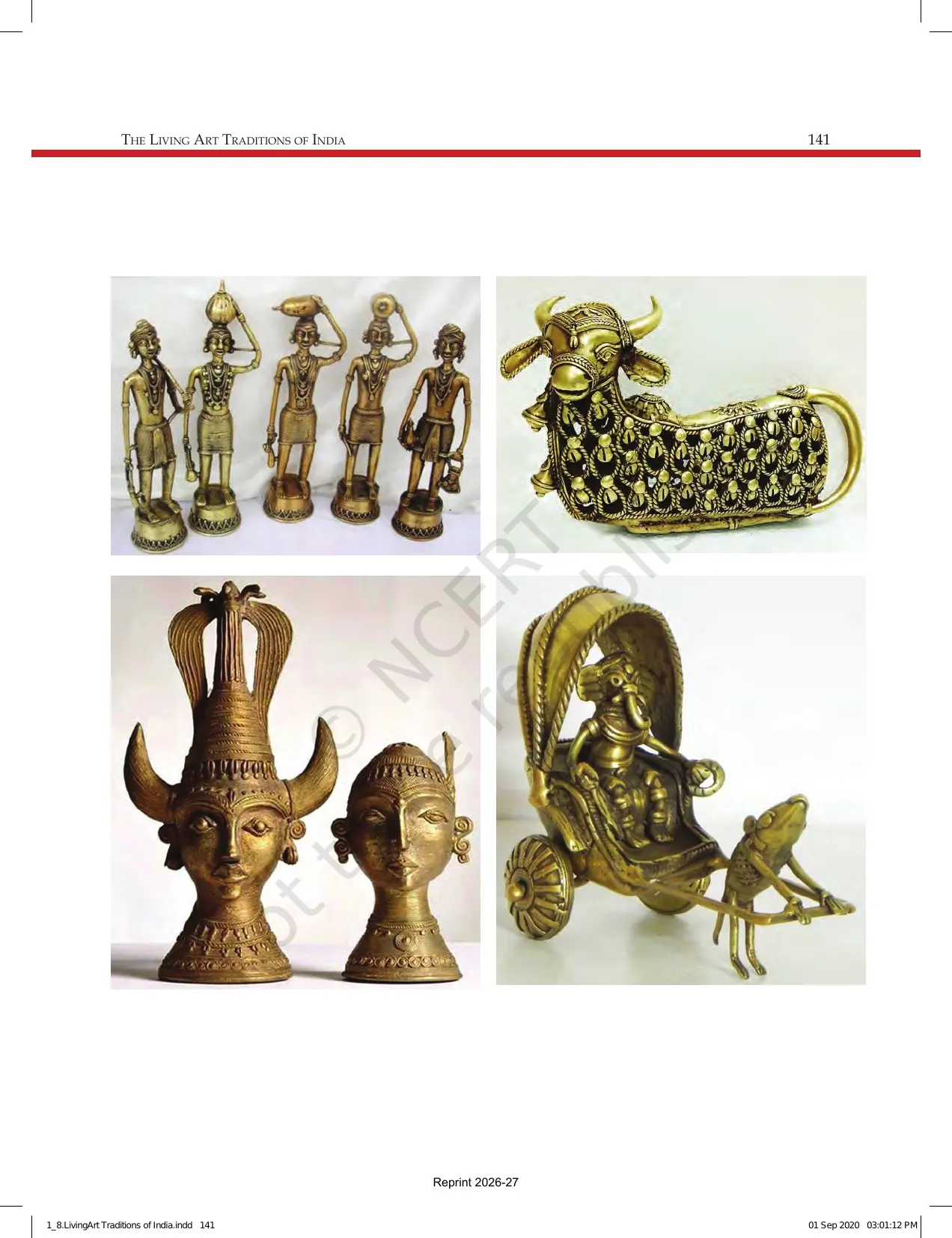
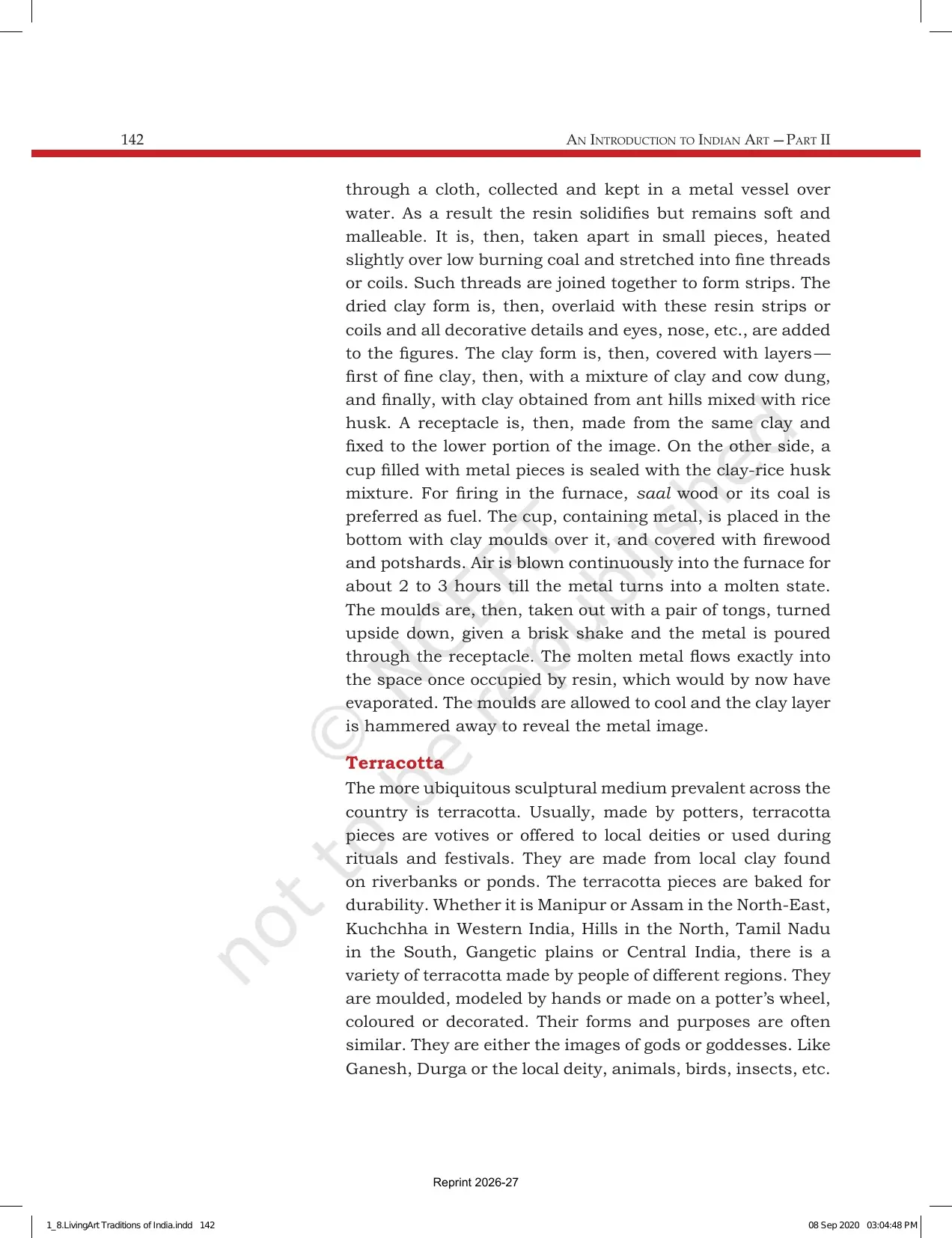
- What it is: metal sculpture made by the lost wax or cire perdue technique, casting bronze.
- Where it is made: Bastar in Chhattisgarh, parts of Madhya Pradesh, Odisha, and Midnapore in West Bengal.
- Who makes it: craftsmen called ghadwa. In popular etymology the word means the act of shaping and creating, which is probably where the casters get their name.
- What they used to make: daily use utensils for villagers, jewellery, icons of locally revered deities, and votive offerings shaped as snakes, elephants, horses and ritual pots.
- What changed: demand for utensils and traditional ornaments fell, so the craftsmen began making new, non traditional forms and decorative objects.
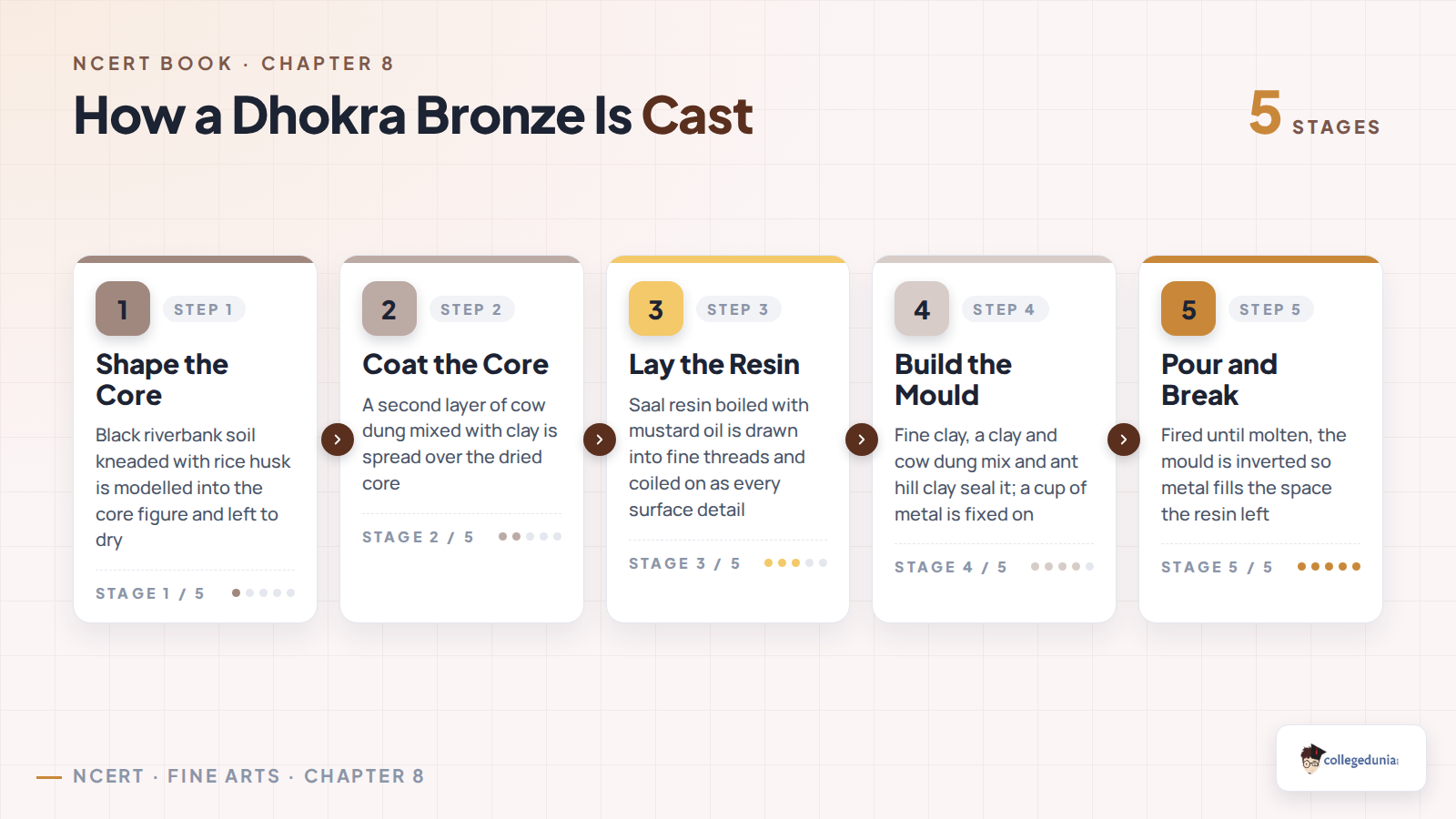
- Make the core. Black soil from the riverbank is mixed with rice husk, kneaded with water, and shaped into the core figure or mould.
- Coat it. On drying it gets a second layer of cow dung mixed with clay.
- Prepare the resin. Resin from the saal tree is heated in a clay pot until liquid, mustard oil is added, and it is boiled.
- Strain and solidify. The boiling liquid is strained through cloth and kept in a metal vessel over water, so the resin solidifies but stays soft and malleable.
- Draw the threads. Small pieces are heated over low burning coal and stretched into fine threads or coils, then joined into strips.
- Lay the detail. The dried clay form is overlaid with those resin coils, and every decorative detail, including eyes and nose, is added at this stage.
- Cover in three layers. First fine clay, then a mixture of clay and cow dung, and finally clay from ant hills mixed with rice husk.
- Fit the receptacle and the metal cup. A receptacle is fixed to the lower portion, and on the other side a cup filled with metal pieces is sealed with the clay and rice husk mixture.
- Fire it. Saal wood or its coal is the preferred fuel. The metal cup goes at the bottom with the clay moulds over it, covered with firewood and potshards, and air is blown in continuously for 2 to 3 hours until the metal is molten.
- Pour and reveal. The moulds are lifted with tongs, turned upside down, given a brisk shake, and the metal is poured through the receptacle. It flows into the space the resin occupied, since the resin has evaporated by then. The moulds cool and the clay is hammered away to reveal the metal image.
The whole method rests on one idea: the resin is the sculpture, and the metal simply takes its place. Say that once in your answer and the ten steps read as a single process instead of a list.
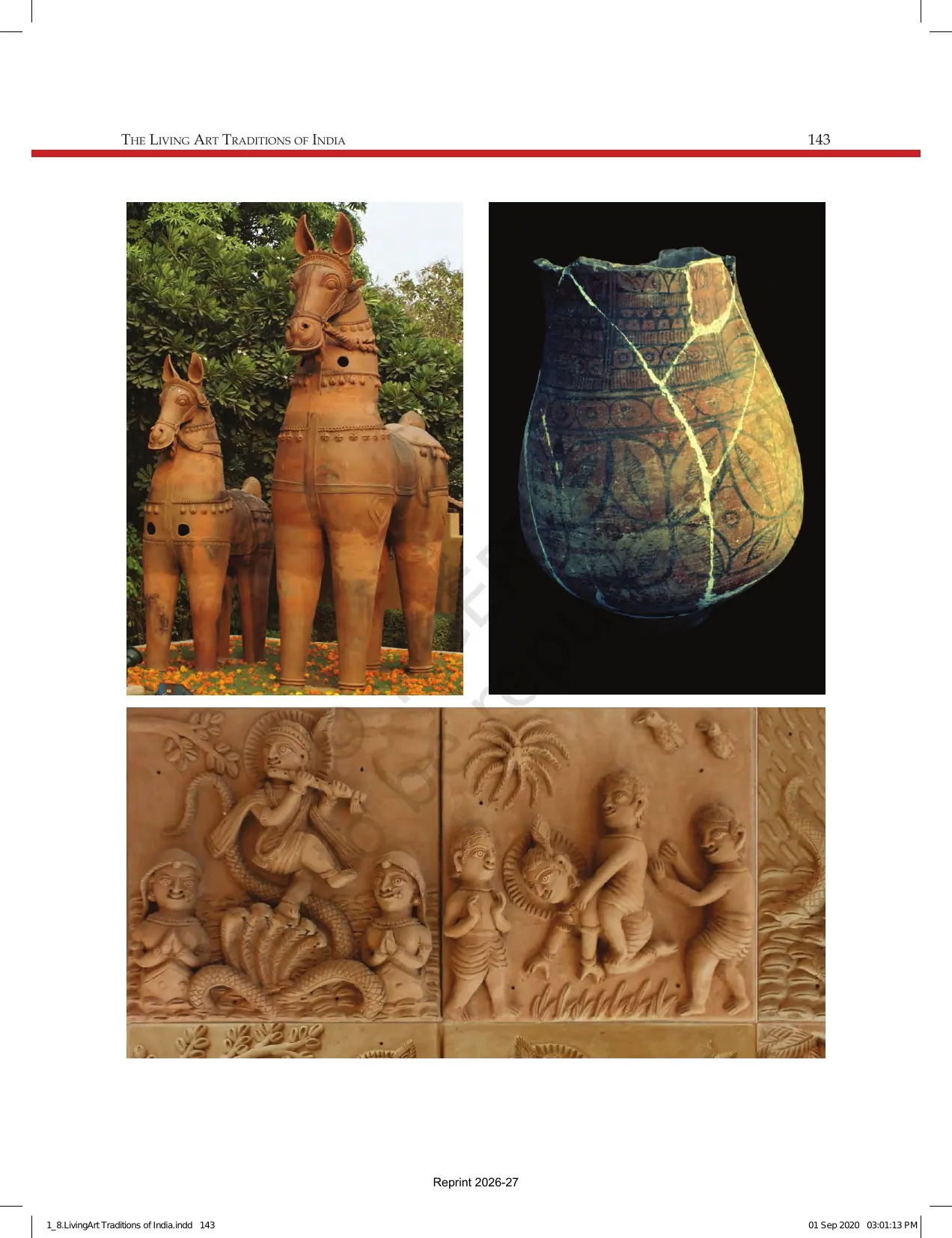
Terracotta: The Most Common Sculptural Medium Across India
The chapter closes with terracotta, described as the more ubiquitous sculptural medium in the country. It is short, it is easy, and it is often the two mark question that students leave half written.
- Who makes it: usually potters.
- Why it is made: as votives, as offerings to local deities, or for use during rituals and festivals.
- The material: local clay found on riverbanks or ponds, and the pieces are baked for durability.
- Where it is found: Manipur and Assam in the north east, Kuchchha in western India, the hills in the north, Tamil Nadu in the south, the Gangetic plains and Central India.
- How it is made: moulded, modelled by hand, or thrown on a potter's wheel, then coloured or decorated.
- What is made: images of gods and goddesses such as Ganesh and Durga, the local deity, and animals, birds and insects.
Note the phrasing the book uses. Forms and purposes across these regions are often similar even though the regions are far apart. That similarity is the point worth stating in an answer, because it links terracotta back to the opening argument about a shared, inherited body of knowledge.
Every Named Tradition, Region and Material You Must Be Able to Quote
Most marks in this chapter are lost by mixing up a region or a material. Learn this grid first and the rest of your revision gets faster.
| Tradition | Community and region | Surface and tool | Key name to quote |
|---|---|---|---|
| Mithila, or Madhubani | Women of Mithila, Bihar | Mud house walls, bamboo twig brush | Kohbar, the lotus in full bloom |
| Warli | Warli community, north Maharashtra, Thane | Rice flour on earth coloured walls, chewed bamboo stick | Palaghat and Panch Sirya Devata |
| Gond | Gonds of Mandla, Madhya Pradesh | Hut walls, geometric votive drawings | Krishna with cows and gopis |
| Pithoro | Rathva Bhils, Panchmahal and Jhabua | House walls, large scale | Rows of horse rider deities |
| Bengal pata | Patuas or chitrakars, Midnapore, Birbhum, Bankura | Cloth scroll, held vertically | The patua performance, three to four stories |
| Puri pata | Puri, Odisha | Cotton cloth, palm leaf, paper | Ansara patti and Jatri patti |
| Phad | Bhilwara, Rajasthan, painted by Joshis | Long horizontal cloth scroll | Bhomia heroes and bhopa bards |
| Dhokra | Ghadwa of Bastar, Chhattisgarh | Bronze, lost wax casting | Saal resin coils and the ant hill clay layer |
| Terracotta | Potters across the country | Local riverbank or pond clay, baked | Votive images of Ganesh and Durga |
Common Mistakes Students Make in the Living Art Traditions Chapter
Watch out for these seven:
- Swapping the Warli and Mithila tools. Warli uses a chewed bamboo stick with rice flour. Mithila uses a bamboo twig with cotton swab, rice straw or fibre.
- Calling Palaghat a corn goddess and stopping there. She represents the corn goddess Kansari and is worshipped as the goddess of fertility.
- Writing that the bhopas paint the phads. They perform with them. The Joshis, court painters of the Rajasthani kings, paint them.
- Describing the Pithoro rows as decoration. They are the cosmography of the Rathvas, gods above the wavy line and the earth below it.
- Saying the Dhokra wax is melted out separately. The book says the resin evaporates during firing and the molten metal flows into the space it leaves.
- Painting palm leaf manuscripts with a brush in your answer. They are incised with a steel stylus and then filled with ink.
- Forgetting the modern subjects in Warli painting. Buses and Mumbai city life appear beside hunting and farming scenes.
Student Feedback on the Living Art Traditions Chapter
What 12,940 students told us about this chapter
- 64% of the students surveyed could not name all five bhomias after a first reading. Gogaji and Jejaji were the two most often dropped.
- Only 29% wrote the Dhokra steps in the printed order. Most merged the resin stage with the clay covering stage.
- Students who made the four column grid of community, region, material and purpose finished revision in about half the time.
- Most skipped line: the note that phads are painted by the Joshis and not by the bhopas, missed by roughly 2 in 5 students.
Source: Collegedunia Class 12 Fine Arts student survey taken before the 2026-27 board exams. Sample of 12,940 students from CBSE schools across 16 states.
How to Revise Living Art Traditions in a Three Block Plan
Seventeen printed pages look heavy, but the chapter is really three blocks of similar size. Keep them separate on the first pass, then join them on the second.
- Block 1, 30 minutes. Read the opening argument and the Mithila and Warli sections. Write, from memory, the three painted areas of the Mithila house, the kohbar, and the four named Warli figures.
- Block 2, 30 minutes. Read Gond, Pithoro and both pata sections. Write the two Pithoro registers, the five Puri themes, and the five Patachitra steps.
- Block 3, 30 minutes. Read the phads, Dhokra and terracotta. Write the five bhomias, the ten Dhokra steps in order, and the terracotta region list.
A week before the paper, repeat only Block 3. The Dhokra chain and the bhomia names fade fastest, and they are the cheapest marks available in the Fine Arts theory paper for both the CBSE Class 12 board exam and the CUET general test.
How the Living Art Traditions Chapter PDF Works with the Rest of the Fine Arts Book
This chapter answers a question the earlier chapters raise but never settle: where did the court painters come from before there were courts. Reading it beside the chapters below turns a list of traditions into an argument you can use in a five mark answer.
| Chapter to pair it with | What the pairing gives you | Link |
|---|---|---|
| The Rajasthani Schools of Painting | The court miniature world the Joshi painters of the phads came from, which is why the book ranks phads above similar traditions | The Rajasthani Schools of Painting Class 12 PDF |
| The Bengal School and Cultural Nationalism | The moment Indian artists began looking at local traditions instead of European models, which is the same turn described in this chapter | The Bengal School and Cultural Nationalism Class 12 PDF |
| Modern Indian Art | The twentieth century artists who treated folk and tribal art as a source of inspiration, exactly as the opening pages here describe | Modern Indian Art Class 12 PDF |
| The Company School | The contrast case, where Indian artists painted for a foreign patron instead of for a ritual or a village occasion | The Company School Class 12 PDF |
Also Check: the CUET general test often frames folk art questions around region and material rather than around style, so revise the grid above before the CUET paper as well.
All 8 Chapters of Class 12 Fine Arts with NCERT Book PDFs
The Class 12 Fine Arts course runs across eight chapters. Every link below opens the official NCERT chapter PDF for the 2026-27 session.
| Chapter | NCERT Book PDF |
|---|---|
| Chapter 1 | The Mughal School of Miniature Painting Class 12 PDF |
| Chapter 2 | The Deccan Schools of Painting Class 12 PDF |
| Chapter 3 | The Rajasthani Schools of Painting Class 12 PDF |
| Chapter 4 | The Pahari Schools of Painting Class 12 PDF |
| Chapter 5 | The Bengal School and Cultural Nationalism Class 12 PDF |
| Chapter 6 | Modern Indian Art Class 12 PDF |
| Chapter 7 | The Company School Class 12 PDF |
| Chapter 8 | Living Art Traditions of India Class 12 PDF, the chapter you are reading |
Living Art Traditions of India Class 12 Fine Arts NCERT Book PDF FAQs
Questions Class 12 Students Ask Most About Living Art Traditions of India
Ques. What are the living art traditions of India?
Ans. They are the art forms practised by people living far from urban life, in forests, deserts, mountains and villages, for ritual, utility and daily need rather than for a court or a city market. The NCERT chapter calls India a repository of indigenous knowledge passed from one generation to another. Scholars have named these forms minor arts, utility art, folk art, tribal art, people's art, ritual art and crafts. The book adds that there is a thin line between the art of the people and crafts, because both involve creativity, instinct, necessity and aesthetics.
Ques. Which painting traditions are named in Class 12 Fine Arts Chapter 8?
Ans. Eight are named: Mithila or Madhubani painting of Bihar, Warli painting of Maharashtra, Pithoro painting of north Gujarat and western Madhya Pradesh, Pabuji ki Phad from Rajasthan, Pichhwai of Nathdwara in Rajasthan, Gond and Sawara paintings of Madhya Pradesh, and Pata Chitra of Odisha and Bengal. Of these, six are then explained in detail: Mithila, Warli, Gond, Pithoro, Pata and the Phads of Rajasthan. A naming question usually wants the full list with the correct region beside each one, so learn the pairs rather than the names alone.
Ques. Why is Mithila painting also called Madhubani painting?
Ans. The tradition takes its first name from Mithila, the ancient Videha and the birthplace of Sita. It is also called Madhubani painting after the nearest district capital. People of the area trace the origin of the art to the time when Princess Sita was married to Lord Rama. For centuries women of the region have painted figures and designs on the walls of their mud houses for ceremonial occasions, especially weddings. Both names refer to the same tradition, so either is acceptable in an answer as long as you explain where the name comes from.
Ques. What is the kohbar ghar in Mithila painting?
Ans. The kohbar ghar is the inner room of the house, and it carries the most extraordinary and colourful painting of all. On its freshly plastered walls the artists paint the kohbar itself, a lotus with a stalk in full bloom that carries metaphoric and tantric meaning, along with images of gods and goddesses. It is one of the areas the paper asks about directly. The other painted areas are the central or outer courtyard, the eastern part of the house where the Kuladevi Kali dwells, and a room in the southern part that houses the most significant images.
Ques. Who is Palaghat in Warli painting?
Ans. Palaghat is the mother goddess who dominates the Chowk, the most important Warli painting, made by married women to mark special occasions. She is chiefly worshipped as the goddess of fertility and represents the corn goddess Kansari. She is enclosed in a small square frame edged with pointed chevrons that stand for Hariyali Deva, the god of plants. Her escort and guardian is a headless warrior riding a horse or standing beside her, with five shoots of corn springing from his neck, which is why he is called Panch Sirya Devata and also Khetrapal, guardian of the fields.
Ques. What materials do Warli artists use?
Ans. Warli paintings are traditionally made with rice flour on the earth coloured walls of the home, and the brush is a bamboo stick chewed at the end. The Warli community lives on the west coast of northern Maharashtra around the north Sahyadri range, with a large concentration in the district of Thane. The paintings are made to promote fertility, avert diseases, propitiate the dead and fulfil the demands of spirits. Around the central Palaghat motif you will find hunting, fishing, farming and dancing scenes, the tiger, and even buses and the busy urban life of Mumbai.
Ques. What does Pithoro painting represent?
Ans. Pithoro paintings are large wall paintings made by the Rathva Bhils of the Panchmahal region in Gujarat and Jhabua in Madhya Pradesh, done to mark special or thanksgiving occasions. They show rows of magnificently coloured deities depicted as horse riders, and those rows are the cosmography of the Rathvas. The uppermost section with the riders represents the world of gods, heavenly bodies and mythical creatures. An ornate wavy line separates it from the lower region, which represents the earth and shows the wedding procession of Pithoro with minor deities, kings, the goddess of destiny, an archetypal farmer and domestic animals.
Ques. Who are the patuas of Bengal?
Ans. Patuas, also called chitrakars, are the performers who use the vertically painted pata as a prop. They belong to communities largely settled around Midnapore, Birbhum and Bankura in West Bengal, and in parts of Bihar and Jharkhand. Handling the pata is their hereditary profession. They travel from village to village, display the paintings in a common village space and sing the narratives painted on the scroll, telling three to four stories each time. After the performance the patua is given alms or a gift in cash or kind. The tradition keeps taking on new themes and responds to major world events.
Ques. How is a Patachitra made?
Ans. Patachitras are done on small strips of cotton cloth coated with soft white stone powder and glue made from tamarind seeds. The borders are made first. The figures are then sketched directly with a brush and flat colours are applied, usually white, black, yellow and red. After completion the painting is held over a charcoal fire and lacquer is applied, which makes it water resistant and gives it sheen. The colours are organic and locally procured. Black comes from lamp black, yellow and red from haritali and hingal stone, and white from powdered conch shells.
Ques. What are the Phads of Rajasthan?
Ans. Phads are long, horizontal cloth scrolls painted to honour the folk deities of pastoral communities around Bhilwara in Rajasthan. Those deities are deified cattle heroes, brave men who died protecting the community's cattle from robbers, known by the broad term bhomia. The bhomias named in the book are Gogaji, Jejaji, Dev Narayan, Ramdevji and Pabhuji, and they have a wide following among the Rabaris, Gujjars, Meghwals and Regars. The phads are carried by bhopas, itinerant bards who display them in night long performances, holding a lamp against the scroll and singing in the Khyal style to ravanahattha and veena.
Ques. Who paints the phads if the bhopas only perform with them?
Ans. The phads are painted by a caste called the Joshis, who were painters in the courts of the kings of Rajasthan and who specialised in court patronised miniature painting. The bhopas carry and perform with the scrolls but do not paint them. This is the detail most students miss. Because a phad brings together skilled painters, bard musicians and court artists in one tradition, the book places phads higher than other similar cultural traditions. Say that in your answer and the whole section reads as an argument rather than a description.
Ques. What is Dhokra casting and who makes it?
Ans. Dhokra is metal sculpture made by the lost wax or cire perdue technique, casting bronze. It is one of the most prominent metal crafts of Bastar in Chhattisgarh, parts of Madhya Pradesh, Odisha and Midnapore in West Bengal. The metal craftsmen of Bastar are called ghadwa, a word that in popular etymology means the act of shaping and creating. Traditionally they supplied villagers with daily use utensils and also made jewellery, icons of locally revered deities and votive offerings shaped as snakes, elephants, horses and ritual pots. As demand for utensils fell they began making decorative objects instead.
Ques. What is terracotta according to the NCERT chapter?
Ans. Terracotta is the more ubiquitous sculptural medium across the country, usually made by potters from local clay found on riverbanks or ponds, and baked for durability. The pieces are votives, offerings to local deities, or objects used during rituals and festivals. They are made in Manipur and Assam in the north east, Kuchchha in western India, the hills in the north, Tamil Nadu in the south, the Gangetic plains and Central India. They are moulded, modelled by hand or made on a potter's wheel, and they usually show gods and goddesses like Ganesh and Durga, the local deity, animals, birds and insects.
Ques. How do I download the Living Art Traditions NCERT Book PDF?
Ans. Use the PDF viewer at the top of this page. It carries the official NCERT chapter as issued in the Reprint 2026-27 print run, printed pages 127 to 143, with every plate and caption in place. You can read it online or save it for offline revision before the CBSE Class 12 board exam and the CUET general test. No sign up is needed. Pair it with the grid of traditions, regions and materials given above if you want the whole chapter compressed into a single revision sheet.



Comments