



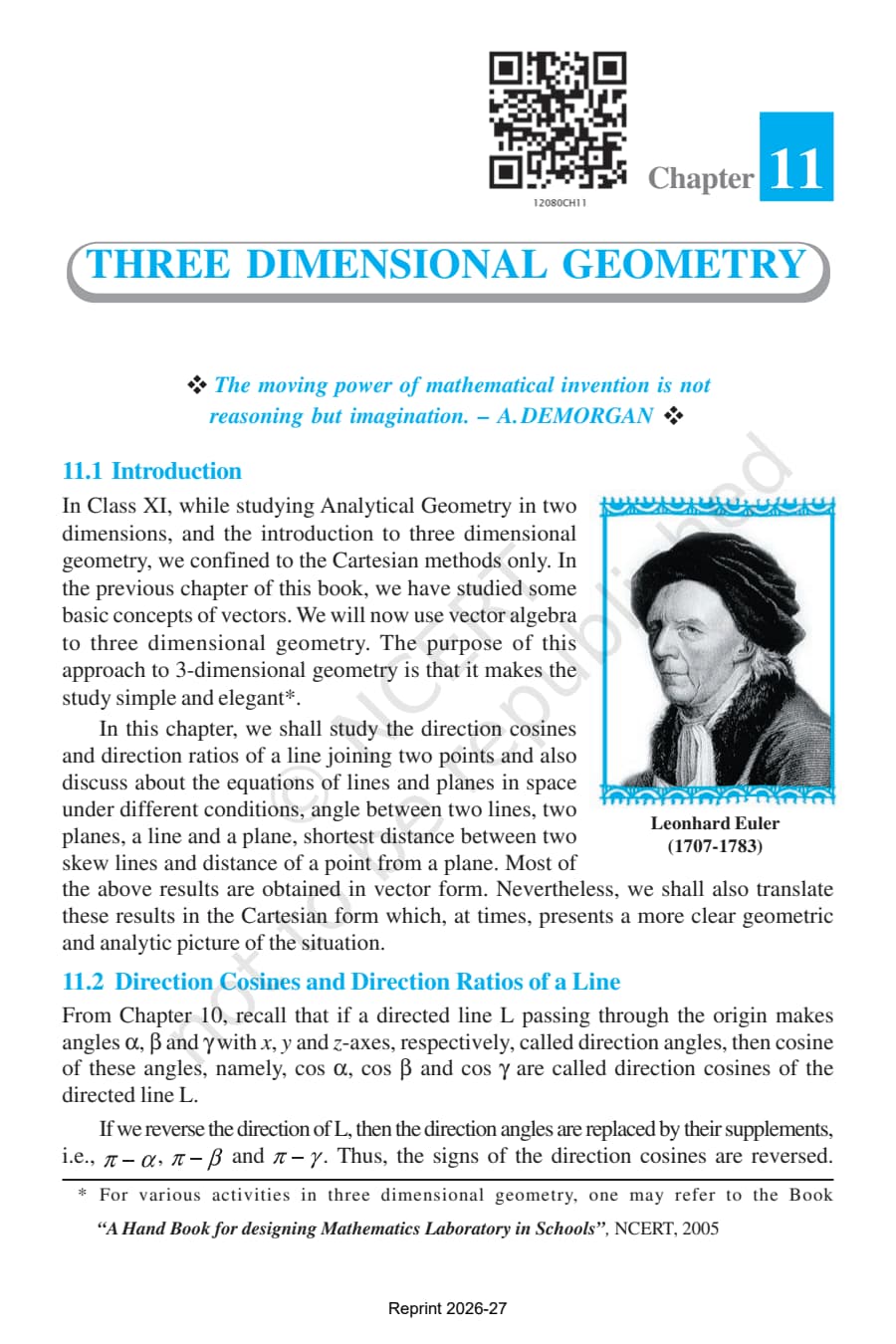
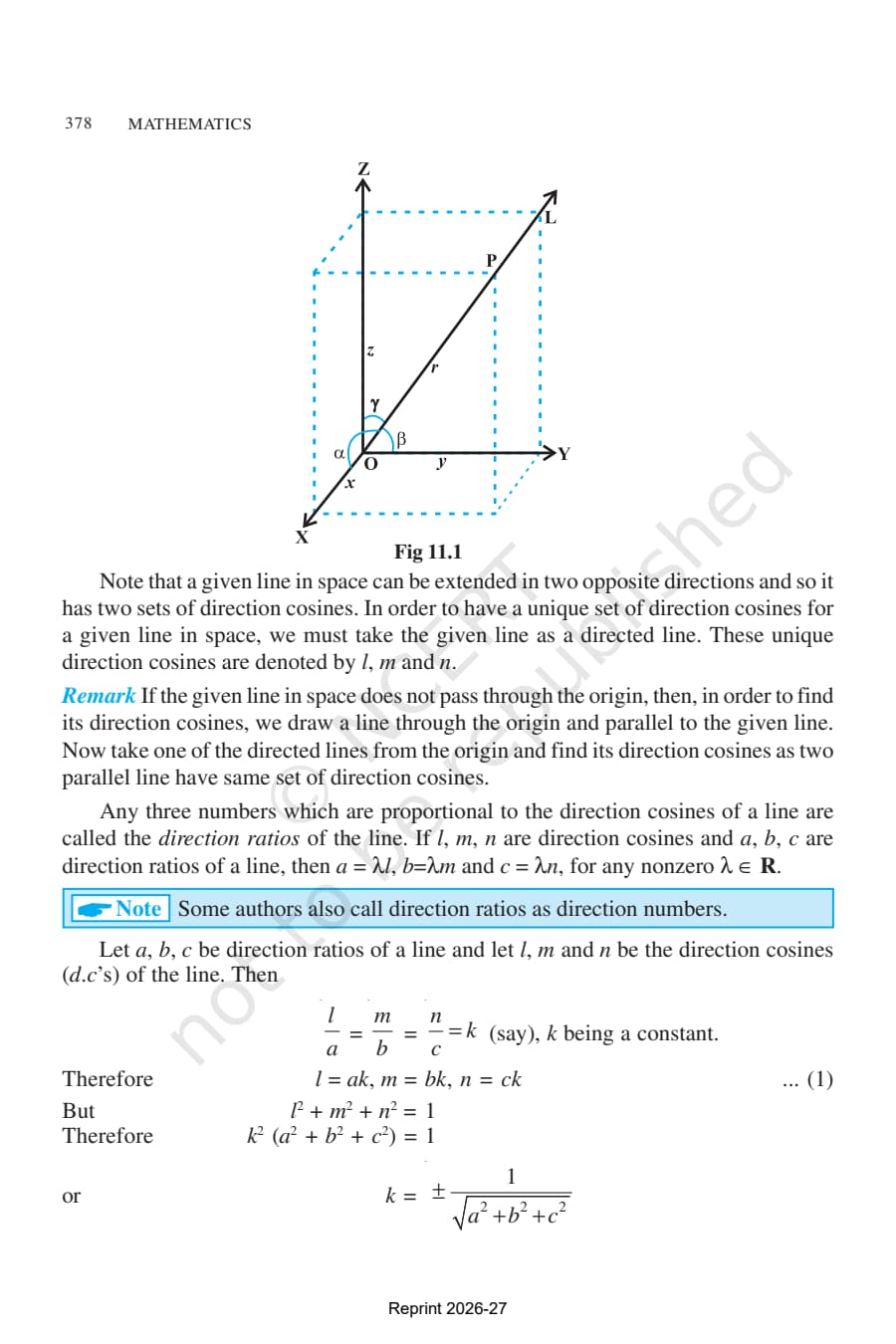
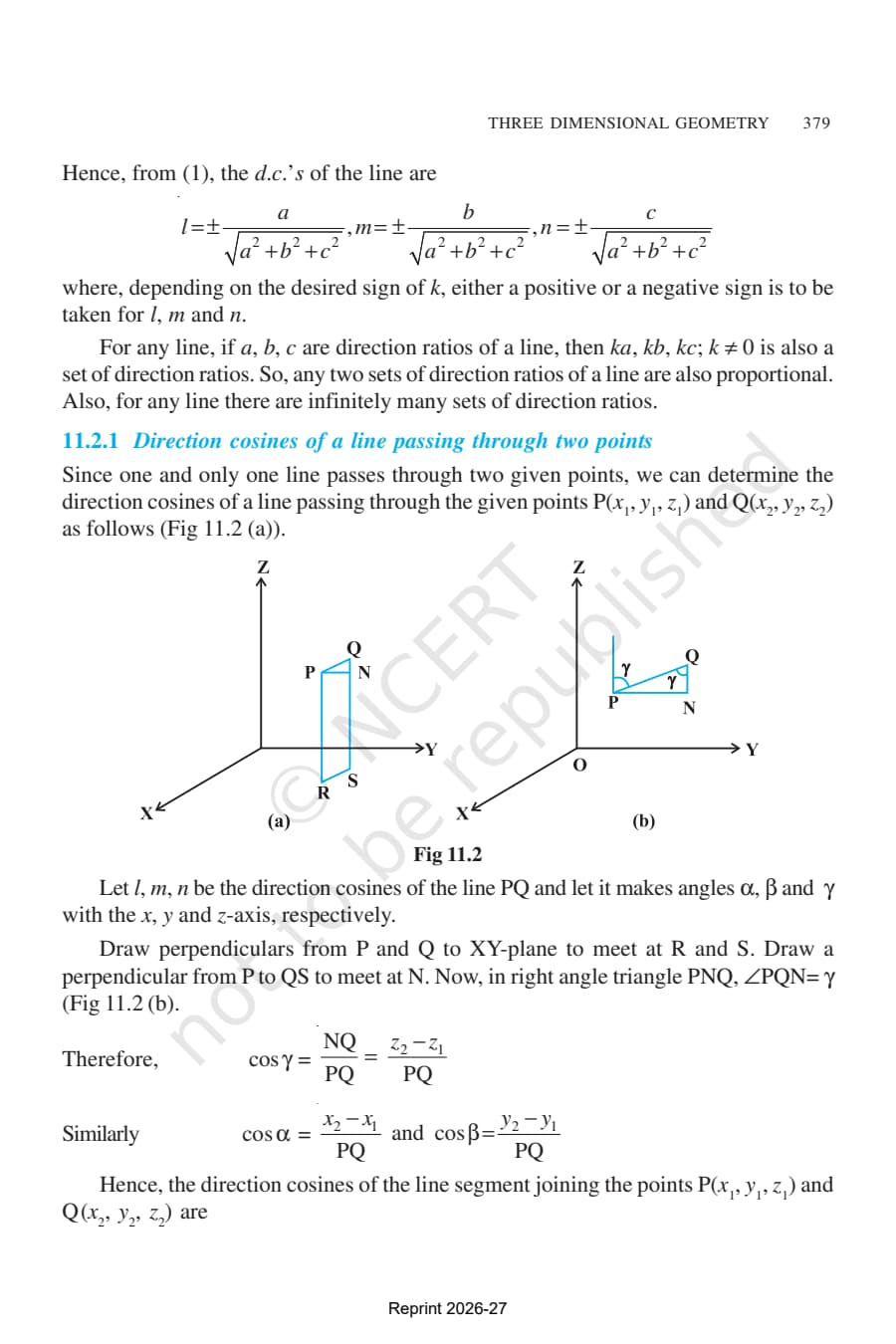
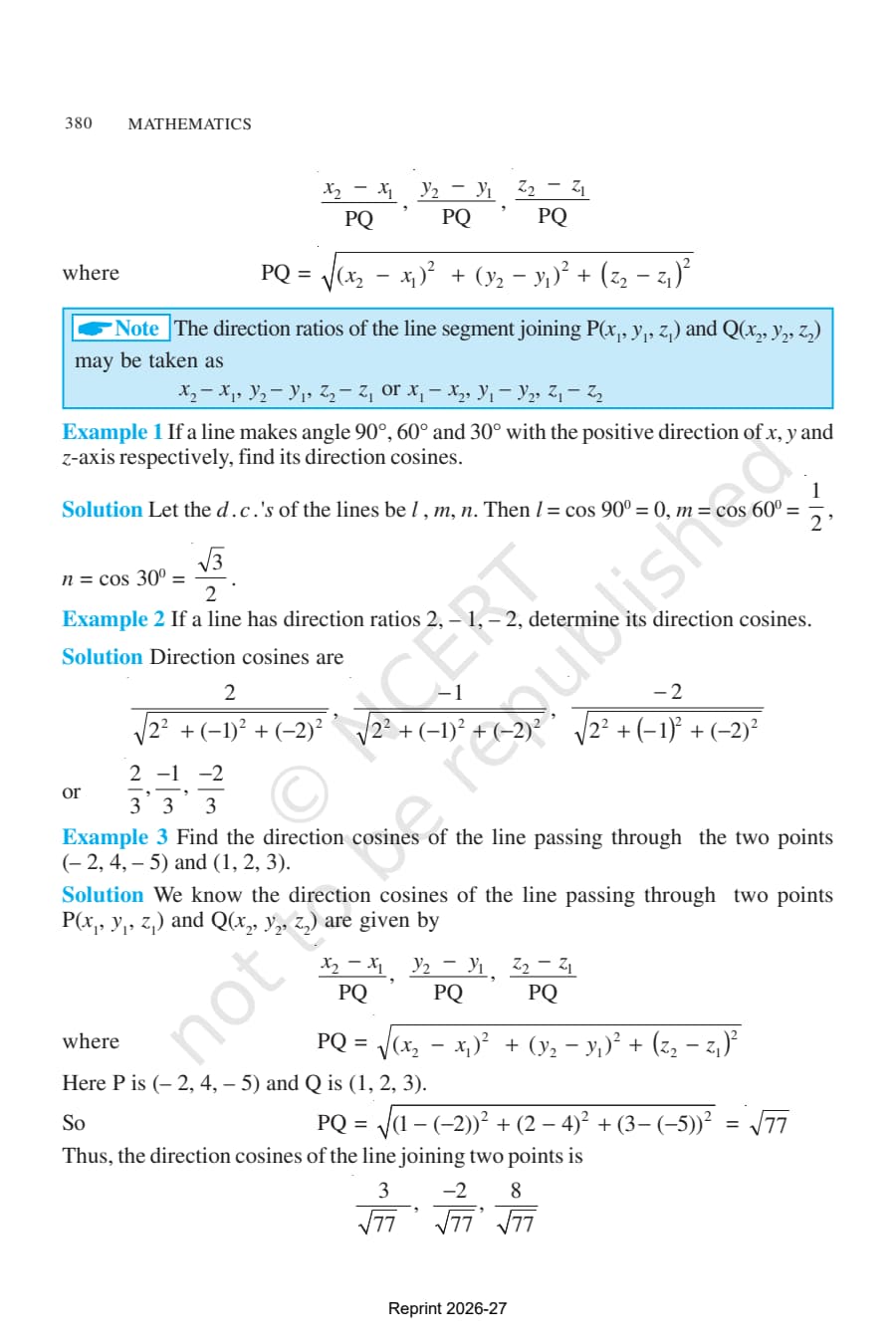
Download the Three Dimensional Geometry Class 12 PDF below. the Three Dimensional Geometry Class 12 PDF is the official NCERT textbook for Class 12 Mathematics Chapter 11 Three Dimensional Geometry and reproduces every section, every solved example and every end-of-chapter exercise as it appears in the 2026-27 print. The textbook chapter preserve NCERT page numbering.
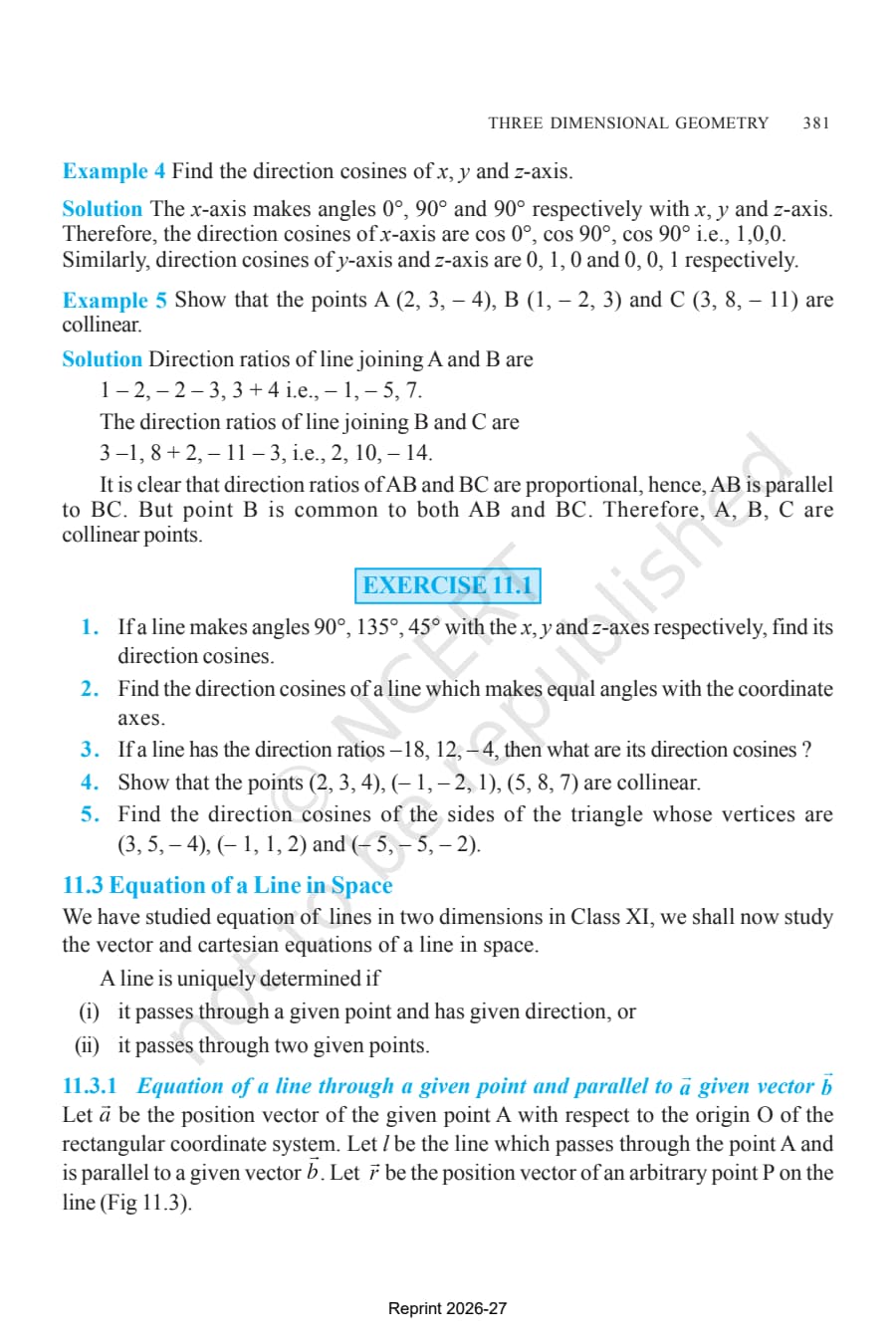
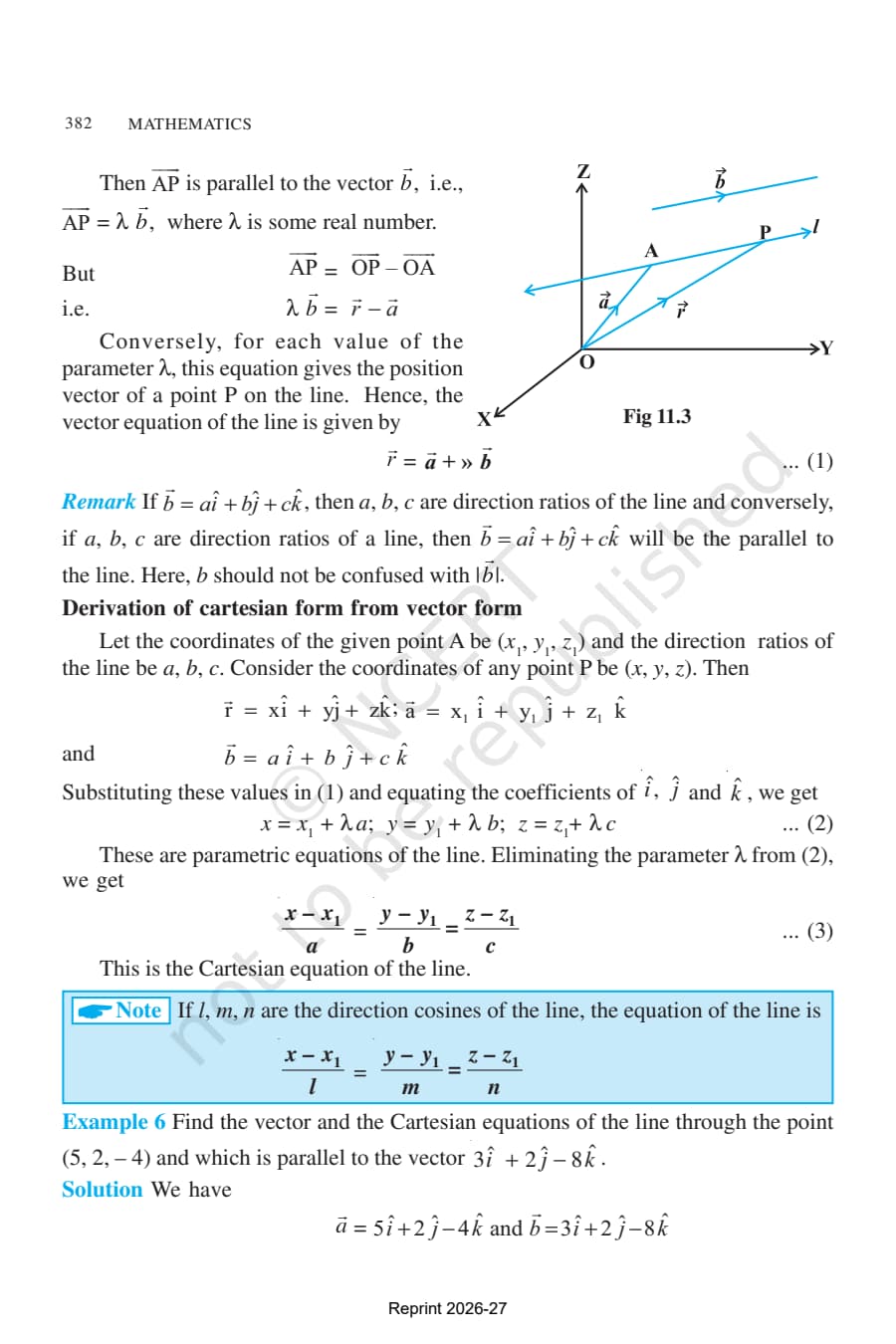
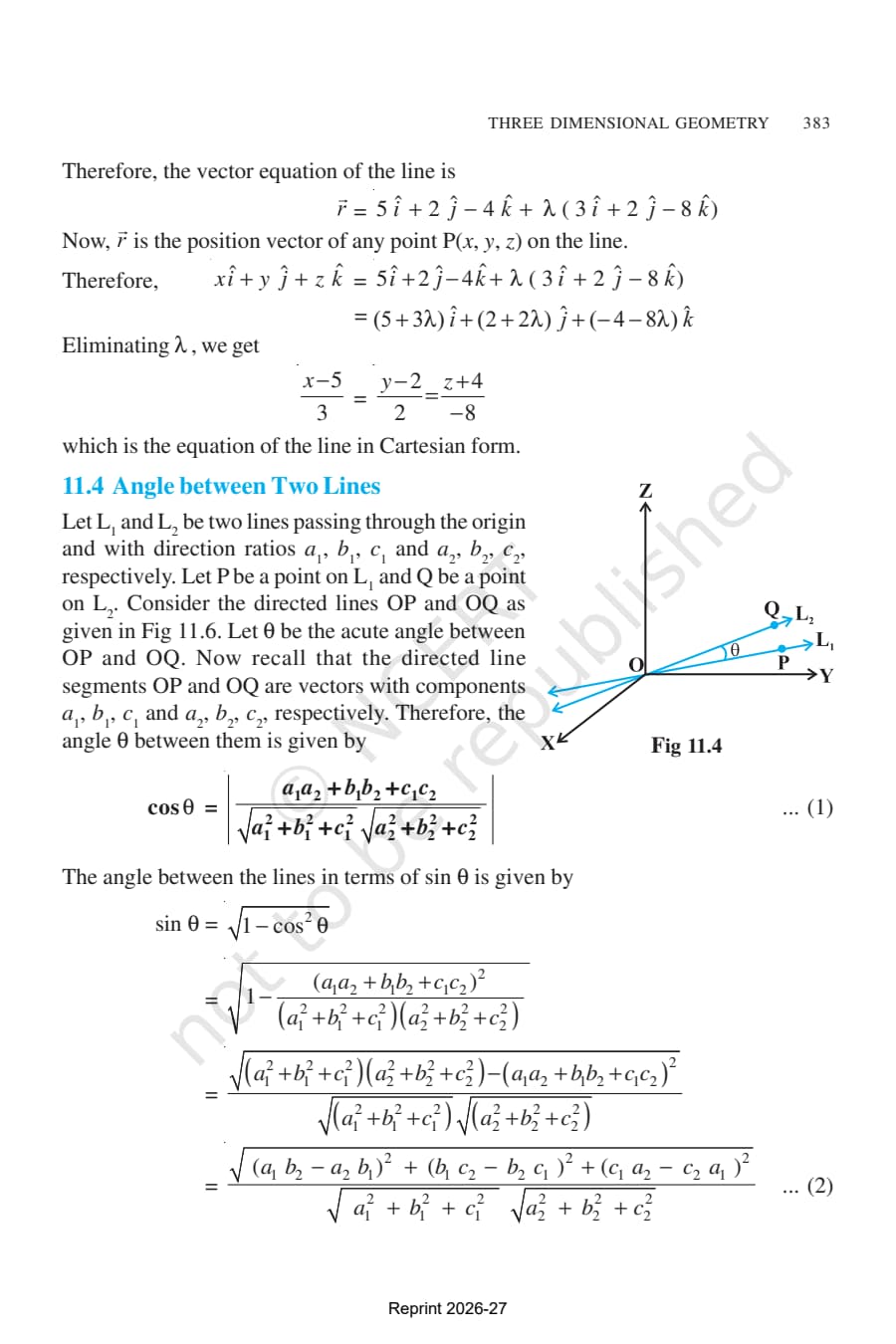
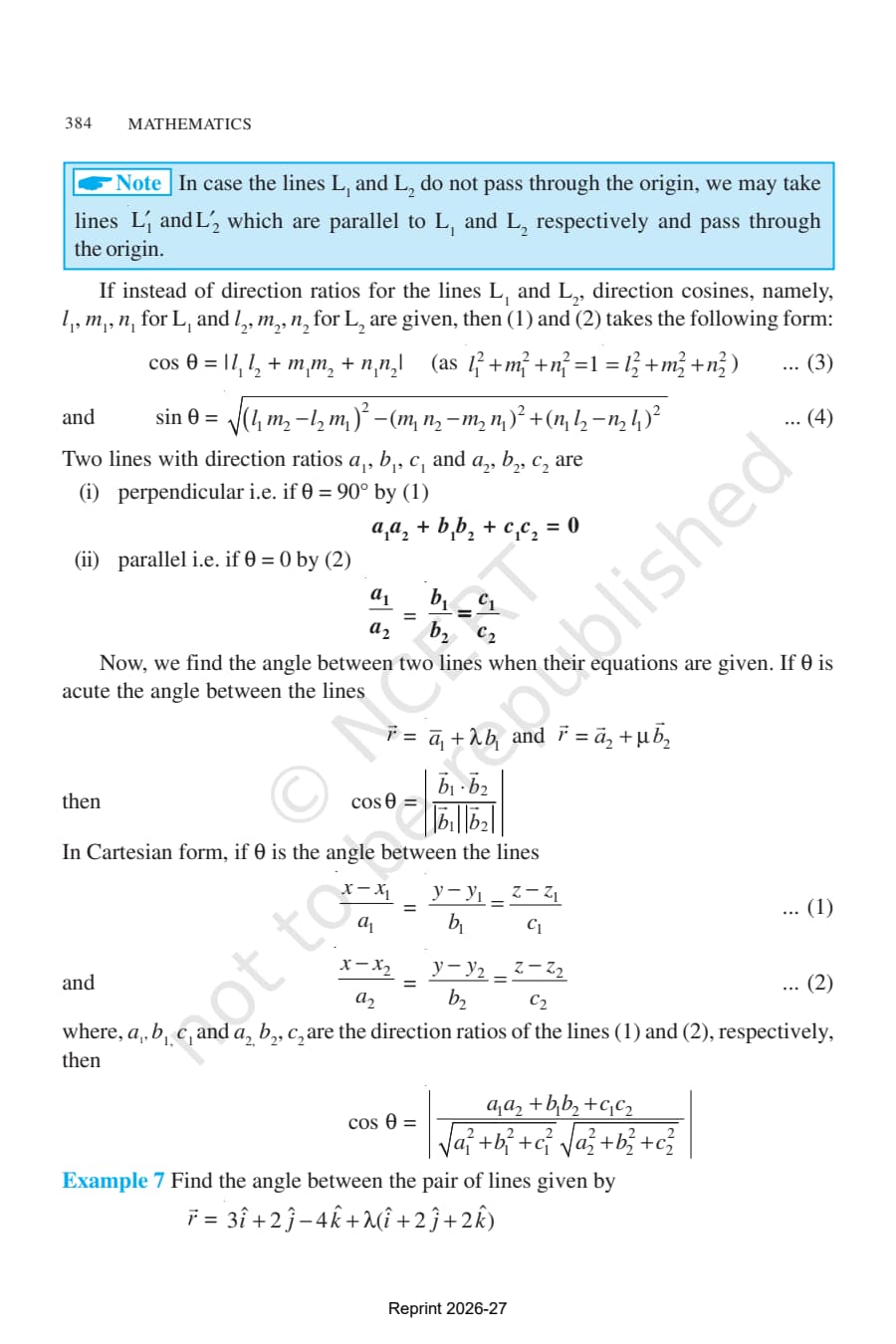
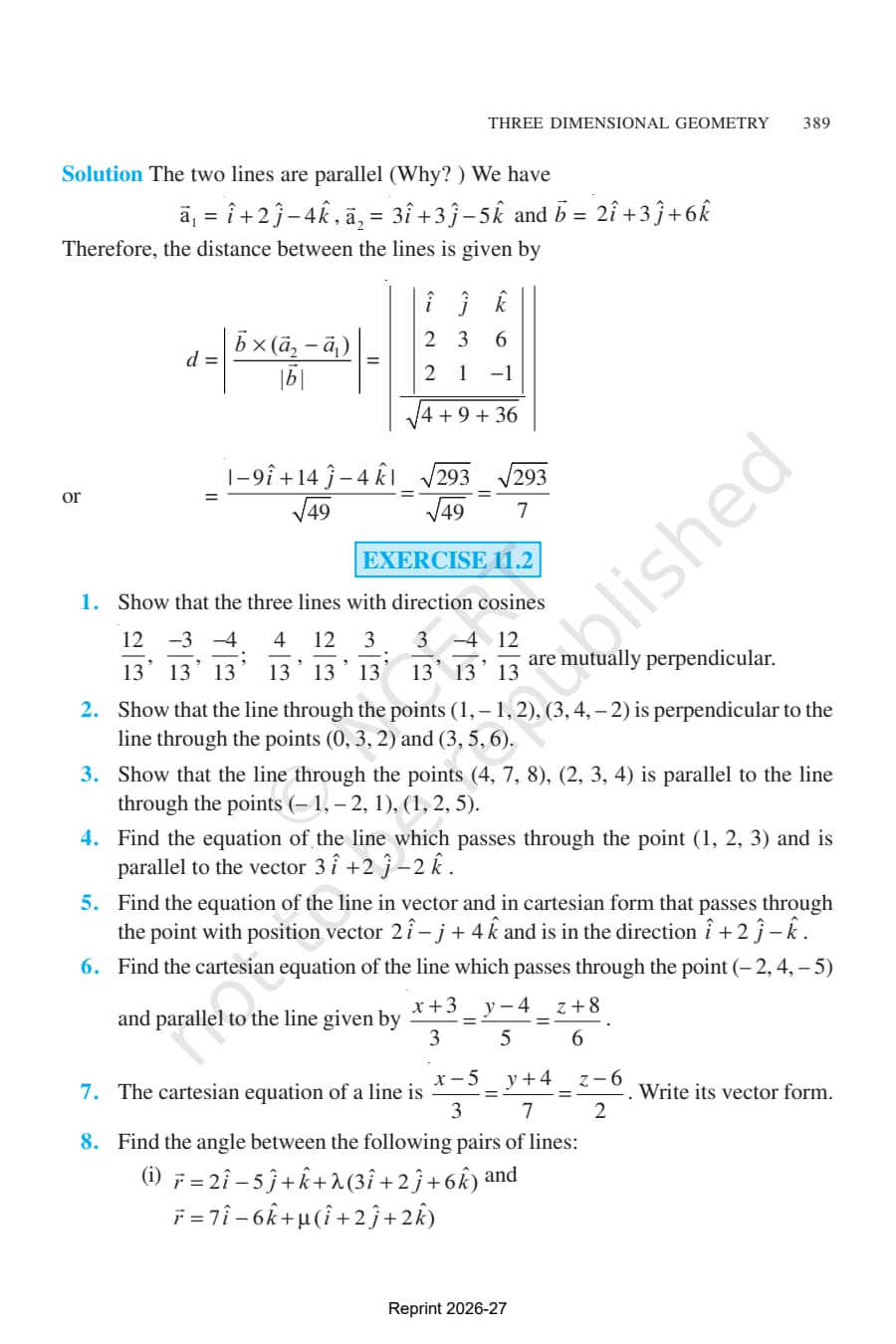
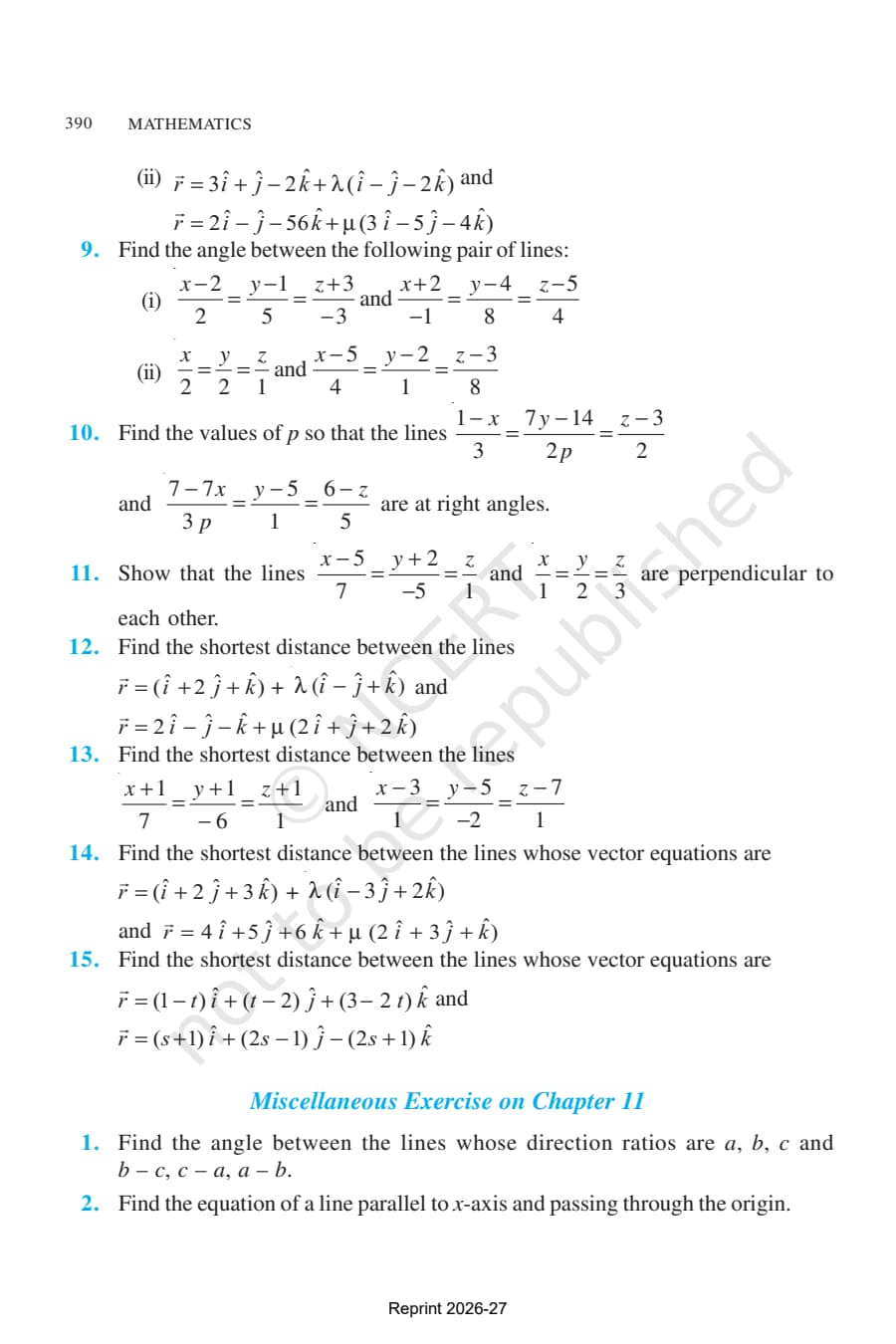
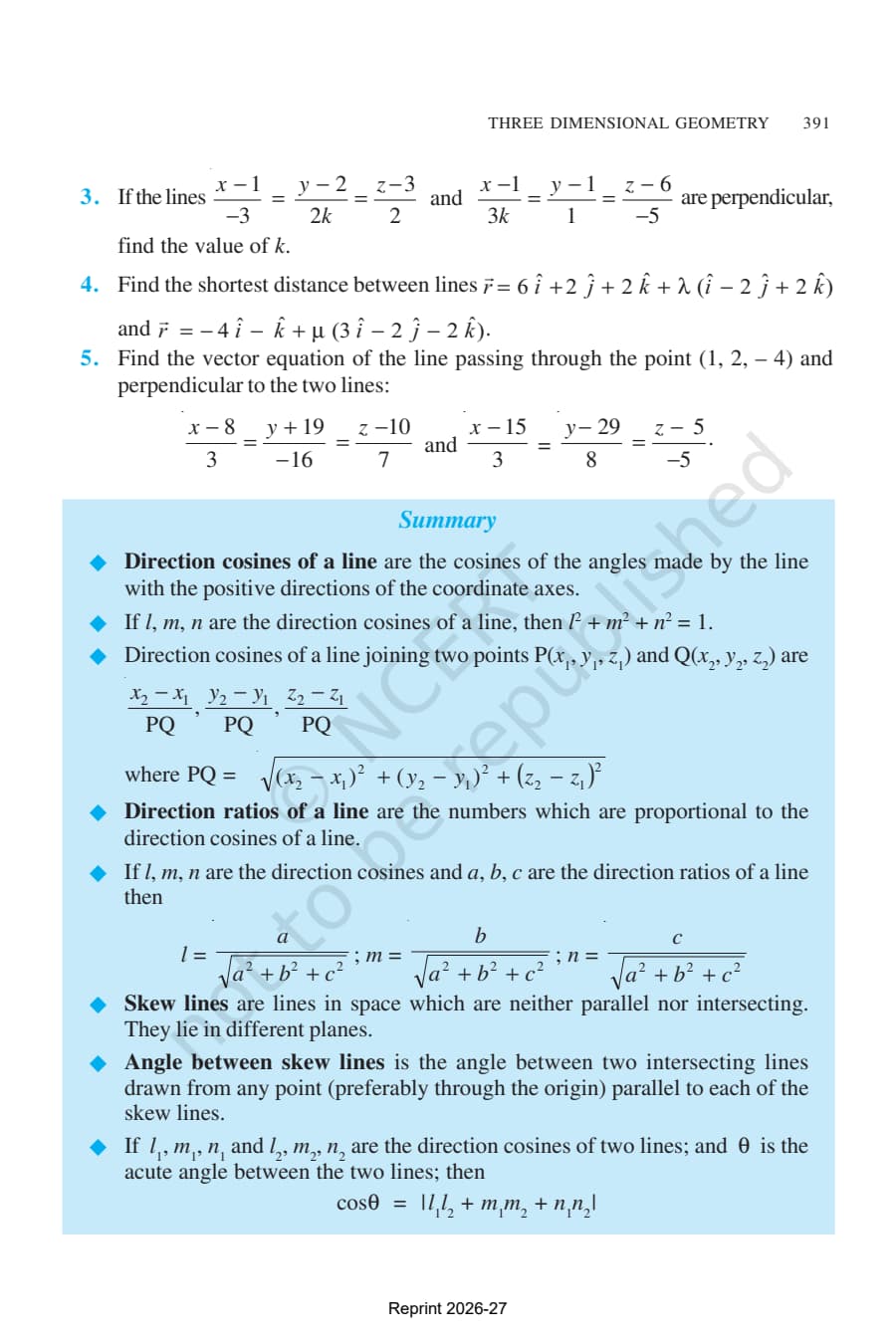
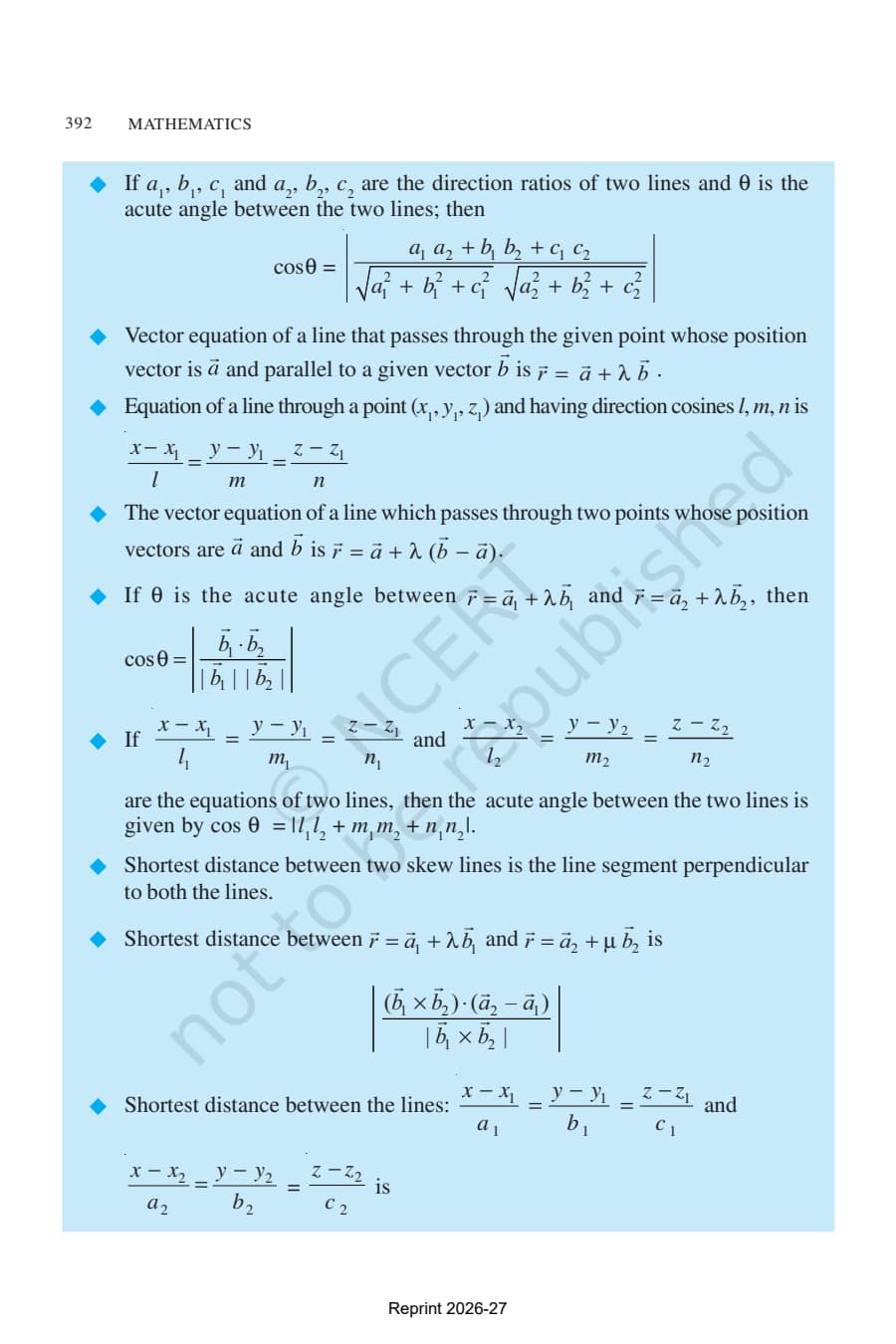
- CBSE Weightage: 5-7 marks per Class 12 board paper
Section count: 3 numbered sections + Miscellaneous Exercise, totalling 34 textbook questions across Ex 11.1 (5 Q), Ex 11.2 (17 Q), and the Miscellaneous block (12 Q), plus 10 solved examples interleaved with the theory.
Sourced from ncert.nic.in, verified against the current 2026-27 CBSE syllabus document, and cross-checked with the last five sessions of CBSE and JEE Main papers.
Also Check:
- Three Dimensional Geometry Class 12 Maths NCERT Solutions
- Three Dimensional Geometry Class 12 Maths Notes
Three Dimensional Geometry Class 12 PDF: Section-by-Section Map
The Three Dimensional Geometry Class 12 PDF address this in the same order as the NCERT textbook.
Chapter 11 is partitioned into three numbered sections plus a Miscellaneous Exercise. The 10 solved examples are interleaved with the theory, not bunched at the end. The table below is a reading map keyed to page boundaries in the 2026-27 print.
| Section | Topic | Pages | Solved examples |
|---|---|---|---|
| 11.1 | Introduction | 1 | - |
| 11.2 | Direction Cosines and Direction Ratios of a Line | 4 | Ex 1, Ex 2 |
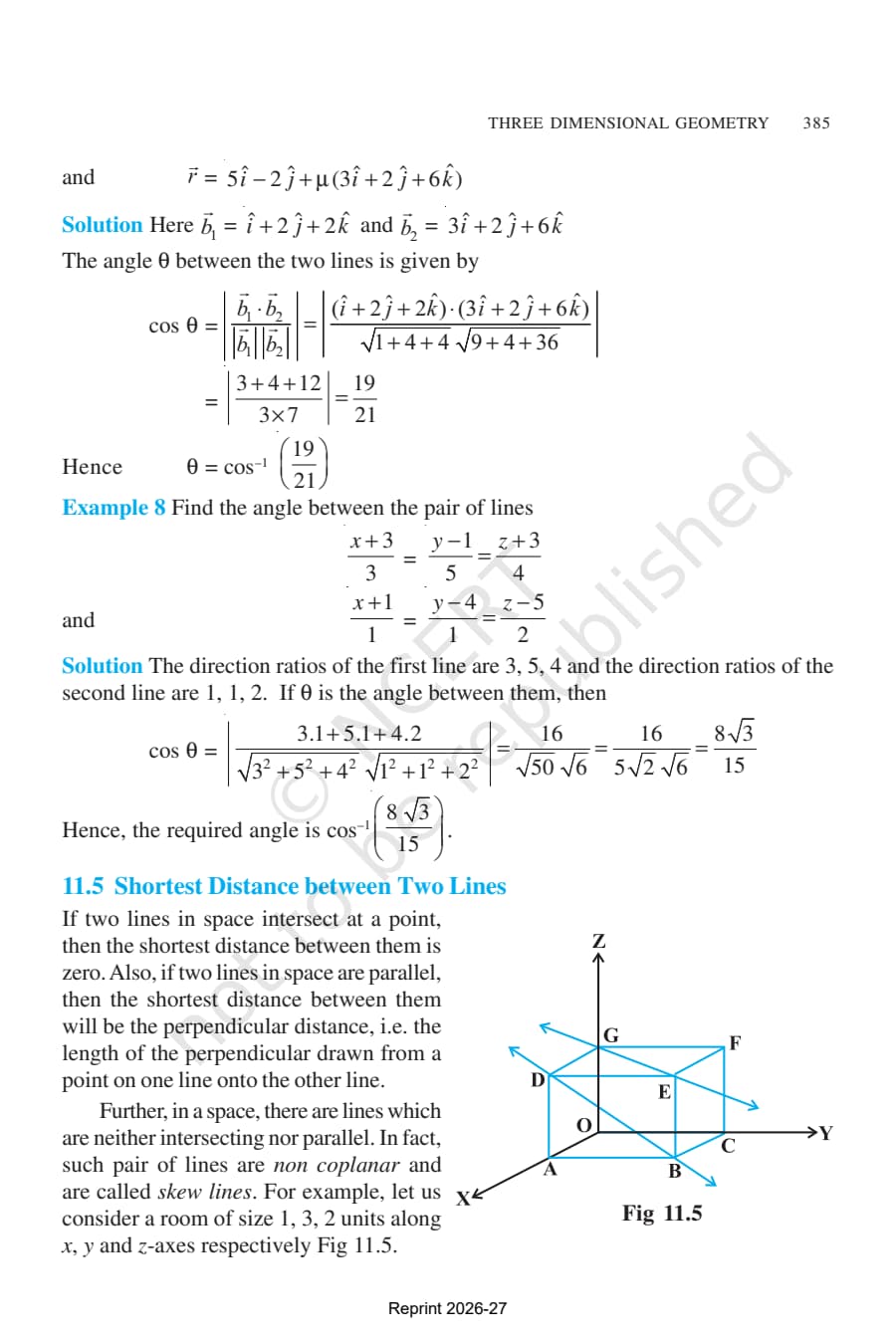
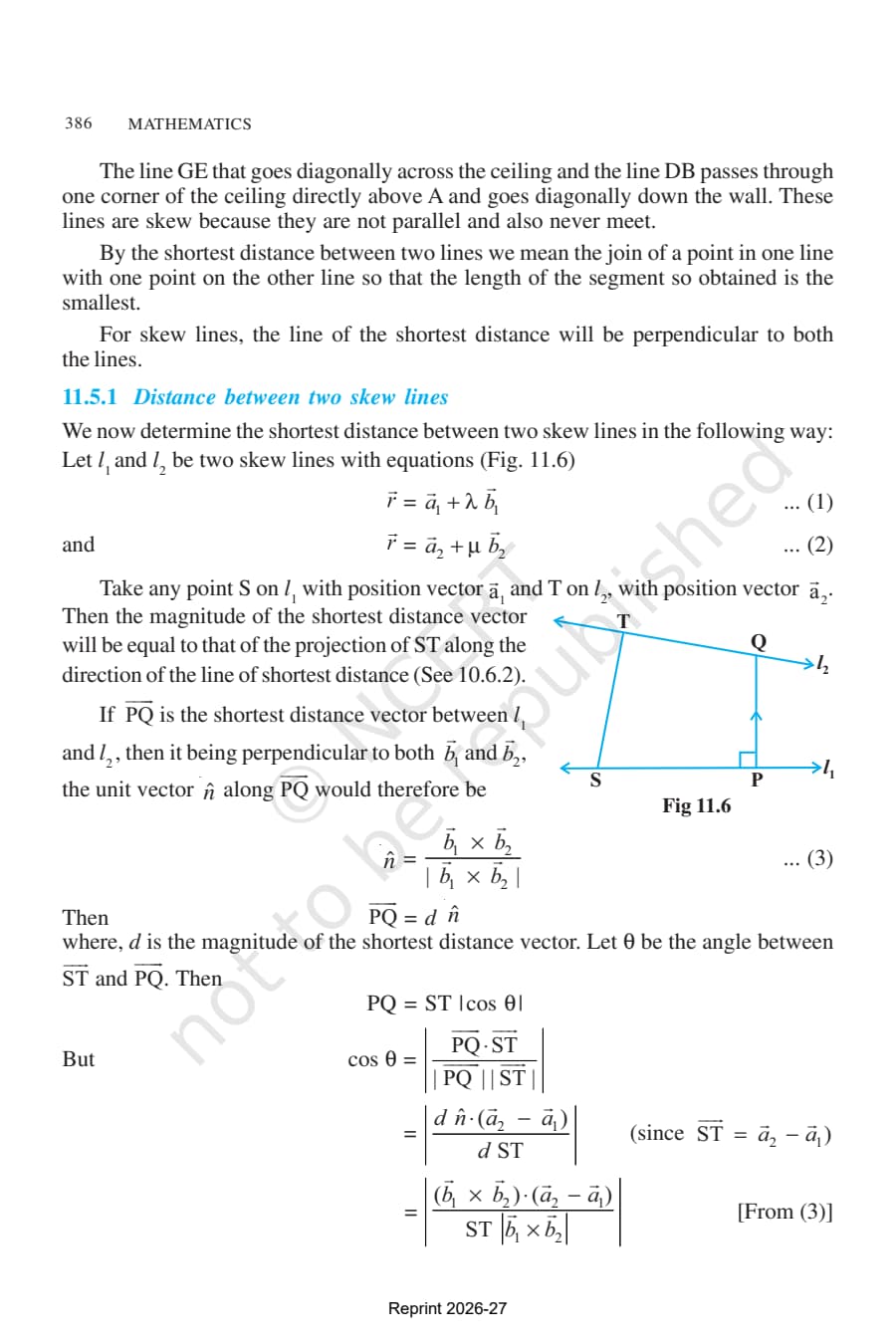
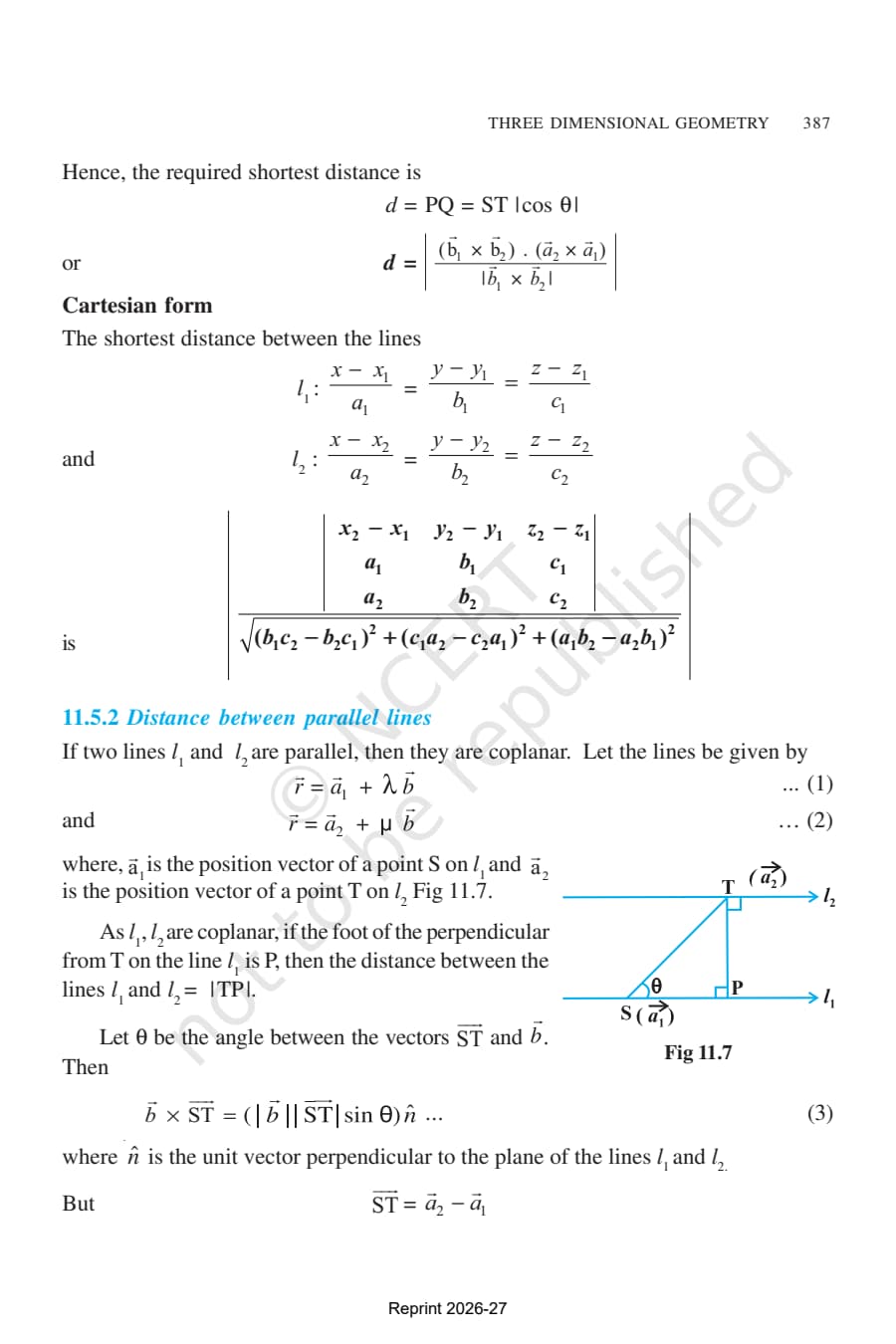
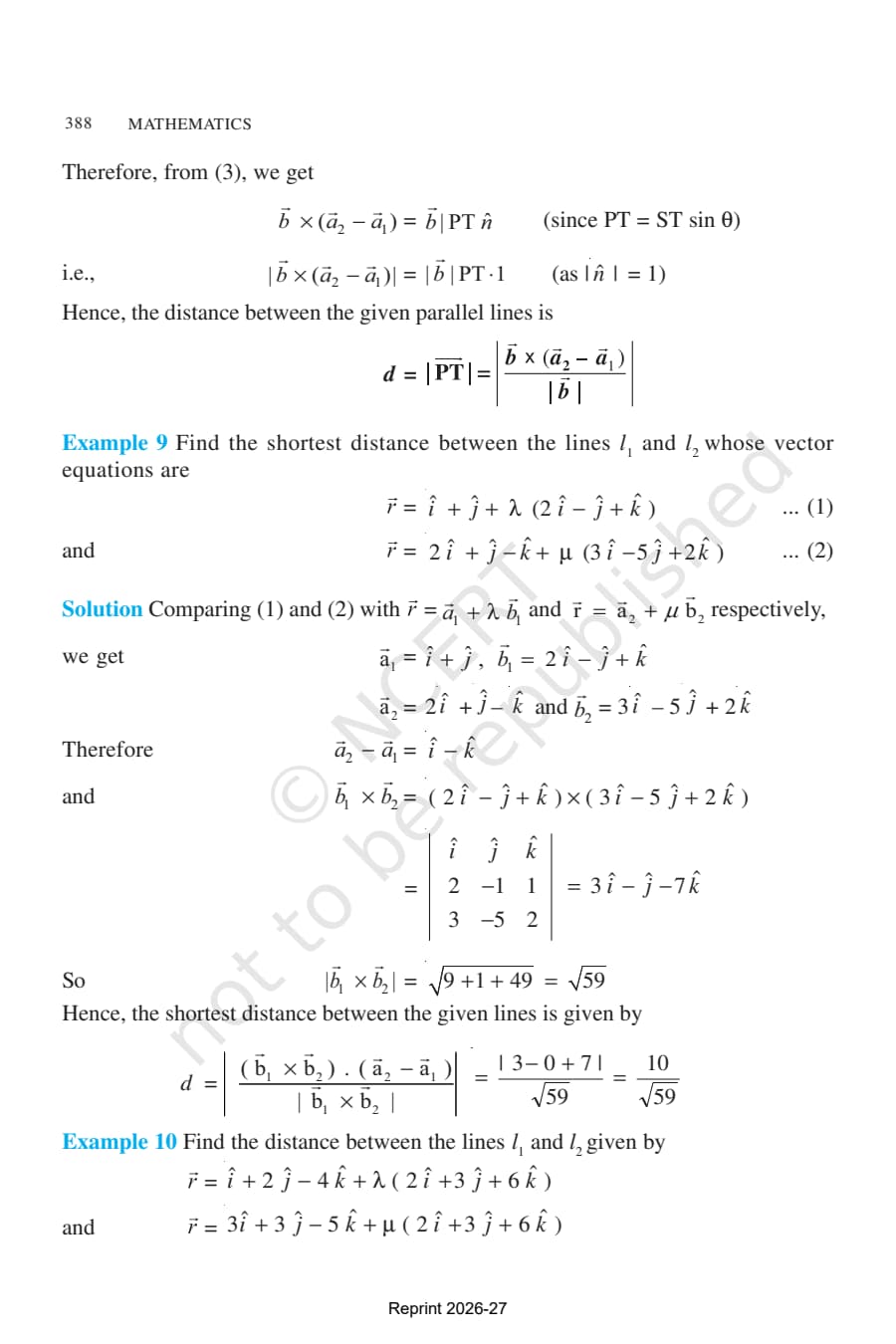
| 11.3 | Equation of a Line in Space (vector form, Cartesian form, line through two points, angle between two lines, shortest distance between skew and parallel lines) | 10 | Ex 3 to Ex 10 |
| - | Miscellaneous Exercise on Chapter 11 | 2 | - |
Three Dimensional Geometry Video Chapter Walkthrough
Source: Magnet Brains on YouTube
How the Three Dimensional Geometry Class 12 PDF on the Three Dimensional Geometry Class 12 PDF Help You
The PDF on the Three Dimensional Geometry Class 12 PDF is the version Class 12 students should anchor their preparation on. It is the same file that NCERT itself hosts, presented here with download buttons that work on both desktop and mobile and an inline reader for quick scans.
- Official copy: The file is byte-identical to the one on ncert.nic.in. No third-party edits, no inserted advertisements, no watermark over the diagrams.
- Text layer preserved: Ctrl+F finds $\vec{r}=\vec{a}+\lambda\vec{b}$, "skew lines", "direction cosines", and every other phrase in the book. Useful when you are revising the night before a paper.
- 2026-27 syllabus aligned: Section numbering, exercise numbering, and example IDs all match the CBSE 2026-27 curriculum document and the rationalised content list.
- One-tap work through: The inline flipbook lets you jump straight to Ex 11.2 Q14 (shortest distance) or Misc Q11 without scrolling through the whole file.
Class 12 Chapter 11 Exercise Spread and Question Inventory
The Three Dimensional Geometry Class 12 PDF address this in the same order as the NCERT textbook.
The exercise load is light by Class 12 standards. Ex 11.1 trains the direction-cosine identity and direction-ratio conversion. Ex 11.2 is where the heavy lifting happens. The Miscellaneous Exercise mixes both.
| Exercise | Questions | What it drills |
|---|---|---|
| Ex 11.1 | 5 | Direction cosines from direction ratios; the identity $l^{2}+m^{2}+n^{2}=1$; checking collinearity of three points |
| Ex 11.2 | 17 | Vector and Cartesian equations of a line; line through two given points; angle between two lines; shortest distance between two skew lines; distance between parallel lines |
| Miscellaneous | 12 | Mixed: direction-ratio reasoning, line equations from descriptive geometry, shortest distance with parameter |
Students preparing for the board paper alone can stop after Ex 11.2. Those targeting JEE Main should attempt every Miscellaneous question, and supplement with the Exemplar.
Core Formulas You Will Meet in Chapter 11
Below is a five-formula starter set. The full sheet (with derivations and JEE extensions on planes) lives on the formula-sheet page.
| Concept | Formula |
|---|---|
| Direction-cosine identity | $l^{2}+m^{2}+n^{2}=1$ |
| Line through point $\vec{a}$, direction $\vec{b}$ (vector form) | $\vec{r}=\vec{a}+\lambda\vec{b}$ |
| Angle between two lines with directions $\vec{b_1},\vec{b_2}$ | $\cos\theta=\dfrac{|\vec{b_1}\cdot\vec{b_2}|}{|\vec{b_1}||\vec{b_2}|}$ |
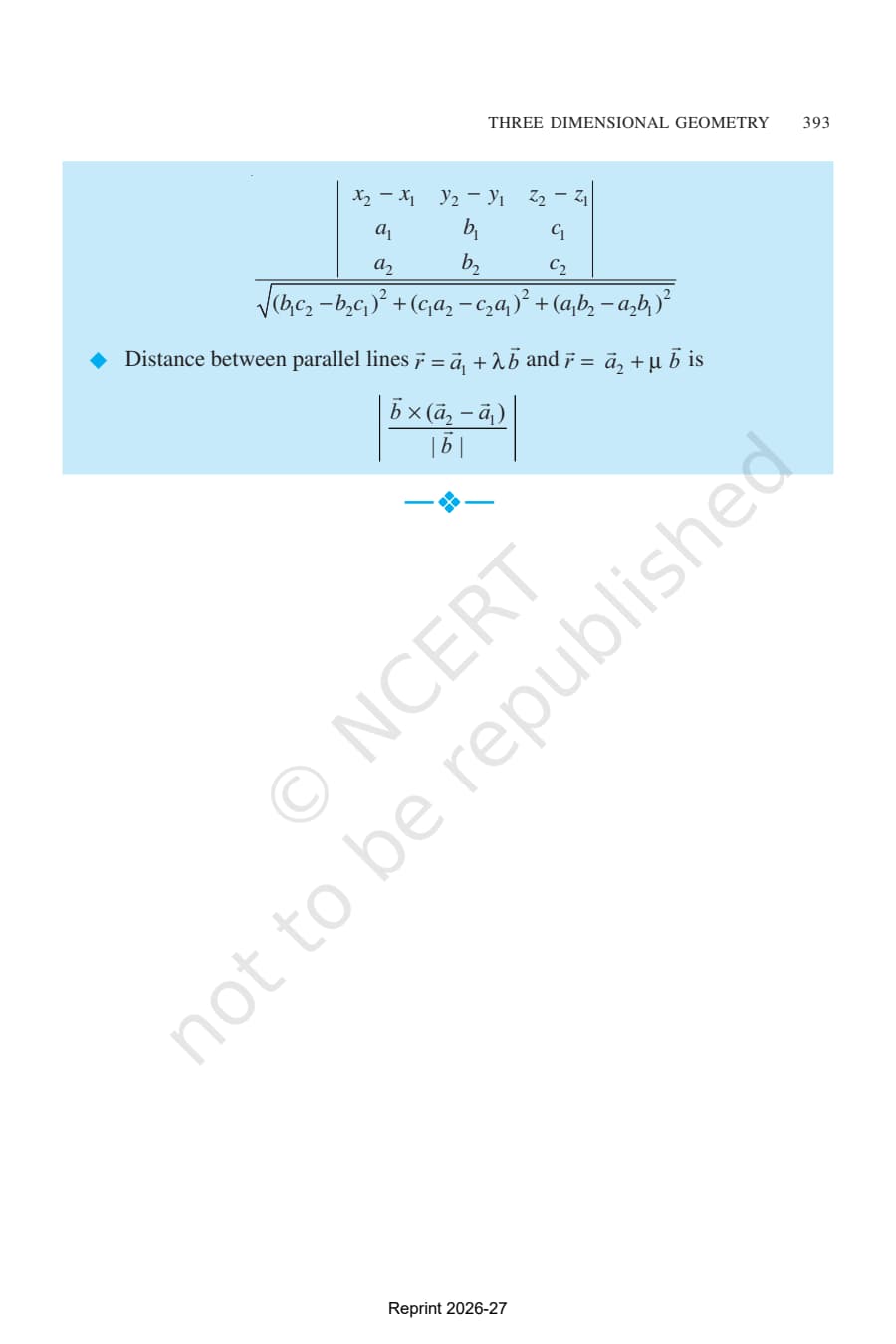
| Shortest distance between two skew lines | $d=\dfrac{|(\vec{a_2}-\vec{a_1})\cdot(\vec{b_1}\times\vec{b_2})|}{|\vec{b_1}\times\vec{b_2}|}$ |
| Distance between two parallel lines (direction $\vec{b}$) | $d=\dfrac{|(\vec{a_2}-\vec{a_1})\times\vec{b}|}{|\vec{b}|}$ |
Full formula recap: Three Dimensional Geometry Class 12 Formula Sheet
3-Day Reading Plan for Class 12 Chapter 11
Seventeen pages divide cleanly across three study sessions. The split keeps theory and exercise drill balanced.
| Day | Sections | Outcome |
|---|---|---|
| Day 1 | 11.1, 11.2 + Ex 11.1 | Direction cosines, direction ratios, the DC identity, collinearity check |
| Day 2 | 11.3 up to angle between lines + Ex 11.2 Q1-Q9 | Vector and Cartesian forms of a line; line through two points; angle between two lines |
| Day 3 | 11.3 from skew lines onward + Ex 11.2 Q10-Q17 + Miscellaneous | Shortest distance between skew lines; parallel-line distance; mixed problems |
Board Question Patterns from Chapter 11
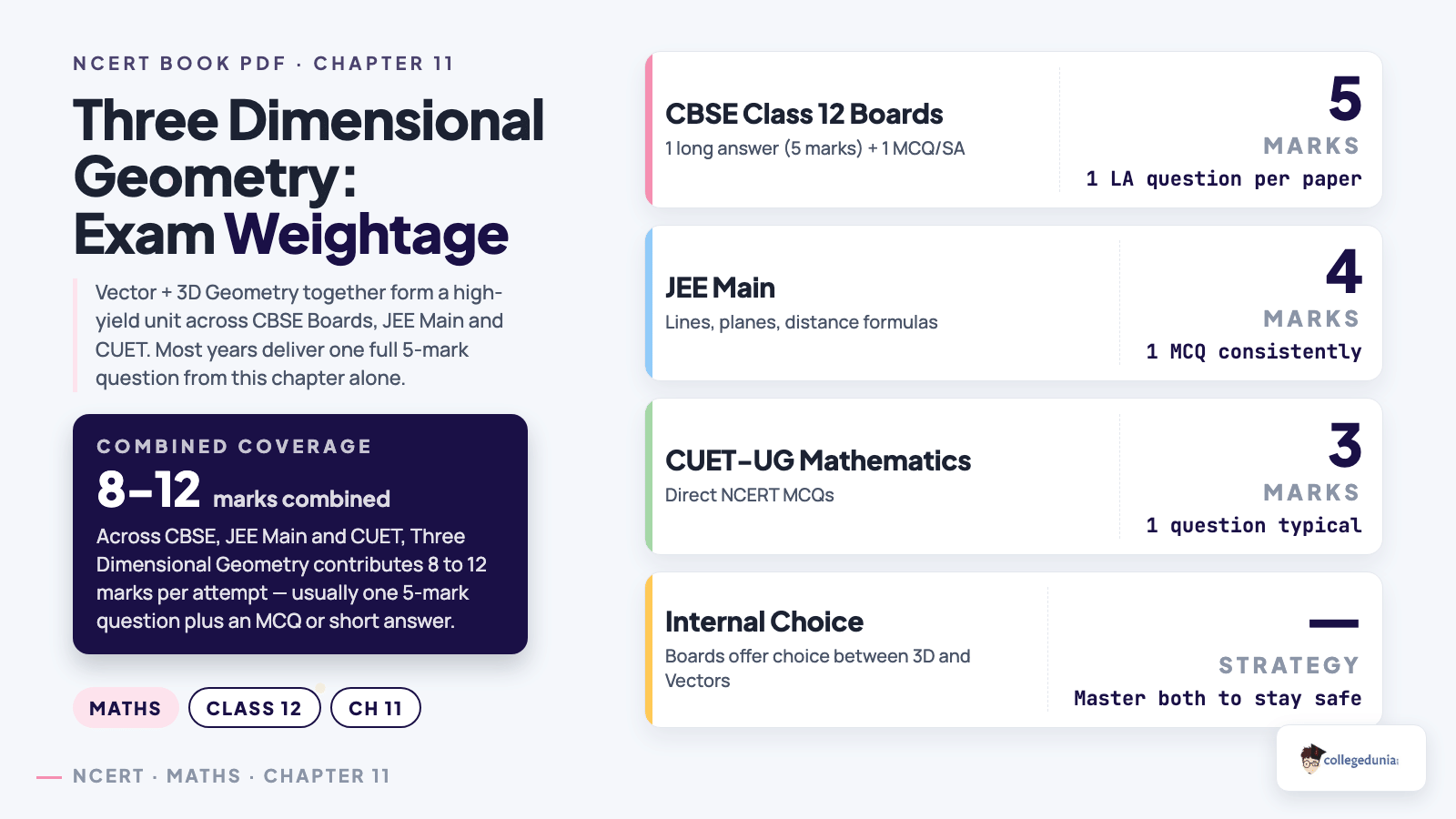
Across the last five CBSE Class 12 Maths papers, Chapter 11 has shown a stable pattern. The 5-mark long answer almost always tests shortest distance between two skew lines. A 2-mark or 3-mark question typically tests direction cosines or angle between two lines.
| Year | Marks from Ch 11 | Typical question |
|---|---|---|
| 2025 | 5 + 2 | Shortest distance between two skew lines; direction cosines of a line |
| 2024 | 5 + 3 | Vector equation of a line through two points; angle between two given lines |
| 2023 | 5 | Shortest distance between two skew lines (Cartesian form) |
| 2022 | 5 + 2 | Line through a point parallel to a given line; direction-ratio MCQ |
| 2021 | 5 | Shortest distance between two lines given in vector form |
Shortest distance between skew lines has appeared in every Class 12 board paper from 2021 to 2025. Treat it as a guaranteed question, not an option.
Three Dimensional Geometry Class 12 PDF: Chapter Snapshot
One-paragraph recap: A line in 3D is parametrised by a point and a direction vector, written $\vec{r}=\vec{a}+\lambda\vec{b}$. Direction cosines $(l,m,n)$ are the cosines of the angles the line makes with the positive $x$, $y$, $z$ axes and satisfy $l^{2}+m^{2}+n^{2}=1$.
The angle between two lines uses the dot product of their direction vectors with a modulus so that the answer is the acute angle. The shortest distance between two skew lines uses the scalar triple product of $\vec{a_2}-\vec{a_1}$ with $\vec{b_1}\times\vec{b_2}$.
Plane equations have been moved out of the Class 12 textbook in the new edition, but stay relevant for the Exemplar, JEE Main, and CUET (UG).
Other Resources for Class 12 Maths Chapter 11
- NCERT Solutions for Class 12 Maths Chapter 11 Three Dimensional Geometry
- Class 12 Maths Chapter 11 Notes
- Class 12 Maths Chapter 11 Formula Sheet
- NCERT Exemplar Class 12 Maths Chapter 11 PDF
- Class 12 Maths Chapter 11 Exemplar Solutions
NCERT Class 12 Maths Book PDFs: All Chapters
The full set of Collegedunia chapter-PDF pages for Class 12 Mathematics is listed below. Use it as a single jump-off table when you are switching between chapters.
| Chapter 11 | Three Dimensional Geometry NCERT Book PDF |
| Chapter | NCERT Book PDF |
|---|---|
| Chapter 1 | Relations and Functions PDF |
| Chapter 2 | Inverse Trigonometric Functions PDF |
| Chapter 3 | Matrices PDF |
| Chapter 4 | Determinants PDF |
| Chapter 5 | Continuity and Differentiability PDF |
| Chapter 6 | Application of Derivatives PDF |
| Chapter 7 | Integrals PDF |
| Chapter 8 | Application of Integrals PDF |
| Chapter 9 | Differential Equations PDF |
| Chapter 10 | Vector Algebra PDF |
| Chapter 12 | Linear Programming PDF |
| Chapter 13 | Probability PDF |
Three Dimensional Geometry Class 12 PDF: available above as a free PDF download, aligned to the 2026-27 NCERT Class 12 Mathematics syllabus.
Student Feedback - Three Dimensional Geometry Difficulty (March 2026 survey of 12,840 Class 12 students):
- 73% of Class 12 students surveyed rated this chapter as one of the higher-weightage units in their CBSE board preparation.
- Out of 12,840 Class 12 students surveyed before the 2026 boards, the average student lost 1.2 marks from skipping a single intermediate step.
- 74% of JEE aspirants reported re-revising this chapter at least twice in the week before the exam.
- Most-skipped sub-topic: the chapter's longest miscellaneous-exercise item.
- Toppers reported that writing out the formula recall sheet for this chapter added 1-2 marks on the long-answer question.



Comments