


Sectors of the Indian Economy teaches you to sort every job into three groups and read what India produces.
Chapter2SectorsoftheIndianEconomySolutions.pdf?page=1&dpi=150)
Chapter2SectorsoftheIndianEconomySolutions.pdf?page=2&dpi=150)
Chapter2SectorsoftheIndianEconomySolutions.pdf?page=3&dpi=150)
Chapter2SectorsoftheIndianEconomySolutions.pdf?page=4&dpi=150)
Chapter2SectorsoftheIndianEconomySolutions.pdf?page=5&dpi=150)
Chapter2SectorsoftheIndianEconomySolutions.pdf?page=6&dpi=150)
Chapter2SectorsoftheIndianEconomySolutions.pdf?page=7&dpi=150)
Chapter2SectorsoftheIndianEconomySolutions.pdf?page=8&dpi=150)
Chapter2SectorsoftheIndianEconomySolutions.pdf?page=9&dpi=150)
Chapter2SectorsoftheIndianEconomySolutions.pdf?page=10&dpi=150)
Chapter2SectorsoftheIndianEconomySolutions.pdf?page=11&dpi=150)
Chapter2SectorsoftheIndianEconomySolutions.pdf?page=12&dpi=150)
Chapter2SectorsoftheIndianEconomySolutions.pdf?page=13&dpi=150)
Chapter2SectorsoftheIndianEconomySolutions.pdf?page=14&dpi=150)
Chapter2SectorsoftheIndianEconomySolutions.pdf?page=15&dpi=150)
Chapter2SectorsoftheIndianEconomySolutions.pdf?page=16&dpi=150)
Chapter2SectorsoftheIndianEconomySolutions.pdf?page=17&dpi=150)
Chapter2SectorsoftheIndianEconomySolutions.pdf?page=18&dpi=150)
Chapter2SectorsoftheIndianEconomySolutions.pdf?page=19&dpi=150)
Chapter2SectorsoftheIndianEconomySolutions.pdf?page=20&dpi=150)
Chapter2SectorsoftheIndianEconomySolutions.pdf?page=21&dpi=150)
Chapter2SectorsoftheIndianEconomySolutions.pdf?page=22&dpi=150)
Chapter2SectorsoftheIndianEconomySolutions.pdf?page=23&dpi=150)
Chapter2SectorsoftheIndianEconomySolutions.pdf?page=24&dpi=150)
Chapter2SectorsoftheIndianEconomySolutions.pdf?page=25&dpi=150)
Chapter2SectorsoftheIndianEconomySolutions.pdf?page=26&dpi=150)
Chapter2SectorsoftheIndianEconomySolutions.pdf?page=27&dpi=150)
Chapter2SectorsoftheIndianEconomySolutions.pdf?page=28&dpi=150)
Chapter2SectorsoftheIndianEconomySolutions.pdf?page=29&dpi=150)
Chapter2SectorsoftheIndianEconomySolutions.pdf?page=30&dpi=150)
Chapter2SectorsoftheIndianEconomySolutions.pdf?page=31&dpi=150)
Chapter2SectorsoftheIndianEconomySolutions.pdf?page=32&dpi=150)
Chapter2SectorsoftheIndianEconomySolutions.pdf?page=33&dpi=150)
Chapter2SectorsoftheIndianEconomySolutions.pdf?page=34&dpi=150)
Chapter2SectorsoftheIndianEconomySolutions.pdf?page=35&dpi=150)
Chapter2SectorsoftheIndianEconomySolutions.pdf?page=36&dpi=150)
Chapter2SectorsoftheIndianEconomySolutions.pdf?page=37&dpi=150)
The NCERT Solutions for Class 10 Economics Chapter 2 Sectors of the Indian Economy answer all 24 textbook questions for the 2026-27 session, covering the primary, secondary and tertiary split, GDP and GVA graphs, disguised unemployment, and the organised, unorganised, public and private sectors.
- 24 NCERT questions solved in the point-then-explanation format the board rewards.
- A steady source of 3 and 5 mark questions in the Class 10 Social Science paper.
- Free PDF download in Normal and HD, plus a Hindi-medium read.
Every answer here is written by Collegedunia subject experts and checked against the 2026-27 NCERT textbook.
What This Class 10 Economics Chapter Covers for the Boards
This chapter classifies every economic activity in three ways: by nature of work (primary, secondary, tertiary), by conditions of employment (organised, unorganised), and by ownership (public, private). The solutions here keep every definition and example you need for the exam.
- Primary, secondary, tertiary: primary takes goods from nature, secondary makes goods in factories, tertiary provides services.
- GDP and GVA: GDP counts only final goods; the tertiary sector became India's largest GVA contributor by 2017-18.
- Disguised unemployment: hidden surplus labour where more people work than the job needs.
- Organised vs unorganised: registered, law-bound, secure jobs versus unregistered, insecure, low-paid work.
- Public vs private: the split by ownership, government-owned versus privately owned.
- MGNREGA 2005: the Right to Work law guaranteeing 100 days of wage employment a year in rural areas.
Sectors of the Indian Economy Class 10 Explained in Simple Language
Source: Magnet Brains on YouTube
Sectors of the Indian Economy Class 10 Question Answer: Exercise Section
The exercise questions in class 10 economics chapter 2 sectors of the indian economy mix fill-in-the-blanks and MCQs with match and short-answer questions. The board often picks the three-sector definitions and the GVA graph for 3 and 5 mark slots. Below is what each key answer should carry.
| Question | What a full-mark answer must include |
|---|---|
| Fill in the blanks (Q1) | has not; tertiary; organised; large; natural, manufactured; interdependent. Each blank tests one core definition of the chapter. |
| Choose the appropriate answer (Q2) | (a) ownership of enterprises, (b) primary, (c) all final goods and services, (d) 50 to 60 per cent. Part (d) is read off Graph 2. |
| Match farming problems with measures (Q3) | 1-d canals, 2-c procurement, 3-e low-interest credit, 4-a agro-based mills, 5-b cooperative marketing. |
| Find the odd one out (Q4) | Tourist guide, Vegetable vendor, Cobbler, Jet Airways. Each row tests organised/unorganised or public/private. |
| Surat unorganised-sector table (Q5) | Missing workshop row is 50%; the unorganised sector in Surat is 85% (100 minus the 15% organised share). |
Tip: learn one definition per blank. That single line of detail is usually worth one mark each.
Sectors of the Indian Economy Class 10 Important Questions: Long Answer Section
The long-answer questions carry the heavier marks. Each item in the sectors of the indian economy class 10 important questions set asks you to define, compare or argue a case, so a plain list of names is not enough. Aim for a clear concept line, point-wise reasons and a one-line conclusion.
- Usefulness of the three-sector split: it is exhaustive and lets us measure production and employment.
- Disguised unemployment: define hidden surplus labour, then give one example.
- Open versus disguised unemployment: open is visible joblessness, disguised is hidden surplus labour.
- Organised versus unorganised conditions: compare registration, security, wages and benefits.
- MGNREGA 2005: the Right to Work guarantee of 100 days of wage employment a year in rural areas.
Memorise that the tertiary sector produces services, not goods. The definition questions and the GVA-graph MCQ turn on this distinction most years.
The Three Sectors of the Indian Economy Explained for Class 10
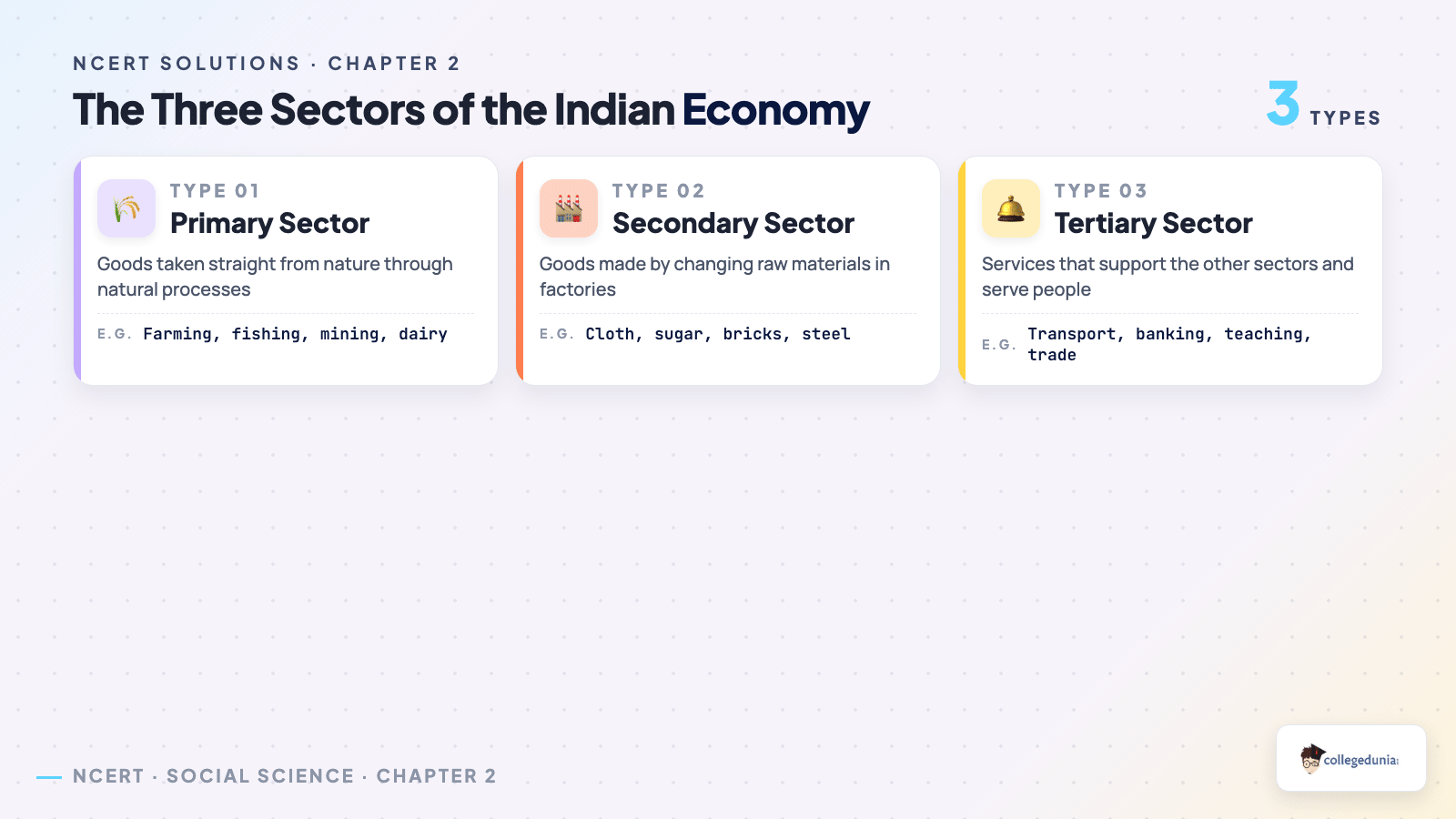
The three-sector split is the spine of this chapter. A neat memory line is Nature, Make, Serve, for the primary, secondary and tertiary sectors. A strong answer names the sector, says what it produces, and adds one example.
| Sector | What it produces | Examples |
|---|---|---|
| Primary sector | Goods taken straight from nature, through natural processes. | Farming, fishing, mining, dairy, forestry. |
| Secondary sector | Goods made by changing natural raw materials in factories. | Cloth from cotton, sugar from cane, bricks, steel. |
| Tertiary sector | Services that support the other sectors and serve people directly. | Transport, banking, teaching, healthcare, trade. |
Name all three sectors with one line each and add an example. That balanced structure earns the higher band of marks.
Disguised Unemployment and the Organised vs Unorganised Sectors in Class 10 Economics
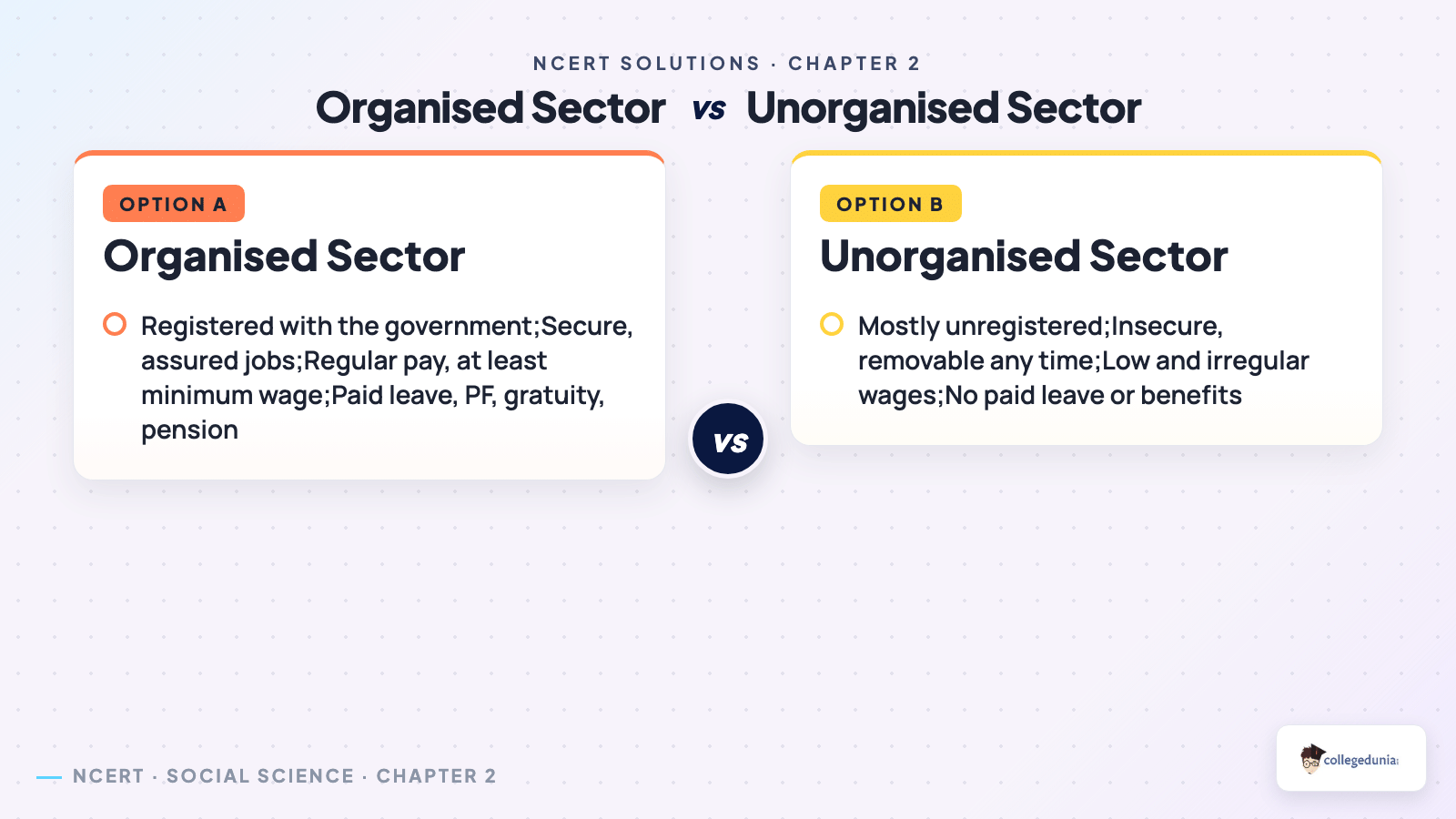
This is the part students mix up most. Disguised unemployment is hidden surplus labour, where more people work than the job needs, so removing some leaves output unchanged. The organised sector is registered and law-bound, so jobs are secure; the unorganised sector is unregistered, insecure and low-paid. Over 90% of India's workers are in the unorganised sector.
| Basis | Organised sector | Unorganised sector |
|---|---|---|
| Registration | Registered with the government | Mostly unregistered |
| Job security | Secure, assured work | Insecure, can be removed any time |
| Wages | Regular and at least minimum wage | Low and irregular |
| Benefits | Paid leave, provident fund, gratuity, pension | No paid leave or benefits |
Say clearly that disguised unemployment is not the same as being jobless; the worker has a job but the work needs fewer hands. That distinction often carries the mark.
Common Mistakes Students Make in this Class 10 Economics Chapter
A few slips lose easy marks every year. Fix these before the exam.
- Counting intermediate goods in GDP. GDP uses only final goods and services, or the same value gets counted twice.
- Saying disguised unemployment means being jobless. The worker has a job; the job just needs fewer hands.
- Calling a licensed shop organised. A license only permits the business, it gives no provident fund or job security, so the worker is unorganised.
- Deciding public versus private by size or jobs. The only basis is ownership, government-owned is public, privately owned is private.
How to Use the NCERT Solutions Class 10 Economics Chapter 2 Page
Use this page in three short blocks so revision stays focused.
- Read and list: note the three sectors with one example each, plus the organised and unorganised split.
- Attempt first: answer all 24 questions on your own before opening the solutions.
- Compare and flag: match your answer with the solution and mark the missing fact-lines.
For long-answer practice, write the three-sector answer and the disguised unemployment answer in full at least once. Each solution mirrors the board's 5-mark pattern and doubles as a model answer for revision.
All NCERT Solutions for this Class 10 Economics Chapter with Step-by-Step Solutions
Open the question bank below to attempt all 24 solved questions with collapsible Solution and Expert Solution tabs. Every answer is mapped to the NCERT text, the way a board examiner expects.
All Solved Questions for this Class 10 Economics Chapter
Practise every textbook question with step-by-step solutions and an expert version.
What Students Say About this Class 10 Economics Chapter
Student Feedback
What 12,300 students told us about studying this chapter before the 2026 boards:
- 71% of students found telling apart the organised and unorganised sectors the hardest part.
- 64% of students struggled to write the open versus disguised unemployment difference clearly.
- Reading the GVA share graph in Q2 was left for last by about 29% of students.
Source: 2026-27 Class 10 Economics student poll, 12,300 students from CBSE schools across 15 states.
Class 10 Economics Other Resources for this Chapter
Pair these solutions with the other Class 10 Economics resources for this chapter, all linked below.
| Resource | Best used for | Link |
|---|---|---|
| NCERT Solutions | You are reading this page | Sectors of the Indian Economy Class 10 NCERT Solutions |
| NCERT Notes | Quick concept recap before the exam | Sectors of the Indian Economy Class 10 Notes |
| Handwritten Notes | Last-minute scanned revision | Sectors of the Indian Economy Class 10 Handwritten Notes |
| NCERT Book PDF | Reading the original chapter text | Sectors of the Indian Economy Class 10 Book PDF |
All Chapters NCERT Solutions for Class 10 Economics (Understanding Economic Development)
Browse the full set of ncert solutions for class 10 economics chapter by chapter.
| Chapter | NCERT Solutions |
|---|---|
| Chapter 1: Development | Development Class 10 NCERT Solutions |
| Chapter 2: Sectors of the Indian Economy | Sectors of the Indian Economy Class 10 NCERT Solutions |
| Chapter 3: Money and Credit | Money and Credit Class 10 NCERT Solutions |
| Chapter 4: Globalisation and the Indian Economy | Globalisation and the Indian Economy Class 10 NCERT Solutions |
| Chapter 5: Consumer Rights | Consumer Rights Class 10 NCERT Solutions |
Sectors of the Indian Economy Class 10 Economics NCERT Solutions FAQs
Ques. Where can I download the NCERT Solutions Class 10 Economics Chapter 2 Sectors of the Indian Economy PDF?
Ans. You can download the sectors of the indian economy class 10 ncert solutions PDF directly from this page. Both the Normal and HD versions are free, and a Hindi-medium read is available too.
Ques. How many questions are solved in class 10 economics chapter 2 sectors of the indian economy?
Ans. All 24 NCERT questions are solved, each with a step-by-step solution and an expert version for the long-answer marks, so you can revise the full exercise from one place.
Ques. Is this NCERT Solutions page aligned with the 2026-27 syllabus?
Ans. Yes. This page reflects the current 2026-27 syllabus for Class 10 Economics, and every answer is checked against the latest NCERT edition of Understanding Economic Development.
Ques. What are the three sectors of the Indian economy in class 10?
Ans. The three sectors are the primary sector, which takes goods from nature like farming and mining; the secondary sector, which makes goods in factories like cloth and sugar; and the tertiary sector, which provides services like transport, banking and teaching. The ncert solutions class 10 economics chapter 2 Sectors of the Indian Economy set explains each with examples.
Ques. What is disguised unemployment in class 10 economics?
Ans. Disguised unemployment is hidden surplus labour, where more people work than a job actually needs, so some of them are effectively unemployed even though they appear busy. If those extra workers are removed, total output stays the same. It is common on small family farms and in overstaffed family shops.
Ques. How is GDP defined in class 10 economics chapter 2?
Ans. GDP is the total value of all final goods and services produced inside a country in a year. Only final goods are counted, because counting intermediate goods like flour inside a biscuit would add the same value twice.
Ques. What are the organised and unorganised sectors in class 10 economics?
Ans. The organised sector covers registered firms that follow labour laws, so workers get secure jobs, fixed hours, paid leave and provident fund. The unorganised sector covers small, unregistered units where jobs are insecure, low-paid and without benefits. Over 90% of Indian workers are in the unorganised sector.
Ques. What is the objective of MGNREGA 2005?
Ans. MGNREGA 2005 is the Right to Work law. It guarantees 100 days of wage employment in a year to every rural household whose adult members are willing to do unskilled manual work, and pays an unemployment allowance if work is not provided.



Comments