



About 15 to 20 marks of the Class 10 Social Science board paper come from Geography, and Minerals and Energy Resources is a regularly set chapter.
Chapter5MineralsandEnergyResourcesSolutions.pdf?page=1&dpi=150)
Chapter5MineralsandEnergyResourcesSolutions.pdf?page=2&dpi=150)
Chapter5MineralsandEnergyResourcesSolutions.pdf?page=3&dpi=150)
Chapter5MineralsandEnergyResourcesSolutions.pdf?page=4&dpi=150)
Chapter5MineralsandEnergyResourcesSolutions.pdf?page=5&dpi=150)
Chapter5MineralsandEnergyResourcesSolutions.pdf?page=6&dpi=150)
Chapter5MineralsandEnergyResourcesSolutions.pdf?page=7&dpi=150)
Chapter5MineralsandEnergyResourcesSolutions.pdf?page=8&dpi=150)
Chapter5MineralsandEnergyResourcesSolutions.pdf?page=9&dpi=150)
Chapter5MineralsandEnergyResourcesSolutions.pdf?page=10&dpi=150)
Chapter5MineralsandEnergyResourcesSolutions.pdf?page=11&dpi=150)
Chapter5MineralsandEnergyResourcesSolutions.pdf?page=12&dpi=150)
Chapter5MineralsandEnergyResourcesSolutions.pdf?page=13&dpi=150)
Chapter5MineralsandEnergyResourcesSolutions.pdf?page=14&dpi=150)
Chapter5MineralsandEnergyResourcesSolutions.pdf?page=15&dpi=150)
Chapter5MineralsandEnergyResourcesSolutions.pdf?page=16&dpi=150)
The NCERT Solutions for Class 10 Geography Chapter 5 Minerals and Energy Resources answer every exercise question to the 2026-27 CBSE syllabus. Each answer covers how minerals are classified, their five modes of occurrence, the key place-to-mineral pairs, and the conventional and non-conventional energy sources in the NCERT text.
- 11 NCERT questions solved: 4 MCQs, 5 short-answer and 2 long-answer, each step-by-step.
- A regular source of 1, 3 and 5 mark questions in the Class 10 board paper.
- Free PDF download in Normal and HD, plus a Hindi-medium read.
Every answer is written by Collegedunia subject experts and checked against the 2026-27 NCERT textbook.
What This Class 10 Geography Chapter Covers for the Boards
This chapter explains what a mineral is, how minerals are classified, how they occur in rocks, and how India meets its power needs from conventional and non-conventional sources. It also pairs each mineral with its producing region and explains why minerals and energy must be conserved.
- What is a mineral: a homogenous, naturally occurring substance with a definable internal structure.
- Classification of minerals: metallic (ferrous, non-ferrous, precious), non-metallic and energy minerals.
- Modes of occurrence: veins and lodes, beds and layers, residual mass, placer deposits and ocean waters.
- Key minerals: iron ore, manganese, copper, bauxite, mica and limestone with their belts.
- Energy sources: conventional (coal, petroleum, natural gas, electricity) and non-conventional (solar, wind, tidal, geothermal, biogas, nuclear).
Minerals and Energy Resources Class 10 One-Shot Revision for Boards
Source: Magnet Brains on YouTube
Geography Class 10 Chapter 5 Question Answer: MCQ Section
The four multiple-choice questions test the mode of mineral formation, the producing region, the rock type and the atomic mineral. Fix one keyword to each mineral first, then read the options.
| Question | Answer and the one fact that proves it |
|---|---|
| Mineral formed by decomposition of rocks, leaving a residual mass | (b) Bauxite. Bauxite is a residual ore left behind after aluminium-rich rocks decay, unlike coal (sedimentary), gold (placer) and zinc (veins and lodes). |
| Koderma in Jharkhand is the leading producer of which mineral | (b) Mica. The Koderma-Gaya-Hazaribagh belt of Jharkhand is the leading producer of mica, a non-metallic insulating mineral. |
| Minerals deposited and accumulated in the stratas of which rocks | (a) Sedimentary rocks. Strata means horizontal layers, and minerals occur in beds and layers only in sedimentary rocks. |
| Which mineral is contained in the Monazite sand | (c) Thorium. The monazite sands of Kerala are rich in thorium, the atomic mineral used for nuclear energy. |
Tip: learn one clue per mineral. That single defining line, residual mass to bauxite or strata to sedimentary, is usually worth the full mark.
Minerals and Energy Resources Important Question: 30-Word Section
The 30-word questions carry the short-answer marks. Each asks for a precise contrast or definition. A clean two-column distinction or the exact textbook definition earns the marks.
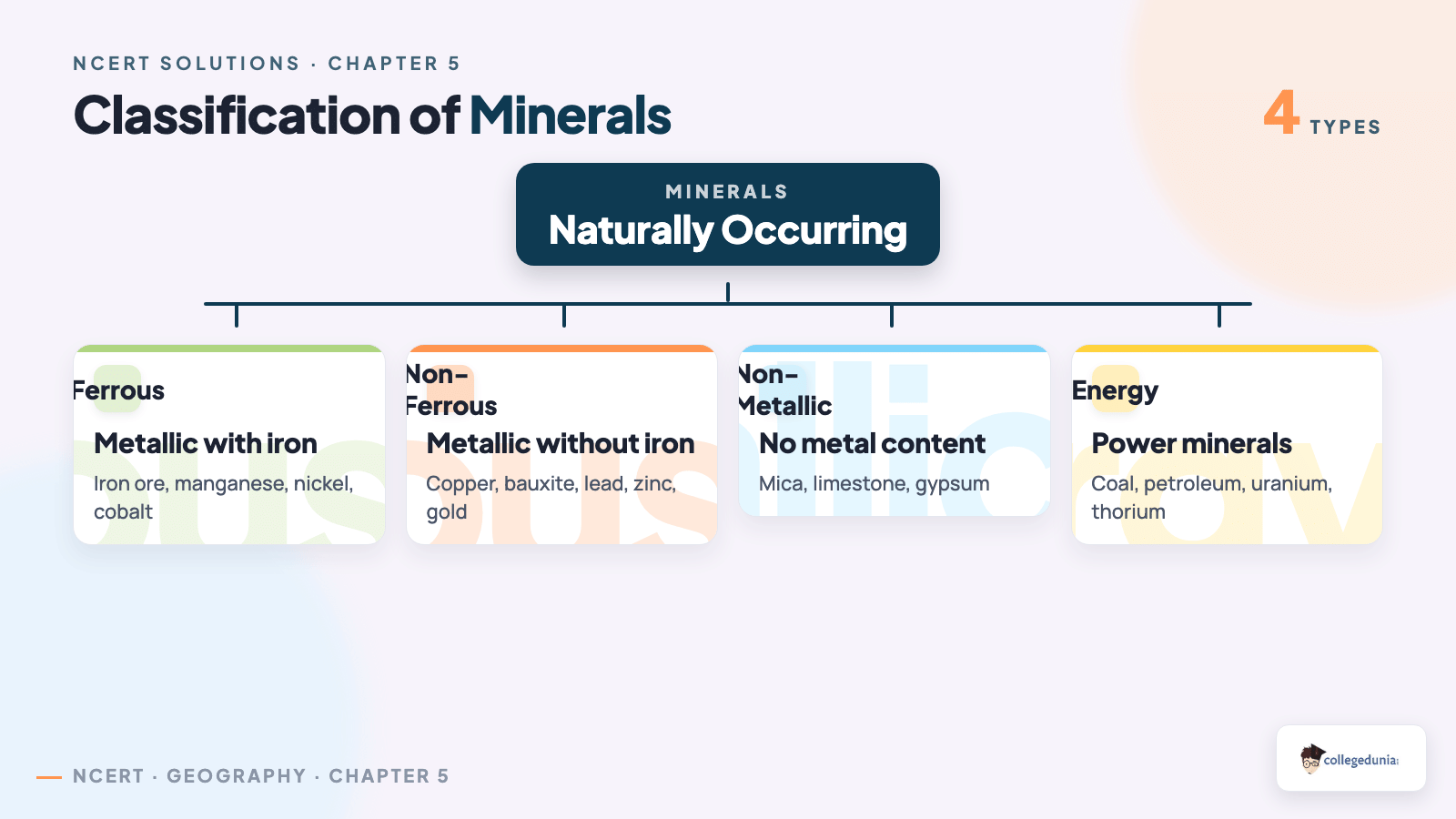
- Ferrous versus non-ferrous minerals: ferrous minerals contain iron (iron ore, manganese); non-ferrous minerals do not (copper, bauxite, zinc, gold).
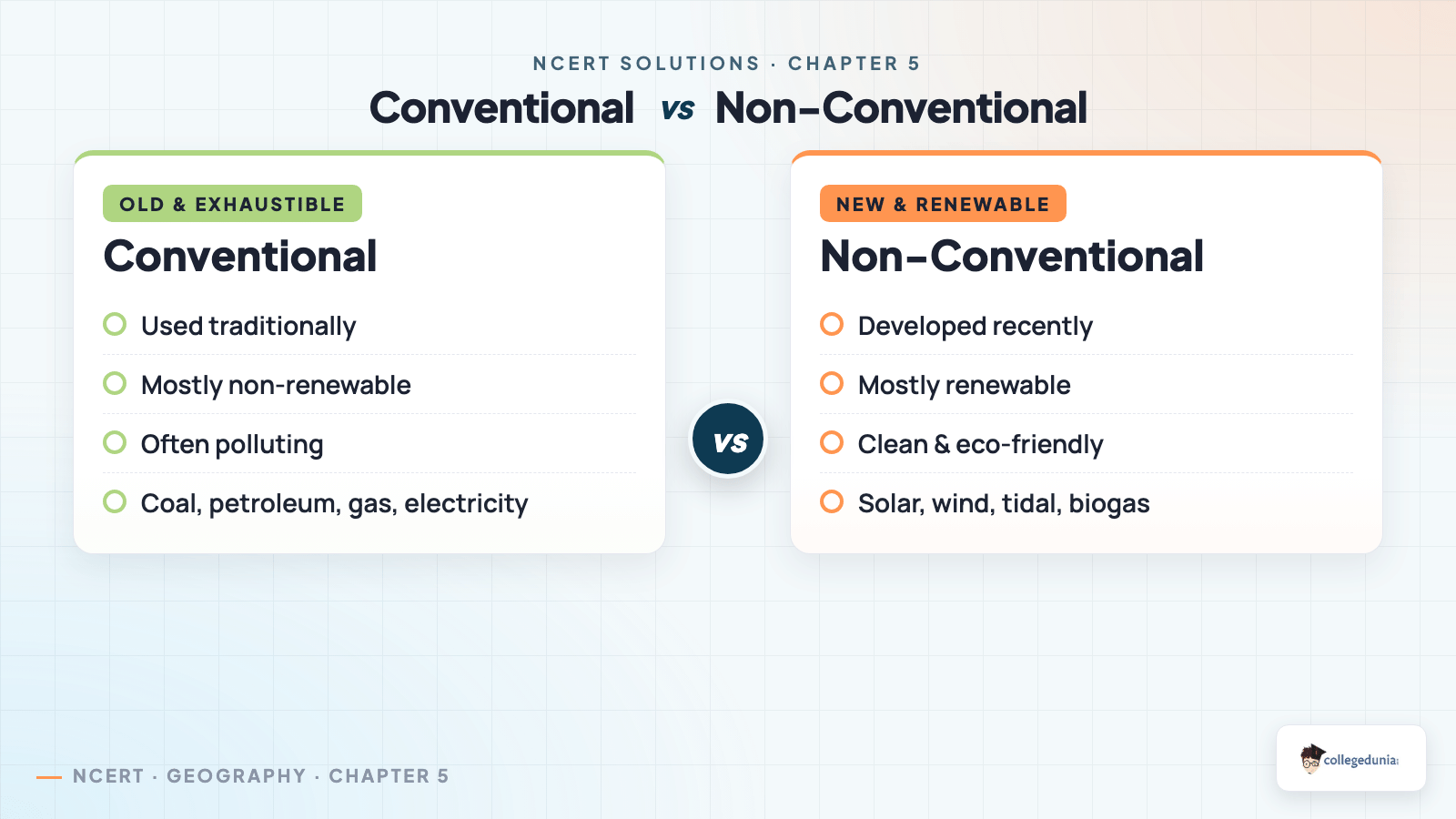
- Conventional versus non-conventional energy: conventional sources are exhaustible (coal, petroleum, natural gas, electricity); non-conventional sources are renewable (solar, wind, tidal, geothermal, biogas).
- What is a mineral: a homogenous, naturally occurring substance with a definable internal structure.
Memorise the single axis of each distinction (presence of iron, old versus new) and keep the exact definition of a mineral ready. These short-answer questions appear most years.
Major Minerals of India Explained for Class 10 Geography
The major minerals of India are the most asked topic, and the MCQ, 30-word and 120-word questions all draw on them. The quickest way to remember a mineral is to tie it to its mode of occurrence first, then its producing belt.
| Mineral | Class, mode of occurrence and producing belt |
|---|---|
| Iron ore | Ferrous metallic mineral; occurs in beds and layers; the Odisha-Jharkhand belt and Bailadila in Chhattisgarh are leading producers. |
| Mica | Non-metallic insulating mineral; the Koderma-Gaya-Hazaribagh belt of Jharkhand is the leading producer. |
| Copper | Non-ferrous metallic mineral; occurs in veins and lodes; Balaghat, Khetri and Singhbhum are the main centres. |
| Bauxite | Non-ferrous ore of aluminium; forms as a residual mass of weathered material; Panchpatmali in Odisha leads production. |
| Thorium | Atomic energy mineral; carried in the monazite sands of the Kerala coast. |
A handy memory rule: Koderma to mica, Khetri to copper, Bailadila to iron ore, Panchpatmali to bauxite. The place-to-mineral pair is often worth a mark on its own.
Conventional and Non-Conventional Energy Sources in This Chapter
The two 120-word questions test the energy sources India uses. The chapter splits these into conventional sources (firewood, coal, petroleum, natural gas and electricity) and non-conventional sources (solar, wind, tidal, geothermal, biogas and nuclear). Naming both kinds, with one example each, earns full marks.
| Energy source | What it is and where it comes from |
|---|---|
| Coal | The most abundant conventional fuel; Gondwana coal lies in the Damodar valley (Jharia, Raniganj, Bokaro) and tertiary coal in the north-east. |
| Petroleum and natural gas | Conventional fuels found in anticlines and fault traps; Mumbai High, Gujarat and Assam are the main fields. |
| Solar energy | Non-conventional, renewable; photovoltaic technology converts sunlight to electricity, with a bright future in tropical India. |
| Wind and tidal energy | Non-conventional, clean; the Nagarcoil to Jaisalmer belt leads wind power, and the Gulf of Khambhat suits tidal energy. |
| Nuclear (atomic) energy | Uses uranium and thorium; the monazite sands of Kerala are rich in thorium. |
Group the sources under two heads, conventional and non-conventional, so a loose list becomes two clear buckets that are easy to recall.
Common Mistakes Students Make in This Class 10 Geography Chapter
A few slips lose easy marks every year.
- Ticking coal instead of bauxite for the residual-mass question. Coal is a sedimentary fossil fuel, while bauxite is a residual ore.
- Naming only the Damodar valley for coal and forgetting the tertiary coal of the north-east and the lignite at Neyveli.
- Mixing up ferrous and non-ferrous minerals. Iron ore is ferrous, copper is non-ferrous.
- Padding a 30-word answer past the limit instead of giving the exact contrast asked for.
How to Use the NCERT Solutions Class 10 Geography Chapter 5 Page
Use these solutions in three short blocks. Read the chapter, attempt the questions, then compare and fix the gaps.
- Read and list: note every mineral, its mode of occurrence and its producing belt.
- Attempt first: answer all 11 questions on your own before opening the solutions.
- Compare and flag: match your answer with the solution and mark the missing fact-lines.
For long-answer practice, write the coal-distribution and solar-energy answers in full at least once. Each answer mirrors the board's 5-mark pattern.
Practice All NCERT Solutions for This Class 10 Geography Chapter with Step-by-Step Solutions
Open the question bank below to attempt all 11 solved questions with collapsible Solution and Expert Solution tabs. Every answer is mapped to the NCERT text, so it reads the way a board examiner expects.
All Solved Questions for this Class 10 Geography Chapter
Practise every question with step-by-step solutions and an expert version for board marks.
Student Feedback on This Class 10 Geography Chapter
What 15,240 students told us about studying this chapter before the 2026 boards.
- 71% of students most often left a coalfield out of the coal-distribution 120-word answer.
- 64% of students said the conventional versus non-conventional distinction was the easiest mark.
- Most-confused pair in revision: ferrous versus non-ferrous minerals, mixed up by about 39% of students.
Source: 2026-27 Class 10 Geography student poll. Sample of 15,240 students from CBSE schools across 15 states.
Class 10 Geography Other Resources for This Chapter
Pair these solutions with the other Class 10 Geography resources for the same chapter.
| Resource | Best used for |
|---|---|
| Minerals and Energy Resources Class 10 Notes | Quick concept recap before the exam |
| Minerals and Energy Resources Class 10 Handwritten Notes | Last-minute scanned revision |
| Minerals and Energy Resources Class 10 NCERT Book PDF | Reading the original chapter text |
All Chapters NCERT Solutions for Class 10 Geography (Contemp India II)
Browse the full set of ncert solutions for class 10 geography chapter by chapter.
| Chapter | NCERT Solutions |
|---|---|
| Chapter 1 | Resources and Development Class 10 NCERT Solutions |
| Chapter 2 | Forest and Wildlife Resources Class 10 NCERT Solutions |
| Chapter 3 | Water Resources Class 10 NCERT Solutions |
| Chapter 4 | Agriculture Class 10 NCERT Solutions |
| Chapter 5 | Minerals and Energy Resources Class 10 NCERT Solutions |
| Chapter 6 | Manufacturing Industries Class 10 NCERT Solutions |
| Chapter 7 | Lifelines of National Economy Class 10 NCERT Solutions |
Minerals and Energy Resources Class 10 Geography NCERT Solutions FAQs
Ques. Where can I download the NCERT Solutions Class 10 Geography Chapter 5 Minerals and Energy Resources PDF?
Ans. You can download the minerals and energy resources class 10 ncert solutions PDF directly from this page. Both the Normal and HD versions are free, and a Hindi-medium read is available too.
Ques. How many questions are solved in class 10 geography chapter 5 question answer?
Ans. All 11 NCERT questions are solved: 4 MCQs, 5 short 30-word answers and 2 long 120-word answers, each with a step-by-step solution and an expert version.
Ques. Is this NCERT Solutions page aligned with the 2026-27 syllabus?
Ans. Yes. This page reflects the current 2026-27 syllabus for Class 10 Geography, and every answer is checked against the latest NCERT edition of Contemporary India II.
Ques. Which mineral is formed by the decomposition of rocks leaving a residual mass?
Ans. Bauxite is formed by the decomposition of aluminium-rich rocks, where the soluble parts are washed away and the insoluble residual mass of weathered material is left behind. So bauxite is a residual ore.
Ques. What is the difference between ferrous and non-ferrous minerals?
Ans. Ferrous minerals contain iron, for example iron ore, manganese, nickel and cobalt. Non-ferrous minerals do not contain iron, for example copper, bauxite, lead, zinc and gold.
Ques. Describe the distribution of coal in India for class 10 geography chapter 5.
Ans. Coal occurs as Gondwana coal in the Damodar valley (Jharia, Raniganj, Bokaro) and the Godavari, Mahanadi, Son and Wardha valleys, as tertiary coal in the north-eastern states (Meghalaya, Assam, Arunachal Pradesh, Nagaland), and as lignite at Neyveli in Tamil Nadu.
Ques. Why does solar energy have a bright future in India?
Ans. Because India is a tropical country with abundant year-round sunshine, solar energy is renewable, clean and pollution-free, and it helps rural and remote areas reduce their dependence on firewood and dung cake, which also conserves forests and frees dung for manure.



Comments