


Geography carries about 15 to 20 marks in the Class 10 Social Science board paper, and Manufacturing Industries is one of its most frequently set chapters.
Chapter6ManufacturingIndustriesSolutions.pdf?page=1&dpi=150)
Chapter6ManufacturingIndustriesSolutions.pdf?page=2&dpi=150)
Chapter6ManufacturingIndustriesSolutions.pdf?page=3&dpi=150)
Chapter6ManufacturingIndustriesSolutions.pdf?page=4&dpi=150)
Chapter6ManufacturingIndustriesSolutions.pdf?page=5&dpi=150)
Chapter6ManufacturingIndustriesSolutions.pdf?page=6&dpi=150)
Chapter6ManufacturingIndustriesSolutions.pdf?page=7&dpi=150)
Chapter6ManufacturingIndustriesSolutions.pdf?page=8&dpi=150)
Chapter6ManufacturingIndustriesSolutions.pdf?page=9&dpi=150)
The NCERT Solutions for Class 10 Geography Chapter 6 Manufacturing Industries answer every exercise question to the latest 2026-27 CBSE syllabus. Each answer defines manufacturing, classifies industries, and lists how industries pollute the environment with the control steps the NCERT text uses.
- 5 NCERT questions solved: 1 MCQ pair, 2 short 30-word answers and 2 long 120-word answers, each step-by-step.
- This chapter is a regular source of 1, 3 and 5 mark questions in the Class 10 board paper.
- Free PDF download in Normal and HD, plus a Hindi-medium read of every answer.
Every answer is written by Collegedunia subject experts, checked against the 2026-27 NCERT textbook, and refined using the last five years of CBSE board papers.

|
Table of Contents |
What This Class 10 Geography Chapter Covers for the Boards
This chapter explains how manufacturing turns raw materials into finished goods on a large scale, and why it measures a nation's economic strength. It then teaches you to classify industries, separate basic from consumer industries, and list the four types of industrial pollution with their control steps.
- Meaning of manufacturing: the large-scale processing of raw materials into finished goods, a secondary activity.
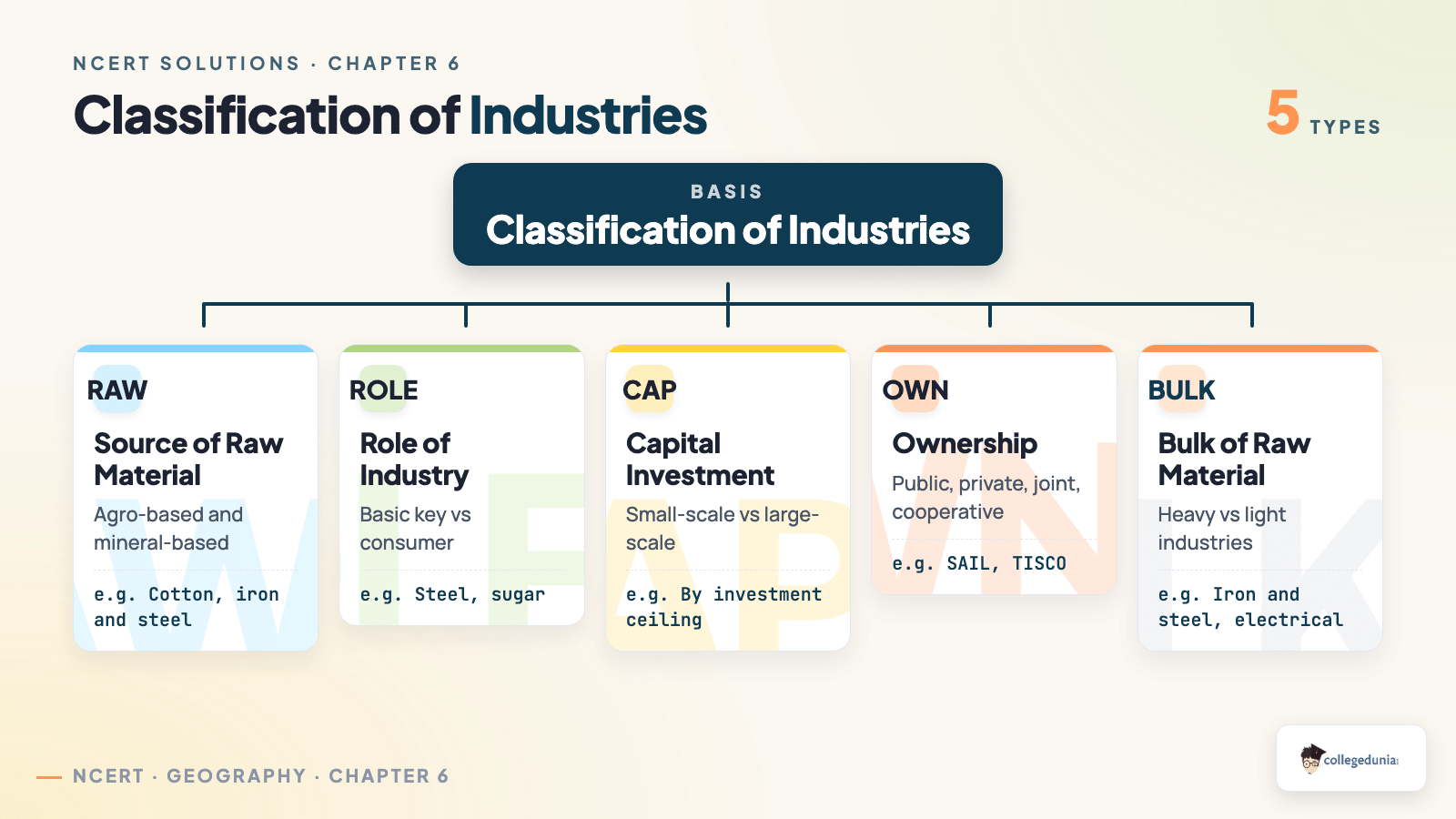
- Classification of industries: by source of raw material, role, capital, ownership, and bulk of raw material.
- Basic and consumer industries: basic industries feed other industries; consumer industries make goods for direct use.
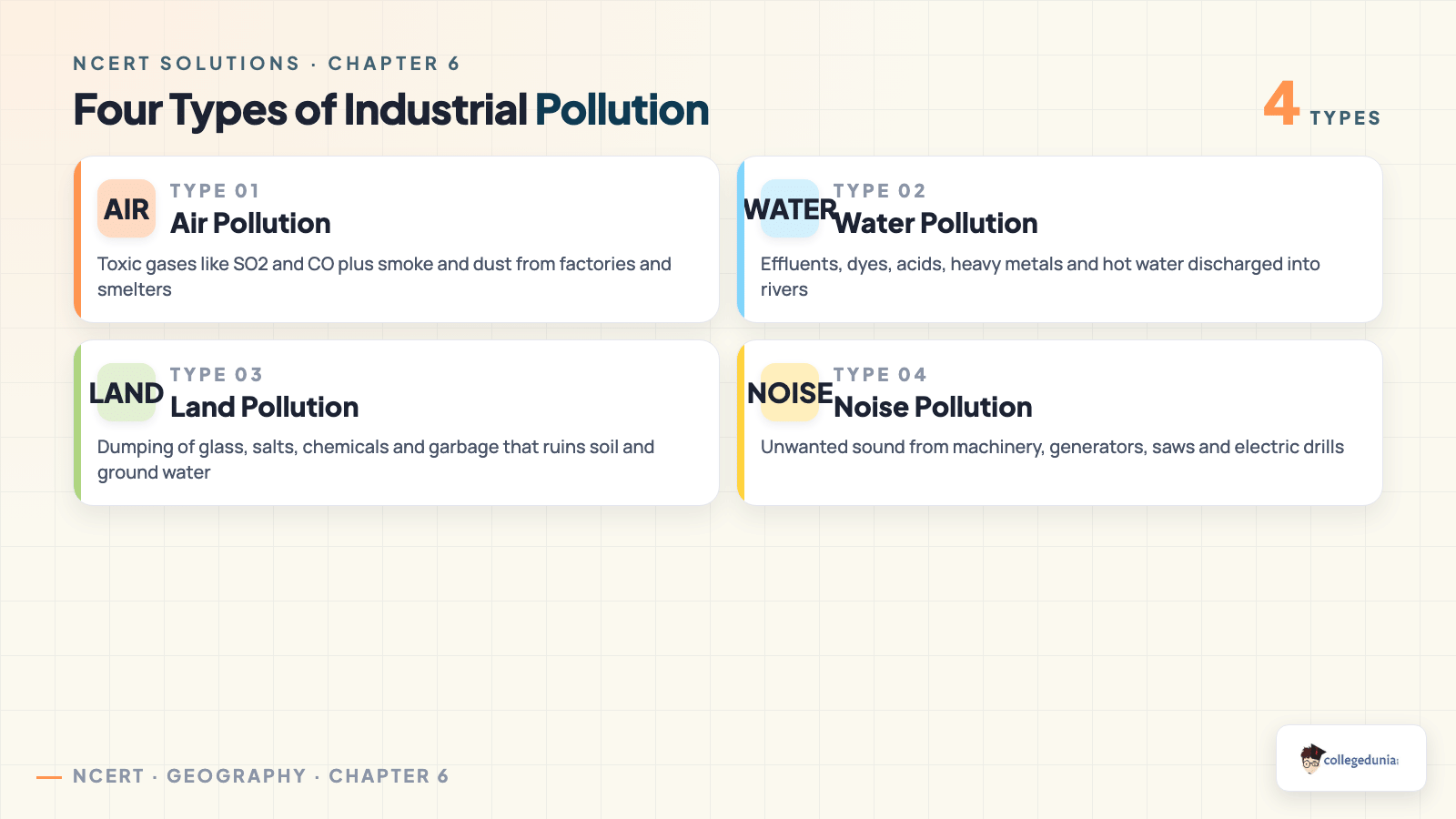
- Industrial pollution: the four types, air, water, land and noise, each with its source.
- Control of degradation: three-phase effluent treatment, ground-water regulation, stack filters and noise silencers.
Manufacturing Industries Class 10 One-Shot Revision for Boards
Source: Magnet Brains on YouTube
Manufacturing Industries Class 10 Question Answer: MCQ Section
The multiple-choice question tests the raw material an industry uses and the goods it makes. Trace the input, not the output, then read the options. Learn each industry paired with its defining raw material or product.
| Question | Answer and the one fact that proves it |
|---|---|
| Which industry uses bauxite as a raw material | (a) Aluminium Smelting. Bauxite is the ore of aluminium, while cement uses limestone, paper uses wood pulp and steel uses iron-ore, so only aluminium smelting fits. |
| Which industry manufactures telephones, computers, etc. | (b) Electronic. The electronic industry makes communication and computing devices, unlike steel and aluminium smelting that make metals or IT that makes software. |
Tip: learn one keyword per industry. That single defining line, bauxite to aluminium or telephones to electronic, is usually worth the full mark.
Manufacturing Industries Important Question: 30-Word Section
The 30-word questions carry the short-answer marks. Each asks for a precise definition, so padding wastes the word limit. A good answer gives the defining keywords of manufacturing or a basic industry with one example.
- What is manufacturing: producing goods in large quantities by processing raw materials into finished products, for example iron-ore into steel.
- What are basic industries: industries whose products are raw materials for other industries, for example iron and steel.
- Marking keywords: say "large quantities", "processing raw materials" and "finished products" for full marks.
Memorise the definition of manufacturing (large-scale processing into finished goods) and keep basic industry to iron and steel ready, as these appear most years.
Classification of Industries Explained for Class 10 Geography
The classification of industries is the backbone of this chapter, and every question draws on it. The quickest way to remember an industry is to tie it to its basis of classification first; the examples then follow.
| Basis of classification | Types and the examples that prove them |
|---|---|
| Source of raw material | Agro-based (cotton, woollen, jute, silk, sugar) and mineral-based (iron and steel, cement, aluminium, machine tools, petrochemicals). |
| Role of the industry | Basic or key industries (iron and steel, copper and aluminium smelting) and consumer industries (sugar, paper, fans, sewing machines). |
| Capital investment | Small-scale (investment up to a fixed ceiling) and large-scale industries above that ceiling. |
| Ownership | Public sector (SAIL), private sector (TISCO), joint sector (Oil India) and cooperative sector (Anand sugar mills). |
| Bulk of raw material | Heavy industries (iron and steel) and light industries (electrical goods using light raw material). |
Memory rule: raw material, role, capital, ownership, bulk. Stating the basis in your answer is often worth a mark.
Industrial Pollution and Its Control in This Chapter
The two 120-word questions test how industries pollute the environment and how to control it. The chapter splits pollution into four types (air, water, land and noise), each from an identifiable source with a matching control measure. Name both the type and its cure, with one example each, for full marks.
| Type of pollution | Source and the control step |
|---|---|
| Air pollution | Caused by gases such as sulphur dioxide and carbon monoxide and by smoke and dust; controlled with electrostatic precipitators, fabric filters and scrubbers, and by switching from coal to oil or gas. |
| Water pollution | Caused by effluents, dyes, acids, heavy metals and hot water; controlled by reusing and recycling water and by three-phase effluent treatment before discharge. |
| Land pollution | Caused by dumping glass, salts, chemicals and garbage that ruins soil and contaminates ground water; controlled by treating and recycling solid waste. |
| Noise pollution | Caused by machinery, generators, saws and drills; controlled with silencers, redesigned machinery, noise-absorbing material and earplugs. |
Group your control points by pollution type, water, air, noise, ground water, so a loose list becomes four easy-to-tick buckets.
Common Mistakes Students Make in This Class 10 Geography Chapter
A few slips lose easy marks every year.
- Confusing basic with heavy industries. Basic versus consumer is by role; heavy versus light is by bulk of raw material.
- Listing only three pollution types and forgetting noise pollution, which carries its own mark.
- Swapping cures. Match three-phase treatment to water and stack filters to air.
- Padding a 30-word definition past the limit instead of giving the exact keywords.
How to Use the NCERT Solutions Class 10 Geography Chapter 6 Page
Use these solutions in three short blocks so revision stays focused. Read the chapter, attempt the questions yourself, then compare with the solutions and fix the gaps.
- Read and list: read the chapter and note every basis of classification and the four pollution types.
- Attempt first: answer all 5 questions on your own before opening the solutions.
- Compare and flag: match your answer with the solution and mark the missing fact-lines.
For long-answer practice, write the pollution and control answers in full at least once. The set mirrors the board's 5-mark pattern, and each answer doubles as a model for revision.
Practice All NCERT Solutions for This Class 10 Geography Chapter with Step-by-Step Solutions
Open the question bank below to attempt all 5 solved questions with collapsible Solution and Expert Solution tabs. Every answer is mapped to the NCERT text, so each one reads the way a board examiner expects.
All Solved Questions for this Class 10 Geography Chapter
Practise every question with step-by-step solutions and an expert version.
Student Feedback on This Class 10 Geography Chapter
What 14,820 students told us about studying this chapter before the 2026 boards.
- 71% of students rated the four-types-of-pollution question as the one they most often left a type out of.
- 58% of students said the steps-to-minimise-degradation 120-word answer was the hardest to keep inside the word limit.
- Most-confused pair in revision: basic versus heavy industries, mixed up by about 34% of students.
Source: 2026-27 Class 10 Geography student poll. Sample of 14,820 students from CBSE schools across 15 states.
Class 10 Geography Other Resources for This Chapter
Pair these solutions with the other Class 10 Geography resources for this chapter. The notes give a quick recap, the handwritten notes help last-minute revision, and the book PDF is the source text.
| Resource | Best used for |
|---|---|
| Manufacturing Industries Class 10 Notes | Quick concept recap before the exam |
| Manufacturing Industries Class 10 Handwritten Notes | Last-minute scanned revision |
| Manufacturing Industries Class 10 NCERT Book PDF | Reading the original chapter text |
All Chapters NCERT Solutions for Class 10 Geography (Contemp India II)
Browse the full set of ncert solutions for class 10 geography chapter by chapter.
| Chapter | NCERT Solutions |
|---|---|
| Chapter 1 | Resources and Development Class 10 NCERT Solutions |
| Chapter 2 | Forest and Wildlife Resources Class 10 NCERT Solutions |
| Chapter 3 | Water Resources Class 10 NCERT Solutions |
| Chapter 4 | Agriculture Class 10 NCERT Solutions |
| Chapter 5 | Minerals and Energy Resources Class 10 NCERT Solutions |
| Chapter 6 | Manufacturing Industries Class 10 NCERT Solutions |
| Chapter 7 | Lifelines of National Economy Class 10 NCERT Solutions |
Manufacturing Industries Class 10 Geography NCERT Solutions FAQs
Ques. Where can I download the NCERT Solutions Class 10 Geography Chapter 6 Manufacturing Industries PDF?
Ans. You can download the manufacturing industries class 10 ncert solutions PDF directly from this page. Both the Normal and HD versions are free, and a Hindi-medium read is available too.
Ques. How many questions are solved in class 10 geography chapter 6 question answer?
Ans. All 5 NCERT questions are solved: 1 MCQ pair, 2 short 30-word answers and 2 long 120-word answers, each with a step-by-step solution and an expert version.
Ques. Is this NCERT Solutions page aligned with the 2026-27 syllabus?
Ans. Yes. This page reflects the current 2026-27 syllabus for Class 10 Geography, and every answer is checked against the latest NCERT edition of Contemporary India II.
Ques. What is manufacturing in class 10 geography chapter 6?
Ans. Manufacturing is the production of goods in large quantities by processing raw materials into more valuable finished products, for example turning iron-ore into steel or sugarcane into sugar. It is a secondary activity of the economy.
Ques. What are basic industries and which is the example given in the chapter?
Ans. Basic or key industries are those whose products are used as raw materials to manufacture other goods. The textbook example is the iron and steel industry, along with copper and aluminium smelting.
Ques. How do industries pollute the environment according to this chapter?
Ans. Industries cause four types of pollution. Air pollution from toxic gases and smoke, water pollution from effluents and heavy metals, land pollution from solid-waste dumping and ground-water contamination, and noise pollution from machinery and generators.
Ques. What steps minimise environmental degradation by industry in manufacturing industries class 10?
Ans. Reuse and recycle water with three-phase effluent treatment, legally regulate ground-water use, fit smoke stacks with precipitators, filters and scrubbers and switch from coal to oil or gas, and use silencers and noise-absorbing material, integrating growth with environmental concern.



Comments