


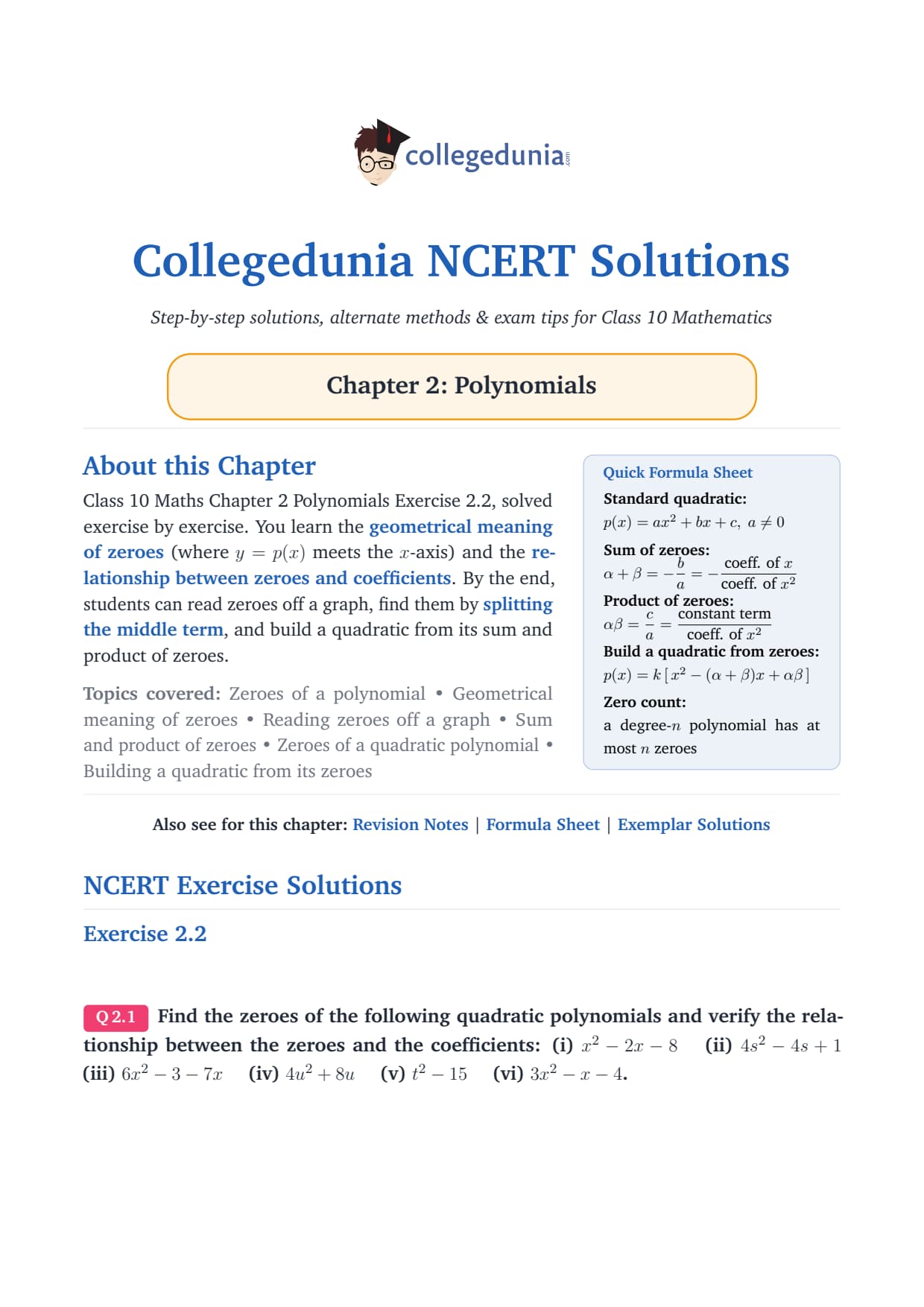
The NCERT Solutions for Class 10 Maths Chapter 2 Polynomials Exercise 2.2 solve both questions on the relationship between zeroes and coefficients, following the latest 2026-27 CBSE syllabus. You find zeroes by splitting the middle term, verify α + β = −ba and αβ = ca, then build a quadratic from a given sum and product.
- Questions covered: 2 in total, the first with six quadratics and the second with six sum-and-product pairs.
- Core skill: finding zeroes by splitting the middle term and checking them against the coefficient relationships.
- Board value: Exercise 2.2 is the high-scoring part of the 3 to 4 marks Polynomials usually carries in the CBSE Class 10 paper.
Solved by Collegedunia: Every Exercise 2.2 question below is solved by subject experts, checked against the official 2026-27 NCERT textbook, and written with full reasoning so each step earns its marks in the CBSE Class 10 paper.
What Exercise 2.2 of Polynomials Covers for Class 10
Exercise 2.2 is the calculation-and-verification part of the Polynomials chapter. It moves from the graph idea of Exercise 2.1 to the algebra of zeroes: you find the zeroes of a quadratic and then prove they obey the relationship between zeroes and coefficients. The exercise has two questions, and each one has six parts.
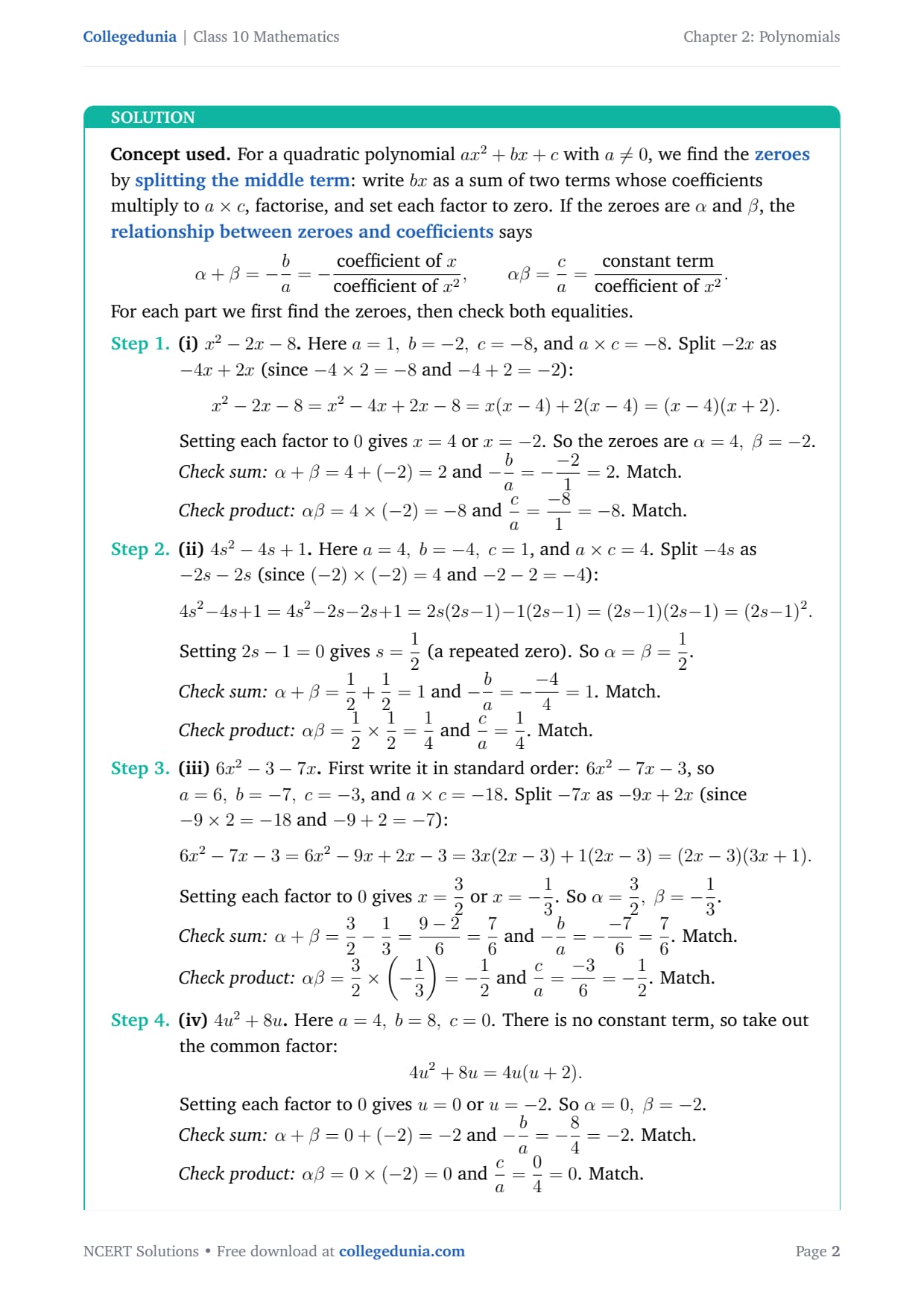
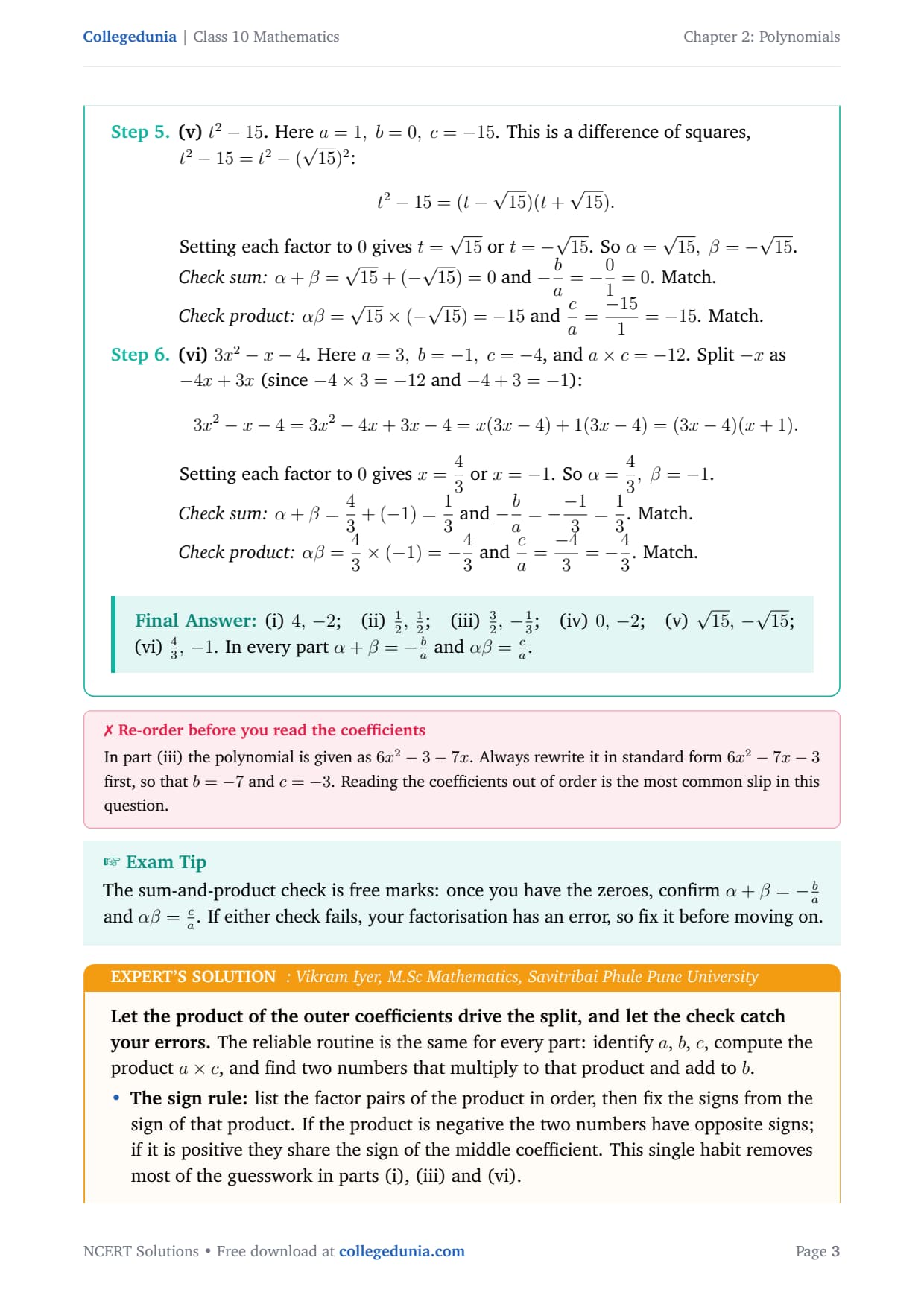
- Q1: find the zeroes of six quadratic polynomials and verify α + β = −ba and αβ = ca.
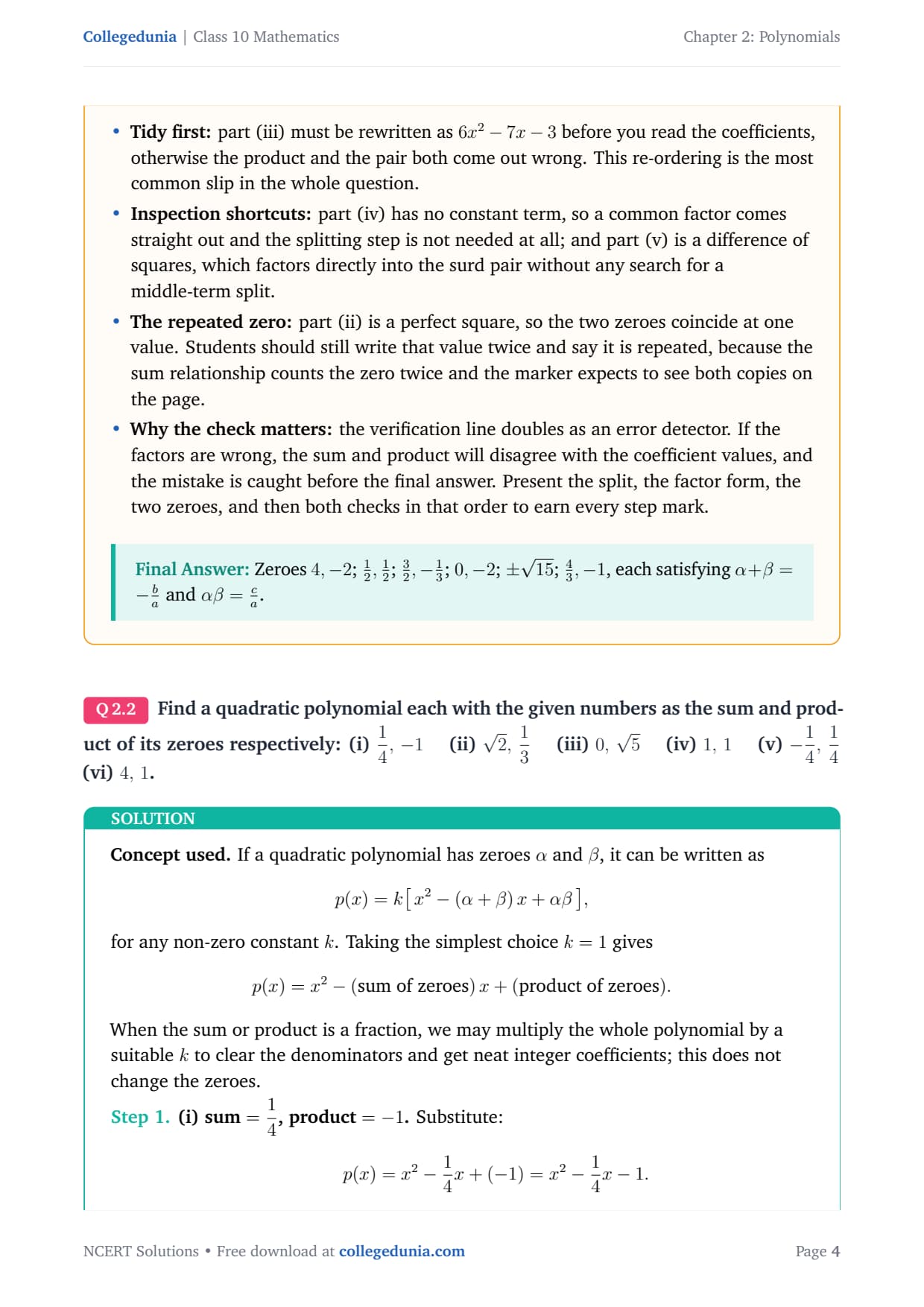
- Q2: build a quadratic polynomial from a given sum and product of zeroes, for six pairs of numbers.
How to Solve Exercise 2.2 Question by Question
The exercise rests on two short formulas. For Q1 you factorise by splitting the middle term, read off the zeroes, then check them. For Q2 you slot the sum and product into one template. Get these two routines right and both questions fall into place.
| Question | What it asks | Key step |
|---|---|---|
| Q1 | Find zeroes of six quadratics and verify the relations | Split the middle term, then check α + β = −ba and αβ = ca |
| Q1(iii) | Find zeroes of 6x2 − 3 − 7x | Reorder to 6x2 − 7x − 3 before reading b and c |
| Q1(v) | Find zeroes of t2 − 15 | Use the difference of squares to get ±√15 |
| Q2 | Build a quadratic from a given sum and product | Use p(x) = x2 − (sum)x + (product), then scale |
Relationship Between Zeroes and Coefficients in Polynomials Exercise 2.2
Question 1 turns on two formulas that link the zeroes of a quadratic to its coefficients. Once you know the zeroes, the sum and product give you a free accuracy check. These same relations are reversed in Question 2 to build a polynomial.
- Sum of zeroes: for p(x) = ax2 + bx + c, the two zeroes satisfy α + β = −ba, the negative of the x-coefficient over the x2-coefficient.
- Product of zeroes: the zeroes also satisfy αβ = ca, the constant term over the x2-coefficient.
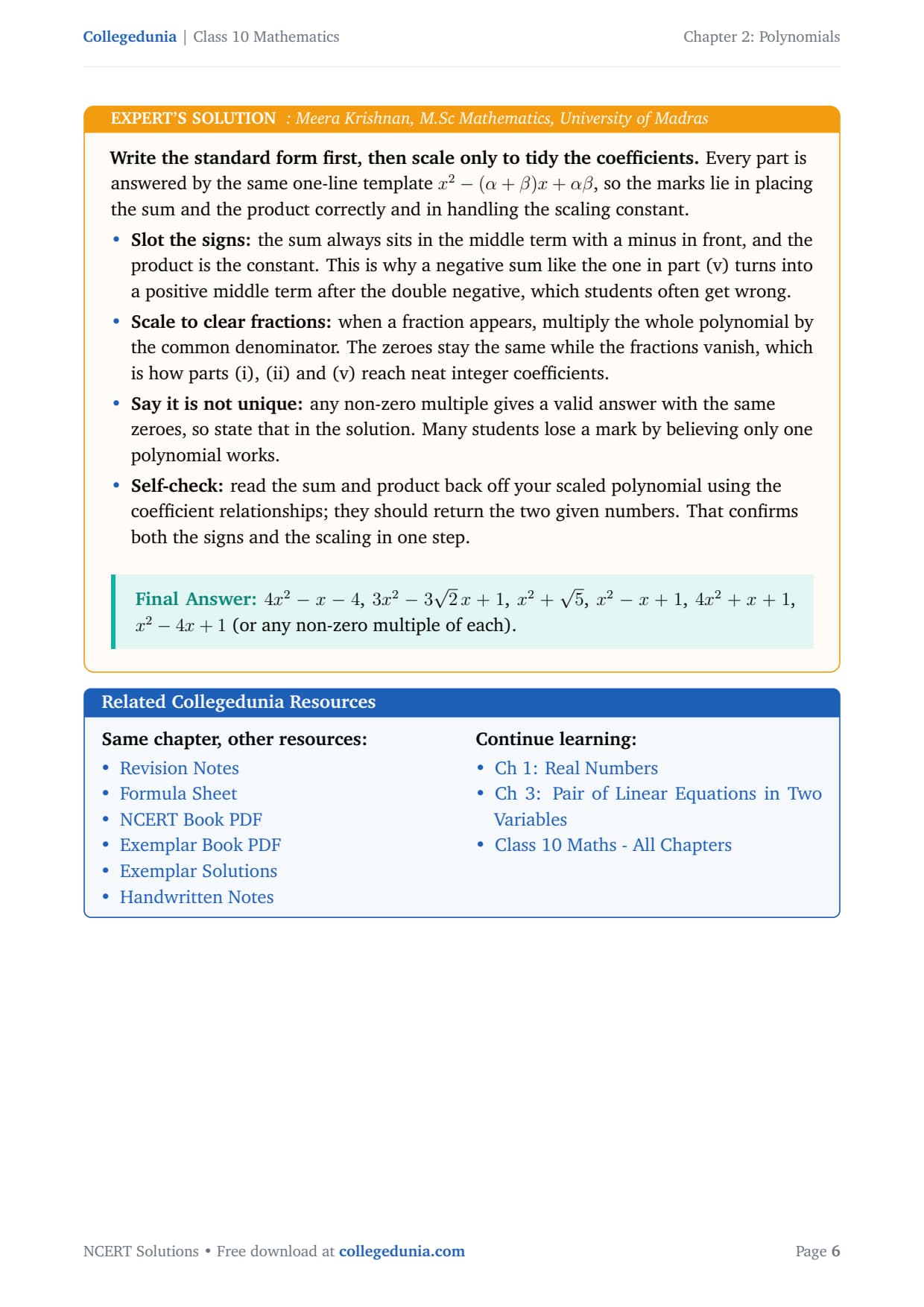
- Build from zeroes: to go the other way, use p(x) = k[x2 − (α + β)x + αβ] for any non-zero k; pick k to clear fractions.
Common Mistakes Students Make in Polynomials Exercise 2.2
Most lost marks here come from sign slips and skipped checks, not from hard ideas. A quick verification line usually catches them before they cost you.
- Reading coefficients out of order: always rewrite the polynomial in standard form ax2 + bx + c before noting a, b, c, as in Q1(iii).
- Wrong split of the middle term: the two numbers must multiply to a × c and add to b; check both conditions before factoring.
- Forgetting the repeated zero: a perfect square like Q1(ii) has one value written twice; state that it is repeated so the sum relation still counts it twice.
- Skipping the scaling constant: in Q2 multiply by a suitable k to clear fractions, and say any non-zero multiple is also a valid answer.
Polynomials Exercise 2.2 Marks and Previous Year Trends for Class 10
Polynomials is a scoring chapter in the CBSE Class 10 board paper, usually worth 3 to 4 marks. Exercise 2.2 supplies the zeroes-and-coefficients questions, which boards favour because they test both factorisation and verification.
| Question type | Where it appears | Typical marks |
|---|---|---|
| Find zeroes and verify the relations (Q1 style) | Frequent 2-mark and 3-mark questions | 2 to 3 |
| Build a quadratic from sum and product (Q2 style) | Short-answer slots | 2 |
| Mixed: find one zero, then use the sum to get the other | Application of the same relations | 3 |
These solutions follow the 2026-27 NCERT exactly, so the method you practise here matches what the CBSE Class 10 board paper rewards.
Other Resources for Polynomials Class 10 Maths
Use the table below to move between the other resources for this chapter and the other exercise of Polynomials. Each link opens the matching Collegedunia page.
| Resource | Open page |
|---|---|
| Full chapter solutions | Polynomials Class 10 NCERT Solutions |
| Previous exercise | Polynomials Class 10 NCERT Solutions Exercise 2.1 |
| Revision notes | Polynomials Class 10 Notes |
| Formula sheet | Polynomials Class 10 Formula Sheet |
| NCERT book PDF | Polynomials Class 10 NCERT Book PDF |
| Handwritten notes | Polynomials Class 10 Handwritten Notes |
| Exemplar solutions | Polynomials Class 10 NCERT Exemplar Solutions |
NCERT Solutions for Class 10 Maths Polynomials: All Exercises
The Polynomials chapter has two exercises. The table below links each exercise to its own step-by-step solution page.
| Exercise | Solutions page |
|---|---|
| Exercise 2.1 | Polynomials Class 10 NCERT Solutions Exercise 2.1 |
| Exercise 2.2 | Polynomials Class 10 NCERT Solutions Exercise 2.2 |
| Full chapter | Polynomials Class 10 NCERT Solutions (all exercises) |
NCERT Solutions for Class 10 Maths: All Chapters
Once Polynomials is done, move on to the other chapters. Each link opens that chapter's NCERT Solutions page.
| Chapter | NCERT Solutions |
|---|---|
| Chapter 1 | Real Numbers NCERT Solutions |
| Chapter 3 | Pair of Linear Equations in Two Variables NCERT Solutions |
| Chapter 4 | Quadratic Equations NCERT Solutions |
| Chapter 5 | Arithmetic Progressions NCERT Solutions |
| Chapter 6 | Triangles NCERT Solutions |
| Chapter 7 | Coordinate Geometry NCERT Solutions |
| Chapter 8 | Introduction to Trigonometry NCERT Solutions |
All NCERT Solutions for Class 10 Maths Chapter 2 Polynomials Exercise 2.2 with Step-by-Step Solutions
Questions
Find the zeroes of the following quadratic polynomials and verify the relationship between the zeroes and the coefficients: (i) x2-2x-8 (ii) 4s2-4s+1 (iii) 6x2-3-7x (iv) 4u2+8u (v) t2-15 (vi) 3x2-x-4.
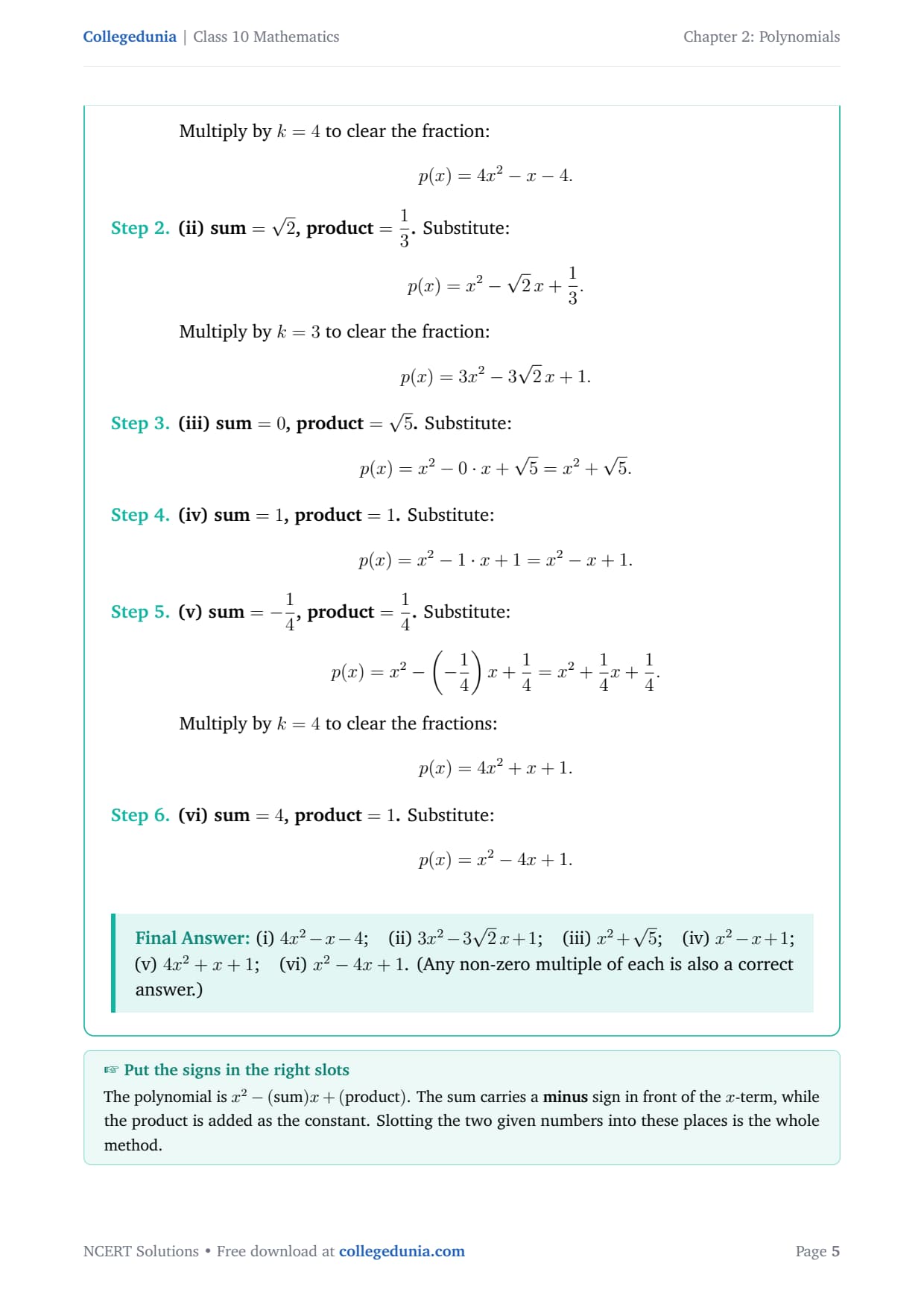
Find a quadratic polynomial each with the given numbers as the sum and product of its zeroes respectively: (i) 14, -1 (ii) √2, 13 (iii) 0, √5 (iv) 1, 1 (v) -14, 14 (vi) 4, 1.
Student Feedback
Student Feedback: Out of 16,400 students surveyed before the 2026 boards, 91% said Exercise 2.2 felt easy once they fixed the splitting-the-middle-term routine, and the most common slip was reading the coefficients before rewriting the polynomial in standard order.
Source: Collegedunia 2026-27 Class 10 Maths student poll.
Polynomials Class 10 Maths Exercise 2.2 NCERT Solutions FAQs
Ques. How many questions are there in Class 10 Maths Chapter 2 Polynomials Exercise 2.2?
Ans. Exercise 2.2 has 2 questions. The first asks you to find the zeroes of six quadratic polynomials and verify the relations, and the second asks you to build a quadratic from six given sum-and-product pairs.
Ques. Where can I download the Polynomials Class 10 Exercise 2.2 NCERT Solutions PDF?
Ans. You can download the Polynomials Class 10 Exercise 2.2 NCERT Solutions PDF directly from this page using the download card at the top. It is free and follows the 2026-27 NCERT textbook.
Ques. Are these Exercise 2.2 solutions based on the 2026-27 syllabus?
Ans. Yes. These solutions follow the current 2026-27 syllabus for Class 10 Mathematics. Exercise 2.2 on zeroes and coefficients is fully retained in the latest NCERT edition.
Ques. What is the relationship between zeroes and coefficients in Exercise 2.2?
Ans. For a quadratic ax2 + bx + c, the zeroes α and β satisfy α + β = −ba and αβ = ca. The sum is the negative of the x-coefficient over the x2-coefficient, and the product is the constant term over the x2-coefficient.
Ques. How do you build a quadratic from a given sum and product of zeroes?
Ans. Use p(x) = x2 − (sum)x + (product). Slot the sum into the middle term with a minus sign and the product as the constant, then multiply by a suitable constant to clear any fractions. Any non-zero multiple of the result is also a correct answer.



Comments