


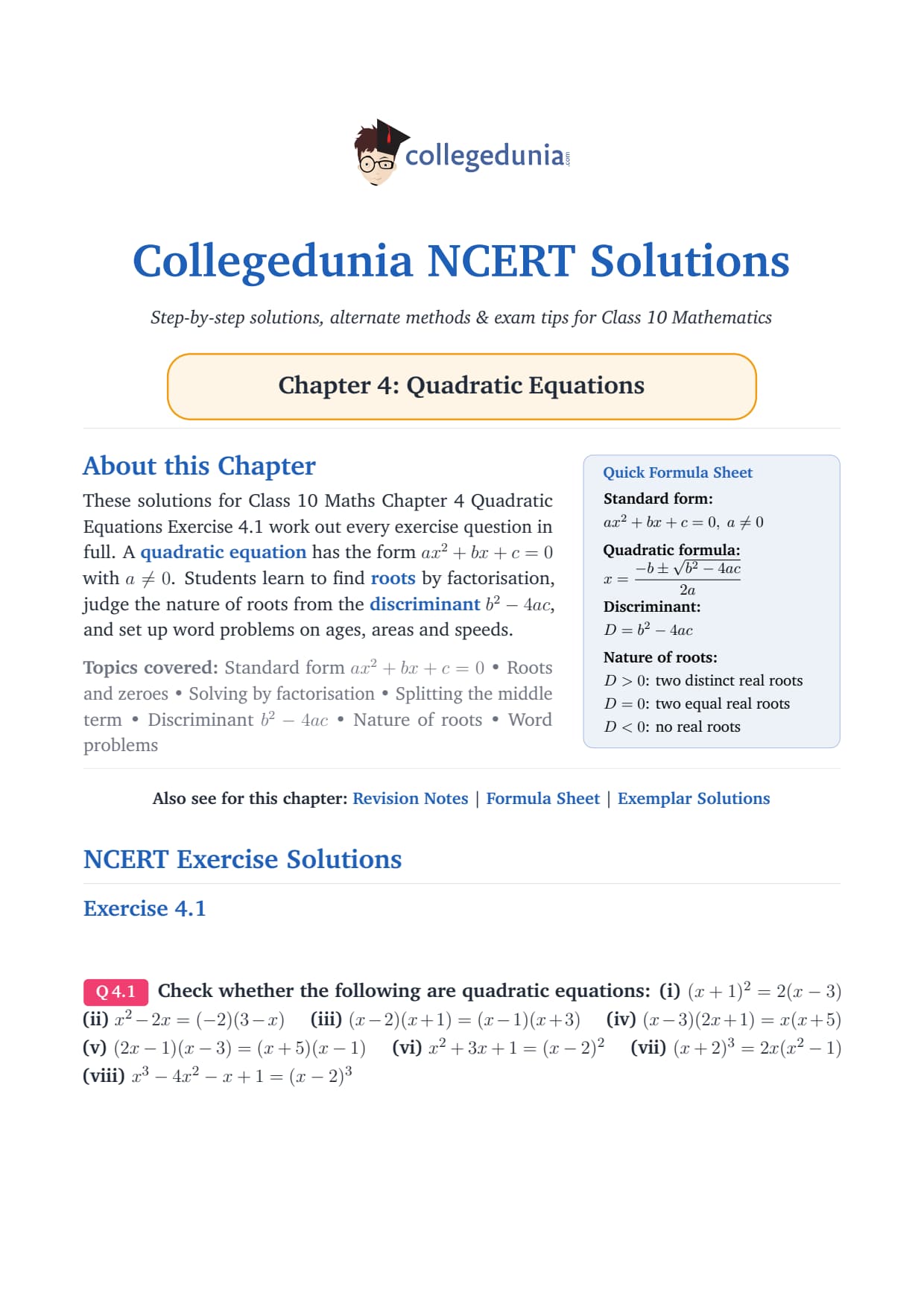
The NCERT Solutions for Class 10 Maths Chapter 4 Quadratic Equations Exercise 4.1 work out both questions in full, following the latest 2026-27 CBSE syllabus. Question 1 tests whether eight equations are truly quadratic, and Question 2 turns four real-life situations into quadratic equations in the standard form ax2 + bx + c = 0. Every step is shown the way the board expects.
- Questions covered: 2 in total, made of 8 check-the-equation parts and 4 word-problem set-ups.
- Core skill: expand both sides, move all terms to one side, and confirm the highest power of x is exactly 2.
- Board value: Exercise 4.1 sets up the 5 to 6 marks this chapter usually carries in the CBSE Class 10 paper.
Solved by Collegedunia: Every Exercise 4.1 question below is solved by subject experts, checked against the official 2026-27 NCERT textbook, and written with full working so each expansion and each word-problem set-up earns its marks in the CBSE Class 10 paper.
What Exercise 4.1 of Quadratic Equations Covers for Class 10
Exercise 4.1 is the opening set of the chapter, and it never asks you to solve a single equation. It builds two linked skills: spotting whether an equation is genuinely a quadratic equation, and writing a real-life situation as one in the standard form ax2 + bx + c = 0. The two questions cover both ends of that idea.
- Q1: check eight equations; expand both sides, shift terms, and decide if the highest power of x is exactly 2.
- Q2: form four quadratic equations from word problems on area, consecutive integers, ages, and the speed of a train.
- What you do not do here: you only set up the equations; finding the roots starts in Exercise 4.2.
How to Check Whether an Equation Is Quadratic in Exercise 4.1
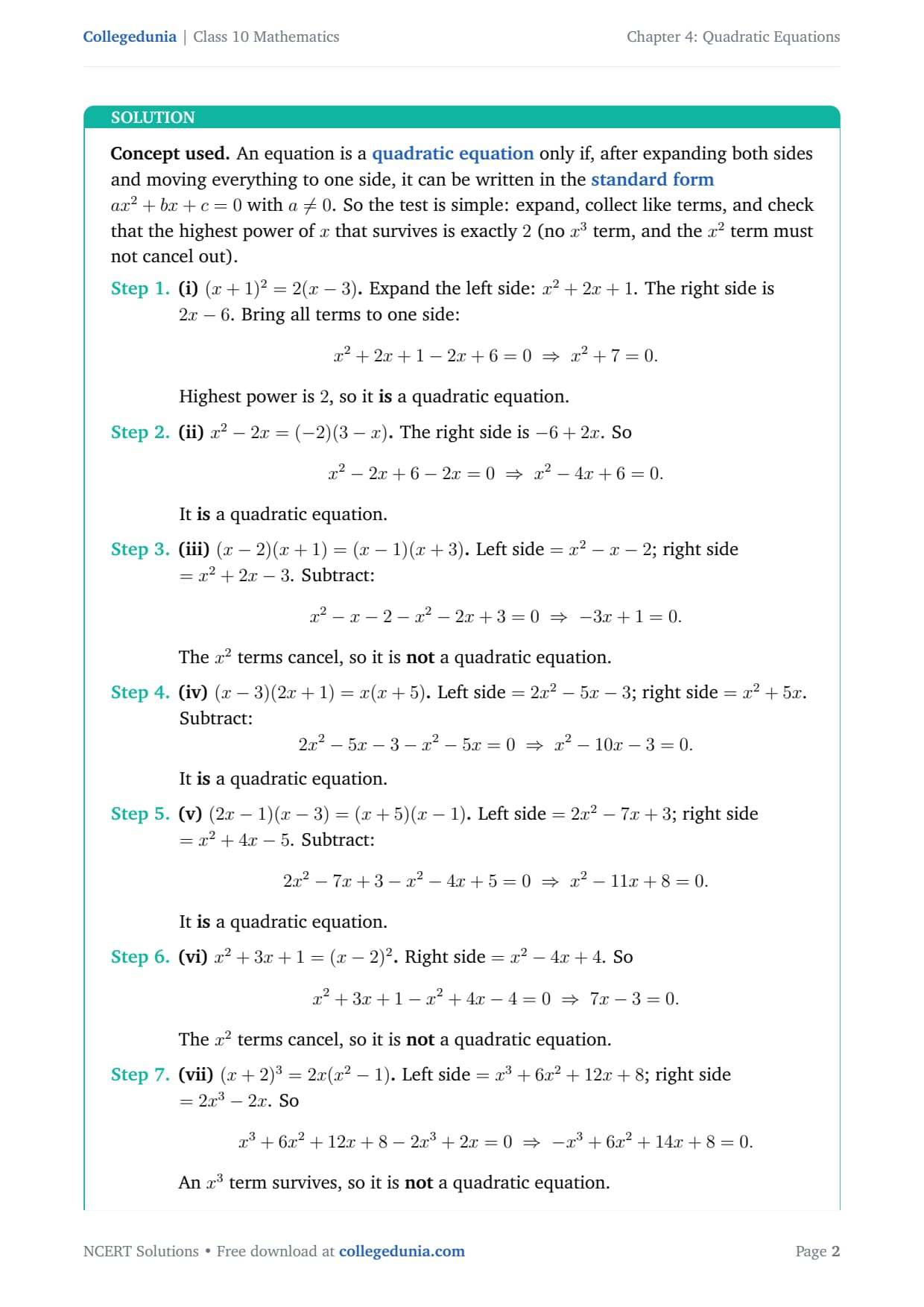
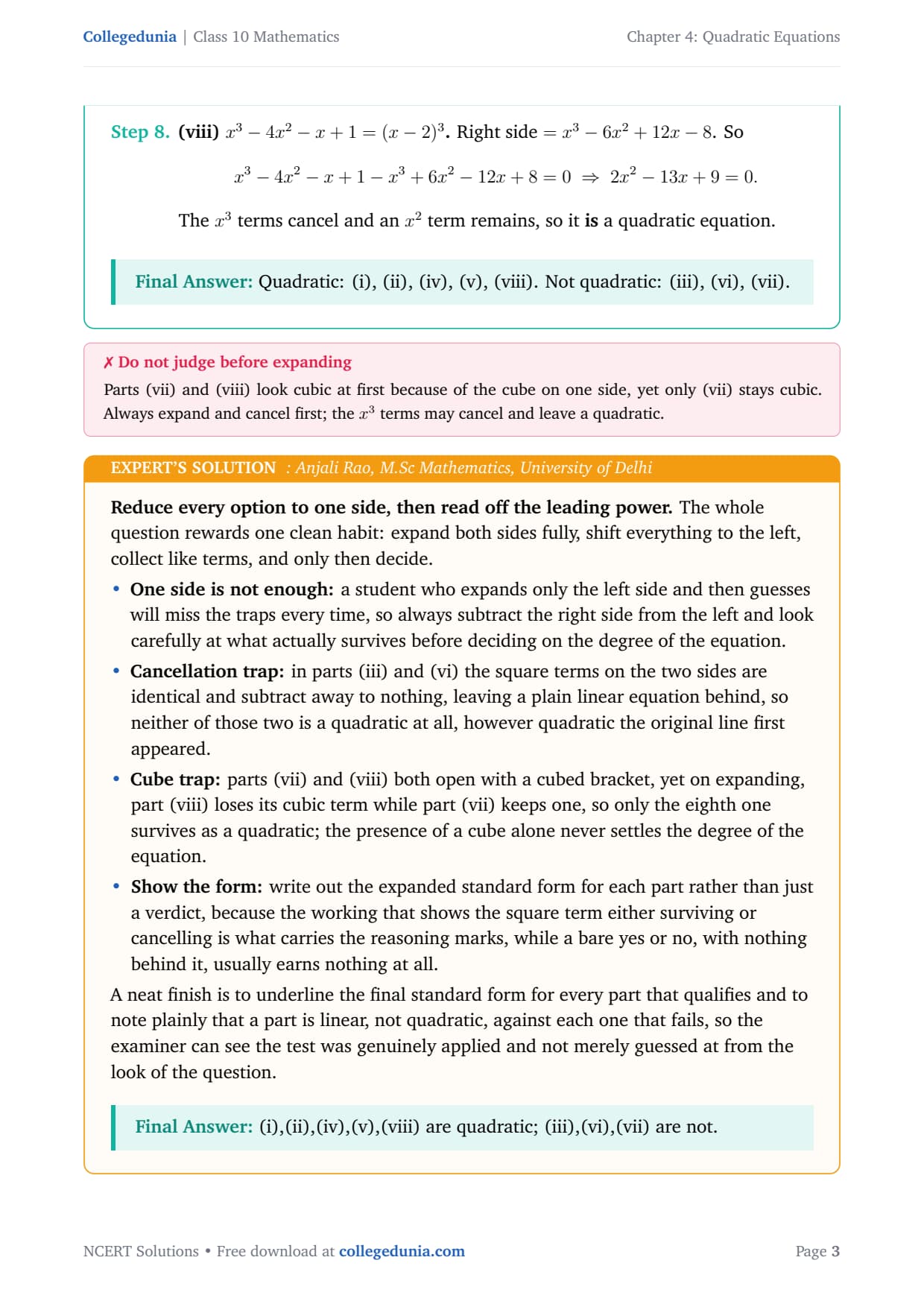
Question 1 rests on one clean habit. Expand both sides, move everything to one side, and only then read off the highest power. A quadratic equation must reduce to ax2 + bx + c = 0 with a ≠ 0, so the x2 term has to survive and no x3 term can be left behind.
| Part | Reduces to | Quadratic? |
|---|---|---|
| (i) | x2 + 7 = 0 | Yes |
| (ii) | x2 − 4x + 6 = 0 | Yes |
| (iii) | −3x + 1 = 0 | No (linear) |
| (iv) | x2 − 10x − 3 = 0 | Yes |
| (v) | x2 − 11x + 8 = 0 | Yes |
| (vi) | 7x − 3 = 0 | No (linear) |
| (vii) | −x3 + 6x2 + 14x + 8 = 0 | No (cubic) |
| (viii) | 2x2 − 13x + 9 = 0 | Yes |
How to Form Quadratic Equations from Word Problems in Exercise 4.1
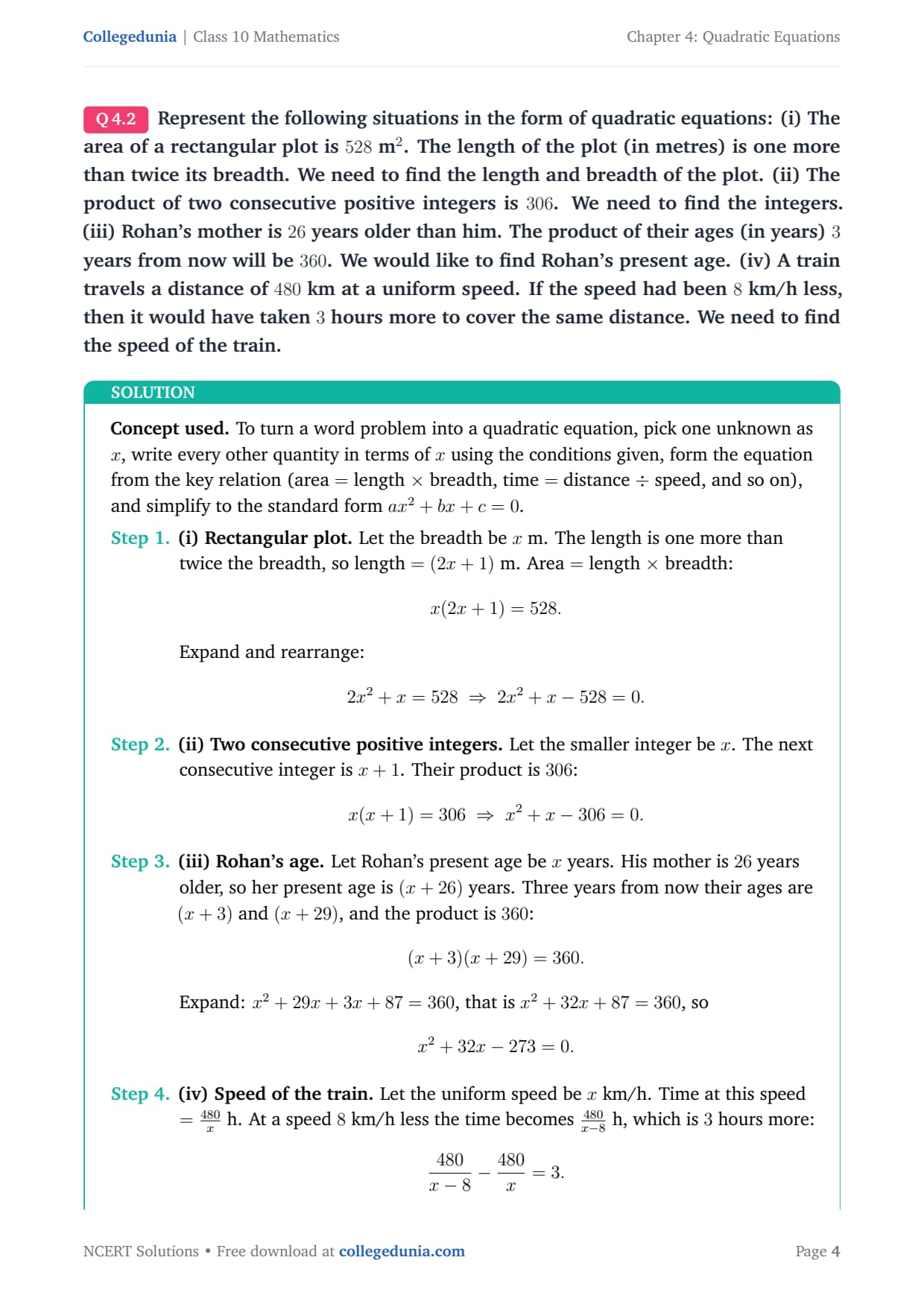
Question 2 turns four everyday situations into quadratic equations. The method is the same each time: name one unknown as x, write every other quantity in terms of x, use the key relation, and tidy the result into standard form. The marks are for the correct set-up, not for any answer.
- (i) Rectangular plot: breadth x, length 2x + 1, area 528 gives 2x2 + x − 528 = 0.
- (ii) Consecutive integers: product x(x + 1) = 306 gives x2 + x − 306 = 0.
- (iii) Rohan's age: (x + 3)(x + 29) = 360 gives x2 + 32x − 273 = 0.
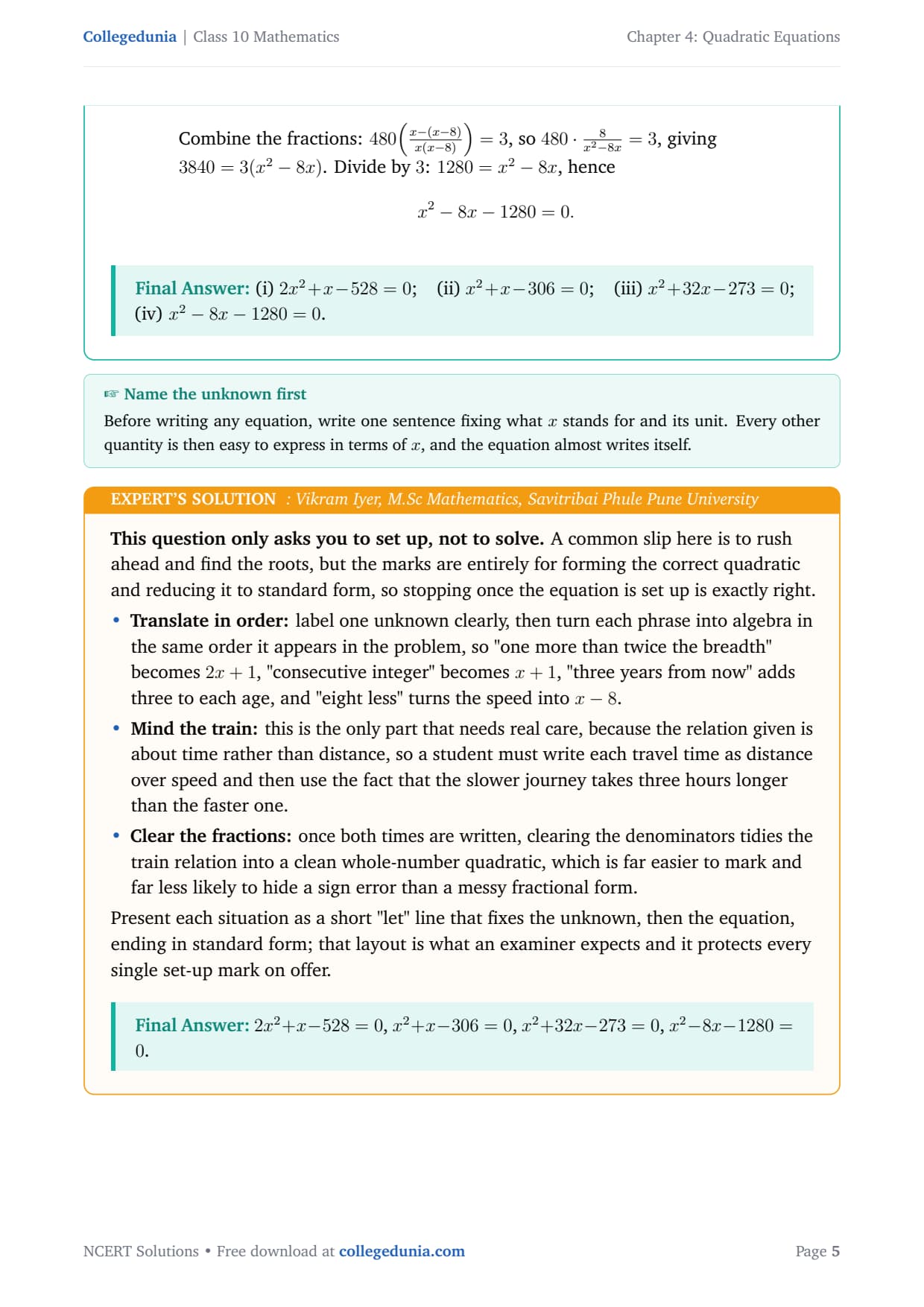
- (iv) Train speed: 480x − 8 − 480x = 3 clears to x2 − 8x − 1280 = 0.
Common Mistakes Students Make in Quadratic Equations Exercise 4.1
Most lost marks here come from small habits, not hard ideas. A quick check of your working usually catches them before they cost you a mark.
- Judging before expanding: deciding the degree from the look of a bracket is the main trap; expand and cancel first, then decide.
- Missing the cancelling square: in (iii) and (vi) the x2 terms subtract away, leaving a linear equation, so those two are not quadratic.
- Trying to solve Question 2: the question asks only for the set-up, so stop at the standard form and do not hunt for roots.
- Sign slip in the train part: the slower journey takes longer, so the larger time is 480x − 8; subtracting in the wrong order flips the equation.
Quadratic Equations Exercise 4.1 Marks and Previous Year Trends for Class 10
Quadratic Equations is a scoring chapter in the CBSE Class 10 board paper, usually worth 5 to 6 marks. Exercise 4.1 is the foundation: the standard-form test and the word-problem set-up both turn up directly, and they also feed the harder root-finding questions that follow.
| Question type | Where it appears | Typical marks |
|---|---|---|
| Check if an equation is quadratic (Q1 style) | 1-mark and 2-mark questions | 1 to 2 |
| Form a quadratic from a word problem (Q2 style) | Short-answer set-up slots | 2 |
| Set up and then solve a word problem | Frequent 3-mark and 5-mark slots | 3 to 5 |
| Standard form and value of coefficients | Objective and 1-mark questions | 1 |
These solutions follow the 2026-27 NCERT exactly, so the working you practise here matches what the board paper rewards.
Other Resources for Quadratic Equations Class 10 Maths
Use the table below to move between the other resources for this chapter and the next exercises of Quadratic Equations. Each link opens the matching Collegedunia page.
| Resource | Open page |
|---|---|
| Full chapter solutions | Quadratic Equations Class 10 NCERT Solutions |
| Next exercise | Quadratic Equations Class 10 NCERT Solutions Exercise 4.2 |
| Revision notes | Quadratic Equations Class 10 Notes |
| Formula sheet | Quadratic Equations Class 10 Formula Sheet |
| NCERT book PDF | Quadratic Equations Class 10 NCERT Book PDF |
| Handwritten notes | Quadratic Equations Class 10 Handwritten Notes |
| Exemplar solutions | Quadratic Equations Class 10 NCERT Exemplar Solutions |
NCERT Solutions for Class 10 Maths Quadratic Equations: All Exercises
The chapter has three exercises. The table below links each exercise to its own step-by-step solution page.
| Exercise | Solutions page |
|---|---|
| Exercise 4.2 | Quadratic Equations Class 10 NCERT Solutions Exercise 4.2 |
| Exercise 4.3 | Quadratic Equations Class 10 NCERT Solutions Exercise 4.3 |
| Full chapter | Quadratic Equations Class 10 NCERT Solutions (all exercises) |
NCERT Solutions for Class 10 Maths: All Chapters
Once Quadratic Equations is done, move on to the other chapters. Each link opens that chapter's NCERT Solutions page.
| Chapter | NCERT Solutions |
|---|---|
| Chapter 1 | Real Numbers NCERT Solutions |
| Chapter 2 | Polynomials NCERT Solutions |
| Chapter 3 | Pair of Linear Equations NCERT Solutions |
| Chapter 5 | Arithmetic Progressions NCERT Solutions |
| Chapter 6 | Triangles NCERT Solutions |
| Chapter 7 | Coordinate Geometry NCERT Solutions |
| Chapter 8 | Introduction to Trigonometry NCERT Solutions |
All NCERT Solutions for Class 10 Maths Chapter 4 Quadratic Equations Exercise 4.1 with Step-by-Step Solutions
Questions
Check whether the following are quadratic equations: (i) (x+1)2=2(x-3) (ii) x2-2x=(-2)(3-x) (iii) (x-2)(x+1)=(x-1)(x+3) (iv) (x-3)(2x+1)=x(x+5) (v) (2x-1)(x-3)=(x+5)(x-1) (vi) x2+3x+1=(x-2)2 (vii) (x+2)3=2x(x2-1) (viii) x3-4x2-x+1=(x-2)3
Represent the following situations in the form of quadratic equations: (i) The area of a rectangular plot is 528 m2. The length of the plot (in metres) is one more than twice its breadth. We need to find the length and breadth of the plot. (ii) The product of two consecutive positive integers is 306. We need to find the integers. (iii) Rohan's mother is 26 years older than him. The product of their ages (in years) 3 years from now will be 360. We would like to find Rohan's present age. (iv) A train travels a distance of 480 km at a uniform speed. If the speed had been 8 km/h less, then it would have taken 3 hours more to cover the same distance. We need to find the speed of the train.
Student Feedback
Student Feedback: Out of 15,400 students surveyed before the 2026 boards, 86% said Exercise 4.1 stopped tricking them once they expanded both sides before judging the degree, since the cube and the cancelling square terms are the only real traps in this set.
Source: Collegedunia 2026-27 Class 10 Maths student poll.
Quadratic Equations Class 10 Maths Exercise 4.1 NCERT Solutions FAQs
Ques. How many questions are there in Class 10 Maths Chapter 4 Quadratic Equations Exercise 4.1?
Ans. Exercise 4.1 has 2 questions. Question 1 checks whether eight given equations are quadratic, and Question 2 asks students to represent four real-life situations as quadratic equations in standard form.
Ques. Where can I download the Quadratic Equations Class 10 Exercise 4.1 NCERT Solutions PDF?
Ans. You can download the Quadratic Equations Class 10 Exercise 4.1 NCERT Solutions PDF directly from this page using the download card at the top. It is free and follows the 2026-27 NCERT textbook.
Ques. How do I check whether an equation is quadratic in Exercise 4.1?
Ans. Expand both sides, move every term to one side so the other side is 0, and collect like terms. The equation is quadratic only if it reduces to ax2 + bx + c = 0 with the x2 term surviving and no x3 term left behind.
Ques. Do I need to solve the equations in Exercise 4.1?
Ans. No. Exercise 4.1 only asks you to test or set up the equations. Finding the roots by factorisation begins in Exercise 4.2, so for this exercise you stop once the equation is written in standard form.
Ques. Are these Exercise 4.1 solutions based on the 2026-27 syllabus?
Ans. Yes. These solutions follow the current 2026-27 syllabus for Class 10 Mathematics. Exercise 4.1 on the standard form and forming quadratic equations from word problems is fully retained in the latest NCERT edition.



Comments