Maths Mentor, Thapar Institute | Updated 3+ months ago
The NCERT Solutions for Class 10 Maths Chapter 4 Quadratic Equations answer all 13 exercise questions from Exercises 4.1, 4.2 and 4.3, written for the latest 2026-27 CBSE syllabus. Every answer follows the textbook flow: checking the standard form ax2 + bx + c = 0, solving by factorisation, and judging the nature of roots from the discriminant b2 − 4ac.
All 13 NCERT questions solved step by step in plain English, with an Expert Solution per question that adds board-exam strategy.
Full coverage of factorisation, splitting the middle term, the discriminant and word problems on ages, areas and speeds, the exact ideas CBSE repeats.
Answers aligned with the 2026-27 CBSE Class 10 Mathematics syllabus and useful for school tests and the board exam alike.
Every answer is checked by Maths teachers, mapped to the 2026-27 NCERT textbook, and matched to the last five years of CBSE Class 10 board papers.
Exercise 4.2 and Exercise 4.3 carry the most marks. Split the middle term cleanly, then test both roots against the real situation.
Solving Quadratic Equations by Factorisation
The main method here is factorisation, also called splitting the middle term. To solve ax2 + bx + c = 0, use three steps.
List the factor pairs of the product a × c (the first number times the last).
Pick the pair whose sum is b, the middle number, then split the middle term with it.
Group and factor, then set each factor equal to zero to get the two roots.
Quick Tip: Clear fractions before splitting. For 2x2 − x + 1/8 = 0, multiply by 8 to get 16x2 − 8x + 1 = 0. Multiplying by a number never changes the roots.
When the two roots are equal, the quadratic is a perfect square, like 100x2 − 20x + 1 = (10x − 1)2. Write this repeated root once.
The Discriminant and Nature of Roots
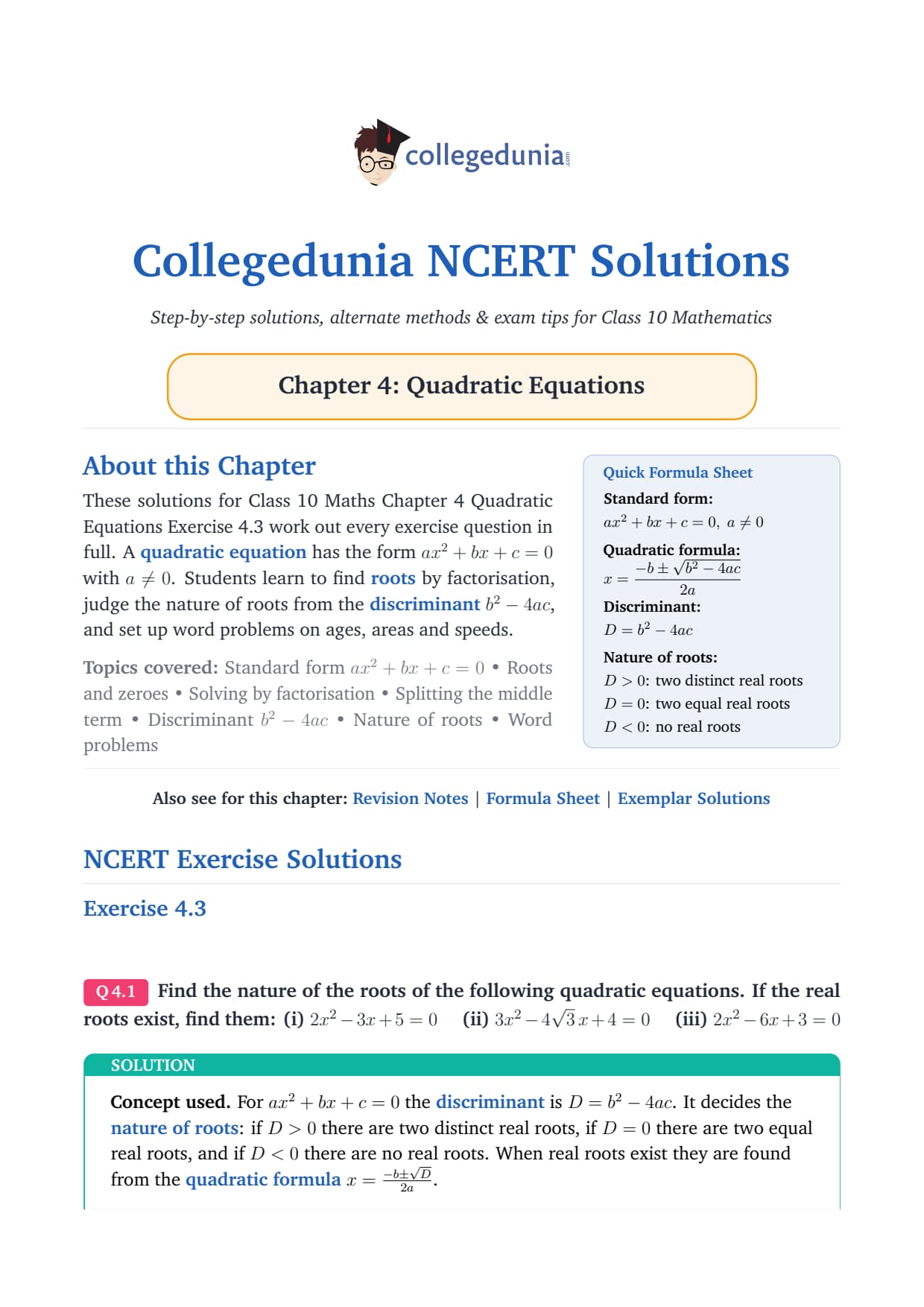
For any quadratic ax2 + bx + c = 0, the discriminant is D = b2 − 4ac. Its sign tells you the kind of roots without solving the equation.
Discriminant
Nature of roots
What it means
D > 0
Two distinct real roots
Two different values of x work.
D = 0
Two equal real roots
A repeated root; a perfect square.
D < 0
No real roots
No real x works.
Remember: A "is it possible to design..." question is testing the discriminant. State D ≥ 0 so real roots exist, then give the dimensions for full marks.
When real roots exist, find them with the quadratic formula x = (−b ± √D) / 2a. A negative D is the full answer, showing the situation can never happen. In the exam, write D, state its sign, name the nature in words, then find the roots.
Common Mistakes in the Quadratic Equations Chapter
The mistakes that cost marks in board answers:
Judging the degree before expanding: an x3 term may cancel and leave a quadratic, or an x2 term may cancel and leave a linear equation.
Keeping an invalid root: a count or a length must be a positive whole number, so reject negative and fractional roots with a one-line reason.
Forgetting to square the surd: in (−4√3)2 the surd also squares, giving 48, not a negative.
Accepting k = 0 for equal roots: if k = 0 makes the x2 term zero, the equation is no longer quadratic.
Other Resources for Class 10 Maths Chapter 4 Quadratic Equations
Use this Solutions page with the matching notes, formula sheet and NCERT book chapter, all linked below.
Resource
What it covers
Open
NCERT Solutions
Step-by-step answers to all 13 questions, with an Expert Solution each.
All NCERT Solutions for Class 10 Maths Chapter 4 Quadratic Equations with Step-by-Step Solutions
Questions
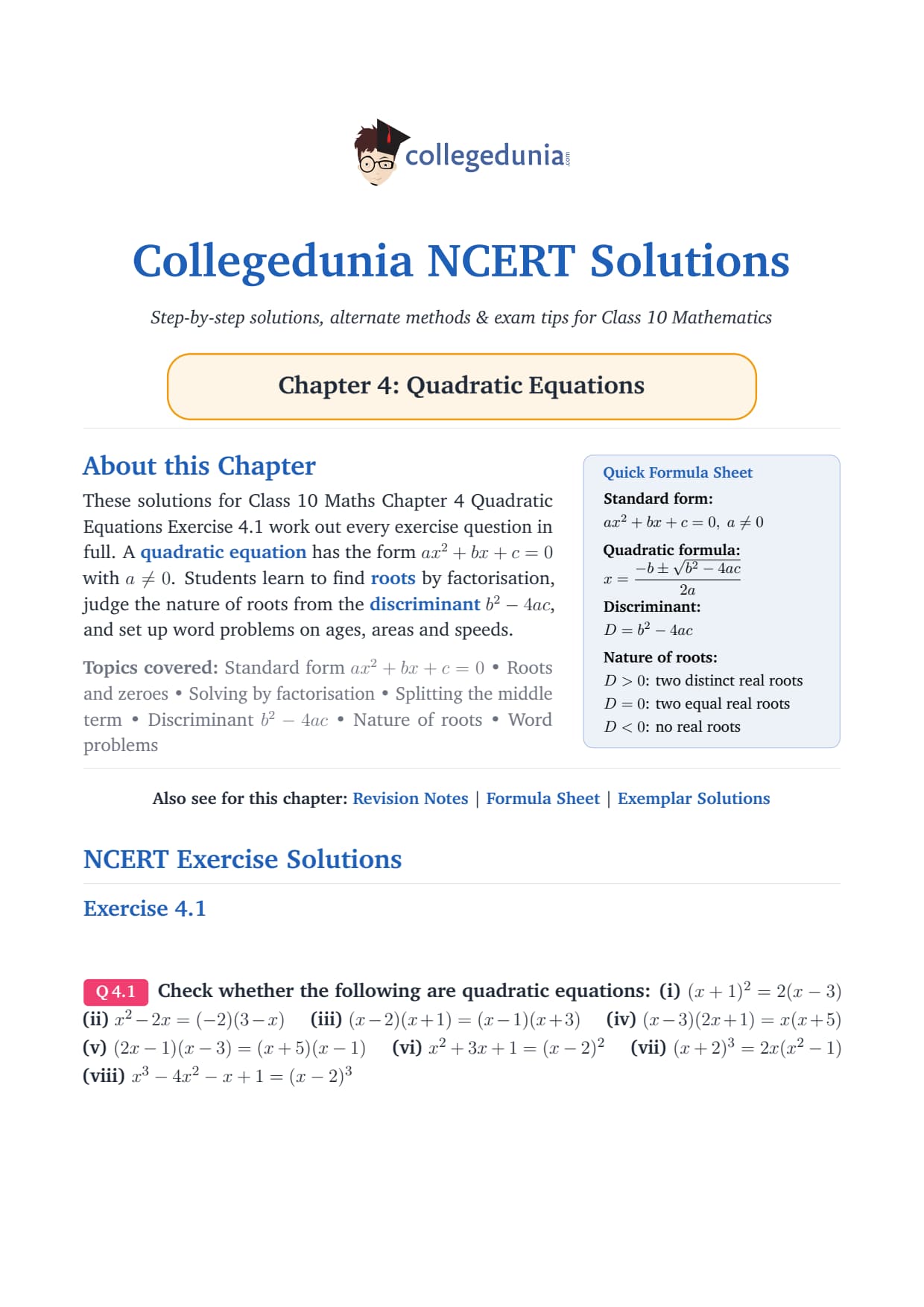
Q 4.1
Check whether the following are quadratic equations:
(i) (x+1)2=2(x-3) (ii) x2-2x=(-2)(3-x)
(iii) (x-2)(x+1)=(x-1)(x+3) (iv) (x-3)(2x+1)=x(x+5)
(v) (2x-1)(x-3)=(x+5)(x-1) (vi) x2+3x+1=(x-2)2
(vii) (x+2)3=2x(x2-1) (viii) x3-4x2-x+1=(x-2)3
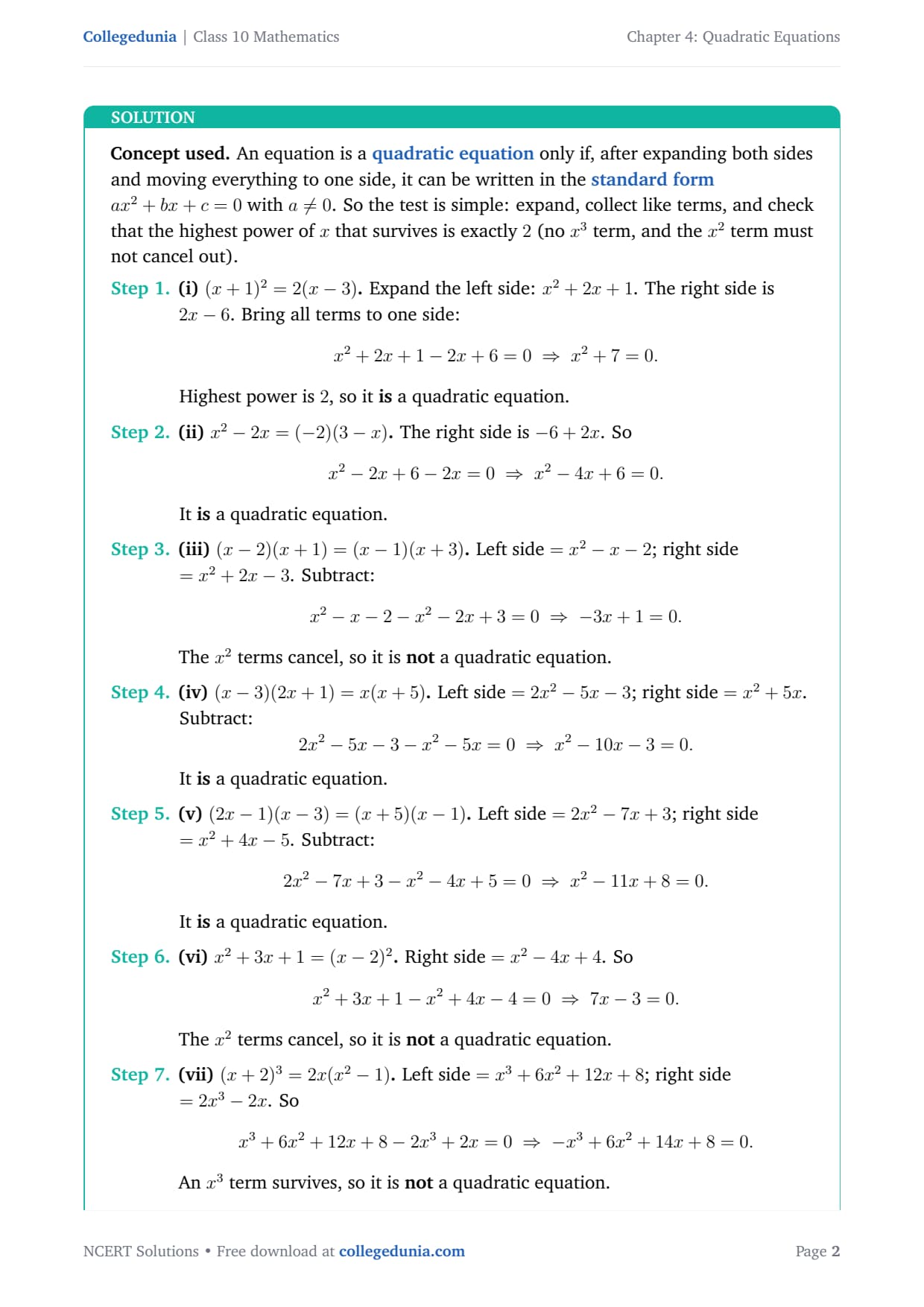
Concept used. An equation is a quadratic equation only if,
after expanding both sides and moving everything to one side, it can be
written in the standard formax2+bx+c=0 with a≠ 0. So the
test is simple: expand, collect like terms, and check that the highest power
of x that survives is exactly 2 (no x3 term, and the x2 term must
not cancel out).
(i) (x+1)2=2(x-3). Expand the left side:
x2+2x+1. The right side is 2x-6. Bring all terms to one side:
x2+2x+1-2x+6=0 ⇒ x2+7=0.
Highest power is 2, so it is a quadratic equation.
(ii) x2-2x=(-2)(3-x). The right side is
-6+2x. So
x2-2x+6-2x=0 ⇒ x2-4x+6=0.
It is a quadratic equation.
(iii) (x-2)(x+1)=(x-1)(x+3). Left side
=x2-x-2; right side =x2+2x-3. Subtract:
x2-x-2-x2-2x+3=0 ⇒ -3x+1=0.
The x2 terms cancel, so it is not a quadratic equation.
(iv) (x-3)(2x+1)=x(x+5). Left side
=2x2-5x-3; right side =x2+5x. Subtract:
2x2-5x-3-x2-5x=0 ⇒ x2-10x-3=0.
It is a quadratic equation.
(v) (2x-1)(x-3)=(x+5)(x-1). Left side
=2x2-7x+3; right side =x2+4x-5. Subtract:
2x2-7x+3-x2-4x+5=0 ⇒ x2-11x+8=0.
It is a quadratic equation.
(vi) x2+3x+1=(x-2)2. Right side
=x2-4x+4. So
x2+3x+1-x2+4x-4=0 ⇒ 7x-3=0.
The x2 terms cancel, so it is not a quadratic equation.
(vii) (x+2)3=2x(x2-1). Left side
=x3+6x2+12x+8; right side =2x3-2x. So
x3+6x2+12x+8-2x3+2x=0 ⇒ -x3+6x2+14x+8=0.
An x3 term survives, so it is not a quadratic equation.
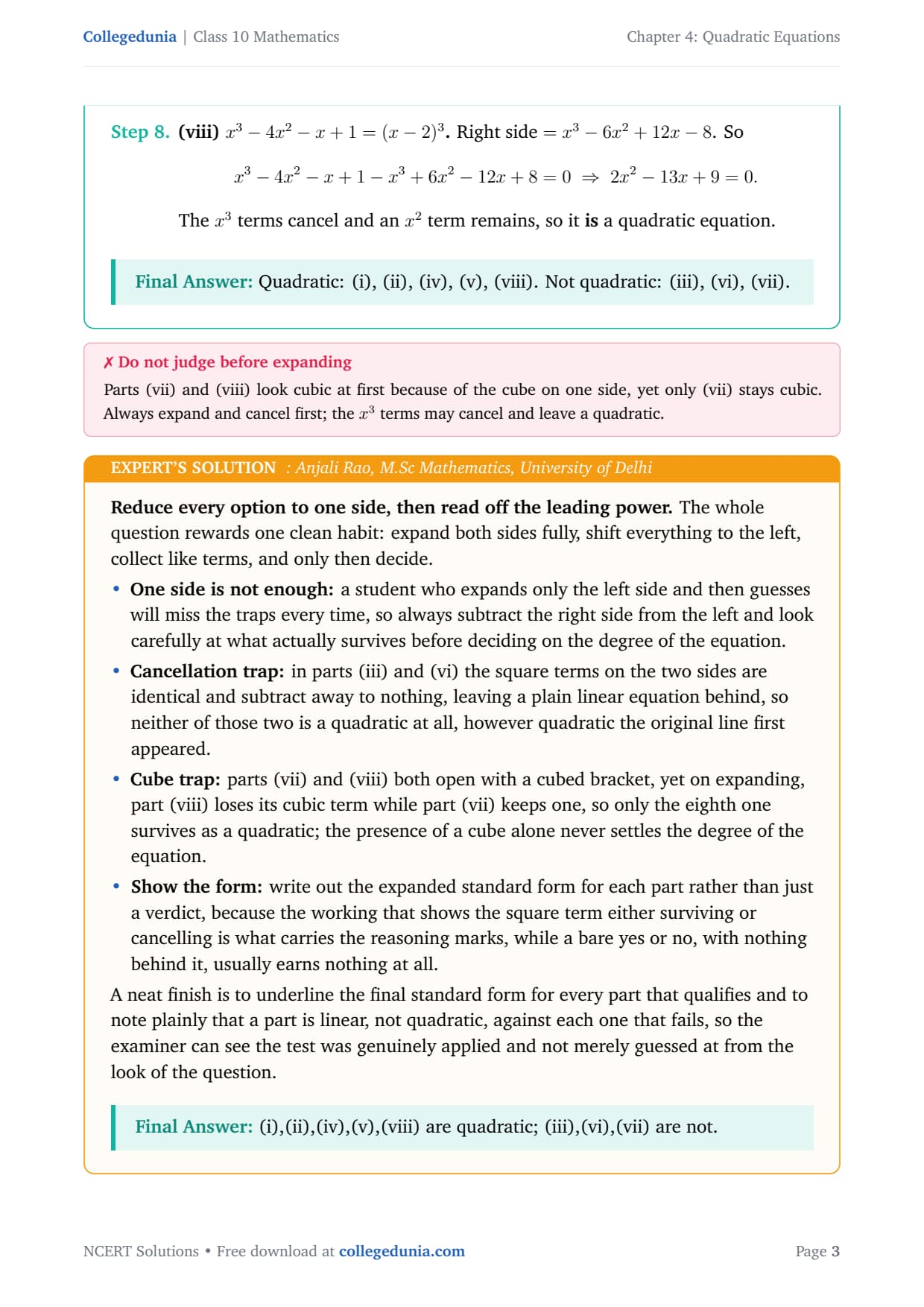
(viii) x3-4x2-x+1=(x-2)3. Right side
=x3-6x2+12x-8. So
x3-4x2-x+1-x3+6x2-12x+8=0 ⇒ 2x2-13x+9=0.
The x3 terms cancel and an x2 term remains, so it
is a quadratic equation.
Reduce every option to one side, then read off the leading power.
The whole question rewards one clean habit: expand both sides fully, shift
everything to the left, collect like terms, and only then decide.
One side is not enough: a student who expands only the left
side and then guesses will miss the traps every time, so always
subtract the right side from the left and look carefully at what
actually survives before deciding on the degree of the equation.
Cancellation trap: in parts (iii) and (vi) the square terms on
the two sides are identical and subtract away to nothing, leaving a
plain linear equation behind, so neither of those two is a quadratic at
all, however quadratic the original line first appeared.
Cube trap: parts (vii) and (viii) both open with a cubed
bracket, yet on expanding, part (viii) loses its cubic term while part
(vii) keeps one, so only the eighth one survives as a quadratic; the
presence of a cube alone never settles the degree of the equation.
Show the form: write out the expanded standard form for each
part rather than just a verdict, because the working that shows the
square term either surviving or cancelling is what carries the reasoning
marks, while a bare yes or no, with nothing behind it, usually earns
nothing at all.
A neat finish is to underline the final standard form for every part that
qualifies and to note plainly that a part is linear, not quadratic, against
each one that fails, so the examiner can see the test was genuinely applied and
not merely guessed at from the look of the question.
(i),(ii),(iv),(v),(viii) are quadratic; (iii),(vi),(vii) are not.
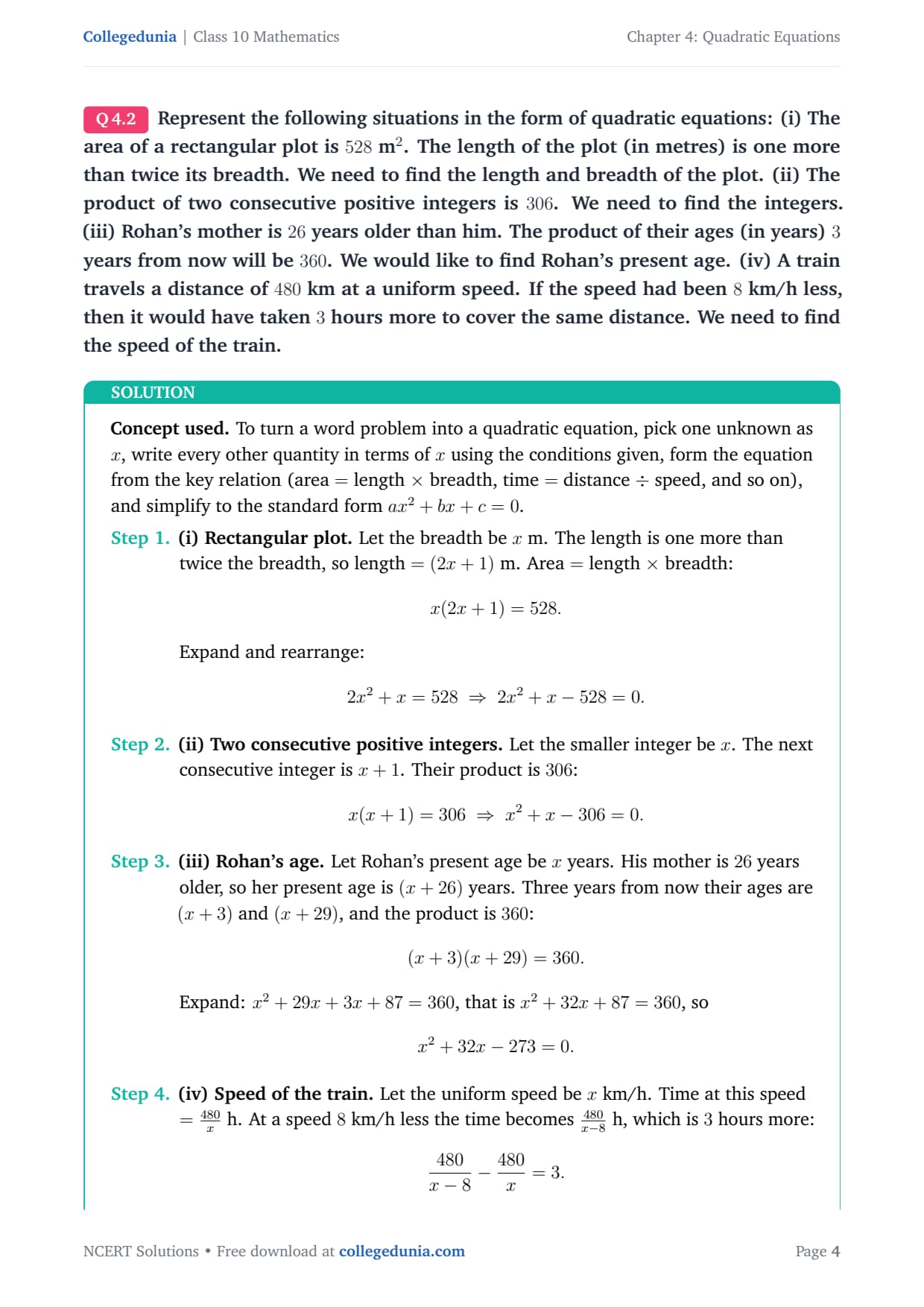
Q 4.2
Represent the following situations in the form of quadratic equations:
(i) The area of a rectangular plot is 528 m2. The length of the plot
(in metres) is one more than twice its breadth. We need to find the length and
breadth of the plot.
(ii) The product of two consecutive positive integers is 306. We need to find
the integers.
(iii) Rohan's mother is 26 years older than him. The product of their ages
(in years) 3 years from now will be 360. We would like to find Rohan's
present age.
(iv) A train travels a distance of 480 km at a uniform speed. If the
speed had been 8 km/h less, then it would have taken 3 hours more to
cover the same distance. We need to find the speed of the train.
Concept used. To turn a word problem into a quadratic equation, pick
one unknown as x, write every other quantity in terms of x using the
conditions given, form the equation from the key relation (area = length
× breadth, time = distance ÷ speed, and so on), and simplify to
the standard form ax2+bx+c=0.
(i) Rectangular plot. Let the breadth be x m. The length is
one more than twice the breadth, so length =(2x+1) m.
Area = length × breadth:
x(2x+1)=528.
Expand and rearrange:
2x2+x=528 ⇒ 2x2+x-528=0.
(ii) Two consecutive positive integers. Let the smaller
integer be x. The next consecutive integer is x+1.
Their product is 306:
x(x+1)=306 ⇒ x2+x-306=0.
(iii) Rohan's age. Let Rohan's present age be x years. His
mother is 26 years older, so her present age is (x+26) years.
Three years from now their ages are (x+3) and (x+29), and the
product is 360:
(x+3)(x+29)=360.
Expand: x2+29x+3x+87=360, that is x2+32x+87=360, so
x2+32x-273=0.
(iv) Speed of the train. Let the uniform speed be x km/h.
Time at this speed =480x h. At a speed 8 km/h less the
time becomes 480x-8 h, which is 3 hours more:
480x-8-480x=3.
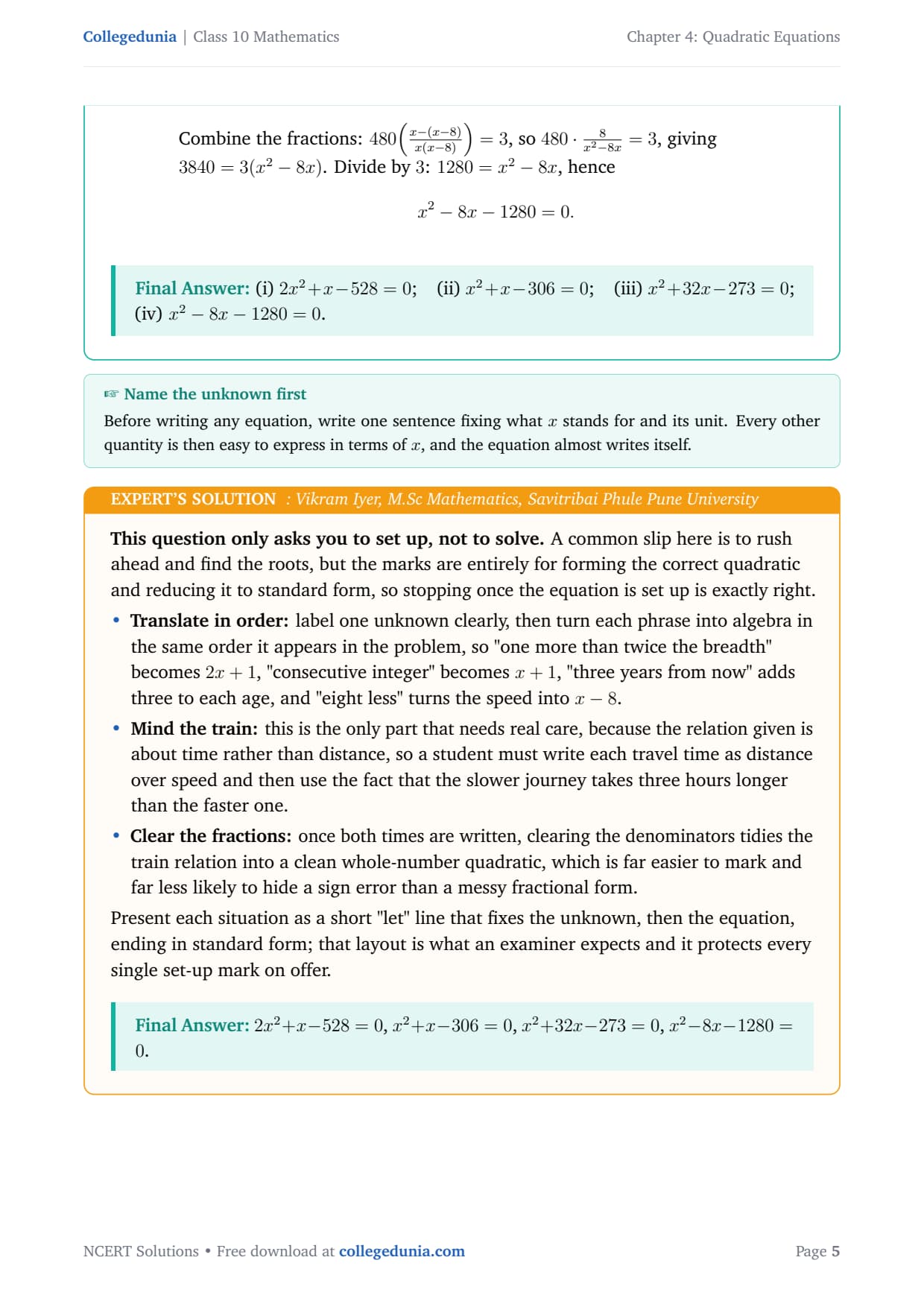
Combine the fractions: 480(x-(x-8)x(x-8))=3,
so 480·8x2-8x=3, giving 3840=3(x2-8x).
Divide by 3: 1280=x2-8x, hence
x2-8x-1280=0.
(i) 2x2+x-528=0; (ii) x2+x-306=0; (iii) x2+32x-273=0; (iv) x2-8x-1280=0.
VI
Vikram Iyer
M.Sc Mathematics, Savitribai Phule Pune University
Verified Expert
This question only asks you to set up, not to solve. A common slip
here is to rush ahead and find the roots, but the marks are entirely for
forming the correct quadratic and reducing it to standard form, so stopping
once the equation is set up is exactly right.
Translate in order: label one unknown clearly, then turn each
phrase into algebra in the same order it appears in the problem, so
"one more than twice the breadth" becomes 2x+1, "consecutive integer"
becomes x+1, "three years from now" adds three to each age, and "eight
less" turns the speed into x-8.
Mind the train: this is the only part that needs real care,
because the relation given is about time rather than distance, so a
student must write each travel time as distance over speed and then use
the fact that the slower journey takes three hours longer than the
faster one.
Clear the fractions: once both times are written, clearing the
denominators tidies the train relation into a clean whole-number
quadratic, which is far easier to mark and far less likely to hide a
sign error than a messy fractional form.
Present each situation as a short "let" line that fixes the unknown, then the
equation, ending in standard form; that layout is what an examiner expects and
it protects every single set-up mark on offer.
NCERT solutions Class 10 Mathematics Chapter 4 Quadratic Equations
All 6 questions with collapsible Solution and Expert Solution. Tap a button to reveal the working.
Questions
Q 4.1
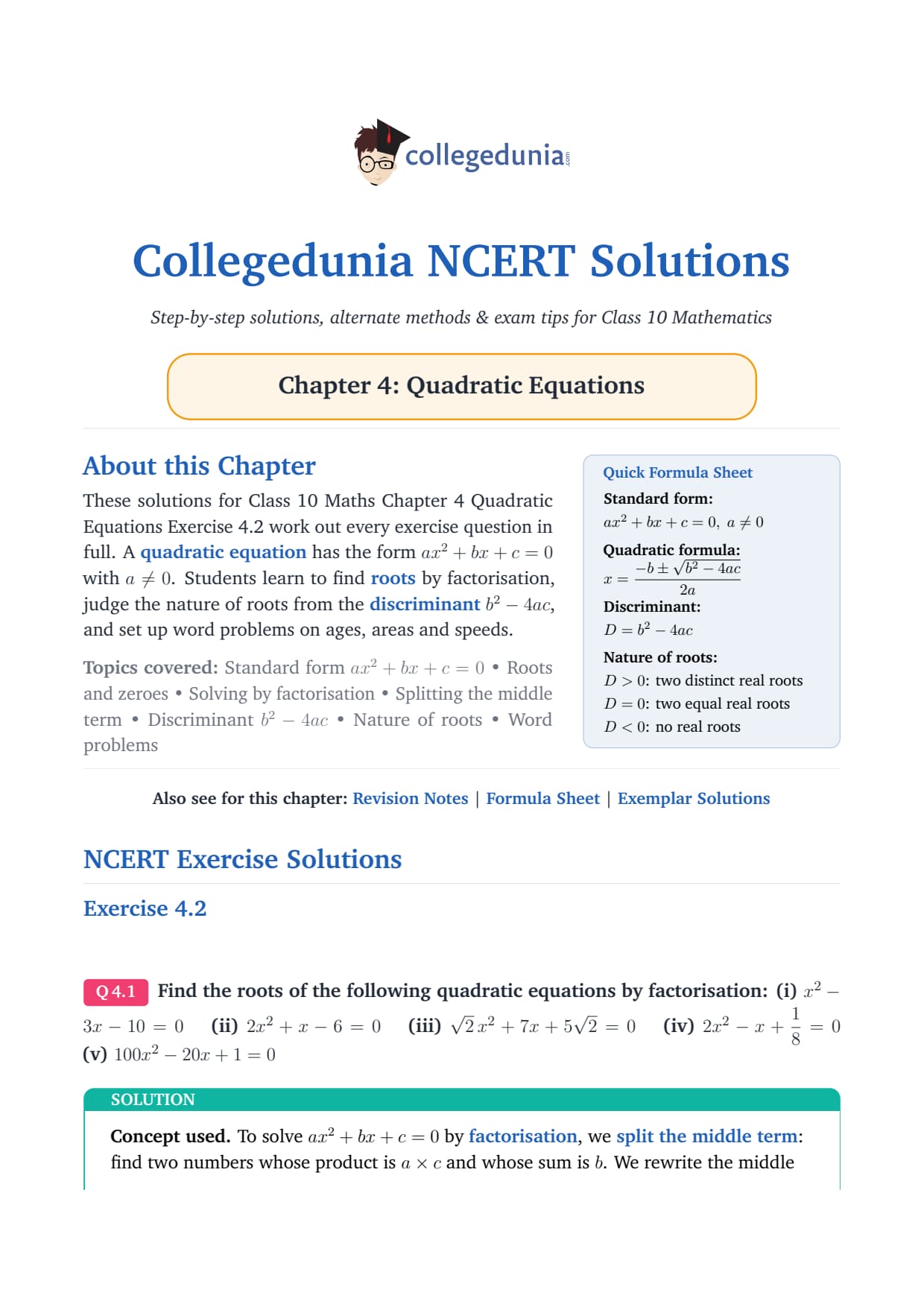
Find the roots of the following quadratic equations by factorisation:
(i) x2-3x-10=0 (ii) 2x2+x-6=0
(iii) √2 x2+7x+5√2=0 (iv) 2x2-x+18=0
(v) 100x2-20x+1=0
Concept used. To solve ax2+bx+c=0 by factorisation, we
split the middle term: find two numbers whose product is a× c
and whose sum is b. We rewrite the middle term using these two numbers, take
out common factors in pairs, and write the expression as a product of two
linear factors. Setting each factor equal to zero gives the roots,
because if a product is zero then at least one factor is zero.
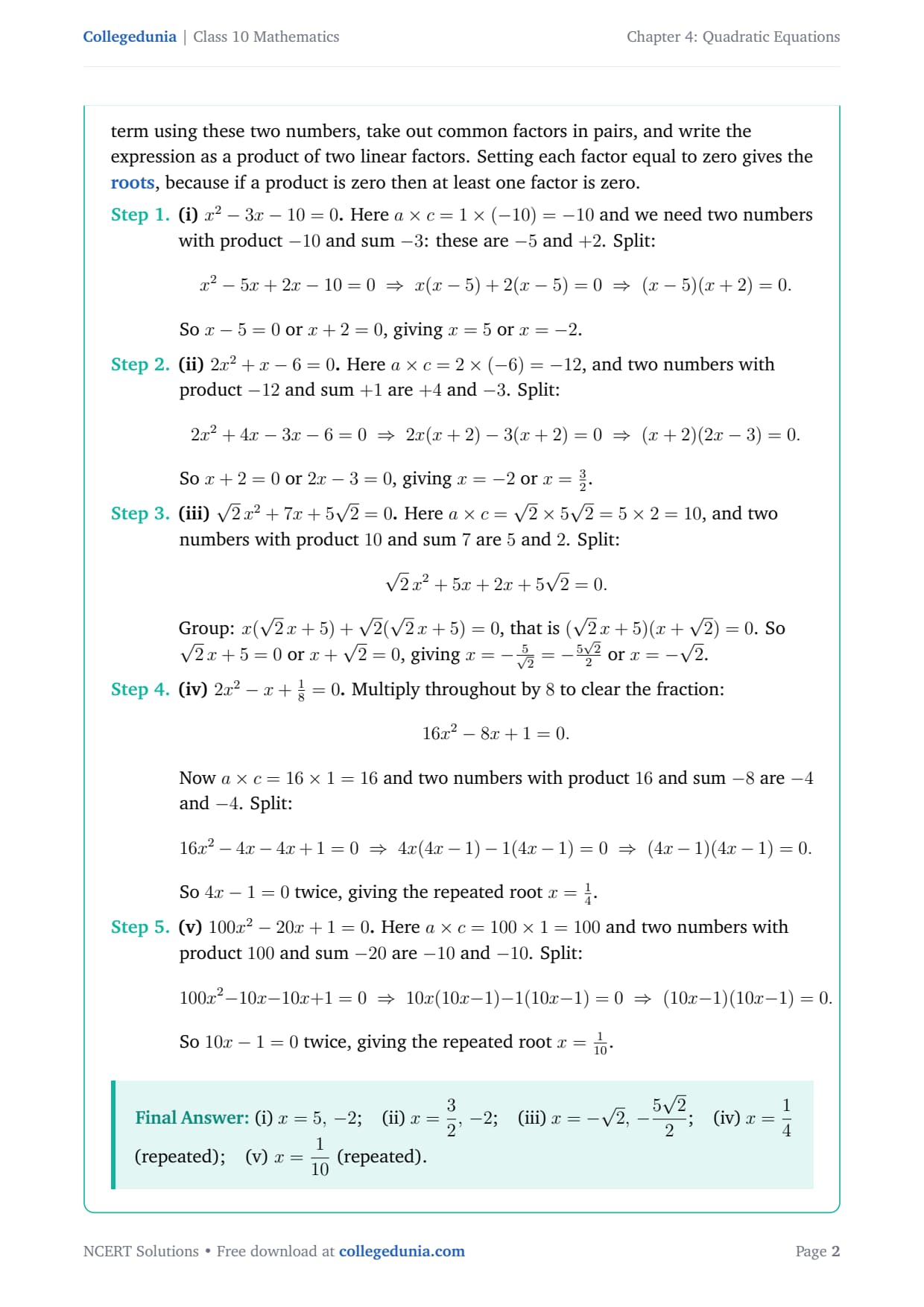
(i) x2-3x-10=0. Here a× c=1×(-10)=-10 and we
need two numbers with product -10 and sum -3: these are -5 and
+2. Split:
x2-5x+2x-10=0 ⇒ x(x-5)+2(x-5)=0 ⇒ (x-5)(x+2)=0.
So x-5=0 or x+2=0, giving x=5 or x=-2.
(ii) 2x2+x-6=0. Here a× c=2×(-6)=-12, and two
numbers with product -12 and sum +1 are +4 and -3. Split:
2x2+4x-3x-6=0 ⇒ 2x(x+2)-3(x+2)=0 ⇒ (x+2)(2x-3)=0.
So x+2=0 or 2x-3=0, giving x=-2 or x=32.
(iii) √2 x2+7x+5√2=0. Here
a× c=√2× 5√2=5× 2=10, and two numbers with
product 10 and sum 7 are 5 and 2. Split:
√2 x2+5x+2x+5√2=0.
Group: x(√2x+5)+√2(√2x+5)=0, that is
(√2x+5)(x+√2)=0.
So √2x+5=0 or x+√2=0, giving
x=-5√2=-5√22 or x=-√2.
(iv) 2x2-x+18=0. Multiply throughout by 8 to
clear the fraction:
16x2-8x+1=0.
Now a× c=16× 1=16 and two numbers with product 16 and sum
-8 are -4 and -4. Split:
16x2-4x-4x+1=0 ⇒ 4x(4x-1)-1(4x-1)=0 ⇒ (4x-1)(4x-1)=0.
So 4x-1=0 twice, giving the repeated root x=14.
(v) 100x2-20x+1=0. Here a× c=100× 1=100 and
two numbers with product 100 and sum -20 are -10 and -10. Split:
100x2-10x-10x+1=0 ⇒ 10x(10x-1)-1(10x-1)=0 ⇒ (10x-1)(10x-1)=0.
So 10x-1=0 twice, giving the repeated root x=110.
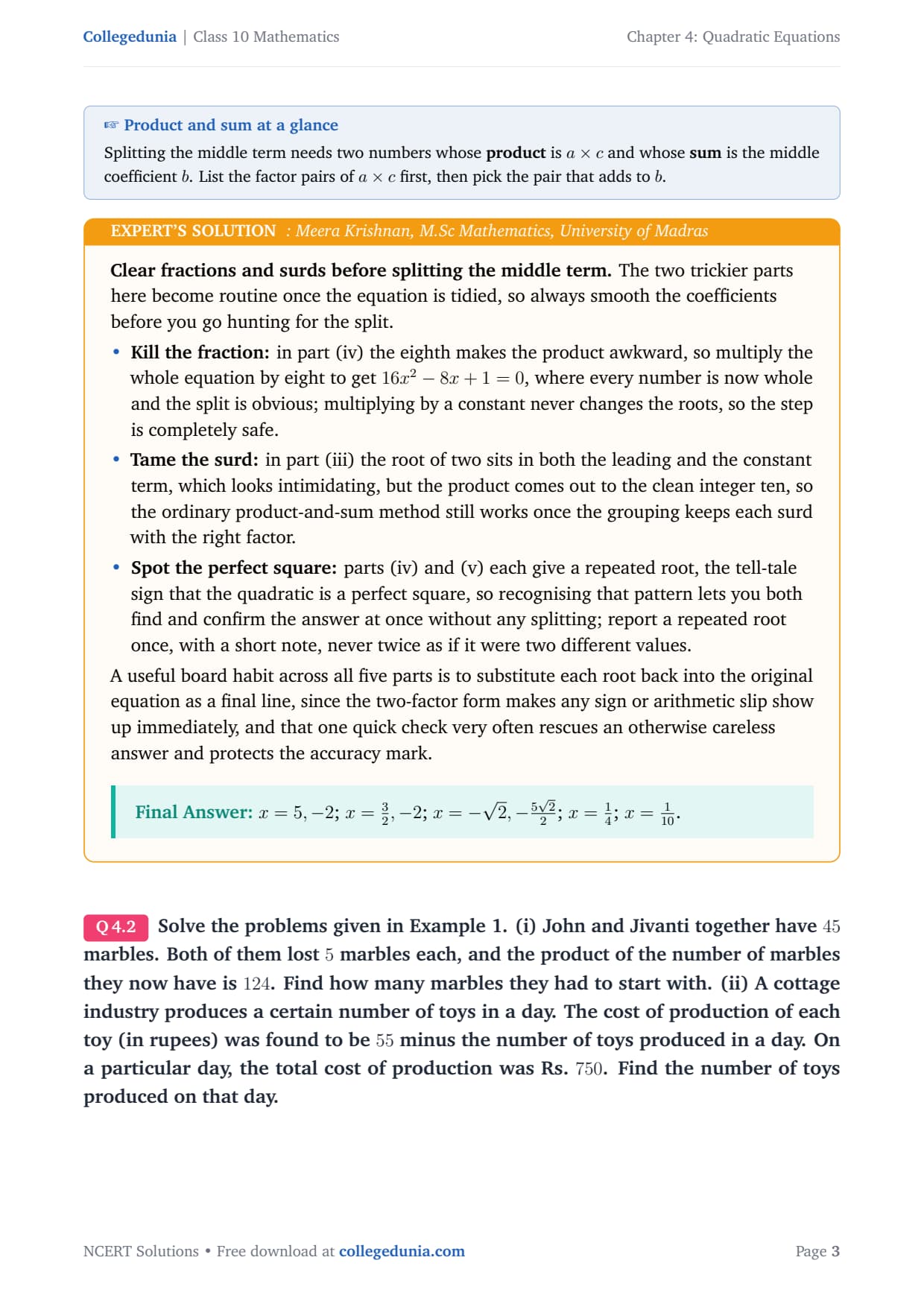
Clear fractions and surds before splitting the middle term. The two
trickier parts here become routine once the equation is tidied, so always
smooth the coefficients before you go hunting for the split.
Kill the fraction: in part (iv) the eighth makes the product
awkward, so multiply the whole equation by eight to get
16x2-8x+1=0, where every number is now whole and the split is
obvious; multiplying by a constant never changes the roots, so the step
is completely safe.
Tame the surd: in part (iii) the root of two sits in both the
leading and the constant term, which looks intimidating, but the
product comes out to the clean integer ten, so the ordinary
product-and-sum method still works once the grouping keeps each surd
with the right factor.
Spot the perfect square: parts (iv) and (v) each give a
repeated root, the tell-tale sign that the quadratic is a perfect
square, so recognising that pattern lets you both find and confirm the
answer at once without any splitting; report a repeated root once, with
a short note, never twice as if it were two different values.
A useful board habit across all five parts is to substitute each root back into
the original equation as a final line, since the two-factor form makes any sign
or arithmetic slip show up immediately, and that one quick check very often
rescues an otherwise careless answer and protects the accuracy mark.
x=5,-2; x=32,-2; x=-√2,-5√22; x=14; x=110.
Q 4.2
Solve the problems given in Example 1.
(i) John and Jivanti together have 45 marbles. Both of them lost 5 marbles
each, and the product of the number of marbles they now have is 124. Find how
many marbles they had to start with.
(ii) A cottage industry produces a certain number of toys in a day. The cost of
production of each toy (in rupees) was found to be 55 minus the number of toys
produced in a day. On a particular day, the total cost of production was
Rs. 750. Find the number of toys produced on that day.
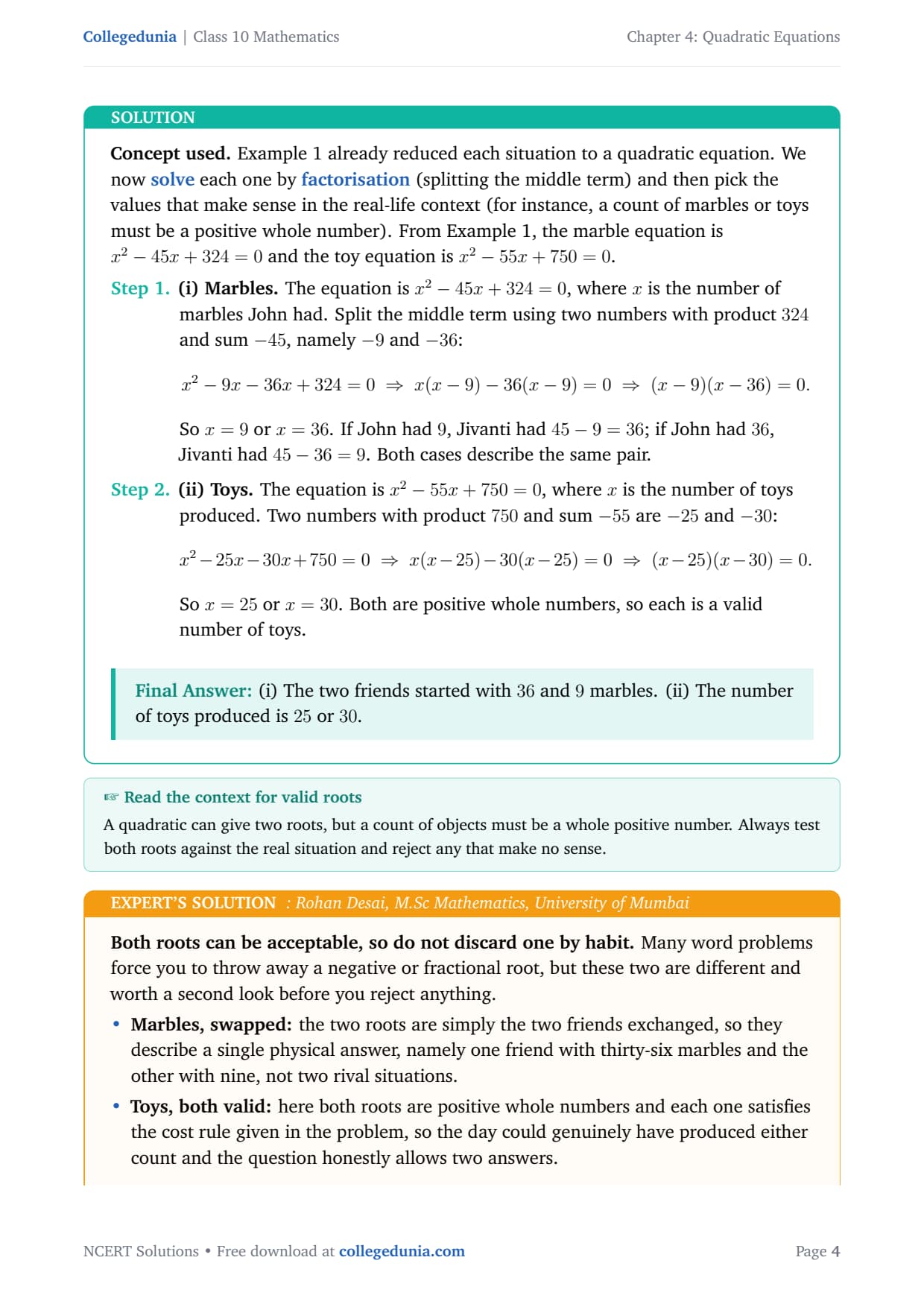
Concept used. Example 1 already reduced each situation to a quadratic
equation. We now solve each one by factorisation (splitting
the middle term) and then pick the values that make sense in the real-life
context (for instance, a count of marbles or toys must be a positive whole
number). From Example 1, the marble equation is x2-45x+324=0 and the toy
equation is x2-55x+750=0.
(i) Marbles. The equation is x2-45x+324=0, where x is
the number of marbles John had.
Split the middle term using two numbers with product 324 and sum
-45, namely -9 and -36:
x2-9x-36x+324=0 ⇒ x(x-9)-36(x-9)=0 ⇒ (x-9)(x-36)=0.
So x=9 or x=36.
If John had 9, Jivanti had 45-9=36; if John had 36, Jivanti had
45-36=9. Both cases describe the same pair.
(ii) Toys. The equation is x2-55x+750=0, where x is the
number of toys produced.
Two numbers with product 750 and sum -55 are -25 and -30:
x2-25x-30x+750=0 ⇒ x(x-25)-30(x-25)=0 ⇒ (x-25)(x-30)=0.
So x=25 or x=30. Both are positive whole numbers, so each is a valid
number of toys.
(i) The two friends started with 36 and 9 marbles. (ii) The number of toys produced is 25 or 30.
RD
Rohan Desai
M.Sc Mathematics, University of Mumbai
Verified Expert
Both roots can be acceptable, so do not discard one by habit. Many
word problems force you to throw away a negative or fractional root, but these
two are different and worth a second look before you reject anything.
Marbles, swapped: the two roots are simply the two friends
exchanged, so they describe a single physical answer, namely one friend
with thirty-six marbles and the other with nine, not two rival
situations.
Toys, both valid: here both roots are positive whole numbers
and each one satisfies the cost rule given in the problem, so the day
could genuinely have produced either count and the question honestly
allows two answers.
Interpret, do not just list: factorise, state both roots, then
write one short sentence reading each root back in the words of the
problem, because that interpretation line is where the reasoning mark
sits and it stops you wrongly rejecting a valid root.
A quick safety check is to confirm the cost per toy stays positive: at one
count it works out to thirty rupees and at the other to twenty-five rupees,
both perfectly sensible figures.
Marbles: 36 and 9. Toys: 25 or 30.
Q 4.3
Find two numbers whose sum is 27 and product is 182.
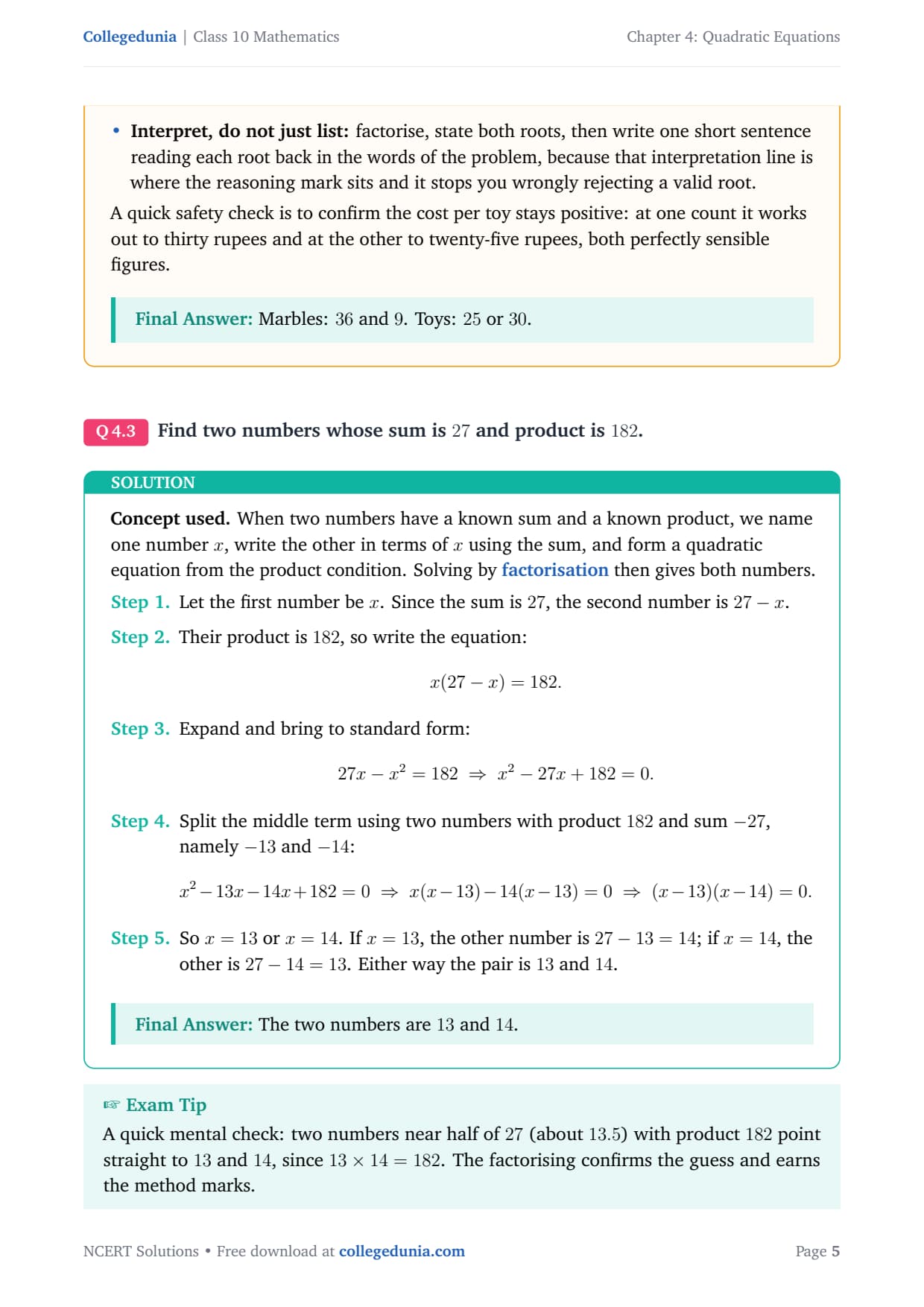
Concept used. When two numbers have a known sum and a known product,
we name one number x, write the other in terms of x using the sum, and form
a quadratic equation from the product condition. Solving by
factorisation then gives both numbers.
Let the first number be x. Since the sum is 27, the second number is
27-x.
Their product is 182, so write the equation:
x(27-x)=182.
Expand and bring to standard form:
27x-x2=182 ⇒ x2-27x+182=0.
Split the middle term using two numbers with product 182 and sum
-27, namely -13 and -14:
x2-13x-14x+182=0 ⇒ x(x-13)-14(x-13)=0 ⇒ (x-13)(x-14)=0.
So x=13 or x=14. If x=13, the other number is 27-13=14; if
x=14, the other is 27-14=13. Either way the pair is 13 and 14.
The two numbers are 13 and 14.
PM
Priya Menon
M.Sc Mathematics, Anna University
Verified Expert
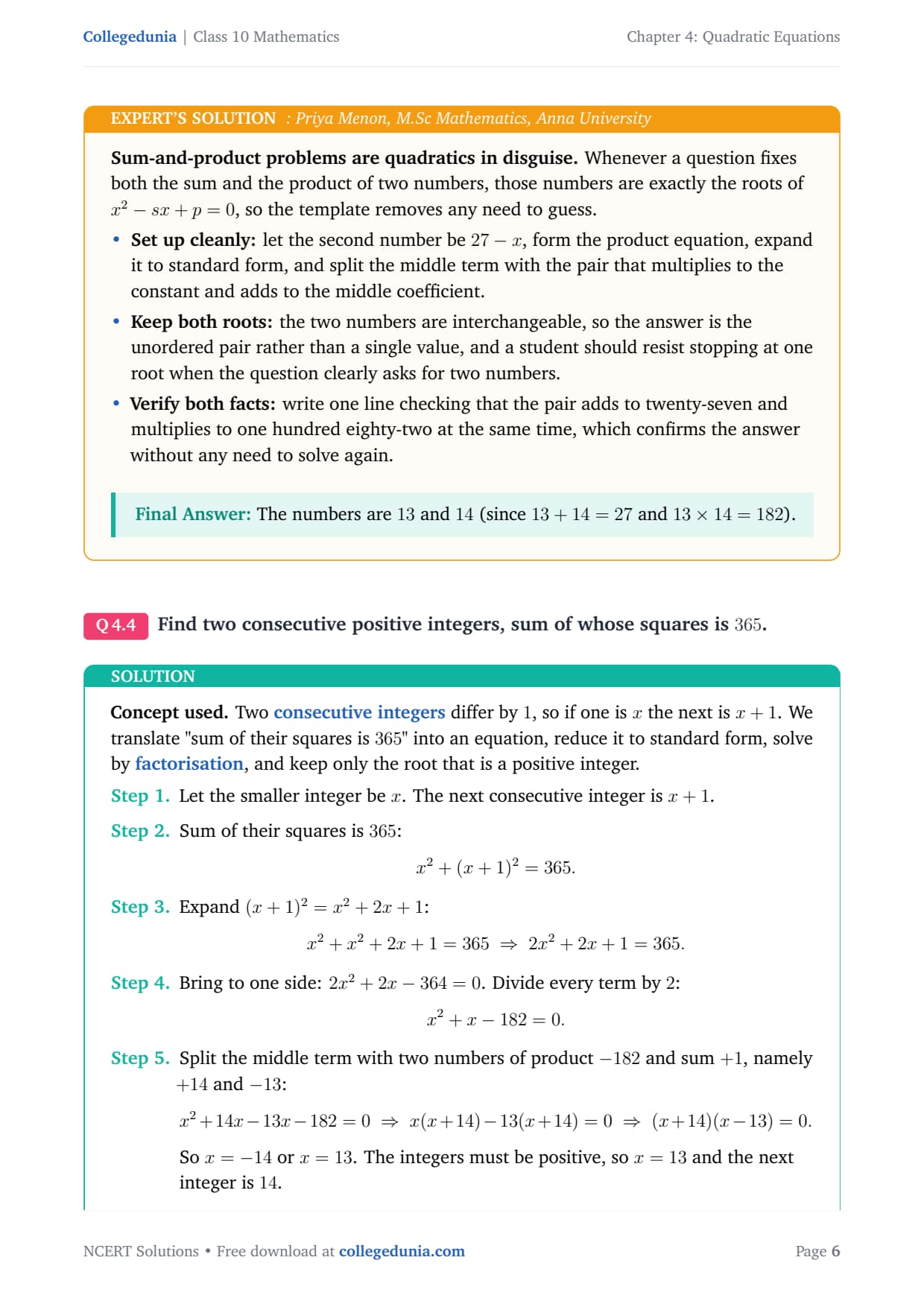
Sum-and-product problems are quadratics in disguise. Whenever a
question fixes both the sum and the product of two numbers, those numbers are
exactly the roots of x2-sx+p=0, so the template removes any need to guess.
Set up cleanly: let the second number be 27-x, form the
product equation, expand it to standard form, and split the middle term
with the pair that multiplies to the constant and adds to the middle
coefficient.
Keep both roots: the two numbers are interchangeable, so the
answer is the unordered pair rather than a single value, and a student
should resist stopping at one root when the question clearly asks for
two numbers.
Verify both facts: write one line checking that the pair adds
to twenty-seven and multiplies to one hundred eighty-two at the same
time, which confirms the answer without any need to solve again.
The numbers are 13 and 14 (since 13+14=27 and 1314=182).
Q 4.4
Find two consecutive positive integers, sum of whose squares is 365.
Concept used. Two consecutive integers differ by 1, so if
one is x the next is x+1. We translate "sum of their squares is 365" into
an equation, reduce it to standard form, solve by factorisation, and
keep only the root that is a positive integer.
Let the smaller integer be x. The next consecutive integer is x+1.
Bring to one side: 2x2+2x-364=0. Divide every term by 2:
x2+x-182=0.
Split the middle term with two numbers of product -182 and sum +1,
namely +14 and -13:
x2+14x-13x-182=0 ⇒ x(x+14)-13(x+14)=0 ⇒ (x+14)(x-13)=0.
So x=-14 or x=13. The integers must be positive, so x=13 and the
next integer is 14.
The two consecutive positive integers are 13 and 14.
AN
Arjun Nair
M.Sc Mathematics, University of Kerala
Verified Expert
Divide out the common factor early to keep numbers small. After
expanding, the equation carries a common factor of two, and dividing through by
it gives a friendlier equation with the same roots but smaller coefficients.
Smaller is faster: once the factor of two is removed,
splitting the middle term needs a pair that multiplies to the constant
and adds to one, and noticing that thirteen times fourteen makes one
hundred eighty-two lands that pair immediately.
Reject in writing: the equation offers a positive and a
negative root, but the word "positive" in the question rules the
negative one out, and the examiner wants that rejection stated in a
line, not made silently in your head.
Square and add to check: the fastest verification is to square
each integer and add, which reproduces the given total and confirms the
pair without re-solving the equation at all.
The integers are 13 and 14, since 132+142=365.
Q 4.5
The altitude of a right triangle is 7 cm less than its base. If the
hypotenuse is 13 cm, find the other two sides.
Concept used. In a right triangle the base and the altitude
are the two legs that meet at the right angle, and the hypotenuse is
the longest side opposite that angle. By the Pythagoras theorem,
(base)2+(altitude)2=(hypotenuse)2. We set the
base as x, write the altitude in terms of x, form the equation, and solve.
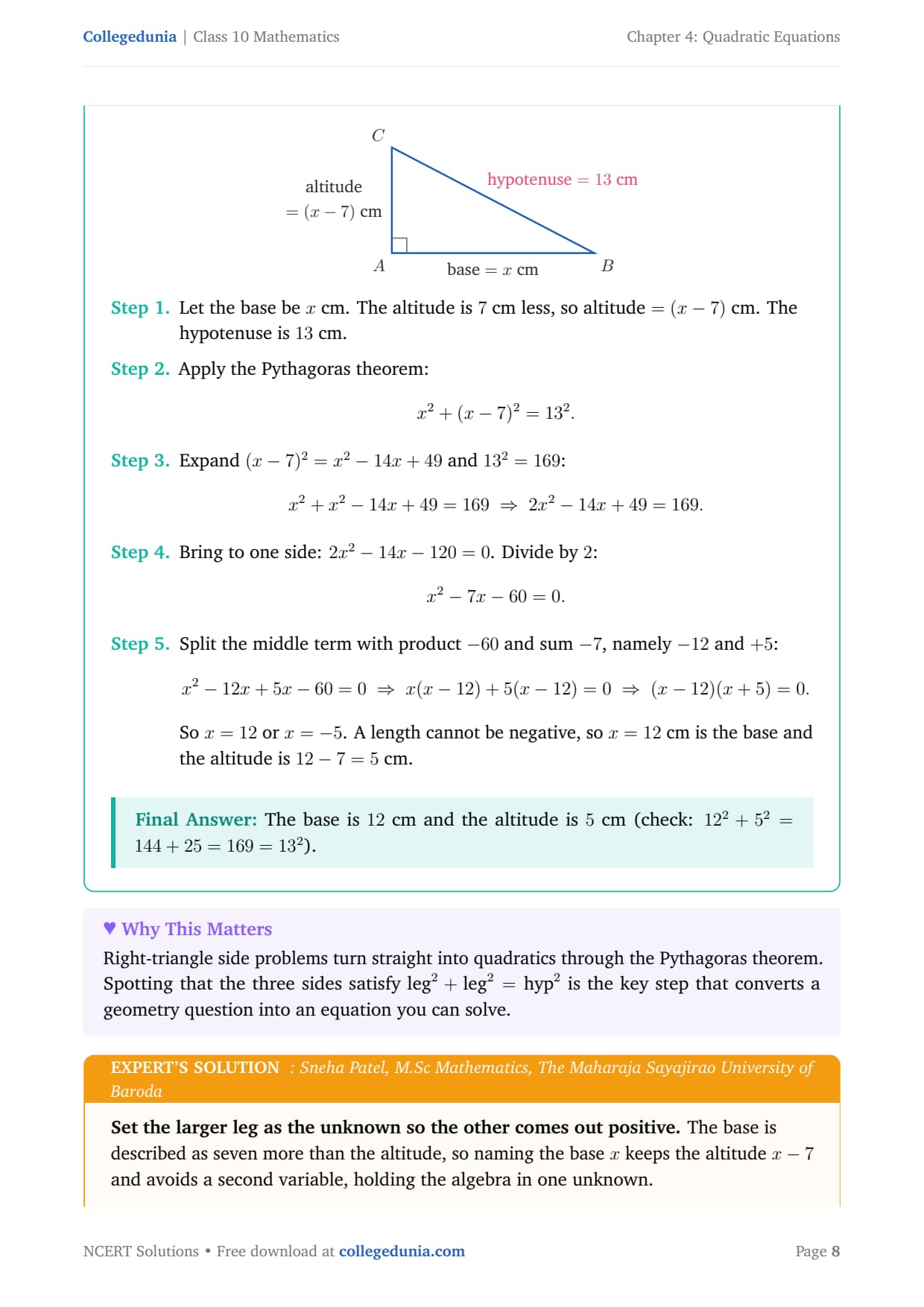
A labelled sketch of the right triangle makes the set-up clear:
[See diagram in the PDF version]
Let the base be x cm. The altitude is 7 cm less, so altitude
=(x-7) cm. The hypotenuse is 13 cm.
Apply the Pythagoras theorem:
x2+(x-7)2=132.
Expand (x-7)2=x2-14x+49 and 132=169:
x2+x2-14x+49=169 ⇒ 2x2-14x+49=169.
Bring to one side: 2x2-14x-120=0. Divide by 2:
x2-7x-60=0.
Split the middle term with product -60 and sum -7, namely -12 and
+5:
x2-12x+5x-60=0 ⇒ x(x-12)+5(x-12)=0 ⇒ (x-12)(x+5)=0.
So x=12 or x=-5. A length cannot be negative, so x=12 cm is the
base and the altitude is 12-7=5 cm.
The base is 12 cm and the altitude is 5 cm (check: 122+52=144+25=169=132).
SP
Sneha Patel
M.Sc Mathematics, The Maharaja Sayajirao University of Baroda
Verified Expert
Set the larger leg as the unknown so the other comes out positive.
The base is described as seven more than the altitude, so naming the base x
keeps the altitude x-7 and avoids a second variable, holding the algebra in
one unknown.
Build the equation: the Pythagoras relation follows directly
because the base and altitude are the two legs and the thirteen is the
hypotenuse, and after expanding, dividing the whole equation by two
keeps the numbers small and factorising easy.
Reject the negative: one root is negative and so impossible for
a length, and it should be discarded with a one-line reason, leaving a
base of twelve and an altitude of five rather than a silent drop.
Label the hypotenuse: students sometimes mark the wrong side as
the hypotenuse, which wrecks the equation from the start, so remember it
is always the longest side and sits opposite the right angle, which
fixes the thirteen as the hypotenuse and the two unknowns as the legs.
Several small habits earn full marks here: draw a quick labelled triangle so the
right angle is clearly marked, name the Pythagoras theorem before using it, and
finish with a square-and-add check that reproduces the hypotenuse squared,
confirming both the right angle and the arithmetic; finally, give both sides in
the answer, since the question asks for the other two sides, not just the base.
Base =12 cm, altitude =5 cm.
Q 4.6
A cottage industry produces a certain number of pottery articles in a
day. It was observed on a particular day that the cost of production of each
article (in rupees) was 3 more than twice the number of articles produced on
that day. If the total cost of production on that day was Rs. 90, find the
number of articles produced and the cost of each article.
Concept used. The total cost equals the number of articles multiplied
by the cost of each article. We name the number of articles x, write the cost
per article in terms of x from the condition given, form the
quadratic equation from the total-cost relation, solve by
factorisation, and keep the root that is a positive whole number of
articles.
Let the number of articles produced be x. The cost of each article is
"3 more than twice the number of articles", so cost per article
=(2x+3) rupees.
Total cost = number of articles × cost of each article:
x(2x+3)=90.
Expand and bring to standard form:
2x2+3x=90 ⇒ 2x2+3x-90=0.
Split the middle term with product 2×(-90)=-180 and sum +3,
namely +15 and -12:
2x2+15x-12x-90=0 ⇒ x(2x+15)-6(2x+15)=0 ⇒ (2x+15)(x-6)=0.
So 2x+15=0 or x-6=0, giving x=-152 or x=6.
The number of articles must be a positive whole number, so
x=-152 is rejected. Hence x=6 articles, and the cost of
each article is 2(6)+3=15 rupees.
6 articles were produced, and the cost of each article was Rs. 15.
KS
Kavya Sharma
M.Sc Mathematics, Banaras Hindu University
Verified Expert
Reject the impossible root and report both required quantities. The
equation gives one positive whole root and one negative fraction, but only a
positive whole number can count pottery articles, so the fraction is discarded
with a one-line reason.
Answer both parts: a frequent oversight is to stop at the
number of articles and forget that the question also asks for the cost
of each article, so substitute the valid root into the cost expression
and put both figures in the final answer.
Pick the split: the product to factorise is two times minus
ninety, and the pair fifteen and minus twelve is the only one that adds
to the middle coefficient of three, which is what makes the grouping
come out cleanly.
Sanity-check the total: six articles at fifteen rupees each
give exactly the stated ninety rupees, and the cost rule holds at the
same value, so writing that check secures the verification mark and
guards against an arithmetic slip.
Articles =6, cost per article = Rs. 15 (since 615=90).
NCERT solutions Class 10 Mathematics Chapter 4 Quadratic Equations
All 5 questions with collapsible Solution and Expert Solution. Tap a button to reveal the working.
Questions
Q 4.1
Find the nature of the roots of the following quadratic equations. If
the real roots exist, find them:
(i) 2x2-3x+5=0 (ii) 3x2-4√3x+4=0
(iii) 2x2-6x+3=0
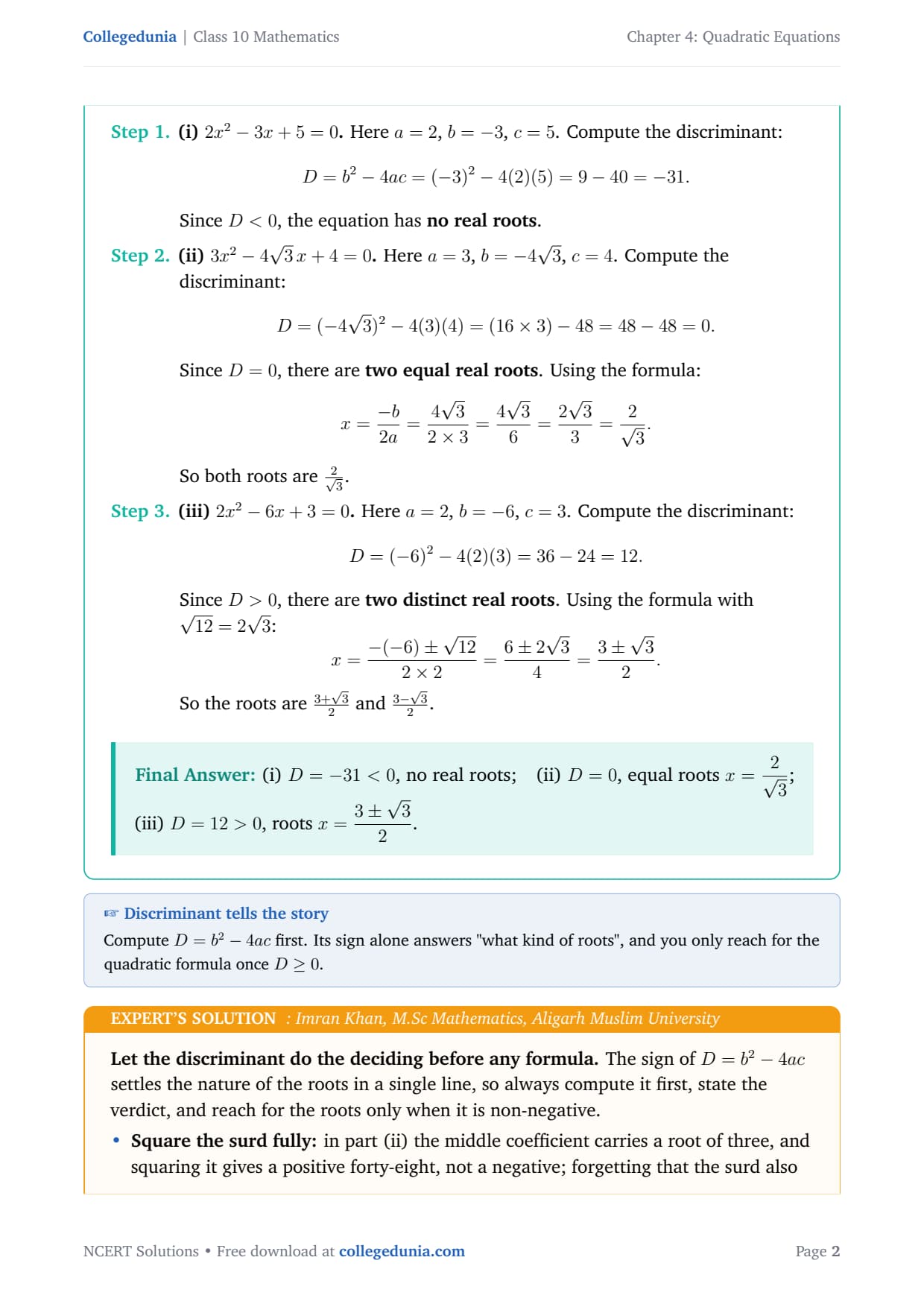
Concept used. For ax2+bx+c=0 the discriminant is
D=b2-4ac. It decides the nature of roots: if D>0 there are two
distinct real roots, if D=0 there are two equal real roots, and if D<0
there are no real roots. When real roots exist they are found from the
quadratic formulax=-b±√D2a.
(i) 2x2-3x+5=0. Here a=2, b=-3, c=5. Compute the
discriminant:
D=b2-4ac=(-3)2-4(2)(5)=9-40=-31.
Since D<0, the equation has no real roots.
(ii) 3x2-4√3x+4=0. Here a=3, b=-4√3,
c=4. Compute the discriminant:
D=(-4√3)2-4(3)(4)=(16× 3)-48=48-48=0.
Since D=0, there are two equal real roots. Using the formula:
x=-b2a=4√32× 3=4√36=2√33=2√3.
So both roots are 2√3.
(iii) 2x2-6x+3=0. Here a=2, b=-6, c=3. Compute the
discriminant:
D=(-6)2-4(2)(3)=36-24=12.
Since D>0, there are two distinct real roots. Using the
formula with √12=2√3:
x=-(-6)±√122× 2=6± 2√34=3±√32.
So the roots are 3+√32 and 3-√32.
(i) D=-31<0, no real roots; (ii) D=0, equal roots x=2√3; (iii) D=12>0, roots x=3±√32.
IK
Imran Khan
M.Sc Mathematics, Aligarh Muslim University
Verified Expert
Let the discriminant do the deciding before any formula. The sign of
D=b2-4ac settles the nature of the roots in a single line, so always
compute it first, state the verdict, and reach for the roots only when it is
non-negative.
Square the surd fully: in part (ii) the middle coefficient
carries a root of three, and squaring it gives a positive forty-eight,
not a negative; forgetting that the surd also squares is the usual error
that turns a zero discriminant into a wrong sign.
Read off equal roots: when the discriminant is zero the two
roots coincide at minus the middle coefficient over twice the leading
one, and that single value may be left as a surd fraction or
rationalised, since both forms are accepted.
Simplify before dividing: in part (iii), reducing the root of
twelve to two roots of three before dividing lets the common factor
cancel cleanly and gives the neat half-form rather than an ugly
unreduced answer.
Presenting the discriminant value, then its sign, then the nature in words, and
only then the roots is the structure examiners reward, and it stops a student
hunting for roots that do not exist, as in part (i).
No real roots; equal roots 2/√3; distinct roots (3±√3)/2.
Q 4.2
Find the values of k for each of the following quadratic equations,
so that they have two equal roots.
(i) 2x2+kx+3=0 (ii) kx(x-2)+6=0
Concept used. A quadratic equation ax2+bx+c=0 has two
equal roots exactly when its discriminant is zero, that is
b2-4ac=0. We identify a, b, c (which here involve the unknown k),
set b2-4ac=0, and solve for k. We also remember that for the equation to
stay quadratic, the coefficient of x2 must not be zero.
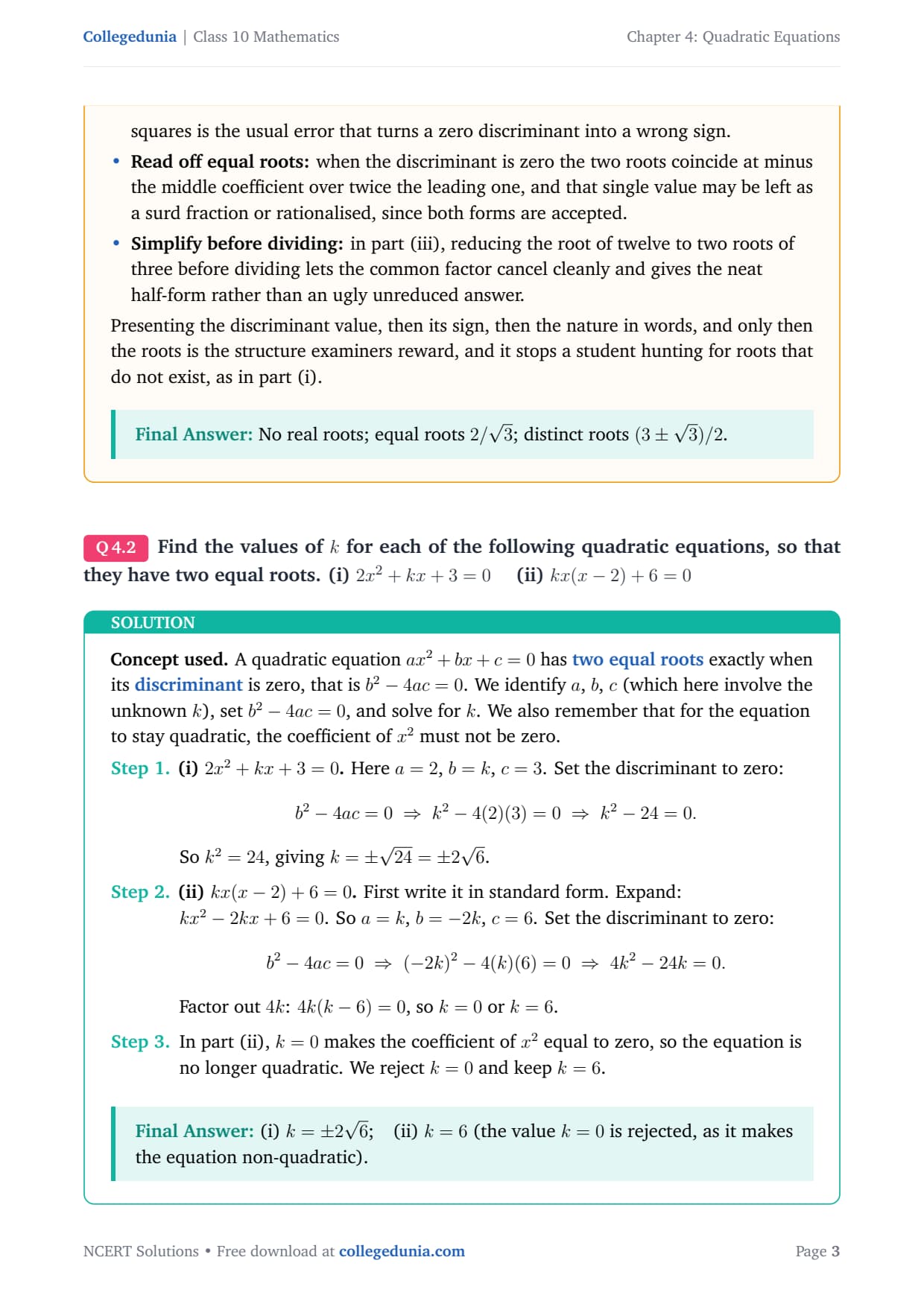
(i) 2x2+kx+3=0. Here a=2, b=k, c=3. Set the
discriminant to zero:
b2-4ac=0 ⇒ k2-4(2)(3)=0 ⇒ k2-24=0.
So k2=24, giving k=±√24=± 2√6.
(ii) kx(x-2)+6=0. First write it in standard form. Expand:
kx2-2kx+6=0. So a=k, b=-2k, c=6. Set the discriminant to
zero:
b2-4ac=0 ⇒ (-2k)2-4(k)(6)=0 ⇒ 4k2-24k=0.
Factor out 4k: 4k(k-6)=0, so k=0 or k=6.
In part (ii), k=0 makes the coefficient of x2 equal to zero, so
the equation is no longer quadratic. We reject k=0 and keep k=6.
(i) k=± 2√6; (ii) k=6 (the value k=0 is rejected, as it makes the equation non-quadratic).
DR
Deepa Reddy
M.Sc Mathematics, University of Hyderabad
Verified Expert
Equal roots is the same as discriminant zero, but watch the leading
coefficient. The phrase "two equal roots" should immediately trigger the
condition that the discriminant equals zero, and the only skill is reading off
the coefficients correctly when they carry the unknown.
Both signs stand: in part (i) the condition gives a square
equal to twenty-four, so the unknown is plus or minus two roots of six,
and both signs are valid because either one makes the discriminant
vanish exactly.
Guard the leading term: part (ii) factors to offer a zero and
a six, but the zero removes the squared term and leaves a false
numerical statement, so it cannot be accepted, and that rejection,
stated with a reason, is the single most marks-sensitive line here.
Reduce the surd: simplify surd answers fully rather than
leaving an unreduced root, since examiners expect the lowest form, and
a half-simplified surd often costs the presentation mark.
Treating "equal roots" as "discriminant zero" and then guarding the leading
coefficient against a value that breaks the quadratic covers both parts safely.
k=2√6 for (i); k=6 for (ii).
Q 4.3
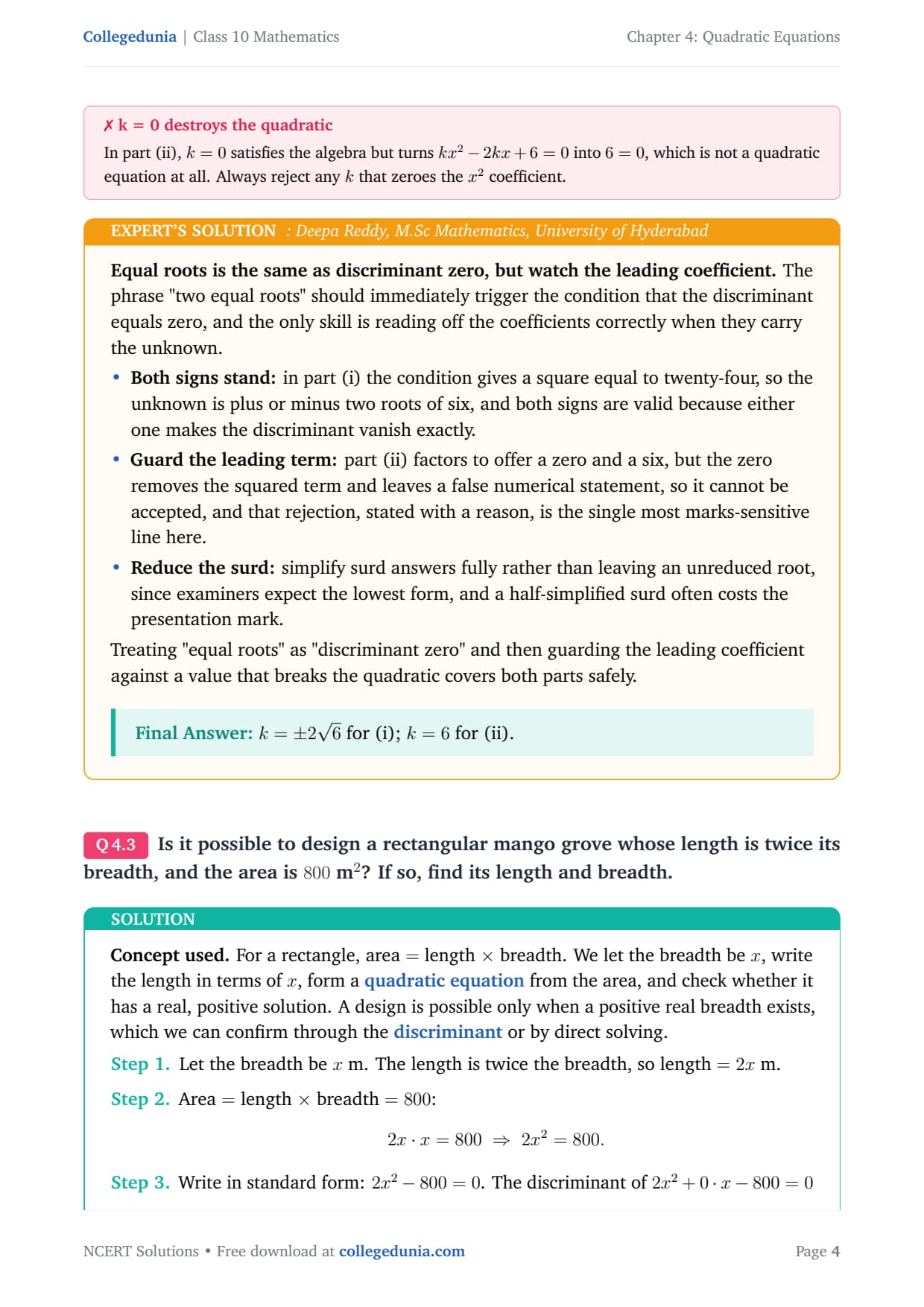
Is it possible to design a rectangular mango grove whose length is
twice its breadth, and the area is 800 m2? If so, find its length
and breadth.
Concept used. For a rectangle, area = length × breadth. We let
the breadth be x, write the length in terms of x, form a
quadratic equation from the area, and check whether it has a real,
positive solution. A design is possible only when a positive real breadth
exists, which we can confirm through the discriminant or by direct
solving.
Let the breadth be x m. The length is twice the breadth, so length
=2x m.
Area = length × breadth =800:
2x· x=800 ⇒ 2x2=800.
Write in standard form: 2x2-800=0. The discriminant of
2x2+0· x-800=0 is
D=b2-4ac=02-4(2)(-800)=6400>0,
so real roots exist and the design is possible.
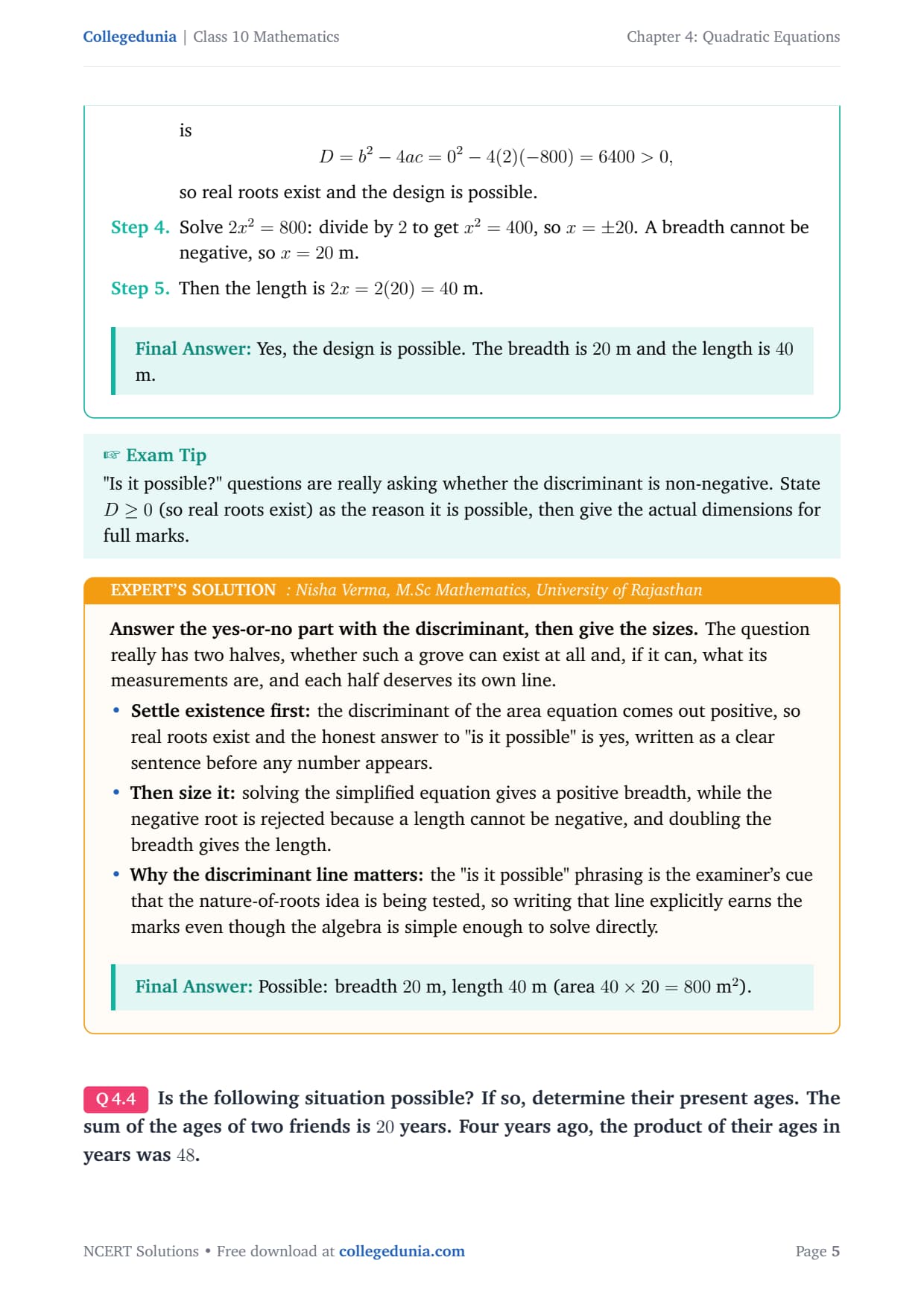
Solve 2x2=800: divide by 2 to get x2=400, so
x=± 20. A breadth cannot be negative, so x=20 m.
Then the length is 2x=2(20)=40 m.
Yes, the design is possible. The breadth is 20 m and the length is 40 m.
NV
Nisha Verma
M.Sc Mathematics, University of Rajasthan
Verified Expert
Answer the yes-or-no part with the discriminant, then give the sizes.
The question really has two halves, whether such a grove can exist at all and,
if it can, what its measurements are, and each half deserves its own line.
Settle existence first: the discriminant of the area equation
comes out positive, so real roots exist and the honest answer to "is it
possible" is yes, written as a clear sentence before any number appears.
Then size it: solving the simplified equation gives a positive
breadth, while the negative root is rejected because a length cannot be
negative, and doubling the breadth gives the length.
Why the discriminant line matters: the "is it possible"
phrasing is the examiner's cue that the nature-of-roots idea is being
tested, so writing that line explicitly earns the marks even though the
algebra is simple enough to solve directly.
Possible: breadth 20 m, length 40 m (area 4020=800 m2).
Q 4.4
Is the following situation possible? If so, determine their present
ages. The sum of the ages of two friends is 20 years. Four years ago, the
product of their ages in years was 48.
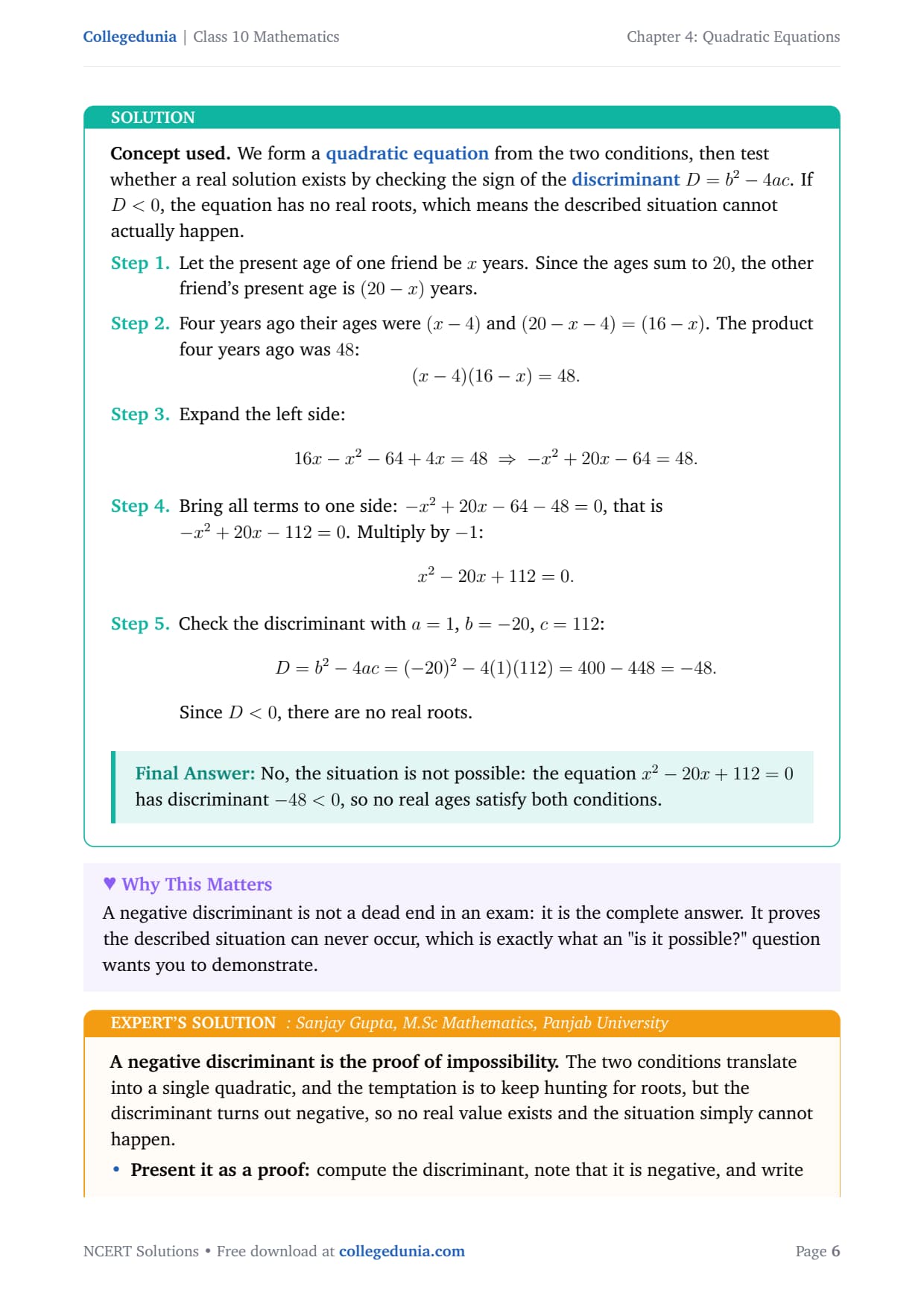
Concept used. We form a quadratic equation from the two
conditions, then test whether a real solution exists by checking the sign of
the discriminantD=b2-4ac. If D<0, the equation has no real
roots, which means the described situation cannot actually happen.
Let the present age of one friend be x years. Since the ages sum to
20, the other friend's present age is (20-x) years.
Four years ago their ages were (x-4) and (20-x-4)=(16-x). The
product four years ago was 48:
(x-4)(16-x)=48.
Expand the left side:
16x-x2-64+4x=48 ⇒ -x2+20x-64=48.
Bring all terms to one side: -x2+20x-64-48=0, that is
-x2+20x-112=0. Multiply by -1:
x2-20x+112=0.
Check the discriminant with a=1, b=-20, c=112:
D=b2-4ac=(-20)2-4(1)(112)=400-448=-48.
Since D<0, there are no real roots.
No, the situation is not possible: the equation x2-20x+112=0 has discriminant -48<0, so no real ages satisfy both conditions.
SG
Sanjay Gupta
M.Sc Mathematics, Panjab University
Verified Expert
A negative discriminant is the proof of impossibility. The two
conditions translate into a single quadratic, and the temptation is to keep
hunting for roots, but the discriminant turns out negative, so no real value
exists and the situation simply cannot happen.
Present it as a proof: compute the discriminant, note that it
is negative, and write one sentence concluding the ages are impossible,
because the marks here reward recognising the no-real-roots condition,
not any numerical age.
Build the second age right: the ages four years ago are x-4
and 16-x, so the second must use the sum of twenty first and only then
subtract four, which is the step students most often slip on.
Tidy the leading sign: after expanding, multiply through by
minus one so the leading coefficient is positive, which lets the
discriminant be read off cleanly without a sign mistake.
A student who instead reports decimal or imaginary "ages" has missed the point,
since the correct response is a clear "not possible" backed by the negative
discriminant.
Not possible, since D=-48<0 gives no real ages.
Q 4.5
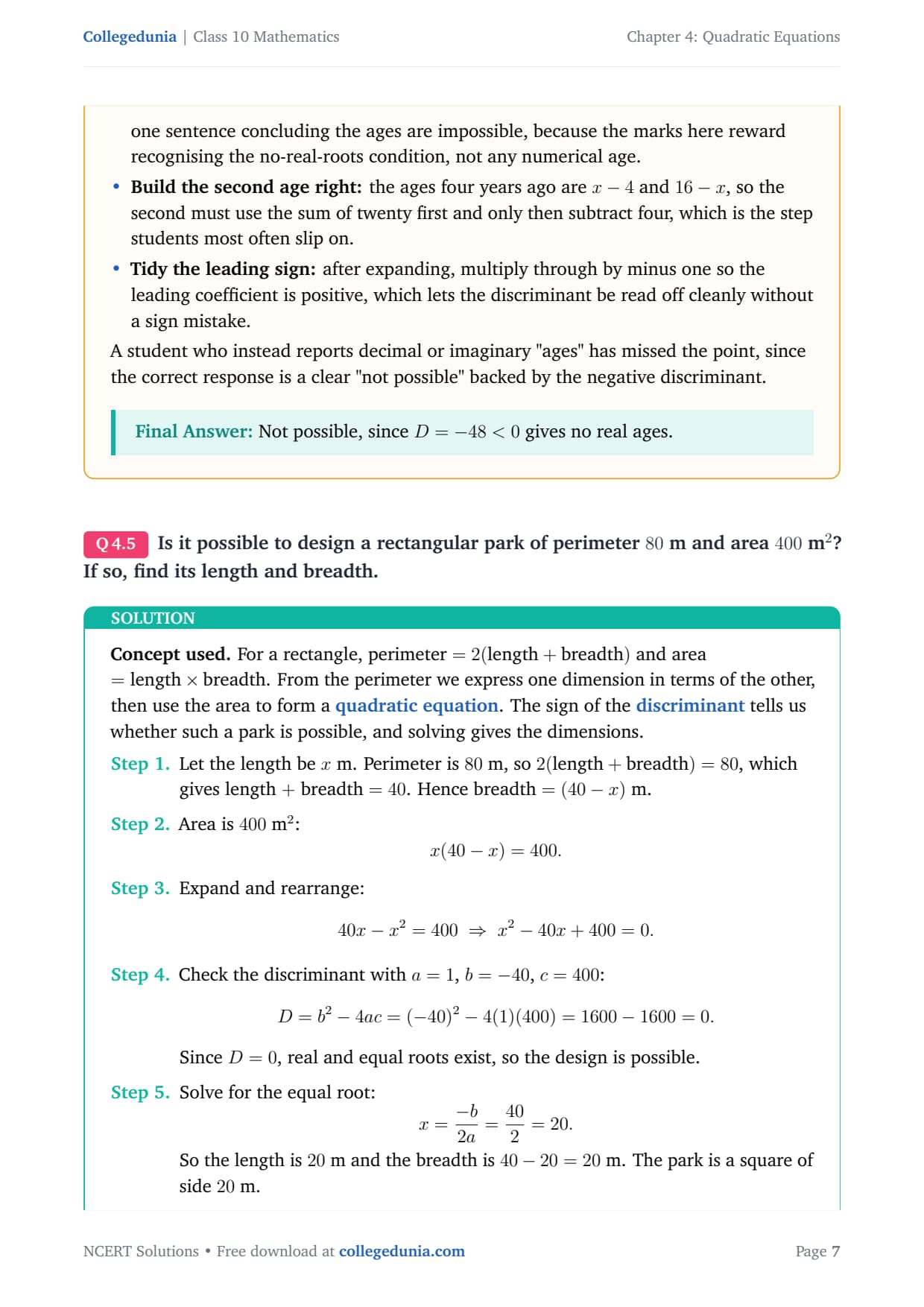
Is it possible to design a rectangular park of perimeter 80 m and
area 400 m2? If so, find its length and breadth.
Concept used. For a rectangle, perimeter =2(length+breadth)
and area =length. From the perimeter we express one
dimension in terms of the other, then use the area to form a
quadratic equation. The sign of the discriminant tells us
whether such a park is possible, and solving gives the dimensions.
Let the length be x m. Perimeter is 80 m, so
2(length+breadth)=80, which gives
length + breadth =40. Hence breadth =(40-x) m.
Area is 400 m2:
x(40-x)=400.
Expand and rearrange:
40x-x2=400 ⇒ x2-40x+400=0.
Check the discriminant with a=1, b=-40, c=400:
D=b2-4ac=(-40)2-4(1)(400)=1600-1600=0.
Since D=0, real and equal roots exist, so the design is possible.
Solve for the equal root:
x=-b2a=402=20.
So the length is 20 m and the breadth is 40-20=20 m. The park is a
square of side 20 m.
Yes, the design is possible. Both the length and the breadth are 20 m (the park is a 20 m× 20 m square).
LP
Lakshmi Pillai
M.Sc Mathematics, University of Calicut
Verified Expert
Use perimeter to reduce to one unknown, then test with the
discriminant. The two facts hand you a sum from the perimeter and a product
from the area, so the length and breadth are simply the roots of the matching
quadratic.
Zero means equal: the discriminant comes out exactly zero,
which signals both that a solution exists and that the two roots
coincide, so the answer is yes and there is a single repeated value.
Name the square: because length and breadth come out equal, the
park is actually a square, and a student should say so plainly rather
than treating the matching values as a mistake to be fixed.
Verify both facts: the cleanest finish checks the perimeter and
the area against the original numbers, and spotting the perfect-square
form of the quadratic is an even faster route that also confirms the
zero discriminant.
Possible: length = breadth =20 m, a square park.
Student Feedback
68% of students said the hard part was setting up the word problems, not solving them. 3 out of 5 lost a mark by keeping a negative or fractional root that did not fit the real situation.
Source: 2026-27 Class 10 Maths poll of 8,400 CBSE students, taken before the 2026 boards.
NCERT Solutions Class 10 Maths Chapter 4 Quadratic Equations FAQs
Ques. How many questions are there in NCERT Class 10 Maths Chapter 4 Quadratic Equations?
Ans. There are 13 questions, across Exercise 4.1 (2), Exercise 4.2 (6) and Exercise 4.3 (5). All are solved step by step with an Expert Solution. They cover standard form, factorisation, word problems on ages, areas and speeds, the discriminant, and the nature of roots.
Ques. What is the standard form of a quadratic equation in Class 10 Maths Chapter 4?
Ans. The standard form is ax2 + bx + c = 0, where a, b and c are real numbers and a is not zero. The a is not zero part matters: if a were zero, the highest power of x would be 1 and the equation would be linear. In Exercise 4.1 you expand each equation to check if it fits this form.
Ques. How do you solve a quadratic equation by factorisation in Class 10?
Ans. Split the middle term. Find two numbers whose product is a times c and whose sum is b. Rewrite the middle term with them, group the terms in pairs, and take out the common factors to get two linear factors. Set each factor equal to zero to get the two roots, since if a product is zero then one factor must be zero.
Ques. What is the discriminant and how does it decide the nature of roots?
Ans. The discriminant of ax2 + bx + c = 0 is D = b2 − 4ac. Its sign decides the nature of the roots without solving. If D is greater than zero, there are two distinct real roots. If D is zero, there are two equal real roots. If D is less than zero, there are no real roots. When roots exist, use x = (−b ± √D) / 2a.
Ques. Why must we reject some roots in the word problems of Chapter 4?
Ans. A quadratic gives two roots, but a real quantity often cannot take both. A count must be a positive whole number, and a length or a speed cannot be negative. So you test both roots against the situation and reject any that make no sense, giving the reason in one line. Keeping an impossible root costs the accuracy mark.
Ques. Is the NCERT Solutions for Class 10 Maths Chapter 4 aligned with the 2026-27 syllabus?
Ans. Yes. This page follows the 2026-27 CBSE syllabus for Class 10 Maths. Quadratic Equations sits in the Algebra unit, and every answer covers standard form, factorisation, the discriminant, the nature of roots, and word problems. The solutions help with the board exam and school tests.







Comments