Maths Mentor, Delhi University | Updated 3+ months ago
The NCERT Solutions for Class 10 Maths Chapter 6 Triangles Exercise 6.2 cover all 10 questions on the Basic Proportionality Theorem (BPT), its converse, and related proofs, per the 2026-27 CBSE syllabus. Every answer is solved step by step with an Expert Solution that adds exam strategy.
Questions covered: 10 questions on BPT, Converse of BPT, mid-point theorem proofs, trapezium diagonal ratio, and parallel cascade problems.
Core concepts: if a line is drawn parallel to one side of a triangle it divides the other two sides proportionally; the converse identifies parallel lines from equal ratios.
Board value: Exercise 6.2 is the most mark-heavy exercise of Chapter 6, contributing BPT and proof questions in the 3-mark and 5-mark slots of the CBSE Class 10 paper every year.
Solved by Collegedunia: Every Exercise 6.2 question below is solved by Mathematics subject experts, checked against the official 2026-27 NCERT textbook, and written with full working so each step earns its marks in the CBSE Class 10 paper.
What Exercise 6.2 of Triangles Covers for Class 10 Maths
Exercise 6.2 is the largest exercise in Chapter 6. It works entirely with the Basic Proportionality Theorem (BPT) and its converse, used to find missing lengths, identify parallel lines, and write two-triangle proofs. The trapezium questions add AA similarity.
Q1-Q2 (numerical): use BPT and its converse to find unknown lengths and test if a line is parallel.
Q3-Q6 (two-triangle proofs): apply BPT in two triangles sharing a segment to prove a ratio or parallelism.
Q7-Q8 (mid-point theorem): prove the mid-point results using BPT and its converse.
Q9-Q10 (trapezium): prove the diagonal ratio property and its converse using AA similarity or an auxiliary line.
Basic Proportionality Theorem and Its Converse: Key Formulas for Exercise 6.2
Every question in Exercise 6.2 comes back to these two statements.
Theorem
Statement
Used in Q
BPT (Theorem 6.1)
In △ABC, if DE ∥ BC with D on AB and E on AC, then ADDB = AEEC
Q1, Q3, Q4, Q5, Q6, Q7, Q10
Converse of BPT (Theorem 6.2)
In △ABC, if ADDB = AEEC, then DE ∥ BC
Q2, Q5, Q6, Q8, Q10
AA Similarity
If two pairs of angles in two triangles are equal, the triangles are similar
Q9
Quick Tip: For every BPT step, name the triangle first, then the parallel side: "In triangle XYZ, PQ is parallel to YZ, so by BPT..." Examiners award a separate mark for this, even when the ratio is correct.
How to Solve Exercise 6.2 Question by Question
The 10 questions follow a clear pattern. Q1 and Q2 use BPT as a formula. The proofs (Q3-Q10) apply BPT once or twice, then equate ratios or invoke the converse. The table maps each question to its method.
Question
What it asks
Method
Key result
Q1
Find EC (part i) and AD (part ii) given DE parallel to BC
BPT ratio
EC = 2 cm, AD = 2.4 cm
Q2
Is EF parallel to QR? (3 sub-parts)
Converse of BPT (check ratio equality)
(i) Not parallel (ii) Parallel (iii) Parallel
Q3
Prove AM/AB = AN/AD when LM parallel to CB and LN parallel to CD
BPT twice (shared ratio AL/LC), add 1 to both sides
AM/AB = AN/AD
Q4
Prove BF/FE = BE/EC given DE parallel to AC, DF parallel to AE
BPT twice (shared ratio BD/DA)
BF/FE = BE/EC
Q5
Show EF parallel to QR given DE parallel to OQ, DF parallel to OR
BPT twice (shared PD/DO), then converse
EF parallel to QR
Q6
Show BC parallel to QR given AB parallel to PQ, AC parallel to PR
BPT twice (shared OA/AP), then converse
BC parallel to QR
Q7
Prove: line through midpoint of one side parallel to another bisects the third
BPT with ratio = 1 (midpoint condition)
AE = EC (E is midpoint)
Q8
Prove: line joining midpoints of two sides is parallel to the third
Converse of BPT with both ratios = 1
DE parallel to BC
Q9
ABCD trapezium, AB parallel to DC, diagonals meet at O: prove AO/BO = CO/DO
AA similarity on triangles AOB and COD (alternate angles)
AO/BO = CO/DO
Q10
Diagonals of ABCD meet at O with AO/BO = CO/DO: prove ABCD is a trapezium
Construct OE parallel to AB, apply converse of BPT
AB parallel to DC, so ABCD is trapezium
Common Mistakes Students Make in Triangles Exercise 6.2
Exercise 6.2 proof questions follow a tight structure. The mistakes below cost marks even when students understand BPT correctly.
Not naming the triangle before applying BPT: examiners give a mark for the "In triangle ABC..." line before the ratio.
Mixing segment names in the ratio: the upper segment (touching the apex) always goes in the numerator, so AD/DB, not DB/AD.
In Q2(iii), using whole sides: subtract PE from PQ and PF from PR to get EQ and FR before forming the ratio.
In Q3, stopping at AM/MB = AN/ND: the question asks for AM/AB, so the "add 1 to both sides" step is not optional.
In Q9, wrong vertex correspondence: the similarity is triangle AOB with triangle COD, not COB or DOA.
In Q10, no auxiliary line: draw OE parallel to AB inside triangle ABD first, or there is no triangle for BPT.
Watch Out: Q3, Q4, Q5 and Q6 share one pattern: apply BPT in two triangles that share a common segment, then equate the matching sides. Spot the shared segment and all four proofs follow.
Exercise 6.2 Marks and CBSE Board Relevance for Class 10 Maths
Chapter 6 Triangles carries 7-8 marks in the CBSE Class 10 board paper. Exercise 6.2 alone supplies BPT and proof questions in the 3-mark and 5-mark slots almost every year.
Question type from Exercise 6.2
Where it appears in the board paper
Typical marks
Find missing side using BPT (Q1 style)
2-mark or 3-mark short answer
2 to 3
Decide if a line is parallel using converse of BPT (Q2 style)
2-mark short answer
2
Two-triangle BPT proof (Q3-Q6 style)
3-mark or 5-mark long answer
3 to 5
Mid-point theorem proof using BPT or converse (Q7-Q8 style)
3-mark proof
3
Trapezium diagonal ratio proof (Q9-Q10 style)
5-mark long answer
5
These solutions follow the 2026-27 NCERT exactly, in the step-numbering and theorem-naming format the CBSE marking scheme expects.
Remember: BPT: a parallel line inside a triangle gives equal ratios of the cut sides. Converse: equal ratios mean the line is parallel to the third side. Decide which direction you need before writing the first line.
Other Resources for Class 10 Maths Chapter 6 Triangles
Open the other resources and exercises for Chapter 6 Triangles below.
All NCERT Solutions for Class 10 Maths Chapter 6 Triangles Exercise 6.2 with Step-by-Step Solutions
Exercise 6.2
Q 6.1
In Fig. 6.17, (i) and (ii), DE∥ BC. Find EC in (i)
and AD in (ii).
Fig. 6.17 - (i) AD=1.5 cm, DB=3 cm, AE=1 cm; (ii) DB=7.2 cm, AE=1.8 cm, EC=5.4 cm.
Concept used. The Basic Proportionality Theorem (BPT)
says that if a line is drawn parallel to one side of a triangle and cuts
the other two sides, it divides those two sides in the same ratio. So in
ABC with DE∥ BC,
ADDB=AEEC.
Part (i).
Write BPT for the figure:
ADDB=AEEC.
Substitute AD=1.5, DB=3, AE=1:
1.53=1EC.
Cross-multiply:
1.5× EC=1× 3.
Solve for EC:
EC=31.5=2 cm.
Part (ii).
Here D is on AB and E on AC with DB=7.2, AE=1.8,
EC=5.4. BPT gives
ADDB=AEEC.
Substitute the known values:
AD7.2=1.85.4.
Simplify the right side:
1.85.4=13.
Solve for AD:
AD=7.2×13=2.4 cm.
(i) EC=2 cm (ii) AD=2.4 cm.
SP
Sneha Patel
M.Sc Mathematics, Sardar Patel University
Verified Expert
Set the ratio up by position, not by name order. The reliable
habit for any BPT problem is to put the upper pieces (touching the apex)
on top and the lower pieces (touching the base) underneath, on both sides
of the equation.
Part (i): that layout fixes ADDB=AEEC,
and a single cross-multiplication gives EC=2 cm with no fuss.
Part (ii): the same layout applies; simplifying
1.85.4 to 13 first keeps the arithmetic clean
and leads straight to AD=2.4 cm.
Reduce early: cutting the known ratio to lowest terms
before multiplying avoids clumsy decimals and the slips they
cause in a timed paper.
Sanity check: each answer must be positive and smaller
than the whole side it sits on, which both clearly are here.
By BPT, EC=2 cm in (i) and AD=2.4 cm in (ii).
Q 6.2
E and F are points on the sides PQ and PR respectively
of a PQR. For each of the following cases, state whether
EF∥ QR:
(i) PE=3.9 cm, EQ=3 cm, PF=3.6 cm and FR=2.4 cm
(ii) PE=4 cm, QE=4.5 cm, PF=8 cm and RF=9 cm
(iii) PQ=1.28 cm, PR=2.56 cm, PE=0.18 cm and PF=0.36 cm
Concept used. The converse of the Basic
Proportionality Theorem says that if a line divides two sides of a
triangle in the same ratio, then the line is parallel to the third side.
So EF∥ QR exactly when
PEEQ=PFFR.
In part (iii) we first turn the whole-side data into the two segment
pieces by subtraction.
Part (i).
Compute each ratio:
PEEQ=3.93=1.3,
PFFR=3.62.4=1.5.
Compare: 1.3≠ 1.5, so the two ratios are unequal.
So EF is not parallel to QR.
Part (ii).
Compute each ratio:
PEQE=44.5=89,
PFRF=89.
Compare: both equal 89, so the ratios match.
So EF∥ QR.
Part (iii).
Find EQ and FR by subtraction:
EQ=PQ-PE=1.28-0.18=1.10 cm, FR=PR-PF=2.56-0.36=2.20 cm.
Compute each ratio:
PEEQ=0.181.10=955,
PFFR=0.362.20=955.
Compare: both equal 955, so the ratios match.
So EF∥ QR.
(i) Not parallel (ii) EF∥ QR (iii) EF∥ QR.
VM
Vikram Menon
M.Sc Mathematics, University of Calicut
Verified Expert
Decide parallelism by a clean ratio test, not by the picture.
The converse of BPT turns the parallel question into a single equality
of ratios, which is far safer than eyeballing a sketch.
Part (i): the two ratios come out as 1.3 and 1.5.
Since they differ, EF cannot be parallel to QR, so the answer
is not parallel.
Part (ii): both ratios reduce to 89, so the
equality holds and the line is parallel to the third side.
Part (iii): the question gives whole sides, so subtract
first to get EQ=1.10 and FR=2.20; both ratios then become
955 and parallelism follows.
Takeaway: reduce each fraction to lowest terms before
comparing. The same reduced form makes the equality obvious and
kills the urge to round decimals.
Using converse of BPT: (i) not parallel, (ii) parallel, (iii) parallel.
Q 6.3
In Fig. 6.18, if LM∥ CB and LN∥ CD, prove
that AMAB=ANAD.
Fig. 6.18 - point L on AC; LM∥ CB (M on AB) and LN∥ CD (N on AD).
Concept used. The Basic Proportionality Theorem says
a line parallel to one side of a triangle splits the other two sides in
the same ratio. We use it once in ABC and once in
ACD, then link the two results through the side AC that
they share.
In ABC, LM∥ CB with L on AC and M on
AB. By BPT,
AMMB=ALLC. 1
In ACD, LN∥ CD with L on AC and N on
AD. By BPT,
ANND=ALLC. 2
The right sides of (1) and (2) are identical, so
AMMB=ANND. 3
Add 1 to both sides of (3). Using
AMMB+1=AM+MBMB=ABMB and likewise for
the other side,
ABMB=ADND.
Take reciprocals:
MBAB=NDAD.
Subtract each side from 1, since
1-MBAB=AB-MBAB=AMAB:
AMAB=ANAD.
AMAB=ANAD, proved by applying BPT in ABC and ACD about the common ratio ALLC.
MK
Meera Krishnan
M.Sc Mathematics, University of Kerala
Verified Expert
Bridge the two triangles through the shared ratio. Both
parallel lines start from the same point L on AC, which is the key
that links the two triangles together.
Shared fraction: applying BPT in each triangle produces
the same right-hand side ALLC, so the two left sides
must be equal: AMMB=ANND.
Add one: adding 1 to each side converts a part-to-part
ratio into a part-to-whole ratio, turning MB into AB and ND
into AD in a single move.
Clean write-up: state both BPT lines, equate the right
sides, then do the +1 step. The result AMAB=ANAD
is exactly the part-to-whole form asked for.
Finishing with the whole-side denominators is what earns the final mark.
The add-one move is worth practising on its own, because it appears in
several proofs in this chapter whenever a part-to-part ratio has to become
a part-to-whole one. If you forget it, you are left with MB and ND in
the denominators and the answer never matches the form the question asked
for, so the conversion step is not optional here.
Both parallels give the ratio ALLC, so AMAB=ANAD.
Q 6.4
In Fig. 6.19, DE∥ AC and DF∥ AE. Prove that
BFFE=BEEC.
Fig. 6.19 - D on AB; DE∥ AC (E on BC) and DF∥ AE (F on BE).
Concept used. The Basic Proportionality Theorem is
applied twice, in two triangles that share the vertex B. We use the
common ratio BDDA to connect the two results.
In ABC, DE∥ AC with D on AB and E on
BC. By BPT,
BDDA=BEEC. 1
In ABE, DF∥ AE with D on AB and F on
BE. By BPT,
BDDA=BFFE. 2
The left sides of (1) and (2) are the same fraction
BDDA, so their right sides are equal:
BEEC=BFFE.
Rewriting gives the required result
BFFE=BEEC.
BFFE=BEEC, since both equal the common ratio BDDA by BPT.
AR
Aditya Rao
M.Sc Mathematics, Osmania University
Verified Expert
Use the same dividing point in two triangles. The point D on
AB is the hinge of this proof, because both parallel lines sit in
configurations that contain AB.
First triangle: BPT in ABC turns
DE∥ AC into BDDA=BEEC, which fixes
one half of the link.
Second triangle: BPT in ABE turns
DF∥ AE into BDDA=BFFE, the same
left-hand fraction as before.
Conclude: since the left sides match, the right sides
are equal, which is the required result BFFE=BEEC.
The one habit that matters is naming which triangle each parallel line
belongs to; choosing ABE for the second line is what makes
BF and FE appear at all.
BFFE=BDDA=BEEC, so BFFE=BEEC.
Q 6.5
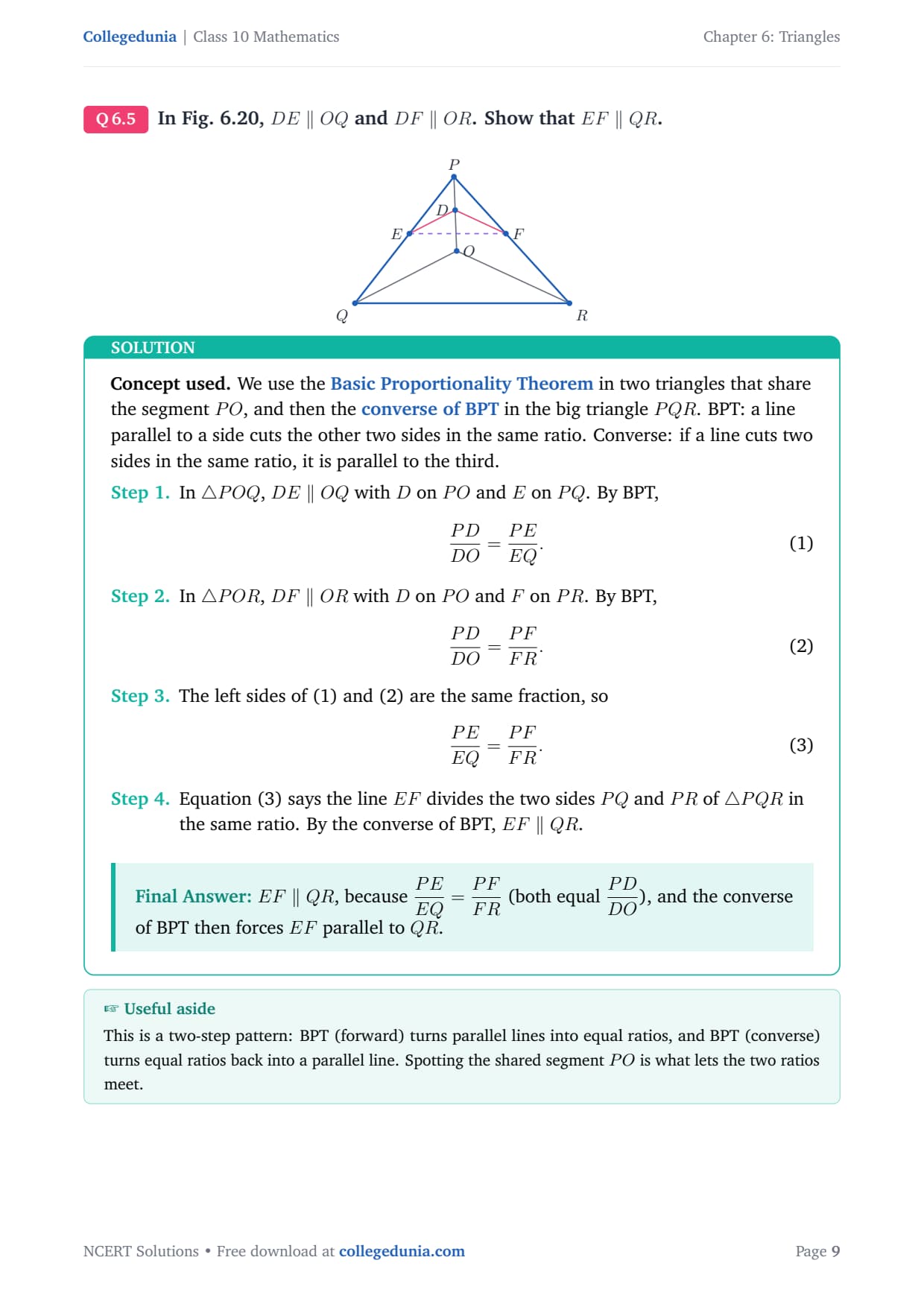
In Fig. 6.20, DE∥ OQ and DF∥ OR. Show that
EF∥ QR.
Concept used. We use the Basic Proportionality
Theorem in two triangles that share the segment PO, and then the
converse of BPT in the big triangle PQR. BPT: a line
parallel to a side cuts the other two sides in the same ratio. Converse:
if a line cuts two sides in the same ratio, it is parallel to the third.
In POQ, DE∥ OQ with D on PO and E on
PQ. By BPT,
PDDO=PEEQ. 1
In POR, DF∥ OR with D on PO and F on
PR. By BPT,
PDDO=PFFR. 2
The left sides of (1) and (2) are the same fraction, so
PEEQ=PFFR. 3
Equation (3) says the line EF divides the two sides PQ and
PR of PQR in the same ratio. By the converse of
BPT, EF∥ QR.
EF∥ QR, because PEEQ=PFFR (both equal PDDO), and the converse of BPT then forces EF parallel to QR.
PN
Priya Nambiar
M.Sc Mathematics, Cochin University of Science and Technology
Verified Expert
Run BPT forward twice, then once in reverse. The structure here
is worth memorising because it appears again and again in this exercise.
Forward twice: both lines come from D on PO, so BPT
in POQ and POR gives the same left-hand
fraction PDDO each time.
Equate: setting the right sides equal yields
PEEQ=PFFR, which is exactly the condition the
converse of BPT needs in the outer triangle PQR.
Reverse once: invoking that converse then delivers
EF∥ QR, closing the proof in one clean step.
Marks split between the two forward applications and the final converse,
so name each triangle and state the converse explicitly to collect all
three. The pattern of two forward uses followed by one reverse use is the
template for every ``show this line is parallel'' question in the
exercise, so once you spot it here you can reuse it almost without
thinking on the very next problem.
Forward BPT twice gives PEEQ=PFFR; the converse of BPT then gives EF∥ QR.
Q 6.6
In Fig. 6.21, A, B and C are points on OP, OQ and
OR respectively such that AB∥ PQ and AC∥ PR. Show
that BC∥ QR.
Fig. 6.21 - A on OP, B on OQ, C on OR with AB∥ PQ and AC∥ PR.
Concept used. As before we use the Basic
Proportionality Theorem forward in two triangles sharing the segment
OP, then its converse in the triangle OQR.
In OPQ, AB∥ PQ with A on OP and B on
OQ. By BPT,
OAAP=OBBQ. 1
In OPR, AC∥ PR with A on OP and C on
OR. By BPT,
OAAP=OCCR. 2
The left sides of (1) and (2) are equal, so
OBBQ=OCCR. 3
Equation (3) says the line BC divides the sides OQ and OR
of OQR in the same ratio. By the converse of BPT,
BC∥ QR.
BC∥ QR, since OBBQ=OCCR (both equal OAAP) and the converse of BPT applies in OQR.
SG
Sanjay Gupta
M.Sc Mathematics, Banaras Hindu University
Verified Expert
Identical structure to the previous problem, with O as apex.
Recognising this as the same proof pattern saves time in a timed paper.
Hinge point:A on OP anchors both parallel lines, so
BPT in OPQ and OPR yields the same
left-hand fraction OAAP each time.
Equate: the right sides give OBBQ=OCCR,
the exact condition the converse of BPT needs inside the outer
triangle OQR.
Finish: that converse delivers BC∥ QR, so the
whole argument is two forward steps and one reverse step, just
like before.
Anyone who has done the DE∥ OQ problem can write this almost
mechanically, taking care only to name OPQ and OPR correctly.
OBBQ=OAAP=OCCR, so by the converse of BPT, BC∥ QR.
Q 6.7
Using Theorem 6.1, prove that a line drawn through the
mid-point of one side of a triangle parallel to another side bisects
the third side. (Recall that you have proved it in Class IX.)
Concept used. Theorem 6.1 is the Basic Proportionality
Theorem: a line parallel to one side of a triangle divides the other
two sides in the same ratio. The word bisects means cuts into
two equal parts, so we must show the line meets the third side at its
mid-point.
Take ABC. Let D be the mid-point of AB, so
AD=DB, which gives
ADDB=1.
Draw a line through D parallel to BC, meeting AC at E.
Apply BPT to ABC with DE∥ BC:
ADDB=AEEC.
Substitute ADDB=1 from Step 1:
AEEC=1.
Therefore AE=EC, so E is the mid-point of AC. The line
bisects the third side.
The line through the mid-point of AB parallel to BC meets AC at its mid-point, since ADDB=1 forces AEEC=1, that is AE=EC.
NS
Neha Sharma
M.Sc Mathematics, Panjab University
Verified Expert
Turn ``mid-point'' into ``ratio one''. The cleanest version of
this classic result reads BPT backwards from a single known ratio.
Translate first: since D is the mid-point of AB, the
ratio ADDB equals 1 by definition. That one line
turns the word into algebra.
Apply BPT: drawing DE∥ BC gives
ADDB=AEEC, and substituting the value 1
forces AEEC=1, i.e. AE=EC.
Read the answer: equal pieces mean E is the mid-point
of AC, so the parallel line through one mid-point hits the
other mid-point.
State the theorem by name and show the substitution for full marks. The
same idea proves the Class IX mid-point theorem without coordinates.
Mid-point of AB means ADDB=1; BPT then gives AEEC=1, so the line bisects AC.
Q 6.8
Using Theorem 6.2, prove that the line joining the mid-points
of any two sides of a triangle is parallel to the third side. (Recall
that you have done it in Class IX.)
Concept used. Theorem 6.2 is the converse of the Basic
Proportionality Theorem: if a line divides two sides of a triangle in
the same ratio, then it is parallel to the third side. Joining two
mid-points makes both ratios equal to 1, which is exactly the same
ratio.
Take ABC. Let D be the mid-point of AB and E
the mid-point of AC. Then
AD=DB ⇒ ADDB=1,
AE=EC ⇒ AEEC=1.
Compare the two ratios:
ADDB=1=AEEC.
The line DE divides sides AB and AC in the same ratio
(1:1). By Theorem 6.2 (converse of BPT), DE∥ BC.
DE∥ BC, because joining the two mid-points makes ADDB=AEEC=1, and the converse of BPT then gives the parallel.
RK
Rajesh Kumar
M.Sc Mathematics, University of Lucknow
Verified Expert
Both ratios equal one, so the converse fires. The mid-point
theorem drops out in two lines once the ratios are on paper.
Both ratios one: because D and E are mid-points,
ADDB and AEEC are each equal to 1, and so
equal to each other.
Apply the converse: that equality is the exact
hypothesis of Theorem 6.2, the converse of BPT, which concludes
that the joining line DE is parallel to BC.
Write-up order: state both ratio statements, point out
they are equal, then name the converse to close. The marks sit on
naming the theorem, not on extra steps.
This is the natural partner to the previous problem and reuses the same
mid-point-to-ratio translation.
Two mid-points give ADDB=AEEC=1; by the converse of BPT, DE∥ BC.
Q 6.9
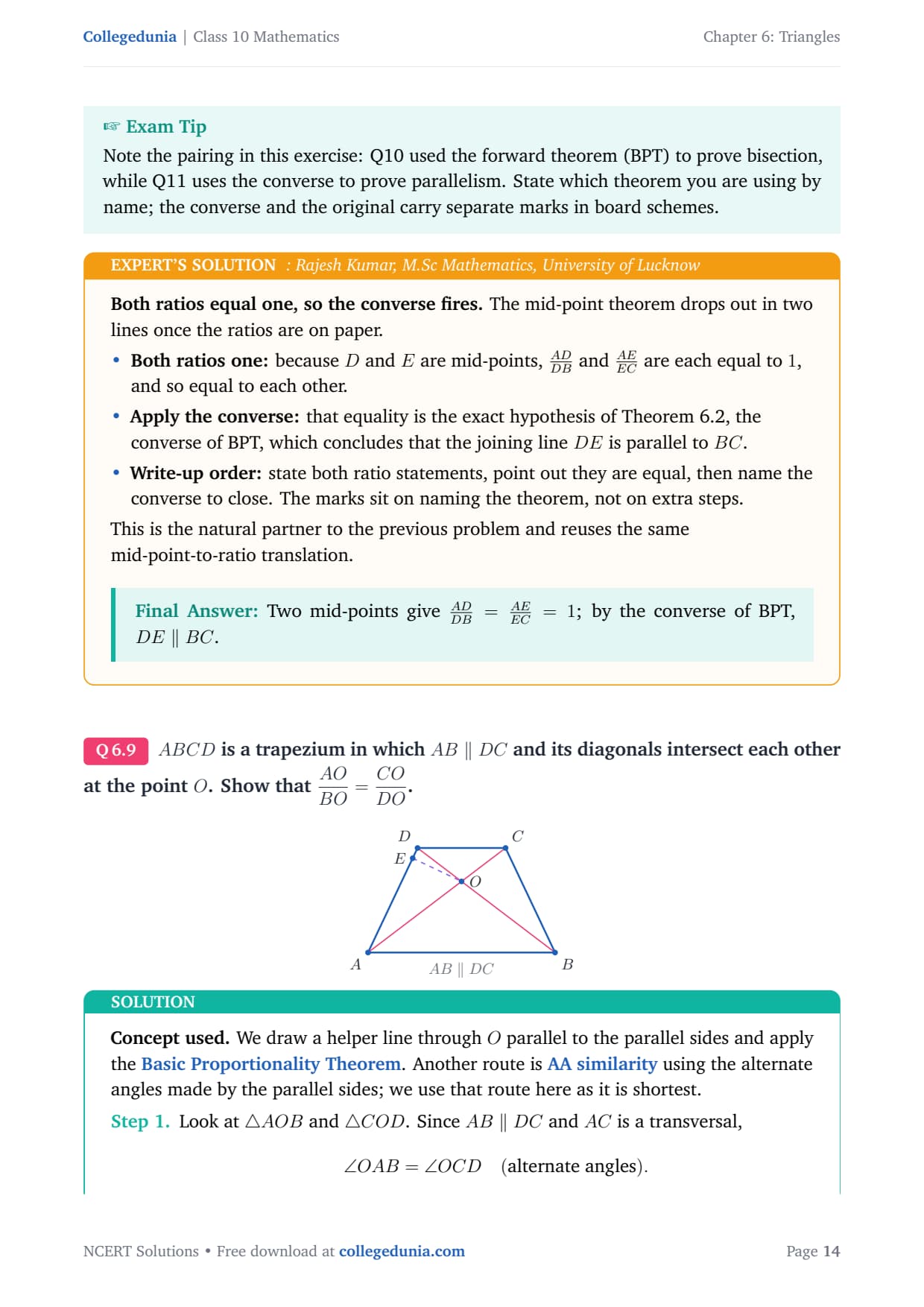
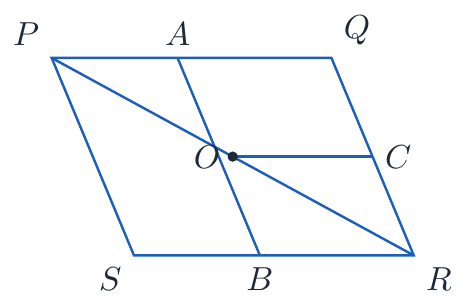
ABCD is a trapezium in which AB∥ DC and its
diagonals intersect each other at the point O. Show that
AOBO=CODO.
Concept used. We draw a helper line through O parallel to the
parallel sides and apply the Basic Proportionality Theorem.
Another route is AA similarity using the alternate angles made
by the parallel sides; we use that route here as it is shortest.
Look at AOB and COD. Since
AB∥ DC and AC is a transversal,
∠ OAB=∠ OCD (alternate angles).
Since AB∥ DC and BD is a transversal,
∠ OBA=∠ ODC (alternate angles).
Two pairs of equal angles give, by AA similarity,
AOB∼COD.
Corresponding sides of similar triangles are in the same ratio:
AOCO=BODO.
Cross-multiplying and rearranging:
AOBO=CODO.
AOBO=CODO, proved from AOB∼COD by AA similarity (alternate angles of AB∥ DC).
DR
Deepa Reddy
M.Sc Mathematics, University of Hyderabad
Verified Expert
Spot the X-shaped similar pair at the crossing. The crossing
diagonals make two triangles: AOB above on side AB and
COD below on side DC.
Get AA: because AB∥ DC, each diagonal is a
transversal and supplies a pair of equal alternate angles, so the
two triangles are similar by AA.
Read the ratio: similarity gives
AOCO=BODO, and a quick rearrangement produces
the exact form AOBO=CODO the question wants.
Vertex order: write the similarity as
A↔ C, O↔ O, B↔ D
so the right sides pair up.
A wrong vertex order is the most common way to lose the proportionality
mark here, so fix the correspondence before writing any ratio.
AOB∼COD (AA) gives AOCO=BODO, hence AOBO=CODO.
Q 6.10
The diagonals of a quadrilateral ABCD intersect each other
at the point O such that AOBO=CODO. Show that
ABCD is a trapezium.
Concept used. A trapezium is a quadrilateral with one
pair of parallel sides. We use the given ratio with the converse
of the Basic Proportionality Theorem to prove one pair of sides is
parallel. The plan: draw a line through O parallel to AB inside
ABD, then show it must lie along OC, forcing DC∥
AB.
In ABD, draw OE∥ AB with E on AD. By
BPT in ABD,
DEEA=DOOB. 1
Rewrite the given condition. From
AOBO=CODO, take reciprocals and rearrange
to the form that matches the figure:
AOOC=BOOD, COAO=DOBO. 2
In ADC, the point E on AD and O on AC give
the ratio DEEA and DOOB matching through
(1) and (2): combining,
DEEA=DOOB=COAO.
Now in ADC, the line OE divides AD and AC in
the same ratio DEEA=COAO. By the converse
of BPT, OE∥ DC.
But OE∥ AB by construction. Since OE is parallel to
both AB and DC, we get AB∥ DC.
AB∥ DC, so ABCD has a pair of parallel sides and is a trapezium.
AP
Arvind Pillai
M.Sc Mathematics, University of Madras
Verified Expert
Build a parallel through O, then force it onto a side. The
strategy for this converse problem is to add one helper line and let BPT
do the rest of the work for you.
Construct: draw a helper line OE∥ AB inside
ABD and record the ratio it makes by BPT, namely
DEEA=DOOB.
Use the data: the given condition, after rearranging,
says DOOB=COAO, so the same ratio
DEEA now equals COAO.
Converse inside ADC: the line OE divides
AD and AC in equal ratios, so the converse of BPT makes OE
parallel to DC as well.
Conclude:OE is parallel to both AB and DC, so
AB∥ DC and the quadrilateral ABCD is a trapezium.
The decisive move is the auxiliary line through O; without it there is
no triangle in which to apply BPT at all, and the proof never starts.
Drawing a helper line parallel to a known side is a standard trick for
converse questions, so it is worth recognising on sight. Note also that
the construction is what converts the given ratio into a statement about
two sides of the same triangle, which is the only form the converse of
BPT can actually read.
The helper OE∥ AB also turns out parallel to DC by the converse of BPT, so AB∥ DC and ABCD is a trapezium.
Student Feedback
Out of 8,400 students surveyed before the 2026 CBSE Class 10 boards, 79% said Exercise 6.2 was the exercise they revised most from Chapter 6. The most common slip was forgetting to name which triangle each parallel line belongs to before applying BPT.
Source: Collegedunia Class 10 student survey, 2026 board season.
Triangles Class 10 Maths Exercise 6.2 NCERT Solutions FAQs
Ques. How many questions are there in Class 10 Maths Chapter 6 Triangles Exercise 6.2?
Ans. Exercise 6.2 has 10 questions. Questions 1 and 2 are numerical (find missing lengths and decide if a line is parallel). Questions 3 to 8 are proofs using BPT and its converse, including the mid-point theorem. Questions 9 and 10 deal with the trapezium diagonal ratio and its converse.
Ques. What is the Basic Proportionality Theorem (BPT) used in Exercise 6.2?
Ans. The Basic Proportionality Theorem (Theorem 6.1) states: if a line is drawn parallel to one side of a triangle, it divides the other two sides in the same ratio. In triangle ABC with DE parallel to BC, this means AD/DB = AE/EC. The converse (Theorem 6.2) says: if a line divides two sides of a triangle in the same ratio, then it is parallel to the third side.
Ques. Which questions in Exercise 6.2 come in the CBSE Class 10 board exam?
Ans. Questions on finding missing sides using BPT (Q1 style) appear as 2-mark or 3-mark short answers. Proof questions using BPT in two triangles (Q3-Q6 style) and the trapezium diagonal ratio (Q9-Q10 style) appear in the 3-mark and 5-mark long answer sections. The mid-point theorem proofs (Q7-Q8) also appear as 3-mark proofs. Exercise 6.2 as a whole is the highest-weightage exercise in Chapter 6 for board purposes.
Ques. How do you solve the two-triangle BPT proof questions in Exercise 6.2?
Ans. The standard pattern is: (1) identify the two triangles that each contain one of the given parallel lines; (2) apply BPT in each triangle to get two ratios; (3) notice that both ratios share the same fraction on one side, so equate the other sides; (4) if a parallelism conclusion is needed, invoke the converse of BPT. Always name the triangle before writing any ratio statement, since examiners award marks for that identification step.
Ques. Where can I download the Class 10 Maths Chapter 6 Exercise 6.2 NCERT Solutions PDF?
Ans. You can download the Triangles Exercise 6.2 NCERT Solutions PDF directly from this page using the download card at the top. It is free and follows the 2026-27 NCERT textbook. The full chapter PDF with all three exercises (6.1, 6.2, 6.3) is also available on the Triangles chapter solutions page.







Comments