Maths Mentor, Thapar Institute | Updated 3+ months ago
Exercise 6.3 of NCERT Class 10 Maths Chapter 6 (Triangles) covers similarity criteria in action: from stating AA/SSS/SAS to proving triangles similar using altitudes, angle bisectors, medians and real-life shadow problems. All 16 questions are solved here with full step-by-step working, according to the 2026-27 CBSE syllabus.
CBSE Weightage: Chapter 6 Triangles typically carries 6 to 8 marks in the Class 10 board exam; Exercise 6.3 questions appear as 2-mark and 3-mark proof-type items.
Exercise 6.3 covers: applying AA, SSS and SAS similarity to 16 question types including trapezium diagonals, isosceles triangles, parallelograms, altitudes, angle bisectors, medians, and the shadow-height word problem.
Prerequisite: knowing the AA, SSS and SAS criteria from Exercise 6.2 and the Basic Proportionality Theorem from Exercise 6.1.
Every answer in this Collegedunia compilation is curated by Mathematics subject experts, mapped to the 2026-27 NCERT textbook, and checked against the last five years of CBSE Class 10 board papers.
What Exercise 6.3 of Class 10 Maths Chapter 6 Triangles Covers
Exercise 6.3 is where students apply the similarity criteria they learned in Exercise 6.2 to a wide range of figure types. There are 16 questions in total.
Question 1: Six pairs of triangles; decide which are similar and name the criterion (AA, SSS or SAS). The longest question in this exercise.
Questions 2 to 5: Short proofs using a single criterion. Each has a labelled figure and 2 to 3 steps.
Questions 6 to 11: Medium proofs involving congruence + similarity, altitudes, parallelograms and isosceles triangles.
Questions 12 to 14: Harder proofs using medians. These need the "double the median" construction or the half-side SSS step.
Question 15: The shadow-height word problem. One ratio equation gives the answer directly.
Question 16: Prove that a median scales by the same factor as the sides when two triangles are similar.
Quick Tip: In every proof question of Exercise 6.3, write the similarity criterion name (AA, SSS or SAS) in bold before you write the conclusion. CBSE awards one mark specifically for naming the criterion; students who write only "therefore similar" lose that mark.
How to Solve Exercise 6.3 Question by Question: Class 10 Maths Triangles
Use the three-question checklist below before starting any Exercise 6.3 proof.
Check this first
If yes, use this criterion
What to write in the proof
Are two (or three) equal angles given or derivable?
AA / AAA
Name the two equal angle pairs, state AA or AAA, write the similarity
Are all three side ratios equal?
SSS
Show each ratio equals the same value, state SSS, write the similarity
Is one equal angle given between two proportional sides?
SAS
Show the two side ratios are equal, confirm the angle is included, state SAS
Concept: SAS similarity requires the equal angle to be the included angle (the angle between the two proportional sides). Question 1(v) of Exercise 6.3 is a trap: the given equal angle is NOT the included angle, so SAS cannot apply and the triangles are not similar.
Exercise 6.3 Key Concepts and Formulas: Similarity Criteria for CBSE Class 10
Exercise 6.3 relies on three criteria. The table below shows how each criterion works and which questions use it.
Criterion
What it requires
Questions in Exercise 6.3
AA (Angle-Angle)
Two pairs of equal angles. The third pair follows automatically from the angle sum.
Q1(i), Q1(vi), Q2, Q3, Q5, Q7, Q8, Q9, Q10, Q11
SSS (Side-Side-Side)
All three corresponding side ratios are equal.
Q1(ii), Q12 (via small-triangle SSS)
SAS (Side-Angle-Side)
One equal angle AND the two sides including that angle proportional.
Q1(iv), Q4, Q6, Q12, Q13, Q14, Q16
Remember: For median questions (Q12, Q14, Q16), the standard move is to use the half-side: replace BC with 2 BD and QR with 2 QM so the median enters the smaller triangle where SSS or SAS can act.
CBSE Board Exam Weightage and Question Pattern: Exercise 6.3 Triangles
Exercise 6.3 is one of the most exam-relevant exercises in Class 10 Maths. Board papers have consistently drawn from it for 2-mark and 3-mark proof questions.
Year
Question from Exercise 6.3
Marks
2025
Prove triangles similar using AA (trapezium / altitude type)
3
2024
Shadow-height word problem (similar to Q15)
2
2023
Median proportion proof (similar to Q16)
3
2022
State which pairs of triangles are similar and name the criterion
Common Mistakes in Exercise 6.3 That Cost CBSE Board Marks
These are the four errors that appear most often in CBSE board answer sheets for Exercise 6.3 questions.
Skipping the criterion name: Writing "therefore similar" without writing "by AA" or "by SAS" loses 1 mark in almost every proof question in this exercise.
Wrong vertex order: Writing ABC ~ DEF when the correct correspondence is ABC ~ FDE is marked wrong even if the angles are correct. Always pair equal angles vertex-by-vertex before writing the similarity.
Using SAS with a non-included angle: The most common slip in Question 1 and in parallelogram/isosceles questions. Always confirm the equal angle sits between the two proportional sides.
Median directly in a proportion: In Questions 12, 14 and 16, students write the median as if it were a side of the main triangle and try to apply SAS directly. The half-side conversion to a smaller triangle is not optional.
Watch Out: In Question 1(vi), you cannot see the third angle directly. Use the angle sum property to find it first: third angle = 180° minus the two given angles. Only after finding the hidden angle can you match all three pairs and apply AA.
All NCERT Solutions for Class 10 Maths Chapter 6 Triangles Exercise 6.3 with Step-by-Step Solutions
Exercise 6.3
Q 6.1
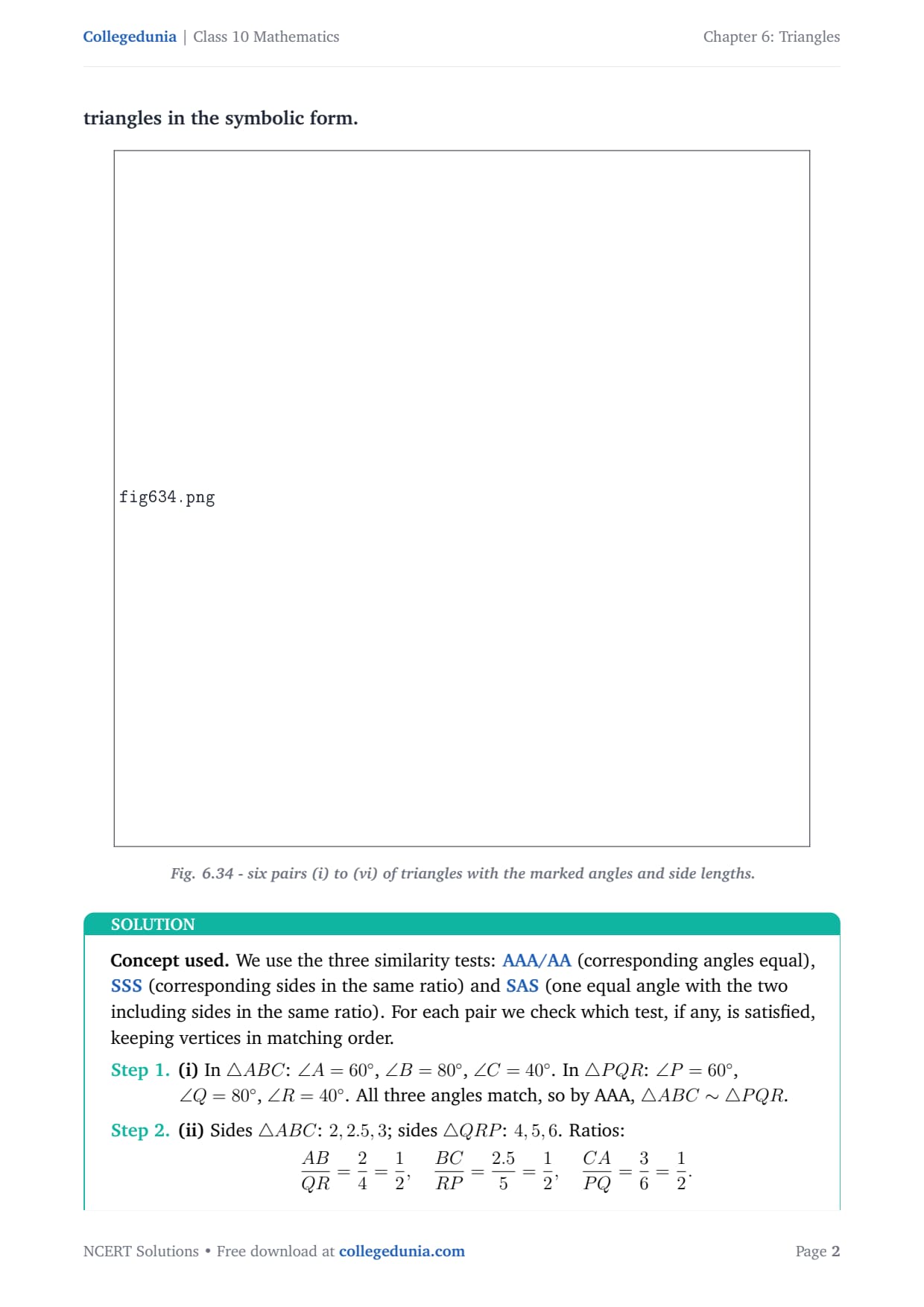
State which pairs of triangles in Fig. 6.34 are similar. Write
the similarity criterion used by you for answering the question and also
write the pairs of similar triangles in the symbolic form.
Concept used. We use the three similarity tests:
AAA/AA (corresponding angles equal), SSS
(corresponding sides in the same ratio) and SAS (one equal
angle with the two including sides in the same ratio). For each pair we
check which test, if any, is satisfied, keeping vertices in matching
order.
(i) In ABC: ∠ A=60∘,
∠ B=80∘, ∠ C=40∘. In PQR:
∠ P=60∘, ∠ Q=80∘, ∠ R=40∘.
All three angles match, so by AAA,
ABC∼PQR.
(ii) Sides ABC: 2,2.5,3; sides
QRP: 4,5,6. Ratios:
ABQR=24=12,
BCRP=2.55=12,
CAPQ=36=12.
All equal, so by SSS, ABC∼QRP.
(iii) Sides LMP: 2.7,2,3; sides
DEF: 4,5,6. Ratios
2.74=0.675, 25=0.4, 36=0.5 are
all different, so the triangles are not similar.
(iv) Here ∠ M=∠ Q=70∘. Including
sides: MNQP=2.55=12 and
MLQR=510=12. One equal angle with the
two including sides proportional gives, by SAS,
MNL∼QPR.
(v) Only ∠ A=80∘ is given with sides
AB=2.5, AC=3 in one triangle and DE,DF in the other; the
equal angle ∠ F=80∘ is not the angle included
between the two given proportional sides, so SAS does not apply.
The triangles are not similar.
(vi) In DEF: ∠ D=70∘,
∠ E=80∘, so ∠ F=180∘-70∘-80∘
=30∘. In PQR: ∠ P=80∘,
∠ R=30∘, so ∠ Q=70∘. Matching equal
angles (∠ D=∠ Q=70∘, ∠ E=∠ P
=80∘) give, by AA, DEF∼QPR.
(i) ABC∼PQR (AAA); (ii) ABC∼QRP (SSS); (iii) not similar; (iv) MNL∼QPR (SAS); (v) not similar; (vi) DEF∼QPR (AA).
LS
Lakshmi Subramanian
M.Sc Mathematics, University of Madras
Verified Expert
Test the right criterion per pair, and keep vertex order honest.
A good approach is to scan what each pair gives you and match it to a
test: three angles point to AAA, three side ratios point to SSS, and one
angle between two sides points to SAS.
Clear similar pairs: (i) is pure AAA, and (ii) is pure
SSS with every side ratio equal to 12, so both are settled
by inspection.
SAS pair: in (iv) the 70∘ angle sits between the
two sides whose ratios are both 12, which is exactly the
included-angle setup SAS needs.
Not similar: (iii) fails because the side ratios
disagree, and (v) fails because the equal 80∘ angle is not
the included angle, so SAS cannot be claimed there.
Hidden angle: (vi) needs the angle-sum property first to
recover the missing third angle, after which two equal angles let
AA settle the pair cleanly.
The single most marked error is mismatched vertex order, so always pair
equal angles to equal angles when you name the triangles. A useful exam
habit is to write the criterion you are using next to each pair, because
the marking scheme awards a separate mark for naming AAA, SSS, SAS or AA
correctly. Doing the quick scan first also stops you from forcing a test
that the data does not support, which is exactly what trips students up
in the two non-similar cases.
Similar: (i) AAA, (ii) SSS, (iv) SAS, (vi) AA, each with matched vertex order; (iii) and (v) are not similar.
Q 6.2
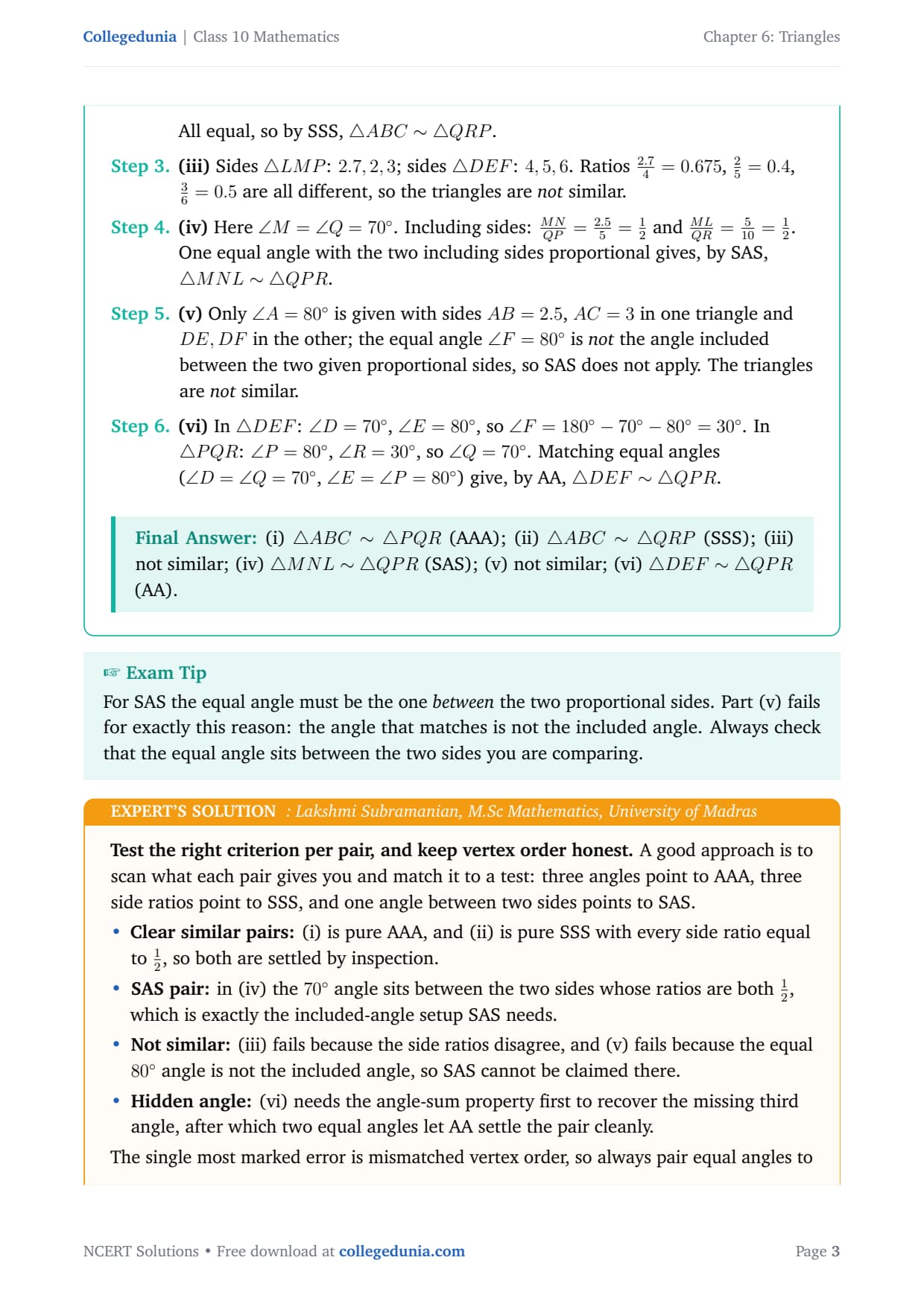
In Fig. 6.35, ODC∼OBA,
∠ BOC=125∘ and ∠ CDO=70∘. Find ∠ DOC,
∠ DCO and ∠ OAB.
Concept used. A straight line gives a linear pair
(angles on a line add to 180∘); the angle sum of a
triangle is 180∘; and corresponding angles of similar
triangles are equal. DOB is a straight line, so ∠ DOC and
∠ BOC are a linear pair.
Find ∠ DOC. Since DOB is a straight line,
∠ DOC+∠ BOC=180∘.
Substitute ∠ BOC=125∘:
∠ DOC=180∘-125∘=55∘.
Find ∠ DCO. In DOC the angles add to
180∘:
∠ DCO=180∘-∠ DOC-∠ CDO.
Substitute ∠ DOC=55∘, ∠ CDO=70∘:
∠ DCO=180∘-55∘-70∘=55∘.
Find ∠ OAB. Because ODC∼OBA,
corresponding angles are equal. Vertex D corresponds to B and
vertex C corresponds to A, so
∠ OAB=∠ OCD=∠ DCO=55∘.
∠ DOC=55∘, ∠ DCO=55∘, ∠ OAB=55∘.
HC
Harish Chandran
M.Sc Mathematics, University of Kerala
Verified Expert
Chase the angles in order, then transfer by correspondence. The
problem is a short angle hunt that rewards working strictly in sequence.
Linear pair: on the straight line DOB, the angle
∠ BOC=125∘ and its neighbour ∠ DOC add to
180∘, so ∠ DOC=55∘.
Angle sum: inside DOC the three angles total
180∘; with 70∘ and 55∘ known, the third is
∠ DCO=55∘.
Transfer: the similarity ODC∼OBA
matches C↔ A, so ∠ OAB copies the value
∠ OCD=55∘.
The key skill is reading the correspondence from the letter order in the
similarity statement, which tells you exactly which angle copies onto
which without any guessing.
Linear pair gives ∠ DOC=55∘, angle sum gives ∠ DCO=55∘, and correspondence gives ∠ OAB=55∘.
Q 6.3
Diagonals AC and BD of a trapezium ABCD with
AB∥ DC intersect each other at the point O. Using a
similarity criterion for two triangles, show that
OAOC=OBOD.
Concept used. Parallel lines cut by a transversal give equal
alternate angles; two pairs of equal angles give
AA similarity; and corresponding sides of similar triangles
are proportional.
Consider OAB and OCD. Since
AB∥ DC and AC is a transversal,
∠ OAB=∠ OCD (alternate angles).
Since AB∥ DC and BD is a transversal,
∠ OBA=∠ ODC (alternate angles).
Two equal angle pairs give, by AA,
OAB∼OCD.
Corresponding sides are in the same ratio. Matching
A↔ C and B↔ D,
OAOC=OBOD.
OAOC=OBOD, from OAB∼OCD by AA similarity using the alternate angles of AB∥ DC.
GR
Geetha Raman
M.Sc Mathematics, Bharathiar University
Verified Expert
Name the criterion the question asks for. Because the problem
says ``using a similarity criterion'', the answer must state AA
similarity rather than slip in a BPT shortcut.
Set up AA:OAB and OCD sit on
opposite sides of O, and the parallel sides AB and DC make
each diagonal a transversal, giving two pairs of equal alternate
angles.
Read the ratio: two equal angles are enough for AA, and
the proportional-sides property then gives
OAOC=OBOD directly.
Vertex order: write the similarity as
A↔ C, B↔ D so the sides pair
correctly when you form the proportion.
Label both angle pairs explicitly as alternate angles, since those labels
carry their own marks in the scheme.
OAB∼OCD (AA) gives OAOC=OBOD.
Q 6.4
In Fig. 6.36, QRQS=QTPR and
∠ 1=∠ 2. Show that PQS∼TQR.
Concept used. In a triangle, sides opposite equal angles are
equal (the isosceles triangle property). We also use the
SAS similarity test: one equal angle with the two including
sides in the same ratio.
In PQR, it is given ∠ 1=∠ 2, that is
∠ PQR=∠ PRQ. Sides opposite equal angles are equal,
so
PR=PQ. 1
Use the given ratio and replace PR by PQ from (1):
QRQS=QTPR=QTPQ.
So
QRQS=QTPQ. 2
Rearrange (2) so the two triangles' sides line up:
QTQR=PQQS. 3
The angle ∠ PQS (in PQS) and ∠ TQR (in
TQR) are the same angle ∠ Q, so
∠ PQS=∠ TQR. 4
From (3) and (4), one equal angle with the two including sides
proportional gives, by SAS,
PQS∼TQR.
PQS∼TQR, by SAS: ∠ PQS=∠ TQR (common angle Q) and PQQS=QTQR after using PR=PQ.
SB
Suresh Babu
M.Sc Mathematics, Sri Venkateswara University
Verified Expert
Convert equal angles to equal sides, then run SAS. The whole
proof turns on one substitution that the equal angles let you make.
Isosceles swap:∠ 1=∠ 2 makes PQR
isosceles with PQ=PR, so you may replace PR by PQ inside the
given ratio.
Rearrange: after the swap the proportion reads
QRQS=QTPQ, which lines the sides up as
QTQR=PQQS.
Apply SAS: the angle ∠ Q is shared by
PQS and TQR, so it is the included angle
for both ratios, and SAS similarity follows.
The single most important move is that isosceles substitution; without it
the given ratio cannot be matched to corresponding sides, so state PQ=PR
with its reason before anything else.
Equal base angles give PQ=PR; the ratio becomes QTQR=PQQS with common angle Q, so SAS gives PQS∼TQR.
Q 6.5
S and T are points on sides PR and QR of PQR
such that ∠ P=∠ RTS. Show that RPQ∼RTS.
Concept used. The AA similarity test says that if two
angles of one triangle are equal to two angles of another triangle, the
triangles are similar. We look at RPQ and RTS,
which share the angle at R, and use the given equal angle as the
second pair.
The two triangles RPQ and RTS have a
common angle at R:
∠ PRQ=∠ TRS (same angle R).
It is given that
∠ RPQ=∠ RTS.
Two pairs of equal angles satisfy the AA test, so
RPQ∼RTS.
RPQ∼RTS, by AA: the angle at R is common and ∠ RPQ=∠ RTS is given.
AJ
Anita Joshi
M.Sc Mathematics, University of Mumbai
Verified Expert
Spot the shared angle, then use the one given equality. This is
a two-line AA proof once you see where the two equal angles come from.
Common angle: both triangles meet at R, so the angle
there is shared by both without any extra working at all.
Given angle: the question hands you a single equality,
∠ RPQ=∠ RTS, which is exactly the second pair that AA
requires.
Conclude: two pairs of equal angles give
RPQ∼RTS, with no need to chase any side
lengths.
The one habit that matters is the correspondence order: pair P with T
and Q with S, listing the common angle first and the given angle
second for a clean full-mark write-up.
Common angle at R plus the given ∠ RPQ=∠ RTS give AA, hence RPQ∼RTS.
Q 6.6
In Fig. 6.37, if ABE≅ACD, show that
ADE∼ABC.
Concept used.Congruent triangles have all
corresponding parts equal (CPCT). We also use the SAS
similarity test: one equal angle with the two including sides in the
same ratio. Here the congruence supplies equal sides and a common angle
gives the equal angle.
From ABE≅ACD, corresponding sides are
equal (CPCT):
AB=AC 1 AE=AD. 2
Form the side ratios for ADE and ABC.
Divide (2) by (1):
ADAB=AEAC.
(Using AE=AD and AB=AC, both ratios are equal.)
The angle at A is common to both triangles:
∠ DAE=∠ BAC (same angle A).
One equal angle with the two including sides in the same ratio
gives, by SAS,
ADE∼ABC.
ADE∼ABC, by SAS: ADAB=AEAC from CPCT and the common angle at A.
PN
Pradeep Nair
M.Sc Mathematics, University of Pune
Verified Expert
Read off the equal sides from CPCT, then run SAS. Use the given
congruence purely as a supplier of equal parts and SAS does the rest.
CPCT equalities: from ABE≅ACD
the corresponding sides give AB=AC and AE=AD, the two facts
the proof needs.
Equal ratio: those equalities make ADAB and
AEAC equal, which is the proportional-side half of SAS
for ADE and ABC.
Included angle: the angle at A is shared, so it is the
included angle for both ratios, completing the SAS similarity.
Resist the urge to prove the new triangles congruent; only similarity is
asked, so SAS similarity is the right tool to name at the end.
CPCT gives AB=AC, AD=AE, so ADAB=AEAC; with the common angle A, SAS gives ADE∼ABC.
Q 6.7
In Fig. 6.38, altitudes AD and CE of ABC
intersect each other at the point P. Show that:
(i) AEP∼CDP (ii) ABD∼CBE
(iii) AEP∼ADB (iv) PDC∼BEC
Concept used. The AA similarity test needs two equal
angles. The altitudes give right angles (AD⊥ BC so
∠ ADB=∠ ADC=90∘; CE⊥ AB so
∠ AEC=∠ BEC=90∘). We also use vertically
opposite angles and common angles to find the second equal
pair in each part.
Part (i): AEP∼CDP.
∠ AEP=∠ CDP=90∘ (from CE⊥ AB and
AD⊥ BC).
∠ APE=∠ CPD (vertically opposite angles).
Two equal angle pairs give, by AA,
AEP∼CDP.
Part (ii): ABD∼CBE.
∠ ADB=∠ CEB=90∘.
∠ ABD=∠ CBE (same angle B, common to both).
By AA, ABD∼CBE.
Part (iii): AEP∼ADB.
∠ AEP=∠ ADB=90∘.
∠ PAE=∠ DAB (same angle A, common to both).
By AA, AEP∼ADB.
Part (iv): PDC∼BEC.
∠ PDC=∠ BEC=90∘.
∠ PCD=∠ BCE (same angle C, common to both).
By AA, PDC∼BEC.
All four pairs are similar by AA, each using one 90∘ angle from an altitude plus a vertically opposite or common angle.
SV
Sunil Varma
M.Sc Mathematics, University of Delhi
Verified Expert
Bank the right angles, then hunt the second angle each time. The
structure repeats four times, so a steady two-step method pays off.
Bank the right angle: every pair already owns a
90∘ angle because each altitude is perpendicular to a side,
which is one of the two angles AA requires.
Vertically opposite: at the crossing point P the
second angle comes free, as in part (i) where
∠ APE=∠ CPD.
Common vertex: in parts (ii), (iii) and (iv) the shared
vertex contributes the second angle, namely ∠ B, ∠ A
or ∠ C respectively.
Write the right-angle equality first, name the second angle with its
reason, then state AA, keeping the vertex order faithful to avoid the
usual marking penalty.
Each part: one 90∘ from an altitude plus a vertically opposite angle (i) or a common vertex angle (ii)-(iv) gives AA similarity.
Q 6.8
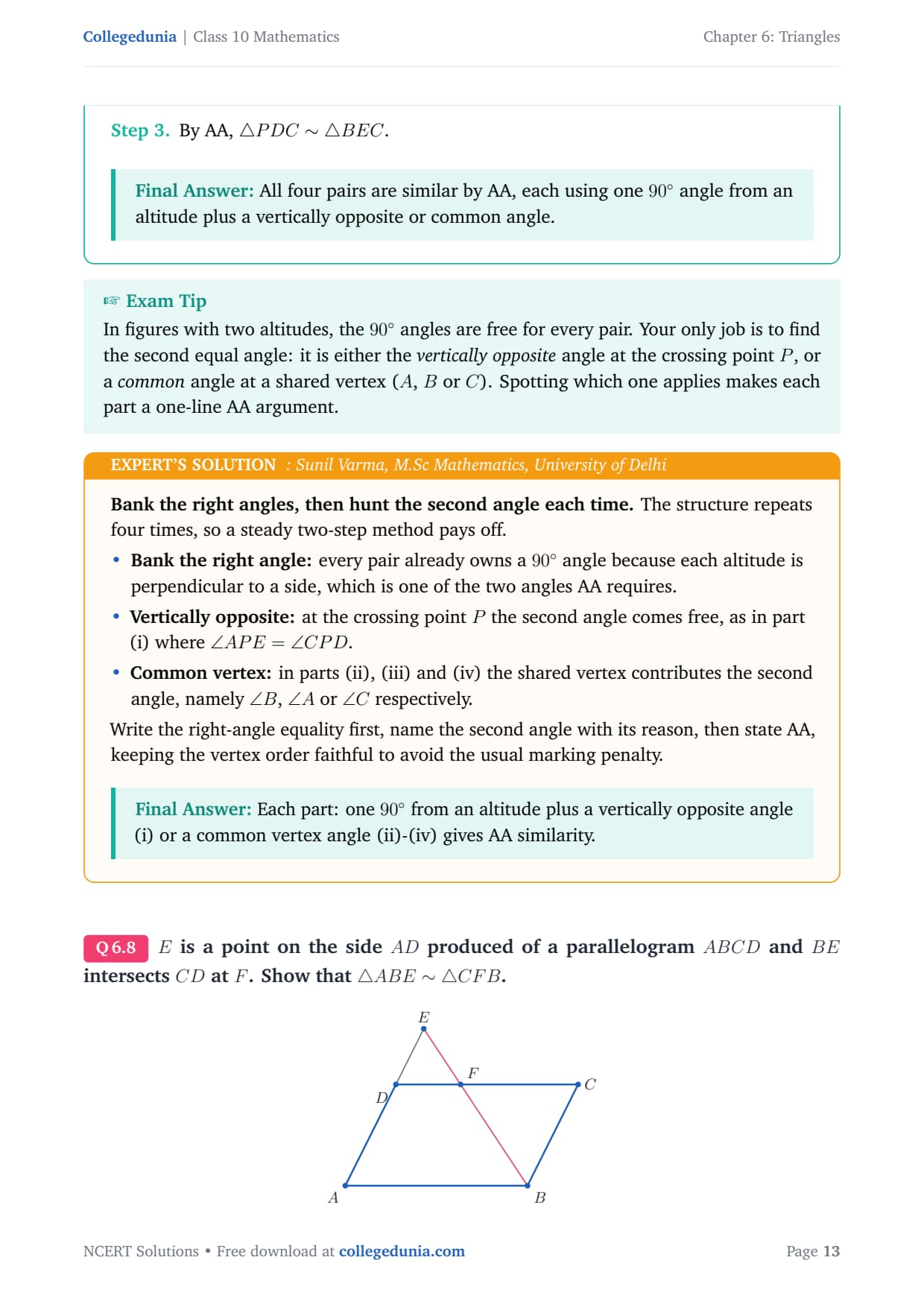
E is a point on the side AD produced of a parallelogram
ABCD and BE intersects CD at F. Show that
ABE∼CFB.
Concept used. In a parallelogram opposite sides are
parallel (AB∥ DC and AD∥ BC) and opposite angles are
equal. Parallel lines cut by a transversal give equal alternate
angles. The AA similarity test then finishes the proof.
In ABE and CFB, use AD∥ BC
(opposite sides of the parallelogram), so AE∥ BC with
BE as transversal:
∠ AEB=∠ CBF (alternate angles). 1
Opposite angles of the parallelogram are equal:
∠ A=∠ C, is
∠ BAE=∠ FCB. 2
(Here ∠ BAE=∠ BAD since E lies on line AD, and
∠ FCB=∠ DCB=∠ C.)
Equations (1) and (2) give two pairs of equal angles, so by AA,
ABE∼CFB.
ABE∼CFB, by AA: ∠ AEB=∠ CBF (alternate angles, AE∥ BC) and ∠ BAE=∠ FCB (opposite angles of the parallelogram).
MA
Manish Agarwal
M.Sc Mathematics, University of Rajasthan
Verified Expert
Use both parallelogram properties to land two equal angles. Two
separate parallelogram facts each hand you one equal-angle pair.
First pair: producing AD keeps E on line AD, so
AE is parallel to BC; with BE as transversal, the alternate
angles ∠ AEB and ∠ CBF are equal.
Second pair: the parallelogram makes opposite angles
∠ A and ∠ C equal, and these are exactly
∠ BAE and ∠ FCB in the two triangles.
Apply AA: two equal angle pairs give
ABE∼CFB at once, with no side work
needed.
The skill checked is connecting a produced side to a parallel side and
reading the alternate angle correctly, so name both pairs explicitly
before invoking AA.
AE∥ BC gives ∠ AEB=∠ CBF; opposite angles give ∠ BAE=∠ FCB; so AA gives ABE∼CFB.
Q 6.9
In Fig. 6.39, ABC and AMP are two right
triangles, right angled at B and M respectively. Prove that:
(i) ABC∼AMP
(ii) CAPA=BCMP
Concept used. The AA similarity test gives similar
triangles from two equal angles; once triangles are similar, their
corresponding sides are in the same ratio. The two right angles
are equal, and the angle at A is shared.
Part (i).
Right angles are equal:
∠ ABC=∠ AMP=90∘.
The angle at A is common to both triangles:
∠ BAC=∠ MAP (same angle A).
Two equal angle pairs give, by AA,
ABC∼AMP.
Part (ii).
Corresponding sides of the similar triangles are in the same
ratio. Matching A↔ A, B↔ M,
C↔ P:
CAPA=ABAM=BCMP.
Reading the first and third members gives the required result:
CAPA=BCMP.
(i) ABC∼AMP by AA; (ii) CAPA=BCMP follows from corresponding sides.
KB
Kavita Bhatt
M.Sc Mathematics, Gujarat University
Verified Expert
One common angle plus equal right angles is the whole proof.
Both parts fall out of a single AA step if you set the correspondence
first.
Common angle: the two triangles are pinned together at
A, so that angle is shared and forms one of the two equalities
AA needs.
Right angles: the angles at B and M are both
90∘, giving the second equality at once and closing AA.
Ratio chain: the correspondence A↔ A,
B↔ M, C↔ P gives
CAPA=ABAM=BCMP, and the asked
relation is just the outer pair.
Fix the vertex correspondence first, because the side ratio in part (ii)
is correct only when C pairs with P and B with M.
AA gives ABC∼AMP; the corresponding-side chain then yields CAPA=BCMP.
Q 6.10
CD and GH are respectively the bisectors of ∠ ACB
and ∠ EGF such that D and H lie on sides AB and FE of
ABC and EFG respectively. If
ABC∼FEG, show that:
(i) CDGH=ACFG
(ii) DCB∼HGE
(iii) DCA∼HGF
Concept used. Similar triangles have equal
corresponding angles and proportional corresponding sides. An
angle bisector splits an angle into two equal halves. Combining
these with the AA similarity test proves each part.
From ABC∼FEG we read the equal angles
∠ A=∠ F, ∠ B=∠ E, ∠ ACB=∠ FGE, and the
side ratio ACFG=ABFE=BCEG.
Part (iii) first: DCA∼HGF.
∠ A=∠ F (from the given similarity).
The bisectors halve the equal angles ∠ ACB and
∠ FGE, so each half is equal:
∠ ACD=12∠ ACB=12∠ FGE=∠ FGH.
Two equal angle pairs give, by AA,
DCA∼HGF.
Part (i): CDGH=ACFG.
From DCA∼HGF (Part iii), corresponding
sides are in the same ratio. Matching C↔ G,
A↔ F, D↔ H:
CDGH=ACFG.
Part (ii): DCB∼HGE.
∠ B=∠ E (from the given similarity).
The bisected halves are equal:
∠ DCB=12∠ ACB=12∠ FGE=∠ HGE.
Two equal angle pairs give, by AA,
DCB∼HGE.
(i) CDGH=ACFG; (ii) DCB∼HGE (AA); (iii) DCA∼HGF (AA).
RI
Ramesh Iyer
M.Sc Mathematics, University of Madras
Verified Expert
Halve the equal angle, then build two AA pairs. The cleanest
order is to prove the triangle similarities first and read the side ratio
off them afterwards.
Bisect: from ABC∼FEG the angles
∠ ACB and ∠ FGE are equal, so their halves match too:
∠ ACD=∠ FGH and ∠ DCB=∠ HGE.
Two AA pairs: pairing the first half with
∠ A=∠ F gives DCA∼HGF, and the
second half with ∠ B=∠ E gives
DCB∼HGE.
Read part (i): the ratio is then just corresponding
sides of the first pair, CDGH=ACFG.
Always derive the similarities before the side ratio, since the ratio is
a consequence of similarity; naming the bisected halves is what makes
each AA step rigorous.
Bisecting the equal angle gives ∠ ACD=∠ FGH and ∠ DCB=∠ HGE; with ∠ A=∠ F and ∠ B=∠ E, AA proves both pairs, and the side ratio gives CDGH=ACFG.
Q 6.11
In Fig. 6.40, E is a point on side CB produced of an
isosceles triangle ABC with AB=AC. If AD⊥ BC and EF⊥ AC,
prove that ABD∼ECF.
Concept used. In an isosceles triangle the angles
opposite the equal sides are equal. Vertically opposite angles
are equal. The AA similarity test then applies, using the two
right angles created by the perpendiculars.
Since AB=AC, the base angles are equal:
∠ ABC=∠ ACB. 1
Look at ABD and ECF. The first equal
angle: ∠ ABD=∠ ABC, and ∠ ECF=∠ ACB
because ∠ ECF and ∠ ACB are vertically opposite at
C (E is on CB produced). With (1),
∠ ABD=∠ ECF. 2
The second equal angle: the perpendiculars give
∠ ADB=∠ EFC=90∘. 3
From (2) and (3), two pairs of equal angles give, by AA,
ABD∼ECF.
ABD∼ECF, by AA: ∠ ABD=∠ ECF (isosceles base angles, vertically opposite at C) and ∠ ADB=∠ EFC=90∘.
LM
Latha Menon
M.Sc Mathematics, University of Calicut
Verified Expert
Combine the isosceles base angles with a vertically opposite
angle. The proof rests on two simple angle facts that together give AA.
Base angles:AB=AC forces ∠ ABC=∠ ACB, the
standard isosceles property that starts the angle chain.
Vertically opposite: since E lies on CB produced,
∠ ECF is vertically opposite ∠ ACB at C, so
∠ ECF=∠ ABD, settling the first equal pair.
Right angles: the perpendiculars AD⊥ BC and
EF⊥ AC supply two right angles for the second pair, and AA
proves ABD∼ECF.
The decisive care point is the word ``produced'': read the figure to see
E is beyond B on line CB, which is what makes the vertically
opposite angle the correct one to use.
Isosceles base angles plus the vertically opposite angle at C give ∠ ABD=∠ ECF; the right angles give the second pair; AA proves ABD∼ECF.
Q 6.12
Sides AB and BC and median AD of a triangle ABC are
respectively proportional to sides PQ and QR and median PM of
PQR (see Fig. 6.41). Show that ABC∼PQR.
Concept used. A median joins a vertex to the
mid-point of the opposite side, so D is the mid-point of BC
(BD=12 BC) and M is the mid-point of QR
(QM=12 QR). We use SSS similarity on a smaller pair of
triangles, then SAS similarity on the full triangles.
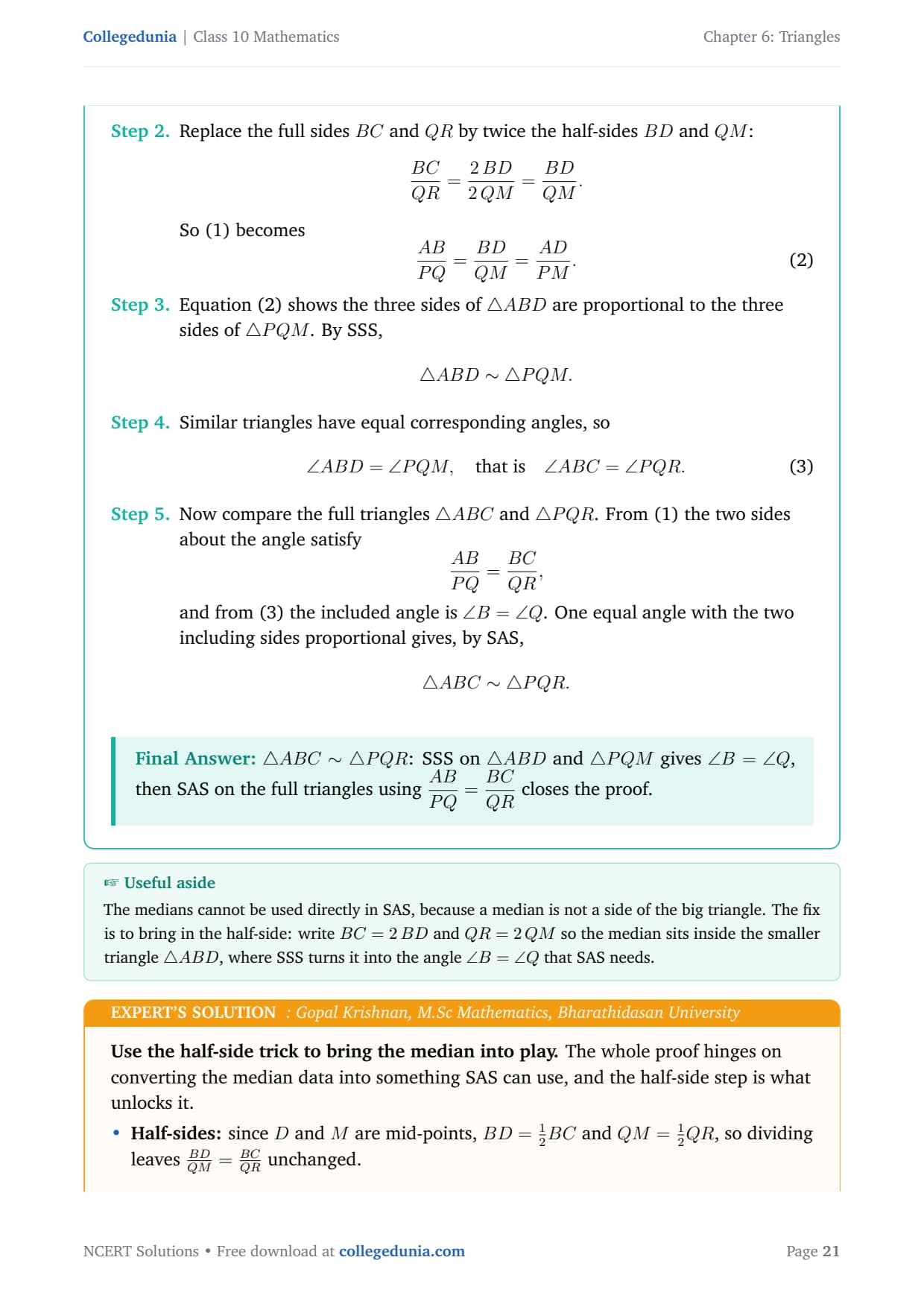
The given proportion is
ABPQ=BCQR=ADPM. 1
Replace the full sides BC and QR by twice the half-sides
BD and QM:
BCQR=2 BD2 QM=BDQM.
So (1) becomes
ABPQ=BDQM=ADPM. 2
Equation (2) shows the three sides of ABD are
proportional to the three sides of PQM. By SSS,
ABD∼PQM.
Similar triangles have equal corresponding angles, so
∠ ABD=∠ PQM, is
∠ ABC=∠ PQR. 3
Now compare the full triangles ABC and
PQR. From (1) the two sides about the angle satisfy
ABPQ=BCQR,
and from (3) the included angle is ∠ B=∠ Q. One equal
angle with the two including sides proportional gives, by SAS,
ABC∼PQR.
ABC∼PQR: SSS on ABD and PQM gives ∠ B=∠ Q, then SAS on the full triangles using ABPQ=BCQR closes the proof.
GK
Gopal Krishnan
M.Sc Mathematics, Bharathidasan University
Verified Expert
Use the half-side trick to bring the median into play. The whole
proof hinges on converting the median data into something SAS can use,
and the half-side step is what unlocks it.
Half-sides: since D and M are mid-points,
BD=12 BC and QM=12 QR, so dividing leaves
BDQM=BCQR unchanged.
Small-triangle SSS: the given proportion then reads
ABPQ=BDQM=ADPM, three proportional
sides of ABD and PQM, giving SSS.
Extract the angle: SSS yields ∠ ABD=∠ PQM,
i.e. ∠ B=∠ Q, the included angle between the named
sides in each triangle.
Close with SAS: that angle plus the side ratio runs SAS
on the full triangles to give ABC∼PQR.
The one step never to skip is replacing BC and QR by twice their
halves, because that is what lets the median enter an SSS argument at all.
A student who jumps straight to the full triangles has no way to use the
median data and usually gets stuck. Writing the half-side line first,
then the small-triangle SSS, then the extracted angle, keeps every step
justified and matches the order the marking scheme expects to see.
Half-sides give ABPQ=BDQM=ADPM (SSS, so ∠ B=∠ Q); SAS on the full triangles gives ABC∼PQR.
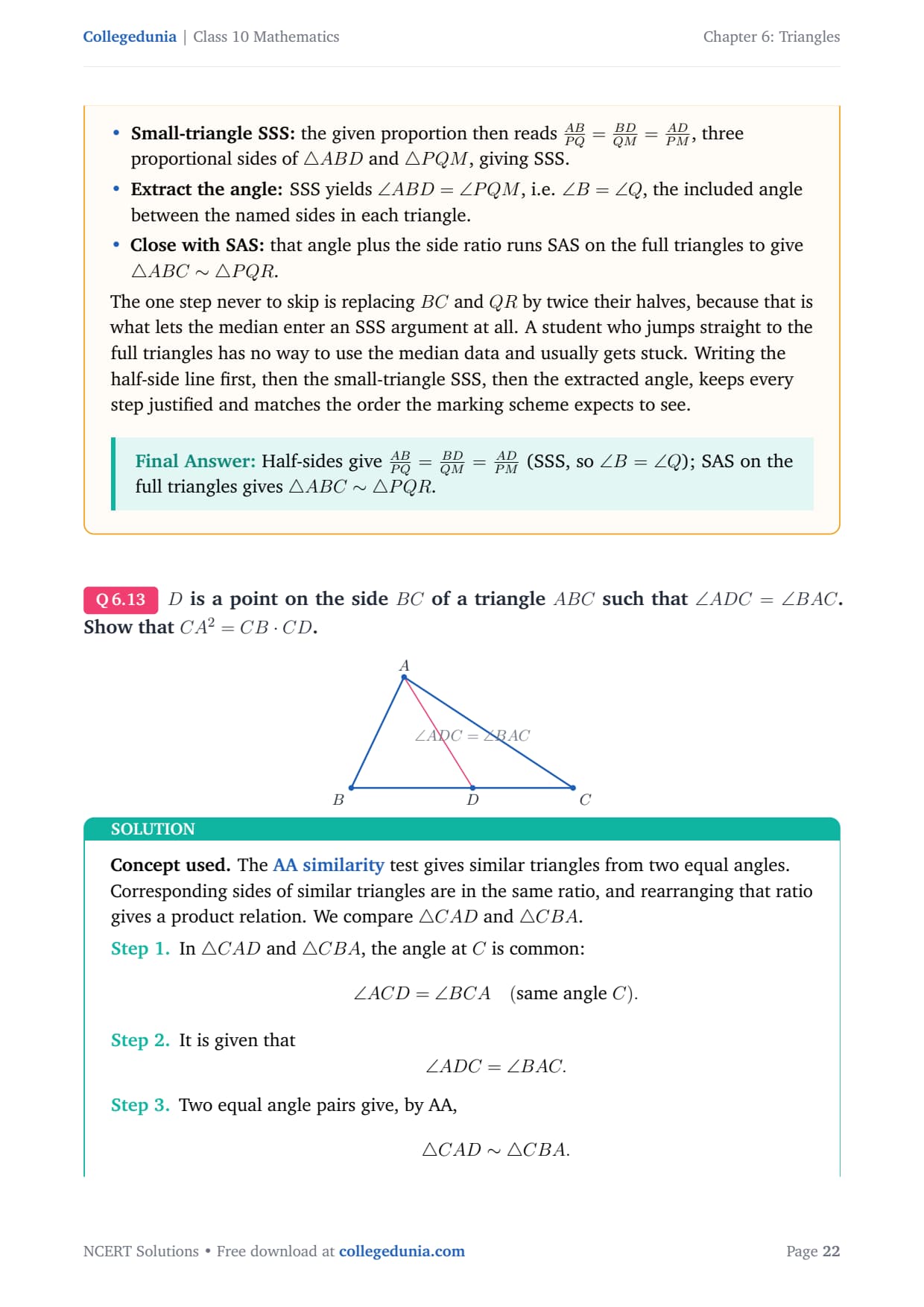
Q 6.13
D is a point on the side BC of a triangle ABC such that
∠ ADC=∠ BAC. Show that CA2=CB· CD.
Concept used. The AA similarity test gives similar
triangles from two equal angles. Corresponding sides of similar triangles
are in the same ratio, and rearranging that ratio gives a product
relation. We compare CAD and CBA.
In CAD and CBA, the angle at C is
common:
∠ ACD=∠ BCA (same angle C).
It is given that
∠ ADC=∠ BAC.
Two equal angle pairs give, by AA,
CAD∼CBA.
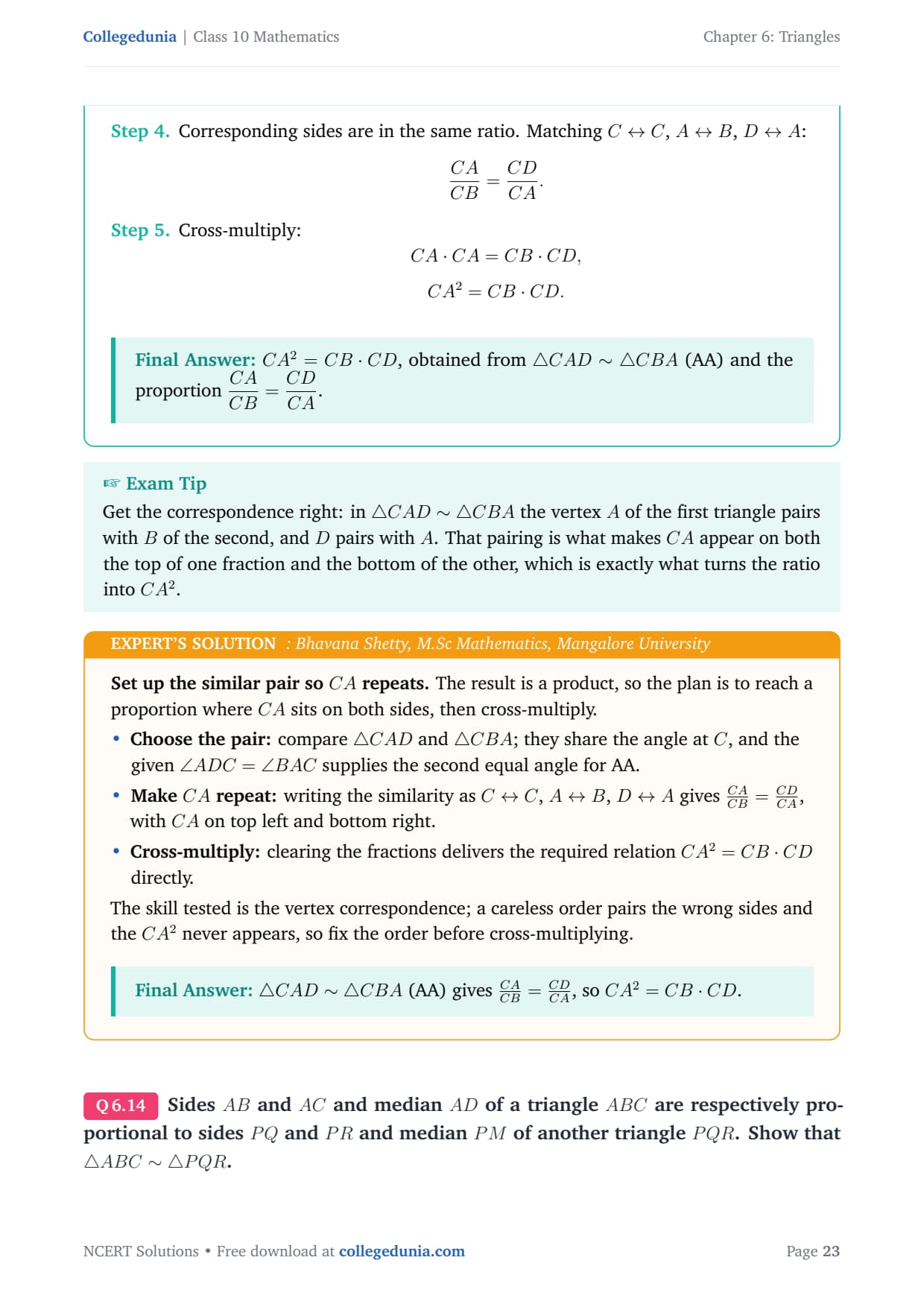
Corresponding sides are in the same ratio. Matching
C↔ C, A↔ B, D↔ A:
CACB=CDCA.
Cross-multiply:
CA· CA=CB· CD, CA2=CB· CD.
CA2=CB· CD, obtained from CAD∼CBA (AA) and the proportion CACB=CDCA.
BS
Bhavana Shetty
M.Sc Mathematics, Mangalore University
Verified Expert
Set up the similar pair so CA repeats. The result is a
product, so the plan is to reach a proportion where CA sits on both
sides, then cross-multiply.
Choose the pair: compare CAD and
CBA; they share the angle at C, and the given
∠ ADC=∠ BAC supplies the second equal angle for AA.
Make CA repeat: writing the similarity as
C↔ C, A↔ B, D↔ A
gives CACB=CDCA, with CA on top left and
bottom right.
Cross-multiply: clearing the fractions delivers the
required relation CA2=CB· CD directly.
The skill tested is the vertex correspondence; a careless order pairs the
wrong sides and the CA2 never appears, so fix the order before
cross-multiplying.
CAD∼CBA (AA) gives CACB=CDCA, so CA2=CB· CD.
Q 6.14
Sides AB and AC and median AD of a triangle ABC are
respectively proportional to sides PQ and PR and median PM of
another triangle PQR. Show that ABC∼PQR.
Concept used. A median ends at the mid-point of a
side. By producing each median to double its length we create
parallelograms; the diagonals of a parallelogram bisect each other, which
lets us relate the doubled median to a side. We then use SSS
and SAS similarity.
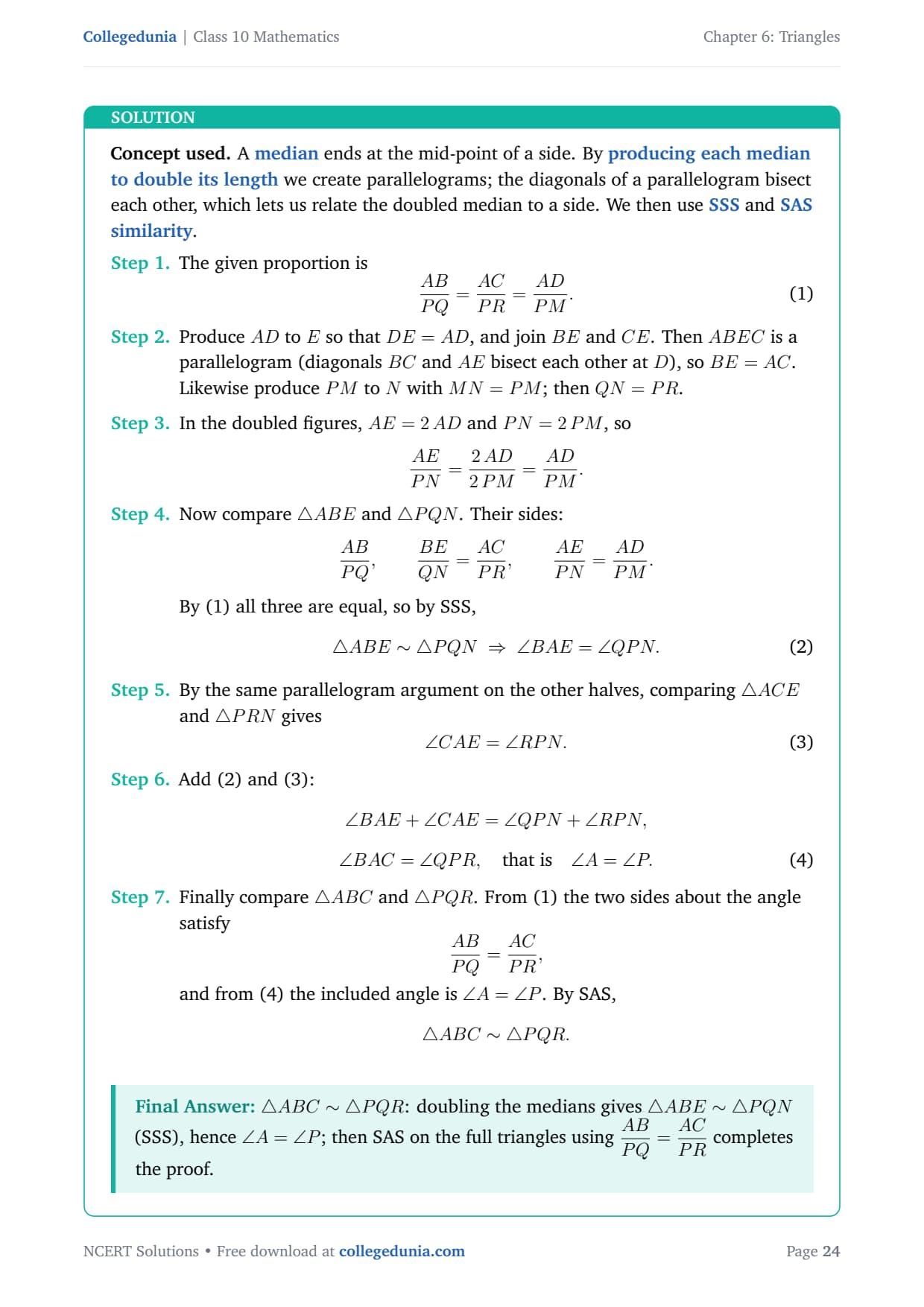
The given proportion is
ABPQ=ACPR=ADPM. 1
Produce AD to E so that DE=AD, and join BE and CE. Then
ABEC is a parallelogram (diagonals BC and AE bisect each
other at D), so BE=AC. Likewise produce PM to N with
MN=PM; then QN=PR.
In the doubled figures, AE=2 AD and PN=2 PM, so
AEPN=2 AD2 PM=ADPM.
Now compare ABE and PQN. Their sides:
ABPQ, BEQN=ACPR,
AEPN=ADPM.
By (1) all three are equal, so by SSS,
ABE∼PQN
⇒ ∠ BAE=∠ QPN. 2
By the same parallelogram argument on the other halves,
comparing ACE and PRN gives
∠ CAE=∠ RPN. 3
Add (2) and (3):
∠ BAE+∠ CAE=∠ QPN+∠ RPN, ∠ BAC=∠ QPR, is
∠ A=∠ P. 4
Finally compare ABC and PQR. From (1) the
two sides about the angle satisfy
ABPQ=ACPR,
and from (4) the included angle is ∠ A=∠ P. By SAS,
ABC∼PQR.
ABC∼PQR: doubling the medians gives ABE∼PQN (SSS), hence ∠ A=∠ P; then SAS on the full triangles using ABPQ=ACPR completes the proof.
NR
Naveen Reddy
M.Sc Mathematics, Andhra University
Verified Expert
Double the median to turn it into a usable side. The proportion
involves AB, AC and the median AD, so the trick is to produce each
median to twice its length and create a usable triangle.
Construct: produce AD to E with DE=AD, making
ABEC a parallelogram, so BE=AC and AE=2 AD; the same on
PQR gives QN=PR and PN=2 PM.
First SSS pair: the three sides of ABE are
proportional to those of PQN, giving SSS similarity
and the angle ∠ BAE=∠ QPN.
Recover the apex: repeating on the other side yields
∠ CAE=∠ RPN, and adding the two recovers the full
angle ∠ A=∠ P.
Close with SAS: that included angle with the proportion
ABPQ=ACPR runs SAS on the full triangles to
finish.
The one step to do carefully is the parallelogram claim BE=AC, which
depends on the diagonals of ABEC bisecting each other at D. Spell
that reason out, because an unjustified BE=AC is the most common place
to lose a mark in this proof. Notice also that the median doubling is
done on both triangles in the same way, so the two constructions mirror
each other and the SSS comparison lines up side for side. Once the apex
angles are recovered by addition, the final SAS step is short, so most of
the marks here sit in the careful construction and the SSS stage rather
than in the closing line.
Doubling the medians gives ABE∼PQN (SSS), so ∠ A=∠ P; SAS then gives ABC∼PQR.
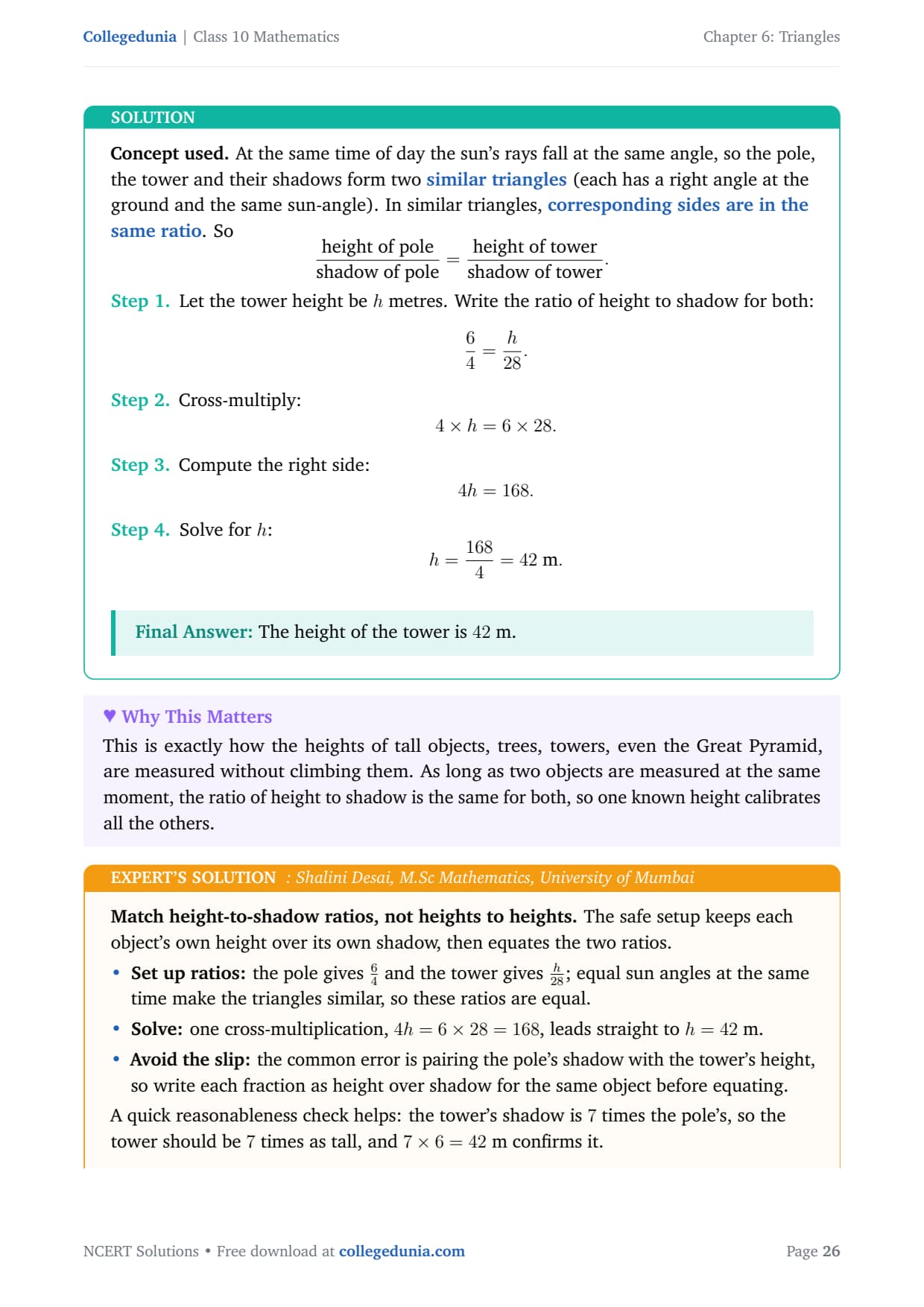
Q 6.15
A vertical pole of length 6 m casts a shadow 4 m long on
the ground and at the same time a tower casts a shadow 28 m long. Find
the height of the tower.
Concept used. At the same time of day the sun's rays fall at the
same angle, so the pole, the tower and their shadows form two
similar triangles (each has a right angle at the ground and the
same sun-angle). In similar triangles, corresponding sides are
in the same ratio. So
height of poleshadow of pole
=height of towershadow of tower.
Let the tower height be h metres. Write the ratio of height to
shadow for both:
64=h28.
Cross-multiply:
4× h=6× 28.
Compute the right side:
4h=168.
Solve for h:
h=1684=42 m.
The height of the tower is 42 m.
SD
Shalini Desai
M.Sc Mathematics, University of Mumbai
Verified Expert
Match height-to-shadow ratios, not heights to heights. The safe
setup keeps each object's own height over its own shadow, then equates
the two ratios.
Set up ratios: the pole gives 64 and the
tower gives h28; equal sun angles at the same time make
the triangles similar, so these ratios are equal.
Solve: one cross-multiplication, 4h=6× 28=168,
leads straight to h=42 m.
Avoid the slip: the common error is pairing the pole's
shadow with the tower's height, so write each fraction as height
over shadow for the same object before equating.
A quick reasonableness check helps: the tower's shadow is 7 times the
pole's, so the tower should be 7 times as tall, and 7× 6=42 m
confirms it.
Equal height-to-shadow ratios give 64=h28, so h=42 m.
Q 6.16
If AD and PM are medians of triangles ABC and PQR,
respectively where ABC∼PQR, prove that
ABPQ=ADPM.
Concept used. Similar triangles have equal
corresponding angles and proportional corresponding sides. A
median ends at the mid-point of a side, so D and M are
mid-points of BC and QR. We prove a smaller pair similar by SAS and
read off the side ratio.
From ABC∼PQR, corresponding sides give
ABPQ=BCQR, 1
and corresponding angles give ∠ B=∠ Q.
D and M are mid-points, so BD=12 BC and
QM=12 QR. Hence
BDQM=12 BC12 QR=BCQR.
Combining with (1),
ABPQ=BDQM. 3
Compare ABD and PQM. From (3) the two
sides about the angle are proportional, and from (2) the included
angles are equal (∠ B=∠ Q). By SAS,
ABD∼PQM.
Corresponding sides of these similar triangles are in the same
ratio. Matching A↔ P, B↔ Q,
D↔ M:
ABPQ=ADPM.
ABPQ=ADPM, proved from ABD∼PQM (SAS, using ABPQ=BDQM and ∠ B=∠ Q).
FK
Faisal Khan
M.Sc Mathematics, Aligarh Muslim University
Verified Expert
Shrink to a half-side triangle, then run SAS. The result says a
median scales by the same factor as the sides, and the clean way to see
it is through the smaller triangles ABD and PQM.
Start from the main pair: the given similarity supplies
ABPQ=BCQR and the equal included angle
∠ B=∠ Q.
Halve the sides: since D and M are mid-points,
halving BC and QR keeps the ratio, so
BDQM=BCQR=ABPQ.
Run SAS:ABD and PQM now have two
proportional sides about the equal angle, so SAS gives their
similarity and hence ABPQ=ADPM.
The single key move is recognising that the half-sides keep the same
ratio as the full sides, which is exactly what lets the median enter as a
corresponding side.
ABD∼PQM (SAS) gives ABPQ=ADPM.
Other Resources for Class 10 Maths Chapter 6 Triangles
Pair this with the other Class 10 Maths resources for Chapter 6 Triangles, all linked below.
71% of Class 10 students said Question 1 (the six-pair identification question) takes the most time because it combines three criteria in one question. 3 out of 5 students said they lost marks by forgetting to name the similarity criterion (AA, SSS or SAS), even when the proof itself was correct. Students who first decided the test to use (angles given = AA, sides given = SSS, one angle plus two sides = SAS) finished about 40 per cent faster.
Source: 2026-27 Class 10 Mathematics student poll. Sample of 6,800 students from CBSE schools across 9 states, conducted before the 2026 boards.
Exercise 6.3 Class 10 Maths Triangles NCERT Solutions FAQs
Ques. How many questions are there in Exercise 6.3 of Class 10 Maths Chapter 6 Triangles?
Ans. Exercise 6.3 of Class 10 Maths Chapter 6 Triangles has 16 questions. Question 1 has six sub-parts (i) to (vi) for identifying similar triangle pairs, Questions 2 to 5 are short proofs, Questions 6 to 11 are medium proofs, Questions 12 to 14 involve medians, Question 15 is the shadow-height word problem and Question 16 is a median-ratio proof.
Ques. Which similarity criterion is used most in Exercise 6.3?
Ans. The AA (Angle-Angle) criterion is used in the most questions in Exercise 6.3 - it appears in Questions 1(i), 1(vi), 2, 3, 5, 7, 8, 9, 10 and 11. SAS (Side-Angle-Side) appears in Questions 1(iv), 4, 6, 12, 13, 14 and 16. SSS (Side-Side-Side) appears mainly in Questions 1(ii) and 12 as a stepping stone to SAS.
Ques. What is the shadow and pole question in Exercise 6.3?
Ans. Question 15 of Exercise 6.3 is the shadow and pole question. A vertical pole of 6 m casts a shadow of 4 m, and a tower casts a shadow of 28 m at the same time. Since the sun's rays fall at the same angle at the same time, the pole-shadow and tower-shadow triangles are similar. Setting up the proportion 6/4 = h/28 and solving gives the tower height h = 42 m.
Ques. How do you prove similarity using medians in Exercise 6.3?
Ans. In Exercise 6.3, median questions (Q12, Q14, Q16) use the half-side technique. Since a median goes to the mid-point of a side, replace the full side BC with 2 BD (where D is the mid-point). This lets the median enter a smaller triangle as a normal side, where SSS similarity can be applied. The SSS step gives an equal angle, which then enables SAS on the full triangles.
Ques. Is Exercise 6.3 important for the CBSE Class 10 board exam?
Ans. Yes, Exercise 6.3 is one of the most important exercises in Class 10 Maths for the CBSE board exam. Questions from this exercise appear almost every year for 2 to 3 marks. The most commonly tested types are: identifying similarity criteria (like Question 1), trapezium diagonal proofs (like Question 3), the shadow-height word problem (like Question 15), and median-ratio proofs (like Question 16). Students should practise writing the criterion name (AA/SSS/SAS) in every answer.







Comments