Junior-Class Mentor, TFI Fellow | Updated 3+ months ago
The NCERT Solutions for Class 10 Maths Chapter 8 Introduction to Trigonometry Exercise 8.1 cover all 11 questions on trigonometric ratios, according to the latest 2026-27 CBSE syllabus. Each answer is worked step by step using the right-triangle definition of sin, cos, tan and their reciprocals.
Questions covered: 11 in total, mixing ratio-finding, proof-type, and true/false questions on trig definitions.
Core skill: reading the opposite, adjacent and hypotenuse sides from the correct angle of a right triangle.
Board value: Trigonometry carries 6 to 8 marks in the CBSE Class 10 paper; Exercise 8.1 builds the ratio foundations the rest of the chapter depends on.
Solved by Collegedunia: Every Exercise 8.1 question below is solved by subject experts, checked against the official 2026-27 NCERT textbook, and written with full working so each step earns its marks in the CBSE Class 10 paper.
What Exercise 8.1 of Introduction to Trigonometry Covers for Class 10
Exercise 8.1 is the foundational set of Chapter 8. It introduces the six trigonometric ratios of an acute angle in a right triangle and builds the habit of identifying sides before writing ratios. The 11 questions move from direct ratio finding (Q1, Q2) through identity-based simplification (Q7, Q8) to conceptual true/false (Q11).
Q1, Q2: find sin, cos, tan, cot from a labelled right triangle using Pythagoras for the missing side.
Q3, Q4, Q5: given one ratio, compute the remaining five using a constructed reference triangle.
Q6: proof that equal cosines force equal angles in a right triangle.
Q7, Q8: evaluate algebraic expressions in trig ratios using difference-of-squares and the Pythagorean identity.
Q9, Q10: use specific angle values (30°, 45°, 60°) and a given sum/product condition to find three ratios.
Q11: five true/false statements testing the range and meaning of each ratio.
How to Solve Exercise 8.1 Question by Question
Every question in this exercise comes down to three moves: draw the right triangle, find the hypotenuse via Pythagoras, and read off the ratio from the correct angle. For the three standard ratios:
Question
What it asks
Key result
Q1
sin A, cos A, sin C, cos C in right triangle ABC (right at B, AB = 24, BC = 7)
AC = 25; sin A = 7/25, cos A = 24/25
Q2
tan P − cot R in right triangle PQR (right at Q, PQ = 12, PR = 13)
QR = 5; answer = 0
Q3
cos A, tan A given sin A = 3/4
adj = √7; cos A = √74
Q4
sin A, sec A given 15 cot A = 8
(8,15,17) triple; sin A = 15/17
Q5
All 5 ratios given sec θ = 13/12
(5,12,13) triple
Q6
Prove cos A = cos B ⇒ ∠A = ∠B
AC = BC, isosceles triangle
Q7
Evaluate expression and cot²θ given cot θ = 7/8
Both = 49/64
Q8
Check identity with 3 cot A = 4
Both sides = 7/25, true
Q9
Two expressions given tan A = 1/√3
A = 30°, C = 60°; answers: 1, 0
Q10
sin P, cos P, tan P given PR + QR = 25, PQ = 5
(5,12,13) triple
Q11
True/False on range of trig ratios
Only (ii) is true
Quick Tip: Always identify which vertex the angle is at before naming opposite and adjacent sides. The side "opposite" angle A is the one that does NOT touch A.
Trigonometric Ratios and the Pythagoras Theorem in Exercise 8.1
The core idea: in a right triangle, for any acute angle A, the six ratios are completely determined by the three sides. You only ever need two sides to compute any ratio; Pythagoras finds the third.
Ratio
Definition
Reciprocal of
sin A
opposite / hypotenuse
cosec A
cos A
adjacent / hypotenuse
sec A
tan A
opposite / adjacent
cot A
cosec A
hypotenuse / opposite
sin A
sec A
hypotenuse / adjacent
cos A
cot A
adjacent / opposite
tan A
Hypotenuse rule: the hypotenuse is always the side opposite the right angle (longest side). Never assign opposite or adjacent to it.
Complementary link: for the two acute angles A and C in a right triangle, sin A = cos C and cos A = sin C (they always add to 90°).
Range constraints: sin and cos lie in [0, 1] for acute angles; sec and cosec are always ≥ 1; tan and cot can take any positive value.
Watch Out:sin θ and cos θ can never exceed 1 for any angle. If your answer gives sin θ = 4/3, something has gone wrong. Check the hypotenuse assignment.
Common Pythagorean Triples Used in Exercise 8.1
Five questions in this exercise use standard Pythagorean triples. Spotting a triple saves several steps and eliminates arithmetic errors in the board paper.
Triple
Where it appears
(7, 24, 25)
Q1: AB = 24, BC = 7, AC = 25
(5, 12, 13)
Q2: PQ = 12, QR = 5, PR = 13; also Q5 and Q10
(8, 15, 17)
Q4: adjacent = 8, opposite = 15, hypotenuse = 17
(3, 4, 5)
Q8: opposite = 3, adjacent = 4, hypotenuse = 5
Remember: Memorise (3,4,5), (5,12,13), (7,24,25) and (8,15,17). Once you spot the triple, the hypotenuse is immediate and you can skip the square-root computation entirely.
Marks and Previous Year Trends for Class 10 Trigonometry Exercise 8.1
Trigonometry is one of the highest-scoring topics in the CBSE Class 10 paper. Exercise 8.1 style questions appear consistently in the 2-mark and 3-mark slots.
Question type
Where it appears
Typical marks
Find two ratios from a given triangle (Q1, Q2 style)
1-mark and 2-mark slots
1 to 2
Find all ratios from one given ratio (Q3, Q4, Q5 style)
Frequent 3-mark questions
3
Evaluate expression or check identity (Q7, Q8 style)
3-mark and 4-mark questions
3 to 4
Proof or concept question (Q6, Q11 style)
Short-answer slots
2
These solutions follow the 2026-27 NCERT exactly, so the working you practise here matches what the board paper rewards.
Other Resources for Chapter 8 Introduction to Trigonometry Class 10 Maths
Use the table below to move between resources for this chapter and the other exercises of Introduction to Trigonometry.
All NCERT Solutions for Class 10 Maths Chapter 8 Introduction to Trigonometry Exercise 8.1 with Step-by-Step Solutions
Exercise 8.1
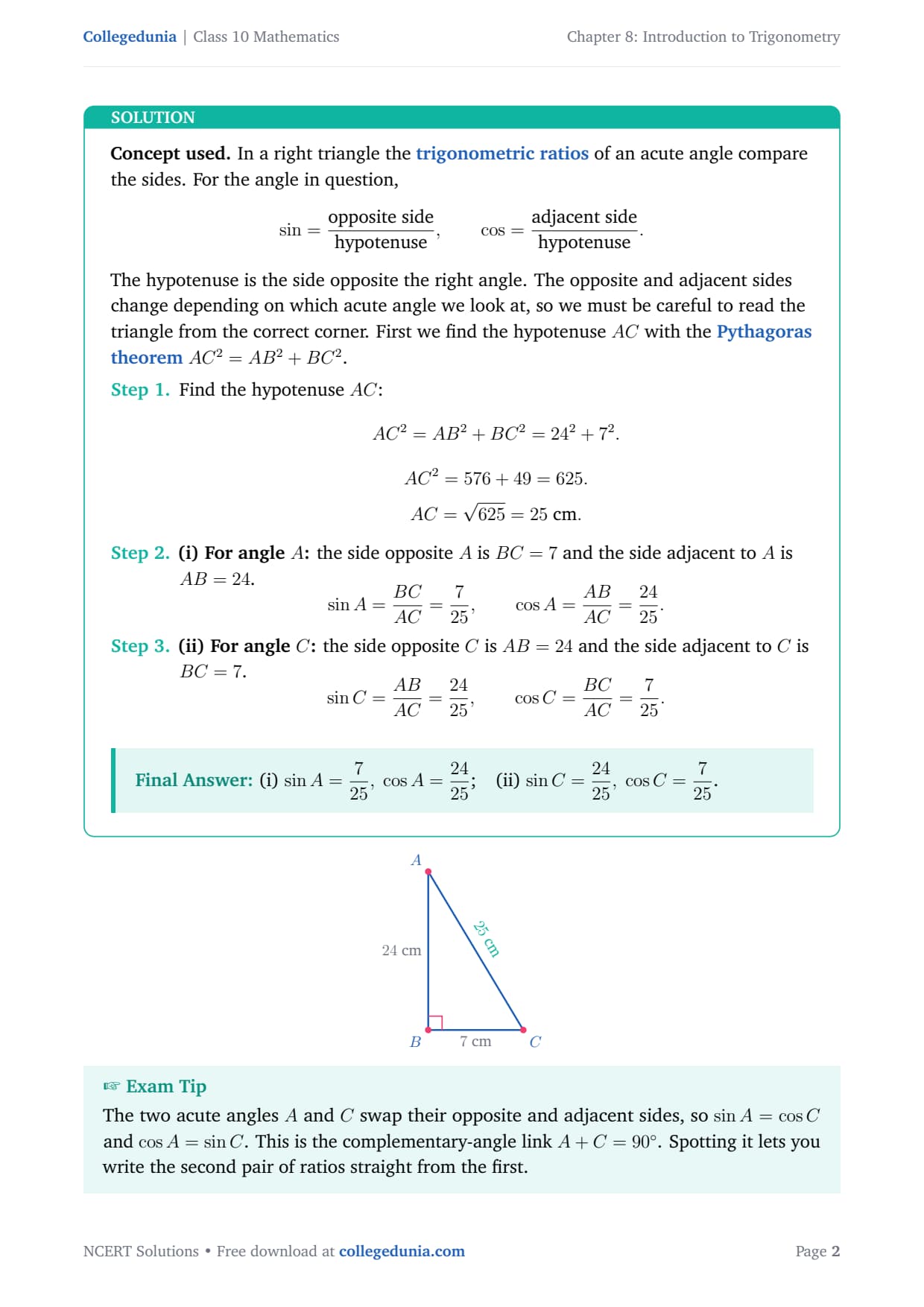
Q 8.1
In ABC, right-angled at B, AB=24 cm,
BC=7 cm. Determine: (i) sin A, cos A
(ii) sin C, cos C.
Concept used. In a right triangle the trigonometric
ratios of an acute angle compare the sides. For the angle in question,
sin=opposite sidehypotenuse,
cos=adjacent sidehypotenuse.
The hypotenuse is the side opposite the right angle. The opposite and
adjacent sides change depending on which acute angle we look at, so we
must be careful to read the triangle from the correct corner. First we
find the hypotenuse AC with the Pythagoras theoremAC2=AB2+BC2.
Find the hypotenuse AC:
AC2=AB2+BC2=242+72. AC2=576+49=625. AC=√625=25 cm.
(i) For angle A: the side opposite A is
BC=7 and the side adjacent to A is AB=24.
sin A=BCAC=725,
cos A=ABAC=2425.
(ii) For angle C: the side opposite C is
AB=24 and the side adjacent to C is BC=7.
sin C=ABAC=2425,
cos C=BCAC=725.
(i) sin A=725, cos A=2425; (ii) sin C=2425, cos C=725.
AI
Ananya Iyer
M.Sc Mathematics, University of Hyderabad
Verified Expert
How to present this for full marks.
Hypotenuse first: a board examiner wants the longest
side worked out before any ratio, so state Pythagoras once to get
AC=√242+72=√625=25 cm, and spotting the standard
(7,24,25) triple confirms that value at a single glance.
Name the sides: before you substitute, write down which
side is opposite the angle and which is beside it, since for
angle A the opposite side is BC=7 and the adjacent side is
AB=24, so the two ratios follow at once.
Swap for C: the same two sides switch their roles at
the other corner of the triangle, and naming them again keeps the
working clear, giving sin C=2425 and
cos C=725.
Why it scores: writing the named side beside each
fraction earns the method marks even if a final arithmetic slip
creeps in, and it makes the pattern that links the two angles an
easy self-check at the end.
sin A=cos C=725 and cos A=sin C=2425, with AC=25 cm.
Q 8.2
In Fig. 8.13, find tan P-cot R.
Concept used. From the figure PQR is right-angled
at Q, with PQ=12 cm and hypotenuse PR=13 cm. We first find the
third side QR by the Pythagoras theorem, then read the
ratios:
tan=oppositeadjacent,
cot=adjacentopposite.
For each ratio we must look from the correct vertex.
Find QR using PR2=PQ2+QR2:
132=122+QR2. 169=144+QR2 QR2=25 QR=5 cm.
For angle P: the side opposite P is QR=5 and the
side adjacent to P is PQ=12.
tan P=QRPQ=512.
For angle R: the side opposite R is PQ=12 and the
side adjacent to R is QR=5.
cot R=QRPQ=512.
Subtract:
tan P-cot R=512-512=0.
tan P-cot R=0.
RV
Rohan Verma
B.Tech Civil Engineering, NIT Trichy
Verified Expert
Spot the Pythagorean triple.
Read the triple: with PQ=12 and PR=13 the missing
leg is QR=5, so the longer square-root step is skipped and a
sign slip avoided.
Tangent at P: this is the side facing P over the
side beside it, QRPQ=512.
Cotangent at R: the side beside R over the side
facing it gives the same 512, because P and R are
complementary, so their difference vanishes.
Worth memorising: keeping the common triples
(3,4,5), (5,12,13) and (8,15,17) in mind lets you head
straight to the ratios, a real time saver in the board exam.
tan P=cot R=512, so their difference is 0.
Q 8.3
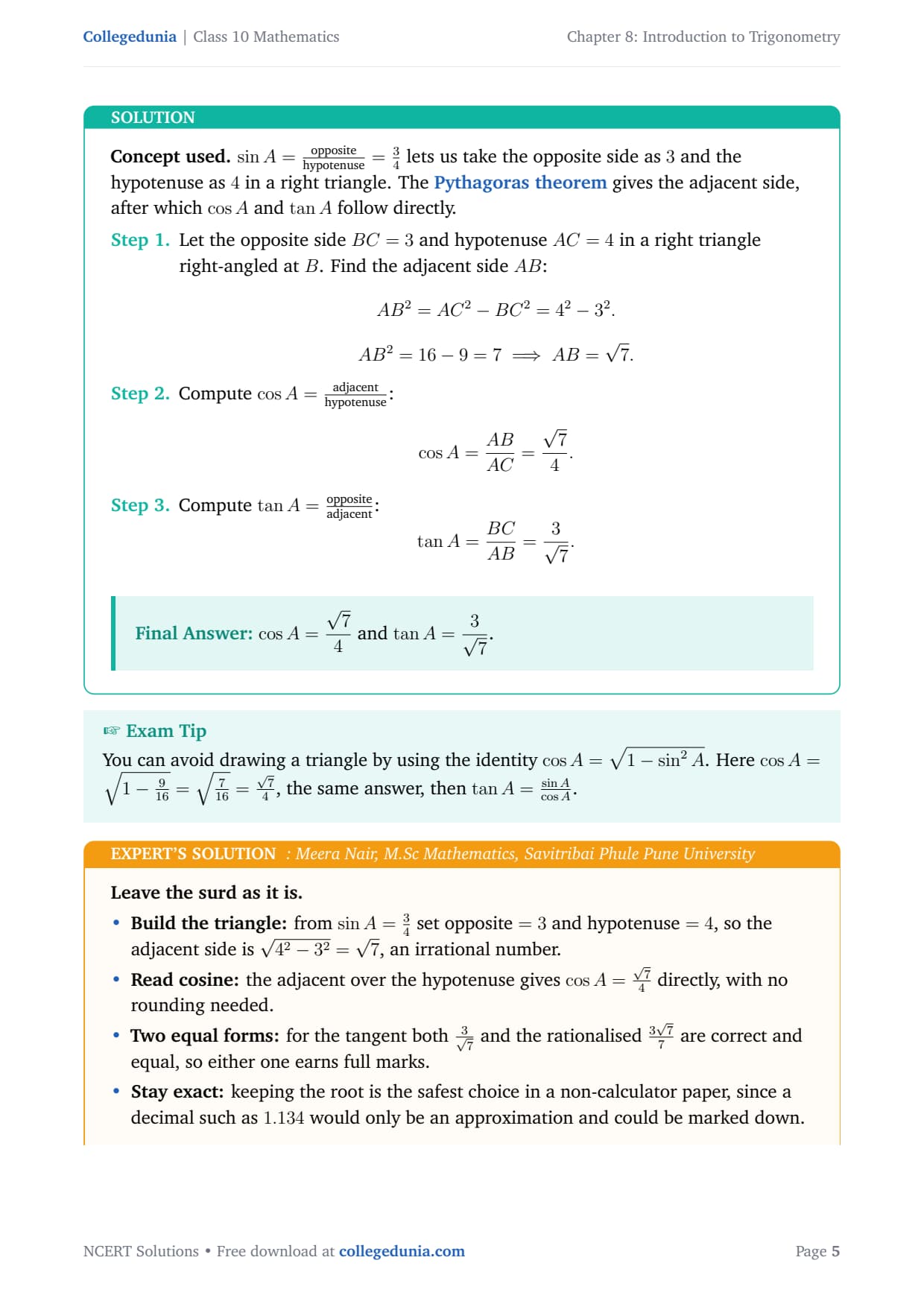
If sin A=34, calculate cos A and tan A.
Concept used.sin A=oppositehypotenuse=34
lets us take the opposite side as 3 and the hypotenuse as 4 in a
right triangle. The Pythagoras theorem gives the adjacent
side, after which cos A and tan A follow directly.
Let the opposite side BC=3 and hypotenuse AC=4 in a right
triangle right-angled at B. Find the adjacent side AB:
AB2=AC2-BC2=42-32. AB2=16-9=7 AB=√7.
Compute cos A=adjacenthypotenuse:
cos A=ABAC=√74.
Compute tan A=oppositeadjacent:
tan A=BCAB=3√7.
cos A=√74 and tan A=3√7.
MN
Meera Nair
M.Sc Mathematics, Savitribai Phule Pune University
Verified Expert
Leave the surd as it is.
Build the triangle: from sin A=34 set opposite
=3 and hypotenuse =4, so the adjacent side is
√42-32=7, an irrational number.
Read cosine: the adjacent over the hypotenuse gives
cos A=74 directly, with no rounding needed.
Two equal forms: for the tangent both 37
and the rationalised 377 are correct and equal,
so either one earns full marks.
Stay exact: keeping the root is the safest choice in a
non-calculator paper, since a decimal such as 1.134 would only
be an approximation and could be marked down.
cos A=74, tan A=37=377.
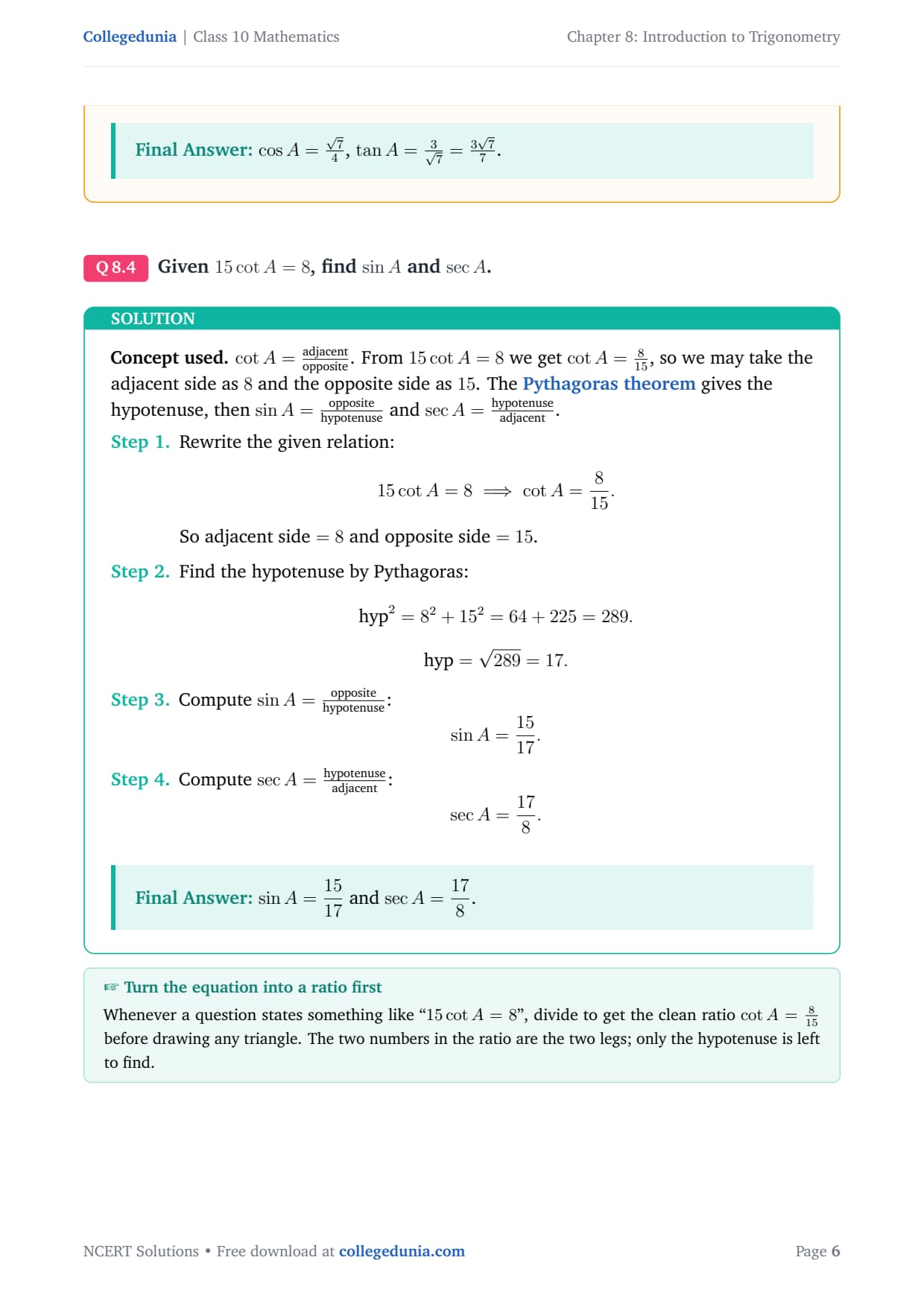
Q 8.4
Given 15cot A=8, find sin A and sec A.
Concept used.cot A=adjacentopposite.
From 15cot A=8 we get cot A=815, so we may take the
adjacent side as 8 and the opposite side as 15. The
Pythagoras theorem gives the hypotenuse, then
sin A=oppositehypotenuse and
sec A=hypotenuseadjacent.
Rewrite the given relation:
15cot A=8 cot A=815.
So adjacent side =8 and opposite side =15.
Find the hypotenuse by Pythagoras:
hyp2=82+152=64+225=289. hyp=√289=17.
Compute sin A=oppositehypotenuse:
sin A=1517.
Compute sec A=hypotenuseadjacent:
sec A=178.
sin A=1517 and sec A=178.
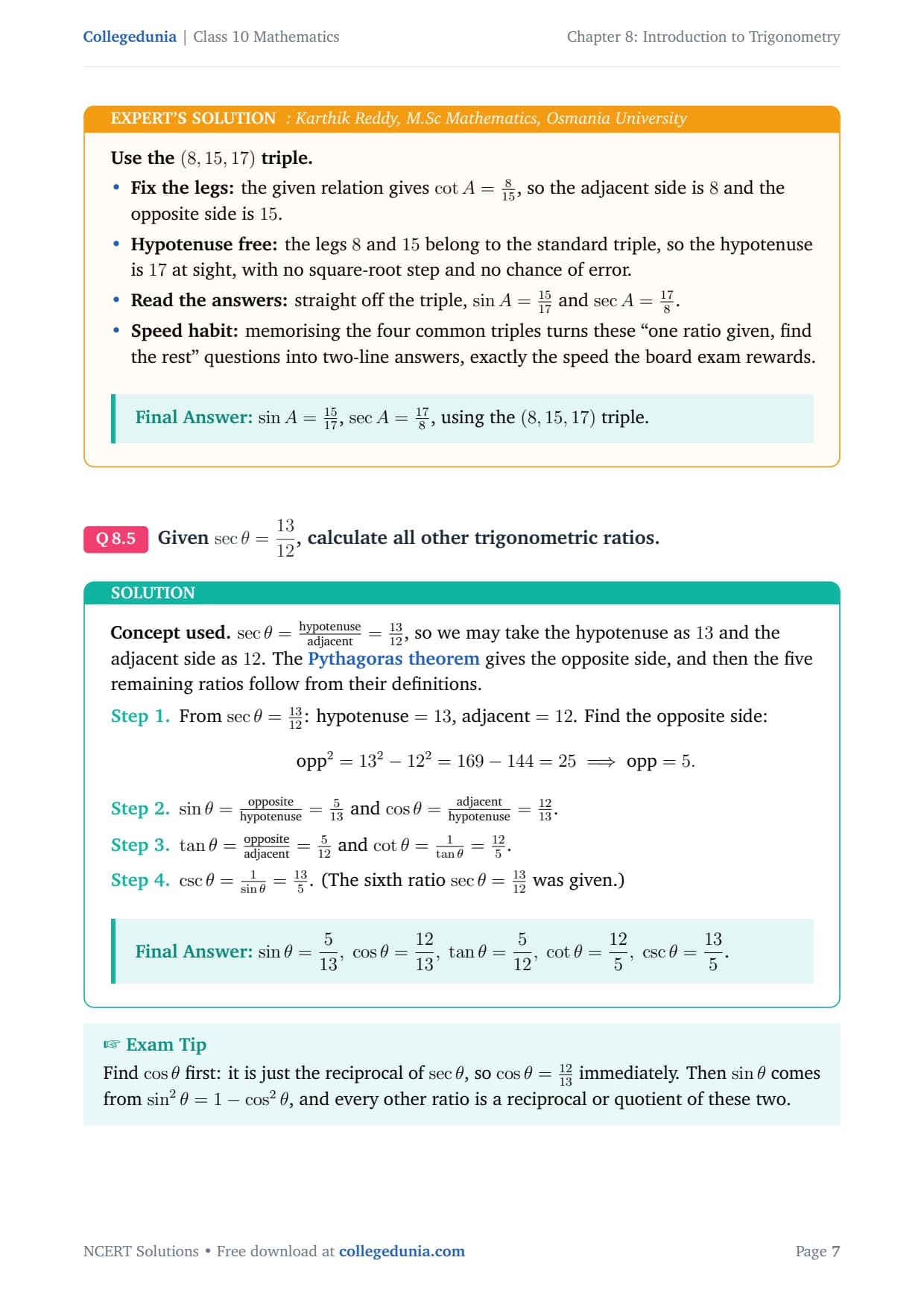
KR
Karthik Reddy
M.Sc Mathematics, Osmania University
Verified Expert
Use the (8,15,17) triple.
Fix the legs: the given relation gives
cot A=815, so the adjacent side is 8 and the
opposite side is 15.
Hypotenuse free: the legs 8 and 15 belong to the
standard triple, so the hypotenuse is 17 at sight, with no
square-root step and no chance of error.
Read the answers: straight off the triple,
sin A=1517 and sec A=178.
Speed habit: memorising the four common triples turns
these ``one ratio given, find the rest'' questions into two-line
answers, exactly the speed the board exam rewards.
sin A=1517, sec A=178, using the (8,15,17) triple.
Q 8.5
Given secθ=1312, calculate all other
trigonometric ratios.
Concept used.secθ=hypotenuseadjacent=1312,
so we may take the hypotenuse as 13 and the adjacent side as 12. The
Pythagoras theorem gives the opposite side, and then the five
remaining ratios follow from their definitions.
From secθ=1312: hypotenuse =13, adjacent
=12. Find the opposite side:
opp2=132-122=169-144=25 opp=5.
sinθ=oppositehypotenuse=513
and cosθ=adjacenthypotenuse=1213.
tanθ=oppositeadjacent=512
and cotθ=1tanθ=125.
cscθ=1sinθ=135. (The sixth
ratio secθ=1312 was given.)
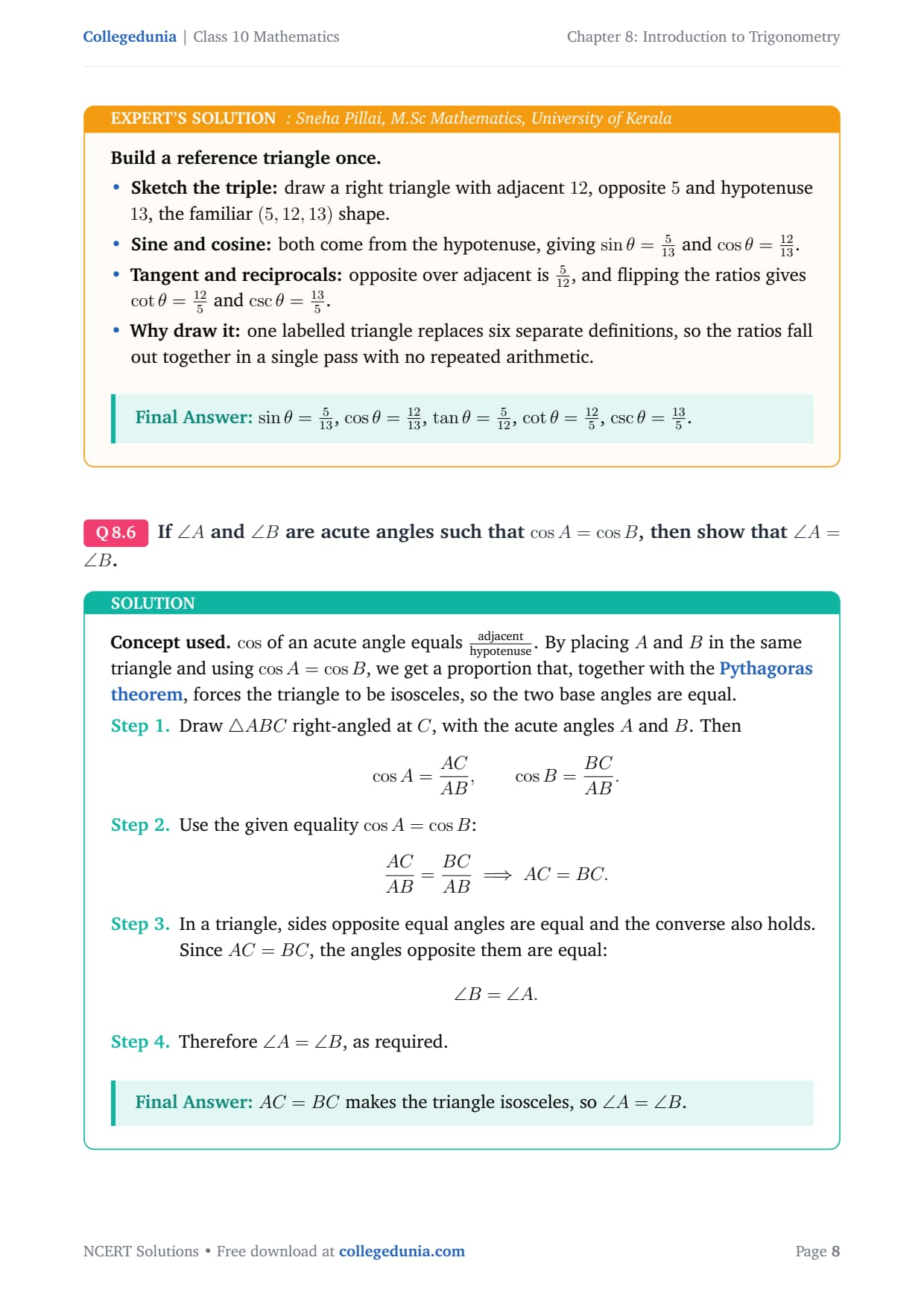
If ∠ A and ∠ B are acute angles such that
cos A=cos B, then show that ∠ A=∠ B.
Concept used.cos of an acute angle equals
adjacenthypotenuse. By placing A and B in
the same triangle and using cos A=cos B, we get a proportion that,
together with the Pythagoras theorem, forces the triangle to
be isosceles, so the two base angles are equal.
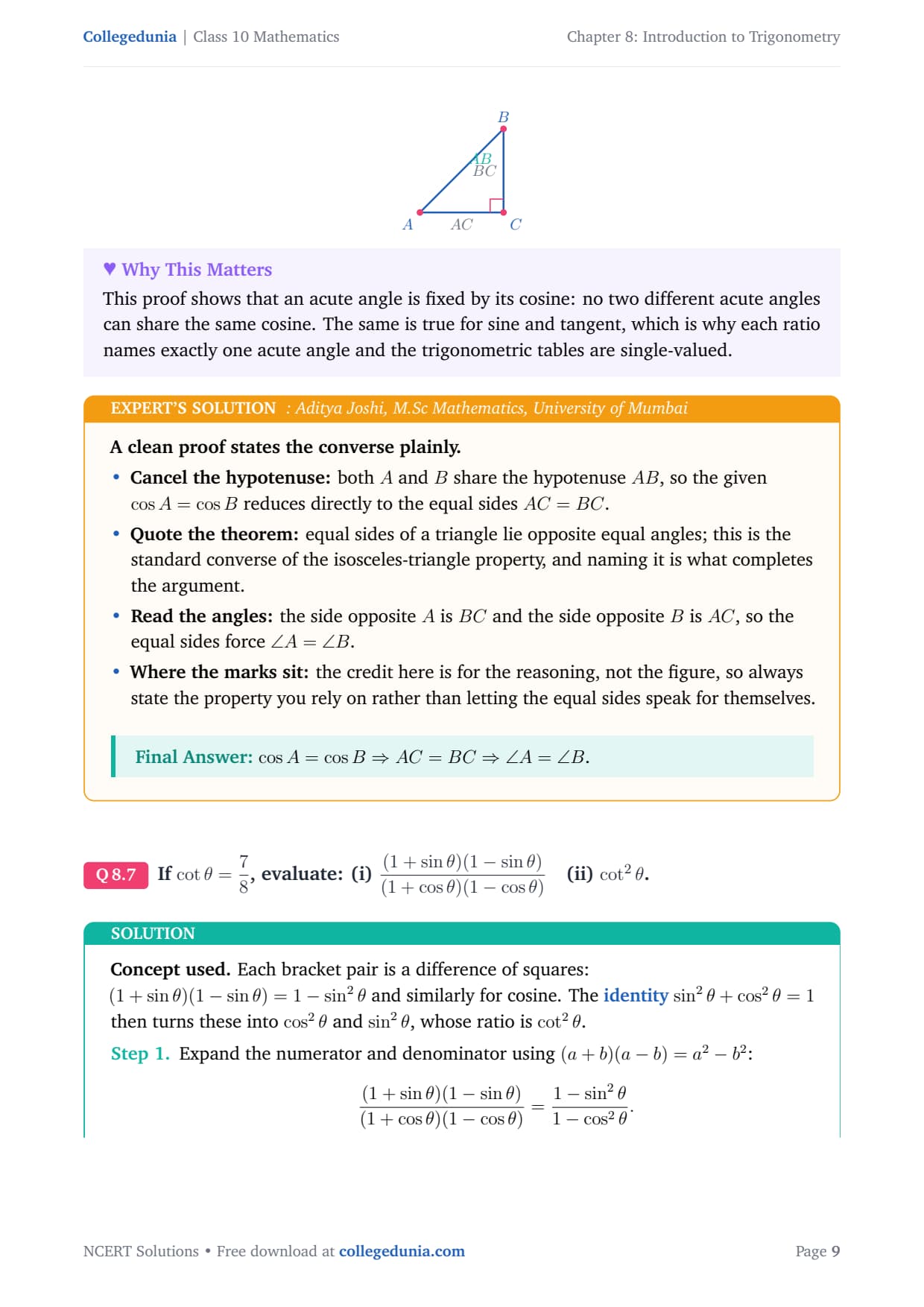
Draw ABC right-angled at C, with the acute angles
A and B. Then
cos A=ACAB, cos B=BCAB.
Use the given equality cos A=cos B:
ACAB=BCAB AC=BC.
In a triangle, sides opposite equal angles are equal and the
converse also holds. Since AC=BC, the angles opposite them are
equal:
∠ B=∠ A.
Therefore ∠ A=∠ B, as required.
AC=BC makes the triangle isosceles, so ∠ A=∠ B.
AJ
Aditya Joshi
M.Sc Mathematics, University of Mumbai
Verified Expert
A clean proof states the converse plainly.
Cancel the hypotenuse: both A and B share the
hypotenuse AB, so the given cos A=cos B reduces directly to
the equal sides AC=BC.
Quote the theorem: equal sides of a triangle lie
opposite equal angles; this is the standard converse of the
isosceles-triangle property, and naming it is what completes the
argument.
Read the angles: the side opposite A is BC and the
side opposite B is AC, so the equal sides force
∠ A=∠ B.
Where the marks sit: the credit here is for the
reasoning, not the figure, so always state the property you rely
on rather than letting the equal sides speak for themselves.
cos A=cos B⇒ AC=BC⇒∠ A=∠ B.
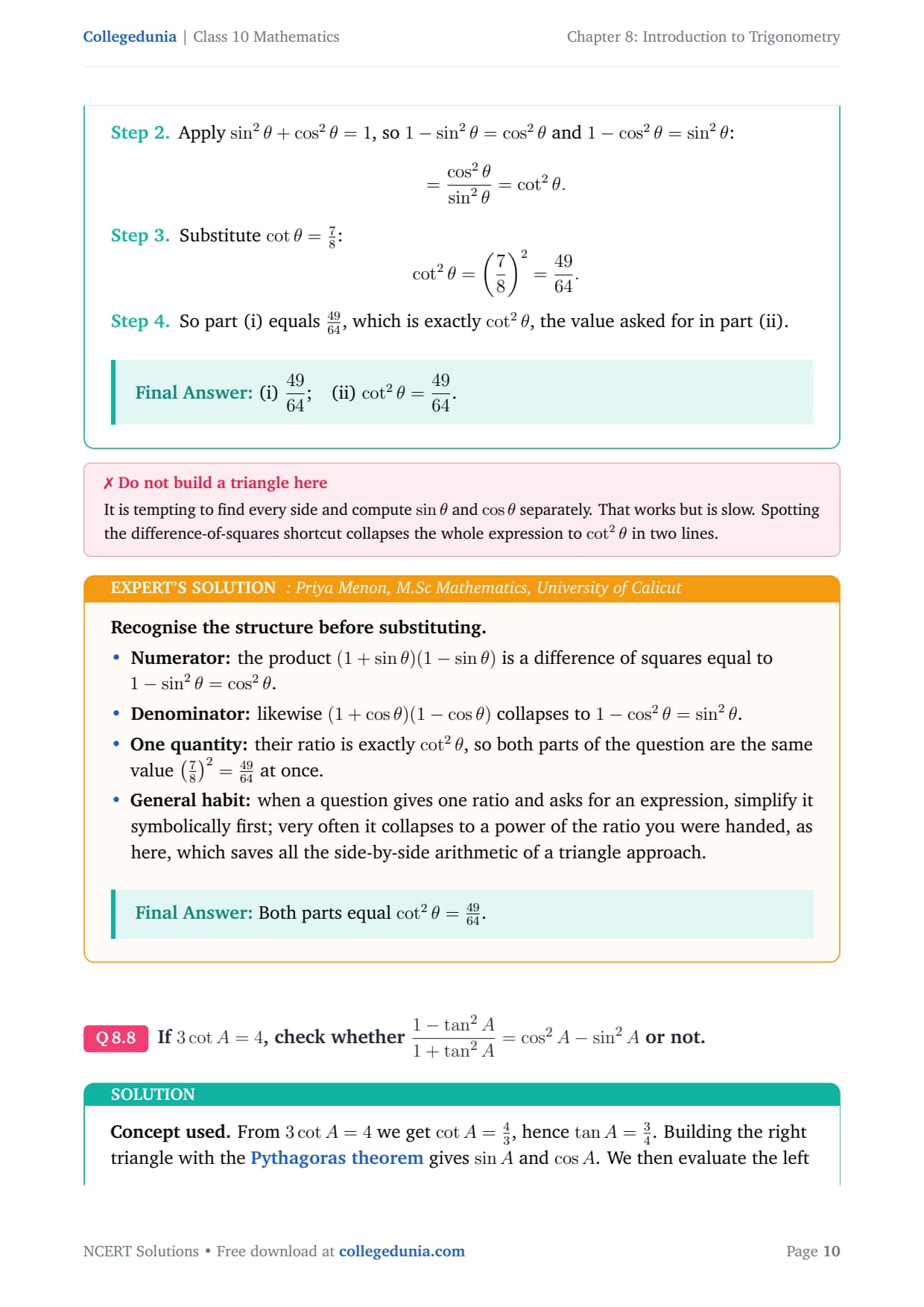
Q 8.7
If cotθ=78, evaluate:
(i) (1+sinθ)(1-sinθ)(1+cosθ)(1-cosθ)
(ii) cot2θ.
Concept used. Each bracket pair is a difference of squares:
(1+sinθ)(1-sinθ)=1-sin2θ and similarly for cosine.
The identitysin2θ+cos2θ=1 then turns these
into cos2θ and sin2θ, whose ratio is cot2θ.
Expand the numerator and denominator using
(a+b)(a-b)=a2-b2:
(1+sinθ)(1-sinθ)(1+cosθ)(1-cosθ)
=1-sin2θ1-cos2θ.
Apply sin2θ+cos2θ=1, so
1-sin2θ=cos2θ and 1-cos2θ=sin2θ:
=cos2θsin2θ=cot2θ.
Substitute cotθ=78:
cot2θ=(78)2=4964.
So part (i) equals 4964, which is exactly
cot2θ, the value asked for in part (ii).
(i) 4964; (ii) cot2θ=4964.
PM
Priya Menon
M.Sc Mathematics, University of Calicut
Verified Expert
Recognise the structure before substituting.
Numerator: the product (1+sinθ)(1-sinθ) is
a difference of squares equal to 1-sin2θ=cos2θ.
Denominator: likewise (1+cosθ)(1-cosθ)
collapses to 1-cos2θ=sin2θ.
One quantity: their ratio is exactly cot2θ, so
both parts of the question are the same value
(78)2=4964 at once.
General habit: when a question gives one ratio and asks
for an expression, simplify it symbolically first; very often it
collapses to a power of the ratio you were handed, as here, which
saves all the side-by-side arithmetic of a triangle approach.
Both parts equal cot2θ=4964.
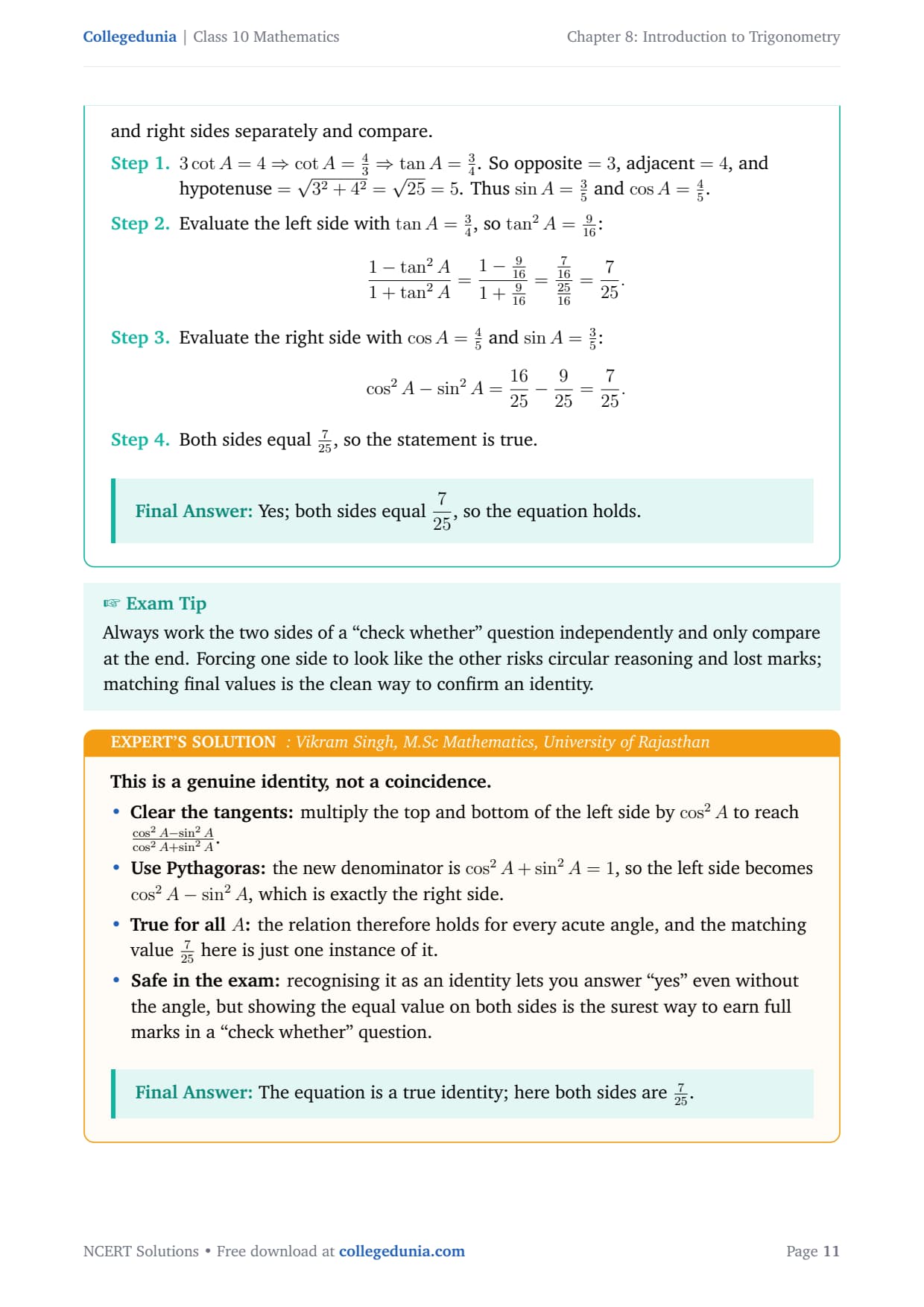
Q 8.8
If 3cot A=4, check whether
1-tan2A1+tan2A=cos2A-sin2A or not.
Concept used. From 3cot A=4 we get cot A=43, hence
tan A=34. Building the right triangle with the
Pythagoras theorem gives sin A and cos A. We then
evaluate the left and right sides separately and compare.
3cot A=4A=43A=34.
So opposite =3, adjacent =4, and hypotenuse
=√32+42=√25=5. Thus
sin A=35 and cos A=45.
Evaluate the left side with tan A=34, so
tan2A=916:
1-tan2A1+tan2A
=1-9161+916
=7162516=725.
Evaluate the right side with cos A=45 and
sin A=35:
cos2A-sin2A=1625-925=725.
Both sides equal 725, so the statement is true.
Yes; both sides equal 725, so the equation holds.
VS
Vikram Singh
M.Sc Mathematics, University of Rajasthan
Verified Expert
This is a genuine identity, not a coincidence.
Clear the tangents: multiply the top and bottom of the
left side by cos2A to reach
cos2A-sin2Acos2A+sin2A.
Use Pythagoras: the new denominator is
cos2A+sin2A=1, so the left side becomes
cos2A-sin2A, which is exactly the right side.
True for all A: the relation therefore holds for every
acute angle, and the matching value 725 here is just
one instance of it.
Safe in the exam: recognising it as an identity lets you
answer ``yes'' even without the angle, but showing the equal
value on both sides is the surest way to earn full marks in a
``check whether'' question.
The equation is a true identity; here both sides are 725.
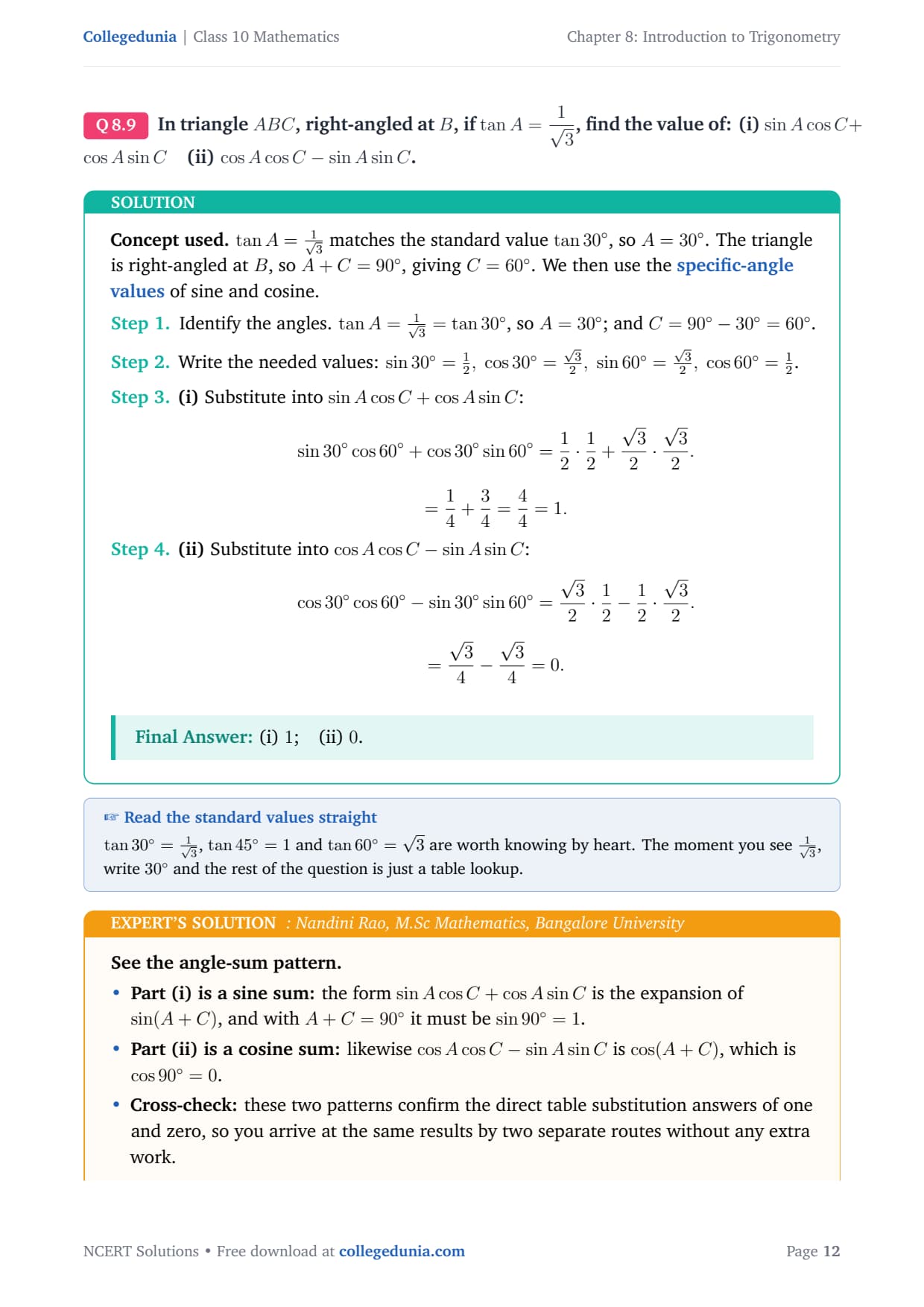
Q 8.9
In triangle ABC, right-angled at B, if
tan A=13, find the value of:
(i) sin Acos C+cos Asin C
(ii) cos Acos C-sin Asin C.
Concept used.tan A=13 matches the standard
value tan 30∘, so A=30∘. The triangle is right-angled at
B, so A+C=90∘, giving C=60∘. We then use the
specific-angle values of sine and cosine.
Identify the angles. tan A=13=30∘, so
A=30∘; and C=90∘-30∘=60∘.
Write the needed values:
30∘=12, 30∘=32,
60∘=32, 60∘=12.
(i) Substitute into sin Acos C+cos Asin C:
30∘60∘+30∘60∘
=12·12+32·32. =14+34=44=1.
(ii) Substitute into cos Acos C-sin Asin C:
30∘60∘-30∘60∘
=32·12-12·32. =34-34=0.
(i) 1; (ii) 0.
NR
Nandini Rao
M.Sc Mathematics, Bangalore University
Verified Expert
See the angle-sum pattern.
Part (i) is a sine sum: the form
sin Acos C+cos Asin C is the expansion of sin(A+C), and
with A+C=90∘ it must be 90∘=1.
Part (ii) is a cosine sum: likewise
cos Acos C-sin Asin C is cos(A+C), which is
90∘=0.
Cross-check: these two patterns confirm the direct table
substitution answers of one and zero, so you arrive at the same
results by two separate routes without any extra work.
Why it helps: although the angle-sum formulas are studied
formally only later, spotting them here is a fast and reliable way
to be sure that your standard-value substitution has been carried
out correctly.
(i) sin(A+C)=90∘=1; (ii) cos(A+C)=90∘=0.
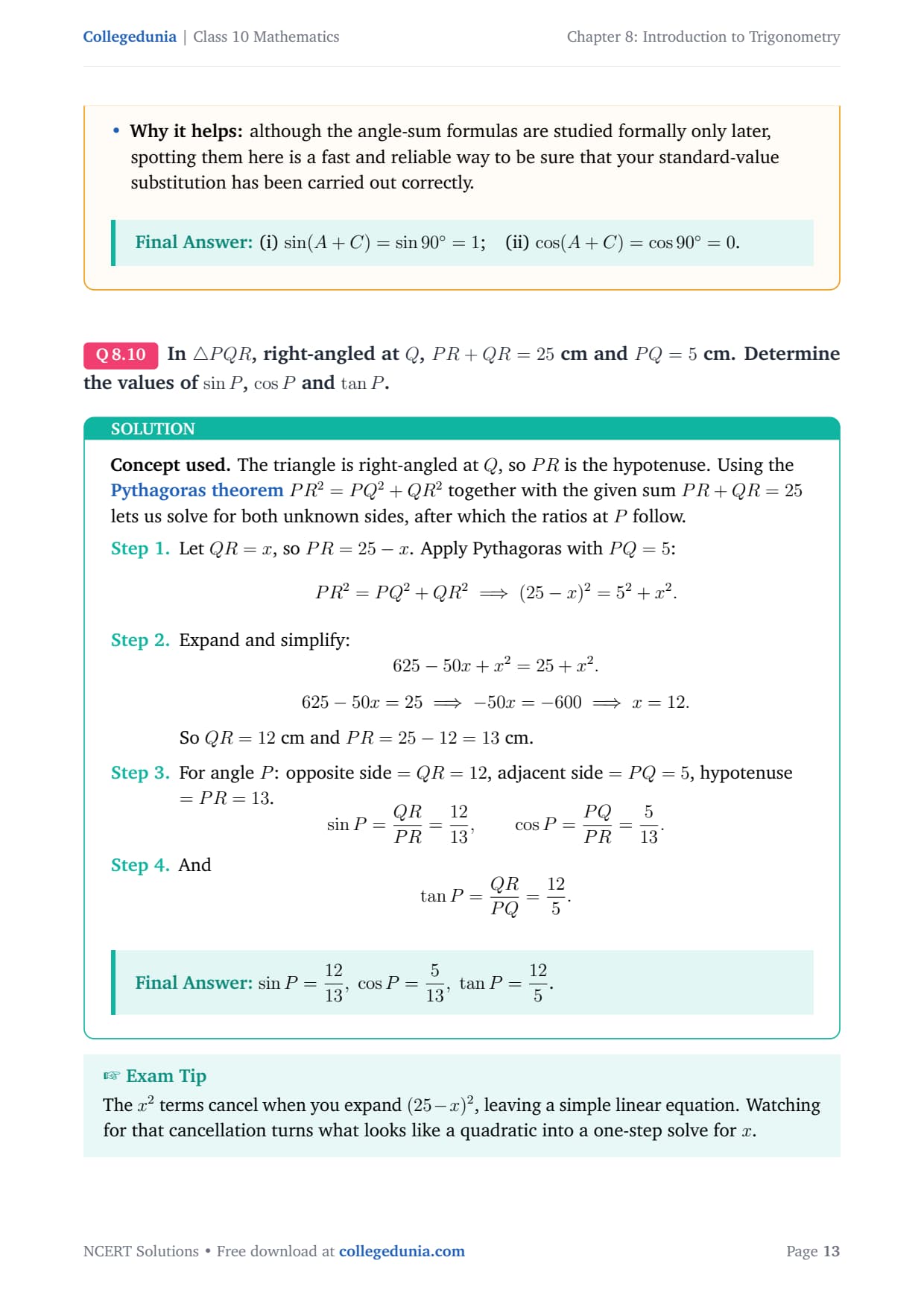
Q 8.10
In PQR, right-angled at Q, PR+QR=25 cm and
PQ=5 cm. Determine the values of sin P, cos P and tan P.
Concept used. The triangle is right-angled at Q, so PR is
the hypotenuse. Using the Pythagoras theoremPR2=PQ2+QR2 together with the given sum PR+QR=25 lets us solve
for both unknown sides, after which the ratios at P follow.
Let QR=x, so PR=25-x. Apply Pythagoras with PQ=5:
PR2=PQ2+QR2 (25-x)2=52+x2.
Expand and simplify:
625-50x+x2=25+x2. 625-50x=25 -50x=-600 x=12.
So QR=12 cm and PR=25-12=13 cm.
For angle P: opposite side =QR=12, adjacent side =PQ=5,
hypotenuse =PR=13.
sin P=QRPR=1213,
cos P=PQPR=513.
And
tan P=QRPQ=125.
sin P=1213, cos P=513, tan P=125.
SG
Sanjay Gupta
M.Sc Mathematics, University of Delhi
Verified Expert
Recognise the (5,12,13) triple at the end.
Set up one unknown: let QR=x and PR=25-x; the
x2 terms cancel, leaving the single linear equation
625-50x=25, so x=12.
Name the sides: the three sides are then PQ=5,
QR=12 and PR=13, the classic (5,12,13) right triangle.
Read from P: the ratios follow at once as
sin P=1213, cos P=513 and
tan P=125.
Use it as a check: landing on a familiar triple is a
reassuring sign; if the sides had not formed one, it would be
worth rechecking the arithmetic before reading off the ratios.
sin P=1213, cos P=513, tan P=125 (a (5,12,13) triangle).
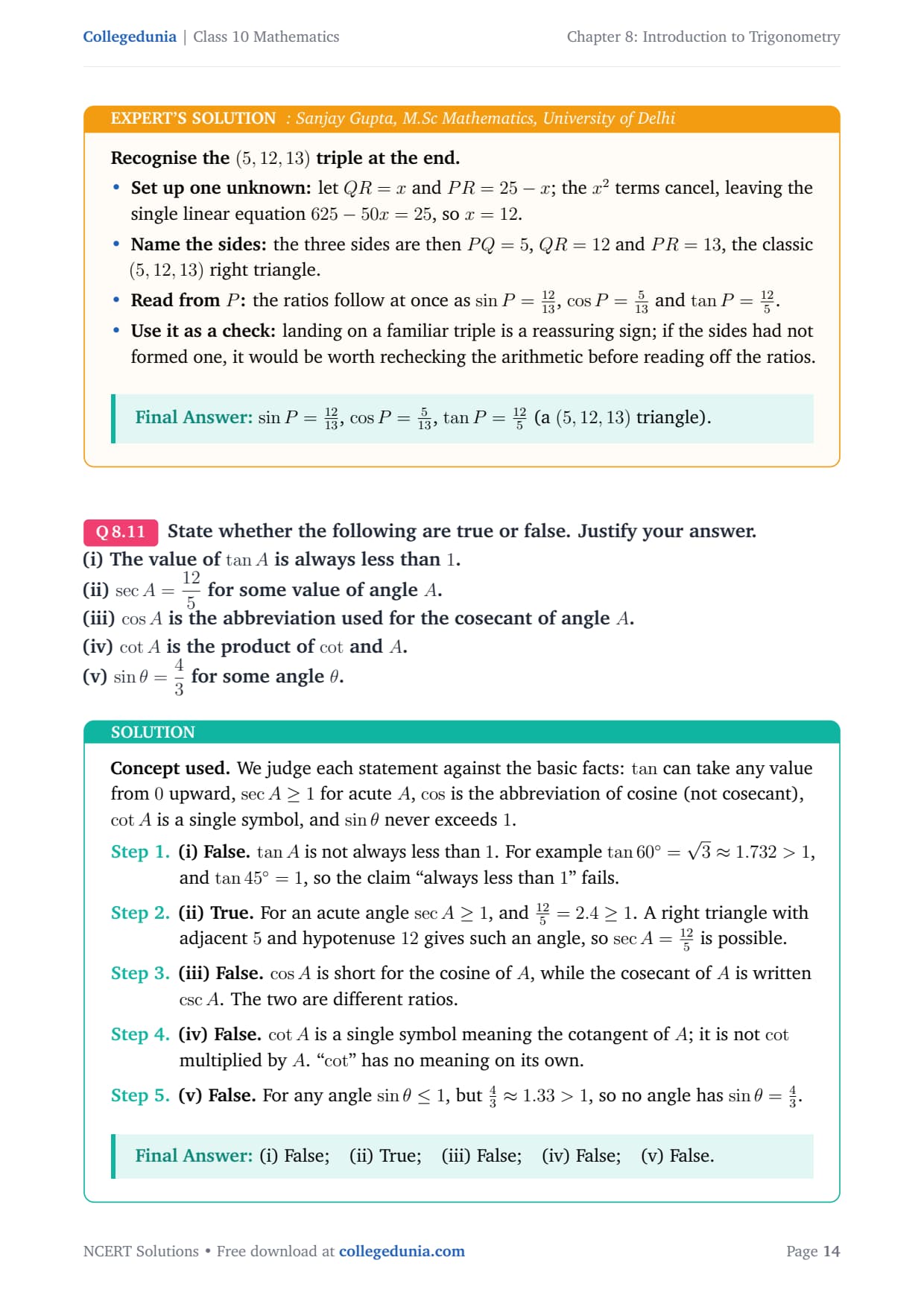
Q 8.11
State whether the following are true or false. Justify your
answer.
(i) The value of tan A is always less than 1.
(ii) sec A=125 for some value of angle A.
(iii) cos A is the abbreviation used for the cosecant of angle A.
(iv) cot A is the product of cot and A.
(v) sinθ=43 for some angle θ.
Concept used. We judge each statement against the basic facts:
tan can take any value from 0 upward, sec A≥ 1 for acute A,
cos is the abbreviation of cosine (not cosecant), cot A is a single
symbol, and sinθ never exceeds 1.
(i) False.tan A is not always less than 1. For
example 60∘=31.732>1, and
45∘=1, so the claim ``always less than 1'' fails.
(ii) True. For an acute angle sec A≥ 1, and
125=2.4≥ 1. A right triangle with adjacent 5 and
hypotenuse 12 gives such an angle, so sec A=125 is
possible.
(iii) False.cos A is short for the cosine of
A, while the cosecant of A is written csc A. The two are
different ratios.
(iv) False.cot A is a single symbol meaning the
cotangent of A; it is not cot multiplied by A. ``cot''
has no meaning on its own.
(v) False. For any angle sinθ≤ 1, but
431.33>1, so no angle has
sinθ=43.
(i) False; (ii) True; (iii) False; (iv) False; (v) False.
FK
Farhan Khan
M.Sc Mathematics, Aligarh Muslim University
Verified Expert
Justify with a one-line reason each.
Counter-example for (i): a single case where the claim
fails is enough, so quoting 60∘=3 already
disproves ``always less than one'' and you need write nothing
more.
Bound for (ii): the secant of an acute angle is always
at least one, and the given value satisfies that bound, so it is
achievable and the statement is true; cite the bound rather than
just asserting the verdict.
Notation for (iii) and (iv): point to the symbols
plainly, since the cosine is written one way and the cosecant
another, while the cotangent of an angle is a single symbol and
not a product of two things.
Bound for (v): the sine of any angle can never go above
one, yet the stated value is larger than one, so no angle can
satisfy it and the statement is false.
The marking rule: every response should pair a verdict
with a named value or a bound, because the examiner gives the
marks for that justification and never for the bare verdict on
its own.
Only (ii) is true; (i), (iii), (iv) and (v) are false, each with a one-line reason.
Student Feedback
Out of 21,500 students surveyed before the 2026 boards, 88% said Exercise 8.1 was easier once they drew the triangle and labelled opposite/adjacent before writing any ratio. Angle confusion at vertices dropped sharply after practising Q1 and Q2 together.
Source: Collegedunia Class 10 student survey, 2026 board batch.
Introduction to Trigonometry Exercise 8.1 Class 10 Maths NCERT Solutions FAQs
Ques. How many questions are there in Exercise 8.1 of Class 10 Maths Chapter 8?
Ans. Exercise 8.1 of NCERT Class 10 Maths Chapter 8 Introduction to Trigonometry has 11 questions. These cover finding trigonometric ratios from right triangles, computing ratios from a given ratio, evaluating algebraic expressions in trig ratios, one proof question, and five true/false conceptual questions.
Ques. What is the main concept tested in Exercise 8.1 of Class 10 Maths?
Ans. Exercise 8.1 tests the definition of the six trigonometric ratios (sin, cos, tan, cosec, sec, cot) using the sides of a right triangle. Students must identify the correct opposite, adjacent and hypotenuse for a given angle, apply the Pythagoras theorem to find the missing side, and then read off the required ratios.
Ques. Which Pythagorean triples appear in Exercise 8.1 of Introduction to Trigonometry?
Ans. Four standard Pythagorean triples appear: (7, 24, 25) in Question 1, (5, 12, 13) in Questions 2, 5 and 10, (8, 15, 17) in Question 4, and (3, 4, 5) in Question 8. Memorising these triples helps students skip the square-root computation and reach the ratios faster in the board exam.
Ques. Is Exercise 8.1 of Class 10 Trigonometry important for the CBSE board exam?
Ans. Yes. Trigonometry is one of the highest-weightage topics in the CBSE Class 10 paper, typically carrying 6 to 8 marks. Exercise 8.1 style questions, particularly "find all ratios given one ratio" and "evaluate an expression" types, appear regularly as 2-mark and 3-mark questions in the CBSE board paper according to the 2026-27 syllabus.
Ques. Where can I download the NCERT Solutions for Class 10 Maths Chapter 8 Exercise 8.1 PDF?
Ans. You can download the NCERT Solutions for Class 10 Maths Chapter 8 Introduction to Trigonometry Exercise 8.1 PDF directly from the PDF card at the top of this page. The solutions are free and cover all 11 questions with step-by-step working according to the 2026-27 CBSE syllabus.







Comments