Physics Strategist, JEE/NEET | Updated 3+ months ago
The NCERT Solutions for Class 10 Science Chapter 2 Acids, Bases and Salts cover all 34 questions (16 in-text and 18 exercise questions), written for the 2026-27 CBSE syllabus.
Every answer follows the textbook flow: how indicators tell acids from bases, how acids and bases react, why they conduct electricity, the pH scale, and the common salts made from common salt.
All 34 NCERT questions solved with balanced equations, step-by-step working, and an Expert Solution per question that adds board-exam strategy.
Full coverage of indicators, neutralisation, the pH scale, and salts like washing soda, baking soda, bleaching powder and Plaster of Paris that the CBSE board paper tests directly.
Answers are aligned with the 2026-27 CBSE Class 10 Science syllabus, written in plain English for board exam students.
Solved by Collegedunia Science Experts
These NCERT Solutions for Class 10 Science Chapter 2 Acids, Bases and Salts are checked against the latest 2026-27 NCERT textbook and refined against the last five years of CBSE board papers. Each of the 34 questions gives a Check Solution for the clean board answer and an Expert Solution for extra marks.
What the NCERT Solutions for Class 10 Science Chapter 2 Acids, Bases and Salts Cover
This chapter answers one big question: how do acids and bases behave, and how do they give us the salts we use every day? The NCERT book builds the answer in clear blocks, and these solutions stay faithful to that order while filling the gaps students hit in the exam.
Acids, bases and indicators: how litmus, methyl orange and other indicators tell an acid from a base by their colour change.
Reactions of acids and bases: with metals, metal carbonates, metal oxides, and each other (neutralisation), plus why both conduct electricity in water.
The pH scale: how pH from 0 to 14 measures the hydrogen ion concentration, and how pH matters in daily life.
Salts and chemicals from common salt: common salt, washing soda, baking soda, bleaching powder and Plaster of Paris, plus water of crystallisation.
Acids, Bases and Salts Class 10 Science Video Solutions
Question-wise Breakdown of the Acids, Bases and Salts NCERT Solutions
Chapter 2 has 16 in-text questions and 18 exercise questions, 34 in all. The table maps the main groups to their topic and mark weight.
Questions
Topic covered
Typical marks
In-text Q 1 to 10
Acids/bases with litmus, metals and carbonates; ionisation, conduction, dilution
2 to 3 marks
In-text Q 11 to 19
pH scale, neutralising acidic soil; bleaching powder, washing soda, baking soda, Plaster of Paris
2 to 3 marks
Q 20 to 23
MCQs on pH, lime-water test, neutralisation, antacid
1 mark each
Q 24 to 34
Acid-metal equations, pH ordering, strong vs weak acids, uses of salts
2 to 5 marks
The acid-metal equation (Q 24) and pH-ordering (Q 28) carry the heaviest marks. Name the concept, write a balanced equation, and add the reason for full marks.
Acids, Bases and Indicators: How to Tell Them Apart
An acid is a substance that gives hydrogen ions, written H+(aq), in water and tastes sour. A base gives hydroxide ions, OH−(aq), and a base that dissolves in water is called an alkali. An indicator is a substance that shows a different colour in an acid than in a base, which is how we test a solution without tasting it.
Litmus: blue litmus turns red in acid; red litmus turns blue in base; neither changes in a neutral liquid.
Methyl orange: red in acid, yellow in base.
Phenolphthalein: colourless in acid, pink in base.
Olfactory indicators like onion and clove oil change their smell in acids and bases.
Quick Tip: When given only one colour of litmus, remember that a strip which has already changed colour can be reused as the other colour. A red strip that turned blue in a base now works as blue litmus to find an acid.
Reactions of Acids and Bases: Metals, Carbonates and Neutralisation
Acids and bases are defined by what they react with. These reactions appear in almost every board paper, so learn the four patterns below and the gas or product each one gives.
Reaction
General pattern
Example
Acid + Metal
Acid + Metal → Salt + H2
Zn + H2SO4 → ZnSO4 + H2
Acid + Metal carbonate
→ Salt + CO2 + H2O
CaCO3 + 2HCl → CaCl2 + H2O + CO2
Acid + Metal oxide
→ Salt + H2O
CuO + 2HCl → CuCl2 + H2O
Acid + Base (neutralisation)
Acid + Base → Salt + Water
NaOH + HCl → NaCl + H2O
The gas released with a metal is hydrogen, tested by the pop sound with a burning splinter. The gas released with a carbonate is carbon dioxide, tested by turning lime water milky. Acids and bases both conduct electricity in water because they give free ions that carry the current; glucose and alcohol do not, because they release no ions.
The pH Scale and pH in Daily Life
The pH scale runs from 0 to 14 and tells us how acidic or basic a solution is by measuring its hydrogen ion concentration. The single most important rule for the exam is the inverse link below.
pH below 7 is acidic; the lower the value, the stronger the acid.
pH equal to 7 is neutral, like pure water.
pH above 7 is basic; the higher the value, the stronger the base.
Lower pH means more H+ ions. A solution at pH 4 has more hydrogen ions than one at pH 6.
Watch Out: The most repeated 1-mark slip is reading the pH scale the wrong way. A higher pH number does not mean more acid; it means less. When asked which solution has more hydrogen ions, pick the one with the lower pH.
pH explains many everyday facts: our stomach makes acid for digestion, and an antacid (a mild base) cures the pain of excess acid. Tooth decay starts when mouth pH falls below 5.5, acid rain has a pH below 5.6, and a bee sting (acidic) is soothed with baking soda while a wasp sting (basic) is treated with a mild acid.
Salts and Chemicals from Common Salt: Washing Soda, Baking Soda, Bleaching Powder and Plaster of Paris
A salt is the compound formed when an acid reacts with a base. Common salt (sodium chloride) is the raw material for a whole family of useful chemicals that the board asks about by name, formula, preparation and use.
Common name
Formula
Key use
Washing soda
Na2CO3·10H2O
Removes permanent hardness of water; glass, soap, paper industry
Baking soda
NaHCO3
Baking powder; antacid; fire extinguishers
Bleaching powder
Ca(ClO)2
Bleaching cloth and paper; disinfecting water
Plaster of Paris
CaSO4·½H2O
Setting fractured bones; making moulds and smooth walls
Remember: Plaster of Paris sets because it reacts with water to form gypsum, CaSO4·½H2O + 1½H2O → CaSO4·2H2O. That is also why it must be stored in a moisture-proof container, or it sets in the bag.
The water of crystallisation is the fixed number of water molecules in one formula unit of a salt, like the 10 in washing soda. It is why washing soda crystals are dry solids yet are written with water in the formula.
Common Mistakes Students Make in the Acids, Bases and Salts Chapter
The repeat-offender mistakes in Acids, Bases and Salts board answers:
Reading the pH scale backwards: a lower pH means more hydrogen ions, so pH 4 is more acidic than pH 6.
Forgetting that water is needed for acidity: dry HCl gas shows no acid behaviour because there is no water to free the H+ ions.
Not balancing the aluminium reaction: 2Al + 3H2SO4 → Al2(SO4)3 + 3H2 needs the coefficients counted carefully.
Mixing up the gas tests: hydrogen gives a pop sound; carbon dioxide turns lime water milky.
Wrong water count for Plaster of Paris: it carries half a water molecule and forms gypsum with two, so the difference is one and a half.
Previous Year Question Trends
The chapter is tested mainly through pH reasoning, acid reactions and salt recall:
Year
Question type asked
Marks
2025
Reaction of an acid with a metal carbonate; gas test
2 + 1
2024
Why dry HCl gas is not acidic; arrange solutions by pH
2 + 3
2023
Uses of washing soda and baking soda; preparation of bleaching powder
3
2021
Why Plaster of Paris is stored moisture-proof; its formula
2 + 1
Also Check: The full set of CBSE board paper questions for this chapter is included in the downloadable PDF above, updated for the 2026-27 cycle.
Other Resources for Class 10 Science Chapter 2 Acids, Bases and Salts
Pair this NCERT Solutions PDF with the matching revision notes, handwritten notes and the official NCERT book chapter. All resources for Class 10 Science Chapter 2 Acids, Bases and Salts are linked below.
Resource
What it covers
Open
NCERT Solutions
Step-by-step answers to all 34 questions, with an Expert Solution for each.
You are here
Notes
Concept-first revision notes on indicators, reactions, the pH scale and salts.
69% of Class 10 students said the pH scale and the strong-versus-weak acid idea was the trickiest part of this chapter. 3 out of 5 students told us they mixed up overflow of hydrogen ions, naming the wrong solution as more acidic when the pH was higher.
Toppers found that writing the concept and a balanced equation before the final answer added 1 to 2 marks on the 3-mark salt questions, and the average student spent 2 to 3 hours on this chapter across the first read and exercise practice.
Source: 2026-27 Class 10 Science student poll. Sample of 10,200 students from CBSE schools across 14 states, conducted before the 2026 boards.
NCERT Solutions for Class 10 Science: All Chapters
Related Links: Use the table below to open the NCERT Solutions for the other chapters of Class 10 Science. Every chapter ships with the same step-by-step answer style, full PDF download, and revision FAQ.
All NCERT Solutions for Class 10 Science Chapter 2 Acids, Bases and Salts with Step-by-Step Solutions
Q 1
You have been provided with three test tubes. One of them contains distilled water and the other two contain an acidic solution and a basic solution, respectively. If you are given only red litmus paper, how will you identify the contents of each test tube?
An indicator shows a different colour in an acid and in a base. Litmus is a natural indicator. The key rule is that red litmus turns blue only in a base; it stays red in an acid and in neutral water. So red litmus alone can clearly point out only the basic test tube, and we use a smart second step for the rest.
Test all three with red litmus. In one tube the paper turns blue. That tube holds the basic solution. In the other two the red litmus stays red, because acid and water do not turn red litmus blue.
Reuse the strip. The strip that turned blue is now blue litmus paper.
Test the remaining two with this blue litmus. The tube that turns it red holds the acid; the tube with no change holds the distilled water.
Answer: Red litmus turns blue only in the basic tube. Reuse that now-blue strip as blue litmus: the tube that turns it red is the acid, and the tube with no change is the distilled water.
NV
Neha Verma
M.Sc Chemistry, B.Ed
Verified Expert
Plan the order of tests. Red litmus gives a clear yes-or-no answer for only one of the three liquids, so use the result of the first test to set up the second. Red litmus changes colour only when it meets a base.
Testing all three tubes with red litmus picks out the basic solution at once, because that is the only tube where the red paper turns blue. The acid and the water both leave red litmus unchanged, so after round one those two still look the same.
The clever part is that the strip which turned blue in the base is now, for all purposes, blue litmus paper, and blue litmus is exactly what finds an acid. Dip this freshly blued strip into the two unknown tubes. The one that turns it red is the acid, and the one that leaves it blue is the neutral distilled water. With a single supply of red litmus and a sensible order of testing, all three liquids are identified.
Answer: The basic tube turns red litmus blue; reuse that blue strip to find the acid (turns it red) and the water (no change).
Q 2
Why should curd and sour substances not be kept in brass and copper vessels?
Curd and other sour foods contain weak acids (curd has lactic acid, lemon and orange have citric acid). Acids react with metals, and brass and copper are metals, so the acid slowly attacks the vessel.
Curd and sour substances are acidic because they contain food acids such as lactic acid.
When such an acid stays in contact with copper or brass (brass is an alloy of copper and zinc), the acid reacts with the metal.
This reaction forms harmful (poisonous) copper salts and spoils the taste of the food. Eating these salts can make a person ill.
Answer: Sour foods contain acids that react with copper and brass to form toxic metal salts, which spoil the food and can harm health, so they are not stored in these vessels.
RM
Ravi Menon
M.Sc Chemistry, IIT Madras
Verified Expert
Link the sour taste to a chemical reaction. The idea to pull out is that sour means acidic, and acids react with metals. Curd, lemon, tamarind and vinegar all owe their sour taste to acids: curd to lactic acid, lemon to citric acid, tamarind to tartaric acid, vinegar to acetic acid.
Copper and brass are reactive enough to be attacked by these mild acids over time. When the food acid sits in a copper or brass vessel, it slowly reacts with the metal surface and produces copper compounds. These copper salts are poisonous if eaten, and they also give the food an unpleasant taste and colour.
This is why sour foods are stored in vessels that do not react with acids, such as stainless steel, glass or glazed earthenware. The same reasoning explains why we should not squeeze lemon onto food kept in a brass plate for a long time. The chemistry is exactly the metal-with-acid reaction from this chapter, just happening slowly in the kitchen.
Answer: Acids in curd and sour foods react with copper and brass to give toxic copper salts that spoil the food, so non-reactive vessels are used instead.
Q 3
Which gas is usually liberated when an acid reacts with a metal? Illustrate with an example. How will you test for the presence of this gas?
When an acid reacts with a metal, the metal pushes out the hydrogen of the acid as hydrogen gas and a salt is formed. The general pattern is Acid + Metal → Salt + H2. Hydrogen is the gas usually given off.
Name the gas. The gas usually liberated is hydrogen (H2).
Example. Dilute sulphuric acid reacts with zinc granules: Zn + H2SO4 → ZnSO4 + H2. Here zinc sulphate is the salt and hydrogen is the gas.
Test for hydrogen. Bring a burning candle or lighted matchstick near the mouth of the test tube. The hydrogen burns with a pop sound, which confirms the gas is hydrogen.
Answer: Hydrogen gas is liberated. Example: Zn + H2SO4 → ZnSO4 + H2. Test: a burning matchstick brought near the gas burns it with a characteristic pop sound.
PN
Pooja Nair
M.Sc Chemistry, B.Ed
Verified Expert
Tie the answer to a balanced equation. A complete answer has three parts: the name of the gas, a balanced example reaction, and the test. Many students lose marks by skipping the balanced equation, so always include one.
The gas given off when a metal reacts with a dilute acid is hydrogen. A clean example is zinc dropped into dilute sulphuric acid, which fizzes and releases hydrogen while forming zinc sulphate. Writing this as Zn + H2SO4 → ZnSO4 + H2 shows the salt and the gas clearly. You could equally use magnesium with dilute hydrochloric acid, Mg + 2HCl → MgCl2 + H2; the gas is hydrogen in both cases.
To test the gas, collect it in a test tube and bring a burning matchstick or candle close to the mouth of the tube. Hydrogen catches fire and burns with a sharp pop sound. That pop is the simple, reliable confirmation that the gas is hydrogen, and it is the test the board expects you to describe.
Answer: Hydrogen is liberated; e.g. Zn + H2SO4 → ZnSO4 + H2. A burning matchstick near the gas makes it burn with a pop sound, confirming hydrogen.
Q 4
Metal compound A reacts with dilute hydrochloric acid to produce effervescence. The gas evolved extinguishes a burning candle. Write a balanced chemical equation for the reaction if one of the compounds formed is calcium chloride.
A gas that puts out a burning candle is carbon dioxide (CO2), because CO2 does not support burning. A metal compound that gives CO2 with an acid is a metal carbonate. Since one product is calcium chloride (CaCl2), compound A must be calcium carbonate (CaCO3).
Identify the gas. The gas extinguishes a burning candle, so it is carbon dioxide. Effervescence (fizzing) tells us a gas is coming out.
Identify A. A reacts with dilute HCl to give CO2, so A is a carbonate. The salt is calcium chloride, so A contains calcium; therefore A is calcium carbonate, CaCO3.
Balance.CaCO3 + 2HCl → CaCl2 + H2O + CO2. Check: 1 Ca, 1 C, 3 O, 2 H, 2 Cl on each side.
Answer: Compound A is calcium carbonate. The balanced equation is CaCO3 + 2HCl → CaCl2 + H2O + CO2.
AP
Arjun Pillai
M.Sc Chemistry, IIT Bombay
Verified Expert
Work backwards from the clues. This is a small detective problem. Read the three clues and let each narrow down compound A. Clue one: effervescence with dilute HCl means a gas is produced. Clue two: the gas extinguishes a flame, the signature of carbon dioxide. Clue three: one product is calcium chloride, so calcium must be in compound A.
Putting these together, a compound that releases carbon dioxide with an acid is a carbonate, and since the salt formed is calcium chloride, the compound is calcium carbonate, CaCO3. Limestone, chalk and marble are all forms of CaCO3, so this is a very common reaction.
Now write the equation and balance it carefully. Because one calcium chloride unit carries two chlorine atoms, you must use two molecules of HCl: CaCO3 + 2HCl → CaCl2 + H2O + CO2. A quick atom count on both sides confirms the balance.
Answer: A is calcium carbonate; CaCO3 + 2HCl → CaCl2 + H2O + CO2.
Q 5
Why do HCl, HNO3, etc., show acidic characters in aqueous solutions while solutions of compounds like alcohol and glucose do not show acidic character?
A substance is acidic only if it produces hydrogen ions H+(aq) (as hydronium, H3O+) when dissolved in water. The hydrogen ion is responsible for all acidic properties.
Acids like HCl and HNO3ionise in water, splitting to give hydrogen ions: HCl + H2O → H3O+ + Cl−. Because they release H+(aq) ions, they behave as acids.
Alcohol and glucose also contain hydrogen atoms, but their molecules do not split in water to give H+ ions. Their hydrogen stays locked inside the molecule.
With no free H+(aq) ions, alcohol and glucose solutions cannot show acidic character.
Answer: HCl and HNO3 are acidic because they release H+(aq) ions in water, while alcohol and glucose do not release H+ ions even though they contain hydrogen, so they are not acidic.
SA
Sania Ahmed
M.Sc Chemistry, B.Ed
Verified Expert
Acidity is about free H+ ions, not just hydrogen atoms. The whole answer rests on one idea: a compound is an acid only when it produces hydrogen ions in water. The presence of hydrogen atoms in the formula is not enough.
Hydrochloric acid and nitric acid are made of molecules that break apart in water and release H+ ions, which immediately join water molecules to form hydronium ions, H3O+. These free hydrogen ions make the solution taste sour, turn blue litmus red and react with metals, so in water these substances are clearly acidic.
Alcohol and glucose tell a different story. Their molecules carry hydrogen atoms, but when they dissolve they stay as whole molecules and do not let go of any hydrogen as ions. With no free H+(aq) in the solution, there is nothing to produce acidic behaviour. This is exactly why a glucose drink is not sour, while even dilute hydrochloric acid is sharply acidic. The lesson is to test for the release of H+ ions, not just to look for an H in the formula.
Answer: Acids release H+(aq) ions in water; alcohol and glucose keep their hydrogen inside the molecule and release no H+, so they are not acidic.
Q 6
Why does an aqueous solution of an acid conduct electricity?
An electric current is a flow of charged particles. In a solution, the charge is carried by ions (charged particles). A liquid conducts electricity only if it has free ions that can move.
When an acid dissolves in water, it ionises and produces ions: the positive hydrogen ion H+(aq) and a negative ion (such as Cl− from HCl).
These ions are free to move through the solution.
When the circuit is switched on, the moving ions carry the charge from one electrode to the other, so the solution conducts and the bulb glows.
Answer: An acid solution conducts electricity because the acid produces free, movable H+ and negative ions in water, and these moving ions carry the electric current.
KR
Kavya Reddy
M.Sc Chemistry, University of Hyderabad
Verified Expert
Conduction needs moving charges. The cleanest way to think about this is to ask what carries the current. In a metal wire, electrons move. In a solution there are no free electrons, so the only way to carry charge is through ions that can drift through the liquid.
An acid dissolved in water ionises and fills the solution with free hydrogen ions and free negative ions. For hydrochloric acid these are H+(aq) and Cl−(aq). Because these ions are charged and free to move, they respond to the battery: positive ions drift one way and negative ions the other. This movement of charge is exactly an electric current, which is why the bulb glows.
By contrast, glucose and alcohol dissolve as neutral molecules and produce no ions, so their solutions have nothing to carry the charge and the bulb stays dark. The single deciding factor is whether the dissolved substance releases free ions. Acids do, so their aqueous solutions are good conductors.
Answer: Because the acid ionises in water to give free H+ and negative ions, and these moving ions carry the current.
Q 7
Why does dry HCl gas not change the colour of the dry litmus paper?
HCl can act as an acid only when it gives hydrogen ions H+. The splitting of HCl into H+ and Cl− ions happens only in the presence of water. Litmus changes colour because of these H+ ions.
Dry HCl gas has no water present, so it does not split into ions. There are no free H+ ions.
Dry litmus paper also has no moisture in it.
With no water on either side, no H+ ions form, so the litmus sees no acid and its colour does not change. (If the litmus is wet, water lets HCl give H+ ions, and blue litmus then turns red.)
Answer: Dry HCl gas does not ionise without water, so it gives no H+ ions. Without H+ ions there is no acidic behaviour, so dry litmus paper does not change colour.
IK
Imran Khan
M.Sc Chemistry, Jamia Millia Islamia
Verified Expert
No water, no ions, no acidity. The heart of this answer is that acidic behaviour comes from free hydrogen ions, and those appear only when water is around to separate them from the rest of the molecule.
Hydrogen chloride as a dry gas is made of whole HCl molecules. With no moisture present, these molecules stay intact and do not release any H+ ions. Litmus, however, responds to H+ ions. Dry litmus paper has no water in it either, so when dry HCl gas meets dry litmus there is simply no water anywhere to set the hydrogen ions free.
Since no H+ ions are produced, the paper detects no acid and keeps its original colour. The situation changes completely if the litmus is moist: the small amount of water lets HCl ionise on the paper, free H+ ions appear, and blue litmus promptly turns red. This shows that the acidic property of HCl depends on water being present, not on the gas alone.
Answer: Without water dry HCl gas cannot give H+ ions, and with no H+ ions there is no acidity, so dry litmus paper stays unchanged.
Q 8
While diluting an acid, why is it recommended that the acid should be added to water and not water to the acid?
Mixing (dissolving) a concentrated acid in water is highly exothermic, which means a large amount of heat is released. This heat must be managed safely.
When acid mixes with water, a lot of heat is produced very quickly.
If we add water to a concentrated acid, the small amount of water suddenly meets a large amount of acid. The heat is so great and so local that the mixture can boil and splash out, causing acid burns, and the glass container may even crack.
If we add acid slowly to a large amount of water with stirring, the heat is spread out and absorbed by the large quantity of water, so the temperature does not rise dangerously and the dilution is safe.
Answer: Mixing acid and water releases a lot of heat. Adding acid slowly to water spreads this heat over plenty of water and keeps it safe, while adding water to acid causes violent boiling and splashing, so acid is always added to water.
DI
Deepa Iyer
M.Sc Chemistry, B.Ed
Verified Expert
It is a heat-management problem. The reason for the rule comes straight from the fact that diluting a strong acid is highly exothermic, so the real question is how to stop the released heat from becoming dangerous.
Think about what each order does. If you pour water onto concentrated acid, a little water lands on a large amount of acid and the heat is released in that small patch of water. That water can flash to steam, and the sudden boiling throws hot acid droplets out of the container, which can burn skin and eyes and even crack the glassware.
Now reverse it. If you add the acid slowly to a large volume of water while stirring, each bit of acid is surrounded by plenty of water that soaks up the heat. The temperature climbs only gently because so much water shares the heat, and the mixing stays under control. This is why every laboratory rule and the warning labels on acid bottles tell you to add acid to water, never water to acid.
Answer: Because dilution is highly exothermic, acid is added slowly to a large amount of water so the heat is absorbed safely; the reverse order causes violent splashing of hot acid.
Q 9
How is the concentration of hydronium ions (H3O+) affected when a solution of an acid is diluted?
Concentration means the number of ions in a given volume. Dilution means adding more water. Adding water increases the volume but does not add any new ions.
In an acid solution, the acidic nature is due to hydronium ions H3O+ (the form of H+ in water).
When we dilute the acid by adding water, the same number of H3O+ ions now spreads through a larger volume of liquid.
So the number of H3O+ ions per unit volume falls. In other words, the concentration of hydronium ions decreases on dilution.
Answer: On diluting an acid, the concentration of hydronium ions (H3O+) decreases, because the same ions are spread through a larger volume of water.
SR
Suresh Rao
M.Sc Chemistry, IIT Kharagpur
Verified Expert
Same ions, more water. The way to reason about dilution is to track two things separately: how many hydronium ions there are, and how much liquid they sit in. Concentration is the first divided by the second.
When you add water to an acid, you are not adding any new acid, so the actual number of H3O+ ions stays the same as before. What changes is the total volume of the solution, which goes up because you have poured in extra water.
Concentration is the number of ions in each unit of volume. With the count of H3O+ ions unchanged but the volume larger, the number of ions packed into each millilitre goes down. So the hydronium ion concentration decreases on dilution. This is also why a diluted acid is milder and its pH moves closer to 7: fewer hydronium ions per unit volume means weaker acidic behaviour.
Answer: The hydronium ion concentration decreases on dilution, since the same number of H3O+ ions is spread through a greater volume.
Q 10
How is the concentration of hydroxide ions (OH−) affected when excess base is dissolved in a solution of sodium hydroxide?
A base (alkali) like sodium hydroxide gives hydroxide ions OH− when dissolved in water: NaOH → Na+ + OH−. Adding more base adds more of these ions.
Sodium hydroxide dissolves in water to give Na+ ions and OH− ions.
When excess (more) NaOH is dissolved in the same solution, more NaOH breaks up and releases extra OH− ions.
So the number of OH− ions per unit volume goes up. The concentration of hydroxide ions increases, and the solution becomes more strongly basic.
Answer: Dissolving excess base adds more OH− ions to the solution, so the concentration of hydroxide ions increases and the solution becomes more basic.
AG
Anjali Gupta
M.Sc Chemistry, Delhi University
Verified Expert
More base means more hydroxide ions. The simple principle is that the strength of a basic solution is set by how many hydroxide ions it holds in each unit of volume, and adding more base directly adds more of those ions.
Sodium hydroxide is a strong base, so when it dissolves it splits fully into sodium ions and hydroxide ions. The hydroxide ions make the solution basic and push the pH above 7. Start with a sodium hydroxide solution that already has a certain number of OH− ions.
Now dissolve extra sodium hydroxide in the same solution. Each new unit of NaOH releases its own hydroxide ion, so the total number of OH− ions climbs while the volume barely changes. The result is a higher concentration of hydroxide ions per unit volume, which means a more strongly basic solution and a higher pH.
Answer: The hydroxide ion concentration increases, because the extra base releases more OH− ions into the solution.
Q 11
You have two solutions, A and B. The pH of solution A is 6 and pH of solution B is 8. Which solution has more hydrogen ion concentration? Which of this is acidic and which one is basic?
The pH scale runs from 0 to 14 and measures hydrogen ion concentration. The rule is: the lower the pH, the higher the hydrogen ion concentration. A pH below 7 is acidic, exactly 7 is neutral, and above 7 is basic.
Compare the pH values. Solution A has pH 6 and solution B has pH 8, so solution A has the lower pH.
Lower pH means more hydrogen ions, so solution A has the higher hydrogen ion concentration.
pH 6 is less than 7, so solution A is acidic; pH 8 is more than 7, so solution B is basic.
Answer: Solution A (pH 6) has the higher hydrogen ion concentration. Solution A is acidic and solution B is basic.
VS
Vikram Singh
M.Sc Chemistry, B.Ed
Verified Expert
Read the pH scale in two directions. Two small facts unlock this: pH 7 is the neutral mark, and pH falls as hydrogen ions rise. Holding both in mind makes the comparison quick.
Place A and B on the scale. Solution A sits at pH 6, just below neutral, and solution B sits at pH 8, just above neutral. Anything below 7 is acidic and anything above 7 is basic, so A is the acidic solution and B is the basic one.
For the hydrogen ion concentration, use the inverse relationship: a lower pH means more hydrogen ions. Since A has the lower pH, it must contain more hydrogen ions than B. So solution A is both the more acidic solution and the one with the greater hydrogen ion concentration, while B, being above 7, is basic and poorer in hydrogen ions. Keeping the rule lower pH, more H+ clear prevents the common mix-up of thinking a bigger pH number means more acid.
Answer: Solution A (pH 6) has more hydrogen ions and is acidic; solution B (pH 8) is basic.
Q 12
What effect does the concentration of H+(aq) ions have on the nature of the solution?
The nature of a solution (acidic, neutral or basic) is decided by its hydrogen ion concentration. More hydrogen ions make a solution more acidic.
If the H+(aq) ion concentration is high, the solution is acidic. The higher the H+ concentration, the more strongly acidic (and the lower the pH).
If the H+(aq) ion concentration is low (and OH− is higher), the solution is basic.
When the H+ and OH− concentrations are equal, the solution is neutral (pH 7).
Answer: The higher the concentration of H+(aq) ions, the more acidic the solution (lower pH). A low H+ concentration makes the solution basic, and equal H+ and OH− make it neutral.
MJ
Meera Joshi
M.Sc Chemistry, IIT Roorkee
Verified Expert
Tie nature directly to the H+ count. The cleanest answer is to state plainly that the hydrogen ion concentration is what controls whether a solution is acidic, neutral or basic.
When a solution is rich in H+(aq) ions, it behaves as an acid: it tastes sour, turns blue litmus red, and sits below 7 on the pH scale. The more hydrogen ions per unit volume, the stronger the acidity and the lower the pH.
As the hydrogen ion concentration falls, the solution becomes less acidic. When the hydrogen ions are balanced exactly by hydroxide ions, the solution is neutral at pH 7, like pure water. If hydroxide ions outnumber hydrogen ions, the solution turns basic and the pH rises above 7. So a single quantity, the H+(aq) concentration, decides the whole character of the solution: high means acidic, balanced means neutral, low means basic.
Answer: A higher H+(aq) concentration makes the solution more acidic (lower pH); a lower H+ concentration makes it basic, and equal H+ and OH− make it neutral.
Q 13
Do basic solutions also have H+(aq) ions? If yes, then why are these basic?
In any water solution, both H+(aq) ions and OH−(aq) ions are present together, because water itself gives a tiny amount of both. Whether a solution is acidic or basic depends on which ion is in excess.
Yes, basic solutions also contain some H+(aq) ions. A small number is always present in any aqueous solution.
In a basic solution, the number of OH−(aq) ions is much greater than the number of H+(aq) ions.
Because OH− ions are in excess over H+ ions, the solution shows basic character even though a few H+ ions are present.
Answer: Yes, basic solutions still contain some H+(aq) ions, but the OH−(aq) ions are far more in number. Since OH− ions are in excess, the solution is basic.
FS
Farah Sheikh
M.Sc Chemistry, Aligarh Muslim University
Verified Expert
It is a question of which ion wins. The key realisation is that acidity and basicity are not about the total absence of one ion, but about the balance between hydrogen ions and hydroxide ions.
In every aqueous solution, water itself supplies a small number of both H+(aq) and OH−(aq) ions, so a basic solution does indeed contain some hydrogen ions. The answer to the first part is therefore yes.
What makes the solution basic is the comparison between the two kinds of ions. In a basic solution the hydroxide ions are present in much larger numbers than the hydrogen ions. Since the OH− ions are in clear excess, the solution feels soapy, turns red litmus blue and has a pH above 7. The few hydrogen ions that remain are simply overwhelmed by the larger crowd of hydroxide ions, so they do not give the solution acidic character.
Answer: Yes, basic solutions have a small amount of H+(aq) ions, but they are basic because OH−(aq) ions are present in much greater number.
Q 14
Under what soil condition do you think a farmer would treat the soil of his fields with quick lime (calcium oxide) or slaked lime (calcium hydroxide) or chalk (calcium carbonate)?
Neutralisation is the reaction in which a base cancels the effect of an acid. Quick lime (CaO), slaked lime (Ca(OH)2) and chalk (CaCO3) are all basic substances, so a farmer adds them only when the soil is too acidic.
Some soils become too acidic (their pH falls below the level plants need), which is bad for crop growth.
Quick lime, slaked lime and chalk are bases. Added to acidic soil, they neutralise the extra acid present.
This raises the soil pH back towards neutral, making the soil suitable for healthy plant growth.
Answer: A farmer treats the soil with quick lime, slaked lime or chalk when the soil is too acidic. These bases neutralise the excess acid and bring the soil pH back to a level good for crops.
RD
Rahul Desai
M.Sc Chemistry, B.Ed
Verified Expert
Match the treatment to the problem. Each of the three substances named is basic, so the right question is: when does soil need a base added to it? The answer is when the soil has turned acidic.
Soil can become acidic for several reasons, such as overuse of certain fertilisers or natural processes, and acidic soil holds back the growth of most crops. To fix this, a farmer needs something that will react with and remove the extra acid, which is exactly what a base does in a neutralisation reaction.
Calcium oxide, calcium hydroxide and calcium carbonate are all bases that the farmer can spread on the field. They react with the acid in the soil and neutralise it, nudging the pH back up towards neutral. Once the soil is no longer too acidic, plants can take up nutrients properly and grow well. So the single condition is when the soil is too acidic; these treatments would not be added to soil that is already neutral or basic.
Answer: The farmer uses these basic substances when the soil is too acidic, so that they neutralise the excess acid and restore a pH suitable for plant growth.
Q 15
What is the common name of the compound Ca(ClO)2?
Bleaching powder is the everyday name for calcium oxychloride. It is made by passing chlorine gas over dry slaked lime, and it is written with the formula Ca(ClO)2.
The compound Ca(ClO)2 is calcium oxychloride (a calcium hypochlorite type compound).
Its common name, used in everyday life and in industry, is bleaching powder.
Answer: The common name of Ca(ClO)2 is bleaching powder.
SP
Sunita Patil
M.Sc Chemistry, Savitribai Phule Pune University
Verified Expert
Connect formula to common name. This is a recall question, and the best preparation is to keep a short list linking formulas to familiar names. The compound Ca(ClO)2 appears in the chapter as the product made by treating dry slaked lime with chlorine.
That product is what we call bleaching powder. Although its exact composition is a little complex in practice, the chapter represents it by the formula Ca(ClO)2, and its common name is simply bleaching powder. It is used for bleaching cloth and paper, as a disinfectant to make drinking water germ-free, and as an oxidising agent in industry.
Remembering this link also helps with related questions, such as how bleaching powder is prepared from chlorine and slaked lime, or why it smells of chlorine. Building these formula-to-name pairs for the common salts and their derivatives is one of the most reliable ways to secure easy marks in this chapter.
Answer: Ca(ClO)2 is commonly known as bleaching powder.
Q 16
Name the substance which on treatment with chlorine yields bleaching powder.
Bleaching powder is produced by the action of chlorine gas on dry slaked lime, which is calcium hydroxide Ca(OH)2.
The substance treated with chlorine is dry slaked lime, calcium hydroxide, Ca(OH)2.
When chlorine is passed over it, bleaching powder is formed: Ca(OH)2 + Cl2 → CaOCl2 + H2O. (Bleaching powder is also written as Ca(ClO)2.)
Answer: The substance is slaked lime, that is calcium hydroxide Ca(OH)2. On treatment with chlorine it yields bleaching powder.
MA
Manish Agarwal
M.Sc Chemistry, IIT Kanpur
Verified Expert
Trace the preparation backwards. The question gives you the product, bleaching powder, and asks for the starting material that reacts with chlorine. So recall how bleaching powder is made in the chapter.
Bleaching powder is manufactured by passing chlorine gas over dry slaked lime. Slaked lime is the common name for calcium hydroxide, Ca(OH)2. So the substance that yields bleaching powder on treatment with chlorine is slaked lime.
Writing the reaction makes this clear: Ca(OH)2 + Cl2 → CaOCl2 + H2O, where CaOCl2 (also written Ca(ClO)2) is bleaching powder. Knowing both the name and the formula of slaked lime, and being able to write this single preparation equation, covers the whole family of bleaching-powder questions the board may ask, including its uses in disinfecting water and bleaching textiles.
Answer: Slaked lime, calcium hydroxide Ca(OH)2, gives bleaching powder when treated with chlorine.
Q 17
Name the sodium compound which is used for softening hard water.
Washing soda (sodium carbonate, Na2CO3·10H2O) is used for removing the permanent hardness of water, that is for softening hard water.
Hard water contains dissolved salts of calcium and magnesium that make it hard.
Washing soda, the sodium compound Na2CO3·10H2O, is added to such water. It reacts with these calcium and magnesium salts and removes them.
This softens the hard water, which is why washing soda is used for removing permanent hardness.
Answer: The sodium compound used for softening hard water is washing soda, sodium carbonate, Na2CO3·10H2O.
LK
Lakshmi Krishnan
M.Sc Chemistry, B.Ed
Verified Expert
Pick the right sodium salt. The chapter lists several useful chemicals made from common salt, so the task is to choose the one whose job is softening hard water. That chemical is washing soda.
Washing soda is sodium carbonate with ten molecules of water of crystallisation, written Na2CO3·10H2O. It is obtained by recrystallising the sodium carbonate that you get on heating baking soda. Among its listed uses, removing the permanent hardness of water is the one this question tests.
Hard water owes its hardness to dissolved calcium and magnesium compounds. When washing soda is added, it reacts with these compounds and takes the calcium and magnesium out of solution, leaving the water soft. This is why washing soda is the standard sodium compound named for softening hard water, and why it is also used in laundries and homes for cleaning. Stating the common name with its formula gives a full-mark answer.
Answer: Washing soda, sodium carbonate Na2CO3·10H2O, is the sodium compound used for softening hard water.
Q 18
What will happen if a solution of sodium hydrocarbonate is heated? Give the equation of the reaction involved.
Sodium hydrogencarbonate (sodium hydrocarbonate), baking soda NaHCO3, is not stable to heat. On heating it decomposes to give sodium carbonate, water and carbon dioxide. This is a thermal decomposition reaction.
On heating, sodium hydrogencarbonate breaks down into three products: sodium carbonate, water and carbon dioxide gas.
The balanced equation is 2NaHCO3 → Na2CO3 + H2O + CO2 (on heating).
The carbon dioxide gas escapes; the sodium carbonate left behind is what makes baked food rise and turn spongy.
Answer: On heating, sodium hydrogencarbonate decomposes to sodium carbonate, water and carbon dioxide: 2NaHCO3 → Na2CO3 + H2O + CO2 (on heating).
TB
Tarun Bhatia
M.Sc Chemistry, Panjab University
Verified Expert
Recognise it as thermal decomposition. The clue word is heated, so think of what heat does to baking soda. Sodium hydrogencarbonate is a salt that breaks apart when warmed, which is a thermal decomposition reaction.
When heated, one product is sodium carbonate, and the other two are water and carbon dioxide. The carbon dioxide gas bubbles off, which is exactly why baking soda is used in cooking: the escaping gas makes cakes and pakoras rise and become soft and spongy.
The balanced equation needs two molecules of sodium hydrogencarbonate on the left to match one sodium carbonate on the right: 2NaHCO3 → Na2CO3 + H2O + CO2, with the reaction happening on heating. Writing the equation balanced and noting that heat drives it shows you understand both the chemistry and its everyday use.
Answer: Heating sodium hydrogencarbonate gives sodium carbonate, water and carbon dioxide: 2NaHCO3 → Na2CO3 + H2O + CO2 on heating.
Q 19
Write an equation to show the reaction between Plaster of Paris and water.
Plaster of Paris is calcium sulphate hemihydrate, CaSO4·½H2O. When mixed with water, it takes up water molecules and sets into a hard solid called gypsum, CaSO4·2H2O.
Plaster of Paris is CaSO4·½H2O. It carries only half a water molecule per formula unit.
On adding water, it joins with more water and changes into gypsum, which has two water molecules per formula unit.
The balanced equation is CaSO4·½H2O + 1½H2O → CaSO4·2H2O. Here CaSO4·2H2O is gypsum, the hard set solid.
Answer: Plaster of Paris reacts with water to form gypsum: CaSO4·½H2O + 1½H2O → CaSO4·2H2O.
PD
Priyanka Das
M.Sc Chemistry, Jadavpur University
Verified Expert
Setting is a chemistry of water of crystallisation. Plaster of Paris and gypsum are the same calcium sulphate, just with different numbers of water molecules attached. Plaster of Paris is the hemihydrate with half a water per unit, and gypsum is the dihydrate with two.
When you mix Plaster of Paris with water, the powder absorbs water molecules and converts back into gypsum. Because gypsum carries two waters and the plaster carries only half a water, the difference of one and a half water molecules has to be supplied by the added water, giving CaSO4·½H2O + 1½H2O → CaSO4·2H2O.
This conversion is what makes the wet paste set into a solid block, and it explains the storage rule: because Plaster of Paris reacts with water so readily, it has to be kept in a moisture-proof container, otherwise it would slowly set from the moisture in the air. Writing the equation with the correct water amounts is the key to a full-mark answer.
Answer:CaSO4·½H2O + 1½H2O → CaSO4·2H2O; Plaster of Paris takes up water to form gypsum and sets hard.
Q 20
A solution turns red litmus blue, its pH is likely to be
(a) 1 (b) 4 (c) 5 (d) 10
Red litmus turns blue only in a base. A basic solution has a pH greater than 7, so we pick the option with pH above 7.
The solution turns red litmus blue, so the solution is basic.
A basic solution has pH more than 7.
Among the options 1, 4, 5 and 10, only 10 is greater than 7. So the pH is likely to be 10, option (d).
Answer: Option (d) 10. A solution that turns red litmus blue is basic, so its pH is above 7.
GS
Gaurav Saxena
M.Sc Chemistry, B.Ed
Verified Expert
Translate the indicator clue into a pH range. For a multiple-choice question like this, convert the observation into a band on the pH scale first, then test the options against that band.
The single observation given is that the solution turns red litmus blue. Red litmus changes to blue only in the presence of a base, so straight away we know the solution is basic. Basic solutions all lie above pH 7 on the scale, which can run as high as 14.
Now scan the four options. Choices 1, 4 and 5 are all below 7, which would mean acidic solutions that turn blue litmus red, not the other way round, so they are ruled out. Only option (d), pH 10, lies above 7 and fits a basic solution. The general skill here, turning an indicator result into a pH range and then matching, makes these MCQs fast and safe.
Answer: Option (d) 10, because turning red litmus blue means the solution is basic with pH above 7.
Q 21
A solution reacts with crushed egg-shells to give a gas that turns lime-water milky. The solution contains
(a) NaCl (b) HCl (c) LiCl (d) KCl
Egg-shells are made of calcium carbonate (CaCO3). A carbonate reacts with an acid to give carbon dioxide gas, and carbon dioxide turns lime water milky. So the solution must be an acid.
The gas that turns lime water milky is carbon dioxide (CO2).
CO2 is produced when the calcium carbonate of the egg-shells reacts with an acid, so the solution must contain an acid.
Among the options, NaCl, LiCl and KCl are neutral salts, not acids. Only HCl is an acid: CaCO3 + 2HCl → CaCl2 + H2O + CO2.
Answer: Option (b) HCl. Only HCl is an acid, and it reacts with the calcium carbonate of egg-shells to give CO2, which turns lime water milky.
NK
Nisha Kulkarni
M.Sc Chemistry, IIT Guwahati
Verified Expert
Identify the gas, then the reactant. Two test results point the way: a gas is produced, and that gas turns lime water milky. The lime-water test is the classic confirmation of carbon dioxide, so the gas is CO2.
Carbon dioxide is released when a carbonate meets an acid, and egg-shells are made mostly of calcium carbonate. So the unknown solution must be supplying the acid that attacks the carbonate of the shells. That immediately tells us to look for an acid among the four options.
Sodium chloride, lithium chloride and potassium chloride are all neutral salts and would not react with egg-shells to give a gas. Hydrochloric acid is an acid and reacts readily: CaCO3 + 2HCl → CaCl2 + H2O + CO2. The carbon dioxide it produces then turns lime water milky. The reasoning chain, gas to CO2 to carbonate-plus-acid to which option is an acid, is the reliable route.
Answer: Option (b) HCl, the only acid, which reacts with the carbonate of egg-shells to give CO2 that turns lime water milky.
Q 22
10 mL of a solution of NaOH is found to be completely neutralised by 8 mL of a given solution of HCl. If we take 20 mL of the same solution of NaOH, the amount of HCl solution (the same solution as before) required to neutralise it will be
(a) 4 mL (b) 8 mL (c) 12 mL (d) 16 mL
In a neutralisation reaction, a fixed volume of acid neutralises a fixed volume of base of the same strength. If we double the amount of base, we need double the amount of acid (the ratio stays the same).
Given: 10 mL of NaOH is neutralised by 8 mL of HCl.
Find the ratio. The volume of NaOH has now doubled from 10 mL to 20 mL, so the HCl needed must also double.
Answer: Option (d) 16 mL. Doubling the NaOH from 10 mL to 20 mL doubles the HCl needed from 8 mL to 16 mL.
AA
Ahmed Ansari
M.Sc Chemistry, B.Ed
Verified Expert
Treat it as a ratio problem. Because the same NaOH and the same HCl are used throughout, the volumes that exactly neutralise each other keep a fixed proportion. That single fact does all the work.
The starting information is that 10 mL of the sodium hydroxide solution is just neutralised by 8 mL of the hydrochloric acid solution. This sets the ratio of base to acid at 10 to 8 for these particular solutions.
Now the amount of base is increased to 20 mL, which is exactly twice the original 10 mL. Since the strengths have not changed, twice as much base needs twice as much acid. So the acid required becomes twice 8 mL, that is 16 mL, written as 8 × (20/10) = 16 mL. This matches option (d). Spotting that the base volume simply doubled lets you answer in seconds without any formal molarity calculation, which is the intended quick method for this kind of board MCQ.
Answer: Option (d) 16 mL, since doubling the NaOH volume doubles the HCl needed to neutralise it.
Q 23
Which one of the following types of medicines is used for treating indigestion?
During indigestion the stomach makes too much hydrochloric acid, which causes pain. The medicine that cures this is a mild base called an antacid, which neutralises the excess acid.
Indigestion is caused by excess acid in the stomach.
An antacid is a mild base (such as milk of magnesia) that neutralises this extra acid and gives relief.
The other options do different jobs: an antibiotic kills bacteria, an analgesic relieves pain in general, and an antiseptic prevents infection of wounds. So the answer is antacid, option (c).
Answer: Option (c) Antacid. An antacid is a mild base that neutralises the excess acid produced in the stomach during indigestion.
SM
Shweta Mishra
M.Sc Chemistry, Banaras Hindu University
Verified Expert
Match the medicine to the cause. The smart approach is to first work out what is wrong during indigestion, then choose the medicine that fixes that exact problem. Indigestion comes from the stomach producing too much hydrochloric acid.
If the trouble is excess acid, the cure must be something that neutralises acid, which means a base. The chapter calls such medicines antacids, literally against acid, and they are mild bases like magnesium hydroxide, milk of magnesia. They react with the surplus stomach acid and bring relief from the pain and burning.
The other three choices target different problems and do not neutralise acid: an antibiotic is for bacterial infections, an analgesic is a painkiller, and an antiseptic is applied to wounds to stop germs. None addresses excess stomach acid. So the medicine for indigestion is the antacid, option (c), and the reasoning excess acid needs a base makes the choice obvious.
Answer: Option (c) Antacid, a mild base that neutralises the excess stomach acid causing indigestion.
Q 24
Write word equations and then balanced equations for the reaction taking place when:
(a) dilute sulphuric acid reacts with zinc granules. (b) dilute hydrochloric acid reacts with magnesium ribbon. (c) dilute sulphuric acid reacts with aluminium powder. (d) dilute hydrochloric acid reacts with iron filings.
When a dilute acid reacts with a metal, it forms a salt and releases hydrogen gas: Acid + Metal → Salt + H2. Write the word equation first, then balance the chemical equation.
Follow one pattern, then balance. All four parts are the same kind of reaction: a dilute acid attacks a metal to give a salt and hydrogen gas. Write each word equation in that fixed shape first, naming the salt from the metal and the acid, and then balance the symbol equation.
For zinc and dilute sulphuric acid, the salt is zinc sulphate, giving Zn + H2SO4 → ZnSO4 + H2, already balanced. For magnesium with dilute hydrochloric acid, the salt is magnesium chloride and two HCl are needed for the two chlorines: Mg + 2HCl → MgCl2 + H2.
Aluminium needs the closest attention because it has a valency of three. Two aluminium atoms combine with three sulphate groups, so three sulphuric acid molecules are required: 2Al + 3H2SO4 → Al2(SO4)3 + 3H2. Finally iron with dilute hydrochloric acid forms iron(II) chloride: Fe + 2HCl → FeCl2 + H2. In every case the gas is hydrogen, confirmed by the pop test.
Compounds such as alcohols and glucose also contain hydrogen but are not categorised as acids. Describe an Activity to prove it.
A compound is an acid only if it gives hydrogen ions H+(aq) in water. Free ions let a solution conduct electricity, so an electrical conductivity test checks whether a substance gives H+ ions like an acid.
Set up the apparatus. Fix two nails (electrodes) on a cork in a beaker. Connect the nails to a battery through a bulb and a switch, so the bulb glows only if the liquid conducts.
Test acids first. Pour dilute hydrochloric (or sulphuric) acid into the beaker and switch on. The bulb glows, because the acid gives H+ ions that carry the current.
Now test glucose and alcohol. Replace the acid with a glucose solution, then an alcohol solution, and switch on each time. The bulb does not glow.
Conclusion. Glucose and alcohol do not give H+ ions in water, so even though they contain hydrogen, they are not acids.
Answer: Using a conductivity tester, the bulb glows for dilute HCl or H2SO4 but not for glucose or alcohol solutions. This shows glucose and alcohol give no H+ ions, so they are not acids.
DP
Divya Pillai
M.Sc Chemistry, B.Ed
Verified Expert
Design the test around H+ ions. The aim is to prove that glucose and alcohol are not acids even though they contain hydrogen. Since acidity comes from free H+ ions, and free ions make a solution conduct electricity, an electrical conductivity test is the perfect activity.
Set up a simple circuit: two nails as electrodes dipped in the test liquid, connected through a bulb and a switch to a battery. The bulb is the detector; it lights up only when the liquid carries a current, which happens only when free ions are present. First test dilute hydrochloric or sulphuric acid, and the bulb glows, confirming that acids release H+ ions into the water.
Next, with the same circuit, test glucose solution and then alcohol solution. In both cases the bulb stays dark, showing that these liquids do not produce ions and therefore do not release H+ ions. Since the test for acidity fails for glucose and alcohol, they cannot be classed as acids despite having hydrogen in their molecules. The neat acid-versus-non-acid contrast in one simple experiment is what makes this the standard activity for the question.
Answer: A conductivity test (bulb glows for acids but not for glucose or alcohol) proves glucose and alcohol release no H+ ions, so they are not acids.
Q 26
Why does distilled water not conduct electricity, whereas rain water does?
A liquid conducts electricity only if it contains free ions. Pure (distilled) water has almost no ions, but rain water picks up dissolved gases and salts that give it ions.
Distilled water is pure water with no dissolved salts or acids. It has practically no free ions, so there are no charged particles to carry a current. Hence it does not conduct electricity.
Rain water falls through the air and dissolves gases such as carbon dioxide (and other acidic gases), forming small amounts of acid, and it also picks up dissolved salts.
These dissolved substances give rain water free ions, which can move and carry the current, so rain water conducts electricity.
Answer: Distilled water is pure and has no free ions, so it does not conduct electricity. Rain water dissolves acidic gases and salts from the air, which give it free ions, so it conducts electricity.
RK
Rajesh Kumar
M.Sc Chemistry, Madras Christian College
Verified Expert
Compare what is dissolved in each. The deciding factor for whether water conducts is whether it holds free ions, so compare distilled water and rain water on that single point.
Distilled water has been purified by boiling and condensing, which removes dissolved salts, acids and gases. What is left is almost pure water molecules, with so few ions that no measurable current can pass. That is why distilled water behaves almost like an insulator and does not light the bulb in a conductivity test.
Rain water is a different case. As raindrops fall, they dissolve carbon dioxide and other acidic gases from the atmosphere, forming weak acids, and they also pick up traces of dissolved salts and dust. These dissolved substances release free ions into the rain water. With free ions available to move between the electrodes, rain water carries a current and conducts electricity. So the contrast comes entirely from the presence or absence of dissolved ions, not from the water itself.
Answer: Distilled water has no free ions and does not conduct; rain water dissolves acidic gases and salts that give it free ions, so it conducts.
Q 27
Why does dry HCl gas not show acidic behaviour in the absence of water?
HCl shows acidic behaviour only when it releases hydrogen ions H+. The separation of HCl into H+ and Cl− ions happens only in the presence of water.
Dry HCl gas is made of whole HCl molecules. With no water present, these molecules do not split into ions.
Because there is no water, no H+ ions are released.
Acidic behaviour (sour taste, turning litmus red, reacting as an acid) is caused by H+ ions. With no H+ ions formed, dry HCl gas cannot show any acidic behaviour. (In water, HCl + H2O → H3O+ + Cl−, and then it is acidic.)
Answer: Dry HCl gas does not ionise in the absence of water, so it produces no H+ ions. Since acidic behaviour needs H+ ions, dry HCl gas shows no acidic behaviour.
AB
Aisha Begum
M.Sc Chemistry, B.Ed
Verified Expert
Water is the key to ionisation. The whole answer turns on the fact that acidity is produced by free hydrogen ions, and HCl can give those ions only when water is present to pull the molecule apart.
In the dry state, hydrogen chloride exists as intact HCl molecules. There is no water to separate the hydrogen from the chlorine, so the molecules hold together and no H+ ions are set free. Acidic behaviour, such as turning litmus red or tasting sour, depends entirely on the presence of these hydrogen ions.
Because dry HCl gas produces no hydrogen ions, it cannot act as an acid; it shows no acidic behaviour at all. The moment water is introduced, the picture changes: the HCl reacts with water to form hydronium and chloride ions, HCl + H2O → H3O+ + Cl−, and the now-free hydrogen ions make the solution strongly acidic. This is why the same substance is inert as a dry gas but a strong acid in solution.
Answer: Dry HCl gas does not ionise without water, so it forms no H+ ions and shows no acidic behaviour.
Q 28
Five solutions A, B, C, D and E when tested with universal indicator showed pH as 4, 1, 11, 7 and 9, respectively. Which solution is
(a) neutral? (b) strongly alkaline? (c) strongly acidic? (d) weakly acidic? (e) weakly alkaline? Arrange the pH in increasing order of hydrogen-ion concentration.
On the pH scale, pH 7 is neutral, below 7 is acidic (the lower the value, the stronger the acid), and above 7 is basic. Also, the lower the pH, the higher the hydrogen-ion concentration. Here A = 4, B = 1, C = 11, D = 7, E = 9.
(a) Neutral. pH exactly 7 is neutral, so D (pH 7) is neutral.
(b) Strongly alkaline. The highest pH is the most basic, so C (pH 11) is strongly alkaline.
(c) Strongly acidic. The lowest pH is the most acidic, so B (pH 1) is strongly acidic.
(d) Weakly acidic. A pH a little below 7, so A (pH 4) is weakly acidic.
(e) Weakly alkaline. A pH a little above 7, so E (pH 9) is weakly alkaline.
Increasing hydrogen-ion concentration (highest pH to lowest): C (11) < E (9) < D (7) < A (4) < B (1).
Answer: (a) D (pH 7); (b) C (pH 11); (c) B (pH 1); (d) A (pH 4); (e) E (pH 9). Increasing hydrogen-ion concentration: C < E < D < A < B.
SY
Sandeep Yadav
M.Sc Chemistry, IIT Indore
Verified Expert
Sort the values on the pH scale. The fastest way is to lay the five pH values out in order and read off each label from its position relative to 7. The values are A 4, B 1, C 11, D 7 and E 9.
Neutral is pH 7, so D is neutral at once. Anything below 7 is acidic and anything above 7 is basic. The most extreme low value, B at pH 1, is strongly acidic, while A at pH 4 is only mildly below 7 and so is weakly acidic. On the basic side, the highest value, C at pH 11, is strongly alkaline, and E at pH 9, just above 7, is weakly alkaline. That settles all five labels.
For the hydrogen-ion concentration order, recall the inverse rule: lower pH means more hydrogen ions. To list the concentration in increasing order, start from the highest pH and move to the lowest, giving pH 11, 9, 7, 4, 1, that is solutions C, E, D, A and B. Keeping the lower pH, more H+ rule in mind is the one step students most often reverse, so state it explicitly.
Answer: Neutral D, strongly alkaline C, strongly acidic B, weakly acidic A, weakly alkaline E; hydrogen-ion concentration increases as C (11) < E (9) < D (7) < A (4) < B (1).
Q 29
Equal lengths of magnesium ribbons are taken in test tubes A and B. Hydrochloric acid (HCl) is added to test tube A, while acetic acid (CH3COOH) is added to test tube B. Amount and concentration taken for both the acids are same. In which test tube will the fizzing occur more vigorously and why?
The speed of an acid-metal reaction depends on the number of hydrogen ions H+ the acid gives in water. A strong acid gives many H+ ions; a weak acid gives few. More H+ ions mean faster reaction and more vigorous fizzing.
Hydrochloric acid (HCl) is a strong acid: it ionises almost completely and gives a large number of H+ ions.
Acetic acid (CH3COOH) is a weak acid: it ionises only partly and gives far fewer H+ ions, even at the same concentration.
More H+ ions react faster with magnesium and release hydrogen gas faster, so the fizzing is more vigorous in test tube A, which contains the strong acid HCl.
Answer: Fizzing is more vigorous in test tube A (HCl). HCl is a strong acid and gives more H+ ions than the weak acetic acid, so it reacts faster with magnesium and releases hydrogen gas more vigorously.
GS
Geeta Sharma
M.Sc Chemistry, B.Ed
Verified Expert
Compare the supply of H+ ions. Because the metal, its length, and the amount and concentration of acid are all the same in the two test tubes, the only thing that can differ is how many hydrogen ions each acid provides. That is exactly the strong-versus-weak difference.
Hydrochloric acid is a strong acid, which means it ionises almost completely in water and floods the solution with hydrogen ions. Acetic acid is a weak acid, so even at the same concentration only a small fraction of its molecules ionise, and it releases far fewer hydrogen ions.
The fizzing is caused by hydrogen gas bubbling off as the acid attacks the magnesium, and the rate of that reaction rises with the number of available hydrogen ions. Since test tube A with HCl has many more hydrogen ions than test tube B with acetic acid, the magnesium in A reacts faster and the fizzing is more vigorous there. This experiment is a clean demonstration that the strength of an acid, set by how many H+ ions it gives, controls how fast it reacts, quite apart from its concentration.
Answer: Test tube A (HCl) fizzes more vigorously, because the strong acid HCl supplies more H+ ions than the weak acetic acid, so it reacts faster with magnesium.
Q 30
Fresh milk has a pH of 6. How do you think the pH will change as it turns into curd? Explain your answer.
A lower pH means a more acidic solution. When milk turns into curd, bacteria produce lactic acid in it. Adding acid increases the hydrogen ion concentration and lowers the pH.
Fresh milk already has a pH of 6, which is slightly acidic (just below neutral 7).
As milk turns into curd, bacteria convert part of it into lactic acid, which adds more acid and raises the hydrogen ion concentration.
More H+ ions mean a lower pH, so the pH of curd is less than 6. Curd is therefore more acidic (more sour) than fresh milk.
Answer: As milk turns into curd, lactic acid is produced, so the solution becomes more acidic and the pH falls below 6.
VC
Vivek Chauhan
M.Sc Chemistry, University of Calcutta
Verified Expert
Link the souring to acid formation. The change in pH follows directly from what happens chemically when milk sets into curd: bacteria make lactic acid. Adding acid to a liquid lowers its pH, so the pH must go down.
Fresh milk starts at pH 6, which already sits slightly on the acidic side of neutral. As it ferments into curd, microorganisms break down the milk sugar and release lactic acid into it. This new acid increases the number of hydrogen ions present in the milk.
Since the hydrogen ion concentration goes up, the pH comes down to a value below 6, and the curd is more acidic than the milk it came from. This is also why curd tastes distinctly more sour than fresh milk, because sourness is the taste of acidity. So the answer is that the pH decreases as milk turns into curd, and the reason is the production of lactic acid during the souring process.
Answer: The pH decreases below 6 as milk turns into curd, because lactic acid is produced, raising the hydrogen ion concentration.
Q 31
A milkman adds a very small amount of baking soda to fresh milk.
(a) Why does he shift the pH of the fresh milk from 6 to slightly alkaline? (b) Why does this milk take a long time to set as curd?
Baking soda (sodium hydrogencarbonate) is a mild base. Adding a base raises the pH and reduces the acidity. Curd forms only when enough acid (lactic acid) builds up, so reducing acidity delays curd formation.
(a) Fresh milk is slightly acidic (pH 6). The small amount of baking soda is a mild base that neutralises some of the acid and shifts the pH from 6 to slightly alkaline (above 7). He does this so the milk does not turn sour quickly and stays fresh longer.
(b) Curd forms when bacteria produce enough lactic acid to make the milk acidic. Since the milk is now slightly alkaline, the bacteria must first use up the extra base before the milk can become acidic enough to set. So it takes longer for the milk to set as curd.
Answer: (a) Baking soda is a mild base; it neutralises the acid in the milk and shifts the pH to slightly alkaline so the milk stays fresh longer. (b) Because the milk is alkaline, the lactic acid from bacteria must first neutralise the extra base before the milk turns acidic, so the curd takes longer to set.
PN
Pallavi Naik
M.Sc Chemistry, B.Ed
Verified Expert
One base, two consequences. Both parts follow from a single fact: baking soda is a mild base, and curd formation needs an acidic medium. Holding these two ideas together explains the milkman's trick.
For part (a), fresh milk is at pH 6, slightly acidic, and acidic milk tends to spoil and sour quickly. By stirring in a pinch of baking soda, the milkman adds a base that neutralises some of the acid and lifts the pH past 7 to slightly alkaline. In this less acidic state the milk resists souring and stays fresh for longer, which is why he deliberately makes the shift from 6 to slightly alkaline.
For part (b), curd sets only when bacteria have produced enough lactic acid to make the milk sufficiently acidic. When the milk has been made alkaline, the bacteria must first generate enough acid just to cancel the added base before the milk can even reach the acidity needed to curdle. This extra step takes time, so the treated milk takes much longer to set as curd. The same property that keeps the milk fresh, its raised pH, is what slows the curdling.
Answer: (a) Baking soda, a mild base, neutralises the milk's acid and raises the pH to slightly alkaline, keeping the milk fresh longer. (b) The added base must be neutralised by lactic acid first, so the milk takes longer to become acidic enough to set as curd.
Q 32
Plaster of Paris should be stored in a moisture-proof container. Explain why?
Plaster of Paris (CaSO4·½H2O) reacts with water to form hard gypsum (CaSO4·2H2O). Even the moisture in the air can make it react and set, so it must be kept away from moisture.
Plaster of Paris reacts with water and sets into a hard solid (gypsum): CaSO4·½H2O + 1½H2O → CaSO4·2H2O.
In an open or damp container, it absorbs moisture from the air. This small amount of water makes the powder slowly react and harden.
Once it has set, it becomes a useless hard lump and can no longer be used as a plaster, so it must be kept in a moisture-proof (airtight, dry) container.
Answer: Plaster of Paris reacts with water (even moisture from the air) to form hard gypsum. If it absorbs moisture it sets into a useless hard lump, so it must be stored in a moisture-proof container.
MJ
Mohit Jain
M.Sc Chemistry, IIT BHU Varanasi
Verified Expert
Storage rule from the setting reaction. The reason for the special storage follows straight from the chemistry of how Plaster of Paris works. It is calcium sulphate hemihydrate, and it sets because it reacts with water to turn into gypsum.
The same reaction that makes Plaster of Paris useful is also its weakness during storage. If the powder is left exposed to a damp atmosphere, it takes up moisture from the air, and that water is enough to start the conversion to gypsum: CaSO4·½H2O + 1½H2O → CaSO4·2H2O. The powder then slowly hardens in the container.
Once it has reacted with moisture and set, the plaster becomes a hard, solid lump that cannot be mixed into a paste any more, so it is no longer fit for making casts, moulds or smooth surfaces. To prevent this premature setting, Plaster of Paris is kept in a sealed, moisture-proof container that keeps air moisture away, preserving it as a dry, usable powder.
Answer: Because Plaster of Paris reacts with moisture from the air to form hard gypsum and set into a useless lump, it must be kept in a moisture-proof container.
Q 33
What is a neutralisation reaction? Give two examples.
A neutralisation reaction is the reaction between an acid and a base to give a salt and water. In it, the acid and the base cancel out each other's effect. The general form is Acid + Base → Salt + Water.
Definition. The reaction in which an acid reacts with a base to form salt and water, cancelling each other's effect, is a neutralisation reaction.
Example 1. Hydrochloric acid with sodium hydroxide: NaOH + HCl → NaCl + H2O. The salt is sodium chloride.
Example 2. Sulphuric acid with sodium hydroxide: 2NaOH + H2SO4 → Na2SO4 + 2H2O. The salt is sodium sulphate.
Answer: A neutralisation reaction is the reaction of an acid with a base to form salt and water. Examples: NaOH + HCl → NaCl + H2O and 2NaOH + H2SO4 → Na2SO4 + 2H2O.
RP
Reshma Pillai
M.Sc Chemistry, B.Ed
Verified Expert
Define it, then show it. A complete answer has two parts: a clear definition and two balanced examples. The definition is that a neutralisation reaction is the reaction between an acid and a base that produces a salt and water, in which the acidic and basic properties cancel out.
The simplest way to understand it is through the strong acid and strong base pair. When hydrochloric acid meets sodium hydroxide, the hydrogen ions of the acid join the hydroxide ions of the base to form water, while the leftover ions form the salt sodium chloride: NaOH + HCl → NaCl + H2O. This is the classic example and is worth memorising.
A second example uses a different acid to show the same pattern. Sulphuric acid reacting with sodium hydroxide gives the salt sodium sulphate and water, needing two molecules of the base for one of the diprotic acid: 2NaOH + H2SO4 → Na2SO4 + 2H2O. Both examples produce a salt and water, confirming the general rule. Presenting the definition followed by two balanced equations is exactly what earns full marks.
Answer: Neutralisation is an acid reacting with a base to give salt and water; e.g. NaOH + HCl → NaCl + H2O and 2NaOH + H2SO4 → Na2SO4 + 2H2O.
Q 34
Give two important uses of washing soda and baking soda.
Washing soda (sodium carbonate, Na2CO3·10H2O) and baking soda (sodium hydrogencarbonate, NaHCO3) are useful basic salts made from common salt, each with many everyday and industrial uses.
Washing soda (Na2CO3·10H2O): used in glass, soap and paper industries; and for removing the permanent hardness of water. (It is also a good cleaning agent at home.)
Baking soda (NaHCO3): used in making baking powder, which makes cakes and bread soft and spongy; and as an antacid to neutralise excess stomach acid (and in soda-acid fire extinguishers).
Answer: Washing soda: used in glass, soap and paper industries, and for removing permanent hardness of water. Baking soda: used in baking powder for soft spongy cakes, and as an antacid (and in fire extinguishers).
AN
Ashok Nair
M.Sc Chemistry, Cochin University of Science
Verified Expert
Group the uses by the salt. The cleanest way to answer is to take each salt in turn and give two clear, separate uses, so the examiner can tick them off easily. Both salts come from common salt and are mildly basic, which already hints at uses like cleaning and neutralising acid.
Washing soda is sodium carbonate with ten waters of crystallisation. Its two standout uses are in industry, where it goes into making glass, soap and paper, and in water treatment, where it removes the permanent hardness of water by taking out the dissolved calcium and magnesium. It also serves as a household cleaning agent.
Baking soda is sodium hydrogencarbonate. One major use is in baking, where it is the key part of baking powder; on heating it releases carbon dioxide that makes cakes and bread rise and turn soft and spongy. Its other important use comes from its mild basic nature: it acts as an antacid to neutralise excess stomach acid, and it is used in soda-acid fire extinguishers. Listing two distinct uses for each salt gives a tidy, full-mark answer.
Answer: Washing soda: in glass, soap and paper industries, and for softening hard water. Baking soda: in baking powder for soft spongy cakes, and as an antacid (also in fire extinguishers).
NCERT Solutions Class 10 Science Chapter 2 Acids, Bases and Salts FAQs
Ques. How many questions are there in NCERT Class 10 Science Chapter 2 Acids, Bases and Salts?
Ans. There are 34 questions in all: 16 in-text questions inside the chapter and 18 end-of-chapter exercise questions. All 34 are solved here with full step-by-step answers and an Expert Solution. The mix covers indicators, reactions of acids and bases, the pH scale, and the common salts made from common salt.
Ques. Which gas is released when an acid reacts with a metal, and how is it tested?
Ans. Hydrogen gas is usually released when a dilute acid reacts with a metal, giving a salt and hydrogen, for example zinc with dilute sulphuric acid gives zinc sulphate and hydrogen. The gas is tested by bringing a burning matchstick or candle near the mouth of the test tube: hydrogen burns with a characteristic pop sound, which confirms the gas is hydrogen.
Ques. What is the pH scale and what does a lower pH mean?
Ans. The pH scale runs from 0 to 14 and measures the hydrogen ion concentration of a solution. A pH below 7 is acidic, exactly 7 is neutral, and above 7 is basic. The key rule is that a lower pH means a higher hydrogen ion concentration, so a solution at pH 4 is more acidic and has more hydrogen ions than one at pH 6. Many students lose marks by reading this the wrong way round.
Ques. Why does dry HCl gas not show acidic behaviour?
Ans. HCl shows acidic behaviour only when it releases hydrogen ions, and HCl splits into hydrogen and chloride ions only in the presence of water. Dry HCl gas is made of whole molecules and there is no water to free the hydrogen ions, so no hydrogen ions form and the gas shows no acidic behaviour. The moment water is added, HCl ionises, hydrogen ions appear, and the solution becomes strongly acidic.
Ques. Why should Plaster of Paris be stored in a moisture-proof container?
Ans. Plaster of Paris is calcium sulphate hemihydrate and it reacts with water to form hard gypsum, which is how it sets. If it is stored in a damp place it absorbs moisture from the air, slowly reacts and hardens into a useless lump. To keep it as a usable powder it must be stored in a sealed, moisture-proof container that keeps air moisture away.
Ques. What are the common name, formula and use of washing soda and baking soda?
Ans. Washing soda is sodium carbonate, Na2CO3·10H2O, and it is used to remove the permanent hardness of water and in the glass, soap and paper industries. Baking soda is sodium hydrogencarbonate, NaHCO3, and it is used in baking powder to make cakes soft and spongy, and as an antacid to neutralise excess stomach acid. Both salts are made starting from common salt.
Ques. How many pages is the Class 10 Science Chapter 2 Acids, Bases and Salts NCERT Solutions PDF?
Ans. The Acids, Bases and Salts NCERT Solutions PDF covers all 34 questions with balanced equations, step-by-step working, and an Expert Solution for each question. It is free to download for the 2026-27 session and follows the latest NCERT textbook exactly.
Ques. Is the NCERT Solutions for Class 10 Science Chapter 2 aligned with the 2026-27 syllabus?
Ans. Yes. This page reflects the current 2026-27 CBSE syllabus for Class 10 Science. Every answer follows the NCERT textbook, including the indicator rules, the reactions of acids and bases, the pH scale and the chemicals made from common salt. The solutions are written in plain English for the CBSE board exam.




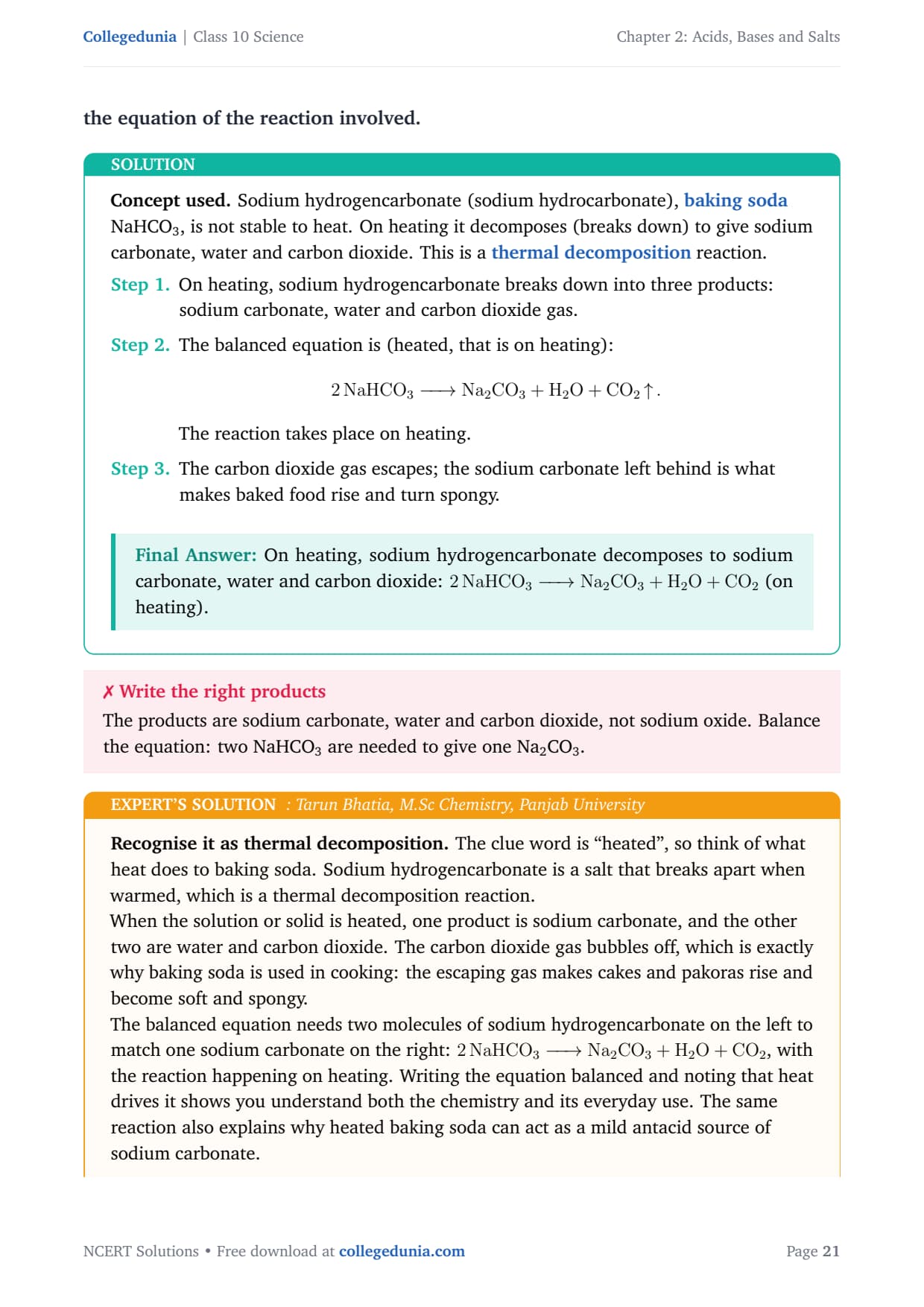
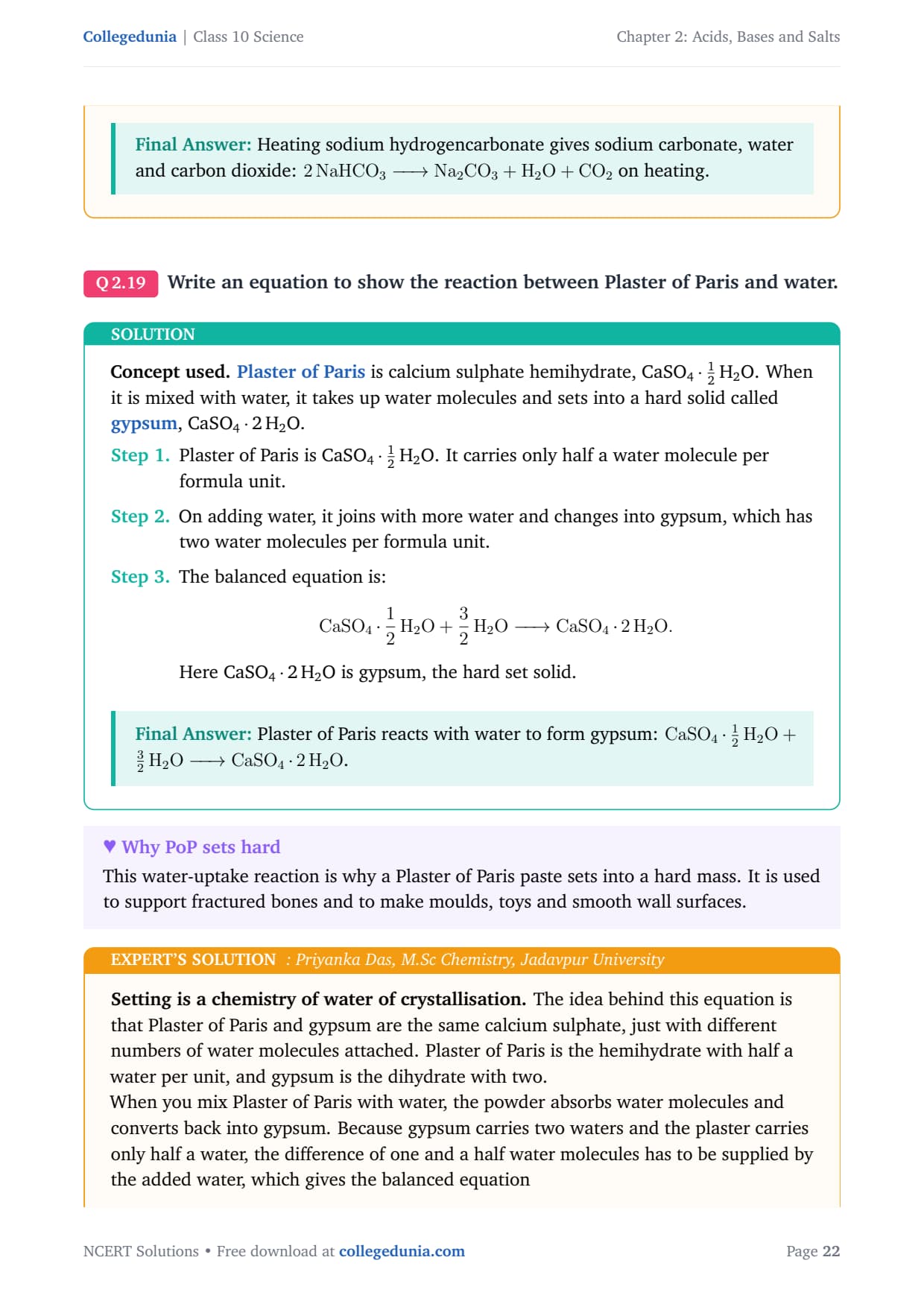
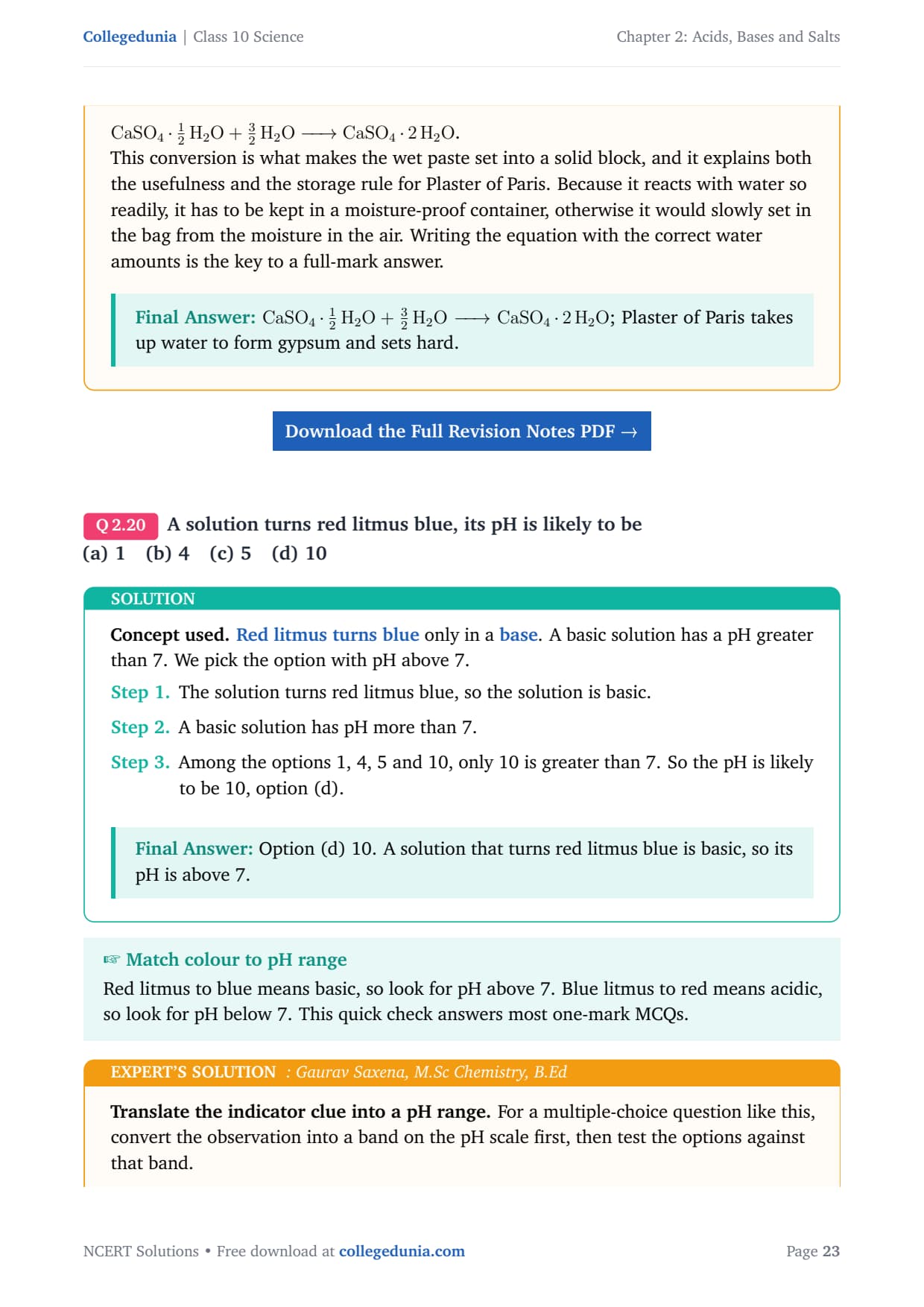
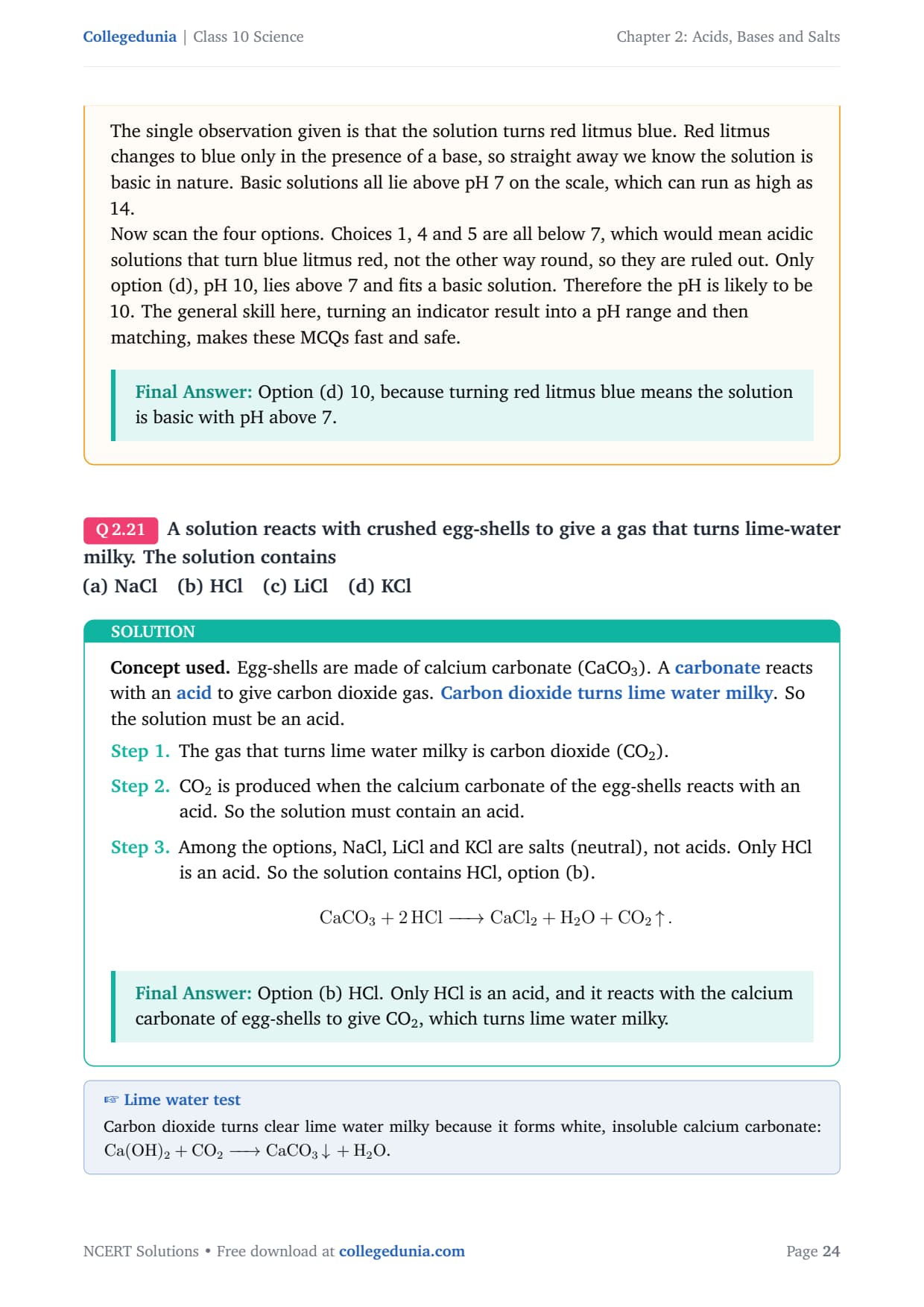
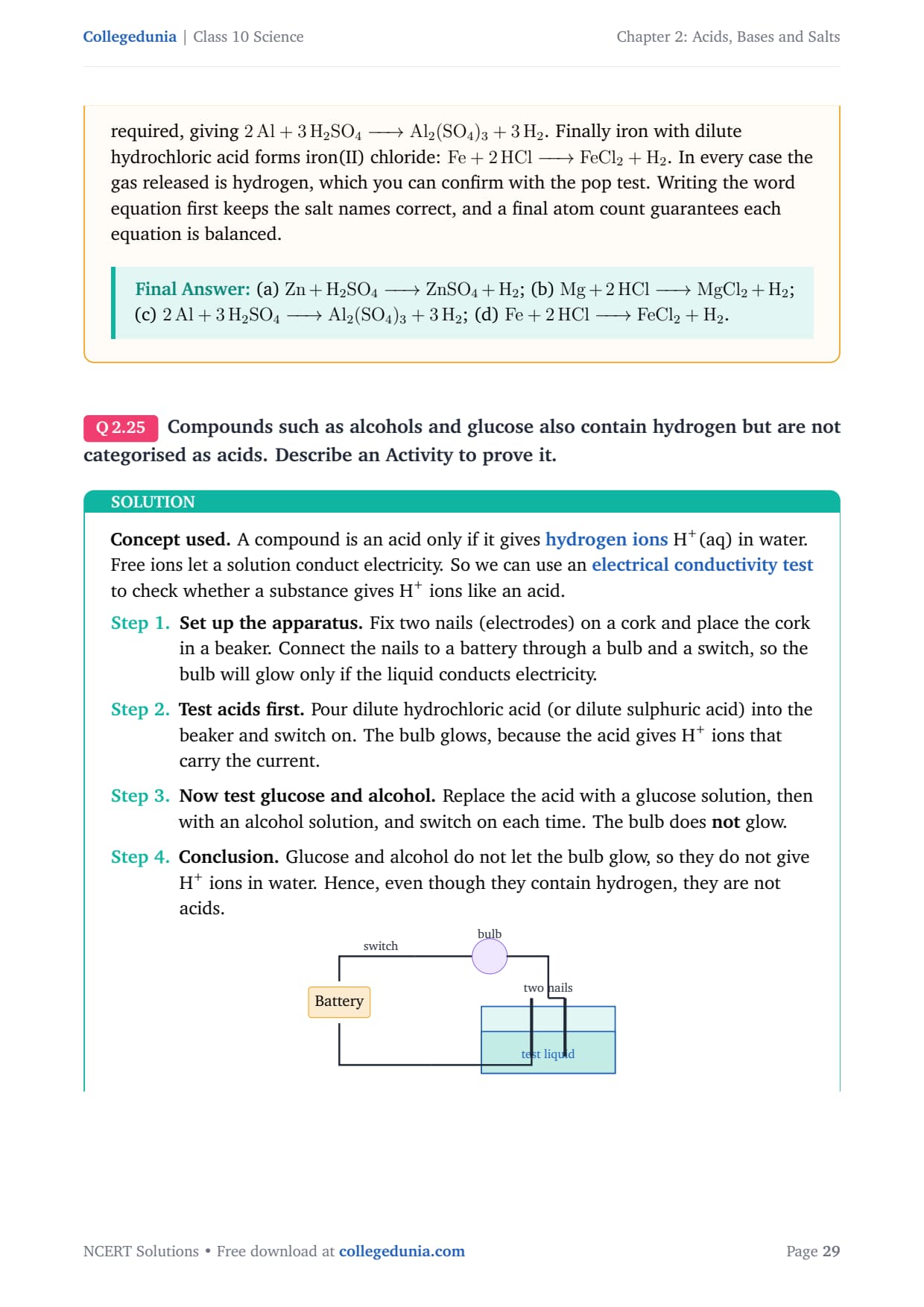
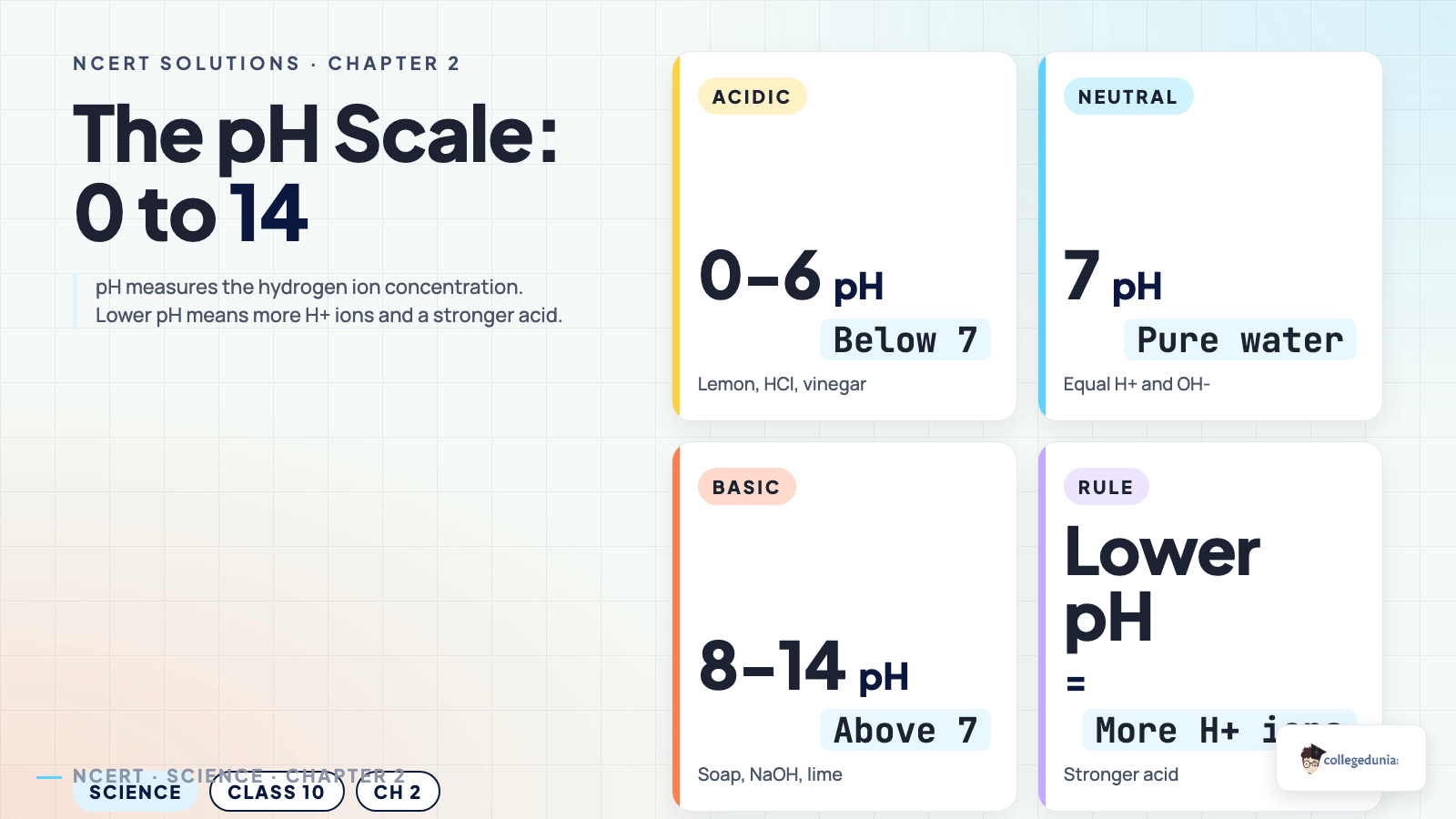
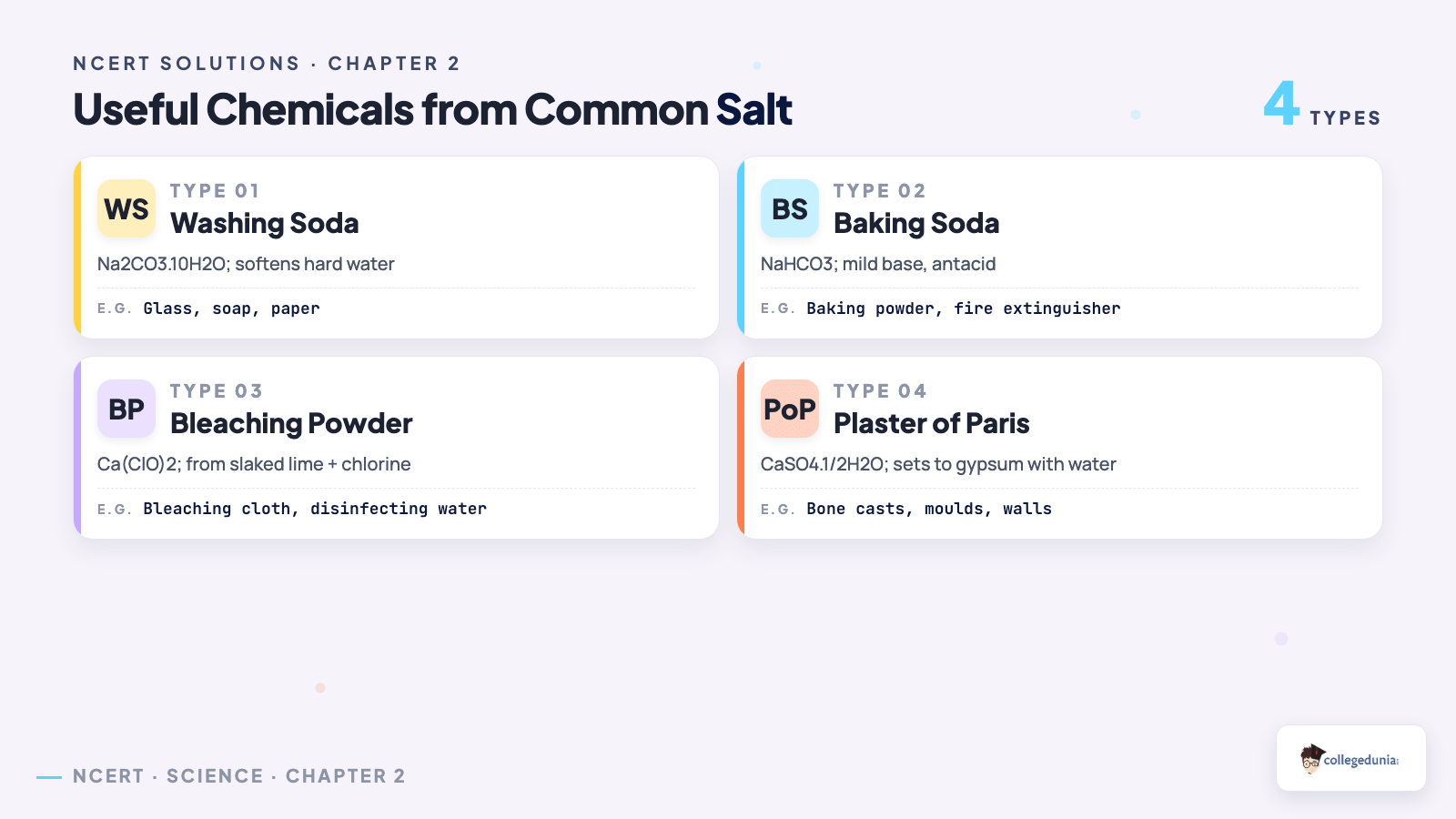



Comments