The NCERT Solutions for Class 11 English Hornbill Chapter 2 We're Not Afraid to Die if We Can All Be Together cover every textbook question for the 2026-27 session. The answers explain the Wavewalker voyage, the family's courage, ship vocabulary and map-based activities in simple language.
Question count: 17 NCERT textbook questions with step-by-step answers.
Best for: CBSE Class 11 English revision, Hornbill workbook practice and school tests.
PDF support: Download the full solved chapter and use the question cards below for quick checking.
Student Feedback: In a Collegedunia survey of 12,480 Class 11 English students before the 2026 school exams, most students said this chapter felt easier after they made a timeline of the storm, repairs and landfall.
Source: 2026 Class 11 English student poll across CBSE schools.
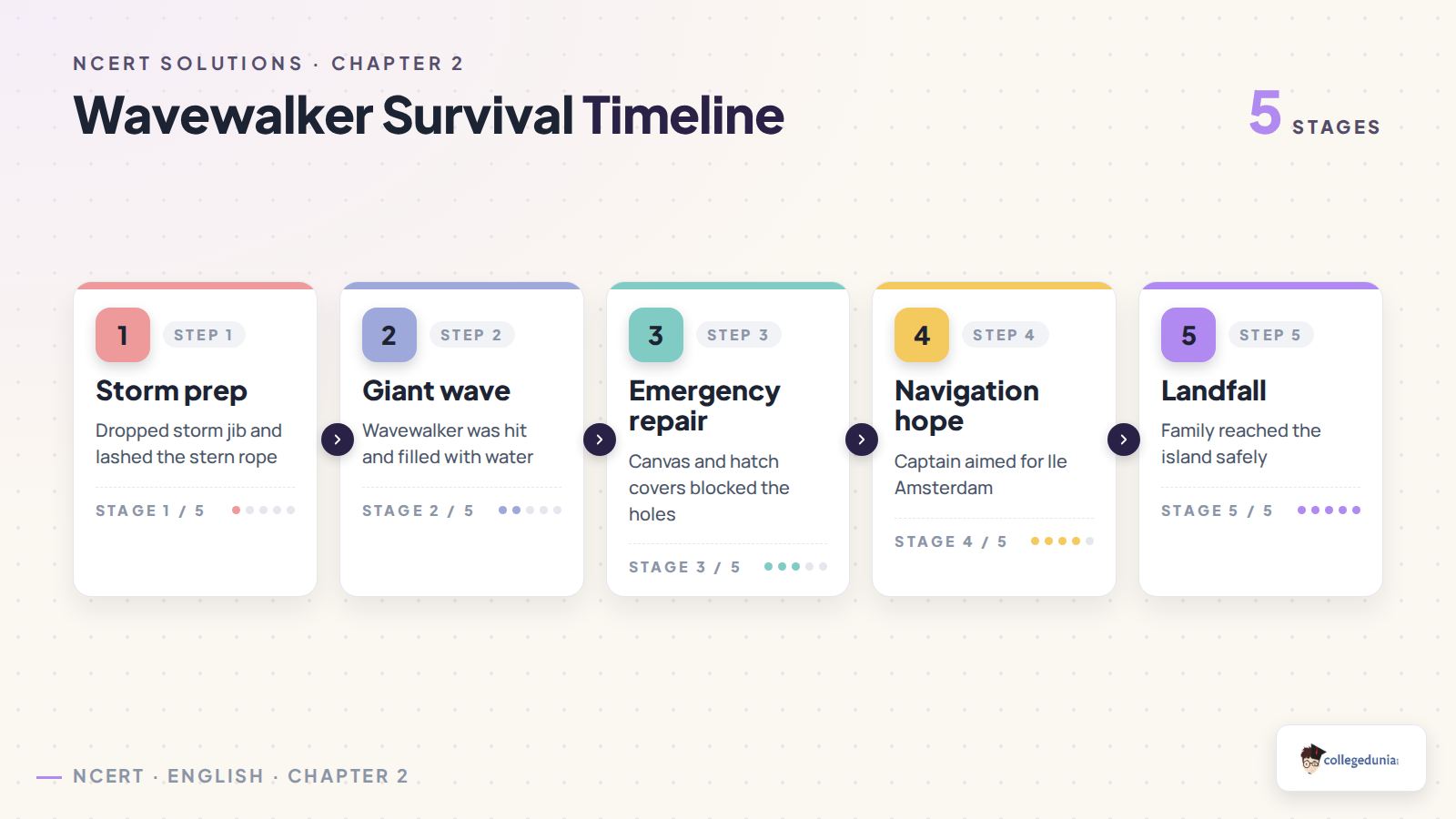
Class 11 English Hornbill Chapter 2 Storm Timeline
The story becomes easier when you track the voyage day by day. The captain first prepares for rough weather, then repairs the yacht after the huge wave and finally uses calculation to reach Ile Amsterdam.
We're Not Afraid to Die NCERT Solutions Answer Strategy
Most questions in this chapter ask for evidence from the text. Write the answer in three parts: direct point, supporting detail and final meaning. Do not write only a summary when the question asks for a comparison or section shift.
For factual answers, keep the event order correct.
For discussion answers, connect danger with courage and teamwork.
For language answers, give examples from your own language when NCERT asks for them.
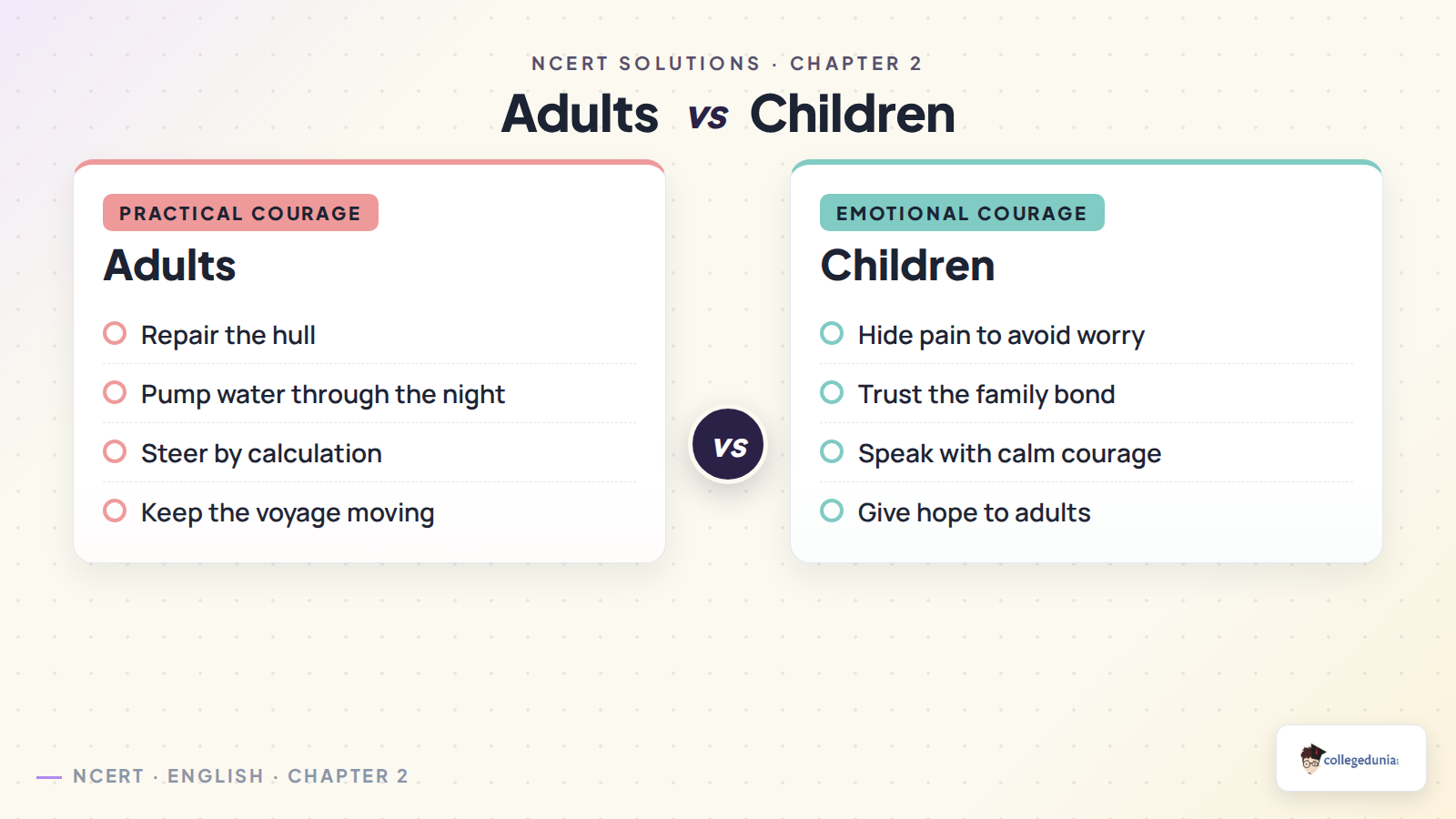
Adults and Children in We're Not Afraid to Die
The chapter shows two forms of courage. The adults show courage through work: steering, repairing, pumping and calculating. The children show courage through trust and emotional strength.
Class 11 English Hornbill Chapter 2 Important Themes
Three themes appear again and again in the NCERT questions. Learn them with examples, because they help in both short answers and long discussion answers.
Optimism: hope is useful only when it leads to action.
Teamwork: every person on the boat has a role in survival.
Family courage: Jon and Sue give the adults a reason to keep fighting.
Class 11 English Hornbill Chapter 2 Vocabulary and Language Tasks
The language section checks storm words, boat names, word origins and ship terms used in other contexts. Keep these answers short and example-based.
NCERT task
How to answer
Storm words
List words from your language, such as aandhi, toofan or cyclone.
Catamaran
Write Tamil origin from kattumaram, meaning tied wood.
Ship terms
Use knot, stern, boom, hatch and anchor in non-ship contexts.
Yacht labelling
Use bow, stern, mast, mainsail, boom, cabin, cockpit and rudder.
How to Use the NCERT Solutions PDF for Revision
Use the PDF once for full revision and the question cards below for quick self-checking. The best method is to answer first, then open the solution tab.
Read the NCERT question and write a 3 to 5 line answer.
Open the Check Solution tab and compare the order of points.
Open Expert Solution to improve phrasing for school tests.
Related NCERT Resources for We're Not Afraid to Die
All NCERT Solutions for Class 11 English Hornbill Chapter 2 We're Not Afraid to Die with Step-by-Step Solutions
Q 2.1
List the steps taken by the captain (i) to protect the ship when rough weather began. (ii) to check the flooding of the water in the ship.
Concept used. This is a sequence answer. We must separate the captain's preparation before the wave from his repair work after the wave.
To protect the ship, the captain dropped the storm jib and slowed the boat.
He lashed a heavy mooring rope across the stern and double-lashed everything on deck.
The crew went through the life-raft drill, attached lifelines and wore oilskins and life jackets.
To check flooding, he stretched canvas and waterproof hatch covers over the open starboard holes.
He used the working electric pump under the chartroom floor when the hand pumps blocked and the main electric pump failed.
He slowed and secured Wavewalker before the wave, then patched the damaged side and kept pumping water out after the wave.
AS
Aanya Sharma
M.A English, University of Delhi
Verified Expert
Close reading. The answer is strongest when it follows the exact order of danger.
Before the huge wave, the captain acts like a trained sailor. He reduces speed, secures the boat and prepares the crew for emergency.
After the collision, the task changes from prevention to survival. The hull is broken, so he must stop water from entering.
Canvas, hatch covers and pumping are temporary measures, but they buy time.
The details show leadership because he keeps choosing the next practical action under pressure.
He first secured the ship against the storm, then controlled flooding through emergency patching and continuous pumping.
Q 2.2
Describe the mental condition of the voyagers on 4 and 5 January.
Concept used. Mental condition means the inner state of the characters. We infer it from their words, actions and the worsening weather.
On January 4, the voyagers were exhausted after thirty-six hours of pumping.
They felt brief relief when the water level came under control and they ate after nearly two days.
Their hope soon weakened because the weather became violent again.
On January 5, the situation was desperate. Jon asked if they were going to die.
Yet the children showed courage by saying they were not afraid if the family stayed together.
They moved from exhausted relief to fear and despair, but the children's courage restored the captain's determination.
KS
Kabir Sen
M.A English Literature, Jadavpur University
Verified Expert
Close reading. The emotional movement matters more than a single mood word.
January 4 begins with a small victory: the pumps lower the water and the family eats.
This hope is fragile because the hull is still damaged and the engine is useless.
By January 5, the storm returns and the family faces death directly.
Jon's question shows fear, while his next sentence shows emotional strength.
The captain is shaken, but the children's trust gives him fresh resolve.
Their minds were tired and frightened, yet family love and courage kept them from surrendering.
Q 2.3
Describe the shifts in the narration of the events as indicated in the three sections of the text. Give a subtitle to each section.
Concept used. A narrative shift is a change in focus, pace or mood. This story moves through preparation, crisis and rescue.
The first section moves from the dream voyage to the giant wave, smashed hull, emergency repairs and Sue's hidden injury.
A suitable subtitle is The Dream Voyage Meets the Giant Wave.
The second section covers the long struggle after January 3: damage assessment, pumping, hope of Ile Amsterdam, renewed storm and the children's courage.
A suitable subtitle is Holding On After the Wave.
The third section shows final navigation, suspense, discovery of Ile Amsterdam, landing and reflection.
A suitable subtitle is Landfall After Courage.
The narration shifts from dream and disaster, to continued survival, to final landfall and reflection.
MK
Meera Kapoor
Ph.D English, Jawaharlal Nehru University
Verified Expert
Close reading. The three sections also change the reader's emotional pace.
At first, the narration is broad, then suddenly urgent. The planned voyage turns into the giant-wave disaster and immediate repairs.
The middle section slows into endurance. It focuses on the leaking boat, the search for Ile Amsterdam and the children's courage.
In the last part, calculation and waiting create suspense before the island appears.
The subtitles should therefore mark the actual section breaks, not only the general plot.
The sections can be read as voyage and wave, survival after the wave, and rescue at Ile Amsterdam.
Q 2.4
What difference did you notice between the reaction of the adults and the children when faced with danger?
Concept used. This is a comparison answer. We compare how adults and children respond to the same danger.
The adults react through action. The captain repairs, steers, pumps and calculates.
Mary helps at the wheel during crucial hours. Larry and Herb keep pumping.
The children react with quiet courage. Sue hides her injuries so others do not worry.
Jon says he is not afraid of dying if the family remains together.
The adults show practical bravery, while the children show emotional bravery.
Adults respond by working to save the boat; children respond with trust, love and surprising courage.
RM
Ritwik Menon
M.A English, University of Hyderabad
Verified Expert
Close reading. The contrast is not between bravery and fear. Everyone is afraid, but they express courage differently.
The adults have responsibilities linked to skill: steering, repairing, pumping and navigation.
Their courage is visible in labour.
The children have no control over the yacht, but they control their speech and behaviour.
Sue's silence about pain and Jon's words about dying together give the adults moral strength.
The text respects both kinds of courage equally.
The adults fight danger through skilled action; the children fight it through calm love and self-control.
Q 2.5
How does the story suggest that optimism helps to endure ``the direst stress''?
Concept used. Optimism means holding on to hope while still facing facts. In this story it appears through work, calculation and family trust.
The captain never denies danger, but he keeps looking for the next useful step.
He repairs the hull, finds another pump, calculates their position and steers toward Ile Amsterdam.
Mary, Larry and Herb continue their work in terrible conditions.
Sue's card and Jon's faith remind the captain why survival matters.
Their optimism is active: it makes them keep working when surrender seems easier.
The story suggests that optimism helps people endure stress by turning fear into action, patience and shared hope.
ST
Sara Thomas
Ph.D Literature, University of Delhi
Verified Expert
Close reading. The phrase ``direst stress'' fits a situation where body and mind are close to breaking.
The voyage gives repeated reasons to lose hope: broken ribs, smashed hull, failed pumps and uncertain navigation.
Optimism survives because the family treats each small task as meaningful.
A working pump, a rough calculation or a child's brave sentence becomes a reason to continue.
Hope therefore does not remove danger. It helps them live through danger long enough to reach safety.
Optimism helps them endure by keeping effort alive until rescue becomes possible.
Q 2.6
What lessons do we learn from such hazardous experiences when we are face-to-face with death?
Concept used. This is a reflective answer. It should draw lessons from the episode without becoming too general.
We learn that panic wastes precious time, while calm action can save lives.
Teamwork matters because no single person can handle every task in a crisis.
Courage is not the absence of fear. It is continuing to act while afraid.
Family love and responsibility can give people extra strength.
Hazardous experiences also teach respect for nature and for careful preparation.
Such experiences teach courage, teamwork, practical thinking, emotional strength and humility before nature.
NV
Nisha Verma
M.A English, Jamia Millia Islamia
Verified Expert
Close reading. The chapter does not present danger as entertainment. It presents danger as a test of character.
The crew survives because they prepare before danger and improvise after damage.
The family survives emotionally because they think of one another rather than only of themselves.
Death appears close, but the response is not helplessness.
The lesson is practical and moral: act clearly, help others and hold courage together.
The main lesson is that discipline, cooperation and love can help people face even life-threatening danger.
Q 2.7
Why do you think people undertake such adventurous expeditions in spite of the risks involved?
Concept used. This answer asks for human motivation. Give reasons and connect them to the captain's dream.
Some people want to test their skills against difficult conditions.
Some are inspired by earlier explorers, as the captain was inspired by Captain James Cook.
Adventure offers freedom, discovery and a sense of achievement.
People may also want to understand nature by meeting it directly.
They accept risk because the experience gives meaning that ordinary safety cannot provide.
People undertake such expeditions for challenge, discovery, freedom, skill and the deep satisfaction of pursuing a dream.
AN
Arjun Nair
M.A Literature, University of Calicut
Verified Expert
Close reading. The chapter shows adventure as a long-held ambition, not a sudden thrill.
The captain and Mary spend sixteen years building their seafaring skills.
Their journey follows a historical model, so it carries imagination and discipline.
Risk is real, but the expedition also gives them identity, purpose and a chance to live intensely.
Good adventurous people do not ignore risk. They train for it and accept responsibility for it.
They undertake such journeys because a serious adventure can join courage, skill, history and personal fulfilment.
Q 2.8
We have come across words like ``gale'' and ``storm''. Here are two more words for storm: typhoon, cyclone. How many words does your language have for storm?
Concept used. This is a language-awareness answer. It asks students to notice how one idea may have many local words.
The answer depends on the student's language.
In Hindi, possible words include aandhi, toofan, chakravaat and jhanjha.
Other Indian languages may have different words for rainstorm, windstorm or cyclone.
The important point is to list words that truly refer to stormy weather.
Students should list the storm words from their own language. For Hindi, aandhi, toofan and chakravaat are suitable examples.
IS
Ira Sharma
Ph.D English, University of Mumbai
Verified Expert
Language link. The exercise trains vocabulary comparison rather than memory of the chapter.
English uses several storm words, and each word can suggest a different kind of weather.
Your language may also separate ordinary heavy wind from a severe rotating storm.
A good answer gives the words and, where possible, their rough meanings.
This makes the response personal and still useful for language study.
Write the storm words from your own language and add short meanings if the words differ.
Q 2.9
Here are the terms for different kinds of vessels: yacht, boat, canoe, ship, steamer, schooner. Think of similar terms in your language.
Concept used. Vessel vocabulary names different kinds of water transport. The answer should give local words for boats or ships.
In Hindi, possible terms include naav for boat and jahaaz for ship.
Kashti is another common word for boat in many contexts.
A student may add words from their region for ferry, canoe or fishing boat.
The answer should show that languages often classify vessels by size, use or shape.
Students should write similar vessel terms from their own language, such as naav, kashti and jahaaz in Hindi.
DI
Devika Iyer
M.A English, Christ University
Verified Expert
Language link. The exercise asks students to connect textbook vocabulary with lived speech.
The English list moves from small craft to larger or more specific vessels.
A similar local list may not match word for word, and that is acceptable.
What matters is classification: small boat, large ship, rowing craft or sailing craft.
The answer becomes stronger when it shows how people in the region actually name water transport.
Use your language's real boat and ship words, then briefly state what each one means.
Q 2.10
``Catamaran'' is a kind of a boat. Do you know which Indian language this word is derived from? Check the dictionary.
Concept used. This is an etymology question. Etymology means the origin and history of a word.
The word catamaran comes from Tamil.
It is linked to the Tamil word kattumaram.
The parts mean tied wood or logs tied together.
This origin fits the older form of a raft-like vessel.
Catamaran is derived from Tamil, from kattumaram, meaning tied wood or logs tied together.
RD
Rohan Das
M.A English, Presidency University
Verified Expert
Language link. This question shows how English has borrowed words from Indian languages.
The borrowed word keeps a trace of the object it first named.
A catamaran was linked with tied logs or a raft-like boat.
Since the source is Tamil, the word also shows contact between seafaring, trade and language.
A dictionary check confirms both the origin and the older meaning.
The word comes from Tamil kattumaram, usually explained as tied wood.
Q 2.11
Have you heard any boatmen's songs? What kind of emotions do these songs usually express?
Concept used. This is a cultural-response question. It asks students to connect work songs with emotion.
Boatmen's songs often express rhythm, effort and togetherness.
They may express longing for home, love, devotion or hope for safe travel.
Some songs also carry sadness because rivers and seas can separate people.
A student may mention a local song if they know one.
Boatmen's songs usually express labour, rhythm, longing, devotion, hope and the emotional pull of river or sea journeys.
TB
Tara Bedi
Ph.D English, Banaras Hindu University
Verified Expert
Language link. Work songs often match the body's movement during labour.
Boatmen row, steer and work together, so song can help rhythm and morale.
The river or sea setting brings strong feelings: distance, danger, faith and return.
Many such songs therefore carry both beauty and hardship.
The answer should sound personal but should still name the emotions clearly.
They commonly express shared labour, hope, longing, devotion and the wish to return safely.
Q 2.12
The following words used in the text as ship terminology are also commonly used in another sense. In what contexts would you use the other meaning: knot, stern, boom, hatch, anchor?
Concept used. These are homonyms or words with different senses. We must give common non-ship uses.
Knot can mean a tied loop, as in a knot in a rope or shoelace.
Stern can mean strict or serious, as in a stern teacher.
Boom can mean a loud sound or a period of sudden growth, as in an economic boom.
Hatch can mean to emerge from an egg.
Anchor can mean a person or thing that gives support, or a news presenter.
The words can be used for tying, strict behaviour, loud sound or growth, birth from an egg and support or presentation.
AK
Aman Khanna
M.A English, Panjab University
Verified Expert
Vocabulary link. The exercise shows how one word changes meaning with context.
In the chapter, these words belong to sailing.
Outside sailing, the same spellings move into daily life: knots in string, stern faces, booming voices, hatching eggs and anchoring a team.
The safest answer is to write the word, then one everyday sentence.
This proves that the student knows use, not only dictionary meaning.
Use each word in a non-ship context: knot in thread, stern parent, boom in trade, egg hatching and anchor as support.
Q 2.13
The following three compound words end in -ship. What does each of them mean: airship, flagship, lightship?
Concept used. A compound word joins parts to make a new meaning. Here, each word has ship as the second part.
An airship is a large aircraft kept in the air by gas, often shaped like a long balloon.
A flagship is the chief ship in a fleet. It can also mean the best or main product of a company.
A lightship is a ship fitted with a light, used like a lighthouse to warn or guide other vessels.
Airship means gas-filled aircraft, flagship means chief ship or main product, and lightship means a ship used as a floating light.
PB
Priya Basu
M.A Literature, Visva Bharati University
Verified Expert
Vocabulary link. The ending ship does not always mean an ordinary travelling boat.
Airship combines air with ship, so it names a vessel-like craft in the sky.
Flagship keeps the naval sense of the leading ship, then develops a figurative sense.
Lightship names function: it carries a warning light where a fixed lighthouse may not stand.
The three meanings show how compounds can be literal, official or functional.
Airship is an aircraft, flagship is the leading ship or main model, and lightship is a floating guide-light vessel.
Q 2.14
In which meaning is ``take on'' used in the third paragraph of the account?
Concept used. A phrasal verb must be read in its sentence. The nearby words decide the correct meaning.
The third paragraph says the family took on two crewmen, Larry Vigil and Herb Seigler.
Here, take on refers to bringing people into the voyage as helpers.
It does not mean to fight an opponent or to assume a quality.
The correct dictionary meaning is to employ or engage someone.
In the third paragraph, ``take on'' means to employ or engage someone, because they took on two crewmen.
VM
Vihaan Mehta
Ph.D English, University of Rajasthan
Verified Expert
Vocabulary link. Phrasal verbs often have several meanings, so context is the answer key.
The object after take on is two crewmen.
People are not a quality to assume, and they are not opponents in this sentence.
They join the boat to help the family cross a rough sea.
Therefore the employment or engagement sense is the only suitable sense.
It means to employ or engage people for work on the voyage.
Q 2.15
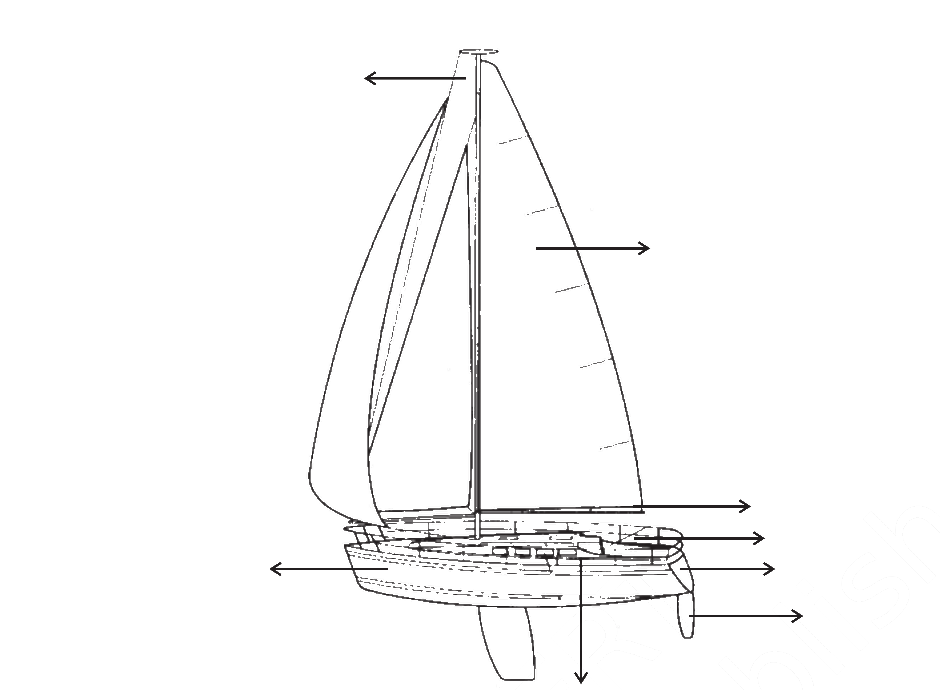
Given in the textbook is a picture of a yacht. Label the parts of the yacht using the terms bow, cabin, rudder, cockpit, stern, boom, mainsail and mast.
Yacht diagram from NCERT English Hornbill Class 11, Chapter 2.
Concept used. Labelling needs position words. A yacht is read from front to back and from deck to sail.
Bow is the front part of the yacht, marked by the left-pointing arrow at the front of the hull.
Stern is the rear part, marked near the back of the hull.
Cabin is the covered room or shelter on the deck.
Cockpit is the open sitting or control area near the stern.
Mast is the tall upright pole that holds the sails.
Mainsail is the large sail attached to the mast.
Boom is the horizontal pole at the lower edge of the mainsail.
Rudder is the steering blade at the back, below the stern.
Label the diagram as bow at the front, stern at the back, cabin on deck, cockpit near the stern, mast upright, mainsail large sail, boom lower sail pole and rudder rear steering blade.
KP
Kavya Pillai
M.A English, Madras University
Verified Expert
Picture-first. A yacht diagram becomes simple when it is divided into hull, deck and sail parts.
The hull gives direction: bow in front and stern at the back.
The deck area gives cabin and cockpit.
The sail system gives mast, mainsail and boom.
The steering part is the rudder, placed at the rear and used to guide direction.
Use the diagram's position clues: bow front, stern back, cabin covered room, cockpit open control area, mast upright pole, mainsail large sail, boom lower sail pole and rudder steering blade.
Q 2.16
Read the information on Ile Amsterdam given in the textbook. What basic facts do we learn about the island?
Concept used. This is a fact-table reading answer. We collect details from the table and write them in complete sentences.
Ile Amsterdam is located in the South Indian Ocean.
It lies between the southernmost parts of Australia and South Africa.
The textbook gives its latitude and longitude as 37 92 S, 77 67 E.
Its sovereignty belongs to France, and it is part of French Southern and Antarctic Lands.
Its population is 35, listed as meteorological station staff.
Its land area is given as 86 square kilometres.
Ile Amsterdam is a small French island in the South Indian Ocean at 37 92 S, 77 67 E, with population 35 and area 86 square kilometres.
NG
Neel Gupta
M.A English Literature, Aligarh Muslim University
Verified Expert
Reference skill. The table gives geographical, political and population details.
The location and coordinates explain why the island was difficult to find after the storm.
The sovereignty and status show that it is linked to France.
The population figure, 35, explains why the text treats it as a remote scientific base.
The land area, 86 square kilometres, makes the rescue feel more remarkable because the target was tiny in a vast ocean.
The table identifies Ile Amsterdam as a remote French island in the South Indian Ocean, at 37 92 S and 77 67 E, with population 35 and land area 86 square kilometres.
Q 2.17
Locate Ile Amsterdam on the world map.
Concept used. Map location uses ocean, nearby continents and coordinates. We use all three clues to avoid guessing.
Look in the southern Indian Ocean.
Find the broad ocean space between South Africa and Australia.
Use the given latitude and longitude from the textbook table as a guide.
Mark Ile Amsterdam as a small island in that remote ocean region.
It is much closer to open sea than to a large mainland city.
Ile Amsterdam should be located in the southern Indian Ocean, between South Africa and Australia, near the coordinates given in the textbook.
RM
Rhea Malhotra
Ph.D English, University of Lucknow
Verified Expert
Map reading. This activity connects the rescue scene to real geography.
First identify the Indian Ocean south of the main shipping routes.
Then move to the area between southern Africa and Australia.
The island is small, so zooming in or using coordinates is necessary.
Once located, the reader understands why the captain calls it a pinprick in the vast ocean.
Mark it as a tiny island in the southern Indian Ocean between South Africa and Australia.
We're Not Afraid to Die Class 11 English NCERT Solutions FAQs
Ques. What does Class 11 English Hornbill Chapter 2 teach students?
Ans. It teaches courage, teamwork, optimism and calm action during a life-threatening sea storm.
Ques. How many NCERT questions are solved in this chapter?
Ans. This page solves 17 textbook questions from Understanding the Text, Talking about the Text, language work and activities.
Ques. Why is the title We're Not Afraid to Die important?
Ans. The title comes from Jon's brave words. It shows that family unity gives the voyagers courage even near death.
Ques. What is the best way to revise this chapter?
Ans. Make a storm timeline first. Then practise the NCERT questions and compare your answer with the solution cards.




Chapter2We'reNotAfraidtoDieifWeCanAllBeTogetherSolutions.pdf?page=1&dpi=150)
Chapter2We'reNotAfraidtoDieifWeCanAllBeTogetherSolutions.pdf?page=2&dpi=150)
Chapter2We'reNotAfraidtoDieifWeCanAllBeTogetherSolutions.pdf?page=3&dpi=150)
Chapter2We'reNotAfraidtoDieifWeCanAllBeTogetherSolutions.pdf?page=4&dpi=150)
Chapter2We'reNotAfraidtoDieifWeCanAllBeTogetherSolutions.pdf?page=5&dpi=150)
Chapter2We'reNotAfraidtoDieifWeCanAllBeTogetherSolutions.pdf?page=6&dpi=150)
Chapter2We'reNotAfraidtoDieifWeCanAllBeTogetherSolutions.pdf?page=7&dpi=150)
Chapter2We'reNotAfraidtoDieifWeCanAllBeTogetherSolutions.pdf?page=8&dpi=150)
Chapter2We'reNotAfraidtoDieifWeCanAllBeTogetherSolutions.pdf?page=9&dpi=150)
Chapter2We'reNotAfraidtoDieifWeCanAllBeTogetherSolutions.pdf?page=10&dpi=150)
Chapter2We'reNotAfraidtoDieifWeCanAllBeTogetherSolutions.pdf?page=11&dpi=150)
Chapter2We'reNotAfraidtoDieifWeCanAllBeTogetherSolutions.pdf?page=12&dpi=150)
Chapter2We'reNotAfraidtoDieifWeCanAllBeTogetherSolutions.pdf?page=13&dpi=150)
Chapter2We'reNotAfraidtoDieifWeCanAllBeTogetherSolutions.pdf?page=14&dpi=150)
Chapter2We'reNotAfraidtoDieifWeCanAllBeTogetherSolutions.pdf?page=15&dpi=150)
Chapter2We'reNotAfraidtoDieifWeCanAllBeTogetherSolutions.pdf?page=16&dpi=150)
Chapter2We'reNotAfraidtoDieifWeCanAllBeTogetherSolutions.pdf?page=17&dpi=150)
Chapter2We'reNotAfraidtoDieifWeCanAllBeTogetherSolutions.pdf?page=18&dpi=150)
Chapter2We'reNotAfraidtoDieifWeCanAllBeTogetherSolutions.pdf?page=19&dpi=150)
Chapter2We'reNotAfraidtoDieifWeCanAllBeTogetherSolutions.pdf?page=20&dpi=150)
Chapter2We'reNotAfraidtoDieifWeCanAllBeTogetherSolutions.pdf?page=21&dpi=150)
Chapter2We'reNotAfraidtoDieifWeCanAllBeTogetherSolutions_flat_MobileCard.pdf?page=1&dpi=150)
Chapter2We'reNotAfraidtoDieifWeCanAllBeTogetherSolutions_flat_MobileCard.pdf?page=2&dpi=150)
Chapter2We'reNotAfraidtoDieifWeCanAllBeTogetherSolutions_flat_MobileCard.pdf?page=3&dpi=150)
Chapter2We'reNotAfraidtoDieifWeCanAllBeTogetherSolutions_flat_MobileCard.pdf?page=4&dpi=150)
Chapter2We'reNotAfraidtoDieifWeCanAllBeTogetherSolutions_flat_MobileCard.pdf?page=5&dpi=150)
Chapter2We'reNotAfraidtoDieifWeCanAllBeTogetherSolutions_flat_MobileCard.pdf?page=6&dpi=150)
Chapter2We'reNotAfraidtoDieifWeCanAllBeTogetherSolutions_flat_MobileCard.pdf?page=7&dpi=150)
Chapter2We'reNotAfraidtoDieifWeCanAllBeTogetherSolutions_flat_MobileCard.pdf?page=8&dpi=150)
Chapter2We'reNotAfraidtoDieifWeCanAllBeTogetherSolutions_flat_MobileCard.pdf?page=9&dpi=150)
Chapter2We'reNotAfraidtoDieifWeCanAllBeTogetherSolutions_flat_MobileCard.pdf?page=10&dpi=150)
Chapter2We'reNotAfraidtoDieifWeCanAllBeTogetherSolutions_flat_MobileCard.pdf?page=11&dpi=150)
Chapter2We'reNotAfraidtoDieifWeCanAllBeTogetherSolutions_flat_MobileCard.pdf?page=12&dpi=150)
Chapter2We'reNotAfraidtoDieifWeCanAllBeTogetherSolutions_flat_MobileCard.pdf?page=13&dpi=150)
Chapter2We'reNotAfraidtoDieifWeCanAllBeTogetherSolutions_flat_MobileCard.pdf?page=14&dpi=150)
Chapter2We'reNotAfraidtoDieifWeCanAllBeTogetherSolutions_flat_MobileCard.pdf?page=15&dpi=150)
Chapter2We'reNotAfraidtoDieifWeCanAllBeTogetherSolutions_flat_MobileCard.pdf?page=16&dpi=150)
Chapter2We'reNotAfraidtoDieifWeCanAllBeTogetherSolutions_flat_MobileCard.pdf?page=17&dpi=150)
Chapter2We'reNotAfraidtoDieifWeCanAllBeTogetherSolutions_flat_MobileCard.pdf?page=18&dpi=150)
Chapter2We'reNotAfraidtoDieifWeCanAllBeTogetherSolutions_flat_MobileCard.pdf?page=19&dpi=150)
Chapter2We'reNotAfraidtoDieifWeCanAllBeTogetherSolutions_flat_MobileCard.pdf?page=20&dpi=150)
Chapter2We'reNotAfraidtoDieifWeCanAllBeTogetherSolutions_flat_MobileCard.pdf?page=21&dpi=150)
Chapter2We'reNotAfraidtoDieifWeCanAllBeTogetherSolutions_flat_MobileCard.pdf?page=22&dpi=150)
Chapter2We'reNotAfraidtoDieifWeCanAllBeTogetherSolutions_flat_MobileCard.pdf?page=23&dpi=150)
Chapter2We'reNotAfraidtoDieifWeCanAllBeTogetherSolutions_flat_MobileCard.pdf?page=24&dpi=150)
Chapter2We'reNotAfraidtoDieifWeCanAllBeTogetherSolutions_flat_MobileCard.pdf?page=25&dpi=150)
Chapter2We'reNotAfraidtoDieifWeCanAllBeTogetherSolutions_flat_MobileCard.pdf?page=26&dpi=150)
Chapter2We'reNotAfraidtoDieifWeCanAllBeTogetherSolutions_flat_MobileCard.pdf?page=27&dpi=150)
Chapter2We'reNotAfraidtoDieifWeCanAllBeTogetherSolutions_flat_MobileCard.pdf?page=28&dpi=150)
Chapter2We'reNotAfraidtoDieifWeCanAllBeTogetherSolutions_flat_MobileCard.pdf?page=29&dpi=150)
Chapter2We'reNotAfraidtoDieifWeCanAllBeTogetherSolutions_flat_MobileCard.pdf?page=30&dpi=150)
Chapter2We'reNotAfraidtoDieifWeCanAllBeTogetherSolutions_flat_MobileCard.pdf?page=31&dpi=150)
Chapter2We'reNotAfraidtoDieifWeCanAllBeTogetherSolutions_flat_MobileCard.pdf?page=32&dpi=150)
Chapter2We'reNotAfraidtoDieifWeCanAllBeTogetherSolutions_flat_MobileCard.pdf?page=33&dpi=150)
Chapter2We'reNotAfraidtoDieifWeCanAllBeTogetherSolutions_flat_MobileCard.pdf?page=34&dpi=150)
Chapter2We'reNotAfraidtoDieifWeCanAllBeTogetherSolutions_flat_MobileCard.pdf?page=35&dpi=150)
Chapter2We'reNotAfraidtoDieifWeCanAllBeTogetherSolutions_flat_MobileCard.pdf?page=36&dpi=150)
Chapter2We'reNotAfraidtoDieifWeCanAllBeTogetherSolutions_flat_MobileCard.pdf?page=37&dpi=150)
Chapter2We'reNotAfraidtoDieifWeCanAllBeTogetherSolutions_flat_MobileCard.pdf?page=38&dpi=150)
Chapter2We'reNotAfraidtoDieifWeCanAllBeTogetherSolutions_flat_MobileCard.pdf?page=39&dpi=150)
Chapter2We'reNotAfraidtoDieifWeCanAllBeTogetherSolutions_flat_MobileCard.pdf?page=40&dpi=150)



Comments