




The NCERT Solutions for Class 11 English Woven Words Chapter 14 Hawk Roosting help students answer every NCERT question from Ted Hughes' poem for the 2026-27 session. The PDF explains the hawk's body images, proud voice, brutal honesty, and the human parallel in simple language.
Chapter14HawkRoostingSolutions.pdf?page=1&dpi=150)
Chapter14HawkRoostingSolutions.pdf?page=2&dpi=150)
Chapter14HawkRoostingSolutions.pdf?page=3&dpi=150)
Chapter14HawkRoostingSolutions.pdf?page=4&dpi=150)
Chapter14HawkRoostingSolutions.pdf?page=5&dpi=150)
Chapter14HawkRoostingSolutions.pdf?page=6&dpi=150)
Chapter14HawkRoostingSolutions.pdf?page=7&dpi=150)
Chapter14HawkRoostingSolutions.pdf?page=8&dpi=150)
Chapter14HawkRoostingSolutions.pdf?page=9&dpi=150)
Chapter14HawkRoostingSolutions_flat_MobileCard.pdf?page=1&dpi=150)
Chapter14HawkRoostingSolutions_flat_MobileCard.pdf?page=2&dpi=150)
Chapter14HawkRoostingSolutions_flat_MobileCard.pdf?page=3&dpi=150)
Chapter14HawkRoostingSolutions_flat_MobileCard.pdf?page=4&dpi=150)
Chapter14HawkRoostingSolutions_flat_MobileCard.pdf?page=5&dpi=150)
Chapter14HawkRoostingSolutions_flat_MobileCard.pdf?page=6&dpi=150)
Chapter14HawkRoostingSolutions_flat_MobileCard.pdf?page=7&dpi=150)
Chapter14HawkRoostingSolutions_flat_MobileCard.pdf?page=8&dpi=150)
Chapter14HawkRoostingSolutions_flat_MobileCard.pdf?page=9&dpi=150)
Chapter14HawkRoostingSolutions_flat_MobileCard.pdf?page=10&dpi=150)
Chapter14HawkRoostingSolutions_flat_MobileCard.pdf?page=11&dpi=150)
Chapter14HawkRoostingSolutions_flat_MobileCard.pdf?page=12&dpi=150)
Chapter14HawkRoostingSolutions_flat_MobileCard.pdf?page=13&dpi=150)
Chapter14HawkRoostingSolutions_flat_MobileCard.pdf?page=14&dpi=150)
Chapter14HawkRoostingSolutions_flat_MobileCard.pdf?page=15&dpi=150)
Chapter14HawkRoostingSolutions_flat_MobileCard.pdf?page=16&dpi=150)
Chapter14HawkRoostingSolutions_flat_MobileCard.pdf?page=17&dpi=150)
Chapter14HawkRoostingSolutions_flat_MobileCard.pdf?page=18&dpi=150)
Chapter14HawkRoostingSolutions_flat_MobileCard.pdf?page=19&dpi=150)
- Resource type: solved NCERT questions with detailed expert answers.
- Best use: revise theme, tone, imagery, and title-based questions before class tests.
- Question count: 6 textbook questions from the Understanding the Poem section.
Each Hawk Roosting NCERT solution is based on the 2026-27 NCERT Woven Words text and written to help students frame direct, exam-ready literature answers.
Student Feedback: In a Collegedunia poll of 10,840 Class 11 English students conducted before the 2026 school exams, 71% said the hardest part of Hawk Roosting was linking the bird's violent confidence with human behaviour.
Hawk Roosting NCERT Solutions: What Students Should Notice First
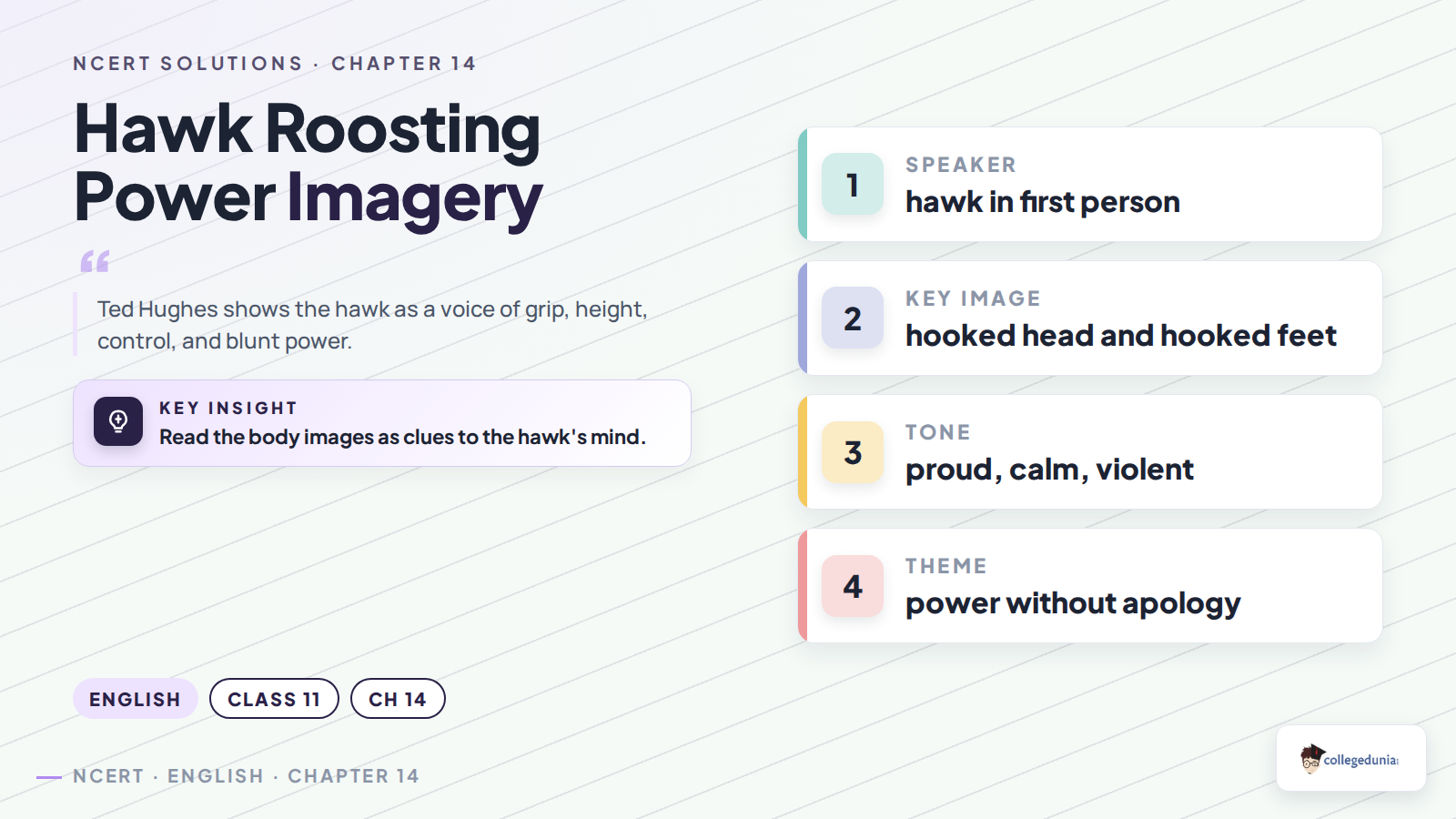
Hawk Roosting is a dramatic monologue. The hawk speaks in the first person and presents itself as calm, powerful, and unquestioned. The poem is short, but each line has a sharp purpose.
- The hawk's body shows power: hooked head, hooked feet, locked grip.
- The tone is proud and direct, not gentle or apologetic.
- The human parallel appears through ownership, control, and violence.
Hawk Roosting Explained for Class 11 English
Source: Magnet Brains on YouTube
Hawk Roosting Theme and Imagery in the NCERT Questions
The NCERT questions focus on physical features, prowess, brutal frankness, the title, and the parallel with human behaviour. The safest answer method is to quote the poem's key images first, then explain what those images reveal about power.
| NCERT Question Focus | Answer Clue |
|---|---|
| Physical features | Hooked head, hooked feet, locked grip |
| Power and control | Height, direct flight, ownership of Creation |
| Human parallel | Force, pride, and refusal to accept moral limits |
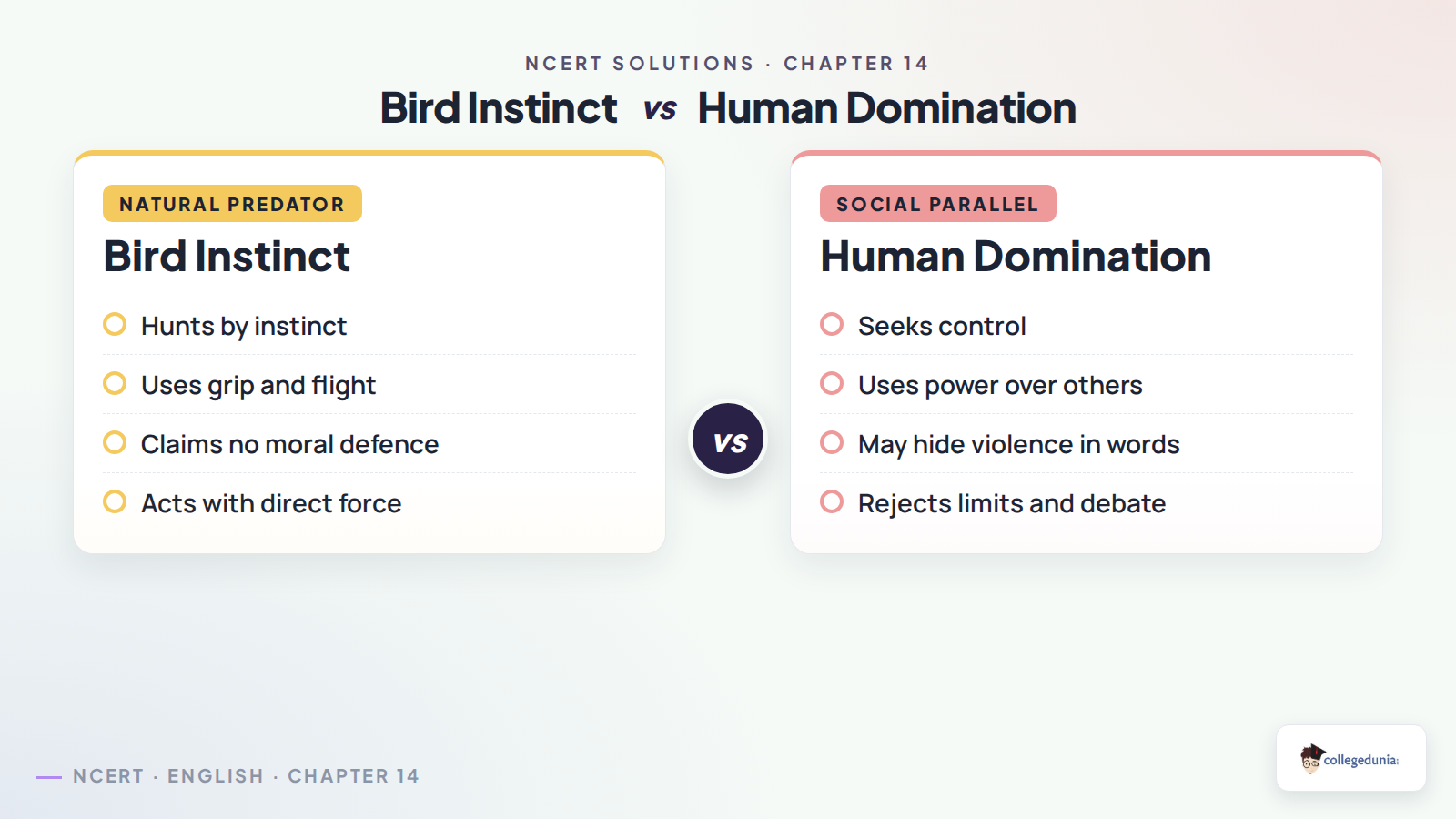
Hawk Roosting Bird Instinct and Human Power Comparison
Hughes does not present the hawk as a soft nature symbol. The hawk's voice is useful because it exposes how domination can sound when it feels no guilt. That is the core idea behind the final NCERT question.
Common Mistakes in Hawk Roosting Class 11 Answers
Many students describe the hawk as only a strong bird. That answer is too thin. The NCERT questions expect students to connect image, tone, and meaning.
- Do not ignore the hawk's first-person voice.
- Do not call the poem only a nature poem.
- Do not miss the human behaviour parallel in question 6.
- Use short quotes, then explain them in your own words.
Hawk Roosting Questions with Step-by-Step Solutions
The full question set is available in the companion solution-card view. It contains every NCERT question with a short solution and an expert explanation.
Open Hawk Roosting Step-by-Step Question Cards
Other Hawk Roosting Class 11 English Resources
| Resource | Use |
|---|---|
| Hawk Roosting Class 11 Notes | Use for theme, summary, and quick revision. |
| Hawk Roosting NCERT Book PDF | Use for the official poem text and textbook questions. |
| Hawk Roosting Handwritten Notes | Use for last-minute handwritten revision. |
Class 11 English Woven Words NCERT Solutions: Related Chapters
| Chapter | NCERT Solutions |
|---|---|
| Chapter 9 | Let Me Not to the Marriage of True Minds Solutions |
| Chapter 11 | Telephone Conversation Solutions |
| Chapter 12 | The World is Too Much With Us Solutions |
| Chapter 13 | Mother Tongue Solutions |
Hawk Roosting Class 11 English NCERT Solutions FAQs
Ques. What is the main idea of Hawk Roosting?
Ans. The main idea is the hawk's belief in its own power. The poem also points to human domination and misuse of authority.
Ques. How many NCERT questions are solved in this Hawk Roosting PDF?
Ans. The PDF solves 6 Understanding the Poem questions from Class 11 English Woven Words.
Ques. Why is Hawk Roosting called a dramatic monologue?
Ans. The hawk speaks in the first person throughout the poem. Its speech reveals its pride, violence, and sense of control.
Ques. What is the hardest NCERT answer in Hawk Roosting?
Ans. Most students find the human-behaviour parallel hardest because it needs both close reading and interpretation.



Comments