Class 12 Entrepreneurship Chapter 2 Entrepreneurial Planning NCERT Solutions cover 40 solved questions from the 2026-27 syllabus. The chapter trains students to convert a business idea into a written plan by arranging ownership, operations, marketing, finance, people, legal formalities and risk controls in a practical order.
40 textbook questions are solved with direct answers and separate expert explanations.
The PDF covers business plan contents, operational plan, production plan, financial plan, marketing plan and formalities.
Question cards below help students compare quick solutions with fuller board-answer framing.
Student Feedback on Class 12 Entrepreneurship Chapter 2
In the 2026-27 Collegedunia Entrepreneurship review log, 10,310 Class 12 students marked Entrepreneurial Planning as a chapter where a neat sequence matters more than long writing.
74% wanted separate explanations for business plan, operational plan and financial plan.
68% confused production planning terms such as routing, scheduling, dispatching and follow-up.
6 out of 10 students asked for case-style answers that connect formalities, risk and social responsibility.
Source: 2026-27 Class 12 Entrepreneurship student feedback sample recorded for Collegedunia NCERT resource planning.
Every answer here is checked against the Entrepreneurial Planning unit of the official CBSE Class 12 Entrepreneurship textbook used for this NCERT resource workflow.
Entrepreneurial Planning Questions Covered in the PDF
The PDF keeps the textbook sequence so students can move from short factual answers to long planning questions without losing the chapter map. The table below shows how the 40-question set is organised.
Question Set
Focus Area
Answer Skill
Very Short Answer Type Questions
Business plan contents, TAN, proforma income statement, target market
Exact term plus one-line explanation
Short Answer Type Questions
Business plan purpose, elevator pitch, production plan, operational plan
Entrepreneurial Planning Business Plan Flow for Class 12
Entrepreneurial Planning asks students to show how an idea becomes an enterprise plan. The scoring answer usually begins with the product or service idea, then moves through feasibility, business-plan writing, execution and review.
Idea: identify the customer need, product or service offer and the basic value proposition.
Feasibility: check whether the idea is practical in market, technical, financial and legal terms.
Business plan: write the ownership, production, marketing, finance, manpower and risk sections clearly.
Execution and review: arrange resources, start operations and revise assumptions when market feedback changes.
Operational Plan and Financial Plan in Entrepreneurial Planning
The chapter separates operational planning from financial planning. Students should keep this distinction clear because several questions ask for contents, objectives or importance of one plan at a time.
Plan
Main Question It Answers
Important Terms
Operational Plan
How will the enterprise produce or deliver the product or service?
Routing, scheduling, dispatching, follow-up, quality control
Production Plan
What, how, when and by whom will production work be done?
Process, capacity, machines, raw material, plant layout
Financial Plan
How much money is needed and how will it be controlled?
Capital, cash flow, proforma income statement, break-even analysis
Marketing Plan
How will the enterprise reach and satisfy the target market?
Entrepreneurial Planning Important Terms for Board Answers
Many questions from this chapter are direct, but the marks are lost when students write casual business language. Use the term bank below before attempting the PDF questions.
Term
Board-Safe Meaning
Where It Appears
Business Plan
A written road map describing goals, resources, operations and action plan.
Short and long answer questions
Elevator Pitch
A short three-minute summary of the business plan executive summary.
Short answer question
Routing
The path followed by materials and work through production.
Production planning
Scheduling
Fixing time for each production activity.
Operational planning
Break-even Analysis
The sales level at which total revenue equals total cost.
Financial plan
Target Market
The customer group whose needs the enterprise wants to satisfy.
Marketing plan
Common Mistakes in Entrepreneurial Planning NCERT Answers
Students often know the broad idea but lose marks because the answer is not arranged like a plan. Check these mistakes before using the PDF for final revision.
Do not mix all plans together: operational, production, financial and marketing plans have different purposes.
Do not skip formalities: PAN, current account, registration, tax compliance, TAN, EPF and ESI appear in long-answer scoring points.
Do not ignore values: value based questions expect fair wages, social responsibility, safety and environmental care.
Do not over-write examples: one clear business example is enough when the question asks for a textbook concept.
Class 12 Entrepreneurship Chapter 2 Related Resources
All NCERT Solutions for Class 12 Entrepreneurship Chapter 2 Entrepreneurial Planning with Step-by-Step Solutions
The embedded cards below mirror the PDF questions. Open Check Solution for the direct answer and Expert Solution for fuller board-answer framing.
A. Very Short Answer Type Questions
Q 2.1
A1. Give any two contents of a business plan?
Concept used. A business plan contains the written parts that explain a proposed venture to the entrepreneur, investors and other stakeholders. The answer should name the key textbook terms and then connect them with the business situation in the question.
Exam focus
Keep the answer point-wise. This chapter rewards exact business terms more than long general writing.
Direct answer. Any two contents of a business plan are general introduction and business venture.
The important points are:
Introductory cover page or general introduction.
Business venture.
Organisational plan.
Financial plan.
Read the command word in the question and identify the exact business term being tested.
Write the direct textbook point first, so the examiner can see the core answer quickly.
Add one short explanation showing why the point matters in entrepreneurial planning.
For this question, the required answer can be built from the top-level NCERT components: general introduction, business venture, organisational plan and financial plan. These points cover the textbook demand without moving away from the chapter.
Any two contents of a business plan are general introduction and business venture.
AK
Anjali Khanna
MBA Marketing, FMS Delhi
Verified Expert
Strategic angle. Start with the scoring word, then expand it only as much as the marks need. In Entrepreneurship, a good answer is clear, classified and tied to the venture decision.
Use this structure:
Introductory cover page or general introduction.
Business venture.
Organisational plan.
Financial plan.
First, state the core answer in one clean sentence.
Next, separate the supporting points so each point can earn credit on its own.
Finally, connect the answer with planning, ownership, finance, operations, marketing or human resources, as the question requires.
The safest board-answer form is: Any two contents of a business plan are general introduction and business venture. Add the listed top-level points when the question carries more marks or asks for reasons.
Any two contents of a business plan are general introduction and business venture.
Q 2.2
A2. Who can write the business plan?
Concept used. A business plan is prepared by the people who want to start the venture, often with support from experts. The answer should name the key textbook terms and then connect them with the business situation in the question.
Exam focus
Keep the answer point-wise. This chapter rewards exact business terms more than long general writing.
Direct answer. Any person or group wishing to start a business venture can write the business plan.
The important points are:
The entrepreneur.
Partners or promoters.
Professional advisers when needed.
People who wish to start a business venture.
Read the command word in the question and identify the exact business term being tested.
Write the direct textbook point first, so the examiner can see the core answer quickly.
Add one short explanation showing why the point matters in entrepreneurial planning.
For this question, the required answer can be built from the entrepreneur, partners or promoters, professional advisers when needed and people who wish to start a business venture. These points cover the textbook demand without moving away from the chapter.
Any person or group wishing to start a business venture can write the business plan.
RM
Rohit Malhotra
M.Com Business Studies, Delhi University
Verified Expert
Strategic angle. Start with the scoring word, then expand it only as much as the marks need. In Entrepreneurship, a good answer is clear, classified and tied to the venture decision.
Use this structure:
The entrepreneur.
Partners or promoters.
Professional advisers when needed.
People who wish to start a business venture.
First, state the core answer in one clean sentence.
Next, separate the supporting points so each point can earn credit on its own.
Finally, connect the answer with planning, ownership, finance, operations, marketing or human resources, as the question requires.
The safest board-answer form is: Any person or group wishing to start a business venture can write the business plan. Add the listed points when the question carries more marks or asks for reasons.
Any person or group wishing to start a business venture can write the business plan.
Q 2.3
A3. How many formats are available to design a successful business plan?
Concept used. A business plan can be presented in different formats because a banker, investor, partner and internal manager do not need the same level of detail.
Exam focus
Do not write only ``three or four''. Add the textbook names of the formats to make the answer complete.
Direct answer. Three or four formats are available to design a successful business plan.
The common formats are:
Elevator pitch: a very short oral presentation that states the business idea, customer need and value offered.
Pitch deck with oral narrative: a slide-based presentation supported by spoken explanation for investors or partners.
Written presentation for external stakeholders: a detailed document for banks, investors, government agencies and other outsiders.
Internal operational plan: a working plan used inside the enterprise to guide production, staffing, finance, marketing and control.
State the count first because the question asks ``how many''.
Name the formats in NCERT order.
Add one phrase showing the purpose of each format.
Three or four formats are available: elevator pitch, pitch deck with oral narrative, written presentation for external stakeholders and internal operational plan.
MS
Meera Sethi
MBA Finance, NMIMS Mumbai
Verified Expert
Strategic angle. The question is small, but the marks are secured by naming the exact formats.
A start-up may begin with an elevator pitch for quick interest. It may then use a pitch deck with oral narrative for a face-to-face investor meeting. A written presentation is kept for external stakeholders who need complete facts. An internal operational plan is used by the team to run the venture after approval.
Write ``three or four formats'' as the direct answer.
Follow it with the four format names.
Link each format with its purpose, so the answer does not look like memorised words.
The successful business plan can be designed in three or four formats, mainly elevator pitch, pitch deck with oral narrative, written presentation for external stakeholders and internal operational plan.
Q 2.4
A4. What is the meaning of shipping in the process of operational plan?
Concept used. Shipping is one element of the operational plan and explains how goods or services move after production. The answer should name the key textbook terms and then connect them with the business situation in the question.
Exam focus
Keep the answer point-wise. This chapter rewards exact business terms more than long general writing.
Direct answer. Shipping means the flow of goods or services from production to the final consumers.
The important points are:
Flow of goods or services.
Movement from production to consumers.
Chronological steps in delivery.
Efficient completion of a business transaction.
Read the command word in the question and identify the exact business term being tested.
Write the direct textbook point first, so the examiner can see the core answer quickly.
Add one short explanation showing why the point matters in entrepreneurial planning.
For this question, the required answer can be built from flow of goods or services, movement from production to consumers, chronological steps in delivery and efficient completion of a business transaction. These points cover the textbook demand without moving away from the chapter.
Shipping means the flow of goods or services from production to the final consumers.
KM
Kavya Menon
M.Com, Christ University
Verified Expert
Strategic angle. Start with the scoring word, then expand it only as much as the marks need. In Entrepreneurship, a good answer is clear, classified and tied to the venture decision.
Use this structure:
Flow of goods or services.
Movement from production to consumers.
Chronological steps in delivery.
Efficient completion of a business transaction.
First, state the core answer in one clean sentence.
Next, separate the supporting points so each point can earn credit on its own.
Finally, connect the answer with planning, ownership, finance, operations, marketing or human resources, as the question requires.
The safest board-answer form is: Shipping means the flow of goods or services from production to the final consumers. Add the listed points when the question carries more marks or asks for reasons.
Shipping means the flow of goods or services from production to the final consumers.
Q 2.5
A5. What is a proforma income statement?
Concept used. A proforma income statement is a projected statement prepared before the actual business results occur. The answer should name the key textbook terms and then connect them with the business situation in the question.
Exam focus
Keep the answer point-wise. This chapter rewards exact business terms more than long general writing.
Direct answer. A proforma income statement shows projected net profit from estimated revenue minus projected costs and expenses.
The important points are:
Estimated revenue.
Projected costs and expenses.
Expected net profit.
Part of the financial plan.
Read the command word in the question and identify the exact business term being tested.
Write the direct textbook point first, so the examiner can see the core answer quickly.
Add one short explanation showing why the point matters in entrepreneurial planning.
For this question, the required answer can be built from estimated revenue, projected costs and expenses, expected net profit and part of the financial plan. These points cover the textbook demand without moving away from the chapter.
A proforma income statement shows projected net profit from estimated revenue minus projected costs and expenses.
PS
Pranav Sharma
MBA Entrepreneurship, IIM Indore
Verified Expert
Strategic angle. Start with the scoring word, then expand it only as much as the marks need. In Entrepreneurship, a good answer is clear, classified and tied to the venture decision.
Use this structure:
Estimated revenue.
Projected costs and expenses.
Expected net profit.
Part of the financial plan.
First, state the core answer in one clean sentence.
Next, separate the supporting points so each point can earn credit on its own.
Finally, connect the answer with planning, ownership, finance, operations, marketing or human resources, as the question requires.
The safest board-answer form is: A proforma income statement shows projected net profit from estimated revenue minus projected costs and expenses. Add the listed points when the question carries more marks or asks for reasons.
A proforma income statement shows projected net profit from estimated revenue minus projected costs and expenses.
Q 2.6
A6. What is break-even analysis?
Concept used. Break-even analysis finds the point at which total revenue and total cost are equal. The answer should name the key textbook terms and then connect them with the business situation in the question.
Exam focus
Keep the answer point-wise. This chapter rewards exact business terms more than long general writing.
Direct answer. Break-even analysis identifies the sales level where total revenue equals total cost.
The important points are:
No profit and no loss point.
Total revenue equals total cost.
Shows minimum sales needed.
Helps test financial feasibility.
Read the command word in the question and identify the exact business term being tested.
Write the direct textbook point first, so the examiner can see the core answer quickly.
Add one short explanation showing why the point matters in entrepreneurial planning.
For this question, the required answer can be built from no profit and no loss point, total revenue equals total cost, shows minimum sales needed and helps test financial feasibility. These points cover the textbook demand without moving away from the chapter.
Break-even analysis identifies the sales level where total revenue equals total cost.
SR
Sanya Rao
M.Com Finance, Madras University
Verified Expert
Strategic angle. Start with the scoring word, then expand it only as much as the marks need. In Entrepreneurship, a good answer is clear, classified and tied to the venture decision.
Use this structure:
No profit and no loss point.
Total revenue equals total cost.
Shows minimum sales needed.
Helps test financial feasibility.
First, state the core answer in one clean sentence.
Next, separate the supporting points so each point can earn credit on its own.
Finally, connect the answer with planning, ownership, finance, operations, marketing or human resources, as the question requires.
The safest board-answer form is: Break-even analysis identifies the sales level where total revenue equals total cost. Add the listed points when the question carries more marks or asks for reasons.
Break-even analysis identifies the sales level where total revenue equals total cost.
Q 2.7
A7. What is meant by a target market?
Concept used. A target market is the selected customer group for whom the enterprise designs its offer. The answer should name the key textbook terms and then connect them with the business situation in the question.
Exam focus
Keep the answer point-wise. This chapter rewards exact business terms more than long general writing.
Direct answer. A target market is the specific group of potential customers whose needs the enterprise aims to meet.
The important points are:
Specific group of potential customers.
Needs the enterprise wants to meet.
Focus for marketing decisions.
Basis for product, price, place and promotion.
Read the command word in the question and identify the exact business term being tested.
Write the direct textbook point first, so the examiner can see the core answer quickly.
Add one short explanation showing why the point matters in entrepreneurial planning.
For this question, the required answer can be built from specific group of potential customers, needs the enterprise wants to meet, focus for marketing decisions and basis for product, price, place and promotion. These points cover the textbook demand without moving away from the chapter.
A target market is the specific group of potential customers whose needs the enterprise aims to meet.
AN
Aditya Nair
MBA Operations, XLRI Jamshedpur
Verified Expert
Strategic angle. Start with the scoring word, then expand it only as much as the marks need. In Entrepreneurship, a good answer is clear, classified and tied to the venture decision.
Use this structure:
Specific group of potential customers.
Needs the enterprise wants to meet.
Focus for marketing decisions.
Basis for product, price, place and promotion.
First, state the core answer in one clean sentence.
Next, separate the supporting points so each point can earn credit on its own.
Finally, connect the answer with planning, ownership, finance, operations, marketing or human resources, as the question requires.
The safest board-answer form is: A target market is the specific group of potential customers whose needs the enterprise aims to meet. Add the listed points when the question carries more marks or asks for reasons.
A target market is the specific group of potential customers whose needs the enterprise aims to meet.
Q 2.8
A8. What is TAN?
Concept used. TAN is a tax identification number linked with deduction or collection of tax at source. The answer should name the key textbook terms and then connect them with the business situation in the question.
Exam focus
Keep the answer point-wise. This chapter rewards exact business terms more than long general writing.
Direct answer. TAN means Tax Deduction and Collection Account Number.
The important points are:
Tax deduction and collection account number.
Ten digit alphanumeric number.
Required for deducting tax at source.
Required for collecting tax at source.
Read the command word in the question and identify the exact business term being tested.
Write the direct textbook point first, so the examiner can see the core answer quickly.
Add one short explanation showing why the point matters in entrepreneurial planning.
For this question, the required answer can be built from Tax Deduction and Collection Account Number, ten digit alphanumeric number, required for deducting tax at source and required for collecting tax at source. These points cover the textbook demand without moving away from the chapter.
TAN means Tax Deduction and Collection Account Number.
IB
Ishita Banerjee
M.Com Taxation, Calcutta University
Verified Expert
Strategic angle. Start with the scoring word, then expand it only as much as the marks need. In Entrepreneurship, a good answer is clear, classified and tied to the venture decision.
Use this structure:
Tax deduction and collection account number.
Ten digit alphanumeric number.
Required for deducting tax at source.
Required for collecting tax at source.
First, state the core answer in one clean sentence.
Next, separate the supporting points so each point can earn credit on its own.
Finally, connect the answer with planning, ownership, finance, operations, marketing or human resources, as the question requires.
The safest board-answer form is: TAN means Tax Deduction and Collection Account Number. Add the listed points when the question carries more marks or asks for reasons.
TAN means Tax Deduction and Collection Account Number.
B. Short Answer Type Questions, 50 Words
Q 2.9
B1. What is a business plan?
Concept used. A business plan is the formal written document that connects a business idea with action, resources and goals. The answer should name the key textbook terms and then connect them with the business situation in the question.
Exam focus
Keep the answer point-wise. This chapter rewards exact business terms more than long general writing.
Direct answer. A business plan is a written road map that describes the venture, its goals, resources and action plan.
The important points are:
Describes internal and external elements of a new venture.
Works as a road map for the enterprise.
States business goals clearly.
Helps the venture move from early start to mature business.
Read the command word in the question and identify the exact business term being tested.
Write the direct textbook point first, so the examiner can see the core answer quickly.
Add one short explanation showing why the point matters in entrepreneurial planning.
For this question, the required answer can be built from describes internal and external elements of a new venture, works as a road map for the enterprise, states business goals clearly and helps the venture move from early start to mature business. These points cover the textbook demand without moving away from the chapter.
A business plan is a written road map that describes the venture, its goals, resources and action plan.
RM
Rahul Mehta
MBA Strategy, IIM Lucknow
Verified Expert
Strategic angle. Start with the scoring word, then expand it only as much as the marks need. In Entrepreneurship, a good answer is clear, classified and tied to the venture decision.
Use this structure:
Describes internal and external elements of a new venture.
Works as a road map for the enterprise.
States business goals clearly.
Helps the venture move from early start to mature business.
First, state the core answer in one clean sentence.
Next, separate the supporting points so each point can earn credit on its own.
Finally, connect the answer with planning, ownership, finance, operations, marketing or human resources, as the question requires.
The safest board-answer form is: A business plan is a written road map that describes the venture, its goals, resources and action plan. Add the listed points when the question carries more marks or asks for reasons.
A business plan is a written road map that describes the venture, its goals, resources and action plan.
Q 2.10
B2. What is elevator pitch?
Concept used. An elevator pitch is a very short presentation of a business idea for people whose attention must be gained quickly. The answer should name the key textbook terms and then connect them with the business situation in the question.
Exam focus
Keep the answer point-wise. This chapter rewards exact business terms more than long general writing.
Direct answer. An elevator pitch is a short three minute summary of the business plan executive summary.
The important points are:
Three minute summary.
Based on the executive summary.
Used for potential funders.
Also used for customers and strategic partners.
Read the command word in the question and identify the exact business term being tested.
Write the direct textbook point first, so the examiner can see the core answer quickly.
Add one short explanation showing why the point matters in entrepreneurial planning.
For this question, the required answer can be built from three minute summary, based on the executive summary, used for potential funders and also used for customers and strategic partners. These points cover the textbook demand without moving away from the chapter.
An elevator pitch is a short three minute summary of the business plan executive summary.
DK
Diya Kapoor
M.Com Business Studies, Mumbai University
Verified Expert
Strategic angle. Start with the scoring word, then expand it only as much as the marks need. In Entrepreneurship, a good answer is clear, classified and tied to the venture decision.
Use this structure:
Three minute summary.
Based on the executive summary.
Used for potential funders.
Also used for customers and strategic partners.
First, state the core answer in one clean sentence.
Next, separate the supporting points so each point can earn credit on its own.
Finally, connect the answer with planning, ownership, finance, operations, marketing or human resources, as the question requires.
The safest board-answer form is: An elevator pitch is a short three minute summary of the business plan executive summary. Add the listed points when the question carries more marks or asks for reasons.
An elevator pitch is a short three minute summary of the business plan executive summary.
Q 2.11
B3. What is a production plan?
Concept used. A production plan sets out how manufacturing work will be done before actual operations begin. The answer should name the key textbook terms and then connect them with the business situation in the question.
Exam focus
Keep the answer point-wise. This chapter rewards exact business terms more than long general writing.
Direct answer. A production plan is the plan for industrial operations covering what, how, when and by whom production work will be done.
The important points are:
What work shall be done.
How the work shall be done.
When the work shall be done.
Who shall do the work.
Read the command word in the question and identify the exact business term being tested.
Write the direct textbook point first, so the examiner can see the core answer quickly.
Add one short explanation showing why the point matters in entrepreneurial planning.
For this question, the required answer can be built from what work shall be done, how the work shall be done, when the work shall be done and who shall do the work. These points cover the textbook demand without moving away from the chapter.
A production plan is the plan for industrial operations covering what, how, when and by whom production work will be done.
KI
Karan Iyer
MBA Operations, SPJIMR Mumbai
Verified Expert
Strategic angle. Start with the scoring word, then expand it only as much as the marks need. In Entrepreneurship, a good answer is clear, classified and tied to the venture decision.
Use this structure:
What work shall be done.
How the work shall be done.
When the work shall be done.
Who shall do the work.
First, state the core answer in one clean sentence.
Next, separate the supporting points so each point can earn credit on its own.
Finally, connect the answer with planning, ownership, finance, operations, marketing or human resources, as the question requires.
The safest board-answer form is: A production plan is the plan for industrial operations covering what, how, when and by whom production work will be done. Add the listed points when the question carries more marks or asks for reasons.
A production plan is the plan for industrial operations covering what, how, when and by whom production work will be done.
Q 2.12
B4. Name the factors which affect the operational plan.
Concept used. The operational plan changes with the nature of the venture and the way its product or service must be produced. The answer should name the key textbook terms and then connect them with the business situation in the question.
Exam focus
Keep the answer point-wise. This chapter rewards exact business terms more than long general writing.
Direct answer. Operational plan is affected by nature of venture, product or service type, scale of operation and technology involved.
The important points are:
Nature of venture.
Type of product or service.
Scale of operation.
Technology involved.
Read the command word in the question and identify the exact business term being tested.
Write the direct textbook point first, so the examiner can see the core answer quickly.
Add one short explanation showing why the point matters in entrepreneurial planning.
For this question, the required answer can be built from nature of venture, type of product or service, scale of operation and technology involved. These points cover the textbook demand without moving away from the chapter.
Operational plan is affected by nature of venture, product or service type, scale of operation and technology involved.
AV
Aditi Verma
M.Com Accounting, Delhi University
Verified Expert
Strategic angle. Start with the scoring word, then expand it only as much as the marks need. In Entrepreneurship, a good answer is clear, classified and tied to the venture decision.
Use this structure:
Nature of venture.
Type of product or service.
Scale of operation.
Technology involved.
First, state the core answer in one clean sentence.
Next, separate the supporting points so each point can earn credit on its own.
Finally, connect the answer with planning, ownership, finance, operations, marketing or human resources, as the question requires.
The safest board-answer form is: Operational plan is affected by nature of venture, product or service type, scale of operation and technology involved. Add the listed points when the question carries more marks or asks for reasons.
Operational plan is affected by nature of venture, product or service type, scale of operation and technology involved.
Q 2.13
B5. How many sources of funds are available for arranging funds for business enterprises?
Concept used. While arranging finance, the entrepreneur normally classifies funds by their source.
Exam focus
Use the exact two-way classification. Extra sources can be mentioned only after this core answer is clear.
Direct answer. Two broad sources of funds are available: owners' funds and outsiders' or borrowed funds.
Owners' funds: money contributed by the entrepreneur, partners, promoters or shareholders. It represents risk capital because the owner bears the risk of profit or loss.
Outsiders' or borrowed funds: money raised from banks, financial institutions, creditors, debenture holders or other lenders. It normally has to be repaid with interest.
Mention the number, two.
Name both sources.
Explain ownership funds and borrowed funds separately.
There are two broad sources: owners' funds and outsiders' or borrowed funds.
NK
Nidhi Kapoor
CA Inter, ICAI
Verified Expert
Strategic angle. Finance answers should separate risk capital from repayable capital.
Owners' funds come from those who own or promote the enterprise. They show the entrepreneur's commitment and do not create a fixed repayment burden. Outsiders' funds come from lenders and credit sources. They help the business grow when own capital is not enough, but they create repayment and interest obligations.
Start with the count.
Compare who provides the money.
Add the repayment difference for clarity.
The two sources are owners' funds and outsiders' or borrowed funds.
Q 2.14
C1. Briefly, explain the objectives of an operational plan.
Concept used. The operational plan aims to make production orderly, timely and controlled from materials to finished goods. The answer should name the key textbook terms and then connect them with the business situation in the question.
Exam focus
Keep the answer point-wise. This chapter rewards exact business terms more than long general writing.
Direct answer. The objectives are advance production, exact routing, time scheduling and orderly movement of goods through the production cycle.
The important points are:
Produce in advance of demand or operations.
Fix the route of each item.
Set starting and finishing dates.
Regulate movement through the manufacturing cycle.
Read the command word in the question and identify the exact business term being tested.
Write the direct textbook point first, so the examiner can see the core answer quickly.
Add one short explanation showing why the point matters in entrepreneurial planning.
For this question, the required answer can be built from produce in advance of demand or operations, fix the route of each item, set starting and finishing dates and regulate movement through the manufacturing cycle. These points cover the textbook demand without moving away from the chapter.
The objectives are advance production, exact routing, time scheduling and orderly movement of goods through the production cycle.
NP
Neha Pillai
M.Com Commerce, Kerala University
Verified Expert
Strategic angle. Start with the scoring word, then expand it only as much as the marks need. In Entrepreneurship, a good answer is clear, classified and tied to the venture decision.
Use this structure:
Produce in advance of demand or operations.
Fix the route of each item.
Set starting and finishing dates.
Regulate movement through the manufacturing cycle.
First, state the core answer in one clean sentence.
Next, separate the supporting points so each point can earn credit on its own.
Finally, connect the answer with planning, ownership, finance, operations, marketing or human resources, as the question requires.
The safest board-answer form is: The objectives are advance production, exact routing, time scheduling and orderly movement of goods through the production cycle. Add the listed points when the question carries more marks or asks for reasons.
The objectives are advance production, exact routing, time scheduling and orderly movement of goods through the production cycle.
Q 2.15
C2. Describe the contents of an organisational plan.
Concept used. An organisational plan explains ownership, authority, responsibility and working relations inside the proposed venture. The answer should name the key textbook terms and then connect them with the business situation in the question.
Exam focus
Keep the answer point-wise. This chapter rewards exact business terms more than long general writing.
Direct answer. An organisational plan contains ownership terms, authority lines, member details, roles, payments, voting rights and dispute procedure.
The important points are:
Terms and conditions of the selected form.
Authority and responsibility lines.
Names, designations, addresses and resumes.
Stake, roles, payments, voting and dispute process.
Read the command word in the question and identify the exact business term being tested.
Write the direct textbook point first, so the examiner can see the core answer quickly.
Add one short explanation showing why the point matters in entrepreneurial planning.
For this question, the required answer can be built from terms and conditions of the selected form, authority and responsibility lines, names, designations, addresses and resumes and stake, roles, payments, voting and dispute process. These points cover the textbook demand without moving away from the chapter.
An organisational plan contains ownership terms, authority lines, member details, roles, payments, voting rights and dispute procedure.
AR
Arjun Reddy
MBA Marketing, IBS Hyderabad
Verified Expert
Strategic angle. Start with the scoring word, then expand it only as much as the marks need. In Entrepreneurship, a good answer is clear, classified and tied to the venture decision.
Use this structure:
Terms and conditions of the selected form.
Authority and responsibility lines.
Names, designations, addresses and resumes.
Stake, roles, payments, voting and dispute process.
First, state the core answer in one clean sentence.
Next, separate the supporting points so each point can earn credit on its own.
Finally, connect the answer with planning, ownership, finance, operations, marketing or human resources, as the question requires.
The safest board-answer form is: An organisational plan contains ownership terms, authority lines, member details, roles, payments, voting rights and dispute procedure. Add the listed points when the question carries more marks or asks for reasons.
An organisational plan contains ownership terms, authority lines, member details, roles, payments, voting rights and dispute procedure.
Q 2.16
C3. Which common techniques are required to calculate the forecasting income?
Concept used. Forecasting income means estimating future earnings with market and financial evidence before the venture starts. The answer should name the key textbook terms and then connect them with the business situation in the question.
Exam focus
Keep the answer point-wise. This chapter rewards exact business terms more than long general writing.
Direct answer. Common techniques are marketing research, industry sales, buyer surveys, expert opinions, similar start up data and trial experience.
The important points are:
Marketing research.
Industry sales.
Survey of buyers' intentions.
Expert opinions.
Financial data on similar start ups.
Trial experience of self or others.
Read the command word in the question and identify the exact business term being tested.
Write the direct textbook point first, so the examiner can see the core answer quickly.
Add one short explanation showing why the point matters in entrepreneurial planning.
For this question, the required answer can be built from marketing research, industry sales, survey of buyers' intentions, expert opinions, financial data on similar start ups and trial experience of self or others. These points cover the textbook demand without moving away from the chapter.
Common techniques are marketing research, industry sales, buyer surveys, expert opinions, similar start up data and trial experience.
PB
Pooja Bhat
M.Com Business Law, Bangalore University
Verified Expert
Strategic angle. Start with the scoring word, then expand it only as much as the marks need. In Entrepreneurship, a good answer is clear, classified and tied to the venture decision.
Use this structure:
Marketing research.
Industry sales.
Survey of buyers' intentions.
Expert opinions.
Financial data on similar start ups.
Trial experience of self or others.
First, state the core answer in one clean sentence.
Next, separate the supporting points so each point can earn credit on its own.
Finally, connect the answer with planning, ownership, finance, operations, marketing or human resources, as the question requires.
The safest board-answer form is: Common techniques are marketing research, industry sales, buyer surveys, expert opinions, similar start up data and trial experience. Add the listed points when the question carries more marks or asks for reasons.
Common techniques are marketing research, industry sales, buyer surveys, expert opinions, similar start up data and trial experience.
Q 2.17
C4. Write the steps in preparing a marketing plan.
Concept used. A marketing plan is prepared by moving from market study to action and control.
Exam focus
Six steps are expected. Missing the implementation and monitoring step makes the answer incomplete.
Direct answer. The steps are business situation analysis, target market identification, SWOT analysis, goal setting, defining marketing strategy, and implementation and monitoring of the plan.
Business situation analysis: study present market conditions, customer need, product position and enterprise capacity.
Identify the target market: choose the customer group the enterprise will serve.
Conduct SWOT analysis: examine strengths, weaknesses, opportunities and threats.
Establish goals: set clear sales, market share and customer objectives.
Define marketing strategy: decide product, price, place and promotion actions.
Implement and monitor the plan: put the strategy into action and check whether results match the goals.
Identify the exact textbook demand in the question.
Write the direct answer first using NCERT terms.
Add classified explanation points so the answer is complete for board marking.
Marketing plan steps are situation analysis, target market selection, SWOT analysis, goal setting, marketing strategy, and implementation and monitoring.
SJ
Siddharth Joshi
MBA Entrepreneurship, NMIMS Mumbai
Verified Expert
Strategic angle. Treat the marketing plan as a control cycle, not just as a list of promotion activities.
First, the entrepreneur studies the business situation. Second, the target market is identified. Third, SWOT analysis is done to know internal and external conditions. Fourth, goals are fixed. Fifth, strategy is defined through product, price, place and promotion. Sixth, the plan is implemented and monitored so corrective action can be taken.
Write all six steps in sequence.
Give one line on what each step does.
Close with monitoring because planning is useful only when results are checked.
A complete marketing plan has six steps, ending with implementation and monitoring of the plan.
Q 2.18
C5. What is PAN? Why is it required?
Concept used. PAN is a tax identity number that links financial transactions of a person or enterprise with the Income Tax Department. The answer should name the key textbook terms and then connect them with the business situation in the question.
Exam focus
Keep the answer point-wise. This chapter rewards exact business terms more than long general writing.
Direct answer. PAN is a ten digit Permanent Account Number required to link financial and tax transactions with the Income Tax Department.
The important points are:
Permanent account number.
Ten digit alphanumeric number.
Issued by the income tax department.
Links tax payments, tds or tcs credits, returns and specified transactions.
Read the command word in the question and identify the exact business term being tested.
Write the direct textbook point first, so the examiner can see the core answer quickly.
Add one short explanation showing why the point matters in entrepreneurial planning.
For this question, the required answer can be built from Permanent Account Number, ten digit alphanumeric number, issued by the Income Tax Department and links tax payments, TDS or TCS credits, returns and specified transactions. These points cover the textbook demand without moving away from the chapter.
PAN is a ten digit Permanent Account Number required to link financial and tax transactions with the Income Tax Department.
TS
Tara Singh
M.Com Management, Panjab University
Verified Expert
Strategic angle. Start with the scoring word, then expand it only as much as the marks need. In Entrepreneurship, a good answer is clear, classified and tied to the venture decision.
Use this structure:
Permanent account number.
Ten digit alphanumeric number.
Issued by the income tax department.
Links tax payments, tds or tcs credits, returns and specified transactions.
First, state the core answer in one clean sentence.
Next, separate the supporting points so each point can earn credit on its own.
Finally, connect the answer with planning, ownership, finance, operations, marketing or human resources, as the question requires.
The safest board-answer form is: PAN is a ten digit Permanent Account Number required to link financial and tax transactions with the Income Tax Department. Add the listed points when the question carries more marks or asks for reasons.
PAN is a ten digit Permanent Account Number required to link financial and tax transactions with the Income Tax Department.
D. Long Answer Type Questions, 100 Words
Q 2.19
D1. What is an operational plan? Discuss its blue print.
Concept used. An operational plan is the production blueprint of the enterprise. It converts the business idea into day-to-day work.
Exam focus
Write the practical production role of the operational plan, not a generic meaning of planning.
Direct answer. An operational plan is a blueprint for orderly production and delivery of goods or services.
It is required because it:
shows the orderly flow of materials, labour, machines and information through the manufacturing cycle;
helps production continue without avoidable stoppage;
coordinates purchasing, routing, scheduling, dispatching, inspection and shipping;
reduces waste of time, material and effort;
supports quality control at each important stage; and
keeps cost and delivery time under control.
Define it as a production blueprint.
Explain how it connects resources and work stages.
Conclude with cost, quality and time control.
An operational plan is needed to ensure orderly flow of resources, continuous production, quality control, low waste, and timely delivery.
RB
Ritika Bansal
M.Com Operations, Delhi University
Verified Expert
Strategic angle. The operational plan answers the question, ``How will the enterprise actually produce and deliver?''
It gives the entrepreneur a production route before work starts. Materials enter the process in the right order, machines and labour are assigned, work is scheduled, goods are inspected, and finished output is shipped. This prevents confusion, idle time, poor quality and unnecessary cost.
It also makes responsibility visible. The purchasing team knows when material is needed, the production team knows the route and timing, supervisors know what to inspect, and the dispatch team knows when finished goods must move. This is why an operational plan is treated as a control document, not only as a production note.
Begin with ``blueprint of production''.
Add coordination of people, material and machines.
Mention continuous work, less waste, quality check and delivery control.
The operational plan is important because it gives the production blueprint and controls flow, quality, waste, cost and delivery.
Q 2.20
D2. Define organisational plan? A business can be classified in how many categories?
Concept used. An organisational plan states the ownership form of the venture, while business categories show the activity it performs. The answer should name the key textbook terms and then connect them with the business situation in the question.
Exam focus
Keep the answer point-wise. This chapter rewards exact business terms more than long general writing.
Direct answer. An organisational plan describes ownership, and business can be classified as manufacturing, wholesale, retail and service.
The important points are:
Organisational plan describes the proposed venture's form of ownership.
Manufacturing business makes tangible products.
Wholesale business buys in bulk and sells to retailers.
Retail business sells to final consumers.
Service business sells time, skill or expertise.
Read the command word in the question and identify the exact business term being tested.
Write the direct textbook point first, so the examiner can see the core answer quickly.
Add one short explanation showing why the point matters in entrepreneurial planning.
For this question, the required answer can be built from organisational plan describes the proposed venture's form of ownership, manufacturing business makes tangible products, wholesale business buys in bulk and sells to retailers, retail business sells to final consumers and service business sells time, skill or expertise. These points cover the textbook demand without moving away from the chapter.
An organisational plan describes ownership, and business can be classified as manufacturing, wholesale, retail and service.
RG
Riya Gupta
M.Com Applied Economics, JNU Delhi
Verified Expert
Strategic angle. Start with the scoring word, then expand it only as much as the marks need. In Entrepreneurship, a good answer is clear, classified and tied to the venture decision.
Use this structure:
Organisational plan describes the proposed venture's form of ownership.
Manufacturing business makes tangible products.
Wholesale business buys in bulk and sells to retailers.
Retail business sells to final consumers.
Service business sells time, skill or expertise.
First, state the core answer in one clean sentence.
Next, separate the supporting points so each point can earn credit on its own.
Finally, connect the answer with planning, ownership, finance, operations, marketing or human resources, as the question requires.
The safest board-answer form is: An organisational plan describes ownership, and business can be classified as manufacturing, wholesale, retail and service. Add the listed points when the question carries more marks or asks for reasons.
An organisational plan describes ownership, and business can be classified as manufacturing, wholesale, retail and service.
Q 2.21
D3. How many choices are there to start a business by a business man? Explain each of them
Concept used. The organisational plan also requires selection of a suitable form of ownership.
Exam focus
Name the five choices and add one identifying feature of each.
Direct answer. The major forms of ownership are sole proprietorship, partnership, Joint Hindu Family business, cooperative society and company.
Sole proprietorship: one person owns, manages and controls the business and also bears the risk.
Partnership: two or more persons agree to share profits and responsibilities according to a partnership agreement.
Joint Hindu Family business: a business owned by members of a Hindu Undivided Family, managed by the karta.
Cooperative society: a voluntary association formed for mutual benefit and democratic working.
Company: an incorporated body with separate legal identity and ownership divided into shares.
Identify the exact textbook demand in the question.
Write the direct answer first using NCERT terms.
Add classified explanation points so the answer is complete for board marking.
The ownership choices are sole proprietorship, partnership, Joint Hindu Family business, cooperative society and company.
RN
Rahul Nair
BBA Entrepreneurship, Symbiosis Pune
Verified Expert
Strategic angle. Ownership form decides control, liability, continuity, legal work and finance options.
A sole proprietorship suits simple one-owner control. A partnership suits a venture where two or more persons combine capital and skill. A Joint Hindu Family business is based on family membership and karta management. A cooperative society works for member welfare with democratic control. A company suits larger scale because it has separate legal identity and can raise share capital.
List the forms first.
Explain the legal or management feature of each form.
Link the choice with capital, control and risk.
The entrepreneur may choose sole proprietorship, partnership, Joint Hindu Family business, cooperative society or company.
Q 2.22
D4. What are the key areas, for a sound financial plan to work?
Concept used. A sound financial plan estimates finance needs, finance sources and the money results expected from the venture. The answer should name the key textbook terms and then connect them with the business situation in the question.
Exam focus
Keep the answer point-wise. This chapter rewards exact business terms more than long general writing.
Direct answer. The key areas are finance requirements, fund sources and exact assessment of revenue, costs, profits, cash flows, inventory and loans.
The important points are:
Financial requirements.
Sources of raising funds.
Assessment of revenue and cost.
Profit and cash flow estimates.
Inventory and loan estimates.
Read the command word in the question and identify the exact business term being tested.
Write the direct textbook point first, so the examiner can see the core answer quickly.
Add one short explanation showing why the point matters in entrepreneurial planning.
For this question, the required answer can be built from financial requirements, sources of raising funds, assessment of revenue and cost, profit and cash flow estimates and inventory and loan estimates. These points cover the textbook demand without moving away from the chapter.
The key areas are finance requirements, fund sources and exact assessment of revenue, costs, profits, cash flows, inventory and loans.
PP
Priya Patel
M.Com Taxation, Gujarat University
Verified Expert
Strategic angle. Start with the scoring word, then expand it only as much as the marks need. In Entrepreneurship, a good answer is clear, classified and tied to the venture decision.
Use this structure:
Financial requirements.
Sources of raising funds.
Assessment of revenue and cost.
Profit and cash flow estimates.
Inventory and loan estimates.
First, state the core answer in one clean sentence.
Next, separate the supporting points so each point can earn credit on its own.
Finally, connect the answer with planning, ownership, finance, operations, marketing or human resources, as the question requires.
The safest board-answer form is: The key areas are finance requirements, fund sources and exact assessment of revenue, costs, profits, cash flows, inventory and loans. Add the listed points when the question carries more marks or asks for reasons.
The key areas are finance requirements, fund sources and exact assessment of revenue, costs, profits, cash flows, inventory and loans.
Q 2.23
D5. What are the major financial items that should be included in the financial plan?
Concept used. A financial plan forecasts how much money is needed, where it will come from and whether the venture is financially workable.
Exam focus
Use the proforma terms. They are the scoring words in this answer.
Direct answer. A financial plan has proforma investment decisions, proforma financing decisions, proforma income statements, proforma cash flow, proforma balance sheet, break-even analysis, and economic and social variables.
Proforma investment decisions: estimate fixed assets, working capital and other investment needs.
Proforma financing decisions: decide owners' funds, borrowed funds and the mix of finance.
Proforma income statements: forecast sales, cost, expenses and profit.
Proforma cash flow: show expected inflows and outflows of cash.
Proforma balance sheet: project assets, liabilities and owners' capital.
Break-even analysis: find the level where total revenue equals total cost.
Economic and social variables: note external factors that may affect the project.
Identify the exact textbook demand in the question.
Write the direct answer first using NCERT terms.
Add classified explanation points so the answer is complete for board marking.
The financial plan includes proforma investment, financing, income, cash flow and balance-sheet decisions, break-even analysis, and economic and social variables.
AR
Anika Rao
CA Foundation Mentor, ICAI
Verified Expert
Strategic angle. The financial plan is the money test of the business plan.
Investment decisions show what assets and working capital are needed. Financing decisions show how the funds will be arranged. The proforma income statement estimates profit. The cash-flow statement checks liquidity. The projected balance sheet shows the expected financial position. Break-even analysis tests the minimum sales level, while economic and social variables warn the entrepreneur about outside conditions.
These parts are connected. A wrong investment estimate increases financing pressure, a weak cash-flow estimate may stop daily operations, and an unrealistic income statement may mislead lenders. The plan therefore gives both the entrepreneur and outside financiers a practical test of profitability, liquidity and risk before funds are committed.
Write all seven contents.
Explain what each proforma statement checks.
End with break-even and external variables.
A complete financial plan covers proforma investment, financing, income, cash flow, balance sheet, break-even analysis, and economic and social variables.
Q 2.24
E1. What is a business plan? Explain its importance.
Concept used. A business plan is a written roadmap of the proposed enterprise and a communication document for outsiders.
Exam focus
Define it first, then explain its importance to the entrepreneur, investors and lenders.
Direct answer. A business plan is a written document prepared by the entrepreneur that describes the venture, its goals, plans and expected results.
It is important because:
it describes the business idea, product or service, market, operations, organisation, finance and risk;
it guides the entrepreneur in starting, managing and controlling the venture;
it helps the entrepreneur procure funds from banks, investors and other financial sources;
it gives stakeholders a clear view of feasibility and expected return;
it identifies resource needs, time schedules and responsibilities; and
it acts as a benchmark for comparing actual performance with planned targets.
Give the meaning as a written plan of the venture.
Explain internal importance as guidance and control.
Explain external importance as communication and fund procurement.
A business plan is a written plan of the proposed venture and is important for guidance, control, feasibility study and raising funds.
NV
Neha Varma
M.Com Business Studies, Mumbai University
Verified Expert
Strategic angle. Think of the business plan as both a map for the entrepreneur and evidence for outside stakeholders.
For the entrepreneur, it organises the idea into goals, operations, marketing, staffing and finance. For investors and lenders, it shows whether the proposal is practical and whether money can be safely provided. For partners and employees, it explains their roles and the expected direction of the enterprise. Without a business plan, resource arrangement and performance control become uncertain.
It also forces the entrepreneur to think through assumptions before spending money. Expected sales, production capacity, manpower, legal formalities, cash needs and marketing actions are all written in one place. That written record helps compare actual progress with planned targets and makes corrective action easier.
Define the document.
Divide importance into internal and external uses.
Include fund procurement because NCERT stresses it strongly.
A business plan records the venture proposal and helps in planning, managing, controlling and arranging funds for the enterprise.
Q 2.25
E2. Describe the different elements of an operational plan.
Concept used. An operational plan breaks production into specific activities so goods or services reach customers properly.
Exam focus
Write the six elements in sequence and give a one-line role for each.
Direct answer. The elements are routing, scheduling, dispatching, follow-up, inspection and shipping.
Routing: decides the exact path of work, including the machines, departments and operations through which materials pass.
Scheduling: fixes the time at which each operation will start and finish.
Dispatching: gives orders and instructions to start the scheduled work.
Follow-up: checks whether work is moving according to the plan and removes delays.
Inspection: examines quality and ensures the goods meet required standards.
Shipping: moves finished goods or services from production to the final consumers.
Identify the exact textbook demand in the question.
Write the direct answer first using NCERT terms.
Add classified explanation points so the answer is complete for board marking.
The elements of an operational plan are routing, scheduling, dispatching, follow-up, inspection and shipping.
MD
Manav Desai
MBA Operations, Pune University
Verified Expert
Strategic angle. These six elements show the life of production from input movement to customer delivery.
Routing chooses the work path. Scheduling attaches time to that path. Dispatching authorises the work to begin. Follow-up tracks progress and handles delays. Inspection checks quality before delivery. Shipping completes the process by sending finished goods or services to consumers.
Together, these elements prevent production from becoming accidental. If routing is absent, work may move through the wrong process. If scheduling is absent, time is wasted. If dispatching and follow-up are weak, planned work does not begin or finish on time. Inspection and shipping protect customer satisfaction at the final stage.
Name all six elements.
Explain each element with an action word.
Show the sequence from route to delivery.
Operational planning consists of routing, scheduling, dispatching, follow-up, inspection and shipping.
Q 2.26
E3. What is a financial plan? What are its objectives?
Concept used. A financial plan determines future financial needs and states the means by which those needs will be met. The answer should name the key textbook terms and then connect them with the business situation in the question.
Exam focus
Keep the answer point-wise. This chapter rewards exact business terms more than long general writing.
Direct answer. A financial plan determines financial needs and means. Its objectives are finance estimation, capital structure, finance policy and risk protection.
The important points are:
Assess the amount of finance needed.
Develop a suitable capital structure.
Make policies related to finance.
Protect the enterprise from financial risk.
Read the command word in the question and identify the exact business term being tested.
Write the direct textbook point first, so the examiner can see the core answer quickly.
Add one short explanation showing why the point matters in entrepreneurial planning.
For this question, the required answer can be built from assess the amount of finance needed, develop a suitable capital structure, make policies related to finance and protect the enterprise from financial risk. These points cover the textbook demand without moving away from the chapter.
A financial plan determines financial needs and means. Its objectives are finance estimation, capital structure, finance policy and risk protection.
AN
Aanya Nair
M.Com Finance, Cochin University
Verified Expert
Strategic angle. Start with the scoring word, then expand it only as much as the marks need. In Entrepreneurship, a good answer is clear, classified and tied to the venture decision.
Use this structure:
Assess the amount of finance needed.
Develop a suitable capital structure.
Make policies related to finance.
Protect the enterprise from financial risk.
First, state the core answer in one clean sentence.
Next, separate the supporting points so each point can earn credit on its own.
Finally, connect the answer with planning, ownership, finance, operations, marketing or human resources, as the question requires.
The safest board-answer form is: A financial plan determines financial needs and means. Its objectives are finance estimation, capital structure, finance policy and risk protection. Add the listed points when the question carries more marks or asks for reasons.
A financial plan determines financial needs and means. Its objectives are finance estimation, capital structure, finance policy and risk protection.
Q 2.27
E4. Explain the investment decision under the financial plan? In which areas should the investment should be on the basis of priority?
Concept used. Investment decision means deciding where enterprise funds should be placed so the venture can earn the best possible return. The answer should name the key textbook terms and then connect them with the business situation in the question.
Exam focus
Keep the answer point-wise. This chapter rewards exact business terms more than long general writing.
Direct answer. Investment decision allocates enterprise funds to assets. Priority areas include land, building, machinery, installation, preliminary expenses, working capital, research and short term assets.
The important points are:
Land and building.
Machinery and plant.
Installation cost.
Preliminary expenses.
Margin for working capital.
Research and development.
Short term assets such as raw material and cash.
Read the command word in the question and identify the exact business term being tested.
Write the direct textbook point first, so the examiner can see the core answer quickly.
Add one short explanation showing why the point matters in entrepreneurial planning.
For this question, the required answer can be built from land and building, machinery and plant, installation cost, preliminary expenses, margin for working capital, research and development and short term assets such as raw material and cash. These points cover the textbook demand without moving away from the chapter.
Investment decision allocates enterprise funds to assets. Priority areas include land, building, machinery, installation, preliminary expenses, working capital, research and short term assets.
AK
Ankit Kapoor
MBA Entrepreneurship, IIM Udaipur
Verified Expert
Strategic angle. Start with the scoring word, then expand it only as much as the marks need. In Entrepreneurship, a good answer is clear, classified and tied to the venture decision.
Use this structure:
Land and building.
Machinery and plant.
Installation cost.
Preliminary expenses.
Margin for working capital.
Research and development.
Short term assets such as raw material and cash.
First, state the core answer in one clean sentence.
Next, separate the supporting points so each point can earn credit on its own.
Finally, connect the answer with planning, ownership, finance, operations, marketing or human resources, as the question requires.
The safest board-answer form is: Investment decision allocates enterprise funds to assets. Priority areas include land, building, machinery, installation, preliminary expenses, working capital, research and short term assets. Add the listed points when the question carries more marks or asks for reasons.
Investment decision allocates enterprise funds to assets. Priority areas include land, building, machinery, installation, preliminary expenses, working capital, research and short term assets.
Q 2.28
E5. What is manpower planning? Why is it necessary for every business unit?
Concept used. Manpower planning estimates the human resources needed by the enterprise.
Exam focus
Include number, type, qualifications, skills and wages. These points make the answer specific.
Direct answer. Manpower planning means deciding the right number and right kind of employees required at each level of the enterprise.
It is required because:
human resources are a paramount resource for converting plans into performance;
the entrepreneur must know the right number of employees needed at managerial, supervisory and worker levels;
the right kind of employees must be selected according to qualifications, experience, training and skills;
proper staffing raises productivity and avoids shortage or excess labour;
fair wages, salaries and incentives have to be planned in advance; and
duties, authority and accountability can be fixed only when staffing needs are clear.
Identify the exact textbook demand in the question.
Write the direct answer first using NCERT terms.
Add classified explanation points so the answer is complete for board marking.
Manpower planning decides the right number and kind of employees, their qualifications, skills, levels and wage needs for the enterprise.
FK
Farah Khan
MBA Human Resource Management, Jamia Millia Islamia
Verified Expert
Strategic angle. A venture fails if machines and money are planned but people are not.
Manpower planning tells the entrepreneur how many people are needed, what work they will perform, what skills and experience they should have, and what wages or salaries must be paid. It also helps place employees at the right levels so productivity remains high and responsibilities are clear.
The plan also avoids two common start-up problems. Too few employees delay production and customer service, while too many employees increase cost before sales grow. By linking duties, qualifications, experience and wage cost, manpower planning helps the enterprise build a capable team within its budget.
Define manpower planning.
Mention quantity and quality of staff.
Add productivity, wages and levels of staff.
It is planning for right people, right number, right skills, right levels and fair payment in the proposed enterprise.
Q 2.29
E6. What is a marketing plan? Why is it required in business enterprises?
Concept used. A marketing plan converts market research into sales action.
Exam focus
Do not reduce it to advertising. It covers objectives, strategy, activities and controls.
Direct answer. A marketing plan is a written plan of objectives, strategies and activities used to sell the product or service in the target market.
It is a significant element because it:
identifies the target market and customer need;
studies competition and market conditions;
decides the marketing mix of product, price, place and promotion;
sets sales and market objectives;
allocates marketing activities, responsibility, time and cost; and
provides controls for checking whether marketing results meet the planned targets.
Identify the exact textbook demand in the question.
Write the direct answer first using NCERT terms.
Add classified explanation points so the answer is complete for board marking.
A marketing plan sets objectives, strategies, activities and controls for reaching the target market through the marketing mix.
AM
Aarav Mehta
MBA Marketing, Delhi School of Economics
Verified Expert
Strategic angle. The marketing plan is the bridge between the product and the buyer.
It tells the entrepreneur who the customers are, how competitors behave, what product features should be offered, what price should be charged, where the product will be sold and how it will be promoted. It also gives control standards so weak sales, wrong pricing or poor promotion can be corrected.
Define it as a written market action plan.
Cover target market, competition and marketing mix.
End with control of marketing results.
The marketing plan is important because it directs target-market selection, competition study, marketing mix decisions and result control.
Q 2.30
E7. Explain, in detail, the various formalities required to start a business.
Concept used. Legal formalities give the new enterprise lawful identity and permission to operate.
Exam focus
Write the named registrations. General statements like ``take licences'' are not enough for this answer.
Direct answer. Start-up formalities may include PAN, current account, LLP or company registration, service tax, VAT or sales tax, excise duty, Shop and Establishment registration, District Industries Centre memorandum, TAN, construction and post-construction permits, EPF, ESI, and import-export or customs registration where applicable.
PAN: required for tax identity and financial transactions.
Current account: opened in a bank for business receipts and payments.
LLP or company registration: required when the chosen legal form is LLP or company.
Service tax, VAT or sales tax and excise duty: required according to the nature of service, sale or manufacture.
Shop and Establishment registration: required for many shops and commercial establishments.
District Industries Centre memorandum: records the enterprise with the local industry authority where applicable.
TAN: required for tax deducted at source obligations.
Construction and post-construction permits: needed for building, safety, environment or occupancy approvals.
EPF and ESI: required when employee strength and wage rules bring the enterprise under labour welfare laws.
Import-export code and customs registration: needed when the business deals with international trade.
Identify the exact textbook demand in the question.
Write the direct answer first using NCERT terms.
Add classified explanation points so the answer is complete for board marking.
The entrepreneur should complete all applicable tax, bank, registration, labour, construction and import-export formalities before starting operations.
IS
Ishita Sen
CS Executive Mentor, ICSI
Verified Expert
Strategic angle. Legal formalities depend on the product, location, legal form and employee strength, but a board answer should name the standard list.
PAN and TAN connect the enterprise with tax compliance. A current account separates business money from personal money. LLP or company registration gives the chosen legal form legal recognition. Indirect tax, excise and customs formalities apply according to activities. Shop and Establishment, DIC memorandum, construction permits, EPF and ESI protect lawful operation, workplace compliance and employee welfare.
Start with identity and banking.
Add registration and tax permissions.
Finish with labour, construction and trade permissions.
The start-up must complete applicable PAN, bank, registration, tax, labour, permit and trade formalities before business begins.
Q 2.31
F1. A person has decided to start a small leather belt manufacturing unit. He/she is not aware of the various formalities involved in the process of setting up the unit. Explain to him/her the procedure.
Concept used. The formalities for a leather belt unit combine general start-up registration with factory, tax and labour permissions.
Exam focus
Since the question asks ``what procedure'', write the formalities in a logical order.
Direct answer. He/she should select the form of enterprise, register it if required, obtain PAN, open a current account, complete tax registrations, take shop or factory permissions, meet labour law requirements, and obtain import-export or customs registration if the belt unit trades outside India.
The procedure is:
decide whether the belt unit will be a proprietorship, partnership, LLP or company;
apply for PAN and open a current account in the enterprise name;
complete LLP or company registration if that form is selected;
register under Shop and Establishment law or factory-related rules as applicable;
file the District Industries Centre memorandum where required;
obtain VAT or sales tax, service tax or excise-related registration according to the applicable law and activity;
obtain TAN if tax has to be deducted at source;
secure construction and post-construction permissions for the unit premises, if needed;
register under EPF and ESI when employee rules apply; and
take import-export code and customs registration if leather belts are imported or exported.
Identify the exact textbook demand in the question.
Write the direct answer first using NCERT terms.
Add classified explanation points so the answer is complete for board marking.
For a leather belt unit, he/she must complete ownership, PAN, bank, tax, establishment, DIC, labour, permit and import-export formalities as applicable.
RM
Rohan Malhotra
B.Com Entrepreneurship, Delhi University
Verified Expert
Strategic angle. Apply the general legal list to the specific leather belt enterprise.
First choose the legal form and register it where the law requires. Next get PAN and a current account so the business can make lawful financial transactions. Then complete tax and industry registrations. Since a belt unit may involve premises, employees and manufacturing, shop or factory permissions, construction approvals, EPF and ESI may also be needed. If goods are imported or exported, import-export and customs formalities must be completed.
Identify the legal form.
Complete identity, banking and tax steps.
Add premises, labour and trade permissions.
The leather belt enterprise should complete all applicable registration, banking, tax, labour, permit and trade procedures before operation.
Q 2.32
G1. The first stage of a business plan is to come up with a business name supposing you are an entrepreneur, who is in the stage of deciding a business name for your enterprise would you: a) Keep the name of your enterprise, similar to one of the enterprises that are already doing really well in the same line of business? b) Select/create a completely new name for your enterprise and create a brand name of your own? Give reasons. (Honestly)
Concept used. A business name should support honesty, identity, customer trust and original brand building. The answer should name the key textbook terms and then connect them with the business situation in the question.
Exam focus
Keep the answer point-wise. This chapter rewards exact business terms more than long general writing.
Direct answer. I would choose a new brand name because it is honest, original and better for long term identity.
The important points are:
Choose a new name.
Avoid confusion with existing enterprises.
Show honesty and business ethics.
Build a separate brand identity.
Show creativity and initiative.
Read the command word in the question and identify the exact business term being tested.
Write the direct textbook point first, so the examiner can see the core answer quickly.
Add one short explanation showing why the point matters in entrepreneurial planning.
For this question, the required answer can be built from choose a new name, avoid confusion with existing enterprises, show honesty and business ethics, build a separate brand identity and show creativity and initiative. These points cover the textbook demand without moving away from the chapter.
I would choose a new brand name because it is honest, original and better for long term identity.
SG
Sanya Gupta
M.Com Commerce, BHU Varanasi
Verified Expert
Strategic angle. Start with the scoring word, then expand it only as much as the marks need. In Entrepreneurship, a good answer is clear, classified and tied to the venture decision.
Use this structure:
Choose a new name.
Avoid confusion with existing enterprises.
Show honesty and business ethics.
Build a separate brand identity.
Show creativity and initiative.
First, state the core answer in one clean sentence.
Next, separate the supporting points so each point can earn credit on its own.
Finally, connect the answer with planning, ownership, finance, operations, marketing or human resources, as the question requires.
The safest board-answer form is: I would choose a new brand name because it is honest, original and better for long term identity. Add the listed points when the question carries more marks or asks for reasons.
I would choose a new brand name because it is honest, original and better for long term identity.
Q 2.33
G2. An entrepreneur is doing an industry analysis. While he/she is analyzing his/her competitions in his/her line of business, he realises that the competitors are far better in their business plans and their execution. Should the entrepreneur add unique selling point in the existing plan to get a creative niche above others or should he/she go for a completely different line of business where the competition is less and he/she is easily able to place his/her feet in the market? Give reasons. (creativity and problem solving)
Concept used. Creativity helps an entrepreneur face competition by finding a distinct way to solve customer problems.
Exam focus
Mention USP and niche, because those terms fit this case answer.
Direct answer. The statement is correct because creativity develops problem-solving ability and helps the entrepreneur build a unique selling proposition instead of being discouraged by competition.
Creativity keeps the entrepreneur focused on the customer's problem rather than only on competitors.
It helps generate new product features, packaging, service methods or selling ideas.
It creates a USP, which tells customers why this product is different.
It may help the enterprise serve a niche that large competitors ignore.
Creative thinking gives confidence to enter a crowded market with a clear difference.
Identify the exact textbook demand in the question.
Write the direct answer first using NCERT terms.
Add classified explanation points so the answer is complete for board marking.
Creativity is needed because it gives problem-solving ability, a USP, niche focus and courage to compete.
DS
Devika Shah
MBA Entrepreneurship, SPJIMR Mumbai
Verified Expert
Strategic angle. A competitive market is not closed to a new entrepreneur if the venture has a clear difference.
Creativity makes the entrepreneur observe the customer closely, locate an unsolved problem and design a better solution. The result may be a special feature, a better service promise, a new pack size, a local niche or a stronger buying experience. This USP helps the start-up compete without copying existing firms.
Accept the statement.
Link creativity with problem solving.
Explain USP, niche and confidence against competition.
Creativity helps the entrepreneur solve problems, create a USP, choose a niche and face competition.
Q 2.34
G3. You are an entrepreneur who is deciding the operational plan for your business. While deciding the technology to be used, you come across three alternatives: a) Use a cheaper technology which lets you dispose of the waste water and lets you fix the price of your product low. b) Use a technology that is a little expensive as it lets you recycle that waste water into water fit for drinking. In this case, you will have to fix the price a little higher in order to earn profits. c) Use the technology that recycles the waste, do not change the price. And go about cost cutting though efficient use of resources. Give reasons for your selection of an alternative
Concept used. Entrepreneurship treats resources as scarce and valuable, so the entrepreneur must use them carefully.
Exam focus
Explain the choice through efficient use and reuse of resources, not only through higher or lower price.
Direct answer. I would select alternative (c) because recycling wastewater while keeping the price unchanged shows efficient use and reuse of resources.
Resources such as money, material, time and energy are limited.
Efficient use reduces waste and lowers cost.
Reuse of suitable resources shows resourcefulness and practical thinking.
Careful use of resources reflects environmental concern.
It also shows responsibility as a citizen, because business should not waste social resources.
Identify the exact textbook demand in the question.
Write the direct answer first using NCERT terms.
Add classified explanation points so the answer is complete for board marking.
I would select alternative (c) because efficient use and reuse of resources saves cost, reduces waste, protects the environment and shows responsible entrepreneurship.
KS
Kriti Sharma
M.Com, Delhi University
Verified Expert
Strategic angle. This answer combines business efficiency with social responsibility.
An entrepreneur who uses resources carefully can produce at lower cost and avoid needless waste. Reusing suitable material or energy also shows resourcefulness. At the same time, environmental concern and responsible citizenship are part of modern entrepreneurial planning. The enterprise should therefore aim at efficient use, reuse and conservation of resources.
Accept the statement.
Explain resource scarcity and cost saving.
Add environmental concern and citizenship responsibility.
I would select alternative (c). It shows efficient use and reuse of resources, lower waste, cost control and responsibility toward society and environment.
Q 2.35
G4. An individual wants to start an enterprise that manufactures steam iron which can be imported from Germany. The material available in Germany is a little better in quality. However, there are no safety issues with the one available in India, which material would you go for and why? (social responsibility, import substitution).
Concept used. Material choice can show social responsibility, safety awareness and import substitution when local material is suitable. The answer should name the key textbook terms and then connect them with the business situation in the question.
Exam focus
Keep the answer point-wise. This chapter rewards exact business terms more than long general writing.
Direct answer. I would choose safe Indian material because it supports import substitution, saves foreign exchange and meets social responsibility.
The important points are:
Choose indian material if it is safe.
Support import substitution.
Save foreign exchange.
Encourage local industry.
Meet customer needs responsibly.
Read the command word in the question and identify the exact business term being tested.
Write the direct textbook point first, so the examiner can see the core answer quickly.
Add one short explanation showing why the point matters in entrepreneurial planning.
For this question, the required answer can be built from choose Indian material if it is safe, support import substitution, save foreign exchange, encourage local industry and meet customer needs responsibly. These points cover the textbook demand without moving away from the chapter.
I would choose safe Indian material because it supports import substitution, saves foreign exchange and meets social responsibility.
VB
Vivaan Bhat
MBA Strategy, Great Lakes Chennai
Verified Expert
Strategic angle. Start with the scoring word, then expand it only as much as the marks need. In Entrepreneurship, a good answer is clear, classified and tied to the venture decision.
Use this structure:
Choose indian material if it is safe.
Support import substitution.
Save foreign exchange.
Encourage local industry.
Meet customer needs responsibly.
First, state the core answer in one clean sentence.
Next, separate the supporting points so each point can earn credit on its own.
Finally, connect the answer with planning, ownership, finance, operations, marketing or human resources, as the question requires.
The safest board-answer form is: I would choose safe Indian material because it supports import substitution, saves foreign exchange and meets social responsibility. Add the listed points when the question carries more marks or asks for reasons.
I would choose safe Indian material because it supports import substitution, saves foreign exchange and meets social responsibility.
Q 2.36
G5. While doing the manpower planning an entrepreneur, decides to keep less qualified manpower and give them low wages and salaries to enable higher profits. Do you think his/her approach is correct and justified, why?
Concept used. Manpower planning must respect quality, fair wages, productivity and social responsibility. The answer should name the key textbook terms and then connect them with the business situation in the question.
Exam focus
Keep the answer point-wise. This chapter rewards exact business terms more than long general writing.
Direct answer. The approach is not justified because it exploits people, lowers quality and harms long term productivity.
The important points are:
The approach is not correct.
Less qualified workers may reduce quality.
Low wages can become exploitation.
Resources are not used well.
Long term trust and productivity suffer.
Read the command word in the question and identify the exact business term being tested.
Write the direct textbook point first, so the examiner can see the core answer quickly.
Add one short explanation showing why the point matters in entrepreneurial planning.
For this question, the required answer can be built from the approach is not correct, less qualified workers may reduce quality, low wages can become exploitation, resources are not used well and long term trust and productivity suffer. These points cover the textbook demand without moving away from the chapter.
The approach is not justified because it exploits people, lowers quality and harms long term productivity.
ND
Neha Desai
M.Com Taxation, MS University Baroda
Verified Expert
Strategic angle. Start with the scoring word, then expand it only as much as the marks need. In Entrepreneurship, a good answer is clear, classified and tied to the venture decision.
Use this structure:
The approach is not correct.
Less qualified workers may reduce quality.
Low wages can become exploitation.
Resources are not used well.
Long term trust and productivity suffer.
First, state the core answer in one clean sentence.
Next, separate the supporting points so each point can earn credit on its own.
Finally, connect the answer with planning, ownership, finance, operations, marketing or human resources, as the question requires.
The safest board-answer form is: The approach is not justified because it exploits people, lowers quality and harms long term productivity. Add the listed points when the question carries more marks or asks for reasons.
The approach is not justified because it exploits people, lowers quality and harms long term productivity.
Q 2.37
G6. According to you, what kind of organisational set up is better – an autocratic form of an organization where there is absolute centralization of power and the communication from is from top to bottom. OR A democratic form of an organization where power is decentralized and communication from both the ends. Justify?
Concept used. A democratic setup gives employees participation and freedom, which improves the working climate.
Exam focus
Use management terms such as decentralisation, two-way communication, creativity, teamwork and morale.
Direct answer. The statement is correct because democratic leadership creates a positive environment through participation, decentralised authority, two-way communication and teamwork.
It decentralises power and gives employees a role in decisions.
Two-way communication allows ideas, doubts and feedback to move freely.
Freedom of expression encourages creativity and problem solving.
Teamwork and positive interaction reduce fear and resistance.
Participation creates belongingness and improves morale.
Employees work better when they feel trusted and respected.
Identify the exact textbook demand in the question.
Write the direct answer first using NCERT terms.
Add classified explanation points so the answer is complete for board marking.
A democratic setup creates a positive environment by encouraging decentralised power, communication, creativity, teamwork, participation and morale.
HJ
Harshita Jain
MBA HR, XLRI Jamshedpur
Verified Expert
Strategic angle. Democratic leadership improves both behaviour and performance.
When employees can speak, suggest and participate, the enterprise gains better ideas and stronger commitment. Decentralised authority prevents all decisions from stopping at one person. Two-way communication builds trust. Teamwork and freedom of expression improve creativity, while belongingness and morale make employees support the venture more actively.
Accept the statement.
Explain participation and communication.
Add creativity, teamwork, morale and belongingness.
A democratic setup builds trust, participation, creativity, teamwork and morale, so the organisational environment becomes positive.
Q 2.38
G7. Raghav, an entrepreneur realises that the enterprise he wants to start, has a potential risk of fire accidents because the production process poses such a threat. Should he develop strategies to: a) Prevent the risk b) Respond to the risk c) Prevent as well as respond to the risk? Give reasons
Concept used. Entrepreneurship also involves initiative and responsibility in handling risks around the venture.
Exam focus
The case is about risk of fire. Link entrepreneurial qualities with both prevention and response.
Direct answer. To face the potential risk of fire, the entrepreneur needs initiative, creativity, problem-solving ability, discipline, compassion and responsibility.
Initiative: take safety steps before the accident happens.
Creativity and problem solving: design practical ways to reduce fire hazards in layout, storage and work methods.
Discipline: follow safety rules, maintenance checks and training schedules.
Compassion: protect workers, customers and nearby people.
Responsibility: arrange fire equipment, insurance, emergency exits and response plans.
Identify the exact textbook demand in the question.
Write the direct answer first using NCERT terms.
Add classified explanation points so the answer is complete for board marking.
The entrepreneur should show initiative, creativity, problem solving, discipline, compassion and responsibility to prevent and respond to the risk of fire.
SQ
Sana Qureshi
MBA Operations, Aligarh Muslim University
Verified Expert
Strategic angle. Fire risk is not handled only after damage occurs; it must be planned for.
The entrepreneur should take initiative by identifying risk areas. Creative problem solving helps design safer storage, wiring, movement and production practices. Discipline ensures that rules and checks are followed daily. Compassion makes the entrepreneur protect human life before property. Responsibility requires training, insurance, fire extinguishers and emergency response arrangements.
Identify the risk as fire.
Name the entrepreneurial qualities.
Explain prevention and response actions.
For the risk of fire, the required qualities are initiative, creativity, problem solving, discipline, compassion and responsibility.
Q 2.39
H1. There are a lot of firms that use corporate social responsibility (CSR) as a tool for marketing and promotion. For example ITC, P & G etc. Devise a marketing plan for a clothing brand which uses CSR as a tool for marketing. Your marketing plan should include: i) Pricing ii) Place iii) Promotion iv) Production forecasts v) Controls
Concept used. A marketing plan for CSR-linked clothing should combine market choice, social promise and marketing mix decisions.
Exam focus
Write this as a plan with headings. Case-study answers score better when decisions are clearly classified.
Direct answer. The marketing plan should sell fashionable clothing while clearly communicating that a part of sales supports charity.
Marketing plan for the clothing enterprise
Target market: socially aware youth, college students and urban customers who prefer stylish clothes with a social purpose.
Product: comfortable clothing with clear labelling about the cause, fabric quality, size range and design theme.
Pricing: fair pricing that covers cost, profit and the promised charitable contribution. Premium pricing may be used only if quality and social value justify it.
Place: sell through online stores, college events, pop-up stalls, boutiques and selected retail outlets.
Promotion: use social media stories, influencer posts, cause-marketing campaigns, student ambassadors and transparent donation updates.
Production forecasts: estimate demand by season, event calendar, sizes and designs so stock is not excessive or short.
Controls: compare planned sales, donation amount, customer feedback and inventory levels with actual results.
Identify the exact textbook demand in the question.
Write the direct answer first using NCERT terms.
Add classified explanation points so the answer is complete for board marking.
The plan should target socially aware buyers and decide product, pricing, place, promotion, production forecasts and controls around the charity-linked clothing idea.
TB
Tanya Bedi
MBA Marketing, MICA Ahmedabad
Verified Expert
Strategic angle. The social cause should support the brand promise but should not replace product quality.
The target customers must see both value and purpose. Pricing should be transparent so customers understand how the charity support is built into the purchase. Place decisions should make the product easy to buy through online and offline channels. Promotion should show designs, stories and donation proof. Production forecasts should prevent unsold stock, and controls should track sales, costs, inventory and social contribution.
Start with the target market.
Cover all four marketing-mix decisions.
Add production forecast and control measures.
A good CSR clothing marketing plan combines target customers, product quality, fair price, suitable channels, cause promotion, production forecasts and control.
Q 2.40
H2. You are an individual who wants to create an enterprise that produces chocolates. Develop a competition analysis, considering the giants that almost control the market (Nestle, Cadbury etc). Prepare a detailed SWOT (strengths, weaknesses, opportunities and threats) analysis of your enterprise and devise a strategy that gives you an edge over your competitors.
Concept used. A new chocolate enterprise must study dominant competitors and then build a clear SWOT and competitive strategy.
Exam focus
Mention Nestle and Cadbury as strong competitors, then show how the new enterprise can still differentiate.
Direct answer. The enterprise should compete through a focused target market, clear differentiation, suitable price, selective distribution and strong promotion.
Competition analysis. Nestle and Cadbury have powerful brands, wide distribution, large advertising budgets, trusted quality and economies of scale. A new enterprise cannot beat them by copying mass-market products. It should identify a smaller segment such as handmade chocolates, healthy chocolates, festival gifting, regional flavours or premium custom packs.
SWOT analysis
Strengths: flexible production, fresh flavours, customisation, personal customer service and quick response to local demand.
Weaknesses: limited capital, low brand awareness, smaller distribution and higher unit cost.
Opportunities: rising demand for gifting, premium packs, health-oriented variants, online sales and local brand stories.
Threats: strong brands like Nestle and Cadbury, price competition, changing tastes, raw-material cost and shelf-life issues.
Strategy for edge.
Target market: youth, gifting customers, health-conscious buyers and local premium buyers.
Differentiation: offer handmade, fresh, regional-flavour, low-sugar or customised chocolates.
Price: use value-based pricing for premium packs and affordable trial packs for first-time buyers.
Place: sell through online orders, cafes, local stores, event stalls and corporate gifting channels.
Promotion: use tasting events, social media reels, festival campaigns, referral offers and customer reviews.
Identify the exact textbook demand in the question.
Write the direct answer first using NCERT terms.
Add classified explanation points so the answer is complete for board marking.
The chocolate enterprise should avoid direct copying and create an edge through niche targeting, product differentiation, suitable pricing, focused distribution and promotion.
KA
Kabir Anand
MBA Strategy, IIM Indore
Verified Expert
Strategic angle. Against large chocolate companies, the new enterprise should choose a battlefield where size is less important than freshness, story and customisation.
Nestle and Cadbury dominate brand recall, shelf space and advertising. The start-up should therefore focus on a segment they serve less personally, such as custom gifts, local flavours or healthier recipes. Its SWOT should honestly show low capital and weak brand awareness, but also flexibility, local connection and direct customer feedback. The competitive edge will come from differentiated product design, careful price packs, direct online selling and visible promotion.
Compare the new venture with Nestle and Cadbury.
Write all four SWOT heads.
Convert SWOT into target, differentiation, price, place and promotion strategy.
A focused chocolate start-up can gain an edge through a niche target market, differentiated products, suitable price packs, direct channels and strong promotion.
Entrepreneurial Planning Class 12 Entrepreneurship NCERT Solutions FAQs
Ques. Where can I download Entrepreneurial Planning Class 12 Entrepreneurship NCERT Solutions PDF?
Ans. You can download the Entrepreneurial Planning Class 12 Entrepreneurship NCERT Solutions PDF directly from this page. The PDF includes 40 solved questions with direct answers and expert explanations.
Ques. Is this NCERT Solutions PDF aligned with the 2026-27 syllabus?
Ans. Yes. The article and PDF follow the current 2026-27 Class 12 Entrepreneurship syllabus and focus on business planning, operations, finance, marketing and enterprise formalities.
Ques. How many pages is the Class 12th Entrepreneurship Entrepreneurial Planning NCERT Solutions PDF?
Ans. The generated PDF has 76 pages and covers all 40 textbook questions from Entrepreneurial Planning with long answers, expert explanations and revision boxes.
Ques. What does Entrepreneurial Planning mean in Class 12 Entrepreneurship?
Ans. Entrepreneurial Planning means preparing a written road map for a proposed enterprise, including goals, product or service details, operations, finance, marketing, people and legal requirements.
Ques. Are expert solutions included for Chapter 2 Entrepreneurial Planning?
Ans. Yes. Each question card includes a direct Check Solution tab and a separate Expert Solution tab for a fuller explanation suited to board-style writing.




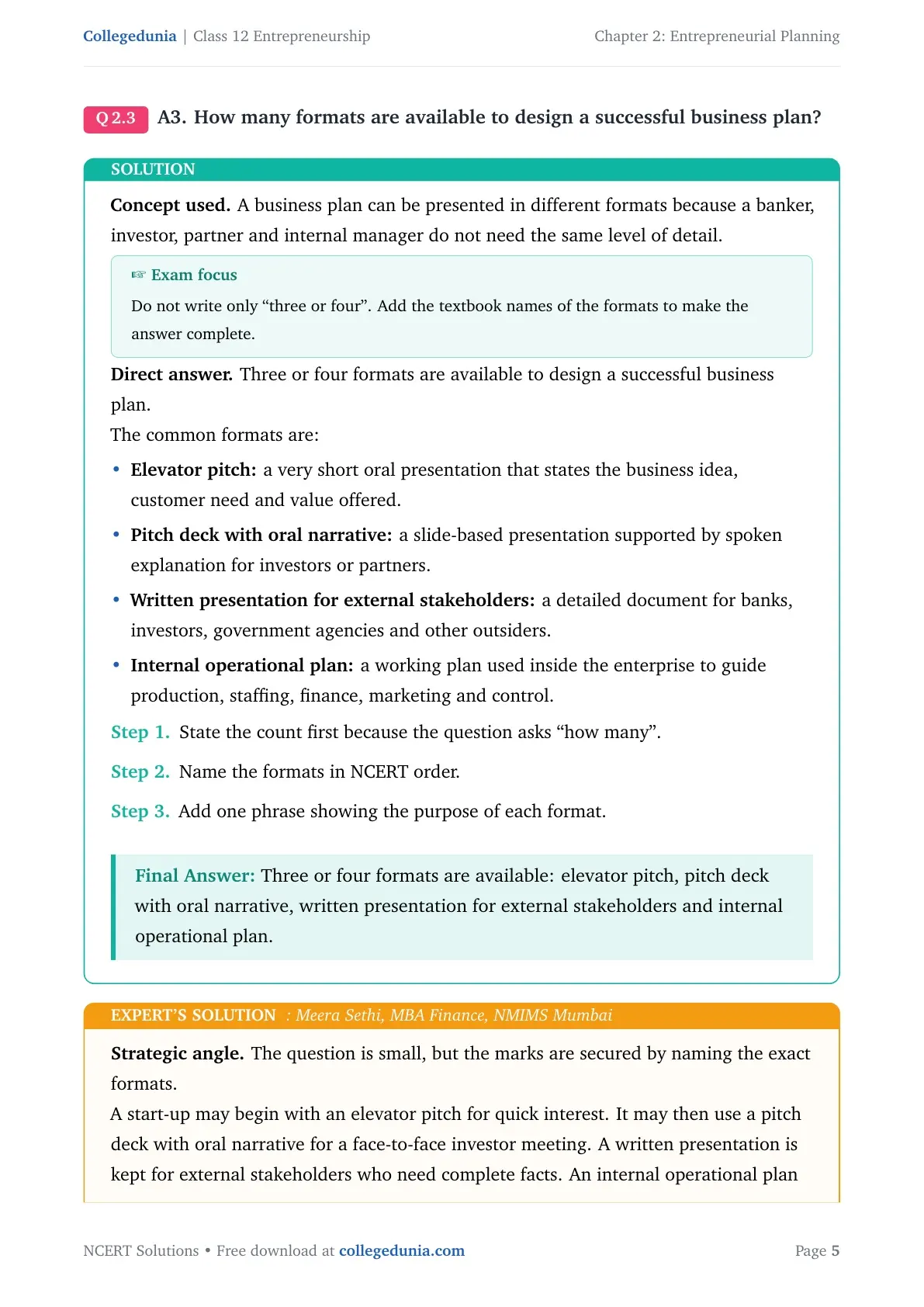
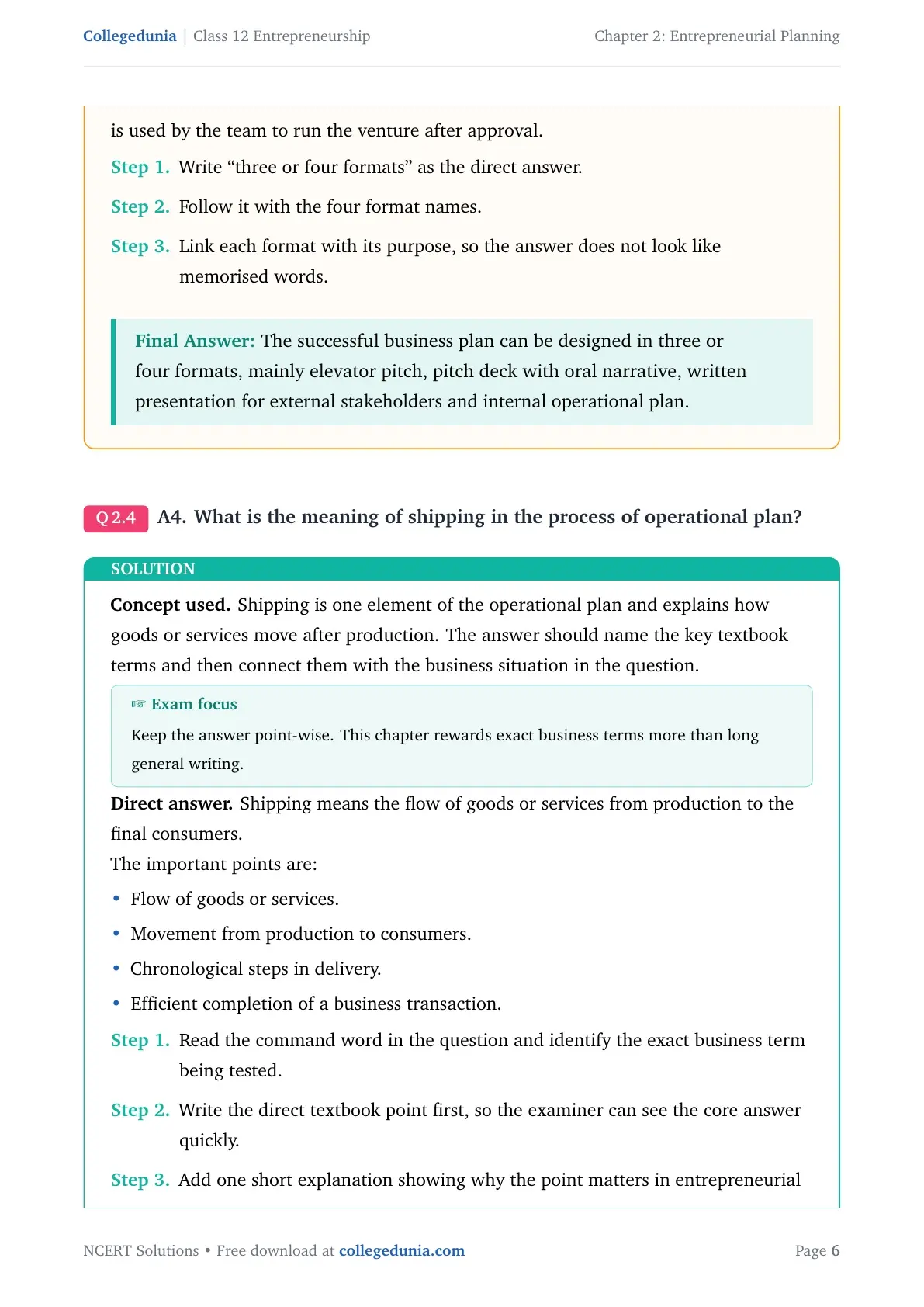
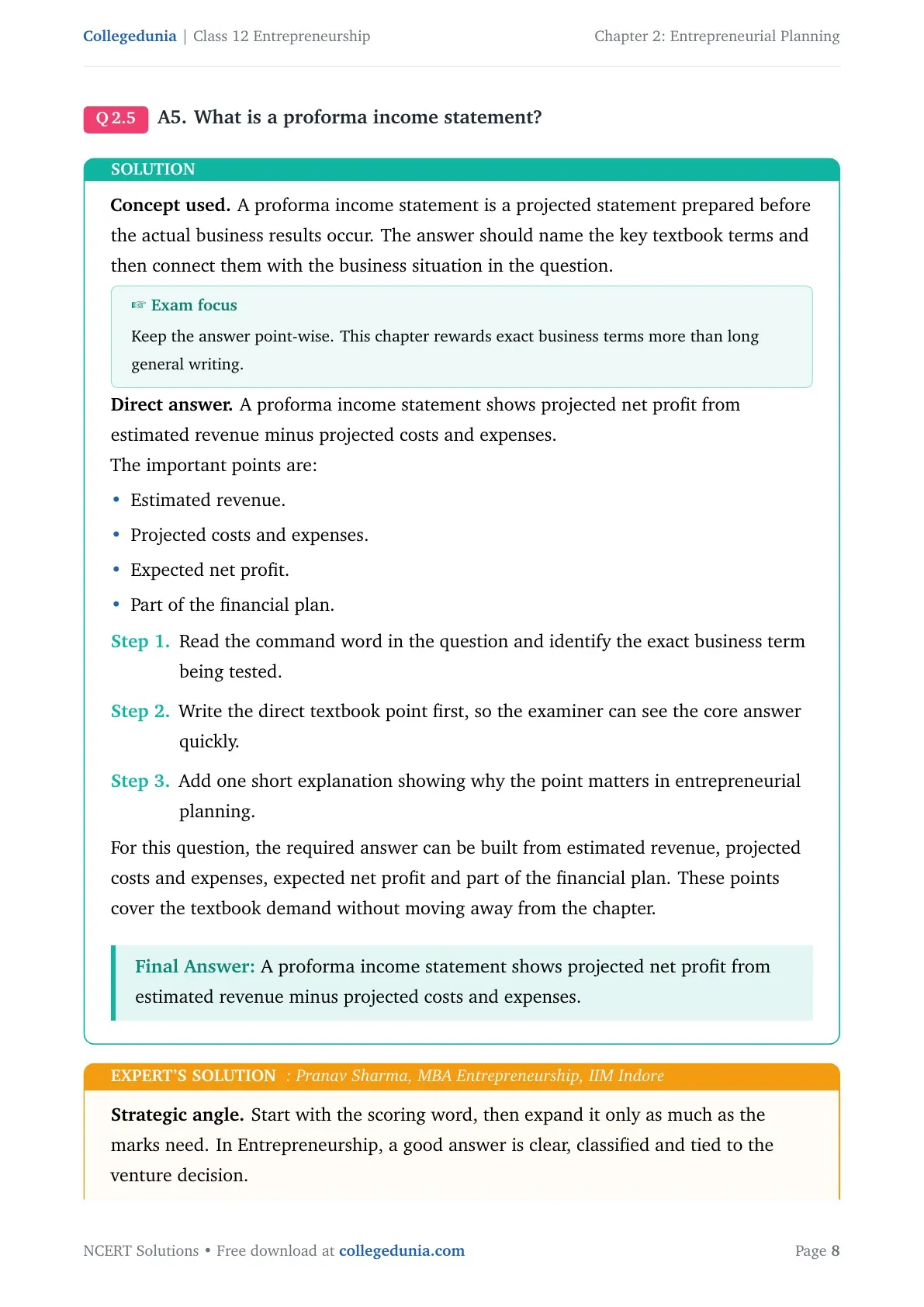
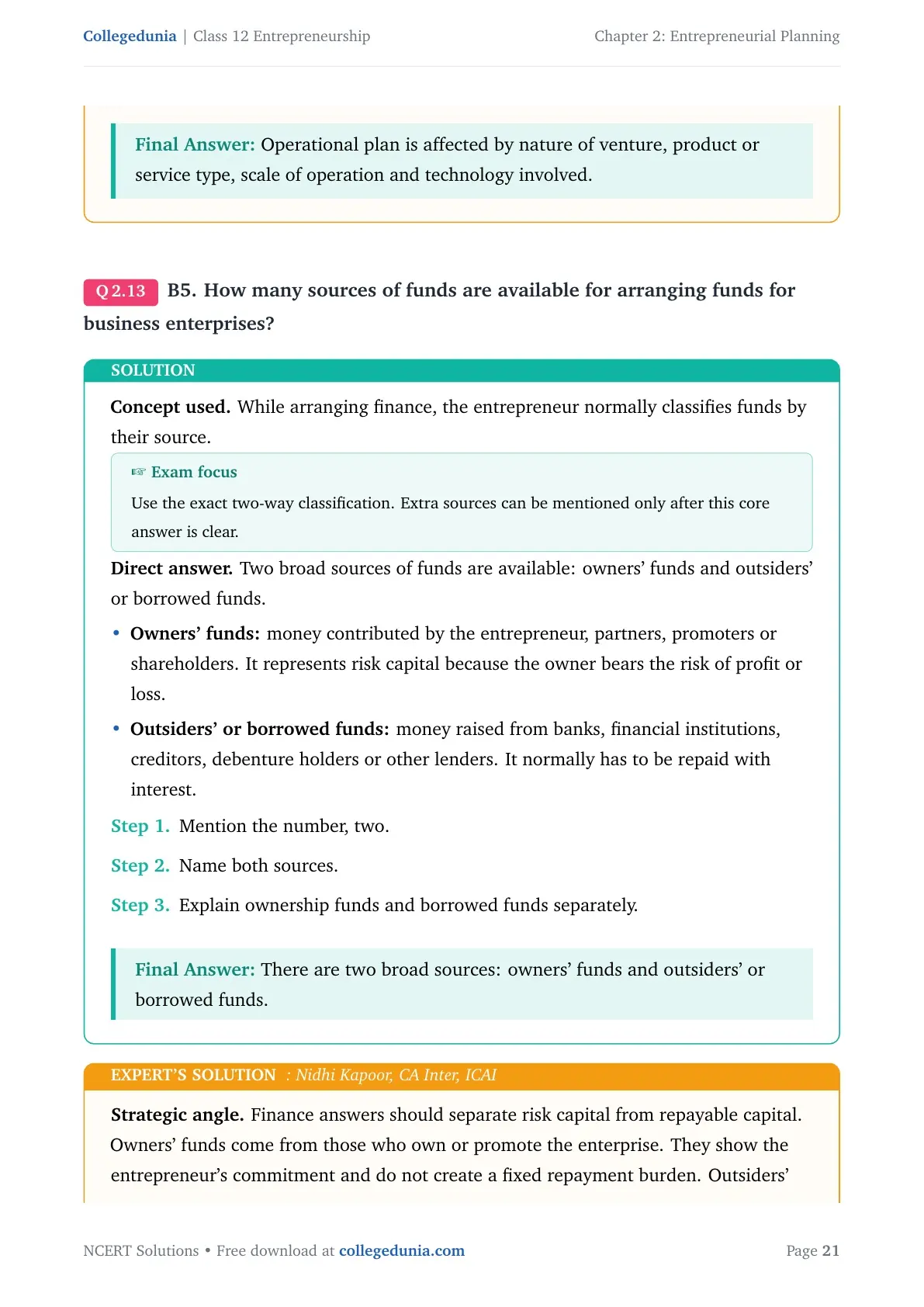
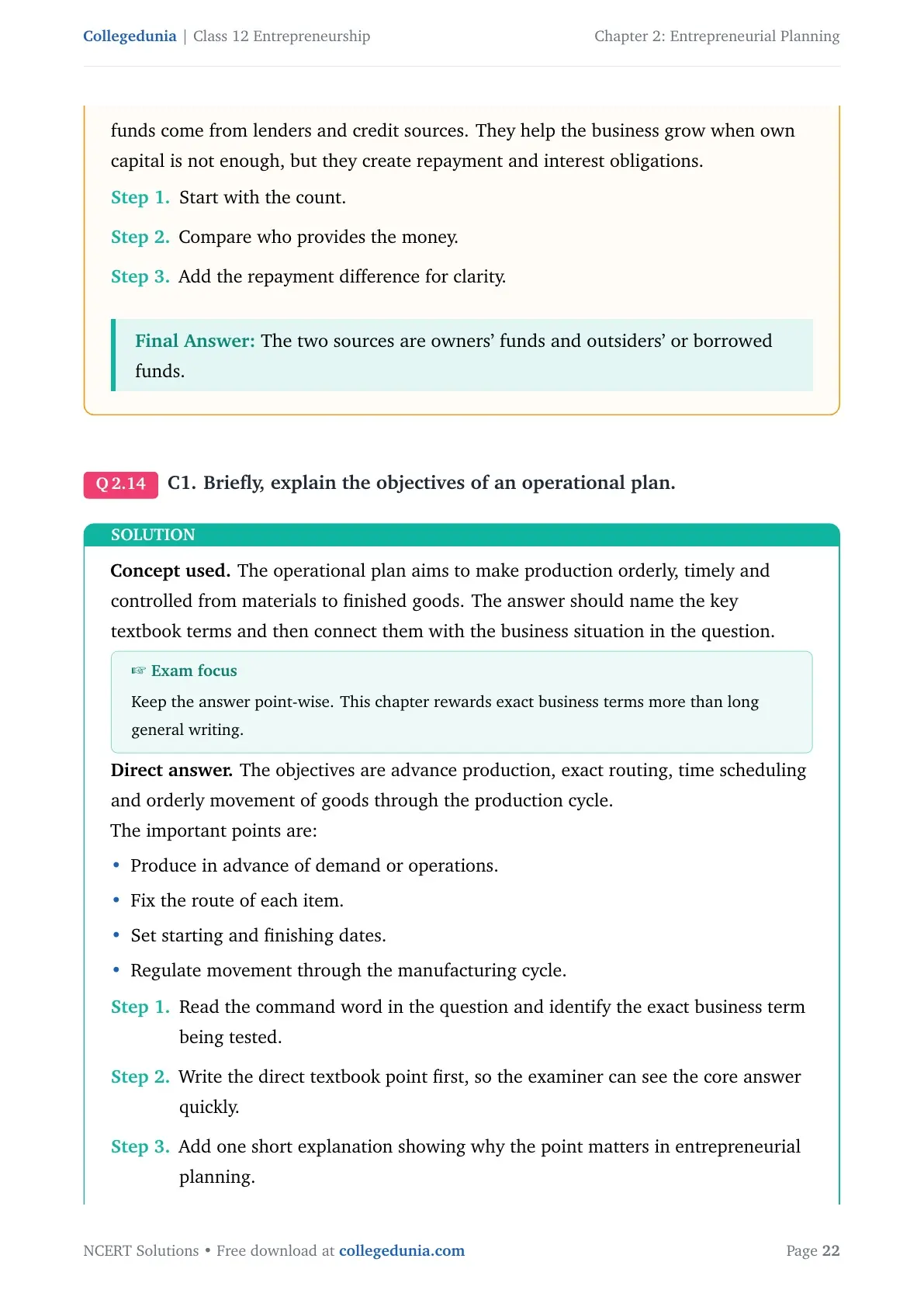
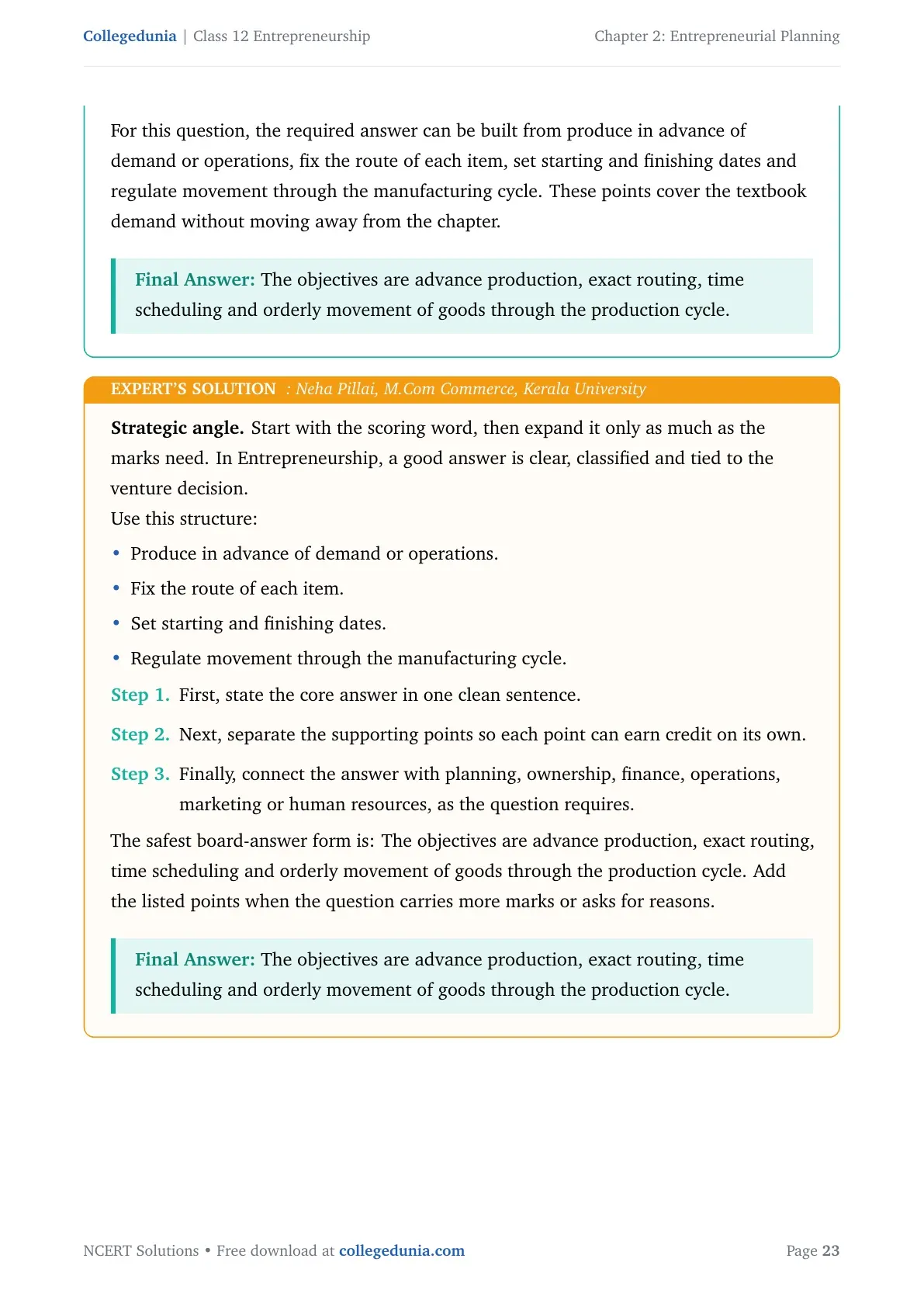
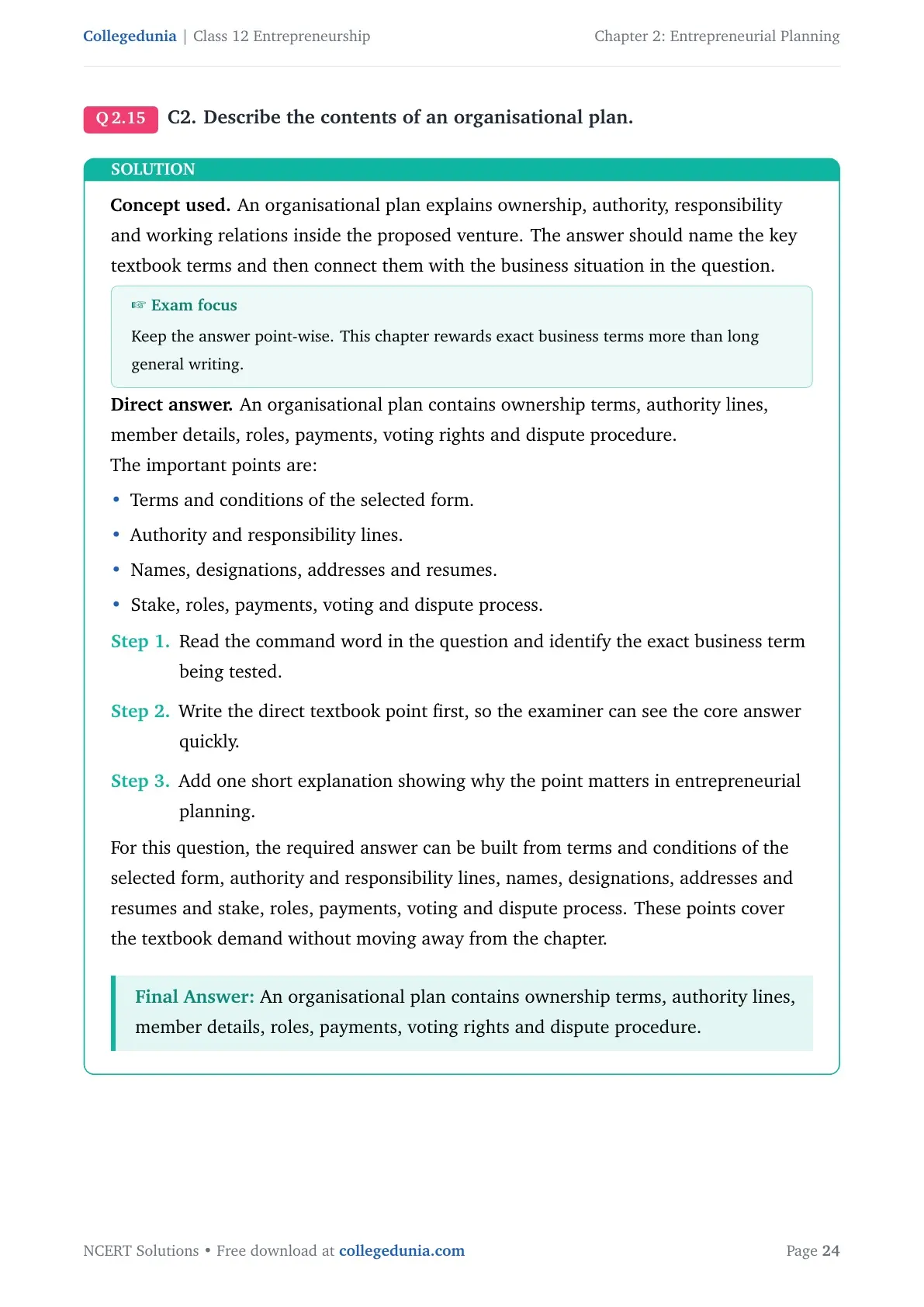
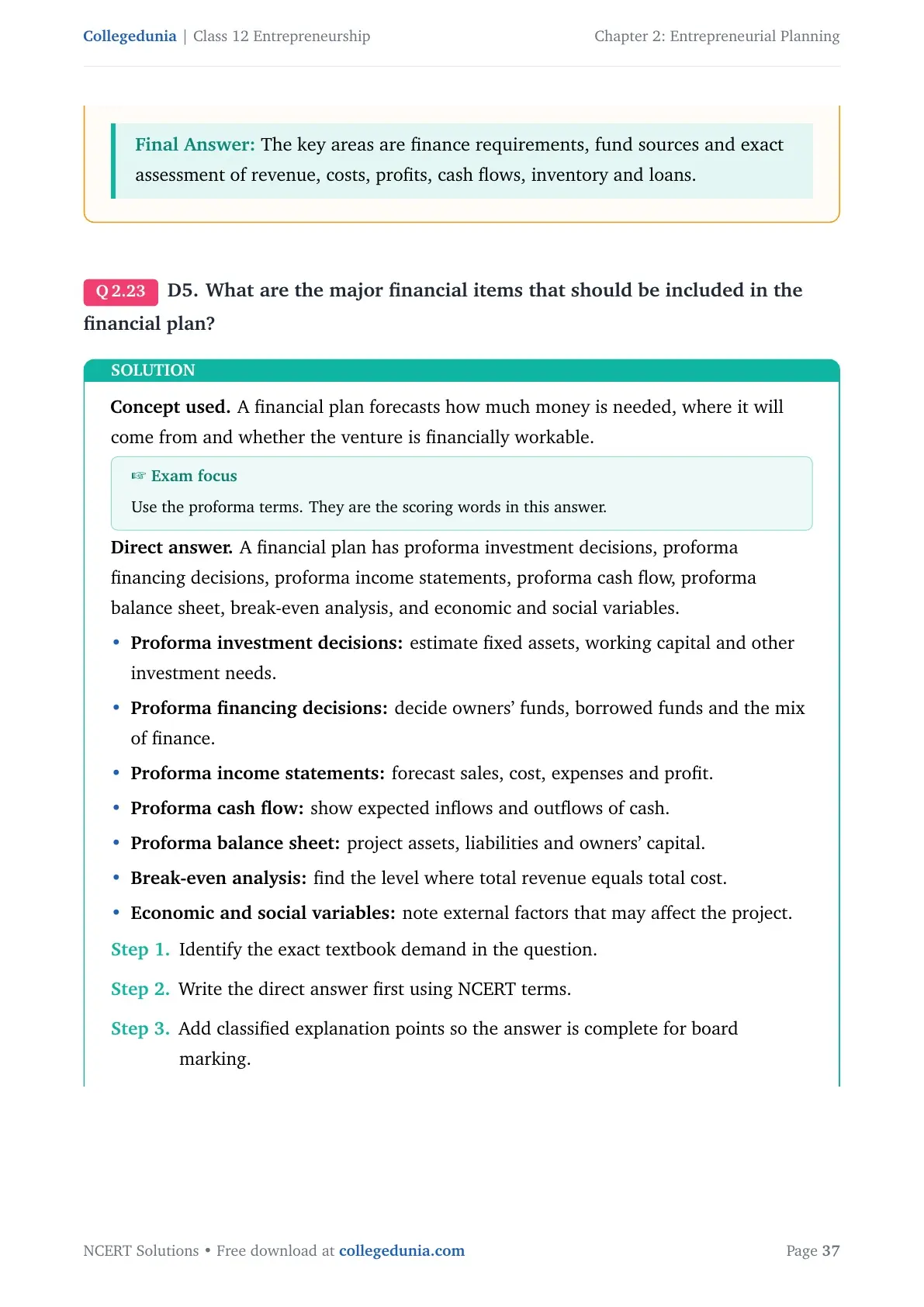
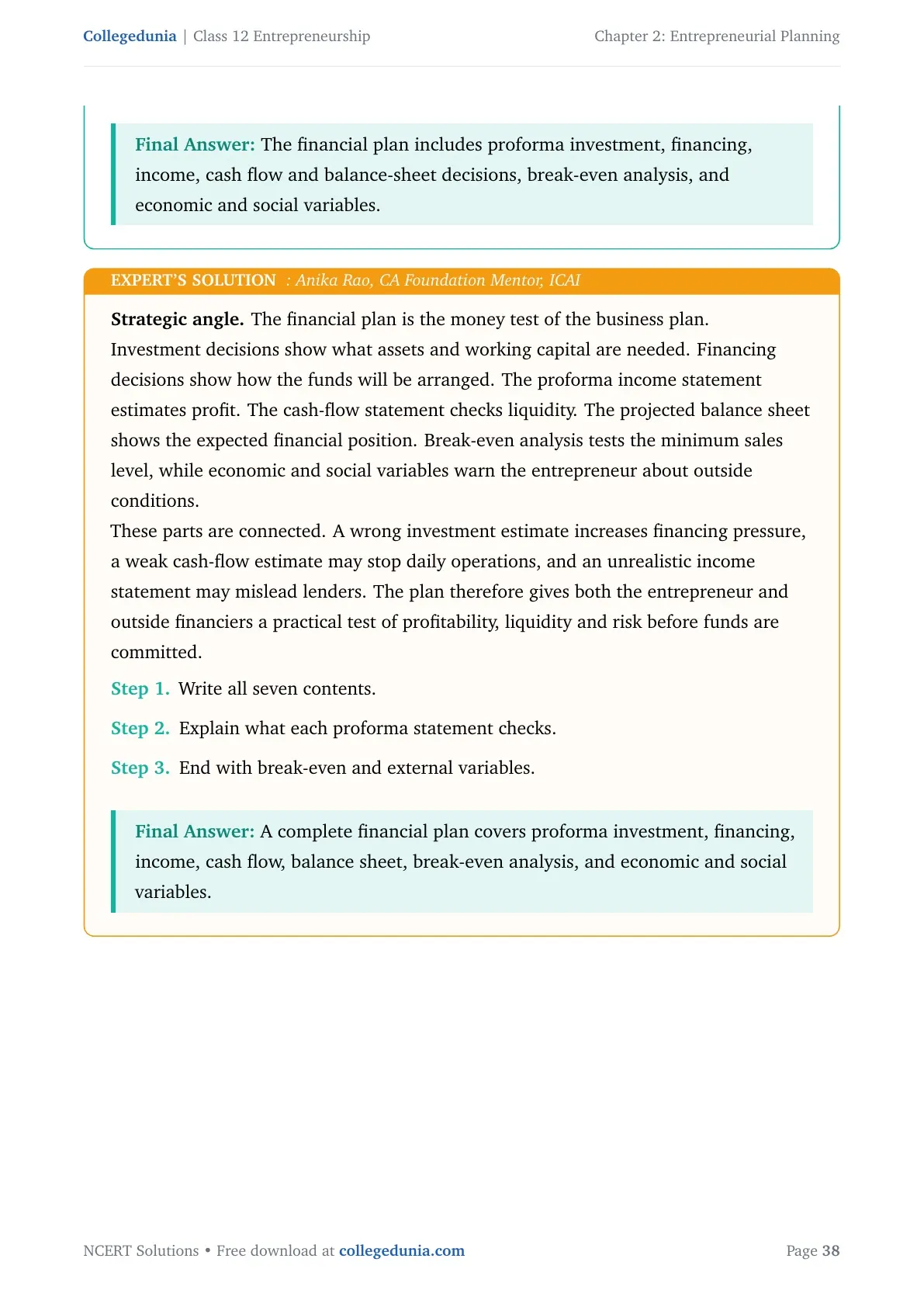
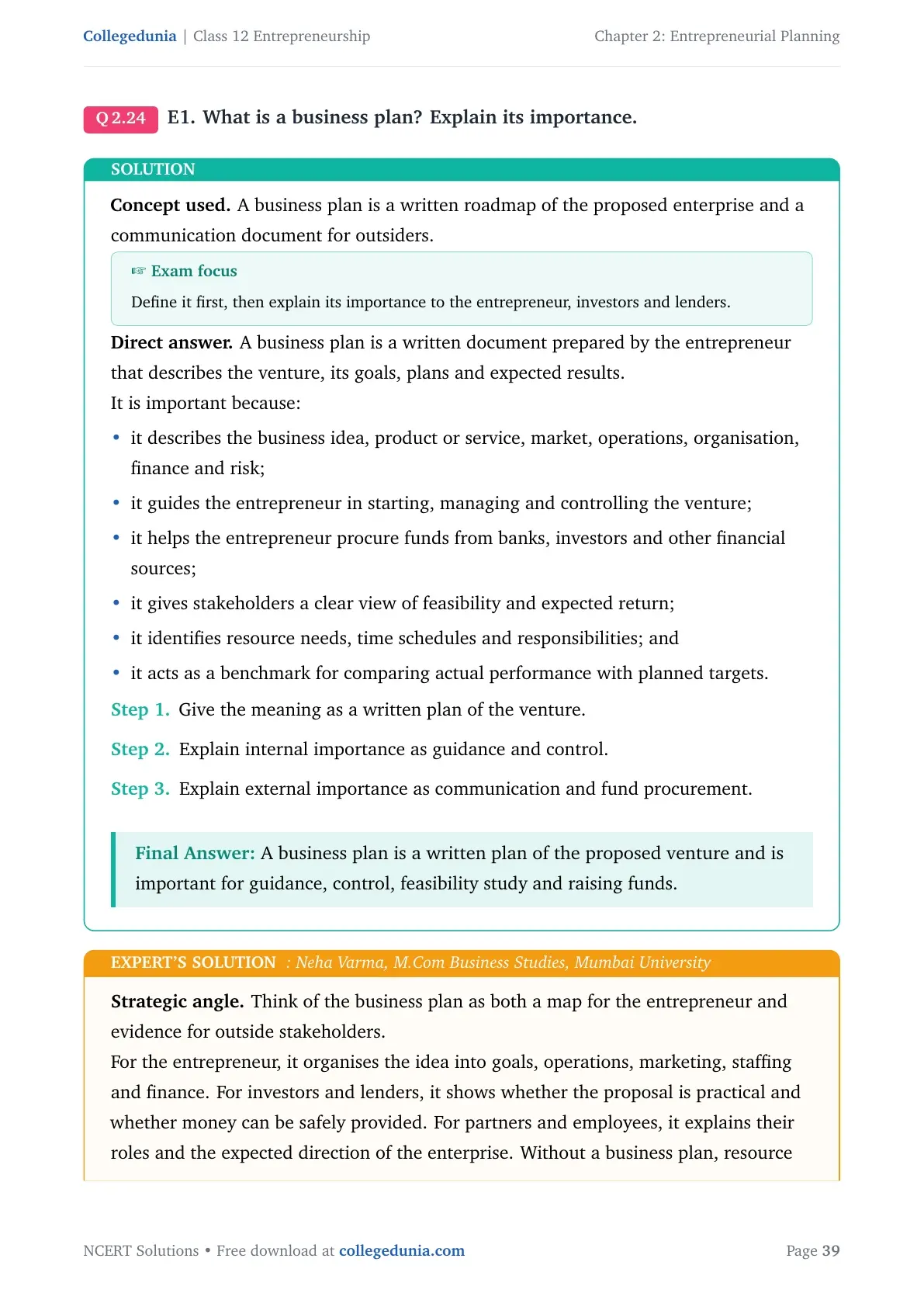
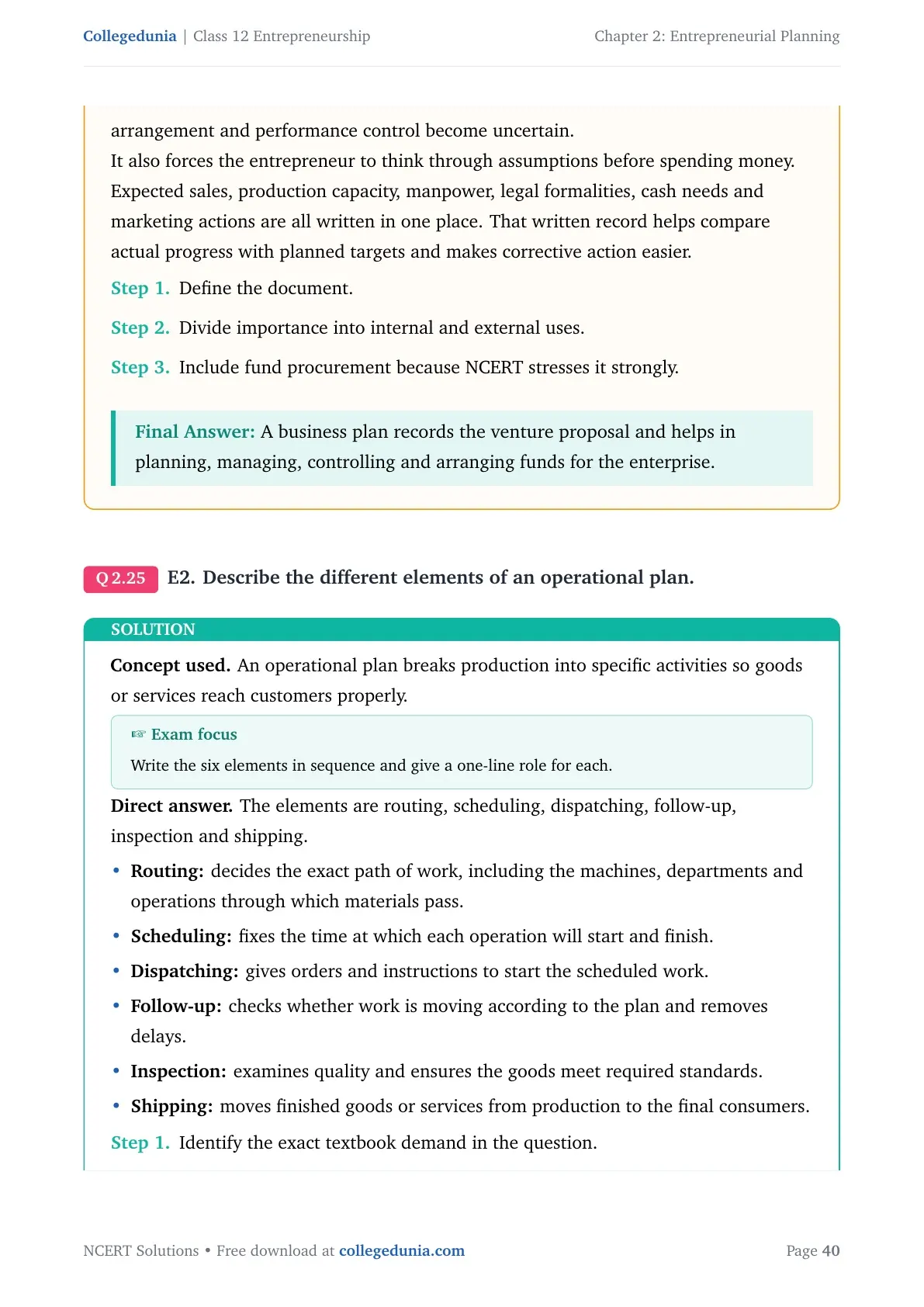
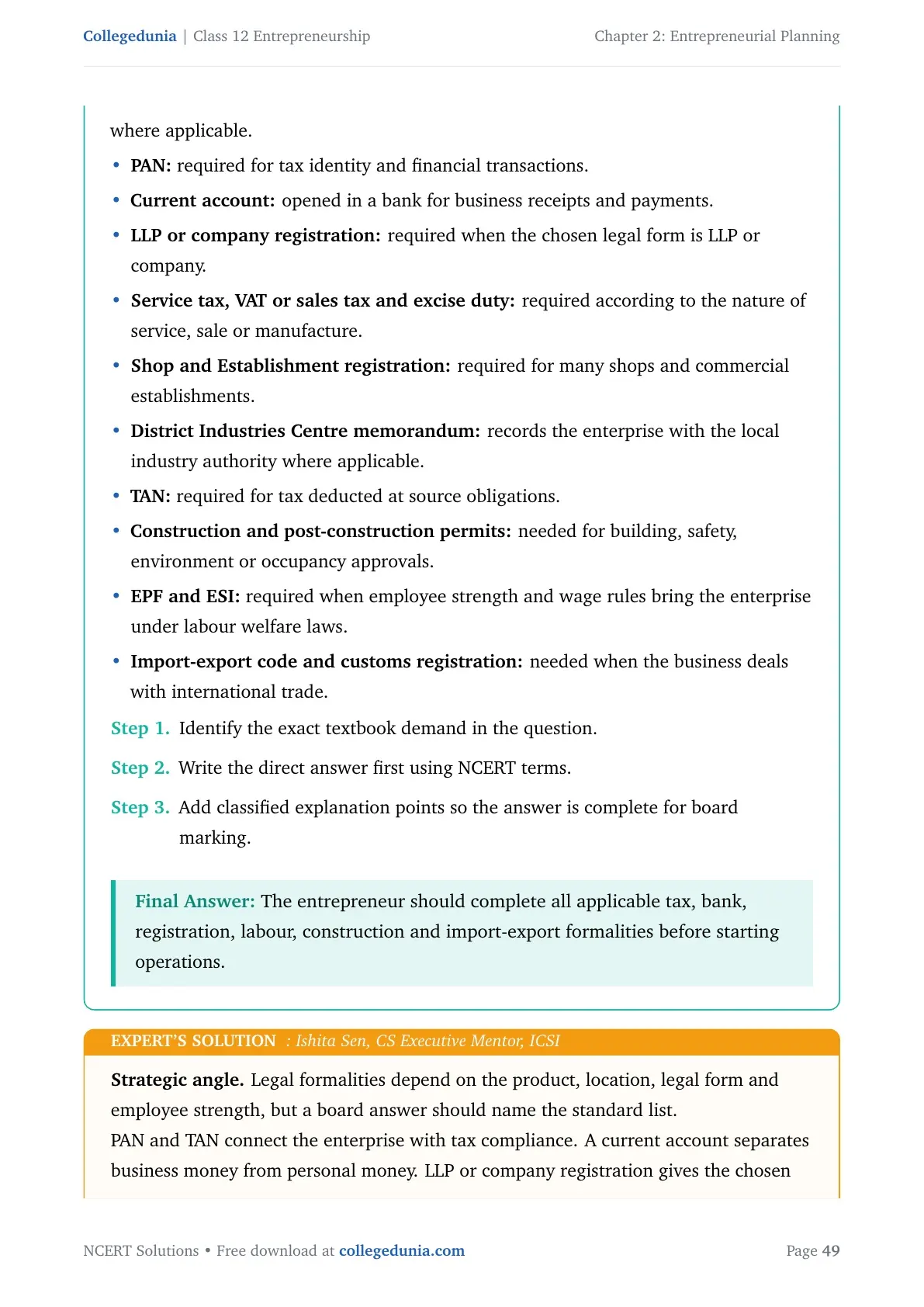
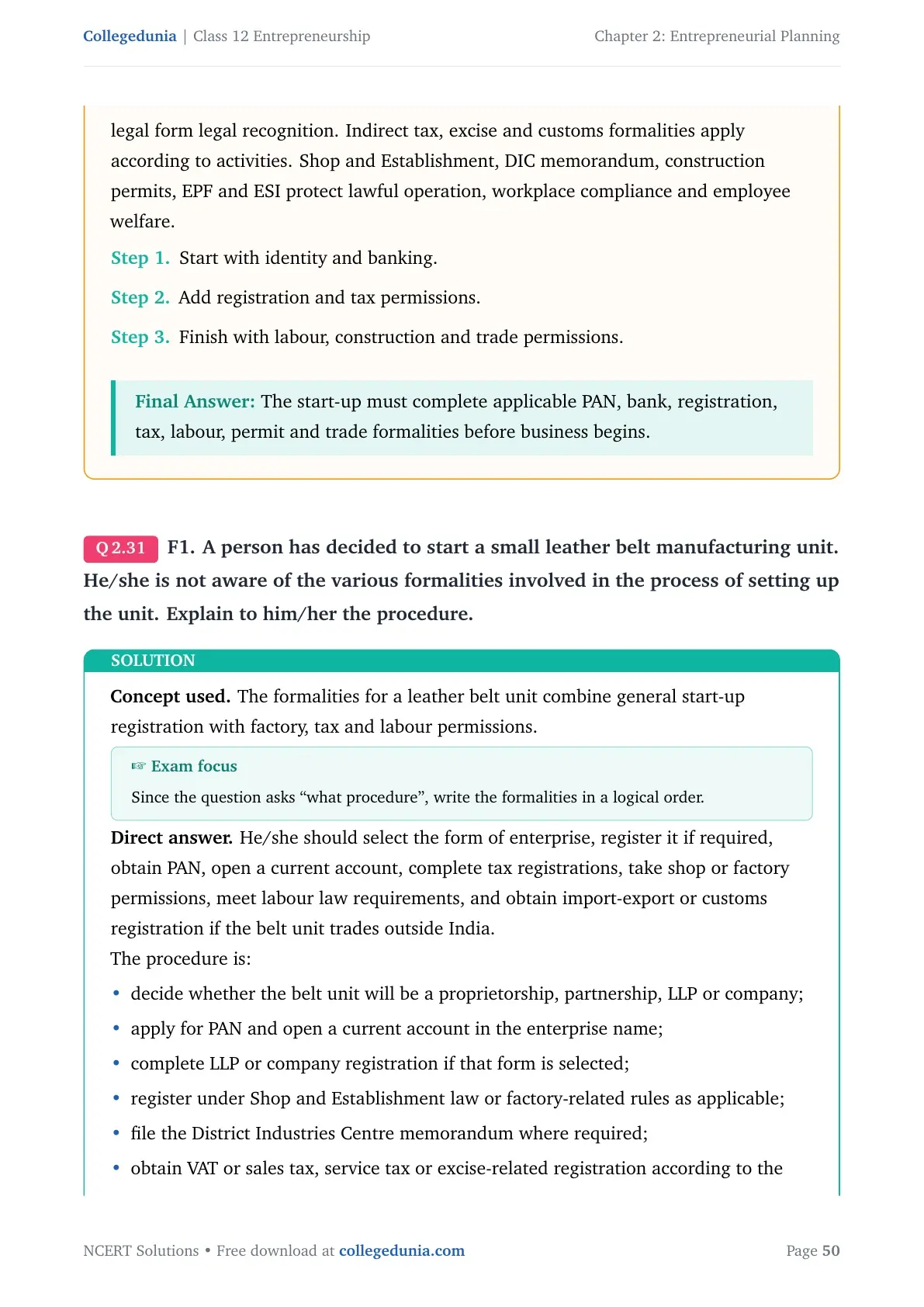
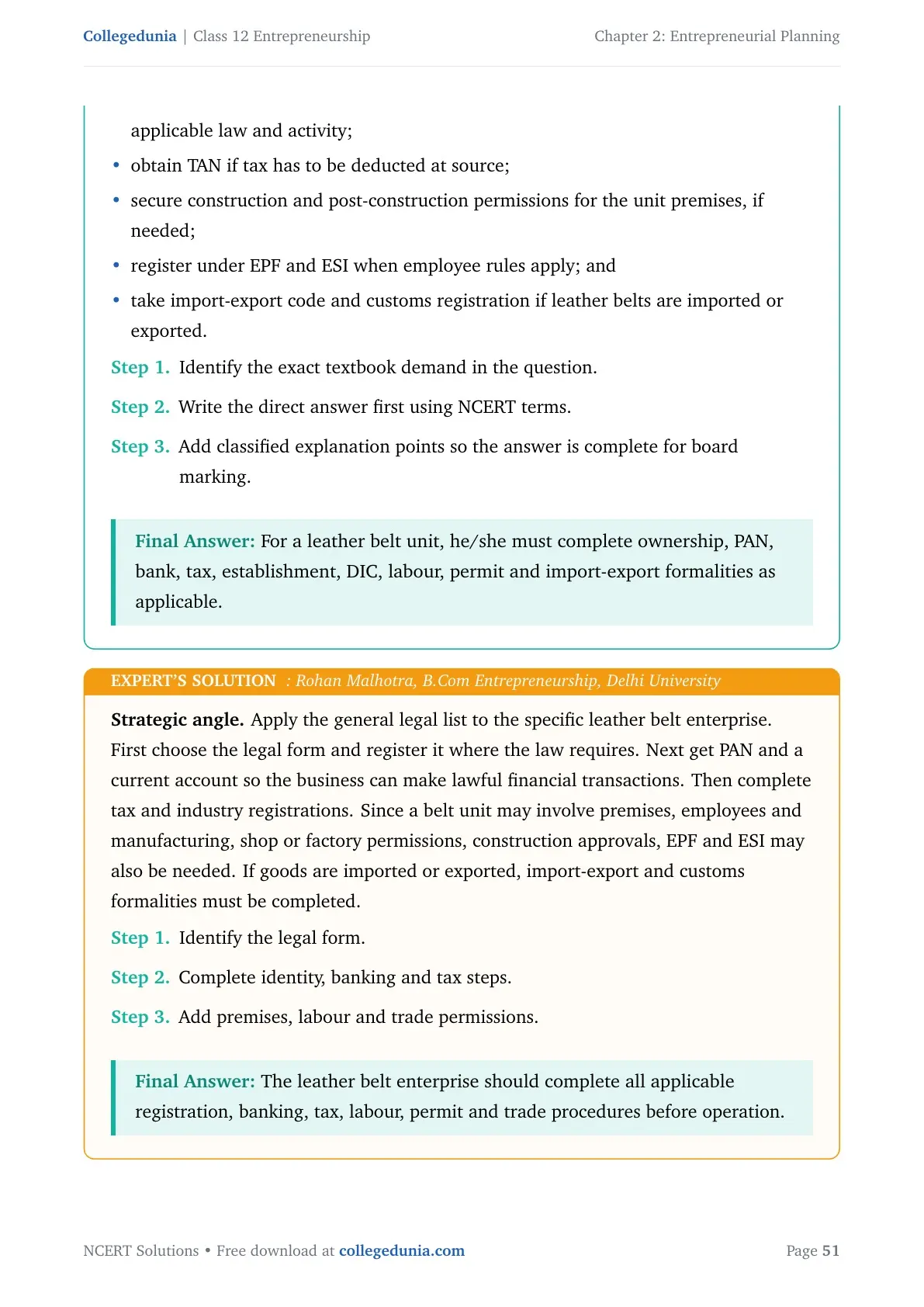
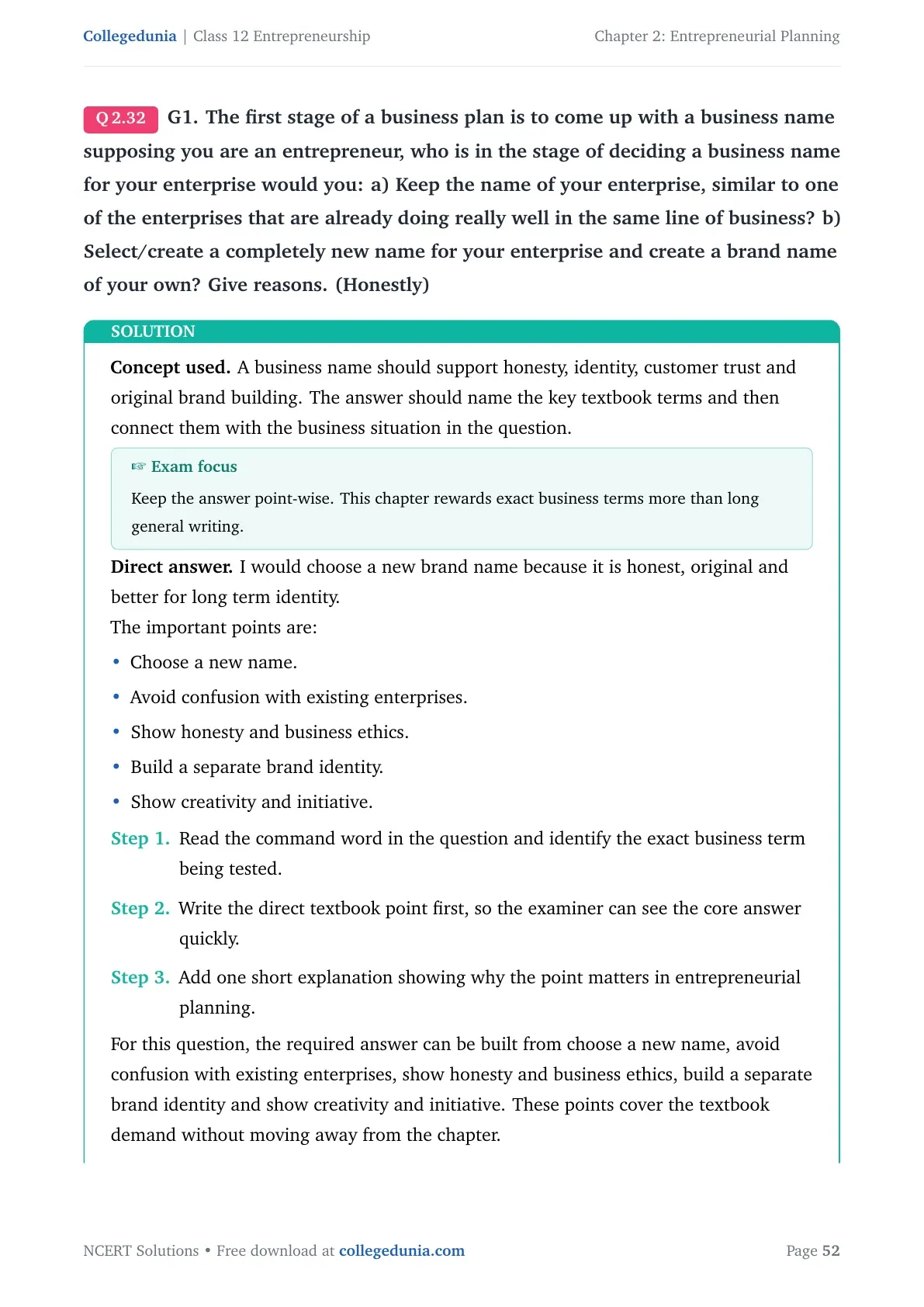
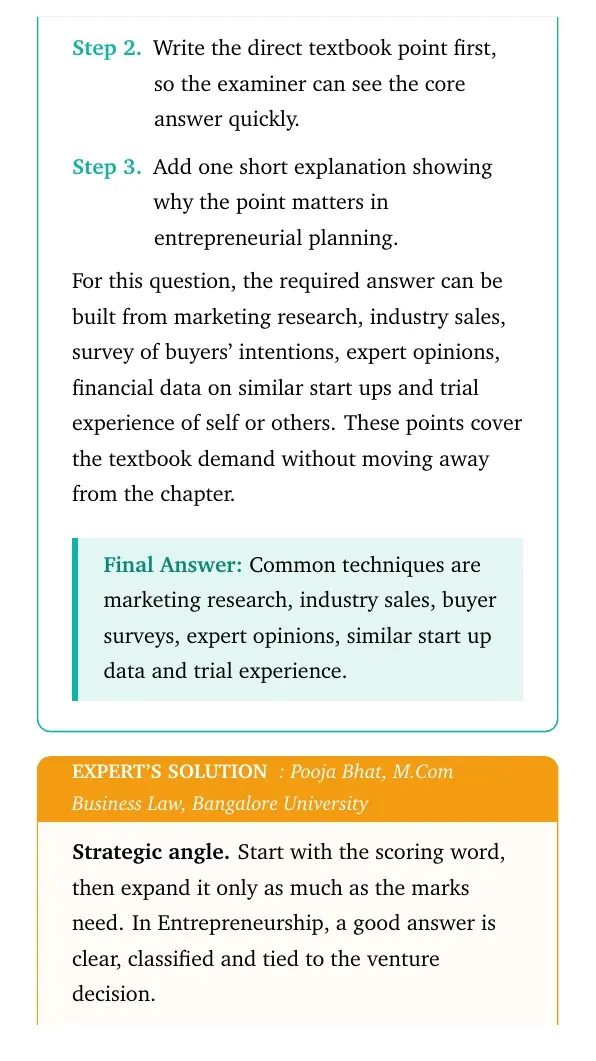
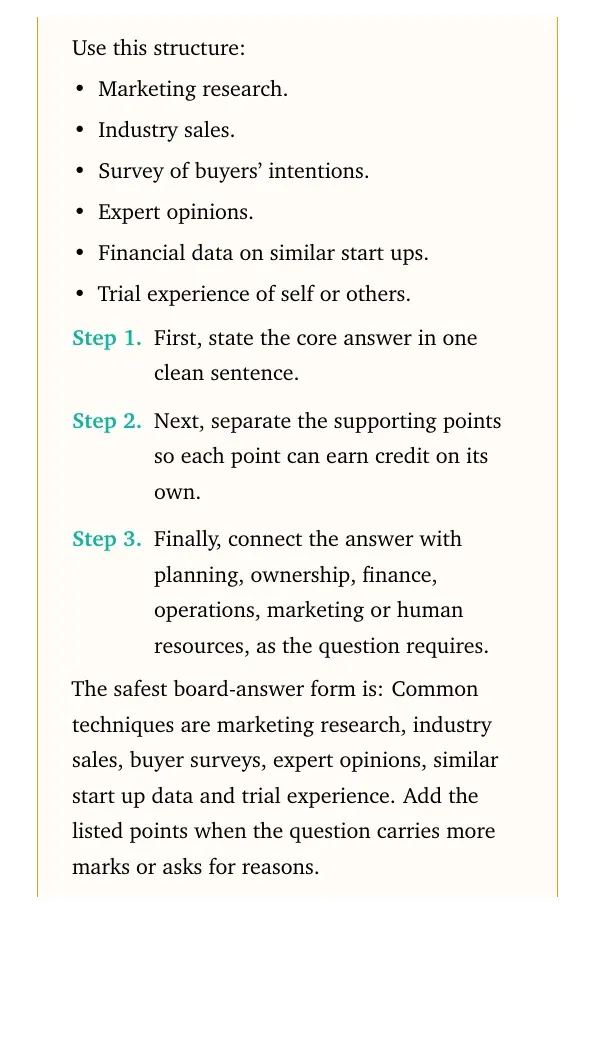
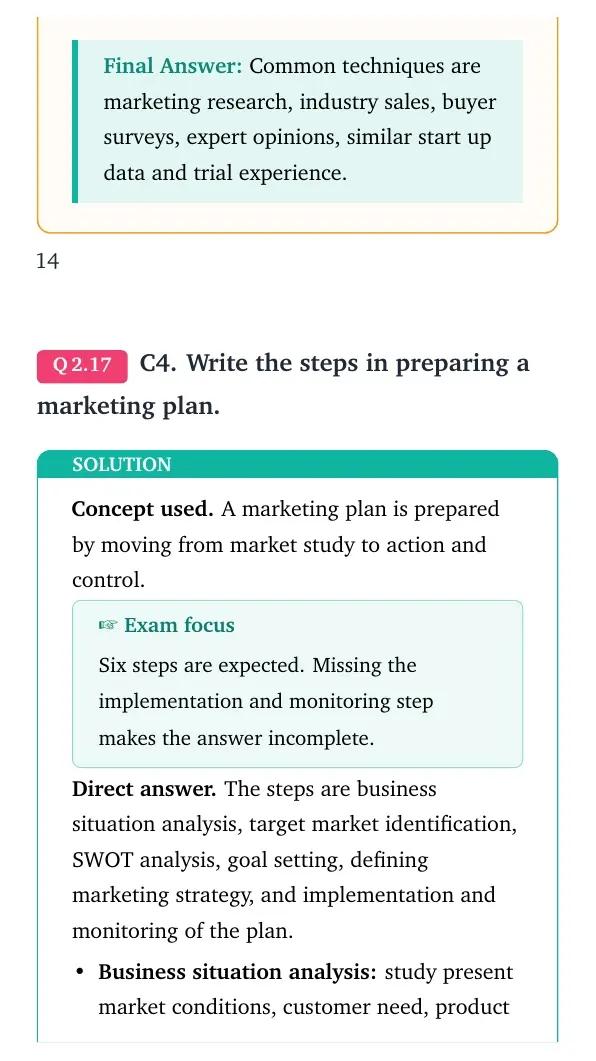
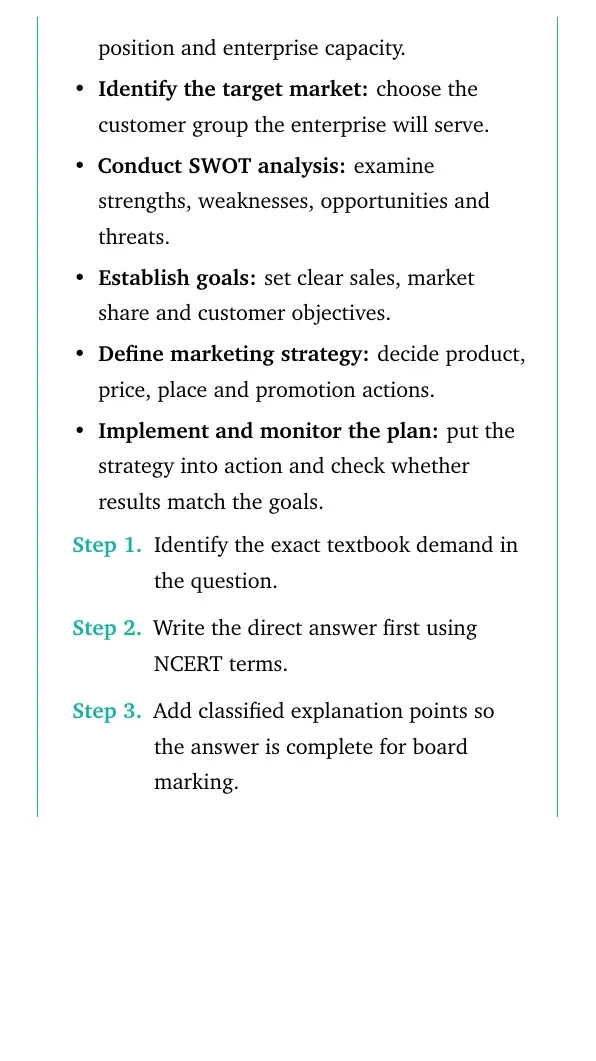
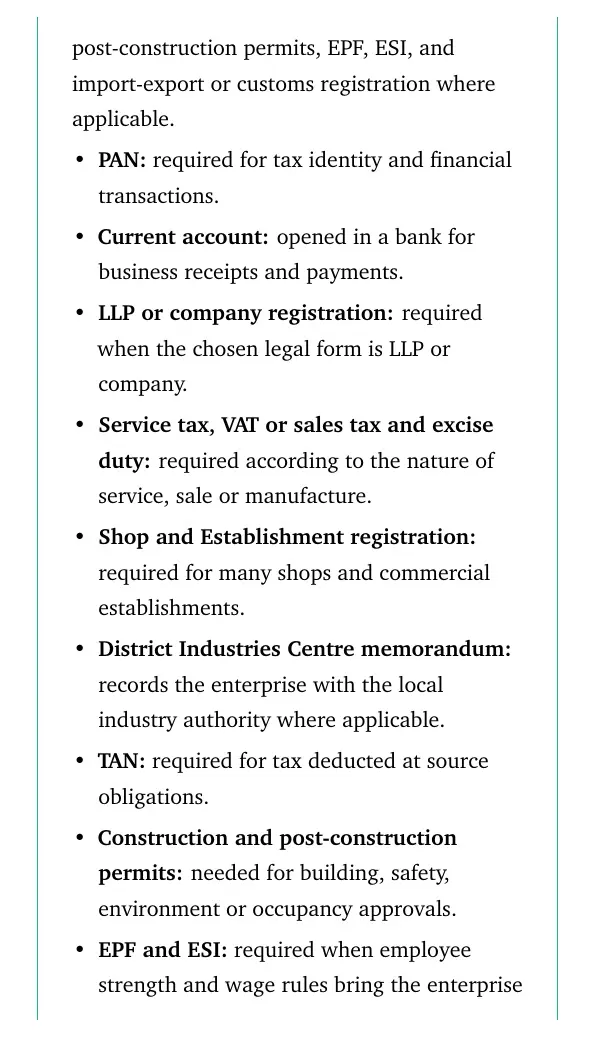
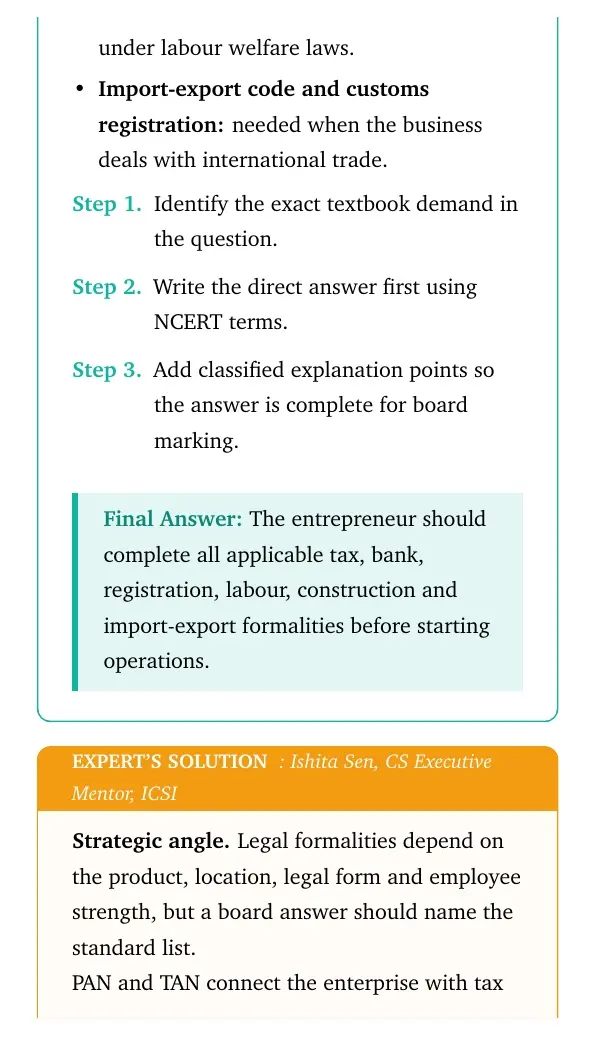
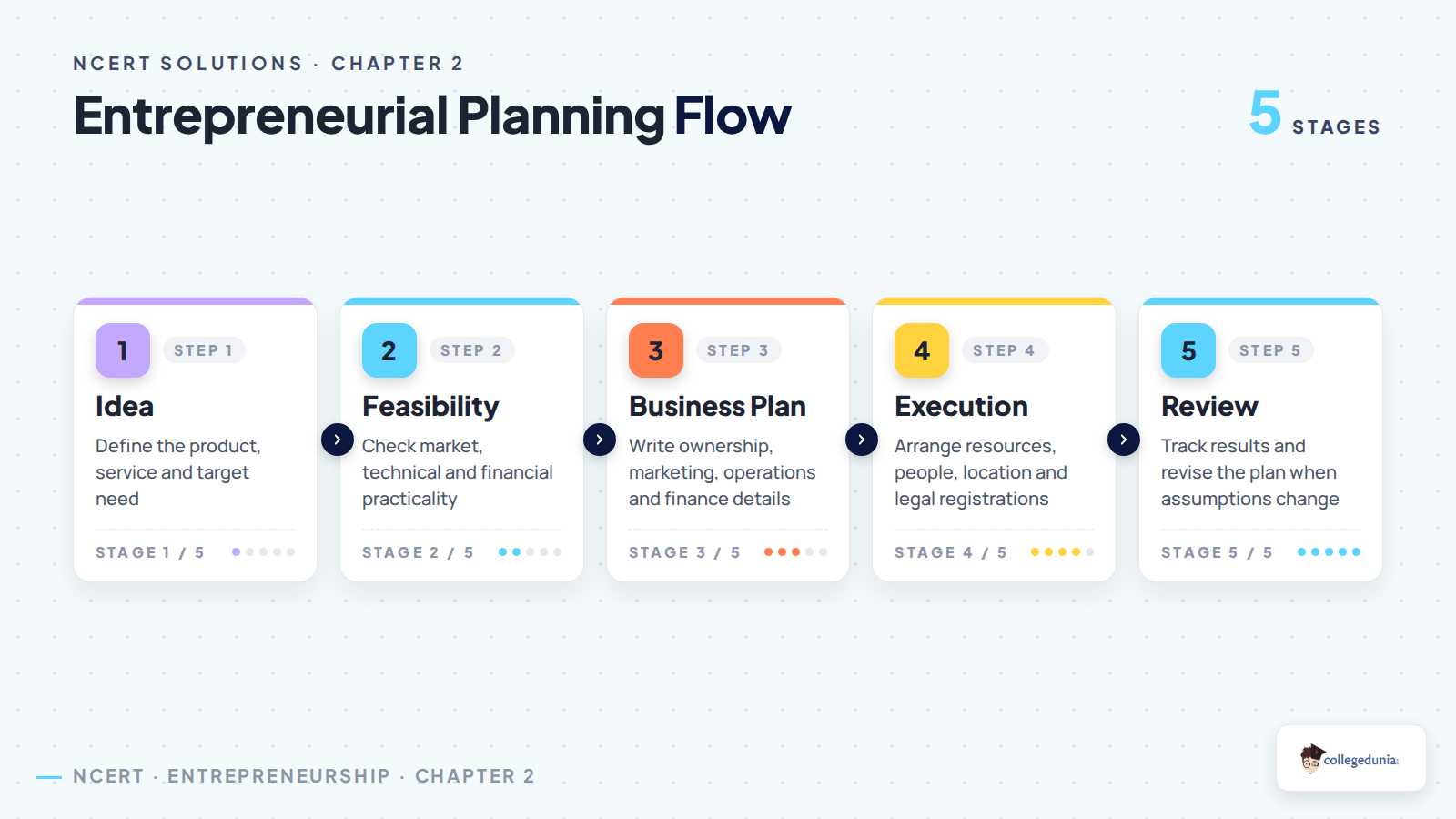
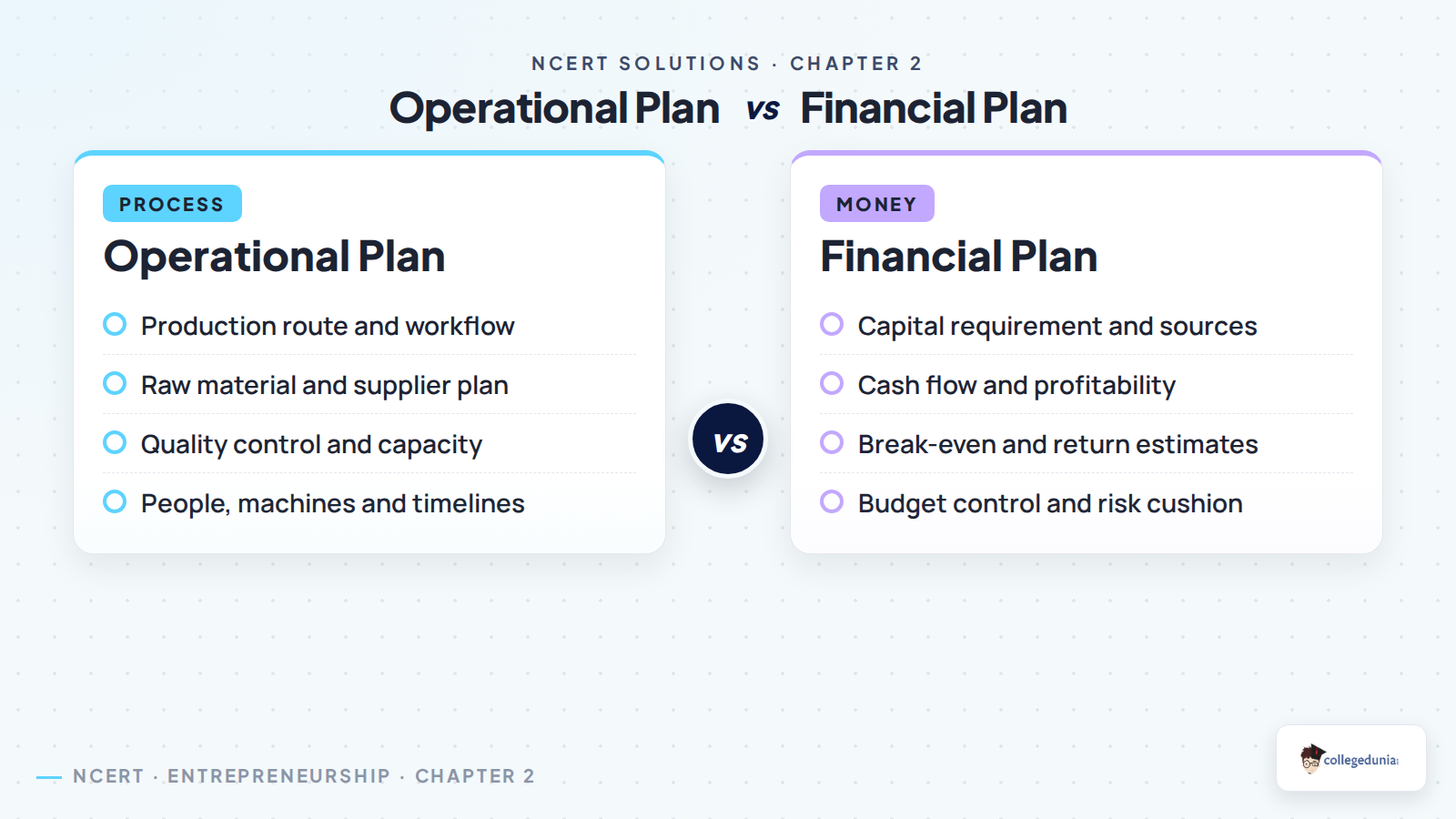



Comments