



Class 12 Entrepreneurship Chapter 6 Resource Mobilisation NCERT Solutions cover all 23 LET'S REVISE textbook questions for the 2026-27 NCERT resource workflow. The PDF explains finance, financial markets, stock exchange, SEBI and specialised financial institutions with direct answers and expert explanations. The specialised financial institutions questions are marked as textbook-only appendix practice because the CBSE 2026-27 Unit 6 topic list is narrower.
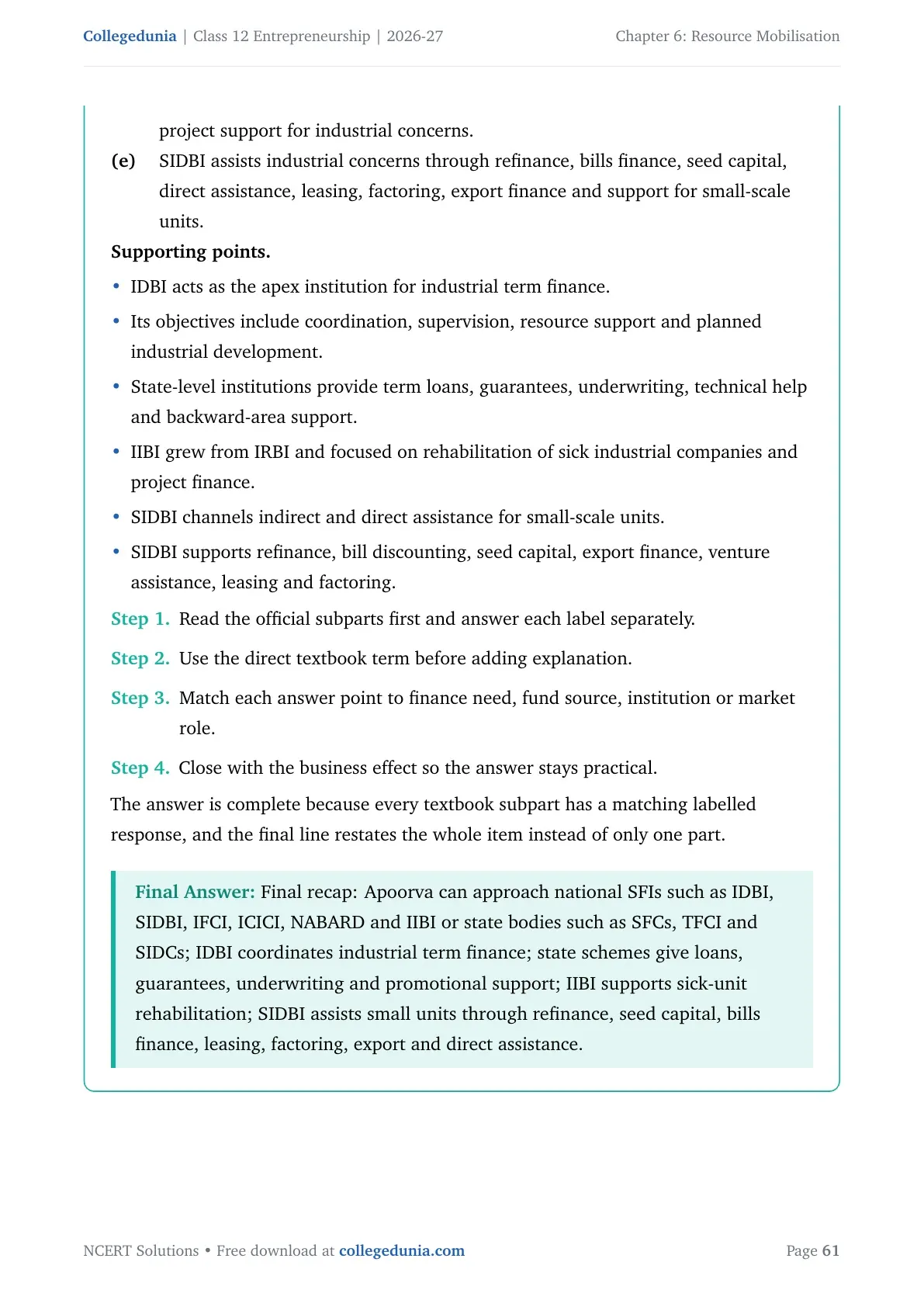
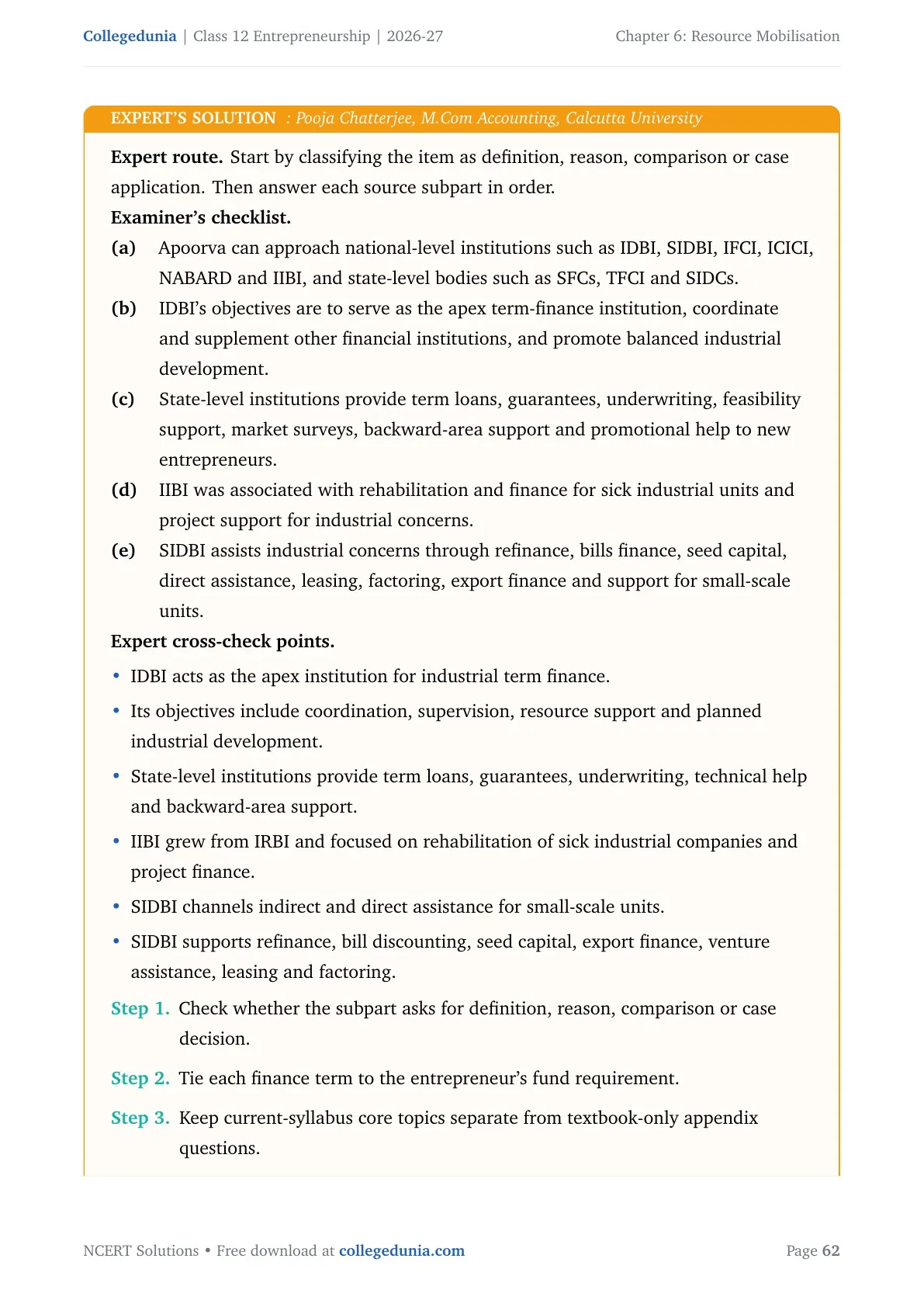
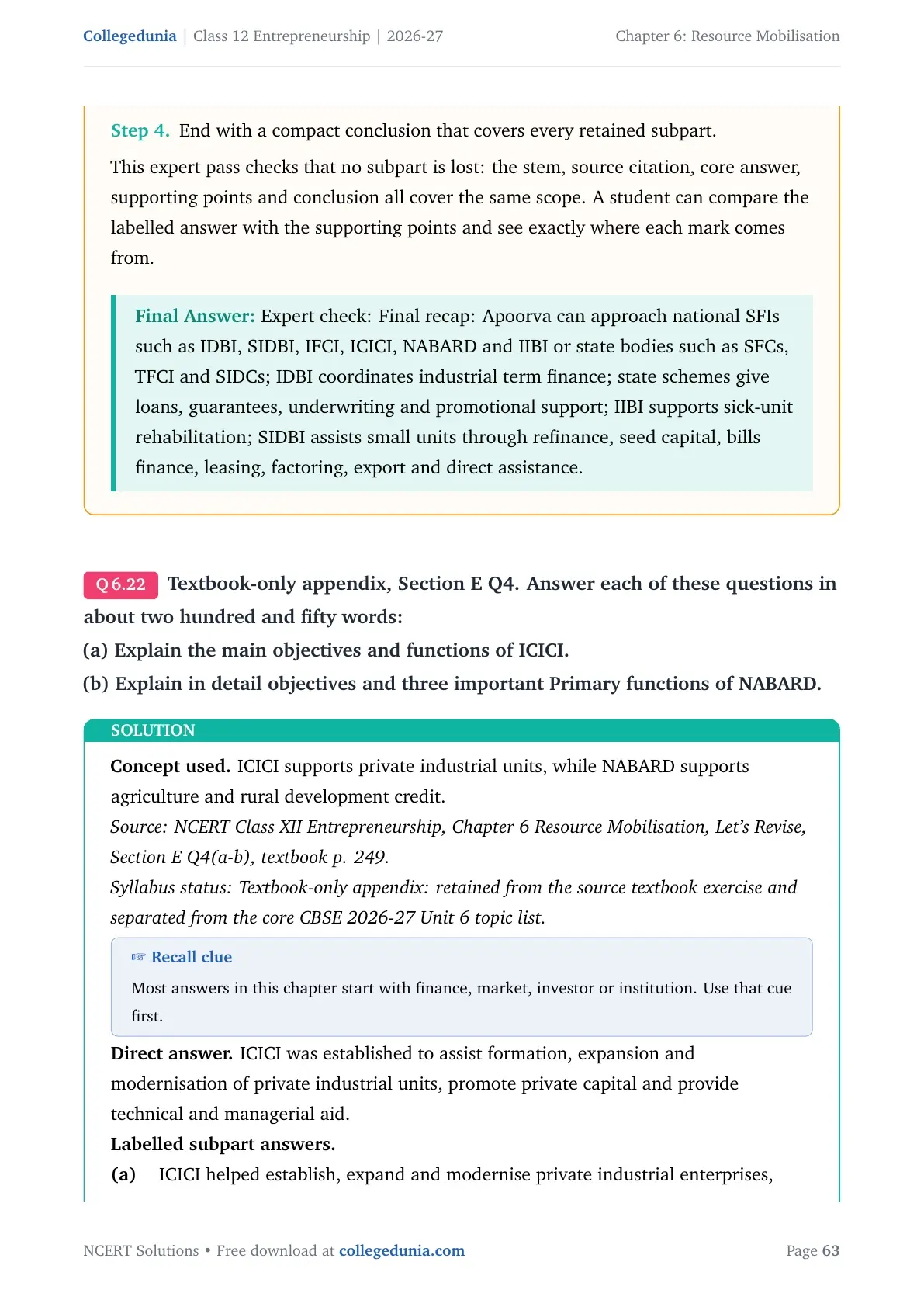
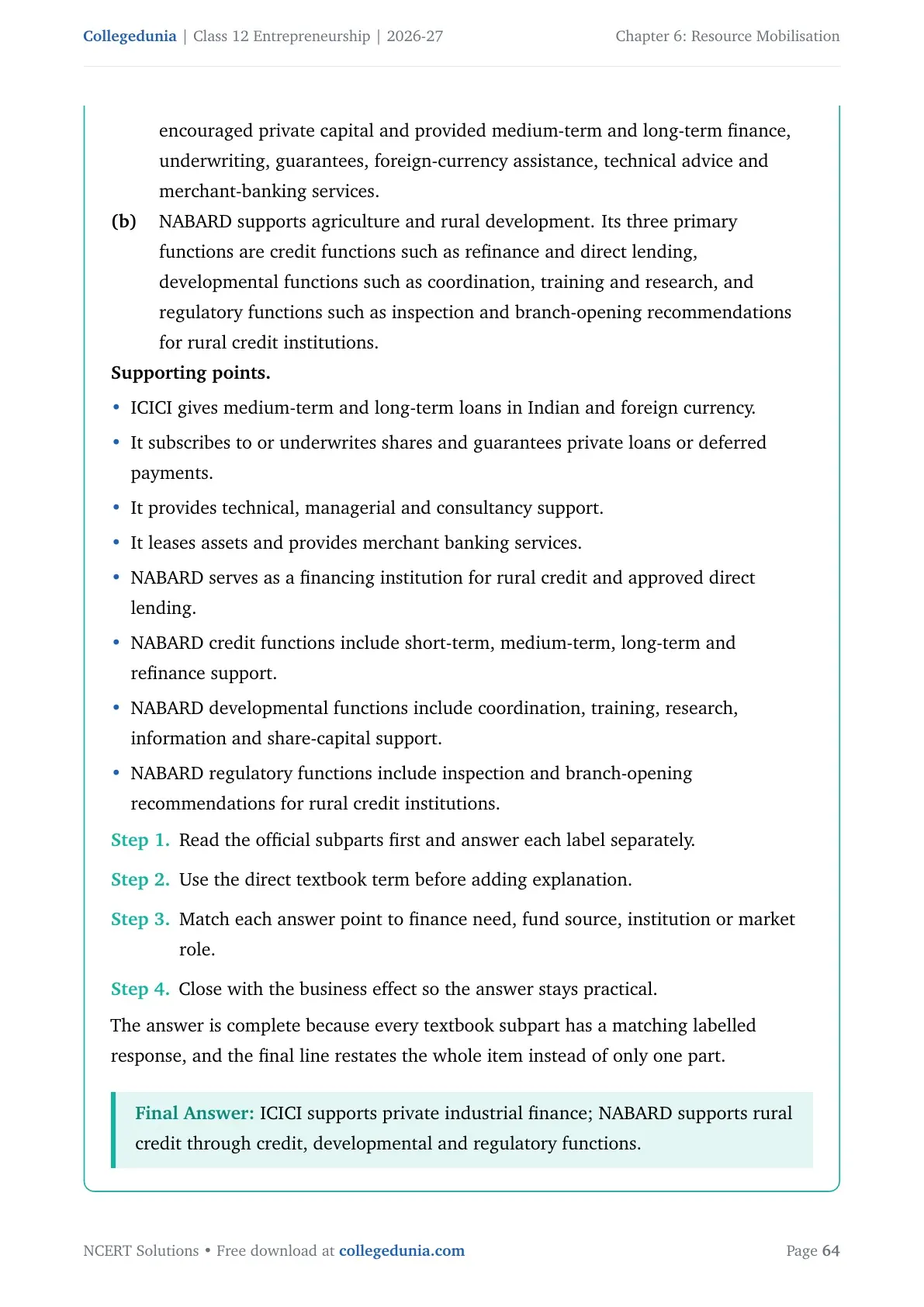
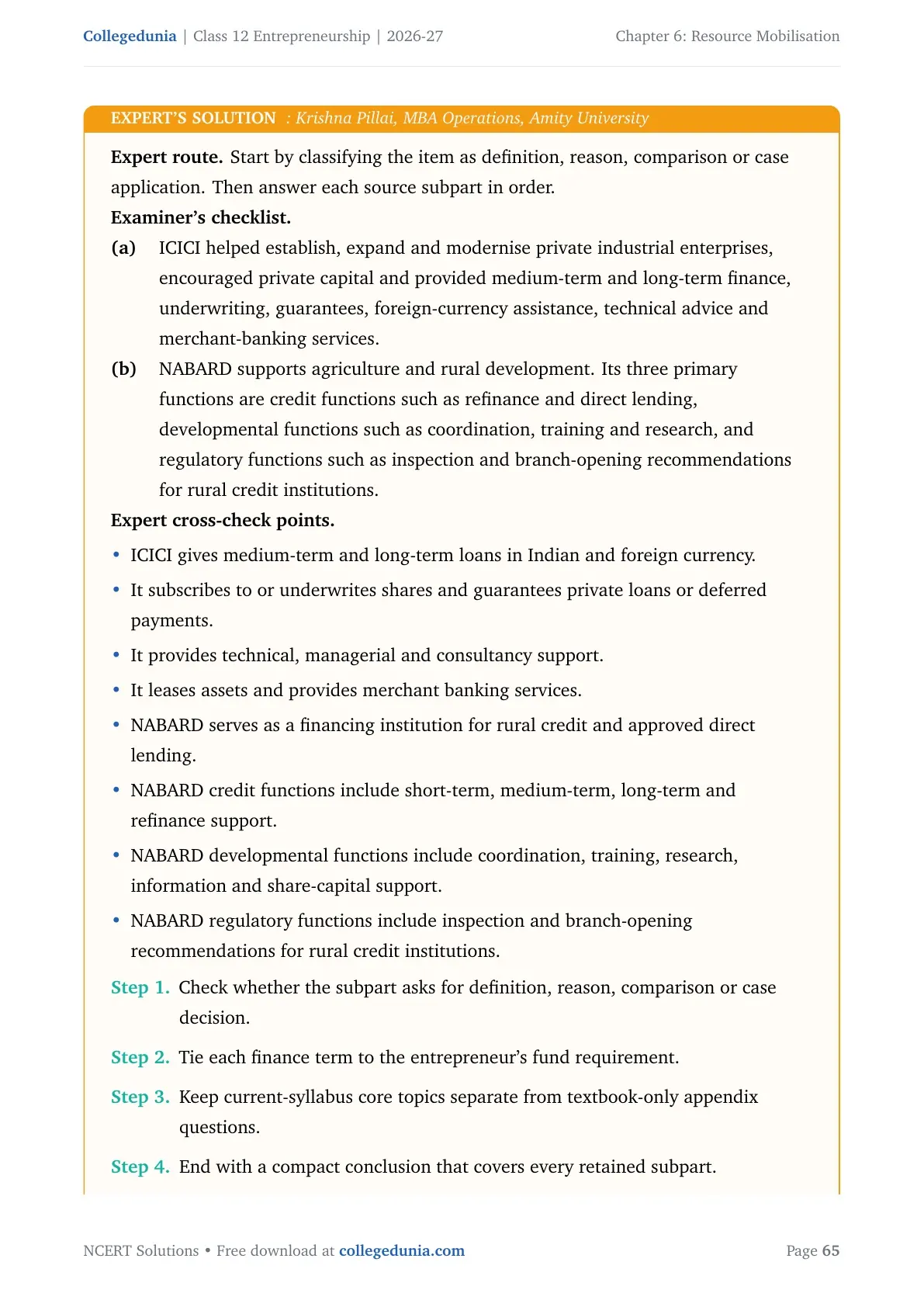
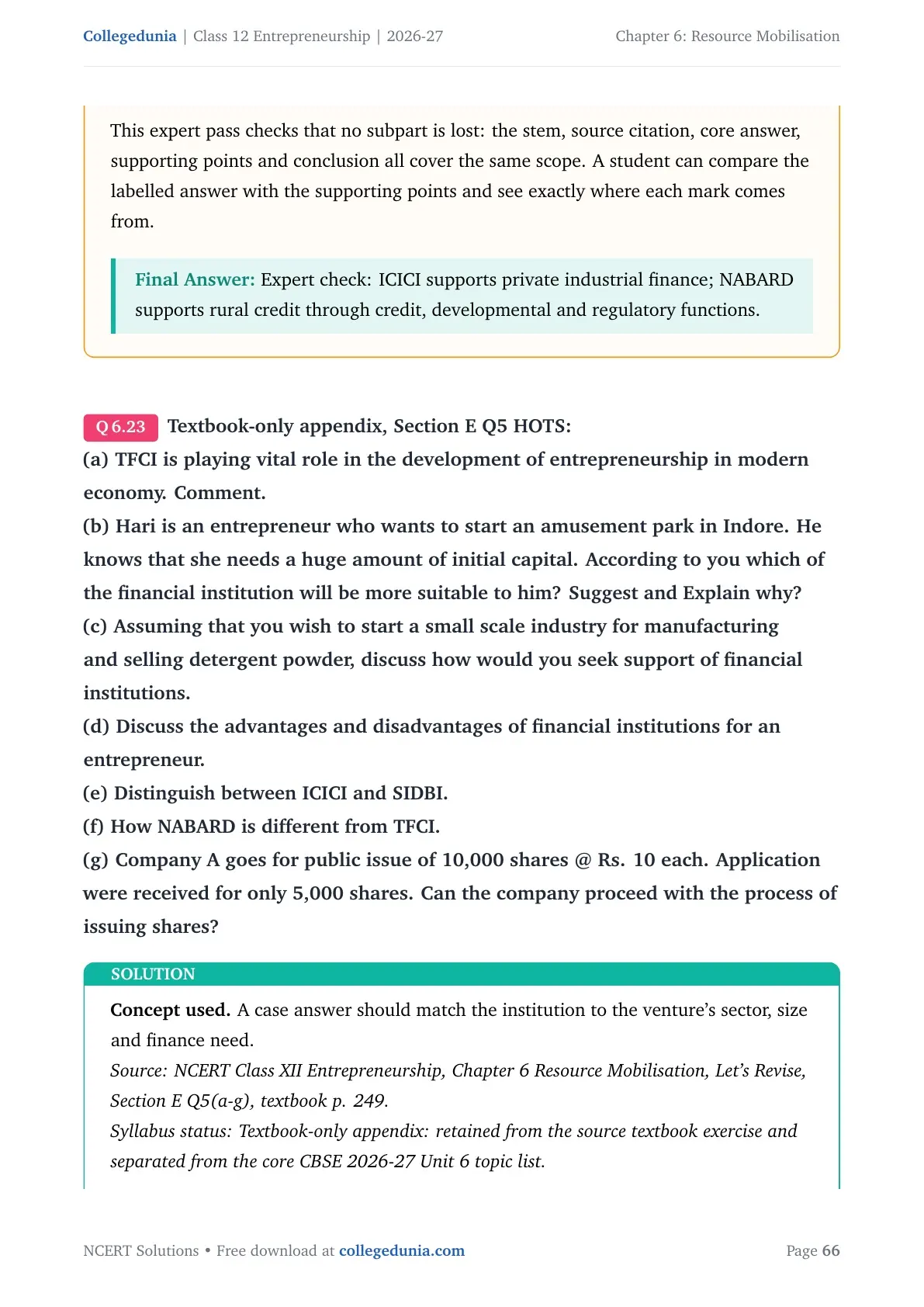
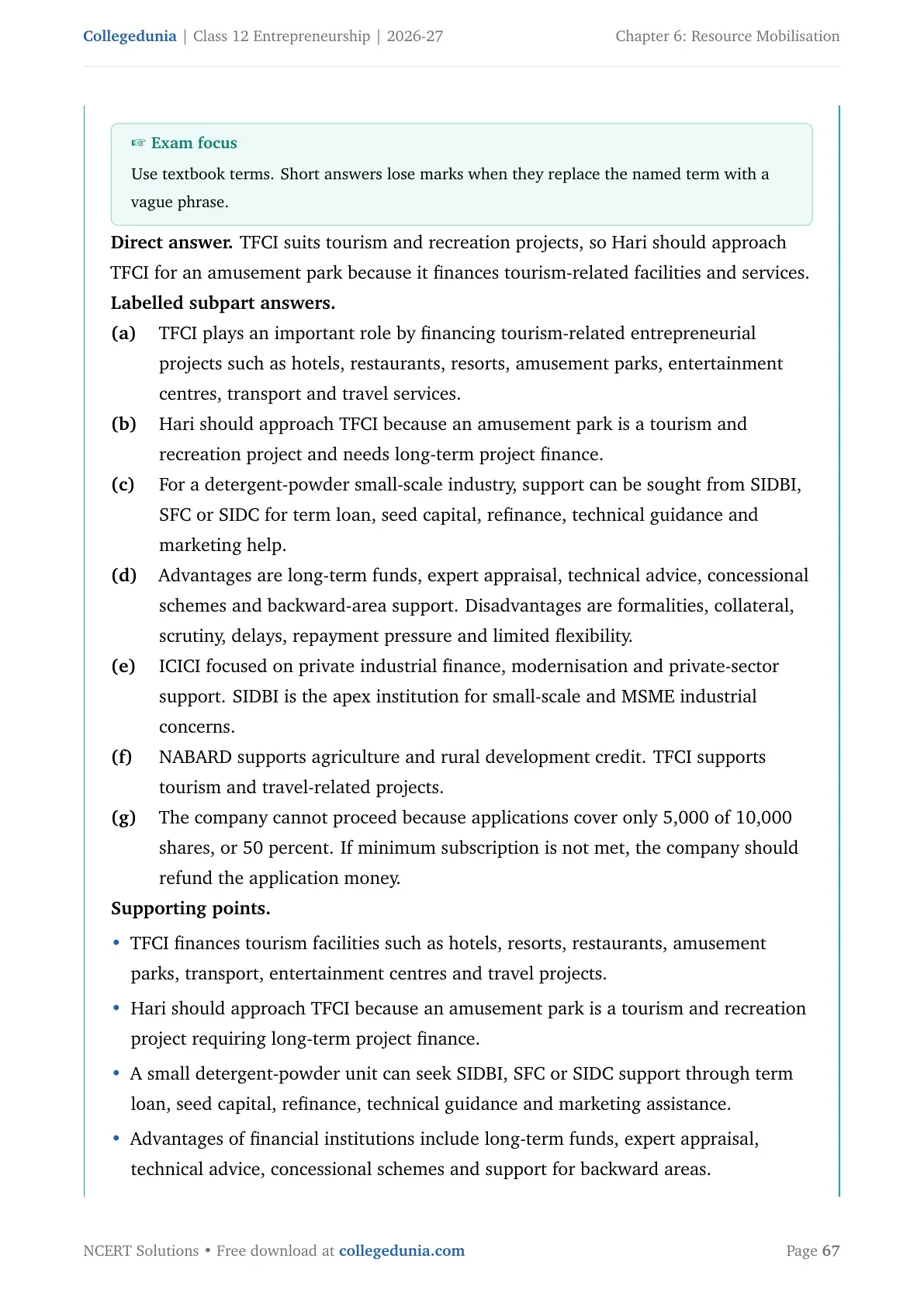
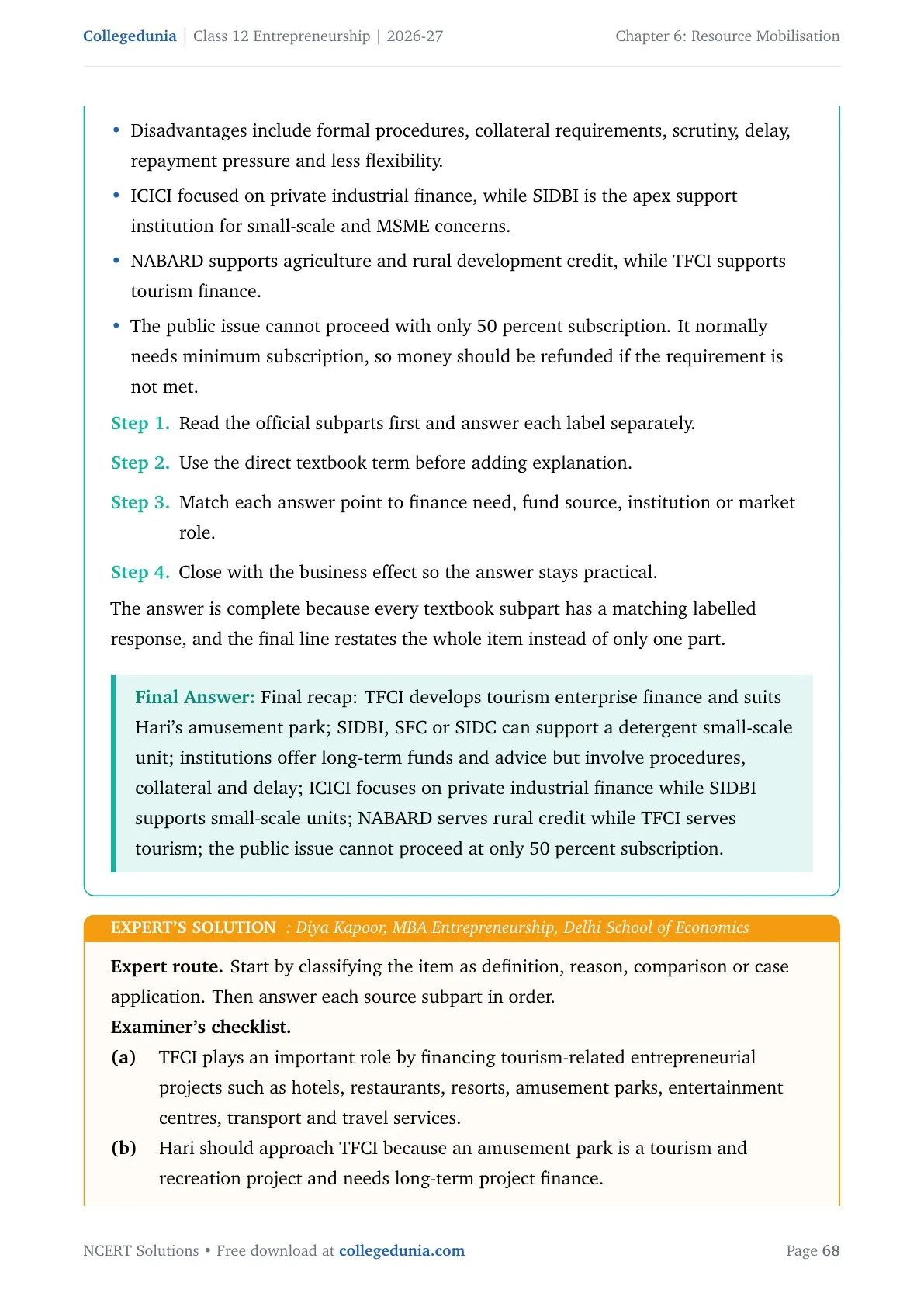



- 23 textbook questions are solved in the same order as the Resource Mobilisation exercise.
- The PDF covers finance, capital markets, stock exchange functions, SEBI and development banks.
- Expert solution cards give a second explanation for every question.
Student Feedback on Class 12 Entrepreneurship Chapter 6
In a Collegedunia poll of 12,840 Class 12 students for the 2026-27 board cycle, most students marked Resource Mobilisation as a term-heavy chapter.
- 74% wanted the primary market and secondary market difference shown in a table.
- 69% asked for stock exchange, SEBI and SFI answers with direct headings.
- 6 out of 10 students revised the funding sources only after solving the exercise.
Source: 2026-27 Class 12 Entrepreneurship student feedback sample recorded for Collegedunia NCERT resource planning.
Every answer here is checked against the Resource Mobilisation unit of the Class 12 Entrepreneurship textbook and the 2026-27 NCERT resource workflow.
|
Table of Contents |
Resource Mobilisation Questions Covered in the PDF
The PDF follows the textbook sequence from one-line finance terms to long case-based answers. Students can use this table to revise the exact answer length expected in the chapter.
| Question Set | Focus Area | Answer Skill |
|---|---|---|
| Section A | Finance, sources of finance, internal finance and financial market meaning | Direct term plus one reason |
| Section B | Capital market, primary market, secondary market and stock exchange | Definition with difference points |
| Section C | Stock exchange functions, SEBI and investor protection | Point-wise explanation |
| Section D | SEBI powers, objectives, control and watchdog role | Structured short notes |
| Textbook appendix | Specialised financial institutions, SIDC, TFCI, SFC, NABARD, IFCI, IDBI, ICICI and SIDBI | Institution matched to business need |
Resource Mobilisation Class 12 Revision Video
Source: Magnet Brains on YouTube
Resource Mobilisation Funding Flow for Class 12
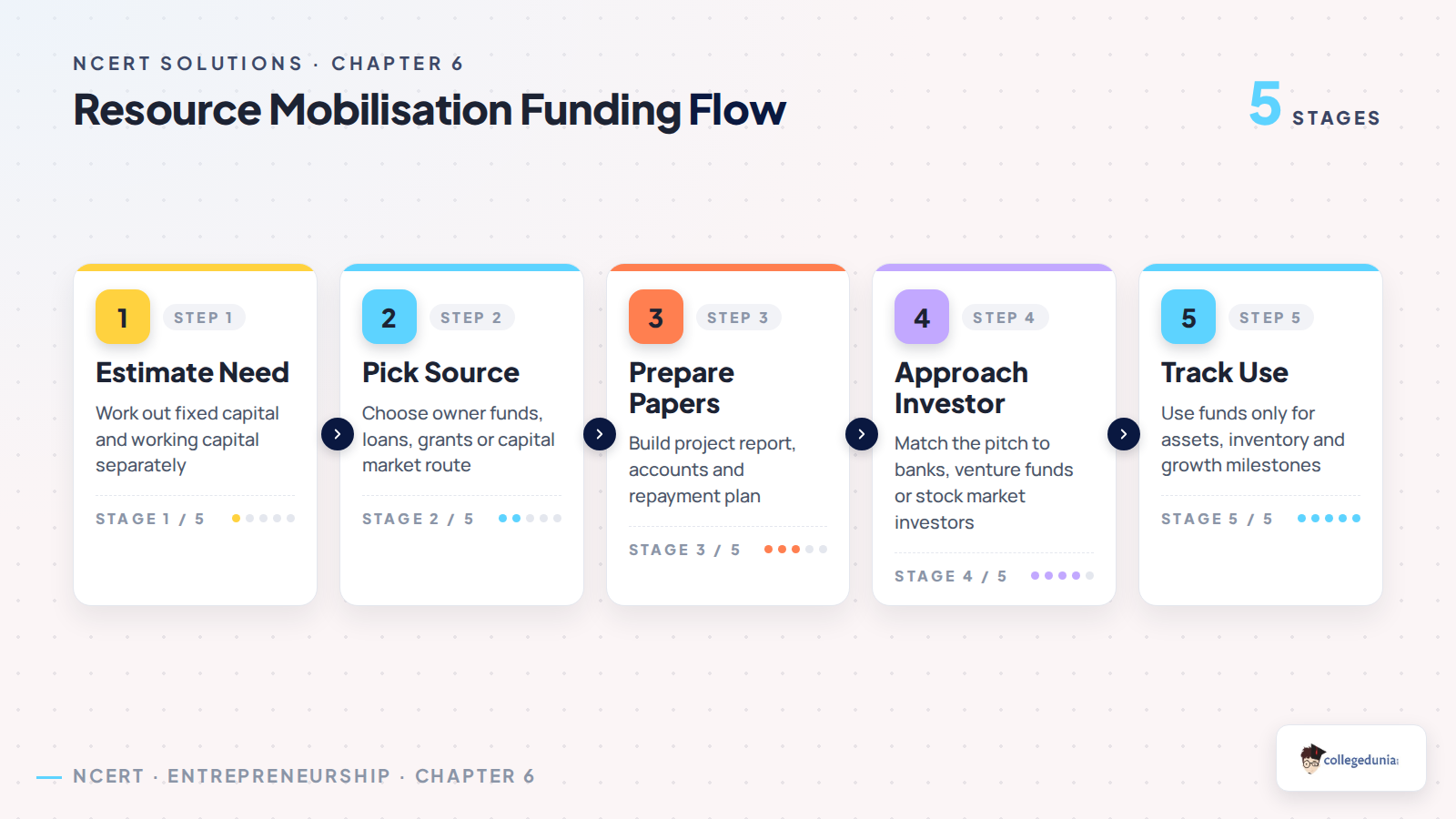
Resource Mobilisation teaches how an entrepreneur arranges funds before work can begin. The chapter links finance need, source choice, market route and institution support.
- Estimate need: separate fixed capital from working capital.
- Pick source: choose owner funds, loans, grants or capital markets.
- Prepare papers: keep project report, accounts and repayment plan ready.
- Track use: spend funds only on assets, inventory and growth milestones.
Primary Market and Secondary Market in Resource Mobilisation
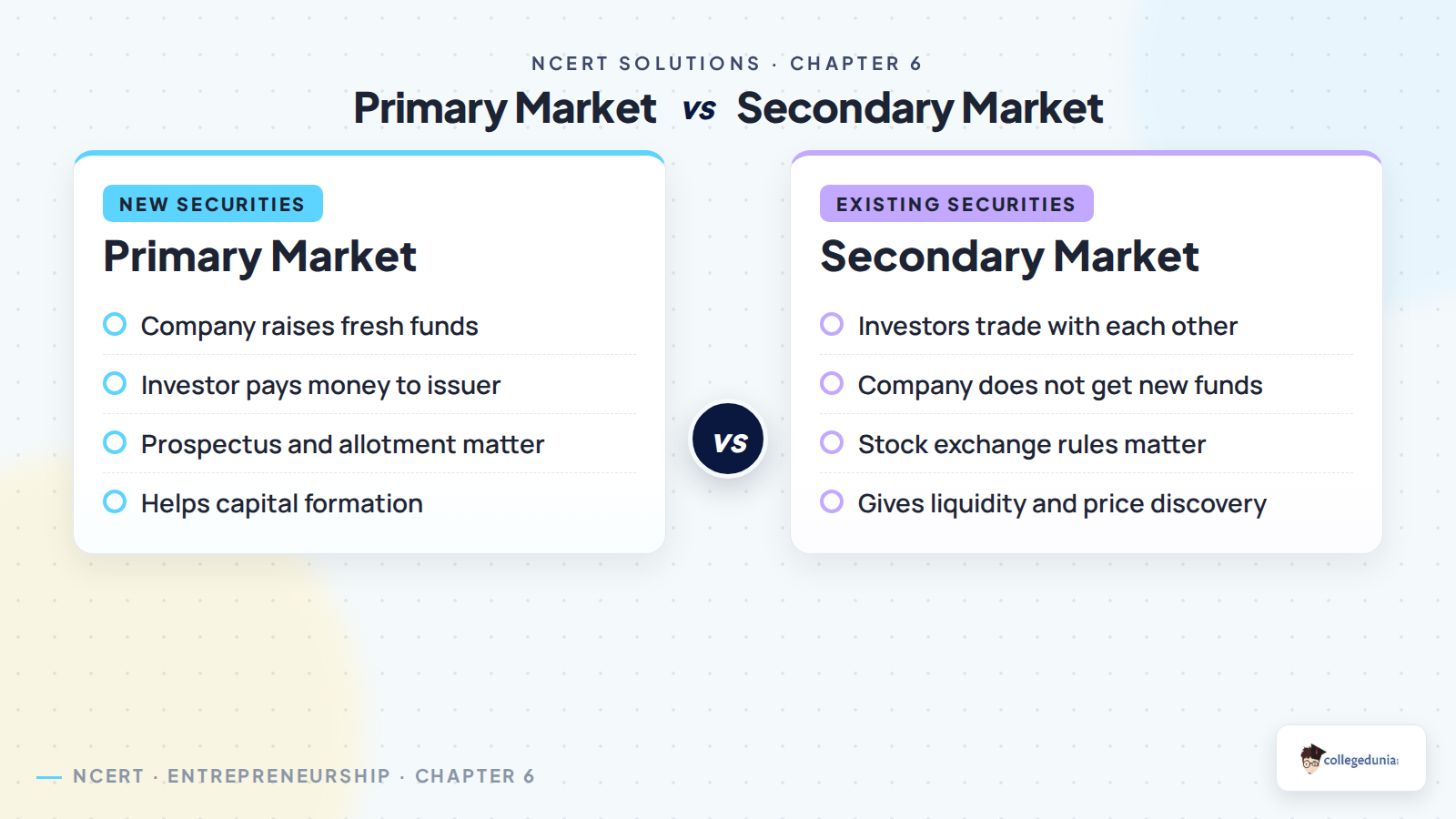
The financial market moves money from savers to users of funds. The primary market helps a company raise fresh money by issuing new securities. The secondary market lets investors buy and sell existing securities.
| Basis | Primary Market | Secondary Market |
|---|---|---|
| Main work | Issue of new shares, debentures or bonds | Trading of already issued securities |
| Money flow | Money reaches the company | Money moves between investors |
| Student cue | Think issue, prospectus and allotment | Think stock exchange, price and liquidity |
Stock Exchange, SEBI and Investor Protection
A stock exchange gives a regular market for securities. It helps price discovery, liquidity, fair dealing and capital formation. SEBI works as the regulator that protects investors and controls unfair trade practices.
- Stock exchange: provides a safe platform for securities trading.
- SEBI: regulates brokers, protects investors and checks price manipulation.
- Investor protection: depends on disclosure, fair dealing and grievance handling.
- Exam cue: write function first, then explain its business effect.
Specialised Financial Institutions in Resource Mobilisation
Specialised financial institutions provide development finance where ordinary bank credit may not be enough. These questions are retained as textbook-only appendix practice in the PDF. In Class 12 Entrepreneurship, students should match each institution with its purpose.
| Institution | Main Use | Memory Cue |
|---|---|---|
| SIDC and SFC | State-level industrial finance | State industry support |
| TFCI | Tourism and recreation project finance | Tourism funding |
| NABARD | Agriculture and rural development credit | Rural finance |
| SIDBI | Small-scale and MSME support | Small business finance |
| IFCI, IDBI and ICICI | Industrial development and long-term project finance | Industrial finance |
Common Mistakes in Resource Mobilisation NCERT Answers
Most errors in Resource Mobilisation happen when students know the term but do not connect it to funding decisions. Use these checks before revising the PDF.
- Do not mix markets: the primary market raises new capital; the secondary market gives liquidity.
- Do not write only stock trading: add price discovery, safety, liquidity and capital formation.
- Do not define SEBI vaguely: name investor protection, regulation and control of unfair practices.
- Do not list institutions randomly: match each SFI to industry, tourism, rural or small business need.
Class 12 Entrepreneurship Chapter 6 Related Resources
Use these companion resources when revising Resource Mobilisation in another format.
| Resource | Best Use | Link |
|---|---|---|
| NCERT Notes | Quick revision of finance sources and market terms | Class 12 Entrepreneurship Chapter 6 Notes |
| Handwritten Notes | Visual recap of SEBI, stock exchange and SFI points | Class 12 Entrepreneurship Chapter 6 Handwritten Notes |
| NCERT Book PDF | Original textbook reading and exercise context | Class 12 Entrepreneurship Chapter 6 Book PDF |
NCERT Solutions for Class 12 Entrepreneurship All Chapters
The same chapter-wise NCERT Solutions series helps students revise the full Class 12 Entrepreneurship textbook in order.
| Chapter | Chapter Name | NCERT Solutions |
|---|---|---|
| Chapter 1 | Entrepreneurial Opportunity | View solutions |
| Chapter 2 | Entrepreneurial Planning | View solutions |
| Chapter 3 | Enterprise Marketing | View solutions |
| Chapter 4 | Enterprise Growth Strategies | View solutions |
| Chapter 5 | Business Arithmetic | View solutions |
| Chapter 6 | Resource Mobilisation | View solutions |
All NCERT Solutions for Class 12 Entrepreneurship Chapter 6 Resource Mobilisation with Step-by-Step Solutions
The embedded cards below mirror the PDF questions. Open Check Solution for the direct answer and Expert Solution for a fuller explanation.
Section A: Finance
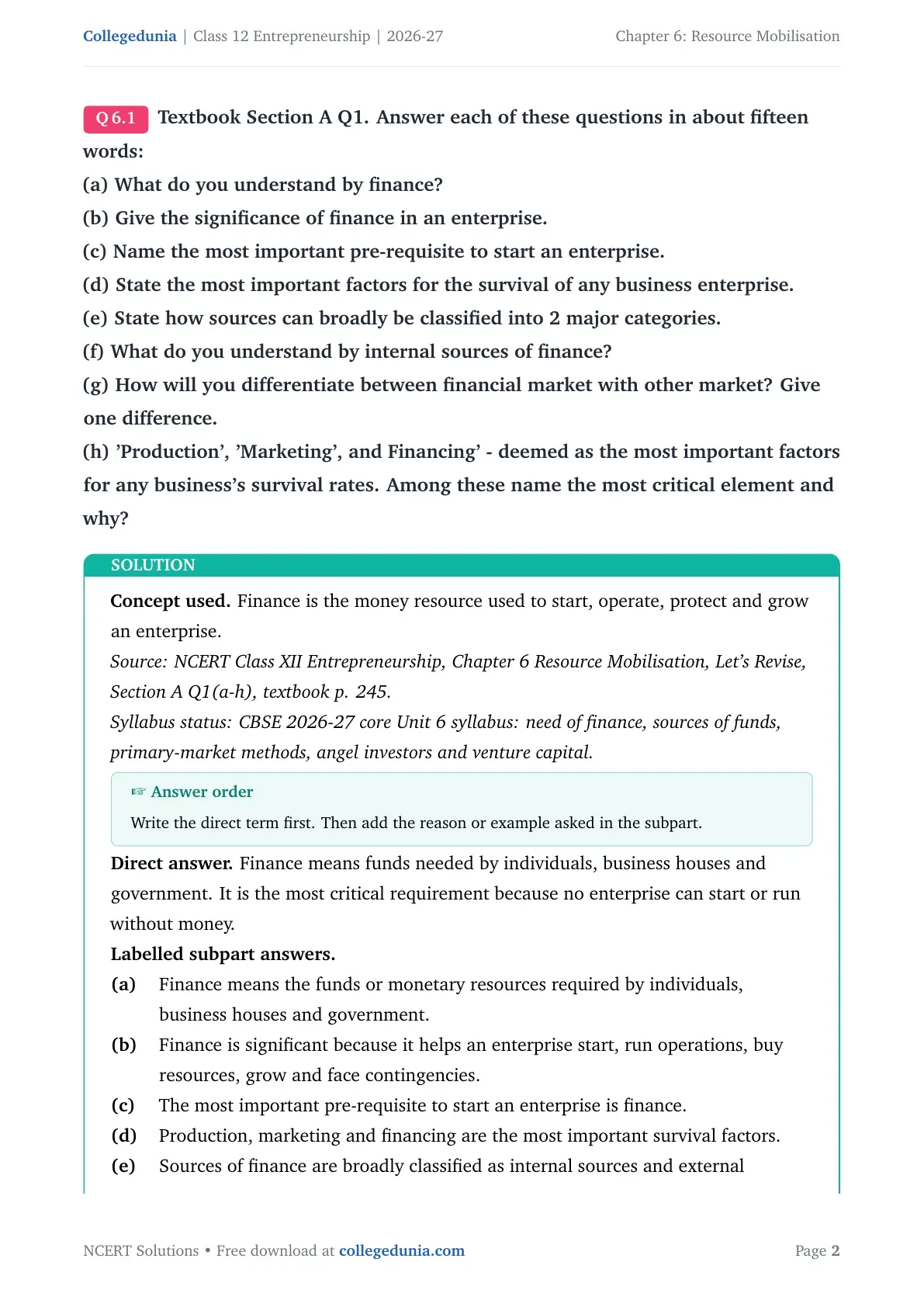
Textbook Section A Q1. Answer each of these questions in about fifteen words:
(a) What do you understand by finance?
(b) Give the significance of finance in an enterprise.
(c) Name the most important pre-requisite to start an enterprise.
(d) State the most important factors for the survival of any business enterprise.
(e) State how sources can broadly be classified into 2 major categories.
(f) What do you understand by internal sources of finance?
(g) How will you differentiate between financial market with other market? Give one difference.
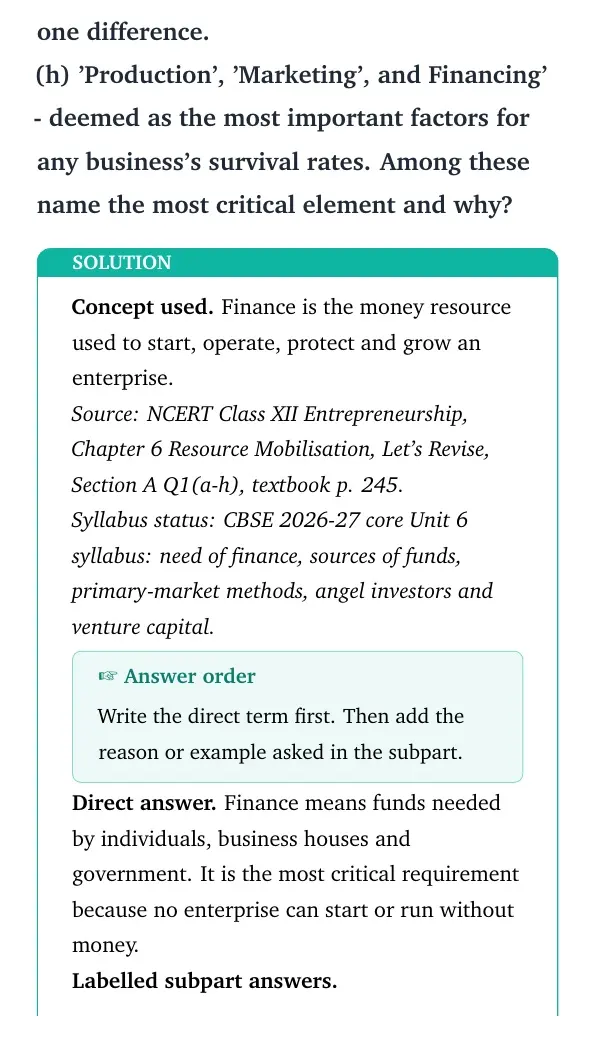
(h) 'Production', 'Marketing', and Financing' - deemed as the most important factors for any business's survival rates. Among these name the most critical element and why?
Concept used. Finance is the money resource used to start, operate, protect and grow an enterprise.
Source: NCERT Class XII Entrepreneurship, Chapter 6 Resource Mobilisation, Let's Revise, Section A Q1(a-h), textbook p. 245.
Syllabus status: CBSE 2026-27 core Unit 6 syllabus: need of finance, sources of funds, primary-market methods, angel investors and venture capital.
Answer order
Write the direct term first. Then add the reason or example asked in the subpart.Direct answer. Finance means funds needed by individuals, business houses and government. It is the most critical requirement because no enterprise can start or run without money.
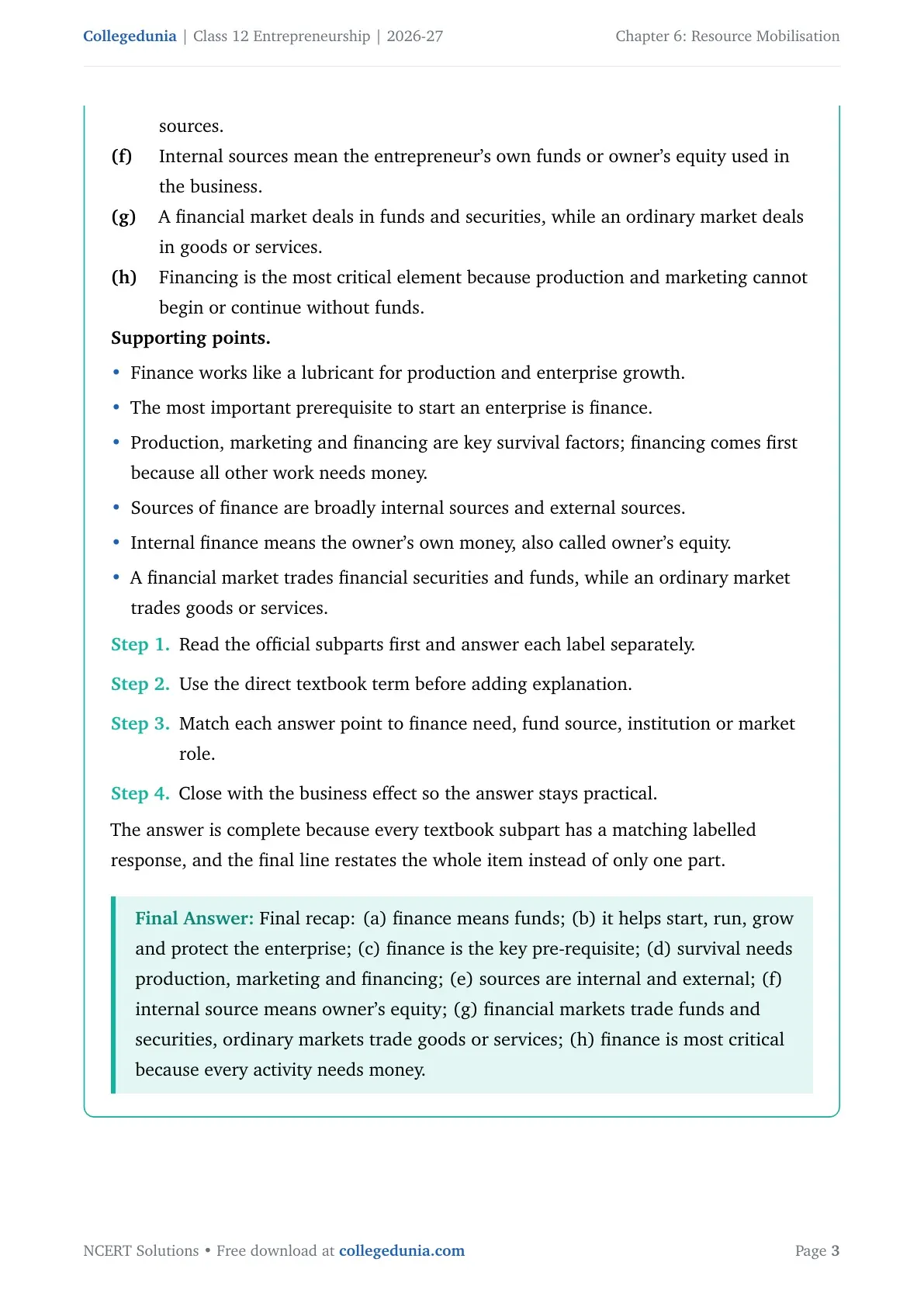
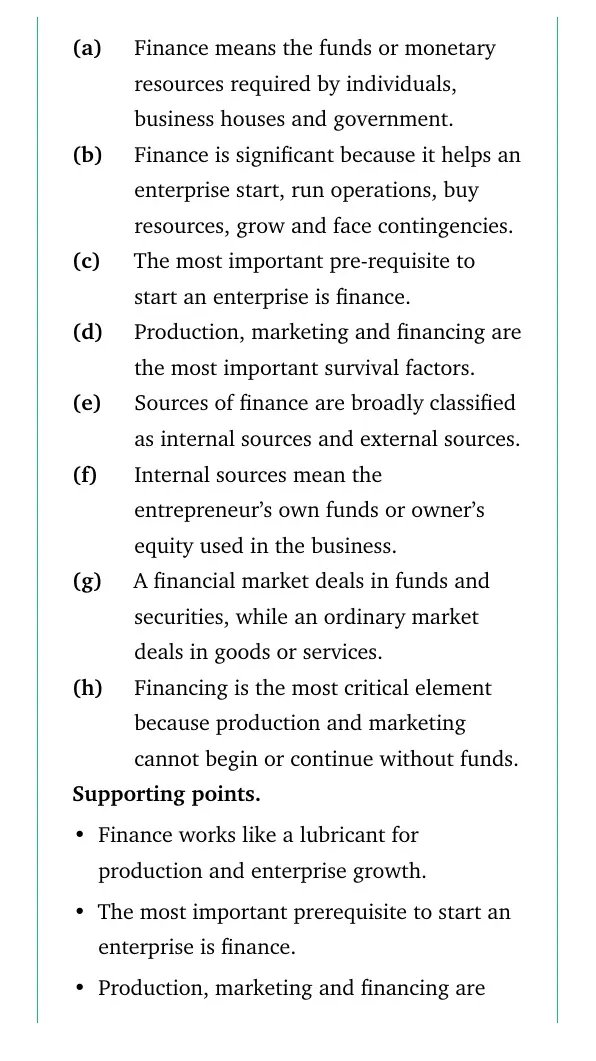
Labelled subpart answers. description[leftmargin=1.1cm, style=nextline] [(a)] Finance means the funds or monetary resources required by individuals, business houses and government. [(b)] Finance is significant because it helps an enterprise start, run operations, buy resources, grow and face contingencies. [(c)] The most important pre-requisite to start an enterprise is finance. [(d)] Production, marketing and financing are the most important survival factors. [(e)] Sources of finance are broadly classified as internal sources and external sources. [(f)] Internal sources mean the entrepreneur's own funds or owner's equity used in the business. [(g)] A financial market deals in funds and securities, while an ordinary market deals in goods or services. [(h)] Financing is the most critical element because production and marketing cannot begin or continue without funds. description
Supporting points.
- Finance works like a lubricant for production and enterprise growth.
- The most important prerequisite to start an enterprise is finance.
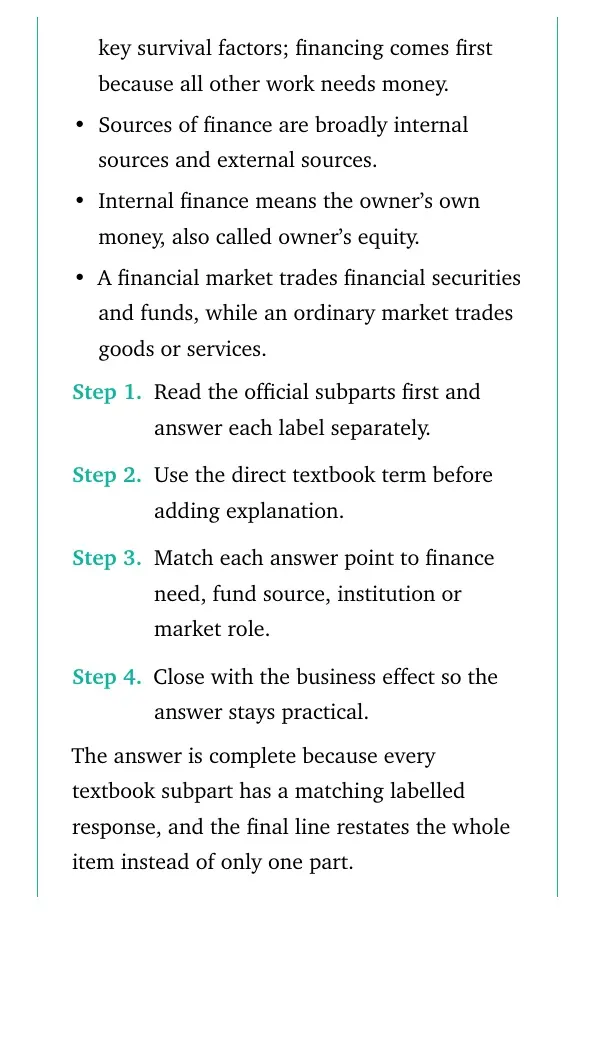
- Production, marketing and financing are key survival factors; financing comes first because all other work needs money.
- Sources of finance are broadly internal sources and external sources.
- Internal finance means the owner's own money, also called owner's equity.
- A financial market trades financial securities and funds, while an ordinary market trades goods or services.
- Read the official subparts first and answer each label separately.
- Use the direct textbook term before adding explanation.
- Match each answer point to finance need, fund source, institution or market role.
- Close with the business effect so the answer stays practical.
The answer is complete because every textbook subpart has a matching labelled response, and the final line restates the whole item instead of only one part.
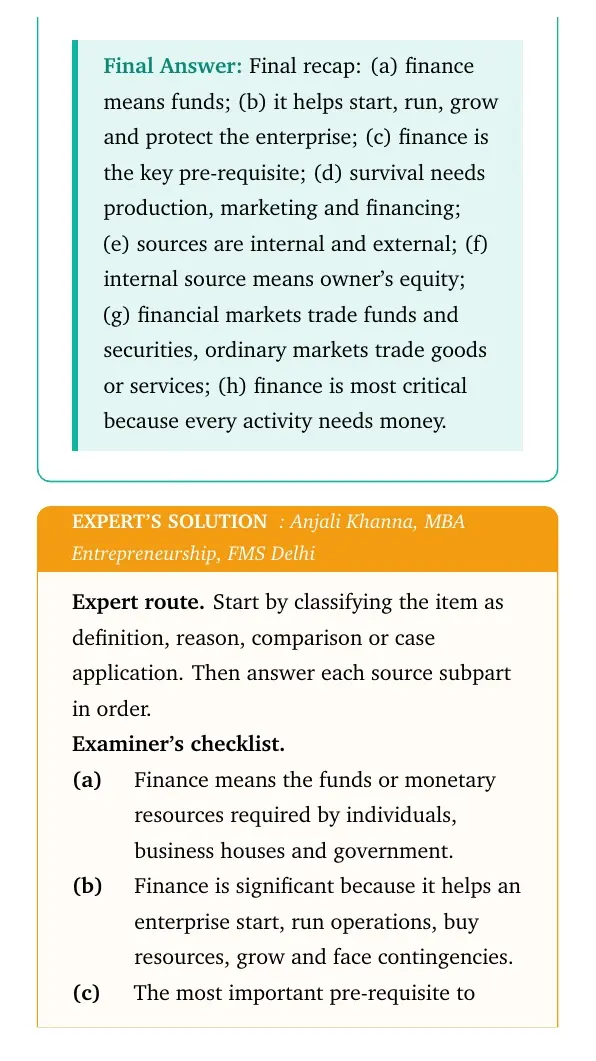
Final recap: (a) finance means funds; (b) it helps start, run, grow and protect the enterprise; (c) finance is the key pre-requisite; (d) survival needs production, marketing and financing; (e) sources are internal and external; (f) internal source means owner's equity; (g) financial markets trade funds and securities, ordinary markets trade goods or services; (h) finance is most critical because every activity needs money.
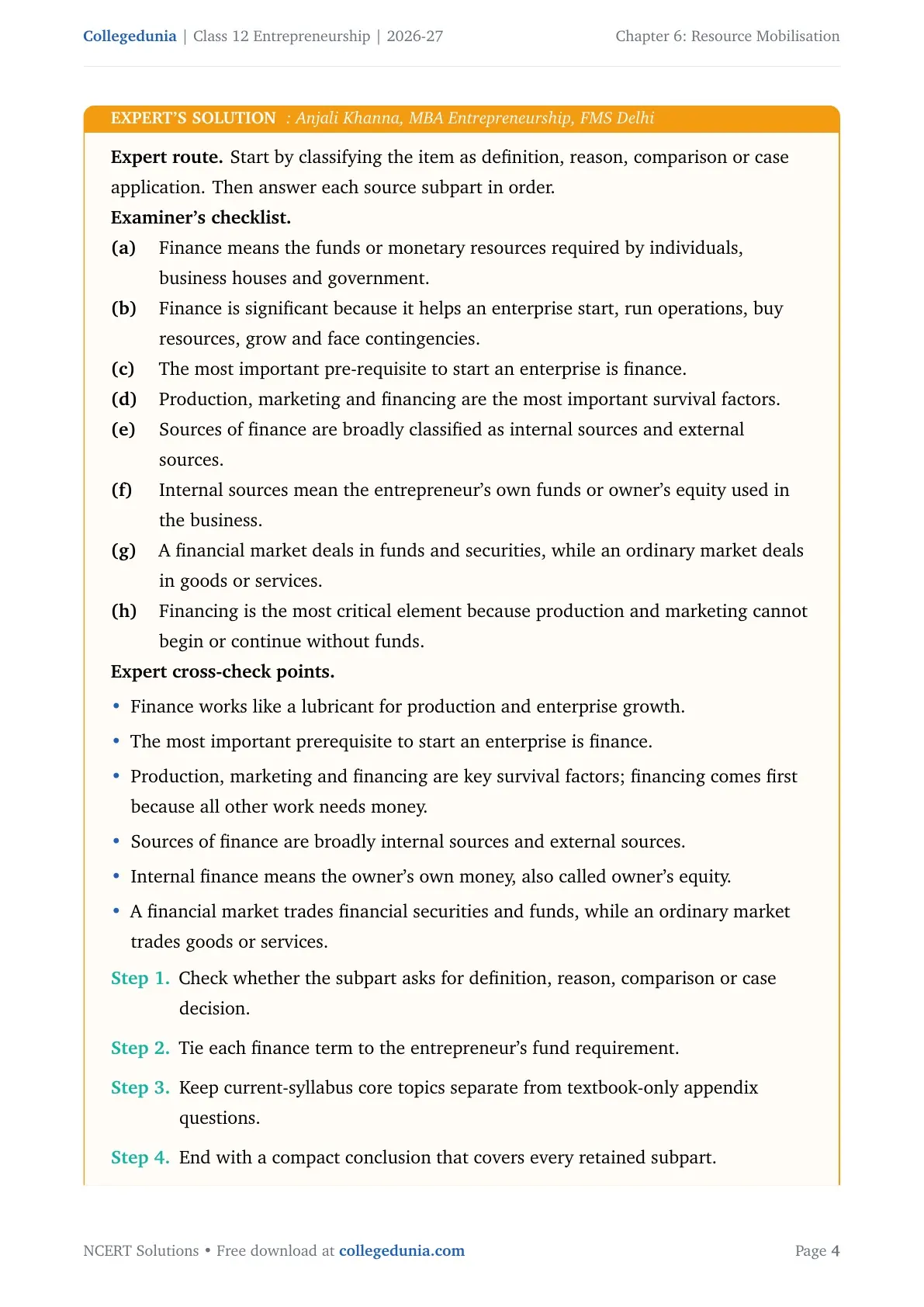
Expert route. Start by classifying the item as definition, reason, comparison or case application. Then answer each source subpart in order.
Examiner's checklist. description[leftmargin=1.1cm, style=nextline] [(a)] Finance means the funds or monetary resources required by individuals, business houses and government. [(b)] Finance is significant because it helps an enterprise start, run operations, buy resources, grow and face contingencies. [(c)] The most important pre-requisite to start an enterprise is finance. [(d)] Production, marketing and financing are the most important survival factors. [(e)] Sources of finance are broadly classified as internal sources and external sources. [(f)] Internal sources mean the entrepreneur's own funds or owner's equity used in the business. [(g)] A financial market deals in funds and securities, while an ordinary market deals in goods or services. [(h)] Financing is the most critical element because production and marketing cannot begin or continue without funds. description
Expert cross-check points.
- Finance works like a lubricant for production and enterprise growth.
- The most important prerequisite to start an enterprise is finance.
- Production, marketing and financing are key survival factors; financing comes first because all other work needs money.
- Sources of finance are broadly internal sources and external sources.
- Internal finance means the owner's own money, also called owner's equity.
- A financial market trades financial securities and funds, while an ordinary market trades goods or services.
- Check whether the subpart asks for definition, reason, comparison or case decision.
- Tie each finance term to the entrepreneur's fund requirement.
- Keep current-syllabus core topics separate from textbook-only appendix questions.
- End with a compact conclusion that covers every retained subpart.
This expert pass checks that no subpart is lost: the stem, source citation, core answer, supporting points and conclusion all cover the same scope. A student can compare the labelled answer with the supporting points and see exactly where each mark comes from.
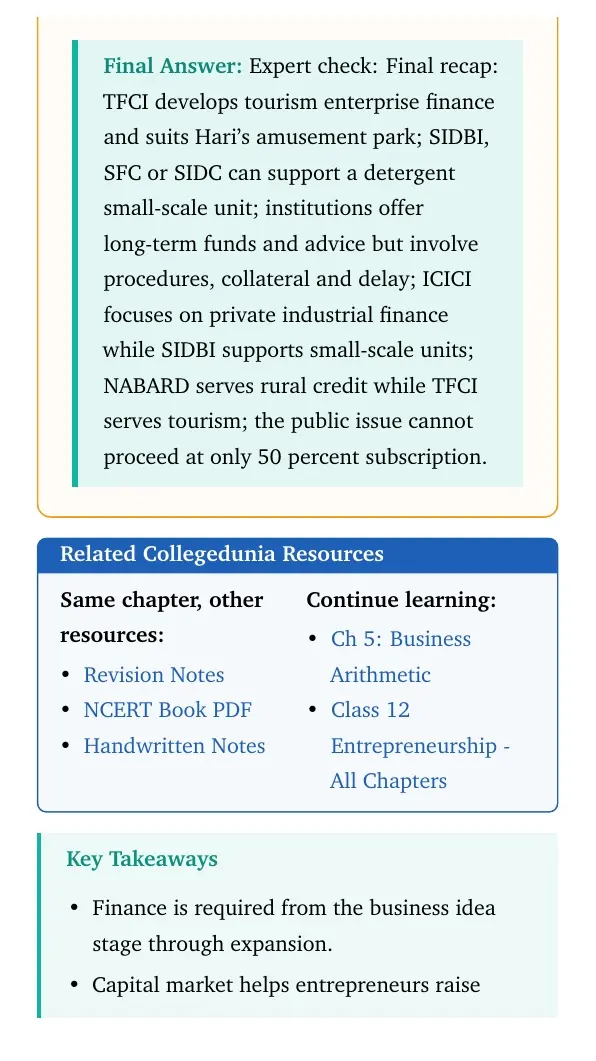
Expert check: Final recap: (a) finance means funds; (b) it helps start, run, grow and protect the enterprise; (c) finance is the key pre-requisite; (d) survival needs production, marketing and financing; (e) sources are internal and external; (f) internal source means owner's equity; (g) financial markets trade funds and securities, ordinary markets trade goods or services; (h) finance is most critical because every activity needs money.
Textbook Section A Q2. Answer each of these questions in about fifty words:
(a) Which sources provide the supply for long-term funds?
(b) Name the sources of demand for capital comes from.
(c) Entrepreneur can use the capital raised for a variety of purposes, what are they?
(d) How can an entrepreneur, raises funds by selling the issue mainly to the institutional investors?
(e) How stock options lead to enable employees to become shareholders and share the profits of the company?
Concept used. Capital market connects suppliers of long-term funds with entrepreneurs who need capital.
Source: NCERT Class XII Entrepreneurship, Chapter 6 Resource Mobilisation, Let's Revise, Section A Q2(a-e), textbook p. 245.
Syllabus status: CBSE 2026-27 core Unit 6 syllabus: need of finance, sources of funds, primary-market methods, angel investors and venture capital.
Recall clue
Most answers in this chapter start with finance, market, investor or institution. Use that cue first.Direct answer. Long-term funds come from household savings, foreign capital, institutional investors, corporate savings and government. Demand comes mainly from industry and government.
Labelled subpart answers. description[leftmargin=1.1cm, style=nextline] [(a)] Long-term funds are supplied by household savings, foreign capital, institutional investors, corporate savings and government. [(b)] Demand for capital mainly comes from industry and government. [(c)] Capital may be used for growth and expansion, retiring debt, corporate marketing and development, and acquisition capital. [(d)] The entrepreneur can use private placement, which means direct sale of securities to selected institutional investors. [(e)] Stock options allow employees to buy or receive shares, become shareholders and share profits, improving efficiency, relations and retention while lowering flotation cost. description
Supporting points.
- Capital may be used for growth, expansion, retiring debt, marketing, development and acquisition.
- Private placement means direct sale of securities to selected institutional investors.
- Institutional investors may include UTI, LIC, GIC, Army Group Insurance and state financial corporations.
- Employee stock options allow employees to become shareholders.
- Stock options may improve efficiency, reduce labour turnover, improve industrial relations and lower floatation cost.
- Read the official subparts first and answer each label separately.
- Use the direct textbook term before adding explanation.
- Match each answer point to finance need, fund source, institution or market role.
- Close with the business effect so the answer stays practical.
The answer is complete because every textbook subpart has a matching labelled response, and the final line restates the whole item instead of only one part.
Final recap: long-term fund supply comes from household savings, foreign capital, institutional investors, corporate savings and government; demand comes from industry and government; uses include growth, expansion, debt retirement, marketing, development and acquisition; private placement sells securities directly to selected institutions; stock options let employees become shareholders and share profits.
Expert route. Start by classifying the item as definition, reason, comparison or case application. Then answer each source subpart in order.
Examiner's checklist. description[leftmargin=1.1cm, style=nextline] [(a)] Long-term funds are supplied by household savings, foreign capital, institutional investors, corporate savings and government. [(b)] Demand for capital mainly comes from industry and government. [(c)] Capital may be used for growth and expansion, retiring debt, corporate marketing and development, and acquisition capital. [(d)] The entrepreneur can use private placement, which means direct sale of securities to selected institutional investors. [(e)] Stock options allow employees to buy or receive shares, become shareholders and share profits, improving efficiency, relations and retention while lowering flotation cost. description
Expert cross-check points.
- Capital may be used for growth, expansion, retiring debt, marketing, development and acquisition.
- Private placement means direct sale of securities to selected institutional investors.
- Institutional investors may include UTI, LIC, GIC, Army Group Insurance and state financial corporations.
- Employee stock options allow employees to become shareholders.
- Stock options may improve efficiency, reduce labour turnover, improve industrial relations and lower floatation cost.
- Check whether the subpart asks for definition, reason, comparison or case decision.
- Tie each finance term to the entrepreneur's fund requirement.
- Keep current-syllabus core topics separate from textbook-only appendix questions.
- End with a compact conclusion that covers every retained subpart.
This expert pass checks that no subpart is lost: the stem, source citation, core answer, supporting points and conclusion all cover the same scope. A student can compare the labelled answer with the supporting points and see exactly where each mark comes from.
Expert check: Final recap: long-term fund supply comes from household savings, foreign capital, institutional investors, corporate savings and government; demand comes from industry and government; uses include growth, expansion, debt retirement, marketing, development and acquisition; private placement sells securities directly to selected institutions; stock options let employees become shareholders and share profits.
Textbook Section A Q3. Answer each of these questions in about two hundred and fifty words:
(a) Explain some important sources of raising finance in business.
Concept used. An entrepreneur chooses finance sources by comparing cost, control, time period and risk.
Source: NCERT Class XII Entrepreneurship, Chapter 6 Resource Mobilisation, Let's Revise, Section A Q3(a), textbook p. 245.
Syllabus status: CBSE 2026-27 core Unit 6 syllabus: need of finance, sources of funds, primary-market methods, angel investors and venture capital.
Exam focus
Use textbook terms. Short answers lose marks when they replace the named term with a vague phrase.Direct answer. Important sources include public issue, rights issue, private placement, employee stock options, angel investors, venture capital and specialised financial institutions.
Labelled subpart answers. description[leftmargin=1.1cm, style=nextline] [(a)] Important sources include capital-market issues, rights issue, private placement, offer to employees, angel investors, venture capital and development finance from specialised institutions. The entrepreneur compares each source by amount needed, cost, control, risk, time period and stage of the enterprise. description
Supporting points.
- Public issue raises money from the public through a prospectus.
- Rights issue offers new securities to existing shareholders on a proportionate basis.
- Private placement sells securities directly to selected sophisticated investors.
- Employee stock options turn selected employees into shareholders.
- Angel investors fund early-stage firms and often guide the entrepreneur.
- Venture capital gives equity support to high-growth, high-risk ventures.
- Specialised financial institutions provide medium-term and long-term industrial finance.
- Read the official subparts first and answer each label separately.
- Use the direct textbook term before adding explanation.
- Match each answer point to finance need, fund source, institution or market role.
- Close with the business effect so the answer stays practical.
The answer is complete because every textbook subpart has a matching labelled response, and the final line restates the whole item instead of only one part.
The major business finance sources are capital-market methods, angel finance, venture capital and, where relevant, development-finance institutions.
Expert route. Start by classifying the item as definition, reason, comparison or case application. Then answer each source subpart in order.
Examiner's checklist. description[leftmargin=1.1cm, style=nextline] [(a)] Important sources include capital-market issues, rights issue, private placement, offer to employees, angel investors, venture capital and development finance from specialised institutions. The entrepreneur compares each source by amount needed, cost, control, risk, time period and stage of the enterprise. description
Expert cross-check points.
- Public issue raises money from the public through a prospectus.
- Rights issue offers new securities to existing shareholders on a proportionate basis.
- Private placement sells securities directly to selected sophisticated investors.
- Employee stock options turn selected employees into shareholders.
- Angel investors fund early-stage firms and often guide the entrepreneur.
- Venture capital gives equity support to high-growth, high-risk ventures.
- Specialised financial institutions provide medium-term and long-term industrial finance.
- Check whether the subpart asks for definition, reason, comparison or case decision.
- Tie each finance term to the entrepreneur's fund requirement.
- Keep current-syllabus core topics separate from textbook-only appendix questions.
- End with a compact conclusion that covers every retained subpart.
This expert pass checks that no subpart is lost: the stem, source citation, core answer, supporting points and conclusion all cover the same scope. A student can compare the labelled answer with the supporting points and see exactly where each mark comes from.
Expert check: The major business finance sources are capital-market methods, angel finance, venture capital and, where relevant, development-finance institutions.
Section B: Financial Markets
Textbook Section B Q1. Answer each of these questions in about fifteen words:
(a) Define capital market.
(b) Name the two players in the capital market.
(c) Identify the reward IPO investors seek as an appreciation of their investment.
(d) Identify the method of raising additional finance from existing shareholders by offering securities to them on pro-rata basis.
(e) What do you understand by pro-rata allotment of securities?
(f) What is Right Issue?
(g) When the right issue are proposed to the existing shareholders and if they are not ready to subscribe what is the next step taken by an entrepreneur?
(h) Why right issue method of issuing securities is considered to be inexpensive?
(i) What do you understand by private placement?
(j) What is meant by Stock options or offering shares to the employees?
(k) Name the method which enables employees to become shareholders and share the profits of the company.
(l) What is a secondary market?
(m) What is the need of secondary market?
(n) In what forms company can raise capital through primary market?
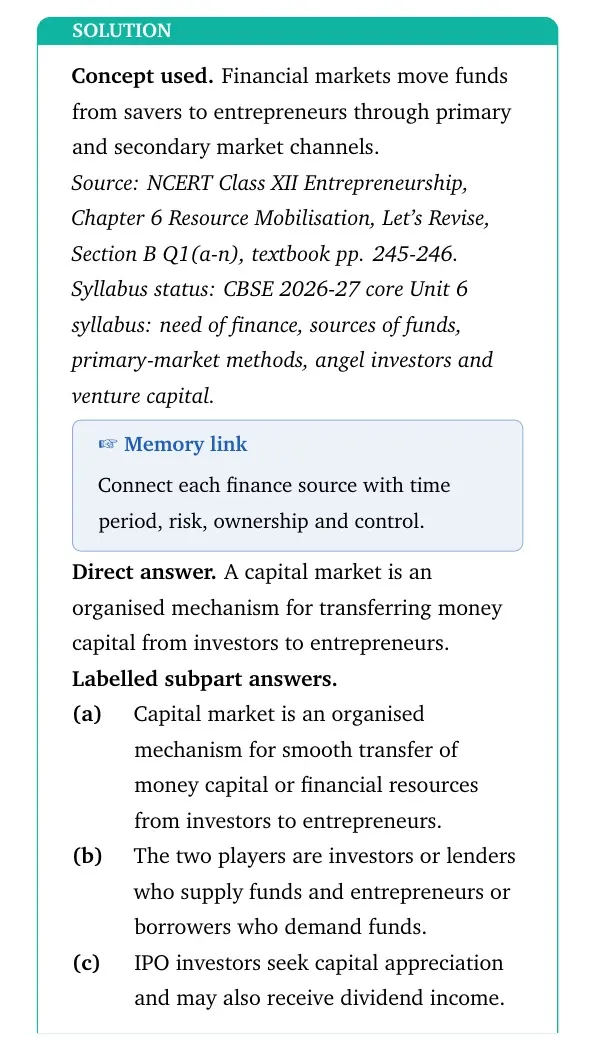
Concept used. Financial markets move funds from savers to entrepreneurs through primary and secondary market channels.
Source: NCERT Class XII Entrepreneurship, Chapter 6 Resource Mobilisation, Let's Revise, Section B Q1(a-n), textbook pp. 245-246.
Syllabus status: CBSE 2026-27 core Unit 6 syllabus: need of finance, sources of funds, primary-market methods, angel investors and venture capital.
Memory link
Connect each finance source with time period, risk, ownership and control.Direct answer. A capital market is an organised mechanism for transferring money capital from investors to entrepreneurs.
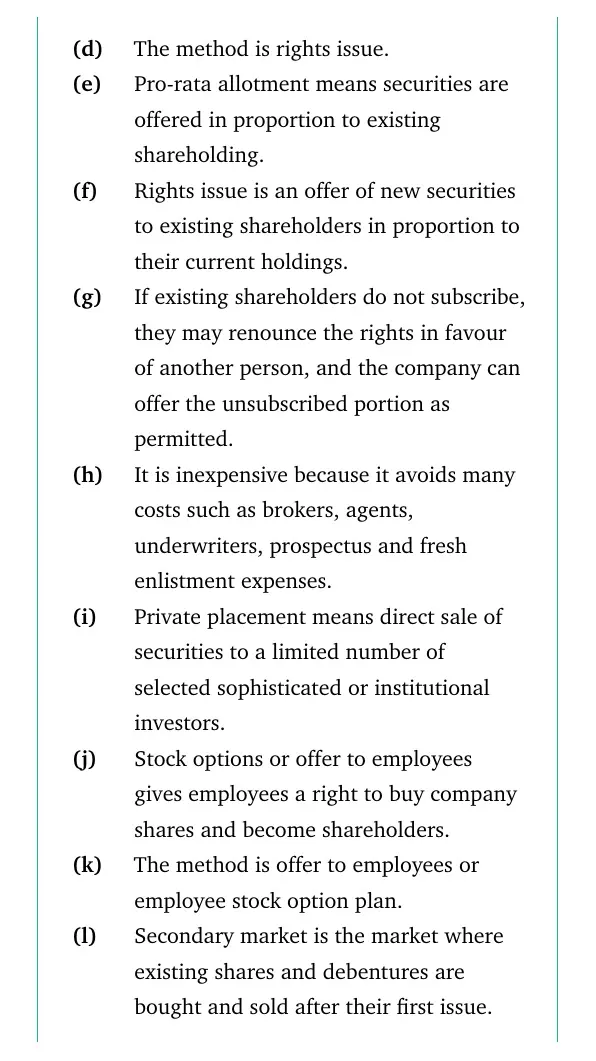
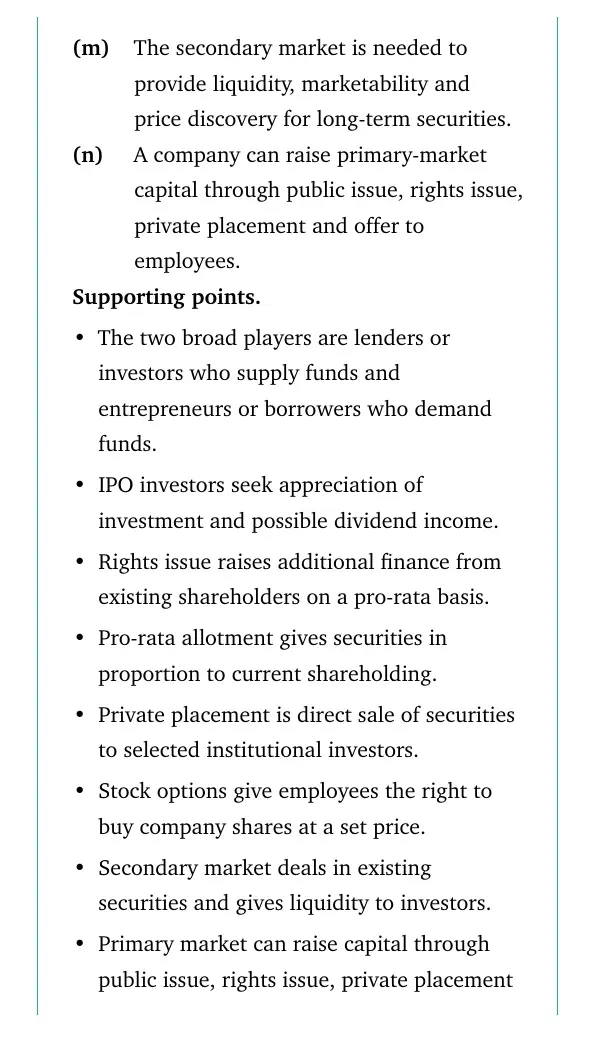
Labelled subpart answers. description[leftmargin=1.1cm, style=nextline] [(a)] Capital market is an organised mechanism for smooth transfer of money capital or financial resources from investors to entrepreneurs. [(b)] The two players are investors or lenders who supply funds and entrepreneurs or borrowers who demand funds. [(c)] IPO investors seek capital appreciation and may also receive dividend income. [(d)] The method is rights issue. [(e)] Pro-rata allotment means securities are offered in proportion to existing shareholding. [(f)] Rights issue is an offer of new securities to existing shareholders in proportion to their current holdings. [(g)] If existing shareholders do not subscribe, they may renounce the rights in favour of another person, and the company can offer the unsubscribed portion as permitted. [(h)] It is inexpensive because it avoids many costs such as brokers, agents, underwriters, prospectus and fresh enlistment expenses. [(i)] Private placement means direct sale of securities to a limited number of selected sophisticated or institutional investors. [(j)] Stock options or offer to employees gives employees a right to buy company shares and become shareholders. [(k)] The method is offer to employees or employee stock option plan. [(l)] Secondary market is the market where existing shares and debentures are bought and sold after their first issue. [(m)] The secondary market is needed to provide liquidity, marketability and price discovery for long-term securities. [(n)] A company can raise primary-market capital through public issue, rights issue, private placement and offer to employees. description
Supporting points.
- The two broad players are lenders or investors who supply funds and entrepreneurs or borrowers who demand funds.
- IPO investors seek appreciation of investment and possible dividend income.
- Rights issue raises additional finance from existing shareholders on a pro-rata basis.
- Pro-rata allotment gives securities in proportion to current shareholding.
- Private placement is direct sale of securities to selected institutional investors.
- Stock options give employees the right to buy company shares at a set price.
- Secondary market deals in existing securities and gives liquidity to investors.
- Primary market can raise capital through public issue, rights issue, private placement and offer to employees.
- Read the official subparts first and answer each label separately.
- Use the direct textbook term before adding explanation.
- Match each answer point to finance need, fund source, institution or market role.
- Close with the business effect so the answer stays practical.
The answer is complete because every textbook subpart has a matching labelled response, and the final line restates the whole item instead of only one part.
Final recap: (a) capital market transfers long-term funds; (b) players are investors and entrepreneurs; (c) IPO reward is appreciation or dividend; (d)-(f) rights issue and pro-rata allotment serve existing shareholders; (g) unsubscribed rights may be renounced or offered as permitted; (h) rights issue is cheaper because broker, underwriter, prospectus and fresh listing costs are avoided; (i) private placement sells to selected institutions; (j)-(k) stock options make employees shareholders; (l)-(m) secondary market trades old securities and gives liquidity; (n) primary market uses public issue, rights issue, private placement and offer to employees.
Expert route. Start by classifying the item as definition, reason, comparison or case application. Then answer each source subpart in order.
Examiner's checklist. description[leftmargin=1.1cm, style=nextline] [(a)] Capital market is an organised mechanism for smooth transfer of money capital or financial resources from investors to entrepreneurs. [(b)] The two players are investors or lenders who supply funds and entrepreneurs or borrowers who demand funds. [(c)] IPO investors seek capital appreciation and may also receive dividend income. [(d)] The method is rights issue. [(e)] Pro-rata allotment means securities are offered in proportion to existing shareholding. [(f)] Rights issue is an offer of new securities to existing shareholders in proportion to their current holdings. [(g)] If existing shareholders do not subscribe, they may renounce the rights in favour of another person, and the company can offer the unsubscribed portion as permitted. [(h)] It is inexpensive because it avoids many costs such as brokers, agents, underwriters, prospectus and fresh enlistment expenses. [(i)] Private placement means direct sale of securities to a limited number of selected sophisticated or institutional investors. [(j)] Stock options or offer to employees gives employees a right to buy company shares and become shareholders. [(k)] The method is offer to employees or employee stock option plan. [(l)] Secondary market is the market where existing shares and debentures are bought and sold after their first issue. [(m)] The secondary market is needed to provide liquidity, marketability and price discovery for long-term securities. [(n)] A company can raise primary-market capital through public issue, rights issue, private placement and offer to employees. description
Expert cross-check points.
- The two broad players are lenders or investors who supply funds and entrepreneurs or borrowers who demand funds.
- IPO investors seek appreciation of investment and possible dividend income.
- Rights issue raises additional finance from existing shareholders on a pro-rata basis.
- Pro-rata allotment gives securities in proportion to current shareholding.
- Private placement is direct sale of securities to selected institutional investors.
- Stock options give employees the right to buy company shares at a set price.
- Secondary market deals in existing securities and gives liquidity to investors.
- Primary market can raise capital through public issue, rights issue, private placement and offer to employees.
- Check whether the subpart asks for definition, reason, comparison or case decision.
- Tie each finance term to the entrepreneur's fund requirement.
- Keep current-syllabus core topics separate from textbook-only appendix questions.
- End with a compact conclusion that covers every retained subpart.
This expert pass checks that no subpart is lost: the stem, source citation, core answer, supporting points and conclusion all cover the same scope. A student can compare the labelled answer with the supporting points and see exactly where each mark comes from.
Expert check: Final recap: (a) capital market transfers long-term funds; (b) players are investors and entrepreneurs; (c) IPO reward is appreciation or dividend; (d)-(f) rights issue and pro-rata allotment serve existing shareholders; (g) unsubscribed rights may be renounced or offered as permitted; (h) rights issue is cheaper because broker, underwriter, prospectus and fresh listing costs are avoided; (i) private placement sells to selected institutions; (j)-(k) stock options make employees shareholders; (l)-(m) secondary market trades old securities and gives liquidity; (n) primary market uses public issue, rights issue, private placement and offer to employees.
Textbook Section B Q2. Answer each of these questions in about fifty words:
(a) For what purpose is finance required right from the very beginning i.e. conceiving an idea?
(b) What is the need of finance?
(c) An entrepreneur is a person who bears the risks, unites various factors of production and carries out a creative innovation, and for doing all these, what is the basic requirement to be reached to this extent.
(d) State some mushrooming sources of raising finance in the business.
Concept used. Finance is needed from the idea stage because every business resource has a cost.
Source: NCERT Class XII Entrepreneurship, Chapter 6 Resource Mobilisation, Let's Revise, Section B Q2(a-d), textbook p. 246.
Syllabus status: CBSE 2026-27 core Unit 6 syllabus: need of finance, sources of funds, primary-market methods, angel investors and venture capital.
Answer order
Write the direct term first. Then add the reason or example asked in the subpart.Direct answer. Finance is required to promote the business, buy assets, study the market, develop products, keep people and machines working, create value and meet unexpected expenses.
Labelled subpart answers. description[leftmargin=1.1cm, style=nextline] [(a)] Finance is required from the idea stage for feasibility study, product development, market work, registration, resource purchase and initial operations. [(b)] Finance is needed to bring together land, labour, materials, machines and management and to keep the enterprise running. [(c)] The basic requirement for risk-bearing, production and innovation is adequate finance. [(d)] Growing sources include capital markets, angel investors, venture capital and specialised financial institutions. description
Supporting points.
- An entrepreneur needs finance to bring together land, labour, machines, materials and methods.
- The basic requirement for risk bearing and innovation is finance.
- Long-term and medium-term funds may come from share capital, preference shares and debentures.
- Other growing sources include angel investors, venture capital and specialised financial institutions.
- The total need depends on business size, nature and stage.
- Read the official subparts first and answer each label separately.
- Use the direct textbook term before adding explanation.
- Match each answer point to finance need, fund source, institution or market role.
- Close with the business effect so the answer stays practical.
The answer is complete because every textbook subpart has a matching labelled response, and the final line restates the whole item instead of only one part.
Finance is needed from idea to operation, and newer sources include capital market, angel investors, venture capital and development-finance institutions.
Expert route. Start by classifying the item as definition, reason, comparison or case application. Then answer each source subpart in order.
Examiner's checklist. description[leftmargin=1.1cm, style=nextline] [(a)] Finance is required from the idea stage for feasibility study, product development, market work, registration, resource purchase and initial operations. [(b)] Finance is needed to bring together land, labour, materials, machines and management and to keep the enterprise running. [(c)] The basic requirement for risk-bearing, production and innovation is adequate finance. [(d)] Growing sources include capital markets, angel investors, venture capital and specialised financial institutions. description
Expert cross-check points.
- An entrepreneur needs finance to bring together land, labour, machines, materials and methods.
- The basic requirement for risk bearing and innovation is finance.
- Long-term and medium-term funds may come from share capital, preference shares and debentures.
- Other growing sources include angel investors, venture capital and specialised financial institutions.
- The total need depends on business size, nature and stage.
- Check whether the subpart asks for definition, reason, comparison or case decision.
- Tie each finance term to the entrepreneur's fund requirement.
- Keep current-syllabus core topics separate from textbook-only appendix questions.
- End with a compact conclusion that covers every retained subpart.
This expert pass checks that no subpart is lost: the stem, source citation, core answer, supporting points and conclusion all cover the same scope. A student can compare the labelled answer with the supporting points and see exactly where each mark comes from.
Expert check: Finance is needed from idea to operation, and newer sources include capital market, angel investors, venture capital and development-finance institutions.
Textbook Section B Q3. Answer each of these questions in about one hundred and fifty words:
(a) State the nature of money market. Who are the major participants in the money market?
(b) Explain how Capital markets are the most important source of raising finance for an entrepreneur.
(c) What do you understand by capital market? How can the capital market in India be broadly classified into different categories?
(d) Write down the sectors of organized and un-organized market?
(e) What is meant by primary market? Briefly explain the concept of 'Right Issue for existing companies'?
Concept used. Money market serves short-term funds, while capital market serves medium-term and long-term funds.
Source: NCERT Class XII Entrepreneurship, Chapter 6 Resource Mobilisation, Let's Revise, Section B Q3(a-e), textbook p. 246.
Syllabus status: CBSE 2026-27 core Unit 6 syllabus: need of finance, sources of funds, primary-market methods, angel investors and venture capital.
Recall clue
Most answers in this chapter start with finance, market, investor or institution. Use that cue first.Direct answer. The money market handles lending and borrowing for short periods. Major participants include RBI, banks, NBFCs, governments, large companies, mutual funds, LIC, GIC and UTI.
Labelled subpart answers. description[leftmargin=1.1cm, style=nextline] [(a)] Money market is a short-term funds market. Its major participants include RBI, banks, NBFCs, government, large companies, mutual funds, LIC, GIC and UTI. [(b)] Capital markets are important because they mobilise national savings, bring foreign capital and know-how, and make long-term productive capital available to entrepreneurs. [(c)] Capital market transfers long-term funds from investors to entrepreneurs. It can be classified into organised and unorganised markets, and also into primary and secondary markets. [(d)] The organised sector includes corporate enterprises, government institutions, individual investors and institutional investors. The unorganised sector includes indigenous bankers and money lenders. [(e)] Primary market deals in new securities issued for the first time. Rights issue offers new securities to existing shareholders on a pro-rata basis, generally through a circular. description
Supporting points.
- Capital markets mobilise savings across the country and direct them to productive projects.
- They help entrepreneurs raise long-term finance for growth and diversification.
- Organised markets include corporate enterprises, government institutions, individual investors and institutional investors.
- Unorganised markets include indigenous bankers and money lenders.
- The primary market transfers savings to entrepreneurs for new enterprises, expansion and diversification.
- Rights issue offers new securities only to existing shareholders, usually through a circular.
- Read the official subparts first and answer each label separately.
- Use the direct textbook term before adding explanation.
- Match each answer point to finance need, fund source, institution or market role.
- Close with the business effect so the answer stays practical.
The answer is complete because every textbook subpart has a matching labelled response, and the final line restates the whole item instead of only one part.
Final recap: money market handles short-term funds with RBI, banks, NBFCs, government, companies and institutions; capital market mobilises long-term savings; it is organised or unorganised and primary or secondary; organised players include corporates, government and investors; unorganised players include indigenous bankers and money lenders; primary market issues new securities, and rights issue offers them to existing shareholders pro-rata.
Expert route. Start by classifying the item as definition, reason, comparison or case application. Then answer each source subpart in order.
Examiner's checklist. description[leftmargin=1.1cm, style=nextline] [(a)] Money market is a short-term funds market. Its major participants include RBI, banks, NBFCs, government, large companies, mutual funds, LIC, GIC and UTI. [(b)] Capital markets are important because they mobilise national savings, bring foreign capital and know-how, and make long-term productive capital available to entrepreneurs. [(c)] Capital market transfers long-term funds from investors to entrepreneurs. It can be classified into organised and unorganised markets, and also into primary and secondary markets. [(d)] The organised sector includes corporate enterprises, government institutions, individual investors and institutional investors. The unorganised sector includes indigenous bankers and money lenders. [(e)] Primary market deals in new securities issued for the first time. Rights issue offers new securities to existing shareholders on a pro-rata basis, generally through a circular. description
Expert cross-check points.
- Capital markets mobilise savings across the country and direct them to productive projects.
- They help entrepreneurs raise long-term finance for growth and diversification.
- Organised markets include corporate enterprises, government institutions, individual investors and institutional investors.
- Unorganised markets include indigenous bankers and money lenders.
- The primary market transfers savings to entrepreneurs for new enterprises, expansion and diversification.
- Rights issue offers new securities only to existing shareholders, usually through a circular.
- Check whether the subpart asks for definition, reason, comparison or case decision.
- Tie each finance term to the entrepreneur's fund requirement.
- Keep current-syllabus core topics separate from textbook-only appendix questions.
- End with a compact conclusion that covers every retained subpart.
This expert pass checks that no subpart is lost: the stem, source citation, core answer, supporting points and conclusion all cover the same scope. A student can compare the labelled answer with the supporting points and see exactly where each mark comes from.
Expert check: Final recap: money market handles short-term funds with RBI, banks, NBFCs, government, companies and institutions; capital market mobilises long-term savings; it is organised or unorganised and primary or secondary; organised players include corporates, government and investors; unorganised players include indigenous bankers and money lenders; primary market issues new securities, and rights issue offers them to existing shareholders pro-rata.
Textbook Section B Q4. Answer each of these questions in about two hundred and fifty words:
(a) "An entrepreneur can raise the required capital in the primary market". Explain the various methods of raising the funds in the primary market by an entrepreneur.
(b) When an entrepreneur decides to go public and become a public company, he/she tends to be in advantageous positions and get many benefit out of it. Explain the benefits.
(c) While there are benefits to going public, at the same time additional obligations and reporting requirements on the companies and its directors means disadvantages too what are they? Explain.
Concept used. The primary market raises fresh capital when new securities are issued to investors.
Source: NCERT Class XII Entrepreneurship, Chapter 6 Resource Mobilisation, Let's Revise, Section B Q4(a-c), textbook p. 246.
Syllabus status: CBSE 2026-27 core Unit 6 syllabus: need of finance, sources of funds, primary-market methods, angel investors and venture capital.
Exam focus
Use textbook terms. Short answers lose marks when they replace the named term with a vague phrase.Direct answer. An entrepreneur can raise funds in the primary market through public issue, rights issue, private placement and offer to employees.
Labelled subpart answers. description[leftmargin=1.1cm, style=nextline] [(a)] Primary-market methods are public issue through prospectus, rights issue to existing shareholders, private placement with selected institutional investors, and offer to employees or stock options. [(b)] Benefits of going public include access to large capital, wider investor base, visibility, prestige, share liquidity, better valuation and easier future fund raising. [(c)] Disadvantages include higher issue cost, statutory compliance, continuous disclosure, loss of privacy, accountability to many shareholders, dilution of control, takeover risk and market pressure. description
Supporting points.
- Public issue raises money from the public through a prospectus and is common for a public limited company.
- Rights issue gives existing shareholders the first chance to buy new securities in proportion to holdings.
- Private placement sells securities to selected institutional investors through a direct route.
- Offer to employees, or stock options, lets employees become shareholders.
- Going public can raise large capital, improve visibility, create share liquidity and support future funding.
- It can also increase accountability, reporting cost, takeover risk, loss of privacy and loss of control.
- Read the official subparts first and answer each label separately.
- Use the direct textbook term before adding explanation.
- Match each answer point to finance need, fund source, institution or market role.
- Close with the business effect so the answer stays practical.
The answer is complete because every textbook subpart has a matching labelled response, and the final line restates the whole item instead of only one part.
Primary-market finance offers public issue, rights issue, private placement and employee offers; going public raises capital but adds disclosure, cost and control responsibilities.
Expert route. Start by classifying the item as definition, reason, comparison or case application. Then answer each source subpart in order.
Examiner's checklist. description[leftmargin=1.1cm, style=nextline] [(a)] Primary-market methods are public issue through prospectus, rights issue to existing shareholders, private placement with selected institutional investors, and offer to employees or stock options. [(b)] Benefits of going public include access to large capital, wider investor base, visibility, prestige, share liquidity, better valuation and easier future fund raising. [(c)] Disadvantages include higher issue cost, statutory compliance, continuous disclosure, loss of privacy, accountability to many shareholders, dilution of control, takeover risk and market pressure. description
Expert cross-check points.
- Public issue raises money from the public through a prospectus and is common for a public limited company.
- Rights issue gives existing shareholders the first chance to buy new securities in proportion to holdings.
- Private placement sells securities to selected institutional investors through a direct route.
- Offer to employees, or stock options, lets employees become shareholders.
- Going public can raise large capital, improve visibility, create share liquidity and support future funding.
- It can also increase accountability, reporting cost, takeover risk, loss of privacy and loss of control.
- Check whether the subpart asks for definition, reason, comparison or case decision.
- Tie each finance term to the entrepreneur's fund requirement.
- Keep current-syllabus core topics separate from textbook-only appendix questions.
- End with a compact conclusion that covers every retained subpart.
This expert pass checks that no subpart is lost: the stem, source citation, core answer, supporting points and conclusion all cover the same scope. A student can compare the labelled answer with the supporting points and see exactly where each mark comes from.
Expert check: Primary-market finance offers public issue, rights issue, private placement and employee offers; going public raises capital but adds disclosure, cost and control responsibilities.
Textbook Section B Q5 HOTS.
(a) Why primary market is also known as new issue market? Give one reason.
Concept used. Primary market deals with fresh securities issued for the first time.
Source: NCERT Class XII Entrepreneurship, Chapter 6 Resource Mobilisation, Let's Revise, Section B Q5(a), textbook p. 246.
Syllabus status: CBSE 2026-27 core Unit 6 syllabus: need of finance, sources of funds, primary-market methods, angel investors and venture capital.
Memory link
Connect each finance source with time period, risk, ownership and control.Direct answer. It is called the new issue market because companies issue new shares or debentures to raise new money from investors.
Labelled subpart answers. description[leftmargin=1.1cm, style=nextline] [(a)] Primary market is called the new issue market because companies issue fresh securities there for the first time and the money raised goes to the issuing company. description
Supporting points.
- The securities are not second-hand securities already traded among investors.
- The money raised goes to the company or entrepreneur.
- New issues may support starting, expanding or diversifying an enterprise.
- This is different from the secondary market, where old securities change hands.
- Read the official subparts first and answer each label separately.
- Use the direct textbook term before adding explanation.
- Match each answer point to finance need, fund source, institution or market role.
- Close with the business effect so the answer stays practical.
The answer is complete because every textbook subpart has a matching labelled response, and the final line restates the whole item instead of only one part.
Primary market is the new issue market because it handles fresh securities issued to raise new capital.
Expert route. Start by classifying the item as definition, reason, comparison or case application. Then answer each source subpart in order.
Examiner's checklist. description[leftmargin=1.1cm, style=nextline] [(a)] Primary market is called the new issue market because companies issue fresh securities there for the first time and the money raised goes to the issuing company. description
Expert cross-check points.
- The securities are not second-hand securities already traded among investors.
- The money raised goes to the company or entrepreneur.
- New issues may support starting, expanding or diversifying an enterprise.
- This is different from the secondary market, where old securities change hands.
- Check whether the subpart asks for definition, reason, comparison or case decision.
- Tie each finance term to the entrepreneur's fund requirement.
- Keep current-syllabus core topics separate from textbook-only appendix questions.
- End with a compact conclusion that covers every retained subpart.
This expert pass checks that no subpart is lost: the stem, source citation, core answer, supporting points and conclusion all cover the same scope. A student can compare the labelled answer with the supporting points and see exactly where each mark comes from.
Expert check: Primary market is the new issue market because it handles fresh securities issued to raise new capital.
Section C: Stock Exchange
Textbook Section C Q1. Answer each of these questions in about fifteen words:
(a) What are the responsibilities of governing body?
(b) Name the stock exchanges were most of the stock trading in India is done.
(c) What is a secondary capital market?
Concept used. A stock exchange is an organised secondary market for listed securities.
Source: NCERT Class XII Entrepreneurship, Chapter 6 Resource Mobilisation, Let's Revise, Section C Q1(a-c), textbook p. 247.
Syllabus status: CBSE 2026-27 core Unit 6 syllabus: need of finance, sources of funds, primary-market methods, angel investors and venture capital.
Answer order
Write the direct term first. Then add the reason or example asked in the subpart.Direct answer. The governing body frames policy, admits or expels members, manages exchange property, interprets rules, settles disputes and runs the exchange.
Labelled subpart answers. description[leftmargin=1.1cm, style=nextline] [(a)] The governing body manages exchange affairs, frames policy, admits or expels members, interprets rules, settles disputes and supervises conduct. [(b)] Most stock trading in India is done through BSE and NSE. [(c)] Secondary capital market is the market where already-issued shares and debentures are traded among investors. description
Supporting points.
- Most stock trading in India is associated with BSE and NSE.
- BSE stands for Bombay Stock Exchange.
- NSE stands for National Stock Exchange.
- Secondary capital market means the market where existing shares and debentures are bought and sold.
- Read the official subparts first and answer each label separately.
- Use the direct textbook term before adding explanation.
- Match each answer point to finance need, fund source, institution or market role.
- Close with the business effect so the answer stays practical.
The answer is complete because every textbook subpart has a matching labelled response, and the final line restates the whole item instead of only one part.
The governing body manages the exchange, BSE and NSE are the major exchanges, and the secondary capital market trades existing securities.
Expert route. Start by classifying the item as definition, reason, comparison or case application. Then answer each source subpart in order.
Examiner's checklist. description[leftmargin=1.1cm, style=nextline] [(a)] The governing body manages exchange affairs, frames policy, admits or expels members, interprets rules, settles disputes and supervises conduct. [(b)] Most stock trading in India is done through BSE and NSE. [(c)] Secondary capital market is the market where already-issued shares and debentures are traded among investors. description
Expert cross-check points.
- Most stock trading in India is associated with BSE and NSE.
- BSE stands for Bombay Stock Exchange.
- NSE stands for National Stock Exchange.
- Secondary capital market means the market where existing shares and debentures are bought and sold.
- Check whether the subpart asks for definition, reason, comparison or case decision.
- Tie each finance term to the entrepreneur's fund requirement.
- Keep current-syllabus core topics separate from textbook-only appendix questions.
- End with a compact conclusion that covers every retained subpart.
This expert pass checks that no subpart is lost: the stem, source citation, core answer, supporting points and conclusion all cover the same scope. A student can compare the labelled answer with the supporting points and see exactly where each mark comes from.
Expert check: The governing body manages the exchange, BSE and NSE are the major exchanges, and the secondary capital market trades existing securities.
Textbook Section C Q2. Answer each of these questions in about fifty words:
(a) What is the alternate name of stock used by different people?
Concept used. Stock market language uses several names for ownership securities.
Source: NCERT Class XII Entrepreneurship, Chapter 6 Resource Mobilisation, Let's Revise, Section C Q2(a), textbook p. 247.
Syllabus status: CBSE 2026-27 core Unit 6 syllabus: need of finance, sources of funds, primary-market methods, angel investors and venture capital.
Recall clue
Most answers in this chapter start with finance, market, investor or institution. Use that cue first.Direct answer. Stock is also commonly called shares, equity or securities, depending on the context.
Labelled subpart answers. description[leftmargin=1.1cm, style=nextline] [(a)] The alternate name of stock used by many people is scrip. In wider market language, it may also be called share, equity or security, but the textbook term here is scrip. description
Supporting points.
- Share stresses one unit of ownership in a company.
- Equity stresses ownership capital and residual claim.
- Security is the wider legal term for tradable financial instruments.
- In stock-exchange discussion, these terms often appear together.
- Read the official subparts first and answer each label separately.
- Use the direct textbook term before adding explanation.
- Match each answer point to finance need, fund source, institution or market role.
- Close with the business effect so the answer stays practical.
The answer is complete because every textbook subpart has a matching labelled response, and the final line restates the whole item instead of only one part.
Stock is also called shares, equity or scrip by different people; in this textbook question, the expected alternate term is scrip.
Expert route. Start by classifying the item as definition, reason, comparison or case application. Then answer each source subpart in order.
Examiner's checklist. description[leftmargin=1.1cm, style=nextline] [(a)] The alternate name of stock used by many people is scrip. In wider market language, it may also be called share, equity or security, but the textbook term here is scrip. description
Expert cross-check points.
- Share stresses one unit of ownership in a company.
- Equity stresses ownership capital and residual claim.
- Security is the wider legal term for tradable financial instruments.
- In stock-exchange discussion, these terms often appear together.
- Check whether the subpart asks for definition, reason, comparison or case decision.
- Tie each finance term to the entrepreneur's fund requirement.
- Keep current-syllabus core topics separate from textbook-only appendix questions.
- End with a compact conclusion that covers every retained subpart.
This expert pass checks that no subpart is lost: the stem, source citation, core answer, supporting points and conclusion all cover the same scope. A student can compare the labelled answer with the supporting points and see exactly where each mark comes from.
Expert check: Stock is also called shares, equity or scrip by different people; in this textbook question, the expected alternate term is scrip.
Textbook Section C Q3. Answer each of these questions in about one hundred and fifty words:
(a) Explain the importance of Stock Exchange from the viewpoint of companies.
(b) Explain the importance of Stock Exchange from the viewpoint of investors.
(c) Explain the importance of Stock Exchange from the viewpoint of society.
(d) Rahil (Finance) and Anushk (HR) are doing MBA (IIM Indore). While reading the newspaper Anushk saw the heading 'Sensex goes up'. But last week the heading was different that 'Sensex goes down'. Now some confusion was going on his mind, immediately he asked his friend Rahil the same? Now according to you how Rahil will clear the confusion of Anushk? Explain and give some value points.
Concept used. Stock exchange acts as a market, information system and economic barometer.
Source: NCERT Class XII Entrepreneurship, Chapter 6 Resource Mobilisation, Let's Revise, Section C Q3(a-d), textbook p. 247.
Syllabus status: CBSE 2026-27 core Unit 6 syllabus: need of finance, sources of funds, primary-market methods, angel investors and venture capital.
Exam focus
Use textbook terms. Short answers lose marks when they replace the named term with a vague phrase.Direct answer. For investors it gives information, liquidity and protection. For companies it gives recognition, wider market and higher share value. For society it supports capital formation and development.
Labelled subpart answers. description[leftmargin=1.1cm, style=nextline] [(a)] For companies, a stock exchange gives reputation, visibility, valuation of securities, wider market and easier future fund raising. [(b)] For investors, it gives liquidity, price information, safe dealing through rules, broker supervision and investor protection. [(c)] For society, it channels savings into productive investment, supports capital formation, public borrowing and economic development. [(d)] Rahil should explain that Sensex is an index of selected share prices. It rises when those prices rise and falls when they fall; this reflects market sentiment and economic expectations. description
Supporting points.
- Investors get price quotations, ready market, guidance and protection through rules.
- Companies gain reputation when their share prices are published and watched.
- A wider market helps companies raise larger capital from different investors.
- Society benefits when savings move into productive corporate and government securities.
- Sensex goes up when prices of selected shares rise; it goes down when those share prices fall.
- The movement reflects investor expectations about business and the economy.
- Read the official subparts first and answer each label separately.
- Use the direct textbook term before adding explanation.
- Match each answer point to finance need, fund source, institution or market role.
- Close with the business effect so the answer stays practical.
The answer is complete because every textbook subpart has a matching labelled response, and the final line restates the whole item instead of only one part.
Stock exchange helps companies, investors and society, and Sensex movement shows whether selected listed share prices have generally risen or fallen.
Expert route. Start by classifying the item as definition, reason, comparison or case application. Then answer each source subpart in order.
Examiner's checklist. description[leftmargin=1.1cm, style=nextline] [(a)] For companies, a stock exchange gives reputation, visibility, valuation of securities, wider market and easier future fund raising. [(b)] For investors, it gives liquidity, price information, safe dealing through rules, broker supervision and investor protection. [(c)] For society, it channels savings into productive investment, supports capital formation, public borrowing and economic development. [(d)] Rahil should explain that Sensex is an index of selected share prices. It rises when those prices rise and falls when they fall; this reflects market sentiment and economic expectations. description
Expert cross-check points.
- Investors get price quotations, ready market, guidance and protection through rules.
- Companies gain reputation when their share prices are published and watched.
- A wider market helps companies raise larger capital from different investors.
- Society benefits when savings move into productive corporate and government securities.
- Sensex goes up when prices of selected shares rise; it goes down when those share prices fall.
- The movement reflects investor expectations about business and the economy.
- Check whether the subpart asks for definition, reason, comparison or case decision.
- Tie each finance term to the entrepreneur's fund requirement.
- Keep current-syllabus core topics separate from textbook-only appendix questions.
- End with a compact conclusion that covers every retained subpart.
This expert pass checks that no subpart is lost: the stem, source citation, core answer, supporting points and conclusion all cover the same scope. A student can compare the labelled answer with the supporting points and see exactly where each mark comes from.
Expert check: Stock exchange helps companies, investors and society, and Sensex movement shows whether selected listed share prices have generally risen or fallen.
Textbook-only practice, Section C Q4. Answer each of these questions in about two hundred and fifty words:
(a) Write down the features of stock exchanges.
(b) Explain the functions of stock exchange.
Concept used. A stock exchange provides a regulated place for trading existing listed securities.
Source: NCERT Class XII Entrepreneurship, Chapter 6 Resource Mobilisation, Let's Revise, Section C Q4(a-b), textbook p. 247.
Syllabus status: Textbook-only practice: detailed stock-exchange features and functions are retained from the source textbook exercise and are not presented as core CBSE 2026-27 Unit 6 exam-syllabus questions.
Memory link
Connect each finance source with time period, risk, ownership and control.Direct answer. A stock exchange is an association recognised by government where authorised members trade listed, existing securities under rules and SEBI guidelines.
Labelled subpart answers. description[leftmargin=1.1cm, style=nextline] [(a)] Features include association of persons, central-government recognition, market for second-hand securities, trading only in listed securities, transactions through members and working under rules and regulations. [(b)] Functions include providing a continuous market, valuation of securities, safety of transactions, broker supervision, management discipline, capital formation, public borrowing, healthy speculation and economic barometer signals. description
Supporting points.
- Its features include association of persons, central-government recognition and market for securities.
- It deals in second-hand securities and allows trading only in listed securities.
- Transactions happen through authorised brokers and members.
- It works through rules, regulations, electronic systems and a specific trading place or platform.
- Functions include continuous market, valuation of securities, checks on brokers and safe dealing.
- It also supports company management discipline, capital formation, new capital, public borrowing, healthy speculation, economic barometer role and bank lending.
- Read the official subparts first and answer each label separately.
- Use the direct textbook term before adding explanation.
- Match each answer point to finance need, fund source, institution or market role.
- Close with the business effect so the answer stays practical.
The answer is complete because every textbook subpart has a matching labelled response, and the final line restates the whole item instead of only one part.
Final recap: stock exchanges are recognised associations trading listed second-hand securities through members under rules; their functions include liquidity, valuation, safe dealings, broker checks, management discipline, capital formation, public borrowing, healthy speculation and economic barometer signals.
Expert route. Start by classifying the item as definition, reason, comparison or case application. Then answer each source subpart in order.
Examiner's checklist. description[leftmargin=1.1cm, style=nextline] [(a)] Features include association of persons, central-government recognition, market for second-hand securities, trading only in listed securities, transactions through members and working under rules and regulations. [(b)] Functions include providing a continuous market, valuation of securities, safety of transactions, broker supervision, management discipline, capital formation, public borrowing, healthy speculation and economic barometer signals. description
Expert cross-check points.
- Its features include association of persons, central-government recognition and market for securities.
- It deals in second-hand securities and allows trading only in listed securities.
- Transactions happen through authorised brokers and members.
- It works through rules, regulations, electronic systems and a specific trading place or platform.
- Functions include continuous market, valuation of securities, checks on brokers and safe dealing.
- It also supports company management discipline, capital formation, new capital, public borrowing, healthy speculation, economic barometer role and bank lending.
- Check whether the subpart asks for definition, reason, comparison or case decision.
- Tie each finance term to the entrepreneur's fund requirement.
- Keep current-syllabus core topics separate from textbook-only appendix questions.
- End with a compact conclusion that covers every retained subpart.
This expert pass checks that no subpart is lost: the stem, source citation, core answer, supporting points and conclusion all cover the same scope. A student can compare the labelled answer with the supporting points and see exactly where each mark comes from.
Expert check: Final recap: stock exchanges are recognised associations trading listed second-hand securities through members under rules; their functions include liquidity, valuation, safe dealings, broker checks, management discipline, capital formation, public borrowing, healthy speculation and economic barometer signals.
Textbook-only practice, Section C Q5 HOTS.
(a) Stock exchange performs a number of functions in respect of marketability of different types of securities for investors and borrowing companies. Explain the important functions of stock exchanges.
Concept used. Marketability means an investor can sell a security and a company can maintain investor confidence.
Source: NCERT Class XII Entrepreneurship, Chapter 6 Resource Mobilisation, Let's Revise, Section C Q5(a), textbook p. 247.
Syllabus status: Textbook-only practice: this detailed stock-exchange-functions HOTS item is retained from the source chapter and is not presented as a core CBSE 2026-27 Unit 6 exam-syllabus question.
Answer order
Write the direct term first. Then add the reason or example asked in the subpart.Direct answer. Stock exchanges make securities marketable by giving a ready market, fair prices, broker control, safety, information and liquidity.
Labelled subpart answers. description[leftmargin=1.1cm, style=nextline] [(a)] Important functions are marketability through a continuous market, fair valuation through price quotations, safety through rules, checking brokers, management discipline, liquidity, raising new capital, public borrowing support, healthy speculation, economic barometer information and bank-lending support because quoted securities can be used as collateral. description
Supporting points.
- Continuous market: a stock exchange creates liquidity and marketability by giving investors a regular place to buy and sell listed securities.
- Valuation of securities: regular price quotations reveal the market value of shares and debentures for investors and borrowing companies.
- Safety of dealings: rules, listing requirements, settlement procedures and supervision reduce fraud and promote orderly transactions.
- Checking brokers: exchange rules discipline members and help investors deal through recognised intermediaries.
- Management discipline: listed companies face disclosure, price signals and shareholder scrutiny, so management is pressured to perform responsibly.
- Raising new capital: an active secondary market gives confidence to investors, which helps companies raise fresh capital in the primary market later.
- Public borrowing: government and public bodies benefit when securities are marketable and investor confidence is higher.
- Healthy speculation: regulated speculation provides liquidity and price discovery without turning into manipulation.
- Economic barometer: rising or falling security prices signal business expectations and the general economic mood.
- Bank lending: quoted securities are acceptable collateral, so investors and companies can use them to obtain loans more easily.
- Read the official subparts first and answer each label separately.
- Use the direct textbook term before adding explanation.
- Match each answer point to finance need, fund source, institution or market role.
- Close with the business effect so the answer stays practical.
The answer is complete because every textbook subpart has a matching labelled response, and the final line restates the whole item instead of only one part.
Final recap: stock exchanges improve marketability through continuous liquidity, valuation, safety of dealings, broker checks, management discipline, capital formation, public borrowing support, healthy speculation, economic barometer signals and bank-lending support through collateral value.
Expert route. Start by classifying the item as definition, reason, comparison or case application. Then answer each source subpart in order.
Examiner's checklist. description[leftmargin=1.1cm, style=nextline] [(a)] Important functions are marketability through a continuous market, fair valuation through price quotations, safety through rules, checking brokers, management discipline, liquidity, raising new capital, public borrowing support, healthy speculation, economic barometer information and bank-lending support because quoted securities can be used as collateral. description
Expert cross-check points.
- Continuous market: a stock exchange creates liquidity and marketability by giving investors a regular place to buy and sell listed securities.
- Valuation of securities: regular price quotations reveal the market value of shares and debentures for investors and borrowing companies.
- Safety of dealings: rules, listing requirements, settlement procedures and supervision reduce fraud and promote orderly transactions.
- Checking brokers: exchange rules discipline members and help investors deal through recognised intermediaries.
- Management discipline: listed companies face disclosure, price signals and shareholder scrutiny, so management is pressured to perform responsibly.
- Raising new capital: an active secondary market gives confidence to investors, which helps companies raise fresh capital in the primary market later.
- Public borrowing: government and public bodies benefit when securities are marketable and investor confidence is higher.
- Healthy speculation: regulated speculation provides liquidity and price discovery without turning into manipulation.
- Economic barometer: rising or falling security prices signal business expectations and the general economic mood.
- Bank lending: quoted securities are acceptable collateral, so investors and companies can use them to obtain loans more easily.
- Check whether the subpart asks for definition, reason, comparison or case decision.
- Tie each finance term to the entrepreneur's fund requirement.
- Keep current-syllabus core topics separate from textbook-only appendix questions.
- End with a compact conclusion that covers every retained subpart.
This expert pass checks that no subpart is lost: the stem, source citation, core answer, supporting points and conclusion all cover the same scope. A student can compare the labelled answer with the supporting points and see exactly where each mark comes from.
Expert check: Final recap: stock exchanges improve marketability through continuous liquidity, valuation, safety of dealings, broker checks, management discipline, capital formation, public borrowing support, healthy speculation, economic barometer signals and bank-lending support through collateral value.
Section D: SEBI and Others
Textbook Section D Q1. Answer each of these questions in about fifteen words:
(a) What do you mean by stock exchange?
(b) What is SEBI?
(c) State three functions of SEBI rolled into one body.
(d) "Humorously, they were once given the acronym FFF for Angel Investors". What is FFF stands for.
(e) What do you understand by angel investors?
Concept used. SEBI regulates India's securities market, while angel investors finance early-stage businesses.
Source: NCERT Class XII Entrepreneurship, Chapter 6 Resource Mobilisation, Let's Revise, Section D Q1(a-e), textbook p. 247.
Syllabus status: CBSE 2026-27 core Unit 6 syllabus: need of finance, sources of funds, primary-market methods, angel investors and venture capital.
Recall clue
Most answers in this chapter start with finance, market, investor or institution. Use that cue first.Direct answer. A stock exchange is a body formed to assist, regulate or control buying and selling of securities. SEBI is India's securities-market regulator.
Labelled subpart answers. description[leftmargin=1.1cm, style=nextline] [(a)] Stock exchange is an organisation formed to assist, regulate or control buying and selling of securities. [(b)] SEBI is the Securities and Exchange Board of India, the regulator of the securities market. [(c)] SEBI combines quasi-legislative, quasi-judicial and quasi-executive functions. [(d)] FFF stands for friends, family and fools. [(e)] Angel investors are affluent individuals who invest personal money in start-up or early-stage ventures, often with guidance. description
Supporting points.
- SEBI has quasi-legislative, quasi-judicial and quasi-executive functions.
- FFF stands for friends, family and fools in the humorous angel-investor phrase.
- Angel investors are affluent individuals who fund start-ups and early-stage firms.
- They usually invest in exchange for convertible debt or ownership equity.
- They may also provide mentoring, contacts and industry guidance.
- Read the official subparts first and answer each label separately.
- Use the direct textbook term before adding explanation.
- Match each answer point to finance need, fund source, institution or market role.
- Close with the business effect so the answer stays practical.
The answer is complete because every textbook subpart has a matching labelled response, and the final line restates the whole item instead of only one part.
Final recap: (a) stock exchange assists, regulates or controls buying and selling of securities; (b) SEBI is the securities-market regulator; (c) it performs quasi-legislative, quasi-judicial and quasi-executive functions; (d) FFF means friends, family and fools; (e) angel investors are affluent early-stage funders who may also guide entrepreneurs.
Expert route. Start by classifying the item as definition, reason, comparison or case application. Then answer each source subpart in order.
Examiner's checklist. description[leftmargin=1.1cm, style=nextline] [(a)] Stock exchange is an organisation formed to assist, regulate or control buying and selling of securities. [(b)] SEBI is the Securities and Exchange Board of India, the regulator of the securities market. [(c)] SEBI combines quasi-legislative, quasi-judicial and quasi-executive functions. [(d)] FFF stands for friends, family and fools. [(e)] Angel investors are affluent individuals who invest personal money in start-up or early-stage ventures, often with guidance. description
Expert cross-check points.
- SEBI has quasi-legislative, quasi-judicial and quasi-executive functions.
- FFF stands for friends, family and fools in the humorous angel-investor phrase.
- Angel investors are affluent individuals who fund start-ups and early-stage firms.
- They usually invest in exchange for convertible debt or ownership equity.
- They may also provide mentoring, contacts and industry guidance.
- Check whether the subpart asks for definition, reason, comparison or case decision.
- Tie each finance term to the entrepreneur's fund requirement.
- Keep current-syllabus core topics separate from textbook-only appendix questions.
- End with a compact conclusion that covers every retained subpart.
This expert pass checks that no subpart is lost: the stem, source citation, core answer, supporting points and conclusion all cover the same scope. A student can compare the labelled answer with the supporting points and see exactly where each mark comes from.
Expert check: Final recap: (a) stock exchange assists, regulates or controls buying and selling of securities; (b) SEBI is the securities-market regulator; (c) it performs quasi-legislative, quasi-judicial and quasi-executive functions; (d) FFF means friends, family and fools; (e) angel investors are affluent early-stage funders who may also guide entrepreneurs.
Textbook Section D Q2. Answer each of these questions in about fifty words:
(a) What is SEBI and what is its role?
(b) Who manages SEBI?
(c) Explain briefly the three functions of SEBI rolled into one body.
(d) What do you understand by venture capital?
(e) Enlist several categories of financing possibilities in which smaller ventures sometimes rely on.
(f) Why are Venture capitalists typically very selective in deciding while doing the investment?
Concept used. Regulation and venture finance both reduce uncertainty in entrepreneurial finance.
Source: NCERT Class XII Entrepreneurship, Chapter 6 Resource Mobilisation, Let's Revise, Section D Q2(a-f), textbook pp. 247-248.
Syllabus status: CBSE 2026-27 core Unit 6 syllabus: need of finance, sources of funds, primary-market methods, angel investors and venture capital.
Exam focus
Use textbook terms. Short answers lose marks when they replace the named term with a vague phrase.Direct answer. SEBI supervises and regulates the securities market to curb malpractices and promote healthy capital markets.
Labelled subpart answers. description[leftmargin=1.1cm, style=nextline] [(a)] SEBI is the securities-market regulator. Its role is to curb malpractices, protect investors and promote orderly securities markets. [(b)] SEBI is managed by a chairman, finance-ministry officers, an RBI member and members nominated by the Union Government. [(c)] Its rolled-in functions are rule-making, investigation/enforcement and adjudication or orders. [(d)] Venture capital is private equity finance for early-stage, high-potential and high-risk ventures. [(e)] Small ventures may rely on seed capital, start-up finance, expansion finance, bridge finance, acquisition finance and buyout finance. [(f)] Venture capitalists are selective because they bear high risk and need strong technology, rapid growth, sound model, competent team and a clear exit. description
Supporting points.
- SEBI is managed by a chairman, finance-ministry officers, one RBI member and members nominated by the Union Government.
- Its three rolled-in functions are legislative regulation, executive enforcement and judicial orders.
- Venture capital is private equity for early-stage, high-potential and high-risk firms.
- Smaller ventures may rely on seed capital, start-up finance, expansion finance, bridge finance, acquisition finance and buyout finance.
- Venture capitalists are selective because they seek rare firms with technology, rapid growth, a strong business model, a good team and a clear exit.
- Read the official subparts first and answer each label separately.
- Use the direct textbook term before adding explanation.
- Match each answer point to finance need, fund source, institution or market role.
- Close with the business effect so the answer stays practical.
The answer is complete because every textbook subpart has a matching labelled response, and the final line restates the whole item instead of only one part.
Final recap: SEBI regulates and protects the securities market; it is managed by a chairman, finance-ministry officers, an RBI member and Union Government nominees; it performs rule-making, enforcement and adjudication functions; venture capital is private equity for high-risk growth ventures; smaller ventures use seed, start-up, expansion, bridge, acquisition and buyout finance; venture capitalists are selective because they need strong growth, team quality and exit potential.
Expert route. Start by classifying the item as definition, reason, comparison or case application. Then answer each source subpart in order.
Examiner's checklist. description[leftmargin=1.1cm, style=nextline] [(a)] SEBI is the securities-market regulator. Its role is to curb malpractices, protect investors and promote orderly securities markets. [(b)] SEBI is managed by a chairman, finance-ministry officers, an RBI member and members nominated by the Union Government. [(c)] Its rolled-in functions are rule-making, investigation/enforcement and adjudication or orders. [(d)] Venture capital is private equity finance for early-stage, high-potential and high-risk ventures. [(e)] Small ventures may rely on seed capital, start-up finance, expansion finance, bridge finance, acquisition finance and buyout finance. [(f)] Venture capitalists are selective because they bear high risk and need strong technology, rapid growth, sound model, competent team and a clear exit. description
Expert cross-check points.
- SEBI is managed by a chairman, finance-ministry officers, one RBI member and members nominated by the Union Government.
- Its three rolled-in functions are legislative regulation, executive enforcement and judicial orders.
- Venture capital is private equity for early-stage, high-potential and high-risk firms.
- Smaller ventures may rely on seed capital, start-up finance, expansion finance, bridge finance, acquisition finance and buyout finance.
- Venture capitalists are selective because they seek rare firms with technology, rapid growth, a strong business model, a good team and a clear exit.
- Check whether the subpart asks for definition, reason, comparison or case decision.
- Tie each finance term to the entrepreneur's fund requirement.
- Keep current-syllabus core topics separate from textbook-only appendix questions.
- End with a compact conclusion that covers every retained subpart.
This expert pass checks that no subpart is lost: the stem, source citation, core answer, supporting points and conclusion all cover the same scope. A student can compare the labelled answer with the supporting points and see exactly where each mark comes from.
Expert check: Final recap: SEBI regulates and protects the securities market; it is managed by a chairman, finance-ministry officers, an RBI member and Union Government nominees; it performs rule-making, enforcement and adjudication functions; venture capital is private equity for high-risk growth ventures; smaller ventures use seed, start-up, expansion, bridge, acquisition and buyout finance; venture capitalists are selective because they need strong growth, team quality and exit potential.
Textbook-only practice, Section D Q3. Answer each of these questions in about one hundred and fifty words:
(a) Explain the powers SEBI has been vested wit for discharging of its functions efficiently.
(b) What are the features of venture capital finance?
(c) When can an entrepreneur seek venture capital financing?
Concept used. SEBI powers protect market fairness, while venture capital finance supports risky growth stages.
Source: NCERT Class XII Entrepreneurship, Chapter 6 Resource Mobilisation, Let's Revise, Section D Q3(a-c), textbook p. 248.
Syllabus status: Textbook-only practice: SEBI powers and venture-capital stages are retained from the source textbook exercise and are not presented as core CBSE 2026-27 Unit 6 exam-syllabus questions.
Memory link
Connect each finance source with time period, risk, ownership and control.Direct answer. SEBI can approve and amend stock-exchange by-laws, inspect accounts, call returns, compel listing, levy fees, grant licences, delegate powers, prosecute violations and impose monetary penalties.
Labelled subpart answers. description[leftmargin=1.1cm, style=nextline] [(a)] SEBI can approve and amend stock-exchange by-laws, inspect books, call returns, compel listing, levy fees, grant licences, delegate powers, prosecute violations and impose penalties. [(b)] Venture capital is equity finance in new or growth-oriented firms; it is long-term, risky, return-seeking, skill-supporting and usually involves later disinvestment. [(c)] An entrepreneur can seek venture capital at seed, start-up, early-growth, second-round, bridge or pre-public stages when the idea has high growth potential. description
Supporting points.
- Venture capital is equity finance in relatively new companies.
- It is a long-term investment in growth-oriented small or medium firms.
- Venture capitalists provide capital and business skills.
- It involves high risk and high return.
- Venture capital institutions stay involved after investment and later disinvest.
- Entrepreneurs may seek it at seed, start-up, second-round, bridge or pre-public stages.
- Read the official subparts first and answer each label separately.
- Use the direct textbook term before adding explanation.
- Match each answer point to finance need, fund source, institution or market role.
- Close with the business effect so the answer stays practical.
The answer is complete because every textbook subpart has a matching labelled response, and the final line restates the whole item instead of only one part.
Final recap: SEBI can approve by-laws, inspect books, call returns, compel listing, levy fees, grant licences, delegate powers, prosecute and impose penalties; venture capital is long-term high-risk equity with skill support and later disinvestment; entrepreneurs seek it at seed, start-up, growth, bridge and pre-public stages.
Expert route. Start by classifying the item as definition, reason, comparison or case application. Then answer each source subpart in order.
Examiner's checklist. description[leftmargin=1.1cm, style=nextline] [(a)] SEBI can approve and amend stock-exchange by-laws, inspect books, call returns, compel listing, levy fees, grant licences, delegate powers, prosecute violations and impose penalties. [(b)] Venture capital is equity finance in new or growth-oriented firms; it is long-term, risky, return-seeking, skill-supporting and usually involves later disinvestment. [(c)] An entrepreneur can seek venture capital at seed, start-up, early-growth, second-round, bridge or pre-public stages when the idea has high growth potential. description
Expert cross-check points.
- Venture capital is equity finance in relatively new companies.
- It is a long-term investment in growth-oriented small or medium firms.
- Venture capitalists provide capital and business skills.
- It involves high risk and high return.
- Venture capital institutions stay involved after investment and later disinvest.
- Entrepreneurs may seek it at seed, start-up, second-round, bridge or pre-public stages.
- Check whether the subpart asks for definition, reason, comparison or case decision.
- Tie each finance term to the entrepreneur's fund requirement.
- Keep current-syllabus core topics separate from textbook-only appendix questions.
- End with a compact conclusion that covers every retained subpart.
This expert pass checks that no subpart is lost: the stem, source citation, core answer, supporting points and conclusion all cover the same scope. A student can compare the labelled answer with the supporting points and see exactly where each mark comes from.
Expert check: Final recap: SEBI can approve by-laws, inspect books, call returns, compel listing, levy fees, grant licences, delegate powers, prosecute and impose penalties; venture capital is long-term high-risk equity with skill support and later disinvestment; entrepreneurs seek it at seed, start-up, growth, bridge and pre-public stages.
Textbook Section D Q4. Answer each of these questions in about two hundred and fifty words:
(a) Explain the characteristics of angle [angel] investors.
Concept used. Angel investors bridge the finance gap between family funding and formal venture capital.
Source: NCERT Class XII Entrepreneurship, Chapter 6 Resource Mobilisation, Let's Revise, Section D Q4(a), textbook p. 248.
Syllabus status: CBSE 2026-27 core Unit 6 syllabus: need of finance, sources of funds, primary-market methods, angel investors and venture capital.
Answer order
Write the direct term first. Then add the reason or example asked in the subpart.Direct answer. Angel investors are wealthy individuals, often current or retired executives and business owners, who fund early-stage companies.
Labelled subpart answers. description[leftmargin=1.1cm, style=nextline] [(a)] Angel investors are high-net-worth individuals, often experienced entrepreneurs or executives, who invest personal funds in early-stage ventures. They fill the gap between friends and family and venture capital. They accept high risk for high return, usually expect ownership equity or convertible debt, and add knowledge, mentoring, contacts and industry guidance. description
Supporting points.
- They invest personal funds in start-ups with high-risk and high-return prospects.
- They usually expect ownership equity or convertible debt.
- They bring knowledge, expertise and networks along with money.
- They provide advice, mentoring and industry connections in the early days.
- They expect high returns because failure risk and dilution risk are high.
- Their objective is to help create valuable companies while earning investment gains.
- Read the official subparts first and answer each label separately.
- Use the direct textbook term before adding explanation.
- Match each answer point to finance need, fund source, institution or market role.
- Close with the business effect so the answer stays practical.
The answer is complete because every textbook subpart has a matching labelled response, and the final line restates the whole item instead of only one part.
Angel investors provide early capital, mentoring and networks, usually in exchange for ownership-linked returns.
Expert route. Start by classifying the item as definition, reason, comparison or case application. Then answer each source subpart in order.
Examiner's checklist. description[leftmargin=1.1cm, style=nextline] [(a)] Angel investors are high-net-worth individuals, often experienced entrepreneurs or executives, who invest personal funds in early-stage ventures. They fill the gap between friends and family and venture capital. They accept high risk for high return, usually expect ownership equity or convertible debt, and add knowledge, mentoring, contacts and industry guidance. description
Expert cross-check points.
- They invest personal funds in start-ups with high-risk and high-return prospects.
- They usually expect ownership equity or convertible debt.
- They bring knowledge, expertise and networks along with money.
- They provide advice, mentoring and industry connections in the early days.
- They expect high returns because failure risk and dilution risk are high.
- Their objective is to help create valuable companies while earning investment gains.
- Check whether the subpart asks for definition, reason, comparison or case decision.
- Tie each finance term to the entrepreneur's fund requirement.
- Keep current-syllabus core topics separate from textbook-only appendix questions.
- End with a compact conclusion that covers every retained subpart.
This expert pass checks that no subpart is lost: the stem, source citation, core answer, supporting points and conclusion all cover the same scope. A student can compare the labelled answer with the supporting points and see exactly where each mark comes from.
Expert check: Angel investors provide early capital, mentoring and networks, usually in exchange for ownership-linked returns.
Textbook Section D Q5 HOTS.
(a) Why it is said that "A venture capitalists investments are illiquid". Give reason.
Concept used. Illiquid investment means money cannot be quickly converted into cash without a suitable exit.
Source: NCERT Class XII Entrepreneurship, Chapter 6 Resource Mobilisation, Let's Revise, Section D Q5(a), textbook p. 248.
Syllabus status: CBSE 2026-27 core Unit 6 syllabus: need of finance, sources of funds, primary-market methods, angel investors and venture capital.
Recall clue
Most answers in this chapter start with finance, market, investor or institution. Use that cue first.Direct answer. Venture capital is illiquid because the investment is usually locked in an unlisted business until sale, buyback, merger or public issue.
Labelled subpart answers. description[leftmargin=1.1cm, style=nextline] [(a)] Venture-capital investment is illiquid because it is usually locked in an unlisted young enterprise. There is no ready daily market for the shares, and the investor normally recovers cash only through a later exit such as buyback, merger, sale or public issue. description
Supporting points.
- Venture capitalists invest through equity, not normal short-term loans.
- Young ventures often do not have a ready market for their shares.
- Exit may take three to seven years.
- The investor harvests return only when the firm grows and an exit route appears.
- This is why venture capitalists examine growth potential and exit plans carefully.
- Read the official subparts first and answer each label separately.
- Use the direct textbook term before adding explanation.
- Match each answer point to finance need, fund source, institution or market role.
- Close with the business effect so the answer stays practical.
The answer is complete because every textbook subpart has a matching labelled response, and the final line restates the whole item instead of only one part.
Venture-capital investments are illiquid because cash recovery depends on a later exit, not daily market trading.
Expert route. Start by classifying the item as definition, reason, comparison or case application. Then answer each source subpart in order.
Examiner's checklist. description[leftmargin=1.1cm, style=nextline] [(a)] Venture-capital investment is illiquid because it is usually locked in an unlisted young enterprise. There is no ready daily market for the shares, and the investor normally recovers cash only through a later exit such as buyback, merger, sale or public issue. description
Expert cross-check points.
- Venture capitalists invest through equity, not normal short-term loans.
- Young ventures often do not have a ready market for their shares.
- Exit may take three to seven years.
- The investor harvests return only when the firm grows and an exit route appears.
- This is why venture capitalists examine growth potential and exit plans carefully.
- Check whether the subpart asks for definition, reason, comparison or case decision.
- Tie each finance term to the entrepreneur's fund requirement.
- Keep current-syllabus core topics separate from textbook-only appendix questions.
- End with a compact conclusion that covers every retained subpart.
This expert pass checks that no subpart is lost: the stem, source citation, core answer, supporting points and conclusion all cover the same scope. A student can compare the labelled answer with the supporting points and see exactly where each mark comes from.
Expert check: Venture-capital investments are illiquid because cash recovery depends on a later exit, not daily market trading.
Section E: Specialised Financial Institutions - Textbook-only Appendix
Textbook-only appendix, Section E Q1. Answer each of these questions in about fifteen words:
(a) What is the role of Specialized Financial Institutions in India?
(b) Enumerate the types of Specialised Financial Institutions from were entrepreneur can access capital according to their need and requirements.
(c) When was SIDBI established?
Concept used. Specialised financial institutions provide development finance for industrial and entrepreneurial growth.
Source: NCERT Class XII Entrepreneurship, Chapter 6 Resource Mobilisation, Let's Revise, Section E Q1(a-c), textbook p. 248.
Syllabus status: Textbook-only appendix: these Specialised Financial Institutions questions are retained from the source textbook exercise, while the CBSE 2026-27 Unit 6 topic list names capital market, primary market, angel investors and venture capital as core exam topics.
Exam focus
Use textbook terms. Short answers lose marks when they replace the named term with a vague phrase.Direct answer. Specialised financial institutions provide medium-term and long-term finance, mentoring and technical support to entrepreneurs.
Labelled subpart answers. description[leftmargin=1.1cm, style=nextline] [(a)] Specialised Financial Institutions provide medium-term and long-term development finance, technical help and promotional support for industrial and entrepreneurial growth. [(b)] The main types are national-level institutions and state-level institutions. [(c)] SIDBI was established in April 1990. description
Supporting points.
- National-level institutions include IDBI, SIDBI, IFCI, ICICI, NABARD and IIBI.
- State-level institutions include SFCs, TFCI and SIDCs.
- SIDBI was established in April 1990.
- These institutions support sectors that struggle to get long-term finance from ordinary sources.
- Read the official subparts first and answer each label separately.
- Use the direct textbook term before adding explanation.
- Match each answer point to finance need, fund source, institution or market role.
- Close with the business effect so the answer stays practical.
The answer is complete because every textbook subpart has a matching labelled response, and the final line restates the whole item instead of only one part.
SFIs provide development finance; their broad types are national-level and state-level institutions, and SIDBI was established in April 1990.
Expert route. Start by classifying the item as definition, reason, comparison or case application. Then answer each source subpart in order.
Examiner's checklist. description[leftmargin=1.1cm, style=nextline] [(a)] Specialised Financial Institutions provide medium-term and long-term development finance, technical help and promotional support for industrial and entrepreneurial growth. [(b)] The main types are national-level institutions and state-level institutions. [(c)] SIDBI was established in April 1990. description
Expert cross-check points.
- National-level institutions include IDBI, SIDBI, IFCI, ICICI, NABARD and IIBI.
- State-level institutions include SFCs, TFCI and SIDCs.
- SIDBI was established in April 1990.
- These institutions support sectors that struggle to get long-term finance from ordinary sources.
- Check whether the subpart asks for definition, reason, comparison or case decision.
- Tie each finance term to the entrepreneur's fund requirement.
- Keep current-syllabus core topics separate from textbook-only appendix questions.
- End with a compact conclusion that covers every retained subpart.
This expert pass checks that no subpart is lost: the stem, source citation, core answer, supporting points and conclusion all cover the same scope. A student can compare the labelled answer with the supporting points and see exactly where each mark comes from.
Expert check: SFIs provide development finance; their broad types are national-level and state-level institutions, and SIDBI was established in April 1990.
Section E: Specialised Financial Institutions
Textbook-only appendix, Section E Q2. Answer each of these questions in about fifty words:
(a) Explain the need and importance of Specialized Financial Institutions in India?
(b) Explain the objectives and functions of SIDC.
(c) Write the full form of and when it was established: (i) SIDC (ii) TFCI (iii) SFCs (iv) NABARD (v) IFCI (vi) IDBI (vii) ICICI.
Concept used. Development banks fill long-term finance gaps for industry, small firms, rural ventures and tourism projects.
Source: NCERT Class XII Entrepreneurship, Chapter 6 Resource Mobilisation, Let's Revise, Section E Q2(a-c), textbook p. 248.
Syllabus status: Textbook-only appendix: retained from the source textbook exercise and separated from the core CBSE 2026-27 Unit 6 topic list.
Memory link
Connect each finance source with time period, risk, ownership and control.Direct answer. SFIs are needed because some enterprises need large, long-term and technical finance that ordinary lenders may not provide.
Labelled subpart answers. description[leftmargin=1.1cm, style=nextline] [(a)] SFIs are important because they provide long-term funds, technical help and promotional support to sectors and entrepreneurs that ordinary lenders may not serve adequately. [(b)] SIDCs promote industrial development in their states by giving term finance, underwriting or subscribing to shares and debentures, preparing feasibility studies, conducting surveys, motivating entrepreneurs, supporting joint-sector ventures and implementing IDBI's seed-capital scheme in the state. [(c)] SIDC means State Industrial Development Corporation, set up under the Companies Act, 1956; TFCI means Tourism Finance Corporation of India, incorporated in 1989; SFCs means State Financial Corporations, enabled by the 1951 Act; NABARD means National Bank for Agriculture and Rural Development, functioning from 1982; IFCI means Industrial Finance Corporation of India, established in 1948; IDBI means Industrial Development Bank of India, set up in 1964; ICICI means Industrial Credit and Investment Corporation of India, established in 1955. description
Supporting points.
- They support planned sectors, small firms, backward areas, new entrepreneurs and long-gestation projects.
- SIDCs provide term finance and underwrite or directly subscribe to securities of industrial enterprises.
- SIDCs prepare feasibility studies, conduct market surveys, motivate private entrepreneurs, support joint-sector ventures and implement IDBI's seed-capital scheme.
- SIDC means State Industrial Development Corporation, set up under the Companies Act, 1956.
- TFCI means Tourism Finance Corporation of India, incorporated in 1989.
- SFCs means State Financial Corporations, enabled by the 1951 Act.
- NABARD means National Bank for Agriculture and Rural Development, functioning from 1982.
- IFCI means Industrial Finance Corporation of India, established in 1948.
- IDBI means Industrial Development Bank of India, set up in 1964.
- ICICI means Industrial Credit and Investment Corporation of India, established in 1955.
- Read the official subparts first and answer each label separately.
- Use the direct textbook term before adding explanation.
- Match each answer point to finance need, fund source, institution or market role.
- Close with the business effect so the answer stays practical.
The answer is complete because every textbook subpart has a matching labelled response, and the final line restates the whole item instead of only one part.
Final recap: SFIs give long-term development finance; SIDC promotes state industry through term finance, underwriting, studies, surveys, entrepreneur motivation, joint-sector help and IDBI seed-capital implementation; SIDC 1956, TFCI 1989, SFCs 1951, NABARD 1982, IFCI 1948, IDBI 1964 and ICICI 1955 are the key full-form and year pairs.
Expert route. Start by classifying the item as definition, reason, comparison or case application. Then answer each source subpart in order.
Examiner's checklist. description[leftmargin=1.1cm, style=nextline] [(a)] SFIs are important because they provide long-term funds, technical help and promotional support to sectors and entrepreneurs that ordinary lenders may not serve adequately. [(b)] SIDCs promote industrial development in their states by giving term finance, underwriting or subscribing to shares and debentures, preparing feasibility studies, conducting surveys, motivating entrepreneurs, supporting joint-sector ventures and implementing IDBI's seed-capital scheme in the state. [(c)] SIDC means State Industrial Development Corporation, set up under the Companies Act, 1956; TFCI means Tourism Finance Corporation of India, incorporated in 1989; SFCs means State Financial Corporations, enabled by the 1951 Act; NABARD means National Bank for Agriculture and Rural Development, functioning from 1982; IFCI means Industrial Finance Corporation of India, established in 1948; IDBI means Industrial Development Bank of India, set up in 1964; ICICI means Industrial Credit and Investment Corporation of India, established in 1955. description
Expert cross-check points.
- They support planned sectors, small firms, backward areas, new entrepreneurs and long-gestation projects.
- SIDCs provide term finance and underwrite or directly subscribe to securities of industrial enterprises.
- SIDCs prepare feasibility studies, conduct market surveys, motivate private entrepreneurs, support joint-sector ventures and implement IDBI's seed-capital scheme.
- SIDC means State Industrial Development Corporation, set up under the Companies Act, 1956.
- TFCI means Tourism Finance Corporation of India, incorporated in 1989.
- SFCs means State Financial Corporations, enabled by the 1951 Act.
- NABARD means National Bank for Agriculture and Rural Development, functioning from 1982.
- IFCI means Industrial Finance Corporation of India, established in 1948.
- IDBI means Industrial Development Bank of India, set up in 1964.
- ICICI means Industrial Credit and Investment Corporation of India, established in 1955.
- Check whether the subpart asks for definition, reason, comparison or case decision.
- Tie each finance term to the entrepreneur's fund requirement.
- Keep current-syllabus core topics separate from textbook-only appendix questions.
- End with a compact conclusion that covers every retained subpart.
This expert pass checks that no subpart is lost: the stem, source citation, core answer, supporting points and conclusion all cover the same scope. A student can compare the labelled answer with the supporting points and see exactly where each mark comes from.
Expert check: Final recap: SFIs give long-term development finance; SIDC promotes state industry through term finance, underwriting, studies, surveys, entrepreneur motivation, joint-sector help and IDBI seed-capital implementation; SIDC 1956, TFCI 1989, SFCs 1951, NABARD 1982, IFCI 1948, IDBI 1964 and ICICI 1955 are the key full-form and year pairs.
Textbook-only appendix, Section E Q3. Answer each of these questions in about one hundred and fifty words:
(a) Apoorva wants to start a new business near to her locality, for which she requires capital. State different types of national level and state level financial institutions from where Apoorva can access capital according to her needs and requirements.
(b) Write down the objectives of IDBI.
(c) Write an explanatory note on the financing schemes of state level financial institutions and their importance in promotion of an entrepreneur in India.
(d) Write a short note on IIBI.
(e) Describe the form of assistance provided by SIDBI to the industrial concern.
Concept used. Entrepreneurs select financial institutions according to industry size, location, stage and purpose.
Source: NCERT Class XII Entrepreneurship, Chapter 6 Resource Mobilisation, Let's Revise, Section E Q3(a-e), textbook pp. 248-249.
Syllabus status: Textbook-only appendix: retained from the source textbook exercise and separated from the core CBSE 2026-27 Unit 6 topic list.
Answer order
Write the direct term first. Then add the reason or example asked in the subpart.Direct answer. Apoorva can approach national-level institutions such as IDBI, SIDBI, IFCI, ICICI, NABARD and IIBI, and state-level institutions such as SFCs, TFCI and SIDCs.
Labelled subpart answers. description[leftmargin=1.1cm, style=nextline] [(a)] Apoorva can approach national-level institutions such as IDBI, SIDBI, IFCI, ICICI, NABARD and IIBI, and state-level bodies such as SFCs, TFCI and SIDCs. [(b)] IDBI's objectives are to serve as the apex term-finance institution, coordinate and supplement other financial institutions, and promote balanced industrial development. [(c)] State-level institutions provide term loans, guarantees, underwriting, feasibility support, market surveys, backward-area support and promotional help to new entrepreneurs. [(d)] IIBI was associated with rehabilitation and finance for sick industrial units and project support for industrial concerns. [(e)] SIDBI assists industrial concerns through refinance, bills finance, seed capital, direct assistance, leasing, factoring, export finance and support for small-scale units. description
Supporting points.
- IDBI acts as the apex institution for industrial term finance.
- Its objectives include coordination, supervision, resource support and planned industrial development.
- State-level institutions provide term loans, guarantees, underwriting, technical help and backward-area support.
- IIBI grew from IRBI and focused on rehabilitation of sick industrial companies and project finance.
- SIDBI channels indirect and direct assistance for small-scale units.
- SIDBI supports refinance, bill discounting, seed capital, export finance, venture assistance, leasing and factoring.
- Read the official subparts first and answer each label separately.
- Use the direct textbook term before adding explanation.
- Match each answer point to finance need, fund source, institution or market role.
- Close with the business effect so the answer stays practical.
The answer is complete because every textbook subpart has a matching labelled response, and the final line restates the whole item instead of only one part.
Final recap: Apoorva can approach national SFIs such as IDBI, SIDBI, IFCI, ICICI, NABARD and IIBI or state bodies such as SFCs, TFCI and SIDCs; IDBI coordinates industrial term finance; state schemes give loans, guarantees, underwriting and promotional support; IIBI supports sick-unit rehabilitation; SIDBI assists small units through refinance, seed capital, bills finance, leasing, factoring, export and direct assistance.
Expert route. Start by classifying the item as definition, reason, comparison or case application. Then answer each source subpart in order.
Examiner's checklist. description[leftmargin=1.1cm, style=nextline] [(a)] Apoorva can approach national-level institutions such as IDBI, SIDBI, IFCI, ICICI, NABARD and IIBI, and state-level bodies such as SFCs, TFCI and SIDCs. [(b)] IDBI's objectives are to serve as the apex term-finance institution, coordinate and supplement other financial institutions, and promote balanced industrial development. [(c)] State-level institutions provide term loans, guarantees, underwriting, feasibility support, market surveys, backward-area support and promotional help to new entrepreneurs. [(d)] IIBI was associated with rehabilitation and finance for sick industrial units and project support for industrial concerns. [(e)] SIDBI assists industrial concerns through refinance, bills finance, seed capital, direct assistance, leasing, factoring, export finance and support for small-scale units. description
Expert cross-check points.
- IDBI acts as the apex institution for industrial term finance.
- Its objectives include coordination, supervision, resource support and planned industrial development.
- State-level institutions provide term loans, guarantees, underwriting, technical help and backward-area support.
- IIBI grew from IRBI and focused on rehabilitation of sick industrial companies and project finance.
- SIDBI channels indirect and direct assistance for small-scale units.
- SIDBI supports refinance, bill discounting, seed capital, export finance, venture assistance, leasing and factoring.
- Check whether the subpart asks for definition, reason, comparison or case decision.
- Tie each finance term to the entrepreneur's fund requirement.
- Keep current-syllabus core topics separate from textbook-only appendix questions.
- End with a compact conclusion that covers every retained subpart.
This expert pass checks that no subpart is lost: the stem, source citation, core answer, supporting points and conclusion all cover the same scope. A student can compare the labelled answer with the supporting points and see exactly where each mark comes from.
Expert check: Final recap: Apoorva can approach national SFIs such as IDBI, SIDBI, IFCI, ICICI, NABARD and IIBI or state bodies such as SFCs, TFCI and SIDCs; IDBI coordinates industrial term finance; state schemes give loans, guarantees, underwriting and promotional support; IIBI supports sick-unit rehabilitation; SIDBI assists small units through refinance, seed capital, bills finance, leasing, factoring, export and direct assistance.
Textbook-only appendix, Section E Q4. Answer each of these questions in about two hundred and fifty words:
(a) Explain the main objectives and functions of ICICI.
(b) Explain in detail objectives and three important Primary functions of NABARD.
Concept used. ICICI supports private industrial units, while NABARD supports agriculture and rural development credit.
Source: NCERT Class XII Entrepreneurship, Chapter 6 Resource Mobilisation, Let's Revise, Section E Q4(a-b), textbook p. 249.
Syllabus status: Textbook-only appendix: retained from the source textbook exercise and separated from the core CBSE 2026-27 Unit 6 topic list.
Recall clue
Most answers in this chapter start with finance, market, investor or institution. Use that cue first.Direct answer. ICICI was established to assist formation, expansion and modernisation of private industrial units, promote private capital and provide technical and managerial aid.
Labelled subpart answers. description[leftmargin=1.1cm, style=nextline] [(a)] ICICI helped establish, expand and modernise private industrial enterprises, encouraged private capital and provided medium-term and long-term finance, underwriting, guarantees, foreign-currency assistance, technical advice and merchant-banking services. [(b)] NABARD supports agriculture and rural development. Its three primary functions are credit functions such as refinance and direct lending, developmental functions such as coordination, training and research, and regulatory functions such as inspection and branch-opening recommendations for rural credit institutions. description
Supporting points.
- ICICI gives medium-term and long-term loans in Indian and foreign currency.
- It subscribes to or underwrites shares and guarantees private loans or deferred payments.
- It provides technical, managerial and consultancy support.
- It leases assets and provides merchant banking services.
- NABARD serves as a financing institution for rural credit and approved direct lending.
- NABARD credit functions include short-term, medium-term, long-term and refinance support.
- NABARD developmental functions include coordination, training, research, information and share-capital support.
- NABARD regulatory functions include inspection and branch-opening recommendations for rural credit institutions.
- Read the official subparts first and answer each label separately.
- Use the direct textbook term before adding explanation.
- Match each answer point to finance need, fund source, institution or market role.
- Close with the business effect so the answer stays practical.
The answer is complete because every textbook subpart has a matching labelled response, and the final line restates the whole item instead of only one part.
ICICI supports private industrial finance; NABARD supports rural credit through credit, developmental and regulatory functions.
Expert route. Start by classifying the item as definition, reason, comparison or case application. Then answer each source subpart in order.
Examiner's checklist. description[leftmargin=1.1cm, style=nextline] [(a)] ICICI helped establish, expand and modernise private industrial enterprises, encouraged private capital and provided medium-term and long-term finance, underwriting, guarantees, foreign-currency assistance, technical advice and merchant-banking services. [(b)] NABARD supports agriculture and rural development. Its three primary functions are credit functions such as refinance and direct lending, developmental functions such as coordination, training and research, and regulatory functions such as inspection and branch-opening recommendations for rural credit institutions. description
Expert cross-check points.
- ICICI gives medium-term and long-term loans in Indian and foreign currency.
- It subscribes to or underwrites shares and guarantees private loans or deferred payments.
- It provides technical, managerial and consultancy support.
- It leases assets and provides merchant banking services.
- NABARD serves as a financing institution for rural credit and approved direct lending.
- NABARD credit functions include short-term, medium-term, long-term and refinance support.
- NABARD developmental functions include coordination, training, research, information and share-capital support.
- NABARD regulatory functions include inspection and branch-opening recommendations for rural credit institutions.
- Check whether the subpart asks for definition, reason, comparison or case decision.
- Tie each finance term to the entrepreneur's fund requirement.
- Keep current-syllabus core topics separate from textbook-only appendix questions.
- End with a compact conclusion that covers every retained subpart.
This expert pass checks that no subpart is lost: the stem, source citation, core answer, supporting points and conclusion all cover the same scope. A student can compare the labelled answer with the supporting points and see exactly where each mark comes from.
Expert check: ICICI supports private industrial finance; NABARD supports rural credit through credit, developmental and regulatory functions.
Textbook-only appendix, Section E Q5 HOTS:
(a) TFCI is playing vital role in the development of entrepreneurship in modern economy. Comment.
(b) Hari is an entrepreneur who wants to start an amusement park in Indore. He knows that she needs a huge amount of initial capital. According to you which of the financial institution will be more suitable to him? Suggest and Explain why?
(c) Assuming that you wish to start a small scale industry for manufacturing and selling detergent powder, discuss how would you seek support of financial institutions.
(d) Discuss the advantages and disadvantages of financial institutions for an entrepreneur.
(e) Distinguish between ICICI and SIDBI.
(f) How NABARD is different from TFCI.
(g) Company A goes for public issue of 10,000 shares @ Rs. 10 each. Application were received for only 5,000 shares. Can the company proceed with the process of issuing shares?
Concept used. A case answer should match the institution to the venture's sector, size and finance need.
Source: NCERT Class XII Entrepreneurship, Chapter 6 Resource Mobilisation, Let's Revise, Section E Q5(a-g), textbook p. 249.
Syllabus status: Textbook-only appendix: retained from the source textbook exercise and separated from the core CBSE 2026-27 Unit 6 topic list.
Exam focus
Use textbook terms. Short answers lose marks when they replace the named term with a vague phrase.Direct answer. TFCI suits tourism and recreation projects, so Hari should approach TFCI for an amusement park because it finances tourism-related facilities and services.
Labelled subpart answers. description[leftmargin=1.1cm, style=nextline] [(a)] TFCI plays an important role by financing tourism-related entrepreneurial projects such as hotels, restaurants, resorts, amusement parks, entertainment centres, transport and travel services. [(b)] Hari should approach TFCI because an amusement park is a tourism and recreation project and needs long-term project finance. [(c)] For a detergent-powder small-scale industry, support can be sought from SIDBI, SFC or SIDC for term loan, seed capital, refinance, technical guidance and marketing help. [(d)] Advantages are long-term funds, expert appraisal, technical advice, concessional schemes and backward-area support. Disadvantages are formalities, collateral, scrutiny, delays, repayment pressure and limited flexibility. [(e)] ICICI focused on private industrial finance, modernisation and private-sector support. SIDBI is the apex institution for small-scale and MSME industrial concerns. [(f)] NABARD supports agriculture and rural development credit. TFCI supports tourism and travel-related projects. [(g)] The company cannot proceed because applications cover only 5,000 of 10,000 shares, or 50 percent. If minimum subscription is not met, the company should refund the application money. description
Supporting points.
- TFCI finances tourism facilities such as hotels, resorts, restaurants, amusement parks, transport, entertainment centres and travel projects.
- Hari should approach TFCI because an amusement park is a tourism and recreation project requiring long-term project finance.
- A small detergent-powder unit can seek SIDBI, SFC or SIDC support through term loan, seed capital, refinance, technical guidance and marketing assistance.
- Advantages of financial institutions include long-term funds, expert appraisal, technical advice, concessional schemes and support for backward areas.
- Disadvantages include formal procedures, collateral requirements, scrutiny, delay, repayment pressure and less flexibility.
- ICICI focused on private industrial finance, while SIDBI is the apex support institution for small-scale and MSME concerns.
- NABARD supports agriculture and rural development credit, while TFCI supports tourism finance.
- The public issue cannot proceed with only 50 percent subscription. It normally needs minimum subscription, so money should be refunded if the requirement is not met.
- Read the official subparts first and answer each label separately.
- Use the direct textbook term before adding explanation.
- Match each answer point to finance need, fund source, institution or market role.
- Close with the business effect so the answer stays practical.
The answer is complete because every textbook subpart has a matching labelled response, and the final line restates the whole item instead of only one part.
Final recap: TFCI develops tourism enterprise finance and suits Hari's amusement park; SIDBI, SFC or SIDC can support a detergent small-scale unit; institutions offer long-term funds and advice but involve procedures, collateral and delay; ICICI focuses on private industrial finance while SIDBI supports small-scale units; NABARD serves rural credit while TFCI serves tourism; the public issue cannot proceed at only 50 percent subscription.
Expert route. Start by classifying the item as definition, reason, comparison or case application. Then answer each source subpart in order.
Examiner's checklist. description[leftmargin=1.1cm, style=nextline] [(a)] TFCI plays an important role by financing tourism-related entrepreneurial projects such as hotels, restaurants, resorts, amusement parks, entertainment centres, transport and travel services. [(b)] Hari should approach TFCI because an amusement park is a tourism and recreation project and needs long-term project finance. [(c)] For a detergent-powder small-scale industry, support can be sought from SIDBI, SFC or SIDC for term loan, seed capital, refinance, technical guidance and marketing help. [(d)] Advantages are long-term funds, expert appraisal, technical advice, concessional schemes and backward-area support. Disadvantages are formalities, collateral, scrutiny, delays, repayment pressure and limited flexibility. [(e)] ICICI focused on private industrial finance, modernisation and private-sector support. SIDBI is the apex institution for small-scale and MSME industrial concerns. [(f)] NABARD supports agriculture and rural development credit. TFCI supports tourism and travel-related projects. [(g)] The company cannot proceed because applications cover only 5,000 of 10,000 shares, or 50 percent. If minimum subscription is not met, the company should refund the application money. description
Expert cross-check points.
- TFCI finances tourism facilities such as hotels, resorts, restaurants, amusement parks, transport, entertainment centres and travel projects.
- Hari should approach TFCI because an amusement park is a tourism and recreation project requiring long-term project finance.
- A small detergent-powder unit can seek SIDBI, SFC or SIDC support through term loan, seed capital, refinance, technical guidance and marketing assistance.
- Advantages of financial institutions include long-term funds, expert appraisal, technical advice, concessional schemes and support for backward areas.
- Disadvantages include formal procedures, collateral requirements, scrutiny, delay, repayment pressure and less flexibility.
- ICICI focused on private industrial finance, while SIDBI is the apex support institution for small-scale and MSME concerns.
- NABARD supports agriculture and rural development credit, while TFCI supports tourism finance.
- The public issue cannot proceed with only 50 percent subscription. It normally needs minimum subscription, so money should be refunded if the requirement is not met.
- Check whether the subpart asks for definition, reason, comparison or case decision.
- Tie each finance term to the entrepreneur's fund requirement.
- Keep current-syllabus core topics separate from textbook-only appendix questions.
- End with a compact conclusion that covers every retained subpart.
This expert pass checks that no subpart is lost: the stem, source citation, core answer, supporting points and conclusion all cover the same scope. A student can compare the labelled answer with the supporting points and see exactly where each mark comes from.
Expert check: Final recap: TFCI develops tourism enterprise finance and suits Hari's amusement park; SIDBI, SFC or SIDC can support a detergent small-scale unit; institutions offer long-term funds and advice but involve procedures, collateral and delay; ICICI focuses on private industrial finance while SIDBI supports small-scale units; NABARD serves rural credit while TFCI serves tourism; the public issue cannot proceed at only 50 percent subscription.
Resource Mobilisation NCERT Solutions FAQs
Ques. How many questions are included in Class 12 Entrepreneurship Chapter 6 Resource Mobilisation NCERT Solutions?
Ans. The PDF includes 23 solved LET'S REVISE questions from Resource Mobilisation, covering finance, financial markets, stock exchange, SEBI and specialised financial institutions.
Ques. What are the main topics in Resource Mobilisation?
Ans. The main topics are sources of finance, capital market, primary market, secondary market, stock exchange, SEBI and development finance institutions.
Ques. What is the difference between the primary market and secondary market?
Ans. The primary market issues new securities and raises money for the company. The secondary market trades existing securities between investors.
Ques. Why is SEBI important in Resource Mobilisation?
Ans. SEBI regulates the securities market, protects investors, checks unfair practices and supports orderly capital market growth.



Comments