



The NCERT Solutions for Class 6 Science Curiosity Chapter 10 Living Creatures: Exploring their Characteristics explain every exercise question from the 2026-27 NCERT textbook. Students can download the PDF to revise living and non-living things, seed germination, plant growth, life cycles and fair experiments with clear step-by-step answers.
- Resource: Class 6 Science Chapter 10 NCERT Solutions PDF.
- Chapter focus: life processes, germination, roots, shoots, mosquito and frog life cycles.
- Question type: tables, reasoning answers, drawing-based questions and experiment design.
Chapter10LivingCreatures:ExploringtheirCharacteristicsSolutions.pdf?page=1&dpi=150)
Chapter10LivingCreatures:ExploringtheirCharacteristicsSolutions.pdf?page=2&dpi=150)
Chapter10LivingCreatures:ExploringtheirCharacteristicsSolutions.pdf?page=3&dpi=150)
Chapter10LivingCreatures:ExploringtheirCharacteristicsSolutions.pdf?page=4&dpi=150)
Chapter10LivingCreatures:ExploringtheirCharacteristicsSolutions.pdf?page=5&dpi=150)
Chapter10LivingCreatures:ExploringtheirCharacteristicsSolutions.pdf?page=6&dpi=150)
Chapter10LivingCreatures:ExploringtheirCharacteristicsSolutions.pdf?page=7&dpi=150)
Chapter10LivingCreatures:ExploringtheirCharacteristicsSolutions.pdf?page=8&dpi=150)
Chapter10LivingCreatures:ExploringtheirCharacteristicsSolutions.pdf?page=9&dpi=150)
Chapter10LivingCreatures:ExploringtheirCharacteristicsSolutions.pdf?page=10&dpi=150)
Chapter10LivingCreatures:ExploringtheirCharacteristicsSolutions.pdf?page=11&dpi=150)
Chapter10LivingCreatures:ExploringtheirCharacteristicsSolutions.pdf?page=12&dpi=150)
Chapter10LivingCreatures:ExploringtheirCharacteristicsSolutions.pdf?page=13&dpi=150)
Chapter10LivingCreatures:ExploringtheirCharacteristicsSolutions.pdf?page=14&dpi=150)
Chapter10LivingCreatures:ExploringtheirCharacteristicsSolutions.pdf?page=15&dpi=150)
Chapter10LivingCreatures:ExploringtheirCharacteristicsSolutions.pdf?page=16&dpi=150)
Chapter10LivingCreatures:ExploringtheirCharacteristicsSolutions_flat_MobileCard.pdf?page=1&dpi=150)
Chapter10LivingCreatures:ExploringtheirCharacteristicsSolutions_flat_MobileCard.pdf?page=2&dpi=150)
Chapter10LivingCreatures:ExploringtheirCharacteristicsSolutions_flat_MobileCard.pdf?page=3&dpi=150)
Chapter10LivingCreatures:ExploringtheirCharacteristicsSolutions_flat_MobileCard.pdf?page=4&dpi=150)
Chapter10LivingCreatures:ExploringtheirCharacteristicsSolutions_flat_MobileCard.pdf?page=5&dpi=150)
Chapter10LivingCreatures:ExploringtheirCharacteristicsSolutions_flat_MobileCard.pdf?page=6&dpi=150)
Chapter10LivingCreatures:ExploringtheirCharacteristicsSolutions_flat_MobileCard.pdf?page=7&dpi=150)
Chapter10LivingCreatures:ExploringtheirCharacteristicsSolutions_flat_MobileCard.pdf?page=8&dpi=150)
Chapter10LivingCreatures:ExploringtheirCharacteristicsSolutions_flat_MobileCard.pdf?page=9&dpi=150)
Chapter10LivingCreatures:ExploringtheirCharacteristicsSolutions_flat_MobileCard.pdf?page=10&dpi=150)
Chapter10LivingCreatures:ExploringtheirCharacteristicsSolutions_flat_MobileCard.pdf?page=11&dpi=150)
Chapter10LivingCreatures:ExploringtheirCharacteristicsSolutions_flat_MobileCard.pdf?page=12&dpi=150)
Chapter10LivingCreatures:ExploringtheirCharacteristicsSolutions_flat_MobileCard.pdf?page=13&dpi=150)
Chapter10LivingCreatures:ExploringtheirCharacteristicsSolutions_flat_MobileCard.pdf?page=14&dpi=150)
Chapter10LivingCreatures:ExploringtheirCharacteristicsSolutions_flat_MobileCard.pdf?page=15&dpi=150)
Chapter10LivingCreatures:ExploringtheirCharacteristicsSolutions_flat_MobileCard.pdf?page=16&dpi=150)
Chapter10LivingCreatures:ExploringtheirCharacteristicsSolutions_flat_MobileCard.pdf?page=17&dpi=150)
Chapter10LivingCreatures:ExploringtheirCharacteristicsSolutions_flat_MobileCard.pdf?page=18&dpi=150)
Chapter10LivingCreatures:ExploringtheirCharacteristicsSolutions_flat_MobileCard.pdf?page=19&dpi=150)
Chapter10LivingCreatures:ExploringtheirCharacteristicsSolutions_flat_MobileCard.pdf?page=20&dpi=150)
Chapter10LivingCreatures:ExploringtheirCharacteristicsSolutions_flat_MobileCard.pdf?page=21&dpi=150)
Chapter10LivingCreatures:ExploringtheirCharacteristicsSolutions_flat_MobileCard.pdf?page=22&dpi=150)
Chapter10LivingCreatures:ExploringtheirCharacteristicsSolutions_flat_MobileCard.pdf?page=23&dpi=150)
Chapter10LivingCreatures:ExploringtheirCharacteristicsSolutions_flat_MobileCard.pdf?page=24&dpi=150)
Chapter10LivingCreatures:ExploringtheirCharacteristicsSolutions_flat_MobileCard.pdf?page=25&dpi=150)
Chapter10LivingCreatures:ExploringtheirCharacteristicsSolutions_flat_MobileCard.pdf?page=26&dpi=150)
Chapter10LivingCreatures:ExploringtheirCharacteristicsSolutions_flat_MobileCard.pdf?page=27&dpi=150)
Chapter10LivingCreatures:ExploringtheirCharacteristicsSolutions_flat_MobileCard.pdf?page=28&dpi=150)
Chapter10LivingCreatures:ExploringtheirCharacteristicsSolutions_flat_MobileCard.pdf?page=29&dpi=150)
Chapter10LivingCreatures:ExploringtheirCharacteristicsSolutions_flat_MobileCard.pdf?page=30&dpi=150)
Chapter10LivingCreatures:ExploringtheirCharacteristicsSolutions_flat_MobileCard.pdf?page=31&dpi=150)
Student Feedback: Students found the diagram questions easier after writing the rule first: roots grow downward and shoots grow upward.
Class 6 Science Chapter 10 Solutions Overview
Chapter 10 asks a simple question: how do we know that something is living? The answers use a group of signs. Living beings grow, respire, need nutrition, respond, reproduce, excrete and die. Movement alone is not enough because cars move, but they are not living.
The exercise has 9 questions. Several answers ask students to explain an idea in their own words. A good answer names the life process first, then connects it with the example from the question.
| Topic | What to remember | Answer cue |
|---|---|---|
| Living features | Living beings show many life processes together | avoid judging by movement alone |
| Germination | Seeds need water, air and suitable temperature | dry storage stops sprouting |
| Plant growth | Roots grow downward and shoots grow upward | use Fig. 10.9 and Fig. 10.10 |
| Animal life cycles | Mosquito and frog have different young stages | compare egg, young stage and adult |
| Fair experiment | Change one factor and keep the rest same | temperature is the changed factor in Q9 |
Living Creatures Class 6 Video Lesson
Source: EduRev Class 6 - 10 on YouTube
Living and Non-living Clues in Chapter 10
The chapter shows why one sign is not enough. A car moves, but it does not grow or reproduce. A wooden log came from a tree, but it no longer carries out life processes. A thing is living only when it shows the main life processes as a group.
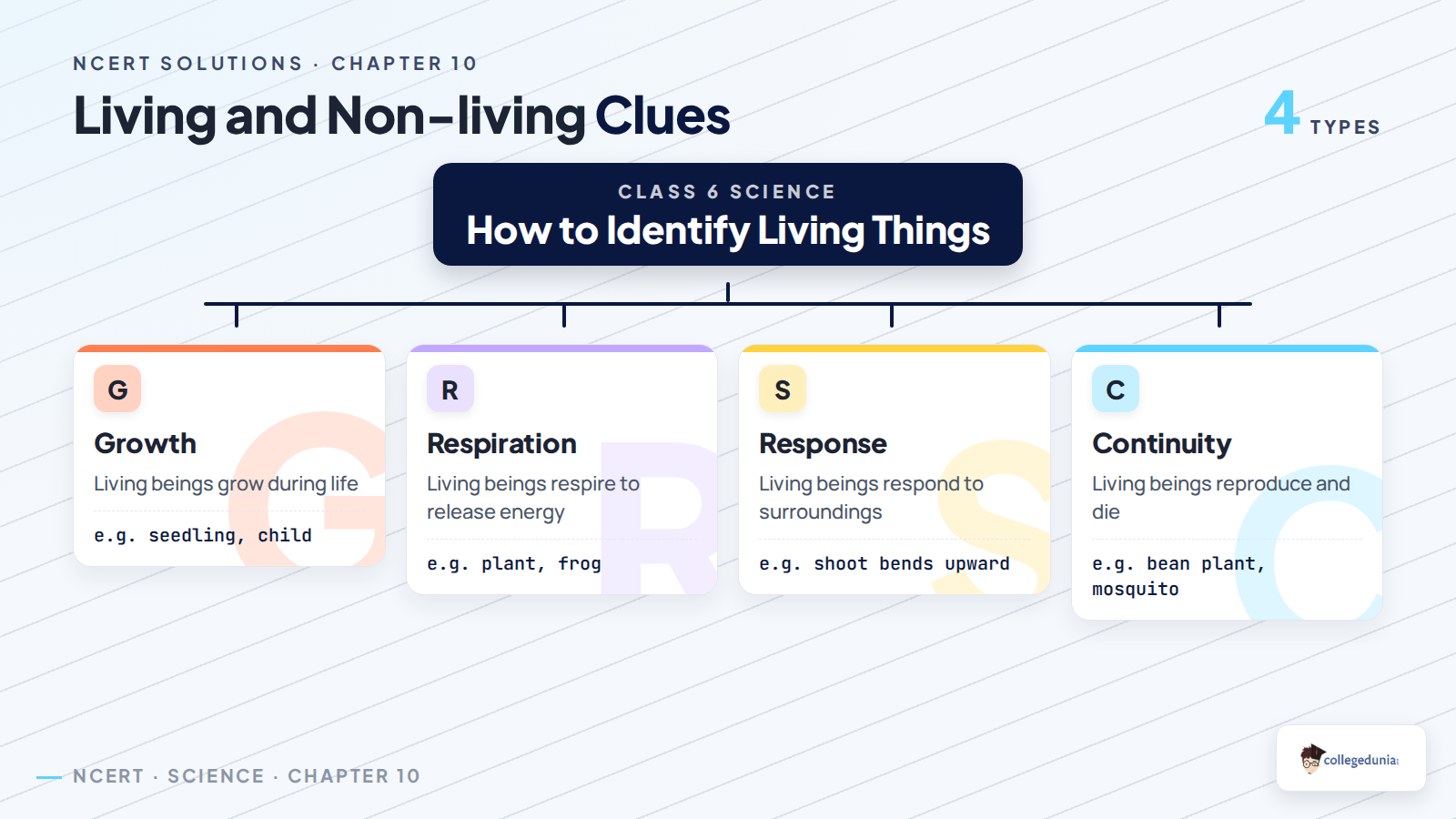
- A plant is living even though it does not move from place to place.
- A crystal may become bigger, but it does not respire.
- A wooden log is non-living now because it does not carry out life processes.
- A bean plant is living because it grows, respires and reproduces.
Life Cycle Stages in Living Creatures
Life cycles explain how living beings continue their kind. A plant may begin from a seed, grow into a seedling and form new seeds. A mosquito passes through egg, larva, pupa and adult stages. A frog passes through egg, tadpole, froglet and adult stages.
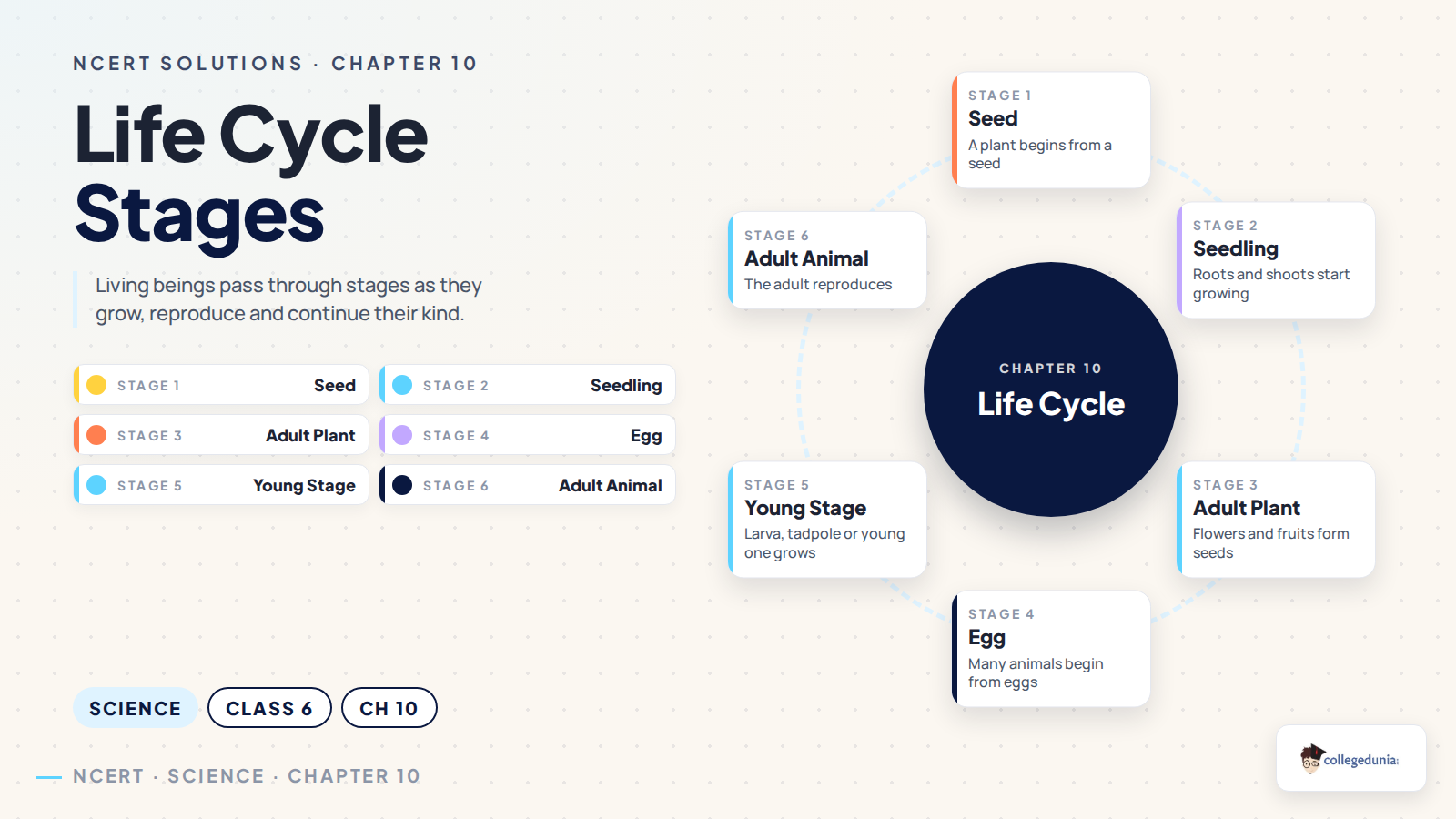
The key difference: plants and animals both grow and reproduce, but their stages look different. The tadpole has a tail for swimming. The adult frog has legs for jumping and swimming.
Question Cards for Chapter 10 NCERT Solutions
The companion question-card page gives each Chapter 10 prompt with a Check Solution panel and an Expert Solution panel. It is useful for oral revision before opening the full PDF.
Open question cards: Class 6 Science Chapter 10 step-by-step solutions
Related Class 6 Science Chapter 10 Resources
| Resource | Class 6 Science Chapter 10 Link |
|---|---|
| Revision Notes | Revise Chapter 10 with notes |
| Handwritten Notes | Open handwritten revision notes |
Class 6 Science Curiosity NCERT Solutions for All Chapters
| Chapter | NCERT Solutions |
|---|---|
| Chapter 1 | The Wonderful World of Science Solutions |
| Chapter 2 | Diversity in the Living World Solutions |
| Chapter 3 | Mindful Eating: A Path to a Healthy Body Solutions |
| Chapter 4 | Exploring Magnets Solutions |
| Chapter 5 | Measurement of Length and Motion Solutions |
| Chapter 6 | Materials Around Us Solutions |
| Chapter 7 | Temperature and its Measurement Solutions |
| Chapter 8 | A Journey through States of Water Solutions |
| Chapter 9 | Methods of Separation in Everyday Life Solutions |
| Chapter 10 | Living Creatures: Exploring their Characteristics Solutions |
Class 6 Science Chapter 10 NCERT Solutions FAQs
Ques. What is covered in Class 6 Science Chapter 10 NCERT Solutions?
Ans. The solutions cover living and non-living things, seed germination, roots, shoots, mosquito and frog life cycles, and all 9 exercise questions.
Ques. Are these answers based on the 2026-27 NCERT book?
Ans. Yes. The PDF follows the 2026-27 NCERT Class 6 Science Curiosity Chapter 10 Living Creatures: Exploring their Characteristics.
Ques. Why is movement alone not enough to identify a living thing?
Ans. A car can move, but it does not grow, respire, reproduce or respond like a living being. Several life processes must be checked together.
Ques. What should students draw for the sideways plant question?
Ans. Students should draw the root bending downward and the shoot bending upward. The reason is that roots and shoots grow in different directions.



Comments