



The NCERT Solutions for Class 6 Science Curiosity Chapter 11 Nature's Treasures explain every exercise question from the 2026-27 NCERT textbook. Students can download the PDF to revise natural resources, renewable and non-renewable resources, air, water, forests, soil, rocks, minerals, fossil fuels and conservation with clear step-by-step answers.
- Resource: Class 6 Science Chapter 11 NCERT Solutions PDF.
- Chapter focus: nature's treasures, fossil fuels, solar energy, forests and water conservation.
- Question type: matching, true-false, MCQs, classification, reasoning and report-writing answers.
Chapter11Nature’sTreasuresSolutions.pdf?page=1&dpi=150)
Chapter11Nature’sTreasuresSolutions.pdf?page=2&dpi=150)
Chapter11Nature’sTreasuresSolutions.pdf?page=3&dpi=150)
Chapter11Nature’sTreasuresSolutions.pdf?page=4&dpi=150)
Chapter11Nature’sTreasuresSolutions.pdf?page=5&dpi=150)
Chapter11Nature’sTreasuresSolutions.pdf?page=6&dpi=150)
Chapter11Nature’sTreasuresSolutions.pdf?page=7&dpi=150)
Chapter11Nature’sTreasuresSolutions.pdf?page=8&dpi=150)
Chapter11Nature’sTreasuresSolutions.pdf?page=9&dpi=150)
Chapter11Nature’sTreasuresSolutions.pdf?page=10&dpi=150)
Chapter11Nature’sTreasuresSolutions.pdf?page=11&dpi=150)
Chapter11Nature’sTreasuresSolutions.pdf?page=12&dpi=150)
Chapter11Nature’sTreasuresSolutions.pdf?page=13&dpi=150)
Chapter11Nature’sTreasuresSolutions.pdf?page=14&dpi=150)
Chapter11Nature’sTreasuresSolutions.pdf?page=15&dpi=150)
Chapter11Nature’sTreasuresSolutions.pdf?page=16&dpi=150)
Chapter11Nature’sTreasuresSolutions.pdf?page=17&dpi=150)
Chapter11Nature’sTreasuresSolutions.pdf?page=18&dpi=150)
Chapter11Nature’sTreasuresSolutions.pdf?page=19&dpi=150)
Chapter11Nature’sTreasuresSolutions.pdf?page=20&dpi=150)
Chapter11Nature’sTreasuresSolutions.pdf?page=21&dpi=150)
Chapter11Nature’sTreasuresSolutions.pdf?page=22&dpi=150)
Chapter11Nature’sTreasuresSolutions.pdf?page=23&dpi=150)
Chapter11Nature’sTreasuresSolutions_flat_MobileCard.pdf?page=1&dpi=150)
Chapter11Nature’sTreasuresSolutions_flat_MobileCard.pdf?page=2&dpi=150)
Chapter11Nature’sTreasuresSolutions_flat_MobileCard.pdf?page=3&dpi=150)
Chapter11Nature’sTreasuresSolutions_flat_MobileCard.pdf?page=4&dpi=150)
Chapter11Nature’sTreasuresSolutions_flat_MobileCard.pdf?page=5&dpi=150)
Chapter11Nature’sTreasuresSolutions_flat_MobileCard.pdf?page=6&dpi=150)
Chapter11Nature’sTreasuresSolutions_flat_MobileCard.pdf?page=7&dpi=150)
Chapter11Nature’sTreasuresSolutions_flat_MobileCard.pdf?page=8&dpi=150)
Chapter11Nature’sTreasuresSolutions_flat_MobileCard.pdf?page=9&dpi=150)
Chapter11Nature’sTreasuresSolutions_flat_MobileCard.pdf?page=10&dpi=150)
Chapter11Nature’sTreasuresSolutions_flat_MobileCard.pdf?page=11&dpi=150)
Chapter11Nature’sTreasuresSolutions_flat_MobileCard.pdf?page=12&dpi=150)
Chapter11Nature’sTreasuresSolutions_flat_MobileCard.pdf?page=13&dpi=150)
Chapter11Nature’sTreasuresSolutions_flat_MobileCard.pdf?page=14&dpi=150)
Chapter11Nature’sTreasuresSolutions_flat_MobileCard.pdf?page=15&dpi=150)
Chapter11Nature’sTreasuresSolutions_flat_MobileCard.pdf?page=16&dpi=150)
Chapter11Nature’sTreasuresSolutions_flat_MobileCard.pdf?page=17&dpi=150)
Chapter11Nature’sTreasuresSolutions_flat_MobileCard.pdf?page=18&dpi=150)
Chapter11Nature’sTreasuresSolutions_flat_MobileCard.pdf?page=19&dpi=150)
Chapter11Nature’sTreasuresSolutions_flat_MobileCard.pdf?page=20&dpi=150)
Chapter11Nature’sTreasuresSolutions_flat_MobileCard.pdf?page=21&dpi=150)
Chapter11Nature’sTreasuresSolutions_flat_MobileCard.pdf?page=22&dpi=150)
Chapter11Nature’sTreasuresSolutions_flat_MobileCard.pdf?page=23&dpi=150)
Chapter11Nature’sTreasuresSolutions_flat_MobileCard.pdf?page=24&dpi=150)
Chapter11Nature’sTreasuresSolutions_flat_MobileCard.pdf?page=25&dpi=150)
Chapter11Nature’sTreasuresSolutions_flat_MobileCard.pdf?page=26&dpi=150)
Chapter11Nature’sTreasuresSolutions_flat_MobileCard.pdf?page=27&dpi=150)
Chapter11Nature’sTreasuresSolutions_flat_MobileCard.pdf?page=28&dpi=150)
Chapter11Nature’sTreasuresSolutions_flat_MobileCard.pdf?page=29&dpi=150)
Chapter11Nature’sTreasuresSolutions_flat_MobileCard.pdf?page=30&dpi=150)
Chapter11Nature’sTreasuresSolutions_flat_MobileCard.pdf?page=31&dpi=150)
Chapter11Nature’sTreasuresSolutions_flat_MobileCard.pdf?page=32&dpi=150)
Chapter11Nature’sTreasuresSolutions_flat_MobileCard.pdf?page=33&dpi=150)
Chapter11Nature’sTreasuresSolutions_flat_MobileCard.pdf?page=34&dpi=150)
Chapter11Nature’sTreasuresSolutions_flat_MobileCard.pdf?page=35&dpi=150)
Chapter11Nature’sTreasuresSolutions_flat_MobileCard.pdf?page=36&dpi=150)
Chapter11Nature’sTreasuresSolutions_flat_MobileCard.pdf?page=37&dpi=150)
Chapter11Nature’sTreasuresSolutions_flat_MobileCard.pdf?page=38&dpi=150)
Chapter11Nature’sTreasuresSolutions_flat_MobileCard.pdf?page=39&dpi=150)
Chapter11Nature’sTreasuresSolutions_flat_MobileCard.pdf?page=40&dpi=150)
Chapter11Nature’sTreasuresSolutions_flat_MobileCard.pdf?page=41&dpi=150)
Chapter11Nature’sTreasuresSolutions_flat_MobileCard.pdf?page=42&dpi=150)
Chapter11Nature’sTreasuresSolutions_flat_MobileCard.pdf?page=43&dpi=150)
Student Feedback: Students found the classification questions easier after separating examples into renewable and non-renewable resources first.
Class 6 Science Chapter 11 Solutions Overview
Chapter 11 explains that nature provides the resources needed for life. Air, water, sunlight, forests, soil, rocks, minerals and fossil fuels are important resources. The chapter also explains why some resources renew naturally while others take a very long time to form.
The exercise has 16 questions. A strong answer usually names the resource, classifies it, and then gives one short reason. For report-style questions, students should write a balanced answer with practical actions.
| Question area | What to remember | Answer cue |
|---|---|---|
| Renewable resources | Restored in a reasonable time | air, water, wind, forests |
| Non-renewable resources | Limited or formed very slowly | coal, petroleum, natural gas, minerals |
| Water conservation | Freshwater is limited and precious | close taps, fix leaks, harvest rainwater |
| Forests | Forests protect soil and support life | avoid cutting and plant responsibly |
| Solar energy | Energy from the Sun is renewable | solar cooker, panels and heaters |
Nature's Treasures Resource Revision Video
Source: Magnet Brains on YouTube
Natural Resources Classification in Nature's Treasures
Natural resources are resources that we get from nature. The chapter classifies them as renewable and non-renewable. This classification is important because it tells us how carefully each resource must be used.
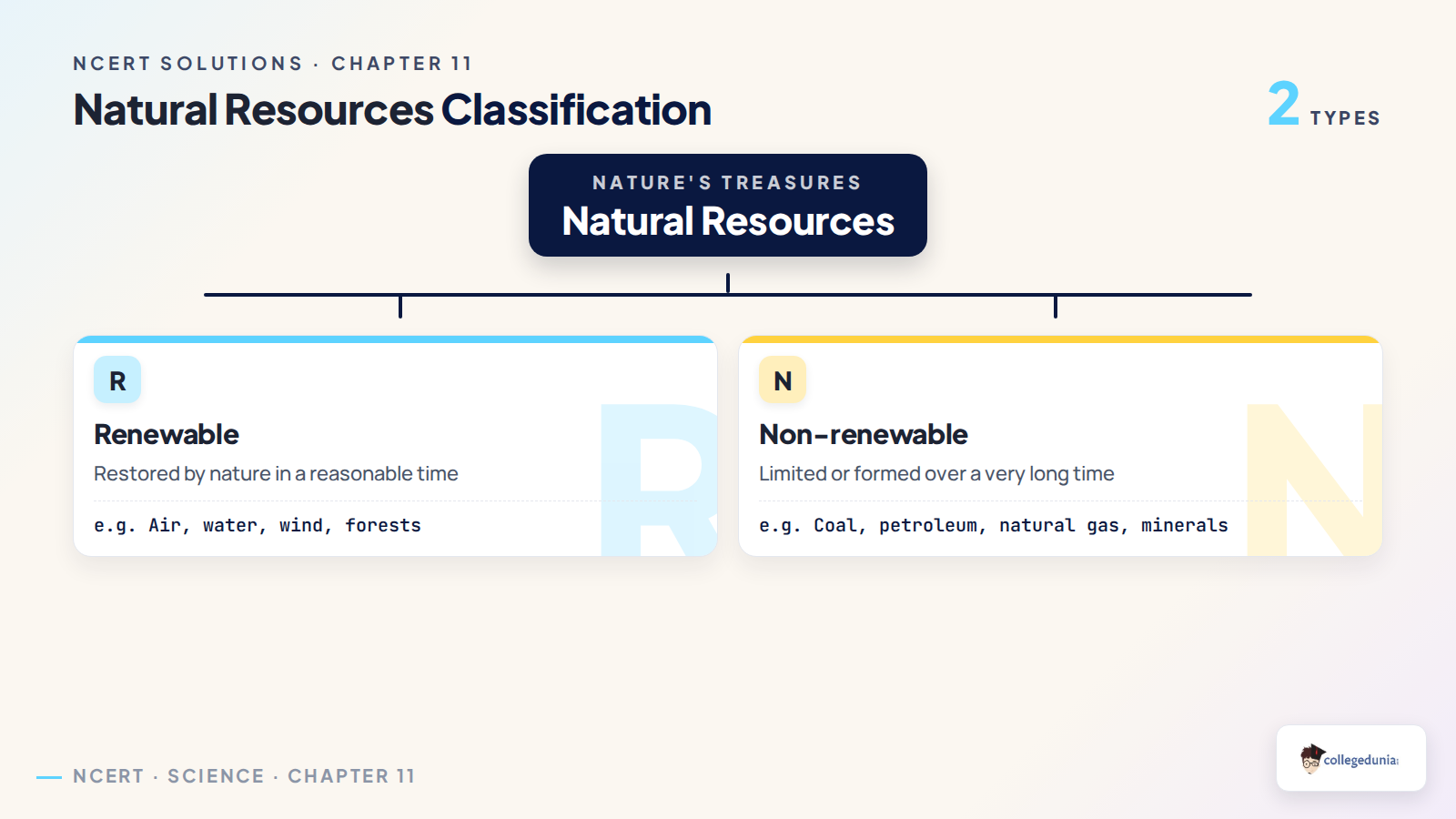
- Renewable resources: air, water, wind and forests can be renewed by natural processes.
- Non-renewable resources: coal, petroleum, natural gas, rocks and minerals take a very long time to form.
- Important caution: renewable does not mean unlimited. Freshwater and forests can still be damaged by careless use.
Renewable and Non-renewable Resources in the Exercise
The exercise asks students to match pictures, decode jumbled words and classify resources. The picture of a tap becomes water, the windmill becomes wind, the forest picture becomes forest, and the stone picture becomes rock.
Water, wind and forest are renewable resources. Rock is non-renewable because rocks take thousands to millions of years to form. Coal and natural gas are also non-renewable because they are fossil fuels.
| Resource | Type | Reason |
|---|---|---|
| Water | Renewable | Renewed through the water cycle, but freshwater is limited. |
| Wind | Renewable | Moving air forms naturally. |
| Forest | Renewable | Can regrow if protected and given enough time. |
| Coal | Non-renewable | Takes millions of years to form. |
| Natural gas | Non-renewable | A fossil fuel found in limited quantity. |
| Minerals | Non-renewable | Form over very long periods. |
Fossil Fuels, Solar Energy and Conservation Answers
Petrol, diesel and kerosene are obtained from petroleum. Petroleum, natural gas and coal are called fossil fuels. They are formed from buried remains of ancient living things and take millions of years to form.
The chapter also shows cleaner choices. Solar cookers use energy from the Sun. Windmills use moving air. Walking, cycling and public transport reduce fossil-fuel use. These examples help students answer application-based questions.
Water-saving Plan for School
The last exercise question asks students to propose a plan to use less water in school. The best answer should have steps that can actually be followed, not only slogans.
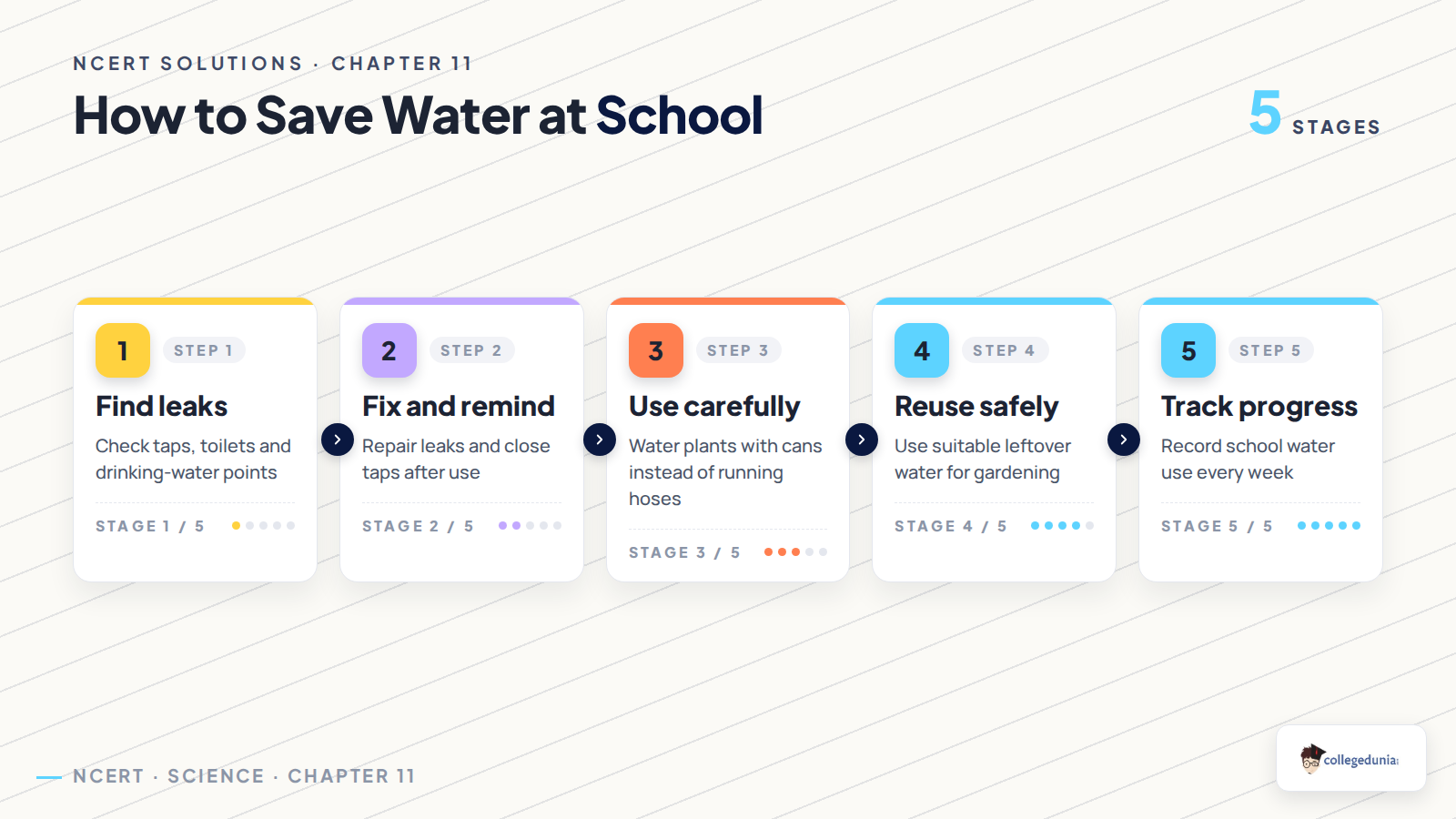
- Check all taps, toilets and drinking-water areas for leaks.
- Repair leaks quickly and put reminders near taps.
- Use watering cans for plants instead of running hoses.
- Reuse suitable leftover water safely for gardening.
- Record weekly water use to check whether the plan is working.
Question Cards for Chapter 11 NCERT Solutions
The companion question-card page gives each Chapter 11 prompt with a Check Solution panel and an Expert Solution panel. It is useful for quick oral revision before opening the full PDF.
Open question cards: Class 6 Science Chapter 11 step-by-step solutions
Related Class 6 Science Chapter 11 Resources
| Resource | Class 6 Science Chapter 11 Link |
|---|---|
| Revision Notes | Revise Nature's Treasures with notes |
| Handwritten Notes | Open handwritten revision notes |
Class 6 Science Curiosity NCERT Solutions for All Chapters
| Chapter | NCERT Solutions |
|---|---|
| Chapter 1 | The Wonderful World of Science Solutions |
| Chapter 2 | Diversity in the Living World Solutions |
| Chapter 3 | Mindful Eating: A Path to a Healthy Body Solutions |
| Chapter 4 | Exploring Magnets Solutions |
| Chapter 5 | Measurement of Length and Motion Solutions |
| Chapter 6 | Materials Around Us Solutions |
| Chapter 7 | Temperature and its Measurement Solutions |
| Chapter 8 | A Journey through States of Water Solutions |
| Chapter 9 | Methods of Separation in Everyday Life Solutions |
| Chapter 10 | Living Creatures: Exploring their Characteristics Solutions |
| Chapter 11 | Nature's Treasures Solutions |
Class 6 Science Chapter 11 NCERT Solutions FAQs
Ques. What is covered in Class 6 Science Chapter 11 NCERT Solutions?
Ans. The solutions cover natural resources, air, water, solar energy, forests, soil, rocks, minerals, fossil fuels and all 16 exercise questions.
Ques. Are these answers based on the 2026-27 NCERT book?
Ans. Yes. The PDF follows the 2026-27 NCERT Class 6 Science Curiosity Chapter 11 Nature's Treasures.
Ques. Why is petroleum called a non-renewable resource?
Ans. Petroleum is limited and takes millions of years to form. It cannot be replaced quickly after humans use it.
Ques. What is the best way to answer resource classification questions?
Ans. First identify the resource, then decide whether nature renews it in a reasonable time. Add one reason for the classification.



Comments