



NCERT Solutions for Class 7 Mathematics (Part 1) Chapter 1 Large Numbers Around Us help students practise the 2026-27 textbook questions on lakh, crore, place value, estimation, products, and real-life comparisons. The PDF below keeps the answers stepwise so students can check both the method and the final value.
Chapter1LargeNumbersAroundUsSolutions.pdf?page=1&dpi=150)
Chapter1LargeNumbersAroundUsSolutions.pdf?page=2&dpi=150)
Chapter1LargeNumbersAroundUsSolutions.pdf?page=3&dpi=150)
Chapter1LargeNumbersAroundUsSolutions.pdf?page=4&dpi=150)
Chapter1LargeNumbersAroundUsSolutions.pdf?page=5&dpi=150)
Chapter1LargeNumbersAroundUsSolutions.pdf?page=6&dpi=150)
Chapter1LargeNumbersAroundUsSolutions.pdf?page=7&dpi=150)
Chapter1LargeNumbersAroundUsSolutions.pdf?page=8&dpi=150)
Chapter1LargeNumbersAroundUsSolutions.pdf?page=9&dpi=150)
Chapter1LargeNumbersAroundUsSolutions.pdf?page=10&dpi=150)
Chapter1LargeNumbersAroundUsSolutions.pdf?page=11&dpi=150)
Chapter1LargeNumbersAroundUsSolutions.pdf?page=12&dpi=150)
Chapter1LargeNumbersAroundUsSolutions.pdf?page=13&dpi=150)
Chapter1LargeNumbersAroundUsSolutions.pdf?page=14&dpi=150)
Chapter1LargeNumbersAroundUsSolutions.pdf?page=15&dpi=150)
Chapter1LargeNumbersAroundUsSolutions.pdf?page=16&dpi=150)
Chapter1LargeNumbersAroundUsSolutions.pdf?page=17&dpi=150)
Chapter1LargeNumbersAroundUsSolutions.pdf?page=18&dpi=150)
Chapter1LargeNumbersAroundUsSolutions.pdf?page=19&dpi=150)
Chapter1LargeNumbersAroundUsSolutions.pdf?page=20&dpi=150)
Chapter1LargeNumbersAroundUsSolutions.pdf?page=21&dpi=150)
Chapter1LargeNumbersAroundUsSolutions.pdf?page=22&dpi=150)
Chapter1LargeNumbersAroundUsSolutions_flat_MobileCard.pdf?page=1&dpi=150)
Chapter1LargeNumbersAroundUsSolutions_flat_MobileCard.pdf?page=2&dpi=150)
Chapter1LargeNumbersAroundUsSolutions_flat_MobileCard.pdf?page=3&dpi=150)
Chapter1LargeNumbersAroundUsSolutions_flat_MobileCard.pdf?page=4&dpi=150)
Chapter1LargeNumbersAroundUsSolutions_flat_MobileCard.pdf?page=5&dpi=150)
Chapter1LargeNumbersAroundUsSolutions_flat_MobileCard.pdf?page=6&dpi=150)
Chapter1LargeNumbersAroundUsSolutions_flat_MobileCard.pdf?page=7&dpi=150)
Chapter1LargeNumbersAroundUsSolutions_flat_MobileCard.pdf?page=8&dpi=150)
Chapter1LargeNumbersAroundUsSolutions_flat_MobileCard.pdf?page=9&dpi=150)
Chapter1LargeNumbersAroundUsSolutions_flat_MobileCard.pdf?page=10&dpi=150)
Chapter1LargeNumbersAroundUsSolutions_flat_MobileCard.pdf?page=11&dpi=150)
Chapter1LargeNumbersAroundUsSolutions_flat_MobileCard.pdf?page=12&dpi=150)
Chapter1LargeNumbersAroundUsSolutions_flat_MobileCard.pdf?page=13&dpi=150)
Chapter1LargeNumbersAroundUsSolutions_flat_MobileCard.pdf?page=14&dpi=150)
Chapter1LargeNumbersAroundUsSolutions_flat_MobileCard.pdf?page=15&dpi=150)
Chapter1LargeNumbersAroundUsSolutions_flat_MobileCard.pdf?page=16&dpi=150)
Chapter1LargeNumbersAroundUsSolutions_flat_MobileCard.pdf?page=17&dpi=150)
Chapter1LargeNumbersAroundUsSolutions_flat_MobileCard.pdf?page=18&dpi=150)
Chapter1LargeNumbersAroundUsSolutions_flat_MobileCard.pdf?page=19&dpi=150)
Chapter1LargeNumbersAroundUsSolutions_flat_MobileCard.pdf?page=20&dpi=150)
Chapter1LargeNumbersAroundUsSolutions_flat_MobileCard.pdf?page=21&dpi=150)
Chapter1LargeNumbersAroundUsSolutions_flat_MobileCard.pdf?page=22&dpi=150)
Chapter1LargeNumbersAroundUsSolutions_flat_MobileCard.pdf?page=23&dpi=150)
Chapter1LargeNumbersAroundUsSolutions_flat_MobileCard.pdf?page=24&dpi=150)
Chapter1LargeNumbersAroundUsSolutions_flat_MobileCard.pdf?page=25&dpi=150)
Chapter1LargeNumbersAroundUsSolutions_flat_MobileCard.pdf?page=26&dpi=150)
Chapter1LargeNumbersAroundUsSolutions_flat_MobileCard.pdf?page=27&dpi=150)
Chapter1LargeNumbersAroundUsSolutions_flat_MobileCard.pdf?page=28&dpi=150)
Chapter1LargeNumbersAroundUsSolutions_flat_MobileCard.pdf?page=29&dpi=150)
Chapter1LargeNumbersAroundUsSolutions_flat_MobileCard.pdf?page=30&dpi=150)
Chapter1LargeNumbersAroundUsSolutions_flat_MobileCard.pdf?page=31&dpi=150)
Chapter1LargeNumbersAroundUsSolutions_flat_MobileCard.pdf?page=32&dpi=150)
Chapter1LargeNumbersAroundUsSolutions_flat_MobileCard.pdf?page=33&dpi=150)
Chapter1LargeNumbersAroundUsSolutions_flat_MobileCard.pdf?page=34&dpi=150)
Chapter1LargeNumbersAroundUsSolutions_flat_MobileCard.pdf?page=35&dpi=150)
Chapter1LargeNumbersAroundUsSolutions_flat_MobileCard.pdf?page=36&dpi=150)
Chapter1LargeNumbersAroundUsSolutions_flat_MobileCard.pdf?page=37&dpi=150)
Chapter1LargeNumbersAroundUsSolutions_flat_MobileCard.pdf?page=38&dpi=150)
Chapter1LargeNumbersAroundUsSolutions_flat_MobileCard.pdf?page=39&dpi=150)
Chapter1LargeNumbersAroundUsSolutions_flat_MobileCard.pdf?page=40&dpi=150)
Chapter1LargeNumbersAroundUsSolutions_flat_MobileCard.pdf?page=41&dpi=150)
Chapter1LargeNumbersAroundUsSolutions_flat_MobileCard.pdf?page=42&dpi=150)
Chapter1LargeNumbersAroundUsSolutions_flat_MobileCard.pdf?page=43&dpi=150)
Chapter1LargeNumbersAroundUsSolutions_flat_MobileCard.pdf?page=44&dpi=150)
- PDF covers 24 grouped textbook question blocks with worked answers.
- Every answer follows place-value reasoning before the final result.
- Questions HTML is embedded below for quick checking on mobile.
NCERT Solutions Class 7 Maths Chapter 1 Overview
Large Numbers Around Us introduces students to one lakh, one crore, million, billion, Indian place value, American place value, rounding, nearest neighbours, and quick multiplication patterns. The chapter uses everyday contexts such as city populations, heights, journeys, and paper sheets so that large numbers feel measurable instead of abstract.
The solved PDF is aligned with the NCERT 2026-27 chapter sequence. It groups closely related subparts together, which keeps the solution flow readable while still covering the full chapter surface.
Large Numbers Around Us Video Explanation
Source: Magnet Brains
How to Use Place Value in Chapter 1
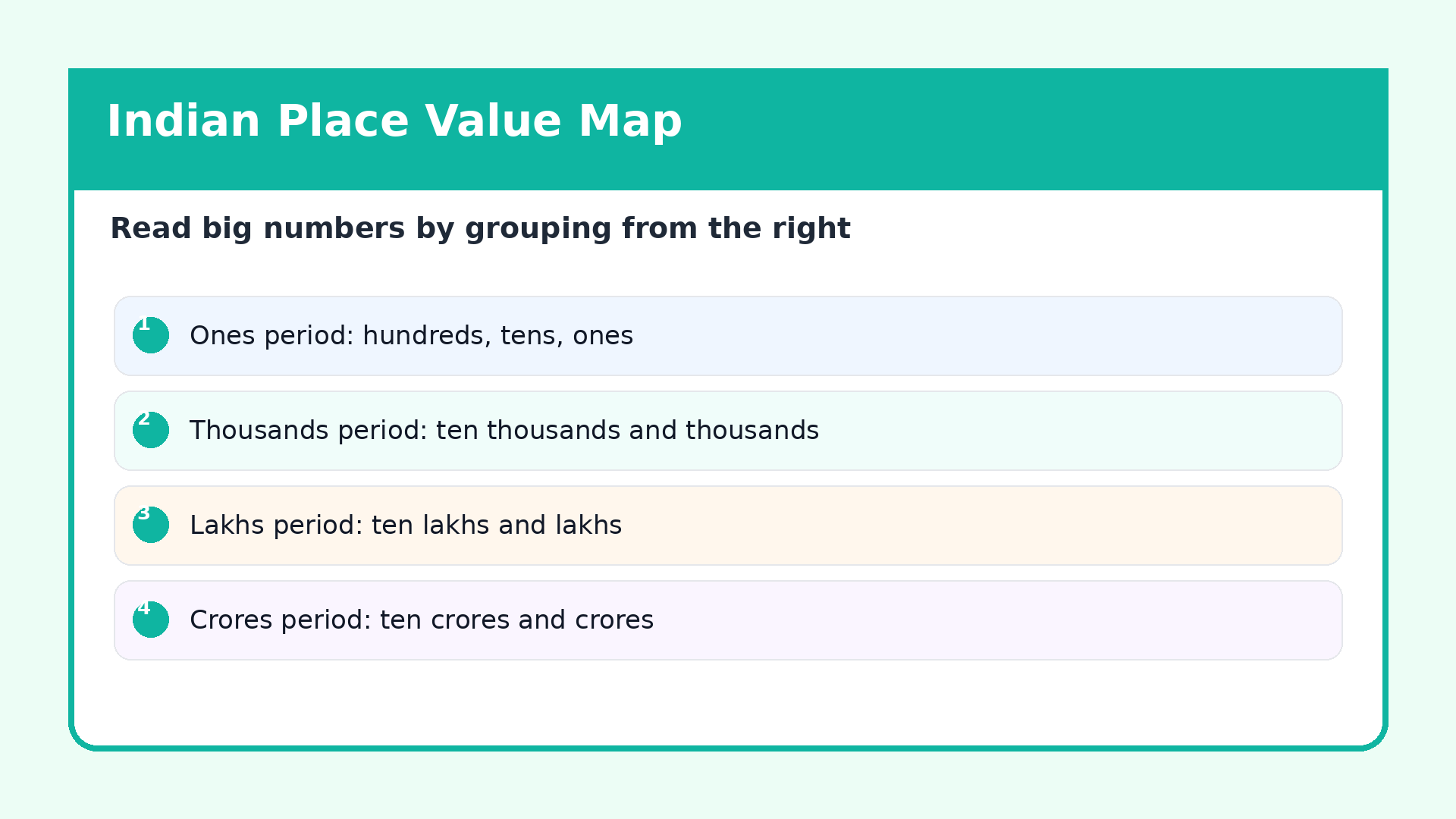
The first rule is to group digits from the right. In the Indian system, the first group has three digits and every group after that has two digits. So 70,53,138 is read as seventy lakh fifty three thousand one hundred thirty eight.
- Compare with 1,00,000 when a question says one lakh.
- Subtract smaller population values from larger values to find increases.
- Use commas before reading number names aloud.
Important NCERT Solutions from Large Numbers Around Us
The table below summarises a few high-use answers from the PDF. Students should still read the full solution because the working explains why each comma, estimate, or multiplication shortcut is valid.
| Question | Final Answer |
|---|---|
| Question 1.1 | 25,000 less, 6,000 more, and an increase of 31,000. |
| Question 1.2 | 999, 1000, 9999, 10,000, 99,999, 1,00,000. |
| Question 1.3 | One and two per day are not enough. Three per day is enough. |
| Question 1.4 | Building about 40 m, statue 140 m taller, waterfall 410 m taller, about 113 floors. |
| Question 1.5 | Three lakh six hundred; five lakh four thousand eighty five; twenty seven lakh thirty thousand; seventy lakh fifty three thousand one hundred thirty eight. |
| Question 1.6 | 1,23,456; 4,07,704; 50,05,050; 10,00,235. |
| Question 1.7 | Use target number divided by button value. Handy Hundreds has no extra multiples beyond Tedious Tens. |
| Question 1.8 | Each number can be split by place value or by regrouped place values. |
Quick Product Patterns and Estimates
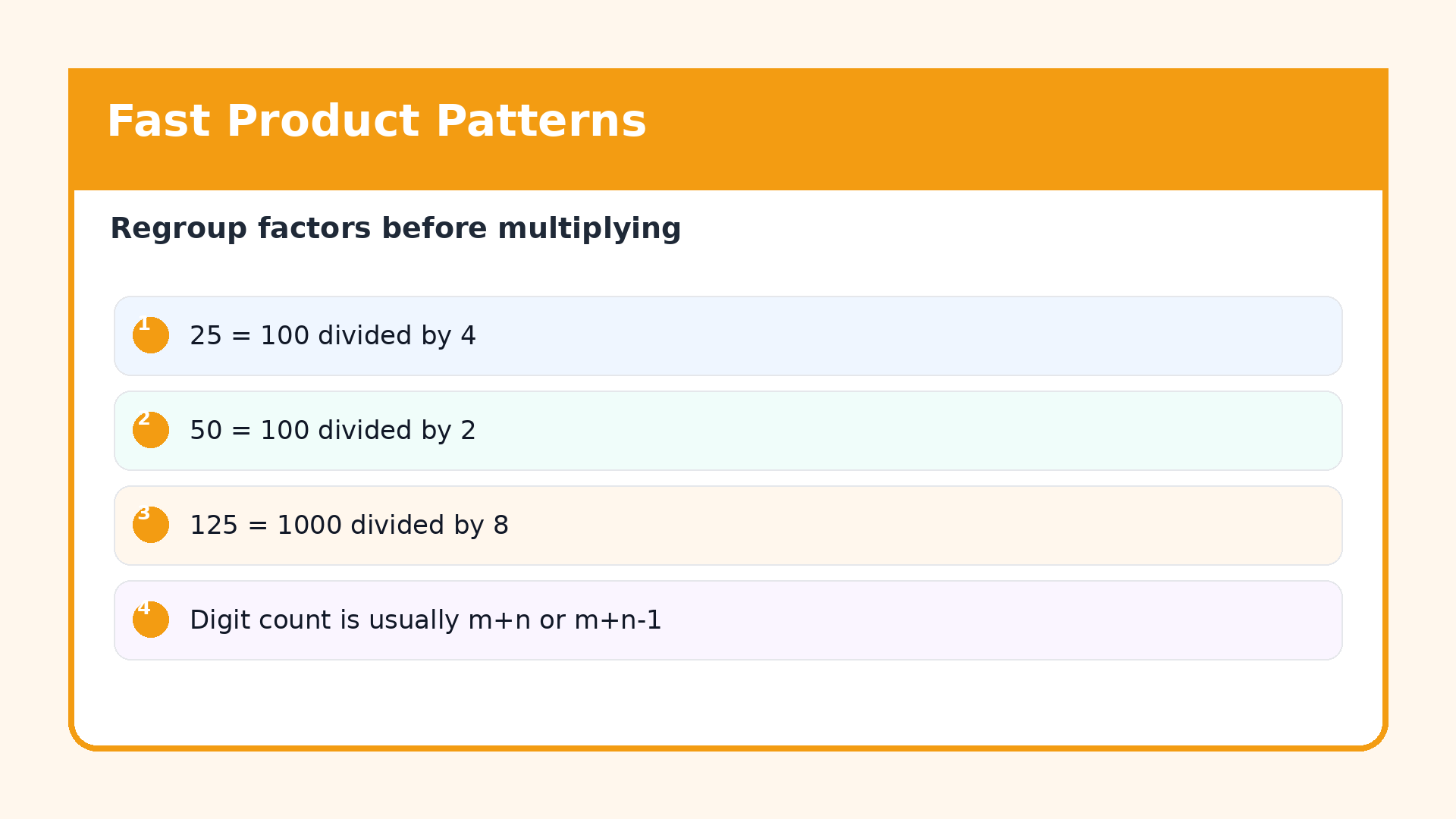
The chapter repeatedly uses shortcuts such as 25 = 100 divided by 4, 50 = 100 divided by 2, and 125 = 1000 divided by 8. These shortcuts reduce long multiplication into smaller mental steps.
- 2 x 1768 x 50 becomes 1768 x 100.
- 72 x 125 becomes 9 x 1000.
- 125 x 40 x 8 x 25 becomes 1000 x 1000.
Related Class 7 Mathematics Chapter 1 Resources
| NCERT Solutions | Step-by-step answers |
| Revision Notes | Large Numbers Around Us notes |
| NCERT Book PDF | Chapter 1 textbook PDF |
Class 7 Mathematics Part 1 NCERT Solutions All Chapters
| Chapter 1 | Large Numbers Around Us Solutions |
| Chapter 2 | Arithmetic Expressions Solutions |
| Chapter 3 | A Peek Beyond the Point Solutions |
| Chapter 4 | Expressions Using Letter-Numbers Solutions |
| Chapter 5 | Parallel and Intersecting Lines Solutions |
All NCERT Solutions for Large Numbers Around Us with Step-by-Step Solutions
Question 1.1
Chintamani had about 75,000 people in 2011. How much less than one lakh is this? The 2024 estimate is 1,06,000. How much more than one lakh is it? By how much did the population increase?
- One lakh means 1,00,000.
- 1,00,000 - 75,000 = 25,000, so 75,000 is 25,000 less than one lakh.
- 1,06,000 - 1,00,000 = 6,000, so 1,06,000 is 6,000 more than one lakh.
- 1,06,000 - 75,000 = 31,000, so the population increased by 31,000.
Answer: 25,000 less, 6,000 more, and an increase of 31,000.
Expert view: Use place value first, then calculate. 25,000 less, 6,000 more, and an increase of 31,000.
Question 1.2
Read and write the early large-number blanks: largest 3-digit number, smallest 4-digit number, largest 4-digit number, smallest 5-digit number, largest 5-digit number, and smallest 6-digit number.
- The largest 3-digit number is 999.
- Adding 1 gives 1000, the smallest 4-digit number.
- The largest 4-digit number is 9999.
- Adding 1 gives 10,000, the smallest 5-digit number.
- The largest 5-digit number is 99,999.
- Adding 1 gives 1,00,000, the smallest 6-digit number, read as one lakh.
Answer: 999, 1000, 9999, 10,000, 99,999, 1,00,000.
Expert view: Use place value first, then calculate. 999, 1000, 9999, 10,000, 99,999, 1,00,000.
Question 1.3
If a person eats 1, 2, or 3 rice varieties every day for a 100-year lifetime, can they taste one lakh varieties? Ignore leap years.
- Days in 100 years = 365 x 100 = 36,500.
- At 1 variety each day: 36,500 varieties.
- At 2 varieties each day: 73,000 varieties.
- At 3 varieties each day: 1,09,500 varieties.
- Only 3 varieties per day crosses one lakh.
Answer: One and two per day are not enough. Three per day is enough.
Expert view: Use place value first, then calculate. One and two per day are not enough. Three per day is enough.
Question 1.4
Somu is 1 metre tall, and each floor is about four times his height. Use the given scale to compare Somu's building, the Statue of Unity, and Kunchikal waterfall.
- Each floor is about 4 m.
- The picture shows a 10-floor building, so its height is about 10 x 4 = 40 m.
- The Statue of Unity is about 180 m. It is taller by 180 - 40 = 140 m.
- Kunchikal waterfall is about 450 m. It is taller by 450 - 40 = 410 m.
- Floors needed for a 450 m height = 450 / 4 = 112.5, so about 113 floors.
Answer: Building about 40 m, statue 140 m taller, waterfall 410 m taller, about 113 floors.
Expert view: Use place value first, then calculate. Building about 40 m, statue 140 m taller, waterfall 410 m taller, about 113 floors.
Question 1.5
Write the number names of 3,00,600, 5,04,085, 27,30,000, and 70,53,138.
- 3,00,600 is three lakh six hundred.
- 5,04,085 is five lakh four thousand eighty five.
- 27,30,000 is twenty seven lakh thirty thousand.
- 70,53,138 is seventy lakh fifty three thousand one hundred thirty eight.
Answer: Three lakh six hundred; five lakh four thousand eighty five; twenty seven lakh thirty thousand; seventy lakh fifty three thousand one hundred thirty eight.
Expert view: Use place value first, then calculate. Three lakh six hundred; five lakh four thousand eighty five; twenty seven lakh thirty thousand; seventy lakh fifty three thousand one hundred thirty eight.
Question 1.6
Write the numbers for: one lakh twenty three thousand four hundred and fifty six; four lakh seven thousand seven hundred and four; fifty lakhs five thousand and fifty; ten lakhs two hundred and thirty five.
- One lakh twenty three thousand four hundred fifty six = 1,23,456.
- Four lakh seven thousand seven hundred four = 4,07,704.
- Fifty lakhs five thousand fifty = 50,05,050.
- Ten lakhs two hundred thirty five = 10,00,235.
Answer: 1,23,456; 4,07,704; 50,05,050; 10,00,235.
Expert view: Use place value first, then calculate. 1,23,456; 4,07,704; 50,05,050; 10,00,235.
Question 1.7
For the +1000, +10, and +100 calculators, find the missing button presses and explain which numbers each calculator can show.
- +1000 calculator: 10,000 needs 10 presses, 53,000 needs 53, 90,000 needs 90, 1,00,000 needs 100, and 153 presses gives 1,53,000.
- +10 calculator: 500 needs 50 presses, 780 needs 78, 1000 needs 100, 3700 needs 370, 10,000 needs 1000, 1,00,000 needs 10,000, and 435 presses gives 4350.
- +100 calculator: 400 needs 4 presses, 3700 needs 37, 10,000 needs 100, 53,000 needs 530, 90,000 needs 900, 97,600 needs 976, 1,00,000 needs 1000, and 582 presses gives 58,200.
- The +100 calculator can show multiples of 100. The +10 calculator can show all multiples of 10, so it can show every multiple of 100 too. The statement that Handy Hundreds can show a number Tedious Tens cannot is false.
Answer: Use target number divided by button value. Handy Hundreds has no extra multiples beyond Tedious Tens.
Expert view: Use place value first, then calculate. Use target number divided by button value. Handy Hundreds has no extra multiples beyond Tedious Tens.
Question 1.8
For Creative Chitti, write at least two button-click expressions for 8300, 40629, 56354, 66666, and 367813.
- 8300 = 8 x 1000 + 3 x 100 = 83 x 100.
- 40629 = 4 x 10000 + 6 x 100 + 2 x 10 + 9 = 40 x 1000 + 62 x 10 + 9.
- 56354 = 5 x 10000 + 6 x 1000 + 3 x 100 + 5 x 10 + 4 = 56 x 1000 + 354.
- 66666 = 6 x 10000 + 6 x 1000 + 6 x 100 + 6 x 10 + 6 = 66 x 1000 + 666.
- 367813 = 3 x 100000 + 6 x 10000 + 7 x 1000 + 8 x 100 + 1 x 10 + 3 = 367 x 1000 + 813.
Answer: Each number can be split by place value or by regrouped place values.
Expert view: Use place value first, then calculate. Each number can be split by place value or by regrouped place values.
Question 1.9
Find the smallest number of button clicks for 5072, 8300, 40629, 56354, 66666, and 367813.
- Use the place-value digits as button counts.
- 5072 = 5 x 1000 + 7 x 10 + 2, so 14 clicks.
- 8300 = 8 x 1000 + 3 x 100, so 11 clicks.
- 40629 = 4 x 10000 + 6 x 100 + 2 x 10 + 9, so 21 clicks.
- 56354 = 5 + 6 + 3 + 5 + 4 = 23 clicks by place values.
- 66666 = 6 + 6 + 6 + 6 + 6 = 30 clicks.
- 367813 = 3 + 6 + 7 + 8 + 1 + 3 = 28 clicks.
Answer: 14, 11, 21, 23, 30, and 28 clicks.
Expert view: Use place value first, then calculate. 14, 11, 21, 23, 30, and 28 clicks.
Question 1.10
Read the numbers 4050678, 48121620, 20022002, 246813579, 345000543, and 1020304050 in Indian and American systems.
- 40,50,678: forty lakh fifty thousand six hundred seventy eight. American: four million fifty thousand six hundred seventy eight.
- 4,81,21,620: four crore eighty one lakh twenty one thousand six hundred twenty. American: forty eight million one hundred twenty one thousand six hundred twenty.
- 2,00,22,002: two crore twenty two thousand two. American: twenty million twenty two thousand two.
- 24,68,13,579: twenty four crore sixty eight lakh thirteen thousand five hundred seventy nine. American: two hundred forty six million eight hundred thirteen thousand five hundred seventy nine.
- 34,50,00,543: thirty four crore fifty lakh five hundred forty three. American: three hundred forty five million five hundred forty three.
- 1,02,03,04,050: one arab two crore three lakh four thousand fifty. American: one billion twenty million three hundred four thousand fifty.
Answer: Use Indian groups 3,2,2,... and American groups 3,3,3,... from the right.
Expert view: Use place value first, then calculate. Use Indian groups 3,2,2,... and American groups 3,3,3,... from the right.
Question 1.11
Write numbers for the given number names and compare the given pairs.
- One crore one lakh one thousand ten = 1,01,01,010.
- One billion one million one thousand one = 1,001,001,001.
- Ten crore twenty lakh thirty thousand forty = 10,20,30,040.
- Nine billion eighty million seven hundred thousand six hundred = 9,080,700,600.
- 30 thousand < 3 lakhs, because 30,000 < 3,00,000.
- 500 lakhs = 5 million, because both are 5,00,00,000? Wait: 500 lakhs = 5 crore = 50 million, so 500 lakhs > 5 million.
- 800 thousand < 8 million, because 8,00,000 < 80,00,000.
- 640 crore > 60 billion? Since 640 crore = 6.4 billion, it is less than 60 billion.
Answer: 1,01,01,010; 1,001,001,001; 10,20,30,040; 9,080,700,600; <, >, <, <.
Expert view: Use place value first, then calculate. 1,01,01,010; 1,001,001,001; 10,20,30,040; 9,080,700,600; <, >, <, <.
Question 1.12
Find nearest neighbours for 3,87,69,957 and 29,05,32,481, and describe numbers whose nearest thousand, ten thousand, lakh, ten lakh, and crore are all 5,00,00,000.
- For 3,87,69,957: nearest thousand 3,87,70,000; ten thousand 3,87,70,000; lakh 3,88,00,000; ten lakh 3,90,00,000; crore 4,00,00,000.
- For 29,05,32,481: nearest thousand 29,05,32,000; ten thousand 29,05,30,000; lakh 29,05,00,000; ten lakh 29,10,00,000; crore 29,00,00,000.
- For all five rounded values to be 5,00,00,000, the number must round to 5 crore even at the nearest thousand.
- That gives numbers from 4,99,99,500 to 5,00,00,499, assuming usual rounding to nearest thousand.
Answer: The two neighbour lists are as above. There are 1000 such whole numbers under usual nearest-thousand rounding.
Expert view: Use place value first, then calculate. The two neighbour lists are as above. There are 1000 such whole numbers under usual nearest-thousand rounding.
Question 1.13
Check Roxie and Estu's estimates for 4,63,128 + 4,19,682 and 14,63,128 - 4,90,020.
- 4,63,128 + 4,19,682 = 8,82,810.
- It is more than 8,00,000 and less than 9,00,000. Estu's estimate is closer.
- 8,82,810 is greater than 8,50,000, and less than 8,83,128.
- 14,63,128 - 4,90,020 = 9,73,108.
- It is less than 10,00,000 and more than 9,00,000. Roxie's estimate is closer.
- 9,73,108 is greater than 9,50,000 and greater than 9,63,128.
Answer: 8,82,810 and 9,73,108 with the comparisons listed above.
Expert view: Use place value first, then calculate. 8,82,810 and 9,73,108 with the comparisons listed above.
Question 1.14
Use the city population table to answer the approximation questions.
- Most listed cities grew from 2001 to 2011. Kolkata is one exception.
- A suitable title is Population of Some Indian Cities in 2001 and 2011.
- Pune's 2011 population is 31,15,431. Its increase is 31,15,431 - 25,38,473 = 5,76,958, about 6 lakh.
- Bengaluru increased by 84,25,970 - 43,01,326 = 41,24,644, the largest increase.
- Bengaluru, Hyderabad, Surat, and Vadodara almost doubled.
- Mumbai divided by Patna is about 1,24,42,373 / 16,84,222 = 7.39, so multiply Patna by about 7.4.
Answer: Title, Pune increase, Bengaluru, the near-doubling cities, and multiplier about 7.4.
Expert view: Use place value first, then calculate. Title, Pune increase, Bengaluru, the near-doubling cities, and multiplier about 7.4.
Question 1.15
Find quick products: 2 x 1768 x 50; 72 x 125; 125 x 40 x 8 x 25; 25 x 12; 25 x 240; 250 x 120; 2500 x 12; and one product equal to 120000000.
- 2 x 50 = 100, so 2 x 1768 x 50 = 1,76,800.
- 125 = 1000 / 8, so 72 x 125 = 9 x 1000 = 9000.
- 125 x 8 = 1000 and 40 x 25 = 1000, so the product is 10,00,000.
- 25 x 12 = 300; 25 x 240 = 6000; 250 x 120 = 30,000; 2500 x 12 = 30,000.
- One possible product is 1200 x 1,00,000 = 120000000.
Answer: 1,76,800; 9000; 10,00,000; 300; 6000; 30,000; 30,000; for example 1200 x 1,00,000.
Expert view: Use place value first, then calculate. 1,76,800; 9000; 10,00,000; 300; 6000; 30,000; 30,000; for example 1200 x 1,00,000.
Question 1.16
Use digit-length patterns in products and answer the related questions.
- The product of an m-digit number and an n-digit number has either m+n-1 digits or m+n digits.
- A 2-digit x 2-digit product is 3-digit or 4-digit, so Roxie is correct.
- We need not try all cases. Check the smallest and largest possible products.
- 3-digit x 3-digit cannot give a 4-digit product because 100 x 100 = 10,000.
- 4-digit x 2-digit can give a 5-digit product, for example 1000 x 10 = 10,000.
- 5-digit x 5-digit gives 9 or 10 digits. 8-digit x 3-digit gives 10 or 11 digits. 12-digit x 13-digit gives 24 or 25 digits.
Answer: The digit counts follow m+n-1 or m+n.
Expert view: Use place value first, then calculate. The digit counts follow m+n-1 or m+n.
Question 1.17
Answer the large-number fact calculations and the Sun, paper, babies, and coins questions.
- 1250 x 380 = 4,75,000. 2100 x 70,000 = 14,70,00,000. 6400 x 62,500 = 40,00,00,000.
- 13,95,000 / 150 = 9300. 10,50,00,000 / 700 = 1,50,000. 52,00,00,00,000 / 130 = 4,00,00,000.
- At 1000 km per day, reaching about 14,70,00,000 km takes 1,47,000 days, about 403 years. That is not a normal lifetime.
- One lakh sheets at 5 g each weigh 5,00,000 g = 500 kg, too heavy to lift.
- 250 babies per minute for 1440 minutes gives 3,60,000 babies, not one million.
- At one coin per second, one day gives 86,400 coins, not one million.
Answer: The calculations support all the conclusions above.
Expert view: Use place value first, then calculate. The calculations support all the conclusions above.
Question 1.18
Use digits 0 to 9 exactly once to make the largest multiple of 5 and the smallest even number.
- A multiple of 5 must end in 0 or 5. To make the largest number, put 0 at the end and arrange the rest in descending order.
- Largest multiple of 5 = 9876543210.
- For the smallest even number, the first digit cannot be 0. Start with 1, then 0, then arrange remaining digits as small as possible while ending with an even digit.
- A smallest valid even number is 1023456798.
Answer: 9876543210 and 1023456798.
Expert view: Use place value first, then calculate. 9876543210 and 1023456798.
Question 1.19
Give a 7-digit number name with many letters, and give a 9-digit number where exchanging any two digits can make it bigger.
- One good 7-digit example is 77,77,777.
- Its Indian name is seventy seven lakh seventy seven thousand seven hundred seventy seven, which is long.
- For the 9-digit number, digits in descending order are already largest. We need one small inversion near the end.
- 987654312 works because exchanging 1 and 2 gives 987654321, which is bigger.
Answer: 77,77,777 and 987654312 are valid examples.
Expert view: Use place value first, then calculate. 77,77,777 and 987654312 are valid examples.
Question 1.20
Strike out 10 digits from 12345123451234512345 so the remaining number is as large as possible.
- We must keep 10 digits in the same order.
- Choose the leftmost largest possible digit at each step while leaving enough digits to complete the answer.
- The greedy selection gives 5534512345.
- The two 5s come as early as possible, and then the largest remaining suffix is kept.
Answer: 5534512345.
Expert view: Use place value first, then calculate. 5534512345.
Question 1.21
For the digit string 1, 2, 3, ..., find the 1000th digit, the number containing the millionth digit, and when the digit 5 is written for the 5000th time.
- Digits from 1 to 9 give 9 digits. Digits from 10 to 99 give 90 x 2 = 180 digits. Total to 99 is 189.
- 1000 - 189 = 811 digits into the 3-digit numbers. 811 = 270 x 3 + 1, so the next number is 370 and the digit is 3.
- For the millionth digit, counting by ranges places it in the number 1,85,185.
- Counting occurrences of digit 5 gives the 5000th 5 at 13,995.
Answer: 1000th digit is 3 in 370; millionth digit is in 1,85,185; the 5000th 5 appears at 13,995.
Expert view: Use place value first, then calculate. 1000th digit is 3 in 370; millionth digit is in 1,85,185; the 5000th 5 appears at 13,995.
Question 1.22
A calculator has only +10,000 and +100 buttons. Write expressions for 20,800; 92,100; 1,20,500; 65,30,000; and 70,25,700.
- 20,800 = 2 x 10,000 + 8 x 100, so 10 clicks.
- 92,100 = 9 x 10,000 + 21 x 100, so 30 clicks.
- 1,20,500 = 12 x 10,000 + 5 x 100, so 17 clicks.
- 65,30,000 = 653 x 10,000, so 653 clicks.
- 70,25,700 = 702 x 10,000 + 57 x 100, so 759 clicks.
Answer: The expressions and click counts are 10, 30, 17, 653, and 759 clicks.
Expert view: Use place value first, then calculate. The expressions and click counts are 10, 30, 17, 653, and 759 clicks.
Question 1.23
How many lakhs make a billion? Solve the number-card and estimation problems near the end of the chapter.
- One billion = 1,000,000,000. One lakh = 100,000. So a billion has 10,000 lakhs.
- One largest-sum arrangement is 9988776 + 65544 = 1,00,54,320.
- One smallest-difference arrangement is 1122334 - 99887 = 10,22,447.
- For cards 4000, 13000, 300, 70000, 150000, 20, 5: 2,00,000 = 1,50,000 + 70,000 - 4000 x 5.
- 5,80,000 = 1,50,000 x 4 - 4000 x 5. 12,44,500 is close to 12,45,000 using 70,000 x 20 - 1,50,000 - 4000 - 300 x 5.
- 20,91,000 is close to 20,90,800 using 1,50,000 x 14 + 4000 - 13,000.
Answer: 10,000 lakhs, plus the card examples above.
Expert view: Use place value first, then calculate. 10,000 lakhs, plus the card examples above.
Question 1.24
Solve the Statue of Unity, albatross, godwit, and height-comparison problems.
- Statue of Unity height = 180 m = 1,80,000 mm. At 1 mm per coin, use 1,80,000 coins.
- A 12,000 km trip at 900 to 1000 km per day takes about 12 to 14 days.
- The godwit covered 13,560 km in about 11 days. Per day: 13,560 / 11 = about 1233 km. Per hour: 1233 / 24 = about 51 km.
- Somu's building is about 40 m. Bald eagle height 4500 to 6000 m is about 112.5 to 150 times.
- Mount Everest: 8850 / 40 = about 221 times. Aeroplane height 10,000 to 12,800 m is about 250 to 320 times.
Answer: 1,80,000 coins; 12 to 14 days; about 1233 km/day and 51 km/hour; height ratios as listed.
Expert view: Use place value first, then calculate. 1,80,000 coins; 12 to 14 days; about 1233 km/day and 51 km/hour; height ratios as listed.
Frequently Asked Questions
Ques. What does Chapter 1 Large Numbers Around Us teach?
Ans. It teaches lakh, crore, place value, number names, rounding, estimates, product patterns, and comparisons using large real-life numbers.
Ques. Does this page include the NCERT Solutions PDF?
Ans. Yes. The PDF placeholder is replaced with the hosted flipbook and download card during publishing.
Ques. Are the answers based on the 2026-27 NCERT book?
Ans. Yes. The solutions follow the Class 7 Mathematics (Part 1) 2026-27 chapter on Large Numbers Around Us.



Comments