NCERT Solutions for Class 7 Mathematics (Part 1) Chapter 3 A Peek Beyond the Point help students practise decimals, tenths, hundredths, measurement conversion, comparison, and decimal addition or subtraction for the 2026-27 textbook. The PDF below keeps every calculation stepwise, so students can check both place value and final answers.
Student Feedback: Use this page before solving decimal comparison and measurement-conversion questions independently.
PDF covers 22 grouped NCERT question blocks from the chapter.
Answers explain tenths and hundredths before moving to decimal notation.
Questions HTML is included below for mobile-friendly checking.
NCERT Solutions Class 7 Maths Chapter 3 Overview
A Peek Beyond the Point introduces smaller units such as one-tenth, one-hundredth and one-thousandth. Students learn how decimal notation extends the Indian place value system and why decimal points must be read carefully in measurements, money and real-life examples.
The solved PDF follows the NCERT 2026-27 chapter order. It groups similar prompts together so students can revise measurement conversions, decimal comparisons, sums, differences and sequence patterns without losing the chapter flow.
A Peek Beyond the Point Video Explanation
Source: Khan Academy
How Decimal Place Value Works in Chapter 3
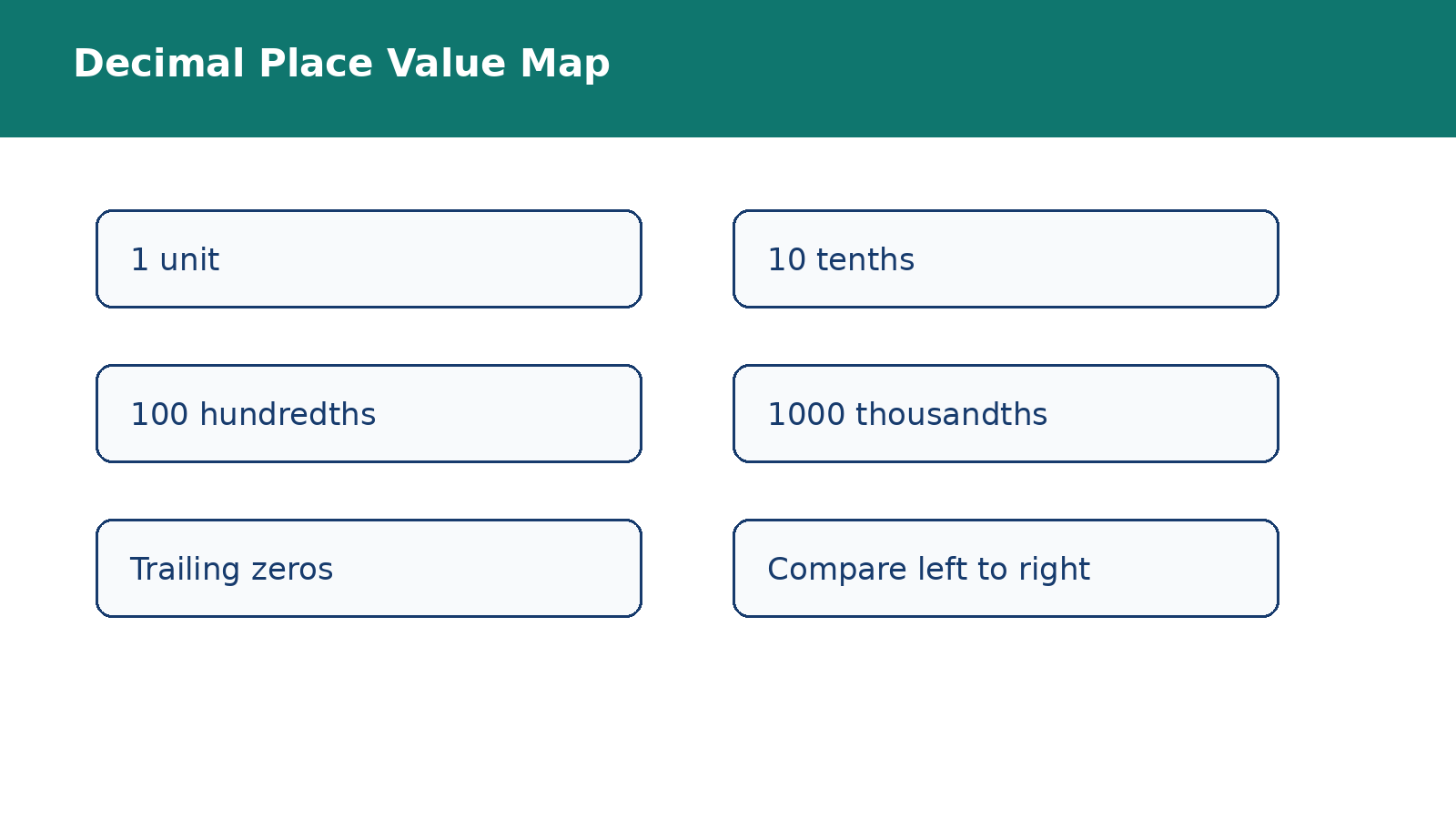
The main rule is simple: each move to the right divides the value by 10. So 1 unit equals 10 tenths, 100 hundredths and 1000 thousandths. This is why 0.2, 0.20 and 0.200 have the same value.
Compare decimals from left to right.
Trailing zeros after the decimal do not change value.
Measurement conversions use the same place-value idea.
Important NCERT Solutions from A Peek Beyond the Point
The table below lists common answers students often recheck. Read the full PDF for the regrouping steps behind each answer.
Decimal Addition, Subtraction and Conversion Checklist
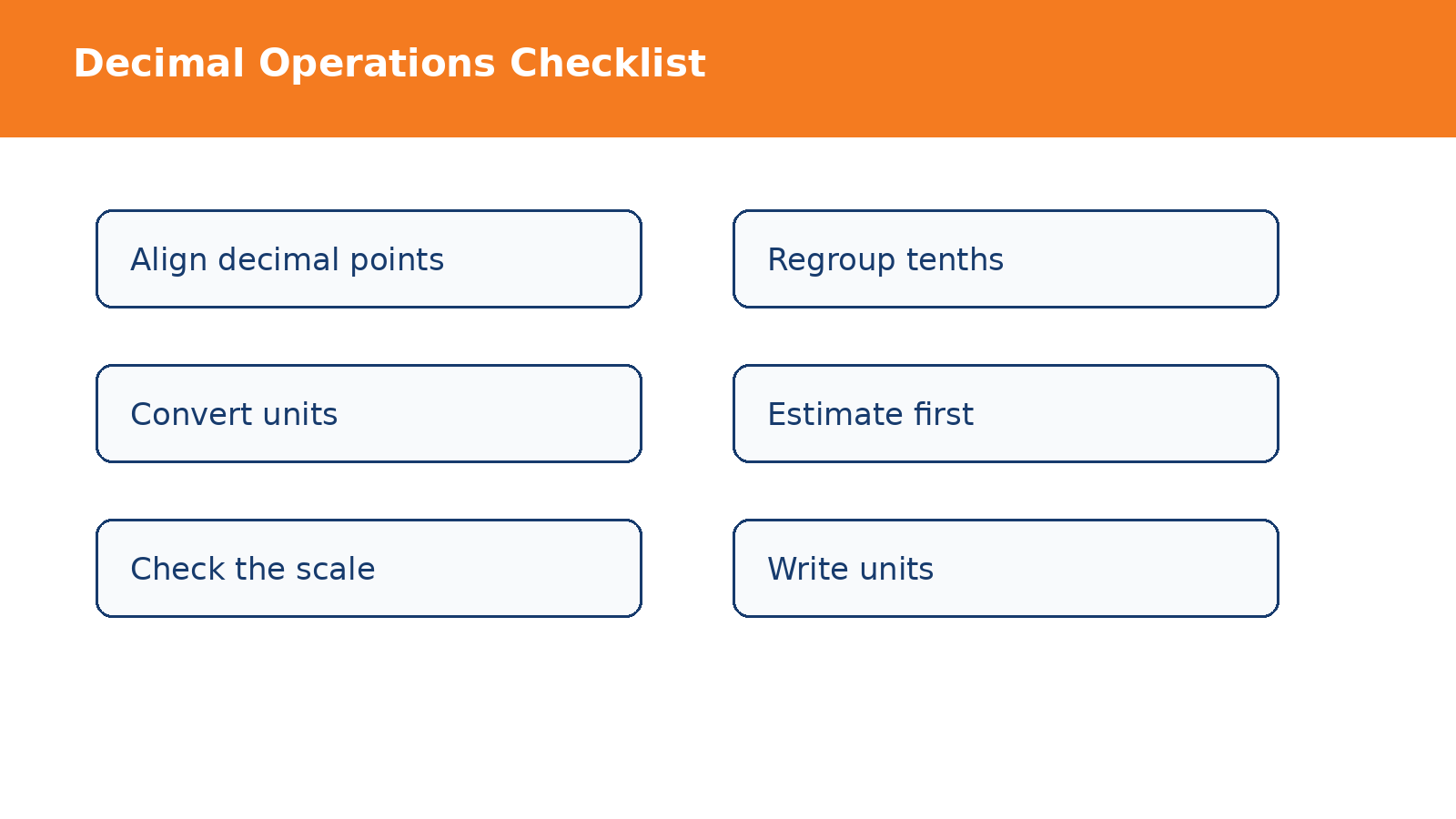
For decimal sums and differences, align decimal points before calculating. For conversions, divide or multiply by 10, 100 or 1000 according to the unit relation, such as 10 mm = 1 cm, 100 cm = 1 m and 1000 g = 1 kg.
All NCERT Solutions for A Peek Beyond the Point with Step-by-Step Solutions
Question 1
Write the measurements of the eraser, pencil and chalk shown in the picture.
Read the end of each object on the centimetre scale.
Eraser length is 2 and 4 tenths cm, so it is 2.4 cm.
Pencil length is 4 and 5 tenths cm, so it is 4.5 cm or 4 1/2 cm.
Chalk length is 1 and 4 tenths cm, so it is 1.4 cm.
Answer: Eraser 2.4 cm, pencil 4.5 cm, chalk 1.4 cm.
Expert Solution: Rewrite all quantities in the same place-value unit, then compute carefully. Final answer: Eraser 2.4 cm, pencil 4.5 cm, chalk 1.4 cm.
Question 2
Arrange 9/10, 1 7/10, 130/10, 13 1/10, 10 5/10, 7 6/10, 6 7/10 and 4/10 in increasing order.
Compare by changing each length to tenths.
4/10 is 0.4, 9/10 is 0.9, 1 7/10 is 1.7, 6 7/10 is 6.7.
Then come 7 6/10 = 7.6, 10 5/10 = 10.5, 130/10 = 13, and 13 1/10 = 13.1.
Expert Solution: Rewrite all quantities in the same place-value unit, then compute carefully. Final answer: 4/10, 9/10, 1 7/10, 6 7/10, 7 6/10, 10 5/10, 130/10, 13 1/10.
Question 3
Arrange 4 1/10, 4/10, 41/10 and 41 1/10 in increasing order.
Write each as a decimal or as tenths.
4/10 = 0.4.
4 1/10 = 4.1 and 41/10 = 4.1, so these two are equal.
41 1/10 = 41.1, which is the largest.
Answer: 4/10, 41/10 = 4 1/10, 41 1/10.
Expert Solution: Rewrite all quantities in the same place-value unit, then compute carefully. Final answer: 4/10, 41/10 = 4 1/10, 41 1/10.
Question 4
The body parts of a honeybee are head 2 3/10 units, thorax 5 4/10 units and abdomen 7 5/10 units. Find its total length.
Add whole units first: 2 + 5 + 7 = 14.
Add tenths: 3/10 + 4/10 + 5/10 = 12/10 = 1 2/10.
Total length = 14 + 1 2/10 = 15 2/10 units.
Answer: 15 2/10 units.
Expert Solution: Rewrite all quantities in the same place-value unit, then compute carefully. Final answer: 15 2/10 units.
Question 5
Shylaja's hand is 12 4/10 units long and her palm is 6 7/10 units long. Find the length of the longest finger.
Finger length = hand length minus palm length.
12 4/10 - 6 7/10 needs regrouping because 4 tenths is less than 7 tenths.
12 4/10 = 11 14/10.
11 14/10 - 6 7/10 = 5 7/10 units.
Answer: 5 7/10 units.
Expert Solution: Rewrite all quantities in the same place-value unit, then compute carefully. Final answer: 5 7/10 units.
Question 6
A Celestial Pearl Danio is 2 4/10 cm long, and a Philippine Goby is 9/10 cm long. What is the difference in their lengths?
Difference = 2 4/10 - 9/10.
Regroup 2 4/10 as 1 14/10.
1 14/10 - 9/10 = 1 5/10 cm.
Answer: 1 5/10 cm.
Expert Solution: Rewrite all quantities in the same place-value unit, then compute carefully. Final answer: 1 5/10 cm.
Answer: The six extended patterns are listed in the solution.
Expert Solution: Rewrite all quantities in the same place-value unit, then compute carefully. Final answer: The six extended patterns are listed in the solution.
Question 8
How many one-hundredths make one-tenth? Can 4 units and 45 one-hundredths describe the folded paper length?
One-tenth equals 10/100.
So 10 one-hundredths make one-tenth.
4 units and 4 tenths and 5 hundredths equals 4 + 40/100 + 5/100 = 4 + 45/100.
Therefore it can be said as 4 units and 45 one-hundredths.
Answer: 10 one-hundredths make one-tenth. Yes, the length is 4 and 45/100 units.
Expert Solution: Rewrite all quantities in the same place-value unit, then compute carefully. Final answer: 10 one-hundredths make one-tenth. Yes, the length is 4 and 45/100 units.
Question 9
For the groups of lengths, identify the longest and shortest.
(a) Among 3/10, 3/100 and 33/100, longest is 33/100 and shortest is 3/100.
(b) Among 3 1/10, 30/10 and 1 3/10, longest is 3 1/10 and shortest is 1 3/10.
(c) Among 45/100, 54/100, 5/10 and 4/10, longest is 54/100 and shortest is 4/10.
(d) Longest is 3 6/10 6/100 and shortest is 3 6/100.
(e) Longest is 1 8/100 and shortest is 9/100.
(f) Longest is 7 5/100 and shortest is 7 3/10 5/100.
(g) Longest is 65/10 15/100 and shortest is 5 7/100.
Answer: Longest and shortest values for groups (a) to (g) are shown above.
Expert Solution: Rewrite all quantities in the same place-value unit, then compute carefully. Final answer: Longest and shortest values for groups (a) to (g) are shown above.
Question 10
Find the sums and differences involving tenths and hundredths from Figure it Out, page 58.
Expert Solution: Rewrite all quantities in the same place-value unit, then compute carefully. Final answer: 3 34/100, 11 7/10, 30, 3 3/100, 3 3/100, 2 63/100.
Question 11
Write the given place-value quantities in decimal form.
2 ones, 3 tenths and 5 hundredths = 2.35.
1 ten and 5 tenths = 10.5.
4 ones and 6 hundredths = 4.06.
1 hundred, 1 one and 1 hundredth = 101.01.
8/100 and 9/10 = 0.98.
5/100 = 0.05.
1/10 = 0.1.
2 1/100, 4 1/10 and 7 7/1000 make 2.01, 4.1 and 7.007.
Expert Solution: Rewrite all quantities in the same place-value unit, then compute carefully. Final answer: 2.35, 10.5, 4.06, 101.01, 0.98, 0.05, 0.1, 2.01, 4.1, 7.007.
Question 12
Write 234 hundredths and 105 tenths in decimal form.
234 hundredths = 234/100 = 2.34.
105 tenths = 105/10 = 10.5.
Answer: 2.34 and 10.5.
Expert Solution: Rewrite all quantities in the same place-value unit, then compute carefully. Final answer: 2.34 and 10.5.
Question 13
Complete the unit conversion blanks for millimetres and centimetres.
10 mm = 1 cm, so divide millimetres by 10 to get centimetres.
70 mm = 7.0 cm.
0.9 cm = 9 mm.
134 mm = 13.4 cm.
203.6 cm = 2036 mm.
Answer: 70 mm = 7.0 cm, 9 mm = 0.9 cm, 134 mm = 13.4 cm, 2036 mm = 203.6 cm.
Expert Solution: Rewrite all quantities in the same place-value unit, then compute carefully. Final answer: 70 mm = 7.0 cm, 9 mm = 0.9 cm, 134 mm = 13.4 cm, 2036 mm = 203.6 cm.
Question 14
Complete the unit conversion blanks for centimetres and metres.
100 cm = 1 m, so divide centimetres by 100 to get metres.
36 cm = 0.36 m.
50 cm = 0.5 m.
0.89 m = 89 cm.
4 cm = 0.04 m.
325 cm = 3.25 m.
2.07 m = 207 cm.
Answer: 0.36 m, 0.5 m, 89 cm, 0.04 m, 3.25 m, 207 cm.
Expert Solution: Rewrite all quantities in the same place-value unit, then compute carefully. Final answer: 0.36 m, 0.5 m, 89 cm, 0.04 m, 3.25 m, 207 cm.
Question 15
Complete the kilogram, rupee and paise conversions.
For grams to kilograms, divide by 1000: 465 g = 0.465 kg, 68 g = 0.068 kg, 1560 g = 1.56 kg, 704 g = 0.704 kg.
0.56 kg = 560 g and 2.5 kg = 2500 g.
For paise to rupees, divide by 100: 10 p = Rs. 0.10, 5 p = Rs. 0.05, 36 p = Rs. 0.36, 50 p = Rs. 0.50, 99 p = Rs. 0.99, 250 p = Rs. 2.50.
Answer: The completed conversions are listed above.
Expert Solution: Rewrite all quantities in the same place-value unit, then compute carefully. Final answer: The completed conversions are listed above.
Question 16
Name the small divisions between 1 and 1.1, and decide which decimals are equal.
If the segment from 1 to 1.1 is divided into 10 equal parts, the marks are 1.01, 1.02, 1.03, 1.04, 1.05, 1.06, 1.07, 1.08 and 1.09.
Trailing zeros on the right of a decimal do not change its value.
So 4.5, 4.50 and 04.50 are equal.
Also 4.05 and 4.050 are equal.
Answer: 1.01 to 1.09; equal groups are 4.5 = 4.50 = 04.50 and 4.05 = 4.050.
Expert Solution: Rewrite all quantities in the same place-value unit, then compute carefully. Final answer: 1.01 to 1.09; equal groups are 4.5 = 4.50 = 04.50 and 4.05 = 4.050.
Question 17
Compare decimals and find the closest decimals.
1.32 is greater than 1.23 because the tenths digit 3 is greater than 2.
13.800 is greater than 3.81 because 13 units is greater than 3 units.
1.090 is greater than 1.009 because at the hundredths place 9 is greater than 0.
Among 0.9, 1.1, 1.01 and 1.11, the closest to 1.09 is 1.1.
Among 3.56, 3.65 and 3.099, the closest to 4 is 3.65.
Among 0.8, 0.69 and 1.08, the closest to 1 is 1.08.
Answer: 1.32, 13.800, 1.090; closest values are 1.1, 3.65 and 1.08.
Expert Solution: Rewrite all quantities in the same place-value unit, then compute carefully. Final answer: 1.32, 13.800, 1.090; closest values are 1.1, 3.65 and 1.08.
Question 18
Find the decimal sums from Figure it Out, page 75.
Expert Solution: Rewrite all quantities in the same place-value unit, then compute carefully. Final answer: 7.9, 26.8, 7.41, 18.11, 39.10, 1.534, 0.78, 6.723.
Question 19
Find the decimal differences from Figure it Out, page 75.
Expert Solution: Rewrite all quantities in the same place-value unit, then compute carefully. Final answer: 3.3, 9.2, 5.9, 0.802, 16.95, 16.405, 0.81, 5.749.
Answer: The next three terms for each sequence are listed above.
Expert Solution: Rewrite all quantities in the same place-value unit, then compute carefully. Final answer: The next three terms for each sequence are listed above.
Question 21
Solve the final Figure it Out problems on decimals, comparison, weights and conversions.
Expert Solution: Rewrite all quantities in the same place-value unit, then compute carefully. Final answer: 0.05, 0.016, 1.2, 0.254; 1.3 kg; 12.76 L; lost 1.25 kg; 10,00,000 mm; Rs. 45,000.
Question 22
Write the decimal forms for mixed place-value quantities and simple fractions.
Expert Solution: Rewrite all quantities in the same place-value unit, then compute carefully. Final answer: 121.2, 111.1, 277.75; 0.5, 1.5, 0.25, 0.75, 0.2, 0.8.
A Peek Beyond the Point Class 7 Maths Solutions FAQs
Ques. What does Chapter 3 A Peek Beyond the Point teach?
Ans. It teaches decimals, tenths, hundredths, thousandths, measurement conversion, number-line location, comparison, addition and subtraction.
Ques. Does this page include the NCERT Solutions PDF?
Ans. Yes. The PDF placeholder is replaced with the hosted flipbook and download card during publishing.
Ques. Are these answers based on the 2026-27 NCERT book?
Ans. Yes. The solutions follow the Class 7 Mathematics (Part 1) 2026-27 chapter sequence and source answer key.




Chapter3APeekBeyondthePointSolutions.pdf?page=1&dpi=150)
Chapter3APeekBeyondthePointSolutions.pdf?page=2&dpi=150)
Chapter3APeekBeyondthePointSolutions.pdf?page=3&dpi=150)
Chapter3APeekBeyondthePointSolutions.pdf?page=4&dpi=150)
Chapter3APeekBeyondthePointSolutions.pdf?page=5&dpi=150)
Chapter3APeekBeyondthePointSolutions.pdf?page=6&dpi=150)
Chapter3APeekBeyondthePointSolutions.pdf?page=7&dpi=150)
Chapter3APeekBeyondthePointSolutions.pdf?page=8&dpi=150)
Chapter3APeekBeyondthePointSolutions.pdf?page=9&dpi=150)
Chapter3APeekBeyondthePointSolutions.pdf?page=10&dpi=150)
Chapter3APeekBeyondthePointSolutions.pdf?page=11&dpi=150)



Comments