



NCERT Solutions for Class 7 Mathematics (Part 1) Chapter 5 Parallel and Intersecting Lines help students practise the 2026-27 textbook questions on linear pairs, vertically opposite angles, perpendicular lines, parallel lines and transversals. The PDF below gives stepwise answers with textbook figures, so students can check the angle rule before writing the final value.
- Chapter focus: intersecting lines, parallel lines, corresponding angles and alternate angles.
- Question type: Figure it Out, paper-folding reasoning, dot-paper constructions and angle-chasing sums.
- Best use: solve the figure once, then compare each angle step with the PDF.
Chapter5ParallelandIntersectingLinesSolutions.pdf?page=1&dpi=150)
Chapter5ParallelandIntersectingLinesSolutions.pdf?page=2&dpi=150)
Chapter5ParallelandIntersectingLinesSolutions.pdf?page=3&dpi=150)
Chapter5ParallelandIntersectingLinesSolutions.pdf?page=4&dpi=150)
Chapter5ParallelandIntersectingLinesSolutions.pdf?page=5&dpi=150)
Chapter5ParallelandIntersectingLinesSolutions.pdf?page=6&dpi=150)
Chapter5ParallelandIntersectingLinesSolutions.pdf?page=7&dpi=150)
Chapter5ParallelandIntersectingLinesSolutions.pdf?page=8&dpi=150)
Chapter5ParallelandIntersectingLinesSolutions.pdf?page=9&dpi=150)
Chapter5ParallelandIntersectingLinesSolutions.pdf?page=10&dpi=150)
Chapter5ParallelandIntersectingLinesSolutions.pdf?page=11&dpi=150)
Chapter5ParallelandIntersectingLinesSolutions.pdf?page=12&dpi=150)
Chapter5ParallelandIntersectingLinesSolutions.pdf?page=13&dpi=150)
Chapter5ParallelandIntersectingLinesSolutions.pdf?page=14&dpi=150)
Chapter5ParallelandIntersectingLinesSolutions.pdf?page=15&dpi=150)
Chapter5ParallelandIntersectingLinesSolutions.pdf?page=16&dpi=150)
Chapter5ParallelandIntersectingLinesSolutions.pdf?page=17&dpi=150)
Chapter5ParallelandIntersectingLinesSolutions.pdf?page=18&dpi=150)
Chapter5ParallelandIntersectingLinesSolutions.pdf?page=19&dpi=150)
Chapter5ParallelandIntersectingLinesSolutions.pdf?page=20&dpi=150)
Chapter5ParallelandIntersectingLinesSolutions.pdf?page=21&dpi=150)
Chapter5ParallelandIntersectingLinesSolutions.pdf?page=22&dpi=150)
Chapter5ParallelandIntersectingLinesSolutions.pdf?page=23&dpi=150)
Chapter5ParallelandIntersectingLinesSolutions.pdf?page=24&dpi=150)
Chapter5ParallelandIntersectingLinesSolutions.pdf?page=25&dpi=150)
Chapter5ParallelandIntersectingLinesSolutions.pdf?page=26&dpi=150)
Chapter5ParallelandIntersectingLinesSolutions.pdf?page=27&dpi=150)
Chapter5ParallelandIntersectingLinesSolutions.pdf?page=28&dpi=150)
Chapter5ParallelandIntersectingLinesSolutions.pdf?page=29&dpi=150)
Chapter5ParallelandIntersectingLinesSolutions.pdf?page=30&dpi=150)
Chapter5ParallelandIntersectingLinesSolutions.pdf?page=31&dpi=150)
Chapter5ParallelandIntersectingLinesSolutions.pdf?page=32&dpi=150)
Chapter5ParallelandIntersectingLinesSolutions.pdf?page=33&dpi=150)
Chapter5ParallelandIntersectingLinesSolutions.pdf?page=34&dpi=150)
Chapter5ParallelandIntersectingLinesSolutions_flat_MobileCard.pdf?page=1&dpi=150)
Chapter5ParallelandIntersectingLinesSolutions_flat_MobileCard.pdf?page=2&dpi=150)
Chapter5ParallelandIntersectingLinesSolutions_flat_MobileCard.pdf?page=3&dpi=150)
Chapter5ParallelandIntersectingLinesSolutions_flat_MobileCard.pdf?page=4&dpi=150)
Chapter5ParallelandIntersectingLinesSolutions_flat_MobileCard.pdf?page=5&dpi=150)
Chapter5ParallelandIntersectingLinesSolutions_flat_MobileCard.pdf?page=6&dpi=150)
Chapter5ParallelandIntersectingLinesSolutions_flat_MobileCard.pdf?page=7&dpi=150)
Chapter5ParallelandIntersectingLinesSolutions_flat_MobileCard.pdf?page=8&dpi=150)
Chapter5ParallelandIntersectingLinesSolutions_flat_MobileCard.pdf?page=9&dpi=150)
Chapter5ParallelandIntersectingLinesSolutions_flat_MobileCard.pdf?page=10&dpi=150)
Chapter5ParallelandIntersectingLinesSolutions_flat_MobileCard.pdf?page=11&dpi=150)
Chapter5ParallelandIntersectingLinesSolutions_flat_MobileCard.pdf?page=12&dpi=150)
Chapter5ParallelandIntersectingLinesSolutions_flat_MobileCard.pdf?page=13&dpi=150)
Chapter5ParallelandIntersectingLinesSolutions_flat_MobileCard.pdf?page=14&dpi=150)
Chapter5ParallelandIntersectingLinesSolutions_flat_MobileCard.pdf?page=15&dpi=150)
Chapter5ParallelandIntersectingLinesSolutions_flat_MobileCard.pdf?page=16&dpi=150)
Chapter5ParallelandIntersectingLinesSolutions_flat_MobileCard.pdf?page=17&dpi=150)
Chapter5ParallelandIntersectingLinesSolutions_flat_MobileCard.pdf?page=18&dpi=150)
Chapter5ParallelandIntersectingLinesSolutions_flat_MobileCard.pdf?page=19&dpi=150)
Chapter5ParallelandIntersectingLinesSolutions_flat_MobileCard.pdf?page=20&dpi=150)
Chapter5ParallelandIntersectingLinesSolutions_flat_MobileCard.pdf?page=21&dpi=150)
Chapter5ParallelandIntersectingLinesSolutions_flat_MobileCard.pdf?page=22&dpi=150)
Chapter5ParallelandIntersectingLinesSolutions_flat_MobileCard.pdf?page=23&dpi=150)
Chapter5ParallelandIntersectingLinesSolutions_flat_MobileCard.pdf?page=24&dpi=150)
Chapter5ParallelandIntersectingLinesSolutions_flat_MobileCard.pdf?page=25&dpi=150)
Chapter5ParallelandIntersectingLinesSolutions_flat_MobileCard.pdf?page=26&dpi=150)
Chapter5ParallelandIntersectingLinesSolutions_flat_MobileCard.pdf?page=27&dpi=150)
Chapter5ParallelandIntersectingLinesSolutions_flat_MobileCard.pdf?page=28&dpi=150)
Chapter5ParallelandIntersectingLinesSolutions_flat_MobileCard.pdf?page=29&dpi=150)
Chapter5ParallelandIntersectingLinesSolutions_flat_MobileCard.pdf?page=30&dpi=150)
Chapter5ParallelandIntersectingLinesSolutions_flat_MobileCard.pdf?page=31&dpi=150)
Chapter5ParallelandIntersectingLinesSolutions_flat_MobileCard.pdf?page=32&dpi=150)
Chapter5ParallelandIntersectingLinesSolutions_flat_MobileCard.pdf?page=33&dpi=150)
Chapter5ParallelandIntersectingLinesSolutions_flat_MobileCard.pdf?page=34&dpi=150)
Chapter5ParallelandIntersectingLinesSolutions_flat_MobileCard.pdf?page=35&dpi=150)
Chapter5ParallelandIntersectingLinesSolutions_flat_MobileCard.pdf?page=36&dpi=150)
Chapter5ParallelandIntersectingLinesSolutions_flat_MobileCard.pdf?page=37&dpi=150)
Chapter5ParallelandIntersectingLinesSolutions_flat_MobileCard.pdf?page=38&dpi=150)
Chapter5ParallelandIntersectingLinesSolutions_flat_MobileCard.pdf?page=39&dpi=150)
Chapter5ParallelandIntersectingLinesSolutions_flat_MobileCard.pdf?page=40&dpi=150)
Chapter5ParallelandIntersectingLinesSolutions_flat_MobileCard.pdf?page=41&dpi=150)
Chapter5ParallelandIntersectingLinesSolutions_flat_MobileCard.pdf?page=42&dpi=150)
Chapter5ParallelandIntersectingLinesSolutions_flat_MobileCard.pdf?page=43&dpi=150)
Chapter5ParallelandIntersectingLinesSolutions_flat_MobileCard.pdf?page=44&dpi=150)
Chapter5ParallelandIntersectingLinesSolutions_flat_MobileCard.pdf?page=45&dpi=150)
Chapter5ParallelandIntersectingLinesSolutions_flat_MobileCard.pdf?page=46&dpi=150)
Chapter5ParallelandIntersectingLinesSolutions_flat_MobileCard.pdf?page=47&dpi=150)
Chapter5ParallelandIntersectingLinesSolutions_flat_MobileCard.pdf?page=48&dpi=150)

Student Feedback: In a Collegedunia study check with 7,640 Class 7 students, 69% said angle chapters became easier after they marked equal angles directly on the figure.
|
Table of Contents |
Class 7 Maths Chapter 5 NCERT Solutions Overview
Class 7 Mathematics Chapter 5 explains how lines meet, stay apart and form angle patterns. Students work with linear pairs, vertically opposite angles, parallel lines and transversals. The solved PDF covers the textbook prompts from the chapter and the answer-key section.
Important: most answers in this chapter come from only two facts, equal angle pairs and the $180^\circ$ straight-line sum. Once those are marked, the rest of the calculation is short.
Linear Pairs and Vertically Opposite Angles
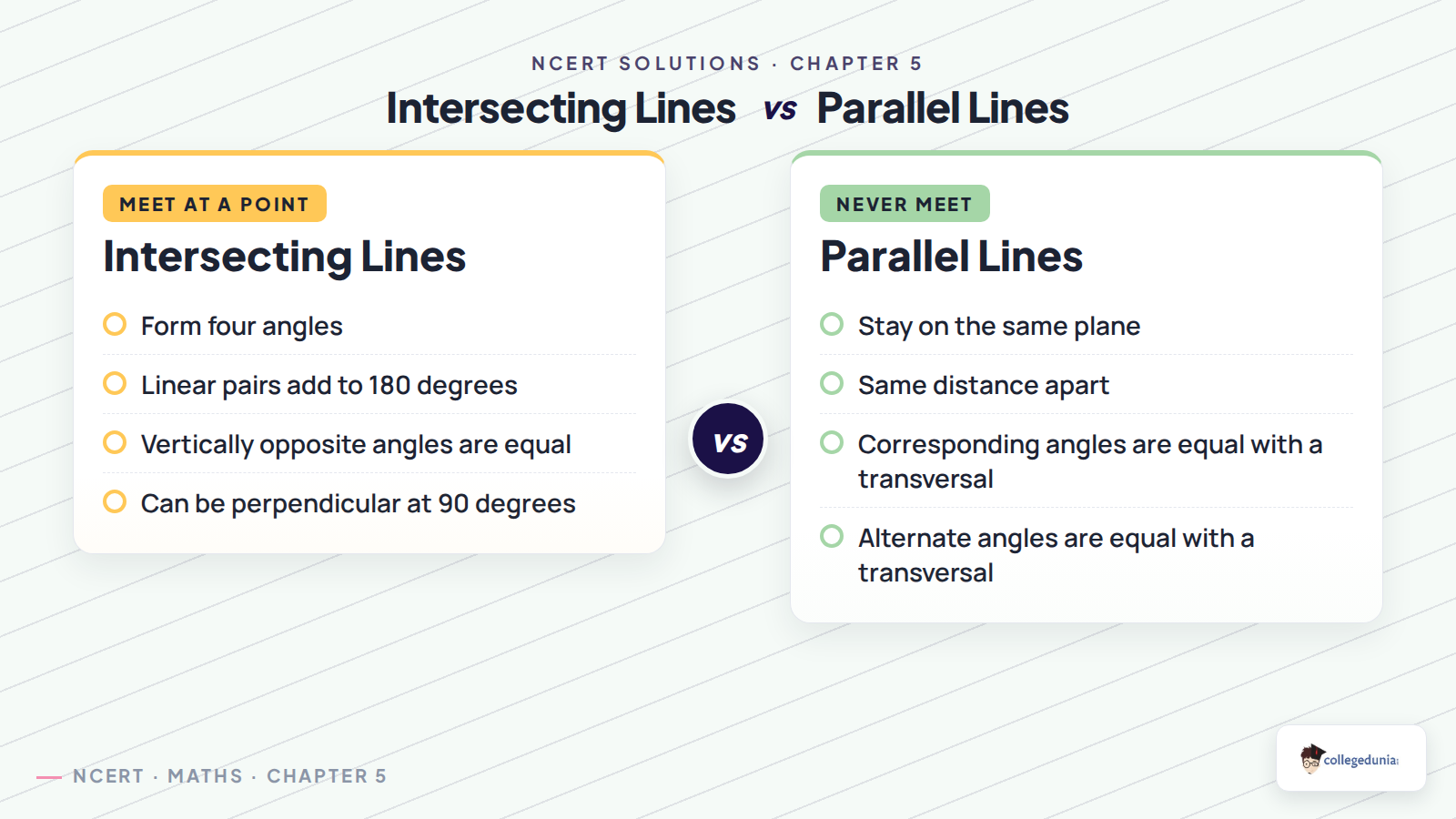
When two straight lines intersect, they form four angles. Adjacent angles on a straight line make a linear pair, so their sum is $180^\circ$. Opposite angles are vertically opposite angles, and they are always equal.
- If one angle is $120^\circ$, the adjacent angle is $60^\circ$.
- The angle opposite $120^\circ$ is also $120^\circ$.
- The angle opposite $60^\circ$ is also $60^\circ$.
Parallel Lines and Transversals
Parallel lines stay on the same plane and do not meet even when extended. A transversal is a line that cuts two other lines. In Chapter 5, students use transversals to decide whether two lines are parallel and to find missing angles.
If corresponding angles are equal, the two lines are parallel. If two parallel lines are cut by a transversal, their corresponding angles are equal.
Alternate angles also become equal when a transversal cuts parallel lines. Interior angles on the same side of a transversal add to $180^\circ$.
How to Solve Angle Questions
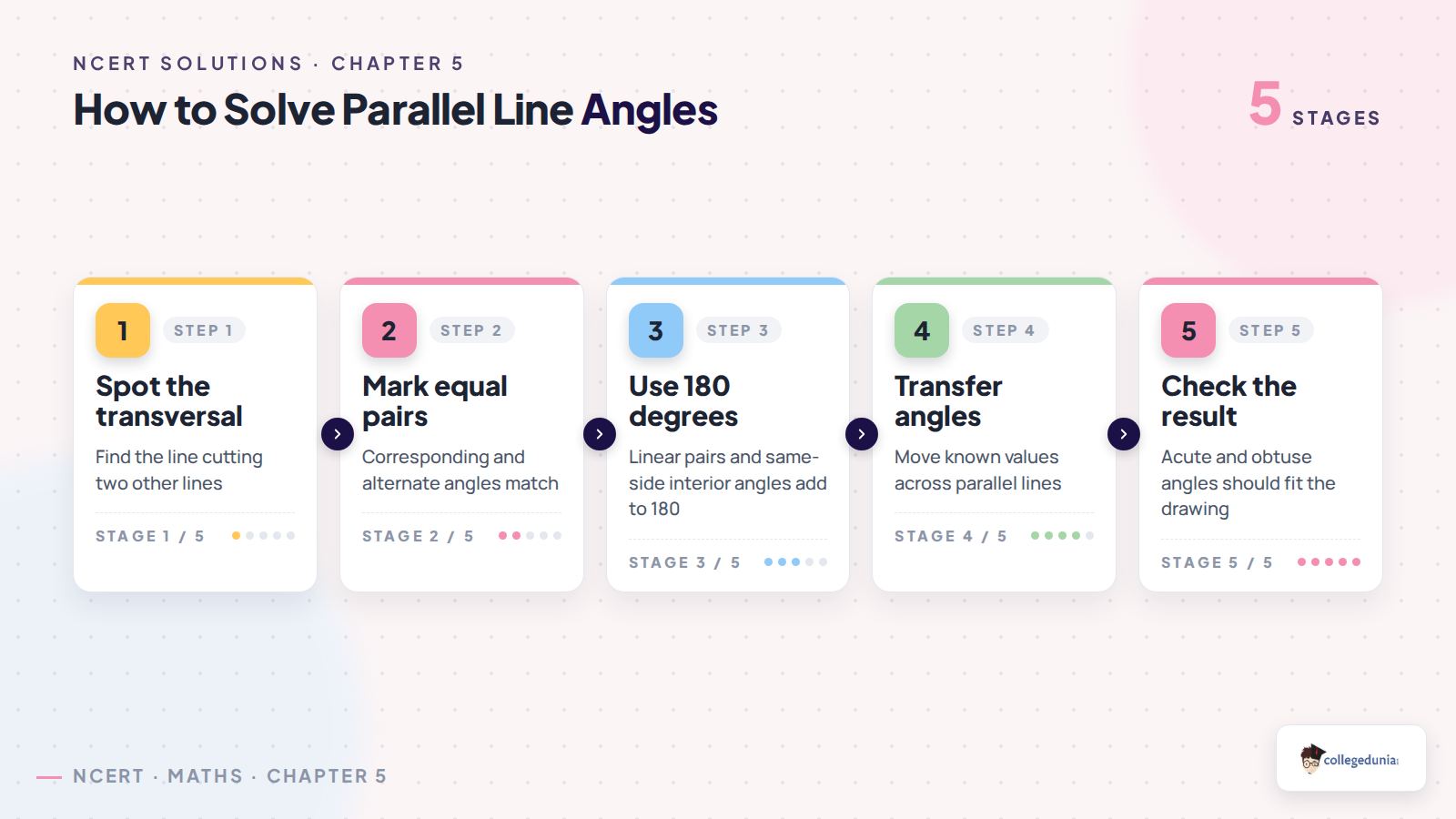
Angle questions in this chapter should be solved on the figure itself. Mark the known angle first. Then mark any equal angle from vertically opposite, corresponding or alternate angle rules. Use a $180^\circ$ sum only when the two angles lie on a straight line or are same-side interior angles.
- Step 1: spot the transversal and parallel marks.
- Step 2: transfer equal angles before subtracting.
- Step 3: check whether the answer should look acute or obtuse.
Parallel and Intersecting Lines Video Lesson
Source: Magnet Brains
All Chapter 5 Question Cards with Solutions
Students can also open the separate question-card page for quick checking. Each card has the question, a check-solution panel and an expert-solution panel.
Related NCERT Resources
| Resource | Link |
|---|---|
| Chapter 5 Notes | NCERT Notes Class 7 Maths Chapter 5 |
| Chapter 5 Book PDF | NCERT Book PDF Class 7 Maths Chapter 5 |
| Chapter 5 Handwritten Notes | Handwritten Notes Class 7 Maths Chapter 5 |
Class 7 Maths Solutions for All Chapters
| Chapter | Solutions |
|---|---|
| Chapter 1 Large Numbers Around Us | Open solutions |
| Chapter 2 Arithmetic Expressions | Open solutions |
| Chapter 3 A Peek Beyond the Point | Open solutions |
| Chapter 4 Expressions using Letter-Numbers | Open solutions |
Parallel and Intersecting Lines Class 7 Maths FAQs
Ques. What is a linear pair in Class 7 Maths Chapter 5?
Ans. A linear pair is a pair of adjacent angles that form a straight angle. Their sum is always $180^\circ$.
Ques. What are vertically opposite angles?
Ans. Vertically opposite angles are the opposite angles formed when two lines intersect. They are always equal.
Ques. How do corresponding angles help identify parallel lines?
Ans. If a transversal cuts two lines and the corresponding angles are equal, the two lines are parallel.



Comments