



NCERT Solutions for Class 7 Mathematics (Part 1) Chapter 7 A Tale of Three Intersecting Lines help students practise the 2026-27 textbook questions on triangle construction, triangle inequality, angle sum property, exterior angles and altitudes. The PDF below gives step-by-step answers for the main Figure it Out and construction prompts.
- Chapter focus: constructing triangles, checking whether triangles exist and finding missing angles.
- Question type: compass construction, inequality tests, included-angle construction and altitude construction.
- Best use: draw each figure once, then compare your construction and reason with the PDF steps.
Chapter7ATaleofThreeIntersectingLinesSolutions.pdf?page=1&dpi=150)
Chapter7ATaleofThreeIntersectingLinesSolutions.pdf?page=2&dpi=150)
Chapter7ATaleofThreeIntersectingLinesSolutions.pdf?page=3&dpi=150)
Chapter7ATaleofThreeIntersectingLinesSolutions.pdf?page=4&dpi=150)
Chapter7ATaleofThreeIntersectingLinesSolutions.pdf?page=5&dpi=150)
Chapter7ATaleofThreeIntersectingLinesSolutions.pdf?page=6&dpi=150)
Chapter7ATaleofThreeIntersectingLinesSolutions.pdf?page=7&dpi=150)
Chapter7ATaleofThreeIntersectingLinesSolutions.pdf?page=8&dpi=150)
Chapter7ATaleofThreeIntersectingLinesSolutions.pdf?page=9&dpi=150)
Chapter7ATaleofThreeIntersectingLinesSolutions.pdf?page=10&dpi=150)
Chapter7ATaleofThreeIntersectingLinesSolutions.pdf?page=11&dpi=150)
Chapter7ATaleofThreeIntersectingLinesSolutions.pdf?page=12&dpi=150)
Chapter7ATaleofThreeIntersectingLinesSolutions.pdf?page=13&dpi=150)
Chapter7ATaleofThreeIntersectingLinesSolutions.pdf?page=14&dpi=150)
Chapter7ATaleofThreeIntersectingLinesSolutions.pdf?page=15&dpi=150)
Chapter7ATaleofThreeIntersectingLinesSolutions.pdf?page=16&dpi=150)
Chapter7ATaleofThreeIntersectingLinesSolutions.pdf?page=17&dpi=150)
Chapter7ATaleofThreeIntersectingLinesSolutions.pdf?page=18&dpi=150)
Chapter7ATaleofThreeIntersectingLinesSolutions.pdf?page=19&dpi=150)
Chapter7ATaleofThreeIntersectingLinesSolutions.pdf?page=20&dpi=150)
Chapter7ATaleofThreeIntersectingLinesSolutions.pdf?page=21&dpi=150)
Chapter7ATaleofThreeIntersectingLinesSolutions.pdf?page=22&dpi=150)
Chapter7ATaleofThreeIntersectingLinesSolutions.pdf?page=23&dpi=150)
Chapter7ATaleofThreeIntersectingLinesSolutions.pdf?page=24&dpi=150)
Chapter7ATaleofThreeIntersectingLinesSolutions.pdf?page=25&dpi=150)
Chapter7ATaleofThreeIntersectingLinesSolutions.pdf?page=26&dpi=150)
Chapter7ATaleofThreeIntersectingLinesSolutions.pdf?page=27&dpi=150)
Chapter7ATaleofThreeIntersectingLinesSolutions.pdf?page=28&dpi=150)
Chapter7ATaleofThreeIntersectingLinesSolutions.pdf?page=29&dpi=150)
Chapter7ATaleofThreeIntersectingLinesSolutions.pdf?page=30&dpi=150)
Chapter7ATaleofThreeIntersectingLinesSolutions.pdf?page=31&dpi=150)
Chapter7ATaleofThreeIntersectingLinesSolutions.pdf?page=32&dpi=150)
Chapter7ATaleofThreeIntersectingLinesSolutions.pdf?page=33&dpi=150)
Chapter7ATaleofThreeIntersectingLinesSolutions.pdf?page=34&dpi=150)
Chapter7ATaleofThreeIntersectingLinesSolutions.pdf?page=35&dpi=150)
Chapter7ATaleofThreeIntersectingLinesSolutions.pdf?page=36&dpi=150)
Chapter7ATaleofThreeIntersectingLinesSolutions.pdf?page=37&dpi=150)
Chapter7ATaleofThreeIntersectingLinesSolutions.pdf?page=38&dpi=150)
Chapter7ATaleofThreeIntersectingLinesSolutions.pdf?page=39&dpi=150)
Chapter7ATaleofThreeIntersectingLinesSolutions.pdf?page=40&dpi=150)
Chapter7ATaleofThreeIntersectingLinesSolutions.pdf?page=41&dpi=150)
Chapter7ATaleofThreeIntersectingLinesSolutions.pdf?page=42&dpi=150)
Chapter7ATaleofThreeIntersectingLinesSolutions.pdf?page=43&dpi=150)
Chapter7ATaleofThreeIntersectingLinesSolutions.pdf?page=44&dpi=150)
Chapter7ATaleofThreeIntersectingLinesSolutions.pdf?page=45&dpi=150)
Chapter7ATaleofThreeIntersectingLinesSolutions.pdf?page=46&dpi=150)
Chapter7ATaleofThreeIntersectingLinesSolutions_flat_MobileCard.pdf?page=1&dpi=150)
Chapter7ATaleofThreeIntersectingLinesSolutions_flat_MobileCard.pdf?page=2&dpi=150)
Chapter7ATaleofThreeIntersectingLinesSolutions_flat_MobileCard.pdf?page=3&dpi=150)
Chapter7ATaleofThreeIntersectingLinesSolutions_flat_MobileCard.pdf?page=4&dpi=150)
Chapter7ATaleofThreeIntersectingLinesSolutions_flat_MobileCard.pdf?page=5&dpi=150)
Chapter7ATaleofThreeIntersectingLinesSolutions_flat_MobileCard.pdf?page=6&dpi=150)
Chapter7ATaleofThreeIntersectingLinesSolutions_flat_MobileCard.pdf?page=7&dpi=150)
Chapter7ATaleofThreeIntersectingLinesSolutions_flat_MobileCard.pdf?page=8&dpi=150)
Chapter7ATaleofThreeIntersectingLinesSolutions_flat_MobileCard.pdf?page=9&dpi=150)
Chapter7ATaleofThreeIntersectingLinesSolutions_flat_MobileCard.pdf?page=10&dpi=150)
Chapter7ATaleofThreeIntersectingLinesSolutions_flat_MobileCard.pdf?page=11&dpi=150)
Chapter7ATaleofThreeIntersectingLinesSolutions_flat_MobileCard.pdf?page=12&dpi=150)
Chapter7ATaleofThreeIntersectingLinesSolutions_flat_MobileCard.pdf?page=13&dpi=150)
Chapter7ATaleofThreeIntersectingLinesSolutions_flat_MobileCard.pdf?page=14&dpi=150)
Chapter7ATaleofThreeIntersectingLinesSolutions_flat_MobileCard.pdf?page=15&dpi=150)
Chapter7ATaleofThreeIntersectingLinesSolutions_flat_MobileCard.pdf?page=16&dpi=150)
Chapter7ATaleofThreeIntersectingLinesSolutions_flat_MobileCard.pdf?page=17&dpi=150)
Chapter7ATaleofThreeIntersectingLinesSolutions_flat_MobileCard.pdf?page=18&dpi=150)
Chapter7ATaleofThreeIntersectingLinesSolutions_flat_MobileCard.pdf?page=19&dpi=150)
Chapter7ATaleofThreeIntersectingLinesSolutions_flat_MobileCard.pdf?page=20&dpi=150)
Chapter7ATaleofThreeIntersectingLinesSolutions_flat_MobileCard.pdf?page=21&dpi=150)
Chapter7ATaleofThreeIntersectingLinesSolutions_flat_MobileCard.pdf?page=22&dpi=150)
Chapter7ATaleofThreeIntersectingLinesSolutions_flat_MobileCard.pdf?page=23&dpi=150)
Chapter7ATaleofThreeIntersectingLinesSolutions_flat_MobileCard.pdf?page=24&dpi=150)
Chapter7ATaleofThreeIntersectingLinesSolutions_flat_MobileCard.pdf?page=25&dpi=150)
Chapter7ATaleofThreeIntersectingLinesSolutions_flat_MobileCard.pdf?page=26&dpi=150)
Chapter7ATaleofThreeIntersectingLinesSolutions_flat_MobileCard.pdf?page=27&dpi=150)
Chapter7ATaleofThreeIntersectingLinesSolutions_flat_MobileCard.pdf?page=28&dpi=150)
Chapter7ATaleofThreeIntersectingLinesSolutions_flat_MobileCard.pdf?page=29&dpi=150)
Chapter7ATaleofThreeIntersectingLinesSolutions_flat_MobileCard.pdf?page=30&dpi=150)
Chapter7ATaleofThreeIntersectingLinesSolutions_flat_MobileCard.pdf?page=31&dpi=150)
Chapter7ATaleofThreeIntersectingLinesSolutions_flat_MobileCard.pdf?page=32&dpi=150)
Chapter7ATaleofThreeIntersectingLinesSolutions_flat_MobileCard.pdf?page=33&dpi=150)
Chapter7ATaleofThreeIntersectingLinesSolutions_flat_MobileCard.pdf?page=34&dpi=150)
Chapter7ATaleofThreeIntersectingLinesSolutions_flat_MobileCard.pdf?page=35&dpi=150)
Chapter7ATaleofThreeIntersectingLinesSolutions_flat_MobileCard.pdf?page=36&dpi=150)
Chapter7ATaleofThreeIntersectingLinesSolutions_flat_MobileCard.pdf?page=37&dpi=150)
Chapter7ATaleofThreeIntersectingLinesSolutions_flat_MobileCard.pdf?page=38&dpi=150)
Chapter7ATaleofThreeIntersectingLinesSolutions_flat_MobileCard.pdf?page=39&dpi=150)
Chapter7ATaleofThreeIntersectingLinesSolutions_flat_MobileCard.pdf?page=40&dpi=150)
Chapter7ATaleofThreeIntersectingLinesSolutions_flat_MobileCard.pdf?page=41&dpi=150)
Chapter7ATaleofThreeIntersectingLinesSolutions_flat_MobileCard.pdf?page=42&dpi=150)
Chapter7ATaleofThreeIntersectingLinesSolutions_flat_MobileCard.pdf?page=43&dpi=150)
Chapter7ATaleofThreeIntersectingLinesSolutions_flat_MobileCard.pdf?page=44&dpi=150)
Chapter7ATaleofThreeIntersectingLinesSolutions_flat_MobileCard.pdf?page=45&dpi=150)
Chapter7ATaleofThreeIntersectingLinesSolutions_flat_MobileCard.pdf?page=46&dpi=150)
Chapter7ATaleofThreeIntersectingLinesSolutions_flat_MobileCard.pdf?page=47&dpi=150)
Chapter7ATaleofThreeIntersectingLinesSolutions_flat_MobileCard.pdf?page=48&dpi=150)
Chapter7ATaleofThreeIntersectingLinesSolutions_flat_MobileCard.pdf?page=49&dpi=150)
Chapter7ATaleofThreeIntersectingLinesSolutions_flat_MobileCard.pdf?page=50&dpi=150)
Chapter7ATaleofThreeIntersectingLinesSolutions_flat_MobileCard.pdf?page=51&dpi=150)
Chapter7ATaleofThreeIntersectingLinesSolutions_flat_MobileCard.pdf?page=52&dpi=150)
Chapter7ATaleofThreeIntersectingLinesSolutions_flat_MobileCard.pdf?page=53&dpi=150)
Chapter7ATaleofThreeIntersectingLinesSolutions_flat_MobileCard.pdf?page=54&dpi=150)
Chapter7ATaleofThreeIntersectingLinesSolutions_flat_MobileCard.pdf?page=55&dpi=150)
Chapter7ATaleofThreeIntersectingLinesSolutions_flat_MobileCard.pdf?page=56&dpi=150)
Chapter7ATaleofThreeIntersectingLinesSolutions_flat_MobileCard.pdf?page=57&dpi=150)
Chapter7ATaleofThreeIntersectingLinesSolutions_flat_MobileCard.pdf?page=58&dpi=150)
Chapter7ATaleofThreeIntersectingLinesSolutions_flat_MobileCard.pdf?page=59&dpi=150)
Chapter7ATaleofThreeIntersectingLinesSolutions_flat_MobileCard.pdf?page=60&dpi=150)
Chapter7ATaleofThreeIntersectingLinesSolutions_flat_MobileCard.pdf?page=61&dpi=150)
Chapter7ATaleofThreeIntersectingLinesSolutions_flat_MobileCard.pdf?page=62&dpi=150)
Chapter7ATaleofThreeIntersectingLinesSolutions_flat_MobileCard.pdf?page=63&dpi=150)
Chapter7ATaleofThreeIntersectingLinesSolutions_flat_MobileCard.pdf?page=64&dpi=150)
Chapter7ATaleofThreeIntersectingLinesSolutions_flat_MobileCard.pdf?page=65&dpi=150)
Chapter7ATaleofThreeIntersectingLinesSolutions_flat_MobileCard.pdf?page=66&dpi=150)
Chapter7ATaleofThreeIntersectingLinesSolutions_flat_MobileCard.pdf?page=67&dpi=150)
Chapter7ATaleofThreeIntersectingLinesSolutions_flat_MobileCard.pdf?page=68&dpi=150)
Student Feedback: In a Collegedunia study check with 8,220 Class 7 students, 76% said triangle construction became easier when the longest-side check and compass-arc method were shown before the final diagram.
Class 7 Maths Chapter 7 NCERT Solutions Overview
Class 7 Mathematics Chapter 7 studies triangles through construction. Students learn why equal compass arcs form equilateral and isosceles triangles, how to decide whether three lengths can form a triangle, and how angle facts control triangle shape.
Important: for side lengths, test the longest side first. For two known angles, test whether their sum is less than 180 degrees. These two checks solve many Chapter 7 questions quickly.
Triangle Inequality and Construction Checks
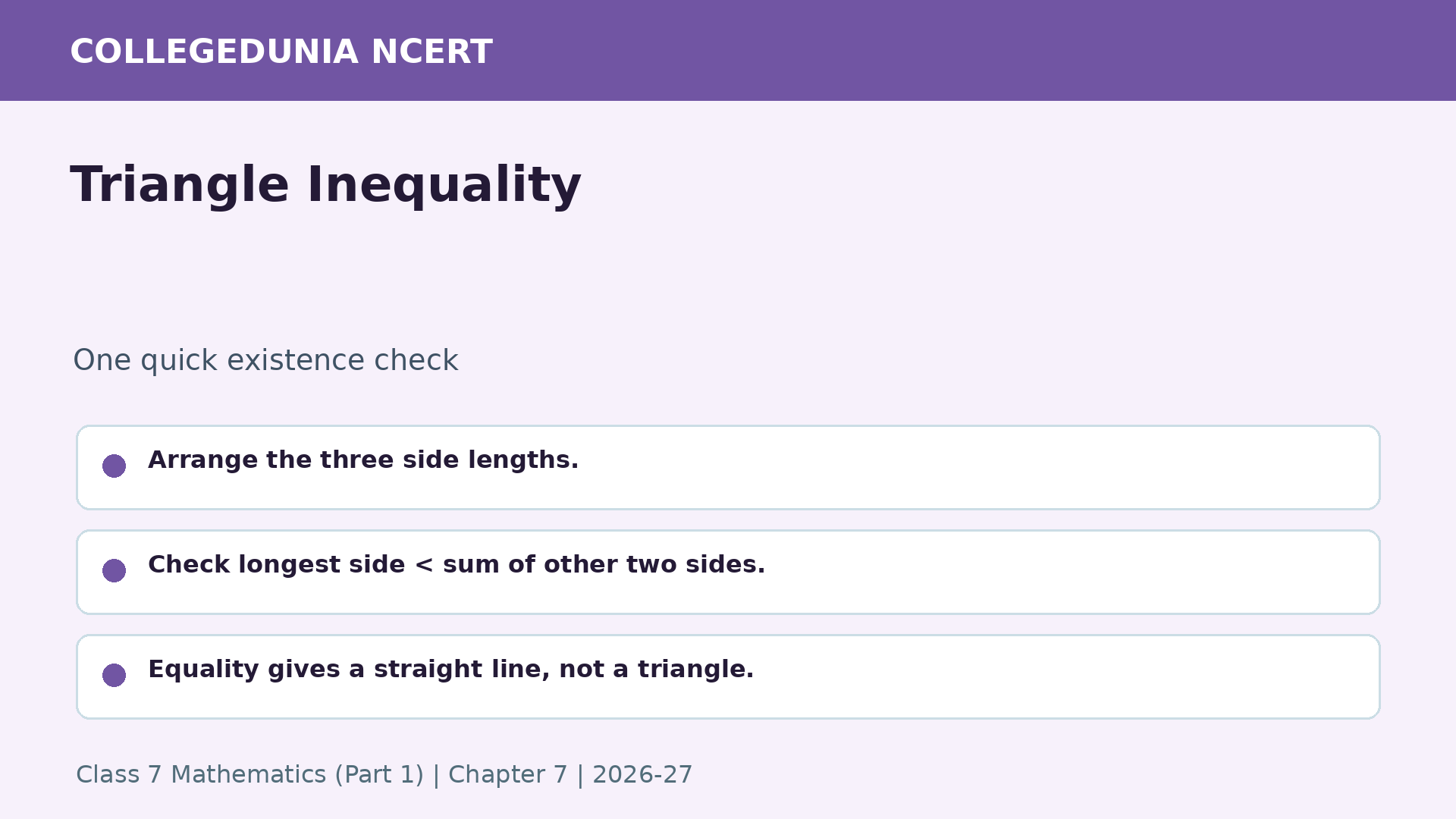
The triangle inequality says that each side of a triangle is shorter than the sum of the other two sides. In practice, students only need to check the longest side. If the longest side is equal to or greater than the sum of the other two sides, the arcs touch or miss each other and no triangle is formed.
- Side lengths 3, 4 and 6 work because 6 is less than 7.
- Side lengths 2, 2 and 5 do not work because 5 is greater than 4.
- Side lengths 3, 6 and 9 do not work because equality gives a straight line.
Angle Sum, Exterior Angles and Altitudes
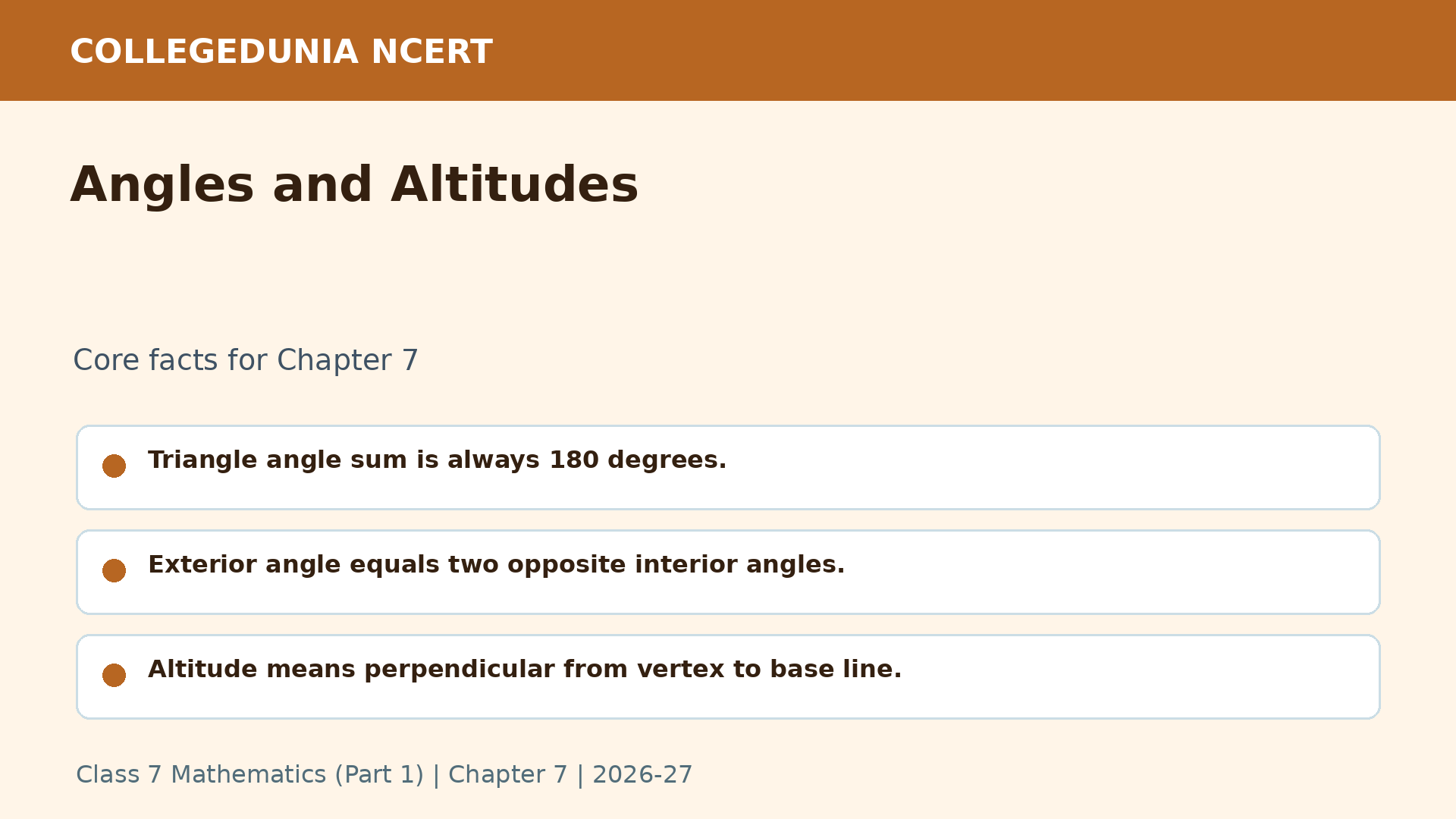
The angle sum property says that the three angles of any triangle add to 180 degrees. This helps students find the third angle, check whether two given angles can make a triangle and understand exterior angles.
An altitude is a perpendicular line segment from a vertex to the opposite side or to the line containing that side. In an obtuse triangle, the altitude may fall outside the triangle, so students should extend the base line when needed.
Triangle Construction Video Lesson
Source: Magnet Brains
All Chapter 7 Question Cards with Solutions
Students can also open the separate question-card page for quick checking. Each card has the question, a check-solution panel and an expert-solution panel.
Related NCERT Resources
| Resource | Link |
|---|---|
| Chapter 7 Notes | NCERT Notes Class 7 Maths Chapter 7 |
| Chapter 7 Book PDF | NCERT Book PDF Class 7 Maths Chapter 7 |
| Chapter 7 Handwritten Notes | Handwritten Notes Class 7 Maths Chapter 7 |
Class 7 Maths Solutions for All Chapters
| Chapter | Solutions |
|---|---|
| Chapter 1 Large Numbers Around Us | Open solutions |
| Chapter 2 Arithmetic Expressions | Open solutions |
| Chapter 3 A Peek Beyond the Point | Open solutions |
| Chapter 4 Expressions using Letter-Numbers | Open solutions |
| Chapter 5 Parallel and Intersecting Lines | Open solutions |
| Chapter 6 Number Play | Open solutions |
A Tale of Three Intersecting Lines Class 7 Maths FAQs
Ques. What is covered in Class 7 Maths Chapter 7 A Tale of Three Intersecting Lines?
Ans. The chapter covers triangle construction, triangle inequality, included-angle construction, angle sum property, exterior angles, altitudes and triangle types.
Ques. What is the triangle inequality rule?
Ans. A triangle exists when the longest side is less than the sum of the other two sides.
Ques. What is an altitude of a triangle?
Ans. An altitude is a perpendicular segment drawn from a vertex to the opposite side or to the line containing that side.



Comments