The Class 7 Maths Chapter 4 NCERT Solutions for Another Peek Beyond the Point help students practise decimal multiplication, decimal division, metric conversions and unit-rate questions according to the 2026-27 NCERT textbook.
35 solved questions are covered in the PDF with Solution and Expert Solution steps.
Decimal point movement is shown for multiplication by 10, 100, 1000 and division by decimals.
Word problems cover money, length, petrol use, shelf space and unit price comparison.
Each Class 7 Maths Chapter 4 NCERT solution follows the latest Ganita Prakash Part 2 chapter and keeps decimal placement visible.
Student Feedback: In a Collegedunia poll of 9,420 Class 7 students, 68% said they lose marks when the decimal point moves in the wrong direction. Students found the product-size check and division-flow steps most useful before tests.
Another Peek Beyond the Point Topics Covered in Class 7 Maths Chapter 4
Another Peek Beyond the Point extends the decimal ideas students already know from place value. The chapter starts with tenths, hundredths and thousandths, then moves into products such as 5.96 x 24.8 and divisions such as 4.68 divided by 0.13.
Topic
What students practise
Decimal multiplication
Multiplying as whole numbers and placing the decimal by total decimal places.
Decimal division
Moving the divisor and dividend by the same power of ten.
Applications
Money, unit price, length, petrol use, shelf space and calendar calculations.
Decimal Multiplication and Division Rules for Another Peek Beyond the Point
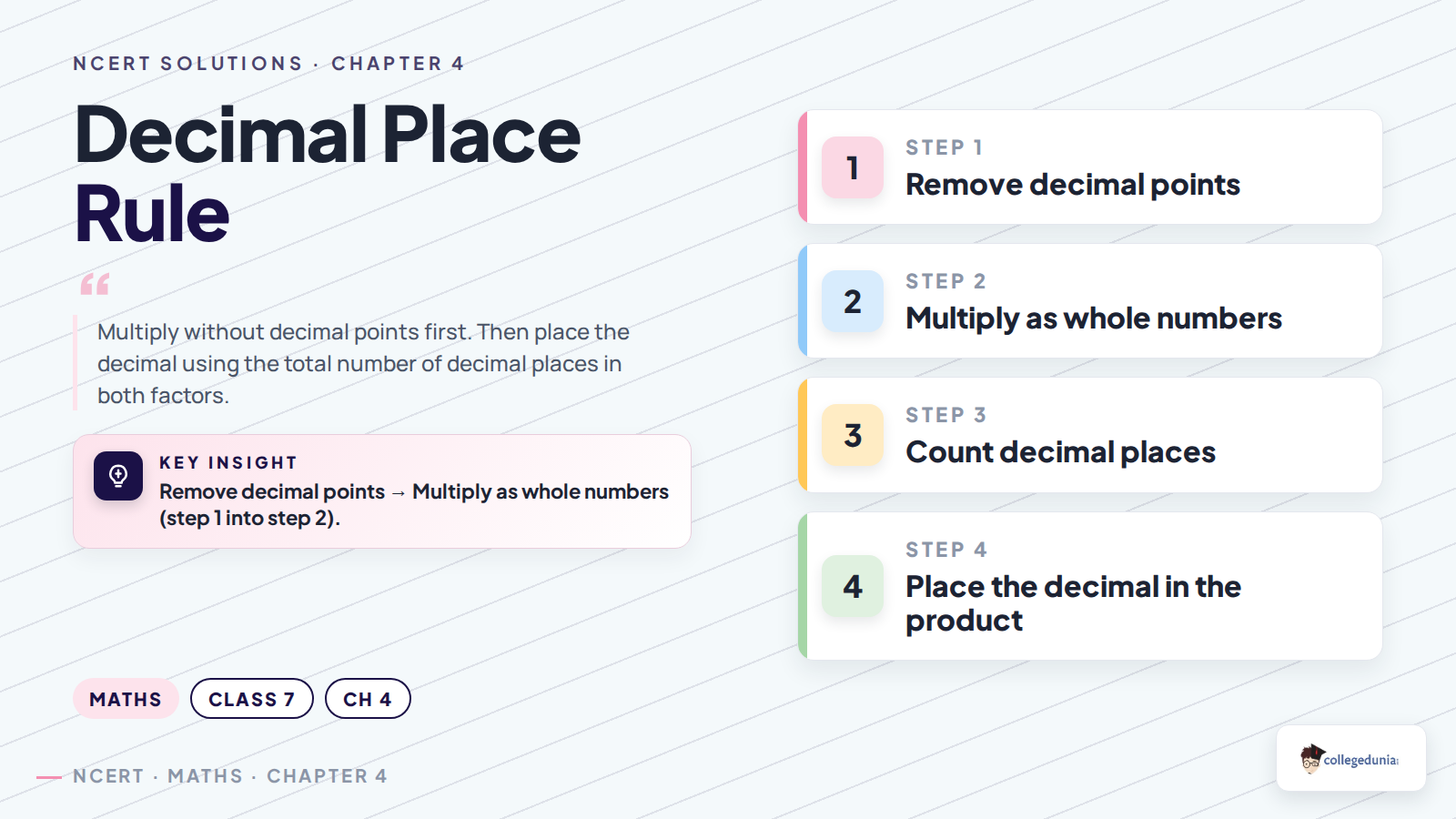
For multiplication, first remove the decimal points and multiply the numbers as counting numbers. Then count the total decimal places in both factors and place the point in the product. This one check prevents most answer-size mistakes.
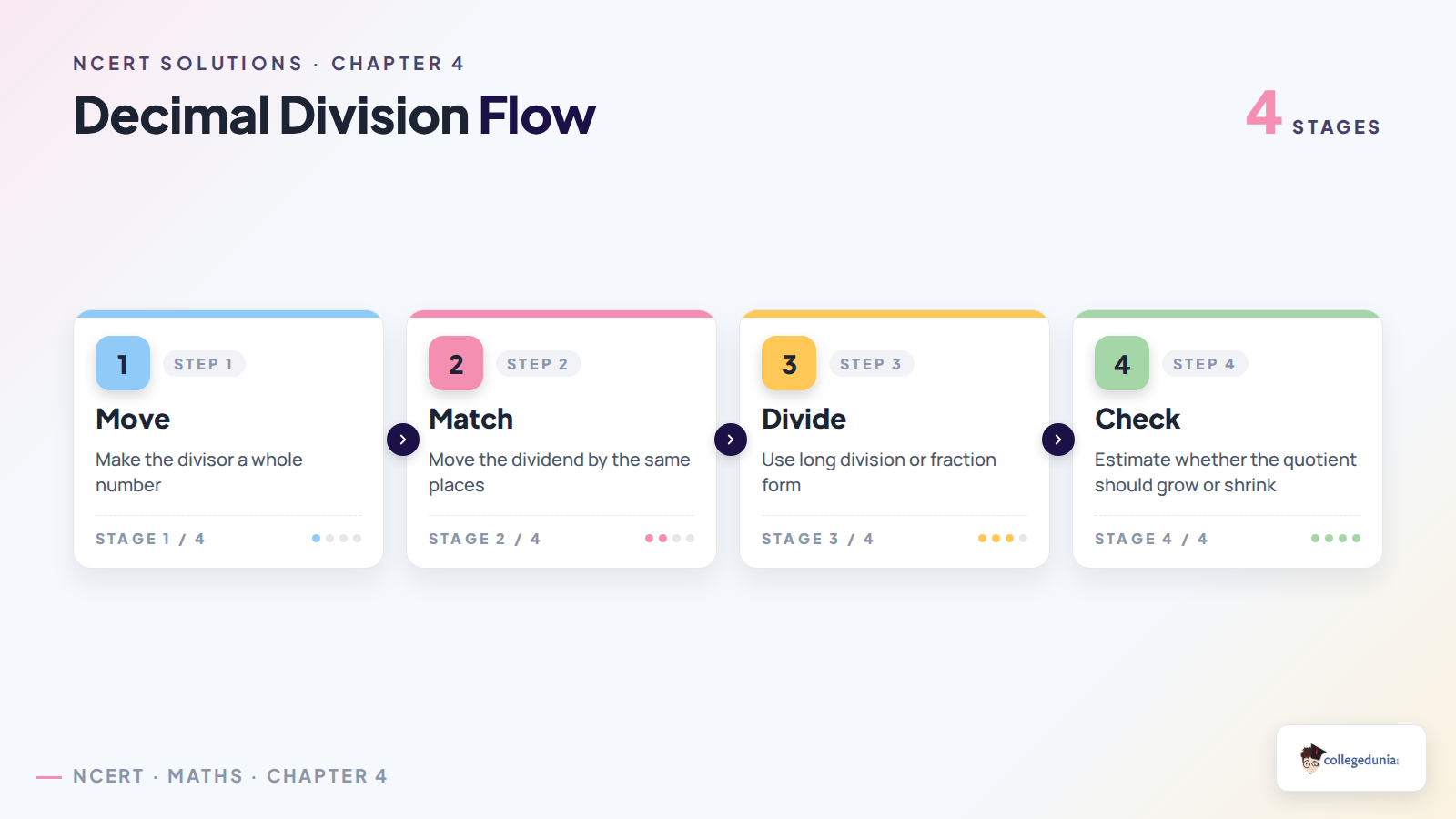
For division by a decimal, make the divisor a whole number. Move the decimal point in the dividend by the same number of places, then divide normally.
Another Peek Beyond the Point Class 7 Maths Video Recap
Strategic angle. Translate the decimal operation into a familiar whole-number or fraction operation, then place the decimal point at the end.
6 × 4 tenths =24 tenths.
Since 10 tenths make 1, 24 tenths =2.4.
7 × 0.3 = 7 × 3 tenths =21 tenths =2.1.
9 × 5 hundredths =45 hundredths =0.45.
This route keeps the size of the answer sensible. A product with two small decimals should stay small, while division by a decimal can make the quotient larger.
Find the products: (a) 27.34 x 6, (b) 4.23 x 3.7, (c) 0.432 x 0.23.
Concept used. This question uses placing the decimal point after multiplying as whole numbers. We keep decimal places and units visible at every step.
Source anchor
NCERT Class 7 Ganita Prakash Part 2, Chapter 4: Another Peek Beyond the Point, Page 73, Figure it Out 2.
27.34 × 6: first multiply 2734 × 6 = 16404. There are 2 decimal places, so the product is 164.04.
4.23 × 3.7: first multiply 423 × 37 = 15651. There are 3 decimal places in all, so the product is 15.651.
0.432 × 0.23: first multiply 432 × 23 = 9936. There are 5 decimal places in all, so the product is 0.09936.
Decimal check
After calculating, check whether the decimal point has moved in the expected direction.
(a) 164.04, (b) 15.651, (c) 0.09936.
RS
Ritwik Sen
B.Ed Mathematics, University of Calcutta
Verified Expert
Strategic angle. Translate the decimal operation into a familiar whole-number or fraction operation, then place the decimal point at the end.
27.34 × 6: first multiply 2734 × 6 = 16404. There are 2 decimal places, so the product is 164.04.
4.23 × 3.7: first multiply 423 × 37 = 15651. There are 3 decimal places in all, so the product is 15.651.
0.432 × 0.23: first multiply 432 × 23 = 9936. There are 5 decimal places in all, so the product is 0.09936.
This route keeps the size of the answer sensible. A product with two small decimals should stay small, while division by a decimal can make the quotient larger.
(a) 164.04, (b) 15.651, (c) 0.09936.
Q 4.3
Thejus needs 1.65 m of cloth for a shirt. How many metres of cloth are needed for 3 shirts?
Concept used. This question uses multiplying a decimal measure by a counting number. We keep decimal places and units visible at every step.
Source anchor
NCERT Class 7 Ganita Prakash Part 2, Chapter 4: Another Peek Beyond the Point, Page 73, Figure it Out 3.
Cloth for 1 shirt =1.65 m.
Cloth for 3 shirts =1.65 × 3 m.
165 × 3 = 495, and 1.65 has 2 decimal places.
So 1.65 × 3 = 4.95.
Decimal check
After calculating, check whether the decimal point has moved in the expected direction.
Thejus needs 4.95 m of cloth.
MI
Meera Iyer
M.Sc Mathematics, University of Madras
Verified Expert
Strategic angle. Translate the decimal operation into a familiar whole-number or fraction operation, then place the decimal point at the end.
Cloth for 1 shirt =1.65 m.
Cloth for 3 shirts =1.65 × 3 m.
165 × 3 = 495, and 1.65 has 2 decimal places.
So 1.65 × 3 = 4.95.
This route keeps the size of the answer sensible. A product with two small decimals should stay small, while division by a decimal can make the quotient larger.
Thejus needs 4.95 m of cloth.
Q 4.4
Meenu bought 4 notebooks and 3 erasers. Each book cost Rs. 15.50 and each eraser cost Rs. 2.75. How much did she spend in all?
Concept used. This question uses using decimal multiplication and addition in a money problem. We keep decimal places and units visible at every step.
Source anchor
NCERT Class 7 Ganita Prakash Part 2, Chapter 4: Another Peek Beyond the Point, Page 73, Figure it Out 4.
Cost of 4 notebooks =4 × 15.50 = 62.00 rupees.
Cost of 3 erasers =3 × 2.75 = 8.25 rupees.
Total cost =62.00+8.25=70.25 rupees.
Decimal check
After calculating, check whether the decimal point has moved in the expected direction.
Meenu spent Rs. 70.25 in all.
KJ
Kabir Joshi
M.Sc Applied Mathematics, IISER Pune
Verified Expert
Strategic angle. Translate the decimal operation into a familiar whole-number or fraction operation, then place the decimal point at the end.
Cost of 4 notebooks =4 × 15.50 = 62.00 rupees.
Cost of 3 erasers =3 × 2.75 = 8.25 rupees.
Total cost =62.00+8.25=70.25 rupees.
This route keeps the size of the answer sensible. A product with two small decimals should stay small, while division by a decimal can make the quotient larger.
Meenu spent Rs. 70.25 in all.
Q 4.5
The thickness of a rupee coin is 1.45 mm. What is the total height of the cylinder formed by placing 36 rupee coins one over the other? Write the answer in centimetres.
Concept used. This question uses multiplying a decimal and converting millimetres to centimetres. We keep decimal places and units visible at every step.
Source anchor
NCERT Class 7 Ganita Prakash Part 2, Chapter 4: Another Peek Beyond the Point, Page 73, Figure it Out 5.
Height in millimetres =1.45 × 36.
145 × 36 = 5220, and 1.45 has 2 decimal places.
So 1.45 × 36 = 52.20 mm.
Since 10 mm =1 cm, 52.20 mm =5.22 cm.
Decimal check
After calculating, check whether the decimal point has moved in the expected direction.
The cylinder is 5.22 cm high.
NB
Nisha Bansal
B.Sc Mathematics, Delhi University
Verified Expert
Strategic angle. Translate the decimal operation into a familiar whole-number or fraction operation, then place the decimal point at the end.
Height in millimetres =1.45 × 36.
145 × 36 = 5220, and 1.45 has 2 decimal places.
So 1.45 × 36 = 52.20 mm.
Since 10 mm =1 cm, 52.20 mm =5.22 cm.
This route keeps the size of the answer sensible. A product with two small decimals should stay small, while division by a decimal can make the quotient larger.
The cylinder is 5.22 cm high.
Q 4.6
The price of 1 kg of oranges is Rs. 56.50. What is the price of 2.250 kg of oranges? Can we write 56.50 as 56.5 and 2.250 as 2.25 and multiply? Will we get the same product? Why?
Concept used. This question uses trailing zeroes in decimals and money multiplication. We keep decimal places and units visible at every step.
Source anchor
NCERT Class 7 Ganita Prakash Part 2, Chapter 4: Another Peek Beyond the Point, Page 73, Figure it Out 6.
Price for 2.250 kg =56.50 × 2.250.
Trailing zeroes after the decimal do not change a number, so 56.50=56.5 and 2.250=2.25.
56.5 × 2.25 = 127.125.
Using 56.50 and 2.250 gives the same value because only extra zeroes were removed.
Decimal check
After calculating, check whether the decimal point has moved in the expected direction.
The price is Rs. 127.125. Yes, the product is the same.
AM
Arjun Menon
M.Sc Mathematics, IIT Hyderabad
Verified Expert
Strategic angle. Translate the decimal operation into a familiar whole-number or fraction operation, then place the decimal point at the end.
Price for 2.250 kg =56.50 × 2.250.
Trailing zeroes after the decimal do not change a number, so 56.50=56.5 and 2.250=2.25.
56.5 × 2.25 = 127.125.
Using 56.50 and 2.250 gives the same value because only extra zeroes were removed.
This route keeps the size of the answer sensible. A product with two small decimals should stay small, while division by a decimal can make the quotient larger.
The price is Rs. 127.125. Yes, the product is the same.
Q 4.7
Dwarakanath purchases notebooks at a wholesale price of Rs. 23.6 per piece and sells each notebook at Rs. 30. How much profit does he make if he sells 50 books in a week?
Concept used. This question uses profit per item multiplied by number of items. We keep decimal places and units visible at every step.
Source anchor
NCERT Class 7 Ganita Prakash Part 2, Chapter 4: Another Peek Beyond the Point, Page 73, Figure it Out 7.
Profit on one notebook =30-23.6=6.4 rupees.
Profit on 50 notebooks =6.4 × 50.
6.4 × 5 = 32, so 6.4 × 50 = 320.
Decimal check
After calculating, check whether the decimal point has moved in the expected direction.
He makes a profit of Rs. 320.
PM
Pooja Mehta
B.Ed Mathematics, Mumbai University
Verified Expert
Strategic angle. Translate the decimal operation into a familiar whole-number or fraction operation, then place the decimal point at the end.
Profit on one notebook =30-23.6=6.4 rupees.
Profit on 50 notebooks =6.4 × 50.
6.4 × 5 = 32, so 6.4 × 50 = 320.
This route keeps the size of the answer sensible. A product with two small decimals should stay small, while division by a decimal can make the quotient larger.
He makes a profit of Rs. 320.
Q 4.8
Given that 18 x 12 = 216, find: 18 x 1.2, 18 x 0.12, 1.8 x 1.2, 0.18 x 0.12, 0.018 x 0.012, and 1.8 x 12. In which cases is the product less than 1?
Concept used. This question uses using a known whole-number product to place decimal points. We keep decimal places and units visible at every step.
Source anchor
NCERT Class 7 Ganita Prakash Part 2, Chapter 4: Another Peek Beyond the Point, Page 73, Figure it Out 8.
18 × 1.2 = 21.6.
18 × 0.12 = 2.16.
1.8 × 1.2 = 2.16.
0.18 × 0.12 = 0.0216.
0.018 × 0.012 = 0.000216.
1.8 × 12 = 21.6.
The products below 1 are 0.0216 and 0.000216.
Decimal check
After calculating, check whether the decimal point has moved in the expected direction.
(a) 21.6, (b) 2.16, (c) 2.16, (d) 0.0216, (e) 0.000216, (f) 21.6. Cases (d) and (e) are less than 1.
SK
Sanya Kapoor
M.Sc Mathematics, IIT Ropar
Verified Expert
Strategic angle. Translate the decimal operation into a familiar whole-number or fraction operation, then place the decimal point at the end.
18 × 1.2 = 21.6.
18 × 0.12 = 2.16.
1.8 × 1.2 = 2.16.
0.18 × 0.12 = 0.0216.
0.018 × 0.012 = 0.000216.
This route keeps the size of the answer sensible. A product with two small decimals should stay small, while division by a decimal can make the quotient larger.
(a) 21.6, (b) 2.16, (c) 2.16, (d) 0.0216, (e) 0.000216, (f) 21.6. Cases (d) and (e) are less than 1.
Q 4.9
In which of these multiplications is the product less than 1? (a) 7 x 0.6, (b) 0.7 x 0.6, (c) 0.7 x 6, (d) 0.07 x 0.06. Can you answer without actually multiplying?
Concept used. This question uses deciding when a decimal product is less than one. We keep decimal places and units visible at every step.
Source anchor
NCERT Class 7 Ganita Prakash Part 2, Chapter 4: Another Peek Beyond the Point, Page 73, Figure it Out 9.
If both factors are between 0 and 1, their product is also less than each factor, hence less than 1.
In (b), both 0.7 and 0.6 are between 0 and 1.
In (d), both 0.07 and 0.06 are between 0 and 1.
In (a) and (c), one factor is greater than 1, so the product is greater than 1 here.
Decimal check
After calculating, check whether the decimal point has moved in the expected direction.
The products in (b) and (d) are less than 1.
DN
Devika Nair
M.Sc Mathematics, CUSAT
Verified Expert
Strategic angle. Translate the decimal operation into a familiar whole-number or fraction operation, then place the decimal point at the end.
If both factors are between 0 and 1, their product is also less than each factor, hence less than 1.
In (b), both 0.7 and 0.6 are between 0 and 1.
In (d), both 0.07 and 0.06 are between 0 and 1.
In (a) and (c), one factor is greater than 1, so the product is greater than 1 here.
This route keeps the size of the answer sensible. A product with two small decimals should stay small, while division by a decimal can make the quotient larger.
The products in (b) and (d) are less than 1.
Q 4.10
Complete the table by multiplying 5.7, 23.02, 0.92, 0.306, and 24.67 by 10, 100, and 1000.
Concept used. This question uses moving the decimal point right when multiplying by powers of ten. We keep decimal places and units visible at every step.
Source anchor
NCERT Class 7 Ganita Prakash Part 2, Chapter 4: Another Peek Beyond the Point, Pages 73-74, Figure it Out 10.
Multiplying by 10 moves the decimal point 1 place right.
Multiplying by 100 moves it 2 places right.
Multiplying by 1000 moves it 3 places right.
5.7 → 57, 570, 5700.
23.02 → 230.2, 2302, 23020.
0.92 → 9.2, 92, 920.
0.306 → 3.06, 30.6, 306.
24.67 → 246.7, 2467, 24670.
Decimal check
After calculating, check whether the decimal point has moved in the expected direction.
Strategic angle. Translate the decimal operation into a familiar whole-number or fraction operation, then place the decimal point at the end.
Multiplying by 10 moves the decimal point 1 place right.
Multiplying by 100 moves it 2 places right.
Multiplying by 1000 moves it 3 places right.
5.7 → 57, 570, 5700.
23.02 → 230.2, 2302, 23020.
This route keeps the size of the answer sensible. A product with two small decimals should stay small, while division by a decimal can make the quotient larger.
Find the quotient by converting the denominator into 1, 10, 100, or 1000 and verify by long division: 18/5, 415/4, 1217/2, and 4827/8.
Concept used. This question uses changing fractions into decimals by making convenient denominators. We keep decimal places and units visible at every step.
Source anchor
NCERT Class 7 Ganita Prakash Part 2, Chapter 4: Another Peek Beyond the Point, Page 83, Figure it Out 1.
185=3610=3.6.
4154=10375100=103.75.
12172=608510=608.5.
48278=6033751000=603.375.
Decimal check
After calculating, check whether the decimal point has moved in the expected direction.
(a) 3.6, (b) 103.75, (c) 608.5, (d) 603.375.
IM
Isha Malhotra
M.Sc Statistics, Panjab University
Verified Expert
Strategic angle. Translate the decimal operation into a familiar whole-number or fraction operation, then place the decimal point at the end.
185=3610=3.6.
4154=10375100=103.75.
12172=608510=608.5.
48278=6033751000=603.375.
This route keeps the size of the answer sensible. A product with two small decimals should stay small, while division by a decimal can make the quotient larger.
(a) 3.6, (b) 103.75, (c) 608.5, (d) 603.375.
Q 4.12
Choose the correct answer: 1526/4 and 3567/8.
Concept used. This question uses dividing whole numbers to get decimal quotients. We keep decimal places and units visible at every step.
Source anchor
NCERT Class 7 Ganita Prakash Part 2, Chapter 4: Another Peek Beyond the Point, Page 83, Figure it Out 2.
1526 ÷ 4 = 381.5, because 381.5 × 4 = 1526.
So the correct option for the first part is (iii).
3567 ÷ 8 = 445.875, because 445.875 × 8 = 3567.
So the correct option for the second part is (iii).
Decimal check
After calculating, check whether the decimal point has moved in the expected direction.
Strategic angle. Translate the decimal operation into a familiar whole-number or fraction operation, then place the decimal point at the end.
1526 ÷ 4 = 381.5, because 381.5 × 4 = 1526.
So the correct option for the first part is (iii).
3567 ÷ 8 = 445.875, because 445.875 × 8 = 3567.
So the correct option for the second part is (iii).
This route keeps the size of the answer sensible. A product with two small decimals should stay small, while division by a decimal can make the quotient larger.
What is the quotient? 132 divided by 4, 13.2 divided by 4, 1.32 divided by 4, and 0.132 divided by 4.
Concept used. This question uses decimal point movement in related divisions. We keep decimal places and units visible at every step.
Source anchor
NCERT Class 7 Ganita Prakash Part 2, Chapter 4: Another Peek Beyond the Point, Page 83, Figure it Out 3.
132 ÷ 4 = 33.
13.2 is one-tenth of 132, so 13.2 ÷ 4 = 3.3.
1.32 is one-hundredth of 132, so 1.32 ÷ 4 = 0.33.
0.132 is one-thousandth of 132, so 0.132 ÷ 4 = 0.033.
Decimal check
After calculating, check whether the decimal point has moved in the expected direction.
(a) 33, (b) 3.3, (c) 0.33, (d) 0.033.
LT
Leela Thomas
B.Sc Mathematics, Kerala University
Verified Expert
Strategic angle. Translate the decimal operation into a familiar whole-number or fraction operation, then place the decimal point at the end.
132 ÷ 4 = 33.
13.2 is one-tenth of 132, so 13.2 ÷ 4 = 3.3.
1.32 is one-hundredth of 132, so 1.32 ÷ 4 = 0.33.
0.132 is one-thousandth of 132, so 0.132 ÷ 4 = 0.033.
This route keeps the size of the answer sensible. A product with two small decimals should stay small, while division by a decimal can make the quotient larger.
(a) 33, (b) 3.3, (c) 0.33, (d) 0.033.
Q 4.14
What is the quotient? 126 divided by 8, 12.6 divided by 8, 1.26 divided by 8, 0.126 divided by 8, and 0.0126 divided by 8.
Concept used. This question uses scaling a dividend by powers of ten before division. We keep decimal places and units visible at every step.
Source anchor
NCERT Class 7 Ganita Prakash Part 2, Chapter 4: Another Peek Beyond the Point, Pages 83-84, Figure it Out 4.
126 ÷ 8 = 15.75.
12.6 ÷ 8 = 1.575.
1.26 ÷ 8 = 0.1575.
0.126 ÷ 8 = 0.01575.
0.0126 ÷ 8 = 0.001575.
Decimal check
After calculating, check whether the decimal point has moved in the expected direction.
M.Sc Mathematics, Savitribai Phule Pune University
Verified Expert
Strategic angle. Translate the decimal operation into a familiar whole-number or fraction operation, then place the decimal point at the end.
126 ÷ 8 = 15.75.
12.6 ÷ 8 = 1.575.
1.26 ÷ 8 = 0.1575.
0.126 ÷ 8 = 0.01575.
0.0126 ÷ 8 = 0.001575.
This route keeps the size of the answer sensible. A product with two small decimals should stay small, while division by a decimal can make the quotient larger.
Express the fractions in decimal form: 2/5, 13/4, 4/50, and 5/8.
Concept used. This question uses fraction to decimal conversion. We keep decimal places and units visible at every step.
Source anchor
NCERT Class 7 Ganita Prakash Part 2, Chapter 4: Another Peek Beyond the Point, Page 86, Figure it Out 1.
25=410=0.4.
134=325100=3.25.
450=8100=0.08.
58=6251000=0.625.
Decimal check
After calculating, check whether the decimal point has moved in the expected direction.
(a) 0.4, (b) 3.25, (c) 0.08, (d) 0.625.
NS
Neha Saxena
B.Ed Mathematics, Lucknow University
Verified Expert
Strategic angle. Translate the decimal operation into a familiar whole-number or fraction operation, then place the decimal point at the end.
25=410=0.4.
134=325100=3.25.
450=8100=0.08.
58=6251000=0.625.
This route keeps the size of the answer sensible. A product with two small decimals should stay small, while division by a decimal can make the quotient larger.
(a) 0.4, (b) 3.25, (c) 0.08, (d) 0.625.
Q 4.16
Find the quotients: (a) 24.86 divided by 1.2, (b) 5.728 divided by 1.52.
Concept used. This question uses division by a decimal divisor. We keep decimal places and units visible at every step.
Source anchor
NCERT Class 7 Ganita Prakash Part 2, Chapter 4: Another Peek Beyond the Point, Pages 86-87, Figure it Out 2.
24.86 ÷ 1.2 = 248.6 ÷ 12 after multiplying both numbers by 10.
248.6 ÷ 12 = 20.7166….
5.728 ÷ 1.52 = 572.8 ÷ 152 after multiplying both numbers by 100.
572.8 ÷ 152 = 3.7684210526….
Decimal check
After calculating, check whether the decimal point has moved in the expected direction.
(a) 20.7166…, (b) 3.7684210526….
OP
Om Prakash
M.Sc Mathematics, University of Rajasthan
Verified Expert
Strategic angle. Translate the decimal operation into a familiar whole-number or fraction operation, then place the decimal point at the end.
24.86 ÷ 1.2 = 248.6 ÷ 12 after multiplying both numbers by 10.
248.6 ÷ 12 = 20.7166….
5.728 ÷ 1.52 = 572.8 ÷ 152 after multiplying both numbers by 100.
572.8 ÷ 152 = 3.7684210526….
This route keeps the size of the answer sensible. A product with two small decimals should stay small, while division by a decimal can make the quotient larger.
(a) 20.7166…, (b) 3.7684210526….
Q 4.17
Evaluate using 156 x 12 = 1872: (a) 15.6 x 1.2, (b) 187.2 divided by 1.2, (c) 18.72 divided by 15.6, (d) 0.156 x 0.12.
Concept used. This question uses using one known product to solve decimal multiplication and division. We keep decimal places and units visible at every step.
Source anchor
NCERT Class 7 Ganita Prakash Part 2, Chapter 4: Another Peek Beyond the Point, Page 87, Figure it Out 3.
Since 156 × 12=1872, 15.6 × 1.2 = 18.72.
187.2 ÷ 1.2 = 156, because 156 × 1.2=187.2.
18.72 ÷ 15.6 = 1.2, because 15.6 × 1.2=18.72.
0.156 × 0.12 = 0.01872.
Decimal check
After calculating, check whether the decimal point has moved in the expected direction.
(a) 18.72, (b) 156, (c) 1.2, (d) 0.01872.
PD
Priya Dutta
M.Sc Applied Mathematics, NIT Durgapur
Verified Expert
Strategic angle. Translate the decimal operation into a familiar whole-number or fraction operation, then place the decimal point at the end.
Since 156 × 12=1872, 15.6 × 1.2 = 18.72.
187.2 ÷ 1.2 = 156, because 156 × 1.2=187.2.
18.72 ÷ 15.6 = 1.2, because 15.6 × 1.2=18.72.
0.156 × 0.12 = 0.01872.
This route keeps the size of the answer sensible. A product with two small decimals should stay small, while division by a decimal can make the quotient larger.
(a) 18.72, (b) 156, (c) 1.2, (d) 0.01872.
Q 4.18
Evaluate: (a) 25 divided by blank equals 0.025, (b) 25 divided by blank equals 250, (c) 25 divided by blank equals 2.5, (d) 25 divided by 10 equals 25 times blank, (e) 25 divided by 0.10 equals 25 times blank, (f) 25 divided by 0.01 equals 25 times blank.
Concept used. This question uses finding missing divisors and reciprocal multipliers. We keep decimal places and units visible at every step.
Source anchor
NCERT Class 7 Ganita Prakash Part 2, Chapter 4: Another Peek Beyond the Point, Page 87, Figure it Out 4.
25 ÷ 1000 = 0.025.
25 ÷ 0.1 = 250.
25 ÷ 10 = 2.5.
Dividing by 10 is the same as multiplying by 0.1.
Dividing by 0.10 is the same as multiplying by 10.
Dividing by 0.01 is the same as multiplying by 100.
Decimal check
After calculating, check whether the decimal point has moved in the expected direction.
Strategic angle. Translate the decimal operation into a familiar whole-number or fraction operation, then place the decimal point at the end.
25 ÷ 1000 = 0.025.
25 ÷ 0.1 = 250.
25 ÷ 10 = 2.5.
Dividing by 10 is the same as multiplying by 0.1.
Dividing by 0.10 is the same as multiplying by 10.
This route keeps the size of the answer sensible. A product with two small decimals should stay small, while division by a decimal can make the quotient larger.
Find the quotient: (a) 2.46 divided by 1.5, (b) 2.46 divided by 0.15, (c) 2.46 divided by 0.015. Is 24.6 divided by 1.5 the same as 2.46 divided by 0.15?
Concept used. This question uses how a smaller decimal divisor makes the quotient larger. We keep decimal places and units visible at every step.
Source anchor
NCERT Class 7 Ganita Prakash Part 2, Chapter 4: Another Peek Beyond the Point, Page 87, Figure it Out 5.
2.46 ÷ 1.5 = 24.6 ÷ 15 = 1.64.
2.46 ÷ 0.15 = 246 ÷ 15 = 16.4.
2.46 ÷ 0.015 = 2460 ÷ 15 = 164.
24.6 ÷ 1.5 = 246 ÷ 15 = 16.4.
So 24.6 ÷ 1.5 and 2.46 ÷ 0.15 are equal.
Decimal check
After calculating, check whether the decimal point has moved in the expected direction.
(a) 1.64, (b) 16.4, (c) 164. Yes, both compared quotients are 16.4.
SJ
Shruti Jain
M.Sc Mathematics, University of Delhi
Verified Expert
Strategic angle. Translate the decimal operation into a familiar whole-number or fraction operation, then place the decimal point at the end.
2.46 ÷ 1.5 = 24.6 ÷ 15 = 1.64.
2.46 ÷ 0.15 = 246 ÷ 15 = 16.4.
2.46 ÷ 0.015 = 2460 ÷ 15 = 164.
24.6 ÷ 1.5 = 246 ÷ 15 = 16.4.
So 24.6 ÷ 1.5 and 2.46 ÷ 0.15 are equal.
This route keeps the size of the answer sensible. A product with two small decimals should stay small, while division by a decimal can make the quotient larger.
(a) 1.64, (b) 16.4, (c) 164. Yes, both compared quotients are 16.4.
Q 4.20
A 4 m long wooden block has to be cut into 5 equal pieces. What is the length of each piece?
Concept used. This question uses sharing a length equally. We keep decimal places and units visible at every step.
Source anchor
NCERT Class 7 Ganita Prakash Part 2, Chapter 4: Another Peek Beyond the Point, Page 87, Figure it Out 6.
Length of each piece =4 ÷ 5 m.
4 ÷ 5 = 45 = 810=0.8.
Decimal check
After calculating, check whether the decimal point has moved in the expected direction.
Each piece is 0.8 m long.
TB
Tara Banerjee
B.Ed Mathematics, Jadavpur University
Verified Expert
Strategic angle. Translate the decimal operation into a familiar whole-number or fraction operation, then place the decimal point at the end.
Length of each piece =4 ÷ 5 m.
4 ÷ 5 = 45 = 810=0.8.
This route keeps the size of the answer sensible. A product with two small decimals should stay small, while division by a decimal can make the quotient larger.
Each piece is 0.8 m long.
Q 4.21
If the perimeter of a regular polygon with 12 sides is 208.8 cm, what is the length of its side?
Concept used. This question uses dividing perimeter equally among equal sides. We keep decimal places and units visible at every step.
Source anchor
NCERT Class 7 Ganita Prakash Part 2, Chapter 4: Another Peek Beyond the Point, Page 87, Figure it Out 7.
A regular polygon has all sides equal.
Side length =208.8 ÷ 12 cm.
208.8 ÷ 12 = 17.4.
Decimal check
After calculating, check whether the decimal point has moved in the expected direction.
Each side is 17.4 cm long.
UM
Uday Mehta
M.Sc Mathematics, IIT Indore
Verified Expert
Strategic angle. Translate the decimal operation into a familiar whole-number or fraction operation, then place the decimal point at the end.
A regular polygon has all sides equal.
Side length =208.8 ÷ 12 cm.
208.8 ÷ 12 = 17.4.
This route keeps the size of the answer sensible. A product with two small decimals should stay small, while division by a decimal can make the quotient larger.
Each side is 17.4 cm long.
Q 4.22
3 litres of watermelon juice is shared among 8 friends equally. How much watermelon juice will each get? Express the quantity in millilitres.
Concept used. This question uses dividing litres and converting to millilitres. We keep decimal places and units visible at every step.
Source anchor
NCERT Class 7 Ganita Prakash Part 2, Chapter 4: Another Peek Beyond the Point, Page 87, Figure it Out 8.
Juice per friend =3 ÷ 8 litres.
3 ÷ 8 = 0.375 litres.
Since 1 litre =1000 ml, 0.375 litres =375 ml.
Decimal check
After calculating, check whether the decimal point has moved in the expected direction.
Each friend gets 375 ml.
VK
Vidya Krishnan
B.Sc Mathematics, Bharathiar University
Verified Expert
Strategic angle. Translate the decimal operation into a familiar whole-number or fraction operation, then place the decimal point at the end.
Juice per friend =3 ÷ 8 litres.
3 ÷ 8 = 0.375 litres.
Since 1 litre =1000 ml, 0.375 litres =375 ml.
This route keeps the size of the answer sensible. A product with two small decimals should stay small, while division by a decimal can make the quotient larger.
Each friend gets 375 ml.
Q 4.23
A car covers 234.45 km using 12.6 litres of petrol. What is the distance travelled per litre?
Concept used. This question uses unit rate through decimal division. We keep decimal places and units visible at every step.
Source anchor
NCERT Class 7 Ganita Prakash Part 2, Chapter 4: Another Peek Beyond the Point, Page 87, Figure it Out 9.
Distance per litre =234.45 ÷ 12.6.
Multiply both numbers by 10: 2344.5 ÷ 126.
The quotient is 18.607142857….
Decimal check
After calculating, check whether the decimal point has moved in the expected direction.
The car travels about 18.607 km per litre.
YA
Yash Agarwal
M.Sc Mathematics, IIT Kanpur
Verified Expert
Strategic angle. Translate the decimal operation into a familiar whole-number or fraction operation, then place the decimal point at the end.
Distance per litre =234.45 ÷ 12.6.
Multiply both numbers by 10: 2344.5 ÷ 126.
The quotient is 18.607142857….
This route keeps the size of the answer sensible. A product with two small decimals should stay small, while division by a decimal can make the quotient larger.
The car travels about 18.607 km per litre.
Q 4.24
13.5 kg of flour was distributed equally among 15 students. How much flour did each student receive?
Concept used. This question uses equal sharing with decimal quantities. We keep decimal places and units visible at every step.
Source anchor
NCERT Class 7 Ganita Prakash Part 2, Chapter 4: Another Peek Beyond the Point, Page 87, Figure it Out 10.
Flour per student =13.5 ÷ 15 kg.
13.5 ÷ 15 = 0.9.
Decimal check
After calculating, check whether the decimal point has moved in the expected direction.
Each student received 0.9 kg of flour.
ZS
Zoya Siddiqui
B.Ed Mathematics, Aligarh Muslim University
Verified Expert
Strategic angle. Translate the decimal operation into a familiar whole-number or fraction operation, then place the decimal point at the end.
Flour per student =13.5 ÷ 15 kg.
13.5 ÷ 15 = 0.9.
This route keeps the size of the answer sensible. A product with two small decimals should stay small, while division by a decimal can make the quotient larger.
Each student received 0.9 kg of flour.
Q 4.25
A 210 gram packet of peanut chikki costs Rs. 70.5, while a 110 gram packet of potato chips costs Rs. 33.25. Which is cheaper?
Concept used. This question uses unit price comparison. We keep decimal places and units visible at every step.
Source anchor
NCERT Class 7 Ganita Prakash Part 2, Chapter 4: Another Peek Beyond the Point, Page 93, Figure it Out 1.
Price per gram of chikki =70.5 ÷ 210 = 0.335714… rupees.
Price per gram of chips =33.25 ÷ 110 = 0.302272… rupees.
Since 0.302272… < 0.335714…, the chips cost less per gram.
Decimal check
After calculating, check whether the decimal point has moved in the expected direction.
The potato chips packet is cheaper per gram.
AV
Aditi Verma
M.Sc Mathematics, Banaras Hindu University
Verified Expert
Strategic angle. Translate the decimal operation into a familiar whole-number or fraction operation, then place the decimal point at the end.
Price per gram of chikki =70.5 ÷ 210 = 0.335714… rupees.
Price per gram of chips =33.25 ÷ 110 = 0.302272… rupees.
Since 0.302272… < 0.335714…, the chips cost less per gram.
This route keeps the size of the answer sensible. A product with two small decimals should stay small, while division by a decimal can make the quotient larger.
The potato chips packet is cheaper per gram.
Q 4.26
Write the decimal number at the arrow marks on the number lines from 3.1 to 3.2 and from 2.15 to 2.17.
Concept used. This question uses reading decimal number lines. We keep decimal places and units visible at every step.
Source anchor
NCERT Class 7 Ganita Prakash Part 2, Chapter 4: Another Peek Beyond the Point, Page 93, Figure it Out 2.
From 3.1 to 3.2, the interval length is 0.1 and it is split into 10 equal parts.
Each small step is 0.01. The arrow is at the sixth small step after 3.10, so the number is 3.16.
From 2.15 to 2.17, the interval length is 0.02 and it is split into 10 equal parts.
Each small step is 0.002. The arrow is at the sixth small step after 2.150, so the number is 2.162.
Decimal check
After calculating, check whether the decimal point has moved in the expected direction.
The arrow marks show 3.16 and 2.162.
BP
Bhavesh Patel
B.Sc Mathematics, MS University Baroda
Verified Expert
Strategic angle. Translate the decimal operation into a familiar whole-number or fraction operation, then place the decimal point at the end.
From 3.1 to 3.2, the interval length is 0.1 and it is split into 10 equal parts.
Each small step is 0.01. The arrow is at the sixth small step after 3.10, so the number is 3.16.
From 2.15 to 2.17, the interval length is 0.02 and it is split into 10 equal parts.
Each small step is 0.002. The arrow is at the sixth small step after 2.150, so the number is 2.162.
This route keeps the size of the answer sensible. A product with two small decimals should stay small, while division by a decimal can make the quotient larger.
The arrow marks show 3.16 and 2.162.
Q 4.27
Shyamala bought 3 kg bananas at Rs. 30 per kg. She counted 35 bananas in all. She sells each banana for Rs. 5. How much profit does she make selling all the bananas?
Concept used. This question uses profit from total cost and total selling price. We keep decimal places and units visible at every step.
Source anchor
NCERT Class 7 Ganita Prakash Part 2, Chapter 4: Another Peek Beyond the Point, Page 93, Figure it Out 3.
Cost price =3 × 30=90 rupees.
Selling price =35 × 5=175 rupees.
Profit =175-90=85 rupees.
Decimal check
After calculating, check whether the decimal point has moved in the expected direction.
Shyamala makes a profit of Rs. 85.
CS
Charu Singh
M.Sc Mathematics, Kumaun University
Verified Expert
Strategic angle. Translate the decimal operation into a familiar whole-number or fraction operation, then place the decimal point at the end.
Cost price =3 × 30=90 rupees.
Selling price =35 × 5=175 rupees.
Profit =175-90=85 rupees.
This route keeps the size of the answer sensible. A product with two small decimals should stay small, while division by a decimal can make the quotient larger.
Shyamala makes a profit of Rs. 85.
Q 4.28
Textbooks are 2.5 cm thick. The teacher wanted to place 80 textbooks on a 160 cm shelf. How many books could be placed? Was any space left?
Concept used. This question uses dividing shelf length by book thickness. We keep decimal places and units visible at every step.
Source anchor
NCERT Class 7 Ganita Prakash Part 2, Chapter 4: Another Peek Beyond the Point, Pages 93-94, Figure it Out 4.
Number of books that fit =160 ÷ 2.5.
Multiply both numbers by 10: 1600 ÷ 25 = 64.
64 books take 64 × 2.5 = 160 cm.
So the shelf is exactly full.
Decimal check
After calculating, check whether the decimal point has moved in the expected direction.
64 books can be placed, and no space is left.
DS
Dhruv Sethi
B.Ed Mathematics, Jamia Millia Islamia
Verified Expert
Strategic angle. Translate the decimal operation into a familiar whole-number or fraction operation, then place the decimal point at the end.
Number of books that fit =160 ÷ 2.5.
Multiply both numbers by 10: 1600 ÷ 25 = 64.
64 books take 64 × 2.5 = 160 cm.
So the shelf is exactly full.
This route keeps the size of the answer sensible. A product with two small decimals should stay small, while division by a decimal can make the quotient larger.
64 books can be placed, and no space is left.
Q 4.29
Fill the blanks: 5.5 km in metres, 35 cm in metres, 14.5 cm in millimetres, 68 g in kilograms, 9.02 m in millimetres, and 125.5 ml in litres.
Concept used. This question uses metric unit conversions using powers of ten. We keep decimal places and units visible at every step.
Source anchor
NCERT Class 7 Ganita Prakash Part 2, Chapter 4: Another Peek Beyond the Point, Page 94, Figure it Out 5.
5.5 km =5.5 × 1000=5500 m.
35 cm =35 ÷ 100=0.35 m.
14.5 cm =14.5 × 10=145 mm.
68 g =68 ÷ 1000=0.068 kg.
9.02 m =9.02 × 1000=9020 mm.
125.5 ml =125.5 ÷ 1000=0.1255 l.
Decimal check
After calculating, check whether the decimal point has moved in the expected direction.
5500 m, 0.35 m, 145 mm, 0.068 kg, 9020 mm, 0.1255 l.
ER
Esha Roy
M.Sc Mathematics, Tezpur University
Verified Expert
Strategic angle. Translate the decimal operation into a familiar whole-number or fraction operation, then place the decimal point at the end.
5.5 km =5.5 × 1000=5500 m.
35 cm =35 ÷ 100=0.35 m.
14.5 cm =14.5 × 10=145 mm.
68 g =68 ÷ 1000=0.068 kg.
9.02 m =9.02 × 1000=9020 mm.
This route keeps the size of the answer sensible. A product with two small decimals should stay small, while division by a decimal can make the quotient larger.
5500 m, 0.35 m, 145 mm, 0.068 kg, 9020 mm, 0.1255 l.
Q 4.30
Sridharacharya asked: 6 and 1/4 is divided by 2 and 1/2, and 60 and 1/4 is divided by 3 and 1/2. Find the quotients by converting the fractions into decimals.
Concept used. This question uses dividing mixed numbers after decimal conversion. We keep decimal places and units visible at every step.
Source anchor
NCERT Class 7 Ganita Prakash Part 2, Chapter 4: Another Peek Beyond the Point, Page 94, Figure it Out 6.
614=6.25 and 212=2.5.
6.25 ÷ 2.5 = 62.5 ÷ 25 = 2.5.
6014=60.25 and 312=3.5.
60.25 ÷ 3.5 = 602.5 ÷ 35 = 17.214285….
Decimal check
After calculating, check whether the decimal point has moved in the expected direction.
The quotients are 2.5 and 17.214285….
FA
Farhan Ali
M.Sc Statistics, University of Hyderabad
Verified Expert
Strategic angle. Translate the decimal operation into a familiar whole-number or fraction operation, then place the decimal point at the end.
614=6.25 and 212=2.5.
6.25 ÷ 2.5 = 62.5 ÷ 25 = 2.5.
6014=60.25 and 312=3.5.
60.25 ÷ 3.5 = 602.5 ÷ 35 = 17.214285….
This route keeps the size of the answer sensible. A product with two small decimals should stay small, while division by a decimal can make the quotient larger.
The quotients are 2.5 and 17.214285….
Q 4.31
Fill the boxes in at least two ways: (a) blank times blank equals 2.4, (b) blank times blank equals 14.5.
Concept used. This question uses finding factor pairs for decimal products. We keep decimal places and units visible at every step.
Source anchor
NCERT Class 7 Ganita Prakash Part 2, Chapter 4: Another Peek Beyond the Point, Page 94, Figure it Out 7.
For 2.4, one way is 1.2 × 2 = 2.4.
Another way is 0.6 × 4 = 2.4.
For 14.5, one way is 2.9 × 5 = 14.5.
Another way is 1.45 × 10 = 14.5.
Decimal check
After calculating, check whether the decimal point has moved in the expected direction.
(a) 1.2 × 2 and 0.6 × 4. (b) 2.9 × 5 and 1.45 × 10.
GD
Gauri Deshpande
B.Sc Mathematics, Nagpur University
Verified Expert
Strategic angle. Translate the decimal operation into a familiar whole-number or fraction operation, then place the decimal point at the end.
For 2.4, one way is 1.2 × 2 = 2.4.
Another way is 0.6 × 4 = 2.4.
For 14.5, one way is 2.9 × 5 = 14.5.
Another way is 1.45 × 10 = 14.5.
This route keeps the size of the answer sensible. A product with two small decimals should stay small, while division by a decimal can make the quotient larger.
(a) 1.2 × 2 and 0.6 × 4. (b) 2.9 × 5 and 1.45 × 10.
Q 4.32
Find the quotients given that 756 divided by 36 equals 21: 75.6 divided by 3.6, 7.56 divided by 0.36, 756 divided by 0.36, 75.6 divided by 360, 7560 divided by 3.6, and 7.56 divided by 0.36.
Concept used. This question uses scaling dividend and divisor in the same ratio. We keep decimal places and units visible at every step.
Source anchor
NCERT Class 7 Ganita Prakash Part 2, Chapter 4: Another Peek Beyond the Point, Page 94, Figure it Out 8.
75.6 ÷ 3.6 = 756 ÷ 36 = 21.
7.56 ÷ 0.36 = 756 ÷ 36 = 21.
756 ÷ 0.36 = 75600 ÷ 36 = 2100.
75.6 ÷ 360 = 756 ÷ 3600 = 0.21.
7560 ÷ 3.6 = 75600 ÷ 36 = 2100.
The last expression repeats 7.56 ÷ 0.36, so it is also 21.
Decimal check
After calculating, check whether the decimal point has moved in the expected direction.
Strategic angle. Translate the decimal operation into a familiar whole-number or fraction operation, then place the decimal point at the end.
75.6 ÷ 3.6 = 756 ÷ 36 = 21.
7.56 ÷ 0.36 = 756 ÷ 36 = 21.
756 ÷ 0.36 = 75600 ÷ 36 = 2100.
75.6 ÷ 360 = 756 ÷ 3600 = 0.21.
7560 ÷ 3.6 = 75600 ÷ 36 = 2100.
This route keeps the size of the answer sensible. A product with two small decimals should stay small, while division by a decimal can make the quotient larger.
Find the missing cells if each cell represents a divided by b, with a values 1517, 151.7, 15.17, 1.517, 15170 and b values 37, 3.7, 0.37, 0.037, 370.
Concept used. This question uses division table patterns when dividend and divisor shift by powers of ten. We keep decimal places and units visible at every step.
Source anchor
NCERT Class 7 Ganita Prakash Part 2, Chapter 4: Another Peek Beyond the Point, Page 94, Figure it Out 9.
Row b=37: 41, 4.1, 0.41, 0.041, 410.
Row b=3.7: 410, 41, 4.1, 0.41, 4100.
Row b=0.37: 4100, 410, 41, 4.1, 41000.
Row b=0.037: 41000, 4100, 410, 41, 410000.
Row b=370: 4.1, 0.41, 0.041, 0.0041, 41.
Decimal check
After calculating, check whether the decimal point has moved in the expected direction.
The completed rows are 41,4.1,0.41,0.041,410; 410,41,4.1,0.41,4100; 4100,410,41,4.1,41000; 41000,4100,410,41,410000; 4.1,0.41,0.041,0.0041,41.
JK
Janvi Kapoor
B.Ed Mathematics, Guru Gobind Singh Indraprastha University
Verified Expert
Strategic angle. Translate the decimal operation into a familiar whole-number or fraction operation, then place the decimal point at the end.
Row b=37: 41, 4.1, 0.41, 0.041, 410.
Row b=3.7: 410, 41, 4.1, 0.41, 4100.
Row b=0.37: 4100, 410, 41, 4.1, 41000.
Row b=0.037: 41000, 4100, 410, 41, 410000.
Row b=370: 4.1, 0.41, 0.041, 0.0041, 41.
This route keeps the size of the answer sensible. A product with two small decimals should stay small, while division by a decimal can make the quotient larger.
The completed rows are 41,4.1,0.41,0.041,410; 410,41,4.1,0.41,4100; 4100,410,41,4.1,41000; 41000,4100,410,41,410000; 4.1,0.41,0.041,0.0041,41.
Q 4.34
Using the digits 2, 4, 5, 8, and 0, fill the boxes in a two-digit decimal times a one-digit decimal to get: maximum product, minimum product, product greater than 150, product nearest to 100, and product nearest to 5.
Concept used. This question uses arranging digits to control a decimal product. We keep decimal places and units visible at every step.
Source anchor
NCERT Class 7 Ganita Prakash Part 2, Chapter 4: Another Peek Beyond the Point, Pages 94-95, Figure it Out 10.
A brute-force check of all digit arrangements gives the maximum product as 82.0 × 5.4 = 442.8.
The minimum product is 45.8 × 0.2 = 9.16.
One product greater than 150 is 54.0 × 2.8 = 151.2.
The product nearest to 100 is 20.5 × 4.8 = 98.4.
The product nearest to 5 is again 45.8 × 0.2 = 9.16, since no arrangement gets closer to 5.
Decimal check
After calculating, check whether the decimal point has moved in the expected direction.
Strategic angle. Translate the decimal operation into a familiar whole-number or fraction operation, then place the decimal point at the end.
A brute-force check of all digit arrangements gives the maximum product as 82.0 × 5.4 = 442.8.
The minimum product is 45.8 × 0.2 = 9.16.
One product greater than 150 is 54.0 × 2.8 = 151.2.
The product nearest to 100 is 20.5 × 4.8 = 98.4.
The product nearest to 5 is again 45.8 × 0.2 = 9.16, since no arrangement gets closer to 5.
This route keeps the size of the answer sensible. A product with two small decimals should stay small, while division by a decimal can make the quotient larger.
Sort in increasing order: 245.05 x 0.942368, 245.05 x 7.9682, 245.05 divided by 7.9682, 245.05 divided by 0.942368, 245.05, and 7.9682.
Concept used. This question uses comparing products and quotients without over-calculating. We keep decimal places and units visible at every step.
Source anchor
NCERT Class 7 Ganita Prakash Part 2, Chapter 4: Another Peek Beyond the Point, Page 95, Figure it Out 11.
7.9682 is the smallest listed number.
245.05 ÷ 7.9682 ≈ 30.7535.
245.05 × 0.942368 ≈ 230.9273.
245.05 comes next.
245.05 ÷ 0.942368 ≈ 260.0364.
245.05 × 7.9682 ≈ 1952.6074 is the largest.
Decimal check
After calculating, check whether the decimal point has moved in the expected direction.
(f) < (c) < (a) < (e) < (d) < (b).
MB
Mitali Bose
B.Sc Mathematics, Presidency University
Verified Expert
Strategic angle. Translate the decimal operation into a familiar whole-number or fraction operation, then place the decimal point at the end.
7.9682 is the smallest listed number.
245.05 ÷ 7.9682 ≈ 30.7535.
245.05 × 0.942368 ≈ 230.9273.
245.05 comes next.
245.05 ÷ 0.942368 ≈ 260.0364.
This route keeps the size of the answer sensible. A product with two small decimals should stay small, while division by a decimal can make the quotient larger.
(f) < (c) < (a) < (e) < (d) < (b).
Another Peek Beyond the Point Class 7 Maths NCERT Solutions FAQs
Ques. What does Another Peek Beyond the Point Class 7 Maths teach?
Ans. It teaches decimal multiplication, decimal division, place-value movement, unit conversions, unit rates and repeating decimals.
Ques. How many questions are solved in the Class 7 Maths Chapter 4 PDF?
Ans. The PDF solves 35 NCERT Figure it Out questions with a main Solution and an Expert Solution.
Ques. What is the main rule for decimal multiplication?
Ans. Multiply as whole numbers first, then place the decimal using the total decimal places in both factors.
Ques. Is the Class 7 Maths Chapter 4 PDF updated for 2026-27?
Ans. Yes. The PDF follows the 2026-27 Ganita Prakash Part 2 chapter and covers all main exercise questions.




Chapter4AnotherPeekBeyondthePointSolutions.pdf?page=1&dpi=150)
Chapter4AnotherPeekBeyondthePointSolutions.pdf?page=2&dpi=150)
Chapter4AnotherPeekBeyondthePointSolutions.pdf?page=3&dpi=150)
Chapter4AnotherPeekBeyondthePointSolutions.pdf?page=4&dpi=150)
Chapter4AnotherPeekBeyondthePointSolutions.pdf?page=5&dpi=150)
Chapter4AnotherPeekBeyondthePointSolutions.pdf?page=6&dpi=150)
Chapter4AnotherPeekBeyondthePointSolutions.pdf?page=7&dpi=150)
Chapter4AnotherPeekBeyondthePointSolutions.pdf?page=8&dpi=150)
Chapter4AnotherPeekBeyondthePointSolutions.pdf?page=9&dpi=150)
Chapter4AnotherPeekBeyondthePointSolutions.pdf?page=10&dpi=150)
Chapter4AnotherPeekBeyondthePointSolutions.pdf?page=11&dpi=150)
Chapter4AnotherPeekBeyondthePointSolutions.pdf?page=12&dpi=150)
Chapter4AnotherPeekBeyondthePointSolutions.pdf?page=13&dpi=150)
Chapter4AnotherPeekBeyondthePointSolutions.pdf?page=14&dpi=150)
Chapter4AnotherPeekBeyondthePointSolutions.pdf?page=15&dpi=150)
Chapter4AnotherPeekBeyondthePointSolutions.pdf?page=16&dpi=150)
Chapter4AnotherPeekBeyondthePointSolutions.pdf?page=17&dpi=150)
Chapter4AnotherPeekBeyondthePointSolutions.pdf?page=18&dpi=150)
Chapter4AnotherPeekBeyondthePointSolutions.pdf?page=19&dpi=150)
Chapter4AnotherPeekBeyondthePointSolutions.pdf?page=20&dpi=150)
Chapter4AnotherPeekBeyondthePointSolutions.pdf?page=21&dpi=150)
Chapter4AnotherPeekBeyondthePointSolutions.pdf?page=22&dpi=150)
Chapter4AnotherPeekBeyondthePointSolutions.pdf?page=23&dpi=150)
Chapter4AnotherPeekBeyondthePointSolutions.pdf?page=24&dpi=150)
Chapter4AnotherPeekBeyondthePointSolutions.pdf?page=25&dpi=150)
Chapter4AnotherPeekBeyondthePointSolutions.pdf?page=26&dpi=150)
Chapter4AnotherPeekBeyondthePointSolutions.pdf?page=27&dpi=150)
Chapter4AnotherPeekBeyondthePointSolutions.pdf?page=28&dpi=150)
Chapter4AnotherPeekBeyondthePointSolutions.pdf?page=29&dpi=150)
Chapter4AnotherPeekBeyondthePointSolutions.pdf?page=30&dpi=150)
Chapter4AnotherPeekBeyondthePointSolutions.pdf?page=31&dpi=150)
Chapter4AnotherPeekBeyondthePointSolutions.pdf?page=32&dpi=150)
Chapter4AnotherPeekBeyondthePointSolutions.pdf?page=33&dpi=150)
Chapter4AnotherPeekBeyondthePointSolutions.pdf?page=34&dpi=150)
Chapter4AnotherPeekBeyondthePointSolutions.pdf?page=35&dpi=150)
Chapter4AnotherPeekBeyondthePointSolutions.pdf?page=36&dpi=150)
Chapter4AnotherPeekBeyondthePointSolutions.pdf?page=37&dpi=150)
Chapter4AnotherPeekBeyondthePointSolutions.pdf?page=38&dpi=150)
Chapter4AnotherPeekBeyondthePointSolutions.pdf?page=39&dpi=150)
Chapter4AnotherPeekBeyondthePointSolutions.pdf?page=40&dpi=150)
Chapter4AnotherPeekBeyondthePointSolutions.pdf?page=41&dpi=150)
Chapter4AnotherPeekBeyondthePointSolutions.pdf?page=42&dpi=150)
Chapter4AnotherPeekBeyondthePointSolutions.pdf?page=43&dpi=150)
Chapter4AnotherPeekBeyondthePointSolutions.pdf?page=44&dpi=150)
Chapter4AnotherPeekBeyondthePointSolutions.pdf?page=45&dpi=150)
Chapter4AnotherPeekBeyondthePointSolutions.pdf?page=46&dpi=150)
Chapter4AnotherPeekBeyondthePointSolutions.pdf?page=47&dpi=150)
Chapter4AnotherPeekBeyondthePointSolutions_flat_MobileCard.pdf?page=1&dpi=150)
Chapter4AnotherPeekBeyondthePointSolutions_flat_MobileCard.pdf?page=2&dpi=150)
Chapter4AnotherPeekBeyondthePointSolutions_flat_MobileCard.pdf?page=3&dpi=150)
Chapter4AnotherPeekBeyondthePointSolutions_flat_MobileCard.pdf?page=4&dpi=150)
Chapter4AnotherPeekBeyondthePointSolutions_flat_MobileCard.pdf?page=5&dpi=150)
Chapter4AnotherPeekBeyondthePointSolutions_flat_MobileCard.pdf?page=6&dpi=150)
Chapter4AnotherPeekBeyondthePointSolutions_flat_MobileCard.pdf?page=7&dpi=150)
Chapter4AnotherPeekBeyondthePointSolutions_flat_MobileCard.pdf?page=8&dpi=150)
Chapter4AnotherPeekBeyondthePointSolutions_flat_MobileCard.pdf?page=9&dpi=150)
Chapter4AnotherPeekBeyondthePointSolutions_flat_MobileCard.pdf?page=10&dpi=150)
Chapter4AnotherPeekBeyondthePointSolutions_flat_MobileCard.pdf?page=11&dpi=150)
Chapter4AnotherPeekBeyondthePointSolutions_flat_MobileCard.pdf?page=12&dpi=150)
Chapter4AnotherPeekBeyondthePointSolutions_flat_MobileCard.pdf?page=13&dpi=150)
Chapter4AnotherPeekBeyondthePointSolutions_flat_MobileCard.pdf?page=14&dpi=150)
Chapter4AnotherPeekBeyondthePointSolutions_flat_MobileCard.pdf?page=15&dpi=150)
Chapter4AnotherPeekBeyondthePointSolutions_flat_MobileCard.pdf?page=16&dpi=150)
Chapter4AnotherPeekBeyondthePointSolutions_flat_MobileCard.pdf?page=17&dpi=150)
Chapter4AnotherPeekBeyondthePointSolutions_flat_MobileCard.pdf?page=18&dpi=150)
Chapter4AnotherPeekBeyondthePointSolutions_flat_MobileCard.pdf?page=19&dpi=150)
Chapter4AnotherPeekBeyondthePointSolutions_flat_MobileCard.pdf?page=20&dpi=150)
Chapter4AnotherPeekBeyondthePointSolutions_flat_MobileCard.pdf?page=21&dpi=150)
Chapter4AnotherPeekBeyondthePointSolutions_flat_MobileCard.pdf?page=22&dpi=150)
Chapter4AnotherPeekBeyondthePointSolutions_flat_MobileCard.pdf?page=23&dpi=150)
Chapter4AnotherPeekBeyondthePointSolutions_flat_MobileCard.pdf?page=24&dpi=150)
Chapter4AnotherPeekBeyondthePointSolutions_flat_MobileCard.pdf?page=25&dpi=150)
Chapter4AnotherPeekBeyondthePointSolutions_flat_MobileCard.pdf?page=26&dpi=150)
Chapter4AnotherPeekBeyondthePointSolutions_flat_MobileCard.pdf?page=27&dpi=150)
Chapter4AnotherPeekBeyondthePointSolutions_flat_MobileCard.pdf?page=28&dpi=150)
Chapter4AnotherPeekBeyondthePointSolutions_flat_MobileCard.pdf?page=29&dpi=150)
Chapter4AnotherPeekBeyondthePointSolutions_flat_MobileCard.pdf?page=30&dpi=150)
Chapter4AnotherPeekBeyondthePointSolutions_flat_MobileCard.pdf?page=31&dpi=150)
Chapter4AnotherPeekBeyondthePointSolutions_flat_MobileCard.pdf?page=32&dpi=150)
Chapter4AnotherPeekBeyondthePointSolutions_flat_MobileCard.pdf?page=33&dpi=150)
Chapter4AnotherPeekBeyondthePointSolutions_flat_MobileCard.pdf?page=34&dpi=150)
Chapter4AnotherPeekBeyondthePointSolutions_flat_MobileCard.pdf?page=35&dpi=150)
Chapter4AnotherPeekBeyondthePointSolutions_flat_MobileCard.pdf?page=36&dpi=150)
Chapter4AnotherPeekBeyondthePointSolutions_flat_MobileCard.pdf?page=37&dpi=150)
Chapter4AnotherPeekBeyondthePointSolutions_flat_MobileCard.pdf?page=38&dpi=150)
Chapter4AnotherPeekBeyondthePointSolutions_flat_MobileCard.pdf?page=39&dpi=150)
Chapter4AnotherPeekBeyondthePointSolutions_flat_MobileCard.pdf?page=40&dpi=150)
Chapter4AnotherPeekBeyondthePointSolutions_flat_MobileCard.pdf?page=41&dpi=150)
Chapter4AnotherPeekBeyondthePointSolutions_flat_MobileCard.pdf?page=42&dpi=150)
Chapter4AnotherPeekBeyondthePointSolutions_flat_MobileCard.pdf?page=43&dpi=150)
Chapter4AnotherPeekBeyondthePointSolutions_flat_MobileCard.pdf?page=44&dpi=150)
Chapter4AnotherPeekBeyondthePointSolutions_flat_MobileCard.pdf?page=45&dpi=150)
Chapter4AnotherPeekBeyondthePointSolutions_flat_MobileCard.pdf?page=46&dpi=150)
Chapter4AnotherPeekBeyondthePointSolutions_flat_MobileCard.pdf?page=47&dpi=150)
Chapter4AnotherPeekBeyondthePointSolutions_flat_MobileCard.pdf?page=48&dpi=150)
Chapter4AnotherPeekBeyondthePointSolutions_flat_MobileCard.pdf?page=49&dpi=150)
Chapter4AnotherPeekBeyondthePointSolutions_flat_MobileCard.pdf?page=50&dpi=150)
Chapter4AnotherPeekBeyondthePointSolutions_flat_MobileCard.pdf?page=51&dpi=150)
Chapter4AnotherPeekBeyondthePointSolutions_flat_MobileCard.pdf?page=52&dpi=150)
Chapter4AnotherPeekBeyondthePointSolutions_flat_MobileCard.pdf?page=53&dpi=150)
Chapter4AnotherPeekBeyondthePointSolutions_flat_MobileCard.pdf?page=54&dpi=150)
Chapter4AnotherPeekBeyondthePointSolutions_flat_MobileCard.pdf?page=55&dpi=150)
Chapter4AnotherPeekBeyondthePointSolutions_flat_MobileCard.pdf?page=56&dpi=150)
Chapter4AnotherPeekBeyondthePointSolutions_flat_MobileCard.pdf?page=57&dpi=150)
Chapter4AnotherPeekBeyondthePointSolutions_flat_MobileCard.pdf?page=58&dpi=150)
Chapter4AnotherPeekBeyondthePointSolutions_flat_MobileCard.pdf?page=59&dpi=150)
Chapter4AnotherPeekBeyondthePointSolutions_flat_MobileCard.pdf?page=60&dpi=150)
Chapter4AnotherPeekBeyondthePointSolutions_flat_MobileCard.pdf?page=61&dpi=150)
Chapter4AnotherPeekBeyondthePointSolutions_flat_MobileCard.pdf?page=62&dpi=150)
Chapter4AnotherPeekBeyondthePointSolutions_flat_MobileCard.pdf?page=63&dpi=150)
Chapter4AnotherPeekBeyondthePointSolutions_flat_MobileCard.pdf?page=64&dpi=150)
Chapter4AnotherPeekBeyondthePointSolutions_flat_MobileCard.pdf?page=65&dpi=150)
Chapter4AnotherPeekBeyondthePointSolutions_flat_MobileCard.pdf?page=66&dpi=150)
Chapter4AnotherPeekBeyondthePointSolutions_flat_MobileCard.pdf?page=67&dpi=150)
Chapter4AnotherPeekBeyondthePointSolutions_flat_MobileCard.pdf?page=68&dpi=150)
Chapter4AnotherPeekBeyondthePointSolutions_flat_MobileCard.pdf?page=69&dpi=150)
Chapter4AnotherPeekBeyondthePointSolutions_flat_MobileCard.pdf?page=70&dpi=150)
Chapter4AnotherPeekBeyondthePointSolutions_flat_MobileCard.pdf?page=71&dpi=150)
Chapter4AnotherPeekBeyondthePointSolutions_flat_MobileCard.pdf?page=72&dpi=150)
Chapter4AnotherPeekBeyondthePointSolutions_flat_MobileCard.pdf?page=73&dpi=150)
Chapter4AnotherPeekBeyondthePointSolutions_flat_MobileCard.pdf?page=74&dpi=150)
Chapter4AnotherPeekBeyondthePointSolutions_flat_MobileCard.pdf?page=75&dpi=150)
Chapter4AnotherPeekBeyondthePointSolutions_flat_MobileCard.pdf?page=76&dpi=150)
Chapter4AnotherPeekBeyondthePointSolutions_flat_MobileCard.pdf?page=77&dpi=150)
Chapter4AnotherPeekBeyondthePointSolutions_flat_MobileCard.pdf?page=78&dpi=150)
Chapter4AnotherPeekBeyondthePointSolutions_flat_MobileCard.pdf?page=79&dpi=150)
Chapter4AnotherPeekBeyondthePointSolutions_flat_MobileCard.pdf?page=80&dpi=150)
Chapter4AnotherPeekBeyondthePointSolutions_flat_MobileCard.pdf?page=81&dpi=150)
Chapter4AnotherPeekBeyondthePointSolutions_flat_MobileCard.pdf?page=82&dpi=150)
Chapter4AnotherPeekBeyondthePointSolutions_flat_MobileCard.pdf?page=83&dpi=150)
Chapter4AnotherPeekBeyondthePointSolutions_flat_MobileCard.pdf?page=84&dpi=150)
Chapter4AnotherPeekBeyondthePointSolutions_flat_MobileCard.pdf?page=85&dpi=150)
Chapter4AnotherPeekBeyondthePointSolutions_flat_MobileCard.pdf?page=86&dpi=150)
Chapter4AnotherPeekBeyondthePointSolutions_flat_MobileCard.pdf?page=87&dpi=150)
Chapter4AnotherPeekBeyondthePointSolutions_flat_MobileCard.pdf?page=88&dpi=150)
Chapter4AnotherPeekBeyondthePointSolutions_flat_MobileCard.pdf?page=89&dpi=150)
Chapter4AnotherPeekBeyondthePointSolutions_flat_MobileCard.pdf?page=90&dpi=150)
Chapter4AnotherPeekBeyondthePointSolutions_flat_MobileCard.pdf?page=91&dpi=150)
Chapter4AnotherPeekBeyondthePointSolutions_flat_MobileCard.pdf?page=92&dpi=150)
Chapter4AnotherPeekBeyondthePointSolutions_flat_MobileCard.pdf?page=93&dpi=150)
Chapter4AnotherPeekBeyondthePointSolutions_flat_MobileCard.pdf?page=94&dpi=150)
Chapter4AnotherPeekBeyondthePointSolutions_flat_MobileCard.pdf?page=95&dpi=150)
Chapter4AnotherPeekBeyondthePointSolutions_flat_MobileCard.pdf?page=96&dpi=150)
Chapter4AnotherPeekBeyondthePointSolutions_flat_MobileCard.pdf?page=97&dpi=150)
Chapter4AnotherPeekBeyondthePointSolutions_flat_MobileCard.pdf?page=98&dpi=150)
Chapter4AnotherPeekBeyondthePointSolutions_flat_MobileCard.pdf?page=99&dpi=150)



Comments