The NCERT solutions for Class 7 Science Chapter 11 Light: Shadows and Reflections answer textbook questions on light, shadow formation, mirrors, and pinhole images. The explanations follow the 2026-27 Curiosity book. Each answer uses short steps and clear science terms.
Main ideas: Light travels in straight lines and changes direction after reflection.
Key skill: Compare a shadow with an image formed by a plane mirror.
Answer focus: Use labelled ray paths and activity-based reasoning.
Light, Shadows and Reflections Important Ideas for Class 7
We see an object when light from it reaches our eyes. A luminous object gives out its own light. A non-luminous object becomes visible by reflecting light from another source. Light usually travels in a straight line through the same transparent material.
Idea
What to remember
Simple example
Transparent material
Allows most light to pass through
Clear glass
Translucent material
Allows some light to pass through
Butter paper
Opaque material
Blocks light and can form a shadow
Cardboard
Reflection
Light returns after striking a surface
Plane mirror
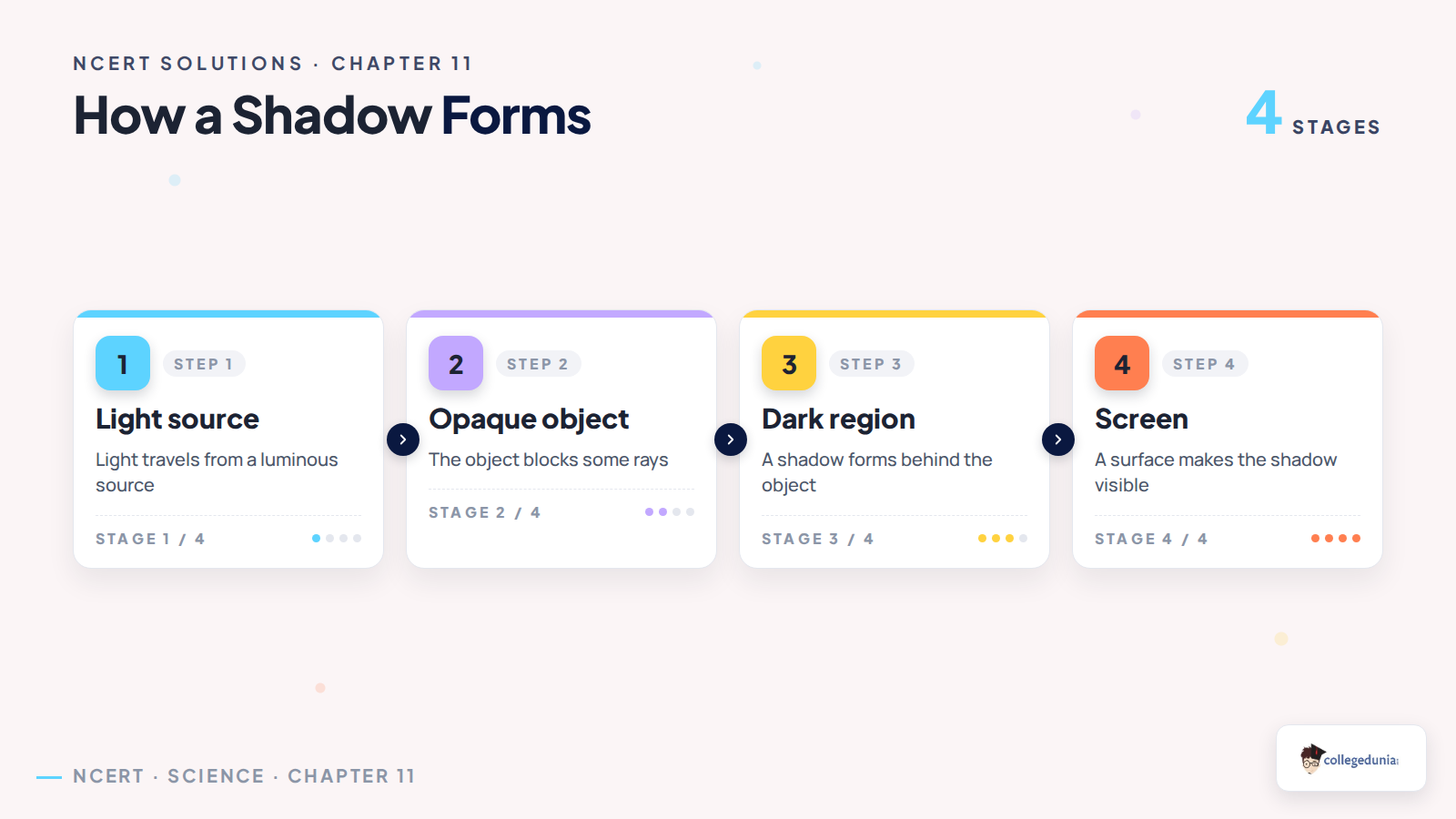
A shadow needs a light source, an opaque object, and a screen.
Light, Shadows and Reflections NCERT Solutions Video
A shadow forms when an opaque object blocks light. The dark patch shows the outline of the object, but not its colour or surface details. Its size and sharpness depend on the positions of the source, object, and screen.
Moving the object closer to the source often makes the shadow larger.
Moving the object closer to the screen often makes the shadow smaller and sharper.
A point-like source gives a sharper shadow than a broad source.
A transparent object usually does not form a dark shadow.
Never identify an object only from one shadow because different objects can produce similar outlines.
Reflection and Plane-Mirror Images Explained
Reflection happens when light strikes a surface and returns. Smooth, shiny surfaces give clearer images because reflected rays remain orderly. Rough surfaces scatter light in many directions and do not form a clear image.
Feature
Shadow
Plane-mirror image
Colour
Usually dark
Shows object colours
Details
Shows mainly the outline
Shows surface details
Screen
Can appear on a screen
Cannot be caught on a screen
Position
Forms away from the blocked light
Appears behind the mirror
A plane mirror forms an upright image of the same size. Lateral inversion makes the left side appear right and the right side appear left.
Pinhole Camera and Straight-Line Travel of Light
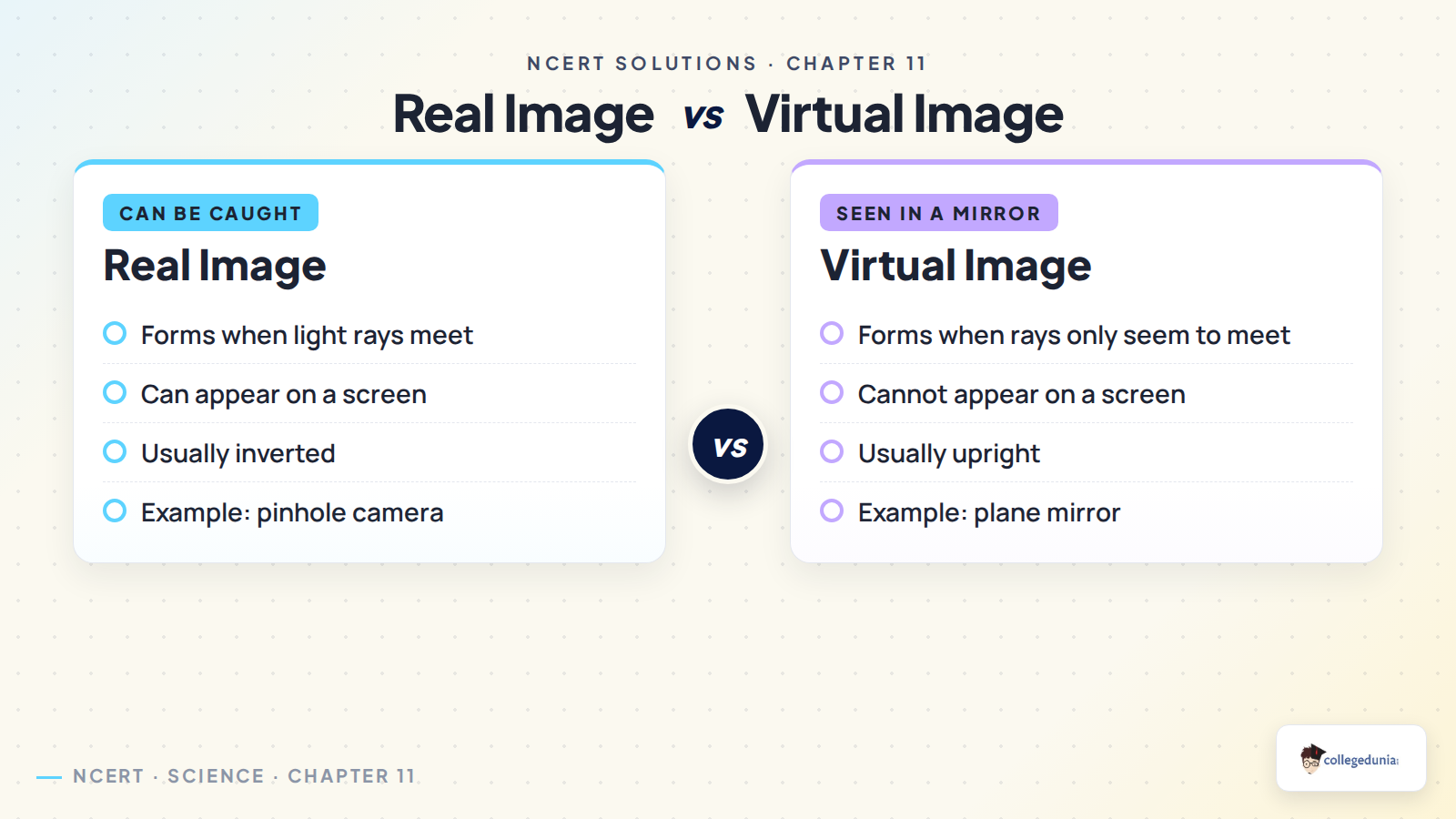
A pinhole camera is a closed box with a tiny hole on one side and a screen on the opposite side. Light from the top and bottom of an object crosses at the hole. This produces an inverted image on the screen.
Point the pinhole towards a bright object.
Keep the screen side shaded from outside light.
Move the camera until a clear inverted image appears.
The pinhole camera works without a lens. Its image supports the idea that light travels in straight lines.
Common Mistakes in Light, Shadows and Reflections Answers
Do not call every shiny object a source of light.
Do not say a shadow always has the same size as its object.
Do not confuse a mirror image with a shadow.
Do not forget the screen while describing shadow formation.
Use the word inverted for the image made by a pinhole camera.
Light, Shadows and Reflections Student Feedback
What 12,460 students told us about learning the light chapter
In a Collegedunia student poll before the 2026 exams, students found comparison tables more useful than long definitions.
Source: 2026-27 Class 7 Science student poll of 12,460 students.
Other Class 7 Light, Shadows and Reflections Resources
All NCERT Solutions for Class 7 Science Chapter 11 with Step-by-Step Solutions
All 12 questions with collapsible Solution and Expert Solution. Tap a button to reveal the working.
Questions
Q 11.1
Which of the following are luminous objects? Mars, Moon, Pole Star, Sun, Venus, Mirror
Concept used. A luminous object produces its own light. A non-luminous object only reflects light.
Concept recall
Stars make light. Planets, moons, and mirrors reflect light.
The Sun is a star, so it gives out light.
The Pole Star is also a star, so it is luminous.
Mars, Venus, Moon, and a mirror only reflect received light.
The Pole Star and Sun are luminous.
AS
Aarav Sharma
M.Sc Physics, IIT Madras
Verified Expert
Quick reading. Sort each object by where its light begins. Made light means luminous. Reflected light means non-luminous.
Put the two stars, Sun and Pole Star, in the luminous group.
Put Mars, Venus, and Moon in the reflecting group.
A mirror also returns light without making it.
This test works even when an object looks very bright.Pole Star and Sun.
Q 11.2
Match the items in Column A with those in Column B. [4pt]
tabularp0.42p0.50
Column A & Column B
Pinhole camera & Blocks light completely
Opaque object & The dark region formed behind the object
Transparent object & Forms an inverted image
Shadow & Light passes almost completely through it
tabular
Concept used. Materials differ in how much light they pass. A pinhole camera uses straight-line light to form an inverted image.
Concept recall
Recall: pinhole images are inverted, opaque materials block light, transparent materials pass light, and a shadow is the dark region behind a blocker.
Pinhole camera: forms an inverted image.
Opaque object: blocks light completely.
Transparent object: passes light almost completely.
Structural observation. The entries test passage of light and image formation. Sorting them first makes every pair clear.
Pair the camera with inverted image.
Pair opaque and transparent with opposite light-passing properties.
Pair shadow with the remaining dark-region definition.
Every definition now has one term.The four pairs are pinhole-inverted, opaque-blocks, transparent-passes, shadow-dark.
Q 11.3
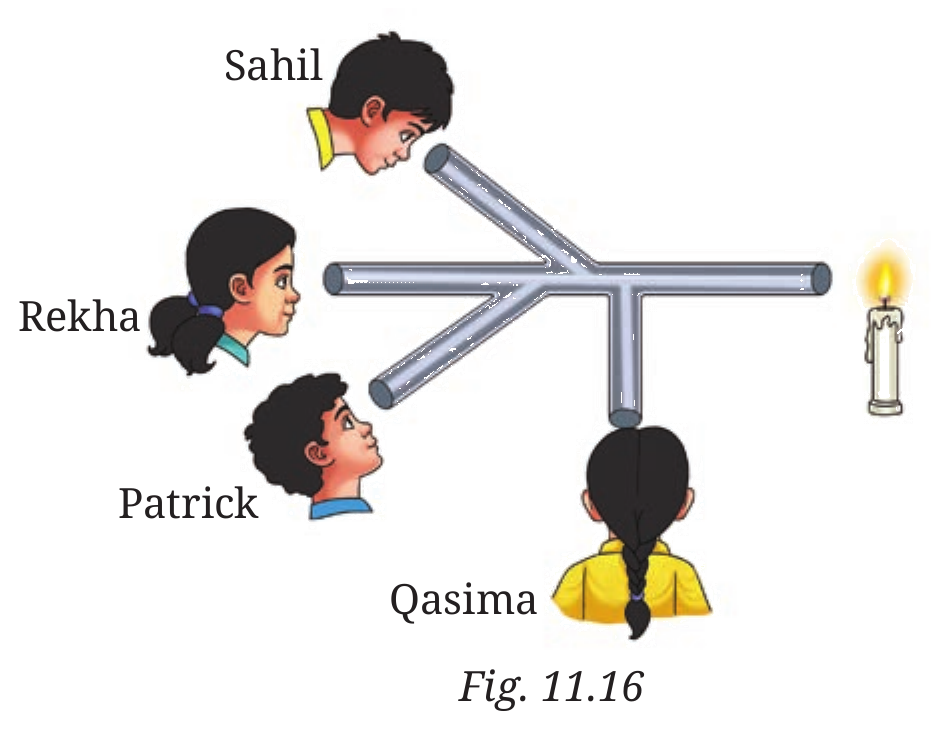
Sahil, Rekha, Patrick, and Qasima are trying to observe the candle flame through the pipe as shown in Fig. 11.16. Who can see the flame?
Fig. 11.16, NCERT Curiosity Class 7 Science, Chapter 11.Fig. 11.16 repeated for the detailed solution.
Concept used. Light travels in straight lines. A person sees the flame only through a straight, open pipe path.
Concept recall
A bent pipe cannot show a flame without mirrors.
Trace a straight line from the flame through the horizontal pipe.
Continue it through the left opening.
This opening points at Rekha. Other branches bend away.
Rekha can see the flame.
VP
Vivaan Patel
M.Tech Applied Physics, IIT Delhi
Verified Expert
Picture-first. Imagine one narrow ray leaving the flame. It cannot turn at a pipe junction by itself.
Fig. 11.16 repeated for the expert explanation.
Draw the ray leftwards along the main tube.
It reaches the opening opposite Rekha.
It cannot follow the slanting or downward branches.
Only one observer has a direct line of sight.Only Rekha.
Q 11.4
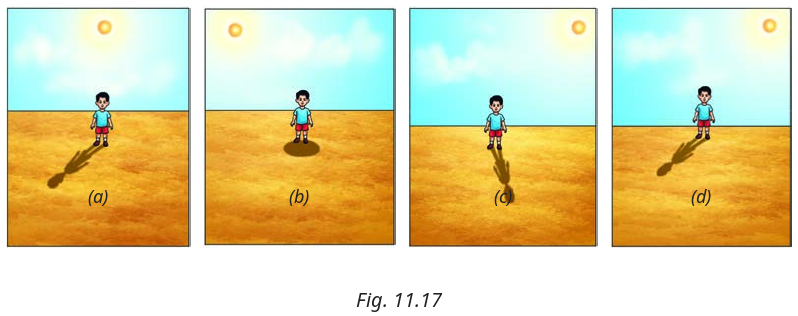
Look at the images shown in Fig. 11.17 and select the correct image showing the shadow formation of the boy.
Fig. 11.17, NCERT Curiosity Class 7 Science, Chapter 11.Fig. 11.17 repeated with all four choices.
Concept used. A shadow forms opposite the light source. Its direction follows a straight line from source past object.
Method choice
Extend an imaginary line from Sun through boy.
The Sun is above and right of the boy.
Rays travel downwards and leftwards.
The shadow must stretch to the lower left, as in (d).
Image (d) is correct.
SG
Sneha Gupta
B.Tech Engineering Physics, IIT Bombay
Verified Expert
Strategic angle. A shadow points away from a source. We need only the two positions.
Fig. 11.17 repeated for the expert explanation.
Locate the Sun at upper right.
Join it to the boy.
Extend that direction beyond him to lower left.
That direction matches one choice.Option (d).
Q 11.5
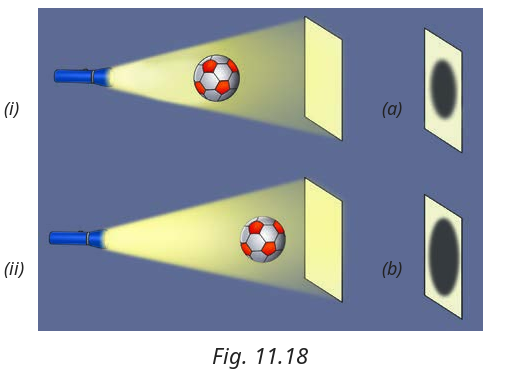
The shadow of a ball is formed on a wall by placing the ball in front of a fixed torch as shown in Fig. 11.18. In scenario (i) the ball is closer to the torch, while in scenario (ii) the ball is closer to the wall. Choose the most accurate representation of the shadows formed in both scenarios from the options provided (a and b).
Fig. 11.18, NCERT Curiosity Class 7 Science, Chapter 11.Source Fig. 11.18 kept with the detailed solution.
Concept used. Torch rays spread. A ball near the torch blocks a wider cone and makes a larger wall shadow.
Trap warning
Moving the ball nearer the wall makes its shadow smaller, not larger.
In (i), the ball is near the torch. Its wall shadow is large, which matches option (b).
In (ii), it is near the wall. Its shadow is smaller, which matches option (a).
Therefore the complete mapping is (i) to (b), and (ii) to (a).
Scenario (i) → option (b); scenario (ii) → option (a).
AM
Arjun Mehta
M.Sc Physics, IIT Kanpur
Verified Expert
Picture-first. Treat the beam as an expanding cone. The blocked region keeps spreading after the ball.
Source Fig. 11.18 kept with the expert solution.
Near the torch, much distance remains for spreading, so scenario (i) matches the large shadow in (b).
Near the wall, little distance remains, so scenario (ii) matches the small shadow in (a).
Check both pairings against the two standalone choices.
This is also seen with hand shadows.(i) → (b), and (ii) → (a).
Q 11.6
Based on Fig. 11.18, match the position of the torch in Column A with the characteristics of the ball's shadow in Column B. [4pt]
tabularp0.48p0.44
Column A & Column B
If the torch is close to the ball & The shadow would be smaller
If the torch is far away & The shadow would be larger
If the ball is removed from the set-up & Two shadows would appear on the screen
If two torches are present in the set-up on the left side of the ball & A bright spot would appear on the screen
tabular
Fig. 11.18 repeated with scenarios and answer choices.
Concept used. Shadow size depends on source distance. Removing the blocker passes light. Separate sources form separate shadows.
Method choice
Check whether each change affects distance, blocker, or sources.
Torch close to ball: larger shadow.
Torch far away: smaller shadow.
Ball removed: bright spot.
Two torches: two shadows.
Close-larger; far-smaller; removed-bright; two torches-two shadows.
AN
Aditi Nair
Ph.D Physics, TIFR Mumbai
Verified Expert
Structural observation. Each setup changes one feature of the light path.
Fig. 11.18 repeated for the expert explanation.
A nearby source produces more enlargement.
A distant source produces less enlargement.
No ball means no shadow.
Two sources make two blocked paths.
The four outcomes follow directly.Close-larger; far-smaller; removed-bright; two torches-two shadows.
Q 11.7
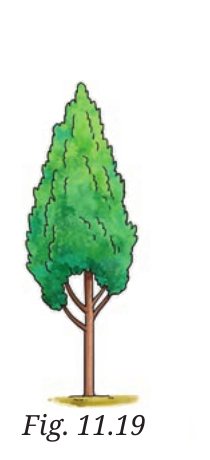
Suppose you view the tree shown in Fig. 11.19 through a pinhole camera. Sketch the outline of the image of the tree formed in the pinhole camera.
Concept used. A pinhole camera forms an inverted image because top and bottom rays cross at the hole.
Concept recall
The image is upside down because rays cross.
Use the same tree outline shown in Fig. 11.19.
Rotate the complete outline through 180°.
The canopy appears below and the long trunk with its base appears above.
[width=0.25]fig11_19_inverted.png [-2pt] Clean inverted-tree answer outline, without the source caption
Draw an upside-down tree.
RV
Rohit Verma
M.Sc Astrophysics, IIT Kanpur
Verified Expert
Picture-first. Follow rays from two ends of the tree.
Source Fig. 11.19 kept with the expert explanation.
A top ray reaches the lower screen.
A base ray reaches the upper screen.
Join the points with the tree outline.
[width=0.25]fig11_19_inverted.png [-2pt] The same canopy, branches, trunk, and base appear inverted.
Crossing rays cause inversion.The tree image is inverted.
Q 11.8
Write your name on a piece of paper and hold it in front of a plane mirror such that the paper is parallel to the mirror. Sketch the image. What difference do you notice? Explain the reason for the difference.
Concept used. A plane mirror causes lateral inversion. Reflection makes rays appear to come from corresponding points behind the mirror. This reverses the front-back direction. When we face the object and its image, that reversal is perceived as left-right interchange. Top and bottom stay unchanged.
Concept recall
AMBULANCE is reversed on vehicles for mirror reading.
Face the name towards the mirror.
Copy every letter in its left-right reversed form.
Reflected rays appear to come from behind the mirror.
0.72!%
[See diagram in the PDF version]
The name appears laterally inverted.
NS
Neha Singh
M.Tech Applied Physics, IIT Delhi
Verified Expert
Strategic angle. Compare one letter at a time.
A left mark appears at the image's right.
Sketch each letter with left and right reversed.
Keep its height and top-bottom direction unchanged.
0.72!%
[See diagram in the PDF version]
The mirror sends rays back to the eye. Their backward extensions locate the virtual image behind the mirror. The front-back direction is therefore reversed. Facing the object and image makes us perceive this as a left-right reversal. This is not an upside-down turn.Sketch a left-right reversed name.
Q 11.9
Measure the length of your shadow at 9 AM, 12 PM, and 4 PM with the help of your friend. Write down your observations: (i) At which of the given times is your shadow the shortest? (ii) Why do you think this happens?
Concept used. A higher Sun gives steeper rays and a shorter shadow.
Concept recall
Lengths vary, but midday is usually shortest among these times.
(i) Among the given times, the shadow is usually shortest at about 12 PM.
(ii) The Sun is highest then. Its rays fall most steeply, so the shadow covers the least horizontal distance. At 9 AM and 4 PM, slanting rays make longer shadows.
(i) About 12 PM. (ii) The Sun is highest, so its steep rays form the shortest shadow.
KR
Kavya Rao
M.Sc Physics, IIT Madras
Verified Expert
Quick reading. Use sunlight angle, not the clock alone.
(i) Compare the three measurements. The smallest should occur near 12 PM.
(ii) At that time the Sun has its greatest elevation among the three observations. Steeper rays place the shadow tip nearer the feet. Morning and afternoon rays are more slanted, so their shadows extend farther.
Measure from feet to the shadow tip each time.(i) 12 PM. (ii) The Sun is highest and its rays are steepest.
Q 11.10
On the basis of following statements, choose the correct option. Statement A: Image formed by a plane mirror is laterally inverted. Statement B: Images of alphabets T and O appear identical to themselves in a plane mirror.
(i) Both statements are true
(ii) Both statements are false
(iii) Statement A is true, but Statement B is false
(iv) Statement A is false, but Statement B is true
Concept used. A mirror interchanges left and right. Vertical symmetry can hide the visible change.
Concept recall
Matching halves mean reversal may look unchanged.
A is true because mirror images are laterally inverted.
T has vertical symmetry.
O has vertical symmetry. Therefore B is true.
Option (i): Both statements are true.
IB
Ishaan Bhat
B.Tech Engineering Physics, IIT Bombay
Verified Expert
Structural observation. Inversion still occurs, but symmetric letters look unchanged.
Apply the mirror rule to A. It is true.
Reverse T; it looks the same.
Reverse O; it also looks the same.
The mirror has not stopped inverting them.Both A and B are true.
Q 11.11
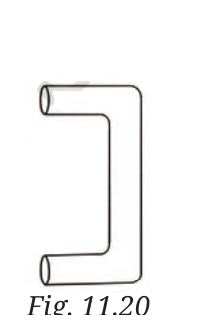
Suppose you are given a tube of the shape shown in the Fig. 11.20 and two plane mirrors smaller than the diameter of the tube. Can this tube be used to make a periscope? If yes, mark where you will fix the plane mirrors.
Fig. 11.20, NCERT Curiosity Class 7 Science, Chapter 11.
Concept used. The law of reflection states that the angle of incidence equals the angle of reflection, both measured from the normal. Two parallel plane mirrors at 45° turn light through the tube.
Trap warning
Mirrors without the diagonal tilt cannot guide light through both bends.
Put one mirror at the upper bend, tilted 45°.
Put the second at the lower bend, parallel to the first.
Light enters, reflects down, then reflects out.
Yes. Fix parallel 45° mirrors at the two bends.
DK
Diya Kapoor
M.Sc Physics, IIT Madras
Verified Expert
Picture-first. The law of reflection gives equal incidence and reflection angles at both mirrors. The ray needs two direction changes.
Face the upper mirror towards the top opening.
Face the lower mirror towards the first mirror.
Check the path: in, down, then out.
This makes a simple periscope.Use one parallel 45° mirror at each bend.
Q 11.12
We do not see the shadow on the ground of a bird flying high in the sky. However, the shadow is seen on the ground when the bird swoops near the ground. Think and explain why it is so.
Concept used. The Sun is an extended source. It makes a dark full shadow and a lighter partial shadow.
Concept recall
A hand shadow also sharpens near a wall.
Different parts of the Sun's broad disc send rays towards the bird from slightly different directions.
Far below a high bird, those rays enter and fill much of the region blocked from other parts of the Sun. The full shadow can end before reaching the ground, while the partial shadow spreads and becomes too faint to notice.
Near the ground, there is too little distance for rays from different parts of the Sun to fill the blocked region. The shadow stays dark and sharp.
The high shadow is faint and spread out; the low shadow is dark and sharp.
YD
Yash Desai
Ph.D Physics, IISc Bangalore
Verified Expert
Strategic angle. Treat the ground as a screen and compare its distance from the bird.
The Sun is not a point source. Rays from different points across its disc reach the bird at slightly different angles.
At a large bird-ground separation, rays from one part of the Sun reach regions blocked from another part. They progressively fill the shadow region, so only a broad, weak partial shadow reaches the ground.
When the bird swoops low, the rays have little distance to spread into that region. A compact dark shadow reaches the ground and is easy to see.
The bird always blocks some light, but the shadow contrast changes with distance.Different solar rays fill the distant shadow region, while a nearby shadow remains dark and visible.
Light, Shadows and Reflections Science NCERT Solutions FAQs
Ques. What is needed to form a shadow?
Ans. A shadow needs a light source, an opaque object in the path of light, and a screen.
Ques. What is lateral inversion?
Ans. Lateral inversion is the apparent left-right reversal seen in a plane-mirror image.
Ques. Why is a pinhole-camera image inverted?
Ans. Light rays from opposite ends of the object cross at the pinhole and reach opposite parts of the screen.
Ques. How is a shadow different from a mirror image?
Ans. A shadow mainly shows a dark outline. A mirror image shows colours and surface details.
Ques. Does every object make a dark shadow?
Ans. No. Opaque objects form dark shadows, while transparent materials allow most light to pass through.




Ch11Light:ShadowsandReflectionsNCERTSolutions2026-27.pdf?page=1&dpi=150)
Ch11Light:ShadowsandReflectionsNCERTSolutions2026-27.pdf?page=2&dpi=150)
Ch11Light:ShadowsandReflectionsNCERTSolutions2026-27.pdf?page=3&dpi=150)
Ch11Light:ShadowsandReflectionsNCERTSolutions2026-27.pdf?page=4&dpi=150)
Ch11Light:ShadowsandReflectionsNCERTSolutions2026-27.pdf?page=5&dpi=150)
Ch11Light:ShadowsandReflectionsNCERTSolutions2026-27.pdf?page=6&dpi=150)
Ch11Light:ShadowsandReflectionsNCERTSolutions2026-27.pdf?page=7&dpi=150)
Ch11Light:ShadowsandReflectionsNCERTSolutions2026-27.pdf?page=8&dpi=150)
Ch11Light:ShadowsandReflectionsNCERTSolutions2026-27.pdf?page=9&dpi=150)
Ch11Light:ShadowsandReflectionsNCERTSolutions2026-27.pdf?page=10&dpi=150)
Ch11Light:ShadowsandReflectionsNCERTSolutions2026-27.pdf?page=11&dpi=150)
Ch11Light:ShadowsandReflectionsNCERTSolutions2026-27.pdf?page=12&dpi=150)
Ch11Light:ShadowsandReflectionsNCERTSolutions2026-27.pdf?page=13&dpi=150)
Ch11Light:ShadowsandReflectionsNCERTSolutions2026-27.pdf?page=14&dpi=150)
Ch11Light:ShadowsandReflectionsNCERTSolutions2026-27.pdf?page=15&dpi=150)
Ch11Light:ShadowsandReflectionsNCERTSolutions2026-27.pdf?page=16&dpi=150)
Ch11Light:ShadowsandReflectionsNCERTSolutions2026-27.pdf?page=17&dpi=150)
Ch11Light:ShadowsandReflectionsNCERTSolutions2026-27.pdf?page=18&dpi=150)
Ch11Light:ShadowsandReflectionsNCERTSolutions2026-27.pdf?page=19&dpi=150)
Ch11Light:ShadowsandReflectionsNCERTSolutions2026-27.pdf?page=20&dpi=150)
Ch11Light:ShadowsandReflectionsNCERTSolutions2026-27.pdf?page=21&dpi=150)
Ch11Light:ShadowsandReflectionsNCERTSolutions2026-27.pdf?page=22&dpi=150)
Ch11Light:ShadowsandReflectionsNCERTSolutions2026-27.pdf?page=23&dpi=150)
Ch11Light:ShadowsandReflectionsNCERTSolutions2026-27MobileCard.pdf?page=1&dpi=150)
Ch11Light:ShadowsandReflectionsNCERTSolutions2026-27MobileCard.pdf?page=2&dpi=150)
Ch11Light:ShadowsandReflectionsNCERTSolutions2026-27MobileCard.pdf?page=3&dpi=150)
Ch11Light:ShadowsandReflectionsNCERTSolutions2026-27MobileCard.pdf?page=4&dpi=150)
Ch11Light:ShadowsandReflectionsNCERTSolutions2026-27MobileCard.pdf?page=5&dpi=150)
Ch11Light:ShadowsandReflectionsNCERTSolutions2026-27MobileCard.pdf?page=6&dpi=150)
Ch11Light:ShadowsandReflectionsNCERTSolutions2026-27MobileCard.pdf?page=7&dpi=150)
Ch11Light:ShadowsandReflectionsNCERTSolutions2026-27MobileCard.pdf?page=8&dpi=150)
Ch11Light:ShadowsandReflectionsNCERTSolutions2026-27MobileCard.pdf?page=9&dpi=150)
Ch11Light:ShadowsandReflectionsNCERTSolutions2026-27MobileCard.pdf?page=10&dpi=150)
Ch11Light:ShadowsandReflectionsNCERTSolutions2026-27MobileCard.pdf?page=11&dpi=150)
Ch11Light:ShadowsandReflectionsNCERTSolutions2026-27MobileCard.pdf?page=12&dpi=150)
Ch11Light:ShadowsandReflectionsNCERTSolutions2026-27MobileCard.pdf?page=13&dpi=150)
Ch11Light:ShadowsandReflectionsNCERTSolutions2026-27MobileCard.pdf?page=14&dpi=150)
Ch11Light:ShadowsandReflectionsNCERTSolutions2026-27MobileCard.pdf?page=15&dpi=150)
Ch11Light:ShadowsandReflectionsNCERTSolutions2026-27MobileCard.pdf?page=16&dpi=150)
Ch11Light:ShadowsandReflectionsNCERTSolutions2026-27MobileCard.pdf?page=17&dpi=150)
Ch11Light:ShadowsandReflectionsNCERTSolutions2026-27MobileCard.pdf?page=18&dpi=150)
Ch11Light:ShadowsandReflectionsNCERTSolutions2026-27MobileCard.pdf?page=19&dpi=150)
Ch11Light:ShadowsandReflectionsNCERTSolutions2026-27MobileCard.pdf?page=20&dpi=150)
Ch11Light:ShadowsandReflectionsNCERTSolutions2026-27MobileCard.pdf?page=21&dpi=150)
Ch11Light:ShadowsandReflectionsNCERTSolutions2026-27MobileCard.pdf?page=22&dpi=150)
Ch11Light:ShadowsandReflectionsNCERTSolutions2026-27MobileCard.pdf?page=23&dpi=150)
Ch11Light:ShadowsandReflectionsNCERTSolutions2026-27MobileCard.pdf?page=24&dpi=150)
Ch11Light:ShadowsandReflectionsNCERTSolutions2026-27MobileCard.pdf?page=25&dpi=150)
Ch11Light:ShadowsandReflectionsNCERTSolutions2026-27MobileCard.pdf?page=26&dpi=150)
Ch11Light:ShadowsandReflectionsNCERTSolutions2026-27MobileCard.pdf?page=27&dpi=150)
Ch11Light:ShadowsandReflectionsNCERTSolutions2026-27MobileCard.pdf?page=28&dpi=150)
Ch11Light:ShadowsandReflectionsNCERTSolutions2026-27MobileCard.pdf?page=29&dpi=150)
Ch11Light:ShadowsandReflectionsNCERTSolutions2026-27MobileCard.pdf?page=30&dpi=150)
Ch11Light:ShadowsandReflectionsNCERTSolutions2026-27MobileCard.pdf?page=31&dpi=150)
Ch11Light:ShadowsandReflectionsNCERTSolutions2026-27MobileCard.pdf?page=32&dpi=150)
Ch11Light:ShadowsandReflectionsNCERTSolutions2026-27MobileCard.pdf?page=33&dpi=150)
Ch11Light:ShadowsandReflectionsNCERTSolutions2026-27MobileCard.pdf?page=34&dpi=150)
Ch11Light:ShadowsandReflectionsNCERTSolutions2026-27MobileCard.pdf?page=35&dpi=150)



Comments