NCERT Solutions for Class 7 Science Curiosity Chapter 12 Earth, Moon, and the Sun help students revise rotation, revolution, seasons, apparent star motion, and eclipses for the 2026-27 syllabus. All solved questions are available here with clear steps and expert checks.
Question count: 12 textbook questions from Let Us Enhance Our Learning.
Main focus: day-night cycle, seasons, solar eclipse, and lunar eclipse.
Best use: read the PDF first, then open each question card below.
Each Class 7 Science Earth, Moon, and the Sun solution is checked against the 2026-27 NCERT Curiosity textbook and supported with figure-based reasoning where needed.
Student Feedback: In a Collegedunia poll of 11,640 Class 7 Science students before the 2026 school exams, 76% said eclipse order and polar-day diagrams needed the most practice.
Earth, Moon, and the Sun Class 7 Solutions PDF Overview
The Earth, Moon, and the Sun chapter explains why day and night happen, why seasons change, and why eclipses are seen only in special alignments. The safest shortcut is to remember which body is in the middle.
Day, Night, and Seasons in Earth, Moon, and the Sun
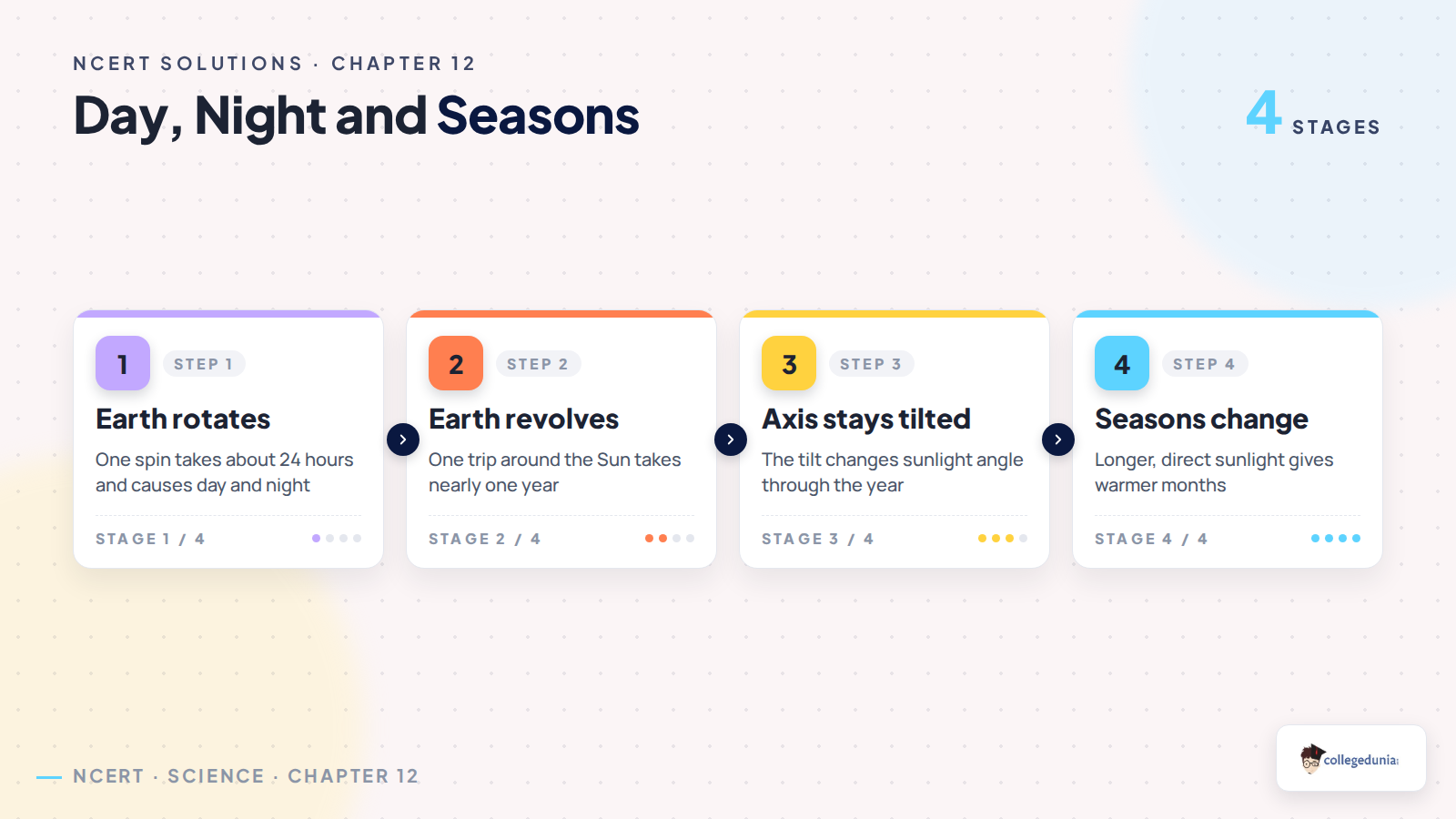
Earth rotates from west to east. This makes the Sun and stars appear to rise in the east and set in the west. The same rotation also explains why India and the USA can have different times of day.
Rotation: one spin of Earth causes day and night.
Revolution: one orbit around the Sun takes nearly one year.
Axis tilt: different sunlight angles create seasons.
Solar Eclipse and Lunar Eclipse Order in Class 7 Science
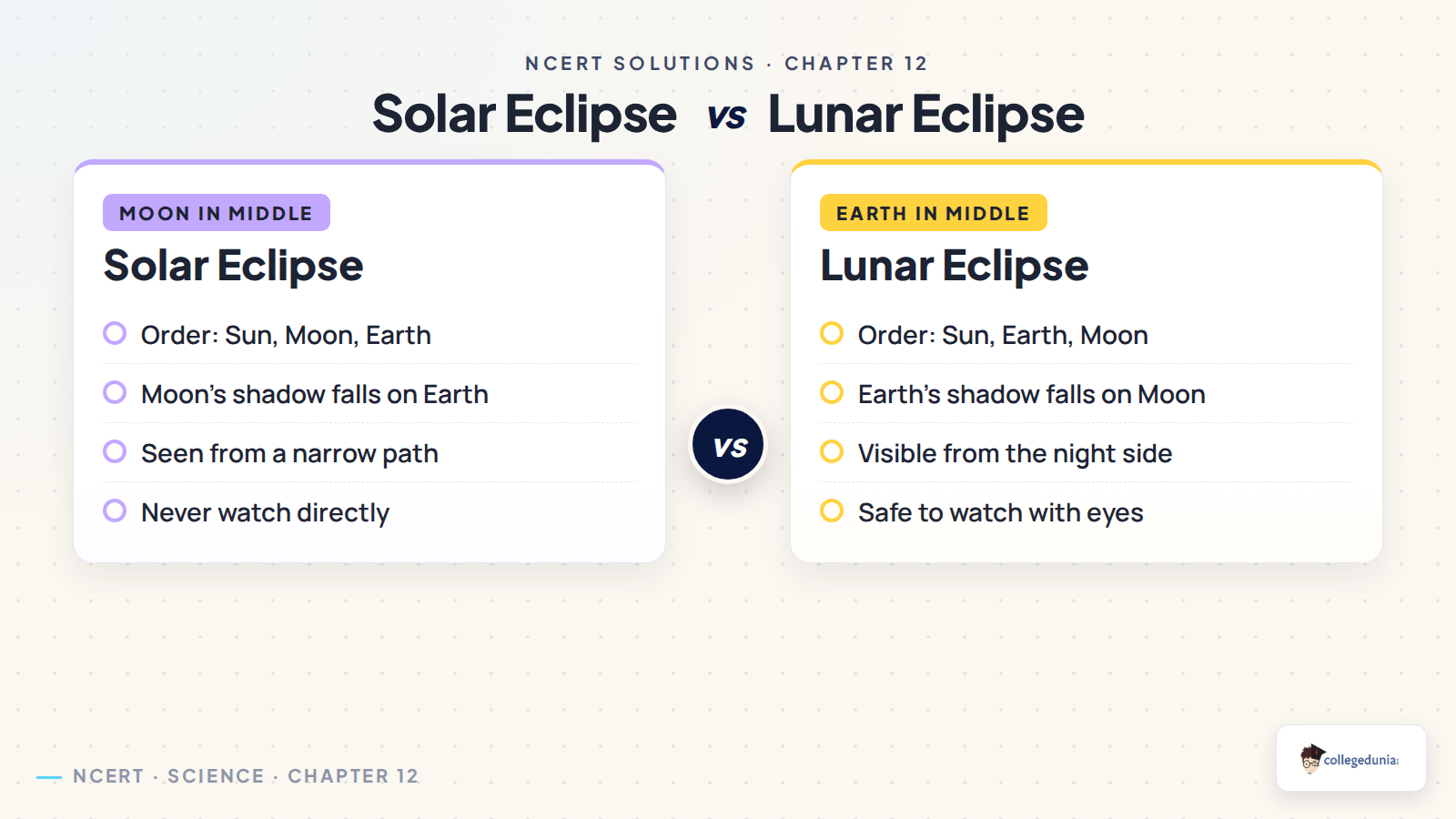
Solar and lunar eclipses become easy when students write the order of bodies. In a solar eclipse, the Moon is between the Sun and Earth. In a lunar eclipse, Earth is between the Sun and Moon.
Tip: Never look directly at the Sun during a solar eclipse. Use approved eclipse glasses or a safe projection method.
How to Use These Class 7 Science NCERT Solutions
Use the PDF for full-page revision and the question cards for quick answer checking. Start with the diagram questions, then revise the true-false and fill-in-the-blank questions.
Read the question once without opening the solution.
Write the order, reason, or time answer in one line.
Open Check Solution and compare the steps.
Open Expert Solution for the alternate explanation.
Related NCERT Resources for Earth, Moon, and the Sun
All NCERT Solutions for Class 7 Science Chapter 12 Earth, Moon, and the Sun with Step-by-Step Solutions
Questions
Q 12.1
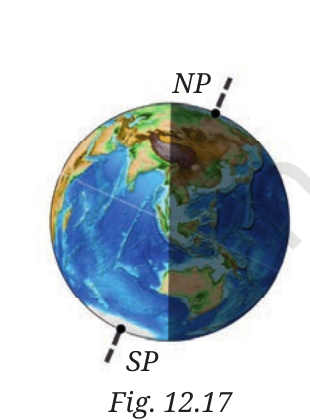
In Fig. 12.17, how many hours of sunlight do the North Pole and the South Pole receive during one rotation of the Earth?
Fig. 12.17, NCERT Science Class 7, Chapter 12.
Concept used. During one full rotation, a pole that remains in the lit half gets continuous daylight. A pole that remains in the dark half gets no sunlight.
In Fig. 12.17, the North Pole is on the dark side of the Earth.
The South Pole is on the sunlit side.
As the Earth rotates, each pole keeps that same tilted orientation during one rotation.
Read the shaded half first. Then decide whether a pole stays in light or darkness.
The North Pole receives 0 hours of sunlight, and the South Pole receives 24 hours of sunlight.
AM
Aarav Mehta
M.Sc Physics, University of Delhi
Verified Expert
Figure-first method. The terminator line separates day from night.
The North Pole marker lies inside the unlit half, so it remains dark for the rotation shown.
The South Pole marker lies inside the bright half, so it stays lit.
One rotation takes about 24 hours, so continuous light means 24 hours and continuous darkness means 0 hours.
This is the polar-day and polar-night idea shown in a simple globe picture.North Pole: 0 hours; South Pole: 24 hours.
Q 12.2
Fill in the blanks. (i) Stars rise in the 2cm and set in the 2cm. (ii) Day and night are caused by the Earth's 2cm. (iii) When the Moon fully covers the Sun from our view, it is called a 2cm solar eclipse.
Concept used. Earth's rotation from West to East makes the sky appear to move from East to West. Day and night are also due to this rotation.
Stars appear to rise in the East and set in the West.
Day and night are caused by the Earth's rotation on its axis.
If the Moon fully covers the Sun, the eclipse is total.
Rotation causes day and night. Revolution helps explain seasons and the yearly change in visible stars.
(i) East, West; (ii) rotation; (iii) total.
MN
Meera Nair
M.Sc Astronomy, Osmania University
Verified Expert
Cause-and-effect route. Match each blank with the chapter's key motions.
The apparent motion of stars follows the apparent motion of the Sun, from East to West.
The day-night cycle needs Earth's spin, not its yearly path.
A complete covering of the Sun by the Moon is called a total solar eclipse.
These words complete the statements directly.East; West; rotation; total.
Q 12.3
State whether True or False. (i) Lunar eclipse occurs when the Sun comes between the Earth and the Moon. (ii) Sunrise happens earlier in Gujarat than in Jharkhand. (iii) In Chennai, the longest day occurs on the summer solstice. (iv) We should watch the solar eclipse directly with our naked eye. (v) Seasons occur due to the tilt of Earth's axis of rotation and its spherical shape. (vi) The Earth's revolution around the Sun causes day and night.
Concept used. Use the correct middle body for eclipses, Earth's West-to-East rotation for sunrise, and axial tilt for seasons.
(i) False. In a lunar eclipse, Earth comes between the Sun and the Moon.
(ii) False. Jharkhand is east of Gujarat, so sunrise happens earlier in Jharkhand.
(iii) True. Chennai is in the Northern Hemisphere, where the longest day is near the summer solstice.
(iv) False. Looking directly at the Sun can damage the eyes.
(v) True. Seasons depend on the tilt of Earth's axis and Earth's spherical surface.
(vi) False. Day and night are caused by Earth's rotation.
Do not swap rotation and revolution. Rotation gives day and night; tilted revolution gives seasons.
(i) F; (ii) F; (iii) T; (iv) F; (v) T; (vi) F.
KS
Kabir Singh
M.Ed Science, NCERT
Verified Expert
Statement check. Test each statement against one rule.
Lunar eclipse: Sun, Earth, Moon. So (i) is false.
India sees sunrise from east to west. Jharkhand is east of Gujarat. So (ii) is false.
Chennai follows Northern Hemisphere solstice behaviour. So (iii) is true.
Solar viewing needs special protection. So (iv) is false.
The stated cause of seasons is correct. So (v) is true.
Revolution is not the cause of day and night. So (vi) is false.
False, False, True, False, True, False.
Q 12.4
Padmashree saw the Orion constellation nearly overhead at 8 pm yesterday. When will she see Orion overhead today?
Concept used. Because Earth revolves around the Sun while rotating, a star pattern reaches the same position about 4 minutes earlier each day.
Yesterday, Orion was overhead at 8:00 pm.
Today, the same position is reached about 4 minutes earlier.
Subtract 4 minutes from 8:00 pm.
For stars, the daily shift is about 4 minutes earlier.
She will see Orion nearly overhead at about 7:56 pm today.
RB
Riya Bose
B.Sc Physics, Presidency University
Verified Expert
Time-shift idea. One solar day is slightly longer than one star day.
Earth must rotate a little extra each day to face the Sun again.
Distant stars therefore return to the same sky position about 4 minutes earlier by clock time.
So Orion overhead at 8:00 pm yesterday becomes nearly 7:56 pm today.
About 7:56 pm.
Q 12.5
Nandhini saw a group of stars rising at midnight on 21 June. When will she see the same group of stars rising at midnight next year?
Concept used. Earth completes one revolution around the Sun in nearly one year. After a year, the same night sky returns at about the same date and time.
The observation happened at midnight on 21 June.
After one complete revolution, Earth faces nearly the same direction in space at midnight.
Therefore, the same group of stars will rise at midnight again around the same date next year.
This yearly repeat lets people use star patterns as seasonal markers.
She will see the same group rising at midnight around 21 June next year.
DM
Dev Malhotra
M.Sc Astrophysics, IIT Indore
Verified Expert
Year-cycle reading. The date matters because Earth's position in its orbit decides the midnight view.
On 21 June, the night side of Earth faces a particular region of space.
One year later, Earth returns almost to that orbital position.
The same star group therefore rises at nearly the same clock time.
At midnight on about 21 June next year.
Q 12.6
Abhay noticed that when it was daytime in India, his uncle who was in the USA was generally sleeping as it was night-time there. What is the reason behind this difference?
Concept used. Earth is spherical and rotates. At one time, only the half facing the Sun has day.
India and the USA are far apart on Earth.
When India faces the Sun, it experiences daytime.
At the same time, the USA may be turned away from the Sun, so it has night.
Earth's rotation keeps changing which places face the Sun.
Day and night are local because different places face the Sun at different times.
The difference is due to Earth's spherical shape and rotation, which make India and the USA face the Sun at different times.
SQ
Sana Qureshi
M.Sc Geography, Jamia Millia Islamia
Verified Expert
Globe view. Imagine a lamp shining on a globe.
The bright half has day.
The dark half has night.
India and the USA are placed far apart on the globe.
So one can be in light while the other is in darkness.
This is why time zones are different across the world.Earth's rotation creates day in one region and night in another.
Q 12.7
Four friends used the following ways to see the solar eclipse. Who among them was being careless? (i) Ravikiran used a solar eclipse goggle. (ii) Jyothi used a mirror to project the Sun's image. (iii) Adithya saw the Sun directly with his eyes. (iv) Aruna attended a programme arranged by a planetarium.
Concept used. Direct solar viewing is unsafe. A solar eclipse must be seen using approved protection or safe projection under supervision.
Solar eclipse goggles are meant for safe viewing.
Projection using a mirror can be safe when supervised.
A planetarium programme usually provides safe equipment and guidance.
Directly seeing the Sun with naked eyes is dangerous.
Never write that an eclipse makes the Sun safe to watch directly.
Adithya was careless because he looked directly at the Sun.
IR
Ishita Rao
B.Sc Optics, IISER Pune
Verified Expert
Safety filter. Classify each method by whether the eye receives direct sunlight.
Ravikiran used a protective filter.
Jyothi used projection instead of direct viewing.
Aruna joined a guided programme.
Adithya let sunlight enter his eyes directly.
That direct method can injure the retina.Adithya was being careless.
Q 12.8
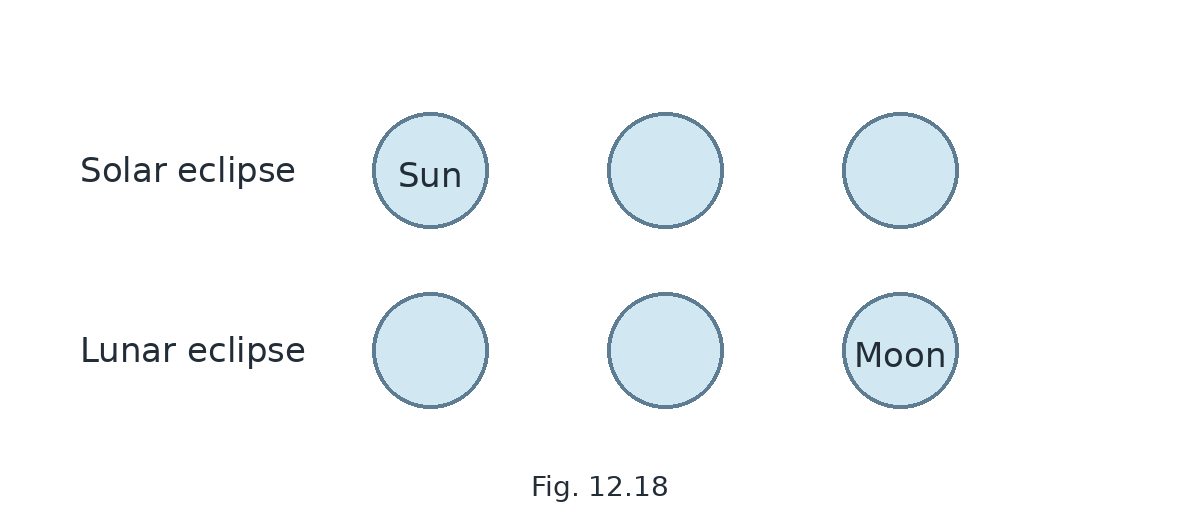
Fill in the circles in Fig. 12.18 appropriately with one of the following: Sun, Moon, Earth.
Fig. 12.18, NCERT Science Class 7, Chapter 12.
Concept used. In a solar eclipse, the Moon is between the Sun and Earth. In a lunar eclipse, Earth is between the Sun and Moon.
Solar eclipse row: the given first circle is Sun. The middle circle is Moon. The last circle is Earth.
Lunar eclipse row: the given last circle is Moon. The first circle is Sun. The middle circle is Earth.
In each row, the body causing the shadow is in the middle.
Solar: Sun, Moon, Earth. Lunar: Sun, Earth, Moon.
Solar eclipse: Sun-Moon-Earth. Lunar eclipse: Sun-Earth-Moon.
OP
Om Prakash
M.Sc Astronomy, Banaras Hindu University
Verified Expert
Middle-body rule. Name what blocks the light and place that body between the other two.
During a solar eclipse, sunlight travels from the Sun towards Earth.
The Moon blocks this light before it reaches Earth, so Moon must be placed in the middle circle.
The solar row therefore reads Sun, Moon, Earth.
During a lunar eclipse, sunlight again starts from the Sun.
Earth blocks this sunlight before it reaches the Moon, so Earth must be the middle body.
The lunar row therefore reads Sun, Earth, Moon.
This also explains the names: solar eclipse means the Sun is hidden from us; lunar eclipse means the Moon is darkened by Earth's shadow.Fill the solar row as Sun, Moon, Earth and the lunar row as Sun, Earth, Moon.
Q 12.9
The Moon is much smaller than the Sun, yet it can block the Sun completely from our view during a total solar eclipse. Why is it possible?
Concept used. Apparent size depends on actual size and distance from the observer.
The Sun is much larger than the Moon.
The Sun is also much farther away from Earth.
The Moon is much closer to Earth.
Because of this, the Sun and Moon can appear nearly the same size in our sky.
During a total solar eclipse, the Moon covers the Sun's apparent disc.
A nearby small object can hide a faraway large object if their apparent sizes match.
It is possible because the closer Moon has nearly the same apparent size as the faraway Sun.
TI
Tara Iyer
M.Ed Science Education, University of Mysore
Verified Expert
Thumb analogy. A small thumb can cover a friend's head if it is close to your eye.
Apparent size gets larger when an object is nearer.
The Moon is small but near.
The Sun is huge but very far.
Their apparent sizes become similar enough for the Moon to cover the Sun fully.
The Moon can cover the Sun because it is much closer to us.
Q 12.10
The Indian cricket team matches in Australia are often held in December. Should they pack winter or summer clothes for their trip?
Concept used. Seasons are reversed in the Northern and Southern Hemispheres.
India lies in the Northern Hemisphere.
Australia lies in the Southern Hemisphere.
December is winter in much of the Northern Hemisphere.
In the Southern Hemisphere, December is summer because that hemisphere is tilted towards the Sun.
For Australia, reverse the Indian season.
They should pack summer clothes.
VJ
Vikram Joshi
B.Sc Earth Science, University of Rajasthan
Verified Expert
Hemisphere check. First locate the country.
Australia is south of the Equator.
When India has winter, the Southern Hemisphere generally has summer.
Cricket in Australia in December is therefore played in warm-season conditions.
Summer clothes are suitable.
Q 12.11
Why do you think lunar eclipses can be seen from a large part of the Earth when they happen, but total solar eclipse can be seen by only a small part of the Earth?
Concept used. A lunar eclipse happens on the Moon and is visible from the night side of Earth. A total solar eclipse is seen only where the Moon's dark shadow falls on Earth.
In a lunar eclipse, Earth's shadow falls on the Moon.
Many places on Earth's night side can see that same eclipsed Moon.
In a total solar eclipse, the Moon's shadow falls on Earth.
The Moon's darkest shadow covers only a narrow path on Earth's surface.
Only people inside that small path see the Sun fully covered.
Ask where the shadow falls: on the Moon or on Earth.
A lunar eclipse is visible from much of the night side, but a total solar eclipse is visible only along the Moon's narrow shadow path.
NV
Neel Verma
M.Sc Space Science, IIT Kharagpur
Verified Expert
Shadow-size route. Compare where the shadow falls and who can look at that target.
In a lunar eclipse, Earth's shadow falls on the Moon itself.
The Moon is far away and visible from the whole night side of Earth.
Therefore, many countries can watch the same darkened Moon at the same time.
In a total solar eclipse, the Moon's shadow falls directly on Earth.
This shadow is small compared with Earth's surface and forms a narrow path.
Only observers inside that path see totality; nearby places may see only a partial eclipse.
So the difference is not that one eclipse is stronger. The difference is the size and position of the viewing region.Lunar eclipses have a wide viewing region; total solar eclipses have a narrow one.
Q 12.12
If the Earth's axis were not tilted with respect to the axis of revolution, explain what would be the effect on seasons?
Concept used. Seasons occur because Earth's axis is tilted while Earth revolves around the Sun. The tilt changes sunlight angle and day length through the year.
If there were no tilt, each place would receive nearly the same sunlight pattern through the year.
The length of day and night at a given latitude would not change much by season.
The strong cycle of summer, winter, spring, and autumn would not occur in the usual way.
Places would still differ by latitude, but they would not have the regular seasonal changes caused by tilt.
Seasons are not mainly caused by Earth's changing distance from the Sun.
Without axial tilt, Earth would not have regular seasons like it has now.
AP
Ananya Patel
M.Sc Environmental Science, JNU
Verified Expert
Tilt test. Remove the tilt and the year loses its changing sunlight pattern.
With no tilt, neither hemisphere leans towards the Sun during part of the year.
Both hemispheres would receive a more similar pattern of sunlight throughout Earth's revolution.
The length of daytime at a place would stay nearly the same from month to month.
The angle of sunlight would also show much less yearly change.
Summer and winter caused by axial tilt would disappear or become very weak.
The equator would still be warmer than the poles because Earth is spherical. However, the regular seasonal cycle produced by axial tilt would not happen.There would be no regular tilt-based seasons.
Earth, Moon, and the Sun Class 7 NCERT Solutions FAQs
Ques. What is covered in NCERT Solutions for Class 7 Science Chapter 12 Earth, Moon, and the Sun?
Ans. The solutions cover rotation, revolution, day and night, seasons, apparent star motion, solar eclipse, lunar eclipse, and all 12 textbook questions.
Ques. What is the order of bodies in a solar eclipse?
Ans. In a solar eclipse, the order is Sun, Moon, Earth. The Moon comes between the Sun and Earth and blocks sunlight for a narrow region.
Ques. What is the order of bodies in a lunar eclipse?
Ans. In a lunar eclipse, the order is Sun, Earth, Moon. Earth comes between the Sun and Moon, so Earth's shadow falls on the Moon.
Ques. Why do stars rise about four minutes earlier each day?
Ans. Earth revolves around the Sun while rotating, so the same star pattern reaches the same sky position about four minutes earlier each day.




Chapter12Earth,Moon,andtheSunSolutions.pdf?page=1&dpi=150)
Chapter12Earth,Moon,andtheSunSolutions.pdf?page=2&dpi=150)
Chapter12Earth,Moon,andtheSunSolutions.pdf?page=3&dpi=150)
Chapter12Earth,Moon,andtheSunSolutions.pdf?page=4&dpi=150)
Chapter12Earth,Moon,andtheSunSolutions.pdf?page=5&dpi=150)
Chapter12Earth,Moon,andtheSunSolutions.pdf?page=6&dpi=150)
Chapter12Earth,Moon,andtheSunSolutions.pdf?page=7&dpi=150)
Chapter12Earth,Moon,andtheSunSolutions.pdf?page=8&dpi=150)
Chapter12Earth,Moon,andtheSunSolutions.pdf?page=9&dpi=150)
Chapter12Earth,Moon,andtheSunSolutions.pdf?page=10&dpi=150)
Chapter12Earth,Moon,andtheSunSolutions.pdf?page=11&dpi=150)
Chapter12Earth,Moon,andtheSunSolutions.pdf?page=12&dpi=150)
Chapter12Earth,Moon,andtheSunSolutions.pdf?page=13&dpi=150)
Chapter12Earth,Moon,andtheSunSolutions.pdf?page=14&dpi=150)
Chapter12Earth,Moon,andtheSunSolutions.pdf?page=15&dpi=150)
Chapter12Earth,Moon,andtheSunSolutions_flat_MobileCard.pdf?page=1&dpi=150)
Chapter12Earth,Moon,andtheSunSolutions_flat_MobileCard.pdf?page=2&dpi=150)
Chapter12Earth,Moon,andtheSunSolutions_flat_MobileCard.pdf?page=3&dpi=150)
Chapter12Earth,Moon,andtheSunSolutions_flat_MobileCard.pdf?page=4&dpi=150)
Chapter12Earth,Moon,andtheSunSolutions_flat_MobileCard.pdf?page=5&dpi=150)
Chapter12Earth,Moon,andtheSunSolutions_flat_MobileCard.pdf?page=6&dpi=150)
Chapter12Earth,Moon,andtheSunSolutions_flat_MobileCard.pdf?page=7&dpi=150)
Chapter12Earth,Moon,andtheSunSolutions_flat_MobileCard.pdf?page=8&dpi=150)
Chapter12Earth,Moon,andtheSunSolutions_flat_MobileCard.pdf?page=9&dpi=150)
Chapter12Earth,Moon,andtheSunSolutions_flat_MobileCard.pdf?page=10&dpi=150)
Chapter12Earth,Moon,andtheSunSolutions_flat_MobileCard.pdf?page=11&dpi=150)
Chapter12Earth,Moon,andtheSunSolutions_flat_MobileCard.pdf?page=12&dpi=150)
Chapter12Earth,Moon,andtheSunSolutions_flat_MobileCard.pdf?page=13&dpi=150)
Chapter12Earth,Moon,andtheSunSolutions_flat_MobileCard.pdf?page=14&dpi=150)
Chapter12Earth,Moon,andtheSunSolutions_flat_MobileCard.pdf?page=15&dpi=150)
Chapter12Earth,Moon,andtheSunSolutions_flat_MobileCard.pdf?page=16&dpi=150)
Chapter12Earth,Moon,andtheSunSolutions_flat_MobileCard.pdf?page=17&dpi=150)
Chapter12Earth,Moon,andtheSunSolutions_flat_MobileCard.pdf?page=18&dpi=150)
Chapter12Earth,Moon,andtheSunSolutions_flat_MobileCard.pdf?page=19&dpi=150)
Chapter12Earth,Moon,andtheSunSolutions_flat_MobileCard.pdf?page=20&dpi=150)
Chapter12Earth,Moon,andtheSunSolutions_flat_MobileCard.pdf?page=21&dpi=150)
Chapter12Earth,Moon,andtheSunSolutions_flat_MobileCard.pdf?page=22&dpi=150)
Chapter12Earth,Moon,andtheSunSolutions_flat_MobileCard.pdf?page=23&dpi=150)
Chapter12Earth,Moon,andtheSunSolutions_flat_MobileCard.pdf?page=24&dpi=150)
Chapter12Earth,Moon,andtheSunSolutions_flat_MobileCard.pdf?page=25&dpi=150)
Chapter12Earth,Moon,andtheSunSolutions_flat_MobileCard.pdf?page=26&dpi=150)
Chapter12Earth,Moon,andtheSunSolutions_flat_MobileCard.pdf?page=27&dpi=150)



Comments