



The NCERT Solutions for Class 8 Arts (Kriti) Chapter 4 Applause and Advice explain how students can review a performance with respect, clarity and confidence. The 2026-27 PDF gives model answers for self-review, peer feedback, applause, suggestions, genre observation and stage-design comments.
- Resource focus: solved responses for theatre review, appreciation and constructive advice.
- Best use: read each model answer, then practise giving one balanced feedback comment.
- Chapter link: follows the Class 8 Arts Kriti 2026-27 NCERT textbook.
Chapter4ApplauseandAdviceSolutions.pdf?page=1&dpi=150)
Chapter4ApplauseandAdviceSolutions.pdf?page=2&dpi=150)
Chapter4ApplauseandAdviceSolutions.pdf?page=3&dpi=150)
Chapter4ApplauseandAdviceSolutions.pdf?page=4&dpi=150)
Chapter4ApplauseandAdviceSolutions.pdf?page=5&dpi=150)
Chapter4ApplauseandAdviceSolutions.pdf?page=6&dpi=150)
Chapter4ApplauseandAdviceSolutions.pdf?page=7&dpi=150)
Chapter4ApplauseandAdviceSolutions.pdf?page=8&dpi=150)
Chapter4ApplauseandAdviceSolutions.pdf?page=9&dpi=150)
Chapter4ApplauseandAdviceSolutions.pdf?page=10&dpi=150)
Chapter4ApplauseandAdviceSolutions.pdf?page=11&dpi=150)
Chapter4ApplauseandAdviceSolutions_flat_MobileCard.pdf?page=1&dpi=150)
Chapter4ApplauseandAdviceSolutions_flat_MobileCard.pdf?page=2&dpi=150)
Chapter4ApplauseandAdviceSolutions_flat_MobileCard.pdf?page=3&dpi=150)
Chapter4ApplauseandAdviceSolutions_flat_MobileCard.pdf?page=4&dpi=150)
Chapter4ApplauseandAdviceSolutions_flat_MobileCard.pdf?page=5&dpi=150)
Chapter4ApplauseandAdviceSolutions_flat_MobileCard.pdf?page=6&dpi=150)
Chapter4ApplauseandAdviceSolutions_flat_MobileCard.pdf?page=7&dpi=150)
Chapter4ApplauseandAdviceSolutions_flat_MobileCard.pdf?page=8&dpi=150)
Chapter4ApplauseandAdviceSolutions_flat_MobileCard.pdf?page=9&dpi=150)
Chapter4ApplauseandAdviceSolutions_flat_MobileCard.pdf?page=10&dpi=150)
Chapter4ApplauseandAdviceSolutions_flat_MobileCard.pdf?page=11&dpi=150)
Chapter4ApplauseandAdviceSolutions_flat_MobileCard.pdf?page=12&dpi=150)
Chapter4ApplauseandAdviceSolutions_flat_MobileCard.pdf?page=13&dpi=150)
Chapter4ApplauseandAdviceSolutions_flat_MobileCard.pdf?page=14&dpi=150)
Chapter4ApplauseandAdviceSolutions_flat_MobileCard.pdf?page=15&dpi=150)
Chapter4ApplauseandAdviceSolutions_flat_MobileCard.pdf?page=16&dpi=150)
Chapter4ApplauseandAdviceSolutions_flat_MobileCard.pdf?page=17&dpi=150)
Chapter4ApplauseandAdviceSolutions_flat_MobileCard.pdf?page=18&dpi=150)
Chapter4ApplauseandAdviceSolutions_flat_MobileCard.pdf?page=19&dpi=150)
Chapter4ApplauseandAdviceSolutions_flat_MobileCard.pdf?page=20&dpi=150)
Chapter4ApplauseandAdviceSolutions_flat_MobileCard.pdf?page=21&dpi=150)
Each Class 8 Arts Kriti Chapter 4 solution is written for classroom review circles, performance reflection and 2026-27 NCERT revision.
Student Feedback: In a Collegedunia study check with 12,600 Class 8 students, 76% said feedback-based theatre answers became easier when praise and advice were separated into two clear points.
Class 8 Arts Kriti Chapter 4 NCERT Solutions Overview
Applause and Advice teaches students how to respond to a performance after watching it carefully. The chapter explains that a review should not be careless praise or harsh criticism. It should notice what worked, explain why it worked, and suggest one helpful improvement.
The solved PDF keeps the answers practical. It covers performer learning, self-review, peer review, accepting comments fairly, identifying the genre of a play, observing a scene, writing possible dialogues, and judging lighting, costumes, make-up and props. The key idea is that feedback should help the performer grow without hurting confidence.
- Applause names a strength with a clear reason.
- Advice gives one useful improvement in respectful language.
- Self-review builds honesty before outside feedback begins.
- Peer review helps students notice what performers may miss.
Applause and Advice Feedback Cycle
The chapter presents feedback as a cycle. A student first observes the performance, then appreciates a strong choice, gives advice, revises the work and reflects on the next attempt. This order keeps the review fair and useful.
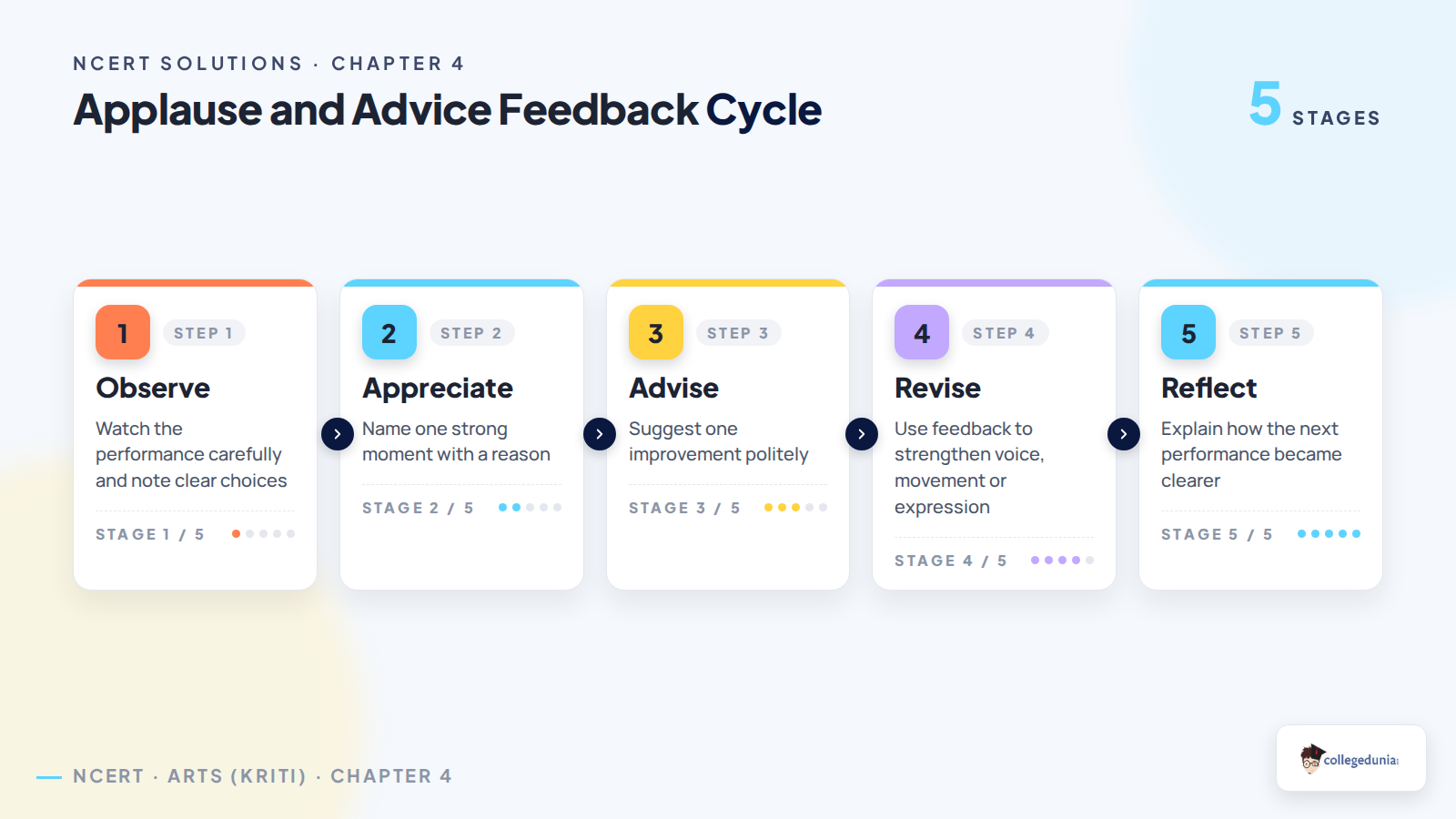
| Feedback Step | What the Student Should Do |
|---|---|
| Observe | Watch voice, movement, expression, timing and stage use carefully. |
| Appreciate | Point out one strong moment and explain why it worked. |
| Advise | Suggest one improvement without attacking the performer. |
| Revise | Use the suggestion to improve the next practice or performance. |
A complete answer should show both sides of review. It should include the kindness of applause and the usefulness of advice. That is why the chapter title joins the two words together.
Applause and Advice Video Lesson for Class 8 Arts
Source: NCERT Hindi Tutor on YouTube
How to Write Balanced Review Answers
Many Chapter 4 questions ask for reflection. Students should avoid one-word praise such as "good" or vague criticism such as "needs improvement". A better answer mentions the exact performance feature and then connects it with class understanding.
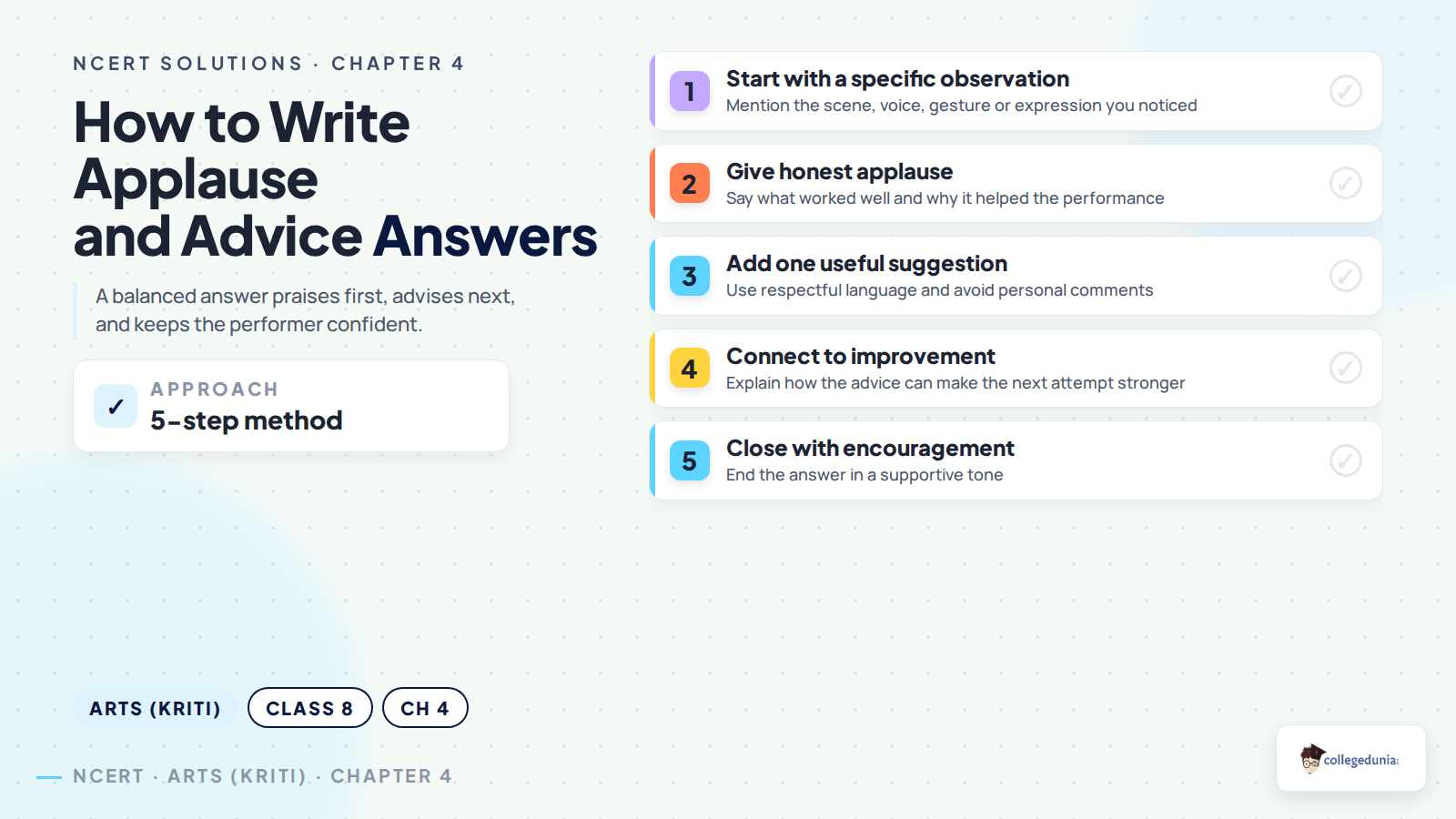
- Start with observation: name the scene, expression, voice, gesture, lighting or prop.
- Add applause: explain what was effective and why it helped the performance.
- Add advice: suggest one improvement politely and practically.
- Close with growth: show how the performer or group can use the feedback next time.
A strong answer sounds fair, specific and supportive. It should review the work, not judge the person. This is the difference between useful feedback and hurtful comment.
All NCERT Solutions Class 8 Arts Kriti Chapter 4 with Step-by-Step Answers
The full question set is available as a companion HTML page with solution and expert-solution panels. Use it when you want to revise each activity one by one before opening the PDF.
Open question cards: Class 8 Arts Kriti Chapter 4 step-by-step solutions
Common Mistakes in Applause and Advice Answers
Most mistakes happen when students make feedback too general. Chapter 4 expects students to think like careful viewers. The answer should show what was noticed, why it matters, and how the performer can improve.
- Do not write only praise. Add one meaningful suggestion when the question asks for review.
- Do not make advice personal. Say "the voice could be clearer", not "you are bad".
- Do not ignore design elements. Lighting, costumes, make-up and props can support mood and character.
- Do not forget self-review. A performer should first check personal preparation and then listen to others.
The safest format is: observation, applause, advice and improvement. This simple order makes the answer complete without becoming too long.
Class 8 Arts Kriti Chapter 4 Related Resources
| Resource | Class 8 Arts Kriti Chapter 4 Link |
|---|---|
| NCERT Book PDF | Applause and Advice Book PDF |
| Handwritten Notes | Applause and Advice Handwritten Notes |
| Chapter 4 Question Cards | Applause and Advice step-by-step answers |
Class 8 Arts Kriti NCERT Solutions for All Chapters
| Chapter | NCERT Solutions |
|---|---|
| Chapter 1 Bringing Words Alive - Play Reading | Download Chapter 1 NCERT Solutions |
| Chapter 2 One Stage, Many Scripts | Download Chapter 2 NCERT Solutions |
| Chapter 3 From Page to Stage | Download Chapter 3 NCERT Solutions |
| Chapter 4 Applause and Advice | Download Chapter 4 NCERT Solutions |
Applause and Advice Class 8 Arts Kriti NCERT Solutions FAQs
Ques. What is covered in the Applause and Advice NCERT Solutions?
Ans. The solutions cover performance review, applause, constructive advice, self-review, peer feedback, genre identification, scene observation and design elements such as lighting, costumes, make-up and props.
Ques. Are these solutions based on the 2026-27 NCERT chapter?
Ans. Yes. The PDF follows Class 8 Arts (Kriti) Chapter 4 Applause and Advice from the 2026-27 NCERT textbook.
Ques. What is the main idea of Applause and Advice?
Ans. The chapter teaches students to review performance fairly by appreciating strengths first and then giving respectful advice for improvement.
Ques. How should students write better Chapter 4 answers?
Ans. Students should write a specific observation, add one point of applause, give one practical suggestion, and explain how the performer can improve next time.



Comments