The NCERT Solutions for Class 8 Mathematics Part 1 Chapter 2 cover Power Play for the 2026-27 Ganita Prakash textbook. Students can download the PDF for step-by-step answers on exponential notation, exponent laws, negative powers, powers of 10, scientific notation and growth questions.
Resource: Class 8 Maths Part 1 Chapter 2 NCERT Solutions PDF.
Chapter focus: powers, exponents, scientific notation and growth patterns.
Question type: Figure it Out, Math Talk and estimation answers.
Class 8 Mathematics Part 1 Chapter 2 starts with the paper-folding story and then builds the language of powers. The PDF explains how repeated multiplication becomes exponential notation, why the laws of exponents work, and how powers of 10 make large numbers easier to read.
The chapter also compares linear growth and exponential growth through lotuses, passwords, ladders and estimation tasks. Each answer shows the rule first and the calculation next.
Key Methods for Power Play Questions
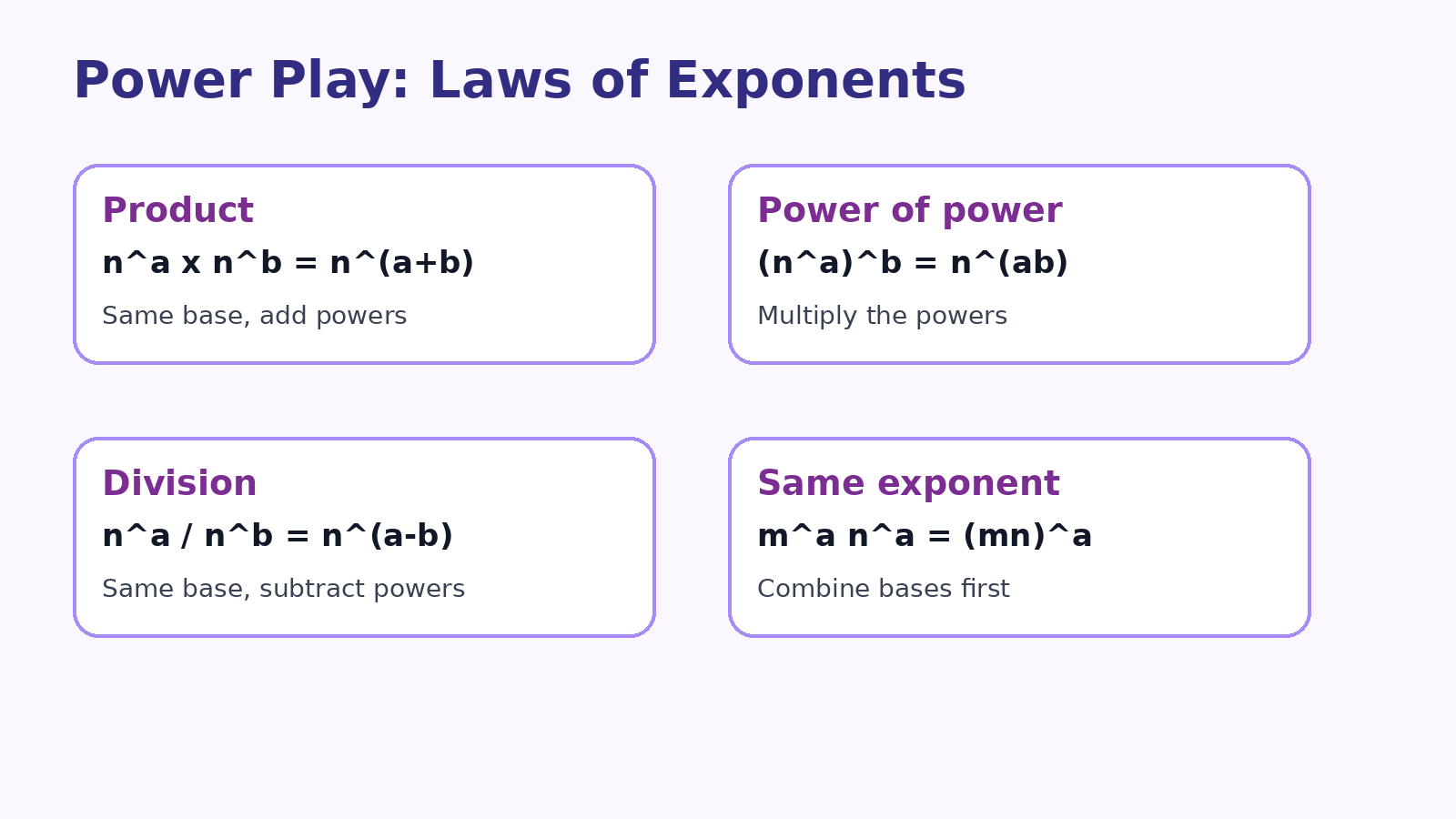
Most Power Play questions become short once students identify the operation between powers. Same-base multiplication adds exponents. Same-base division subtracts exponents. A power of a power multiplies the exponents. Scientific notation keeps one coefficient between 1 and 10.
Use na × nb = na+b for same-base multiplication.
Use na ÷ nb = na-b for same-base division.
Use n-a = 1/na when the exponent is negative.
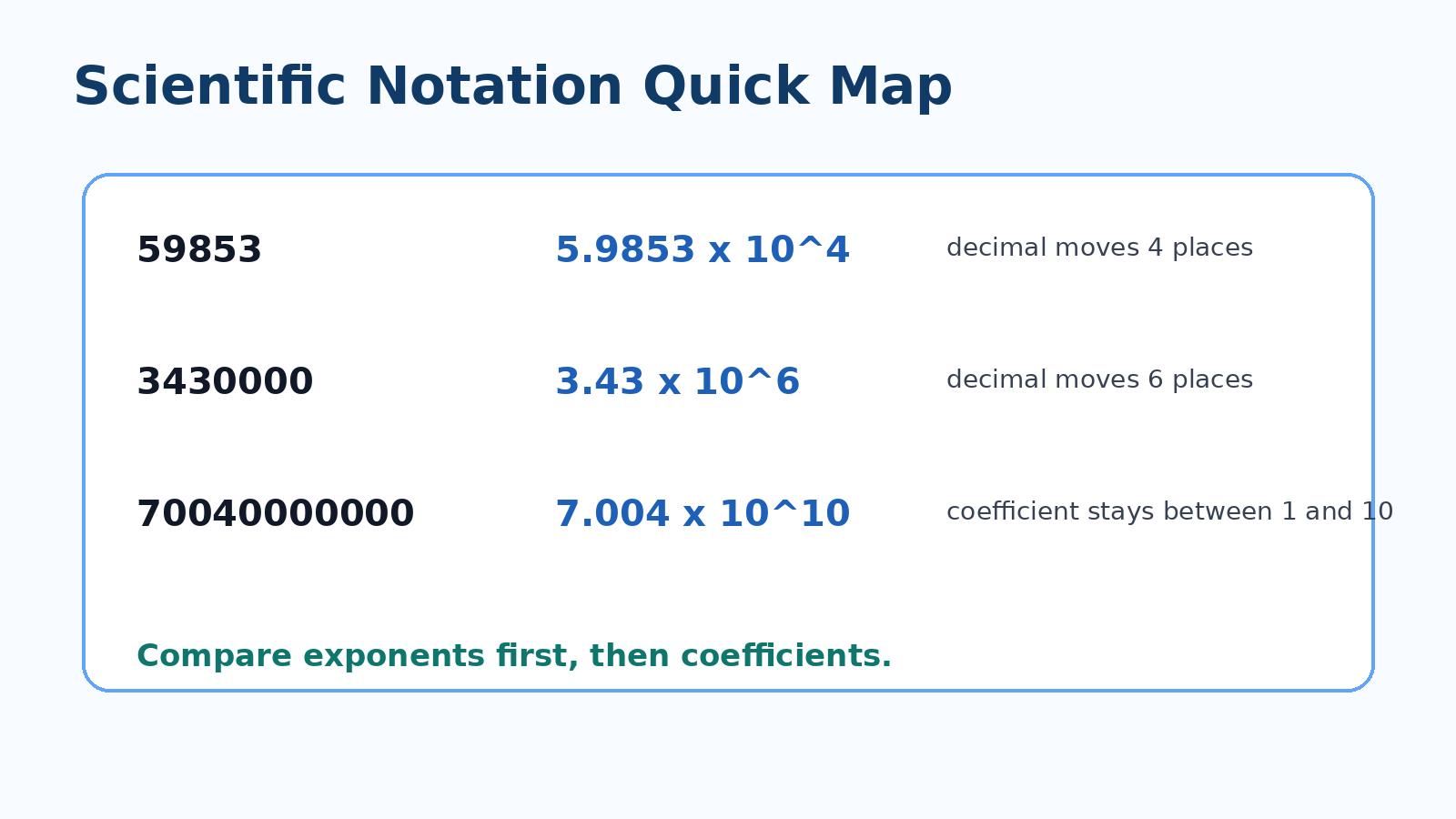
Use x × 10y, where 1 ≤ x < 10, for scientific notation.
Q4. Find the numerical values of 2 imes 103, 72 imes 23, 3 imes 44, (-3)2 imes (-5)2, 32 imes 104, and (-2)5 imes (-10)6.
Concept used. Evaluate powers first, then multiply. A negative base raised to an even power becomes positive, and to an odd power remains negative.
2 × 103 = 2 × 1000 = 2000.
72 × 23 = 49 × 8 = 392.
3 × 44 = 3 × 256 = 768.
(-3)2 × (-5)2 = 9 × 25 = 225.
32 × 104 = 9 × 10000 = 90000.
(-2)5 × (-10)6 = -32 × 1000000 = -32000000.
Final answer:2000, 392, 768, 225, 90000, -32000000.
Pranav Iyer, M.Sc Mathematics, IISc Bengaluru
Concept used. Evaluate powers first, then multiply. A negative base raised to an even power becomes positive, and to an odd power remains negative.
2 × 103 = 2 × 1000 = 2000.
72 × 23 = 49 × 8 = 392.
3 × 44 = 3 × 256 = 768.
(-3)2 × (-5)2 = 9 × 25 = 225.
32 × 104 = 9 × 10000 = 90000.
(-2)5 × (-10)6 = -32 × 1000000 = -32000000.
Final answer:2000, 392, 768, 225, 90000, -32000000.
Q5. The Stones that Shine puzzle gives 37 diamonds. Find the total number of diamonds.
Concept used. The exponent 7 says that 3 is multiplied by itself seven times. We can use known partial products to keep the work short.
The chapter computes 34 = 81.
The remaining factor is 33 = 27.
So 37 = 34 × 33 = 81 × 27.
81 × 27 = 81 × (20 + 7) = 1620 + 567 = 2187.
Final answer: There are 2187 diamonds.
Meera Joshi, B.Sc Mathematics, Delhi University
Concept used. The exponent 7 says that 3 is multiplied by itself seven times. We can use known partial products to keep the work short.
The chapter computes 34 = 81.
The remaining factor is 33 = 27.
So 37 = 34 × 33 = 81 × 27.
81 × 27 = 81 × (20 + 7) = 1620 + 567 = 2187.
Final answer: There are 2187 diamonds.
Q6. Use na imes nb = na+b to compute 29, 57 and 46.
Concept used. When the base is the same, multiplying powers means adding exponents. Then evaluate if a numerical value is needed.
29 = 25 × 24 = 32 × 16 = 512.
57 = 54 × 53 = 625 × 125 = 78125.
46 = 43 × 43 = 64 × 64 = 4096.
Final answer:29=512, 57=78125, 46=4096.
Arjun Nair, M.Sc Mathematics, IIT Kanpur
Concept used. When the base is the same, multiplying powers means adding exponents. Then evaluate if a numerical value is needed.
29 = 25 × 24 = 32 × 16 = 512.
57 = 54 × 53 = 625 × 125 = 78125.
46 = 43 × 43 = 64 × 64 = 4096.
Final answer:29=512, 57=78125, 46=4096.
Q7. Write 86, 715, 914, and 58 as a power of a power in at least two different ways.
Concept used. The rule (na)b = nab lets us split the exponent into factor pairs.
86 = (82)3 = (83)2.
715 = (73)5 = (75)3.
914 = (92)7 = (97)2.
58 = (52)4 = (54)2.
Final answer:86=(82)3=(83)2; 715=(73)5=(75)3; 914=(92)7=(97)2; 58=(52)4=(54)2.
Sana Khan, M.Ed Mathematics, Jamia Millia Islamia
Concept used. The rule (na)b = nab lets us split the exponent into factor pairs.
86 = (82)3 = (83)2.
715 = (73)5 = (75)3.
914 = (92)7 = (97)2.
58 = (52)4 = (54)2.
Final answer:86=(82)3=(83)2; 715=(73)5=(75)3; 914=(92)7=(97)2; 58=(52)4=(54)2.
Q8. In the magical pond, lotuses double every day and the pond is full on day 30. On which day was it half full?
Concept used. If a quantity doubles each day, then one day before it is full it must be half full.
On day 30, the pond is fully covered.
The number of lotuses on day 30 is double the number on day 29.
So day 29 has exactly half the number of lotuses needed to fill the pond.
Therefore the pond was half full on day 29.
Final answer: The pond was half full on day 29.
Dev Patel, M.Sc Applied Mathematics, IIT Bombay
Concept used. If a quantity doubles each day, then one day before it is full it must be half full.
On day 30, the pond is fully covered.
The number of lotuses on day 30 is double the number on day 29.
So day 29 has exactly half the number of lotuses needed to fill the pond.
Therefore the pond was half full on day 29.
Final answer: The pond was half full on day 29.
Q9. Damayanti grows one lotus for 4 days in a doubling pond, then moves all lotuses to a tripling pond for 4 more days. How many lotuses are there? What if the order is reversed?
Concept used. The final number is a product of the growth factors. Multiplication is commutative, so the order of doubling and tripling does not change the final product.
After 4 days in the doubling pond, the number is 1 × 24 = 16.
After 4 more days in the tripling pond, the number is 24 × 34.
Using ma na = (mn)a, we get 24 × 34 = (2 × 3)4 = 64.
64 = 1296.
If the order is reversed, the product is 34 × 24, which is the same.
Final answer: There are 1296 lotuses in either order.
Ishita Roy, M.Sc Mathematics, Jadavpur University
Concept used. The final number is a product of the growth factors. Multiplication is commutative, so the order of doubling and tripling does not change the final product.
After 4 days in the doubling pond, the number is 1 × 24 = 16.
After 4 more days in the tripling pond, the number is 24 × 34.
Using ma na = (mn)a, we get 24 × 34 = (2 × 3)4 = 64.
64 = 1296.
If the order is reversed, the product is 34 × 24, which is the same.
Final answer: There are 1296 lotuses in either order.
Q10. Use the same-exponent rule to compute 25 imes 55 and simplify rac10454.
Concept used. For the same exponent, multiply or divide the bases first: ma na = (mn)a and ma/na = (m/n)a.
25 × 55 = (2 × 5)5 = 105 = 100000.
10454 = (105)4 = 24.
24 = 16.
Final answer:25 × 55 = 105 = 100000, and 10454=24=16.
Neel Verma, B.Ed Mathematics, Banaras Hindu University
Concept used. For the same exponent, multiply or divide the bases first: ma na = (mn)a and ma/na = (m/n)a.
25 × 55 = (2 × 5)5 = 105 = 100000.
10454 = (105)4 = 24.
24 = 16.
Final answer:25 × 55 = 105 = 100000, and 10454=24=16.
Q11. What is 2100 ÷ 225 in powers of 2?
Concept used. When dividing powers with the same non-zero base, subtract the exponents.
The base is the same, 2.
Use na ÷ nb = na-b.
2100 ÷ 225 = 2100-25.
So the result is 275.
Final answer:275.
Tara Kapoor, M.Sc Statistics, University of Hyderabad
Concept used. When dividing powers with the same non-zero base, subtract the exponents.
The base is the same, 2.
Use na ÷ nb = na-b.
2100 ÷ 225 = 2100-25.
So the result is 275.
Final answer:275.
Q12. Why is x0 = 1 for xe 0?
Concept used. The zero exponent is defined so that the division rule for powers stays consistent.
For any non-zero x, xa ÷ xa = 1.
Using the exponent rule, xa ÷ xa = xa-a = x0.
Both expressions describe the same division.
So x0 = 1, provided x ≠ 0.
Final answer:x0 = 1 for every non-zero x.
Rohan Das, M.Sc Mathematics, Presidency University
Concept used. The zero exponent is defined so that the division rule for powers stays consistent.
For any non-zero x, xa ÷ xa = 1.
Using the exponent rule, xa ÷ xa = xa-a = x0.
Both expressions describe the same division.
So x0 = 1, provided x ≠ 0.
Final answer:x0 = 1 for every non-zero x.
Q13. Write equivalent forms of 2-4, 10-5, (-7)-2, (-5)-3, and 10-100.
Concept used. A negative exponent means reciprocal: n-a = 1/na, for ne 0.
2-4 = 124 = 116.
10-5 = 1105.
(-7)-2 = 1(-7)2 = 149.
(-5)-3 = 1(-5)3 = -1125.
10-100 = 110100.
Final answer:116, 1105, 149, -1125, 110100.
Ananya Sen, M.Ed Mathematics, TISS Mumbai
Concept used. A negative exponent means reciprocal: n-a = 1/na, for ne 0.
Q18. Which distance is the smallest: Sun to Saturn 1.4335 imes 1012 m, Saturn to Uranus 1.439 imes 1012 m, or Sun to Earth 1.496 imes 1011 m?
Concept used. In scientific notation, first compare exponents. A number with exponent 11 is ten times smaller than a similar coefficient with exponent 12.
Sun to Saturn has exponent 12.
Saturn to Uranus also has exponent 12.
Sun to Earth has exponent 11.
Since 1011 is one-tenth of 1012, the Sun to Earth distance is smallest.
Final answer: The Sun to Earth distance is the smallest.
Omkar Kulkarni, M.Sc Mathematics, Savitribai Phule Pune University
Concept used. In scientific notation, first compare exponents. A number with exponent 11 is ten times smaller than a similar coefficient with exponent 12.
Sun to Saturn has exponent 12.
Saturn to Uranus also has exponent 12.
Sun to Earth has exponent 11.
Since 1011 is one-tenth of 1012, the Sun to Earth distance is smallest.
Final answer: The Sun to Earth distance is the smallest.
Q19. Estimate the worth of jaggery equal to Roxie's weight and wheat equal to Estu's weight using reasonable assumptions.
Concept used. This is a modeling question. State assumptions, write the relationship, then multiply.
Assume Roxie weighs 45 kg and jaggery costs rupees 70 per kg.
Worth of jaggery = 45 x 70 = rupees 3150.
Assume Estu weighs 50 kg and wheat costs rupees 50 per kg.
Worth of wheat = 50 x 50 = rupees 2500.
Different reasonable assumptions can give slightly different answers.
Final answer: With these assumptions, jaggery is worth rupees 3150 and wheat is worth rupees 2500.
Zoya Siddiqui, M.Sc Mathematics, Aligarh Muslim University
Concept used. This is a modeling question. State assumptions, write the relationship, then multiply.
Assume Roxie weighs 45 kg and jaggery costs rupees 70 per kg.
Worth of jaggery = 45 x 70 = rupees 3150.
Assume Estu weighs 50 kg and wheat costs rupees 50 per kg.
Worth of wheat = 50 x 50 = rupees 2500.
Different reasonable assumptions can give slightly different answers.
Final answer: With these assumptions, jaggery is worth rupees 3150 and wheat is worth rupees 2500.
Q20. How many steps would a ladder need to reach the Moon if the Earth-Moon distance is 384400 km and the gap between steps is 20 cm?
Concept used. This is linear growth. Each step adds the same distance, so divide the total distance by the step size after converting units.
384400 km = 384400 × 100000 cm.
So the distance is 38440000000 cm.
Each step covers 20 cm.
Number of steps = 38440000000 ÷ 20 = 1922000000.
This is 192 crore 20 lakh steps.
Final answer: The ladder would need 1,922,000,000 steps, or 192 crore 20 lakh steps.
Harsh Mehta, B.Sc Mathematics, St Xavier's College
Concept used. This is linear growth. Each step adds the same distance, so divide the total distance by the step size after converting units.
384400 km = 384400 × 100000 cm.
So the distance is 38440000000 cm.
Each step covers 20 cm.
Number of steps = 38440000000 ÷ 20 = 1922000000.
This is 192 crore 20 lakh steps.
Final answer: The ladder would need 1,922,000,000 steps, or 192 crore 20 lakh steps.
Q21. Give examples of linear growth and exponential growth.
Concept used. Linear growth adds a fixed amount each time. Exponential growth multiplies by a fixed factor each time.
A ladder climb is linear growth if every step adds 20 cm.
Saving the same amount of money every week is also linear growth.
Paper folding is exponential growth because the thickness doubles each fold.
Lotuses doubling every day is another exponential growth example.
Final answer: Linear growth examples: ladder steps and fixed weekly savings. Exponential growth examples: paper folding and lotuses doubling daily.
Naina Pillai, M.Ed Mathematics, University of Kerala
Concept used. Linear growth adds a fixed amount each time. Exponential growth multiplies by a fixed factor each time.
A ladder climb is linear growth if every step adds 20 cm.
Saving the same amount of money every week is also linear growth.
Paper folding is exponential growth because the thickness doubles each fold.
Lotuses doubling every day is another exponential growth example.
Final answer: Linear growth examples: ladder steps and fixed weekly savings. Exponential growth examples: paper folding and lotuses doubling daily.
Class 8 Maths Part 1 Chapter 2 NCERT Solutions FAQs
Ques. What is covered in Class 8 Maths Part 1 Chapter 2 NCERT Solutions?
Ans. The solutions cover powers, exponents, laws of exponents, negative powers, powers of 10, scientific notation and growth questions from Power Play.
Ques. Are these Chapter 2 solutions based on the 2026-27 NCERT book?
Ans. Yes. The PDF follows the 2026-27 NCERT Ganita Prakash Class 8 Mathematics Part 1 chapter Power Play.
Ques. Which exponent laws are used most in Power Play?
Ans. Students mainly use product of powers, quotient of powers, power of a power, same-exponent multiplication and negative exponent rules.
Ques. Does the PDF include scientific notation answers?
Ans. Yes. It includes expanded powers of 10, standard form and comparison of astronomical distances.




Chapter2PowerPlaySolutions.pdf?page=1&dpi=150)
Chapter2PowerPlaySolutions.pdf?page=2&dpi=150)
Chapter2PowerPlaySolutions.pdf?page=3&dpi=150)
Chapter2PowerPlaySolutions.pdf?page=4&dpi=150)
Chapter2PowerPlaySolutions.pdf?page=5&dpi=150)
Chapter2PowerPlaySolutions.pdf?page=6&dpi=150)
Chapter2PowerPlaySolutions.pdf?page=7&dpi=150)
Chapter2PowerPlaySolutions.pdf?page=8&dpi=150)
Chapter2PowerPlaySolutions.pdf?page=9&dpi=150)
Chapter2PowerPlaySolutions.pdf?page=10&dpi=150)
Chapter2PowerPlaySolutions.pdf?page=11&dpi=150)
Chapter2PowerPlaySolutions.pdf?page=12&dpi=150)
Chapter2PowerPlaySolutions.pdf?page=13&dpi=150)
Chapter2PowerPlaySolutions.pdf?page=14&dpi=150)
Chapter2PowerPlaySolutions.pdf?page=15&dpi=150)
Chapter2PowerPlaySolutions.pdf?page=16&dpi=150)
Chapter2PowerPlaySolutions.pdf?page=17&dpi=150)
Chapter2PowerPlaySolutions.pdf?page=18&dpi=150)
Chapter2PowerPlaySolutions.pdf?page=19&dpi=150)
Chapter2PowerPlaySolutions.pdf?page=20&dpi=150)
Chapter2PowerPlaySolutions.pdf?page=21&dpi=150)
Chapter2PowerPlaySolutions.pdf?page=22&dpi=150)
Chapter2PowerPlaySolutions.pdf?page=23&dpi=150)
Chapter2PowerPlaySolutions_flat_MobileCard.pdf?page=1&dpi=150)
Chapter2PowerPlaySolutions_flat_MobileCard.pdf?page=2&dpi=150)
Chapter2PowerPlaySolutions_flat_MobileCard.pdf?page=3&dpi=150)
Chapter2PowerPlaySolutions_flat_MobileCard.pdf?page=4&dpi=150)
Chapter2PowerPlaySolutions_flat_MobileCard.pdf?page=5&dpi=150)
Chapter2PowerPlaySolutions_flat_MobileCard.pdf?page=6&dpi=150)
Chapter2PowerPlaySolutions_flat_MobileCard.pdf?page=7&dpi=150)
Chapter2PowerPlaySolutions_flat_MobileCard.pdf?page=8&dpi=150)
Chapter2PowerPlaySolutions_flat_MobileCard.pdf?page=9&dpi=150)
Chapter2PowerPlaySolutions_flat_MobileCard.pdf?page=10&dpi=150)
Chapter2PowerPlaySolutions_flat_MobileCard.pdf?page=11&dpi=150)
Chapter2PowerPlaySolutions_flat_MobileCard.pdf?page=12&dpi=150)
Chapter2PowerPlaySolutions_flat_MobileCard.pdf?page=13&dpi=150)
Chapter2PowerPlaySolutions_flat_MobileCard.pdf?page=14&dpi=150)
Chapter2PowerPlaySolutions_flat_MobileCard.pdf?page=15&dpi=150)
Chapter2PowerPlaySolutions_flat_MobileCard.pdf?page=16&dpi=150)
Chapter2PowerPlaySolutions_flat_MobileCard.pdf?page=17&dpi=150)
Chapter2PowerPlaySolutions_flat_MobileCard.pdf?page=18&dpi=150)
Chapter2PowerPlaySolutions_flat_MobileCard.pdf?page=19&dpi=150)
Chapter2PowerPlaySolutions_flat_MobileCard.pdf?page=20&dpi=150)
Chapter2PowerPlaySolutions_flat_MobileCard.pdf?page=21&dpi=150)
Chapter2PowerPlaySolutions_flat_MobileCard.pdf?page=22&dpi=150)
Chapter2PowerPlaySolutions_flat_MobileCard.pdf?page=23&dpi=150)
Chapter2PowerPlaySolutions_flat_MobileCard.pdf?page=24&dpi=150)
Chapter2PowerPlaySolutions_flat_MobileCard.pdf?page=25&dpi=150)
Chapter2PowerPlaySolutions_flat_MobileCard.pdf?page=26&dpi=150)
Chapter2PowerPlaySolutions_flat_MobileCard.pdf?page=27&dpi=150)
Chapter2PowerPlaySolutions_flat_MobileCard.pdf?page=28&dpi=150)
Chapter2PowerPlaySolutions_flat_MobileCard.pdf?page=29&dpi=150)
Chapter2PowerPlaySolutions_flat_MobileCard.pdf?page=30&dpi=150)
Chapter2PowerPlaySolutions_flat_MobileCard.pdf?page=31&dpi=150)
Chapter2PowerPlaySolutions_flat_MobileCard.pdf?page=32&dpi=150)
Chapter2PowerPlaySolutions_flat_MobileCard.pdf?page=33&dpi=150)
Chapter2PowerPlaySolutions_flat_MobileCard.pdf?page=34&dpi=150)
Chapter2PowerPlaySolutions_flat_MobileCard.pdf?page=35&dpi=150)
Chapter2PowerPlaySolutions_flat_MobileCard.pdf?page=36&dpi=150)
Chapter2PowerPlaySolutions_flat_MobileCard.pdf?page=37&dpi=150)
Chapter2PowerPlaySolutions_flat_MobileCard.pdf?page=38&dpi=150)
Chapter2PowerPlaySolutions_flat_MobileCard.pdf?page=39&dpi=150)
Chapter2PowerPlaySolutions_flat_MobileCard.pdf?page=40&dpi=150)
Chapter2PowerPlaySolutions_flat_MobileCard.pdf?page=41&dpi=150)
Chapter2PowerPlaySolutions_flat_MobileCard.pdf?page=42&dpi=150)
Chapter2PowerPlaySolutions_flat_MobileCard.pdf?page=43&dpi=150)
Chapter2PowerPlaySolutions_flat_MobileCard.pdf?page=44&dpi=150)
Chapter2PowerPlaySolutions_flat_MobileCard.pdf?page=45&dpi=150)
Chapter2PowerPlaySolutions_flat_MobileCard.pdf?page=46&dpi=150)
Chapter2PowerPlaySolutions_flat_MobileCard.pdf?page=47&dpi=150)
Chapter2PowerPlaySolutions_flat_MobileCard.pdf?page=48&dpi=150)
Chapter2PowerPlaySolutions_flat_MobileCard.pdf?page=49&dpi=150)
Chapter2PowerPlaySolutions_flat_MobileCard.pdf?page=50&dpi=150)
Chapter2PowerPlaySolutions_flat_MobileCard.pdf?page=51&dpi=150)
Chapter2PowerPlaySolutions_flat_MobileCard.pdf?page=52&dpi=150)
Chapter2PowerPlaySolutions_flat_MobileCard.pdf?page=53&dpi=150)
Chapter2PowerPlaySolutions_flat_MobileCard.pdf?page=54&dpi=150)
Chapter2PowerPlaySolutions_flat_MobileCard.pdf?page=55&dpi=150)



Comments