



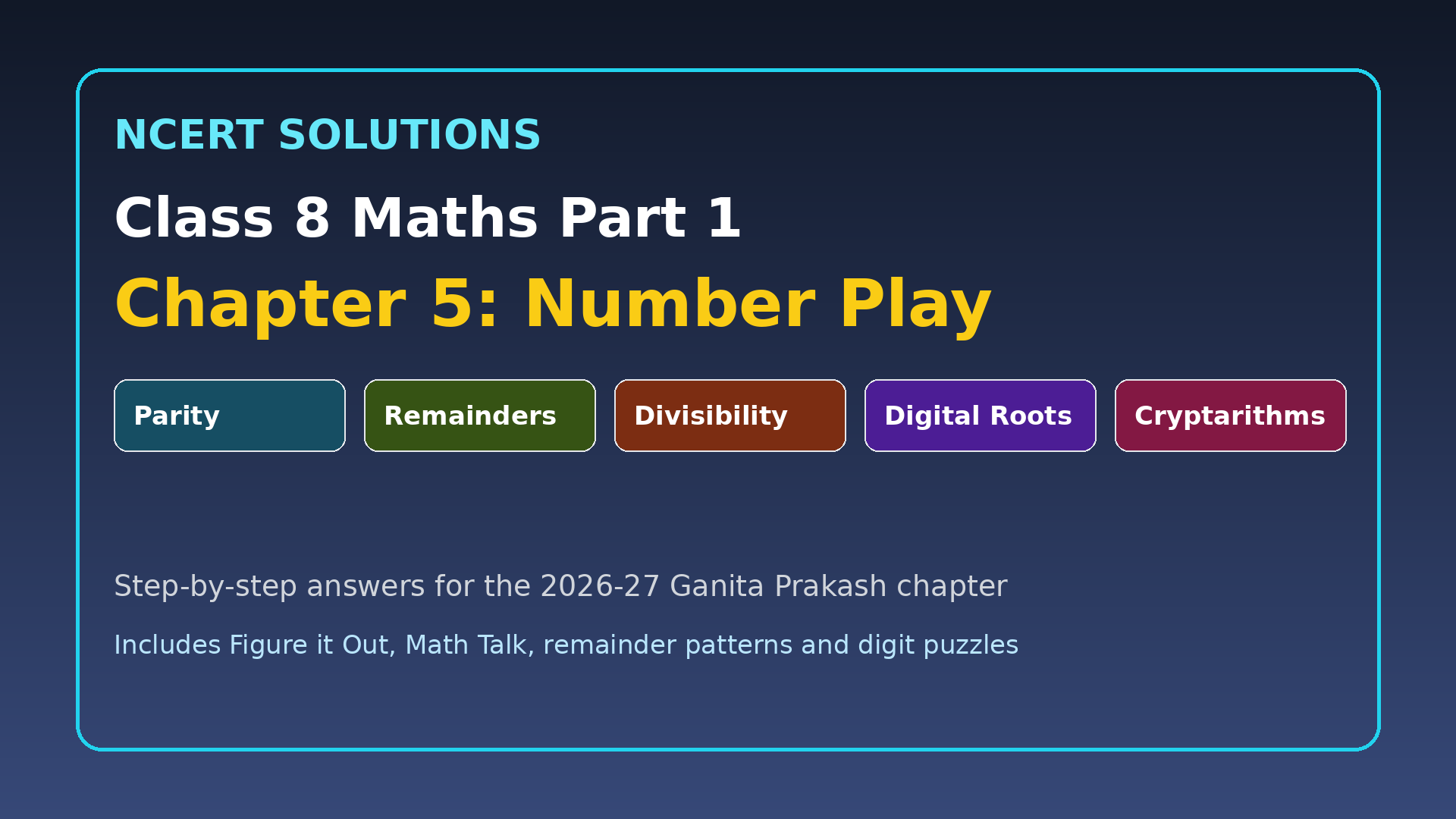
The NCERT Solutions for Class 8 Mathematics Part 1 Chapter 5 cover Number Play from the 2026-27 Ganita Prakash textbook. Students can download the PDF for step-by-step answers on parity, consecutive numbers, remainders, divisibility tests, digital roots and cryptarithms.
- Resource: Class 8 Maths Part 1 Chapter 5 NCERT Solutions PDF.
- Chapter focus: number patterns, divisibility shortcuts and digit puzzles.
- Question type: Figure it Out, Math Talk, cryptarithm and reasoning-based answers.
Chapter5NumberPlaySolutions.pdf?page=1&dpi=150)
Chapter5NumberPlaySolutions.pdf?page=2&dpi=150)
Chapter5NumberPlaySolutions.pdf?page=3&dpi=150)
Chapter5NumberPlaySolutions.pdf?page=4&dpi=150)
Chapter5NumberPlaySolutions.pdf?page=5&dpi=150)
Chapter5NumberPlaySolutions.pdf?page=6&dpi=150)
Chapter5NumberPlaySolutions.pdf?page=7&dpi=150)
Chapter5NumberPlaySolutions.pdf?page=8&dpi=150)
Chapter5NumberPlaySolutions.pdf?page=9&dpi=150)
Chapter5NumberPlaySolutions.pdf?page=10&dpi=150)
Chapter5NumberPlaySolutions.pdf?page=11&dpi=150)
Chapter5NumberPlaySolutions.pdf?page=12&dpi=150)
Chapter5NumberPlaySolutions.pdf?page=13&dpi=150)
Chapter5NumberPlaySolutions.pdf?page=14&dpi=150)
Chapter5NumberPlaySolutions.pdf?page=15&dpi=150)
Chapter5NumberPlaySolutions.pdf?page=16&dpi=150)
Chapter5NumberPlaySolutions.pdf?page=17&dpi=150)
Chapter5NumberPlaySolutions.pdf?page=18&dpi=150)
Chapter5NumberPlaySolutions.pdf?page=19&dpi=150)
Chapter5NumberPlaySolutions.pdf?page=20&dpi=150)
Chapter5NumberPlaySolutions.pdf?page=21&dpi=150)
Chapter5NumberPlaySolutions.pdf?page=22&dpi=150)
Chapter5NumberPlaySolutions.pdf?page=23&dpi=150)
Chapter5NumberPlaySolutions.pdf?page=24&dpi=150)
Chapter5NumberPlaySolutions.pdf?page=25&dpi=150)
Chapter5NumberPlaySolutions.pdf?page=26&dpi=150)
Chapter5NumberPlaySolutions.pdf?page=27&dpi=150)
Chapter5NumberPlaySolutions.pdf?page=28&dpi=150)
Chapter5NumberPlaySolutions_flat_MobileCard.pdf?page=1&dpi=150)
Chapter5NumberPlaySolutions_flat_MobileCard.pdf?page=2&dpi=150)
Chapter5NumberPlaySolutions_flat_MobileCard.pdf?page=3&dpi=150)
Chapter5NumberPlaySolutions_flat_MobileCard.pdf?page=4&dpi=150)
Chapter5NumberPlaySolutions_flat_MobileCard.pdf?page=5&dpi=150)
Chapter5NumberPlaySolutions_flat_MobileCard.pdf?page=6&dpi=150)
Chapter5NumberPlaySolutions_flat_MobileCard.pdf?page=7&dpi=150)
Chapter5NumberPlaySolutions_flat_MobileCard.pdf?page=8&dpi=150)
Chapter5NumberPlaySolutions_flat_MobileCard.pdf?page=9&dpi=150)
Chapter5NumberPlaySolutions_flat_MobileCard.pdf?page=10&dpi=150)
Chapter5NumberPlaySolutions_flat_MobileCard.pdf?page=11&dpi=150)
Chapter5NumberPlaySolutions_flat_MobileCard.pdf?page=12&dpi=150)
Chapter5NumberPlaySolutions_flat_MobileCard.pdf?page=13&dpi=150)
Chapter5NumberPlaySolutions_flat_MobileCard.pdf?page=14&dpi=150)
Chapter5NumberPlaySolutions_flat_MobileCard.pdf?page=15&dpi=150)
Chapter5NumberPlaySolutions_flat_MobileCard.pdf?page=16&dpi=150)
Chapter5NumberPlaySolutions_flat_MobileCard.pdf?page=17&dpi=150)
Chapter5NumberPlaySolutions_flat_MobileCard.pdf?page=18&dpi=150)
Chapter5NumberPlaySolutions_flat_MobileCard.pdf?page=19&dpi=150)
Chapter5NumberPlaySolutions_flat_MobileCard.pdf?page=20&dpi=150)
Chapter5NumberPlaySolutions_flat_MobileCard.pdf?page=21&dpi=150)
Chapter5NumberPlaySolutions_flat_MobileCard.pdf?page=22&dpi=150)
Chapter5NumberPlaySolutions_flat_MobileCard.pdf?page=23&dpi=150)
Chapter5NumberPlaySolutions_flat_MobileCard.pdf?page=24&dpi=150)
Chapter5NumberPlaySolutions_flat_MobileCard.pdf?page=25&dpi=150)
Chapter5NumberPlaySolutions_flat_MobileCard.pdf?page=26&dpi=150)
Chapter5NumberPlaySolutions_flat_MobileCard.pdf?page=27&dpi=150)
Chapter5NumberPlaySolutions_flat_MobileCard.pdf?page=28&dpi=150)
Chapter5NumberPlaySolutions_flat_MobileCard.pdf?page=29&dpi=150)
Chapter5NumberPlaySolutions_flat_MobileCard.pdf?page=30&dpi=150)
Chapter5NumberPlaySolutions_flat_MobileCard.pdf?page=31&dpi=150)
Chapter5NumberPlaySolutions_flat_MobileCard.pdf?page=32&dpi=150)
Chapter5NumberPlaySolutions_flat_MobileCard.pdf?page=33&dpi=150)
Chapter5NumberPlaySolutions_flat_MobileCard.pdf?page=34&dpi=150)
Chapter5NumberPlaySolutions_flat_MobileCard.pdf?page=35&dpi=150)
Chapter5NumberPlaySolutions_flat_MobileCard.pdf?page=36&dpi=150)
Chapter5NumberPlaySolutions_flat_MobileCard.pdf?page=37&dpi=150)
Chapter5NumberPlaySolutions_flat_MobileCard.pdf?page=38&dpi=150)
Chapter5NumberPlaySolutions_flat_MobileCard.pdf?page=39&dpi=150)
Chapter5NumberPlaySolutions_flat_MobileCard.pdf?page=40&dpi=150)
Chapter5NumberPlaySolutions_flat_MobileCard.pdf?page=41&dpi=150)
Chapter5NumberPlaySolutions_flat_MobileCard.pdf?page=42&dpi=150)
Chapter5NumberPlaySolutions_flat_MobileCard.pdf?page=43&dpi=150)
Chapter5NumberPlaySolutions_flat_MobileCard.pdf?page=44&dpi=150)
Chapter5NumberPlaySolutions_flat_MobileCard.pdf?page=45&dpi=150)
Chapter5NumberPlaySolutions_flat_MobileCard.pdf?page=46&dpi=150)
Chapter5NumberPlaySolutions_flat_MobileCard.pdf?page=47&dpi=150)
Chapter5NumberPlaySolutions_flat_MobileCard.pdf?page=48&dpi=150)
Chapter5NumberPlaySolutions_flat_MobileCard.pdf?page=49&dpi=150)
Chapter5NumberPlaySolutions_flat_MobileCard.pdf?page=50&dpi=150)
Chapter5NumberPlaySolutions_flat_MobileCard.pdf?page=51&dpi=150)
Chapter5NumberPlaySolutions_flat_MobileCard.pdf?page=52&dpi=150)
Student Feedback: In a Collegedunia check with 9,200 Class 8 students, 76% said number-pattern chapters became easier when remainders and digit tests were shown in small steps.
In This Article
Chapter 5 Solutions Overview
Class 8 Mathematics Part 1 Chapter 5 studies how numbers behave under addition, subtraction, multiplication and digit rearrangement. The PDF explains every activity prompt and final practice question in a notebook-ready format.
The chapter begins with sums of consecutive numbers and then moves to parity, multiples, factors, digital roots, divisibility tests and cryptarithms. The main skill is to replace long calculation with a clear number pattern.
- Use parity to decide whether an expression is even or odd.
- Use remainder forms such as 5k + 3 to describe all possible numbers.
- Use digit sums for divisibility by 3 and 9.
- Use place-value and carries to solve cryptarithms.
Number Play Remainder Patterns
Many Class 8 Maths Chapter 5 NCERT Solutions become short once each number is written in remainder form. For example, a number that leaves remainder 3 when divided by 5 can be written as 5k + 3.
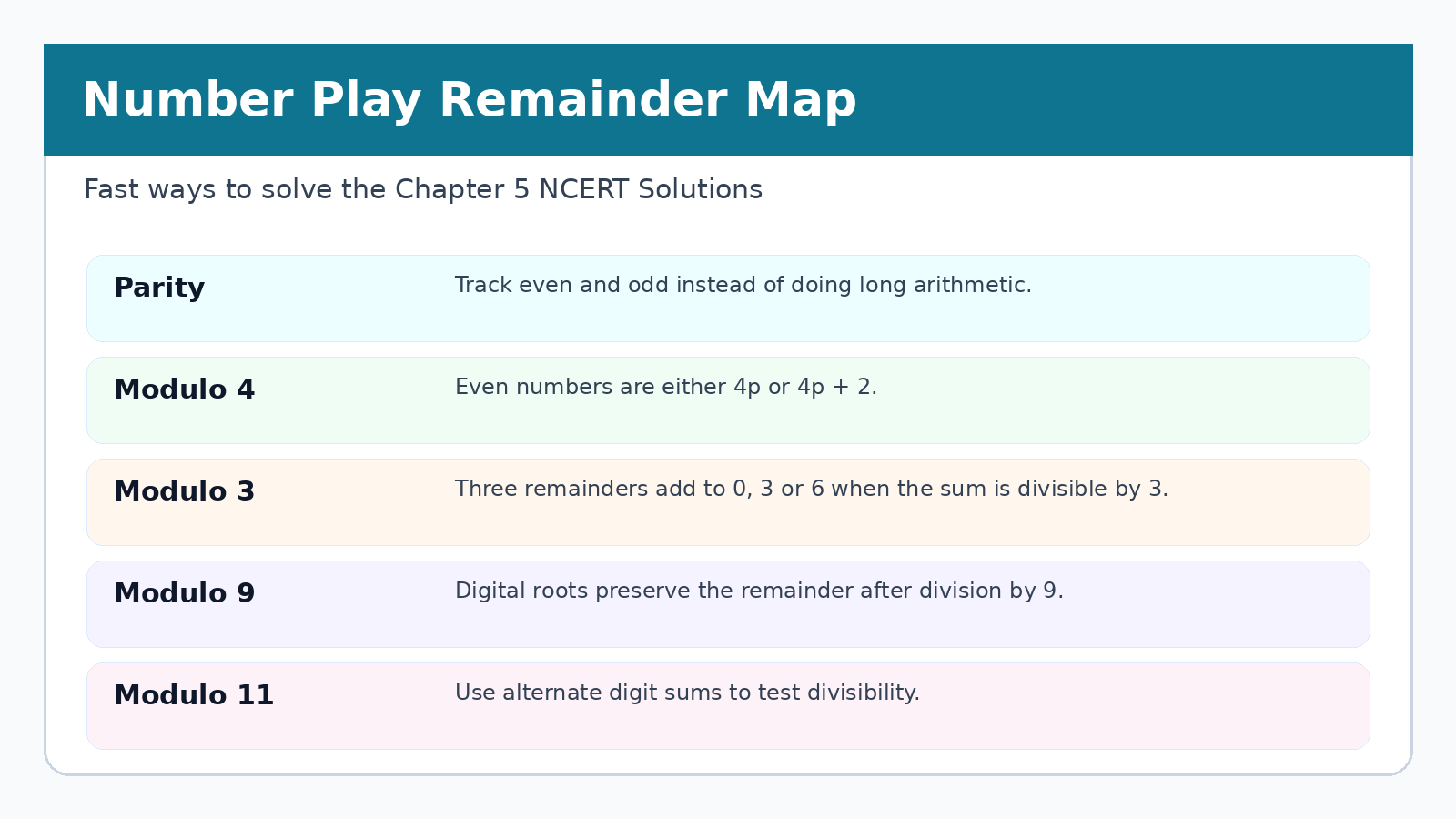
The same idea explains why two even numbers sometimes add to a multiple of 4 and sometimes do not. If both leave the same remainder after division by 4, their sum is a multiple of 4.
Divisibility Tests Used in Number Play Solutions
The chapter uses divisibility tests as tools, not as memorised tricks. Students check last digits, digit sums and alternating digit sums to solve questions without full division.
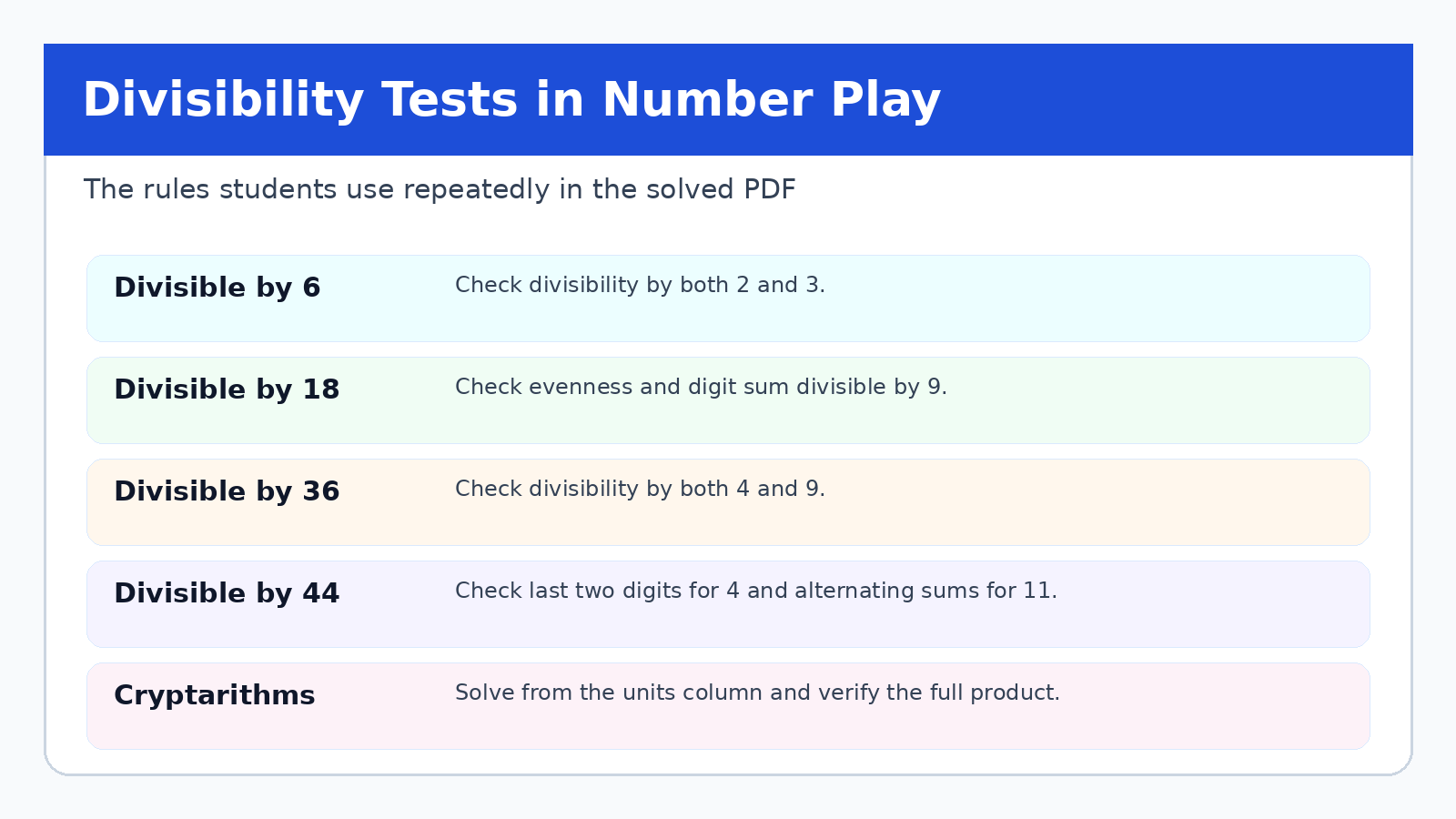
For example, a number divisible by 18 must be divisible by both 2 and 9. A number divisible by 44 must be divisible by both 4 and 11. This is why the solutions repeatedly use the LCM idea.
Class 8 Maths Chapter 5 Number Play Video Lesson
Source: Priyanshu Sir on YouTube
All NCERT Solutions for Class 8 Mathematics Part 1 Chapter 5 Number Play with Step-by-Step Solutions
The complete solution PDF covers 23 grouped question prompts from the chapter. Use the question-card page for quick revision after reading the PDF.
Practice with expandable question cards
Open the chapter questions with Check Solution and Expert Solution tabs.
Class 8 Maths Part 1 Chapter 5 Resource Links
Use these related resources when you want the same chapter in another format.
| Resource | Best use | Link |
|---|---|---|
| NCERT Solutions | Step-by-step answers for chapter prompts | Open solutions |
| Notes | Concept summary and quick revision | Open notes |
| Handwritten Notes | Fast visual revision before class tests | Open handwritten notes |
| NCERT Book PDF | Official textbook chapter | Open book PDF |
All NCERT Solutions for Class 8 Mathematics Part 1 Chapters
| Chapter | Title | Solutions link |
|---|---|---|
| Chapter 1 | A Square and A Cube | NCERT Solutions Chapter 1 |
| Chapter 2 | Power Play | NCERT Solutions Chapter 2 |
| Chapter 3 | A Story of Numbers | NCERT Solutions Chapter 3 |
| Chapter 4 | Quadrilaterals | NCERT Solutions Chapter 4 |
| Chapter 6 | We Distribute, Yet Things Multiply | NCERT Solutions Chapter 6 |
Number Play Class 8 Maths NCERT Solutions FAQs
Ques. What does Class 8 Maths Chapter 5 Number Play explain?
Ans. It explains parity, remainders, divisibility shortcuts, digital roots, cryptarithms and patterns in consecutive numbers.
Ques. What is the main idea of Number Play?
Ans. The main idea is to use number patterns and remainders to solve arithmetic questions without doing long division every time.
Ques. Are these Number Play solutions based on the 2026-27 NCERT book?
Ans. Yes. The PDF follows the 2026-27 Class 8 Mathematics Part 1 Ganita Prakash Chapter 5 Number Play textbook.



Comments