




Class 12 Physics Chapter 6: Constructions and Tilings NCERT Solutions
All 22 questions with collapsible Solution and Expert Solution. Tap a button to reveal the working.
What this PDF covers
When constructing the perpendicular bisector, is it necessary to have the same radius for the arcs above and below XY? Explore this through construction, and then justify your answer.
Concept used. This question uses perpendicular bisector construction. In ruler-compass construction, the important invariant is equality of distance, equality of angle, or a congruent-triangle reason.
Source anchor
NCERT Class 7 Ganita Prakash Part 2, Chapter 6: Constructions and Tilings, Page 140, Figure it Out 1.- The two arcs above \(XY\) must use the same radius from \(X\) and \(Y\) so that their intersection is equidistant from \(X\) and \(Y\).
- The two arcs below \(XY\) must also use the same radius from \(X\) and \(Y\) for the same reason.
- The radius used below need not be equal to the radius used above.
- Both intersection points lie on the perpendicular bisector of \(XY\), so joining them gives the same perpendicular bisector.
Construction check
Keep construction marks light, use the same compass opening when equality is required, and justify the final line or angle using congruence or equal-distance facts.Strategic angle. First identify what must stay equal. Then decide whether the construction needs a perpendicular bisector, an angle bisector, a copied angle, or a repeated equal length.
- The two arcs above \(XY\) must use the same radius from \(X\) and \(Y\) so that their intersection is equidistant from \(X\) and \(Y\).
- The two arcs below \(XY\) must also use the same radius from \(X\) and \(Y\) for the same reason.
- The radius used below need not be equal to the radius used above.
- Both intersection points lie on the perpendicular bisector of \(XY\), so joining them gives the same perpendicular bisector.
No. The upper pair and lower pair may have different radii, but within each pair the radius from \(X\) and \(Y\) must be the same.
Is it necessary to construct the pairs of arcs above and below XY? Instead, can we construct both the pairs of arcs on the same side of XY?
Concept used. This question uses locating two points on a perpendicular bisector. In ruler-compass construction, the important invariant is equality of distance, equality of angle, or a congruent-triangle reason.
Source anchor
NCERT Class 7 Ganita Prakash Part 2, Chapter 6: Constructions and Tilings, Page 140, Figure it Out 2.- A pair of equal-radius arcs from \(X\) and \(Y\) gives one point on the perpendicular bisector.
- A second pair of equal-radius arcs, using a different radius, can give another point on the same side of \(XY\).
- Two distinct points determine a line.
- Since both points are equidistant from \(X\) and \(Y\), the line through them is the perpendicular bisector.
Construction check
Keep construction marks light, use the same compass opening when equality is required, and justify the final line or angle using congruence or equal-distance facts.Strategic angle. First identify what must stay equal. Then decide whether the construction needs a perpendicular bisector, an angle bisector, a copied angle, or a repeated equal length.
- A pair of equal-radius arcs from \(X\) and \(Y\) gives one point on the perpendicular bisector.
- A second pair of equal-radius arcs, using a different radius, can give another point on the same side of \(XY\).
- Two distinct points determine a line.
- Since both points are equidistant from \(X\) and \(Y\), the line through them is the perpendicular bisector.
Yes. Both pairs can be on the same side if they give two distinct intersection points on the perpendicular bisector.
While constructing one pair of intersecting arcs, is it necessary that we use the same radii for both of them?
Concept used. This question uses equal distance condition. In ruler-compass construction, the important invariant is equality of distance, equality of angle, or a congruent-triangle reason.
Source anchor
NCERT Class 7 Ganita Prakash Part 2, Chapter 6: Constructions and Tilings, Page 140, Figure it Out 3.- The construction needs an intersection point whose distance from \(X\) equals its distance from \(Y\).
- If the radius from \(X\) is different from the radius from \(Y\), the intersection point is generally not equidistant from the two endpoints.
- Then the point need not lie on the perpendicular bisector.
- So equal radii are required within one pair of arcs.
Construction check
Keep construction marks light, use the same compass opening when equality is required, and justify the final line or angle using congruence or equal-distance facts.Strategic angle. First identify what must stay equal. Then decide whether the construction needs a perpendicular bisector, an angle bisector, a copied angle, or a repeated equal length.
- The construction needs an intersection point whose distance from \(X\) equals its distance from \(Y\).
- If the radius from \(X\) is different from the radius from \(Y\), the intersection point is generally not equidistant from the two endpoints.
- Then the point need not lie on the perpendicular bisector.
- So equal radii are required within one pair of arcs.
Yes. For one pair of arcs, the radius from \(X\) and the radius from \(Y\) must be equal.
Recreate the given compass design using only a ruler and compass.
Concept used. This question uses perpendicular-bisector design. In ruler-compass construction, the important invariant is equality of distance, equality of angle, or a congruent-triangle reason.
Source anchor
NCERT Class 7 Ganita Prakash Part 2, Chapter 6: Constructions and Tilings, Page 140, Figure it Out 4.- Draw a base segment \(XY\).
- Construct its perpendicular bisector by drawing equal-radius arcs from \(X\) and \(Y\).
- Use the arc intersections as centres for symmetric arcs.
- Repeat equal-radius arcs around the support lines and finally trace only the boundary of the design.
Construction check
Keep construction marks light, use the same compass opening when equality is required, and justify the final line or angle using congruence or equal-distance facts.Strategic angle. First identify what must stay equal. Then decide whether the construction needs a perpendicular bisector, an angle bisector, a copied angle, or a repeated equal length.
- Draw a base segment \(XY\).
- Construct its perpendicular bisector by drawing equal-radius arcs from \(X\) and \(Y\).
- Use the arc intersections as centres for symmetric arcs.
- Repeat equal-radius arcs around the support lines and finally trace only the boundary of the design.
The design can be recreated by first constructing the perpendicular bisector of the base segment and then tracing equal-radius symmetric arcs.
Justify why AB in Fig. 6.4 is the perpendicular bisector.
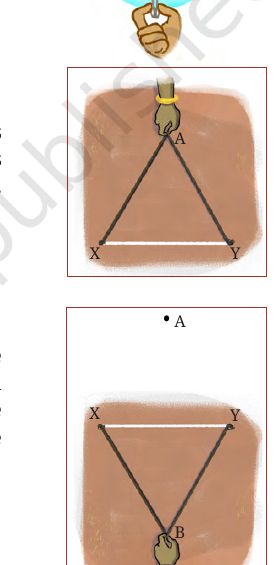
Concept used. This question uses rope construction justification. In ruler-compass construction, the important invariant is equality of distance, equality of angle, or a congruent-triangle reason.
Source anchor
NCERT Class 7 Ganita Prakash Part 2, Chapter 6: Constructions and Tilings, Page 142, Figure it Out 1.- The rope has loops fixed at \(X\) and \(Y\) and its midpoint is pulled to \(A\).
- Because \(A\) is the midpoint of the rope, the stretched lengths \(AX\) and \(AY\) are equal.
- Similarly, pulling the same midpoint below gives \(BX=BY\).
- Any point equidistant from \(X\) and \(Y\) lies on the perpendicular bisector of \(XY\).
- Both \(A\) and \(B\) lie on this perpendicular bisector, so line \(AB\) is the perpendicular bisector.
Construction check
Keep construction marks light, use the same compass opening when equality is required, and justify the final line or angle using congruence or equal-distance facts.Strategic angle. First identify what must stay equal. Then decide whether the construction needs a perpendicular bisector, an angle bisector, a copied angle, or a repeated equal length.
- The rope has loops fixed at \(X\) and \(Y\) and its midpoint is pulled to \(A\).
- Because \(A\) is the midpoint of the rope, the stretched lengths \(AX\) and \(AY\) are equal.
- Similarly, pulling the same midpoint below gives \(BX=BY\).
- Any point equidistant from \(X\) and \(Y\) lies on the perpendicular bisector of \(XY\).
- Both \(A\) and \(B\) lie on this perpendicular bisector, so line \(AB\) is the perpendicular bisector.
\(AB\) is the perpendicular bisector because both \(A\) and \(B\) are equidistant from \(X\) and \(Y\).
Can you think of different methods to construct a 90 degree angle at a given point on a line using a rope?
Concept used. This question uses rope method for perpendicular construction. In ruler-compass construction, the important invariant is equality of distance, equality of angle, or a congruent-triangle reason.
Source anchor
NCERT Class 7 Ganita Prakash Part 2, Chapter 6: Constructions and Tilings, Page 142, Figure it Out 2.- Mark equal distances \(OX\) and \(OY\) on the given line using the rope.
- Use equal rope lengths from \(X\) and \(Y\) to locate a point \(A\) off the line.
- Join \(O\) to \(A\).
- Since \(A\) is equidistant from \(X\) and \(Y\), \(AO\) lies on the perpendicular bisector of \(XY\) and therefore makes a \(90^\circ\) angle with the line.
Construction check
Keep construction marks light, use the same compass opening when equality is required, and justify the final line or angle using congruence or equal-distance facts.Strategic angle. First identify what must stay equal. Then decide whether the construction needs a perpendicular bisector, an angle bisector, a copied angle, or a repeated equal length.
- Mark equal distances \(OX\) and \(OY\) on the given line using the rope.
- Use equal rope lengths from \(X\) and \(Y\) to locate a point \(A\) off the line.
- Join \(O\) to \(A\).
- Since \(A\) is equidistant from \(X\) and \(Y\), \(AO\) lies on the perpendicular bisector of \(XY\) and therefore makes a \(90^\circ\) angle with the line.
One method is to mark equal points \(X\) and \(Y\) around \(O\), locate an equidistant point \(A\) with the rope, and join \(OA\).
Construct at least 4 different angles. Draw their bisectors.
Concept used. This question uses angle bisection. In ruler-compass construction, the important invariant is equality of distance, equality of angle, or a congruent-triangle reason.
Source anchor
NCERT Class 7 Ganita Prakash Part 2, Chapter 6: Constructions and Tilings, Page 144, Figure it Out 1.- Draw any angle \(XOY\).
- With centre \(O\), mark equal points \(A\) and \(B\) on the two arms.
- With centres \(A\) and \(B\) and the same radius, draw arcs meeting at \(C\) inside the angle.
- Draw \(OC\). By SSS congruence, \(OC\) bisects the angle.
- Repeat the same steps for four differently opened angles.
Construction check
Keep construction marks light, use the same compass opening when equality is required, and justify the final line or angle using congruence or equal-distance facts.Strategic angle. First identify what must stay equal. Then decide whether the construction needs a perpendicular bisector, an angle bisector, a copied angle, or a repeated equal length.
- Draw any angle \(XOY\).
- With centre \(O\), mark equal points \(A\) and \(B\) on the two arms.
- With centres \(A\) and \(B\) and the same radius, draw arcs meeting at \(C\) inside the angle.
- Draw \(OC\). By SSS congruence, \(OC\) bisects the angle.
- Repeat the same steps for four differently opened angles.
Each angle is bisected by drawing equal points on its arms, intersecting equal arcs from those points, and joining the vertex to the arc intersection.
Construct the 8-petalled figure shown in Fig. 6.5.
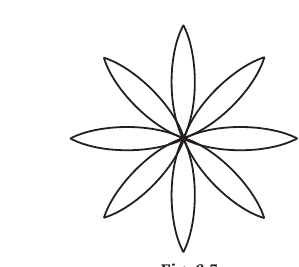
Concept used. This question uses 45 degree angle construction. In ruler-compass construction, the important invariant is equality of distance, equality of angle, or a congruent-triangle reason.
Source anchor
NCERT Class 7 Ganita Prakash Part 2, Chapter 6: Constructions and Tilings, Page 144, Figure it Out 2.- Draw a point \(O\) and construct a \(90^\circ\) angle.
- Bisect the \(90^\circ\) angle to get a \(45^\circ\) ray.
- Repeat around \(O\) so that the full \(360^\circ\) angle is divided into eight equal \(45^\circ\) parts.
- Use equal compass radii on adjacent rays to draw matching petal arcs.
Construction check
Keep construction marks light, use the same compass opening when equality is required, and justify the final line or angle using congruence or equal-distance facts.Strategic angle. First identify what must stay equal. Then decide whether the construction needs a perpendicular bisector, an angle bisector, a copied angle, or a repeated equal length.
- Draw a point \(O\) and construct a \(90^\circ\) angle.
- Bisect the \(90^\circ\) angle to get a \(45^\circ\) ray.
- Repeat around \(O\) so that the full \(360^\circ\) angle is divided into eight equal \(45^\circ\) parts.
- Use equal compass radii on adjacent rays to draw matching petal arcs.
The support rays are eight \(45^\circ\) rays around one centre; equal arcs between adjacent rays form the eight petals.
In Step 2 of angle bisection, if arcs of equal radius are drawn on the other side, will the line OC still be an angle bisector?
Concept used. This question uses external angle bisector. In ruler-compass construction, the important invariant is equality of distance, equality of angle, or a congruent-triangle reason.
Source anchor
NCERT Class 7 Ganita Prakash Part 2, Chapter 6: Constructions and Tilings, Page 144, Figure it Out 3.- The new point \(C\) is still at equal distance from the two marked points \(A\) and \(B\).
- Also \(OA=OB\) by construction.
- Thus triangles formed with \(O\), \(A\), \(B\) and \(C\) are congruent by SSS.
- So \(OC\) still makes equal angles with the two arms, though it may bisect the vertically opposite or external angle depending on where \(C\) lies.
Construction check
Keep construction marks light, use the same compass opening when equality is required, and justify the final line or angle using congruence or equal-distance facts.Strategic angle. First identify what must stay equal. Then decide whether the construction needs a perpendicular bisector, an angle bisector, a copied angle, or a repeated equal length.
- The new point \(C\) is still at equal distance from the two marked points \(A\) and \(B\).
- Also \(OA=OB\) by construction.
- Thus triangles formed with \(O\), \(A\), \(B\) and \(C\) are congruent by SSS.
- So \(OC\) still makes equal angles with the two arms, though it may bisect the vertically opposite or external angle depending on where \(C\) lies.
Yes. Equal arcs on the other side still give a line through \(O\) that bisects the corresponding angle.
What are the other angles that can be constructed using angle bisection? Can you construct a 65.5 degree angle?
Concept used. This question uses constructible angles by repeated bisection. In ruler-compass construction, the important invariant is equality of distance, equality of angle, or a congruent-triangle reason.
Source anchor
NCERT Class 7 Ganita Prakash Part 2, Chapter 6: Constructions and Tilings, Page 144, Figure it Out 4.- From a straight angle, right angle and \(60^\circ\) angle, we can construct many angles.
- Bisection gives \(90^\circ,45^\circ,22.5^\circ,11.25^\circ\) and also \(60^\circ,30^\circ,15^\circ,7.5^\circ\).
- Adding and subtracting these gives more angles such as \(75^\circ,105^\circ,135^\circ\).
- A \(65.5^\circ\) angle is not obtained by the basic ruler-compass bisections introduced here because it needs an exact half-degree construction not generated by these starting angles.
Construction check
Keep construction marks light, use the same compass opening when equality is required, and justify the final line or angle using congruence or equal-distance facts.Strategic angle. First identify what must stay equal. Then decide whether the construction needs a perpendicular bisector, an angle bisector, a copied angle, or a repeated equal length.
- From a straight angle, right angle and \(60^\circ\) angle, we can construct many angles.
- Bisection gives \(90^\circ,45^\circ,22.5^\circ,11.25^\circ\) and also \(60^\circ,30^\circ,15^\circ,7.5^\circ\).
- Adding and subtracting these gives more angles such as \(75^\circ,105^\circ,135^\circ\).
- A \(65.5^\circ\) angle is not obtained by the basic ruler-compass bisections introduced here because it needs an exact half-degree construction not generated by these starting angles.
Many angles such as \(30^\circ,45^\circ,60^\circ,75^\circ\) and \(22.5^\circ\) can be made. With the methods here, \(65.5^\circ\) is not constructed exactly.
Come up with a method to construct the angle bisector using a rope.
Concept used. This question uses rope method for angle bisector. In ruler-compass construction, the important invariant is equality of distance, equality of angle, or a congruent-triangle reason.
Source anchor
NCERT Class 7 Ganita Prakash Part 2, Chapter 6: Constructions and Tilings, Page 144, Figure it Out 5.- Use the rope to mark equal lengths \(OA\) and \(OB\) on the two arms of the angle.
- With the same rope length from \(A\) and \(B\), locate a point \(C\) inside the angle.
- Stretch the rope straight from \(O\) to \(C\).
- Because \(OA=OB\) and \(AC=BC\), triangles \(OAC\) and \(OBC\) are congruent.
- Therefore \(OC\) bisects the angle.
Construction check
Keep construction marks light, use the same compass opening when equality is required, and justify the final line or angle using congruence or equal-distance facts.Strategic angle. First identify what must stay equal. Then decide whether the construction needs a perpendicular bisector, an angle bisector, a copied angle, or a repeated equal length.
- Use the rope to mark equal lengths \(OA\) and \(OB\) on the two arms of the angle.
- With the same rope length from \(A\) and \(B\), locate a point \(C\) inside the angle.
- Stretch the rope straight from \(O\) to \(C\).
- Because \(OA=OB\) and \(AC=BC\), triangles \(OAC\) and \(OBC\) are congruent.
- Therefore \(OC\) bisects the angle.
Mark equal points on the arms, find an equal-distance point from them using the rope, and join it to the vertex.
Construct the given petal figure and decide how to make the petals of maximum possible size within a square.
Concept used. This question uses maximal petal arcs in a square. In ruler-compass construction, the important invariant is equality of distance, equality of angle, or a congruent-triangle reason.
Source anchor
NCERT Class 7 Ganita Prakash Part 2, Chapter 6: Constructions and Tilings, Page 144, Figure it Out 6.- Draw the square and its diagonals or midlines as support lines.
- Use angle bisection to place equal directions for the petals.
- The largest petal radius is limited by the side of the square and neighbouring petals.
- Choose centres on the support lines so that each arc just touches the square boundary or adjacent arc without crossing it.
Construction check
Keep construction marks light, use the same compass opening when equality is required, and justify the final line or angle using congruence or equal-distance facts.Strategic angle. First identify what must stay equal. Then decide whether the construction needs a perpendicular bisector, an angle bisector, a copied angle, or a repeated equal length.
- Draw the square and its diagonals or midlines as support lines.
- Use angle bisection to place equal directions for the petals.
- The largest petal radius is limited by the side of the square and neighbouring petals.
- Choose centres on the support lines so that each arc just touches the square boundary or adjacent arc without crossing it.
Use the square as a boundary, construct symmetric support rays, and take the largest equal radius that keeps every petal inside the square.
Construct at least 4 different angles in different orientations without taking any measurement. Make a copy of all these angles.
Concept used. This question uses copying an angle. In ruler-compass construction, the important invariant is equality of distance, equality of angle, or a congruent-triangle reason.
Source anchor
NCERT Class 7 Ganita Prakash Part 2, Chapter 6: Constructions and Tilings, Page 147, Figure it Out 1.- For each original angle, draw an arc cutting its arms at \(B\) and \(C\).
- At the new point \(X\), draw an arc with the same radius to cut one arm at \(Z\).
- Measure \(BC\) with the compass.
- Transfer that length on the new arc to get \(Y\).
- Join \(XY\). The copied angle equals the original by SSS congruence.
Construction check
Keep construction marks light, use the same compass opening when equality is required, and justify the final line or angle using congruence or equal-distance facts.Strategic angle. First identify what must stay equal. Then decide whether the construction needs a perpendicular bisector, an angle bisector, a copied angle, or a repeated equal length.
- For each original angle, draw an arc cutting its arms at \(B\) and \(C\).
- At the new point \(X\), draw an arc with the same radius to cut one arm at \(Z\).
- Measure \(BC\) with the compass.
- Transfer that length on the new arc to get \(Y\).
- Join \(XY\). The copied angle equals the original by SSS congruence.
Each angle is copied by transferring the same arc radius and the same chord length between the arc-cut points.
Construct Fig. 6.6.
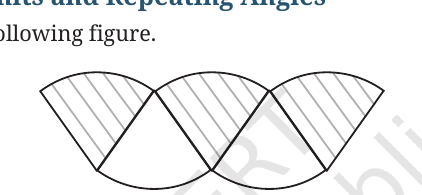
Concept used. This question uses repeating unit construction. In ruler-compass construction, the important invariant is equality of distance, equality of angle, or a congruent-triangle reason.
Source anchor
NCERT Class 7 Ganita Prakash Part 2, Chapter 6: Constructions and Tilings, Page 147, Figure it Out 2.- Identify one repeating unit: two arms with a fixed angle between them.
- Construct the first unit using ruler and compass.
- Copy the angle wherever the same orientation is needed.
- Use the compass to keep all corresponding arm lengths equal.
- Repeat the copied unit to complete the whole pattern.
Construction check
Keep construction marks light, use the same compass opening when equality is required, and justify the final line or angle using congruence or equal-distance facts.Strategic angle. First identify what must stay equal. Then decide whether the construction needs a perpendicular bisector, an angle bisector, a copied angle, or a repeated equal length.
- Identify one repeating unit: two arms with a fixed angle between them.
- Construct the first unit using ruler and compass.
- Copy the angle wherever the same orientation is needed.
- Use the compass to keep all corresponding arm lengths equal.
- Repeat the copied unit to complete the whole pattern.
Construct one unit, copy its angle, transfer equal arm lengths, and repeat the unit in the required orientations.
Construct 4 pairs of parallel lines in different orientations.
Concept used. This question uses parallel line construction. In ruler-compass construction, the important invariant is equality of distance, equality of angle, or a congruent-triangle reason.
Source anchor
NCERT Class 7 Ganita Prakash Part 2, Chapter 6: Constructions and Tilings, Page 148, Figure it Out 1.- Draw a line \(m\) and a transversal \(l\) meeting it at \(A\).
- Choose a point \(B\) on the transversal.
- Copy the angle made by \(m\) and \(l\) at \(A\) to point \(B\).
- Draw the new line through the copied angle.
- Equal corresponding angles make the two lines parallel.
Construction check
Keep construction marks light, use the same compass opening when equality is required, and justify the final line or angle using congruence or equal-distance facts.Strategic angle. First identify what must stay equal. Then decide whether the construction needs a perpendicular bisector, an angle bisector, a copied angle, or a repeated equal length.
- Draw a line \(m\) and a transversal \(l\) meeting it at \(A\).
- Choose a point \(B\) on the transversal.
- Copy the angle made by \(m\) and \(l\) at \(A\) to point \(B\).
- Draw the new line through the copied angle.
- Equal corresponding angles make the two lines parallel.
Each parallel pair is made by copying a corresponding angle from the first line to a chosen point on a transversal.
Construct the given multi-sided parallel-line figure.
Concept used. This question uses parallel sides and angle copying. In ruler-compass construction, the important invariant is equality of distance, equality of angle, or a congruent-triangle reason.
Source anchor
NCERT Class 7 Ganita Prakash Part 2, Chapter 6: Constructions and Tilings, Page 148, Figure it Out 2.- Start with one side of the figure and mark its endpoints.
- Copy the needed angles at the next vertices using the compass method.
- Transfer equal or intended side lengths with the compass.
- Construct opposite sides by copying corresponding angles so that they are parallel.
- Continue around the figure until all vertices are joined.
Construction check
Keep construction marks light, use the same compass opening when equality is required, and justify the final line or angle using congruence or equal-distance facts.Strategic angle. First identify what must stay equal. Then decide whether the construction needs a perpendicular bisector, an angle bisector, a copied angle, or a repeated equal length.
- Start with one side of the figure and mark its endpoints.
- Copy the needed angles at the next vertices using the compass method.
- Transfer equal or intended side lengths with the compass.
- Construct opposite sides by copying corresponding angles so that they are parallel.
- Continue around the figure until all vertices are joined.
The figure can be built by repeated angle copying and compass transfer of side lengths, keeping opposite support lines parallel.
Use support lines in Fig. 6.11 to construct a pointed arch. Make different arches by changing the radius of the arcs.
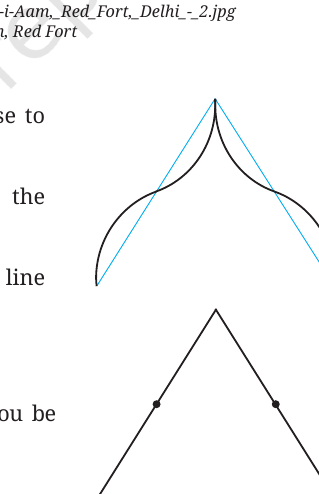
Concept used. This question uses pointed arch construction. In ruler-compass construction, the important invariant is equality of distance, equality of angle, or a congruent-triangle reason.
Source anchor
NCERT Class 7 Ganita Prakash Part 2, Chapter 6: Constructions and Tilings, Page 151, Figure it Out 1.- Draw two equal support segments and mark their midpoints.
- Use the endpoints and midpoints as centres for arcs.
- Choose a radius that lets the upper arcs meet cleanly at the top.
- Trace the outer boundary to form the pointed arch.
- Changing the radius changes the sharpness and width of the arch.
Construction check
Keep construction marks light, use the same compass opening when equality is required, and justify the final line or angle using congruence or equal-distance facts.Strategic angle. First identify what must stay equal. Then decide whether the construction needs a perpendicular bisector, an angle bisector, a copied angle, or a repeated equal length.
- Draw two equal support segments and mark their midpoints.
- Use the endpoints and midpoints as centres for arcs.
- Choose a radius that lets the upper arcs meet cleanly at the top.
- Trace the outer boundary to form the pointed arch.
- Changing the radius changes the sharpness and width of the arch.
A pointed arch is constructed from equal support segments and equal arcs meeting at the top; changing the radius gives different arch shapes.
Make your own arch designs.
Concept used. This question uses arch design exploration. In ruler-compass construction, the important invariant is equality of distance, equality of angle, or a congruent-triangle reason.
Source anchor
NCERT Class 7 Ganita Prakash Part 2, Chapter 6: Constructions and Tilings, Page 151, Figure it Out 2.- Choose a base line and mark symmetric support points.
- Construct equal angles or equal lengths where symmetry is needed.
- Draw arcs from selected centres with compass radii that meet neatly.
- Trace the final arch boundary and erase or ignore support lines.
Construction check
Keep construction marks light, use the same compass opening when equality is required, and justify the final line or angle using congruence or equal-distance facts.Strategic angle. First identify what must stay equal. Then decide whether the construction needs a perpendicular bisector, an angle bisector, a copied angle, or a repeated equal length.
- Choose a base line and mark symmetric support points.
- Construct equal angles or equal lengths where symmetry is needed.
- Draw arcs from selected centres with compass radii that meet neatly.
- Trace the final arch boundary and erase or ignore support lines.
Own designs should use symmetric support points, equal arcs, and a clean traced boundary.
Construct a regular hexagon with sidelength 5 cm.
Concept used. This question uses regular hexagon construction. In ruler-compass construction, the important invariant is equality of distance, equality of angle, or a congruent-triangle reason.
Source anchor
NCERT Class 7 Ganita Prakash Part 2, Chapter 6: Constructions and Tilings, Page 153, construction prompt.- Draw a segment \(AB=5\) cm.
- With radius \(5\) cm, draw arcs from \(A\) and \(B\) to locate the centre \(O\) of an equilateral triangle on \(AB\).
- Draw a circle with centre \(O\) and radius \(5\) cm.
- Step the same radius around the circle to mark six points.
- Join consecutive points. Each side is \(5\) cm and the angles are equal.
Construction check
Keep construction marks light, use the same compass opening when equality is required, and justify the final line or angle using congruence or equal-distance facts.Strategic angle. First identify what must stay equal. Then decide whether the construction needs a perpendicular bisector, an angle bisector, a copied angle, or a repeated equal length.
- Draw a segment \(AB=5\) cm.
- With radius \(5\) cm, draw arcs from \(A\) and \(B\) to locate the centre \(O\) of an equilateral triangle on \(AB\).
- Draw a circle with centre \(O\) and radius \(5\) cm.
- Step the same radius around the circle to mark six points.
- Join consecutive points. Each side is \(5\) cm and the angles are equal.
A regular hexagon of side \(5\) cm is made by stepping a \(5\) cm compass radius six times around a circle.
Construct 30 degree and 15 degree angles.
Concept used. This question uses angle bisection from 60 degrees. In ruler-compass construction, the important invariant is equality of distance, equality of angle, or a congruent-triangle reason.
Source anchor
NCERT Class 7 Ganita Prakash Part 2, Chapter 6: Constructions and Tilings, Page 154, Related Constructions.- Construct a \(60^\circ\) angle using an equilateral-triangle construction.
- Bisect the \(60^\circ\) angle to get \(30^\circ\).
- Bisect the \(30^\circ\) angle to get \(15^\circ\).
Construction check
Keep construction marks light, use the same compass opening when equality is required, and justify the final line or angle using congruence or equal-distance facts.Strategic angle. First identify what must stay equal. Then decide whether the construction needs a perpendicular bisector, an angle bisector, a copied angle, or a repeated equal length.
- Construct a \(60^\circ\) angle using an equilateral-triangle construction.
- Bisect the \(60^\circ\) angle to get \(30^\circ\).
- Bisect the \(30^\circ\) angle to get \(15^\circ\).
\(30^\circ\) is half of \(60^\circ\), and \(15^\circ\) is half of \(30^\circ\).
Construct the 6-pointed star and decide whether the six point triangles are equilateral.
Concept used. This question uses hexagon and equilateral triangles. In ruler-compass construction, the important invariant is equality of distance, equality of angle, or a congruent-triangle reason.
Source anchor
NCERT Class 7 Ganita Prakash Part 2, Chapter 6: Constructions and Tilings, Page 154, six-pointed star.- Construct a regular hexagon.
- Extend or construct outward triangles on each side or on the indicated support segments.
- The central angle pattern gives \(60^\circ\) directions.
- If each point triangle has all three angles \(60^\circ\) and equal side construction, then it is equilateral.
Construction check
Keep construction marks light, use the same compass opening when equality is required, and justify the final line or angle using congruence or equal-distance facts.Strategic angle. First identify what must stay equal. Then decide whether the construction needs a perpendicular bisector, an angle bisector, a copied angle, or a repeated equal length.
- Construct a regular hexagon.
- Extend or construct outward triangles on each side or on the indicated support segments.
- The central angle pattern gives \(60^\circ\) directions.
- If each point triangle has all three angles \(60^\circ\) and equal side construction, then it is equilateral.
Yes, the six point triangles are equilateral when they are constructed on the regular-hexagon support with \(60^\circ\) angles.
Construct the given figures: an inflexed arc and the companion compass figure.
Concept used. This question uses arc pattern construction. In ruler-compass construction, the important invariant is equality of distance, equality of angle, or a congruent-triangle reason.
Source anchor
NCERT Class 7 Ganita Prakash Part 2, Chapter 6: Constructions and Tilings, Page 154, Figure it Out 1.- Draw the basic support segment or polygon shown in the figure.
- Mark equal distances with the compass.
- Use the marked points as centres for the required arcs.
- Trace only the intended final arcs after the support construction is complete.
Construction check
Keep construction marks light, use the same compass opening when equality is required, and justify the final line or angle using congruence or equal-distance facts.Strategic angle. First identify what must stay equal. Then decide whether the construction needs a perpendicular bisector, an angle bisector, a copied angle, or a repeated equal length.
- Draw the basic support segment or polygon shown in the figure.
- Mark equal distances with the compass.
- Use the marked points as centres for the required arcs.
- Trace only the intended final arcs after the support construction is complete.
Both figures are constructed by first building equal support lengths and then drawing the required arcs from those support points.



Comments