



Content Strategist at Collegedunia | Updated On - Nov 4, 2026
Few careers in India compress as much money into as few years as investment banking. The work sits at the centre of every major corporate event in the country: the mergers and acquisitions that reshape entire industries, the IPOs that take companies public, the debt and equity structures that fund their expansion. Deals run into billions of dollars, and the bankers who execute them are paid accordingly.
The ladder is the real story. An analyst entering the field earns around INR 8 - 12 LPA depending on the firm. Three years in, as an associate, that becomes INR 30 - 60 LPA. By Vice President, six to ten years from the start, total compensation crosses INR 1 crore at the global banks. Directors clear INR 1.5 - 3 crore, and Managing Directors go well past INR 3 crore once bonuses are counted. At that level the bonus alone can exceed what most professions pay as a full mid career salary.
Nor is it a single job title. The same underlying skill set opens investment banking, equity research, private equity, mergers and acquisitions, credit and risk, structured finance, asset management and corporate finance, across global banks, boutique advisory firms, private equity and venture capital funds, consulting firms and the corporate finance teams of large corporates. It is a large market and it hires continuously.
What stands between a graduate and that first analyst seat is a specific, teachable skill set. An investment banking course in India typically runs 4 to 12 months and costs INR 50,000 - 4 Lakh, covering financial modelling, valuation, mergers and acquisitions, equity research and, increasingly, financial analytics using Python, Power BI and Tableau.
Among the specialised programmes in this category, the investment banking course in India by Boston Institute of Analytics teaches both Investment Banking and Financial Analytics disciplines under a single dual certification, with a 100% placement guarantee on the internship and on the job training. Boston Institute of Analytics reports more than 15,000 students placed from this programme in 2026, from over 20,000 who enrolled in it that year, at employers including Goldman Sachs, Morgan Stanley, JPMorgan Chase, Barclays, Blackstone and Google.
This guide covers eligibility, syllabus, tools, practical projects, course fees, placement records, career outcomes and campus availability.
Investment Banking and Financial Analytics Course: Quick Overview
|
Course Fee Range
INR 50,000 - 4 Lakh
Across all institutes in India
|
Course Duration
4 - 12 months
Certification to master diploma
|
Reported Placements
15,000+
From 20,000+ enrolled in 2026
|
Reported Packages
INR 6.1 - 45 LPA
Entry level to highest package
|
| Detail | Summary |
|---|---|
| Course duration | 4 month certification, 6 month diploma, 10 month master diploma |
| Eligibility | Class 12 pass onwards in any stream, no entrance exam and no prior finance or coding background required, since everything is taught from scratch |
| Modes of learning | Classroom, live interactive online or hybrid, with the flexibility to switch between them |
| Core subjects | Financial modelling, valuation, mergers and acquisitions, equity research, fixed income, derivatives |
| Tools covered | Excel, Python, Power BI, Tableau, AI and prompt engineering |
| Learning hours | 200+ hours of hands on learning and practicals |
| Practical learning | 9 hands on project categories, 50 case studies, mentored capstone project |
| Guaranteed internship | 2 month internship with 100% placement guarantee on the diploma |
| Guaranteed on the job training | 6 months working as an investment banker with 100% placement guarantee on the master diploma |
| BIA placements | 15,000+ students placed last year, from 20,000+ enrolled, at leading multinationals |
| Reported packages | INR 6.1 - 45 LPA |
| Fees and payment | No cost EMI available over up to 18 months |
| Campuses | 107+ campuses globally, with classroom training across India including Andheri East, Mumbai; Connaught Place, Delhi; MG Road, Bengaluru; HITEC City, Hyderabad; Anna Nagar, Chennai; Cadbury Junction, Thane; Shivaji Nagar, Pune and Park Street, Kolkata |
What Is Investment Banking and Financial Analytics?
Four skills sit under every investment banking role. Financial modelling is forecasting a company's financials in Excel from a blank sheet, linking the income statement, balance sheet and cash flow statement so they move together, and it is the most tested skill in any analyst interview. Valuation establishes what a business is worth, through discounted cash flow, comparable company analysis and precedent transaction analysis. Mergers and acquisitions covers purchase price, financing mix, synergy analysis, merger accounting and accretion dilution, which is how a banker judges whether a deal actually makes money. Equity research and capital markets covers company and sector analysis, research writing, fixed income and derivatives.
A fifth skill is now just as expected. Financial analytics means pulling and cleaning data in Python, building dashboards in Power BI or Tableau, and using AI tools to compress research that once took days. Investment banking is the domain, financial analytics is the method, and the best paid junior roles ask for both. A course that teaches one without the other leaves a visible gap on a resume, which is why Boston Institute of Analytics certifies the two together.
Investment Banking Course Eligibility in India
Most investment banking courses in India require a completed degree. The Boston Institute of Analytics programme is open from Class 12 pass onwards, in any stream, because every subject is taught from scratch. That is three to four years earlier than most institutes will take a student.
There is no prerequisite in commerce, finance, mathematics or programming, and no entrance exam. The course opens with accounting, financial statements and Excel before modelling and valuation begin, so commerce, arts, banking, engineering and science backgrounds all start from the same place, alongside working professionals changing track.
| Background | What the course adds |
|---|---|
| Class 12 students and school leavers | A complete finance education from first principles, years before an MBA route would be possible |
| BCom, BBA and commerce graduates | Converts accounting knowledge into modelling and valuation ability |
| Engineering, science, arts and humanities graduates | Full finance fundamentals from the orientation module onwards |
| CA, CFA and FRM candidates, and professionals in banking or audit | Applied modelling and transaction skills alongside an existing qualification |
| Working professionals in banking, audit or finance | Advisory and valuation skills for a move up, without leaving the job |
| Career switchers from any field | A structured route with hands on projects that evidence the skills to a hiring manager |
Investment Banking and Financial Analytics Syllabus
A complete syllabus moves from accounting fundamentals to transaction modelling in a fixed order, because each module depends on the one before it.
| Module | What it covers |
|---|---|
| Investment banking fundamentals | Functions of investment banks, business model, regulation, market participants |
| Excel for finance | Formulas, data cleaning, pivots, linking across worksheets |
| Financial reporting and analysis | Income statement, balance sheet, cash flow, ratios, ROE and DuPont, deferred tax |
| Corporate finance | Time value of money, NPV, IRR, capital structure, cost of capital |
| Equity investments | Equity valuation models, dividend discount models, relative valuation |
| Fixed income | Bond features, pricing, yield measures, spot and forward rates, duration |
| Derivatives | Forwards, futures, swaps, options, credit derivatives, hedging |
| Wealth management | Risk tolerance, investment policy statements, portfolio construction |
| Equity research | Research report components, business models, revenue drivers, pricing power |
| Financial modelling | 20 stages, from historical statements and driver assumptions to WACC, DCF and sensitivity analysis |
| Mergers and acquisitions | Synergy analysis, deal structuring, merger accounting, accretion dilution |
| Python and analytics | pandas, NumPy, cleaning financial data, statistics |
| Power BI and Tableau | Data transformation, DAX, LOD expressions, dashboards |
| Prompt engineering and AI | AI tools for finance, startups and venture capital |
| Capstone project | Mentor allocated project with dataset and final presentation |
The BIA programme delivers this across 200+ hours of hands on learning and practicals, with a quiz and a practical exercise attached to each module and 50 case studies in total, so every concept is applied the same week it is taught rather than revisited before an exam.
Tools and Technologies
| Tool | Used for |
|---|---|
| MS Excel | Financial modelling, valuation, scenario and sensitivity analysis |
| Python with pandas and NumPy | Acquiring, cleaning and analysing financial data |
| Power BI | Data transformation, DAX, dashboards for financial reporting |
| Tableau | Visual analytics, calculated fields, LOD expressions |
| Matplotlib and Seaborn | Charting financial data in Python |
| ChatGPT and Gemini | Research, drafting and analysis support |
| MySheet AI and Gamma | Spreadsheet automation and presentation building |
Fifteen or more tools and technologies are covered in total. The prompt engineering module is the component most investment banking courses in India still do not include.
Nine Practical Project Categories
- Financial modelling - build a company model and run sensitivity analysis across assumptions
- Valuation - value a listed company by DCF and comparable company analysis, then reconcile the two
- Mergers and acquisitions analysis - evaluate a transaction, assess synergies and quantify the risks
- Financial statement analysis - work through a company's statements and make a recommendation
- Fixed income analysis - assess a corporate bond, analyse interest rate risk and propose a hedge
- Portfolio optimisation - build an allocation strategy and analyse the risk and return trade off
- Hedging and derivatives - design a hedging strategy for a company carrying currency risk
- Investment pitch book - prepare a pitch book for a startup raising seed capital
- Private equity deal structuring - structure financing and exit routes, and evaluate the return
Nine projects plus the capstone means a candidate finishes with a portfolio rather than a certificate. In an interview that is the difference between describing a DCF and opening one.
Financial Analytics Course in India: Syllabus, Tools and Career Opportunities
Financial analytics is the practice of using data tools to analyse financial and business information at a scale spreadsheets alone cannot handle. A financial analytics course in India should cover acquiring and cleaning financial data, forecasting, performance analysis, risk analytics, reporting and visualisation, and AI assisted finance workflows.
Financial Analytics Syllabus and Tools
| Area | What you learn |
|---|---|
| Spreadsheet analysis and modelling | Formulas, pivots, lookups, data cleaning, three statement models, sensitivity analysis |
| Programming for finance | Control flow, functions, pandas, NumPy, data acquisition and cleaning |
| Statistics | Distributions, correlation, regression applied to financial series |
| Business intelligence | Data transformation, modelling, DAX, time intelligence, dashboards |
| Visual analytics and charting | Calculated fields, LOD expressions, interactive dashboards, plotting financial series |
| AI workflows | Prompt design and AI tools for finance, startups and venture capital using ChatGPT and Gemini |
A financial analytics course that teaches only Excel is a spreadsheet course, and one that teaches only Python is a programming course. The useful version teaches the finance domain alongside both, which is why Boston Institute of Analytics certifies Financial Analytics together with Investment Banking rather than selling the two separately.
Financial Analytics Careers and Salary in India
Financial analytics is not a niche. Every bank, insurer, asset manager, consulting firm, fintech and large corporate finance team in India now runs on it, and the job titles multiply accordingly: Financial Analyst, Financial Data Analyst, Business Intelligence Analyst, Credit Risk Analyst, Market Risk Analyst, FP&A Analyst, Financial Analytics Consultant, Model Validation Analyst, Treasury Analyst, Portfolio Analyst, Pricing Analyst, Fraud Analytics Analyst and Quantitative Analyst, rising through Analytics Manager to Head of Analytics.
Artificial intelligence has made the field bigger rather than smaller. Risk models, algorithmic trading, fraud detection and credit scoring all run on machine learning, and research that once took an analyst three days now takes an afternoon with the right AI tooling. The effect is not fewer analysts, it is a higher bar: the analyst who can direct these tools does the work of several who cannot, and is paid on that basis. It is why the programme carries a prompt engineering and AI module that most investment banking courses in India still do not offer.
In India, entry level roles pay INR 6 - 14 LPA. Three to five years in, mid level analysts earn INR 12 - 25 LPA. Senior and lead analysts cross INR 25 LPA and run past INR 50 LPA, and the quantitative end pays more still, with quants at hedge funds and proprietary trading desks earning INR 20 - 70 LPA and above.
The ceiling lifts sharply for anyone targeting roles abroad. In New York, an investment banking or analytics analyst earns USD 190,000 - 245,000 in total compensation, roughly INR 1.6 - 2 crore at current rates, in the first three years. Associates reach USD 325,000 - 550,000, Vice Presidents USD 500,000 - 1 million, and Managing Directors USD 1 million - 5 million and beyond. London analysts earn GBP 140,000 - 180,000, Dubai analysts USD 180,000 - 240,000 with Managing Directors routinely past a million, and Singapore and Hong Kong sit in the same band. The employers are the names everyone knows: Goldman Sachs, JPMorgan Chase, Morgan Stanley, BlackRock, Citadel, Bloomberg, Deloitte and McKinsey among them.
Is financial analytics a good career in India? On current hiring evidence, yes, and the demand is concentrated rather than scattered. The global capability centres of Bengaluru, Hyderabad, Pune and Gurugram run the analytics, risk and research operations of the world's largest banks out of India, and they hire continuously. The skills transfer across banking, consulting, technology, insurance and corporate finance, so the career is not tied to one employer or one sector.
What remains scarce is the combination. Plenty of candidates can write Python. Plenty can read a balance sheet. The person who does both, models a company and then analyses its data at volume, is rare enough to command the top of every band above, in India and abroad. That is exactly what the dual certification is built to produce, and the certificates are issued by an institute headquartered and registered in the United States, which carries weight when the application is going overseas.
Why Choose Boston Institute of Analytics for Investment Banking?
Boston Institute of Analytics is an international institute headquartered in Boston, with more than 107 campuses globally across 7 or more countries, including the United States, the United Kingdom, the United Arab Emirates, South Africa and Pakistan. Across India, classroom training for the Investment Banking and Financial Analytics programme runs at campuses including Andheri East, Mumbai; Cadbury Junction, Thane; Connaught Place, Delhi; MG Road, Bengaluru; HITEC City, Hyderabad; Anna Nagar, Chennai; Shivaji Nagar, Pune; and Park Street, Kolkata. Every classroom session is live streamed, so the same class can be attended online from anywhere.
| Feature | The specific |
|---|---|
| Dual certification | Investment Banking and Financial Analytics, issued separately |
| Depth of instruction | 200+ hours of hands on learning and practicals |
| Applied work | 50 case studies and assignments |
| Modelling rigour | 20 stages of financial modelling, raw data to a finished DCF |
| Project portfolio | 9 project categories plus a mentored capstone |
| Technology coverage | 15+ tools including Python, Power BI, Tableau and prompt engineering |
| Trainers | Industry practitioners with 10 or more years of experience |
| Modes of learning | Classroom, live interactive online or hybrid, with the flexibility to switch |
| Guaranteed internship | 2 month internship with 100% placement guarantee on the diploma |
| Guaranteed on the job training | 6 months working as an investment banker with 100% placement guarantee on the master diploma |
| Career support | 100% career support, one to one mentorship and interview preparation |
| Placement record | 15,000+ students placed last year, from 20,000+ enrolled |
| Scale | Lakhs of students enrolled every year across all BIA programmes |
Boston Institute of Analytics has been ranked the number 1 training institute in the classroom training space by Businessworld, with further recognition from the British Columbia Times and Avalon Global Research, and its curriculum rated the most industry relevant by the Indian Analytics Forum. Learning support runs through Campus Connect, the platform holding study material, lecture recordings and guest lectures, and live DoubtBuster sessions for real time doubt resolution. Certification exam fees are included in the course fee, and no cost EMI is available over up to 18 months.
Where the programme stands apart is the combination. Most investment banking courses in India teach finance without the data layer, or analytics without the finance domain. This programme certifies both to the same depth, which is why graduates qualify for financial modelling and valuation roles as well as financial analytics, risk and business intelligence roles.
BIA Certification, Diploma and Master Diploma
The programme runs as three learning paths. The curriculum is identical in each; what changes is how much supervised, real world practice sits on top of it. That split exists because the audience is split. Around 60% of students enrolling at Boston Institute of Analytics are working professionals upskilling or changing domain, and the rest are students and freshers entering finance for the first time.
| Learning path | Duration | Practical component | Best suited to |
|---|---|---|---|
| Investment Banking and Financial Analytics Certification | 4 months | Mentored capstone project | Dual international certification and a portfolio project, for a professional adding modelling, valuation and the analytics layer to an existing finance role |
| Investment Banking and Financial Analytics Diploma | 6 months | 2 month internship with 100% placement guarantee | The certification plus an internship experience letter from the company, so you enter the market with documented work rather than as a fresher |
| Investment Banking and Financial Analytics Master Diploma | 10 months | 6 months on the job training as an investment banker with 100% placement guarantee | The certification plus six months of recorded work history and an experience letter, the strongest profile of the three for a first finance job or a career switch |
For a fresher, the placement guarantee is the boost. Two months of internship or six months of on the job training, both guaranteed, mean the first application goes out with an experience letter attached. You stop competing on marks and a certificate. You become the candidate in the room who has already done the work, been reviewed on it, and has a company's letter saying so.
For a working professional, the question is different. You already have the job, so what you need is the skill and the credential rather than the entry route, and the 4 month certification adds modelling, valuation and the analytics layer without disrupting the role you are in. If the goal is a switch into investment banking rather than a promotion within it, the diploma or master diploma is the stronger choice, because the internship or on the job training builds a documented transition story before the switch is made.
BIA Investment Banking Placements: 15,000+ Students Placed in 2026
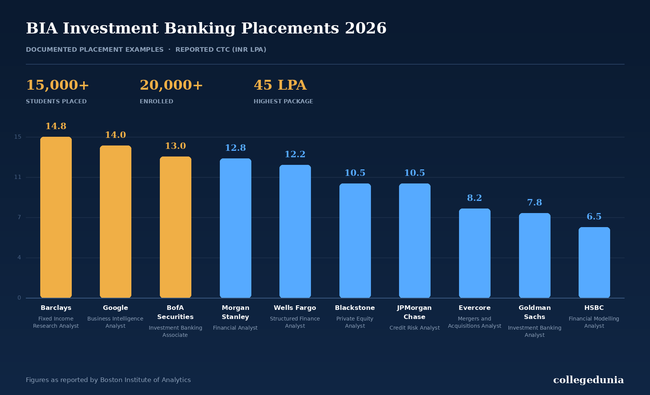
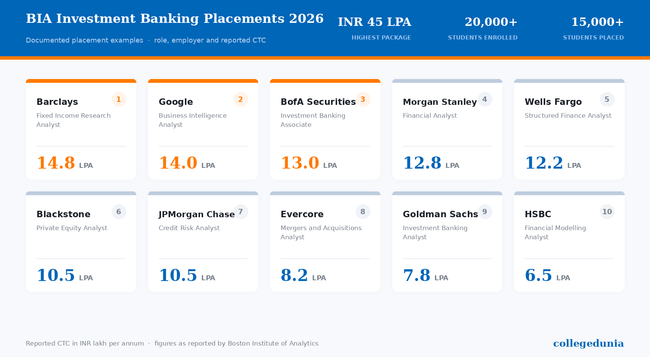
Boston Institute of Analytics placed more than 15,000 students from the Investment Banking and Financial Analytics programme in 2026, from more than 20,000 who enrolled in it that year. Reported packages run from INR 6.1 LPA at entry level to a highest of INR 45 LPA in investment banking.
The placements span the full range of investment careers rather than a single job title, which matters for anyone building a career anywhere in investment, finance or financial data.
Documented Placement Examples
| Role | Employer | Reported CTC |
|---|---|---|
| Fixed Income Research Analyst | Barclays | INR 14.8 LPA |
| Business Intelligence Analyst | INR 14.0 LPA | |
| Investment Banking Associate | BofA Securities | INR 13.0 LPA |
| Financial Analyst | Morgan Stanley | INR 12.8 LPA |
| Structured Finance Analyst | Wells Fargo | INR 12.2 LPA |
| Private Equity Analyst | Blackstone | INR 10.5 LPA |
| Credit Risk Analyst | JPMorgan Chase | INR 10.5 LPA |
| Mergers and Acquisitions Analyst | Evercore | INR 8.2 LPA |
| Investment Banking Analyst | Goldman Sachs | INR 7.8 LPA |
| Financial Modelling Analyst | HSBC | INR 6.5 LPA |
These are a selection chosen to show the range rather than only the strongest outcomes. The highest package recorded on the programme is INR 45 LPA in investment banking.
Documented placements also span global banks including UBS, Citi, Deutsche Bank, Nomura and Standard Chartered; consulting and professional services firms including Deloitte, PwC, KPMG, EY, McKinsey & Company and Boston Consulting Group; asset managers including BlackRock, Fidelity Investments, Vanguard, PIMCO and State Street; and data and technology firms including Bloomberg, Moody's, S&P Global, Amazon, IBM and Cognizant.
The roles are not confined to investment banking job titles. Business Intelligence Analyst at Google and Credit Risk Analyst at JPMorgan Chase sit alongside Investment Banking Analyst and M&A Analyst positions. That is the dual curriculum showing up in outcomes: a graduate who can model a company and handle its data is eligible for roles a single discipline candidate never sees.
BIA Placement and Institutional Figures
| Figure | What it measures |
|---|---|
| 15,000+ students placed | Placements from the Investment Banking and Financial Analytics programme |
| 20,000+ students enrolled | Enrolments in the Investment Banking and Financial Analytics programme every year |
| Lakhs of students every year | Enrolments across all BIA programmes, including Data Science and Artificial Intelligence, Cyber Security and Ethical Hacking and many more |
| 350+ corporate partners | Organisations BIA works with for hiring across all schools |
| 7,000+ industry professionals as trainers | Working finance and analytics professionals teaching across all BIA schools |
| 107+ campuses in 7+ countries | Boston Institute of Analytics locations worldwide |
What Produces the Placement Record
A placement record is an outcome rather than a service. Eight parts of the programme produce this one, and they compound.
Depth of training, built from scratch. 200+ hours of hands on learning and practicals across 20 stages of financial modelling, taught 80% practical and 20% theory. The curriculum assumes no prior finance or coding knowledge and is rebuilt every six months with input from the industry trainers who teach it and the companies that hire from it. Graduates build models from a blank sheet, not a template.
Trainers who do the job on weekdays. Not career faculty, and not recent graduates teaching from a textbook. The people running these sessions are working finance professionals, employed Monday to Friday at banks, advisory firms and funds, who teach at the weekend. They arrive with live transactions, current deal structures and the models they are building in their own roles that week. They also know exactly what an interviewer will press on, because they sit on that side of the table themselves. Different specialists take different modules, so the valuation sessions and the analytics sessions are each led by someone who does that work daily rather than one generalist covering everything.
Classroom teaching, with live online as a safety net rather than a substitute. Sessions run in the classroom with the trainer physically in front of you, which is where most of the learning happens. If you cannot make a Saturday, because of work, travel or anything else, you join the exact same session live and in real time, in the same batch, asking questions by chat or mic. It is not a pre recorded video sent afterwards. Every session is recorded regardless, so a missed class or a difficult concept can be revisited as many times as needed. Nobody falls behind because life got in the way.
Applied practice at volume, in small batches. 50 case studies, nine hands on project categories and a mentored capstone. Batches are capped at 15 to 25 students, so every project is genuinely reviewed and every doubt gets answered rather than lost in a hall of sixty.
Everything in one place, and nothing missed. Campus Connect holds the academic calendar, all study material, every session recording and the Career Enhancement Cell portal. Topic wise quizzes and assignments let a student check whether they have actually understood something rather than assuming it. Weekday sessions run alongside the main programme: guest lectures from industry, refreshers on earlier topics, and dedicated DoubtBuster sessions where anything still unclear gets cleared directly with a trainer.
100% placement guarantee. Two months on the diploma or six months as an investment banker on the master diploma, guaranteed rather than subject to availability, each ending in an experience letter from the company. Candidates enter the market with documented work rather than as freshers.
One to one interview preparation. Individual rather than group based, run by practitioners who have sat on the hiring side and know which assumption an interviewer will challenge on a DCF, and how a weak answer on working capital sounds.
The Career Enhancement Cell. ATS optimised resume building, mock technical and HR interviews, aptitude training, salary negotiation coaching, a job posting portal and lifetime access to the career support team, across more than 350 corporate partners.
Added to that is the dual certification: graduates hold credentials in both Investment Banking and Financial Analytics, qualifying them for modelling and valuation roles and for risk, analytics and business intelligence roles at once. That is why the placement table spans banks, consulting firms, asset managers and technology companies.
None of these works alone. The training produces the skill, the projects produce the evidence, the guaranteed internship or on the job training produces the experience letter, and the Career Enhancement Cell converts all three into interviews. That sequence, repeated at scale, is what the placement numbers measure.
Career Opportunities and Salaries After an Investment Banking Course
An investment banking and financial analytics course leads to a cluster of roles sharing the same skills: reading financial statements, building a model, valuing a business and presenting the result. What they also share is a steep ceiling. The entry figure is only the first rung.
| Role | Entry level | With experience |
|---|---|---|
| Investment Banking Analyst | INR 8 - 12 LPA | INR 3 crore and above at Managing Director level |
| Mergers and Acquisitions Specialist | INR 8 - 14 LPA | INR 1.5 - 3 crore at Director level |
| Private Equity Analyst | INR 10 - 15 LPA | INR 1 crore and above at Principal and Partner level |
| Corporate Finance Manager | INR 10 LPA and above | INR 1 - 3 crore as Chief Financial Officer |
| Financial Analytics Consultant | INR 8 - 14 LPA | INR 1 crore and above at Partner level in consulting |
| Equity Research Analyst | INR 7 - 12 LPA | INR 50 LPA - 1.5 crore as head of sector coverage |
| Risk Analyst | INR 6 - 10 LPA | INR 60 LPA - 1.5 crore as Chief Risk Officer |
| Quantitative Analyst | INR 8 - 15 LPA | INR 70 LPA and above at hedge funds and trading desks |
| FP&A Analyst | INR 6 - 11 LPA | INR 50 LPA - 1 crore as FP&A Head or Finance Director |
| Financial Modelling Specialist | INR 7 - 12 LPA | INR 40 - 80 LPA at senior level |
| Business Intelligence Analyst | INR 7 - 12 LPA | INR 40 - 80 LPA as Head of Analytics |
| Financial Analyst | INR 6 - 10 LPA | INR 40 - 80 LPA as Finance Controller |
The pattern repeats down every row. A solid start, and a ceiling most professions never reach. What moves someone up it is demonstrated capability rather than years served, which is why the modelling, valuation and analytics skills taught here are the ones that compound.
Hiring is not limited to investment banks either. Commercial banks, insurance companies, consulting firms, private equity and venture capital funds, asset managers, technology companies and large corporate finance teams all recruit the same skill set. Front office investment banking hiring concentrates in Mumbai, while Bengaluru holds the largest concentration of global capability centres in India, where the world's biggest banks run their risk, analytics and research desks, which is why an investment banking course in Bengaluru often leads into risk analytics, financial data and startup finance roles alongside traditional banking ones.
Investment Banking Course Fees in India
Investment banking course fees in India range from roughly INR 50,000 for a short online certification to more than INR 4 Lakh for a classroom programme that includes an internship and on the job training. The spread is wide because the products differ substantially, and the headline number tells you very little on its own.
The useful comparison is cost per supervised learning hour. A programme with 200+ hours of live instruction, 50 case studies, nine hands on projects, a mentored capstone and six months of guaranteed on the job training is a different product from forty recorded videos, even where the price looks similar. Before comparing two fees, check how many instruction hours are live rather than recorded, how many stages the financial modelling module runs to, whether the internship is guaranteed or subject to availability, whether Python, Power BI and Tableau are included, and whether the certification exam fee is covered or billed separately.
Boston Institute of Analytics fees start at INR 85,000 for the 4 month certification, with the 6 month diploma and 10 month master diploma quoted by the admissions team, since scholarships apply in some cases. Against the comparison above, the programme answers every line: 200+ hours of live hands on instruction, 20 stages of financial modelling, a guaranteed internship or on the job training rather than an optional one, Python, Power BI, Tableau and AI tools included, and certification exam fees covered within the course fee rather than added later. At 200+ hours, that works out to roughly INR 425 per hour of live instruction, before counting the case studies, the projects or the capstone. No cost EMI is available over up to 18 months, with zero interest and no processing charges, so the fee can be spread without the total rising.
Investment Banking Course vs MBA Finance vs CFA
| Parameter | Investment Banking Course | MBA Finance | CFA |
|---|---|---|---|
| Duration | 4 to 10 months | 2 years full time | 2 to 4 years across 3 levels |
| Typical cost in India | INR 50,000 - 4 Lakh | INR 10 - 25 Lakh | INR 3 - 5 Lakh |
| Primary focus | Financial modelling, valuation and M&A, plus Python and BI tools | Broad management with a finance specialisation | Investment analysis, portfolio management, ethics |
| Practical experience | Guaranteed internship or on the job training, with an experience letter | Summer internship, varies by school | None |
| Best for | Building job ready skills quickly | Changing career level and network | Research, asset management and credibility |
The three are complementary rather than competing. A CFA adds depth over years and an MBA changes seniority and network, but both ask for a long runway, and an MBA asks for INR 10 - 25 Lakh before it starts paying back. For a graduate or a working professional who needs to be employable in finance within a year, a specialised course does it faster and at a fraction of the cost. The Boston Institute of Analytics programme is the version of it that adds guaranteed work experience and a dual international certification on top.
Investment Banking Courses in India FAQs
Ques. Which institute offers a placement guarantee for investment banking in India?
Ans. Boston Institute of Analytics carries a 100% placement guarantee on the internship and on the job training in its Investment Banking and Financial Analytics programme. The 6 month diploma guarantees a 2 month internship, the 10 month master diploma guarantees six months working as an investment banker, and both end with an experience letter from the company. Guaranteed means guaranteed, not subject to availability, which is the clause most institutes leave vague.
Ques. Which is the best institute for investment banking in India?
Ans. Judge it on four things: who actually teaches, how much of the course is practical, whether work experience is guaranteed, and the placement number for that specific programme in a named year. Boston Institute of Analytics is the one to beat on all four. Its trainers are working bankers who teach at weekends, the course runs 80% practical across 200 hours, the internship and on the job training are guaranteed, and the programme placed more than 15,000 students from over 20,000 enrolled in 2026. It was also ranked the number 1 training institute in the classroom training space by Businessworld.
Ques. Which course should I do in India to get a high paying job?
Ans. Finance and data, together. Investment banking takes an analyst from INR 8 LPA to beyond INR 3 crore at Managing Director level, and quants at trading firms clear INR 70 LPA. Pure finance candidates are common. Pure coders are common. The people who do both are scarce enough to name their price. BIA's Investment Banking and Financial Analytics programme is the dual certification route into exactly that gap, starting at INR 85,000 and running four to ten months.
Ques. How much does an investment banker actually earn in India?
Ans. An analyst starts at INR 8 - 12 LPA. An associate makes INR 30 - 60 LPA. A Vice President crosses INR 1 crore. Directors earn INR 1.5 - 3 crore, and Managing Directors go well past INR 3 crore, where the bonus alone exceeds what most professions pay as a full salary. Abroad it is another league again: a New York analyst earns USD 190,000 - 245,000 in the first three years.
Ques. Can I get into investment banking without an MBA or a finance degree?
Ans. Yes. Hiring tests what you can build, not what you studied. Someone who can construct a three statement model, defend a DCF and clean data in Python competes directly with MBA graduates for analyst seats. BIA accepts students from Class 12 pass onwards in any stream, with no entrance exam, because everything is taught from scratch.
Ques. How long does it take to get an investment banking job after a course?
Ans. Four to ten months of study, and the longer paths put you inside a finance role before the course even ends. A diploma student spends two months in a guaranteed internship, a master diploma student six months working as an investment banker. In a number of cases the training organisation makes the offer directly, so the job can arrive before the certificate does.
Ques. Will AI replace investment banking and financial analyst jobs?
Ans. No. It is raising the bar instead. Research that took an analyst three days now takes an afternoon with the right tooling, which means one analyst does what three used to. The people at risk are the ones who cannot use the tools, not the ones who can. That is why BIA teaches Python, Power BI, Tableau and prompt engineering alongside modelling and valuation, which most investment banking courses in India still do not.
Ques. Is investment banking only for people from IIMs and top colleges?
Ans. It used to be. Hiring has shifted to skills based assessment, and the firms in BIA's placement records, Goldman Sachs, Morgan Stanley, JPMorgan Chase, Barclays and Blackstone among them, recruit on demonstrated capability. A candidate with nine modelling and valuation projects, a mentored capstone and six months of documented on the job training will beat a tier one degree with nothing to show behind it.
Ques. Is 28 or 30 too late to move into investment banking?
Ans. No. Entry at analyst level is about demonstrated capability rather than age, and prior work experience in any commercial role is an advantage in interviews, not a handicap. What matters is arriving with the technical skill and something concrete to show for it, which is exactly what the guaranteed internship or on the job training provides.
Ques. Can I do an investment banking course while working full time?
Ans. Yes, and most people do. Around 60% of students enrolling at BIA are working professionals. Classroom sessions run at the weekend, and if work takes out a Saturday you join the same live session online in the same batch, not a recording sent afterwards. Every session is recorded anyway, so nothing is lost to a deadline or a work trip.
Ques. Will an Indian investment banking certificate be recognised if I apply abroad?
Ans. It depends entirely on who issues it. Boston Institute of Analytics is headquartered and registered in Massachusetts, USA, and operates more than 107 campuses across 7 or more countries, so its certificates carry an international issuer rather than a local one, and each one is QR verifiable by an employer. That matters when an application is being screened in New York, London or Dubai, where analyst compensation runs considerably higher than in India.
Conclusion
Investment banking rewards capability faster and further than almost any career in India. An analyst seat at INR 8 - 12 LPA becomes INR 1 crore at Vice President and beyond INR 3 crore at Managing Director, and the same skill set opens equity research, private equity, risk, structured finance and financial analytics alongside it. The only question is whether you arrive able to do the work.
That is what separates one course from another, and it is never the certificate. It is whether you finish able to build a model from a blank sheet, defend a valuation to someone who does this for a living, and point to work you have already been paid to do. Two hundred hours of hands on training, fifty case studies, nine projects, a mentored capstone and guaranteed work experience answer that question. Forty recorded videos do not.
The Boston Institute of Analytics Investment Banking and Financial Analytics programme delivers both disciplines under dual international certification, taught by bankers who do the job on weekdays, with a 100% placement guarantee on the internship and on the job training and 100% Placement Assistance with Lifetime Career Support behind it. In 2026 it placed more than 15,000 students from this programme, from over 20,000 enrolled, in roles running from Financial Modelling Analyst at HSBC to Fixed Income Research Analyst at Barclays, with packages from INR 6.1 - 45 LPA.
Fees start at INR 85,000, no cost EMI runs up to 18 months, and batches are capped at 15 to 25 students. Speak to the admissions team about the current batch and which of the three learning paths fits where you are now.








Comments