





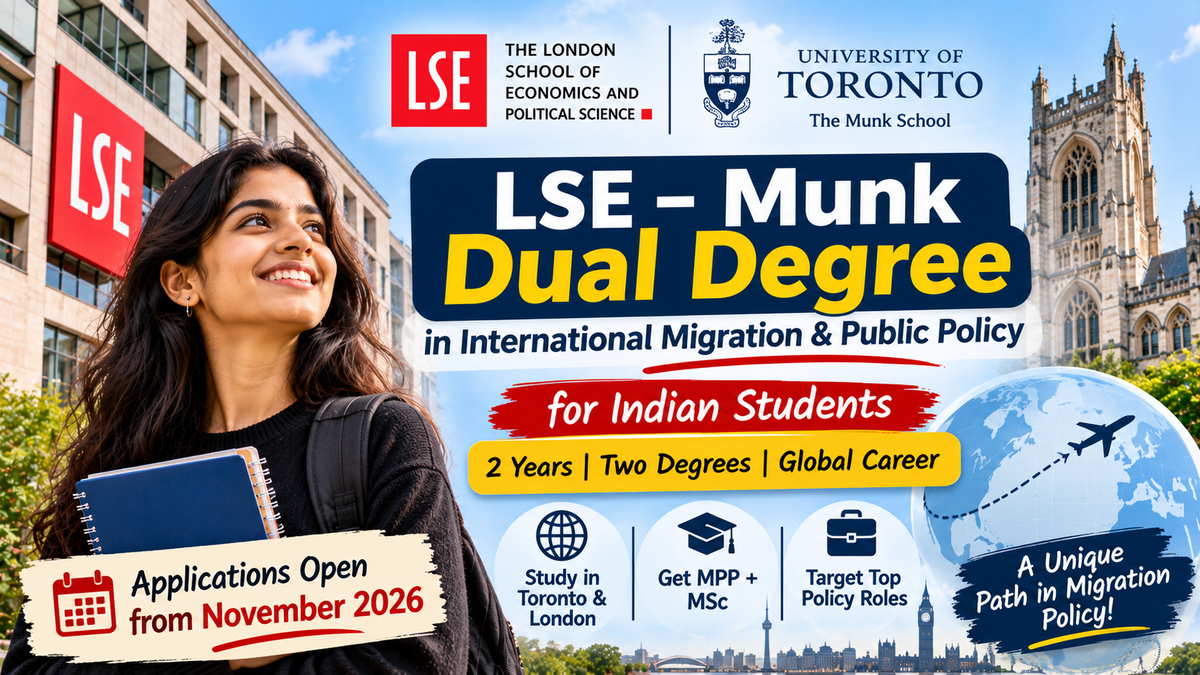
The LSE and Munk School dual degree in international migration and public policy is a new 2-year joint programme. Indian students earn two separate degrees across one course. One is the MPP from the University of Toronto’s Munk School. The other is the MSc in International Migration and Public Policy from LSE.
- This is the only known Munk-LSE pairing built around migration as a core policy theme.
- The programme fits applicants who already have 1-3 years of policy or non-profit work.
- Two campuses means two student visas, two housing searches and a longer financial runway.
- Graduates target international agencies, think tanks and government advisory roles over corporate consulting.
Check Munk School MPP admission steps for Indian applicants
Migration policy is one of the few fields where two-country training is a real hiring filter. Agencies like IOM, UNHCR and OECD run migration teams that look for cross-jurisdictional training on a CV. A single-country MPP rarely covers both Canadian settlement policy and European asylum policy at depth. For Indian applicants with a policy focus, this dual degree sits in a very narrow category of truly cross-border masters.
Quick Facts on the LSE Munk Dual Degree
| Parameter | Detail |
|---|---|
| Partner schools | LSE (London) and Munk School, University of Toronto |
| Degrees awarded | MPP + MSc International Migration and Public Policy |
| Duration | 2 years full-time |
| Indicative format | Year 1 Toronto, Year 2 London |
| Expected first intake | Fall 2027 (confirm on each school’s admissions portal) |
| Indicative international tuition | CAD 62,000+ (Munk Y1) and GBP 33,000+ (LSE Y2), estimated |
| Minimum English | IELTS 7.0 overall with no sub-score below 6.5 |
| Standardised tests | GRE typically not required at either school |
- Why LSE and Munk launched this dual degree
- How the LSE Munk dual degree is structured
- Who should apply for the dual degree
- LSE Munk dual degree fees for Indians
- Entry requirements for the dual degree
- Dual degree application timeline for 2027
- Scholarships, jobs and visa routes
- FAQs on the LSE Munk dual degree
Why LSE and Munk Launched This Dual Degree
Migration policy has become a cross-border discipline, and single-country training no longer matches the real work. Asylum rules, labour migration quotas and refugee settlement policy now move in tandem across North America and Europe.
LSE brings depth on migration research, European policy frameworks and quantitative methods for migration data. Munk School brings North American policy practice, Canadian settlement policy and direct access to Toronto’s immigration research network. Toronto is Canada’s largest settlement city for new permanent residents, which is useful for fieldwork.
For Indian students, the pairing matters for a specific reason. Most policy careers in international migration demand familiarity with at least two jurisdictions. A graduate who can speak to both Canadian multi-year levels planning and UK asylum policy has an edge at IOM, UNHCR and the OECD migration division.
Key Insight: The dual degree is not a generalist MPP with a migration label. It is a focused route for applicants who already know they want to work on migration policy, settlement or refugee affairs.
Applicants looking for a broader public policy degree without the migration focus should compare standalone MPP options in Canada before committing to this route.
Read More: Full list of LSE MSc programmes popular with Indian students
How the LSE Munk Dual Degree Is Structured
The programme runs across two academic years with one year at each campus. Year 1 sits at Munk School in Toronto, Year 2 sits at LSE in London. Order may be reversed in individual cohorts, so students should confirm with each admissions office.
Year 1 at Munk School
Year 1 covers core MPP foundations: public economics, policy analysis, quantitative methods and governance. Students pick migration-focused electives in the second semester. A summer policy placement typically sits between the two years, often with a Canadian ministry or an international non-profit.
Year 2 at LSE
Year 2 moves to LSE for the MSc in International Migration and Public Policy. Core modules cover migration theory, asylum and refugee policy, labour migration and policy evaluation. Students produce a dissertation on a migration policy question.
- Year 1: Toronto core MPP coursework, 8 to 9 courses across two semesters.
- Summer: Policy placement or research internship, 10 to 12 weeks.
- Year 2: LSE migration specialism, 4 to 5 courses plus a dissertation.
- Final output: Dissertation and MPP capstone, counted at both schools.
Who Should Apply for the Dual Degree
The dual degree is built for applicants with a clear migration or policy focus, not freshers testing public policy as a general field. Both schools favour candidates with evidence of policy intent.
A strong Indian applicant profile usually looks like one of the following:
- Graduate from a Tier-1 college (IIT, BITS, Ashoka, LSR, St Stephen’s, NLU) with a policy, economics, political science or law background.
- One to three years of work at a think tank, non-profit, government fellowship (PMRDF, LAMP, CMGGA) or international agency.
- A clear migration angle in past work: refugee legal aid, labour migration research, diaspora policy or urban settlement work.
- Research output or writing that demonstrates policy reasoning, not just advocacy.
Applicants without migration-specific experience can still be competitive if their statement shows a credible pivot. A fresh graduate with only an undergraduate degree faces a harder path because both schools expect prior exposure to policy work.
Key Insight: The dual degree rewards applicants who can name the migration problem they want to work on. A generic "I want to study public policy" statement does not clear the bar at either school.
LSE Munk Dual Degree Fees for Indians
Total tuition for the two-year dual degree sits at an estimated INR 70 lakh to INR 78 lakh for international students, before living costs. This is an indicative estimate based on recent fee patterns at each school and should be verified on the official pages before planning.
| Cost Head | Native Currency | Approximate INR |
|---|---|---|
| Munk MPP tuition (Year 1, international) | CAD 62,000 to 65,000 | INR 39.7 to 41.6 lakh |
| LSE MSc tuition (Year 2, overseas) | GBP 33,000 to 35,000 | INR 37.0 to 39.2 lakh |
| Toronto living costs (12 months) | CAD 18,000 to 22,000 | INR 11.5 to 14.1 lakh |
| London living costs (12 months) | GBP 15,000 to 18,000 | INR 16.8 to 20.2 lakh |
| Flights, visas, insurance, moving | Mixed | INR 3 to 5 lakh |
| Indicative all-in cost | — | INR 1.1 to 1.2 crore |
Indian lenders with experience in two-country programmes include HDFC Credila, Avanse, SBI Global Ed-Vantage, PNB Udaan and Prodigy Finance. Prodigy specifically underwrites cross-border masters, which can help when a two-country collateral discussion gets complicated.
Check education loan options Indian students use for Canada and UK masters
Entry Requirements for the Dual Degree
Applicants must clear admission at both LSE and Munk School, with a single joint application process expected. Each school keeps its own academic and English benchmarks.
Academic benchmarks
- Bachelor’s degree with a strong upper-second class record. In Indian terms this maps to a 65% or 7.5 CGPA minimum, though admitted candidates usually sit higher.
- LSE weighs undergraduate college reputation and transcript depth. Munk weighs quantitative course load and policy-linked electives.
- Both schools accept applicants from any undergraduate discipline, but policy-adjacent backgrounds get more latitude on the statement.
English proficiency
- IELTS 7.0 overall, no sub-score below 6.5 (LSE standard).
- TOEFL iBT 100 or above, often with reading and listening at 25+ (Munk standard).
- Duolingo is accepted at Munk but not consistently at LSE. Default to IELTS.
Documents
- Statement of purpose with a clear migration focus and a named problem area.
- Two to three letters of recommendation, at least one from a policy or research referee.
- CV with work, research and any policy writing.
- Writing sample may be requested at the LSE stage.
Key Insight: GRE is not usually required, but a strong GRE quant score can help an applicant whose undergraduate maths record is thin. Munk’s quantitative core is demanding.
Dual Degree Application Timeline for 2027
Indian applicants should plan a nine to twelve month runway before the first-intake deadline. A joint application typically opens in the September before the following Fall start.
| Month | Action |
|---|---|
| March to May 2026 | Shortlist, start IELTS or TOEFL prep, map referees |
| June to August 2026 | Take IELTS or TOEFL, draft SoP, finalise referees |
| September 2026 | Application portal opens (expected, confirm on each site) |
| December 2026 to January 2027 | Primary deadline window for Fall 2027 intake (indicative) |
| February to April 2027 | Interviews, decisions, offer acceptance |
| May to July 2027 | Canadian study permit application, housing search in Toronto |
| August 2027 | Move to Toronto, orientation at Munk School |
| Summer 2028 | Policy placement, UK Student visa application for LSE year |
The timeline assumes a Fall 2027 first intake, which is the most likely cycle for a programme announced in late 2026. Confirm all dates on the LSE and Munk School admissions pages before planning tests and visas.
Check IELTS test dates and preparation timelines for 2026 to 2027
Scholarships for the LSE Munk Dual Degree
Both schools offer partial scholarships to international students, but a full ride on a two-country dual degree is rare. Most admitted Indian applicants will mix a partial award with an education loan.
- LSE Graduate Support Scheme and LSE Masters Awards: need-based, partial, usually GBP 5,000 to 15,000.
- Munk School MPP fellowships: merit-based, awarded at admission, typically CAD 5,000 to 20,000.
- Commonwealth Scholarship: a strong target for UK-based study, highly competitive.
- Chevening Scholarship: covers the UK portion only, requires two years of work experience by the application date.
- Private Indian awards: Inlaks, J N Tata Endowment and Narotam Sekhsaria Foundation can top up by INR 10 to 25 lakh for strong candidates.
Applicants should apply to each award separately. There is no single scholarship that covers the full two-year, two-country tuition on this programme.
Jobs After the LSE Munk Dual Degree
Graduates target migration-adjacent roles at international agencies, think tanks and government advisory bodies. The dual degree is not a direct pipeline to high-paying consulting, and applicants should factor that into the ROI calculation.
Realistic post-graduation paths for Indian students include:
- Policy analyst or research associate at IOM, UNHCR, OECD or World Bank migration teams.
- Research roles at migration think tanks such as the Migration Policy Institute or the Centre for Policy Research.
- Government advisory roles in Canada, including Immigration, Refugees and Citizenship Canada (IRCC) policy teams.
- Non-profit roles in refugee legal aid, resettlement or diaspora engagement.
- Development finance institutions working on migration-linked remittances or labour mobility.
Entry-level salary ranges for these roles sit meaningfully below MBA or tech consulting benchmarks. Expected starting pay runs from CAD 55,000 to 80,000 in Canada and GBP 30,000 to 45,000 in the UK, based on recent patterns for policy masters graduates. These are indicative and vary by employer and role.
What the dual degree gives you: Credibility at migration-focused agencies, two country alumni networks and a dissertation that doubles as a writing sample.
What it does not cover: A quick path to consulting-level salaries, or a guaranteed job offer at any specific agency. Migration policy hiring is relationship-heavy.
Visa and PR Routes After the Dual Degree
The dual degree opens post-study work options in both Canada and the UK, but only one can be used at a time. Indian students usually pick based on where their first full-time offer lands.
Canada options
A two-year programme at Munk can qualify for a Post-Graduation Work Permit (PGWP) of up to three years, if certain conditions are met. The dual degree complicates this because only the Toronto year is spent in Canada. Confirm PGWP eligibility rules with IRCC before assuming a three-year permit is automatic.
UK options
The UK Graduate Route gives two years of post-study work after an eligible masters at LSE. This is independent of the Canadian year and usable after the London-based MSc year completes.
- Canada PGWP: up to 3 years for eligible 2-year programmes, subject to IRCC rules on time spent in Canada.
- UK Graduate Route: 2 years post-study, work permit after your course.
- Canada PR: Express Entry remains the main route, with Canadian education and work experience boosting the Comprehensive Ranking System score.
- UK settlement (ILR): typically requires five years on a sponsored work visa, not available directly through the Graduate Route.
Also Check:
| Canada PGWP rules for Indian students | UK Graduate Route visa explained | Canada study permit process |
| Cost of living in London | Cost of living in Toronto | Chevening Scholarship guide |
The LSE and Munk School dual degree in international migration and public policy carves out a narrow but valuable position for Indian applicants who already know they want to work on migration. The two-country format matches how migration policy actually operates, and the pair of degrees signals seriousness to niche employers. Costs are high and scholarships are partial at best, so applicants should plan loan structuring early. For a fresh graduate with no policy exposure, a standalone MPP is usually the better first step. For someone with a clear migration focus, this programme is one of the most targeted routes available anywhere.
FAQs
Ques. Is the LSE Munk dual degree worth it for Indian students?
Ans. Yes, for applicants aiming at migration policy careers. The dual degree pairs two strong brands around a specific theme. Expected all-in cost sits at INR 1.1 to 1.2 crore, which fits ROI only when the goal is policy work. For general public policy careers a standalone MPP is cheaper.
Ques. What is the first intake year for the dual degree?
Ans. The first intake is expected in Fall 2027, based on the typical lead time between a programme launch and admissions opening. Confirm the exact cycle on the LSE and Munk School admissions portals before applying.
Ques. Do you need work experience to apply for the dual degree?
Ans. Strongly preferred. Most admitted applicants have one to three years in policy, research, non-profit or government work. Fresh graduates can still apply with a clear migration focus, but the bar sits higher on the statement and references.
Ques. Is the GRE required for the LSE Munk dual degree?
Ans. No, the GRE is typically not required at either school. A strong GRE quant score can still help applicants with a thin maths record. Munk’s quantitative core is demanding and admissions readers look for quant signal elsewhere if the GRE is missing.
Ques. How much does the dual degree cost for Indian students?
Ans. Total tuition sits at an estimated INR 70 to 78 lakh, based on CAD 62,000+ for the Munk year and GBP 33,000+ for the LSE year. Add roughly INR 30 lakh for living costs, visas, flights and insurance across two cities. Plan a 5 to 8% currency buffer.
Ques. Can Indian students get a full scholarship for the dual degree?
Ans. A full ride is rare on this programme. Partial awards from LSE Graduate Support Scheme, Munk fellowships, Commonwealth and Chevening can reduce the bill meaningfully. Most Indian students mix a partial scholarship with an education loan.
Ques. Does the dual degree give both PGWP and UK Graduate Route rights?
Ans. Yes, in principle, but only one at a time. You can use the UK Graduate Route for 2 years after the LSE year. You can apply for the Canada PGWP of up to 3 years based on your Toronto year, subject to IRCC rules. Check PGWP conditions carefully before assuming eligibility.
Ques. What English score do you need for the LSE Munk dual degree?
Ans. The baseline is IELTS 7.0 overall with no sub-score below 6.5, aligned with LSE’s standard. Munk accepts TOEFL iBT 100 or above. Duolingo is accepted at Munk but less reliably at LSE, so default to IELTS for a joint application.
Ques. Where are the first and second years of the dual degree located?
Ans. Year 1 sits at Munk School in Toronto for the MPP core. Year 2 moves to LSE in London for the MSc in International Migration and Public Policy. Order may vary by cohort, so confirm with each admissions office.
Ques. What jobs do graduates of migration policy masters get?
Ans. Common paths include analyst roles at IOM, UNHCR, OECD and World Bank migration teams, research roles at migration think tanks, and government advisory roles like IRCC policy teams. Starting pay ranges from CAD 55,000 to 80,000 in Canada and GBP 30,000 to 45,000 in the UK, based on recent patterns.
Ques. Is the dual degree better than a standalone LSE MSc or Munk MPP?
Ans. Better only for applicants committed to migration policy specifically. A standalone LSE MSc takes one year and costs roughly half. A standalone Munk MPP takes two years with a Canadian career focus. The dual degree makes sense when the two-country training itself is the hiring filter.
Ques. How long does the LSE Munk dual degree take to complete?
Ans. The dual degree runs for two academic years full-time. One year at Munk School in Toronto, one year at LSE in London, with a summer policy placement typically scheduled between the two years.




interested in this College ?
Follow & Share this college to get information about admission.



Comments