



GL Bajaj B.Tech AI FAQs
Ques. What career roles does the AI branch lead to?
Ans. Graduates work in artificial intelligence, machine learning engineering, automation, and intelligent systems development across technology firms. The programme blends theory with applied projects, while the institute’s NCR location supports internships and recruitment by both service and product companies. Students who build strong coding portfolios and complete relevant internships are well placed to enter specialised AI and automation roles after graduation.
Ques. What is the total programme fee?
Ans. The total tuition for the four-year course is INR 4,21,800, charged at INR 1,05,450 per year under the standard AKTU fee. Hostel and mess are separate and optional for day scholars. UP domicile students may claim state fee reimbursement based on family income criteria, which can substantially lower the net cost over the full degree.
Ques. Which entrance exam is needed?
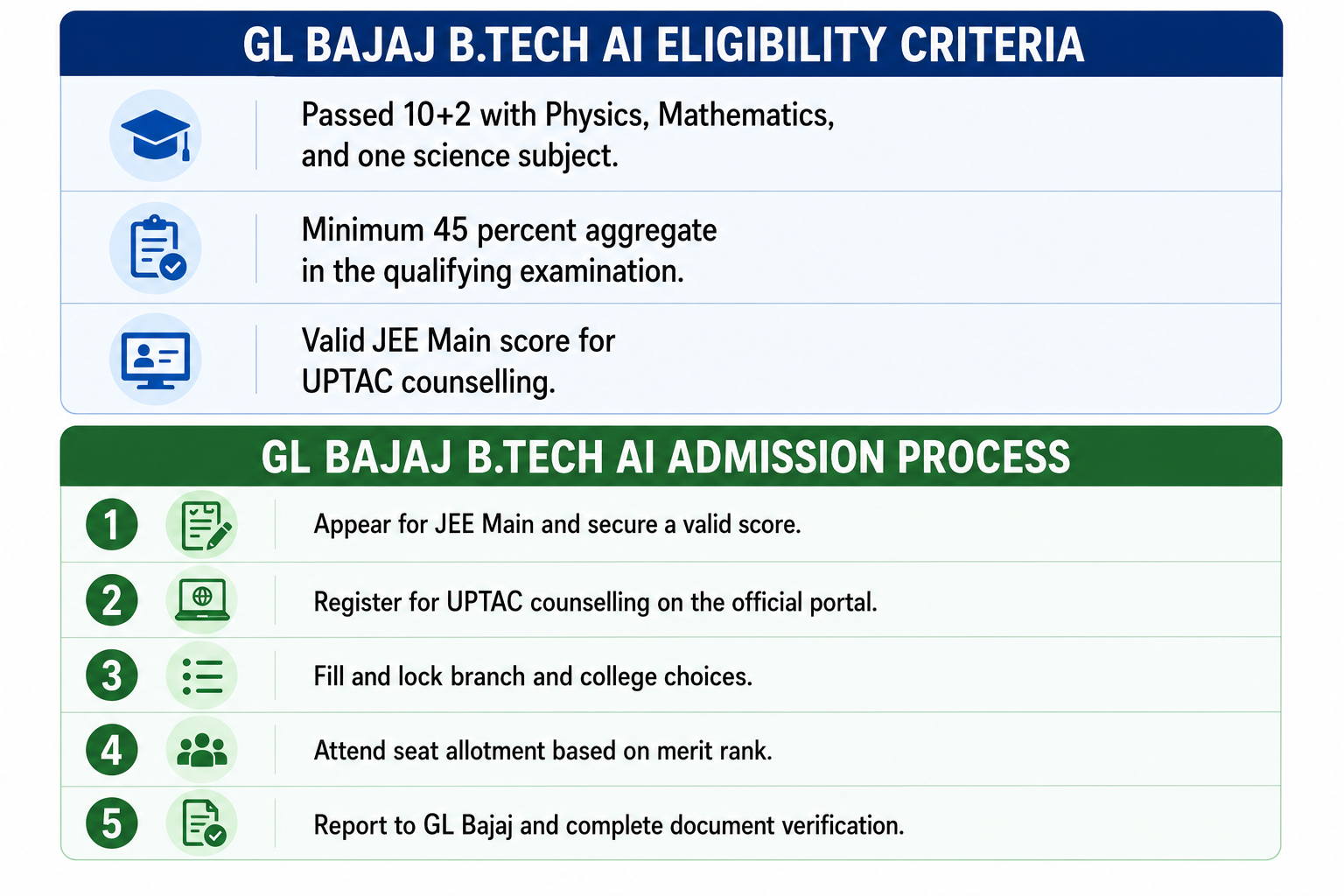
Ans. Admission requires a valid JEE Main score followed by UPTAC counselling. Candidates register online, fill and lock branch and college choices, and receive seats through merit-based allotment. After allotment, students report to GL Bajaj for document verification and fee payment to confirm the seat before classes start in the new session.
Ques. How does AI differ from the AI and ML branch?
Ans. The AI branch covers a broader spread including knowledge representation, robotics, and intelligent systems, while AI and ML leans more on machine learning depth. Both share strong programming foundations and overlapping career paths in technology firms. Students choosing AI gain wider exposure to reasoning and automation, which can suit roles in robotics and intelligent system design. The two branches share many electives and core papers, so switching focus through projects and internships remains practical as students discover their interests over the four years of study.
Ques. Is mathematics important for this branch?
Ans. Yes. Artificial intelligence relies on linear algebra, probability, and statistics alongside programming. Students strong in mathematics adapt faster to the coursework. The curriculum includes labs and projects that build practical AI skills progressively from early semesters, and bridge tutorials help students from non-mathematics backgrounds catch up during the initial part of the programme. Regular assignments and lab sessions reinforce these concepts, so students who keep pace from the first semester find the later AI and automation topics far more approachable. Practising coding alongside the theory helps cement the mathematical ideas, since most AI concepts become clearer once implemented and tested on real examples.
Ques. How does the institute support placements?
Ans. The institute runs aptitude training, soft-skill sessions, and mock interviews to prepare students for recruitment. Recruiters such as TCS, Infosys, Cognizant, and Capgemini visit the campus. The highest package reached INR 57 LPA and the average was near INR 4.50 LPA, with steady grades, internships, and a project portfolio improving final outcomes. The placement cell also coordinates pre-placement talks and skill workshops with visiting firms, giving students a clear view of the roles and expectations before interviews begin.



Comments