



Education Journalist | Study Abroad Lead
Allotropes are elements that occur in more than one form. The most common examples of allotropes are Carbon and sulfur. The forms of an allotrope have different physical properties but identical chemical properties. This is caused by the difference in bonding between two atoms of the element. Although the physical properties of allotropes of any element are different, the physical state or state of matter is the same. In the crystalline form, diamond and graphite are the two allotropes of carbon while the amorphous forms of carbon are coal, coke, petroleum coke, gas carbon, etc. In this article, we will learn more about the allotropes of carbon: diamond, graphite, and fullerenes.
| Table of Contents |
Key takeaways: Allotropes of carbon, graphite, diamond, fullerenes, properties of diamond, properties of graphite
What are allotropes?
[Click Here for Sample Questions]
Allotropes or allotropy may be defined as the existence of a chemical element in one or more physical forms occurring in the same physical state. Allotropes may show different physical or chemical states depending upon the atom arrangement or the number of existent atoms. While carbon and sulfur is the common element displaying allotropy, Carbon can make more allotropes due to their five-membered valency.
What are allotropes of carbon?
Carbon is a p-block element. The atomic number of carbon is 6 and it belongs to group 14. It makes up about 18.5% of our body.
Now, when it comes to carbon, it has only two types of allotropes.
- Crystalline
- Amorphous
The crystalline forms of carbon. The crystalline form of carbon consists of allotropes such as:
- Diamond
- Graphite
- Fullerenes
While the amorphous allotropes of carbon are:
- Coal
- Coke
- Wood charcoal
- Animal charcoal
- Lampblack
- Gas carbon
Diamond
[Click Here for Sample Questions]
Diamond is the crystalline form of carbon. It is one of the purest forms of crystalline carbon present on earth.
- Each atom of carbon is tetrahedrally linked to other atoms of carbon in the diamond.
- So one carbon atom in diamond is linked to four other carbon atoms.
- This creates the 3-dimensional structure of the diamond.
Structure of diamond
Carbon atoms are sp3 hybridized in diamond. Each carbon in a diamond is linked to four other carbon atoms via four σ (sigma) bonds (strongest covalent bonds).
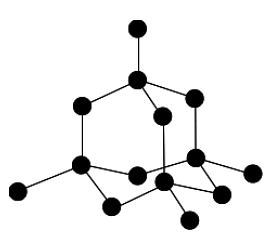
Structure of Diamond
Read More: Hybridization
Properties of Diamond
Some of the properties of diamond are:
- Diamond is the purest and densest form of carbon.
- It is extremely hard. Diamond is the hardest naturally occurring substance.
- The melting point of the diamond is 3843K (approx 3570 celsius).
- In diamonds, all the valence electrons are involved in bond formation. There is no lone pair of electrons, due to this diamond having a very low electrical conductivity.
- Diamond is insoluble in all solvents.
- When heated at 475K in presence of sulphuric acid and potassium dichromate, diamond is oxidized directly into carbon dioxide, leaving no residue.
- Diamond has a very high refractive index.
- It is a good conductor of heat.
Graphite
[Click Here for Sample Questions]
Graphite is one of the most commonly found naturally occurring allotropes of carbon.
- Graphite consists of hexagonally arranged two-dimensional flat layers of carbon atoms.
- It is soft, black, and slippery.
Structure of graphite
In graphite, carbons are in sp2 hybridization. Each carbon is linked to three other carbon atoms via σ bonds in a single layer. The fourth bond of carbon is via π bond. Two subsequent layers are linked by weak Van Der Waal’s forces.
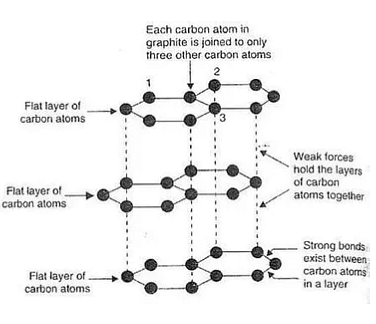
Structure of graphite
Properties of graphite
Some of the properties of graphite are:
- Graphite is slippery because of its characteristic layered structure. It is often used as a dry lubricant.
- Graphites are good conductors of electricity because the fourth electron of each carbon atom is free.
- Graphite is a good conductor of heat. But due to its layered structure, it has lower heat conductivity compared to diamond.
- Graphite is black in color and has a metallic luster.
- Graphite isn’t soluble in polar and non-polar solvents. But it does get oxidized into carbon dioxide upon treating it with potassium dichromate and sulphuric acid.
- Graphite is inert to both alkalis and acids. And hence are often used to make crucibles.
Fullerenes
[Click Here for Sample Questions]
Unlike graphite and diamond, fullerene doesn’t have any dazzling edges or surface bonds to attract atoms hence it is considered the only purest form of carbon.
- It is a spherical molecule of composition C2n, where n ≥ 30.
- The preparation of fullerenes occurs when graphite is heated in an electric arc in an inert gas like helium or argon forming a sooty material by condensation of Cn molecules.
Structure of fullerenes
The Fullerene, also known as buckminsterfullerene, consists of 60 vertices with a carbon atom at the end of each vertex. It consists of 20 six-membered rings and 12 five-membered rings. This gives it a spherical, ball-like structure.
The six-membered rings are fused to the other six and five-membered rings, while the five-membered rings are only fused with the six-membered rings. Fullerene contains both single and double Carbon-Carbon bonds of distance 142pm and 138.3 pm.

Structure of fullerenes
Properties of Fullerene
Fullerene has the following properties:
- Fullerene is soluble in organic solvents.
- C60 fullerene when added to toluene turns purple while a C70 fullerene is orange-red.
- Fullerene can be reduced electrochemically. It can then react with group 1 alkali metals. It will then act as a superconductor under 18K carrying electricity with zero resistance.
- It can also form a platinum complex.
Why is diamond hard?
[Click Here for Sample Questions]
Each carbon has four electrons on its outermost shell. In the case of diamonds, these electrons are bonded with other carbon atoms resulting in a strong chemical bond. The presence of this bond creates an extremely rigid tetrahedral crystal. In simple words, the tightly arranged structure makes diamond the hardest substance on the planet.
Uses of allotropes of carbon
[Click Here for Sample Questions]
Each allotrope of carbon has its unique physical and chemical properties. Based on their properties each allotrope of carbon is used commercially for different purposes.
Uses of diamond: Diamond is used for:
- Being the hardest substance on earth, diamond is used to cut glasses, rock drilling, as well as cutting marbles.
- Diamond is the most precious stone and has a huge demand for jewelry.
- Diamond is used in surgical tools, for example, to remove cataracts from the eyes.
- It is used to make dies to draw thin wires of metals like tungsten.
Uses of graphite: The uses of graphite include:
- Graphite is used as a dry lubricant in machines where wet lubricants cannot be used.
- The most common use of graphite is making pencil leads.
- It is inert in acids and alkalis and hence is used to make crucible.
- Graphite is used as a reducing agent in the steel industry.
- Graphite is used in making carbon arcs, batteries, and electrodes.
Uses of fullerenes: The uses of fullerenes are:
- Fullerene is used as a lubricant.
- It is used to absorb gasses.
- It has various uses in the biomedical industry like drug delivery systems, light-activated antimicrobial agents.
- Fullerene is a good conductor of electricity and is used in batteries and electronic devices.
- Fullerene is used in nanotechnology.
Things to remember
- Allotrope refers to one or more forms of an element occurring in the same state of matter. Each allotrope of an element has distinct physical and chemical properties.
- Crystalline allotropes of carbon are diamond, graphite, and fullerene. The amorphous allotropes of carbon are coal. Coke, charcoal, etc.
- Diamond is a pure form of carbon. It has a tetrahedral structure with sp3 hybridization.
- Graphite consists of multiple flat layers of bonded carbon. Each carbon is attached to 3 other carbons.
- Fullerene is a spherical molecule of composition C2n, where n ≥ 30.
- Carbon in diamond is involved in sigma bond formation with other carbons. This makes diamond the hardest substance on earth.
Sample Questions
Ques. Can coke be considered as an allotrope of carbon? (3 marks)
Ans. Allotrope refers to one or more forms of an element with different physical and chemical properties. Allotropes can be either crystalline or amorphous.
Coke is formed on the destructive dissolution of coal. It consists of about 80-95 carbon. So yes, coke is an amorphous allotrope of carbon. Other examples of an amorphous allotrope of carbon include coal and charcoal.
Ques. What is considered the purest form of Carbon? (3 marks)
Ans. Fullerene is considered the purest form of carbon. Fullerene is made of carbons with single and double bonds. The surface of the fullerene does not have any bonds that can attract any other atoms. The structure of the fullerene is similar to a hollow spherical cage. The fullerene doesn’t have any dazzling edges or surface bonds to attract atoms hence it is considered the only purest form of carbon.
Ques. Graphite acts as a good lubricant. Give reason. (3 marks)
Ans. Graphite has a layered structure. Carbons in graphite are bonded in a hexagonal flat layer. Each two-dimensional layer of graphite is linked via weak Van Der Waal’s force of attraction, as a result, they can be easily cleaved. So the layers of graphite can ‘slide’ over each other giving it a greasy, soft texture. Due to this property of graphite, it is very popular as a dry lubricant. It is used in heavy types of machinery.
Ques. Which allotrope of carbon can be used as a teeth whitening agent and why? (5 marks)
Ans. Charcoal is an amorphous allotrope of carbon. Due to its porous structure, charcoal is highly absorbent in nature. Activated charcoal is a modified form of charcoal by treating it with oxygen to open up pores in it. Activated charcoal is used to absorb gasses, odor, and toxins in waste-water treatment.
Due to the presence of millions of pores in activated charcoal, it is widely used commercially in toothpaste. In the last decade, activated charcoals have been widely used in cosmetics and toothpaste for their high absorbing properties. Activated charcoal can absorb stains in teeth and has antimicrobial properties as well.
Ques. How is fullerene obtained? (2 marks)
Ans. Fullerenes are often created during a carbon arc, however burning a hydrocarbon feedstock with strict management of the oxygen. The fullerenes are often separated from co-produced soot (“amorphous carbon”) by dissolving them out.
Ques. Name the crystalline forms of carbon. Briefly describe the structure of each. (3 marks)
Ans. Crystalline allotropes of carbon are Diamond, Graphite, and fullerene.
- Structure of diamond: In the three-dimensional structure of diamond, each carbon atom is bound to four other carbon atoms. All the four bonds of each atom are sigma bonds hence the structure of carbon is very tough and strong. Diamond has a perfect tetrahedral structure. Each bond angle is equal to 109.5 degrees.
- Structure of graphite: Graphite structure is composed of multiple two-dimensional layers linked to each other by weak Van Der Waal’s force of attraction. Each carbon in graphite has three sigma bonds (C-C).
- Structure of fullerene: Carbon atoms in the fullerene structure are bonded to each other by single bonds (C-C) and double bonds (C=C). It consists of 12 pentagons and 20 hexagons. The overall structure of fullerene is like a spherical cage.
Ques. Why is graphite thermodynamically more stable than a diamond? (5 marks)
Ans- In graphite, all the carbon atoms are sp2 hybridized whereas, in diamond, all the carbon atoms are sp3 hybridized. As a result of the sp2 hybridization of the carbons in the case of graphite, there is one delocalized electron per carbon atom that takes part in resonance. But in the case of diamonds, there is no delocalized electron because of the sp3 hybridization of the carbon atoms.
As we know, that resonance or conjugation, which means delocalization of electrons imparts stability to a compound. So the delocalized electrons in the case of graphite impart stability to graphite as well by making the bonds between carbon atoms stronger ( a partial double bond forms between the carbon atoms ). But this is not the case for diamonds. Thus, graphite is thermodynamically more stable than diamond because the delocalization of the pi-electrons in graphite lowers the energy of graphite through conjugation or resonance.
Ques- Both graphite and diamond are made of carbon atoms, still diamond is very hard and rigid whereas graphite is soft and slippery. Why? (3 marks)
Ans- Graphite is made up of layers of carbon atoms, joined together by weak Van der Waal's forces. The carbon atoms within a particular layer are strongly bonded by covalent bonds but the force of attraction between the layers is very weak. The intermolecular forces between the layers are so weak that these bonds can be broken very easily. As a result of this, the layers slide over one another, making graphite slippery. On the other hand, diamond has a tetrahedral structure in which, their carbon atoms are bonded to each other by strong covalent bonds. As a result of this, the structure of the diamond becomes rigid. Hence, in his right network, the carbon cannot be moved, unlike the layers of graphite. That is why, graphite is soft and slippery whereas diamond is hard and right, despite being made up of carbon atoms in both cases.
Read Also:



Comments