



Content Curator
Alternate angles are a special kind of angles in geometry and form the basics for understanding concepts relating to angles and parallel lines. Alternate angles are the angles formed on either side of the transversal which cuts through two or more parallel lines. These angles are always non adjacent. In this article, we are going to discuss the proper definition of Alternate Angles, types, Theorem, and some sample questions on alternate angles.
| Table of Content |
Key Terms: Alternate Angles, Transversal, Parallel lines, Interior Alternate Angles, Exterior Alternate Angles, Alternate Angle theorem
Also read: Isosceles Triangle Theorems
Alternate Angles Definition
[Click Here for Sample Questions]
Consider two coplanar parallel lines AB and CD as shown in the figure given above. If a line XY cuts these two parallel lines AB and CD at P and Q respectively, then the figure tends to form certain angles with respect to the lines. Whenever a transversal cuts two or more parallel lines, the alternate angles are always equal.

Hence in the given figure;
- ∠4=∠6 and ∠3=∠5
- ∠1=∠7 and ∠2=∠8
These are the pairs of alternate angles and are always equal.
Read More: Calculus Formula
Types of Alternate Angles
[Click Here for Sample Questions]
There are 2 types of alternate angles depending on the position of angles with respect to the transversal. They are:
- Interior alternate angles: The pair of angles formed on the inner or interior sides of the two parallel lines when a transversal makes a cut through them. According to the figure given above, ∠3, ∠4, ∠5, and ∠6 form the interior alternate angles.
- Exterior alternate angles: The pair of angles formed on the outer or exterior sides of the two parallel lines when a transversal makes a cut through them. According to the figure given above, ∠1, ∠2, ∠7, and ∠8 form the exterior alternate angles.
Also Read:
Alternate Angles Theorem
[Click Here for Sample Questions]
According to the alternate angles theorem, the alternate angles formed when a transversal cuts through two or more parallel lines, are always congruent.
To prove: When 2 or more parallel lines are cut by a transversal, the alternate angles formed are always congruent.
Proof:
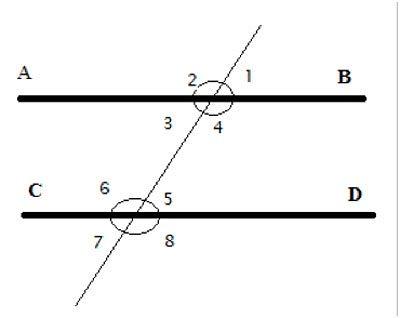
Consider two coplanar parallel lines AB and CD as shown in the figure given above. If a line XY cuts these two parallel lines AB and CD at P and Q respectively, then the figure tends to form certain angles with respect to the lines.
At the point of intersection of straight line AB, the following conditions will hold true:
∠3+ ∠4=180°_________(1)
∠1+∠4=180°__________(2) (Since AB and transversal are straight lines)
Now, from equations (1) and (2), we can conclude that ∠1=∠3.
Similarly,
At the point of intersection of straight line CD, the following conditions will hold true:
∠6+ ∠5=180°_________(3)
∠8+∠5=180°__________(4) (Since AB and transversal are straight lines)
Now, from equations (3) and (4), we can conclude that ∠6=∠8.
In the given figure above:
∠1=∠5 and ∠4=∠8 (Corresponding angles)
So now this implies that ∠3=∠5 and ∠4=∠6, where ∠3,∠4,∠5 and ∠6 are alternate angles.
Hence alternate angles are congruent OR alternate angles are equal.
Things to remember
- Whenever a transversal cuts through two or more parallel lines, the alternate angles formed are always equal.
- The pair of angles formed on the inner or interior sides of the two parallel lines when a transversal makes a cut through them are known as interior alternate angles.
- The pair of angles formed on the outer or exterior sides of the two parallel lines when a transversal makes a cut through them are known as exterior alternate angles.
Also Read:
Sample questions
Ques1. What is the difference between alternate angles and corresponding angles? (2 Marks)
Ans.
- Alternate angles are the angles formed on either side of the transversal which cuts through two or more parallel lines. These angles are always non adjacent.
- Corresponding angles are the angles formed on the same side of transversal. One of them is located on the inner side of the parallel line while the other is located on the outer side of the parallel line. These angles are said to be in correspondence with each other.
Ques2. In the given figure ∠3=60°. Find the following angles: ∠4, ∠5 and ∠6.  (2 Marks)
Ans. Given: ∠3=60°
∠3=∠5 (Interior alternate angles)
Hence, ∠5=60°
Now, ∠5+∠6=180 (Straight lines)
∠6=120°
According to alternate angle theorem,
∠6=∠4
Therefore, ∠4=120°
Answers:
∠4=120°
∠5=60°
∠6=120°
Ques3. Find x° if p and q are parallel lines.  (2 Marks)
Ans. According to Alternate angle theorem,
2x+26°=3x-33°
3x-2x=33°+26°
Hence, x=59°
Ques4. Find p° id CE and FH are parallel lines. 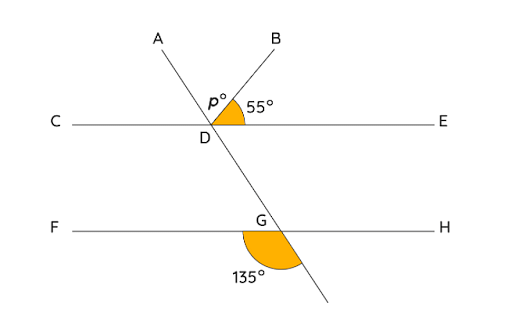 (2 Marks)
Ans. According to Alternate angle theorem,
p+55°=135°
p=(135-55)°
Therefore, p=80°
Ques5. Find the angle OPQ in the given figure:  (2 Marks)
Ans. Extend the lines as shown in the diagram below:

Now, angle NOP = 55 degrees (Interior alternate angles)
X’= (180-55) degrees
X’ = 25 degrees
Therefore angle OPQ is also equal to 25 degrees because angle OPQ and X’ form corresponding angles.
Ques6. FInd x+y+z from the given figure. 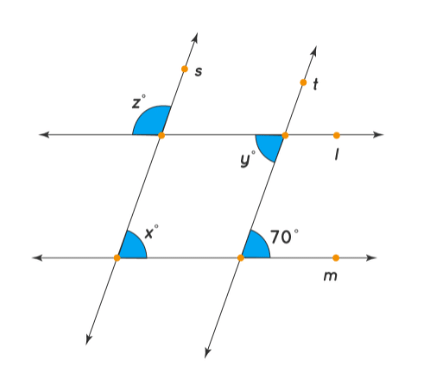 (2 Marks)
Ans. y= 70 degrees (Interior alternate angles)
x=70 degrees (Corresponding angles are congruent)
z= (180-70) degrees= 110 degrees
Therefore x+y+z= (70+70+110)
Answer =240 degrees.
Ques7. If angle 7= 20 degrees. Find angle 2 and 4 from the diagram .  (2 Marks)
Ans. Angle 7= 20 degrees.
Angle 2= 20 degrees (Exterior alternate angles)
Angle 4= (180-20) degrees (Straight line)
Angle 4= 60 degrees
Ques8. Find the angle θ from the figure given:  (2 Marks)
Ans. The angle θ will be equal to 50 degree since they form a pair of exterior alternate angles which are congruent according to the alternate angle theory.
Also Read:



Comments