



Exams Prep Master
The atomic radii of a chemical element refer to a measurement between the nuclei of two identical atoms bonded together, usually the mean or typical distance from the center of the nucleus to the boundary of the surrounding shells of electrons. The value of the atomic radius may depend on the atom’s state or context. Let’s have a closer look at the topic along with some examples and important questions.
| Table of Content |
Protons, Neutrons and Electrons are major constituents of an atom. In the centre of the atom, the nucleus is made up of protons and neutrons. Electrons orbit around the nucleus forming a cloud. And the total distance from the outermost orbital of the electron to the nucleus is known as atomic radii. Atomic radius is the size of an atom.
Download the PDF on Atomic Radii
What are Atomic Radii?
Atomic radius can be understood as the radius of the circle. The nucleus can be understood as the centre of the circle and the outermost orbital of an electron can be taken as the outer edge or boundary of the circle. Atomic radius can typically be said as the distance from the centre of the nucleus to the boundary of the last electron surrounding the nucleus. However, it is difficult to determine atomic radius because of the uncertainty in the positions of electrons.

Heisenberg’s Uncertainty Principle can be used to measure the atomic radius of an atom precisely. According to Heisenberg’s Uncertainty Principle, the radius of an atom is determined based on the distance between nuclei of two bonded atoms. There is no fixed radius of an atom, it can have different radii depending upon the bond it has formed. Ionic radius, Covalent Radius and Vander walls Radius are three widely used definitions of the atomic radius based on types of bonds formed.
Types of Atomic Radii with Respect to Types of Bonds
Depending upon the types of bonds formed by atoms, the types of atomic radius are:
- Ionic Radius
- Covalent Radius
- Metallic Radius
Ionic Radius
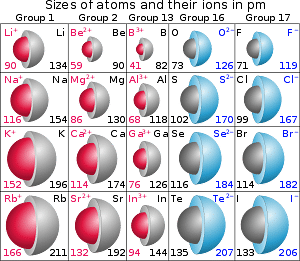
The radius of the atom which forms ionic bonds is called the ionic radius. Electrons and nucleus are restricted by atomic bonds due to which atoms and ions do not have a specific shape. Armstrong (A0) or picometer (pm) is the unit to measure the ionic radius. The characteristic Radius of an ionic atom ranges from 30 to 200 picometers. The ionic radius of an atom is not static and differs concerning coordination number, the spin state of electrons and some other parameters too. Increasing the coordination number will increase ionic size. Also, the ion with a high spin state has a higher ionic radius than the ion with a lower spin state. Considering the size of an ion, an ion with a positive charge will have a smaller size than an ion with a negative charge.
Covalent Radius
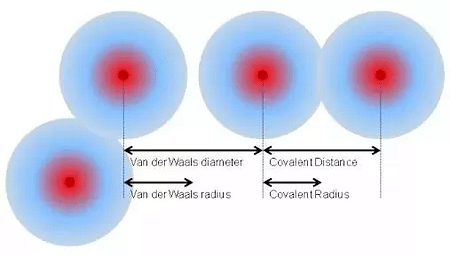
The radius of the atom which is under a covalent bond with another atom is the covalent radius. Covalent radius is also measured by measuring the bond lengths of covalently bonded atoms. When two same kinds of atoms are bonded, the covalent radius is half of the bond length. In some molecules of chlorine and oxygen, it is easily measured by measuring half of the bond length. In cases of other different elements paired together, the atomic radius is to be calculated by measuring bond distances to atoms whose radii are already known. Covalent can be typically defined as half of the internuclear distance between two bonded atoms. The internuclear distance between the two bonded atoms is called bond length.

Metallic Radius
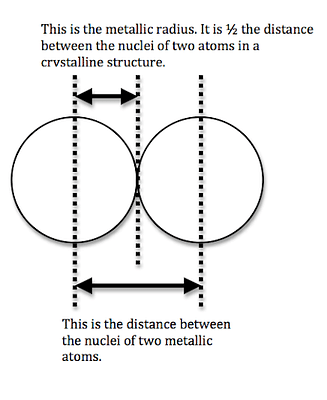
The radius of an atom is the atomic radii of the atoms joined by atomic bonds. Metallic radius can be defined as the distance between nuclei of two adjacent atoms in a metallic cluster.
Other Terms Related to Atomic Radii
Vanderwall's Radius
It can be defined as half of the distance between nuclei of two non-bonded similar atoms which are isolated and also two adjacent identical atoms belonging to the neighbouring atoms which are in the solid state. These are weakly connected by a weak magnitude force which is known as videowalls force. The ionic radius of chlorine in an ionic state is 360 pm and the Vanderwall radius of the chlorine atom is said to be 180 pm.
Bohr Radius
Bohr radius can be defined as the atomic radius of an atom when it is in its lowest energy state. Bohr’s radius is basically relevant to ions and atoms with a single electron, like Hydrogen.
Periodic Trends of Atomic Radii
The atomic size keeps on increasing with an increase in atomic number and with an increase in this atomic radius. Atomic radius keeps increasing while moving down in the periodic table. The size of an atom decreases while going from left to right in a certain table. Hence, atomic radius increases down a group and decreases across a period. Helium has the smallest atomic radius while Francium has the largest.
Recommended video:
Things to Remember based on Atomic Radii
- Atomic radii are used to determine the various chemical and physical properties.
- The periodic table assists to a great extent in determining the atomic radius and presents a number of trends.
- Depending upon the types of bonds formed by atoms, the types of atomic radius are: Ionic Radius, Covalent Radius, Metallic Radius.
- The radius of the atom which forms ionic bonds is called the ionic radius.
- The radius of the atom which is under a covalent bond with another atom is the covalent radius.
- Metallic radius can be defined as the distance between nuclei of two adjacent atoms in a metallic cluster.
- Bohr radius can be defined as the atomic radius of an atom when it is in its lowest energy state.
- Atomic radius keeps increasing while moving down in the periodic table.
Sample Questions based on Atomic Radii
Ques. Select the largest atomic radius among S, Se, P and As. (3 marks)
Ans. Atomic radius keeps on increasing while moving down in a periodic table. Going from left to right will show a decreasing trend in atomic radius. Arsenic and Selenium are in the lowest row but arsenic is more to the left. So, As has the largest atomic radius.
Ques. Select the smallest atomic radius among P, Bi, N and As. (2 marks)
Ans. The provided elements are in the same groups in the periodic table. Atomic radius keeps on increasing from top to bottom. As one travels down a group, another shell is added increasing the atomic size. Hence, Nitrogen has the smallest atomic size.
Ques. Can you measure atomic radius directly? (1 mark)
Ans. No atomic radius cannot be measured directly. This is all because of uncertainty in the position of the outermost electron.
Ques. Which element in the periodic table is said to have the largest atomic radius? (1 mark)
Ans. Francium is said to have the largest atomic radius.
Ques. Does atomic number increase across a period table? (2 marks)
Ans. As one moves from left to right for a certain period, the size of an atom generally decreases. Therefore usually, the atomic radius decreases across a period and increases down a group.
Ques. What is meant by Bohr Radius? (2 marks)
Ans. Bohr radius can be defined as the atomic radius of an atom when it is in its lowest energy state. Bohr’s radius is basically relevant to ions and atoms with a single electron, like Hydrogen.
Ques. What is the meaning of atomic radii? (3 marks)
Ans. Atomic radius can be understood as the radius of the circle. The nucleus can be understood as the centre of the circle and the outermost orbital of an electron can be taken as the outer edge or boundary of the circle. Atomic radius can typically be said as the distance from the centre of the nucleus to the boundary of the last electron surrounding the nucleus.
Ques. What is a covalent radius? (4 marks)
Ans. The radius of the atom which is under a covalent bond with another atom is the covalent radius. Covalent radius is also measured by measuring the bond lengths of covalently bonded atoms. When two same kinds of atoms are bonded, the covalent radius is half of the bond length. In some molecules of chlorine and oxygen, it is easily measured by measuring half of the bond length. In cases of other different elements paired together, the atomic radius is to be calculated by measuring bond distances to atoms whose radii are already known. Covalent can be typically defined as half of the internuclear distance between two bonded atoms. The internuclear distance between the two bonded atoms is called bond length.
Ques. Prove that the atomic radii are a periodic property. (5 marks)
Ans. Atomic radius is a periodic property as:
- Variation in periods: While moving from left to right in a period, the atomic radius decreases. Again, going from left to right in a period, the nuclear charge increases by one unit in each succeeding element. However, the number pf shell remains the same which is why the electrons are strongly attracted by the nucleus, and the atomic radius decreases along the period.
- Variation in a group: With the increase in atomic number, the atomic radius of elements increases as we move from top to bottom in a group. As the shell number increases the attraction of the nucleus for the electrons decreases. Therefore, the atomic radius increases along with the group.
Ques. What do you mean by ionic radius? (3 marks)
Ans. The radius of the atom which forms ionic bonds is called the ionic radius. Electrons and nucleus are restricted by atomic bonds due to which atoms and ions do not have a specific shape. Armstrong (A0) or picometer (pm) is the unit to measure the ionic radius. The characteristic Radius of an ionic atom ranges from 30 to 200 picometers. The ionic radius of an atom is not static and differs concerning coordination number, the spin state of electrons, and some other parameters too. Increasing the coordination number will increase ionic size. Also, the ion with a high spin state has a higher ionic radius than the ion with a lower spin state. Considering the size of an ion, an ion with a positive charge will have a smaller size than an ion with a negative charge.
Ques. Analyse the given figure and answer the following questions: (4 marks)

- What is meant by atomic radius?
- Explain covalent radius.
- What are another two types of terms expressed as atomic size?
Ans. a. Atomic radius can typically be said as the distance from the centre of the nucleus to the boundary of the last electron surrounding the nucleus.
- The radius of the atom which is under a covalent bond with another atom is the covalent radius. Covalent radius is also measured by measuring the bond lengths of covalently bonded atoms. When two same kinds of atoms are bonded, the covalent radius is half of the bond length.
- The other two types of terms for atomic size are Vander Waals’ radius and Metallic radius.



Comments