



Content Curator
Avogadro’s law is commonly known as Avogadro’s principle or Avogadro’s hypothesis. Avogadro’s law states that the number of atoms/particles present in the gas is directly proportional to the volume consumed by the gas at constant temperature and pressure. This law is directly related to the ideal gas equation as both link temperature, volume, pressure, and amount of substance of given gas.
| Table of Content |
Avogadro’s Law
[Click Here for Sample Questions]
Avogadro’s law is named after Amedeo Carlo Avogadro as he is one who suggested that two dissimilar ideal gases occupying the same volume at a given (constant) temperature and pressure must have the same amount of molecules. When he proved the fact, the law was named Avogadro’s Law.
To better understand Avogadro’s Law, let’s consider few examples.
- One of the major examples of Avogadro’s Law is how humans breathe i.e human respiratory system. When a person inhales, the increase in the molar quantity of air in the lungs is accompanied by an increase in the volume of the lungs (expansion of the lungs).
- Another very popular example of Avogadro’s Law is the deflation of tires of a vehicle. When the air inside the tire is reduced, the number of moles of air present in the tire decreases. This results in a decrease in the volume occupied by the gas. Due to this the tire loses its shape and deflate.
Also Read: Gas Laws
Formula of Avogadro’s Law
[Click Here for Sample Questions]
When the pressure and temperature are constant, Avogadro’s Law can be expressed as
V ∝ n
V = kn
Here, the V stands for the volume of the gas, n denotes the amount of gaseous substance present or molecules and K is constant.
When the number of gaseous substances increases then there will be a corresponding increase in the volume occupied by the gas. It can be calculated with the help of the following formula:
V1/n1 = V2/n2 ( = k, according to Avogadro’s law).
Graphical Representation of Avogadro’s Law
[Click Here for Sample Questions]
The following graphical representation can be used to understand Avogadro’s Law Formula:
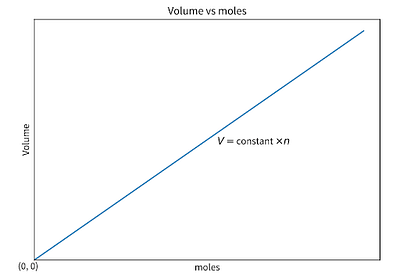
The straight line in the graph indicates that zero moles of gas will occupy zero volume. Hence, both volume and amount of substance are directly proportional
Derivation of Avogadro’s Law
[Click Here for Sample Questions]
Avogadro’s Law can be derived by the ideal gas equation. According to the ideal gas equation:
PV = nRT
- Here P stands for the pressure released or exerted by a gas on its container.
- V stands for the volume occupied by the gas.
- n stands for the number of gaseous substances I.e the number of moles of gas.
- T stands for the absolute temperature of the gas.
- R is the universal gas constant.
If the ideal gas equation is rearranged, the following equation can be obtained.
V/n = (RT)/P.
In the above equation, (RT/P) is a constant as the temperature and pressure are kept stable (constant) and the product/quotient of two or more constants is always a constant).
Therefore, we can conclude that:
V/n = k.
By this, the proportionality between the volume occupied by gas and the number of gaseous molecules is verified.
Limitations of Avogadro’s Law
[Click Here for Sample Questions]
- Avogadro’s Law is perfectly applicable to ideal gas equations but it provides only approximate relationships for real gases.
- The deviation of real gases from the ideal behaviour increases at lower temperatures and higher pressures.
- Gaseous molecules having relatively low molecular masses obey Avogadro’s Law to a greater extent in comparison to heavier molecules.
Avogadro’s Law: Volume- Amount Relationship
[Click Here for Sample Questions]
The volume (V) of an ideal gas varies directly with the number of moles of the gas (n) at constant pressure (P) and temperature (T).
We can express this mathematically as:

Avogadro’s law can be used to predict the volume and number of moles of a gas. As we know V/n is constant for any given sample of gas (at constant P and T). So, we can again imagine two states-
Initial state with a certain number of moles and volume (V1/n1 ), and a final state with values for a different number of moles and volume (V2/n2 ). As V/n is always a constant, So, we can equate the two states and write:
V1/n1 = V2/n2
Thus, it proves the relationship of the volume of a gas and the number of moles of the gas (Avogadro’s law) at constant pressure (Boyle’s law) and the temperature (Charles’s law).
Things to Remember of Avogadro’s Law (Volume-Amount Relationship)
[Click Here for Sample Questions]
- Avogadro’s law is also known as Avogadro’s principle or Avogadro’s hypothesis.
- It states that at constant temperature and pressure, the number of atoms/particles present in the gas is directly proportional to the volume consumed by the gas.
- Avogadro’s Law can easily be derived by the ideal gas equation.
- Avogadro’s Law proves the relationship between the volume of a gas and the number of moles of the gas.
V1/n1 = V2/n2
Important Questions of Avogadro’s Law (Volume-Amount Relationship)
[Click Here for Sample Questions]
Ques.1: State the drawbacks of Avogadro’s Law. (3 Marks)
Click Here To View Answer
Answer: The drawbacks of Avogadro’s Law are:
- Avogadro’s Law is perfectly applicable to ideal gas equations but it provides only approximate relationships for real gases.
- The deviation of real gases from the ideal behaviour increases at lower temperatures and higher pressures.
- Gaseous molecules having relatively low molecular masses obey Avogadro’s Law to a greater extent in comparison to heavier molecules.
Ques.2: Drive Avogadro’s Law with the help of Ideal Gas Equation. (3 Marks)
Click Here To View Answer
Answer: Avogadro’s Law can be derived by the ideal gas equation. According to the ideal gas equation:
PV = nRT
Where P = pressure released or exerted by a gas on its container.
V = volume occupied by the gas.
n = number of gaseous substances
T = absolute temperature of the gas.
R = universal gas constant.
By rearranging the ideal gas equation, the following equation can be obtained.
V/n = (RT)/P.
In the above equation, (RT/P) is a constant as the temperature and pressure are kept constant and the product/quotient of two or more constants is always a constant.
Therefore, we can conclude that:
V/n = k.
By this, the proportionality between the volume occupied by gas and the number of gaseous molecules is verified.
Hence the Avogadro’s Law is verified.
Ques.3: If one mole of helium gas can fill up an empty case of 1.2 liters. What would be the volume of the case if an additional 2.5 moles of helium gas is added? Assuming that the temperature and pressure are constant. (2 Marks)
Click Here To View Answer
Answer: Given that:
The initial amount of helium (n1) = 1 mol
The initial volume of the case (V1) = 1.5L
So, the final amount of of helium (n2) = 1 mol + 2.5 mol = 3.5 mol.
According to Avogadro’s law-
V1/n1 = V1/n2
Therefore,
The final volume of the balloon (V2) = (V1n2)/n1
V2 = (1.5L*3.5mol)/1mol
V2 = 5.25L.
Ques.4: A tyre containing 10 moles of air and occupying a volume of 40L loses half its volume due to a puncture. Considering that the pressure and temperature remain constant, what would be the amount of air in the deflated tyre? (2 marks)
Click Here To View Answer
Answer: Given that:
The initial amount of air (n1) = 10 mol
The initial volume of the tyre (V1) = 40 L
The final volume of the tyre (V2) = 20 L
According to Avogadro’s law,
The final amount of air in the tyre (n2) = (V2n1)/V1 = 5 moles.
So, the amount of air in the deflated tyre is 5 moles of air.
Ques.5: Explain Avogadro’s hypothesis? (2 Marks)
Click Here To View Answer
Answer: Avogadro’s hypothesis can be explained by taking two different gas having equal volume and the same amount of gaseous molecules at some constant pressure and temperature. According to his experiment, he stated that the Volume of the gas does not depend on the number or size of the molecules of the gaseous substance. So, the formula derived was V=kn. The hypothesis was developed by Avogadro in the year 1811. Only the behavior of ideal gases can be seen with Avogadro’s hypothesis.



Comments