



Education Journalist | Study Abroad Lead
Constructing triangles through SSS congruence requires an understanding of congruent triangles and the SSS congruence rule. SSS stands for Side-Side-Side. Congruent triangles are triangles having the same shape and same size. Both corresponding sides and angles of the triangles should be equal through this application.
Key Terms: Congruent triangles, SSS Congruence rule, Construct, Three sides, Angles, Triangle
Congruent Triangles
[Click Here for Sample Questions]
A triangle is a polygon having three line segments joined together and forming three angles. If two triangles are congruent, it means that all the sides and their corresponding angles are congruent. Thus, the sides have the equal length or the angles have the same measure.

Congruent Triangles
Read more:
Rules of Congruence
[Click Here for Sample Questions]
There are four rules of congruency of triangles:
- SSS Criterion: Side-Side-Side; Three sides
- SAS Criterion: Side-Angle-Side; Two sides and the angle between them.
- ASA Criterion: Angle-Side-Angle; Two angles and the side between them.
- RHS Criterion: Right Angle-Hypotenuse; Side hypotenuse and a leg in the case of a right-angled triangle.

Rules of Congruent Triangles
Read more:
SSS Criterion
[Click Here for Sample Questions]
Theorem: Two triangles are congruent if the three sides of one triangle are equal to the corresponding three sides of the other triangle.
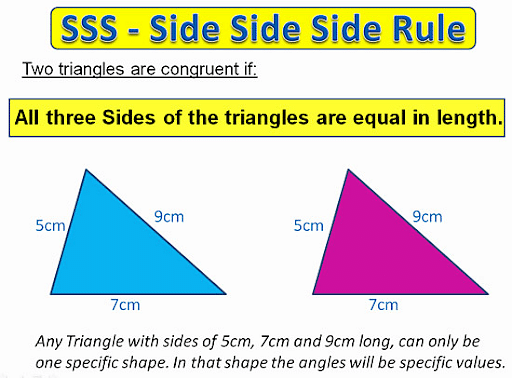
SSS Congruency Theorem
We construct SSS congruent triangles when measures of all three sides are given. The materials required are a ruler, a pencil and a compass
Read more: Pythagoras Theorem
Construction of Three-sided Triangle
[Click Here for Sample Questions]
Important properties of triangles to keep in mind before constructing Congruent Triangles:
- The exterior angle of a triangle is equal in measure to the sum of interior opposite angles.
- The total measure of the three angles of a triangle is 180°.
- Sum of the lengths of any two sides of a triangle is greater than the length of the third side.
- In any right-angled triangle, the square of the length of the hypotenuse is equal to the sum of the squares of the lengths of the other two sides.
Read more:
Construction
Example: Construct a triangle ABC, given that AB=6 cm, BC=7 cm and AC=8 cm.
The steps for constructing triangles are:
Step 1: Draw a line segment BC length 7 cm.

Step 2: Point A lies above point b at a distance of 6 cm. Take the compass and place it on point B, as its centre. Draw the arc of 6 cm above point B. Point A lies somewhere on it.

Step 3: Now with point C as the centre, make the arc at the radius of 8 cm. This arc should intersect the previous arc.

Step 4: The intersection point between both the arcs is Point A. Mark it as A.

Step 5: Join AB and AC. This is the required triangle ABC.

Now construct another triangle PQR such that PQ = 6 cm, BC= 7 cm and AC= 8 cm in the same way shown above. Take the cut out of this triangle and place it on Triangle ABC. We observe that both the triangles coincide. They were constructed when all the sides were given.
Here, the three sides of a triangle are equal to the three sides of another triangle. Therefore, both the triangles are congruent.
Note: For constructing SSS criterion triangles, the sum of the length of any two sides must be greater than the length of the third side.
Read more:
Things to Remember
- Congruent triangles are the triangles in which all sides and their corresponding angles are congruent.
- There are four criteria to prove whether the triangles are congruent.
- SSS Criterion states that two triangles are congruent if three sides of one triangle are equal to the three sides of another triangle.
- Triangles can be constructed through a ruler and a compass if they follow any congruent criteria.
Read more:
Sample Questions
Ques: Are the following two triangles congruent? Prove with the help of a criterion. (2 marks)
Ans: In the
∆ABC and ∆PQR,AC = PR
AB = RQ
BC = PQ
Hence following the SSS criterion, both the triangles are congruent.

Ques: Construct two equilateral triangles sides, 5 cm and 6 cm. Are these two congruent? Why or why not? (2 marks)
Ans: The triangles,
∆ABC and ∆PQR, are not congruent because they do not fulfil the SSS Criterion. The equilateral triangle has equal sides, but to fulfil this criterion that the corresponding sides should be equal.
Ques: In the adjoining figure, apply the SSS congruence condition and state the result in the symbolic form. (2 marks)
Ans: In
∆LNM and ∆OQP
LN = OQ = 3 cm
NM = PQ = 5cm
LM = PO = 8.5cm
Therefore,
∆LNM ≅ ∆OQP, by Side Side Side (SSS) congruence conditionQues: Draw ? XYZ in which XY = 5.5 cm, YZ = 4.5 cm and XZ = 5.5 cm. What type of triangle is this? (2 marks)
Ans:

This is an isosceles triangle where XY= XZ = 5.5 cm.
Ques: Construct PQR in which PQ = 2.5 cm, QR = 6 cm and PR = 6.5 cm. Measure ∠Q. (2 marks)
Ans: ∠Q = 90°, hence
∆PQR is a right-angled triangle.
Ques: By Side Side Side congruence prove that 'Diagonal of the rhombus bisects each other at right angles’. (5 marks)
Ans: Diagonal BD and AC of the rhombus ABCD intersect each other at E.

It is required to prove that CD ⊥ AB and DE = EB and CE = EA.
Proof: ABCD is a rhombus.
Therefore, ABCD is a parallelogram.
Therefore, DE = EB and CE = EA.
In AED and CED; AD = CD, [Since, sides of a rhombus are equal] Side ED is common
AE = EC, [Since diagonal of a parallelogram bisects each other]
Therefore, AED ≅ CED, [by SSS congruence condition]
But, ∠AED + ∠CED = 2 right angle
Therefore, 2∠AED = 2 right angle
or, ∠AED = 1 right. angle
Therefore, CD ⊥ AB
i.e., CD ⊥ AB (Proved)
[Since diagonals of a square are perpendicular to each other]
Ques: If the opposite sides of a quadrilateral are equal, prove that the quadrilateral will be a parallelogram. (5 marks)
Ans: PQRS is a parallelogram quadrilateral, whose sides PQ = SR and PS = QR. It is required to prove that LMNO is a parallelogram.

Construction: Diagonal PR is drawn.
Proof: In PSR and PQR,
PQ = SR and PS = QR, [By hypothesis] PR is the common side.
Therefore, PSR ≅ PQR, [by Side Side Side congruence condition]
Therefore, ∠PRS = ∠QPR, [Corresponding angles of congruent triangles] Since PR cuts SR and PQ and both alternate angles are equal.
Therefore, SR || PQ
Again, ∠PRQ = ∠SPR [Corresponding angles of congruent triangles] But PR cuts PS and QR, and the alternate angles are equal.
Therefore, PS || QR
Therefore, In quadrilateral PQRS,
SR || PQ and
PS || QR.
Therefore, PQRS is a parallelogram. [Proved]
Read More:



Comments