



Exams Prep Master
Van Der Waals equation is derived from the ideal gas equation which states that there are some point masses present in the molecule or the gases which undergo perfectly elastic collisions inside the gases. The real gas equation is unable to explain the real gas behaviour. That's why to derive the physical state of gas the Van der Waals equation is developed.
| Table of Content 1.Derivation from Ideal Gas Behaviour 2.Van der Waals Equation for Real Gases 3.Van der Waals Derivation for one mole gas 4.Units of Van der Waals equation |
The Van der Waals equation tells about the molecular sizes as well as the molecular forces between the gases which can be attractive or repulsive.
The Van der Waals equation is also known as the equation of state.
Deviation from Ideal Gas Behaviour
Real gases
- The real gases do not follow the ideal gas equation in all conditions of pressure as well as temperature.
- Deviation of an ideal gas behaviour with respect to the pressure applied in the gas can be studied by plotting a graph between the pressure Vs Volume curve at the constant temperature which is known as Boyle's law.
Compressibility factor (Z):
Z: PV/nRT
Where P: Pressure applied to the gas
V: Volume at a constant temperature
n: Number of moles
R: Universal Gas Constant
T: Temperature
For ideal gases, the value of the compressibility factor is one (z = 1) and for real gases, it is not equal to one ( z ≠ 1).
If the value of Z is greater than one, the real gases show positive deviation (z > 1) from Ideal Behavior whereas if Z is less than one, it shows negative deviation (z < 1) from the ideal gas behaviour.
Van der Waals Equation for Real Gases
- There is no force of attraction present in between the gas molecules. So correction should be made in the pressure ( P + a/V²).
- The volume acquired by the gas molecule is negligible as compared to the total volume of the gas molecule. So, correction should be made in the Volume ( V - nb)
Where, a and b are known as the Van der Waals gas constant.
From the above two points, we derived the Van der Waals equation is given below
( P + a/V²) ( V - nb) = RT
So, for the n mole of a gas, the equation is written as
( P + an²/V²) ( V - nb) = nRT
where, the van der waals constant
a: the magnitude of the intermolecular force of attraction between the gas particles and
b: the effective size of the gas molecules.
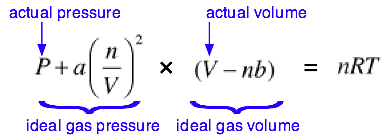
| (P + an²/V²) ( V - nb) = nRT (P + an²/V²): Ideal gas Pressure (V - nb) : Ideal gas Volume where, P: Measure Pressure V: Measure Volume T: Temperature n: Number of moles an²/V²: correction factor of intermolecular forces nb: correction factor of molecular size |
Van der Waals Derivation for One Mole Gas
Let the one mole of gas be composed of non-interacting point particles. Now, according to the law of the ideal gas equation,
PVm = RT
Consider the impact of the limited volume of the particles to decrease the accessible empty space in which the particles are available that can be free to move, here V will be replaced by the co volume 'b' (V - b), where b is known as the excluded volume or co volume
Then,
P (Vm - b) = RT
or,
P = RT/(Vm - b)
Now, let us consider the attractive forces between the particles. The Van der Waals assumption was:
The total net force acts on the surface area of the molecule, pulling it into the container, is directly proportional to the number density given by,
C = Na/ Vm
Additionally, the force between the walls is reduced by a factor relative to the square of the density, and the pressure (force per unit area) is decreased by
a' C² = a' (Na/ Vm)²0 = a/V²m
So, the net pressure become
P = RT/(Vm-b) - a/V²m
Or, (P + a/V²) ( V - b) = nRT
After writing n for the number of moles and nVm equal to V, the equation will result in the second form of the equation given above,
(P + an²/V²) ( V - nb) = nRT
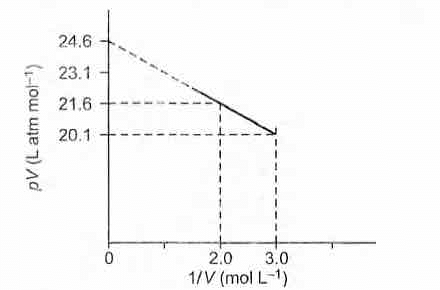
Units of Van der Waals equation Constants
a: atm lit² mol-²
b: litre mol-¹
Compressibility factor & Van der Waals Equation
At low Pressure
| (P + a/V²) ( V - b) = RT here, b can be neglected in comparison to the volume V, so the equation (P + a/V²) ( V) = RT PV + a/V= RT PV = RT - a/V Now, Z = PV/RT = 1 - a/VRT < 1 The results into (-ve) deviation |
At High Pressure
| (P + a/V² ) ( V - b) = RT here, a/V² can be neglected in comparison to the Pressure P, so the equation (P) ( V - b) = RT PV - Pb = RT PV = RT + Pb Now, Z = PV/RT = 1 + Pb/RT > 1 The results into (+ve) deviation |
At Very Low Pressure
| (P + a/V²) ( V - b) = RT here, V is so large so that b and a/V² can be neglected in comparison to the Volume, so the equation PV = RT Now, Z = PV/RT = 1 |
Cubic Equation in Volume
| The Van der Waals equation can be written as (P + a/V²) ( V - b) = RT When we arrange the equation in terms of volume it results in a cubic equation of volume which is written as V³ - (b + RT/P)V² + (a/P) V - ab/P = 0 This cubic equation of volume gives three different volumes which are useful in calculating the volume at and below the critical temperatures. |
Merits and Demerits of Van der Waals Gas Equation
Merits
- The Van der Waals equation can analyse the behaviour of ideal gas much more accurately than the ideal gas equation.
- This equation is also valid for fluids.
- The cubic equation of volume gives three different volumes which can be used in calculating the volume at and below the critical temperature of the gas.
Demerits
- This equation can give accurate results of real gases, above the critical temperature.
- The values below the critical temperature are also accepted in the equation.
- During the transition of the gases, the equation fails to give any answer.
Recommended Video:
Points to Remember
- As per the latest syllabus as well as the exam pattern, around 3 to 5 marks questions will be asked from this topic.
- Most of the questions asked in this topic are to derive the Van der Waals equation, which is mostly considered five marks in the exam.
- The intermolecular forces are negligible whenever the real gases show ideal gas behaviour at a constant temperature. The real gases show ideal gas behaviour when the measured pressure tends to zero. At low pressure, all gases show Z: 1.
- The gases show the behaviour of ideal gas at whatever the point of the volume occupied by the gas is so large that the occupied volume of the molecule can be neglected i.e. at low pressure.
- At low pressure and high temperature, the real gases show ideal gas behaviour.
Sample Questions
Ques. What is the use of the van der Waal equation? (2 marks)
Ans. In the ideal gas law, by adding the corrections of interparticle attractions and the particle volumes, we can derive a new equation that more accurately determines the real gas behaviour. This equation is known as the van der Waals equation which is used to calculate the properties of gas under nonideal conditions.
Ques. An ideal gas occupies a volume of 4 m³ at a pressure of 3 × 10⁶ Pascal. What is the energy of the gas? (2 marks)
Ans. For an ideal gas, the internal energy, E = 3/2 nRT
= 3/2 PV. (PV = nRT)
Substituting the given values, we get
= 3/2 × 3 × 106 × 4
= 18 × 106 J.
Ques. What is a and b in the van der Waals equation? (3 marks)
Ans. In the equation,
( P + an²/V²) ( V - nb) = nRT
The constants a and b are known as the constants of the Van der Waals constant. The constant 'a' gives a measure of the average attraction of the molecules and the constant 'b' in the equation represents the volume occupied by the gas molecules.
Ques. Is the van der Waals equation accurate? (3 marks)
Ans. The Van der Waals equation does not provide very precise predictions on the properties of the substances over their whole range, however, it demonstrates the important differences between real substances and perfect gases.
Ques. What are the units of A and B in the Van der Waals equation? (2 marks)
Ans. The magnitude of a represents the strength of the intermolecular force of attraction and it has units of atm lit² mol-².
Factor b refers to the volume occupied by the molecular gas. The unit of b is litre mol-¹.
Ques. How do you find moles in the van der Waals equation? (2 marks)
Ans. The number of moles of gases can be calculated using the ideal gas law and then the value of PV/nT for the equation of state will get calculated in comparison to the gas constant R.
Ques. What is the difference between the law of ideal gas and van der Waals gas equation of state? (2 marks)
Ans. The difference between the ideal gas law and the van der Waals equation is that the ideal gas law is used for only ideal gases whereas the van der Waals equation of state can be used for the calculation of both ideal gas and real gases.
Ques. Can the van der Waals equation be negative? (2 marks)
Ans. No, as the constant a in the equation only describes attractive forces and the constant b describes repulsive forces. So by the definition, we can say that the value can not be negative.
Ques. What is meant by ideal gas law? (3 marks)
Ans. The ideal gas law, which is also referred to as a general gas equation, can be defined as the equation of a state of a hypothetical ideal gas. The law is used to examine the behaviour of gases in various situations but it also has several limitations. This law does not provide any explanation on whether a gas heats or cools during the process of expansion or compression. Most of the ideal gases do not cause any variation in temperature except for some of them.
Ques. What are the merits and demerits of Van der Waals equation? (4 marks)
Ans. Merits
- The Van der Waals equation can analyse the behaviour of ideal gas much more accurately than the ideal gas equation.
- This equation is also valid for fluids.
- The cubic equation of volume gives three different volumes which can be used in calculating the volume at and below the critical temperature of the gas.
Demerits
- This equation can give accurate results of real gases, above the critical temperature.
- The values below the critical temperature are also accepted in the equation.
- During the transition of the gases, the equation fails to give any answer.



Comments