



Content Curator
Radius of curvature is the reciprocal of a curve at a mentioned point. A spherometer is used to determine the radius of curvature. The aim of a spherometer is to measure the curvature of a spherical surface so it can be convex or concave by using a spherometer.
Radius of Curvature
[Click Here for Sample Questions]
In mathematics, the formula for Radius of curvature is given as-
\(R=\frac{l^2}{6h} + \frac{h}{2}\)\(\)
Where h= height up to which the spherical surface has bent.
l= leg length of the spherometer (Leg length is the average length of the leg calculated using a scale.)
r= radius of the curvature
Also Read: Surface Energy
Few Common Terms to Understand
[Click Here for Sample Questions]
Before getting into the depths of the experiment few terms are enlisted herein:-
- Least count- The least count means the distance measured by the spherometer. The Least count Formula is:
\(LC = \frac{Pitch}{No. of Division on the circular scale}\)
- Pitch: Pitch is the distance covered between two points of the screw. It means by giving one rotation, only one thread is advanced in the screw. So, if only one thread is advanced, then the distance covered in the main scale is the pitch. The division covered in the circular scale is 100 (0 to 90).
Now, Let's take an example to understand the process to calculate Radius of Curvature.
Assume h1 as 1, h2 as 2, and h3 as 3, and the length of the three sides of the triangular surface is 3.2, 3.2, and 3.1. Calculate the Radius of the spherical surface using a tabular format.
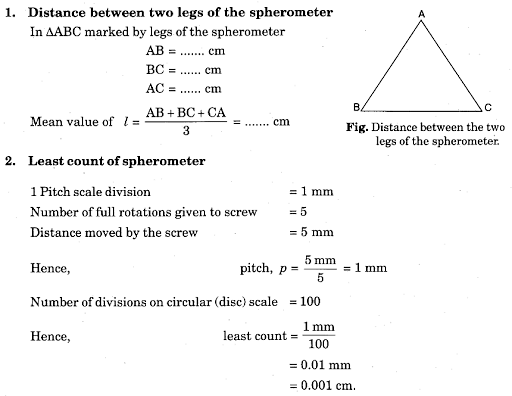
It can be solved in following steps:
- By Calculating Imean which is given as: \(I(Mean)= \frac{AB+BC+CA}{3}\)
- No once Imean is known, now we have to calculate the least count
| Note:
|
The measurement should be taken using a spherometer.
- Sagitta Table (h)
| Sr. No | Circular Disc Scale Reading | No. of Complete rotations (n1) | No of Readings in Incomplete Rotations x= (a-b) Or (100+a)-b | Total Reading h= n1*p+x*(LC) (in mm) | |
| On Convex Suface- Initial (a) | On plane glass sheet Final (b) | ||||
| 1 2 3 | h1= 1 h2= 2 h3= 3 | ||||
Hence,
- If the value of h was not given in the question, then find out every value of h.
- Mean of h= [h1+h2+h3/3]= [1+2+3/3]= 2mm
- Mean of l= [(3.2+3.2+3.1)/3] = 3.16cm
Therefore, R= {(3.1)2/6*2}+{2/2}= 1.80 cm.
What is a Spherometer?
[Click Here for Sample Questions]
It is a simple three-legged scientific device that determines the radius of curvature. The spherometer has a big middle leg. The middle big leg has a rotating screw that is circulated to coincide the edge with zero.
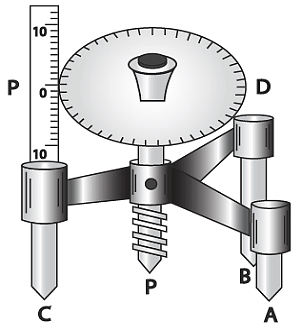
Spherometer
Experiment to Determine the Procedure of Calculating Radius of Curvature Using Spherometer
[Click Here for Sample Questions]
The radius of the curvature can be determined simply through a small experiment. The apparatus required is the spherometer and the watch glass. The glass is required because it has a convex or a concave spherical surface.
Steps Involved
- Calculate the least count of the spherometer.
- Use the circular and vertical scale together in a spherometer.
- Give 5 rotations to the circular scale and mark the reading from the circular scale. Edge is the reference point. (Give rotation in such a manner that 53 points are completed)
- Circulate the screw and give 5 rotations.
- You can give clockwise or anti-clockwise rotation as the only thing that gets calculated is the distance that is covered in the main scale.
Observation of the Experiment Presented in Tabular Format
[Click Here for Sample Questions]
Using the above data the below-mentioned table is presented to determine the observations.
The process of taking the observations is as follows:
- Take a watch glass and the procedure of convex and concave spherical surfaces are different.
- For such a procedure, one must consider at least 10 observations to minimize the error. Herein, only one observation is considered to explain the procedure. Similarly, 9 more observations to consider to complete the process.
- Observation in a convex spherical surface:
- Keep the watch-glass on the convex surface side and then take the spherometer and keep it above the watch-glass.
- Give rotation to the circular scale till the middle leg of the spherometer touches the top surface of the convex spherical surface of the watch-glass.
- Further, to understand whether the same is touching the glass, take a small piece of paper to check the same.
- If all the three legs start rotating, it means the middle leg has touched the above surface.
- If the small paper passes from between the surface of the glass and the middle leg of the spherometer, it means the middle leg has not touched the glass yet. So, place it properly and give back rotations.
- Give the exact position where the middle leg touches the surface.
- Then, take the reading from the circular scale. And the edge of the main scale is the reference.
- Now, suppose the main scale is coinciding with 21 points of the circular scale, then 21 is the initial circular scale reading.
- Further, observe NCR. Take the spherometer and keep it on a flat surface.
- A small gap lies between the middle leg of the spherometer and the flat surface. You can use a small piece of paper to check the same.
- Now, rotate the circular scale till the middle leg touches the upper surface of the flat area.
- Previously, it was noted that the reference point was 21. So, taking that as the base, rotate the spherometer till the middle leg touches the surface.
- After the number of rotations gets completed and the middle leg touches the surface, the exact point is determined. (where the paper does not pass from between the middle leg and the surface of the flat).
- Then, note the reading from the circular scale edge. Suppose the reading is 4.
- Now, INF calculation
if I > F, then INF is (I - F)
Where I = Initial Circular scale reading
F= Final Circular Scale Reading
And if I < F, then add the number of divisions in the circular scale i.e. 100 and I, and deduct F
i.e. [(100+I)-F]
- PSR= Pitch* Number of Complete rotation
- CSR= INF * List Counts
| Sl no | ICSR | NCR | FCSR | INF | PSR (P*N) in cm | CSR (INR*List Counts) in cm | Total (PSR+CSR) |
| 1 | 21 | 1 | 4 | 17 | 0.1 | 0.17 | 0.117 |
Therefore, in the above table,
- ICSR (assumed reading)= 21
- NCR (assumed reading)= 1
- FCSR (assumed reading)= 4
- INF equals= (21-4)= 17
- PSR= (0.1cm*1)= 0.1 cm
Where, pitch (calculated above) is 0.1
CSR= (17 * 0.001cm)= 0.17cm
Where, 17 is the INF
0.001 is the least count (calculated above)
- Total= (O.1+0.17)= 0.117cm
- Mean is also calculated as at least 10 observations are taken so that less number of errors of minimum error is committed.
In such a manner the measurement of the quantity (i.e. the height up to which the spherometer was raised.)
4. Observation in a Concave Spherical Surface
For a concave spherical surface, the same process will be followed but in a reverse manner.
Reverse Procedure:
- First, take the Spherometer and place it on a plain surface.
- Give rotation to the circular scale till it touches the surface.
- Check the difference gap with a piece of paper in a similar manner followed in a convex surface and adjust it to get the edge reading.
- Then, put the spherometer in its current position on the glass watch and observe the gap.
- Adjust the rotations in such a way so that the gap diminishes and the middle leg touches the glass surface.
- Simultaneously, note the number of complete rotations and the FCSR.
Also Read: Bernoulli’s principle
Things to Remember
- Always use a small piece of paper to determine the gap between the middle leg of the spherometer and the surface.
- Always use at least 10 figures to determine the observations.
- Rotate the screw smoothly. If any obstacle while rotating, then remove such obstruction.
- Select glass watches of the same sizes.
Sample Questions
Ques. How can the Accuracy of the Spherometer increase? (3 marks)
Ans. The accuracy of the Spherometer depends on the size of the least count. If the least is small, the chances of accuracy are more. If the divisions of the circular scale are adjusted, then the accuracy level can be adjusted too.
Ques. What is the Lens Maker Formula? (3 marks)
Ans. The focal length of the glass is determined by the below-mentioned formula.
1/f= (n2/n1-1)(1/r1-1/r2)
Ques. How does the error arise while calculating the least count? Note any 3 of them. (3 marks)
Ans. the error can arise due to the following reasons:
- Friction and obstruction in the screw while rotating.
- Back-lash error in the spherometer.
- The dimensions of the glass are of different sizes.
Ques. Why was the height of the spherometer measured? (3 marks)
Ans. To determine the extent the height was curved in the glass is measured using a spherometer. And the combinations of more than 10 are used to determine the correct results using the average of the observations or mean. Mean is calculated so that fewer number errors of minimum errors are committed.
Ques. Define the principle of the Spherometer. (3 marks)
Ans. The principle of micrometer screw is applied on the Spherometer. The breadth of the glass is determined from the same. The readings are taken from the edge of the watch glass or any other glass material to determine the radius of curvature of the spherical surface.
Ques. Explain zero error in Spherometer. (5 marks)
Ans. when the readings are equal in the plain surface, then the zero error possibilities arises. The Spherometer will never have zero error. The observation is the difference between the initial reading and the final reading. So, the difference must be there. If there is similar reading, then perform the procedure again to determine the difference. The difference helps in calculating the other figures which will finally lead to the final measurement of the radius of curvature.
Ques. Define Backlash Error. (3 marks)
Ans. When the spherometer is in motion the backlash error arises. The spherometer is moved back and forth sometimes which creates a gap between the gear. When the mechanism loses the motion, the gap in the gear is created that finally creates a backlash error.
Ques. Explain the Parts of the Spherometer in detail. (5 marks)
Ans.
- It has three outer legs which is the radius of the spherometer. The legs are adjusted accordingly. The smaller surface is adjusted with the three outer legs.
- It has a middle leg that is moved in different directions to calculate the radius of curvature.
- It has a circular scale placed horizontally and the main scale that is placed vertically. When the circular scale coincides with the main scale, determine the radius measurement of the curvature by noting each reading.
- There is a screw on the top of the middle leg by means of which the rotations are given effect.
- The middle leg is adjusted until the three outer legs touch the desired surface and the readings on the main scale are taken.
Also Read:



Comments