



Content Curator
Difference of Cubes is a polynomial expression where the difference of two perfect cubes is expressed as a product of a binomial and a trinomial. Difference of two cubes can be factored into a product of a binomial. This can be expressed as x3+y3=(x+y)(x2−xy+y2) and x3−y3=(x−y)(x2+xy+y2). Difference of cubes formula can be used to factorize binomials of cubes. It is also known as a3 - b3 formula.
| Table of Content |
Key Terms: Cubes, polynomial, binomial, trinomial, difference, factor, product
Difference of Cubes
[Click Here for Sample Questions]
The cubic polynomial expression showing difference of cubes will have
- Two terms
- The terms will be separated by a negative sign
- Each term will be a perfect cube
- The difference of the cubes will be factored into a binomial x trinomial
- The binomial will be cube root of first term minus the cube root of the second term
- The trinomial will be the square of the first term plus the product of the two terms plus the square of the second term.

Difference of Cubes
Let’s say the two terms are a and b, the difference of cubes will be written as
a3 – b3
When we factor the above binomial expression, we will get two factors. The first factor will be a binomial and the second factor will be a trinomial and the equation will be as follows:
a3 – b3 = (a – b) (a2 + ab + b2)
So, the difference of two cubes is equal to the difference of their cube roots i.e. (a - b) times a trinomial (a2 + ab + b2), which contains the squares of the cube roots i.e. a2 and b2 and the opposite of the product of the cube roots i.e. (+ab).
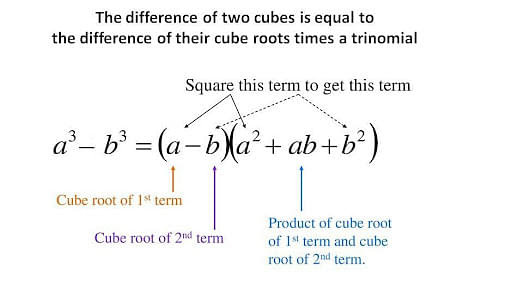
Example of Difference of Cubes
To remember the signs of the factorization use the mnemonic "SOAP",
S - Same sign" as in the middle of the original expression
O- Opposite sign
AP - Always Positive
a3 – b3= (a[Same sign]b)(a2 [Opposite sign] ab [Always Positive] b2)
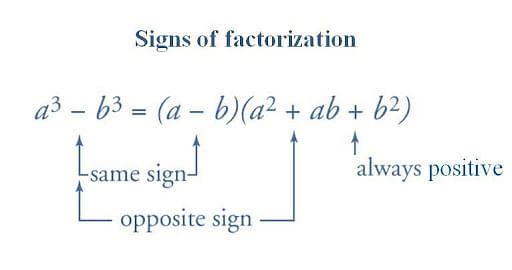
Signs of Factorization: Example
Geometrical Representation of Difference of Cubes
[Click Here for Sample Questions]
The factorization of the difference of two cubes can be visualized geometrically as described follows:
Take two cubes, one with sides of length A and other with sides of length B as shown in the image below.

The expression A3- B3 can be viewed as the difference in volume between two cubes is equal to the remaining volume of the cube with side A after the other cube with side B has been cut out and removed from it.

Note that each of the three highlighted edges has length A-B.

This shape can be cut into three rectangular prisms. Each prism has a side of length A-B.

Now, putting together the prisms in such a way that the entire shape has a depth of A-B.

Note that the volume of this object formed by putting the prisms together is (A-B) (A2+AB+B2)
We can now clearly visualize the expression of difference of cubes as seen in the image below:

Things to Remember
- In case of difference of cubes,
- The first factor on the right side of the equation will be a binomial with a negative middle sign.
- The second factor will be a trinomial and it will always have a positive middle sign which is opposite to the middle sign of the expression on the left side of the equation.
- To recognize the pattern of the difference of two cubes,
- Check whether the distribution has a binomial times a trinomial.
- The binomial being the difference between cube roots of the two terms representing cubes.
- The trinomial will contain the squares of the cube roots of the two terms and the opposite of their product.
Sample Questions
Ques. Prove that (a – b) (a2 + ab + b2) =a3 – b3 . (3 Marks)
Ans. We start with the left hand side of the given expression, i.e.
(a – b) (a2 + ab + b2)
Distributing (a-b) over the trinomial we get -
a (a2 + ab + b2) - b (a2 + ab + b2)
= (a3 + a2b + ab2) - (a2b+ ab2 + b3)
= a3 + a2b + ab2- a2b - ab2 - b3
= a3 + (a2b - a2b) + (ab2 - ab2)- b3
= a3 - b3
Hence proved that (a – b) (a2 + ab + b2) =a3 – b3
Ques. The expression x3-27 has two factors. If one factor is (x-3) then what will be the other factor?
a.(x3-3x+27)
b.(x2+3x+9)
c.(x2+3x-9)
d.(x2-9x+27)
e.(x2-3x+9) (3 Marks)
Ans. Option B
In the given binomial expression, there are two perfect cubes i.e. x3 and 33
As per the formula of difference of cubes, the first factor will be a binomial and the second factor will be a trinomial.
a3 – b3 = (a – b) (a2 + ab + b2)
The first factor has already been given here as the binomial (x-3)
To get the second factor we will replace a = x and b = 3 in the trinomial expression
(a2 + ab + b2)
So the required trinomial is (x2 + 3x + 32) and the answer is Option B) (x2 + 3x + 9)
Ques. Express (2-ab)(4+2ab+a2b2) as difference of cubes. (3 Marks)
Ans. The expression (2-ab)(4+2ab+a2b2) consists of a binomial and a trinomial and their product represents the difference of two perfect cubes.
The first factor, binomial (2-ab) consists of a number (2) and two variables (a,b)
The square of 2 = 4 and square of ab = a2b2
The cube of 2 = 8 and cube of ab = a3b3
So, (2-ab)(4+2ab+a2b2) = 23 - a3b3
Ques. Factorize the expression 27x3- 125 by using the difference of cubes formula. (3 Marks)
Ans. As the two terms of the given expression 27x3 - 125 are perfect cubes
So, we get 27x3 - 125 = (3x)3 - 53
Now, substitute a = 3x and b = 5 in the formula of the difference of cubes.
a3 - b3 = (a - b) (a2 + ab + b2)
(3x)3 − 53 = (3x − 5)((3x)2 + (3x)(5) + 52) = (3x − 5)(9x2 + 15x + 25)
The answer is 27x3 - 125 = (3x - 5)(9x2 + 15x + 25).
Ques. Find the value of 1083 - 83 by using the difference of cubes formula. (3 Marks)
Ans. Let us assume that a = 108 and b = 8.
We will substitute these in the formula of difference of cubes.
a3 - b3 = (a - b) (a2 + ab + b2)
1083−83 = (108 − 8)(1082 + (108)(8) + 82) = (100)(11664 + 864 + 64) = (100)(12592) = 1259200
Answer is 1083 - 83 = 1,259,200.
Ques. Factorise 8x6 - 125. (4 Marks)
Ans. 8x6 and 125 are perfect cubes, so we can apply the rule of difference of cubes to this polynomial expression.
To get the first factor for the difference of cubes, we will find the cube roots of the two terms of the given expression.
cube root of 8x6 is 2x2
cube root of 125 is 5
As the first factor is the difference of the cube roots, we get the binomial is (2x2 - 5)
Now, we shall derive the trinomial using the binomial factor we just found.
To get the first term of the trinomial, square the first term 2x2 to get 4x4
To get the middle term of the trinomial, multiply 2x2 and 5 and change the sign from negative to positive to get +10x2
To get the third term of the trinomial, square the second term 5 to get 25
Putting these three terms together, the second factor trinomial is (4x4 + 10x2 + 25)
So, the answer will be (2x - 5) (4x4 + 10x2 + 25)
Ques. Factorize 250x4 - 128x. (4 Marks)
Ans. In the given expression, neither 250x4 nor 128x are perfect cubes
If we factor out the common factor 2x from this expression
this gives us 2x(125x3 - 64)
Now both 125x3 and 64 are perfect cubes
the cube root of 125x3 is 5x , and the cube root of 64 is 4
so our binomial is (5x - 4)
Now to get the trinomial we square 5x to get 25x2 as our first term
we change the sign to + and multiply 5x and 4 to get +20x as the middle term
we square 4 to get 16 as our third term
so the trinomial is (25x2 + 20x + 16) and the answer is 2x(5x - 4)(25x2 + 20x + 16)
Ques. Factorize 40y3 – 625z3. (3 Marks)
Ans. To convert the given expression into a polynomial having perfect cubes we need to factor out the common factor from the two given terms
So, 40y3 – 625z3 = 5 (8y3 – 125z3)
Expressing the binomial as difference of cubes we get
8y3– 125z3 = (2y)3 - (5z)3
Applying the rule for difference of cubes, we can factorize this binomial as-
40y3 – 625z3 = 5 (8y3 – 125z3) = 5 [(2y)3 - (5z)3]
= 5 [ (2y-5z) ((2y)2 + (2y)(5z) + (5z)2)]
= 5 [ (2y-5z) (4y2+10yz+25z2)]
Ques. Factorize - 1- 216a3b3. (2 Marks)
Ans. In the given expression, 1 = (1)(1)(1) = 13 and 216 = 63
1 - 216a3b3
= (1)3 - (6ab)3
= (1 - 6ab) [(1)2 + (1)(6ab) + (6ab)2]
= (1 - 6ab) (1+6ab+36a2b2)
Also Read:



Comments