



Content Curator
The Energy Level, known popularly as the electron shell, is the orbit with electrons that surround the nucleus of an atom. As per definition, the ascending order arrangement of energies in an orbital is called Energy Level Diagram.
| Table of Content |
Read Also: Class 11 Structure of Atom
The alignment around the atom occurs in consecutive shells, named as L shell, M shell, and so on. The closest shell is called the K shell. The number of electrons in each shell is fixed. The number of electrons that each shell can hold can be calculated through a general formula = 2(n2). The nucleus of the atom attracts the electrons, which later occupy the outer shells; meanwhile, the other electrons are being occupied by the inner shells. At its lowest energy level, the atom and its electron pivot to a ground state. As their excitement increases, they continue to rise up to a higher energy level.

Properties of Energy Level Diagram
- The energies of the subshell of a particular shell are not equal. For instance, 2p and 2s have distinct energies.
- The energy of a sub-shell depends on the value of I. The lower value of I will result in the lower energy of the subshell.
- When the n retains the same value, the difference between the energies of p and s subshell is small, whereas the difference between p and d subshell is comparatively large.
- With the increase in the value of n, the subshell may experience higher energy than any higher shell above it.
Working of Energy Level Diagram
[Click Here for Sample Questions]
In the long sequence of events, the emission of the light and its subsequence absorption occurs at the same wavelength. This phenomenon is called the Grotrian Diagram, named after the 20th-century German astronomer, Walter Grotrian. With reference to the Grotrian diagram, here's how the Energy Level Diagram works:
- An atom or molecule colloids or absorbs light with another ion or atom and generates enough energy for it to move to a higher energy state from a lower energy state.
- An atom supposedly excited by the collision or absorption initiates this emission.

Blank Energy Level Diagram
Ways to Represent Electrons in an Energy Level Diagram
[Click Here for Sample Questions]
An energy level diagram is used by chemists to seek information regarding these things:
- Anticipation of the type of bonding taking place with specific elements and the electrons being used by the atom.
- Demonstration of the indistinguishable ways in which the definite elements behave.
Read More:-
Filling Up of the Orbitals in an Atom
[Click Here for Sample Questions]
The electrons are filled into the orbitals of distinct atoms because of the following principles:
- Aufbau Principle
The Aufbau Principle states that depending on the increasing order of energies, the electrons occupy the energy orbital. The First electrons target the lowest energy orbital and later ascend into higher energy orbitals once the lowest arena is filled. The Aufbau Principle works when the atoms are in their ground state.
The Dependence of Energy: As per the Aufbau Principle, the sum of the values of azimuthal quantum number and principal quantum number (n) is directly impacted by the energy of an orbital.
Here's how the increase in orbital energy and its effect on the filling of the orbital looks like:
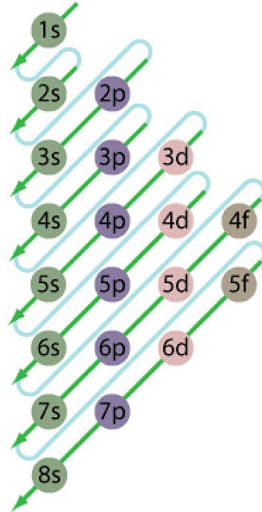
The (n+1) rule:
The (n+1) rule states that when an atom is neutral and isolated, its low energy is directly proportional to the lower value of an orbital.
However, if the orbitals have the same value, the lowest energy of the orbital (n+1) will be the one with the lower value of n.
| Relative Energy | Type of orbitals | Values of n | Values of I | Values of (n +1) |
|---|---|---|---|---|
| Lowest energy | 1s | 1 | 0 | 1 + 0 = 1 |
| Higher energy than 1s orbital | 2s | 2 | 0 | 2 + 0 = 2 |
| 3s orbital (n = 3) with a lower energy than 2p orbital (n = 2) | 2p | 2 | 1 | 2 + 1 = 3 |
| 3s | 3 | 1 | 3 + 1 = 4 |
- Pauli Exclusion Principle
As per the Pauli Exclusion Principle, the maximum orbital capacity of an electron is 2, and they must spin in opposite directions. I.e., one electron must have a clockwise revolution, and the other must have an anticlockwise revolution.
- Hund's Rule of Maximum Multiplicity
As per Hund's rule of maximum multiplicity, the identical electrons in charge repel each other when coincided in the same orbit. To minimize this repulsion, two electrons must be moved as far as possible through the orchestrated placement of degenerate orbitals.
Read More: Quantum Theory of Light
Points to Remember
[Click Here for Sample Questions]
- Energy level diagram is a part of CBSE Class 11 chemistry first term syllabus.
- It carries a total of 12 periods and 5 to 6 marks.
- Atomic radius value: r(n) = n2 x r(1)
- An atomic energy present in the nth level of hydrogen atom: E(n) = -1/n2 x 13.6eV
- The energy value exerted for a particular transition: hv = E = (1/n2low - 1/n2high)13.6eV
- Energy level formula: E = E0/n2
Sample Questions
Ques 1. How is the energy level calculated? (1 mark)
Answer: The energy level of elements is calculated through the organization of periodic tables. Reading the table's columns and rows from left to right, the number of protons increases in the nucleus. The column's elements share similar properties and have the same number of valence electrons.
Ques 2. What is ground state energy? (1 mark)
Answer: The ground state of an electron is the position in which the state of lowest energy has the levels it normally occupies. Each electron has a specific energy associated with it, and the ground state is the placement where the natural state comes to fruition.
Ques 3. In which state does the electron have the highest and the lowest possible energy? (1 mark)
Answer: In the ground state, an electron has the lowest possible energy, whereas the excited state is where an electron gets the highest possible energy.
Ques 4. What does an atom's energy level depend on? (1 mark)
Answer: An atom's energy depends on the number of orbitals it has. The energy levels of an atom determine its properties and its reactivity. At most, two electrons are allocated per orbital. There are layers to the electron, and the outermost energy level of an atom is called valence electron.
Ques 5. What is the significance of an energy level diagram? (1 mark)
Answer: The energy level diagram shows the existing and progressive relative energy levels between the reactants and products. The energy changes occurring through the reactions can be tracked by the energy level diagrams in real-time.
Ques 6. What is the Grotrian Diagram? (2 marks)
Ans. Grotrian Diagram helps in understanding the allowed transition of electrons in between the atom energy levels. It is also known as the term diagram and can be used for both single or multi-electron atoms. The work with the particular selection rules in relation to the alteration in the electronic angular momentum.
Ques 7. State the principles for filling up the orbitals in an atom. (3 marks)
Ans. The three principles for filling up the orbitals in an atom are:
- Aufbau principle - The Aufbau Principle states that depending on the increasing order of energies, the electrons occupy the energy orbital. The First electrons target the lowest energy orbital and later ascend into higher energy orbitals once the lowest arena is filled. The Aufbau Principle works when the atoms are in their ground state.
- Pauli Conclusion Principle - As per the Pauli Exclusion Principle, the maximum orbital capacity of an electron is 2, and they must spin in opposite directions. I.e., one electron must have a clockwise revolution, and the other must have an anticlockwise revolution.
- Hund's Rule of Maximum Multiplicity - As per Hund's rule of maximum multiplicity, the identical electrons in charge repel each other when coincided in the same orbit. To minimize this repulsion, two electrons must be moved as far as possible through the orchestrated placement of degenerate orbitals.
Ques 8. Explain energy level. (1 mark)
Ans. An atom’s electron placed in a specific orbital contains a particular energy which is known as the energy level. When an electron moves from a higher to a lower energy state it starts to emit light.
Ques 9. What can be referred to as an electron shell? (1 mark)
Ans. An electron shell can be referred to as the space surrounding an atom around the atomic nucleus. The electron shell term comes from the Bohr model according to which electron groups move around the nucleus at a particular distance as a result their orbits form shells.
Ques 10. Write the lowest and highest possible energy level of an electron. (1 mark)
Ans. Ground state is referred to as the lowest possible energy level and excited is referred to as the highest energy level.
Ques 11. Name the ray containing the highest energy level. (1 mark)
Ans. Gamma rays can be said to have the highest energy level and a part of which is hazardous to human health.
Read More:-



Comments